SemEval-2016 Task 8: Meaning Representation Parsing
Jonathan May
Information Sciences Institute University of Southern California
Abstract
In this report we summarize the results of the SemEval 2016 Task 8: Meaning Representa-tion Parsing. Participants were asked to gener-ate Abstract Meaning Representation (AMR) (Banarescu et al., 2013) graphs for a set of English sentences in the news and discussion forum domains. Eleven sites submitted valid systems. The availability of state-of-the-art baseline systems was a key factor in lower-ing the bar to entry; many submissions relied on CAMR (Wang et al., 2015b; Wang et al., 2015a) as a baseline system and added exten-sions to it to improve scores. The evaluation set was quite difficult to parse, particularly due to creative approaches to word representation in the web forum portion. The top scoring sys-tems scored 0.62 F1 according to the Smatch (Cai and Knight, 2013) evaluation heuristic. We show some sample sentences along with a comparison of system parses and perform quantitative ablative studies.
1 Introduction
Abstract Meaning Representation (AMR) is a com-pact, readable, whole-sentence semantic annota-tion (Banarescu et al., 2013). It includes entity identification and typing, PropBank semantic roles (Kingsbury and Palmer, 2002), individual entities playing multiple roles, as well as treatments of modality, negation, etc. AMR abstracts in numerous ways, e.g., by assigning the same conceptual struc-ture tofear (v),fear(n), and afraid(adj). Figure 1 gives an example.
With the recent public release of a sizeable cor-pus of English/AMR pairs (LDC2014T12), there has
(f / fear-01 :polarity "-"
:ARG0 ( s / soldier ) :ARG1 ( d / die-01
:ARG1 s ))
The soldier was not afraid of dying. The soldier was not afraid to die.
The soldier did not fear death.
Figure 1: An Abstract Meaning Representation (AMR) with several English renderings. Example
borrowed from Pust et al. (2015).
been substantial interest in creating parsers to re-cover this formalism from plain text. Several parsers were released in the past couple of years (Flanigan et al., 2014; Wang et al., 2015b; Werling et al., 2015; Wang et al., 2015a; Artzi et al., 2015; Pust et al., 2015). This body of work constitutes many diverse and interesting scientific contributions, but it is diffi-cult to adequately determine which parser is numer-ically superior, due to heterogeneous evaluation de-cisions and the lack of a controlled blind evaluation. The purpose of this task, therefore, was to provide a competitive environment in which to determine one winner and award a trophy to said winner.
2 Training Data
LDC released a new corpus of AMRs (LDC2015E86), created as part of the DARPA DEFT program, in August of 2015. The new cor-pus, which was annotated by teams at SDL, LDC, and the University of Colorado, and supervised by Ulf Hermjakob at USC/ISI, is an extension of
vious releases (LDC2014E41 and LDC2014T12). It contains 19,572 sentences (subsuming, in turn, the 18,779 AMRs from LDC2014E41 and the 13,051 AMRs from LDC2014T12), partitioned into training, development, and test splits, from a variety of news and discussion forum sources.
The AMRs in this corpus have changed somewhat from their counterparts in LDC2014E41, consistent with the evolution of the AMR standard. They now contain wikification via the :wiki attribute, they use new (as of July 2015) PropBank framesets that are unified across parts of speech, they have been deepened in a number of ways, and various correc-tions have been applied.
3 Other Resources
We made the following resources available to partic-ipants:
• The aforementioned AMR corpus
(LDC2015E86), which included automati-cally generated AMR-English alignments over tokenized sentences.
• The tokenizer (from Ulf Hermjakob) used to produce the tokenized sentences in the training corpus.
• The AMR specification, used by annotators in producing the AMRs.1
• A deterministic, input-agnostic trivial baseline ‘parser’ courtesy of Ulf Hermjakob.
• The JAMR parser (Flanigan et al., 2014) as a
strong baseline. We provided setup scripts to process the released training data but otherwise provided the parser as is.
• An unsupervised AMR-to-English aligner (Pourdamghani et al., 2014).
• The same Smatch (Cai and Knight, 2013)
scor-ing script used in the evaluation.
• A Python AMR manipulation library, from Nathan Schneider.
1https://github.com/kevincrawfordknight/
amr-guidelines/blob/master/amr.md.
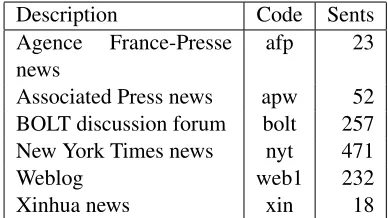
Description Code Sents Agence France-Presse
news
afp 23
Associated Press news apw 52 BOLT discussion forum bolt 257 New York Times news nyt 471
Weblog web1 232
Xinhua news xin 18
Table 1: Split by domain of evaluation data.
System Prec. Rec. F1 Brandeis/cemantix.org/RPI 0.57 0.67 0.62
CLIP@UMD 0.40 0.48 0.44 CMU 0.53 0.61 0.56 CU-NLP 0.58 0.63 0.61 DynamicPower 0.34 0.40 0.37 ICL-HD 0.54 0.67 0.60 M2L 0.54 0.66 0.60 RIGA 0.57 0.68 0.62
[image:2.612.329.523.57.166.2]Meaning Factory 0.46 0.48 0.47 UCL+Sheffield 0.56 0.65 0.60 UofR 0.49 0.51 0.50 Determ. baseline 0.23 0.26 0.24 JAMR baseline 0.43 0.58 0.50 Table 2: Main Results: Mean of five runs of Smatch
2.0.2 with five restarts per run is shown; Standard deviation of F1 was about 0.0002 per system.
4 Evaluation Data
For the specific purposes of this task, DEFT com-missioned and LDC released an additional set of En-glish sentences along with AMR annotations2 that
had not been previously seen. This blind evaluation set consists of 1,053 sentences in a roughly 50/50 discussion forum/newswire split. The distribution of sentences by source is shown in Table 1.
5 Task Definition
by matching instance, attribute, and relation tuples to a reference AMR (See Section 7.2). Since vari-able naming need not be globally consistent, heuris-tic hill-climbing is done to search for the best match in sub-exponential time. A trophy was given to the team with the highest Smatch score under consistent heuristic conditions.3
6 Participants and Results
11 teams participated in the task.4 Their systems
and scores are shown in Table 2. Below are brief de-scriptions of each of the various systems, based on summaries provided by the system authors. Readers are encouraged to consult individual system descrip-tion papers for more details.
6.1 CAMR-based systems
A number of teams made use of the CAMR system from Wang et al. (2015a). These systems proved among the highest-scoring and had little variance from each other in terms of system score.
6.1.1 Brandeis / cemantix.org / RPI (Wang et al., 2016)
This team, the originators of CAMR, started with their existing AMR parser and experimented with three sets of new features: 1) rich named entities, 2) a verbalization list, and 3) semantic role labels. They also used the RPI Wikifier to wikify the con-cepts in the AMR graph.
6.1.2 ICL-HD (Brandt et al., 2016)
This team attempted to improve AMR parsing by exploiting preposition semantic role labeling in-formation retrieved from a multi-layer feed-forward neural network. Prepositional semantics was in-cluded as features into CAMR. The inclusion of the features modified the behavior of CAMR when cre-ating meaning representations triggered by preposi-tional semantics.
6.1.3 RIGA
(Barzdins and Gosko, 2016)
Besides developing a novel character-level neu-ral translation based AMR parser, this team also
3Four random restarts.
4A twelfth team, CUCLEAR, participated but produced in-valid AMRs that could not be scored.
extended the Smatch scoring tool with the C6.0 rule-based classifier to produce a human-readable report on the error patterns frequency observed in the scored AMR graphs. They improved CAMR by adding to it a manually crafted wrapper fixing the identified CAMR parser errors. A small fur-ther gain was achieved by combining the neural and CAMR+wrapper parsers in an ensemble.
6.1.4 M2L
(Puzikov et al., 2016)
This team attempted to improve upon CAMR by using a feed-forward neural network classification algorithm. They also experimented with various ways of enriching CAMR’s feature set. Unlike ICL-HD and RIGA they were not able to benefit from feed-forward neural networks, but were able to ben-efit from feature enhancements.
6.2 Other Approaches
The other teams either improved upon their existing AMR parsers, converted existing semantic parsing tools and pipelines into AMR, or constructed AMR parsers from scratch with novel techniques.
6.2.1 CLIP@UMD (Rao et al., 2016)
This team developed a novel technique for AMR parsing that uses the Learning to Search (L2S) algo-rithm. They decomposed the AMR prediction prob-lem into three probprob-lems—that of predicting the con-cepts, predicting the root, and predicting the rela-tions between the predicted concepts. Using L2S al-lowed them to model the learning of concepts and relations in a unified framework which aims to min-imize the loss over the entire predicted structure, as opposed to minimizing the loss over concepts and relations in two separate stages.
6.2.2 CMU
(Flanigan et al., 2016)
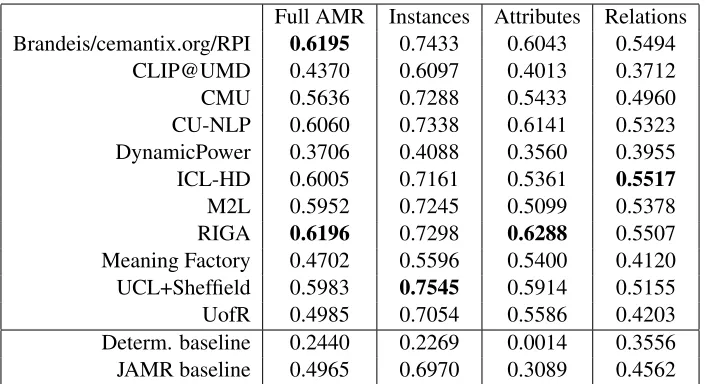
con-Full AMR Instances Attributes Relations Brandeis/cemantix.org/RPI 0.6195 0.7433 0.6043 0.5494
CLIP@UMD 0.4370 0.6097 0.4013 0.3712 CMU 0.5636 0.7288 0.5433 0.4960 CU-NLP 0.6060 0.7338 0.6141 0.5323 DynamicPower 0.3706 0.4088 0.3560 0.3955 ICL-HD 0.6005 0.7161 0.5361 0.5517
M2L 0.5952 0.7245 0.5099 0.5378
RIGA 0.6196 0.7298 0.6288 0.5507
[image:4.612.131.484.56.248.2]Meaning Factory 0.4702 0.5596 0.5400 0.4120 UCL+Sheffield 0.5983 0.7545 0.5914 0.5155 UofR 0.4985 0.7054 0.5586 0.4203 Determ. baseline 0.2440 0.2269 0.0014 0.3556 JAMR baseline 0.4965 0.6970 0.3089 0.4562 Table 3: Ablation of instances, attributes, and relations.
cept identification and relation identification are un-changed from Flanigan et al. (2014).
6.2.3 Dynamic Power (Butler, 2016)
No use was made of the training data provided by the task. Instead, existing components were com-bined to form a pipeline able to take raw sentences as input and output meaning representations. The components are a part-of-speech tagger and parser trained on the Penn Parsed Corpus of Modern British English to produce syntactic parse trees, a seman-tic role labeler, and a named entity recognizer to supplement obtained parse trees with word sense, functional and named entity information. This in-formation is passed into an adapted Tarskian satis-faction relation for a Dynamic Semantics that is used to transform a syntactic parse into a predicate logic based meaning representation, followed by conver-sion to the required Penman notation.
6.2.4 The Meaning Factory (Bjerva et al., 2016)
This team employed an existing open-domain se-mantic parser, Boxer (Curran et al., 2007), which produces semantic representations based on Dis-course Representation Theory. As the meaning rep-resentations produced by Boxer are considerably different from AMRs, the team used a hybrid con-version method to map Boxer’s output to AMRs. This process involves lexical adaptation, a
conver-sion from DRT-representations to AMR, as well as post-processing of the output.
6.2.5 UCL+Sheffield (Goodman et al., 2016)
This team developed a novel transition-based parsing algorithm using exact imitation learning, in which the parser learns a statistical model by imi-tating the actions of an expert on the training data. They used the imitation learning algorithm DAG-GER to improve the performance, and applied an alpha-bound as a simple noise reduction technique.
6.2.6 UofR
(Peng and Gildea, 2016)
6.2.7 CU-NLP
(Foland and Martin, 2016)
This parser does not rely on a syntactic pre-parse, or heavily engineered features, and uses five recur-rent neural networks as the key architectural compo-nents for estimating AMR graph structure.
7 Result Ablations
We conduct several ablations to attempt to empir-ically determine what aspects of the AMR parsing task were more or less difficult for the various sys-tems.
7.1 Impact of Wikification
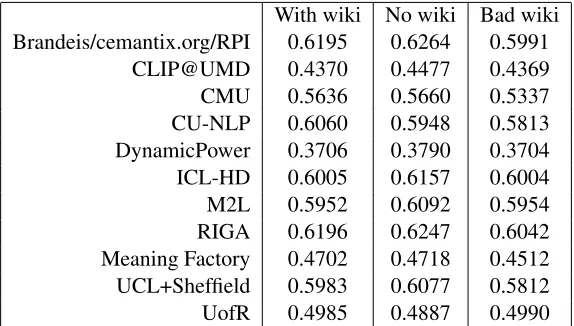
The AMR standard has recently been expanded to include wikification and the data used in this task reflected that expansion. Since this is a rather re-cent change to the standard and requires some kind of global external knowledge of, at a minimum, Wikipedia’s ontology, we suspected performance on :wikiattributes would suffer. To measure the ef-fect of wikification, we performed two ablation ex-periments, the results of which are in Figure 2. In the first (“no wiki”), we removed:wikiattributes and their values from reference and system sets before scoring. In the second (“bad wiki”), we replaced the value of all:wikiattributes with a dummy entry to artificially create systems that did not get any wiki-fication correct.
The “no wiki” ablations show that the inclusion of wikification into the AMR standard had a very small impact on overall system scores. No system’s score changed by more than 0.01 when wikifica-tion was removed, indicating that systems appear to wikify about as well as they handle the rest of AMR’s attributes. The “bad wiki” ablations show performance drop when wikification is corrupted of around 0.02 to 0.03 for six of the systems, and a neg-ligible performance drop for the remaining systems. This result indicates that the systems with a perfor-mance drop are doing a fairly good job at wikifica-tion.
7.2 Performance on different parts of the AMR
In this set of ablations we examine systems’ relative performance on correctly identifyinginstances,
at-tributes, andrelationsof the AMRs. Instances are
the labeled nodes of the AMR. In the example AMR of Figure 1, the instances arefear-01,soldier, anddie-01. To match an instance one must simply match the instance’s label.5
Attributes are labeled string properties of nodes. In the example AMR, there is a polarity attribute attached to thefear-01 instance with a value of “-.” There is also an implicit attribute of “TOP” at-tached to the root node of the graph, with the node’s instance as the attribute value. To match an attribute one must match the attribute’s label and value, and the attribute’s instance must be aligned with the cor-responding instance in the reference graph.
Relations are labeled edges between two in-stances. In the example AMR, the relations(f, s, ARG0), (f, d, ARG1), and (d, s, ARG1) exist. To match a relation, the labeled edge between two nodes of the hypothesis must match the label of the edge between the correspondingly aligned nodes of the reference graph.
It should not be surprising that systems tend to perform best at instance matching and worst at re-lation matching. Note, however, that the best per-forming systems on instances and relations were not the overall best performing systems. Ablation re-sults can be seen in Table 3.
7.3 Performance on different data sources
As discussed in Section 8, less formal sentences, sentences with misspellings, and sentences with non-standard representations of meaning were the hardest to parse. We ablate the results by domain of origin in Table 4. While the strongest-performing systems tended to perform best across ablations, we note that the machine-translated and informal cor-pora were overall the hardest sections to parse.
8 Qualitative Comparison
In this section we examine some of the sentences that the systems found particularly easy or difficult to parse.
8.1 Easiest Sentences
The easiest sentence to parse in the eval corpus was the sentence “I was tempted.”6
It has a gold AMR of:
(t / tempt-01
:ARG1 (i / i))
The mean score for this sentence was 0.977. All submitted systems except one parsed it perfectly.
Another sentence that was quite easy to parse was the sentence “David Cameron is the prime minister of the United Kingdom.”7 Two systems parsed it
perfectly and a third omitted wikification but was otherwise perfect. Figure 3 shows a detailed com-parison of each system’s performance on the sen-tence. In general we see that shorter sentences from the familiar and formal news domain are parsed best by the submitted systems.
8.2 Hardest Sentences
Five sentences were unable to be parsed in any way by any system.8 They are shown below, along with
their AMRs:
E-mail: mward(at)statesman.com. (e / email-address-entity
:value "[email protected]") x
(s / string-entity :value "x") *sigh*
(s / sigh-01) Yes_it_is. (y / yes)
M E D I A A D V I S O R Y (a / advise-01
:ARG1 (m / media))
Data noise was another confounding factor. In the next example,9which had an average score of 0.17,
parsers were confused both by the misspelling (“lie” for “like”) and by the quoted title, which all systems except UCL+Sheffield, tried to parse for meaning.
6nyt eng 20130426 0143.23.
7bolt-eng-DF-200-192446-3811676 0094.5.
8nyt eng 20131029 0042.18, web1-eng-DF-225-195996-5376307 0002.3, web1-eng-DF-233-195474-1207335 0002.1, DF-233-195474-1207335 0010.2, and web1-eng-DF-183-195729-5441907 0001 3.
9bolt-eng-DF-170-181122-8787556 0049 6.
Why not a title lie "School Officials Screw over Rape Victim?" (t / title01 :polarity
-:ARG1-of (r / resemble-01
:ARG2 (t2 / title-01 :wiki "A_Rape_on_Campus" :name (n2 / name :op1 "School" :op2 "Officials"
:op3 "Screw" :op4 "Over" :op5 "Rape" :op6 "Victim"))) :ARG1-of (c / cause-01
:ARG0 (a / amr-unknown)))
We note that all of these difficult sentences are not conceptually hard for humans to parse. Humans have far less difficulty in resolving errors or process-ing non-standard tokenization than do computers.
9 There Can Be Only One?
We intended to award a single trophy to the sin-gle best system, according to the narrow evaluation conditions (balanced F1 via Smatch 2.0.2 with 5 restarts, to two decimal places). However, the top two systems, Brandeis/cemantix.org/RPI and RIGA, scored identically according to that metric. Hop-ing to elicit some consistent difference between the systems, we ran Smatch with 20 restarts, looked at four decimal places, and re-ran five times. Each sys-tem scored a mean of 0.6214 with standard deviation of 0.00013. We thus capitulate in the face of over-whelming statistics and award the inaugural trophy to both teams, equally.10
10 Conclusion
The results of this competition and the interest in participation in it demonstrate that AMR parsing is a difficult, competitive task. The large number of systems using released code lowered the bar to entry significantly but may have led to a narrowing of di-versity in approaches. Low-level irregularities such as creative tokenization and misspellings befuddled the systems. We hope to conduct another AMR pars-ing competition in the future, in the biomedical do-main, and also conduct a generation competition.
With wiki No wiki Bad wiki Brandeis/cemantix.org/RPI 0.6195 0.6264 0.5991
CLIP@UMD 0.4370 0.4477 0.4369 CMU 0.5636 0.5660 0.5337 CU-NLP 0.6060 0.5948 0.5813 DynamicPower 0.3706 0.3790 0.3704 ICL-HD 0.6005 0.6157 0.6004 M2L 0.5952 0.6092 0.5954 RIGA 0.6196 0.6247 0.6042 Meaning Factory 0.4702 0.4718 0.4512 UCL+Sheffield 0.5983 0.6077 0.5812 UofR 0.4985 0.4887 0.4990
(a) Comparison of regular systems (‘With wiki’), systems and references with all wikification removed (‘No wiki’), and systems with wikification corrupted (‘Bad wiki’).
[image:7.612.163.450.152.315.2](b) Removing wikification from hypothesis and reference raises scores by less than 0.01 Smatch in seven systems. Corrupting wikification in the hypothesis lowers scores by 0.015 or more in six systems.
afp apw bolt nyt web1 xin all
# Sentences 23 52 257 471 232 18 1053
Brandeis/cemantix.org/RPI 0.6287 0.6829 0.6052 0.6285 0.5933 0.5703 0.6195
CLIP@UMD 0.4334 0.4723 0.4211 0.446 0.4223 0.3879 0.437 CMU 0.6303 0.6747 0.5954 0.5354 0.572 0.57 0.5636 CU-NLP 0.6136 0.6510 0.5917 0.6088 0.5974 0.6181 0.6060 DynamicPower 0.3249 0.3847 0.3765 0.3715 0.3702 0.3366 0.3706 ICL-HD 0.6136 0.6572 0.581 0.6111 0.573 0.5615 0.6005 M2L 0.5987 0.6409 0.5788 0.603 0.5789 0.5456 0.5952 RIGA 0.6611 0.6715 0.6004 0.6292 0.598 0.5603 0.6196
[image:8.612.90.525.255.478.2]The Meaning Factory 0.5019 0.5542 0.4679 0.4611 0.4566 0.5281 0.4702 UCL+Sheffield 0.611 0.6672 0.5942 0.596 0.5891 0.5936 0.5983 UofR 0.5248 0.5475 0.5022 0.4938 0.4908 0.5039 0.4985 mean 0.5709 0.6132 0.5493 0.5538 0.5419 0.5388 0.5542 Determ. baseline 0.2791 0.2799 0.2095 0.2589 0.2279 0.2562 0.2440 JAMR baseline 0.5422 0.5714 0.5302 0.4722 0.5027 0.5049 0.4965 Table 4: Ablation of Smatch scores by text source. AP wire (‘apw’) data was the easiest to parse, Web
Acknowledgments
Many thanks to the AMR creation team: Kira Grif-fitt, Ulf Hermjakob, Kevin Knight, and Martha Palmer. Thanks also to the SemEval organizers: Steven Bethard, Daniel Cer, Marine Carpuat, David Jurgens, Preslav Nakov, and Torsten Zesch. We also gratefully acknowledge the participating teams’ ef-forts. This work was sponsored by DARPA DEFT (FA8750-13-2-0045).
Erratum
Subsequent to the camera-ready deadline for this document it was determined that changes between Smatch versions 2.0 and 2.0.2 led to quoted and non-quoted items in AMRs being judged non-identical; in previous versions they were judged identical and the change in 2.0.2 was not intended to alter this be-havior. CU-NLP saw a significant increase in overall F1 as a result of the fix, while the other systems were not affected. Thanks to William Foland for identify-ing the bug. This version also fixes some attribution errors.
References
Yoav Artzi, Kenton Lee, and Luke Zettlemoyer. 2015. Broad-coverage CCG semantic parsing with AMR. In Proceedings of the 2015 Conference on Empiri-cal Methods in Natural Language Processing, pages 1699–1710, Lisbon, Portugal, September. Association for Computational Linguistics.
Laura Banarescu, Claire Bonial, Shu Cai, Madalina Georgescu, Kira Griffitt, Ulf Hermjakob, Kevin Knight, Philipp Koehn, Martha Palmer, and Nathan Schneider. 2013. Abstract Meaning Representation for sembanking. InProceedings of the 7th Linguistic Annotation Workshop and Interoperability with Dis-course, pages 178–186, Sofia, Bulgaria, August. As-sociation for Computational Linguistics.
Guntis Barzdins and Didzis Gosko. 2016. RIGA at SemEval-2016 task 8: Impact of Smatch extensions and character-level neural translation on AMR pars-ing accuracy. InProceedings of the 10th International Workshop on Semantic Evaluation (SemEval 2016), San Diego, California, June. Association for Compu-tational Linguistics.
Johannes Bjerva, Johan Bos, and Hessel Haagsma. 2016. The Meaning Factory at SemEval-2016 task 8: Pro-ducing AMRs with Boxer. InProceedings of the 10th
International Workshop on Semantic Evaluation (Se-mEval 2016), San Diego, California, June. Association for Computational Linguistics.
Lauritz Brandt, David Grimm, Mengfei Zhou, and Yan-nick Versley. 2016. ICL-HD at SemEval-2016 task 8: Meaning representation parsing - augmenting AMR parsing with a preposition semantic role labeling neu-ral network. InProceedings of the 10th International Workshop on Semantic Evaluation (SemEval 2016), San Diego, California, June. Association for Compu-tational Linguistics.
Alastair Butler. 2016. DynamicPower at SemEval-2016 task 8: Processing syntactic parse trees with a dy-namic semantics core. In Proceedings of the 10th International Workshop on Semantic Evaluation (Se-mEval 2016), San Diego, California, June. Association for Computational Linguistics.
Shu Cai and Kevin Knight. 2013. Smatch: an evalu-ation metric for semantic feature structures. In Pro-ceedings of the 51st Annual Meeting of the Associa-tion for ComputaAssocia-tional Linguistics (Volume 2: Short Papers), pages 748–752, Sofia, Bulgaria, August. As-sociation for Computational Linguistics.
James Curran, Stephen Clark, and Johan Bos. 2007. Lin-guistically motivated large-scale NLP with C&C and Boxer. InProceedings of the 45th Annual Meeting of the Association for Computational Linguistics Com-panion Volume Proceedings of the Demo and Poster Sessions, pages 33–36, Prague, Czech Republic, June. Association for Computational Linguistics.
Jeffrey Flanigan, Sam Thomson, Jaime Carbonell, Chris Dyer, and Noah A. Smith. 2014. A discriminative graph-based parser for the Abstract Meaning Repre-sentation. InProceedings of the 52nd Annual Meeting of the Association for Computational Linguistics (Vol-ume 1: Long Papers), pages 1426–1436, Baltimore, Maryland, June. Association for Computational Lin-guistics.
Jeffrey Flanigan, Chris Dyer, Noah A. Smith, and Jaime Carbonell. 2016. CMU at SemEval-2016 task 8: Graph-based AMR parsing with infinite ramp loss. In
Proceedings of the 10th International Workshop on Se-mantic Evaluation (SemEval 2016), San Diego, Cali-fornia, June. Association for Computational Linguis-tics.
William Foland and James H. Martin. 2016. CU-NLP at SemEval-2016 task 8: AMR parsing using LSTM-based recurrent neural networks. InProceedings of the 10th International Workshop on Semantic Evaluation (SemEval 2016), San Diego, California, June. Associ-ation for ComputAssoci-ational Linguistics.
8: Imitation learning for AMR parsing with an alpha-bound. InProceedings of the 10th International Work-shop on Semantic Evaluation (SemEval 2016), San Diego, California, June. Association for Computa-tional Linguistics.
Paul Kingsbury and Martha Palmer. 2002. From Tree-bank to PropTree-bank. In In Language Resources and Evaluation.
Xiaochang Peng and Daniel Gildea. 2016. UofR at SemEval-2016 task 8: Learning synchronous hyper-edge replacement grammar for AMR parsing. In Pro-ceedings of the 10th International Workshop on Se-mantic Evaluation (SemEval 2016), San Diego, Cal-ifornia, June. Association for Computational Linguis-tics.
Nima Pourdamghani, Yang Gao, Ulf Hermjakob, and Kevin Knight. 2014. Aligning English strings with Abstract Meaning Representation graphs. In Proceed-ings of the 2014 Conference on Empirical Methods in Natural Language Processing (EMNLP), pages 425– 429, Doha, Qatar, October. Association for Computa-tional Linguistics.
Michael Pust, Ulf Hermjakob, Kevin Knight, Daniel Marcu, and Jonathan May. 2015. Parsing English into Abstract Meaning Representation using syntax-based machine translation. InProceedings of the 2015 Conference on Empirical Methods in Natural Lan-guage Processing, pages 1143–1154, Lisbon, Portu-gal, September. Association for Computational Lin-guistics.
Yevgeniy Puzikov, Daisuke Kawahara, and Sadao Kuro-hashi. 2016. M2L at SemEval-2016 task 8: AMR parsing with neural networks. In Proceedings of the 10th International Workshop on Semantic Evaluation (SemEval 2016), San Diego, California, June. Associ-ation for ComputAssoci-ational Linguistics.
Sudha Rao, Yogarshi Vyas, Hal Daum´e III, and Philip Resnik. 2016. Clip@umd at SemEval-2016 task 8: Parser for Abstract Meaning Representation using learning to search. In Proceedings of the 10th Inter-national Workshop on Semantic Evaluation (SemEval 2016), San Diego, California, June. Association for Computational Linguistics.
Chuan Wang, Nianwen Xue, and Sameer Pradhan. 2015a. Boosting transition-based AMR parsing with refined actions and auxiliary analyzers. In Proceed-ings of the 53rd Annual Meeting of the Association for Computational Linguistics and the 7th Interna-tional Joint Conference on Natural Language Process-ing (Volume 2: Short Papers), pages 857–862, Beijing, China, July. Association for Computational Linguis-tics.
Chuan Wang, Nianwen Xue, and Sameer Pradhan. 2015b. A transition-based algorithm for AMR
pars-ing. In Proceedings of the 2015 Conference of the North American Chapter of the Association for Com-putational Linguistics: Human Language Technolo-gies, pages 366–375, Denver, Colorado, May–June. Association for Computational Linguistics.
Chuan Wang, Nianwen Xue, Sameer Pradhan, Xiaoman Pan, and Heng Ji. 2016. CAMR at SemEval-2016 task 8: An extended transition-based AMR parser. In
Proceedings of the 10th International Workshop on Se-mantic Evaluation (SemEval 2016), San Diego, Cali-fornia, June. Association for Computational Linguis-tics.