A Compositional-Distributional Semantic Model for
Searching Complex Entity Categories
Juliano Efson Sales1, Andr´e Freitas1, Brian Davis2, Siegfried Handschuh1 1Department of Computer Science and Mathematics - University of Passau
Innstrasse 43, ITZ-110, 94032 Passau, Germany
{juliano-sales,andre.freitas,siegfried.handschuh}@uni-passau.de 2Insight Centre for Data Analytics - National University of Ireland Galway
IDA Business Park, Lower Dangan, Galway, Ireland [email protected]
Abstract
Users combine attributes and types to describe and classify entities into cate-gories. These categories are fundamen-tal for organising knowledge in a decen-tralised way acting as tags and predi-cates. When searching for entities, ca-tegories frequently describes the search query. Considering that users do not know in which terms the categories are ex-pressed, they might query the same con-cept by a paraphrase. While some ca-tegories are composed of simple expres-sions (e.g. Presidents of Ireland), oth-ers have more complex compositional pat-terns (e.g.French Senators Of The Second Empire). This work proposes a hybrid se-mantic model based on syntactic analysis, distributional semantics and named entity recognition to recognise paraphrases of entity categories. Our results show that the proposed model outperformed the com-parative baseline, in terms of recall and mean reciprocal rank, thus being suitable for addressing the vocabulary gap between user queries and entity categories.
1 Introduction
A significant part of search queries on the web tar-get entities (e.g. people, places or events) (Pound et al., 2010). In this context, users frequently use the characteristics of the target entity to describe the search query. For example, to find Barack Obama, it is reasonable that a user types the query
Current President of United States.
The combination of attributes and types of an entity in a grammatically correct fashion defines an entity category, which groups a set of entities that share common characteristics. Examples of
entity categories areFrench Female Artistic Gym-nasts, Presidents of Ireland andFrench Senators Of The Second Empire. Considering that users do not know in which terms the categories are ex-pressed, they might query the same concept by a paraphrase, i.e. using synonyms and different syn-tactic structures.
The following text excerpt from Wikipedia shows an example whereEmbraer S.A is defined asBrazilian aerospace conglomerate:
“Embraer S.A. is aBrazilian aerospace conglomerate that produces commer-cial, military, executive and agricultural aircraft and provides aeronautical ser-vices. It is headquartered in S˜ao Jos´e dos Campos, S˜ao Paulo State.”1
The flexibility and richness of natural language allow describing Brazilian aerospace conglom-erateboth asBrazilian Planemaker2or asAircraft
manufacturers of Brazil3.
In addition to their occurrence in texts, en-tity categories are also available in the form of structured data. The Yago project (Suchanek et al., 2007) shares unary properties associating hun-dreds of thousands of descriptive categories ma-nually created by the Wikipedia community to DBpedia entities (Auer et al., 2007). Thus, a mechanism to recognise paraphrases can make a shortcut between a natural language expression and a set of entities. Table 1 shows a list of en-tity categories and associated paraphrases.
This paper focuses on the recognition of
paraphrases of entity categories, which is de-signed as an information retrieval task. To 1Extracted from https://en.wikipedia.org/ wiki/Embraer
2InBrazilian Planemaker Unveils Its Biggest Military Jet Yetpublished by Business Insider.
3The Wikipedia category Aircraft manufacturers of Brazil.
Original Paraphrased
Prehistoric Canines Ancestral Wolves
[image:2.595.135.469.62.132.2]Soviet Pop Music Groups Popular Musical Bands in the USSR American Architectural Styles Fashions of American Building Design Defunct Companies of Finland Bankrupt Finnish Businesses
Table 1: Examples of paraphrases.
deal with this problem, we propose an ap-proach which combines syntactic analysis, dis-tributional semantics and named entity recogni-tion. To support reproducibility and comparabil-ity, we provide the test collection and the source code related to this work at http://bit.ly/
cat-test-collectionandhttp://bit.
ly/linse-code.
2 Understanding the Structure of an Entity Category
An entity category names and classifies a set of en-tities. It is composed of a central concept, called
core, and itsspecialisations. For example, the en-tity category 2008 Film Festivals embraces fes-tivals, which defines the category’s core. More specifically, this category covers those festivals
that are related tofilms and occurred in2008. In its turn,Populated Coastal Places in South Africa
embracesplaces(the core) that arepopulated, in the coast (coastal) and withinSouth Africa. While
festivals and places act as cores, all other terms work as specialisations, defining characteristics such as temporality (specialisations of time), lo-calization(specialisations of place) and other gen-eral characteristics. These three types of terms are respectively classified as temporal named entity,
spatial named entity, andgeneral specialisation. By analysing a large set of entity categories generated in a decentralised setting, Freitas et al. (2014) described them according to a group of re-curring features: contains verbs,contains tempo-ral references, contains named entities, contains conjunctions, contains disjunctions and contains operators. These features suggest a syntactic pat-tern that can be described as a combination of simple relations based on the lexical categories of their constituent terms (Freitas et al., 2014). In this manner, we apply a list of parsing rules to de-termine the graph structure/hierarchy according to Table 2, which definesthe core-oriented segmen-tation model.
During the parsing process, categories are
[image:2.595.351.481.175.277.2] [image:2.595.307.526.348.468.2]ana-POS Pattern Core-side [VB, IN] left [NN, VBG] left
[IN] left
[”,”] left
[POS] right
[CC] left
Table 2: Rules to construct the graph of an entity category.
Populated Coastal Places
is specialized by Populated
South Africa Places
in
Populated Coastal Places in South Africa
Coastal
Coastal Places
is specialized by
Figure 1: Graph ofPopulated Coastal Places in South Africa.
lysed from left to right. Once a pattern is iden-tified, the core-side attribute specifies the side where the core is located. Both parts are then recursively analysed, where the opposite part is treated as specialisation(s). The order of the rules determines their precedence. To simplify the rule list, some tags are normalised, e.g. POS-tag TO
is converted toINandNNPSis converted toNNP. When no pattern is identified, the last term in the resulting chunk is admitted as thecoreand all oth-ers asspecialisations, if any.
3 Semantic Approximation & Compositionality
From a finite set of words, it is possible to express unlimited utterances and ideas. This property is credited to the principle ofsemantic composition-ality(Baroni et al., 2014a).
Distributional semanticsis based on the hypoth-esis that words co-occurring in similar contexts tend to have similar meaning (Harris, 1954; Tur-ney and Pantel, 2010). Distributional semantics supports the automatic construction of semantic models from large-scale unstructured corpora, us-ing vector space models to represent the meanus-ing of a word. The process to construct distributional models ranges from statistical methods to models based on machine learning (Dumais et al., 1988; Mikolov et al., 2013; Jeffrey Pennington, 2014).
Distributional semantics allows measuring the semantic compositionality by combining an ap-propriate word representation and a suitable method tosemantically composethem. Its mean-ing representation supports the construction of more comprehensive semantic models which have semantic approximation at its centre. We compute the semantic similarity and relatedness between two terms using vector operations in the vector space.
4 Compositional-Distributional Model
This work proposesa hybrid model that combines the core-oriented segmentation model with tic approximation based on distributional seman-tics to provide a semantic search approach for en-tity categories. This approach segments the en-tity categories and stores their constituent parts ac-cording to their type in a graph-based data model. The graph data model has a signature Σ =
(C, Z, R, S, E), where C, Z, R and S represent
the sets of cores, general specialisations, tempo-ral specialisationsandspatial specialisations re-spectively. E contains sets of edges, where each set represents a graph. The elements in C and
Z are natural language terms indexed in distribu-tional semantics spaces. The elements in R are closed integer intervals representing the tempo-ral expressions in years. The elements in S are sets of equivalent terms referring to a geographic place and its demonyms. The proposed graph data model is inspired by the τ-Space (Freitas et al., 2011), which represents graph knowledge in a dis-tributional space.
Distributional semantics spacesrepresent terms by distributional vectors. The distributional vec-tors are generated from a large external corpus to capture the semantic relation in a broader sce-nario. It allows that even when dealing with a small dataset, the semantic representation is not limited to that context. The distributional space allows searching by measuring the geometric dis-tances or vector angles between the query term and the indexed terms.
Temporal and spatial specialisations do not use the same representation strategy. In the case of spatial named entities, our tests have shown poor performance when using general-purpose distribu-tional semantics models to compare them. The problem resides in the fact that places and de-monyms have a high relatedness with common nouns. For example, in one distributional model4,
Americanhas a higher relatedness withwar than with Texas. To avoid this kind of misinterpreta-tion, spatial expressions are compared using their names, acronyms, and demonyms.
Because of the numerical and ordered nature of temporal references, temporal specialisations are represented as year intervals. By this represen-tation, two expressions of time are compared by computing the interval intersection. We consider them as semantically related if the intersection is not empty.
4.1 Constructing the Knowledge Representation Model
The first step is to build the data model based on the target set of entity categories. For each entity category in the set, the segmentation model pre-sented in Section 2 generates a graph representa-tion G = (V, E). The set of vertices (V) is the union of the core term~c, the set of general special-isations (Z0), the set of temporal specialisations (R0) and the set of spatial specialisations (S0), i.e.
V ={c0}∪Z0∪R0∪S0. Any of these three sets of specialisations can eventually be empty. The pro-cess of building the data space from a target set of entity categoriesTis described in Algorithm 1. In line 6, the category t is decomposed by the core-oriented segmentation model. Each term is indexed in their respective index according to their type: the core (~c) in the core space (C) and the spe-cialisations in the general specialisation space (Z),
4Distributional models used in the context of this work are
temporal space (R) and spatial space (S).
Spatial specialisations are identified by the longest string matching method comparing against a dictionary which contains the name, acronym and demonym of places. Temporal expressions are converted to an interval of years. Terms that are considered neither spatial nor temporal specialisa-tions fall into the general specialisation case.
Algorithm 1Construction
1: input:T: target set of entity categories.
2: output:Σ: a filled graph data model. 3:
4: C← ∅,Z← ∅,R← ∅,S ← ∅,E← ∅ 5: fort∈Tdo
6: ~c, Z0, R0, S0, E0 ←graphOf(t) 7: C ←S{~c}
8: Z ←SZ0 9: R←SR0 10: S ←SS0
11: E ←S{flat(E0)} 12: returnΣ
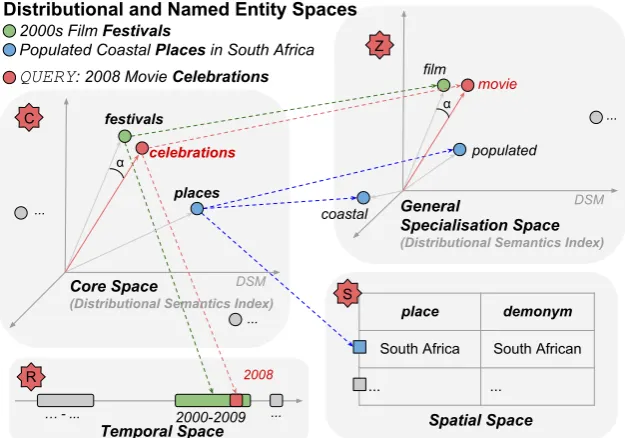
To illustrate visually, Figure 2 depicts a dia-gram where the entity categories2000s Film Festi-valsandPopulated Coastal Places in South Africa
are represented within the model. The cores festi-valsandplacesare stored in the core distributional space (C: geometric representation). The first cat-egory has two specialisations: the time interval 2000-2009, indexed in the temporal space (R: in-terval representation); andfilm, indexed in the gen-eral specialisation space (Z: also geometric repre-sentation). Next, the second category has three specialisations: the spatial named entity South Africa, indexed in the spatial index (S: expanded index); and the general specialisationscoastaland
populated, indexed in (Z). Dashed lines connect-ing the cores to their specialisations represent the flattened edges of the graphs, i.e. all speciali-sations are connected directly to their respective core.
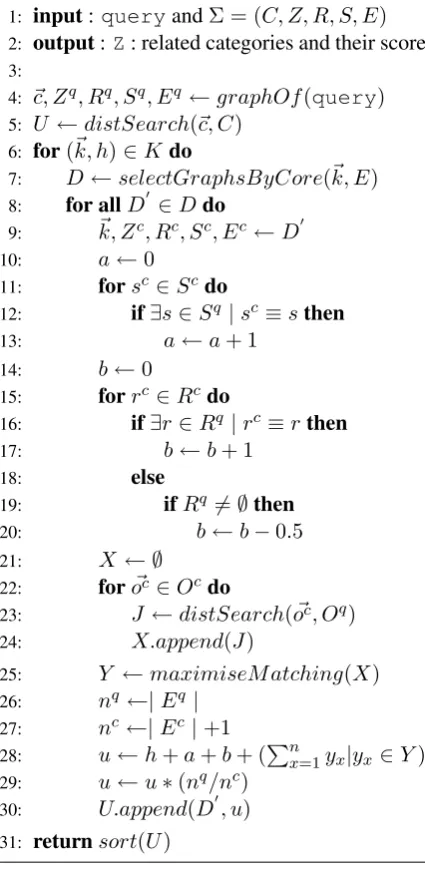
4.2 Searching as Semantic Interpretation Algorithm 2 describes the interpretation process that receives the query and the graph data modelΣ
as inputs. Queries are paraphrases that follow the same syntactic pattern of entity categories. The process starts by generating the graph of the input query (line 4). Considering the graph structure, each vertice becomes a sub-query to be
submit-ted to their respective specific index (representa-tion space).
The core defines the first sub-query. It needs to be semantically aligned to relevant cores inΣ. In line 5,distSearch(~c, C)searches for cores se-mantically related to the query core~c. In addition to the simple searching of terms and synonyms, the vector cosine defines how related~c is to the cores present in C. Given a threshold η, distri-butional search returnsK = {(~k, h)|~k ∈ C, h =
cosine(~k,~c), h > η}. The semantic relatedness threshold η determines the minimum distance or angle between the query core and the target cores that makes them semantically relevant. In the con-text of this work,ηis defined dynamically accord-ing to the result set. Let X be the descending-order set of returned cosine scores,(η =xn|xn∈ X, xn+1 ∈ X, xn/2 > xn+1). The distributional search returns a set of pairs(~k, h)where~kis a core term andhis the normalisedcosine(~k,~c). Entity categories containing relevant cores are select for the next search step (lines 6, 7).
The next step deals with the specialisations. Spatial and temporal named entities found in the query are searched in their respective sub-sets, identifying equivalent spatial representations (lines 11-13) and comparing the time intervals (lines 14-20). Temporal expressions out-of-range are penalised by a negative score (line 20). The pairing of general specialisations (lines 22-24) fol-lows the same principle of the core search. When there are two or more general specialisations, the method maximiseMatching aims to avoid that two terms from one side match to the same term on the other side, selecting the pairs that maximise the final score.
The final score is determined by the composi-tion of all scores proporcomposi-tionally to the number of terms in the categories according to the expres-sions in the lines 26-29.
In the example of Figure 2, 2008 Movie Cele-brationsis the query which is segmented in cele-bration(core),movie(general specialisation) and
2008(temporal interval). The core term celebra-tions feeds a sub-query in the distributional core space. The alignment is defined by computing a distributional semantic relatedness function be-tweencelebrationsand all cores in the core space and by filtering out all the elements which are be-low the semantic relatedness thresholdη.
Distributional and Named Entity Spaces
place demonym
South Africa South African
... ...
Spatial Space Temporal Space2000-2009
… - ... ...
2000s Film Festivals
Populated Coastal Places in South Africa
Core Space
(Distributional Semantics Index) festivals
places
... ...
DSM
General
Specialisation Space
(Distributional Semantics Index)
film
populated
coastal
...
DSM C
R
Z
S
celebrations α
movie
α
QUERY: 2008 Movie Celebrations
[image:5.595.143.456.62.281.2]2008
Figure 2: Depiction of the structured distributional vector space model.
terms representing specialisations are searched in the subspaces according to their type. In the given query example, movie is semantically aligned in the general specialisation space applying the same approach described in the core space. In its turn, the intersection is calculated for the temporal spe-cialisation2008in the temporal space.
5 Evaluation
The evaluation focuses on comparing the compositional-distributional model to baseline approaches and assessing the performance of different distributional semantic models in com-bination with our representation model. The evaluation scenarios are designed to measure the individual contribution of each component.
5.1 Setup
The evaluation has three comparative baselines: Bag-of-words search:Target entity categories are indexed in a state-of-the-art information retrieval system treating each category as a separate docu-ment. Additionally, the document is enriched by synonyms obtained from WorNet (Miller, 1995). Lucene54.10.1 is the information retrieval system used in the experiment.
Pure core-oriented segmentation: The core-oriented segmentation model incorporated by this work is applied in an isolated fashion, i.e. without the distributional component but making use of
5http://lucene.apache.org/
simple string matching, WordNet expansion and temporal and spatial named entity indices.
Sum-algebraic-based method: Entity categories are compared by an algebraic operation that sums up component vectors using the resulting vectors to calculate the cosine similarity. This method re-sults in many scenarios, one for each distributional model.
Five different models are analysed in this work: Latent Semantic Analysis(Dumais et al., 1988): LSA is a distributional semantic space that ex-tracts statistical relations between words in narrow context windows. It is characterised for executing a costly operation to reduce the space dimension-ality.
Random Indexing (RI) (Sahlgren, 2005): Ran-dom Indexing was proposed to avoid the dimen-sional reduction. It dynamically accumulates con-text vectors based on the occurrence of words in contextsto generate the semantic space.
Explicit Semantic Analysis (Gabrilovich and Markovitch, 2007): ESA uses entire documents as contexts. It was created under the assumption of
concept hypothesis6 which states that a portion of information such as an article or document is as-sociated with a particular concept, and the space model could take advantage of this information. Continuous Skip-gram Model (W2V)(Mikolov et al., 2013): Skip-gram is a vector space model created by deep learning techniques focused on lo-6Studies contest the existence of this hypothesis (Gottron
Algorithm 2Semantic Interpretation Process
1: input:queryandΣ = (C, Z, R, S, E) 2: output:Z: related categories and their score. 3:
4: ~c, Zq, Rq, Sq, Eq ←graphOf(query)
5: U ←distSearch(~c, C)
6: for(~k, h)∈Kdo
7: D←selectGraphsByCore(~k, E)
8: for allD0 ∈Ddo
9: ~k, Zc, Rc, Sc, Ec←D0
10: a←0
11: forsc∈Scdo
12: if∃s∈Sq |sc≡sthen
13: a←a+ 1
14: b←0
15: forrc∈Rcdo
16: if∃r∈Rq|rc≡rthen
17: b←b+ 1
18: else
19: ifRq6=∅then
20: b←b−0.5
21: X← ∅
22: for ~oc∈Ocdo
23: J ←distSearch(~oc, Oq)
24: X.append(J)
25: Y ←maximiseMatching(X)
26: nq←|Eq| 27: nc←|Ec|+1
28: u←h+a+b+ (Pnx=1yx|yx∈Y) 29: u←u∗(nq/nc)
30: U.append(D0, u)
31: returnsort(U)
cal context windows.
Global Vectors (GloVe) (Jeffrey Pennington, 2014): GloVe aims to conciliate the statistical co-occurrence knowledge present in the whole corpus with the local pattern analysis (proposed by the skip-gram model) applying a hybrid approach of conditional probability and machine learning tech-niques.
DINFRA (Barzegar et al., 2015), a SaaS distri-butional infrastructure, provided the distridistri-butional vectors. We generated all five ditributional models using the English Wikipedia 2014 dump as a ref-erence corpus, stemming by the Porter algorithm (Porter, 1997) and removing stopwords. For LSA, RI and ESA, we used the SSpace Package (Jur-gens and Stevens, 2010), while W2V and GloVe were generated by the code shared by the
respec-tive authors. All models used the default parame-ters defined in each implementation.
5.2 Test Collection
The test collection is composed of a knowledge base of more than 350,000 entity categories ob-tained from the complete set of Wikipedia 2014 categories, but removing those containing non-ASCII characters. Each category has between one to three paraphrases.
The creation of the queries was guided by seed target categories. The use of seed entity categories was deliberately decided to ensure the presence of one paraphrase equivalence for each query.
Queries were generated by asking a group of English-speaking volunteers to paraphrase the subset of 105 categories. They were instructed to describe the same meaning using different words and, if possible, different syntactic structures. Af-ter that, we applied a curation process conducted by two researchers to validate the paraphrase’s equivalence intuitively. In the end, we admitted a set of 233 paraphrased pairs.
To create various degrees of difficulty in the top-ics, we balanced the test collection with categories varying in size (two to ten terms), in the occur-rence of places and demonyms refeoccur-rences, in the presence of temporal expressions and, in the oc-currence of noun phrase components (verbs, ad-jectives, adverbs).
Test collection files are available at http://
bit.ly/cat-test-collection.
5.3 Results and Discussion
We evaluate our approach in three scenarios. The first considers the TOP-10 list of each execution. The second considers the TOP-20 list and the third the TOP-50.
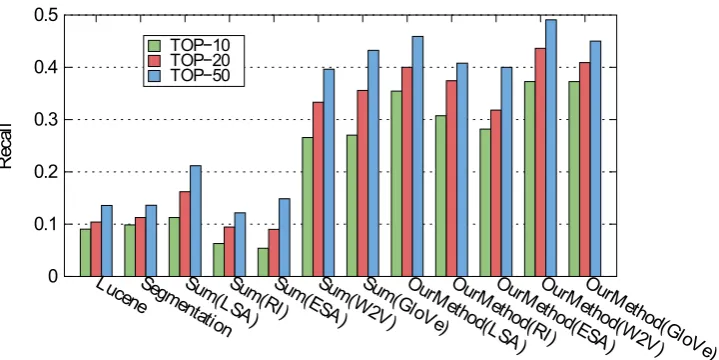
[image:6.595.74.287.79.515.2]For each query in the test collection, we cal-culate the recall and mean reciprocal ranking, to-gether with their aggregate measures (Table 3). Figure 3 provides a visual representation of the recall scores. In the experiment, we assumed that only one category corresponded to the cor-rect answer. This assumption makes precision a redundant indicator since it can be derived from
recall (precision = recall/range|range ∈ {10,20,50}).
WordNet-Approaches Recall MRR
Top 10 Top 20 Top 50 Top 10 Top 20 Top 50
Lucene 0.0904 0.1040 0.1357 0.0410 0.0420 0.0429
Core-Oriented Segmentation 0.0985 0.1126 0.1361 0.0613 0.0623 0.0630
Sum-algebraic-based method - - -
-with LSA 0.1126 0.1621 0.2117 0.0595 0.0631 0.0645 with RI 0.0630 0.0945 0.1216 0.0348 0.0371 0.0379 with ESA 0.0540 0.0900 0.1486 0.0271 0.0296 0.0312 with W2V 0.2657 0.3333 0.3963 0.1356 0.1403 0.1422 with GloVe 0.2702 0.3558 0.4324 0.1417 0.1476 0.1501
Our proposed method - - -
[image:7.595.102.496.61.287.2]-with LSA 0.3545 0.4000 0.4590 0.1981 0.2013 0.2033 with RI 0.3073 0.3743 0.4078 0.1768 0.1813 0.1823 with ESA 0.2818 0.3182 0.4000 0.1822 0.1846 0.1872 with W2V 0.3727 0.4364 0.4909 0.2448 0.2491 0.2510 with GloVe 0.3727 0.4090 0.4500 0.2274 0.2300 0.2314
Table 3: Results for recall and mean reciprocal rank (MRR).
based query expansion. By applying either
sum-algebraic-based method and our proposed method, most of the distributional models present significant performance improvement in compar-ison to non-distributional methods. It is also im-portant to stress that Word2Vec and GloVe consis-tently deliver better results for the test collection. Apart the controversies about predictive-based and count-based distributional models (Baroni et al., 2014b; Lebret and Collobert, 2015; Levy and Goldberg, 2014), in the context of this work, these results suggest that predictive-based distributional models outperform count-based methods (despite the proximity of LSA results).
Regarding the compositional method, the re-sults of thecore-oriented strategycombined with the named entity recognition exceeded all results delivered by the sum-algebraic-based method
when comparing the same distributional model. The performance increases not only in the recall, which represents more entity categories retrieved but also in the mean reciprocal rank, reflecting that the target categories are better positioned in the list. Our proposed method succeed in almost 50% of the test collection when considered the Top-50 scenario.
Sales et al. (2015) shows a prototype demon-stration of this work.
5.4 Analysing Unsuccessful Cases
The most significant limitation is the restriction of comparing words one-by-one, assuming that
each word in a paraphrase is semantically equiv-alent to only one word in the target categories and vice-versa. For example, the pair (Swedish Met-allurgists,Metal Workers from Sweden) is ranked at #1173 when using W2V. It occurs because
metallurgists and workers have low relatedness (0.0031). Comparing the relatedness of metallur-giststometal workerswould have a higher score.
Concerning named entities, we observed three relevant issues. Our approach uses a simple longest string matching method to identify places. Categories containing terms such as Turkey are always considered a spatial named entity. In the pair (American Turkey Breeds and Chicken Breeds Originating in the US) the terms turkey
andchickenwould not be semantically compared, sinceTurkeyis always considered a spatial named entity. Secondly, when searching forWater Parks in the USA, all parks atTexas,Tennesseeor Penn-sylvaniaare also relevant for the user. Our model does not contain this hierarchical information to provide a geographic match. Finally, expressions such asWWIandUSSRshould be identified as the paraphrasing ofWold War Iandthe Soviet Union
or even other variations, what is not available in our model.
6 Related Work
Sum
(RI)Sum(ESASum)(W2 V) Sum
(GloOurMVe)ethod (LSA) OurM
ethodOurM(RI)ethod(ESA ) OurM
ethod(W2 V) OurM
ethod(Glo Ve)
R
ec
al
l
TOP−10 TOP−20 TOP−50
0 0.1 0.2 0.3 0.4 0.5
LuceneSegm enta
tion Sum
[image:8.595.120.480.61.241.2](LSA)
Figure 3: Chart of recall values grouped by different approaches.
by a query. Yao et al. (2013) propose an entity type predictionconsidering theuniversal schema. In this work, a predictor is expected to label a given entity with types. This schema is composed of all types from diverse available ontologies. To identify types from texts, they compose named en-tity recognition with dependency parsing. These works focus on identifying the ontological types that are sought by the query.
Regarding entity similarity, Moreau et al. (2008) propose a method to calculate entity si-milarity based on Soft-TFIDF. Liu and Birnbaum (2007) propose a method based on the Open Di-rectory Project (ODP) to capture category names in all pages where the named entity appears to gen-erate a vector space. Liu et al. (2008) describe a method that uses the set of URLs in which enti-ties are present to measure similarity. The differ-ence to these works is that they focus on compar-ing named entities, not based on their description, but based on non-linguistic attributes.
Other related topics are paraphrasing andtext entailment. Androutsopoulos and Malakasiotis (2010) present an extension overview of datasets and approaches applied in these fields. Papers in this context deal with the paraphrasing of com-plete sentences (formed of subject and predicate) which cannot benefit from the core-oriented seg-mentation model. The different format of their target datasets inhibits a direct comparison, while their lack of association with entities does not cre-ate the required bridge between unstructured and structured data.
This work distinguishes mainly from existing approaches by proposing a novel compositional
method grounded in syntactic analysis to com-bine distributional vectors and by using distribu-tional semantics models generated from external resources. The target knowledge base (the dataset of categories) is not part of the data used to pro-duce the distributional models. This isolation sup-ports a more comprehensive semantic matching.
7 Conclusion
This work proposes a compositional-distributional model to recognise paraphrases of entity cate-gories. Distributional semantics in combination with the proposed compositional model supports a search strategy with robust semantic approxima-tion capabilities, largely outperforming string and WordNet-based approaches in recall and mean re-ciprocal rank. The proposed compositional strat-egy also outperforms the tradional vector-sum method.
paradig-maticthansyntagmaticrelations.
Additionally, the use of distributional semantic models provides a better base for transporting the solution to multi-lingual scenarios, since it does not depend on manually constructed resources.
Future work will focus on the investigation of specialised named entity distributional methods in the context of the semantic search problem.
Acknowledgments
This publication has emanated from research sup-ported by the National Council for Scientific and Technological Development, Brazil (CNPq) and by a research grant from Science Foundation Ire-land (SFI) under Grant Number SFI/12/RC/2289. The authors also would like to thank Douglas N. Oliveira (Florida Institute of Technology) and the anonymous reviewers for the valuable critical comments.
References
Eneko Agirre, Enrique Alfonseca, Keith Hall, Jana Kravalova, Marius Pas¸ca, and Aitor Soroa. 2009. A study on similarity and relatedness using distribu-tional and WordNet-based approaches. In Proceed-ings of Human Language Technologies: The 2009 Annual Conference of the North American Chap-ter of the Association for Computational Linguistics, NAACL ’09.
Nikolaos Aletras and Mark Stevenson. 2015. A hybrid distributional and knowledge-based model of lexi-cal semantics. In Proceedings of the Fourth Joint Conference on Lexical and Computational Seman-tics, June.
Ion Androutsopoulos and Prodromos Malakasiotis. 2010. A survey of paraphrasing and textual entail-ment methods. J. Artif. Int. Res., 38(1):135–187, May.
S¨oren Auer, Christian Bizer, Georgi Kobilarov, Jens Lehmann, Richard Cyganiak, and Zachary Ives. 2007. DBpedia: A nucleus for a web of open data. InProceedings of the 6th International The tic Web and 2Nd Asian Conference on Asian Seman-tic Web Conference, ISWC’07/ASWC’07, pages 722–735, Berlin, Heidelberg. Springer-Verlag. Krisztian Balog and Robert Neumayer. 2012.
Hier-archical target type identification for entity-oriented queries. In Proceedings of the 21st ACM Interna-tional Conference on Information and Knowledge Management, CIKM’12.
Marco Baroni, Raffaella Bernardi, and Roberto Zam-parelli. 2014a. Frege in space: A program for compositional distributional semantics. Linguistic Issues in Language Technology, 9.
Marco Baroni, Georgiana Dinu, and Germ´an Kruszewski. 2014b. Don’t count, predict! a systematic comparison of context-counting vs. context-predicting semantic vectors. InProceedings of the 52nd Annual Meeting of the Association for Computational Linguistics, June.
Siamak Barzegar, Juliano Efson Sales, Andre Freitas, Siegfried Handschuh, and Brian Davis. 2015. DIN-FRA: A one stop shop for computing multilingual semantic relatedness. In Proceedings of the 38th International ACM SIGIR Conference on Research and Development in Information Retrieval, SIGIR ’15.
S. T. Dumais, G. W. Furnas, T. K. Landauer, S. Deer-wester, and R. Harshman. 1988. Using latent se-mantic analysis to improve access to textual infor-mation. In Proceedings of the Conference on Hu-man Factors in Computing Systems.
Andr´e Freitas, Edward Curry, Jo˜ao Gabriel Oliveira, and Se´an O’riain. 2011. A distributional structure semantic space for querying RDF graph data. International Journal of Semantic Computing, 05(04):433–462.
Andr´e Freitas, Edward Curry, and Se´an O’Riain. 2012. A distributional approach for terminological seman-tic search on the linked data web. InProceedings of the 27th Annual ACM Symposium on Applied Com-puting, SAC ’12.
Andr´e Freitas, Rafael Vieira, Edward Curry, Danilo Carvalho, and Jo˜ao Carlos Pereira da Silva. 2014. On the semantic representation and extraction of complex category descriptors. InNatural Language Processing and Information Systems, volume 8455 ofLecture Notes in Computer Science.
Andre Freitas, Juliano Efson Sales, Siegfried Hand-schuh, and Edward Curry. 2015. How hard is this query? measuring the semantic complexity of schema-agnostic queries. InProceedings of the 11th International Conference on Computational Seman-tics, pages 294–304, London, UK, April. Associa-tion for ComputaAssocia-tional Linguistics.
Evgeniy Gabrilovich and Shaul Markovitch. 2007. Computing semantic relatedness using Wikipedia-based explicit semantic analysis. InProceedings of the 20th International Joint Conference on Artifical Intelligence, IJCAI’07.
Thomas Gottron, Maik Anderka, and Benno Stein. 2011. Insights into explicit semantic analysis. In
Proceedings of the 20th ACM International Confer-ence on Information and Knowledge Management, CIKM’11.
Zellig Harris. 1954. Distributional structure. Word, 10(23).
2014 Conference on Empirical Methods in Natural Language Processing (EMNLP), October.
David Jurgens and Keith Stevens. 2010. The S-Space Package: An open source package for word space models. InProceedings of the ACL 2010 Sys-tem Demonstrations, ACLDemos ’10, pages 30–35, Stroudsburg, PA, USA. Association for Computa-tional Linguistics.
R´emi Lebret and Ronan Collobert, 2015. Rehabilita-tion of Count-Based Models for Word Vector Rep-resentations, pages 417–429. Springer International Publishing, Cham.
Omer Levy and Yoav Goldberg. 2014. Linguistic regularities in sparse and explicit word representa-tions. In Proceedings of the Eighteenth Confer-ence on Computational Natural Language Learning, pages 171–180, Ann Arbor, Michigan, June. Asso-ciation for Computational Linguistics.
Jiahui Liu and L. Birnbaum. 2007. Measur-ing semantic similarity between named entities by searching the web directory. In Web Intelligence, IEEE/WIC/ACM International Conference on, Nov.
Hui Liu, Jinglei Zhao, and Ruzhan Lu. 2008. Mining the URLs: An approach to measure the similarities between named-entities. In Innovative Computing Information and Control, 2008. ICICIC ’08. 3rd In-ternational Conference on, June.
Tomas Mikolov, Kai Chen, Greg Corrado, and Jeffrey Dean. 2013. Efficient estimation of word represen-tations in vector space. InICLR Workshop Papers.
George A. Miller. 1995. WordNet: A lexical database for english. Commun. ACM, 38(11), November.
Erwan Moreau, Franc¸ois Yvon, and Olivier Capp´e. 2008. Robust similarity measures for named enti-ties matching. In Proceedings of the 22nd Inter-national Conference on Computational Linguistics (Coling 2008), August.
Martin F. Porter. 1997. Readings in information re-trieval. chapter An Algorithm for Suffix Stripping, pages 313–316. Morgan Kaufmann Publishers Inc., San Francisco, CA, USA.
Jeffrey Pound, Peter Mika, and Hugo Zaragoza. 2010. Ad-hoc object retrieval in the web of data. In Pro-ceedings of the 19th International Conference on World Wide Web, WWW ’10, pages 771–780, New York, NY, USA. ACM.
Magnus Sahlgren. 2005. An introduction to random indexing. InIn Methods and Applications of Seman-tic Indexing Workshop at the 7th International Con-ference on Terminology and Knowledge Engineer-ing, TKE 2005.
Juliano Efson Sales, Andr´e Freitas, Siegfried Hand-schuh, and Brian Davis. 2015. Linse: A distribu-tional semantics entity search engine. In Proceed-ings of the 38th International ACM SIGIR Confer-ence on Research and Development in Information Retrieval, SIGIR ’15, pages 1045–1046, New York, NY, USA. ACM.
Fabian M. Suchanek, Gjergji Kasneci, and Gerhard Weikum. 2007. Yago: A core of semantic knowl-edge. InProceedings of the 16th International Con-ference on World Wide Web, WWW ’07, pages 697– 706, New York, NY, USA. ACM.
Peter D. Turney and Patrick Pantel. 2010. From fre-quency to meaning: Vector space models of seman-tics. J. Artif. Int. Res., 37(1):141–188, January. Limin Yao, Sebastian Riedel, and Andrew McCallum.