NRC Machine Translation System for WMT 2017
Chi-kiu Lo
Samuel Larkin Darlene StewartBoxing Chen
National Research Council Canada
1200 Montreal Road, Ottawa, ON K1A 0R6, Canada
Colin Cherry
Roland Kuhn George Foster
∗
Google Research Montreal, Canada
Abstract
We describe the machine translation sys-tems developed at the National Research Council of Canada (NRC) for the Russian-English and Chinese-Russian-English news trans-lation tasks of the Second Conference on Machine Translation (WMT 2017). We conducted several experiments to explore the best baseline settings for neural ma-chine translation (NMT). In the Russian-English task, to our surprise, our best-performing system is one that rescores phrase-based statistical machine transla-tion outputs using NMT rescoring fea-tures. On the other hand, in the Chinese-English task, which has far more paral-lel training data, NMT is able to outper-form SMT significantly. The NRC MT systems is the best constrained system in Russian-English (out of nine participants) and the fourth best constrained system in Chinese-English (out of twenty partici-pants) in WMT 2017 human evaluation. 1 Introduction
We present NRC’s submission to the Russian-English and Chinese-Russian-English news translation task of WMT 2017. In contrast to last year, when we participated in the Russian-English task only, with our well-developed phrase-based statistical ma-chine translation system (Lo et al., 2016; Larkin et al.,2010;Foster et al.,2009), this year we built large-scale state-of-the-art neural machine transla-tion (NMT) systems for these two language pairs to facilitate further understanding and discussion of NMT.
Russian-English and Chinese-English are both challenging language pairs for machine
transla-∗Work performed while at NRC.
tion. Russian is a highly inflectional and free word order language. The skewed Russian to English word type ratio introduces a data sparsity prob-lem that cannot be solved by discarding word in-flections, since they play an important role in dis-ambiguating the meaning of sentences. Chinese does not have clear word boundaries. The number of Chinese word types created by automatic word segmentation software is high, while naive char-acter segmentation would result in a skewed Chi-nese to English sentence length ratio. These char-acteristics make it difficult for machine translation systems to learn the correct association between words in Chinese and English.
Since this was the first time we deployed NMT models in an evaluation, we first tried to repli-cate the results of previous work (Sennrich et al.,
2016a). Our NMT systems are based on Nema-tus (Sennrich et al., 2017). We used automatic back-translation (Sennrich et al.,2016b) of a sub-selected monolingual News corpus as additional training data, and all the training data is seg-mented into subword units using BPE (Sennrich et al.,2016c). We also experimented with perva-sive dropout as implemented in Nematus.
For Russian-English, our WMT16 PBMT sys-tem scored higher than all the NMT syssys-tems we built this year. We therefore experimented with using the NMT systems as features for rescoring the 1000-best output from our WMT16 PBMT system. This strategy yielded almost 2 BLEU point improvement over the PBMT baseline. For Chinese-English, we exploited different domain adaptation techniques to boost the system perfor-mance on domain news translation. We also in-tegrated various regularization methods to avoid the systems overfitting to the small development set.
The NRC Russian-English and Chinese-English news translation systems achieve competitive
formance (third place in both language pairs) in the preliminary automatic evaluation of WMT 2017. In this paper, we discuss the lessons learned in building large-scale state-of-the-art NMT sys-tems.
2 Russian-English news translation
We used all the Russian-English parallel cor-pora available for the constrained news translation task. They include the CommonCrawl corpus, the NewsCommentary v12 corpus, the Yandex cor-pus and the Wikipedia headlines corcor-pus. In total, 2.6 million parallel Russian-English sentences are used to train the baseline system. We use the news translation test set of WMT 15 as development set and that of WMT 16 as test set. The Russian and English texts in the training/development/test cor-pora were kept in their original true case and to-kenized, then the Russian and English texts were combined to train a BPE model with vocabulary size of 30k.
2.1 NMT baseline system
Our NMT baseline system is developed using Ne-matus (Sennrich et al., 2017). The dimension of word embeddings is set to 512 and that of the hid-den layers is set to 1024. We train the models with rmsprop (Tieleman and Hinton,2012), reshuffling the training corpus between epochs. We use mini-batches of size 100 and validate the model every 8000 minibatches against BLEU on the WMT 15 news translation test set. We perform early stop-ping on the baseline system. We use AmuNMT C++ decoder (Junczys-Dowmunt et al., 2016a) with a beam size of 4.
2.2 Synthetic training data
In statistical machine translation, large monolin-gual corpora in the output language have tradi-tionally been used for training language models to make the system output more fluent. However, it is difficult to integrate language models in cur-rent NMT architectures. Instead of ignoring such large monolingual corpora,Sennrich et al.(2016b) exploited large corpora in the output language by translating a subset of them into the input lan-guage and then using the resulting synthetic sen-tence pairs as additional training data. We trans-lated monolingual English text into Russian us-ing an English to Russian NMT system mirrorus-ing
the one described in Section 2.1,1 and then em-ployed the machine-translated Russian and perfect English sentence pairs as additional data to train the Russian-English MT system.
To select sentences for back-translation, we used a semi-supervised convolutional neural net-work classifier (Chen and Huang, 2016). We sampled two million sentences from the English monolingual News Crawl 2015 & 2016 corpora according to their classifier scores, which reflect their similarity to the the English half of our de-velopment set.
2.3 Pervasive dropout
Pervasive dropout prevents the NMT system from overfitting. We apply the variant of Gal and Ghahramani(2016) pervasive dropout that is im-plemented in Nematus to all layers in the network. This variant has the characteristic that the random dropout is applied at the token level, instead of at the word-type level. We set the dropout probabil-ity for the source words, target words and embed-ding layers to 0.15. For the hidden layers, we set the dropout probability to 0.3.
2.4 Minimum risk training
Minimum risk training (MRT) (Shen et al.,2016) allows model optimization to arbitrary loss func-tions, which do not need to be differentiable, thus enabling direct model tuning against automatic MT evaluation metrics. It uses the MT evaluation metric as the loss function and minimizes the ex-pected loss on the training data at sentence-level. We experimented with further model optimization using MRT on the whole training corpus against sentence BLEU at the final stage.
2.5 Greedy model averaging
A common practice for avoiding overfitting to the training data is ensembling the last few mod-els saved as checkpoints. Recently, Junczys-Dowmunt et al. (2016b) showed that one can see nearly the same benefits by performing a component-wise average of all parameters across checkpoints. We extended this technique by using a greedy strategy to average a wider range of mod-els. Instead of considering only the last few saved models, we considered 30 saved models having the best BLEU performance on the validation set one-by-one. For each checkpoint, in descending
order of BLEU score, we add the checkpoint to our running average to create a model candidate. We then use the candidate to decode our develop-ment set. If this results in improved BLEU, we accept the candidate, and it becomes our new run-ning average. We find that this process generally selects between 5 and 8 checkpoints to include in the average.
2.6 Portage - NRC WMT16 PBMT system
The core of the NRC WMT16 MT system (Lo et al., 2016) is Portage (Larkin et al., 2010). Portage is a conventional log-linear phrase-based SMT system.
The system was trained on all the Russian-English parallel training corpora and WMT 12 and WMT 13 Russian-English news translation test set and tuned on the WMT 14 test set. Both the Rus-sian and English text in the parallel and monolin-gual corpora in the training/development/test cor-pora were tokenized and lowercased.
The system employed Russian lemmatization extensively in building word alignments for trans-lation models, a hierarchical distortion model, a sparse feature model and neural network joint models or NNJMs (Devlin et al., 2014). The system also made extensive use of monolingual English corpora in building language models. Last but not least, it had comprehensive Russian OOV handling, which included a fallback Russian lemma-based phrase table and a Russian translit-eration model.
2.7 Rescoring and truecasing
We rescored 1000-best lists output from the phrase-based decoder using a rescoring model (Och et al., 2004; Foster et al., 2009) consisting of 13 features: 3 NMT models, 2 language mod-els, 5 NNJMs and 3 n-best features. The rescoring model was tuned using n-best MIRA (Cherry and Foster,2012).
The three NMT systems used as rescoring fea-tures were: 1) baseline further trained with syn-thetic data, 2) dropout baseline further trained with synthetic data and with dropout turned off, and 3) the previous model optimized to the development set using minimum risk training.
The five NNJM rescoring features include two Russian-word NNJMs and three Russian-lemma ones. Following Devlin et al. (2014), we take advantage of the rescoring framework to have our NNJMs view each candidate translation from
dev test single
System best ave.
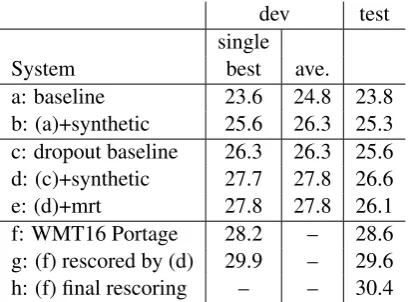
a: baseline 23.6 24.8 23.8 b: (a)+synthetic 25.6 26.3 25.3 c: dropout baseline 26.3 26.3 25.6 d: (c)+synthetic 27.7 27.8 26.6 e: (d)+mrt 27.8 27.8 26.1 f: WMT16 Portage 28.2 – 28.6 g: (f) rescored by (d) 29.9 – 29.6 h: (f) final rescoring – – 30.4
Table 1: Selected results from our Russian-English development experiments. The ave. col-umn shows the result of greedy model averaging, where applicable.
perspectives not available during decoding. The Russian-lemma NNJMs are rescored using nor-mal, target-to-source, and right-to-left perspec-tives. The Russian-word NNJMs are rescored using normal and right-to-left perspectives. The choice of which perspectives to include was made based on empirical devtest (WMT 16) perfor-mance.
The two language models were: a left-to-right 6-gram LM and a right-to-left 6-gram LM. Both were trained on the WMT 16 monolingual English training corpus,
The final output was truecased and detokenized in the same way as described inLo et al.(2016).
2.8 Results
Table1shows the results of selected models from our development experiments. It can be seen that synthetic training data generated by back-translation of large output language monolingual corpora consistently improves the baseline by 1.4 to 2 BLEU. However, this result is rather disap-pointing by comparison with the exciting improve-ment reported inSennrich et al. (2016a), i.e. 3-4 BLEU.
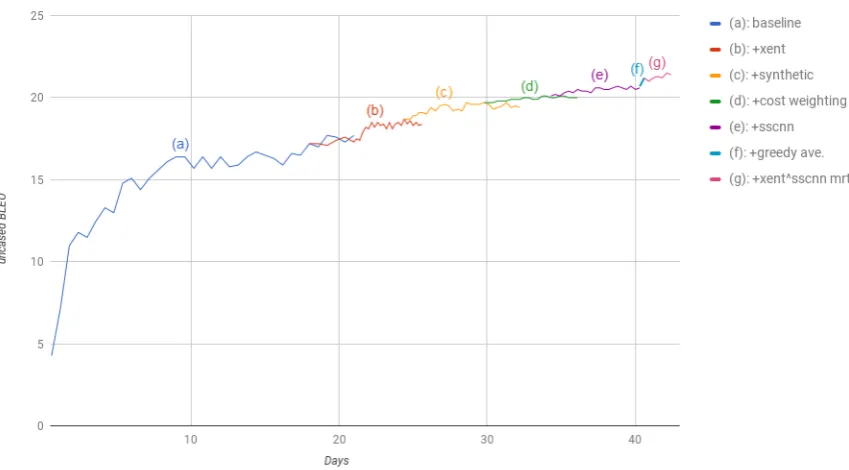
[image:3.595.315.520.62.213.2]Figure 1: Russian-English learning curve on development set in cased BLEU of selected models: a) NMT baseline, b) NMT baseline further trained with synthetic data, c) NMT dropout baseline, d) NMT dropout baseline further trained with synthetic data while dropout is turned off, e) NMT dropout baseline with synthetic data optimized to sentence-level BLEU on the training data using MRT, f) our WMT16 PBMT submission and g) the PBMT rescored by one of the rescoring features.
The most interesting observation in our experi-ments is that the dropout baseline continues to im-prove over the course of many weeks. Figure 1
shows the learning curve of the selected models for all 7 weeks of development. Line (c) of this figure shows that the dropout baseline continues training and improving until the end of the eval-uation campaign, achieving a development BLEU score that is 2.7 BLEU points beyond our best sin-gle NMT system that does not use dropout. This system can be further improved by adding syn-thetic data, as in line (d), however, we found that we needed to switch dropout off after adding the synthetic data.
Although in figure 1 we see that none of the NMT systems manage to beat our WMT16 PBMT submission, the more interesting result is that there is more than 1.8 BLEU gain on the development set and 1.1 BLEU gain on the test set by rescor-ing the PBMT 1000-best list usrescor-ing just one of our NMT systems and no other features, as in line (g). The final rescoring with weighted collections of NMT systems, language model features, NNJM features and n-best features shows 1.8 BLEU im-provement over the WMT 16 submission on the test set.
3 Chinese-English news translation
We used all the Chinese-English parallel corpora available for the constrained news translation task. They include the UN corpus, the NewsCommen-tary v12 corpus and the CWMT corpus. In to-tal, 25 million parallel Chinese-English sentences were used to train the baseline system. We used half of the WMT 17 news translation development set as our development set and the other half as internal test set. The English texts in the train-ing/development/test corpora were tokenized and lowercased while the Chinese texts in the train-ing/development/test corpora were segmented us-ing the ICTCLAS segmenter (Zhang et al.,2003). Then the Chinese and English text were combined to train a BPE model with vocabulary size of 90k.
3.1 NMT baseline system
Figure 2: Chinese-English learning curves on the internal test set in uncased BLEU for selected mod-els: a) NMT baseline, b) further trained with in-domain data selected by bilingual LM cross-entropy difference (xent), c) further trained with synthetic data, d) further trained with cost weighting, e) further trained with in-domain data selected by semi-supervised convolutional neural network classifier (sscnn), f) greedy model averaging and g) optimized against sentence-level BLEU on the intersection of the sub-sets of data selected by xent and sscnn using MRT.
3.2 Data selection and domain adaptation
Since the majority of the 25 million sentence pairs in the training corpus are general domain, we ex-perimented with different data selection and do-main adaptation techniques to further train the NMT system with data that are similar to the de-velopment set so as to perform better in the news domain.
Axelrod et al. (2011) introduced the bilingual language model cross-entropy difference as a sim-ilarity function for identifying sentence pairs from general-domain training corpora that are close to the target domain. We built four language models using the input and output sides of the training cor-pora and the development set respectively to select 3 million sentence pairs from the training corpora that are close to the news domain.
However, the development set, which consists of only 1k sentence pairs, is too tiny to be a suit-able corpus for building the in-domain language models that will enable the bilingual LM cross-entropy difference data selection method to work effectively. Therefore, we also experimented with the semi-supervised convolutional neural network method inChen and Huang(2016) to select 1
mil-lion sentence pairs from the training corpora that are close to the news domain.
Finally, we experimented with a cost weighting domain adaptation technique (Chen et al.,2017). This technique trains a domain classifier concur-rently with the NMT system, and uses the classi-fier probabilities to weight training instances ac-cording to their similarity to the development set.
3.3 Synthetic training data
We generated synthetic Chinese and perfect En-glish sentence pairs in a process similar to that described in section 2.2. We first used a semi-supervised convolutional neural network classifier (Chen and Huang,2016) to sample 20 million sen-tences from the English monolingual News Crawl 2015 & 2016 corpora according to the develop-ment set. We then translated the selected sentences using a English-Chinese NMT baseline trained out-of-the-box using only the parallel corpora.
3.4 Greedy model averaging
System test
baseline 17.2
+biLM cross-entropy (xent) DS 18.7
+synthetic 19.7
+cost weighting DA 20.1
+sscnn DS 20.7
+greedy model averaging 21.2 +xent∩sscnn mrt 21.4
ensemble 24.2
[image:6.595.92.274.62.198.2]rescoring 25.6
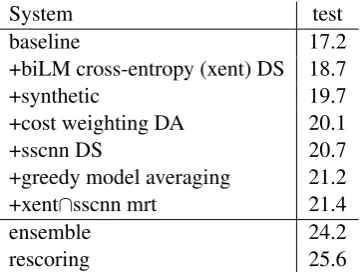
Table 2: Selected results in uncased BLEU from our Chinese-English development experiments.
3.5 Minimum risk training
In contrast to the way in which we carried out MRT for the Russian-English system in sec-tion 2.4, we optimized the Chinese-English sys-tem using MRT against sentence BLEU only on the intersection of the subsets of corpora selected by the LM cross-entropy and the semi-supervised CNN in section3.2. The size of the intersection of the two subsets of corpora is 300k sentence pairs.
3.6 Ensembling, rescoring and truecasing
Applying different combinations of the techniques described in section 3.1 to 3.5, we built 14 dif-ferent NMT systems. Their uncased BLEU on the test set ranged from 19.8 to 21.4. We ensem-bled all the systems together using Simplex-tuned weights.
We rescored 500-best lists output from the en-sembled NMT system using a rescoring model (Och et al.,2004;Foster et al.,2009) consisting of 82 features: IBM models, RNN language models (Mikolov et al., 2010), n-gram language models trained on different data subsets, neural network joint models (NNJMs) (Devlin et al., 2014) and word, n-gram, word alignment posteriors (Foster et al.,2009), etc. The rescoring model was tuned using n-best MIRA (Cherry and Foster,2012).
The final output was truecased and detokenized using heuristic methods.
3.7 Results
Figure 2 shows that all the components we de-scribed in section3.2to3.5help improve the NMT system. The uncased BLEU on the test set in ta-ble2shows that all the data selection and domain adaptation methods improve the NMT systems by 0.4 to 1.5 BLEU. Similar to the results we
ob-served in our Russian-English NMT systems, syn-thetic training data generated by back-translation of large output language monolingual corpora im-proved the NMT system score by 1 BLEU.
The most important observation in our exper-iments is that ensembling of NMT systems de-veloped by different techniques achieves around 3 BLEU improvement and rescoring the n-best out-put from NMT systems also shows 1.4 BLEU gain on the test set.
4 Conclusion
We have presented the NRC submissions to the WMT 2017 Russian-English and Chinese-English news translation task. The Russian-English sub-mitted system is our WMT 16 PBMT system rescored by three NMT models and other rescor-ing features. Our Chinese-English submitted sys-tem is an ensemble of fourteen NMT models rescored by a large set of additional features. Our system achieved the highest score for the Russian-English (among nine participants) and the fourth highest score for Chinese-English (among twenty participants) constrained news translation tasks in WMT 2017 human evaluation.
Our experiences in WMT 2017 illustrate the sharp divide between large- and medium-scale data scenarios when working with neural MT. For Russian-English, we found ourselves relying on techniques that are usually intended for low-resource scenarios, such as pervasive dropout and rescoring a phrase-based system. This is sur-prising, as 2.5 million sentence pairs would have been considered a large-data scenario in the not-too-distant past. Meanwhile, for Chinese-English, we were able to achieve strong individual neural systems, which were further strengthened by en-sembling across various data selection and data weighting techniques. Our results also highlight the necessity to speed up convergence in the pres-ence of dropout, so that it does not take weeks to train a single model.
References
Amittai Axelrod, Xiaodong He, and Jianfeng Gao.
2011. Domain Adaptation via Pseudo In-Domain
Data Selection. In Proceedings of the 2011 Con-ference on Empirical Methods in Natural Language Processing. Association for Computational Linguis-tics, Edinburgh, Scotland, UK., pages 355–362.
Boxing Chen, Colin Cherry, George Foster, and Samuel Larkin. 2017. Cost Weighting for Neural
Machine Translation Domain Adaptation . In 1st
Workshop of Neural Machine Translation.
Boxing Chen and Fei Huang. 2016. Semi-supervised
Convolutional Networks for Translation Adapta-tion with Tiny Amount of In-domain Data. In
Proceedings of the 20th SIGNLL Conference on Computational Natural Language Learning, CoNLL 2016, Berlin, Germany, August 11-12, 2016. pages
314–323.
http://aclweb.org/anthology/K/K16/K16-1031.pdf.
Colin Cherry and George Foster. 2012. Batch
Tun-ing Strategies for Statistical Machine Translation. In
Proc. 2012 Conf. of the N. American Chapter of the Association for Computational Linguistics: Human Language Technologies. Montr´eal, Canada, pages
427–436.
http://www.aclweb.org/anthology/N12-1047.
Jacob Devlin, Rabih Zbib, Zhongqiang Huang, Thomas Lamar, Richard Schwartz, and John Makhoul. 2014.
Fast and Robust Neural Network Joint Models for Statistical Machine Translation. In Proceedings of the Annual Meeting of the Association for Com-putational Linguistics. Baltimore, Maryland, pages
1370–1380.
http://www.aclweb.org/anthology/P14-1129.
George Foster, Boxing Chen, Eric Joanis, Howard Johnson, Roland Kuhn, and Samuel Larkin. 2009.
PORTAGE in the NIST 2009 MT Evaluation.
Tech-nical report, NRC-CNRC..
Yarin Gal and Zoubin Ghahramani. 2016. A Theoreti-cally Grounded Application of Dropout in Recurrent
Neural Networks. In Advances in Neural
Informa-tion Processing Systems 29 (NIPS).
Marcin Junczys-Dowmunt, Tomasz Dwojak, and Hieu
Hoang. 2016a. Is Neural Machine Translation
Ready for Deployment? A Case Study on 30 Trans-lation Directions. In Proceedings of the 9th Inter-national Workshop on Spoken Language Translation (IWSLT). Seattle, WA.
Marcin Junczys-Dowmunt, Tomasz Dwojak, and Rico
Sennrich. 2016b. The AMU-UEDIN Submission
to the WMT16 News Translation Task: Attention-based NMT Models as Feature Functions in Phrase-based SMT. InProceedings of the First Conference on Machine Translation. Association for Computa-tional Linguistics, Berlin, Germany, pages 319–325.
http://www.aclweb.org/anthology/W16-2316.
Samuel Larkin, Boxing Chen, George Foster, Uli Ger-mann, Eric Joanis, J. Howard Johnson, and Roland Kuhn. 2010. Lessons from NRC’s Portage System
at WMT 2010. In5th Workshop on Statistical
Ma-chine Translation.
Chi-kiu Lo, Colin Cherry, George Foster, Dar-lene Stewart, Rabib Islam, Anna Kazantseva, and
Roland Kuhn. 2016. NRC Russian-English
Ma-chine Translation System for WMT 2016. In
Proceedings of the First Conference on Ma-chine Translation. Association for Computational Linguistics, Berlin, Germany, pages 326–332.
http://www.aclweb.org/anthology/W16-2317.
Tomas Mikolov, Martin Karafit, Luks Burget, Jan Cer-nock, and Sanjeev Khudanpur. 2010. Recurrent
neural network based language model. In
INTER-SPEECH. ISCA, pages 1045–1048.
Franz Josef Och, Daniel Gildea, Sanjeev Khudanpur, Anoop Sarkar, Kenji Yamada, Alexander M Fraser, Shankar Kumar, Libin Shen, David Smith, Kather-ine Eng, Viren Jain, Zhen Jin, and Radev Dragomir. 2004. A Smorgasbord of Features for Statistical
Machine Translation. In Proceedings of the
Hu-man Language Technology Conference of the North American Chapter of the Association for Computa-tional Linguistics: HLT-NAACL 2004. pages 161– 168.
Rico Sennrich, Orhan Firat, Kyunghyun Cho, Alexan-dra Birch, Barry Haddow, Julian Hitschler, Marcin Junczys-Dowmunt, Samuel L¨aubli, Antonio Vale-rio Miceli Barone, Jozef Mokry, and Maria
Nade-jde. 2017. Nematus: a Toolkit for Neural
Ma-chine Translation. In Proceedings of the Soft-ware Demonstrations of the 15th Conference of the European Chapter of the Association for Com-putational Linguistics. Association for Computa-tional Linguistics, Valencia, Spain, pages 65–68.
http://aclweb.org/anthology/E17-3017.
Rico Sennrich, Barry Haddow, and Alexandra Birch.
2016a. Edinburgh Neural Machine Translation
Sys-tems for WMT 16. In Proceedings of the First Conference on Machine Translation. Association for Computational Linguistics, Berlin, Germany, pages
371–376.
http://www.aclweb.org/anthology/W16-2323.
Rico Sennrich, Barry Haddow, and Alexandra Birch.
2016b. Improving Neural Machine
Transla-tion Models with Monolingual Data. In Pro-ceedings of the 54th Annual Meeting of the Association for Computational Linguistics (Vol-ume 1: Long Papers). Association for Computa-tional Linguistics, Berlin, Germany, pages 86–96.
http://www.aclweb.org/anthology/P16-1009.
Rico Sennrich, Barry Haddow, and Alexandra
Birch. 2016c. Neural Machine Translation of
Rare Words with Subword Units. In Proceed-ings of the 54th Annual Meeting of the As-sociation for Computational Linguistics (Volume 1: Long Papers). Association for Computational Linguistics, Berlin, Germany, pages 1715–1725.
http://www.aclweb.org/anthology/P16-1162.
Shiqi Shen, Yong Cheng, Zhongjun He, Wei He, Hua
Wu, Maosong Sun, and Yang Liu. 2016.
the Association for Computational Linguistics (Vol-ume 1: Long Papers). Association for Computa-tional Linguistics, Berlin, Germany, pages 1683–
1692.http://www.aclweb.org/anthology/P16-1159.
Tijmen Tieleman and Geoffrey Hinton. 2012. Lecture 6.5-rmsprop: Divide the gradient by a running
aver-age of its recent magnitude. InCOURSERA: Neural
networks for machine learning.
Hua-Ping Zhang, Hong-Kui Yu, De-Yi Xiong, and Qun Liu. 2003. HHMM-based Chinese Lexical Analyzer
ICTCLAS. InProceedings of the Second SIGHAN