Using Complex Argumentative Interactions to Reconstruct the
Argumentative Structure of Large-Scale Debates
John Lawrence and Chris Reed
Centre for Argument Technology, University of Dundee, UK
Abstract
In this paper we consider the insights that can be gained by considering large scale argument networks and the com-plex interactions between their constituent propositions. We investigate metrics for analysing properties of these networks, il-lustrating these using a corpus of argu-ments taken from the 2016 US Presidential Debates. We present techniques for deter-mining these features directly from natu-ral language text and show that there is a strong correlation between these automat-ically identified features and the argumen-tative structure contained within the text. Finally, we combine these metrics with ar-gument mining techniques and show how the identification of argumentative rela-tions can be improved by considering the larger context in which they occur.
1 Introduction
Argument and debate form cornerstones of civi-lized society and of intellectual life. Processes of argumentation elect and run our governments, structure scientific endeavour and frame religious belief. Understanding the nature and structure of these argumentative processes has broad ranging applications including: supporting legal decision making (Palau and Moens,2009); analysing prod-uct reviews to determine not justwhatopinions are being expressed, butwhypeople hold those opin-ions (Wyner et al., 2012); opening up the com-plex debates in parliamentary records to a wider audience (Hirst and Feng, 2015); and providing in-depth, yet easily digestable, summaries of com-plex issues (Lawrence et al.,2016).
Argument Mining1 is the automatic
identifi-1Sometimes also referred to as argumentation mining
cation of the argumentative structure contained within a piece of natural language text. By auto-matically identifying this structure and its associ-ated premises and conclusions, we are able to tell not justwhatviews are being expressed, but also whythose particular views are held.
In this paper, we consider the insights that can be gained by considering large scale argument net-works as a whole. We present two metrics, Cen-trality and Divisiveness which can be viewed as how important an issue is to the argument as a whole (how many other issues are connected to it), and how much an issue splits opinion ( how many others issues are in conflict with it and the amount of support which the two sides have).
We first show how these metrics can be calcu-lated from an annotated argument structure and then showing how they can be automatically ap-proximated from the original text. We use this au-tomatic approximation, reversing the original cal-culation, to determine the argumentative structure of un-annotated text. Finally, we combine this ap-proach with existing argument mining techniques and show how the identification of properties of argumentative relations can be improved by con-sidering the larger context in which these relations occur.
2 Related Work
Despite the rich heritage of philosophical research in argumentation theory (van Eemeren et al.,2014; Ches˜nevar et al.,2006), the majority of argument mining techniques explored to date have focused on identifying specific facets of the argumentative structure rather than considering the complex net-work of interactions which occur in real-life de-bate. For example, existing approaches have con-sidered, classifying sentences as argumentative or non-argumentative (Moens et al.,2007),
ing text spans as premises or conclusions (Palau and Moens, 2009), classifying the relations be-tween specific sets of premises and their conclu-sion (Feng and Hirst,2011), or classifying the dif-ferent types of premise that can support a given conclusion (Park and Cardie,2014).
The approach which we present in this pa-per considers large scale argument networks as a whole, looking at properties of argumentative text spans that are related to their role in the entire ar-gumentative structure. In our automatic determi-nation ofCentralityandDivisiveness, we first con-struct a graph of semantic similarity between text spans and then use the Textrank algorithm ( Mi-halcea and Tarau,2004) to determine those which are most central. ForDivisiveness, we then look at the sentiment polarity of each text span com-pared to the rest of the corpus to measure how many others are in conflict with it and the amount of support which the two sides have. TextRank has been successfully applied to many natural lan-guage processing applications, including identify-ing those parts of a text which are argumentative (as opposed to those which are not) (Petasis and Karkaletsis,2016).
Similarly, Wachsmuth et al. (2017) propose a model for determining the relevance of arguments using PageRank (Brin and Page, 1998). In this approch, the relevance of an argument’s conclu-sion is decided by what other arguments reuse it as a premise. These results are compared to an argument relevance benchmark dataset, manually annotated by seven experts. On this dataset, the PageRank scores are found to beat several intuitive baselines and correlate with human judgments of relevance.
Lawrence and Reed(2015) used semantic simi-larity to determine argumentative connections be-tween text spans. The intuition being that if a proposition is similar to its predecessor then there exists some argumentative link between them, whereas if there is low similarity between a propo-sition and its predecessor, the author is going back to address a previously made point or starting a new topic. Using this method a precision of 0.72, and recall of 0.77 are recorded when comparing the resulting connections to a manual analysis, however it should be noted that what is being iden-tified here is merely that an inference relationship exists between two propositions, and no indication is given as to the direction of this inference.
3 Data: The US 2016 Presidential Debate Corpus
The data which we use is taken from transcripts of the 2016 US presidential debates, along with a sampling of the online reaction to these debates. Specifically, the corpus consists of Argument In-terchange Format (AIF) (Ches˜nevar et al., 2006) analyses of the first general presidential head-to-head debate between Donald Trump and Hillary Clinton along with corresponding comments from threads on Reddit (reddit.com) dedicated to the debates as they were happening2.
3.1 The Argument Interchange Format
The Argument Interchange Format is a popular standard for representing argument structures as graphs, founded upon philosophical research in ar-gumentation theory (van Eemeren et al., 2014), implemented as a Semantic Web ontology, and recently extended to handle dialogical interaction (Reed et al., 2010). The AIF distinguishes in-formation, I-nodes, from the schematic ways in which they are related, S-nodes. I-nodes repre-sent propositional information contained in an ar-gument, such as a conclusion, premise etc. A subset of I-nodes refers to propositional reports specifically about discourse events: these are L-nodes (locutions). S-L-nodes capture the applica-tion of schemes of three categories: argumenta-tive, illocutionary and dialogical. Amongst argu-mentative patterns there are inferences or reason-ing (RA-nodes), conflict (CA-nodes) and rephrase (MA-nodes). Dialogical transitions (TA-nodes) are schemes of interaction or protocol of a given dialogue game which determine possible relations between locutions. Illocutionary schemes (YA-nodes) are patterns of communicative intentions which speakers use to introduce propositional con-tents. These node types are summarised in Table1.
3.2 Annotation
Node Component Category Node Component
I-node Information(propositional contents)
I-node but
not L-node contents oflocutions L-node locutions
S-node
Schemes (relations between contents)
Argument schemes
RA inference
CA conflict
MA rephrase
[image:3.595.130.472.62.165.2]Illocutionary schemes YA illocutionary connections Dialogue schemes TA transitions
Table 1: Types and sub-types of nodes in the AIF standard and components of analysed argument data, and the categories of schemes.
threads based on three criteria (a) sub-threads must not be shorter than five turns; (b) sub-threads con-taining only jokes and wordplays are excluded; (c) technical and non-related threads are excluded. Details of the resulting corpora can be seen in Ta-ble2and a fragment of the analysed structure can be seen in Figure1. The total number of RA and CA nodes is greater than the sum of these val-ues for the TV and reddit corpora, this is due to additional connections linking these two corpora which appear in the combined corpus, but not in the individual copora. These connections mean that the total corpus forms a coherent whole where topics discussed in the televised debate are linked argumentatively to points made in the online dis-cussion.
3.3 Inter-Annotator Agreement
Two analysts (A1, A2) completed analysis of tele-vised debate; and a further two analysts (A3 and A4) worked on the reddit reaction. A subset of the dataset (approximately 10%) was randomly se-lected for duplicate annotation by two analysts and these sets were then used to calculate pairwise inter-annotator agreement. Measures of agree-ment were calculated using Cohen’s kappaκ( Co-hen, 1960) (κ = 0.55) and the Combined Ar-gument Similarity Score version of κ, CASS-κ (Duthie et al., 2016), which refines Cohen’s κ to avoid over-penalizing for segmentation differ-ences (CASS-κ= 0.71)3. In the former case,
Co-hen’sκis difficult to apply directly, because it as-sumes that the items being categorized are fixed – in this case, the items being categorized are seg-ments, whereas analysts may differ on segmenta-tion boundaries.
3The most usual interpretation ofκscores is proposed in (Landis and Koch,1977) which suggest that 0.4 – 0.6 rep-resents “good agreement”; 0.61 – 0.8 reprep-resents “substantial agreement” and 0.81 – 1.0 represents “almost perfect agree-ment”
4 Large Scale Argument Graph Properties
The argument graphs described in the previous section allow us to look at the structure of the de-bate as a whole rather than focusing on the prop-erties of individual relations between propositions. In this section we look at two measures,Centrality andDivisiveness, that individual propositions (I-nodes) exhibit which can only be interpreted when considering the broader context in which they oc-cur.
Whilst there are certainly other measures that could be applied to an argument graph highlight-ing interesthighlight-ing features of the arguments behighlight-ing made, we have selected these two metrics as they can both be calculated as properties of the argu-ment graph and approximations can be determined directly from the original text. In Section5, we de-scribe methods to determine these approximations directly from the original text. By first calculat-ing them directly we can then reverse the process of determining them from the argumentative struc-ture, cutting the manual analysis out of the loop and allowing us to determine the argumentative structure directly. In Section6, we look at how this approach can be used to improve the accuracy of extracting the full argumentative structure directly from un-annotated text.
4.1 Centrality
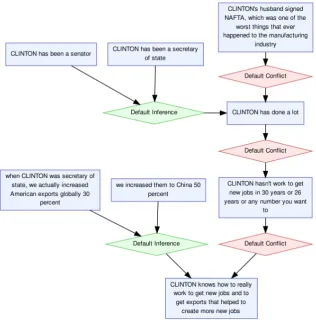
Central issues are those that play a particularly im-portant role in the argumentative structure. For example, in Figure 1, we can see that the node “CLINTON knows how to really work to get new jobs...” is intuitively more central to the dialogue, being the point which all of the others are respond-ing to, than the node “CLINTON’s husband signed NAFTA...”.
Words I-nodes RA-nodes CA-nodes
Televised Debate 17,190 1,473 505 79
Reddit Reaction 12,694 1,279 377 242
[image:4.595.132.469.65.117.2]Total (US2016G1 Corpus) 29,884 2,752 901 347
Table 2: US 2016 General Presidential Debate Corpora statistics, listing word counts, propositions (I-nodes), supporting arguments (RAs) and conflicts (CAs).
I-node, we adapt eigenvector centrality (used in the Google Pagerank algorithm (Brin and Page, 1998)). This measure is closer to intuitions about claim centrality in arguments than alternative mea-sures such as the Estrada index (Estrada,2000) de-spite the latter’s wide applicability. We have not found the Estrada index an informative measure for debate structure.
First, we consider the complete AIF struc-ture as a directed graph, G = (V, E), in which vertices (V) are either propositions, locu-tions or relalocu-tions between proposilocu-tions; and those relations are either support, conflict, rephrase, illocution or transition, captured by a func-tion R which maps V 7→ {prop, loc, support, conflict, rephrase, illocution, transition} and edges exist between themE⊂V ×V.
From this we build the subgraph corresponding only to vertices connected by support or conflict relationships, which we callGl= (Vl, El), where
Vl = {v ∈ V : R(V) ∈ {support, conflict}}
and ∀vl ∈ Vl, if(vl, v0) ∈ E, then,(vl, v0) ∈
Eland if(v0, vl)∈E, then,(v0, vl)∈El. We can
then define eigencentrality overGlas in Equation
1, whereλis a constant representing the greatest eigenvalue for which a non-zero eigenvector solu-tion exists.
Central(v) =def 1λ
X
v0∈Vl s.t.(v,v0)∈El
Central(v0)
(1) This results in a centrality score for each propo-sition, from which we can rank the propositions by how central they are to the debate. The top four ranked central propositions are listed below:
• CLINTON could encourage them by giving them tax incentives, for example
• there is/is not any way that the president can force profit sharing
• CLINTON also wants to see more companies do profit-sharing
• CLINTON is hinting at tax incentives It is encouraging that these issues all concern the economy, which Pew Research identified as the single most important issue to voters (with 84% of voters ranking it as “very important”) in the 2016 US presidential elections4.
4.2 Divisiveness
Divisive issues are those that split opinion and which have points both supporting and attacking them (Konat et al., 2016). Looking again at Fig-ure1, we can see that the node “CLINTON knows how to really work to get new jobs...” is not only central, but also divisive, with both incom-ing support and conflict. At the opposite end of the scale, the node “CLINTON has been a secretary of state”, is not divisive; such factual statements are unlikely to be disputed by anyone on either side of the debate.
The Divisiveness of an issue measures how many others are in conflict with it and the amount of support which the two sides have. By this mea-sure, every propositionv2which is in conflict with
v (i.e. for which there is an edge either outgo-ing from v through a conflict vc tov2, or in the
other direction, or both) is assessed for its support in comparison to that for v and the sum over all suchv2yields an overall measure of Divisiveness
as shown in Equation 2, in which|v|in
R(v)refers to
theinorder of vertex v where constraintR(v)is met.
Again we list the top four ranked divisive is-sues below, and it is certainly easy to see how such statements on the character of the candidates, the validity of their claims and controversial issues such as gun control could easily divide those com-menting on the debate:
• TRUMP settled that lawsuit with no admis-sion of guilt
• I still support hand guns though
Figure 1: Fragment of Manually Analysed Argumentative Structure from the US 2016 General Presiden-tial Debate Corpus. The nodes shown in this graph have been filtered to display only the propositional text spans (I-nodes shown as rectangles) and the support and conflict relations between them (RA and CA nodes shown as diamonds).
Divisive(v) =def
X
∀v2∈V s.t. [(v2,vc),(vc,v)∈E∨ (v,vc),(vc,v2)∈E]∧
R(vc)=conflict |v|in
R(v0)=support∗ |v2|inR(v0)=support
(2)
• people have looked at both of our plans, have concluded that CLINTON’s would create 10 million jobs and TRUMP’s would lose us 3.5 million jobs
• CLINTON didn’t realize coming off as a snarky teenager isn’t a good look either
5 Automating the Identification of Large Scale Argument Graph Properties
In this section we investigate techniques to auto-matically rank text fragments by their centrality and divisiveness with no prior knowledge of the argumentative structure contained within the text. In each case, we take the manually segmented
propositions from our corpus and apply techniques to rank these, we then compare the resulting rank-ings to the ranking determined from the manually analysed argument structures as described in Sec-tion4.
5.1 Automatic Identification of Centrality
to really work to get newjobsand to getexports
that...” is connected via support and attack rela-tions to nodes whose propositional contents are all related to jobs or exports. The remaining nodes in this example fragment all discuss more distant concepts, such as Clinton’s experience.
We consider a range of methods for determin-ing semantic similarity and in each case use these as the edge weights in an automatically generated similarity graph. We can then consider centrality to be determined by high similarity to the great-est number of other nodes. As such, we can use TextRank (Mihalcea and Tarau,2004) to produce a centrality ranking directly from the text and com-pare this to the ranking obtained from the argu-mentative structure.
The first approach to determining similarity that we consider is calculated as the number of com-mon words between the two propositions, based on the method proposed by Mihalcea and Tarau (2004) for ranking sentences. Formally, given two propositionsPi and Pj, with a proposition being
represented by the set ofNi words that appear in
the propositionPi =wi1, wi2, ..., wiNi, the
similar-ity ofPiandPj is defined as:
Similarity(Pi, Pj) = |{wlogk|w(|kP∈Pi∧wk∈Pj}| i|) +log(|Pj|)
(3) Whilst this approach is sufficient to determine similarity in the example discussed above, it is re-liant on the exact same words appearing in each proposition. In order to allow for the use of syn-onyms and related terms in the dialogue, we con-sider several further measures of semantic similar-ity.
The first of these approaches uses WordNet (Miller, 1995) to replace the binary matching of words in the method above with the distance be-tween the synsets of each word. This value is in-versely proportional to the number of nodes along the shortest path between the synsets. The short-est possible path occurs when the two synsets are the same, in which case the length is 1, giving the same result for exactly matching words.
We also tested two further methods of deter-mining semantic similarity which have both been shown to perform robustly when using models trained on large external corpora (Lau and Bald-win,2016).
The first of these approaches uses word2vec
(Mikolov et al., 2013), an efficient neural ap-proach to learning high-quality embeddings for words. Due to the relatively small size of our train-ing dataset, we used pre-trained skip-gram vectors trained on part of the Google News dataset5. This
model contains 300-dimensional vectors for 3 mil-lion words and phrases obtained using a simple data-driven approach described in Mikolov et al. (2013).
To determine similarity between propositions, we located the centroid of the word embeddings for each by averaging the word2vec vectors for the individual words in the proposition, and then cal-culating the cosine similarity between centroids to represent the proposition similarity.
The final approach which we implemented uses a doc2vec (Le and Mikolov,2014) distributed bag of words (dbow) model to represent every propo-sition as a vector with 300 dimensions. Again, we then calculated the cosine similarity between vec-tors to represent the proposition similarity.
For each of the methods described above, we applied the ranking algorithm to give an ordered list of propositions, we then compared the ranking obtained by each to the centrality ranking calcu-lated for the manually annotated argument struc-ture, as described in Section 4, by calculating the Kendall rank correlation coefficient (Kendall, 1938). The results for each method are shown in Table3. In each case the results show a correla-tion between the rankings (p <0.05) suggesting that all of these methods are able to approximate the centrality of propositions in the argumentative structure. In Section6we explore these results fur-ther and show that these approximations are in all cases sufficient to improve the automatic extrac-tion of the argumentative structure directly from the original text.
5.2 Automatic Identification of Divisiveness
Whilst divisiveness is a related concept to central-ity, it is more challenging to determine directly from the text, as we need to not only locate those nodes that are most discussed, but also to limit this to those which are involved in conflict relations.
Here we implement a method of determining conflict relations using SentiWordNet6, a lexical
resource for opinion mining. SentiWordNet as-signs a triple of polarity scores to each synset of
5https://code.google.com/archive/p/ word2vec/
Similarity Method Kendallτ Common words 0.524 WordNet Synsets 0.656
Word2vec 0.618
[image:7.595.107.260.61.131.2]Doc2vec 0.620
Table 3: The Kendall rank correlation coefficient (τ) for the rankings determined using TextRank for each method of determining semantic similar-ity compared to the Centralsimilar-ity ranking obtained from the manually annotated argument structure.
WordNet, a positivity, negativity and objectivity score. The sum of these scores is always 1. For example, the triple (1, 0, 0) (positivity, negativity, objectivity) is assigned to the synset of the word “good”.
Each proposition (I-node), is split into words and each word is stemmed and tagged, and stop words are removed. If a stemmed word belongs to one of the word classes “adjective”, “verb” or “noun”, its polarity scores are looked up in Sen-tiWordNet. Where a word has multiple synsets, each of the polarity scores for that word are av-eraged across all of its synsets. The scores of all words within a sentence are then summed and di-vided by the number of words with scores to give a resulting triple of {positivity, negativity, objec-tivity}values for each proposition.
Having calculated the polarity triples for each proposition, we are then able to calculate the dif-ference in polarity between two propositions, Pi
andPj as in equation 4.
We compute these differences in polarity for each pair of propositions in the corpus and then, for each of the methods of determining similar-ity discussed in the previous Subsection, multiply the similarity scores by the polarity difference to obtain a value representing the likelihood of con-flict between the two. Finally for each proposition, we mirror the method of computing divisiveness from the argument graph. To do this, we look at each proposition, and take the sum of the central-ity scores multiplied by the conflict value for each other proposition.
Following this approach for each method of determining similarity again gives us a ranking which we can then compare to the divisiveness ranking calculated for the manually annotated ar-gument structure, as described in Section 4. For each approach, we again calculate the Kendall
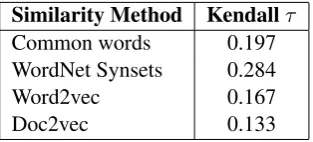
rank correlation coefficient. These results are shown in Table4. We can see from these results that whilst there is still a positive correlation be-tween the rankings, these are substantially less sig-nificant than those obtained for the centrality rank-ings. In the next Section we investigate whether these values are sufficient to have a positive im-pact on the argument mining task.
Similarity Method Kendallτ Common words 0.197 WordNet Synsets 0.284
Word2vec 0.167
Doc2vec 0.133
Table 4: The Kendall rank correlation coefficient (τ) for the Divisiveness rankings for each method of determining semantic similarity compared to the Divisiveness ranking obtained from the man-ually annotated argument structure.
6 Validation: Applying Automatically Identified Centrality and Divisiveness Scores to Argument Mining
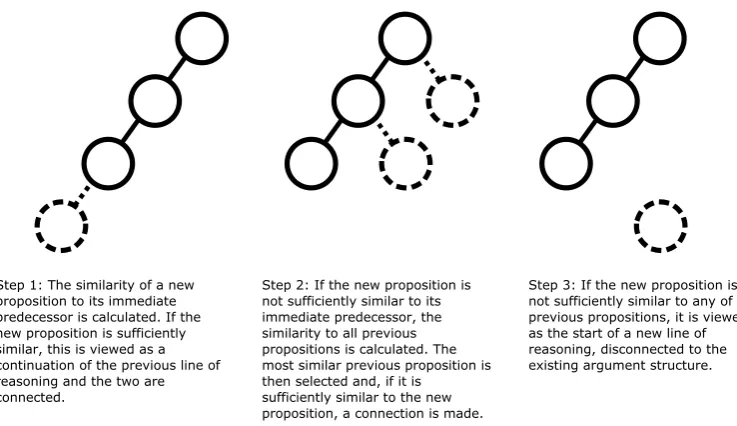
Our final step is to validate both our concepts of centrality and divisiveness as calculated from an-notated argument structures and our methods of calculating these same metrics directly from unan-notated text. To do this, we adapt the “Topical Similarity” argument mining technique presented in (Lawrence et al., 2014), where it is assumed firstly that the argument structure to be determined can be represented as a tree, and secondly, that this tree is generated depth first. That is, the con-clusion is given first and then a line of reason-ing is followed supportreason-ing this conclusion. Once that line of reasoning is exhausted, the argument moves back up the tree to support one of the pre-viously made points. If the current point is not related to any of those made previously, then it is assumed to be disconnected and possibly the start of a new topic.
[image:7.595.339.496.184.255.2]P olarity(Pi, Pj) = |positivity(Pi)−positivity(Pj)|+2|negativity(Pi)−negativity(Pj)| (4)
all of those statements made previously and con-nected to the most similar previous point. Finally, if the current point is not related to any of those made previously, then it is assumed to be discon-nected from the existing structure. This process is illustrated in Figure2.
Lawrence et al. perform these comparisons using a Latent Dirichlet Allocation (LDA) topic model. In our case, however, the argument struc-tures we are working with are from much shorter pieces of text and as such generating LDA topic models from them is not feasible. To achieve the same task, we use the same semantic similarity measures described in Section5. As in (Lawrence et al.,2014), the threshold required for two propo-sitions to be considered sufficiently similar can be adjusted, altering the output structure, with a lower threshold giving more direct connections and a higher threshold greater branching and more un-connected components.
We first carried out this process for each method of computing semantic similarity using the same methodology as Lawrence et al. We then adapted Step 2 from Figure 2 by considering all of the previous propositions as potential candidate tures and, having produced these candidate struc-tures calculated the Centrality and Divisiveness rankings for each structure as described in Sec-tion4. Finally we computed the Kendall rank cor-relation coefficient comparing the centrality rank-ing of each candidate structure to the rankrank-ing com-puted only using similarity (as described in Sec-tion5) and selected the structure which maximised the rank correlation.
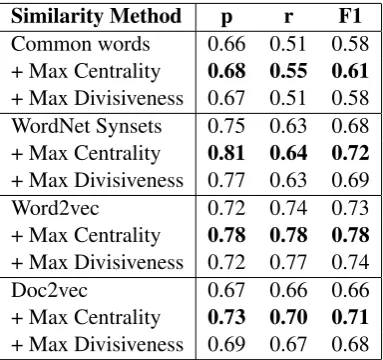
Table 5 shows the precision, recall and F1-scores for automatically determining connections in the argumentative structure using each semantic similarity measure combined with maximising the rank correlations for centrality and divisiveness. We can see from these results that maximising di-visiveness results in small increases in accuracy, and in all cases maximising centrality results in in-creased accuracy in determining connections, with increases of 0.03–0.05 in F1-score demonstrated for all the methods considered.
7 Conclusion
In this paper we have presented two metrics, Cen-trality and Divisiveness, for describing the nature of propositions and their context within a large scale argumentative structure. We have shown how these metrics can be calculated from anno-tated argument structures and produced reliable estimations of these metrics that can be extracted directly from un-annotated text, with strong posi-tive correlations between both rankings.
Finally, we have shown how these metrics can be used to improve the accuracy of existing argu-ment mining techniques. By broadening the fo-cus of argument mining from specific facets, such as classifying as premise or conclusion, to look at features of the argumentative structure as a whole, we have presented an approach which can im-prove argument mining results either as a feature of existing techniques or as a part of a more ro-bust ensemble technique such as that presented in (Lawrence and Reed,2015).
Similarity Method p r F1
Common words 0.66 0.51 0.58 + Max Centrality 0.68 0.55 0.61
+ Max Divisiveness 0.67 0.51 0.58 WordNet Synsets 0.75 0.63 0.68 + Max Centrality 0.81 0.64 0.72
+ Max Divisiveness 0.77 0.63 0.69 Word2vec 0.72 0.74 0.73 + Max Centrality 0.78 0.78 0.78
+ Max Divisiveness 0.72 0.77 0.74 Doc2vec 0.67 0.66 0.66 + Max Centrality 0.73 0.70 0.71
+ Max Divisiveness 0.69 0.67 0.68
Table 5: Precision, recall and F1-scores for au-tomatically determining connections in the argu-mentative structure using each semantic similarity measure combined with Centrality and Divisive-ness.
Acknowledgments
[image:8.595.321.513.439.619.2]Step 1: The similarity of a new proposition to its immediate predecessor is calculated. If the new proposition is sufficiently similar, this is viewed as a continuation of the previous line of reasoning and the two are connected.
Step 2: If the new proposition is not sufficiently similar to its immediate predecessor, the similarity to all previous propositions is calculated. The most similar previous proposition is then selected and, if it is
sufficiently similar to the new proposition, a connection is made.
[image:9.595.110.479.57.270.2]Step 3: If the new proposition is not sufficiently similar to any of the previous propositions, it is viewed as the start of a new line of reasoning, disconnected to the existing argument structure.
Figure 2: The steps involved in determining how the argument structure is connected using the “Topical Similarity” argument mining technique presented in (Lawrence et al.,2014).
References
S. Brin and L. Page. 1998. The anatomy of a large-scale hypertextual web search engine. Comput. Net. ISDN Syst.30:107–117.
Carlos Ches˜nevar, Sanjay Modgil, Iyad Rahwan, Chris Reed, Guillermo Simari, Matthew South, Gerard Vreeswijk, Steven Willmott, et al. 2006. Towards an argument interchange format. The Knowledge Engi-neering Review21(04):293–316.
Jacob Cohen. 1960. A coefficient of agreement for nominal scales. Edu. Psychol. Meas.20:37–46. Rory Duthie, John Lawrence, Katarzyna Budzynska,
and Chris Reed. 2016. The CASS technique for evaluating the performance of argument mining. In Proceedings of the 3rd Workshop on Argumentation Mining. Association for Computational Linguistics, Berlin.
Ernesto Estrada. 2000. Characterization of 3d molecu-lar structure. Chemical Physics Letters319(5):713– 718.
Vanessa Wei Feng and Graeme Hirst. 2011. Clas-sifying arguments by scheme. In Proceedings of the 49th Annual Meeting of the Association for Computational Linguistics: Human Language Technologies-Volume 1. Association for Computa-tional Linguistics, pages 987–996.
Graeme Hirst and Vanessa Wei Feng. 2015. Automatic exploration of argument and ideology political texts. In1st European Conference on Argumentation (ECA 2015). pages 493–504.
Mathilde Janier, John Lawrence, and Chris Reed. 2014. OVA+: An argument analysis interface. In S. Par-sons, N. Oren, C. Reed, and F. Cerutti, editors,
Proceedings of the Fifth International Conference on Computational Models of Argument (COMMA 2014). IOS Press, Pitlochry, pages 463–464.
Maurice G Kendall. 1938. A new measure of rank cor-relation. Biometrika30(1/2):81–93.
Barbara Konat, John Lawrence, Joonsuk Park, Katarzyna Budzynska, and Chris Reed. 2016. A cor-pus of argument networks: Using graph properties to analyse divisive issues. InProceedings of the 10th edition of the Language Resources and Evaluation Conference.
J Richard Landis and Gary G Koch. 1977. The mea-surement of observer agreement for categorical data. Biometrics3:159–174.
Jey Han Lau and Timothy Baldwin. 2016. An empiri-cal evaluation of doc2vec with practiempiri-cal insights into document embedding generation. arXiv preprint arXiv:1607.05368.
John Lawrence, Rory Duthie, Katarzyna Budzysnka, and Chris Reed. 2016. Argument analytics. In P. Baroni, M. Stede, and T. Gordon, editors, Proceedings of the Sixth International Conference on Computational Models of Argument (COMMA 2016). IOS Press, Berlin.
John Lawrence and Chris Reed. 2015. Combining ar-gument mining techniques. In Proceedings of the 2nd Workshop on Argumentation Mining. Associ-ation for ComputAssoci-ational Linguistics, Denver, CO, pages 127–136.
First Workshop on Argumentation Mining. Asso-ciation for Computational Linguistics, Baltimore, Maryland, pages 79–87.
Quoc V Le and Tomas Mikolov. 2014. Distributed rep-resentations of sentences and documents. InICML. volume 14, pages 1188–1196.
Rada Mihalcea and Paul Tarau. 2004. Textrank: Bring-ing order into texts. In Proceedings of EMNLP 2004. Association for Computational Linguistics, pages 404–411.
Tomas Mikolov, Ilya Sutskever, Kai Chen, Greg S Cor-rado, and Jeff Dean. 2013. Distributed representa-tions of words and phrases and their compositional-ity. InAdvances in neural information processing systems. pages 3111–3119.
George A Miller. 1995. Wordnet: a lexical database for english. Communications of the ACM 38(11):39– 41.
Marie-Francine Moens, Erik Boiy, Raquel M. Palau, and Chris Reed. 2007. Automatic detection of argu-ments in legal texts. InProceedings of the 11th in-ternational conference on Artificial intelligence and law. ACM, pages 225–230.
Raquel M. Palau and Marie-Francine Moens. 2009. Argumentation mining: the detection, classification and structure of arguments in text. InProceedings of the 12th international conference on artificial in-telligence and law. ACM, pages 98–107.
Joonsuk Park and Claire Cardie. 2014. Identifying appropriate support for propositions in online user comments. InProceedings of the First Workshop on Argumentation Mining. Association for Computa-tional Linguistics, Baltimore, Maryland, pages 29– 38.
Georgios Petasis and Vangelis Karkaletsis. 2016. Iden-tifying argument components through textrank. In Proceedings of the 3rd Workshop on Argumentation Mining. Association for Computational Linguistics, Berlin.
Chris Reed, Simon Wells, Katarzyna Budzynska, and Joseph Devereux. 2010. Building arguments with argumentation: the role of illocutionary force in computational models of argument. In P. Baroni, F. Cerutti, M. Giacomin, and G.R. Simari, editors, Proceedings of the 3rd International Conference on Computational Models of Argument (COMMA 2010). IOS Press, pages 415–426.
Frans H. van Eemeren, Bart Garssen, Eric C.W. Krabbe, A.Francisca Snoeck Henkemans, Bart Ver-heij, and Jean H.M. Wagemans. 2014. Handbook of Argumentation Theory. Springer.
Henning Wachsmuth, Benno Stein, and Yamen Ajjour. 2017. pagerank for argument relevance. In Pro-ceedings of the 15th Conference of the European Chapter of the Association for Computational Lin-guistics. volume 1, pages 1117–1127.