Inflection Generation for Spanish Verbs using Supervised Learning
Cristina Barros Department of Software and Computing Systems University of Alicante
Apdo. de Correos 99 E-03080, Alicante, Spain [email protected]
Dimitra Gkatzia School of Computing Edinburgh Napier University
Edinburgh, EH10 5DT, UK [email protected]
Elena Lloret Department of Software and Computing Systems University of Alicante
Apdo. de Correos 99 E-03080, Alicante, Spain [email protected]
Abstract
We present a novel supervised approach to inflection generation for verbs in Span-ish. Our system takes as input the verb’s lemma form and the desired features such as person, number, tense, and is able to predict the appropriate grammatical conju-gation. Even though our approach learns from fewer examples comparing to pre-vious work, it is able to deal with all the Spanish moods (indicative, subjunc-tive and imperasubjunc-tive) in contrast to previous work which only focuses on indicative and subjunctive moods. We show that in an intrinsic evaluation, our system achieves 99% accuracy, outperforming (although not significantly) two competitive state-of-art systems. The successful results ob-tained clearly indicate that our approach could be integrated into wider approaches related to text generation in Spanish.
1 Introduction
Existing Natural Language Generation (NLG) ap-proaches are usually applied to non morphological rich languages, such as English, where the mor-phological inflection of the word during the gener-ation process can be addressed using simple hand-written rules or existing libraries such as Sim-pleNLG (Gatt and Reiter,2009). In contrast, when it comes to morphological rich languages, such as Spanish, the use of rules can lead to incorrect in-flection of a word, thus generating ungrammatical or meaningless texts. Our ultimate goal is to im-plement a morphological inflection approach for Spanish sentences within an NLG system based on the use of lexicons. However, lexicons lack some verbs’ information, specifically, regarding gram-matical moods (i.e., the gramgram-matical features of
verbs used for denoting modality - statement of facts, desires, commands, etc.). To create lexicons for all the verb inflections and moods would be a very time-consuming and costly task, so in this context the use of machine learning approaches can benefit the inflection of unseen verb forms. Based on this, the research challenge we tackle is defined as follows: given a Spanish verb in its base form (i.e., its lemma), we want to automati-cally generate all the inflections for that verb. This is very useful for tasks involving natural language generation (e.g., text generation, machine transla-tion), since the generated texts would sound more natural and grammatically correct.
Our contributions to the field are as follows: we present a novel and efficient method for tackling the challenge of inflection generation for Spanish verbs using an ensemble of algorithms; we pro-vide a high-quality dataset which includes inflec-tion rules of Spanish verbs for all the grammatical moods (i.e. indicative, subjunctive and imperative, being this last one do not tackled by the current approaches); our models are trained with fewer re-sources than the state-of-art methods; and finally, our method outperforms the state-of-the-art meth-ods achieving a 2% higher accuracy.
The rest of the paper is shaped as follows: In the next section (Section2) we refer to the related work on inflection generation. In Section 3, we describe the overall methodology and the dataset used to train our model. In Section4, we present a comparison to the state-of-art inflection genera-tion approaches and in Secgenera-tion 5, we discuss the results. Finally, in Section6, directions for future work are discussed.
2 Related Work
Morphological inflection has been addressed from different perspectives within the area of
tational Linguistics, commonly for morphological rich languages, such as German, Spanish, Finnish or Arabic, as well as less morphological rich lan-guages such as English.
Previous work has used supervised or semi-supervised learning (Durrett and DeNero, 2013;
Ahlberg et al.,2014;Nicolai et al.,2015;Faruqui et al., 2016) to learn from large datasets of mor-phological rules on word forms in order to ap-ply them to inflect the desired words. Other approaches have relied on linguistic informa-tion, such as morphemes and phonology ( Cot-terell et al., 2016); morphosyntactic disambigua-tion rules (Su´arez et al., 2005); and, graphical models (Dreyer and Eisner,2009).
Recently, the morphological inflection has been also addressed at SIGMORPHON 2016 Shared Task (Cotterell et al.,2016) where, given a lemma with its part-of-speech, a target inflected form had to be generated (task 1). This task was addressed through several approaches, including align and transduce (Alegria and Etxeberria, 2016; Nico-lai et al., 2016; Liu and Mao, 2016); recurrent neural networks (Kann and Sch¨utze, 2016; Aha-roni et al., 2016; ¨Ostling, 2016); and, linguistic-inspired heuristics approaches (Taji et al., 2016;
Sorokin, 2016). Overall, recurrent neural net-works approaches performed better, being (Kann and Sch¨utze,2016) the best performing system in the shared task, obtaining around 98%.
Furthermore, the work described here differs from existing statistical surface realisation meth-ods which use phrase-based learning (e.g., ( Kon-stas and Lapata, 2012)) since they do not usu-ally include morphological inflection. In this re-spect, our work is more similar to (Duˇsek and Jurˇc´ıˇcek, 2013), where the inflected word forms are learnt through multi-class logistic regression by predicting edit scripts. The aforementioned data-driven methods achieve high accuracy in pre-dicting the appropriate inflection by learning from huge datasets. For example, Durret and DeNero (2013) use 11400 amount of data (i.e. the total number of instances or rules used to predict the inflections of a verb). In contrast, we use almost half to train our system (4556 instances), and we achieve comparable or better results for Spanish. Finally, the work presented here relies on ensem-bles of classifiers which has been proved success-ful for content selection in data-to-text systems (Gkatzia et al.,2014).
3 Methodology
In order to perform the inflection task, we first created a dataset to be used for training machine learning algorithms to inflect verbs in Spanish. As part of this submission we will make our dataset freely available1. Then, we trained a model ca-pable of predicting the appropriate inflection of a verb automatically, given a verb base form. Next, each of the stages of the proposed approach are described in more detail.
3.1 Dataset Creation
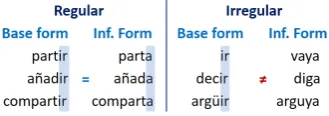
[image:2.595.332.497.352.410.2]For the purposes of this research, we created a par-allel dataset of Spanish base forms and their cor-responding inflected form. The Spanish verbs can be divided into regular and irregular verbs, where all the regular verbs share the same inflection pat-terns whereas, the irregular ones do not and can completely vary from one verb to another, as it is shown in Figure1.
Figure 1: Differences between regular and irregu-lar verbs in Spanish, for the first singuirregu-lar person of the present tense and in the subjunctive mood.
Therefore, we constructed a dataset, contain-ing the necessary examples of inflection for all the tenses in the Spanish language, by consulting theReal Academia Espa˜nola2and the
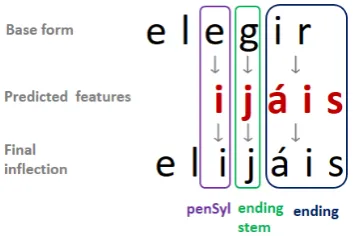
Enciclope-dia Libre Universal en Espa˜nol3. We further con-sidered that a verb can be divided in three parts: (1) ending, (2) ending stem, and (3)penSyl. An example is shown in Figure 2. This information will be later used as features within the dataset. In Spanish, the verbs can be classified depending on theirending, specifically, the verbs ended by “-ar”, “-er” and “-ir” belong to the first, second an third conjugation, respectively. Moreover, for the feature penSyl, the previous syllable of the end-ing, formed by the whole syllable, or its dominant vowel is extracted. Finally, theending stemis the closest consonant to the ending.
1Our dataset for the Spanish verbs inflection is available
here: https://github.com/cbarrosua/infDataset
2
http://www.rae.es/diccionario-panhispanico-de-dudas/apendices/modelos-de-conjugacion-verbal
Figure 2: Division of the Spanish verb to begin
and its inflection for the first singular person of the present tense and in the subjunctive mood.
Besides the previous features obtained from the verb, other features, such assuff1,suff2orstemC1
were included because in Spanish some verbs have several variations of an inflection for the same tense, person and number. Therefore, our dataset is finally composed of the following features: (1)
ending, (2)ending stem, (3)penSyl, (4)person, (5)
number, (6) tense, (7) mood, (8) suff1, (9) suff2, (10)stemC1, (11)stemC2, (12)stemC3. In partic-ular,suff1andsuff2are the inflection predicted for the suffix of the verb form; andstemC1, stemC2
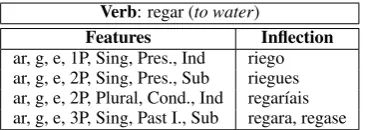
and stemC3, refer to the inflection predicted for the penSyl of the verb form. An example of an entry of the dataset is shown in Table1. Overall, there are 4556 possible inflections. An example of a verb and several of its inflections is shown in Table2.
3.2 Obtaining the Model and Reconstructing the Verb
As mentioned earlier, our learning task is formed as follows: given a set of 7 features, select the inflection which is most appropriate for the verb. The set of 7 features are as follows: (1) ending, (2)ending stem, (3)penSyl, (4)person, (5) num-ber, (6)tense, (7)mood. Using these features, we trained a group of individual models for each of the features described in Section 3.1, which rep-resents a potential inflection value. We used the WEKA (Frank et al.,2016) implementation of the Random Forest algorithm to train the models for thestemC3andstemC2features, and the Random Tree algorithm to train the models for the suff1,
suff2andstemC1features.
Once the models were trained, we predicted all the possible inflections given a verb in its base form, i.e., all the tenses for each mood in Span-ish. For accomplishing this task, we first anal-ysed the base form to extract the necessary
fea-tures for the inflection. In this manner, the base form was divided into syllables, taking the penul-timate one to obtain thepenSylfeature. Since all verbs in Spanish always end with “-ar”, “-er” and “-ir”, as described in the previous section, we split the last syllable into the endingandending stem
[image:3.595.327.504.266.384.2]features. Then, for each model we predicted its potential inflection using these extracted features combined with the ones related to the verb tense, i.e., the number, person, etc. Finally, the predicted inflections were employed to replace the features previously identified in the base form, leading to the reconstruction of the base form into the desired inflection, as it can be seen in Figure3.
Figure 3: Reconstruction of the verb elegir (to choose) with the features predicted by the models.
4 Experiments
We compared our system (RandFT) with two very competitive baselines described below by measur-ing the accuracy of their output for Spanish verb inflections. The baselines are as follows:
• Durret13: This system automatically ex-tracts the orthographic transformation rules of the morphology from labeled examples, and then learns which of those transforma-tions to apply in different contexts by us-ing a semi-Markov conditional random field (CRF) model.
• Ahlberg14: This system uses a semi-supervised approach to generalise inflection paradigms from inflection tables by using a finite-state construction.
We reproduced the experiments presented in
Durrett and DeNero(2013) and inAhlberg et al.
verb
pattern ending endingstem penSyl person number tense mood suff1 suff2 stemC1 stemC2 stemC3
amar arar ANYANY ANYANY 12 00 11 11 arasara asesase ANYANY ANYANY ANYANY
ar ANY ANY 3 0 1 1 ara ase ANY ANY ANY
yacer erer ANYANY yacyac 12 00 00 00 eso ANYANY yacyazc ANYyazg yagANY
[image:4.595.91.275.228.293.2]er ANY yac 3 0 0 0 e ANY yac ANY ANY
Table 1: Example of the 1st, 2nd and 3rd singular person of the subjunctive past tense of “amar” (to love); and the 1st, 2nd and 3rd singular person of present tense in indicative mood of “yacer” (to lie). We assigned the termANYto indicate that the value of a feature does not need to change during the inflection with respect to its value in the base form.
Verb: regar (to water)
Features Inflection
ar, g, e, 1P, Sing, Pres., Ind riego ar, g, e, 2P, Sing, Pres., Sub riegues ar, g, e, 2P, Plural, Cond., Ind regar´ıais ar, g, e, 3P, Sing, Past I., Sub regara, regase Table 2: Example of some possible inflections for the verb “regar” (to water) (Pres. = present; Cond. = conditional; Past I. = imperfect past; Ind = In-dicative; Sub = subjunctive).
by Durrett and DeNero(2013), since this test set included verbs with both uncommon and regular forms. This test set does not included any entry that appeared in the training data. For the experi-ments, we generated all the verb inflections for the 200 base forms. Furthermore, the aforementioned baselines do not predict all the grammatical moods that exist in the Spanish language (both baselines are only able to predict the indicative and subjunc-tive mood, but not the imperasubjunc-tive one, which is not easy, especially for irregular forms). There-fore, we used an additional test-set to evaluate this grammatical mood. We created the additional test-set by employing information from the Freeling’s lexicon for the imperative forms of these 200 verbs (Padr´o and Stanilovsky,2012).
5 Results and Discussion
The results obtained, together with the results of
Durrett and DeNero (2013) and Ahlberg et al.
(2014), are shown in Table3, where we compared the inflection of the same verb tenses as Durret and Ahlberg using the test set described in the previous section. Our group of classifiers (RandFT), trained with our generalised dataset for Spanish, obtained a higher overall accuracy (but not significantly) re-garding the state-of-the-art baselines systems.
In addition, our model can correctly perform the
Approach Correctly pre-dicted verb ta-bles
Correctly pre-dicted verb forms
RandFT 99% 99.98%
Durret13 97% 99.76%
Ahlberg14 96% 99.52%
Table 3: Accuracy of predicting inflection of verb tables and individual verb forms given only the base form, evaluated with an unseen test set of 200 verbs. For the imperative mood, our system achieves 100% accuracy, however the baselines do not predict the imperative form.
inflection of the imperative mood, which was not included in the baseline systems. This grammat-ical mood, which forms commands or requests, contains unique imperative forms among the irreg-ular Spanish verbs, as shown in Table4. For this experiment, our system achieves 100% accuracy when evaluated on the additional test set. Further-more, our model contributes to the improvement of naturalness and expressivity of NLG (Barros et al.,2017).
Base form–Inflected form
contar–cuenta;errar–yerra;haber–he;hacer–haz;oler– huele;ir–ve;o´ır–oye;decir–di
Table 4: Variability of inflection in the imperative mood for the 2nd person singular of the present.
[image:4.595.315.520.228.292.2]6 Conclusion and Future Work
This paper presented a robust light-weight super-vised approach to obtain the inflected forms of any Spanish verb for any of its moods (indica-tive, subjunctive and imperative). This approach uses an ensemble of supervised learning algo-rithms to learn how the verbs are composed in order to obtain the inflection of a verb given its base form. Our method obtained accuracy close to 100%, outperforming existing state-of-the-art ap-proaches. In addition, our method is able to fur-ther predict the inflection of the imperative mood, which was not tackled by previous work. In fu-ture, we plan to test our inflection approach for other languages, as well as other types of words (not only verbs). Furthermore, we also plan to compare this approach with the ones obtaining the best results (i.e. the ones employing recurrent neu-ral networks) in the reinflection task of the SIG-MORPHON 2016 Shared Task. Our short-term goal would be to integrate it within a surface reali-sation method, which will allow us to inflect whole sentences in different ways and tenses, thus im-proving the generation capabilities of current NLG systems.
Acknowledgments
This research work has been partially funded by the Generalitat Valenciana through the projects “DIIM2.0: Desarrollo de t´ecnicas In-teligentes e Interactivas de Miner´ıa y generaci´on de informaci´on sobre la web 2.0” (PROME-TEOII/2014/001); and partially funded by the Spanish Government through projects TIN2015-65100-R, TIN2015-65136-C2-2-R, as well as by the project “An´alisis de Sentimientos Aplicado a la Prevenci´on del Suicidio en las Redes Sociales (ASAP)” funded by Ayudas Fundaci´on BBVA a equipos de investigaci´on cient´ıfica.
References
Roee Aharoni, Yoav Goldberg, and Yonatan Belinkov. 2016. Improving sequence to sequence learning for morphological inflection generation: The biu-mit systems for the sigmorphon 2016 shared task
for morphological reinflection. In Proceedings of
the 14th Annual SIGMORPHON Workshop on Com-putational Research in Phonetics, Phonology, and Morphology. Association for Computational Lin-guistics, pages 41–48.
Malin Ahlberg, Markus Forsberg, and Mans Hulden.
2014. Semi-supervised learning of morphological
paradigms and lexicons. InProceedings of the 14th
Conference of the European Chapter of the Associa-tion for ComputaAssocia-tional Linguistics. pages 569–578. I˜naki Alegria and Izaskun Etxeberria. 2016. Ehu at
the sigmorphon 2016 shared task. a simple proposal:
Grapheme-to-phoneme for inflection. In
Proceed-ings of the 14th Annual SIGMORPHON Workshop on Computational Research in Phonetics, Phonol-ogy, and Morphology. Association for Computa-tional Linguistics, pages 27–30.
Cristina Barros, Dimitra Gkatzia, and Elena Lloret. 2017. Improving the naturalness and expressivity of
language generation for spanish. InProceedings of
the 10th International Conference on Natural Lan-guage Generation (INLG).
Ryan Cotterell, Christo Kirov, John Sylak-Glassman, David Yarowsky, Jason Eisner, and Mans Hulden.
2016. The sigmorphon 2016 shared task—
morphological reinflection. In Proceedings of the
2016 Meeting of SIGMORPHON. Association for Computational Linguistics.
Markus Dreyer and Jason Eisner. 2009. Graphical models over multiple strings. InProceedings of the 2009 Conference on Empirical Methods in Natural Language Processing: Volume 1 - Volume 1. Associ-ation for ComputAssoci-ational Linguistics, pages 101–110. Greg Durrett and John DeNero. 2013. Supervised learning of complete morphological paradigms. In
Proceedings of the North American Chapter of the Association for Computational Linguistics. pages 1185–1195.
Ondˇrej Duˇsek and Filip Jurˇc´ıˇcek. 2013. Robust multi-lingual statistical morphological generation models. In51st Annual Meeting of the Association for Com-putational Linguistics: Proceedings of the Student Research Workshop. Association of Computational Linguistics, pages 158–164.
Manaal Faruqui, Yulia Tsvetkov, Graham Neubig, and Chris Dyer. 2016. Morphological inflection gener-ation using character sequence to sequence
learn-ing. InNAACL HLT 2016, The 2016 Conference of
the North American Chapter of the Association for Computational Linguistics: Human Language Tech-nologies. pages 634–643.
Eibe Frank, Mark A. Hall, and Ian H. Witten. 2016.
The WEKA Workbench. Online Appendix for ”Data Mining: Practical Machine Learning Tools and Techniques”. Morgan Kaufmann, 4 edition. Albert Gatt and Ehud Reiter. 2009. Simplenlg: A
re-alisation engine for practical applications. In Pro-ceedings of the 12th European Workshop on Natural Language Generation (ENLG).
reinforcement learning for summarisation of time-series data. In52nd Annual Meeting of the Associa-tion for ComputaAssocia-tional Linguistics (ACL).
Katharina Kann and Hinrich Sch¨utze. 2016. Med: The lmu system for the sigmorphon 2016 shared
task on morphological reinflection. InProceedings
of the 14th SIGMORPHON Workshop on Computa-tional Research in Phonetics, Phonology, and Mor-phology. Association for Computational Linguistics, pages 62–70.
Ioannis Konstas and Mirella Lapata. 2012. Concept-to-text generation via discriminative reranking. In
Proceedings of the 50th Annual Meeting of the As-sociation for Computational Linguistics. pages 369– 378.
Ling Liu and Lingshuang Jack Mao. 2016. Morpho-logical reinflection with conditional random fields
and unsupervised features. In Proceedings of the
14th Annual SIGMORPHON Workshop on Com-putational Research in Phonetics, Phonology, and Morphology. Association for Computational Lin-guistics, pages 36–40.
Garrett Nicolai, Colin Cherry, and Grzegorz Kondrak. 2015. Inflection generation as discriminative string
transduction. InNAACL HLT 2015, The 2015
Con-ference of the North American Chapter of the Asso-ciation for Computational Linguistics: Human Lan-guage Technologies. pages 922–931.
Garrett Nicolai, Bradley Hauer, Adam St. Arnaud, and Grzegorz Kondrak. 2016. Morphological rein-flection via discriminative string transduction. In
Proceedings of the 14th Annual SIGMORPHON Workshop on Computational Research in Phonetics, Phonology, and Morphology. Association for Com-putational Linguistics, pages 31–35.
Robert ¨Ostling. 2016. Morphological reinflection with
convolutional neural networks. In Proceedings of
the 14th SIGMORPHON Workshop on Computa-tional Research in Phonetics, Phonology, and Mor-phology. Association for Computational Linguistics, pages 23–26.
Llu´ıs Padr´o and Evgeny Stanilovsky. 2012. Freeling
3.0: Towards wider multilinguality. InProceedings
of the Eight International Conference on Language Resources and Evaluation.
Alexey Sorokin. 2016. Using longest common sub-sequence and character models to predict word
forms. InProceedings of the 14th SIGMORPHON
Workshop on Computational Research in Phonetics, Phonology, and Morphology. Association for Com-putational Linguistics, pages 54–61.
Octavio Santana Su´arez, Jos´e Rafael P´erez Aguiar, Luis Javier Losada Garc´ıa, and Francisco Javier Car-reras Riudavets. 2005. Spanish morphosyntactic
disambiguator. In Proceedings of the Association
for Computers and the Humanities and the Associ-ation for Literary and Linguistic Computing. pages 201–204.