Can string kernels pass the test of time in Native Language Identification?
Radu Tudor Ionescu∗ and Marius Popescu∗
University of Bucharest Department of Computer Science 14 Academiei, Bucharest, Romania
[email protected] [email protected]
Abstract
We describe a machine learning approach for the 2017 shared task on Native Lan-guage Identification (NLI). The proposed approach combines several kernels using multiple kernel learning. While most of our kernels are based on character
p-grams (also known as n-grams) ex-tracted from essays or speech transcripts, we also use a kernel based on i-vectors, a low-dimensional representation of au-dio recordings, provided by the shared task organizers. For the learning stage, we choose Kernel Discriminant Analy-sis (KDA) over Kernel Ridge Regression (KRR), because the former classifier ob-tains better results than the latter one on the development set. In our previ-ous work, we have used a similar ma-chine learning approach to achieve state-of-the-art NLI results. The goal of this paper is to demonstrate that our shallow and simple approach based on string ker-nels (with minor improvements) can pass the test of time and reach state-of-the-art performance in the 2017 NLI shared task, despite the recent advances in natu-ral language processing. We participated in all three tracks, in which the competi-tors were allowed to use only the essays (essay track), only the speech transcripts (speech track), or both (fusion track). Us-ing only the data provided by the orga-nizers for training our models, we have reached a macro F1 score of 86.95% in
the closed essay track, a macro F1 score
of87.55%in the closed speech track, and a macroF1 score of93.19%in the closed ∗The authors have equally contributed to this work.
fusion track. With these scores, our team (UnibucKernel) ranked in the first group of teams in all three tracks, while attain-ing the best scores in the speech and the fusion tracks.
1 Introduction
Native Language Identification (NLI) is the task of identifying the native language (L1) of a person, based on a sample of text or speech they have pro-duced in a language (L2) other than their mother tongue. This is an interesting sub-task in forensic linguistic applications such as plagiarism detec-tion and authorship identificadetec-tion, where the native language of an author is just one piece of the puz-zle (Estival et al.,2007). NLI can also play a key role in second language acquisition (SLA) appli-cations where NLI techniques are used to identify language transfer patterns that help teachers and students focus feedback and learning on particu-lar areas of interest (Rozovskaya and Roth,2010; Jarvis and Crossley,2012).
In 2013, Tetreault et al. (2013) organized the first NLI shared task, providing the participants written essays of non-native English learners. In 2016, the Computational Paralinguistics Chal-lenge (Schuller et al.,2016) included a shared task on NLI based on the spoken response of non-native English speakers. The 2017 NLI shared task (Malmasi et al., 2017) attempts to combine these approaches by including a written response (essay) and a spoken response (speech transcript and i-vector acoustic features) for each subject. Our team (UnibucKernel) participated in all three tracks proposed by the organizers of the 2017 NLI shared task, in which the competitors were al-lowed to use only the essays (closed essay track), only the speech transcripts (closed speech track), or both modalities (closed fusion track).
Our approach in each track combines two or
more kernels using multiple kernel learning. The first kernel that we considered is thep-grams pres-ence bits kernel1, which takes into account only the presence ofp-grams instead of their frequency. The second kernel is the (histogram) intersection string kernel2, which was first used in a text min-ing task by Ionescu et al. (2014). While these kernels are based on characterp-grams extracted from essays or speech transcrips, we also use an RBF kernel (Shawe-Taylor and Cristianini,2004) based on i-vectors (Dehak et al., 2011), a low-dimensional representation of audio recordings, made available by the 2017 NLI shared task orga-nizers (Malmasi et al.,2017). We have also con-sidered squared RBF kernel versions of the string kernels and the kernel based on i-vectors. We have taken into consideration two kernel classi-fiers (Shawe-Taylor and Cristianini,2004) for the learning task, namely Kernel Ridge Regression (KRR) and Kernel Discriminant Analysis (KDA). In a set of preliminary experiments performed on the development set, we found that KDA gives bet-ter results than KRR, which is consistent with our previous work (Ionescu et al.,2014,2016). There-fore, we decided to submit results using just the KDA classifier. We have also tuned the range of
p-grams for the string kernels. Using only the data provided by the organizers for training our models, we have reached a weighted F1 score of86.95%
in the essay track, a weightedF1 score of87.55%
in the speech track, and a weighted F1 score of
93.19%in the fusion track.
The first time we used string kernels for NLI, we placed third in the 2013 NLI shared task (Popescu
and Ionescu, 2013). In 2014, we improved
our method and reached state-of-the-art perfor-mance (Ionescu et al.,2014). More recently, we have shown that our method is language indepen-dent and robust to topic bias (Ionescu et al.,2016). However, with all the improvements since 2013, our method remained a simple and shallow ap-proach. In spite of its simplicity, the aim of this paper is to demonstrate that our approach can still achieve state-of-the-art NLI results, 4 years after its conception.
The paper is organized as follows. Related work on native language identification and string ker-nels is presented in Section2. Section3presents 1We computed thep-grams presence bits kernel using the
code available at http://string-kernels.herokuapp.com.
2We computed the intersection string kernel using the
code available at http://string-kernels.herokuapp.com.
the kernels that we used in our approach. The learning methods used in the experiments are de-scribed in Section4. Details about the NLI exper-iments are provided in Section5. Finally, we draw conclusions and discuss future work in Section6.
2 Related Work
2.1 Native Language Identification
As defined in the introduction, the goal of auto-matic native language identification (NLI) is to de-termine the native language of a language learner, based on a piece of writing or speech in a foreign language. Most research has focused on identify-ing the native language of English language learn-ers, though there have been some efforts recently to identify the native language of writing in other languages, such as Chinese (Malmasi and Dras, 2014b) or Arabic (Malmasi and Dras,2014a).
The first work to study automated NLI was that ofTomokiyo and Jones (2001). In their study, a Na¨ıve Bayes model is trained to distinguish speech transcripts produced by native versus non-native English speakers. A few years later, a second study on NLI appeared (Jarvis et al., 2004). In their work,Jarvis et al. (2004) tried to determine how well a Discriminant Analysis classifier could predict the L1 language of nearly five hundred English learners from different backgrounds. To make the task more challenging, they included pairs of closely related L1 languages, such as Por-tuguese and Spanish. The seminal paper by
Kop-pel et al. (2005) introduced some of the
best-performing features for the NLI task: character, word and part-of-speechn-grams along with fea-tures inspired by the work in the area of second language acquisition such as spelling and gram-matical errors. In general, most approaches to NLI have used multi-way classification with SVM or similar models along with a range of linguistic features. The book ofJarvis and Crossley(2012) presents some of the state-of-the-art approaches used up until 2012. Being the first book of its kind, it focuses on the automated detection of L2 language-use patterns that are specific to differ-ent L1 backgrounds, with the help of text classi-fication methods. Additionally, the book presents methodological tools to empirically test language transfer hypotheses, with the aim of explaining how the languages that a person knows interact in the mind.
first shared task in the field. This allowed re-searchers to compare approaches for the first time on a specifically designed NLI corpus that was much larger than previously available data sets. In the shared task,29teams submitted results for the test set, and one of the most successful aspects of the competition was that it drew submissions from teams working in a variety of research fields. The submitted systems utilized a wide range of machine learning approaches, combined with sev-eral innovative feature contributions. The best performing system in the closed task achieved an overall accuracy of83.6%on the 11-way classifi-cation of the test set, although there was no signif-icant difference between the top teams. Since the 2013 NLI shared task, several systems (Bykh and Meurers,2014,2016;Ionescu et al.,2014,2016) have reported results above the top scoring system of the 2013 NLI shared task.
Another interesting linguistic interpretation of native language identification data was only re-cently addressed, specifically the analysis of sec-ond language usage patterns caused by native lan-guage interference. Usually, lanlan-guage transfer is studied by Second Language Acquisition re-searchers using manual tools. Language transfer analysis based on automated native language iden-tification methods has been the approach ofJarvis
and Crossley (2012). Swanson and Charniak
(2014) also define a computational methodology that produces a ranked list of syntactic patterns that are correlated with language transfer. Their methodology allows the detection of fairly obvi-ous language transfer effects, without being able to detect underused patterns. The first work to ad-dress the automatic extraction of underused and overused features on a per native language basis is that of Malmasi and Dras (2014c). The work of Ionescu et al. (2016) also addressed the auto-matic extraction of underused and overused fea-tures captured by characterp-grams.
2.2 String Kernels
In recent years, methods of handling text at the character level have demonstrated impres-sive performance levels in various text analysis tasks (Lodhi et al.,2002;Sanderson and Guenter,
2006; Kate and Mooney, 2006; Grozea et al.,
2009; Popescu, 2011; Escalante et al., 2011;
Popescu and Grozea,2012;Popescu and Ionescu,
2013;Ionescu et al., 2014, 2016;Gim´enez-P´erez
et al., 2017;Ionescu and Butnaru, 2017). String kernels are a common form of using information at the character level. They are a particular case of the more general convolution kernels (Haus-sler,1999).Lodhi et al.(2002) used string kernels for document categorization with very good re-sults. String kernels were also successfully used in authorship identification (Sanderson and Guenter,
2006; Popescu and Grozea, 2012). For
exam-ple, the system described byPopescu and Grozea (2012) ranked first in most problems and overall in the PAN 2012 Traditional Authorship Attribution tasks. More recently, various blended string ker-nels reached state-of-the-art accuracy rates for na-tive language identification (Ionescu et al., 2014, 2016) and Arabic dialect identification (Ionescu
and Popescu, 2016; Ionescu and Butnaru, 2017).
String kernels have also been used for sentiment analysis in various languages (Popescu et al., 2017) and in cross-domain settings (Gim´enez-P´erez et al.,2017).
3 Kernels for Native Language Identification
3.1 String Kernels
The kernel function captures the intuitive notion of similarity between objects in a specific domain and can be any function defined on the respec-tive domain that is symmetric and posirespec-tive definite. For strings, many such kernel functions exist with various applications in computational biology and computational linguistics (Shawe-Taylor and Cris-tianini,2004). String kernels embed the texts in a very large feature space, given by all the substrings of lengthp, and leave it to the learning algorithm to select important features for the specific task, by highly weighting these features.
The first kernel that we use in the NLI experi-ments is the characterp-grams presence bits ker-nel. The feature map defined by this kernel as-sociates to each string a vector of dimension|Σ|p
containing the presence bits of all its substrings of lengthp(p-grams). Formally, for two strings over an alphabet Σ, s, t ∈ Σ∗, the character p-grams
presence bits kernel is defined as:
kp0/1(s, t) = X
v∈Σp
inv(s)·inv(t),
where inv(s)is1if stringvoccurs as a substring
The second kernel that we employ is the inter-section string kernel introduced in (Ionescu et al., 2014). The intersection string kernel is defined as follows:
k∩p(s, t) = X
v∈Σp
min{numv(s),numv(t)},
where numv(s) is the number of occurrences of
stringv as a substring ins. Further details about the string kernels for NLI are given in (Ionescu et al., 2016). The efficient algorithm for com-puting the string kernels is presented in (Popescu et al.,2017).
Data normalization helps to improve machine learning performance for various applications. Since the value range of raw data can have large variation, classifier objective functions will not work properly without normalization. After nor-malization, each feature has an approximately equal contribution to the similarity between two samples. To ensure a fair comparison of strings of different lengths, normalized versions of the
p-grams presence bits kernel and the intersection kernel are being used:
ˆ k0/1
p (s, t) = k
0/1
p (s, t)
q
k0p/1(s, s)·k0p/1(t, t)
,
ˆ
kp∩(s, t) = q k∩p(s, t) k∩p(s, s)·kp∩(t, t).
Taking into account p-grams of different lengths and summing up the corresponding kernels, new kernels, termedblended spectrum kernels, can be obtained. We have used various blended spectrum kernels in the experiments in order to find the best combination. Inspired by the success of Ionescu and Butnaru(2017) in using a squared RBF kernel based on i-vectors for Arabic dialect identification, we have also tried out squared RBF versions of the above kernels. We first compute the standard RBF kernels as follows:
¯ k0/1
p (s, t) =exp −1−
ˆ k0/1
p (s, t)
2σ2 !
,
¯ k∩
p(s, t) =exp −1−
ˆ k∩
p(s, t)
2σ2 !
.
We then interpret the RBF kernel matrix as a feature matrix, and apply the dot product to obtain a linear kernel for this new representation:
¯
K =K·K0.
The resulted squared RBF kernels are denoted by(¯kp0/1)2and(¯k∩p)2, respectively.
3.2 Kernel based on Acoustic Features
For the speech and the fusion tracks, we also build a kernel from the i-vectors provided by the orga-nizers (Malmasi et al., 2017). The i-vector ap-proach (Dehak et al.,2011) is a powerful speech modeling technique that comprises all the updates happening during the adaptation of a Gaussian mixture model (GMM) mean components to a given utterance. The provided i-vectors have800
dimensions. In order to build a kernel from the i-vectors, we first normalize the i-vectors using theL2-norm, then we compute the euclidean
dis-tance between each pair of i-vectors. We next em-ploy the RBF kernel (Shawe-Taylor and Cristian-ini,2004) to transform the distance into a similar-ity measure:
ˆ
ki-vec(x, y) = exp
− v u u tXm
j=1
(xj−yj)2
2σ2
,
wherexandyare two i-vectors andmrepresents the size of the two i-vectors,800in our case. For optimal results, we have tuned the parameterσ in a set of preliminary experiments. We also interpret the resulted similarity matrix as a feature matrix, and we compute the product between the matrix and its transpose to obtain the squared RBF kernel based on i-vectors, denoted by(¯ki-vec)2.
4 Learning Methods
Kernel-based learning algorithms work by embed-ding the data into a Hilbert feature space and by searching for linear relations in that space. The embedding is performed implicitly, by specify-ing the inner product between each pair of points rather than by giving their coordinates explicitly. More precisely, a kernel matrix that contains the pairwise similarities between every pair of train-ing samples is used in the learntrain-ing stage to assign a vector of weights to the training samples.
a function that assigns+1to examples belonging to one class and−1to examples belonging to the other class. In the NLI experiments, we employed the Kernel Ridge Regression (KRR) binary clas-sifier. Kernel Ridge Regression selects the vector of weights that simultaneously has small empiri-cal error and small norm in the Reproducing Ker-nel Hilbert Space generated by the kerKer-nel function. KRR is a binary classifier, but native language identification is usually a multi-class classification problem. There are many approaches for com-bining binary classifiers to solve multi-class prob-lems. Typically, the multi-class problem is broken down into multiple binary classification problems using common decomposition schemes such as: one-versus-all and one-versus-one. We considered the one-versus-all scheme for our NLI task. There are also kernel methods that take the multi-class nature of the problem directly into account, for in-stance Kernel Discriminant Analysis. The KDA classifier is sometimes able to improve accuracy by avoiding the masking problem (Hastie and Tib-shirani,2003). More details about the kernel clas-sifiers employed for NLI are discussed in (Ionescu et al.,2016).
5 Experiments
5.1 Data Set
The corpus provided for the 2017 NLI shared task contains 13,200 multi-modal samples pro-duces by speakers of the following 11 languages: Arabic, Chinese, French, German, Hindi, Italian, Japanese, Korean, Spanish, Telugu and Turkish. The samples are split into 11,000 for training, 1100 for development and 1100 for testing. The distribution of samples per prompt (topic) per na-tive language is balanced. Each sample is com-posed of an essay and an audio recording of a non-native English learner. For privacy reasons, the shared task organizers were not able to provide the original audio recordings. Instead, they provided a speech transcript and an i-vector representation derived from the audio file.
5.2 Parameter and System Choices
In our approach, we treat essays or speech tran-scripts as strings. Because the approach works at the character level, there is no need to split the texts into words, or to do any NLP-specific processing before computing the string kernels. Hence, we apply string kernels on the raw text
Kernel Accuracy
KRR KDA
ˆ
k05/−19 82.18% 84.55% ˆ
k∩
[image:5.595.348.485.62.122.2]5−9 81.91% 84.18%
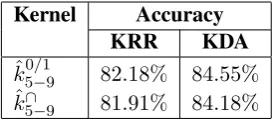
Table 1: Accuracy rates of KRR versus KDA on the essay development set.
samples, disregarding the tokenized version of the samples. The only editing done to the texts was the replacing of sequences of consecutive space char-acters (space, tab, and so on) with a single space character. This normalization was needed in or-der to prevent the artificial increase or decrease of the similarity between texts, as a result of different spacing.
We used the development set for tuning the pa-rameters of our approach. Although we have some intuition from our previous work (Ionescu et al.,
2016) about the optimal range of p-grams that
can be used for NLI from essays, we decided to carry out preliminary experiments in order to con-firm our intuition. We also carried out prelimi-nary experiments to determine the optimal range ofp-grams to be used for speech transcripts, a dif-ferent kind of representation that captures other features of the non-native English speakers. We fixed the learning method to KDA based on the presence bits kernel and we evaluated all the p -grams in the range3-9. For essays, we found that
p-grams in the range 5-9 work best, which con-firms our previous results on raw text documents reported in (Ionescu et al.,2016). For speech tran-scripts, we found that longerp-grams are not help-ful. Thus, the optimal range ofp-grams is5-7. In order to decide which classifier gives higher accu-racy rates, we carried out some preliminary exper-iments using only the essays. The KRR and the KDA classifiers are compared in Table1. We ob-serve that KDA yields better results for both the blendedp-grams presence bits kernel (ˆk50/−19) and the blended p-grams intersection kernel (ˆk∩
5−9).
Therefore, we employ KDA for the subsequent experiments. An interesting remark is that we also obtained better performance with KDA in-stead of KRR for the English L2, in our previous work (Ionescu et al.,2016).
Kernel Accuracy Track
ˆ
k50/−19 84.55% Essay
ˆ k∩
5−9 84.18% Essay
ˆ
k50/−19+ ˆk∩
5−9 85.18% Essay
(¯k05/−19)2 85.45% Essay
(¯k∩
5−9)2 85.09% Essay
(¯k05/−19)2+ (¯k∩
5−9)2 85.55% Essay
ˆ
k50/−17 58.73% Speech
ˆ k∩
5−7 58.55% Speech
ˆ
ki-vec 81.64% Speech
ˆ
k50/−17+ ˆk∩
5−7 58.73% Speech
ˆ
k50/−17+ ˆki-vec 85.27% Speech ˆ
k∩
5−7+ ˆki-vec 85.18% Speech
ˆ
k50/−17+ ˆk∩
5−7+ ˆki-vec 84.91% Speech
(¯k05/−17)2 59.00% Speech
(¯k∩
5−7)2 59.82% Speech
(¯ki-vec)2 81.55% Speech
(¯k05/−17)2+ (¯k∩
5−7)2 59.91% Speech
(¯k05/−17)2+ (¯ki-vec)2 85.36% Speech
(¯k∩
5−7)2+ (¯ki-vec)2 85.27% Speech
(¯k05/−17)2+ (¯k∩
5−7)2+ (¯ki-vec)2 85.45% Speech
ˆ
k50/−19+ ˆk∩
5−9+ ˆk50−/17+ ˆki-vec 91.64% Fusion
ˆ
k50/−19+ ˆk50−/17+ ˆki-vec 92.09% Fusion (¯k05/−19)2+ (¯k∩
[image:6.595.127.469.60.428.2]5−9)2+ (¯k05−/17)2+ (¯k∩5−7)2+ (¯ki-vec)2 91.72% Fusion
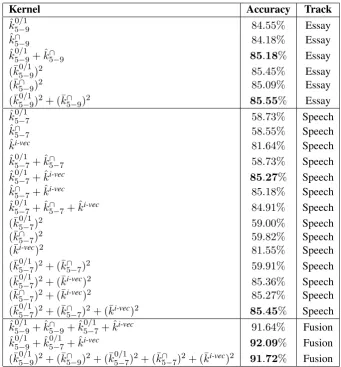
Table 2: Accuracy rates on the NLI development set obtained by KDA based on various kernels for the essay, the speech and the fusion tracks. The submitted systems are highlighted in bold.
kernel, the blended p-grams intersection kernel, or the kernel based on i-vectors. We also in-cluded squared RBF versions of these kernels. Since these different kernel representations are ob-tained either from essays, speech transcripts or from low-level audio features, a good approach for improving the performance is combining the kernels. When multiple kernels are combined, the features are actually embedded in a higher-dimensional space. As a consequence, the search space of linear patterns grows, which helps the classifier in selecting a better discriminant func-tion. The most natural way of combining two or more kernels is to sum them up. Summing up kernels or kernel matrices is equivalent to feature vector concatenation. The kernels were evaluated alone and in various combinations, by employing KDA for the learning task. All the results obtained on the development set are given in Table2.
The empirical results presented in Table 2 re-veal several interesting patterns of the proposed
Kernel Accuracy F1(macro) Track Rank
ˆ
k05/−19+ ˆk∩
5−9 86.91% 86.95% Essay 1st
(¯k05−/19)2+ (¯k∩
5−9)2 86.91% 86.95% Essay 1st
ˆ
k05/−17+ ˆki-vec 87.55% 87.55% Speech 1st (¯k05−/17)2+ (¯k∩
5−7)2+ (¯ki-vec)2 87.45% 87.45% Speech 1st
ˆ
k50/−19+ ˆk50−/17+ ˆki-vec 93.18% 93.19% Fusion 1st (¯k05−/19)2+ (¯k∩
[image:7.595.79.520.62.175.2]5−9)2+ (¯k50−/17)2+ (¯k5∩−7)2+ (¯ki-vec)2 93.00% 93.01% Fusion 1st
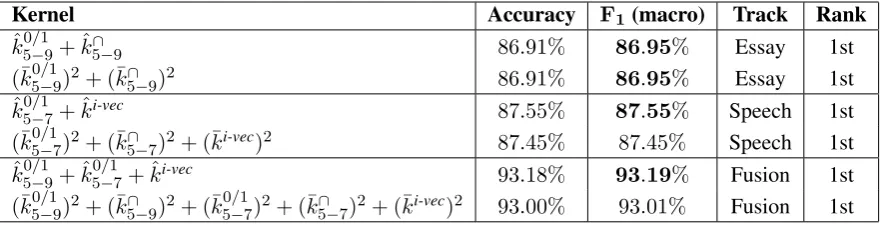
Table 3: Accuracy rates on the NLI test set obtained by KDA based on various kernels for the essay, the speech and the fusion tracks. The best marcoF1score in each track is highlighted in bold. The final rank
of each kernel combination in the 2017 NLI shared task is presented on the last column.
distinguish the native languages. On the other hand, the i-vector representation extracted from audio recordings is much more suitable for the NLI task. Interestingly, we obtain consistently better results when we combine the kernels based on i-vectors with one or both of the string kernels. The best performance on the speech development set (85.45%) is obtained by sum of the squared RBF presence bits kernel, the squared RBF inter-section kernel and the squared RBF kernel based on i-vectors. The top accuracy levels on the es-say and speech development sets are remarkably close. Nevertheless, when we fuse the features captured by the kernels constructed for the two modalities, we obtain considerably better results. This suggests that essays and speech provide com-plementary information, boosting the accuracy of the KDA classifier by more than6%on the fusion development set. It is important to note that we tried to fuse the kernel combinations that provided the best performance on the essay and the speech development sets, while keeping the original and the squared RBF versions separated. We also tried out a combination that does not include the inter-section string kernel, an idea that seems to im-prove the performance. Actually, the best perfor-mance on the fusion development set (92.09%) is obtained by sum of the presence bits kernel (kˆ05/−19) computed from essays, the presence bits kernel (kˆ05−/17) computed from speech transcripts, and the kernel based on i-vectors (kˆi-vec). In each track, we
submitted the top two kernel combinations for the final test evaluation.
5.3 Results
The results on the test set are presented in
Ta-ble 3. Although we tuned our approach to
opti-mize the accuracy rate, the official evaluation
met-ric for the NLI task is the macroF1score.
There-fore, we have reported both the accuracy rate and the macroF1score in Table3. Both kernel
combi-nations submitted to the essay track obtain equally good results (86.95%). For the speech and the fu-sion tracks, the squared RBF kernels reach slightly lower performance than the original kernels. The best submission to the speech track is the KDA classifier based on the sum of the presence bits kernel (kˆ05/−17) and the kernel based on i-vectors (kˆi-vec), a combination that reaches a macro F1
score of87.55%. These two kernels are also in-cluded in the sum of kernels that gives our top performance in the fusion track (93.19%). Along with the two kernels, the best submission to the fusion track also includes the presence bits kernel (kˆ05−/19) computed from essays. An interesting re-mark is that the results on the test set (Table 3) are generally more than1%better than the results on the development set (Table2), perhaps because we have included the development samples in the training set for the final test evaluation.
The organizers have grouped the teams based on statistically significant differences between each team’s best submission, calculated using McNe-mar’s test with an alpha value of0.05. The macro
F1 score of86.95%places us in the first group of
methods in the essay track, although we reach only the sixth best performance within the group. Re-markably, we also rank in the first group of meth-ods in the speech and the fusion tracks, while also reaching the best performance in each of these two tracks. It is important to note that UnibucKernel is the only team ranked in first group of teams in each and every track of the 2017 NLI shared task, indicating that our shallow and simple approach is still state-of-the-art in the field.
CHI JPN KOR HIN TEL FRE ITA SPA GER ARA TUR
Predicted label
CHI
JPN
KOR
HIN
TEL
FRE
ITA
SPA
GER
ARA
TUR
True label
91 2 2 1
1
1
2
1 92 5
1
1
1 8 83
1
3
1 3
83 13 1
3
1 20 77
1
1
1
84 4 8 2
1
1
3 89 4 2
1
2
2 1 91
2 2
1
2 1 3 93
1 1
2 2 5
88 1
1 3 2
1 1 2 3 2 85
Confusion Matrix
[image:8.595.140.454.65.341.2]0.0
0.1
0.2
0.3
0.4
0.5
0.6
0.7
0.8
0.9
Figure 1: Confusion matrix of the system based on squared RBF kernels on the essay track.
CHI JPN KOR HIN TEL FRE ITA SPA GER ARA TUR
Predicted label
CHI
JPN
KOR
HIN
TEL
FRE
ITA
SPA
GER
ARA
TUR
True label
94 3 2
1
1 93 5
1
1 6 90
1
1 1
74 26
22 76
1
1
1
1
90 2 1 4 1
1
3 91 2 2 1
1 1
5
91
1 1
1 2 1
2
1 93
3 2
4 2 2 1 83 3
2 1 2 7 88
Confusion Matrix
0.0
0.1
0.2
0.3
0.4
0.5
0.6
0.7
0.8
0.9
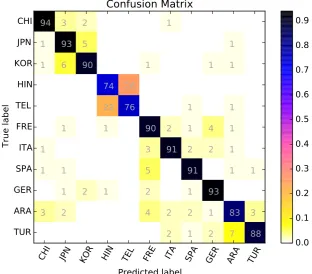
Figure 2: Confusion matrix of the best system on the speech track.
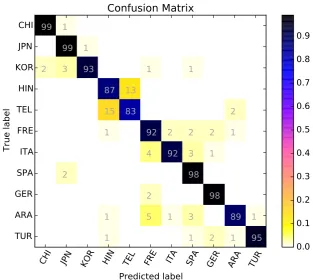
the confusion matrices for our best runs in each track. The confusion matrix presented in Figure1 shows that our approach for the essay track has a higher misclassification rate for Telugu, Hindi and Korean, while the confusion matrix shown in
[image:8.595.142.455.377.651.2]CHI JPN KOR HIN TEL FRE ITA SPA GER ARA TUR
Predicted label
CHI
JPN
KOR
HIN
TEL
FRE
ITA
SPA
GER
ARA
TUR
True label
99 1
99 1
2 3 93
1
1
87 13
15 83
2
1
92 2 2 2 1
4 92 3 1
2
98
2
98
1
5 1 3
89 1
1
1 2 1 95
Confusion Matrix
[image:9.595.141.455.64.344.2]0.0
0.1
0.2
0.3
0.4
0.5
0.6
0.7
0.8
0.9
Figure 3: Confusion matrix of the best system on the fusion track.
each and every L1 language (with respect to the other two confusion matrices) by fusing the es-say and speech information. While there are no more than two misclassified samples for Chinese, Japanese, Spanish and German, our fusion-based approach still has some trouble in distinguishing Hindi and Telugu. Another interesting remark is that 5 native Arabic speakers are wrongly clas-sified as French, perhaps because these Arabic speakers are from Maghreb, a region in which French arrived as a colonial language. As many people in this region speak French as a second language, it seems that our system gets confused by the mixed Arabic (L1) and French (L2) lan-guage transfer patterns that are observable in En-glish (L3).
6 Conclusion and Future Work
In this paper, we have described our approach based on learning with multiple kernels for the 2017 NLI shared task (Malmasi et al., 2017). Our approach attained generally good results, consistent with those reported in our previous works (Ionescu et al., 2014, 2016). Indeed, our team (UnibucKernel) ranked in the first group of teams in all three tracks, while reaching the best marco F1 scores in the speech (87.55%) and the
fusion (93.19%) tracks. As we are the only team
that ranked in first group of teams in each and ev-ery track of the 2017 NLI shared task, we consider that our approach has passed the test of time in na-tive language identification.
Although we refrained from including other types of features in order to keep our approach shallow and simple, and to prove that we can achieve state-of-the-art results using character p -grams alone, we will consider combining string kernels with other features in future work.
Acknowledgments
This research is supported by University of Bucharest, Faculty of Mathematics and Computer Science, through the 2017 Mobility Fund.
References
Serhiy Bykh and Detmar Meurers. 2014. Exploring Syntactic Features for Native Language Identifica-tion: A Variationist Perspective on Feature Encoding and Ensemble Optimization. Proceedings of COL-INGpages 1962–1973.
Najim Dehak, Pedro A. Torres-Carrasquillo, Dou-glas A. Reynolds, and Rda Dehak. 2011. Language recognition via i-vectors and dimensionality reduc-tion. Proceedings of INTERSPEECH pages 857– 860.
Hugo Jair Escalante, Thamar Solorio, and Manuel Montes-y-G´omez. 2011. Local histograms of char-acter n-grams for authorship attribution. Proceed-ings of ACL: HLT1:288–298.
Dominique Estival, Tanja Gaustad, Son-Bao Pham, Will Radford, and Ben Hutchinson. 2007. Author profiling for English emails. Proceedings of PA-CLINGpages 263–272.
Rosa M. Gim´enez-P´erez, Marc Franco-Salvador, and Paolo Rosso. 2017. Single and Cross-domain Polar-ity Classification using String Kernels. Proceedings of EACLpages 558–563.
Cristian Grozea, Christian Gehl, and Marius Popescu. 2009. ENCOPLOT: Pairwise Sequence Matching in Linear Time Applied to Plagiarism Detection. In 3rd PAN Workshop. Uncovering Plagiarism, Author-ship, and Social Software Misuse. page 10.
Trevor Hastie and Robert Tibshirani. 2003. The Ele-ments of Statistical Learning. Springer, corrected edition.
David Haussler. 1999. Convolution Kernels on Dis-crete Structures. Technical Report UCS-CRL-99-10, University of California at Santa Cruz, Santa Cruz, CA, USA.
Radu Tudor Ionescu and Andrei Butnaru. 2017. Learn-ing to Identify Arabic and German Dialects usLearn-ing Multiple Kernels. Proceedings of VarDial Workshop of EACLpages 200–209.
Radu Tudor Ionescu and Marius Popescu. 2016. UnibucKernel: An Approach for Arabic Dialect Identification based on Multiple String Kernels. Proceedings of VarDial Workshop of COLINGpages 135–144.
Radu Tudor Ionescu, Marius Popescu, and Aoife Cahill. 2014. Can characters reveal your native language? a language-independent approach to na-tive language identification.Proceedings of EMNLP pages 1363–1373.
Radu Tudor Ionescu, Marius Popescu, and Aoife Cahill. 2016. String kernels for native language identification: Insights from behind the curtains. Computational Linguistics42(3):491–525.
Scott Jarvis, Gabriela Casta˜neda Jim´enez, and Ras-mus Nielsen. 2004. Investigating L1 lexical trans-fer through learners’ wordprints. Second Language Research Forum (SLRF).
Scott Jarvis and Scott Crossley, editors. 2012. Ap-proaching Language Transfer Through Text Classi-fication: Explorations in the Detection-based Ap-proach, volume 64. Multilingual Matters Limited, Bristol, UK.
Rohit J. Kate and Raymond J. Mooney. 2006. Using String-kernels for Learning Semantic Parsers. Pro-ceedings of ACLpages 913–920.
Moshe Koppel, Jonathan Schler, and Kfir Zigdon. 2005. Automatically Determining an Anonymous Author’s Native Language. Proceedings of ISI pages 209–217.
Huma Lodhi, Craig Saunders, John Shawe-Taylor, Nello Cristianini, and Christopher J. C. H. Watkins. 2002. Text classification using string kernels. Jour-nal of Machine Learning Research2:419–444. Shervin Malmasi and Mark Dras. 2014a. Arabic
Na-tive Language Identification. Proceedings of the EMNLP 2014 Workshop on Arabic Natural Lan-guage Processing (ANLP)pages 180–186.
Shervin Malmasi and Mark Dras. 2014b. Chinese Na-tive Language Identification. Proceedings of EACL 2:95–99.
Shervin Malmasi and Mark Dras. 2014c. Language Transfer Hypotheses with Linear SVM Weights. Proceedings of EMNLPpages 1385–1390.
Shervin Malmasi, Keelan Evanini, Aoife Cahill, Joel Tetreault, Robert Pugh, Christopher Hamill, Diane Napolitano, and Yao Qian. 2017. A Report on the 2017 Native Language Identification Shared Task. Proceedings of the 12th Workshop on Building Edu-cational Applications Using NLP.
Marius Popescu. 2011. Studying translationese at the character level. Proceedings of RANLPpages 634– 639.
Marius Popescu and Cristian Grozea. 2012. Kernel methods and string kernels for authorship analysis. CLEF (Online Working Notes/Labs/Workshop). Marius Popescu, Cristian Grozea, and Radu Tudor
Ionescu. 2017. HASKER: An efficient algorithm for string kernels. Application to polarity classification in various languages. Proceedings of KES.
Marius Popescu and Radu Tudor Ionescu. 2013. The Story of the Characters, the DNA and the Native Language. Proceedings of the Eighth Workshop on Innovative Use of NLP for Building Educational Ap-plicationspages 270–278.
Alla Rozovskaya and Dan Roth. 2010. Generating Confusion Sets for Context-Sensitive Error Correc-tion. Proceedings of EMNLPpages 961–970.
Conrad Sanderson and Simon Guenter. 2006. Short text authorship attribution via sequence kernels, markov chains and author unmasking: An investi-gation. Proceedings of EMNLPpages 482–491. Bjrn Schuller, Stefan Steidl, Anton Batliner, Julia
Evanini. 2016. The INTERSPEECH 2016 Compu-tational Paralinguistics Challenge: Deception, Sin-cerity & Native Language. Proceedings of INTER-SPEECHpages 2001–2005.
John Shawe-Taylor and Nello Cristianini. 2004. Ker-nel Methods for Pattern Analysis. Cambridge Uni-versity Press.
Ben Swanson and Eugene Charniak. 2014. Data driven language transfer hypotheses. Proceedings of EACL pages 169–173.
Joel Tetreault, Daniel Blanchard, and Aoife Cahill. 2013. A report on the first native language identifi-cation shared task. Proceedings of the Eighth Work-shop on Innovative Use of NLP for Building Educa-tional Applicationspages 48–57.