SWEET BAY (
LAURUS NOBILIS
L.
)
ESSENTIAL OIL: A STUDY ON
ITS APPLICATION IN DENTISTRY.
M. Vasundhara*1, Sheetal R. Gujaran2, Ashwini Jayaram3 and Priyanka R.4
1,2,3,4
Department of Horticulture, UAS(B), GKVK, Bangalore-560065.
ABSTRACT
Dental plaque is an oral biofilm that adheres to teeth, comprising of
more than 700 species of bacteria and fungi. It is one of the etiological
factor leading to oral related diseases namely gingivitis, periodontitis
and dental caries. Therefore its treatment becomes a crucial factor in
maintaining oral health. Use of plant essential oils in the treatment of
dental plaque can be beneficial due to the antimicrobial and non-toxic
properties making them ideal for their use in oral care products. Since
ages, essential oils have been researched and there is evidence for their
long term effects in controlling dental plaque. The present study aims
to screen the efficacy of Laurus nobilis essential oil in treating dental
plaque. The essential oil was tested against three dental pathogens –S.mutans, L.acidophilus
and C.albicans. The results demonstrated that L.nobilis essential oil showed inhibition
against the three dental pathogens and proves its efficacy to be used as an antimicrobial agent
to control dental plaque.
KEYWORDS: Dental plaque, essential oil, L.nobilis, disc diffusion.
INTRODUCTION
Aromatic plants are those that have the property of enhancing aroma and flavour of food and
are used as spices. Along with this property, they also have medicinal uses and can be used as
food preservative. The extracts and essential oils extracted from these plants are used in
therapeutics.[1] Laurus nobilis is one such aromatic shrub or small evergreen ornamental tree belonging to family Lauraceae, commonly called as sweet bay, bay laurel, Grecian laurel,
true bay and bay. Leaves of Laurus nobilis Lhave been used in the past in European folk
Volume 5, Issue 6, 2049-2057. Research Article ISSN 2277– 7105
*Corresponding Author
M. Vasundhara
Department of
Horticulture, UAS(B),
GKVK,
Bangalore-560065.
Article Received on 19 April 2016,
Revised on 09 May 2016, Accepted on 29 May 2016
Our oral cavity is a busy place with millions of microorganisms on the move, among which
bacteria predominates the oral microbial population. Some of these bacteria cause harm
directly to the teeth and gums, residing as a yellowish or white sticky film on the teeth called
as plaque. Dental plaque is the community of microorganisms found on a tooth surface as a
biofilm, embedded in a matrix of polymers of host and bacterial origin. It is natural and
contributes to the normal development of the physiology and defences of the host like any
other resident microflora present in the other parts of the body.[3] Since our oral cavity is under constant bombardment with food and drinks, the homeostasis between the oral
microflora is disturbed causing a shift from a healthy to diseased oral condition . This shift in
turn leads to the most common oral diseases – gingivitis, periodontitis and dental caries
suffered by most of the people worldwide due to improper oral habits. Of clinical relevance,
biofilms are less susceptible to anti-microbial agents. Along with the conventional oral
hygiene techniques, a number of mouth rinses have known to subside the growth of oral
microbes accompanying many side effects. This scenario has necessitated the search for an
alternative to incorporate in oral hygiene products. Particularly, there has been an increased
research in the effectiveness of essential oils of aromatic plants on human health. Essential
oils a mixture of terpenoids (monoterpenes, sesqueterpenes and diterpenes) which contribute
to its anti-microbial and antioxidant properties, serve as a potential alternative to synthetic
anti-microbial agents. Despite advances in the application of essential oils on human health,
there are very less studies on the application of L.nobilis essential oil in the field of
dentistry.[4] Therefore, the aim of the present study was to analyze the chemical composition of the bay essential oil using Gas Chromatography – Mass Spectroscopy and investigate the
growth inhibitory effects of the essential oil extracted from Laurus nobilis against a panel of
microbial strains (bacterial and fungal) associated with dental plaque.
MATERIALS AND METHODS
Collection and Extraction of the essential oil.
Fresh leaves of Sweet bay (L.nobilis) used for the study were harvested from the Aromatic
garden at The Department of Horticulture, UAS (B), GKVK, Bangalore. The leaves were
dried for one week at room temperature prior to hydrodistillation. A known weight of dried
leaves was loaded in the Clevenger’s apparatus for the extraction of essential oil for three
Quality analysis of the essential oil Physical and Chemical Parameters
The quality of sweet bay essential oil was analyzed through physiochemical parameters
namely Refractive Index(25°C), Color, Acid value, Ester value and Saponification value.
Gas Chromatography- Mass Spectrometry analysis
The chemical composition of the sweet bay essential oil was determined using GC-MS. The
oil was analyzed by Agilent equipment, model GC-7890 with FID, MS- 5975 C with inert
MSD. Equipped with a DB -17 MS J & W 122-4762, Silica Capillary column of 60 m*0.25
mm* 0.25 um. The carrier gas used was helium at a flow rate of 1 mL/min, detector and
injector temperatures were 280 °C and 250 °C, respectively, and the injection volume was 0.2
µL and the split ratio was 30:1. The oven temperature was programmed from 700C at 20C/min upto 1000C at 2.60C/min and upto 2000C at 50C/min till 2700C. Identification of compounds was done with multi databases including Wiley/Nist/ SOM.
Antimicrobial Analysis of the essential oil
The organisms selected for the study were Gram positive bacteria – Streptococcus mutans
(MTCC 497) and Lactobacillus acidophilus (MTCC 10307) and fungi Candida albicans
(MTCC 7315) procured from MTCC, Institute of Microbial Technology, Chandigarh.
S.mutans was propagated for 24 hours on Brain and Heart Infusion Agar at 37°C under
anaerobic condition ; L.acidophilus was grown on Lactobacilli MRS agar plates incubated at
37°C for 48 hours and C.albicans propagated on Yeast Mannitol agar for 48 hours at 25°C.
Assessment of the growth inhibitory effect of sweet bay essential oil was done by disc
diffusion method.
S.mutans was resuspended in peptone water (10%), L.acidophilus was resuspended in
Lactobacilli MRS broth and C.albicans was resuspended in Yeast Mannitol broth and
incubated for 24 hours. The 24 hour microbial cultures were used for the antimicrobial assay
and were spread over their respective culture media agar plates. Sterile paper disc of 6mm
diameter was aseptically saturated with 30μl of the respective volatile oil obtained from
L.nobilis for an hour and were placed on the respective agar plates and incubated at their
The results were recorded as three independent observations by measuring the zone of growth
inhibition (mm) around the disc. The recorded inhibition zone (mm) of the sample were
compared with the inhibition zone of the standard antibiotics (Ampicillin/Sulbactum (A/S 10/10
), Streptomycin (S 10 10mcg/disc) procured from HiMedia an Flucanazole(100mg).
RESULTS AND DISCUSSION
Microflora accumulated in the oral cavity are responsible for dental caries. It has been
reported that essential oils are capable of inhibiting the growth of these microorganisms and
formation of the biofilm.[5] Several antibiotics such as ampicillin and cholorhexidine have been very effective in preventing oral related problems but adverse effects such as vomiting,
diarrhea, tooth staining have been associated with the use of these chemicals.[6] In the present study, the yield of the essential oil extracted from L.nobilis was 0.9% (v/w)(on dry weight
basis) after three hours of hydro distillation. The oil yield reported was comparable with the
essential oil extracted in various parts of the world, which is in the range of
0.59-4.3%(v/w).[7,8,9]
Quality Assessment of the essential oil
Physical and Chemical Characteristics of the oil
Physicochemical properties of the essential oil can be used as a criterion to evaluate the
purity of oil.[10] The essential oil of L.nobilis was analyzed for physicochemical parameters like color, Refractive Index, acid value, ester value and saponification value. The results
obtained were tabulated (Table 1) with values within the range of previous studies. [11,12]
Table 1 – Physiochemical characteristics of Laurus nobilis.L essential oil.
Gas Chromatography-Mass Spectroscopy Analysis(GC-MS)
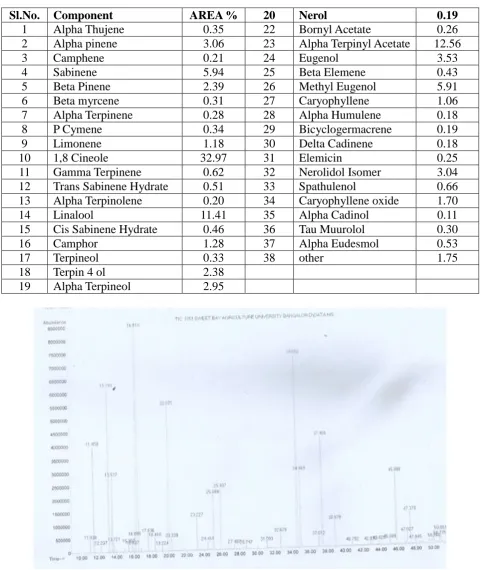
The GC-MS analysis of sweet bay essential oil (Fig 1) reported 37 compounds representing
98.25% of the total composition (Table 2). The prominent constituents characterized were 1,8
cineole(32.97%), linalool(11.41%) and α-terpinyl acetate(12.56%).
Parameter L.nobilis essential oil
Table 2: Chemical composition of L.nobilis essential oil using GC-MS
Figure 1: GC-MS Chromatogram of L.nobilis essential oil
The characteristic odor can be attributed to the composition of the essential oil. It has
previously been reported that 1,8 cineole, linalool and α-terpinyl acetate are known to possess
Sl.No. Component AREA % 20 Nerol 0.19
1 Alpha Thujene 0.35 22 Bornyl Acetate 0.26 2 Alpha pinene 3.06 23 Alpha Terpinyl Acetate 12.56 3 Camphene 0.21 24 Eugenol 3.53 4 Sabinene 5.94 25 Beta Elemene 0.43 5 Beta Pinene 2.39 26 Methyl Eugenol 5.91 6 Beta myrcene 0.31 27 Caryophyllene 1.06 7 Alpha Terpinene 0.28 28 Alpha Humulene 0.18 8 P Cymene 0.34 29 Bicyclogermacrene 0.19 9 Limonene 1.18 30 Delta Cadinene 0.18 10 1,8 Cineole 32.97 31 Elemicin 0.25 11 Gamma Terpinene 0.62 32 Nerolidol Isomer 3.04 12 Trans Sabinene Hydrate 0.51 33 Spathulenol 0.66 13 Alpha Terpinolene 0.20 34 Caryophyllene oxide 1.70 14 Linalool 11.41 35 Alpha Cadinol 0.11 15 Cis Sabinene Hydrate 0.46 36 Tau Muurolol 0.30 16 Camphor 1.28 37 Alpha Eudesmol 0.53 17 Terpineol 0.33 38 other 1.75 18 Terpin 4 ol 2.38
property.[7,8,13] Thus sweet bay can be considered as an oil with high therapeutic value. From the chemical composition of L.nobilis essential oil it is evident that 1,8-cineole is the major
component present in the oil and can be considered as a sustainable source of 1,8 cineole as
compared to other aromatic plants such as Ocimum sanctum and Artemesia sieberi having
20.78% and 21.1% of 1,8 cineole content respectively.[5]
Assessment of Growth Inhibitory Effects of the Essential Oil
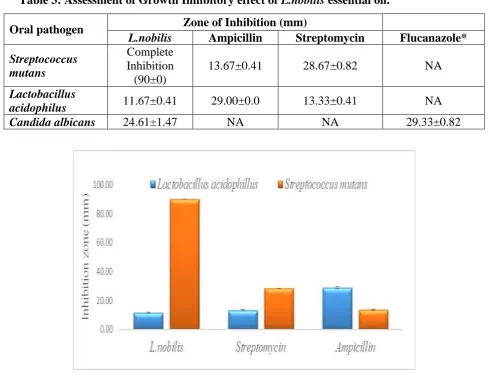
Anti-microbial activity of the essential oil against common oral pathogens was tested. The
results were tabulated in terms of inhibition zone measured in mm. L.nobilis oil showed
inhibition against all the three pathogens tested. Complete inhibition was seen for
Streptococcus mutans (90±0mm) and Lactobacillus acidophilus showed inhibition zone of
11.67 ±0.41mm comparable with the standard antibiotics. While the oil showed inhibition
against Candida albicans with an inhibition zone of 24.61±1.47mm as compared with
[image:6.595.53.544.376.752.2]Flucanazole standard (Table 3; Fig.2a,2b).
Table 3: Assessment of Growth Inhibitory effect of L.nobilis essential oil.
Oral pathogen Zone of Inhibition (mm)
L.nobilis Ampicillin Streptomycin Flucanazole*
Streptococcus mutans
Complete Inhibition (90±0)
13.67±0.41 28.67±0.82 NA
Lactobacillus
acidophilus 11.67±0.41 29.00±0.0 13.33±0.41 NA
Figure 2b: Antifungal activity of L.nobilis essential oil
L.nobilis essential oil was effective against the 3 dental pathogens tested – Streptococcus
mutans, Candida albicans and Lactobacillus acidophilus. S.mutans, one of the most
important oral bacteria and also an initiator of dental biofilm formation having cariogenic
property. Therefore, it becomes important to control mouth flora especially S.mutans.
Lactobacillus acidophilus was considered as a major etiological agent of dental caries due to
its profile as a acidogenic and aciduric Gram positive bacteria.[14] Candida albicans, a fungus, is an opportunistic human pathogen that colonizes in the oral cavity of large proportion of
population and can cause a number of mucosal infections including oral candidiasis.[14]
Bay leaf oil has shown complete inhibition and performed better than the standard antibiotics
Ampicillin and Streptomycin in case of S.mutans and has shown inhibition against Candida
albicans and L.acidophilus comparable with the standards, proving its efficacy as an
anti-microbial agent. Collectively, these observations provide evidence that bay essential
oil/components has the capability to alter the cell membrane of the microorganisms which
eventually result in complete loss of integrity. It is most likely that the activity can be
attributed to the synergistic effect of all the components of the oil, mainly 1,8-cineole having
significant antimicrobial properties either alone or in combination with other monoterpenes
or drugs.[5]
CONCLUSION
used as a mouth rinse and in other oral hygiene products. Further studies using isolated
compounds and combinations will give insights into the anti-microbial mechanism of the
essential oil.
ACKNOWLEDGEMENT
The authors would like to acknowledge Prof.Varshney,former president of EOAI,New Delhi
towards GC-MS analysis.
REFERENCES
1. Efterpi Christaki, Eleftherios Bonos, Ilias Giannenas and Panagiota Florou-Paneri.
Aromatic Plants as a Source of Bioactive Compounds. Agriculture, 2012; 2: 228-243.
2. Sedef Nehir El, Nural Karagozlu, Sibel Karakaya and Serpil Sahın .Antioxidant and
Antimicrobial Activities of Essential Oils Extracted from Laurus nobilis L. Leaves by
Using Solvent-Free Microwave and Hydrodistillation. Food and Nutrition Sciences, 2014;
5: 97-106.
3. Philip D Marsh. Dental Plaque As A Biolfilm And A Microbial Community- Implications
Of Health And Disease.BMC Oral Health, 2006; 6.
4. Francis Ocheng,Freddie Bwanga, Moses Joloba, Abier Softrata,Mohammed Azeem,
Katrin Putsep, Anna-Karin Borg-Karlson, Celestino Obua and Anders Gustafsson.
Essential Oils from Ugandan Aromatic Medicinal Plants:Chemical Composition and
Growth Inhibitory Effects on Oral Pathogens.Hindawi publishing cooporation, 2015.
5. Kamiar Zomorodian, Pooria Ghadiri, Mohammad Jamal Saharkhiz, Mohammad Reza
Moein, Peiman Mehriar,Farideh Bahrani, Tahereh Golzar, Keyvan Pakshir, Mohammad
Mehdi Fani, Antimicrobial Activity of Seven Essential Oils From Iranian Aromatic Plants
Against Common Causes of Oral Infections.Jundishapur J Microbiol, 2015; 8(2).
6. Wagner A. Bernardes, Rodrigo Lucarinia, Marcos G. Tozattia, Luzio G. Bocalon
Flauzinoa, Maria G. M. Souzaa, Isabel C. C. Turattib, Marcio L. Andrade e Silvaa, Carlos
H. G. Martinsa, Ademar A. da Silva Filhoa,Wilson R. Cunha.Antibacterial Activity of the
Essential Oil from Rosmarinus officinalis and its Major Components against Oral
Pathogens., 2010; 588-593.
7. Ivanović, J., Mišić, D., Ristić, M., Pešić, O., and Žižović, I.. Supercritical CO2 extract
and essential oil of bay (Laurus nobilis L.) – chemical composition and antibacterial
8. Zeković, Z.P., Lepojević, Z.D., Mujić, I.O. Laurel Extracts Obtained by Steam
Distillation, Supercritical Fluid and Solvent Extraction. Journal of Natural Products,
2009; 2: 104-109.
9. Sango, M.K., Aydin, E., Timur, M., Karadeniz, H., Caliskan, M., and Ozkan, A.
Comparison of chemical composition of the essential oil of Laurus nobilis L. Leaves and
fruits from different regions of Hatay, Turkey. Journal of Environmental Biology, 2007;
28(4): 731-733.
10.Pawar Vinita A,Bhagat Trupti B,Toshniwal Mitesh R,Mokashi Nitin D and Khandelwal
K R. Formulation and Evaluation of Dental Gel containing essential oil of Coriander
against Oral Pathogens. International Research Journal Of Pharmacy, 2013; 4(10).
11.Joy, P.P., Thomas J, Mathew S, Jose G and Joseph J, 2001.Aromatic plants. Tropical
Horticulture.2. Naya Prokash, Calcutta.
12.Gunkel, W., Fraser, L. C, Bhatia, S.C. 2010. Handbook of Essential Oils. CBS Publishers
and Distributors.4, 102, 149,308,330.
13.Dragicevic, N., Maibach, H.I. Percutaneous Penetration Enhancers- Chemical Methods in
Penetration Enhancement, 2015.
14.Sonia V. Ambade and Bharati J. Bhadbhade, In vitro Comparison of Antimicrobial
Activity of Different Extracts of Cymbopogon citratus on Dental Plaque Isolates,
International Journal of Current Microbiology and Applied Sciences, 2015; 4(7):