The divorce process: a view from the other side of the
desk
WRIGHT, K. M.
Available from Sheffield Hallam University Research Archive (SHURA) at:
http://shura.shu.ac.uk/709/
This document is the author deposited version. You are advised to consult the publisher's version if you wish to cite from it.
Published version
WRIGHT, K. M. (2006). The divorce process: a view from the other side of the desk. Child and family law quarterly, 18 (1), 93-112.
Copyright and re-use policy
See http://shura.shu.ac.uk/information.html
The divorce process: a view from the other side of the desk
Katherine Wright
∗Drawing on a research project in which forty clients were followed throughout the divorce process, this paper attempts to provide some insights into the perspective of the client. The analysis is focused on two specific issues, firstly the need of clients to receive understandable information and secondly, the overall aims of clients embarking on the divorce process.
INTRODUCTION
Much has been written about the input of lawyers during the divorce process.1 However the perspective of the client, the person who sits at the other side of the desk from the lawyer, has received less attention.2 In light of the many recent developments regarding family law practice3 information about the consumers of the service, the clients, could prove timely. This article attempts to go some way to addressing the imbalance in the literature by outlining some of the findings from a small study in which forty clients were followed from their initial appointment with a solicitor regarding divorce, to the conclusion of their case.4 The article will focus around the some of the needs and aims of the clients in the process of divorce and will consider the impact of these on the divorce process.
Clients in the process of divorce have a number of complex needs. Some of these needs may be met by various professionals working outside the legal sphere, for example, by general practitioners; other needs, however, relate more to the legal process and should be met by solicitors. These include a need for information in relation to the legal process and procedures involved both in obtaining a divorce and in regard to the client’s possible entitlements. Clients may also need someone to take action on their behalf and to communicate with various bodies, in particular with their
∗
Senior Lecturer in Law, Sheffield Hallam University.
1
See for example J Eekelaar, M Maclean and S Beinart, Family Lawyers: The Divorce Work of Solicitors (Hart Publishing, 2000), R Ingleby Solicitors and Divorce (Clarendon Press, 1992), L Mather, C A McEwan and R J Mainman, Divorce Lawyers at Work: Varieties of Professionalism in Practice (Oxford University Press, 2001), A Sarat and W L F Felstiner, Divorce Lawyers and their Clients: Power and Meaning in the Legal Process (Oxford University Press, 1995).
2
A notable exception being the works by G Davis, Partisans and Mediators (Clarendon Press, 1988) and G Davis, S Cretney and J Collins Simple Quarrels: Negotiating Money and Property Disputes on Divorce (Clarendon Press, 1994).
3
For example; the ancillary relief procedure contained within Family Proceedings Rules 1991 S1 1991/1247, the protocol relating to the pre-application stage in ancillary relief case (Practice Direction (ancillary relief procedure) [2000] 1 FLR 997, a best practice protocol published by the Law Society (2000) (currently in the process of revision), accreditation schemes administered by both the Law Society and Resolution (formerly the Solicitors Family Law Association), the development of the Family Advice and Information Service (FAIns) and the proposals contained within the recent green paper Parental Separation: Children’s Needs and Parents’ Responsibilities: Next Steps, Cm 6452 (2005) of a new accreditation scheme for family law practitioners and the promotion of the collaborative law approach.
4
spouse, or with their spouse’s legal representative. Clients may feel they have a need for someone on their side to provide partisan support and to protect their interests in any negotiations. Some clients in the present study expressed a need for someone to take decisions for them. These clients did not understand the basis of the solicitor client relationship namely that solicitors act on clients’ instructions and so cannot simply perform that role. At the early stage of the process clients need someone to listen, and to identify the problems they have and to take action by resolving these, whether through further referral or by direct action by the solicitor. At a more general level, clients need a solicitor to be efficient, communicative and to help resolve the financial/property/child disputes which arise on divorce.
The ‘needs’ of clients can consequently be very broad and out of the scope of a single article. The analysis in this paper is limited to one ‘need,’ that is the need of the client to receive understandable information; this is followed by an account of the findings concerning some of the overall aims and goals of the clients as they entered the divorce process. It was felt that a perspective on clients’ overall aims and goals has so far received little attention and that arguably this has led to a picture of clients which may be misleading.
In order to make the paper more readable the participants have been randomly allocated fictitious names, clients are referred to by title followed by a surname and solicitors by first names.
METHODS
As divorce is a dynamic process it was decided that a longitudinal study following both clients and their solicitors throughout the process was most appropriate. Ten solicitors, from four solicitors firms were recruited for the study and 40 clients participated. The research was carried out in a large northern city. The legal firms varied in their size and in the characteristics of their client base. Of the 10 solicitors three were male and seven female. The gender split for clients was 15 male and 25 female. The client sample was also divided along the lines of socio-economic class,5 17 could be described as middle class and 23 working class.
It was decided that a combination of observation and interview in a continuous monitoring process would reveal the clearest picture of the divorce process. To that end meetings between clients seeking a divorce and their solicitors were observed. Following on from each meeting both the solicitor and client were interviewed.6 This practice was followed each time the solicitor and client met. Interviews with clients following their appointment with the solicitor were conducted in a separate location,7 wherever possible, to enable the client to speak freely and to avoid any link in the client’s mind between the researcher and the solicitor. The monitoring of cases continued until the case concluded. In some instances this was very early on in the process as clients withdrew after the first appointment (this in itself has generated some very interesting data, but is outside of the scope of this article). Of those clients
5
Class was assigned on the basis of the Registrar General’s six point scale, whereby class is allocated according to the occupation of the head of the household or chief wage earner.
6
Both semi-structured and unstructured interviews were used at different stages throughout the process.
7
that progressed, cases were followed until the solicitor’s file was closed; most often this occurred after consent orders had been obtained.8As meetings between solicitors and clients became less frequent as cases progressed, communication taking place either through the post or on the telephone, clients were, in addition, interviewed over the telephone and on one occasion in their home.
THE FINDINGS
The receipt and understanding of information by clients
A key duty of solicitors is to provide specialist knowledge to their client. Without such knowledge clients cannot make fully informed decisions. In the case of divorce such information could include how the marital assets and debts are likely to be redistributed, detailed information regarding legal aid, the procedures to be followed, how long the case is to last and how the client’s case is progressing.
In this study an extensive amount of information was given to clients throughout the divorce process by their solicitors. The data suggests that coverage of information provided by the solicitors was adequate. However this did not always translate into client understanding. The timing of the information provision and the level at which solicitors gave information out was not sufficient to ensure that each client fully understood all the information that they had been given.
Information was generally given to clients in one of two forms, either in a letter or verbally in a meeting or over the telephone. Most clients reported that letters were clear and easy to understand; use of legal jargon/terminology was not reported to be a problem. For example, Mrs Wallace stated that the letters she received from the solicitor were, ‘very clear – plainly worded and clear.’ Two clients in the sample, although stating that the letters had generally been understandable, disclosed that they had contacted their solicitor asking for some points in the letters to be more fully explained to them verbally. Although the majority of clients did claim that the letters received from the solicitors had been clear, this was not a universal view. Mrs Lawton had two areas of complaint.
‘I’ve had letters which were gobbledegook. I went to see Richard (the solicitor) and asked him to explain.’
Researcher: ‘Did he?’
Mrs Lawton: ‘Yes very well, but there were also some letters incorrect – saying things that would be done in a few weeks which we had already done.’
Another client, Mr Danks, despite initially responding to the question, ‘have you been able to understand all the letters you’ve received from the solicitor?’ positively, also indicated that he had not fully understood the information and was unhappy with the language used.
8
‘Yeah – there were one that I wasn’t sure about but I understand it now. They use big words – Why don’t they use plain English – Say you’re not going to get a penny – or it’s going to cost you this…’
The majority of clients did, at least initially, claim that the information given to them in letter form had been reasonably clear. The information given out in meetings between solicitors and clients did not always appear to be so easily understood. Observational data reveal that solicitors did not always explain all aspects of the case clearly. The quotation below provides an example and is taken from a meeting between Claire and Mr Ramsey.9
Claire: ‘They (solicitors acting for Mrs Ramsey) may ask for a cash equivalent valuation for the pension. I think we’ll have to ask for the pension to be left on one side for you – and you want a clean break. Is that what you want?’
Neither of the terms, ‘cash equivalent valuation’ and ‘clean break,’ were explained to the client. Such terminology is, of course, very familiar to the legal practitioner, but is not part of common parlance for most clients. At the other end of the scale was Richard who was observed, on occasion, to take a great deal of time explaining aspects of the case, sometimes drawing small diagrams to illustrate a particular point. In the extract below Richard is explaining the operation of the statutory charge to Mrs Lawton.
Richard: (drawing a diagram) ‘…at the end of the job there will be a bill say seven hundred or eight hundred. I send this to the legal aid board. They say by the way (Richard) what happened to Mrs Lawton. And I’ll say well she got the house. Tony Blair – or whoever it is (laughs) comes round to your house and says we want our money back. Legal aid is not free help. It’s free if you lose, it’s free at the time, but not actually free it’s called the statutory charge.’
Richard’s approach was the most unusual in the sample. The extract from Claire above provides a more typical example of the form information giving took at the subsequent meetings. It was, therefore, not surprising that clients did not always appear fully to understand what had been said. Although, as in the case of Mr Ramsey, above, clients initially claimed to understand most of the points raised, their responses raise questions about the client’s actual level of comprehension. Mrs Shepherd remarked in her final interview with the researcher,
‘Only thing I don’t understand is the payment. I’m getting Family Credit – so I’ve got that Green Paper (sic) (legal aid green form scheme). I thought you had to pay it back but she (Helen) says I don’t have to – not the divorce – It’s going into the house- I think it’s just financial I pay back.’
Similarly Mrs Foster, in an interview following an early meeting with the solicitor, responded to the query did she understand what was happening in her case, with,
‘Yes, I think so; it’s a series of stages isn’t it? I’ll be glad when this stage is over. I think he’ll (husband) go ahead with it, but he’s worried about the house that’s the main thing.’
But then continued,
9
‘I’m not committed yet am I?’
This was despite the fact that her solicitor had spent some time attempting to reassure her that proceeding with the divorce would not commit her to pursuing a financial claim.
Notably, clients appeared more willing to admit to not fully understanding all the information given out in the solicitor client meetings as their case progressed and their relationship with the researcher developed. Such clients were also often observed to be willing to lay the blame for any lack of understanding on themselves. Mrs Foster will again be used as an example. In the quotation above Mrs Foster claimed to understand the information given to her by the solicitor, but her response indicates that she was in fact not completely clear about the information. In the next observation of Mrs Foster, her response to a similar question was,
‘I feel a bit befuddled at the moment. I think I do.’
And after the final appointment,
‘More or less, where I haven’t understood it’s been on my side, my fault, I get easily confused.’
If the client was correct in her view it would appear that the solicitor was not providing the information at the appropriate level or in the correct manner for that particular client to understand. Mrs Egan made the following comment in a post meeting interview.
‘It’s quite biased towards the middle class isn’t it – the legal system? There’s the costs and it’s difficult to understand.’
Mrs Egan was an articulate and well educated client but she admitted that in her own case, she had not understood the reasoning behind the settlement proposals.
‘And it seems to me that, that (husband getting a share in the house) wasn’t explained to me as well as it should have been. But maybe I’ve not taken it in mmm – I don’t know though, I’m usually quite good at taking things in.’
In the current study the indications were that clients did not fully understand all the information given to them by their solicitor. The lack of full understanding was not confined to the less well educated and articulate clientele, as the quotation from Mrs Egan, above, demonstrates.10 Many clients did claim initially to the researcher, that they understood but would then qualify their statement, at a later stage. Consequently it is possible that clients gave the solicitors an impression of understanding the information and that instructions were accepted in the mistaken belief that they were making a fully informed decision.
One solicitor remarked on some of the problems faced by solicitors in trying to achieve client understanding.
10
‘Solicitors find it difficult, we could be found to be negligent. We have lots of information to give out. We do send letters but we’re not sure that clients read them. All we can do is keep a record of letters sent and at least we’re covered for negligence – but we have to repeat the information at subsequent interviews and that is not taken on board by the Legal Aid Board. (Mary)
According to Mary, for those solicitors who a high number of clients who are publicly funded, taking steps towards better client understanding by reiterating the information at subsequent appointments could have financial implications for those solicitors and their firms.
The need of clients to receive information which was understandable to them was not, in this study, always met. It is arguable that the reluctance of clients to admit to this lack of understanding may lead to a picture of clients as making fully informed decisions about the future direction of their case. This research suggests this image may be far from the reality.
The next section considers the overall aims of clients as they embark on the divorce process and includes some evidence which may further challenge some commonly held images of parties to a divorce.
The first interview between clients and the researcher: some overall aims of the clients
The perceived needs of clients in relation to their overall aims were explored in the first interview between each client and the researcher. Clients were asked three questions: firstly, ‘How important is it to you that the solicitor obtains the best deal possible for you?’ secondly, ‘How important is it to you that the solicitor will do nothing which would damage your relationship with your husband/wife?’ and thirdly, ‘How important is it to you that any agreement reached will be fair to all sides?’ Clients were invited to respond with, very important, important, not very important or not at all important. It was hoped that the results would provide some knowledge regarding clients’ initial overall goals and intentions at the initiation of the divorce process.
GETTING THE BEST DEAL
Regarding the question on the importance of the solicitor obtaining the best deal possible; twenty-two of the clients rated this as important (8/40), or very important (14/40). Notably, this was a lower rating (for the important/very important category) than was achieved for either of the other two questions (not damaging the relationship 29/40, achieving a fair settlement 28/40).11 Perhaps predictably, the responses appeared often to be linked to the cause of the marital breakdown. Those clients who perceived themselves to be the guilty party were less likely to respond that it was very important to get the best deal possible: Mr Chapman was such a client, ‘It’s not important – just get sorted.’
11
Similarly those clients who felt aggrieved were more likely to respond that it was very important to get the best deal possible. For example, ‘It’s very important because I’ve been hurt and I deserve it.’ (Mrs Lawton). ‘Very important – because it’s not me that’s damaged the relationship.’ (Mrs Whittaker). A typical response from a client who did not feel it to be important to get the best deal possible was, ‘No, I’m not into that grabbing – I just need enough to survive.’ (Mrs Denton).
The picture revealed in this study that getting the ‘best deal possible’ was not rated by the clients to be as important as the other areas they were questioned about, receives some support from research by Pascoe Pleasance et al12, in which 73% of respondents said that their action in taking divorce was non-monetary (p826). 13
NOT FURTHER DAMAGING THE RELATIONSHIP
The second question concerned whether it was important to the clients that the solicitor did nothing which would damage their relationship with their spouse. Twenty-nine clients rated this as important (20/40) or very important (9/40). Six clients claimed that a rating of importance was not relevant in their case, their relationship already being, according to these clients, irrecoverably damaged. The comment by Mr Chapman was typical. ‘Can’t make it any worse.’ Clients who were victims of domestic violence had their own reasons for not wanting their spouses further upset, ‘(I want) the least amount of friction, he can be violent.’ (Mrs Mellor). Mr Fearn similarly had his own reasons for wanting to keep the relationship as amicable as possible, ‘It’s very important – still trying to be reconciled.’ Mrs Raynor, who had responded to the question regarding the best deal possible with, ‘Extremely important’ when asked about the importance of the solicitor not damaging the relationship with her husband replied that not damaging the relationship with her husband was even more important to her than obtaining the best deal possible. Overall, clients gave a higher importance rating to the proposition that the solicitor would do nothing to damage their relationship with their spouse, than to either of the other two propositions.
A RESOLUTION WHICH IS FAIR TO BOTH SIDES
The final question sought to uncover the views of clients regarding seeking a settlement which was fair to all sides. Twenty-eight clients thought it was important (18/40) or very important (10/40) that any agreement reached should be fair to all sides. Mr Spencer who rated this aspect very important stated, ‘I want to be able to hold my head up and say I’ve done nothing wrong.’ Once again the marital history could influence the client’s views. Mrs Whittaker, who had claimed that she was a victim of domestic abuse, responded to the question with, ‘I don’t see why I should walk out with nothing.’ Mr Ashe explained his choice, ‘important – I’m very conscious that we’ve both done things to hurt the other.’
In sum, a picture emerges of a typical client who rates the importance of the solicitor doing nothing to further damage the relationship with their spouse, marginally above
12
P Pleasance, N J Balmer, A Buck, A O’Grady and H Genn, Family Problems – ‘Who Does What and When: Further Findings from the LSRC Survey of Justicable Problems’ Fam Law [2003] Vol 33 pp 822-827.
13
the goal of seeking a settlement which is fair to all sides, and significantly above the need to get the best deal possible. This client needs a solicitor not to act as a ‘hired gun’ but as someone to help them keep their relationship with their husband or wife on as reasonable terms as possible (in the circumstances of divorce), but who will still ensure that the client receives a fair resolution to the financial and property disputes. However, the other picture to emerge was that the views and opinions of clients on these matters were influenced by their marital history. In order for the solicitor to be able to address the needs of clients, some understanding of the client’s marital background appears to be required.
How each of these overall aims of the clients impacted on the process will now be discussed. As there is an overlap in the first and third aims, regarding pursuing an outcome which is ‘fair’ to both sides as opposed to seeking the ‘best deal possible,’ these will considered together. The analysis begins by discussing the aim of clients that the spousal relationship should not be further damaged by the divorce process.
Not Further Damaging the Spousal Relationship: The need to avoid exacerbation of spousal conflict
Spousal conflict is probably an almost inevitable feature of divorce. Concerns were raised by the government in the 1995 white paper14 that such spousal conflict and hostility could be further exacerbated by ‘litigation and arms length negotiation.’15 The perception that action taken by solicitors in resolving the disputes arising on divorce heightens hostility between spouses appears to be widely held, although existing research does not provide any evidence in support of this view.16
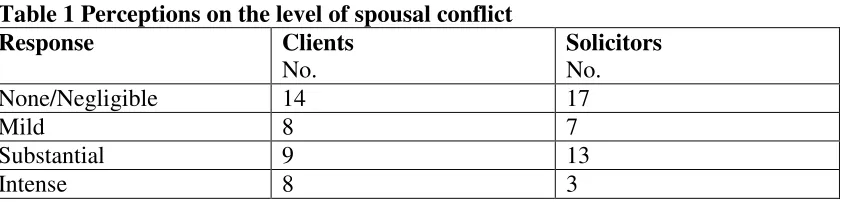
[image:9.595.91.512.569.670.2]The initial perceptions of both solicitors and clients regarding the apparent levels of spousal conflict present prior to any intervention by the solicitor were obtained in the interviews following the initial appointment. In each case, both the solicitor and client were asked to rate, on a scale from negligible to intense, where they thought the level of spousal conflict was at that early stage in the process. The results are contained in the table below.17
Table 1 Perceptions on the level of spousal conflict
Response Clients
No.
Solicitors No.
None/Negligible 14 17
Mild 8 7
Substantial 9 13
Intense 8 3
This table shows that for over half the sample the level of conflict between the spouses was rated as either negligible or mild by both the solicitor and the client.
14
Looking to the Future: Mediation and the Ground for Divorce. Cm 2799.
15
Ibid para 2.20.
16
See for example Davis et al, op cit n 2, Ingleby, op cit n 1, Eekelaar et al, op cit n 1.
17
When allocating a low conflict rating to a case some solicitors referred to an expectation that the conflict might increase once the process got underway. As Claire said after an initial meeting with a female client,
‘There is no obvious conflict - she doesn’t see much of him –so negligible. But there’s potential for huge conflict which she won’t handle at all.’
There were some analysis problems encountered by asking for such a subjective assessment. Participants had different views as to where the boundaries for each category lay. This was demonstrated by Mrs Shaw who had responded to the question on her own case with a rating of ‘substantial’ and then explained, ‘He’s not come at me with an axe or anything so it’s not intense.’ Notably, in this case the solicitor had rated the apparent spousal conflict as intense.
Examination of the data collected reveals a rather complex picture regarding the effect of solicitors’ involvements on spousal conflict. There was evidence that, in some cases, spousal conflict did rise as solicitors became involved, but the data suggests that blaming the solicitors for this rise may be both over simplistic and unjust. The picture to emerge from the research was that there were a number of factors which may have been influential in increasing the spousal conflict once the dispute resolution process began, but these factors were generally those over which the solicitor would have little control.
One of the first factors relates to the grounds for the divorce. Three separate issues were observed to influence conflict under this heading. Firstly, where the evidence for irretrievable breakdown of the marriage had been supported by the fact relating to the respondent’s behaviour,18 this did appear, in some cases, to lead to an increase in hostility. Observations of solicitor client meetings revealed the solicitors taking various steps to defuse the respondent client’s anger. However, the study also included cases where the client was the petitioner and the respondent was unrepresented; there was, therefore, no solicitor on the respondent’s side to advise them as to how the ‘behaviour fact’ is used and to diffuse their anger. This problem arose in the case of Mrs Foster, whose husband (the respondent) was not legally represented. Mrs Foster appeared very keen throughout the process not to hurt her husband, even to the extent of not seeking a share in value of the marital home. However, despite this, there was some apparent increase in spousal hostility during the process. Mrs Foster reported after the third observation,
‘The most upsetting point for me was the behaviour ground – that upset him a great deal. He looked at the list and said those things are normal.’
The second indication that the divorce petition caused problems concerned those situations where the respondent had not wanted the divorce. This was the case for Mr Barnes who, having complained that his wife did not accept that the marriage was over, remarked, ‘She wanted me to try again – she’s still nasty now - still pulling (new partner) down to (son).’
The third reason for spousal conflict rising as an apparent consequence of the terms in the divorce petition was linked to the financial resolution; and concerned the anger which arose when the ‘innocent’ party to the divorce realised that the cause of the
18
divorce would not be reflected in the financial and property settlement. This effect was observed most often where the ‘guilty’ party had committed adultery. Mrs Wallace was one such case; she made the following remark in her final interview concerning the level of hostility between herself and her ex-husband.
‘It’s not getting any better, if anything it’s getting worse – he’s still fighting, he will drag it out you see, he’s thinking I did wrong. So he’s not going to pay a penny.’
The disparity between parties’ expectations regarding the appropriate financial/property resolution and that put forward by the solicitor could cause increased spousal conflict irrespective of the cause of the marital breakdown. Richard made the following point,
‘The other way (spousal conflict is increased) is when they’ve decided to separate and the husband offers the wife a deal which she sees as fair. Only when she sees a solicitor she realises it’s not fair.’
According to Richard, conflict may be initially low where one party (knowingly or unknowingly) is exploiting the other party. A rise in conflict may be inevitable as the exploiting party (in the case of the above quote, the husband) sees his potential share in the marital assets reduced. There are a number of ways in which the financial and property resolution may increase spousal conflict in addition to the rejection of the opposing side’s initial solutions. Foremost amongst these is the process of disclosure. Disclosure is a necessary component of the financial dispute resolution process. However, in this study, disclosure was a notable factor increasing spousal conflict. Helen acknowledged this,
‘We don’t deliberately make it (spousal conflict) worse. I’ll say to them (clients) I’m looking after you – and to do that I’ll need to ask questions and some of them they’re (client’s spouse) not going to like.’
There were many examples in this study of conflict rising, notably where the client was female, and the solicitor had requested evidence of the husband’s financial circumstances. Perhaps the clearest example is in the case of Mrs Shepherd. Mrs Shepherd was not available to be interviewed immediately after her meeting with the solicitor so the researcher telephoned her at home. Mrs Shepherd told the researcher,
‘There was a bit of trouble when I got home – in the past he’s been violent. When I asked for his payslips he went mad shouting ‘why does she want to know those’’
To an outsider, in cases such as this and the other examples outlined above, it might appear that as soon as a solicitor became involved spousal conflict rose. This cannot be disputed, but solicitors do not appear to be the primary cause of this effect. The cause appears to be more to do with the goal of seeking an appropriate settlement.
A further reason for the apparent rise in spousal conflict when solicitors become involved was suggested by Mary. Mary thought conflict could rise as a result of the client not fully understanding the information the solicitor has given him regarding the financial resolution.
said he wants half the house. It’ll make things worse.’ (Mary after an appointment with Mr Pearson).
One of the most potent sources of increased spousal hostility which became apparent during the study concerned the involvement of other parties, most notably family members or new partners. Emily commented, ‘You get clients and they’re quite amicable, but when their parents come in they’re terribly angry.’
The involvement of other family members was observed to occur most often with clients who were from a working class background. The involvement of new partners did not appear to be linked to social class and was observed to occur more frequently than the involvement of family members. The effect new partners had on spousal conflict appeared to the researcher to be quite high. New partners would often attend their partner’s meetings with the solicitor, contributing to any discussion and critical of any proposed solution which they viewed as overly favourable to their partner’s spouse. Solicitors in this study were generally quite critical of the involvement of the new partner in the process.
‘New partners can be very vindictive – you get the girlfriend from hell. They take over the case – they phone up – they just want a fight with the ex-wife.’ (Emily)
‘People say when you get solicitors involved it all goes horribly wrong. I’ve found when you get new partners involved it all goes horribly wrong’ (Helen)
In sum, it became clear in this study that there were a number of factors which could lead to an increase in spousal conflict. Some of these, for example, the pursuance of disclosure, only occur once legal proceedings are to be taken; active pursuit of disclosure being more likely once solicitors are involved. Therefore an impression can be created that the involvement of solicitors increases spousal conflict, but if one accepts that notion may be inaccurate it is important, also, to examine the perception that solicitors act in ways to minimise conflict and it is to that we now turn.
Solicitors were observed employing various tactics to avoid further exacerbating any spousal conflict. A strategy referred to frequently by the solicitors concerned the letters sent by the solicitor to their client’s spouse. Solicitors claimed that they took great care when composing such correspondence; the tone was to be as conciliatory as possible and in addition some solicitors would refer to the tactic of drawing any anger from the spouse towards themselves. Richard explained how he used the term, ‘I now feel it’s time to …’ when outlining proposed action, deliberately drawing any blame towards himself, and he was observed making this tactic clear to clients. As this extract from Richard’s meeting with Mr Chapman shows,
Richard: ‘I would just like to reiterate if you see you wife – stay friendly. Blame me about the letter, say you didn’t understand – I’m paid to take blame.’
Although this may not have worked in this case as Mr Chapman replied,
Another strategy was for solicitors to pressurise clients to into keeping their relationship with their spouses as reasonable as possible, by referring to the consequences of not doing so. Sarah was very clear with her clients.
‘If there is any unpleasantness the main reason to avoid it is because it’s bad for the children and secondly it’s expensive.’
Solicitors were also observed on occasion to modify their client’s anger against their spouse. For example, Mr Jarvis was complaining about his wife’s waste of her redundancy money.
Mr Jarvis: ‘not many people are made redundant, spend £x on a chiropody course and then don’t work.’
Richard: ‘Well it could be because there is no work.’
Richard was observed throughout this case modifying Mr Jarvis’s views of his wife’s actions. Mr Jarvis commented in the final interview,
‘He’s certainly calmed me down a lot – he’s very placid – Stopped me doing anything stupid.’
Spousal hostility, according to the White Paper on divorce reform could be exacerbated by the ‘arms length’ approach to negotiation adopted by solicitors.19 The evidence from this current work suggests that not only is that not the case, but that on occasions the arms length approach may in fact, by providing a degree of distance, have a beneficial effect on the spousal relationship. The case of Mrs Egan will illustrate this point. The level of spousal conflict in Mrs Egan’s relationship with her ex-husband was rated initially by both the solicitor and the client as mild. The relationship then appeared to deteriorate as the various factors mentioned above, for example, disparity of expectation, influence of a new partner and others, impacted on the process and the couple’s relationship. However by the seventh observation it was noted that the relationship between Mr and Mrs Egan appeared to have improved. The researcher asked Mrs Egan about her relationship with her ex-husband.
‘It’s been quite pleasant – We don’t talk about it at all (the dispute resolution process). It’s not made it worse – I suppose, we don’t talk about it; it’s a matter for the solicitors. I think it’s a good thing that solicitors take it on to their shoulders, so that we don’t have to.’
It appeared in this case (and others in the sample) that by removing the dispute from the couple’s immediate responsibility and taking over the management of the dispute, the solicitors had enabled the couple to communicate more freely on other matters. In the case of Mrs Egan such communication concerned their three children and their wider family. The conflict arising from the financial and property dispute was thus contained by the two solicitors. It is suggested that this containment of spousal conflict by the solicitors can be a valuable and perhaps not widely acknowledged benefit of the service provided by family lawyers.
Finally the views of clients were sought regarding, whether the process, or actions of their solicitor, were, as is commonly perceived, having a detrimental impact on their relationship with their (ex) spouse. The majority of clients reported that the
19
involvement of their solicitor had not had a negative impact on their relationship with their (ex) spouse. One client claimed that the actions of the opposing solicitors had made the situation worse, but this was not a view expressed by other clients. The need for the solicitor to act in a manner which would not further exacerbate spousal conflict was met in the opinion of the majority clients in this study.
The goal of seeking a settlement which was ‘fair’ as opposed to seeking the ‘best deal possible.’
It was noted above that for the majority of clients in this study an aim was not to obtain the best deal possible but rather to obtain a resolution which was ‘fair.’ It could be suggested self-presentational interests influenced the clients in their response to such a question. However, there were two related findings from this study which do indicate that, for the clients in this sample, their expressed beliefs were sincere.
Firstly, observational data revealed that it was far more common for solicitors to be observed encouraging the clients to increase their initial expectations (that is clients started from a low point initially) than to reduce them.20 The majority of clients in this study did not appear to embark on the divorce process with an intention of maximising any financial benefit. The second finding, which follows on from this, concerns how the clients responded to their solicitor’s encouragement to seek a higher (in financial terms) settlement. A number of clients did not amend their initial instructions to that advised by their solicitor but instead would agree to seek a settlement which was perhaps better in financial terms than they had originally sought but which still felt short of that advocated by their legal advisor.
A common pattern was as follows: clients would arrive at the solicitors ready to agree to a settlement well below what they might get in an adjudicated outcome. These clients were willing to be persuaded by the solicitor to increase their expectations to something more realistic, but only up to a point. No clients appeared completely malleable; persuasion could only go so far. It appeared that some clients had their own preconceived boundaries over which they would not allow the solicitor to push them. These notions of the client’s could be described as the client’s boundaries of fairness. Such clients were more willing to sign the documents saying they were acting against legal advice than to trespass over their preconceived boundaries of fairness. These preconceived notions of what is right or fair, as distinct from the legal concepts, have been apparent in another area concerned with the reallocation of resources on divorce. A pension can often be, if not the most valuable asset on divorce, at least the second most valuable.21 Pension sharing orders22 however, have not been as widely used as expected. Research carried out by Sue Arthur and Jane Lewis (2001)23 reported that female claimants were unwilling to draw on a resource
20
Eekelaar et al op cit at n 1 appear to observed a similar phenomenon, as they state, ‘We would say that the theme of failure of clients to appreciate their entitlements arose so frequently that it was a pervasive feature of our case study data.”(p 92)
21
J Hanlon ‘Till divorce do out Pension Plan Part’ [2001] CFLQ Vol. 13, No 1, p51-66.
22
A pension-sharing order is defined in s. 21A (1) of the Matrimonial Causes Act 1973.
23
S Arthur and J Lewis (2001) ‘Factors shaping the role of pension rights in financial arrangements after divorce.’ paper presented at the Socio-Legal Studies Association Conference (Bristol 5th April 2001). See also S Arthur and J Lewis, Pensions and Divorce: Exploring Financial Settlements
which they saw as being built up by and owned by the husband. The apparent reluctance of clients to regard a spouse’s pension as a jointly owned marital asset, available for redistribution on divorce, provides support for the idea that clients have their own concept of fairness, a concept which may, in certain circumstances, be out of line with the legal position.
It is not possible to know for certain the factors which may influence the client in arriving at their particular definition of fairness. However, it appears reasonable to speculate that these factors may be tied up in the emotional aspects of divorce. John Griffiths (1986)24 argued that there are two types of divorce: an emotional one, that clients are concerned with, and a legal one with which the solicitors engage. It may be within the field of the emotional divorce, that the key to identifying and understanding these preconceived ideas of fairness lies.
Perhaps the clearest example of an emotional issue influencing the client’s definition of fairness concerns perceptions of guilt in relation to the cause of the marital breakdown and it is to that aspect that we now turn. The effects of perceptions of guilt or innocence were one of the areas explored in this study.
The following discussion is confined to where the marriage breakdown25 had been attributed to one of the parties’ adultery. Adultery appeared to generate very clear feelings amongst the clients regarding perceptions of guilt or innocence. This was not the case for the behaviour fact,26 possibly because in most cases it was less clear that one party was solely to blame.27
This study included clients from both sides of this particular issue. There were clients who reported feelings of guilt after their marriage had broken down as a result of their adultery and there were clients who saw themselves as the innocent victims of their spouse’s adultery. Both these perceptions appeared to have a significant impact on the process.
Clients who had a perception of themselves as guilty and responsible for the marital breakdown often exhibited very similar behaviour. They arrived at the solicitors apparently contrite and appeared willing to agree to a minimal settlement possibly to appease their feelings of guilt. Mr Chapman was such a client. Two weeks before his visit to the solicitors he had left the marital home in which his wife and son remained and was now living with his new partner. Mr Chapman arrived at the solicitor’s office bringing with him a letter from his wife’s solicitors which contained the outline
24
J Griffiths, ‘What do Dutch Lawyers actually do in divorce Cases,’ Law and Society Review
[1986],Vol 20, pp135-175
25
Not necessarily the fact used in the divorce petition. Solicitors in the study often advised clients against using the adultery fact as the local courts required a level of proof to accompany the petition which was not always easy or cheap to obtain. In addition, the adultery fact cannot be used in petitions where the respondent had a sexual relationship with someone of the same sex. Therefore a number of divorces in this sample relied on the behaviour fact contained in section1 (2) (b) of the Matrimonial Causes Act 1973 when the primary cause of the marital breakdown had in fact been the adultery of one of the spouses.
26
S.1. (2) (b) of the Matrimonial Causes Act 1973.
27
of a possible settlement, devised between Mr Chapman and his wife. The terms were viewed by Richard as imbalanced and unfair to Mr Chapman. Richard asked Mr Chapman to comment on the proposal.
Mr Chapman: ‘I agree with it – when I left I said she could have the house. She wants the house signed over to her but me to continue paying the mortgage – she has no money.’
Later in the same appointment there was a question raised regarding the level of child maintenance Mr Chapman was paying.
Richard: ‘Where did this figure of £50 per week come from?’
Mr Chapman: ‘It is a lot – guilt I suppose.’
Mr Chapman appeared initially willing to settle for less financially than he may have been entitled to and was himself aware that his stance may have been caused by his feelings of guilt. Not only did guilty clients appear willing to settle for less but they also on occasion displayed an unwillingness to proceed too quickly or to do anything that they thought might further upset their spouse. This is demonstrated by Mrs Dale who having received notification of her decree nisi was attending her second appointment with Helen. Helen suggested that it was time to move forward with the financial resolution; Mrs Dale was reluctant and explained to Helen,
‘I know you’ll think this is silly – but he’s been ill – and I’d rather wait until after he’s been away in August. I don’t want to make it harder for him I don’t want to push it at all.’
The guilty client by being both unwilling to pursue what the solicitor views as a reasonable settlement and reluctant to tolerate action which could further upset their spouse, can present the family law solicitor with some potential problems. Emily expressed the following view when asked by the researcher if the client’s perception of themselves as guilty or innocent affected the negotiating process or outcome.
‘Oh definitely, always affects the case. At the last firm we marked up the files Guilty Husband Syndrome, after the initial interview. There is a time aspect though, it doesn’t last. I don’t know how long it lasts but it doesn’t last for ever. At first they (guilty husbands) are all for giving up everything – ‘I’ve been a bastard – she can have the house – everything’ – but then they set up home with their new partner and they start to feel the pinch and they try to get things back. The other side is the angry wife - they come in ‘take him for every penny.’’
Emily’s perceptive comment is supported by the evidence of how guilty/innocent parties acted in this study. The researcher asked Emily if this label of guilty husband or angry wife affected how she dealt with the case. On the ‘angry wife’ clients Emily explained, ‘Oh yes – I’d tell clients to rush through (with the process) while they're (guilty parties) feeling guilty because it won’t last.’ And on representing ‘guilty husbands’ reported, ‘Well I advise him and get him to sign what he could go for so he won’t come back.’ Emily’s concern is to avoid a ‘guilty client’ later retrenching and returning to her with a claim for negligence.
exploit a guilty party when there was such a client on the opposite side - were typical of the views held by the solicitors in this study. Helen told the researcher of her own attitude,
‘It’s bad when you’ve got a guilty client, but great when there’s one on the other side.’
Researcher: ‘So you’d exploit that?’
Helen: ‘I’ll say to them (angry/innocent spouse) this is what I think you’ll get if it goes to court, but if we can get more I’ll say yeah why not!’
Even Mary, possibly the most conciliatory and least partisan solicitor in the study, admitted,
‘Basically be very careful to ensure people (guilty parties) are aware of what they could get in writing…. But I must admit if I’m for the other side (angry/innocent spouse) I’ll try to rush it through.’
Regarding the two clients above, Mr Chapman and Mrs Dale, according to Mrs Dale’s solicitor, Mrs Dale settled for ten thousand pounds less than she could possibly have obtained had there been full disclosure and maybe a court hearing. As Helen remarked on Mrs Dale, ‘She feels really bad and doesn’t want him to lose out.’
Mr Chapman though, did increase his expectations and the eventual resolution was more favourable to Mr Chapman than the solution that Mr Chapman had originally agreed with his wife. It would, however, probably be misleading to attribute this change in Mr Chapman’s attitude solely to the actions of his solicitor, as the researcher suspects this would exclude recognition of the significant influence of Mr Chapman’s new partner.
Emily, in the quotation above, refers to both the transient nature of the ‘guilty husband syndrome,’ and the influence of their new partners in curtailing the effect of the perception of guilt. Mrs Egan provides an example of where a ‘guilty’ partner, originally willing to give everything away had, over time, and perhaps influenced by the new partner, retrenched. Mrs Egan had obtained her divorce some time before becoming a client of Helen. She had been dissatisfied with her previous solicitor, but her reason for again seeking legal advice was because her husband who had subsequently remarried wished to reduce and limit the spousal maintenance and revisit the property resolution. Mrs Egan told the researcher,
‘I’d advise anyone separating not to leave it – to sort it out straight away. When he left it was all, “you don’t have to worry about a thing.”’
‘(I want the) best deal possible – financially and for the children – I don’t see why I should lose out it’s not my fault.’
In the second interview with the researcher, Mrs Lawton told of her hurt,
‘I’m very bitter – I’ve asked if he won’t come to the house anymore – I think that’s better … I still love him … She’s (Mr Lawton’s new partner) in my place with my husband and my children.’
In the meeting with the solicitor however, Mrs Lawton appeared very calm and reported that she had taken a number of steps towards resolving the financial and property issues herself. Later in the appointment Richard summed up,
Richard: ‘Well you’re getting a house worth £45,000 with an £18,000 mortgage, that’s £27,000 equity; but of course you’ll have the £4,000 to pay back if you sell. So that’s £23,000 equity. So for that £23,000 what are you giving up? You’re paying your own costs; he’s got the caravan and £12,000 worth of debts - Seems fairly clear to me who’s the winner.’
Mrs Lawton: ‘Well he shouldn’t have messed about. I wasn’t going to lose.’
At the close of the appointment Richard light-heartedly asks the client, ‘Why are you divorcing this man, he’s so kind?’
Mrs Lawton replies,
‘It’s guilt that’s what it is.’
The case concluded basically on the lines given above. The researcher asked the client in the final interview if she thought that the fact that she saw herself as a victim had affected how she had approached the process.
Mrs Lawton’s replied,
‘Yes definitely! I didn’t want to hurt (ex-husband). I would hurt her (husband’s new partner) though – I didn’t want her to benefit. It would be different if we’d just drifted apart – I would have said fine fair enough have half the house.’
Mrs Lawton continued,
‘I’ve done a lot of this myself. I went to the building society myself, sorted out the transfer myself with (building society manager). I wanted it quick, so he didn’t change his mind – get him while he’s feeling guilty.’
The case of Mrs Lawton provides a clear example of a client whose perception of herself as an innocent victim led to her pursuing a larger share of the marital assets than might have been the case if she had not held such a view.
solicitors also referred to a willingness to exploit guilty parties when there was such a party in opposition. This study does not have the data to verify or refute that claim, as the client who most closely fitted the profile of the innocent victim, was so determined in her goal regarding the financial settlement that she undertook much of the action herself.28 However, what is not in dispute is that the client’s perception of herself as an innocent victim was an important factor in the eventual resolution.
Conclusion
This article has attempted to provide insights into the needs and overall aims of clients who are in the process of divorce. Some of these might already be widely accepted, for example the problem with ensuring client understanding, but the issue of clients creating a (misleading) impression of understanding, and then providing instructions which are based on lack of knowledge, has not been widely acknowledged. The emphasis on individual responsibility and autonomy which has been apparent in much of the policy debates within family law carries with it an assumption that parties have achieved a certain level of comprehension and understanding. The findings from this small study question the ability of clients to fully understand the information imparted and further highlight the difficulty which may be faced by professionals in identifying when a lack of understanding, and consequently an inability to make fully informed decisions, exists.
This study also indicates that some of the other commonly held perceptions regarding parties seeking a divorce can be questioned. One of these concerns the level of conflict existing between the husband and wife at the start of the process. In this study over half the clients in the sample rated the initial level of conflict between themselves and their (then) spouse as mild or negligible. This could be a peculiarity of the sample although Robert Dingwall and David Greatbatch29 also noted the low level of conflict in their sample of mediation clients. Dingwall and Greatbatch put forward a number of possible reasons for this relating to their sample but also hypothesize that such low levels of conflict could reflect a secular change in the management of conflict within society. Both the current work and the study by Dingwall and Greatbatch are too small to be able to draw conclusions generalisable to society as a whole. However, this may be an area in which further research could provide some enlightenment. Knowledge of base line levels of spousal conflict could usefully inform the practice of both solicitors and mediators.
28
It is arguable that there is over simplification in the existing literature which does not adequately consider the impact of clients’ own work in resolving the dispute.
29
Much of the existing research30 has already reported that there is a culture amongst family law solicitors whereby they act in such a way as to minimise any exacerbation of spousal conflict throughout the divorce process. Although, despite such efforts by the practitioners, spousal conflict may still rise during the process, the cause of this may lie within the divorce process itself rather than with the solicitor. The impression, however, that the involvement of a solicitor has led to a deterioration in the spouses is relationship is nonetheless created and can be persuasive.
On a similar note, the assumption in policy documents that the ‘arms length negotiation’ aspect of the solicitor led service heightens spousal conflict31 has not been widely challenged. This study found that for some clients this distance had a beneficial effect on their ability to communicate with their spouse. By removing the difficult areas of dispute away from the parties’ immediate responsibility, some clients reported that they were then able to communicate more easily with their (ex) spouse on other issues. Most often this was regarding the couple’s children and more mundane ‘housekeeping’ issues. It could, therefore, be argued that the distance imposed by arms length negotiation can actually be quite helpful, potential conflict over finances and property being able to be contained, leaving the parties and their children free to communicate over other family matters.
The picture revealed in this research, was that a typical client would aim to achieve a settlement which they perceived to be fair and not want further to damage their relationship with their spouse. However, ‘fairness’ is a relative concept and it appears from this study that a clients idea of a fair resolution is to a degree bound up in their marital history. This was most apparent in those cases involving the adultery of one party, where blame for the relationship breakdown appeared to be allocated clearly to the adulterer. A ‘fair’ resolution in these terms was often seen to include an element of compensation for the ‘innocent’ party. If these financial and property disputes were to be resolved by a court, it is extremely unlikely that factors such as guilt or innocence would have any relevance regarding the eventual outcome. The court is directed only to consider conduct which it is inequitable to disregard,32 and has generally only included extreme conduct or that linked to financial aspects, in this category. Adultery, the most common cause in this study of the perceptions of guilt or innocence, would not be sufficient.33According to the law, conduct such as adultery and the perceptions of the parties of guilt or innocence are not relevant factors when formulating the terms of a financial and property resolution on divorce. The solicitors
30
See for example J Eekelaar, M Maclean and S Beinart, Family Lawyers: The Divorce Work of Solicitors (Hart Publishing, 2000), G Davis, Partisans and Mediators (Clarendon Press, 1988) and G Davis, S Cretney and J Collins Simple Quarrels: Negotiating Money and property Disputes on Divorce
(Clarendon Press, 1994,. R Ingleby Solicitors and Divorce (Clarendon Press, 1992), L Mather, C A McEwan and R J Mainman, Divorce Lawyers at Work: Varieties of Professionalism in Practice
(Oxford University Press, 2001), A Sarat and W L F Felstiner, Divorce Lawyers and their Clients: Power and Meaning in the Legal Process (Oxford University Press, 1995).
31
P S C Lewis identifies a number of assumptions regarding the role of lawyers in divorce in Government reform proposals and policy documents. One of which is that ‘arms length negotiation through lawyers often increase tension and conflict’ (p 9-10) in Assumptions about Lawyers in Policy Statement: A Survey of Relevant Research [2000] (Research Series no 1/00) (Lord Chancellor’s Department).
32
See s. 25 (20 (g) of the Matrimonial Causes Act 1973.
33
in this study also appeared to hold this view, discouraging the client’s discourse regarding blame. In the study by Gwynn Davis et al (1994) it was reported that the solicitors talked of having to educate their client as to the irrelevancy (in relation to the financial outcome) of marital conduct.34However, the current study found that conduct could be relevant, solicitors being willing to exploit perceptions of guilt when they were apparent in the opposition, and ‘guilty’ clients resisting their solicitors’ attempts to persuade them into seeking a more favourable outcome.
The image of the clients in this study, as not seeking the maximum financial benefit for themselves from the divorce, and seeking to protect their relationship with their spouse from further hostility, may appear to conflict with a desire for a partisan solicitor. However, it is arguable that these goals do not necessarily conflict. What the clients in this study appeared to want was someone on their side to help them get (what they saw as) their fair share regarding the finances and property. Much as they did not want their relationship with their spouse further damaged, the relationship was by definition already damaged to a degree and the trust had gone. A solicitor who is perceived by the client as being on their side can therefore protect the client from any actions by the spouse they no longer trust.
34