This is not here : connectedness, remote experiences and
immersive telematic art.
HOHL, Michael
Available from Sheffield Hallam University Research Archive (SHURA) at:
http://shura.shu.ac.uk/3200/
This document is the author deposited version. You are advised to consult the
publisher's version if you wish to cite from it.
Published version
HOHL, Michael (2006). This is not here : connectedness, remote experiences and
immersive telematic art. Doctoral, Sheffield Hallam University.
Copyright and re-use policy
See
http://shura.shu.ac.uk/information.html
Sheffield Hallam University Research Archive
L . e c a m i n y e t u u i i o e r v i u e s
Adsetts Centre City Campus Sheffield S1 1WB
1 0 1 8 4 4 5 9 3 5
Return to Learning Centre of issu e
Fines are charged at 50p per hour
ProQuest Number: 10697110
All rights reserved
INFORMATION TO ALL USERS
The quality of this reproduction is dependent upon the quality of the copy submitted.
In the unlikely event that the author did not send a com plete manuscript and there are missing pages, these will be noted. Also, if material had to be removed,
a note will indicate the deletion.
uest
ProQuest 10697110
Published by ProQuest LLC(2017). Copyright of the Dissertation is held by the Author.
All rights reserved.
This work is protected against unauthorized copying under Title 17, United States C ode Microform Edition © ProQuest LLC.
ProQuest LLC.
789 East Eisenhower Parkway P.O. Box 1346
This is not here:
Connectedness, remote
experiences and
immersive telematic art.
A thesis submitted in partial fulfilment of the requirements of Sheffield Hallam University
for the degree of Doctor of Philosophy
Michael Hohl
Acknowledgements
I wish to express my gratitude to my supervisory team Professor Simon Biggs, Professor Mike Press, Dr. Chris Roast and Professor Chris Rust.
I am also indebted to Professor Roy Ascott, Professor Steve Benford, Stewart Brand, John Brockman, Professor Ken Goldberg, Dr. Oliver Grau, Professor Eduardo Kac, Professor Joachim Krausse, Professor Joachim Sauter and Professor Stephen Wilson.
My thanks also goes to the craftsmen and technicians at Sheffield Hallam University Jon Wills, Peter Downs, Adrian Christer and Paul Slingsby for their support with the projection-mirror; and the staff of the library especially Loma Raynes.
A special thanks goes to my colleagues and friends, foremost Stephan Huber for pro gramming the Radiomap application and the Video-tracking system, Lisa Solomine for proof-reading and moral support; Jessica Wahl, Bjom Barnekow, Ralph Ammer, Grace Home and especially Peter Walters for the many fmitful disputes and discussions. And to Mark Purcell who always knew the answer to an administrative question.
An approximately eight minute video documenting the Radiomap application is in cluded in this thesis in form of a DVD. It is also available via the project website at http://www.hohlwelt.com/en/interact/practice/radiomap.html.
This thesis was created with the help of the software applications VoodooPad, Keynote, OmniGraffle and Mellel on Mac OS 10.4. VoodooPad was used for organising notes, quotations and references, Keynote and OmniGraffle to create most of the diagrams and graphics, Mellel was the text editor.
This research was funded by the DTRC and the
DAAD.
This work is dedicated to all the friends I had the opportunity to learn from, especially Fred, Anne Kristin, Jochen, Nick and Eberhard.
This is not here: Connectedness, remote experiences and immersive
telematic art.
1
Abstract 6
General Introduction, aims and objectives 8
Methodological Approach 15
Theoretical Frameworks 1 7
Practice relating to research 18
Research methods used 18
Making 19
Contextual Review
20
Questions and context 20
Mapping the terrain 25
Global awareness and the physical world 27 Transformation of data into a sensual experience 28 The dimensions of Transportation, Spatiality and Artificiality 32 How real does it feel? The concepts of presence and immersion. 36
Bringing there here 39
Classification of Media Art Installations 47
Case Studies 49
Buckminster Fuller's "World Game", 1964 52 Stewart Brand's "Whole Earth" Buttons, 1968; NASA's APOLLO mission 54 Ingo Gunther: "Worldprocessor", 1988 - 57 Taos Group's "Beware Satellite," 1996 59 Smart Studio's "remote home", 2003 64 Paul Sermon's "Telematic Vision," 1993 68 Kohji Setoh's "Global wind chimes project", 1999 - 70 Golan Levin, Zach Lieberman, Jaap Blonk, Joan La Barbara,"Messa di Voce," 2003 73
Luke Jerram's "Tide", 2001 76
The system of methods 81
Studies in practice: immersive telematic environment
91
Conceptual issues the artwork explores 94
Telematic Culture, Telematic Art 96
Experiences of global awareness and holistic overview of the world in Radiomap 101 Telepresence and Telepistemology: How can we trust remote data? 112
Hearing and Radio 114
The map image 118
Exploration, immersion and collaboration 120 Telematic Art: the dialogical vs. the contemplative 121
Art, Design, HCI critique 126
My position 132
Software development 139
Process model workflow: Concept, role, evolution, communication 139 Documentation of affordances and constraints, detail 141
Making 143
Statement of ownership of work 147
Pilot Study: Screen-based application 148
Review o f pilot study conditions 148
Study focus 150
Methods 151
Developing a grounded theory from interview data 153
Visitors book 154
Analysis o f data 155
Conclusions o f the pilot study 1 70
Main Study: Interactive Environment 1 74
Review of main study conditions 1 74
Study focus 1 77
Methods 179
Observation 179
Reply postcards 181
Developing a grounded theory from interview data 182
Analysis o f data 183
Conclusions o f the main study 208
Conclusions
215
Introduction 215
Main research questions: 215
Critical review of the system of methods 221
Reflections 230
Outcomes and contributions 232
Concluding remarks and future research 235
Appendix I: Concept paper and structure of software 239
Appendix II: Structure of software modules 251
Appendix III: Questions, interviews, coded pages and notes, visitors book 259
Appendix IV: Technical construction of interactive environment 300
Appendix V: Secondary sources 302
Bibliography 303
Footnotes 313
DVD: Video documentation of Radiomap software application (approx. 8 Minutes, PAL)
This is not here:
Connectedness, remote experience and
immersive telematic art
1: Abstract
In this interdisciplinary research I set out to develop an understanding of the stages in which human participants experience the application Radiomap, an interactive telematic application mapping live radio stations upon a photorealistic live map of the world, de veloped as part of this practice-based research program. It was applied in two iterative studies, first in a study using a screen-based version of the application, followed by a study using an immersive, telematic environment. Both studies capture and analyse par ticipants experience via interviews in an adapted Grounded Theory approach, resulting in different models of the stages of experience. This includes diagrams of experiential stages as well as telematic set-ups.
A contextual review looks at media theory, media design practice, and relevant dimen sions of Human-Computer Interaction research and how this discipline understands and describes telematic experiences. Parts of these dimensions are adapted to inform the methods and methodologies necessary for this research and also to discuss a selection of case studies of interactive art. These case studies, as part of the contextual review, are used to elucidate, establish and analyse the areas of interest Telematic Art, Transforma tion Art and Global Awareness Art and point to their intrinsic capabilities of not only extending our limited human senses to sense the natural world via remote sensors, but also to create a global awareness, in the sense of an awareness of the planet Earth, in this process. Relevant literature from art theory, philosophy and history of arts comple ments these examples to form a comprehensive and interdisciplinary system of research methods aided by diagrams and other visual aids depicting crucial experiential charac teristics, such as spatiality and medium, which again inform the analysis of data.
The conclusions present a critical theory of the different stages of experience that indi viduals using the application go through. It suggests that a combination of immersive telematics together with the transformation of data into another sensorial modality can create a platform for technological art that questions our relationship with technology and that this critical distance, as opposed to an overwhelming immersion, may aid this process in leaving space to reflect and contemplate this relationship.
ACM (1998), Categories and Subject Descriptors
D.3.3 [Information Systems, Arts and Humanities]: H.5.5.1 Multimedia information systems - Artificial, augmented, and virtual realities, Audio input/output, Evaluation / methodology, H.5.5.2 User Interfaces - Evaluation/methodology, input devices and strategies, interactions styles. H.5.3 Group and Organization Interfaces - Synchronous Interaction, Asynchronous Interaction, Theory and models J.5 Arts and humanities -Fine Arts.
Keywords:
immersive telematic environment, unencumbered, immersion, live experience, global awareness, collaboration, interconnectedness, presence
2: General Introduction, aims and objectives
“We need a new medium that will nurture our senses so that we may all be compatible with the natural and cultural diversity o f the world. A new world demands a new medi um: a medium to develop a new “common sense’’ regarding our planet, our land, and ourselves. ”*
Shin'ichi Takemura, Taos Group, creators ofSensorium.org
To introduce myself, and contextualise the origins of the work you encounter here, I would like to state that my own background lies in graphic design and digital media design. In 1989 I began a traditional three year apprenticeship as a graphic-designer in the town of Ulm in Southern Germany. This apprenticeship was very much influenced by the formalist ideals of the Bauhaus and the School of Ulm, and based on craftsman ship and hands-on-experience, especially in courses that involved manual techniques such as photography, aquatint, etching and lithography. But also in typography and lay out practice we focused on manual techniques such as drawing and sketching. Access to computers was limited until students had shown a basic understanding and confidence in working with ratios, materials, sizes, shapes and colour. At the heart of this appren ticeship lay the insight that a graphic-designer structures data in such a way that it becomes information, and in the best case, knowledge; and that he or she plays a decis ive role in whether a way-finding system or bus schedule is intuitively accessible or re quires disproportional effort to be understood. The program provided a sense, that if the recipient had to work too hard to understand the purpose of the visualised information the designer had failed his or her responsibility. Information had to be structured and displayed simple, clear and concise.
After this apprenticeship I continued with a BA and an MA in Visual Communication and Digital Media Design at the Berlin University of the Arts. This course regarded design as taking a sign out of its context and placing it into another relationship context, looking into the heart of a problem and finding a form from within - instead of imposing
*. Shin'ichi Takemura. : “The Internet a s a Sensory Medium for Rediscovering Ourselves and Our World” http://www.sensorium .org/faqs/person/takecom m ent.htm l a c c e s s e d Ju n e 29th, 2006.
the form over the problem from the outside. This often involved intractable problems and the insight that there was not one perfect solution but many different ones, all with their own advantages and disadvantages. Media-adequacy was an important guideline, which emphasised that the best media format depends on the audience, context and the purpose. Some times this would be a book, at other occasions a film, a web-site, a CD- ROM or an interactive installation piece. During these studies I learned to use the com puter as a tool, and later as a medium in itself to convey information into an experience. In 1996, at the beginning of my MA, we began to leave the screen behind and explore interactive installations in spatial settings. Usually these installations allowed an audi ence to navigate information by an interactive process, but also included structuring in formation or processes in an accessible and comprehensible format to create knowledge.
The quote above was taken from a talk given by Shin’ichi Takemura, one of the initiat ors of the Japanese Taos group, an interdisciplinary group of designers, artists and re searchers who created a number of interactive pieces for Ars Electronica in 1997 under the name Sensorium.org. Their seminal approach towards technology, making the com plexity disappear and turning the engagement with their pieces into an inspiring, eye- opening and sensual experience has always been an inspiration for me since the days of my MA. Through their work I realised that interactive art can be a deep, sophisticated and physical as well as a sensual experience; and that computer mediated experiences can be pleasurable and knowledgeable at the same time.
In 1997, during my studies at the digital media class I created an interactive map of the world as an alternative to the common navigation of internet radio stations otherwise or ganised as a verbose hierarchical list. I presented this browser-based version created with Macromedia’s Shockwave software several times in public and the responses of visitors were very unexpected. Although individuals could not interact with this version themselves they were very excited about this representation, very immersed and emo tional. I was surprised by these reactions as I saw the geographical mapping of data primarily as a smart alternative to the common three-click depth of navigation usually offered by websites: Country/State/City. My deeper intentions were also to show a map of the world without political boundaries in an synchronoptic* overview and to provide
*. Synchronoptic implies a point of view that allows to view different entities of information at the sa m e period they occurred in time. In Radiomap the synchronoptic overview allows to s e e the radio stations at their geographical location at the sa m e m om ent in time.
this as a live audio experience. Something that is not possible with a hierarchical list. Though very curious, at this time it was not possible to follow-up and research the back ground of the observations made. Once the opportunity arose in late 2002 to conduct this research project it became clear that this would be the ideal situation to explore the relationship between the mapping of remote data, global awareness experience and telematics.
Aim of this research is to gain an understanding of a particular area of media art. It fo cusses on those projects that use telematic technology to create experiences of intercon nectedness and global awareness for participants. The objective is to gain a better un derstanding of this type of artistic practice, its history and its relation to technology; to create a visual language in this process to describe these types of set-ups and also look at computer sciences to develop methods and methodologies that may aid in determin ing participants experience of the application created for this purpose. By doing so bringing a new perspective into telematic art practice. The results gained through this research describing conditions and characteristics of immersive telematic* art will hope fully open a vista of potential applications that involve remote data in interactive telematic environments for the benefit of all disciplines involved, HCI, media art and media design.
The study begins with a review of literature and art works that incorporated enhanced experiential qualities in the engagement with technologies and the main findings include examples of biofeedback, telematics and transforming data into another sensorial mod ality. At this stage I recognised that my observations from 1997 related in some respect to telepresence, but to a different type of telepresence that was not about “going there” but that could rather be described as telematic experience, a special awareness of the moment induced by live data. The research proceeded in different directions, gaining an understanding of the manner in which Human-Computer Interaction (HCI) describes these telematic experiences and to get an overview of the history of the idea of a global awareness, in the sense of an overview of the planet Earth.
*. I define immersive telematic art a s art that creates its main experiential characteristics by employing data from a distant (tele) location by technical (matic) m eans, thus tele-m atic. Its immersiveness may be the result of a physical immersion by surrounding the participant or by psychological immersion by captivating the participants attention.
Then it engaged in the development of an immersive telematic artwork, to gain an un derstanding of how participants experienced its telematic characteristics.
Since the 1980s HCI has gained a deep understanding of the technological and psycho logical aspects of telematic technologies and provides a rich resource of concepts, meth ods and principles of the human effects involved, especially in the disciplines of Virtual Reality and Telepresence. Of particular value were texts by Gaver, Benford, Ditton, Lombard and others, that included concepts and diagrams of Presence, Immersion, Transportation, Spatiality and Artificiality to describe the psychological dimensions that individuals in telematic setups experienced.
Other findings included the works and the writings of Buckminster Fuller and Stewart Brand. Fuller emphasising a holistic view of the world, spaceship earth (Fuller, 1969) a finite world with limited resources and the yet infinite possibilities to achieve a sustain able relationship with the world through the intelligent use of technology. Doing more with less. Brand was among the first individuals who recognised the inspirational value that a photograph of the whole earth from space would have upon individuals. Both thinkers having a global perspective of the planet earth at the core of their philosophies.
Gaining an understanding of telematics and telecommunication technologies and their application in the arts proved an intractable and confounding challenge. While works are very similar on a technical level they appear very different on an experiential level and in the expression of their content.
While some of the works allow remote parties to communicate with each other from person to person, others allow access to, or control of information. The communication part often includes video and audio connections beside written texts or other, more ex perimental and playful characteristics such as collaborative drawing. The information part is often used in telematics as a two-way connection to control remote machinery. This may result in creating a telepresence experience for the operator of the device, the experience of leaving the local space behind and feeling more present at the remote place than in the immediate physical surrounding. One-way, or non-interactive connec tions, are used to embed data from remote places such as weather data and others. This sometimes includes the transformation of this data from one sensorial modality to another.
Although this set-up does not offer a factual interconnectedness with the remote place, it often creates vivid telematic experiences for the recipients of the remote data. What facilitates these experiences? How do people experience them? How can we distinguish between the different layers of connectivity and experience?
The vehicle for the practice-based part of the research is an immersive telematic envir onment called Radiomap. Participants walk on a 8 x 4 Meter projection of a photoreal istic map image of the earth, which is updated every five minutes. This map shows day and night regions and it is updated regularly. Depending on their location participants access live radio broadcasts from the corresponding place on earth.
infrared
floodlight
Figure 1: The immersive, telematic environment Radiomap with three participants
collaborating. The ring-element in the centre is used to select radio stations. A short description of the software application follows on page 90.
The selected stations usually have a strong local character and program format as op posed to stations which only play music. These broadcasts together with the unusual, disorientating viewpoint create Gestalt effects that enable participants to perceive the earth and other cultures from a different perspective. It is a collective and holistic exper ience of cultural exploration, surprise, longing and belonging, mediating between indi
viduals in the installation and the culture of the broadcasting origin, creating an intense presence that is expected to last beyond the active participation itself.
The desired outcomes include:
• an understanding of participant’s experiences of immersive telematics
• the conditions for a telematic global awareness experience
• a visual methods to depict telematic installations that enable researchers from the con cerned disciplines to converse about these experiences.
• a new perspective and understanding of telematic experience, which is not about “go ing there” but bringing properties of “there” here.
• a new perspective on Telematics emphasising its combination with the transformation of data into another sensorial modality.
• a new perspective upon the artistic application of telematics, besides from connecting people with people and communication, to connecting people with places, emphas ising a global awareness experience.
• new perspectives for the broader media arts and computer science community
• novel methods to capture and describe the “experiential quality” of immersive, telematic environments.
Qualitative methods include an adapted Grounded Theory approach consisting of obser vation and semi-structured video interviews, a visitors book and reply postcards.
This practice-based research seeks to critically engage the disciplines of media art, HCI and digital media design. It negotiates its own path through the contrasting theoretical and practice-based methods and methodologies of these disciplines, creating an expan ded, multidisciplinary methodology for its own purposes. Visits to conferences and seminars show an area gradually developing where the disciplines of media art, HCI and media design share mutual interests, their different approaches and skills comple menting each other. Collaborations between teams of researchers, artists and other prac titioners of different backgrounds become more significant. Although their methods and approaches may differ, these projects have brought media arts, HCI and media design closer together in order to cope with the increasing complexity and magnitude of con temporary projects.
Behind this research into immersive telematic environments lies a persistent interest in the effects of telematic technologies upon our lives. Among the reoccurring terms of this thesis are experiences of global awareness, feelings of interconnectedness and an holistic overview of the world. These terms attempt to describe an enhanced awareness of the planet earth and our position on it, of its geography without national borders, and its ecosystem in the sense of an expanded home and expanded self. Feelings of intercon nectedness refers to a sense of being subliminally connected with distant places. Holist ic overview refers to the overview effect, (White, 1987) realising the difference between dry knowledge and the true reality that our home is a huge sphere that is slowly rotating through black, inhospitable space.
Altogether these terms allude to a process of insight or Erkenntnis* of a fundamental change of Weltanschauung; of taking a cognitive step from abstract dry knowledge of a bigger world out there - to a vibrant mental state of concrete realisation and the internal isation of this insight as a truth. These experiences can be facilitated by telematic tech nologies. Their qualities are the underlying objective behind this research project.
This practice-based research explores how users experience the software application Radiomap. The application allows participants to physically navigate a projected photorealistic map of the world and listen to live radio programs from worldwide loca tions. While a pilot study focuses upon visitors experiences of a screen-based applica tion and refining research methods, the main study focusses on the experiential qualities of an unencumbered, immersive telematic environment.
Both studies attempt to capture the experiential quality of the application, especially of being connected with a remote place and to understand which properties constitute ex periences of global awareness, holistic overview o f the world and feelings o f intercon nectedness which some visitors report they experience. During the process of making the artwork this research creates its own methodology drawing from the different dis ciplines and establishes an adaptable system of methods to describe conditions and res ults of these experiences in words and diagrams. This also includes a collection of terms and diagrams that enable us to communicate about telematic characteristics.
*. A conscious insight transcending mere knowledge and including the a c c e p ta n c e of this knowledge. It always refers to the relationship between a recognising subject and a recognised object.
This thesis is structured into three main chapters, beginning with a contextual review which gives an overview of Human-Computer Interaction (HCI) perspectives upon telematic technologies. These perspectives conclusively inform a number of selected case studies which are used to establish the areas of interest telematic art, transforma tion art and global awareness art. Together HCI perspectives, art theory and the selected case studies form a system of methods which inform the data analysis.
It then proceeds to the second main part. This section begins with a discussion of the conceptual and theoretical issues the artwork explores and its philosophical background. After establishing these terms the software application is introduced, the software devel opment and the two practical studies conducted with the application. These are followed by the conclusions which critically reflecting upon methods, methodologies, the out comes and relevance of this research.
Initial Research Questions & Hypotheses
1. Are the reactions observed related to Telepresence?
2. How is Telepresence defined and described by the computer sciences?
3. Is there a vocabulary or a visual language from HCI or the arts that helps us to under stand the relationship between the spatiality and display technologies of telepresence systems? Or rephrased: Is there a method of displaying the relationship of the spatial di mension together with the sensorial modality at both places?
4. How are telepresence technologies applied in art practice?
5. Are there examples of art practice focusing on experiences of global awareness and holistic overview?
2.1: M ethodological Approach
This research project developed its own methodology consisting of applied and contex tual research on a qualitative basis. This process was formed by an analysis of existing artworks, relevant art history theory relating to interactive art, as well as specific frame works of HCI. The most notable frameworks deriving from presence research, telepres ence research and virtual reality research. A focus is placed on terms that refer directly to telematics. These terms can be further employed to describe the enhanced experien tial qualities of global awareness, an holistic overview o f the world and feelings o f inter connectedness among participants and the properties which constitute these effects.
The applied research consists of the implementation of an application as a research in strument; a tool to explore the original hypotheses. The planning is carried out in two it erative studies, its framework of production grounded in professional practice. The first study examines participants experience of a screen-based version of the application,* the second study examines their experience of an unencumbered, interactive and im mersive environment. Participants are observed, interviewed and their responses are recorded and later analysed.
Another important strand of the research process consists of carrying out a contextual research by collecting and analysing mainly artistic works and thoughts of other makers, focusing on how they represent enhanced experiential qualities. This included investig ating how artists have used telecommunication technologies or other live connections in their works. This also served the purpose of understanding the relationship between the technical set-up of a piece and the imaginative quality of experience it created, as it is difficult to tell from the magnitude of technology deployed the imaginativeness of a piece. That said, this is no attempt to create a framework of evaluating the quality of in teractive art. Through the different perspectives of the conceptual framework, these case studies are later described and analysed forming an adaptive and flexible strategy for creating an own framework and definitions.
Main research question are:
1. Which qualities are necessary to create experiences of global awareness, holistic overview and interconnectedness? In which ways can the evidence be recorded and analysed?
2. How does the experience change when participants of the interactive environment version have to collaborate?
3. What is the history of the idea of global awareness? Is there artistic practice inter ested in this experience?
The study’s focus is on how participants experience the Radiomap application. One group experiencing the screen-based version, another group the interactive environment version. Following a grounded theory approach, interviews are conducted immediately
*. The pilot study w as originally intended to be an immersive telematic environment with the following study as an iteration. Site-specific reasons such as a prohibitively low ceiling and building regulations prevented this. Therefore the screen -b ased m ode w as u sed instead.
after the experience and then analysed relating overall themes to which participants refer, to concepts and categories of experience. The phenomena we are looking for in these themes are informed by HCI concepts of Telepresence, Virtual Reality and Pres ence research.
2.2: Theoretical Frameworks
Before locating my own practical work within this methodological framework we will look at different approaches towards telepresence and among others, associated con cepts such as telematics, immersion and presence. Several of these concepts form the foundation for my views and are later adapted to describe some characteristics of the case studies which were used to inform and aid in the re-evaluation of these views.
Both early Telematic Art and applied Telepresence research are interested in facilitating connections over unnatural distances*. While in the past the artistic perspective focused more on the medium,** telematics is interested in functionalities such as agency.*** An other area closely related to Telepresence is Virtual Reality (VR). VR is also applied to connect remote participants. These participants do not remain isolated in their individu al Virtual Realities but meet each other in a shared virtual place. This involves similar technologies such as head-mounted displays and paradigms such as “going there,” and explains the close link between VR and Telepresence.
In a joint paper, “Understanding and Constructing Shared Spaces with Mixed-Reality Boundaries” Steve Benford (Benford, et.al., 1998) describe different properties of
shared spaces and their commercial application. This includes systems for tele-confer encing and shared workspaces where remote parties can jointly act.
*. An unnatural distance implies a distance beyond what we can s e n s e with our innate capabilities. As human history is also a technical history of the tools we invented to extend our limited human sen ses, th ese extensions have almost b eco m e part of our nature. We may speculate here, that what is perceived as natural may underlie cultural influences, exposure and habituation and is probably not a static value but c h a n g e s over time.
**. Creating a process such as collaborative storytelling via international tele-facsimile exchange or slow-scan tv, a black-and-white radio image that takes betw een ten s e c o n d s and several minutes to transmit.
***. Controlling remote robots that could handle hazardous materials.
This text provided initial frameworks to inform this research, especially the concepts of Transportation, Spatiality and Artificiality.
Other helpful frameworks include “Immersion, Engagement and Flow ” by Douglas and Hargadon (Douglas and Hargadon, 2000) and Ideas on Presence and Immersion by Lombard and Ditton (Lombard and Ditton, 1997).
Another key dimension is the concept of transformation. Transformation refers to the degree data is transformed from one medium into another medium, for example the ac tual live measurements of a seismograph into changes of the sound of a media installa tion piece. It determines the overall experience for participants in fundamental ways. It may be compared to synaesthesia a neurological phenomenon where sensorial percep tions overlap so that a sound can not only be heard but also tasted on the tongue. In the same manner transformation transforms data from one sense to another, thereby making information more sensual and graspable .
2.3: Practice relating to research
The initial research is based on observations made with a similar, browser-based applic ation created in 1997. Visitors then showed strong reactions to this experience and the purpose of this research is to repeat and systematically examine and analyse the condi tions for these experiences to understand their requirements. This also includes re searching related works and writing.
2.4: Research m ethods used
The aim is to apply qualitative methods that will give insights into participants experi ence; qualitative as this would give a deeper understanding in visitors own words of their experience with the application.
The methodological framework to analyse the data will be models and perspectives from HCI, a comprehensive contextual analysis of comparing and analysing a number of relevant case studies and also literature from the arts.
After evaluating a number of Qualitative methods I decided for an adapted Grounded Theory approach. Grounded Theory is a qualitative methods and often involves inter views, observations and note taking. Following a set of procedures it results in a theory to emerge from the original data in participants own voice.
2.5: Making
The Radiomap application is designed in a top-down approach following professional practice. It included sketching and reflecting on the design, then describing it in detail in different techniques such as 3D models and written concepts. This information was passed on to an external programmer. Past hands-on experience with digital media res ulted in a design that was technically feasible as well as realistic and economic to imple ment. Sketches where done in one main “idea book” in A4 size. Two of these books are filled over the course of this research, each containing 200 pages. John Maeda writes:
“[...] paper is more a state o f mind then an object, it is a place outside our minds, to think and reflect” (Maeda, 2000, 145) They are filled with sketches, ideas, notes from books, references to papers and notes from conferences as well as with comments from tutorials creating a long narrative that mirrors the development of ideas around the re search in all its diversity. In these two books the whole research process is documented.
Once the affordances (Gibson, 1977) of the application were outlined the external pro grammer set up “Subversion,” a version-control system that keeps track of changes of the software and is seamlessly integrated into the computer desktop which allows to up date the software when necessary.
Contextual Review
1: Questions and context
The following contextual review consists of two main sections. The first part provides an overview of relevant HCI dimensions, frameworks and methods used to describe conditions and characteristics of Telepresence and Virtual Reality technologies. The second part introduces a number of relevant case studies to elucidate and establish the areas of interest, which are also used to see the HCI dimensions applied as a visual lan guage to describe the technical layer of the works. This will be followed by an elabora tion on methods and methodologies, and a discussion regarding their appropriateness and scope.
The initial research questions were:
1. How is Telepresence defined and described by the computer sciences?
2. Are the reactions observed related to Telepresence?
3. Is there a vocabulary or a visual language from HCI or the arts that helps us to under stand the relationship between the spatiality and display technologies of telepresence systems? Or rephrased: Is there a method of displaying the relationship of the spatial di mension together with the sensorial modality at both places?
4. How are telepresence technologies applied in art practice?
5. Are there examples of art practice focusing on experiences of global awareness and holistic overview?
Why is this research needed and what evidence is there to support it?
When we use tele-communication technologies we exchange or receive data over an un natural distance from a remote location. The effects of these technologies and how they change society have been observed and described in the 1950s by Marshall McLuhan who describes these networks literally as extensions of our nervous system. Marshall McLuhan also coined the term “global village” referring to the change tele-technologies inflicted upon modem societies. McLuhan’s “global village” does not refer to a global
perspective in a general sense, but more to the shrinking of distances as a result of radio broadcasts, television and the telephone. It was Buckminster Fuller in 1927-28 who first drew and spoke about the “one town world” which later turned into the “one island in one ocean” Dymaxion world map (Sieden, 2000, 213-240, 241-269). The drawing (Fig ure 2) depicts different kind of vehicles, planes mostly, travelling from continent to con tinent. The display emphasises a global perspective whereas McLuhan’s view focuses on tele-communication networks which connect people to each other and allow for in formation to be distributed on an unprecedented speed and quantity. It is this change of perspective, from the “global village” to “spaceship earth” this research is concerned about.
Lloyd S. Sieden writes about this drawing: “Because [Buckminster Fuller] understood that improving global transportation and communication were advancing humanity to ward a single World society, Fuller began referring to his illustrated map as the “One Town World” perspective. He continued refining and expanding that global perception, and in 1951 he coined a new descriptive phrase for it, “Spaceship Earth. ” (Sieden, 1989, 127)
Since 1927 telecommunications technologies and transportation have dramatically in creased, yet it took longer for the public to gain a global perspective. While we make
use of the television, the internet, the radio and the telephone we utilise it to get inform ation, to be entertained or educated - but we hardly view it from a perspective that em phasises the miraculous distances involved or the global network that encompasses the whole planet behind it. Its utilitarian qualities mostly supersede these reflective in sights. Understanding this difference between utilitarian use and a holistic overview ex perience of the planet is part of this research and an argument why it is needed.
Figure 2: Buckminster Fuller's 1927 “4D time lock” drawing also referred to a s the “one-tow n world.” Image by The Buckminster Fuller Institute; (Krausse, 1999, 99)
The application of certain aspects of telecommunications and Telepresence* has been extensively researched over the last two decades, both in artistic practice and the com puter sciences. On the one hand there is the proliferating area of mobile technologies
*. Telepresence e n c o m p a sse s a wide variety of applications. For so m e research ers it is restricted to operating remote machinery while others define it a s the psychological phenom ena of ‘feeling more present at a rem ote location then in the immediate physical environment.’ For so m e researchers the telephone is already an application of Telepresence. These and other definitions are presented in more detail on p a g e 24.
and ubiquitous computing where a wide variety of new devices blur the boundaries between media. This area is increasingly explored by multidisciplinary teams of artists and researchers. On the other hand in the mainly immobile area of telepresence re search, Collaborative Virtual Environments (CVE’s) we find new applications such as virtual meeting places while virtual workbenches are interconnected with CAVES and CUBES* allowing multiple individuals to collaborate in virtual environments while be ing physically present at different locations. Most of these explorations are concerned about facilitating communication as this is a promising commercial area high in demand as we see in the increased demand in mobile technologies over recent years.
While these areas have received great attention for their tele-communicative properties there appears to be little thought about the mapping of remote data and how it is visual ised or transformed into a sensual experience. Lev Manovich referred to this in his 2001 essay “The Anti-Sublime Ideal in New Media” (Manovich, 2001) where he describes the possibilities of “mapping data” as “one o f the most fruitful research directions in new media art” without explicitly referring to telematic technologies in this context. In other words, while the model of exchanging information, facilitating communication, and connecting people with each other has received great attention from the research community the theoretical model of connecting a person with a place or two places with each other has been overseen to a certain extent. Mobile devices are potentially telemat ic technologies yet transport little of the magic that telematics initially incorporated, in the early days of radio and telephony when the public was still fascinated by these tech nologies. Why is that so?
*. CAVE, CUBE: Acronym for “Cave Automatic Virtual Environment” An immersive Virtual Reality room which is open on one side, while a CUBE is closed on all sides. C om puter generated imagery is projected onto the walls of the CAVE or CUBE from the outside. Participants inside this s p a c e have the impression of being immersed in an interactive virtual world. S enders em b ed d ed within stereoscopic glasses simulate m ovem ent and a handheld controller allows interaction with virtual objects. People experience representations of them selves and other interactors of th ese virtual worlds a s simplistic graphical representations called Avatars. (DeFanti et.al. in Guedj et.al., 2001, 137)
Fundamentally it also is about realising the inherent kinship between telematics and so called non-visual multi-modal visualisation or what we here refer to as the transforma tion of data from one sensorial modality to another or short transformation.
One application of Telematics is Telepresence. The term Telepresence was coined in 1980 by Marvin Minsky and Pat Gunkel. It referred to the “phenomenon that a human operator develops a sense o f being physically present at a remote location through in teraction with the system’s human interface, i.e. through the user’s actions and sub sequent perceptual feedback he/she receives via the teleoperational technology” (IJssel- steijn, 2000) more recently its meaning has changed somewhat and it is less about the perception of leaving the local space behind but is more generally understood as “the union o f telematics and elements o f remote physical action. ” (Kac, 2005,193) Stephen Wilson also has a wider definition and suggests that “every kind of telecommunications is telepresence - a technology for a person to be present in some form in a distant place” (Wilson, 2002, 526) adding that email was telepresent to an extent. Brenda Laurel and Scott Fisher define it as a technology ’’that enables people to feel as if they were actu ally present at a different place or time, ” (Wilson, 2002, 527) a definition that includes the change of the spatial properties of a local environment as telematic data is augmen ted and would thus pertain to Radiomap. For Rosenberg or Sheridan (Wilson, 2002, 527) telepresence is not complete without the ability to act at the remote location, some thing other researchers would define as teleoperation.
Trying to understand telepresence effects and telematics with the aim of developing a methodology for this research project that could also inform my methods of enquiry I began looking at relevant texts from HCI. These texts referred to Virtual Reality, Col laborative Workspaces and Interactive Workbenches and introduced me to a variety of different views upon telematic technologies from an HCI perspective.
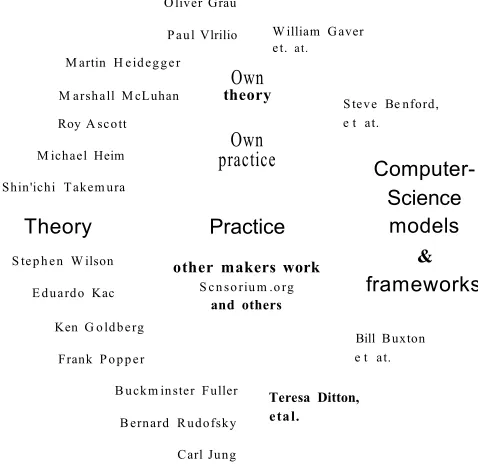
A selection of texts, mostly from Computer Sciences but also from Cultural Studies, Art history and Media Studies informs the search for the methodological background and methods. Here frameworks of telepresence were most valuable, psychological effects and perception. The findings included dimensions and concepts such as Presence,
Im-*. As m ost transformations are visualisations, this term has established itself. Nevertheless, it is linked to the visual se n se and d o e s not em phasise the other forms that d ata may materialise in, such as sound, vibration, tem perature or all of the above.
mersion, Spatiality, Artificiality among others. Cultural Studies and Media Studies gave an overview of the development of computers in art, communication arts and telepres ence art.
Overall three texts from HCI proved essential, providing the methodological foundation for this research. They were necessary to understand implications and related ideas to immersive experience and especially the idea that connected my own observations with Telematics. Here the rich history of computer science exploring telepresence was very useful. The concept of “Immersion, Engagement and Flow ” by Douglas and Hargadon (Douglas and Hargadon, 2000); Ideas on Presence and Immersion by Lombard and Dit- ton (Lombard & Ditton, 1997), ideas on transportation and spatiality “Here, there meet ing in a virtual space.” by Benford et. al. (Benford, 1998). Although this paper is on “shared spaces” and the commercial application of Collaborative Virtual Environments it provides three helpful dimensions called Transportation, Artificiality and Spatiality to classify shared space technology. These dimensions inspire classifying interactive art in general and allow for comparing artworks to each other from their technical set-up and enable conclusions to be drawn. They also inform the conceptual background in inform ing the interview questions and successive coding of the interviews with participants. Benford also introduces three different spatial properties: Containment, Topology, Movement plus a shared coordinate systems which were of no deeper relevance for this undertaking as they were more speculative allusions.
This research is needed to promote and gain a better understanding of a promising area of interactive art that creates experiences of holistic overview of the world. This area can apply telematic technologies in combination with the process of transforming data from one sensorial modality to another to create these experiences. An important role in this process is most likely played by the degree of interactivity and the live-character of data provided. This may be data resulting from natural processes such as the wind, other weather phenomena or earthquakes. The following section attempts to ground and elab orate on the initial questions this research began with.
1.1: Mapping the terrain
This section maps the terrain of my area of interest and allows the reader a view of the phenomena this research project is trying to understand and provide evidence support ing my claims. It can be seen as an epistemological and philosophical framework to contextualise the work.
This exploration begins with the attempt to understand phenomena evoked by my own work and to position it within the context and tradition of existing artworks and thoughts. These ideas and artefacts emerge from different disciplines within the 19th and 20th century. They include the telephone and radio as well as robots or wind actu ated sculptures. What they have in common can be described as three distinct areas partly overlapping each other as follows;
Firstly, there is the area of telematic art which includes communicating over unnatural distances or the control of remote devices. Secondly, the phenomenon of transformation art, where this research focusses on the transformation o f data from one sensorial medi um to another. Thirdly, the focus is on the idea of global awareness, an enhanced, dis sociated state of awareness of the planet which may also include enhanced awareness of the physical process or nature and a different perception of self as a result.
Part of this exploration is to become aware of these distinct similarities and to develop the ability to critically frame, compare and communicate them, but also of realising that some of the effects experienced could be more generally seen from a telematic perspect ive as live data from remote locations is involved.
The selected pieces show a concern for the earth as a habitat, for geographical distances, interest in different cultures, time-zones or communicating with people across unnatural distances. All in all they try to create a certain awareness of the physical world. Some do so with advanced technology and equipment whereas others achieve their goal by more reduced and poetic means. The works had something in common that was difficult to point out, a captivating immersive experience being one of them.
So what are these similarities?
During the research process, 1 began to understand that some of these interesting experi ential qualities were technically achieved through telepresence effects, biofeedback and the transformation of data from one sensorial modality to another. From their content they circumscribe an interest in the natural process (weather, wind, earthquakes), geo graphy and distances (time-zones), the orbital view of the earth and experiencing these qualities with multiple senses, a fascination with simultaneous and synchronous pro cesses. Overall they beckon an interest for a “holistic overview of the world” and “inter connectedness” in one way or another.
Some of the values and affordances have been recognised and described before, some have not. Namely some aspects of Telepresence have been documented well since the
1980s by HCI, while aspects of communication art have been documented in artist’s texts; the area that this research project engages, telematic experience and transforma tion of data, has only just recently been recognised by HCI and has only rarely been consciously explored by artists or designers.
1.2: Global awareness and the physical world
As we have seen in the introduction there is a distinct difference between McLuhan’s “global village” of the perceived shrinking of the world and Fuller’s “one-town world” which emphasises more a global perspective and interconnectedness. Peter Weibel (Weibel, 1990) distinguishes between two different experiences of global awareness: A
global consciousness as a result of a growing awareness of the simultaneity of actions in the world as a result of the disappearance of distance, duration and global networking. Secondly, an orbital consciousness as the result of an orbital perspective of the world, a holistic overview of the planet Earth. This we see in art that is made to be seen from space down on earth, or art made in space to be seen from the earth’s surface.
This reminds of the comment made by the astronaut Eugene Ceman “We went to ex plore the Moon, and in fact discovered the Earth. ” (Krausse, 1998, 270) It appears that
inherently global consciousness has the potential to create an awareness, rediscovery and attachment for the physical world. When our attention is directed towards planet earth as a whole it becomes close and comprehensible, instead of being abstract and dis tant. In that sense the global awareness experience makes us aware of the immediate physical world surrounding us as part of the whole world we are now able to fathom through technical images such as satellite imagery that we can interact with.
Philosopher Paul Virilio warns that our engagement with the world is more and more substituted by images that we take for the real world. Virilio describes that the visualisa tions created by television, surveillance cameras, microscope, telescope and satellite turn inside and outside around and that this resulted in the virtualisation and amplifica tion of optical density of the real world (Virilio, 2000, 14). As a result we would see an
“end o f geography” (Virilio, 2000, 9) and warns that the monitor may become the new horizon of our world.
Abraham Moles also commented on the dangers of these vicarial1 technologies in 1992:
“As we enter the age o f telepresence we seek to establish an equivalence between 'actu al presence' and 'vicarial presence.' This vicarial presence is destroying the organising principle upon which our society has, until now, been constructed. We have called this principle the law o f proximity: what is close is more important, true, or concrete than what is fa r away, smaller, and more difficult to access (all other factors being equal). We are aspiring, henceforth, to a way o f life in which the distance between us and ob jects is becoming irrelevant to our realm o f consciousness. In this respect, telepresence also signifies a feeling o f equidistance o f everyone from everybody else, and from each o f us to any world event. ” (Moles in Kac, 2005, 145)
This may also be seen as a challenge for media designers to think about solutions for the negative results of Moles’ experience of equidistance. Just as tele-technologies are changing our perception and expectations of the world we could also state that once be coming aware of this characteristic bears in itself already an awareness for these dangers and a vigilance towards them. I believe that artistic projects that make critical use of telematic technologies are an inherently advantageous and beneficial contribution to becoming aware of these dangers - instead of actually contributing them. This re quires artists as well as an audience that are media-literate enough, inclined and suscept ible to a certain extent to these issues. An interest in design could be beneficial for artists in that respect in that they better understand how the audience perceives their work and expects from it.
1.3: Transformation of data into a sensual experience
Transformation involves the process of transforming data from one sensorial modality into another. Two of several examples are visual plug-ins for MP3-Players that trans form properties of the music into animated visuals on a computer screen, or changes in gravity which are transformed into a spatial sound experience. Both examples transform data, in one case music and in the other indiscernible changes in gravity to a different sensorial modality, and effectively allow us to experience the data in deeper and some times more meaningful ways.
Other data may be of numerical kind and convey the strength, duration and location of earthquakes. Yet, whereas a scientific transformation would have to be accurate within
1. Vicarial referring to a vicar, serving in the place of so m eo n e or som ething else.
constraints and transparent regarding the rules it performs upon the data, an artistic ap plication would allow more freedom, as for example the transformation of remote earth quakes into vibrations of a local media installation piece. This would give the visitors a sensual impression of these distant geological events without exposing them to a real and dangerous situation. We can also envision the same set-up from a scientific per spective where the data is accurately simulated. The transformation of the information into a sensorial experience, from an abstract description to an actual experience domin ates the overall character for participants in fundamental ways. It may be compared to synaesthesia a neurological phenomenon where, for example, individuals perceive sounds also as visuals.
Fundamentally the idea behind this concept of transformation is that dry data can be transformed into a sensual, tangible experience that allows us to understand and engage with information in an embodied and physical manner, moving us in different ways than reading numerical data, charts or graphs, may. By transforming them into the sensual realm they may move us in a viceral manner and not a cognitive and rational, mind-fo cussed one, as we are multi-sensorial beings and exist with all our senses in the world.
With the proliferation of computers this possibility has become more accessible and easier to achieve. Potentially it may change the proverbial cold computer technology into something associated with a sensual and more humane realm.
Several different labels are used by different disciplines to describe the transformation process. Among these labels are morphologically analogous (Popper, 1968, 158) used by Etienne Souriau in 1912. Transformation (Reichhardt, 1968, 43) by Roger Dainton in 1968 and just recently by Lev Manovich as Visualisation Art and mapping from one domain to another (Manovich, 2001). The first HCI symposium about “Non-visual & Multi-Modal Visualization” 1 took place in 2004 in London. While visualisation refers solely, to the visual sense, this label does not seem appropriate for most of these sen sorial processes that involve the other senses as well. I prefer using the term Transform ation, which is used in Roger Dainton’s 1968 essay Simulated Synesthesia.2 (Reich hardt, 1968, 43) Transformation emphasises the change of form and appearance the data undergoes and not the sensorial modality it addresses as it can be the very same sensori al modality it originates from e.g. speech being transformed into music. This is where context becomes relevant and is the explanation why the classical information theory model developed by Claude Shannon and Warren Weaver (Shannon, 1948) is not suit
able as a descriptive model. Although it allows for different media such as television, radio or discrete telegraph signals it does not include the role of the spatial dimension
and sensorial modality, which in the telematic connections under investigation is con cerned about.
Transformation is a rule-based process which allows for data to be processed according to certain procedures from its original raw state and displayed in a new medium or addi tional medium. Computers treat data indiscriminately and the data of origin can be of al most any kind, from actual, live figures of an earthquake or gravity to asynchronous statistical data of a region or physiological data of a body. It is only humans that give, and can give meaning to this data." And it is only this recipient for whom the content in form of meaning can make a difference.
The benefit of this transformation is that we are engaged also with our body and not with our mind only. We feel and experience the world with our whole body and all our senses and Transformation Art should make use of this, instead of cold, rational and cognitively intake of information. The process of transformation makes the fundamental
*. There also is a d eep er problem involved in using th e term data. W e cannot sp e a k in such an ab stract way of d ata as such; also digitisation m akes it a p p ear this way. D ata is content on several layers. An intractable conceptual problem of this research w as recognising the n ecessary distinction betw een synchronous and asynchronous d ata and becom ing aw are of the difference betw een the dialogical, engaging and active “com m unication art” and the m onological, contem plative, passive and observant “telem atic art” (with or w ithout true interaction or agency). The technical setu p in both sy stem s is som etim es identical, and even the signal format. Yet they are perceived very differently. “Global w indchim es Project” creates a se n se of global aw aren ess while “Hole in S p a c e ” (Wilson, 2003, 487) in the end is a video conferencing application. Data, or the information into which w e turn it, is not neutral, it is political, it has a m eaning, an agenda, sen d er and receiver bring with them history and context. So w e cannot sp eak of d ata a s such, also the digitasation of it m akes it a p p ear the sam e: it is not so, only for the com puters that relay it indiscrim inately through the netw orks. It also pertains to connecting people with people, or people with places. We are social beings and talk is not only a medium , but a way of expressing our personalities of becom ing oneself in a conversation with others. Talk is a social p ro cess. W e b eco m e who w e are by mirroring ourselves in others. Som ething captivating and engrossing is happening to our m inds and our behaviour w hen w e en g ag e in a dialogue with others. The m ore “natural” this dialogue is the m ore captivating it b eco m es, even w hen this dialogue is com puter m ediated.
difference between the abstract knowledge of something and actually experiencing it. We trust our sense of touch more than what we read. (Singer, 2004). This also suggests a hierarchy of the senses.
Employing the transformation process to experience data on an embodied, physical and spatial level instead a rational and cognitive one will result in a deeper and more mov ing and memorable experience. A balance of the two would be desirable.
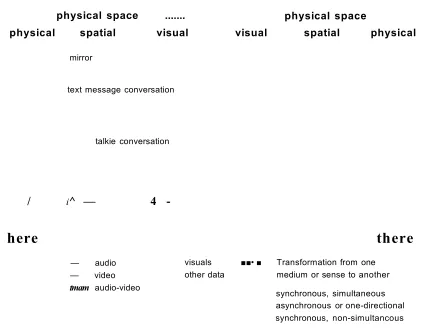
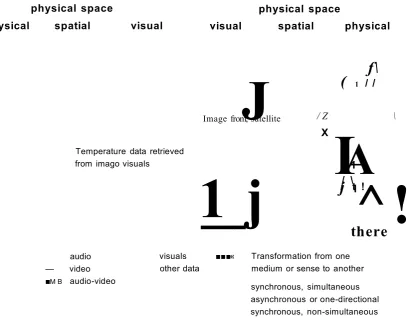
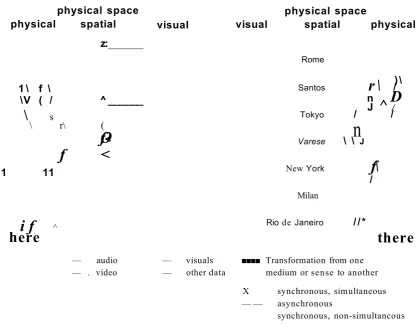
The following diagram (Figure 3) attempts to visualise the transformation of data from its origin to another location and a different medium. Assuming that it is a telematic set up connecting two distant places it consists of the gallery space (here) and the place of origin (there). In this example, Ken Goldberg’s non-interactive installation work “Mori” (Wilson, 2002, 241, 531), a remote seismograph measures the constant movements of the earth’s crust and sends the data over the Internet to another computer about one mile away. Here the data is transformed into an animated curve on a computer screen and into a low frequency sound made audible in the space. A visitor needs knowledge about the background of the installation to understand what is taking place and create meaning from it, in this case that the ground beneath her feet is not as stable and permanent as it seems, thus alluding to the title of the piece, mori, latin for a “reminder of mortality.” The imperceptible vibrations of the earth’s crust can now be perceived by the visitor through different sensorial modalities, visual and audible.
transformed manipulation/
output on displays transformation data original action
Figure 3: Transform ation, from There to Here. Ken G oldberg's installation “Mori” the perm anent trembling of the earth ’s crust is transform ed to a visual and m usic at another location. This diagram evolved into the diagram s in Figures 6, 7, 8.
1.44 0.45 1.98 0.61 2.07 0.45
visuals; graphs low frequency sound
vibrations of Hayward Fault detected by seismograph
here
there
Partly this diagram is limited as it requires a connection to a remote location to depict the transformation process. What about local processes? Visualising the transformation of a local process hidden from the range of our senses cannot be displayed.
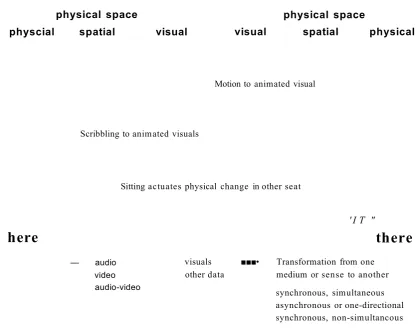
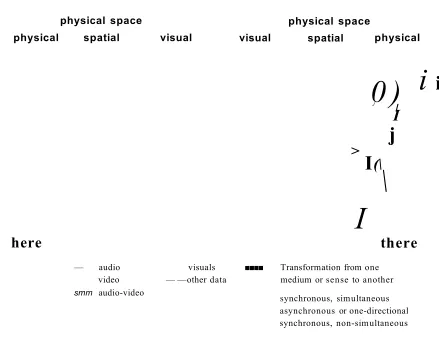
This diagram (Figure 3) was considered an addition to Figures 6 and 7, finally merging with the “Here, there: Transformation and Spatiality” (Figure 8) diagram. It visualises the concept of transformation of data into another sensorial modality and shows its close relationship to telematics.
1.4: The dim ensions of Transportation, Spatiality and Artificiality
The text “Understanding and Constructing Shared Spaces with Mixed-Reality Boundar ies” by Steve Benford et.al., describes different properties of “Shared Spaces” in com mercial applications especially tele-conferencing and shared workspaces where remote parties can jointly act in a CAVE or an Interactive Workbench (Benford et.al., 1998).
Interesting for this research are the different dimensions between which they distinguish as they relate to a certain extent to other remotely connected installation pieces.
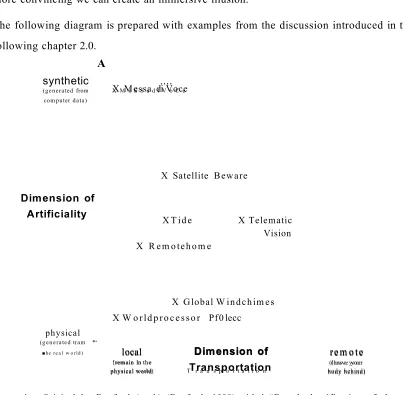
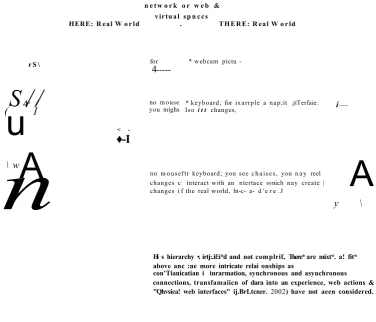
The interesting concepts drawn from this text are Transportation, Spatiality and Artifici ality. They were used to create a framework that informed qualitative interview ques tions and the diagrams to gain a better understanding of these experiences.
Transportation is the “extent to which a group o f participants and objects leave behind their local space and enter into some new remote space in order to meet with others, versus the extent to which they remain in their local space and remote participants and objects are brought to them. It therefore characterises the essential difference between local and remote. ”
Artificiality can be understood as “the extent to which a space is either synthetic or is based in the physical world. This spans the extremes from wholly synthetic to wholly physical environments. ” This definition is related to the researchers own term “trans
formation” described above as it may also involve computer mediation.
Spatiality concerns the environments “level o f support fo r fundamental, physical spatial properties such as containment, topology, distance, orientation,, and movement [...]. Its extremes are characterised by the notions o f space, a context that further provides a consistent, navigable, and shared spatial frame o f reference (e.g. Cartesian coordinate system). ”
Benford’s categories theoretically contain the concept of Telepresence a