<http://orcid.org/0000-0002-0954-2725>, WEARN, Jenny and JANSON, Rob
Available from Sheffield Hallam University Research Archive (SHURA) at:
http://shura.shu.ac.uk/4449/
This document is the author deposited version. You are advised to consult the
publisher's version if you wish to cite from it.
Published version
LANGLEY, Joseph, YOXALL, Alaster, WEARN, Jenny and JANSON, Rob (2004).
Inclusive design: making packaging easier to open for all. In: 14th IAPRI World
Conference on Packaging, Stockholm, June 13-16 2004.
Copyright and re-use policy
See
http://shura.shu.ac.uk/information.html
‘INCLUSIVE DESIGN’: MAKING PACKAGING EASIER TO OPEN
FOR ALL
J. Langley, J. Wearn, R. Janson, Dr. A. Yoxall
Department of Mechanical Engineering, The University of Sheffield, UK
Keywords: Closure, Finish, Finite Element Analysis, ROPP
ABSTRACT
Social equality demands a shift in attitude, away from treating older people and people with disabilities as special cases requiring special design solutions, and towards enabling them to have equal access to any product or service through a more inclusive approach to the design of buildings, public spaces and, more recently, products and services. This is not just important for social equality but also for business growth through new products and services and through creating wider potential markets.
Consumer packaging is a field in which many people, including young able bodied people, often struggle in relation to openability. Until now, the main thrust of inclusive design in the consumer packaging field has been driven by art and design disciplines, focusing on the shape and ergonomics of the packaging or cognitive solutions in order to make them easier to open. This approach does not always work first time and a time consuming, materially expensive trial and error process often ensues.
This paper outlines all the arguments for inclusive design, stressing the importance for both consumers and business. This paper also outlines an engineering design approach for inclusive design that uses real human factors as design limits, resulting in packaging that will be easily opened by all it’s end users without the expensive trial and error approach that has been used up to this point in time. The example of the Roll-On-Pilfer-Proof (ROPP) closure system is used in this paper.
GLOSSARY
GF305 Industry Standard spirit bottle thread profile.
Cap/Closure Generic term for screw thread closure for stopping bottles.
Finish Generic term for glass thread.
ROPP Roll-on-Pilfer-Proof, common closure type for spirit bottles.
Wadding/liner Material insert in the top of the closure to create a tight seal between glass and closure.
Wood pulp A type of liner material.
Over torque Torque required to turn the closure the wrong way and strip the thread. Slip torque Torque required in opening the closure to make the initial movement or
the very first slip.
Bridge torque Torque required in opening the closure to break the pilfer bridges between cap and pilfer band.
INTRODUCTION
‘…design for the young and you exclude the old, design for the old and you include the young…’
- Bernard Isaacs, Founding Director of the Birmingham Centre for Applied Gerontology(1)The problems associated with opening packaging have long been
documented. However, the drive to overcome these issues has been slow due to the conflict between ease of opening and protecting the packaged product from both structural damage and from environmental attack, demanding both rigidity and good seal integrity.
However, with the current technical capabilities at the disposal of the packaging industry this is no longer an excuse and it is in the interests of not only the consumer but also the manufacturer to supply packaging that is both easy to open and fulfils all other traditional functions of packaging.
With the capability to measure human factors, it is now possible to use these
measurements as design limits. This project investigated the current methods of measuring human strength. It was found that, although indicative of trends, this data is not specific enough to use as design limits for specific products.
Variations such as dimensions and materials, need to be accounted for each specific type of packaging. Therefore there is an ongoing student project to create devices for the measurements of specific human strengths, such as grip strength or opening strength. These devices will have universal fittings to which can be attached specific closures or materials, of specific sizes and shapes.
SOCIAL MOTIVATION FOR INCLUSIVE DEISGN
Attitudes to people with disabilities are changing. This has largely been due to government recognition of the needs of those sections of society and pressure from societies, charities and people with disabilities themselves (2). One such pressure group called ‘People First’ state (on their website) ‘Jars should be labelled, not people.’ These labels are
condescending and enforce damaging stereotypes.
It is recognised therefore that there needs to be a change in perception to think of all other individuals as people, not labels no matter what their colour, age, religion, physical or mental ability. Hence, it is envisaged that this change of attitude will bring about a more integrated and inclusive society.
BUSINESS MOTIVATION FOR INCLUSIVE DESIGN
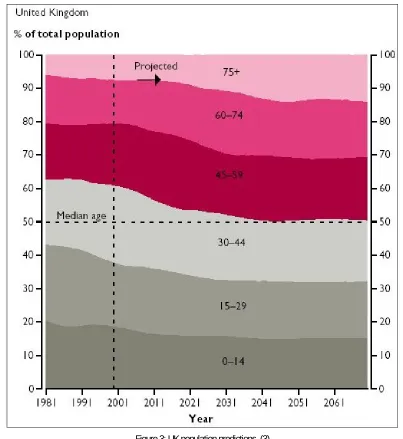
By 2020, the new consumer will be the 50+ year old (3). Demographic predictions illustrate that by 2020, 50% of the UK population will be over 50 (figure 3). These people will be the wealthiest 50+ generations that the UK has ever seen, commanding a
substantial disposable income and hence control a large proportion of the country’s wealth and savings. This wealth needs to be put back into circulation in order to generate jobs and keep the economy healthy. Retired people also have time to spend more money and also the time to shop around and compare products. Products that are physically inaccessible to them will not be on their shopping lists. In order to maximise market potential for a given product, manufacturers should ensure that they are accessible to the weakest person and by doing so, make it is accessible to all people.
There is also a current costs to both industry and tax payer due to accidents caused by difficult to open packaging. Injury litigations and consumer dissatisfaction directly cost the industry whilst 94,000 accidents a year cost the NHS £12 million a year (4). A large proportion of these costs are due to people using knives and such to attempt to open
packaging which shouldn’t require a tool at all. The reason a knife is used is solely down to the difficulty of opening.
MEASUREMENT OF HUMAN STRENGTH
The existing research into human strength is indicative of trends only. It is not sufficient for use as precise design limiting factors. The design limits need to be gathered for specific packages.
The typical types of strength that are required in opening a package are pinch strength, grip strength, opening strength, wrist twisting strength, pull strength and many more. For each of these various strength measurements there are different variations based on orient-tation, fingers used etc. The strength that can be applied to a form of packaging can vary greatly. For instance, in the case of glass bottles and jars, the height of the closure, the diameter of the closure, the material of the closure, the height of the jar and the diameter of the jar will all affect the type of grip that is applied and hence the strength of grip that can be applied. At the University of Sheffield a universal device is being created for measuring grip strength on bottles and jars in which ‘jars’ and ‘closures’ of various sizes and shapes can be attached to the device in order to get accurate and specific measurements.
and a type of opening strength. An analysis needs to be carried out to investigate the various types of grip that are applied and the affect these differences have on the opening strength that can be applied. Once this is done a relationship between grip and opening strength for that specific closure can be created and the lowest grip and opening strength is taken as the design limiting factors.
THE ENGINEERING APPROACH TO INCLUSIVE DESIGN
The basis of the engineering approach to inclusive design is on an analytical analysis, deriving an equation that describes the opening of the packaging. This equation must include both human factor terms and structural terms. That is to say the strength of the human is what overcomes the structural forces resisting opening be they frictional, tensile of shearing forces. The terms in this equation are then found using experimental and/or numerical methods. For example, the human factor terms and material properties can be found using experimentation whilst forces between threads can be found using finite element methods. Precise values or ranges of values can be found for each term.
Once this has been done a parametric study can be carried out using the experimental, numerical and analytical models. The parameters of the components and the process by which those components are brought together to create the package are varied and the effect this has on the openability can be determined.
The human factor terms in the equation are then fixed at the lower limits found from the experimental analysis whilst the remaining terms are changed and optimised, based on the findings of the parametric study, to fit with these low human opening forces. The new design of component(s) and/or process are then tested using any of or all three of the analysis techniques for functions such as seal integrity, structural integrity etc. Figure 4 demonstrates how this can be achieved.
THE ROPP EXAMPLE
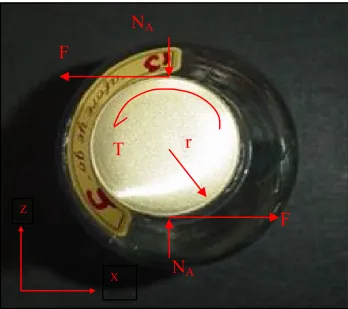
Figure 5 shows a typical set of forces that a human would apply to the outside of an ROPP closure. The number of points of contact between the hand and the closure will vary from person to person and hence the number of times that the NA and F are repeated will vary
although NA will always act raidially towards the centre of the closure and F always at a
tangent to the circumference to the closure. To simplify this complication, the terms NA
and F will be taken as the sum of all the grip and frictional forces generating the torque. These forces can be resolved to give the opening torque as:
T=Fr Equation 1
where:
F=NAμshc Equation 2
and hence:
T=NAμshcr Equation 3
where:
T = Applied human opening strength r = Radius of closure
NA = Applied human grip strength
μshc = Static co-efficient of friction between human skin and closure
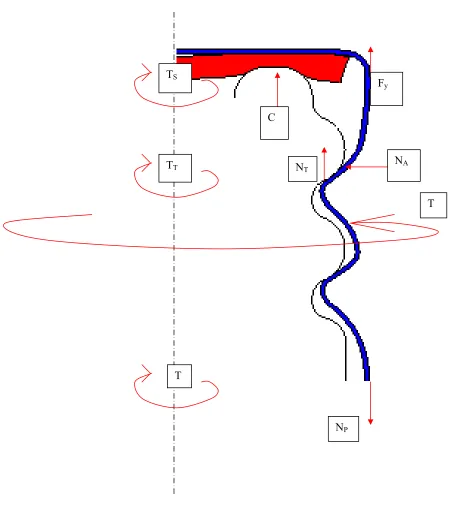
Between the closure and the glass bottle there is another set of forces that resist opening. Figure 6 shows some of these forces. From the full force diagram the following equation can be derived:
T = [Cμgl + (NA+NT)μgccosθ - NTcosφsinθ +Aσflowµgc]r Equation 4
where:
T = Torque required to open closure
C = force at sealing surface due to liner compression
μgl= Coefficient of friction between glass and liner NA= Applied force from human grip
NT= Normal force at thread interface
μgc= Coefficient of friction between glass and closure θ = Thread helix angle
φ = Angle of NT to the vertical
A = Cross sectional area of the pilfer bridge(s) σflow = Flow stress of closure material
Equations 3 and 4 describe what the human can apply to the closure and what the closure requires to open it. These two must equate and currently do not. During the opening process, some of the terms in equation 4 will change state from static to dynamic, such as the friction coefficients.
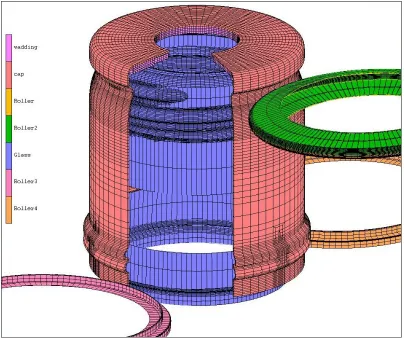
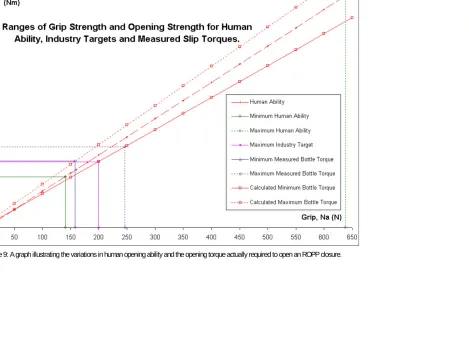
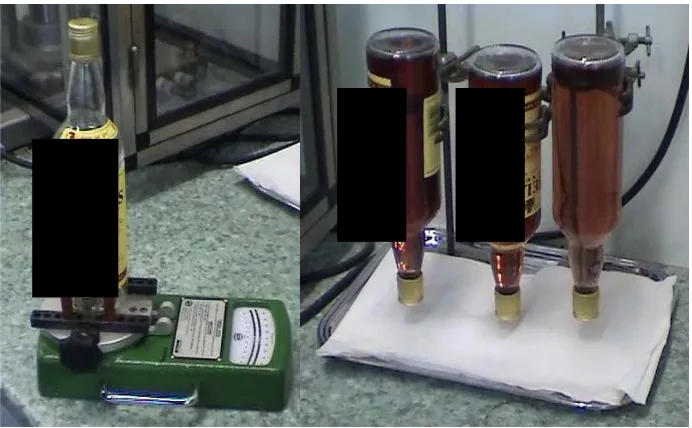
Research, FEA (figure 7) and experimental (figure 8) analyses give ranges of values to the terms in both equations. This gives a range of possible values for the opening torque of the bottle (figure 9). The human strength terms are fixed at the lower limits of the weakest consumer group and the remaining terms are changed via parametric study to incorporate these low human strength terms. The new design is then tested for other functions such as openability and seal integrity (figure 10).
CONCLUSIONS
In conclusion it can be said that:
1. There are excellent social and business motivators for industry to take up the engineering approach to inclusive design.
2. The current human strength research is indicative of trends but specific measure-ments need to be taken for specific packaging.
3. The engineering approach to implementing inclusive design outlined in this paper ensures that the largest possible percentage of a potential product user group will be able to access that product.
4. The key aspects of this engineering approach to inclusive design are:
a. Deriving and equating the human element of opening the packaging and the structural element of opening the packaging
c. Optimising the terms in the equation using the lowest possible values for the human strength terms.
d. Testing the new design with respect to the other functions of the packaging such as seal integrity.
ACKNOWLEDGEMENTS
The authors would like to thank The Engineering and Physical Sciences Research Council (EPSRC), The White Rose Faraday Packaging Initiative in Leeds, British Glass and Glass Technology Services, (GTS).
REFERENCES
1. Design council website:
http://www.designcouncil.info/webdav/servlet/XRM?Page/@id=6046&Session/@id=D_Fd mpAjwckqNhw8ajlcj2&Document[@id%3D2312]/Chapter/@id=2
2. Disability Discrimination Act 1995 3. National Static’s Office
4. DTI – Consumer Safety Reports, 1994
5. Yoxall, A. & Haake, S. 2000, Numerical Simulation of interaction between a threaded glass container and a screw cap. Glass Technology. Vol 41/1
6. Yoxall, A. 2002, A numerical simulation of the roll-on-pilfer-proof process on a GF305 Thread. Glass Technology. Vol 43/3
7. Yoxall, A. & Langley, J. 2002, A Numerical Model of Closure Liner Materials. Glass Technology. Vol 44/6
8. Dragoni, E. 1994, Effect of thread pitch and frictional coefficient on the stress concentration in metric nut-bolt connections. Journal of Offshore Mechanics and Arctic Engineering. Vol. 116/21.
9. Kenny, B. & Patterson, E.A. 1989, The distribution of load and stress in the threads of fasteners-a review. Journal of Mechanical Behaviour of Materials. Vol. 2, 1-2. 10. Brennnan, F.P. & Dover, W.D. 1995, Stress intensity factors for threaded
connections. Engineering Fracture Mechanics. Vol. 50/4; 545-567.
11. Lochegnies, D., Marion C., Carpentier E., & Oudin J., 1996, Finite element contributions to glass manufacturing, control and optimisation. Part 2. Blowing, pressing and centrifuging hollow items. Glass Technology. Vol. 27/5; 169-174. 12. Murnane, R.A. & Moreland, N.J. 1988, Ceramic Engineering Science Proceedings.
Vol. 9/3-4:192-202.
Figure 1: Showing the ROPP closure before and after application respectively.
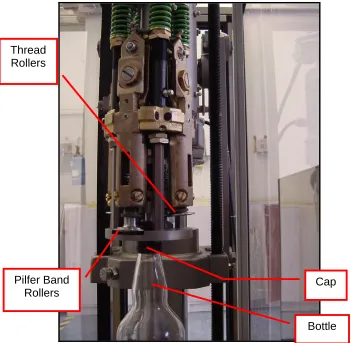
Figure 2: A single head capping machine used to roll thread and pilfer proof band into the closure.
Pilfer Band Rollers Thread Rollers
Cap
[image:8.612.110.461.252.595.2]Figure 4: The engineering approach to inclusive design
Figure 5: A typical set of forces applied by a human to open an ROPP closure.
F
N
A
r
T
F
N
A
Z
[image:10.612.93.441.322.631.2]Figure 6: Part of the force diagram used to derive the equation describing the opening torque of the ROPP closure.
NP
T TS
TT
T C
Fy
NA
Figure 7: Schematic diagram of the FEA model created to analyse the capping process
[image:12.612.155.443.471.615.2]