Derk-Jan de Grood
TestGoal
Result-Driven Testing
Derk-Jan de Grood Collis B.V. De Heijderweg 1 2314 XZ Leiden The Netherlands [email protected]
ISBN 978-3-540-78828-7 e-ISBN 978-3-540-78829-4
DOI 10.1007/978-3-540-78829-4
ACM Computing Classification (1998): K.6, D.2.5
Library of Congress Control Number: 2008924999
© 2008 Collis B.V., Leiden, The Netherlands
This work is subject to copyright. All rights are reserved, whether the whole or part of the material is concerned, specifically the rights of translation, reprinting, reuse of illustrations, recitation, broadcasting, reproduction on microfilm or in any other way, and storage in data banks. Duplication of this publication or parts thereof is permitted only under the provisions of the German Copyright Law of September 9, 1965, in its current version, and permission for use must always be obtained from Springer. Violations are liable to prosecution under the German Copyright Law.
The use of general descriptive names, registered names, trademarks, etc. in this publication does not imply, even in the absence of a specific statement, that such names are exempt from the relevant protective laws and regulations and therefore free for general use.
Cover Design:KünkelLopka, Heidelberg
Illustrations:Thijs Geritz, The Hague
Back cover photo:H. de Vries, Rijswijk
Printed on acid-free paper
9 8 7 6 5 4 3 2 1
Preface by Lee Copeland
Focus on business goals. Align your work with those goals. Eliminate work that does not add value to the business – this is today’s management mantra. All good advice. But few in the testing community truly understand what that kind of alignment means. Derk-Jan de Grood is one of those few.
Today, many variations of testing processes are available to organizations. Some are tool driven (both commercial and open source); others are document driven (IEEE 829 Standard for Software Test Documentation); while still others are tech-nique driven (boundary value, state-transition, and pair-wise testing). A myriad of books are available to help you from the classics by Beizer and Myers to the latest from Black; Bach, Kaner, and Pettichord; Graham, Evans, and van Veenendaal; Craig; and Copeland.
TestGoal is different. TestGoal is result-driven. Not the kind of results testers have historically tried to achieve–find all the severity 1 defects, reach 100% state-ment coverage, or accurately estimate the number of defects remaining. TestGoal focuses on results that the business cares about. Like it or not, the business does not care about pair-wise test design and defect taxonomies and defect reports no matter how pretty our charts and graphs may be. The business cares about busi-ness results – sales, profit, market share, time to market, product differentiation, and competitive advantage.
As testers, our goals must not only support the goals of the business, they must be the goals of the business. Result-driven testing understands those goals, carries out only those activities that contribute to those goals, and produces information that enables executive management to achieve those goals. In this way, all of our test-ing activities support and add value to the organization.
condi-vi Preface by Lee Copeland
tion coverage, of course.” They don’t even know what those words mean. Yet that is what we measure and report – a sign of our disconnectedness from the business. TestGoal puts us on the right track.
Another way TestGoal guides us is by pointing out that the “risks” in risk analysis are those things that prevent the business goals from being achieved – profit, im-age, product differentiation. Yet most testing risk analysis focuses on threats at a very different level–resource availability, staff availability, and training needs.
TestGoal also emphasizes the central role that testers should play in their organi-zations. Gone are the days when the testing group was tucked away in the corner of the organization chart. Today’s testers play a central role in the creation of quality systems, building bridges to all parts of the organization. We add value to the organization when we influence others in aligning their work to the business.
This book, however, is more than just high-level philosophy. It describes the intri-cacies of test plans, levels, budgets, strategies, techniques, and designs. It explains the importance of test environments, execution, reporting, and automation. But throughout, Derk-Jan reminds us that while “Testers see a lot of suboptimal proc-esses and faulty systems … This doesn’t change the fact that testing is a wonderful and fun profession. Result-driven testers … know they add value to the software development project.” It is a great profession. I’m proud to be a part of it. Best wishes in your testing efforts.
March 2008 Lee Copeland
Preface by Martin Pol
For many organizations, software has become one of the most important pillars of their business processes. The requirements for the timely availability and quality of information systems are high by definition. But in spite of all of the innovations and initiatives to improve processes, it’s still not easy to develop error-free soft-ware. Testing is, and will continue to be, indispensable to identify poor quality in a timely manner, or in other words, to identify the risks of going live. Learning by error has taught organizations that testing is not only a must but that it contributes positively to the company’s business goals.
Structured testing began in the United States in the 1960s, and has since developed into a mature and independent field. Structured testing was first carried out in military environments and in the computer hardware industry. Pioneers such as Beizer, Perry, Parnas, Myers, Hetzel and Gelperin have provided a solid methodi-cal and organizational foundation. Throughout the years, the materials they devel-oped have been included in various standards such as IEEE, ISEB and ISTQB. Over time, these standards have been supplemented with extensions, variations and special applications.
As the result of a study that was conducted by the General Accounting Office and due to political pressure, the Dutch Tax and Customs Services was the first (unbe-lievable but true) to introduce a comprehensive structured test approach in 1985. As an employee of the Dutch Tax and Customs Services, I was able to build a bridge between the American developments and the Dutch approach. In 1988, this approach was published as the “Testing Manual,” which was quickly sold out. In the years following its publication, every self-respecting organization, administra-tive or other, gladly applied this approach, which is the source of every Dutch testing standard. The Netherlands also have an international reputation to main-tain, because their contribution to the worldwide testing community is significant.
viii Preface by Martin Pol
therefore, to the contribution testing makes to the organization’s goals. What dam-age is prevented by testing? What are the risks? And what are the rewards? In short, the main goal of testing is to minimize risk!
Can testing have more than one goal? It sure can! Testing, of course, is still an activity aimed at finding errors. But with the improvement of methods, techniques, and especially of testing tools, the development of reusable testware, expertise and infrastructure have become valuable by-products. As a result, testing is faster, cheaper and better, which of course has a positive effect on the costs and the time-to-market. TestGoal takes a result-driven approach to testing.
TestGoal is a very valuable addition to today’s broad range of available test litera-ture. The “result-driven” approach is hotter than ever. This book’s clear explana-tions pleasantly point the different disciplines involved in the testing process in the right direction: “What is needed to achieve the anticipated goal?”
Experience shows that it is not easy to apply a methodology. Pressures such as deadlines, low budgets or low quality stop many good intentions dead in their tracks. Six clearly described steps lead the reader to the goal – the test result.
Throughout the book, TestGoal provides readers with pointers that enable them to focus on the anticipated goal, the test result, and in fact to minimize risk and pro-duce reusable test products. “Who does what when? How are risks analyzed and processes set up?” Everything has a purpose.
For the TestGoal tester, this result-driven mindset (the ten test principles) is almost innate. A unique element of this book is that every letter focuses on these princi-ples, which I interpret as follows: Professional, Result-driven, Confidence-build-ing, Predictable, Supportive, Flexible and Transparent. The flaws of comparable methodologies are discussed and useful solutions introduced, always with the same goal in mind – the result!
Derk-Jan de Grood has made an exceptional contribution to the world of testing. His drive for result is now available to everyone.
I wish you a lot of fun applying the approach and am confident that this book will enable you to achieve your test goals.
Amersfoort, The Netherlands,
February 2007 Martin Pol
Acknowledgements
A book does not write itself. A lot of people helped create the TestGoal philoso-phy described in this book. A word of thanks is therefore more than appropriate; this book would not be what it is without their contribution.
A lot of colleagues contributed to the first version of TestGoal by writing down the experiences they gained with specific activities in a test project. Thanks to their efforts, TestGoal is not only my story, but our story. For their efforts, I would like to thank the following people:
Albert Los, Albert Witteveen, Colin Lek, Edward van der Pijl, Frodo Wesseling, Gert de Mooij, Hans van Bommel, Jaap Wijnands, Jos Oudsen, Juul Roelofs, Leonard Hugenholtz, Marcel van Donge, Marco van der Heide, Mario de Boer, Mehdi Jalilivandt, Paul van Leeuwen, Roy Miller Sander Panhuyzen, Wilco Schumacher, Mathilda Banfield and Janneke Klop.
x Acknowledgements
your review, you knew nothing about TestGoal, which makes you an ideal re-viewer. And even more so because I respect your knowledge of the testing profes-sion. Jaap Wijnands: Thank you for your meticulous thoughts during the review. Jan Rodenburg: Thank you for your contribution on performance testing. Jasper Overgaauw: I appreciate how you thought along and helped put exploratory testing into practice. Thanks go to Cynthia Maasbommel, Jos Oudsen and Herman Rus: for their indispensable contribution on security testing. Thank you. Vien Sawer of L&L Bunnick: Thanks to your edit work the text just as I wanted it, understandable and easy to read. I Couldn’t have done without you. Thijs Geritz: You know that I really like your drawings. Thank you for the pictograms and the other illustrations you made for us. I am happy to have them in my book.
Henk van Dam and Dirk van den Heuvel: Thank you for your contribution. Our discussion about the position and content of TestGoal was very intense, but it resulted in a joint product. I also want to thank you for the support and the free-dom that you gave me while I was writing. Dirk Jan, the first time we met I still had to learn everything about this intriguing profession. I am glad you introduced me to the world of testing and I am thankful for what you taught me. Without your lessons, this book would not have come into existence.
Erik Petersen, Donna McLeod, Fariba Marvasti, Julie Gardiner and Thérèse Schoch. Thanks for your interest and pre-reading the English edition.
And finally, I would like to thank the following people:
Martin Pol and Lee Copeland who wrote the prefaces: Thank you for your words of praise. I am honored that you were took interest in my book. I am thrilled you liked it.
Hilda and Babette: I am aware of the fact that writing a book is an enormous drain on the family quality time. Thanks for understanding and for your patience while I was sitting behind my laptop again.
Leiden, The Netherlands
Content
1 Result-driven Testing ... 1
1.1 The Importance of IT ... 1
1.2 A Statement about Quality ... 3
1.3 The Perception of Testing ... 6
1.4 A Common Goal ... 7
1.5 Tying in with the Business... 10
1.6 Result-driven Testing... 11
1.7 Focus on the Goal ... 13
2 TestGoal and the Ten Test Principles... 15
2.1 Test Principles... 15
2.2 Focus on Result... 16
2.3 Build Trust ... 17
2.4 Take Responsibility... 19
2.5 Master the Testing Profession... 20
2.6 Build Bridges ... 22
2.7 Test in Phases... 23
2.8 Facilitate the Entire Product Life Cycle ... 24
2.9 Provide Overview and Insight... 25
2.10 Ensure Reusability ... 27
2.11 Keep in Mind: Testing is Fun... 28
2.12 Applying the Test Principles... 29
3 Test Expertise ... 31
3.1 The Test Manager ... 32
3.2 The Test Coordinator ... 32
3.3 The Test Analyst ... 33
3.4 The Test Engineer ... 33
xii Content
4 The Approach ... 37
4.1 Context of the Test Project... 38
4.2 Test Levels ... 42
4.3 The Details of the Test Project... 44
4.3.1 The Step Plan ... 45
4.3.2 Sequence of Activities... 46
4.4 Testing a New Program... 47
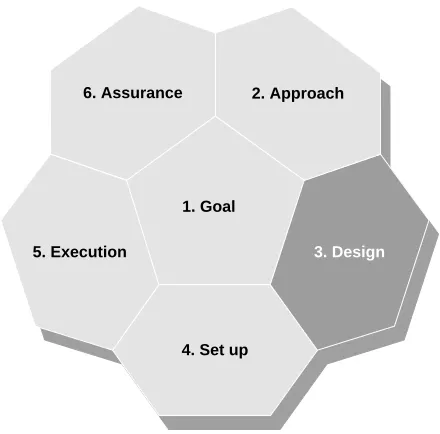
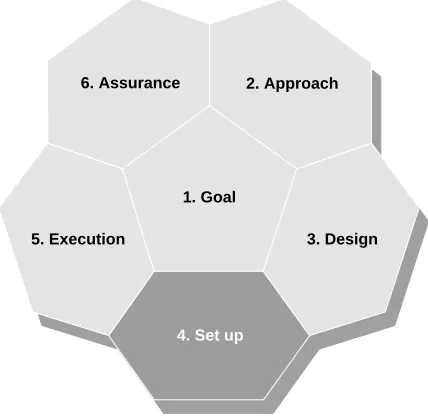
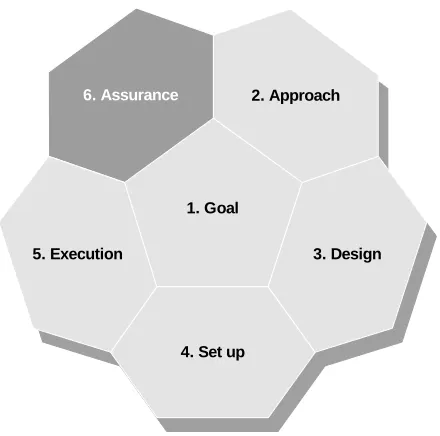
4.4.1 Step 1: Goal ... 48
4.4.2 Step 2: Approach ... 49
4.4.3 Step 3: Design ... 51
4.4.4 Step 4: Set up... 54
4.4.5 Step 5: Execution... 56
4.4.6 Step 6: Assurance ... 58
4.4.7 Goal (Information and Communication) ... 59
4.4.8 Review and Acceptance ... 61
4.5 Testing in a Maintenance Environment ... 61
4.6 Testing Conformity and Interoperability... 65
4.6.1 Introduction ... 65
4.6.2 Applying the Step Plan... 67
4.6.3 Certification Tests ... 69
4.7 Testing Performance ... 71
4.7.1 Introduction ... 71
4.7.2 Applying the Step Plan... 72
4.7.3 Test Design Techniques ... 73
4.7.4 Test Tools ... 74
4.7.5 Dependencies ... 75
4.8 Testing Security ... 77
4.8.1 Introduction ... 77
4.8.2 Approach ... 77
4.8.3 Applying the Step Plan... 79
5 Getting Started ... 83
Step 1 – Goal 6 Assessing the Anticipated Goal ... 87
6.1 Introduction... 87
6.2 Aim of the Assessment ... 88
6.3 Goal Description ... 90
6.4 Information Gathering... 93
6.4.1 Product Development ... 93
6.4.2 People ... 94
Content xiii
Step 2 – Approach
7 Test Risk Analysis ... 101
7.1 Introduction... 101
7.2 The 1D Test Risk Analysis ... 104
7.2.1 Introduction ... 104
7.2.2 Identify Stakeholders and Kick-off ... 105
7.2.3 Determine the Functions and Areas of Attention ... 106
7.2.4 Determine the Relative Importance ... 108
7.2.5 Process the Data ... 111
7.2.6 Agree on the TRA ... 112
7.3 The 2D Test Risk Analysis ... 113
7.3.1 Introduction ... 113
7.3.2 Identify Stakeholders and Kick-off ... 116
7.3.3 Establish the Risks... 116
7.3.4 Data Processing ... 117
7.3.5 Agree on the TRA ... 118
8 Generic Test Strategy... 119
8.1 Introduction... 119
8.2 The Generic Test Strategy... 120
8.3 Test Strategy in the DTP and MTP ... 123
9 Test Budget and Planning... 125
9.1 Introduction... 125
9.2 Create the Test Budget... 126
9.2.1 General ... 126
9.2.2 Work Breakdown Structure... 127
9.2.3 Assessing the Requisites... 135
9.2.4 Establishing the Budget... 136
9.3 Test Planning ... 137
9.3.1 Generic Planning ... 137
9.3.2 Detailed Planning ... 138
9.4 Key Indicators ... 141
10 Test Plan... 143
10.1 Introduction... 143
10.2 Description of the Assignment... 145
10.3 Test Base... 146
10.4 Test Strategy ... 148
10.4.1 Description of the Test Strategy ... 149
10.4.2 Test risk analysis ... 151
10.4.3 Quality Attributes ... 152
xiv Content
10.4.5 Technique Matrix ... 157
10.4.6 Previous and Next Phases... 158
10.4.7 Test Environment ... 159
10.4.8 Assuring the Quality of the Test Project ... 160
10.4.9 Release Advice ... 163
10.4.10 Change and Error Management... 164
10.4.11 Transfer ... 164
10.5 Planning ... 166
10.6 Test Organization... 167
10.6.1 Organization Chart ... 167
10.6.2 Responsibilities ... 168
10.6.3 Meeting Structures ... 169
10.7 Deliverables ... 170
10.8 Requisites for the Test Process ... 171
10.9 Changes and Deviations... 171
Step 3 – Design 11 Sanity Check ... 175
11.1 Introduction... 175
11.2 Filling out the Sanity Check Checklist... 176
11.3 Continuous Learning... 178
11.4 Test Base Review... 178
11.5 Registration ... 180
11.6 Formal Review and Inspection Procedures ... 181
12 Logical Test Design ... 183
12.1 Introduction... 183
12.2 Test Design Techniques ... 185
12.3 Use Test Design Techniques Cleverly ... 191
12.4 Little Experience with Test Design Techniques?... 191
12.5 No Test Design Techniques ... 192
12.6 Using Test Design Techniques... 193
12.6.1 Syntax Testing... 193
12.6.2 EP: Equivalence Partitioning... 196
12.6.3 BVA: Boundary Value Analysis ... 199
12.6.4 C/E: Cause-effect Graphing ... 203
12.6.5 State Transition... 206
12.6.6 CRUD Testing... 208
12.6.7 PCT: Process Cycle Test / AT: Algorithm Test ... 210
12.6.8 Load Tests ... 215
12.6.9 Stress Testing ... 221
Content xv
12.6.11 Concurrency Tests ... 225
12.6.12 HT: Heuristic Testing ... 226
12.6.13 ET: Exploratory Testing ... 227
12.7 Test Design Techniques and Security Testing ... 234
13 The Physical Test Design ... 237
13.1 Introduction... 237
13.2 Relationship Between the TRA and the Logical Test Design ... 237
13.3 Physical Test Case ... 238
13.4 Test Actions ... 243
13.5 The Physical Test Scenario ... 245
13.6 Test Data ... 246
14 Test Data ... 247
14.1 Test Data Elements ... 247
14.2 Test Data Repository... 249
14.3 Live Data Versus Test Data ... 250
14.4 Test Data Management Strategy ... 251
14.4.1 Input from the Application ... 251
14.4.2 Input from the Database ... 252
14.4.3 Closed Loop ... 253
14.5 Including Data in the Physical Test Design ... 254
14.6 Automated Tests ... 255
14.7 Test Data and Exploratory Testing... 256
14.8 Back-up and Restore ... 256
15 Test Environment... 257
15.1 Introduction... 257
15.2 Determine the Requirements of the Test Environment ... 258
15.2.1 Module Tests and Module Integration Tests ... 258
15.2.2 System Tests... 259
15.2.3 Functional Acceptation Tests ... 260
15.2.4 User Acceptance Tests ... 261
15.2.5 Production Acceptance Tests ... 262
15.2.6 Chain Tests ... 262
15.2.7 Pilot ... 263
15.2.8 Performance Tests ... 264
15.2.9 Security Tests ... 265
15.2.10 Training Purposes... 266
15.3 Test Environment Requirements Checklist... 267
15.4 Setting up the Test Environment... 270
15.5 Configuration and Smoke Test... 271
15.5.1 Configuring the Test Environment ... 271
xvi Content
15.6 Maintaining the Test Environment... 272
15.6.1 Configuration Management... 272
15.6.2 Release Management... 273
15.6.3 Back-up and Restore ... 274
Step 4 – Set up 16 Test Automation ... 277
16.1 Introduction... 277
16.2 What is Test Automation?... 278
16.3 Dynamic Test Tools ... 278
16.3.1 Additional Testing Possibilities... 278
16.3.2 Time Saving ... 279
16.3.3 Log files... 279
16.3.4 Comparing Results ... 280
16.3.5 Extensive Repeatability ... 280
16.4 Static Test Tools ... 282
16.5 Supporting Tools... 282
16.6 Test Automation: Yes/No ... 283
16.6.1 Business Case ... 283
16.6.2 Making a Well-Informed Decision... 285
16.7 Developing Test Scripts ... 285
16.7.1 Record and Playback ... 286
16.7.2 Programming Test Scripts ... 288
16.8 Automated Testing for Systems with More Than One Interface... 289
17 Smoke Test ... 293
17.1 Introduction... 293
17.2 Filling out the Checklist ... 295
17.3 Maintaining the Checklist ... 296
Step 5 – Execution 18 Test Execution ... 299
18.1 Test Execution and its Activities... 299
18.2 Activities During the Test Execution ... 301
18.3 Test Run and Regression Tests ... 303
18.4 Leaving the Beaten Track ... 305
18.5 When is Testing Finished? ... 306
19 Error Logging and Management ... 309
19.1 Introduction... 309
Content xvii
19.3 Error Attributes ... 311
19.4 Error Management ... 316
20 Test Reporting ... 321
20.1 Introduction... 321
20.2 Elements in the Test Report ... 323
20.2.1 Scope ... 323
20.2.2 Release Advice ... 324
20.2.3 Hour Estimate... 325
20.2.4 Project Risks and Bottlenecks ... 326
20.2.5 Product Status... 327
20.2.6 Completed Versus Planned Tests ... 327
20.2.7 Error Status... 328
20.2.8 Defect Detection Rate ... 332
20.2.9 Open Errors ... 333
20.2.10 Test Result by Risk Category or Test Cluster ... 334
20.2.11 Test Progress – Executed Versus Planned Tests ... 337
20.2.12 Outstanding Product Risks ... 339
20.3 The Dashboard ... 340
20.4 Clarity of the Test Report... 342
Step 6 – Assurance 21 Assurance ... 349
21.1 Introduction... 349
21.2 Evaluating the Test Project ... 349
21.2.1 Purpose of the Evaluation... 349
21.2.2 Points of Attention... 350
21.2.3 Lessons Learned Report ... 352
21.3 Determining the Regression Test Set ... 353
21.4 Archiving and Securing the Testware ... 354
21.5 Handover... 354
21.6 Discharging the Test Team ... 355
Appendix A – Checklist: Sanity Check on the Design... 357
Appendix B – Checklist: Sanity Check on the Testware... 363
Appendix C – Checklist: Checklist smoke test system ... 367
Appendix D – Checklist: Test charter exploratory testing ... 369
Appendix E – Glossary ... 371
References ... 389
Introduction
Software testing is gaining in popularity. Today, organizations are investing more in the quality of their software and in ways that enable them to control it better. Testing is a very suitable tool that enables companies to do just that.
As testers and consultants, my colleagues and I have visited many different com-panies over the years. Many of the comcom-panies we visited have very mature testing processes, others do not. Although business management and other stakeholders understand that testing is necessary, they are often not aware of its added value. Testers who overlook the added value of testing have difficulty demonstrating it and incorporating it in their software development process. Two aspects seem to function as pitfalls time and time again: the reason to test and the actual framing of the test project. In other words, why are we going to test, and how are we going to do it? The many books that are available on software testing do not spend enough time on these aspects. This is one of the reasons why many companies still con-sider testing as an activity that is separate from the actual development process. Consequently, the collaboration between testers, business managers, users, devel-opers and other stakeholders is not optimal.
My colleagues and I know that things can be done differently. We know that test-ing adds value, saves money, minimizes risk and increases overall profitability. There’s no denying that testing has a lot of added value.
The added value of testing:
• Testing improves the quality of software products
• Testing accelerates the time-to-market of software products
xx Introduction
Testing also accelerates the time-to-market of software products by providing insight into the actual operation and performance of the software and reducing uncertainties that business stakeholders have.
Testing supports the development process by building bridges to the other parties involved. Testers work with developers to find a solution that meets the business needs and wishes. Testing increases the confidence stakeholders have in the solu-tion, which creates support and speeds up the decision to go live. The test activi-ties provide insight into the quality of the system and the progress of the develop-ment. This information helps steer development activities and thus contributes to an efficient development process.
My intention with this book is to highlight the substantial contribution that testing makes to an organization’s business goals. This does, however, require an effort on behalf of both the tester and the organization. It also requires a testing method that focuses on the business goals: result-driven testing.
Result-driven testing is more than just applying a methodology. The success of a project is not determined by the methodology, but by the way the methodology is applied. Result-driven testing, therefore, encompasses several aspects:
• A result-driven mindset
• Testing knowledge
• A result-driven approach that supports the application of result-driven testing
TestGoal is a philosophy that supports all three aspects of result-driven testing. The combination of these three aspects into one philosophy is what makes Test-Goal a fully result-driven approach that enables testers to create transparent and well-structured test projects. This not only benefits the company, it also motivates testers by enabling them to give the company visible added value, namely im-proved product quality and shorter time-to-market.
This book explains how you can make testing result driven. It explains why testing is important and describes all of the activities involved in testing. This makes it a “GO kit” that enables testers to immediately get started. I hope that this book will make you as enthusiastic as I am about the testing profession and the added value testing has for your organisation and its development process. This being the case, I will have achieved my goal with this book.
TestGoal: A Different View on Testing
Introduction xxi
other profession, testing encompasses more than the simple application of a meth-odology. After all, strict adherence to a specific methodology is no guarantee for success. Success stems from the mindset, enthusiasm, knowledge and skill of the tester. These factors determine whether a methodology is applied successfully and whether testing takes on a result-driven character.
Collis is a professional testing organization that has been testing software under different conditions at both large and small companies for more than ten years. TestGoal is the result of this extensive experience. TestGoal was developed in the field and contains practical descriptions combined with familiar examples. Test-Goal helps you combine the mindset, enthusiasm, knowledge and skills needed to successfully streamline your test project.
• TestGoal provides a concrete proposal for an efficient test approach. It defines the activities that must be included in the test project, the sequence in which they are best run, and the products they produce. The process is efficient be-cause this information enables testers to start testing early on in the project.
• TestGoal enables expectations to be aligned and the customer to formulate its wishes. It stimulates discussion between the tester and the stakeholders about the approach. Involving stakeholders in the determination of the approach builds trust and commitment. It also helps align the stakeholders’ different ex-pectations.
• For each of the test activities, the drive to achieve goals and the test principles are integrated in the practical descriptions. Testers not only learn what their tasks are, but also how each task contributes to the anticipated goal. The result-driven tester involves the stakeholders in the test process and ensures that they can see how the quality of the software improves and how the risks of going live are reduced one by one. This builds trust and a basis for the go-live decision.
• TestGoal provides companies with a generic test approach. Together with a clear test report, a generic approach makes the test projects more controllable and comparable to other test projects. This increases the efficiency of the de-velopment process and accelerates the time-to-market.
In short: TestGoal is not a methodology, but a philosophy. It’s a practical philoso-phy that gives testers the tools and best practices to make choices and create good test projects. TestGoal is an integrated combination of these two aspects and helps testers think and act in a result-driven way.
The Reason for Testing: What are we Going to Test and Why?
xxii Introduction
part of successfully delivering quality software. If the goal of the test is not clear, the tester will not be able to indicate whether the test produces the desired results or contributes to the organization’s business goals. And the latter is crucial to any company. Testers who know what they’re doing and what their goal is, are not only able to make the right choices, they are also able to explain their activities and their goals to others.
The first part of this book explains why and how we should focus on the company’s business goals. It discusses the role business goals play in a test project and how it helps involve stakeholders in the test activities. The ten test principles are discussed after the introduction to result-driven testing. They help the tester apply the theory with the right mindset and are the driving force behind the tester’s actions. What characterizes a result-driven tester and what do their actions contribute to?
Most of the literature about test methodologies covers the testing of applications that are in development, in other words, brand new systems. TestGoal is widely applicable, and can be efficiently and successfully used in maintenance or line organizations to test new programs, as well as changes or enhancements to exist-ing applications. The first part of the book takes a look at various levels of testexist-ing and how TestGoal is applied in the different environments. It provides insight into the approach of a test project and the activities involved. Separate chapters are dedicated to the testing of new systems, testing in a maintenance environment, and the testing of performance, security, conformity and interoperability.
Setting up the Test Project: How do we Apply the Methodology?
The second important aspect of testing is the set up of the test project and the approach. More than enough books describe how to test, but because the informa-tion is usually very generic, many organizainforma-tions find it difficult to translate theory into practice. The books do not provide enough information to help the readers make the choices required to apply the theory.
Introduction xxiii
• A number of decisions have already been made in TestGoal based on best prac-tices. Choices are always made at the cost of genericness, but this usually bene-fits the concreteness and applicability of the approach.
• Where decisions have not been made, TestGoal suggests a “standard” option. Arguments for other options are also provided. This gives readers a starting point and support should they choose another option.
• Each activity is described clearly and in detail. If the activity produces a prod-uct, the information the product should contain is indicated. If possible, guide-lines and examples are provided. For example, the description of the physical test design contains tips for the clear formulation of the “goal of the test.”
• Each activity is explained using an action plan. The action plan enables readers to go through the activities in the test project in a practical sequence, whereby some activities can be carried out simultaneously. The action plan clarifies the relationship between the activities and prevents activities being forgotten.
• Integrated test principles . Several places in the book refer to relevant test prin-ciples. This provides readers insight into the practical application of the princi-ples and into the coherence between the different activities in the test process.
• Situations to which best practices apply are indicated. Tips from the field can be adopted by readers or can serve as an inspiration for devising one’s own so-lution.
The set up of the test process is closely linked to the tester’s drive to achieve goals and the test principles. The description of the test approach regularly refers to the test principles introduced in the first part of the book.
Who is this Book Intended for?
Business Managers and Others Who Have an Interest
in Producing High-Quality Software
xxiv Introduction
Junior and Senior Testers
Second, it addresses the testers. This book gives them insight into the role the goal plays in their activities. Testers must be aware of the added value of tests so they can run them effectively. This book describes a tester’s goals as well as the activi-ties he needs to carry out in order to achieve them. It also contains numerous ex-amples and practical tips that junior testers can use as starting points to work out the details of the activities they are asked to perform. Senior testers will also bene-fit from the book in more way than one. On the one hand, the book helps them streamline their activities, which enables them to work on the organization’s view on testing. On the other hand, the book’s practical approach helps them crystallize their expectations and explain to their teams how they want certain aspects to be executed.
Students
IT students are a separate target group. Many students are interested in a career as a tester, but find it difficult to grasp what the profession actually consists of. The limited amount of time schools spend on testing is partly to blame. This book demonstrates how testing contributes to the development of an organization, and thanks to its practical approach, it also provides a clear overview of what testing actually encompasses. I also hope that the pleasure I get out of this profession – which I hope can be read between the lines – will motivate them to become a member of the great profession testing is.
Want to Know More? TestGoal.com
D.-J. de Grood, TestGoal,
DOI: 10.1007/978-3-540-78828-7_1, © Collis B.V., Leiden, The Netherlands, 2008
1
Result-driven Testing
1.1
The Importance of IT
It’s no longer possible to imagine life without information technology – every day, we use computers at home and at work. Companies earn their money by supplying IT-related services and products, or use IT systems to run their business.
An error in an IT system can have grave consequences: a company might not be able to supply products or bill for performed services. A customer who is disappointed by the quality of a service or product will look for another supplier. Software has become an entity that must be taken seriously.
The life cycle of software has sharply declined over the past decades. Due to the rapid succession of technological developments and chang-ing markets, systems are constantly adapted. There are many reasons for this, see Example 1.1.
Example 1.1: Why is software adapted? Some practical examples:
2 1 Result-driven Testing
An acquisition results in the merger of the companies' finance de-partments. An analysis reveals that the software that one company is using needs to be scaled up to the size of the new company. The other company has streamlined processes that can be applied to the new company with minor changes. A project is set up to implement the new processes in the invoicing system in order to create the desired synergy. Management is also expecting the in-voicing system will be more efficient.
The users of a system at a medium-sized bank indicate that a number of improvements are needed. In the current system, bank statements are printed for all account holders. To save on postage, it has been decided that bank statements will only be sent to account holders when transactions have taken place. Every month, two employees go through the pile of printed bank state-ments to find the statestate-ments in question. The users indicate that an additional option in the application would make this activity redundant and significantly reduce work pressure.
To maintain its membership file and book catalogue, a library uses an off-the-shelf application that has been customized over the years. Although the users are very happy with the system, the supplier indicates that their version of the application will no longer be supported. The supplier advises the system administra-tor to migrate to the newest version so they can continue to offer help when problems occur.
The helpdesk gets a phone call from a customer about an incor-rect invoice. The discount applied to the invoice does not corspond to the stated discount percentage. Closer examination re-veals that the correct percentage was used in the calculation, but that the standard percentage was printed on the invoice. The number of complaints about invoices has recently increased. The helpdesk thinks that correcting the invoice will reduce the number of calls, which will reduce the waiting time, which will increase customer satisfaction.
1.2 A Statement about Quality 3
To minimize risk, measures are taken in the software development process, for example, by developing flexible systems. Service-oriented Architecture (SOA), for example, is a system architecture that is de-signed to easily combine and reuse functionality. It enables new busi-ness wishes to be implemented faster [Thillard, 2006]. A second option is to choose a development method that fits the dynamics of the organi-zation better. The ongoing trend for software products to work faster and faster means that incremental development and agile techniques are frequently chosen. A third option is to minimize risk by applying con-trol measures, which consist, for example, of involving business in the development and assessment of the system design, and carrying out re-views and audits. Another control measure to minimize risk and in-crease the performance of the software is result-driven testing, the sub-ject of this book.
1.2
A Statement about Quality
What is testing? The Dutch dictionary van Dale gives the following definition:
A test is an assessment of the quality, capacities of people or things [van Dale].
There are a number of definitions for “test.” Some of the definitions explain the term “test” more precisely. They talk about comparing the desired situation to the existing situation [IEEE 829]. Other definitions include the aim: “testing is aimed at finding the errors,” in which “er-rors” are defined as the difference between the desired and the existing situation.
Error, Fault, Failure, Finding, Defect and Bug
4 1 Result-driven Testing
When the analyst or the developer makes an error (or mistake) he will produce a fault. Faults are also called defects or bugs. A defect is a flaw in a component or system that can cause it to fail. Many defects hide in the code, but are never discovered. The moment they are discovered we speak of a failure, indicating that the systems does not react as we expect [ISTQB, 2007].
Findings indicate an observed difference between expected and implemented system behavior that can jeopardize the anticipated goal. This definition includes both the experience of the tester and the anticipated business goal. A finding can originate from a test fault, a fault in the test base, or a bug in the code.
Experience shows that the above definitions are accurate, but that in daily work this distinction is often neglected. Since this book is a practical book, we do the same and use “error” in most cases.
Errors are an important output of the test process. They are important because they can be solved, and hence improve the quality of the sys-tem. It must be said, however, that finding errors is not the only aim of testing. The added value of testing should not be measured by the num-ber of findings (errors), but by the numnum-ber of errors that are actually solved [Pas, 2004].
The test process has to produce information about the errors found and the degree to which the quality has been improved by solving them. In turn, the tests have to indicate whether the modified system responds to the reason that led to the change, and if it contributes to the business re-quirements. As shown in Example 1.1, an expectation is expressed about the extent to which
• the sales figures of the devices will double and the market share will increase
• billing in the merged company will never fail and market share will increase
• the two bank employees will be able to concentrate on their other tasks again, postage will be saved and customers will still get a bank statement
• software errors in the library package will be quickly solved without affecting the lending of books
1.2 A Statement about Quality 5
It’s not always easy to determine how a modified system will contribute to the business requirements. In the case of large and complex systems, it is particularly difficult to prove how software (a function or service) will contribute to the company’s goals. This is why derived goals are defined in the development process to determine the requirements the system components must meet. In actual fact, it’s a translation of the business goals to system specifications. The system design defines things such as the technical requirements for the operating system and the environment in which the system will be used.
Functional requirements define what the system has to do. Which func-tions are available, how does the system react when a user carries out a wrong action, which validations and business rules are applied? The system design also defines non-functional demands, such as perform-ance and security, user friendliness and design, such as the structure and sequence of the screens or the use of a company style. The system de-sign is a collection of documents, such as
• the requirement specifications
• the functional design
• the technical design
• UML diagrams
• the database design
• the interface specifications
• important quality attributes
• acceptance criteria
• use cases and user scenarios
• possible norms, standards, policies and legislation
If the translation is carried out correctly and each system component meets its system specifications, it is realistic to say that the anticipated business goals will be achieved. IT system testing generally focuses on checking whether the system and/or its components meet the specifica-tions. This is called verification. Verification indicates whether the sys-tem has been “properly” built, i. e. built according to specification.
6 1 Result-driven Testing
1.3
The Perception of Testing
Many business managers perceive IT as “too little, too late, too costly.” There is a gap between business and IT on both sides of which reign in-comprehension and a lack of knowledge about the other discipline [Ommeren, 2006]. This is why business management often has wrong expectations of software development and testing.
A software development project consists of building applications and systems, making software development an activity that produces a product. Business may perceive the product as being too little, too late and too costly, but in the end they have a system. Many people actually believe that testing is an activity that does not produce anything at all. The system will be built anyway, tested or not.
The testing community has difficulty explaining what the added value of testing is to management, customers and developers [Clermont, 2006]. As a result, testing is frequently pushed into a subordinate role and cannot fully contribute to the development process.
Provided testing is carried out well, it makes a positive contribution to the software development process. Testing adds value to the develop-ment process by
• Contributing to the development of “fit-for-purpose” systems that work according to the requirements, quality attributes and expecta-tions (implicit or other). It achieves the goal.
• Preventing damage while the system is live because errors will have been detected during testing and solved on time. This takes away the cause.
• Preventing damage while the system is live because the errors are known and their consequences have been anticipated. This reduces the impact.
• Providing insight into the quality of the test object, which instills confidence in the test object.
• Providing insight into the quality of the test object and its progress, making effective project coordination possible [Black, 2002].
require-1.4 A Common Goal 7
ments. Business managers like hearing which wishes and requirements are feasible. They prefer hearing about the risks that are being dealt with than about the problems that still exist. In short, a manager’s involvement is obtained by giving them the information they ask for, not data.
Business managers will also become increasingly involved if they have insight into the testers’ activities. They are involved when crucial deci-sions need to be made to reassure them that testing will answer their questions, and that only the activities required to answer those questions will be carried out. This requires a specific view on testing, which we call result-driven testing.
Business managers are not the only people who have a stake in the sys-tem that is being developed. Result-driven testing also involves a num-ber of other stakeholders.
1.4
A Common Goal
Software is changed to eliminate the cause of an error, or because the users have additional wishes. New requirements sometimes lead to the replacement of existing applications. Key notions in this text are the elimination of errors, additional wishes and new requirements. These notions imply that each change in the software is related to a stake-holder that is having problems with an error, would like to see his wishes implemented, or has come up with new requirements. In addi-tion to business managers, the following groups are involved:
• Users
The people who use the system. Users can be end-users, for exam-ple, customers who place orders at a Web store, or company staff, such as order processing clerks or managers who need sales reports.
• System Administrators
The people who are responsible for the tasks and activities that are required to maintain the system in such a state that it continues to run according to the known requirements and needs [ASL].
• Controller
8 1 Result-driven Testing
level agreement that includes traceability. Government institutions also demand that a company’s operations are “auditable.” Examples are the requirements defined by the Internal Revenue Service, the Sarbanes-Oxley Act, Basel II and the Tabaksblat Code (Dutch Cor-porate Governance Code) [van Es et al, 2005].
All of these stakeholders have their own job-related wishes and re-quirements. For example, users will want a fast and user-friendly sys-tem, while the system administrator will be more interested in a system that is easy to maintain. The controller will find traceability (the degree to and the ease with which the correctness, completeness and integrity of information can be checked) an important quality aspect.
Testing is part of a chain of activities that are required to change or de-velop software. Testing is usually part of a project, which has a project organization. In this project organization, the tester works with various parties, namely:
• Developers
Changes and enhancements require changes to be made to the pro-gram code. This is the job of the developers. Ideally, developers base their work on a design created by analysts. If there is no design, the developers decide what is done and how.
• Analysts and System Designers
The analysts and system designers translate the wishes and require-ments of the business, the users, the system administrators and the controllers into a system design, which defines how the system should work and how the code needs to be changed.
• IT Architects
IT architects specify the framework within which the system will be developed and the long-term guidelines the design must meet. Be-cause IT architects like their systems to be built within the specified framework, they are considered to be quality driven [Dietz].
• Project Managers
1.4 A Common Goal 9
• Customers
Customers are people who have test budgets and commission test activities. The customers’ hierarchical position makes them an important stakeholder with whom testers communicate intensively. Customers are usually among the group of previously described stakeholders, i. e. business managers, project managers or test managers .
Each of the mentioned stakeholders have their own job-related issues and interests. Their daily work determines the issues they focus on. Each party will also try to leave their mark on the system.
Will I finish in time for the dead line ?
Any new features ?
Did we test all ?
What is changed ?
Will we beat competition ? Can I continue doing
my tasks ?
Project manager
Developer
Tester
User
Administrator
Business manager
Fig. 1.1 A software development project involves a number of disciplines, each of which has their own issues and interests
Interests that diverge too much during a software development project jeopardize the success of the project. Conversely, the following can be said:
An important success factor for a project is the degree to which the disciplines involved pursue the same goal .
10 1 Result-driven Testing
In a result-driven project, testers, developers, project managers, sys-tem administrators, users and other stakeholders all work toward the same goal. Ideally, every activity that is carried out contributes to achieving the common goal. We could speak of result-driven develop-ment, result-driven project managedevelop-ment, result-driven system admini-stration, result-driven work, and of course … result-driven testing.
1.5
Tying in with the Business
Focusing our activities on the business goals should enable us to bridge the gap with the business managers. It is crucial that we understand the goals the business managers are aiming for and that the business man-agers understand our point of view.
Let us listen in on the board meeting of a fictitious company. The busi-ness managers are talking about conquering new markets and increasing sales revenue. “How’s our market share doing? Can we reduce costs by streamlining operational processes?” The company has legal obliga-tions, and politics also play a role. One manager has a hobbyhorse and is ready to sacrifice everything to make it a success.
The managers know that most of their plans will involve IT. That may be why they discuss software development projects now and again. Testing, however, never makes it on to the agenda. They’re not IT driven: software is no more than a means of achieving the defined busi-ness goals.
Many organizations use business cases to drive their projects because they justify the investment. A business case describes the business goals, the advantages the project has for the organization and the degree to which the project contributes to the business goals. The core of the business case is the assessment of the pros and the cons. The project’s goal is assessed against the required effort [PRINCE2, 2005].
1.6 Result-driven Testing 11
Example 1.2
Example 1.1 shows a number of reasons why software is adapted. The company that is launching a new cell phone expects to double its sales. The financial result is quite easily derived. The profit gained from additional sales has to balance with the device’s de-velopment costs. But even if the numbers balance, it doesn’t nec-essarily mean that the company’s market share has increased. The new device may have sold well, but the competitors didn’t sleep. The device that the competitor launched was also well received by consumers. As a result, the market share of the company in the ex-ample did not increase and the anticipated goal was not achieved.
Throughout the software development project, the test project provides information about the quality of the system being built. Testers would be well-advised to compile this information in a language that business managers understand. Incorporating the anticipated goal as frame of reference in the information gives managers an idea of the progress and the bottlenecks encountered on the path to achieving their goals.
1.6
Result-driven Testing
Result-driven testing assesses the quality and suitability of the devel-oped products as well as the extent to which they meet the business re-quirements and wishes. In order to do this well and efficiently, we must
• know and understand the anticipated goal
• only carry out those activities that contribute to the anticipated goal, or that produce information about the extent to which the goal has been achieved
• provide the stakeholders with understandable information in a timely manner
Result-driven testing is therefore defined as follows:
12 1 Result-driven Testing
Result-driven testing puts the business goals at the center of each step in the test project. The reason for the development or modification of the system is defined at the beginning of the test project. While creating the test assignment, the tester not only establishes what the anticipated goal of his assignment will be, but also what the business wishes are. The difference between the two becomes clear in the following example.
Example 1.3: The Connecta project
A test coordinator is discussing a new test project with his cus-tomer and asks what is expected of him. The cuscus-tomer replies that he wants the system to be properly tested. A detailed system de-sign has been created and the customer wants to know if the sys-tem can meet the requirements. During the test, the test coordina-tor must adhere to both the company’s rules and the test’s guidelines. The customer wishes to receive regular information on the progress, status and risks encountered during the project.
This may sound like a clear assignment, but it does not say much about when the test coordinator can give a positive release advice. Doing this requires information on the goal the company is aim-ing for. Askaim-ing about the crucial success factors reveals that the company wants to streamline its activities. The new system is supposed to replace a number of existing systems. Transferring the data manually between the various systems is too time con-suming and prone to errors. The customer expects the new system will help prevent many of the errors and unnecessary delays. The investment in the new system will be recovered because fewer FTEs will be required to carry out the activities.
The test coordinator thanks the customer for this information. He now knows which questions he will have to answer. He sets up the test project so that he can give a well-founded release advice that answers the questions.
Result Aimed and Result Driven
1.7 Focus on the Goal 13
produces the desired information about the extent to which the goal has been achieved. We focus on this throughout the duration of the activity (the same applies to ”result aimed”).
1.7
Focus on the Goal
In the previous sections, we learned about goal. Now that we under-stand what they are, we can use this knowledge and this notion to put the goal at the center of our test project. The anticipated goal is used to
• describe the test strategy
• sets up the tests
• build bridges to the organization
• run tests
• generate test reports
• write a release advice
The anticipated goal determines the test strategy. The test coordinator uses the information he gathered during the assessment of the antici-pated goal to draft a suitable test strategy. The purpose of the test strat-egy is to establish as effectively as possible whether the anticipated goal will be achieved. In Example 1.3, the system should, of course, function well, but the real question that has to be answered is: does the new sys-tem save resources now that the processing has become faster and con-tains fewer errors?
The goal is also central during the set up of the tests. First, a sanity check is run to determine whether the system documentation supports the test strategy. The test base is also tested against the anticipated goal to obtain a timely indication of whether the system design will produce the right system. The goal determines the structure of the test design, which ensures that all of the test results can be related to the identified risks, i. e. the areas that need attention. This bridges the gap between the world of the business managers and the other stakeholders.
14 1 Result-driven Testing
During the test, the goal is taken into account by running the tests that provide insight into the quality of the system the quickest. The tester as-sesses the test object against the anticipated system behavior (described in the test design) without losing sight of the fitness for purpose. The tester shares the information produced by the tests with all of the stake-holders.
The anticipated goal is defined according to a number of Key Perform-ance Indicators (KPIs). Throughout the test project, the test report (see Chap. 20 Test Reports) provides insight into the status of the KPIs. Re-porting on the same KPIs from the beginning produces clear informa-tion about the progress of the test and its results, and prevents surprises arising after the test has been completed.
D.-J. de Grood, TestGoal,
DOI: 10.1007/978-3-540-78828-7_2, © Collis B.V., Leiden, The Netherlands, 2008
2
TestGoal and the Ten Test Principles
2.1
Test Principles
Testing is commonly carried out according to a test methodology. The test methodology ensures that testers and other stakeholders use the same terminology and definitions. The methodology also contains best practices so that the knowledge and experience of others can be used. This contributes to the efficiency and quality of the test project.
But there’s more to testing than just the methodology. Many organiza-tions apply a methodology but not all of them implement it properly. There are testers who do everything according to the book but can’t find their feet in the organization. After all, strict adherence to a specific
16 2 TestGoal and the Ten Test Principles
methodology is no guarantee for success: it is not the method, but the way it is applied that determines the success of a project
The correct application of the methodology depends on the mindset and the expertise of the tester, who has to be able to stress the right things and make the right choices. Ten test principles have been developed to help result-driven testers put this into practice. The test principles are a short and strong formulation of the tester’s desired mindset, knowledge and working method. They indicate how the tester can create added value and how he can make it visible to the organization.
The test principles enable testers to focus on the anticipated goal with-out external assistance. By thinking and acting according to the ten test principles, testers assume a result-driven mindset. They make sure that they apply the test methodology in such a way that it achieves optimal added value for the organization.
The result-driven tester works according to the following principles.
Table 2.1 The ten principles of the tester
Focus on result Test in phases
Build trust Facilitate the entire IT life cycle
Take responsibility Provide overview and insight
Master the testing
profession Ensure reusability
Build bridges Keep in mind: Testing is fun!
2.2
Focus on Result
2.3 Build Trust 17
whether the system helps to reach the goals that are being pursued. Reaching the goals will contribute to the companies business result. In this context the companies result could be a non-financial one or aimed revenue
Result-driven testers do more than just verify, i. e. demonstrate that the system is built according to the system design. They also validate, i. e. provide insight into the extent to which the system fits the business processes and whether the business goals will be achieved.
Working from the organization’s anticipated goal enables testers to look after different interests. For example, a functionally correct solution could be very user unfriendly or an application that is easy to maintain could conflict with the security requirements. Result-driven testers not only inform stakeholders when their interests are at risk, they often have better solutions.
Focusing on the goal also prevents investing excessive energy in rela-tively unimportant matters. Result-driven testers are critical about their activities and continually ask themselves how the activities fit the or-ganization and contribute to the goal. The testers’ result-driven mindset adds value to the organization. The organization knows that the tester will look further than the tip of his nose.
2.3
Build Trust
Confidence in the system can be built through intensive testing. Inten-sive testing reduces the risk of errors being overlooked, but is unfortu-nately not always feasible; there is rarely enough time to test every situation. This is why risk-based testing is used, and the most important parts of the system tested more thoroughly than others.
It’s easy to find fault in people’s work. Good testers not only look for errors in other people’s work, they also look for the good things. By re-lating the test goals to the business needs and requirements, business management can establish the areas that need attention and the compo-nents that work well. As testing progresses, confidence in the system grows. By indicating which parts of the anticipated goal will be achieved, testers show that they understand the business goal and are pursuing the common goal.
18 2 TestGoal and the Ten Test Principles
other way around; when testers indicate that the quality is poor, they expect their indication to be taken seriously and their recommendation to be followed. Testers can build trust in a number of ways. First, by doing a good job, which is the main prerequisite to building trust. They also have to carry out the right activities, and those are defined in con-sultation with the stakeholders.
This is why the stakeholders should be actively involved in the deter-mination of the risks and the areas that need attention. Stakeholders are often concerned about one specific component or anticipate certain problems. If the tester takes things seriously, the stakeholders will take the tester seriously. The tester shows which tests he is going to run to determine whether the concerns are justified and explains how he uses his test expertise to make sure the anticipated problems do not occur in the live system.
Trust is also a result of thoroughness and transparency. Do not spend time and energy on hiding mistakes. Everyone makes mistakes, even the test team. People in the organization will start worrying if they have the feeling that there are hidden problems. It’s never pleasant when a tester has to admit he has a problem or has made a mistake. Expe-rience, however, shows that others appreciate their honesty and are of-ten prepared to accept the consequences. A good solution is ofof-ten found together.
Example 2.1: Trust
The functional acceptance test for a new software development project is almost finished. A lot of tests were run over the last couple of weeks, and there’s one week to go. A concern emerges during a meeting with the maintenance organisation: all of the live data has to be migrated to the new database. The system ad-ministrator knows that tests have been developed for this, but he recently heard about a situation that rarely occurs and is now wondering if it will also be tested. The test coordinator is starting to feel insecure. Should he say that the migration tests have been discussed in detail and that he is confident that this situation has also been tested? Or should he admit that he did not anticipate this situation at all. But if additional tests need to be run, the planned tests will never be finished on time.
2.4 Take Responsibility 19
coordinator decides to give this issue additional attention. He and the customer investigate how the situation can be solved and quickly find the answer. They decide that one of the testers will look into the situation with a system administrator and will amend the test set accordingly. The activities that were planned for the coming week, the testing of low-risk functions, have already been documented. The project manager asks a programmer to run the tests, which is not the ideal solution because a programmer is not a tester, but the test manager knows the programmer and knows he can do it. “And if he works with us in the testing room, I can keep an eye on the situation,” he thinks.
The migration tests, which were initially a showstopper, are ready on time. The programmer also found a number of things in his colleagues’ code and enjoyed seeing how the test team actually works.
2.4
Take Responsibility
At the end of the test project, the tester gives a release advice that he would “bet his booty on.” The tester ensures that he has prepared the right tests and that he has taken the risks and the necessary coverage into account. He keeps an eye on things during the test project and makes sure that all of the activities that have to be carried out actually take place. As a result, he can vouch for his advice and support it, even if it’s negative.
Testers represent the test domain and are also strongly involved in the rest of the product life cycle. A lot of the problems that are discovered during testing were created somewhere else in the development process. Below are a few examples.
• Bad Assessment of the Customer’s Wishes
The customer’s wishes were not properly assessed. However excel-lent the programmer is, the solution will never achieve the antici-pated goal.
• Poor Design
20 2 TestGoal and the Ten Test Principles
faulty, the developer needs to fill in the gaps. As a result, the differ-ent compondiffer-ents do not always interact well.
• Poor Programming
The quality is poor. The code contains at lot of bugs because there wasn’t enough time to write neat code, or because the programmer is inexperienced.
• Poor Configuration and Version Management
The development team is working hard to solve errors. As a result of poor configuration and version management, errors are being solved in the wrong code or wrong software components are included in the release.
A responsible tester shows stakeholders where the bottlenecks are and explains how they affect the anticipated goal. If necessary, the tester of-fers help and expertise. The tester also draws the stakeholders’ attention to issues that still need to be taken care of.
Taking responsibility also means that the tester does more than just test. He sometimes can’t avoid taking on tasks that are not his responsibility, such as release and configuration management. Because these processes are crucial to achieving the anticipated goal, the tester here too takes re-sponsibility if necessary.
Sometimes the goal is best achieved if the tester relaxes his require-ments. Nobody benefits from sticking to requirements that the tester knows will never be met. It is much better to adapt the strategy, within the realms of possibility, in order to obtain the best possible result. Clear boundaries must be set though, because too many compromises can be counterproductive.
2.5
Master the Testing Profession
2.5 Master the Testing Profession 21
It goes without saying that a tester is familiar with accepted testing standards, methodologies and techniques. This knowledge and experi-ence enables him to select the elements that best suit the purpose of the test. Each test project is unique and it is up to the tester and his skills to define a suitable and efficient approach.
Example 2.2: An inexperienced organization
A tester is asked to set up tests for an organization that has little experience building and testing software. The customer explains that they have subcontracted the development of the system, but that they want to run an acceptance test upon delivery. To prepare and run the tests, three of the organization’s employees are as-signed to the tester. The users have never tested software before, and are looking forward to the challenge.
The tester realizes that the organization’s resources are limited. He decides to let the users do what they are best at. A number of business scenarios will be explored during the acceptance test. The tester explains the basic principles of testing and how he is going to approach the acceptance test. He expects the users will gradually gain a better understanding of both testing and the sys-tem. He therefore introduces elements of ”exploratory” testing . This enables the users to adapt the predefined scenarios according to their experience and even add new ones.
In order to test the functionality and the business scenarios, the tester turns to the contractor. The contract states that he has to supply tested software. The tester shares his requirements for the test plan and test design with the contractor, who reviews the test plan and checks the coverage of the test design. The contractor is cooperative and adopts the suggestions for additional test cases without resistance.
The tester discusses the approach with his customer, who agrees. Both test projects should provide good coverage. The internal working of the system has to be tested as well as its applicability.
22 2 TestGoal and the Ten Test Principles
rapidly developing “agile” d