BEYOND GOOGLE: HELPING LIBRARY/INFORMATION
PROFESSIONALS WORK WITH THE GOOGLE
GENERATION
Jacqueline Chelin
Deputy Librarian
University of the West of England Frenchay Campus Coldharbour Lane
Bristol BS16 1QY [email protected]
Martin De Saulles
Principal Lecturer University of Brighton
Lewes Road Brighton BN2 4GJ [email protected] www.informationmatters.net
ABSTRACT
This paper outlines a Higher Education Academy (HEA)-funded project undertaken by the authors, the output of which was a video designed to help library and information professionals in their work with younger users. While many young people are confident users of the Internet as a tool for communication and sharing information, it should not be assumed they are also competent seekers, finders and evaluators of information. There is a growing realisation that the myriad of information sources on the Internet and the increasing number of tools to find and filter information may be confusing to inexperienced users. An important role for library and information professionals is to help users make sense of this complexity. After outlining some of these issues this paper describes the authors’ project and the feedback it received from its viewers in the library and information community.
Keywords
Information literacy, Google generation, library and information professionals, video, training.
1. INTRODUCTION
There is a growing realisation that just because many people under 25 are avid users of Web applications such as Facebook, MySpace and instant messaging they are not necessarily skilled in using all types of digital information services. Tapscott’s [1] notion of a generation growing up “bathed in digital bits” and, as a consequence, being able to confidently multitask activities such as online research, analysis and producing written work is rather simplistic and does little to expose some of the issues facing those academics and librarians responsible for educating this generation. The British Library and JISC commissioned research carried out by the Centre for Information Behaviour and the Evaluation of Research (CIBER) [2] that overturns assumptions that this Google generation is the most Web literate. These young people may have a strong familiarity with computers and use the Web frequently but they rely heavily on search engines and lack the critical and analytical skills needed to assess the information they find on the Web.
This paper has emerged from an HEA-funded project that the authors undertook in 2007/08 which sought to explore some of the issues facing library and information professionals as they grapple with serving their “digitally bathed” users. The paper will outline some of the current key thinking in the information literacy (IL) sphere as a background and then move on to describe the HEA video project and how it was received by the library and information studies (LIS) community. The paper will conclude with some thoughts on how future projects in this area may be constructed.
2. PERCEPTIONS OF INFORMATION LITERACY
Discussions around the area of information literacy, particularly within the context of the library and information profession, really began to gain momentum in the 1990s. Part of the reason for this may have been the growing use of electronic information services by end users and resulting disintermediation of library and information professionals. Judgments about the veracity of sources and strategies for finding information were starting to move away from those with years of experience of filtering and searching sources to users
85 Permission to make digital or hard copies of all or part of this work for personal or classroom use is granted without fee provided that copies are not made or distributed for profit or commercial advantage and that copies bear this notice and the full citation on the first page. To copy otherwise, to republish, to post on servers or to redistribute to lists, requires prior specific permission.
with little or no understanding of the importance of these issues. As the Internet became established as a key tool for accessing information and networked computers were widely deployed in libraries, the workplace and the home it soon became apparent that simply providing Internet access to those seeking information was not the answer [3]. A variety of terms emerged to describe the challenges facing both end users of information and those tasked with helping them to locate the resources they needed.
Bawden [4] describes the key terms used and explains the context from which they emerged. Information literacy became the dominant phrase used within the literature but other, more granular, terms also entered the vocabulary. According to Bawden these included computer literacy, library literacy, media literacy and digital literacy. There is considerable overlap between many of these terms with digital literacy, for example, sometimes being used to refer to a person’s understanding of digital information resources as well as pertaining to their broader competence with information technology hardware. This ambiguity is largely inevitable as the literature around these discussions is still evolving and as new technologies seem to emerge with increasing frequency.
Since the mid 1990s there has been ongoing discussion and development of the work of Christine Bruce [5] who analysed various approaches to information literacy and, taking a phenomenological approach to her research, presented a range of “conceptions” of IL, including the information technology conception, the information control conception, the knowledge extension conception. Her “relational” model demonstrates information literacy in terms of relations between people and information, and represents IL as it is experienced.
Whatever the term that is used to define it, and however other colleagues and library users within our organisations might perceive or understand it, librarians have identified an increasingly urgent need to provide help for information users navigating the growing amount of information in its increasingly diverse forms. Library and information professionals have designed strategies for achieving this in the most effective ways, not least educating themselves in how best to educate their users.
3. APPROACHES TO TRAINING LIBRARY AND INFORMATION PROFESSIONALS
Whether librarians are operating in the workplace [6], the public library [7] or in an academic environment [8], there is a growing need for them to be able to show users how to find relevant information for themselves. In many instances this requires the librarian to run training programmes in information skills, something which many library and information professionals have not experienced or been explicitly trained to do. Library and information courses, on which both authors teach, have not traditionally offered modules on developing and running training programmes, although one of Mokhtar’s [9] recommendations with regard to teaching information literacy is that “IL educators be equipped with pedagogical training in addition to their discipline knowledge in LIS, which generally promotes user-centred approaches”.
During the 1990s, the JISC-funded Electronic Libraries (eLib) programme produced, amongst other outputs, a series of library projects focused on training and awareness within the increasingly electronic environment, of which the EduLib project was particularly successful. EduLib aimed “to provide librarians with the opportunity to acquire, or further develop their existing educational skills in order to ensure the design and delivery of effective training programmes” [10]. It was to be achieved by developing a nationally recognised and accredited network of library trainers who possessed skills in both the exploitation of networked information and the pedagogy required to make the use of electronic libraries an everyday part of learning, teaching and research. The focus was not on information literacy, per se, but on the pedagogic knowledge and understanding that librarians would need in order to be able to deliver appropriate educational experiences for users trying to make sense of finding, evaluating and using information.
Almost a decade later librarians are making use of the Web itself to promote the same cause. The Infoteach¹ wiki is the outcome of a National Teaching Fellowship Scheme award, the aim of which is to play a part in enabling librarians and information workers, in every sector, to be competent teachers and facilitators of learning.
Members of the UK wide Information Literacy Group, a sub group of the Chartered Institute of Library and Information Professionals (CILIP), have developed a web site that brings together research and activities being developed by librarians across the country. One of the more well known outputs is LolliPop², an online tutorial that aims to enhance the information literacy skills of enquiry desk staff working in libraries. ________________________
¹www.infoteach.org
4. THE “BEYOND GOOGLE” PROJECT
But what do our academic colleagues, our users and other librarians have to say about information literacy (or whatever they prefer to call it)? How can we use their views to help educate library staff about the best ways to help their users to navigate their way through the myriad of information sources made available by the rise of the Web, and in evaluating and using the sources found?
At a meeting of the LIMES³ Information Literacy Community of Practice in early 2007 the authors agreed to produce a short video that would help library and information students as well as practising librarians better understand the value of offering training sessions as well as providing practical suggestions for how they might be designed and run. The main aims of the video were: to provide practical advice and guidance on how library and information professionals can demonstrate to end users the value of information resources beyond the public Internet; to explain some of the key benefits for end users of using structured databases as sources of information; to explore some of the current strategies adopted by University students when looking for information to help with their coursework.
The resulting 10 minute production includes short interviews with students who shared their views and experiences of using the Internet as a research tool for finding course-related information. These were complemented by interviews with academics and librarians where the discussion focused on how they help students and other library users appreciate the benefits of using the many online, high quality (and often expensive) resources available through the library rather than heading straight for Google. The video also includes a practical demonstration of some of the advantages of using a structured, subscription-based database over a standard Internet search engine and a series of tips and guidance for librarians and information professionals on organizing training sessions for library users.
The video format was chosen because it could be re-used and delivered via the Internet4 and on hard media such as DVD. It could be used by university academics teaching LIS students or, equally, by library staff organising or undertaking training (see below). The value of the format is the ability to link theory with practice in a direct and interactive way, and one that is used successfully in other areas of training such as providing appropriate support to disabled users [11] or dealing with difficult users.
Videos are effective in helping to stimulate discussion, to share information and, by extension, to encourage more active learning. [12]. The desire to cater more effectively to visual literacy is gaining momentum, not least because Web 2.0 tools facilitate this [13]. Bull suggests that placing videos on the Web can support the learning context by setting video resources among specific communities of learners [14]. The characteristics of YouTube are appropriate for a video that aims to appeal to both learners, teachers and practitioners in that most content is available to all users, the tags/keywords can help people to find related videos, and user comments/ratings on the content are available. Indeed, Duffy [15] stresses that "video can be a powerful educational and motivational tool", not as an end in itself but as a means of achieving learning goals and objectives by the way in which it is used. Clark and Mayer (quoted in Duffy) assert that "educators (and students) alike will find that video is an effective catalyst and facilitator for classroom discourse and analysis". Guidelines are offered relating to the specific use of video to promote active viewing and to maximise learning [15]. Trier [16] proposes in detail how YouTube videos can be incorporated into teaching (or, by extension, training) and suggests that there is a distinctly "cool" element to this.
5. SUGGESTIONS FOR USE OF THE VIDEO
The format can facilitate discussion with library staff or library and information science students (LIS), for example, by playing the talking heads section as a trigger to ask pertinent questions about the understanding and ideas being conveyed.
The section of the video that includes a practical demonstration of the benefits of a structured database over an internet search engine could lead to an activity whereby participants in the training are asked to prepare a different example from the one shown on the video that meets the needs of a particular user group or subject search. This could involve them doing a demonstration to the rest of the group, indicating the key points they are trying to convey. Their peers could then assess both the persuasiveness of the demonstration and the approach taken.
___________________
³The Library and Information Management Employability Skills project was funded by the FDTL5 and aimed to facilitate skills development during initial professional education by creating learning and teaching materials which reflect employability skills and by embedding them within the curriculum. http:///www.ics.heacademy.ac.uk/limes/CONTENT/index.htm
The list of suggestions to bear in mind when preparing and undertaking a training session with library users is, in the video, necessarily brief. It could be used, therefore, to get the participants to think of additional ideas (i.e. “tips”), by discussing this in groups and bringing their own experience of learning situations, or of working at library service points where they might have dealt with library users struggling to find information.
6. FEEDBACK ON THE VIDEO
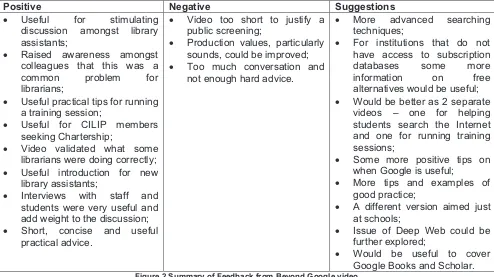
The video was released in the summer of 2008 and over 100 copies of the DVD were sent to library schools and practising librarians who requested copies following a short feature in the CILIP Gazette5. It was also posted to YouTube and by the end of March 2009 had been viewed over 1,700 times. In early 2009 the authors requested feedback6 from those who had used and viewed the video to ascertain where it had been useful but also how it could be improved in future versions, and also checked out reaction to it on various blogs. Godwin [17] is clearly an advocate of using Web 2.0 in library practice and commented on his blog that he would have liked the video to have covered “more about ways of employing wikis, blogs, and video material from YouTube, podcasts, etc.” This is a clear steer for future work.7 Figure 2 summarises the comments of the 28 people who responded directly with feedback and could be useful as the basis of a framework for anyone considering developing their own training programmes and initiatives in this area.
Positive Negative Suggestions
Useful for stimulating discussion amongst library assistants;
Raised awareness amongst colleagues that this was a common problem for librarians;
Useful practical tips for running a training session;
Useful for CILIP members seeking Chartership;
Video validated what some librarians were doing correctly; Useful introduction for new library assistants;
Interviews with staff and students were very useful and add weight to the discussion; Short, concise and useful practical advice.
Video too short to justify a public screening;
Production values, particularly sounds, could be improved; Too much conversation and not enough hard advice.
More advanced searching techniques;
For institutions that do not have access to subscription databases some more information on free alternatives would be useful; Would be better as 2 separate videos – one for helping students search the Internet and one for running training sessions;
Some more positive tips on when Google is useful;
More tips and examples of good practice;
A different version aimed just at schools;
Issue of Deep Web could be further explored;
[image:4.595.51.545.266.543.2]Would be useful to cover Google Books and Scholar. Figure 2 Summary of Feedback from Beyond Google video
From the comments summarised in Figure 2, there seems to have been a generally positive reception to the video with a range of useful suggestions for possible future productions. One of the themes running through much of the feedback is how the video was useful in starting discussions amongst library and information staff on the subject of information literacy and their users, and particularly non-qualified staff. This is clearly an issue that needs further debate but because the technology is changing so rapidly many library and information professionals and academics are struggling to keep abreast with the rapidly changing information landscape. Part of the solution may be for information vendors, search engine providers and the library and information profession to work more closely together so that end users of information can more easily navigate their ways to the most appropriate sources. Several of the video viewers made the point that it would be useful for future training videos to show where Google and other Web services have got it right rather than simply focusing on some of the negative aspects. This is an important point and highlights the need for information professionals to explain to users in what circumstances tools such as Wikipedia and Google are appropriate. In the case of Google this is particularly relevant as the search giant develops new services such as Google Scholar, News and Books.
____________________
5 The CILIP Gazette is the fortnightly magazine for members of the Chartered Institute of Library and Information Professionals
6 Emails were sent to the 105 people who had received a copy of the DVD asking for their comments on how they had used the video, feedback from viewers, if they found it useful and suggestions for changes to future versions.
7. THE FUTURE
In the course of producing the “Beyond Google” video, the authors interacted with a number of library and information professionals as well as drawing on their own experiences as practitioners and academics. These interactions have clearly demonstrated that the issue of information literacy is one of the key challenges facing the profession and is placing increasing pressure on those responsible for helping users find the information they need, whatever the kind of library. As new Web services and technology platforms emerge these pressures are only likely to increase. Assuming that anyone born since 1990 is a “digital native” can be dangerous as for some people as this implies that young people are confident users of the Internet and do not need help from information professionals, but, as the CIBER report [2] indicates, even experienced researchers demonstrate the same characteristics of impatience in search and navigation and therefore libraries need to respond urgently to the changing needs of all their users. If the experiences of those who took part in the video are broadly representative, there has never been a greater need for experienced library and information professionals to act as guides through the increasingly complex digital maze.
8.
REFERENCES
[1] Tapscott, D., Ten Talking Points for Davos, Business Week, 16 Jan (2008)
http://www.businessweek.com/innovate/content/jan2008/id20080116 730939.htm [accessed 25 March 2009].
[2] Centre for Information Behaviour and the Evaluation of Research, Information behaviour of the researcher of the future, CIBER (2008).
[3] De Saulles, M., Information literacy amongst UK SMEs: an information policy gap, Aslib Proceedings, 59, 1, 68-79 (2007).
[4] Bawden, D., Information and digital literacies: a review of concepts, Journal of Documentation, 57, 2 (2001).
[5] Bruce, C., The relational approach: a new model for information literacy, The New Review of Information and Library Research (1997).
[6] Crawford, I. and Irving, C., Information literacy in the workplace: a qualitative exploratory study, Journal of Librarianship and Information Science, 41, 1 (2009).
[7] Heintzelman, N., et al, Cybertutorials: teaching patrons anytime, anywhere, Public Libraries, 46, 2 (2007). [8] Albitz, R., The what and who of information literacy and critical thinking in higher education. Portal, 7, 1
(2007).
[9] Mokhtar, I. A., et al, Teaching information literacy trough learning styles: the application of Gardner’s multiple intelligences, Journal of Librarianship and Information Science, 40, 2 (2008).
[10] Core, J., EduLib: the national network of electronic library accredited trainers, Ariadne, Issue one (1996). [11] Beevers, C., et al., ‘The Open Rose Group: opening up access for disabled users of academic libraries in
Yorkshire’, SCONUL Focus, 32, 55-57 (2004).
[12] Agazio, J. and Buckley, K. M., An untapped resource, Nurse Educator, 34, 1, 23-28 (2009). [13] Jakes, D., Web 2.0 and the new visual literacy, Technology & Learning, 27, 9, 21 (2007).
[14] Bull, G., Video in the age of participation, Learning & Leading with Technology, 34, 5, 10-11 (2007). [15] Duffy, P., Engaging the YouTube Google-Eyed Generation: strategies for using Web 2.0 in teaching and
learning, Electronic Journal of e-Learning, 6, 2, 119-130 (2008).
[16] Trier, J., "Cool" engagements with YouTube: part 2, Journal of Adolescent and Adult Literacy, 50, 7, 598-603 (2007).