Distributed Consensus Algorithm for Events
Detection in Cyber Physical Systems
Shancang Li, Shanshan Zhao, Po Yang, Panagiotis Andriotis, Lida Xu, and Qindong Sun
Abstract—In the harsh environmental conditions of cyber physical systems (CPS), the consensus problem seems to be one of the central topics that affect the performance of consensus-based applications, such as events detection, estimation, tracking, blockchain, etc. In this paper, we investigate the events detection based on consensus problem of CPS by means of compressed sensing (CS) for applications such as attack detection, industrial process monitoring, automatic alert system, and prediction for potentially dangerous events in CPS. The edge devices in a CPS are able to calculate a log-likelihood ratio (LLR) from local observation for one or more events via a consensus approach to iteratively optimize the consensus LLRs for the whole CPS system. The information-exchange topologies are considered as a collection of jointly connected networks and an iterative distributed consensus algorithm is proposed to optimize the LLRs to form a global optimal decision. Each active device in the CPS first detects the local region and obtains a local LLR, which then exchanges with its active neighbors. Compressed data collection is enforced by a reliable cluster partitioning scheme, which conserves sensing energy and prolongs network lifetime. Then the LLR estimations are improved iteratively until a global optimum is reached. The proposed distributed consensus algorithm can converge fast and hence improve the reliability with lower transmission burden and computation costs in CPS. Simulation results demonstrated the effectiveness of the proposed approach.
.
Index Terms—Consensus algorithm, data gathering, security events detection, Cyber-Physical Systems, Internet of Things.
I. INTRODUCTION
Cyber-Physical-Systems (CPS) can provide a broad range of control for complex industrial systems in the Internet of things (IoT) environment through heterogeneous architectures of in-tegrated sensors and devices [1]. CPS systems are expected to be able to perform real-time operations, such as information sensing, processing, communication and actuation by different nodes in the CPS infrastructure. For in-network processing techniques, such as estimation, detection, and tracking in CPS, a compressed sensing based consensus method is introduced for distributed detection, estimation, and tracking, which can guarantee the performance in hash environmental conditions such as random packet losses, asymmetry of the links, etc. [2], [3].
Shancang Li, Shanshan Zhao and Panagiotis Andriotis are with the Univer-sity of the West of England, Bristol, UK (Email:{shancang.li, shanshan.zhao, panagiotis.andriotis}@uwe.ac.uk).
Po Yang is with the Liverpool John Moores University, Liverpool, UK. (Email: [email protected]).
Lida Xu is with the Old Dominion University, Norfolk, VA23529, USA. (Email: [email protected]).
Qindong Sun is with the Xi’an University of Technology, China. (Email: [email protected]).
It is reported that most CPS devices are not adequately designed and more than 47% of all devices in CPS and IoT distrust the security of CPS and IoT [4], [5]. When security in CPS is not sufficient in even seemingly harmless devices or systems, it presents endemic vulnerabilities and risks [4], [6]. As a CPS consists of numerous devices, it is important to develop reliable solutions to ensure that security is built-in against attacks which target connected systems and devices. The consensus is able to improve the security of all devices in a CPS system.
Wireless Sensor Networks (WSNs) are basic CPS compo-nents and they have been successfully utilized in events de-tection and information collection [6], [7], [8], [9], [11], [12]. Compare with WSNs, the CPS can bring several advantages: self-organization, real-time information exchange, collabora-tive controlling, and reliable data consensus to events status [11]. Through this way, CPS can be run at high efficiency yet in low cost [12]. However, due to the unique characteristics, to implement a CPS system involves a combination of expertise from different professional disciplines [14], [15], [16], [17]: (1) application background knowledge, which is required in CPS services development; (2) smart sensor sensing expertise, which is essential to complete a sensing task; (3) reliable wireless communication, which is required to provide infor-mation exchange between nodes or the equipment; and (4) reliable networked data processing expertise, which is needed for understanding the reliable data exchange and processing to provide flexible and scalable networking coverage. The main technical challenges in the CPS include [11], [12], [13], [18]: 1) Resource constraints. In CPS, many infrastructure de-vices are designed with limited processing ability, mem-ory, energy, and communication range. The energy and communication limitations may restrict the coverage and connectivity of the entire system.
2) Dynamic topologies. The topology of a CPS changes dynamically over time due to the reconfiguration of network or failure of links or nodes. The nodes might work in both active and inactive mode to save energy, which can also cause the topology to change over time. 3) Communication burden. In CPS, too high communi-cation burden will cause high bit error rate (BER) and degrade the performance of the networks. Thus, the goal in communication control is to minimize the communication burden while trying to provide sufficient link bandwidth.
require a central fusion center, making the consensus result unstable for networks with topology changing or node and link failures. Distributed consensus has the advantages of improved robustness, scalability, and efficiency.
In industry, the commonly used methods to deal with the consensus events detection are conducted through the
centralized consensus algorithms and distributed consensus algorithms [10]. In the context of centralized consensus al-gorithm, fusion centers (FCs) are used to collect all nodes’ measurements (i.e., log-likelihood ratio (LLR), etc.) regarding one or more target events and combine them to reach a final decision [19], [20]. The fusion centers are selected depends a number of features required by applications, such as location, capacity, types, etc. In distributed consensus scheme, each node is able to calculate a LLR and transmit it to the FC. For the centralized scheme, the optimization performance depends significantly upon the number of nodes, if local decisions can be correctly received at the FC [8]. If measurements from CPS nodes are not correctively received at the FC due to multihop transmission impairments, the detection performance at FC can be significantly affected [19]. The centralized detection may also cause network congestion when the size of CPS increases. On the other hand, sparse events detection is intimately affected by the changes of topology of CPS. In this paper, sparse events denote events that occur very infrequently in sparse regions, but may cause quite dramatic consequences when they do occur [16], [20], [21], [22]. Eventually, the centralized scheme may increase the energy consumption in CPS and might be unreliable when the hop count increases from node to the FC [7], [16], [17].
Aiming at improving the reliability and reducing the com-munication burden in events detection through CPS [7], [16], [17], this paper focuses on robust events detection via a distributed consensus algorithm in CPS, in which the active CPS nodes can collaboratively detect events and seek to iteratively reach a global optimum. In the iterative procedure [8], each node is able to exchange the detection results only with its active neighbors within transmission range. Distributed consensus algorithms can be applied to overcome the problems mentioned before [7], [16], [25], in which only local commu-nications between neighboring nodes are involved. Through the iterative updates between neighboring nodes, a consensus global decision can be achieved at all nodes [8], where a distributed consensus algorithm with a fast convergence rate is needed. Furthermore, low information exchanges and trans-mission is achieved for reliable and energy-effective detection in CPS [8], [9], [16].
Specifically, a distributed consensus algorithm for sparse events detection via a topology-changing CPS is proposed. The monitoring field is represented as a measurement vector, in which each component denotes the detection result at the position that the node lies. Compared with nodes in a CPS, the number of events that might occur is much smaller, which means the measurement vector is sparse where only a few elements are non-zeros. This feature enables themeasurements
collection by using compressed sensing (CS) based methods, for which only a few number of random sensory
measure-ments from activate nodes would be enough to accurately reconstruct all measurements. The resolution for monitoring can be guaranteed by solving the problem: how to obtain a robust detection result, based on the measurements of both active nodes and sleep nodes.
Furthermore, we address the sparse events detection prob-lem by making the following assumptions: (1) Each node in a CPS works in two switchable modes: active and sleep (inactive) modes. Nodes in active mode can actively probe the environment, and nodes in sleep mode remain idle to save energy and they can easily switch to active mode to perform detection; (2) The number of active nodes is much less than those of the sleep nodes; (3) The number of events that might occur simultaneously is much smaller than the total number of nodes (includes active and sleep nodes) in a CPS; and (4) The receivedmeasurementsare superimposed all together from multiple events when events might occur simultaneously. At the beginning of deployment of a CPS, only a random number of nodes are configured to be in sleep mode. These nodes might be switched into active mode or kept in sleep mode depending on the sleep strategy in topology control which is defined by routing layer. In this paper, we skip the changes of topologies from the issues in routing layer by focusing on improving the reliability of detection and reducing the transmission burden to save energy. First, we propose a jointly connected network model, in which the continuous topology of CPS at different timetcan be modeled with jointly connected graphs collection; then the collaborative events detection can be formulated as a consensus optimization problem over the jointly connected networks, which can be solved as a`1-norm optimization problem [7], [8], [9], [16]. The nodes in active mode can optimize the detection results for both itself and its neighbors in sleep mode. Each active node finally reaches consensus for the sleep node. By this way an event can be accurately detected even when it occurs at the point where the node is in sleep mode. The distributed consensus optimization problem can be solved by alternative direction method and details can be found in Section II.
The rest of the paper is organized as follows: in Section II, a jointly connected network model is presented, and a distributed sparse events detection problem is formulated as a consensus optimization; in Section III, a collaborative consensus algorithm is proposed; experiment simulations are provided in Section IV to evaluate the effectiveness of the proposed algorithm; Section V concludes the paper.
II. PROBLEMFORMULATION
A. Jointly Connected Networks
In a CPS, consensus means that the detected states of multiple participants converge to the same state value for an event. To address this problem, in this work we define each participant as a node, and in a CPS nodes can communicate with each other in its communicaton range. Consider a CPS withN nodes and a fusion center (FC). The topology can be modeled as a graph with the interconnection links betweenN
the set of edges of the graph. Let setNa consist of all nodes in active mode, and set Ns include all nodes in sleep mode. Then we have L={1, . . . , N}=Na∪ Ns[20], [21], [22].
For nodei, if nodej lies within its transmission range and (vi, vj) ∈ E then one can say that node i is a neighbor of node j. All one-hop neighbors of i are contained in a set
Ni = {i|(vi, vj) ∈ E}. The FC is denoted by vertex v0. In this case, a CPS can be represented by a graph G¯withV¯ =
V∪{v0}, which includesNnodes and vertexv0with directed edges. Note that there may not be any connection between the nodes and the FC at the moment. If one or more direct edges from every node to the FCv0 can be found, then the graphG¯ is said to be connected graph orsample graph [25], [26].
In CPS, a union of connected graphs{G¯1,G¯2, . . . ,G¯m}(m≥ 1) that have the common vertex setV¯ are defined as a union of simple graphs [26]. For simplicity, the union of simple graphs are denoted asG¯1,...,m. It is clear thatG¯1,...,mincludes a vertex setV¯ and the edges ofG¯1,...,m is the union of edges of all simple graphs. To properly describe the union of simple graphs, a new concept is introduced as “jointly connected graphs” {G¯1, . . . ,G¯m}, in which each simple graph G¯i is a connected graph with a common vertex set V¯ and Ei might be different. It can be understood that a collection of jointly connected graphscontains at least one simple connected graph [23], [24], [26].
Theorem 1. A collection of graphs {G¯1,G¯2, . . . ,G¯m} can
be said jointly connected if its union graphs G¯1,...,m are
connected.
Since each graph in the collection containsv0, it guarantees that each graph contains at least one common node [26], [27]. It should be noticed that if one or more graphs are connected in this collection, then it is jointly connected. At a time interval[t, τ], ifnnodes are connected and formed a collection of simple graphs {G¯t,G¯t+1, . . . ,G¯τ}, then the graphs with different topologies are said to be jointly connected.
Assume a node i is able to make a local decision to determine the occurrence of an event at a point vi, which is superimposed of reading from its neighboring points, and can be modeled as
xi(t+ 1) =xi(t) + X j∈Ni(t)
wijxj(t), i∈ W (1)
in which xi(t) is LLR at node i at time t, and wij is the weight betweeni andj.
For a graph that contains a number of nodes, the links between nodes change over time and that causes change of the topologies of the graph [28]. Let P represent a node-set, in which all simple graphs G¯p(p∈ P) defined onV¯ are well indexed.
The set of LLRs can be easily defined in a state vector form. For each p∈ P, define
x(t+ 1) = (Aσ+I)x(t) =Fσx(t) (2) in which xdenotes a vector of LLRs: x= [x1, x2, . . . , xN]T and σ : {0,1, . . .} → P is used to represent a scheduling signal that reconfigures the networks and hence causes changes of topology at a specific timet(including CPS reconfiguration,
nodes or links failures,etc.),Fσ= (Aσ+I), andAp(p∈ P) denotes the adjacent matrix of graph G¯p.
In this model,σ changes as a function of locations of the active nodes in a CPS. Actually, the convergence analysis of this model is a very difficult task [29], [30]. We ignore the dependencies betweenσand the node positions and instead of thatσcan be any scheduling signal that is properly predefined. By doing this, the convergence difficulty can be avoided. The main goal is to obtain a stable global optimal decision from all n nodes for any initial set of node local decision, which is expected to converge to a stable state value xS. The convergence problem of xi to xS equals to solving the convergence problem ofxS1.
For a very smallP, σ remains constant make sureG is a complete graph inp∈ P. In this case,x can easily converge toxS1. LetQdenote a subset ofP that consists of the indices of the connected simple graphs in collection{G¯p, p∈ P}[31], [32].
Theorem 2. For a scheduling signal σ:{0,1,2, ...} → P, if x(0)is given and for allt∈ {0,1, . . .},σ(t)∈ Qholds, then
lim
t→∞x(t) =xS1 (3)
It is possible that a jointly connected collection of simple graphs converges to a common decision, which has a less strength than that in Theorem 2. Meanwhile, Theorem 2 requires the collection {G¯σ(ti),G¯σ(ti+1), . . . ,G¯σ(ti+1−1)} in
[ti, τ) to be jointly connected. For a scheduling signal σ, Eq.(3) holds if an infinite and non-overlapping sequence of intervals is available across which the collection is jointly connected. It should be noted that during interval from ti to
ti+1, at least one component in Q is picked up as switching signal.
Proof. As mentioned above, each Fp is non-negative, and all the sums of each row of eachFpare equal to1(i.e.,Fp1=1). So the matrixFpis stochastic and its diagonal elements are all non-zeros. For a simple graphG¯p(p∈ Q), ifmis sufficiently large then all entries in (I+Ap)m are positive. Hence both (I+Ap)m andFp are primitive matrices, which means that the largest eigenvalue ofFpforp∈ Qis1, and all remaining eigenvalues must lie in(−1,1). Then we have
lim t→∞F
t
p=1cp (4)
for some row vectorcp.
It is clear that all diagonal elements of a stochastic matrix
Fp(p∈ Q)are positive, and they are primitive.
Theorem 3. For a finite set of ergodic matrices F =
{F1,F2, . . . ,Fm}, then for a stochastic matrix Fp ∈ M, (Fp)i(i→ ∞)is a matrix of rank 1.
corresponding topologies, then the product of matrices Fp1Fp2· · ·Fpm is said ergodic.
Theorem 3 can be proved as follows:
Proof. For t ≥ 0, let Φ(t, t) = I hold and τ be an integer between0andt, then we haveΦ(t, τ) =Fσ(t+1)· · ·Fσ(τ−1)·
Fσ(τ). Accordingly, a matrixθ(t)can be reformatted asθ(t) = Φ(t,0)θ(0). Actually Eq.(5) is enough to prove Theorem 2
lim
t→∞Φ(t,0) =1c (5)
in which c denotes a row vector. According to Lemma 1, for an integer j ≥ 0, matrix Φ(tj+1, tj) is said ergodic, and it can be represented by a product of finite matrices from {Fp, p ∈ P}. Accordingly, Φ(tj,0) can be substituted by Φ(tj, tj−1)Φ(tj−1, tj−2)· · ·Φ(t1, t0). Therefore, Φ(tj,0) is ergodic and we have
lim
j→∞Φ(tj,0) =1c (6)
Let jt denote the largest non-negative integer that satisfies
tjt ≤t. Accordingly,Φ(t,0)can be represented by the product
of Φ(t, tjt)andΦ(tjt,0), and we have
Φ(t,0)−1c= Φ(t, tjt)·(Φ(tjt,0)−1c) (7)
It can be seen that Φ(tjt,0)→0 when t→ ∞ due to Eqs
(5) and (6), therefore Eq.(4) holds and the proof is complete.
For two non-negative matrices Fi andFj, if all elements of Fi− Fj are non-negative, then matrix Fi− Fj is said a non-negative matrix.
Proof. (Lemma 1) Let a non-negative matrixF = (I+A), in whichAdenotes the adjacency matrix of the collection being jointly connected graphs{G¯p1,G¯p2, . . . ,G¯pm}. Then matrixF
is said primitive. According to Lemma 2 we have
Fp1·Fp2·. . .·Fpm ≥ξ(Fp1+Fp2+· · ·+Fpm) (8)
in which ξ denotes a small positive constant. Then for a primitive matrix Fpi,Fpi ≥(I+Api)holds, and
Fp1·Fp2·. . .·Fpm ≥ξ(mI+Ap1+Ap2+· · ·+Apm) (9)
Since m is an integer then mI ≥ I holds and Eq.(9) is reduced to
Fp1·Fp2·. . .·Fpm ≥ξF (10)
It should be noticed that the product is bounded below by
ξF, and the product is primitive as well. As mentioned in [16], [17] the product is also a stochastic matrix, so it is ergodic [26], [33].
Lemma 2. For an m × m non-negative set Ai, i ∈
{1,2,· · · , m}, let µdenote the smallest diagonal element of Aiandρdenote the largest diagonal elements ofAi. We have
A1A2· · ·Am≥(
µ2 2ρ)
(m−1)(A
1+A2+· · ·+Am) (11)
Proof. This can be easily proved by writingAiasAi=µI+
Bi, whereBi is non-negative. For any j, k
AjAk = (µI+Bi)(µI+Bi)≥µ2+
µ2
2ρ(Bj+Bk) (12)
Since(ρI+Bj)≥Aj and(ρI+Bk)≥Ak, then we have
AjAk≥(
µ2
2ρ)(Aj+Ak) (13)
Using Eq.(12) iteratively, Eq.(11) holds and the proof is complete.
B. Jointly Connected Graphs based Consensus Algorithm
For a collection of jointly connected networks, each node is capable of exchanging information with its active neighbors directly and keeping all the local LLRs vector in the network to derive a weighted average, which eventually converges to a global decision vector [34], [35].
As proved in Theorem 2, for x(t+ 1) =Fσx(t), weight matrix Fσ features the sparsity pattern specified by the jointly connected graphs collection{G¯1,G¯2, . . . ,G¯m} andσ:
{0,1, . . .} → P, in which weight matrix Fσ corresponding to the edges of connected graph. For at-step transition matrix Φ(t) =Fp1Fp2· · ·Fpm, we have
x(t+ 1) = Φ(t)x(0) (14) and according to Theorem 2, we have
lim t→∞Φ(t) =
1
n11
T (15)
which is equivalent to lim t→∞x(t) =
1
n1
Tx(0)1 (16) The weight matrix satisfies the condition in Eq.(16). In prac-tice, some links might fail permanently, however the jointly connected scheme guarantees the long-term connectivity of graphs [36], [37].
III. DISTRIBUTEDSPARSEEVENTSDETECTION When an event occurs around a local node vj, it might influence its neighboring area by a non-zero influence function
wj(vj), which can be normalized to obey P
wj(vj) = 1 [33]. Let yi denote the measurement at point vi that is the superposition of the influence of all events onvi. LLR will be obtained at vj, and we havewji =wij, which is the weight event atvi. Letidenote the measurement noise of zero mean. It is easy to understand that the LLRs vectorxis sparse, but the measurement vectoryi can be non-sparse.
For a CPS withNa(t)active nodes andNs(t)inactive nodes at timet, measurementyi atvi can be modeled as
yi=
X
j∈N
Aj,ixj+i (17)
in which Ai,j=Aj,i denotes the influence event atvi. For node i, if node j is out of the transmission range of
i, then let Aji = 0. Accordingly, the observation yi can be represented asyi =xi+Pj∈nAj,ixj+i. Furthermore, for a network with Na active nodes, we have
ya=ΦAx+a (18)
in which Φ denotes the selection matrix, ya denotes the
Here compressed sensing can be used to perfectly recover
x from measurementsya[7], [8]
min
x kAx−bak
2
2+λkxk1 s.t. x≥0 (19) The neighbors list of nodei is denoted byNi. Node i not only keeps xi atvi, but also keeps measurements xk (∀k ∈
Na∩ Ni) that is evaluated at its inactive neighboring nodes. Actually, neighbors ofiinclude active nodes belong toNi∩Na and the sleep nodes belonging to Ni∩ Ns. Then we rewrite Eq.(19) as
min X i∈Na
yi−x (i) i −
X
k∈Ns∩Ni Ak,ix
(i) k −
X
j∈Na Ak,ix
(j) j
2
+λkxk1 (20a)
s.t. x(i)i ≥0,∀i∈ Na, (20b)
x(i)k ≥0,∀k∈ Ns∩ Ni (20c)
Note that herekxk1 can be solved by
kxk1=
X
i
x(i)i + X i∈Ns∪Nk
x(i)k (21)
in which Nk denotes the active neighboring nodes atvk and bothx(i)i andx(i)k are non-negative constraints for all decision variables.
A. Collaborative Consensus Optimization
It is crucial to perform collaborative detection by fusing y
to obtain a global optimal estimation of the sparse decision
x. For a CPS with N = |Na|+|Ns| nodes and a FC, x can be reconstructed from the following`1-norm optimization formulation
min X i∈Na
a2i +X i
x(i)i + X i∈Ns∩Nk
x(i)k (22a)
s.t. ai=yi−x (i) i −
X
k∈Ns∪Ni Ak,ix
(i) k −
X
j∈Na Ak,ix
(j) j
(22b)
x(i)i ≥0,∀i∈ Na, (22c)
x(i)k ≥0,∀k∈ Ns∩ Ni (22d) Eq.(22) might yield a globally optimal result, in which the linear measurements from all the nodes are centrally fused at the FC. It is costly but easy to be implemented. Not only all measurements, but also the measurement matrices of all nodes need to be collected at FC.
LetJ denote the number of active nodes, then the problem reduces to J least-squares sub-optimal functions. This may cause a very expensive computation cost when the number of nodes increases.
min
x kxk1+
J
X
j=1
λjky(j)−Ax(j)k22 (23)
where the positive parameter {λi} describes the noise re-silience of the samples {x(j)t } and λ =
P
jλi describes the trade-off between noise resilience and events sparsity. As
mentioned above, the centralized fusion may cause high com-munication burden and hence cause unstable optimal results and high energy consumption.
A distributed consensus algorithm may overcome the draw-backs of centralized consensus fusion, which uses only local optimal between one-hop neighbors to iteratively estimate the decision. In this case, each active nodej keeps a local copy of the local decisionx(j)j and collaboratively consent on their copies [16], [35]. Let G ={G1,G2,· · ·,Gm} be a collection of jointly connected networks depicting the connectivity of the CPS, in which each networkGi= (Vi,Ei)includes active nodes for the set of vertices Vi(i= 1, . . . , m) and each edge (j, k)∈ Eiconnects an unordered pair of distinct nodes within one-hop neighborhood. Different from the centralized fusion formula, each nodejlocally performs the following consensus optimization
min
x(j)kx
(j)k
1+λjkx(j)−Ax(j)k22 (24) It can be seen that Eq.(24) enforces the consensus between
j and its one-hop active neighbors, which can be solved as a LASSO problem [17], [34]. Each local LLR at an active node is shared with its one-hop neighbors and will be updated and percolated throughout the network after performing an iterative consensus procedure that converges to an optimal result. Upon convergence, all neighboring nodes will have consented on the same globally optimal x. It can be seen that when P
j
P
kwjk= 1, Eq.(24) forces the LLR copy xj to consent to a weighted neighboring LLR by a reminiscent phase. Thus, the weighting matrix A can be easily obtained by setting its(i, k)-th element aswjkby adhering toA1=1, where1is the all-one vector.
B. Distributed Consensus Implementation via the Alternating Direction Method of Multipliers
The iterative optimization can be implemented via the global consensus discussed above. For Eq.(24), an augmented Lagrangian function can be created as
Lx(j), λj,zj,{x(j)}
=ky(j)−A(j)x(j)k2
2+zTjx(j)
+β 2kx
(j)− X
k∈Nj
wjkx(k)k22 (25)
wherezj denotes a Largrangian operator, and β denotes the augmented Lagrangian multipliers in the consensus optimiza-tion constraints.zT
jx(j)is applied to guarantee that Eq.(25) is fulfilled by properly settingzT(x(j)−P
k∈Njwjkx
(k)) = 0.
By using the alternating direction of multipliers, each node can updatex(j)(t)by iteratively solving
x(j)=argmin
x(j)L
x(j), λj,zj,{x(j)}
(26)
in which the multipliers can be updated via a gradient-based iteration
z(j)(t) =z(j)(t−1) +β 2
x(j)− X
k∈Nj
wjkx(k)
Algorithm 1: Distributed Fusion Algorithm
Input: Each node calculates LLR asx(j)t , sets λj andc empirically, initializes estimate x(j)(0) = 0 and local multiplier vectorz(j)(0) = 0. LetT be the maximum number of iterations ande be the tolerable deviation, both are at convergence conditions.
Output: Algorithm converges to an optimal result and each node obtains the global estimation
x=x(j)(T),∀j∈ N. repeat
All nodes update z(j)(t)andx(j)t via Eqs (26) and (27),∀j;
All nodes transmit x(j)t (t+ 1) to their one-hop neighbors inNj,∀j;
t←t+ 1.
until t > T or kx(j)t (t+ 1)−x(j)t (t)k ≤e;
In Eqs (26) and (27), the iterative steps constitute a dis-tributed scheme, and details can be found in Algorithm 1.
In the t-th iteration, a node j first collects x(j) from its one-hop neighbors k ∈ Ni, which is then used to update the local multiplier vector z(j)(t)as described in Eq.(27). By doing this, Eq.(26) can be solved as a quadratic optimization problem and the updated local LLR estimation x(j)(t+ 1) will be yielded. Then, all nodes locally update the decision and exchange the sparse estimationx(j)(t+ 1)with their one-hop neighbors. This procedure repeats until converged to the specific condition.
During iterations, nodes are not required to synchronize the measurements, which makes it easily implemented in a large-scale CPS. The convergence of Algorithm 1 can be proved as follows:
Proof. In [17], the iterative alternating direction method have been proved to converge to a minimizer of Eq.(26) for any positive constantβ.
IV. PERFORMANCEEVALUATION
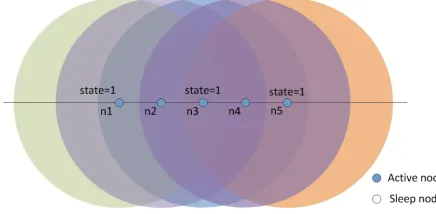
In this section, a CPS will be created to perform the sparse events detection using proposed distributed consensus algorithm. Considering an event detection scheme in a small network with 5 nodes (ni, i= 1, . . . ,5), which are deployed in a two-dimensional area and the distance between two neighboring nodes is 20, and communication range is 50 as shown in Fig.1.
It can be seen that the neighbor-set of n1 includes nodes
[image:6.612.326.544.62.169.2]{n2, n3}. Similarly,n2has a neighbor-set as{n1, n3, n4},n3 has a neighbor-set as {n1, n2, n4, n5}, n4 has a neighbor-set as {n2, n3, n5}, and n5 has a neighbor-set as {n3, n4}, respectively. As mentioned in Section III, each node does not only hold its local decision, but also holds the decisions of its neighbors (both active and sleep neighbors). Letcidenote the possibility that event might occur at the position that ni lies (vi), and all five nodes are in active mode. Assume that three events occurred atv1, v3, and v5, respectively. The detection
Fig. 1. Consensus algorithm on5active nodes
TABLE I
DETECTION RESULTS AFTER200ITERATIONS
c1 c2 c3 c4 c5
n1 1.000 0.000 0.9987 N/A N/A
n2 1.000 0.000 1.000 0.000 N/A
n3 1.000 0.000 1.000 0.000 0.9918
n4 N/A 0.000 1.000 0.000 1.000
n5 N/A N/A 0.9991 0.000 1.000
results from all five nodes are reported in Table I, where the possibilities of events occurred are reported and N/Ameans that the detection is not available. For example, node n1 can successfully detect events occurred atn1,n2,n3, but cannot detect events occurred atn4andn5. It is reasonable that nodes
n1,n2, andn3 are in the neighbors list ofn1.
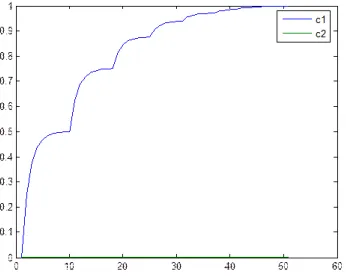
Fig.2 presents the optimization results when all nodes are activevsthe number of iterations. In practice, in order to save energy not all nodes are in active mode. Assume the distance between these nodes is 20 and the transmission range is 25. Let nodes n2 and n4 be in sleep mode, then the consensus algorithm can only be performed on nodesn1,n2, andn3, and can report the decision results. However, as discussed above, the active nodes are able to report the decision result by itself. Meanwhile its neighboring active nodes are able to report the decision results of its neighboring inactive nodes. In Fig.3,n1 has an inactive neighboring noden2, noden3has two inactive neighboring nodes{n2, n4}, andn5 has an inactive neighbor
[image:6.612.344.531.228.291.2]n4, respectively.
Table II depicts the detection results of CPS with3 active nodes and2inactive nodes, where each node is able to keep its local decision and decisions of its one-hop neighbors. It can be seen that the decision results converge to0.9967forc1,0.9989 for c3, and0.9971for c5, respectively. The decisions near to 1 converged faster than the above scenario. It is due to the fact that each active node holds a small number of neighbors. Fig.4 shows the optimization results at node n1,n3, andn5, when events c1, c3, and c5 occurred at n1 and n3, and n5. Nodesn2 andn4 are inactive.
TABLE II
DETECTION RESULTS AFTER50ITERATIONS
c1 c2 c3 c4 c5
n1 0.9967 0.001 N/A N/A N/A
n3 N/A 0.000 0.9989 0.000 N/A
(a) Consensus result atn1vs Iteration number
(b) Consensus result atn2 vs Iteration number
(c) Consensus result atn3vs Iteration number
(d) Consensus result atn4 vs Iteration number
[image:7.612.308.569.58.151.2](e) Consensus result atn5vs Iteration number
Fig. 2. Consensus algorithm on5active nodes
Fig. 3. Consensus algorithm on3active nodes and2inactive nodes
(a) Consensus result atn1 vs Iteration number
(b) Consensus result atn3vs Iteration number
[image:7.612.106.246.63.175.2](c) Consensus result atn5 vs Iteration number
[image:7.612.353.526.193.333.2]Fig. 5. Consensus algorithm on3active nodes
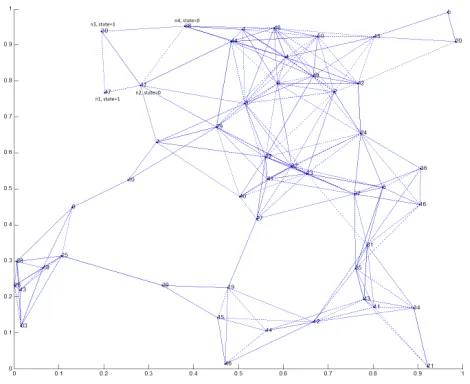
In order to evaluate the performance of sparse events detection in a large CPS, we create a network with50nodes. Consider 50 nodes are randomly deployed in a normalized square, as shown in Fig.5. Nodes are connected with its neighbors if its neighbors are within the transmission range. If the graph (network) is not connected, the locations of nodes are re-generated randomly until the graph is connected. In Fig.5, four active nodes n1, n2, n3, and n4 are located at pointsv47,v17, v30, and n38, respectively. Assume events c1 and c2 occur at v47 and v30, respectively. Fig.6 shows the detection results at active nodes n1,n2,n3, andn4. At node
n1, the eventsc1andc2 are successfully detected as shown in Fig.6(a). In Fig.6(b) n2 successfully detected the occurrence ofc1,c2, andc3since noden1andn2are its neighbors. Since the status ofc3andc4are0, which means no event occurred at
v3andv4, however nodesn3 andn4successfully reported its neighbors’ detection results, as shown in Fig.6(c) and Fig.6(d). In this work, the following normalized mean squared error (MNSE) is used to evaluate the performance of decision making
NMSE=E[||xˆ−x|| 2]
E[||x||2]
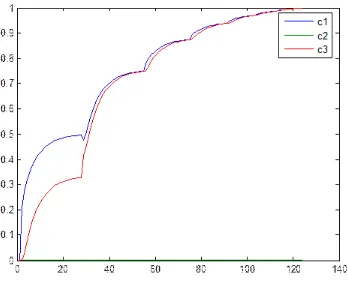
(28) Fig.7 shows the NMSE of decision results made by node
n1 in Fig.5 (the NMSE values obtained by simulations of 100 runs), where N1 denotes the MNSE results when c1 is made, N2 denotes the MNSE results when c2 is made, and
N3 denotes the MNSE results whenc3 is made, respectively.
V. DISCUSSION
This paper proposes a simple but compelling jointly con-nected graph model for topology-changing CPS, which can significantly improve the reliability of distributed consensus decision-making. Although several decentralized consensus schemes have been reported in [19], [37], [20], however most of them are developed for decentralized in-networking consensus without supporting the changes of topologies of WSNs. This paper uses the idea of consensus optimization and compressed sensing to develop a distributed consensus
events detection scheme by exploiting sparsity, which has the following key differentiating features:
(1) This scheme can still perform consensus optimization when the topology dynamically changes, which avoids the reconfiguration of CPS caused by the switch of node work model (between active and sleep modes). This feature signifi-cantly increases the reliability of CPS and decreases the power consumption in network reconfiguration and re-organization.
(2) Different from the existing distributed consensus scheme reported in [19], [37], [20], where each node holds a local decision vector of the whole network, it is too costly for each node in a large network. In our scheme, each active node holds an LLR vector for itself and its inactive neighbors. This significantly reduces the computation and communication costs per node, and improves the reliability and scalability of the algorithm for a CPS with a large number of nodes.
(3) The proposed scheme exploits compressed sensing to recover LLRs by distributive joint sparsity local estimations. This can improve the reliability of consensus optimization by tolerating the failure of nodes or links without causing the reconfiguration or rebuilding of CPS.
VI. CONCLUSION
This paper proposed an iterative distributed consensus al-gorithm that can be employed for sparse events detection in CPS, which was originally derived for achieving consensus by providing each node the full detection information even when the topologies change. Each node is able to iteratively calculate the LLR of itself and LLRs of neighbors by communicating with the neighboring active nodes. Using the notion of com-pressed sensing, the estimation of decision can be converged faster. The numerical results showed that the estimation of sparse events detection can be successful calculated with the proposed distributed consensus algorithm.
REFERENCES
[1] Danna B. Rawat, Joel J.P.C. Rodrigues, Ivan Stojmenovic, Cyber-Physical Systems: From Theory to Practice,CRC Press, 2015. [2] Houbing Song, Glenn A. Fink, and Sabina Jeschke, Security and Privacy
in Cyber-Physical Systems: Foundations, Principles and Applicaations.
UK: Wiley - IEEE Press, 2017.
[3] Kostas Kolomvatsos; Christos Anagnostopoulos; Stathes Hadjiefthymi-ades, Distributed Localized Contextual Event Reasoning under Uncer-tainty,IEEE Internet of Things Journal, vol.pp, no.99, pp.1-1, May 2016. [4] Bhavya Kailkhura; Swastik Brahma; Pramod Varshney, Data Falsifica-tion Attacks on Consensus-based DetecFalsifica-tion Systems,IEEE Transactions
on Signal and Information Processing over Networks, vol.10, no.2,
pp.1461-1468, May 2016.
[5] Bhavya Kailkhura; Swastik Brahma; Pramod Varshney, Data Falsifica-tion Attacks on Consensus-based DetecFalsifica-tion Systems,IEEE Transactions
on Signal and Information Processing over Networks, vol.3, no.1,
pp.145-158, Sep 2016.
[6] Shancang Li, George Oikonomou, Theo Tryfonas, Tom Chen, and Lida Xu, “A Distributed Consensus Algorithm for Decision Making in Service-Oriented Internet of Things”,IEEE Transactions on Industrial
Informatics, vol.10, no.2, pp.1461-1468, May 2014.
[7] Jia Meng, Husheng Li, and Zhu Han, “Sparse Event Detection in Wireless Sensor Networks using Compressive Sensing”,the 43rd Annual
Conference on Information Sciences and Systems (CISS), 2009.
[9] Leinonen, M.; Codreanu, M.; Juntti, M., “Sequential Compressed Sens-ing With Progressive Signal Reconstruction in Wireless Sensor Net-works”,IEEE Transactions on Wireless Communications, vol.14, no.3, pp.1622-1635, 2015.
[10] Adnan Aijaz; A. Hamid Aghvami, Cognitive Machine-to-Machine Com-munications for Internet-of-Things: A Protocol Stack Perspective,IEEE
Internet of Things Journal, vol.2, no.2, pp.103-112, 2015.
[11] Yujiao Zheng; Nianxia Cao; Wimalajeewa, T.; Varshney, P.K., “Com-pressive Sensing Based Probabilistic Sensor Management for Target Tracking in Wireless Sensor Networks”,IEEE Transactions on Signal
Processing, vol.63, no.22, pp.6049-6060, 2015.
[12] Dautov, R.; Tsouri, G.R., “Securing While Sampling in Wireless Body Area Networks With Application to Electrocardiography”,IEEE Journal
of Biomedical and Health Informatics,, vol.20, no.1, pp.135-142, 2016.
[13] Liqun Hou; Bergmann, N.W., “Novel Industrial Wireless Sensor Net-works for Machine Condition Monitoring and Fault Diagnosis”,IEEE
Transactions on Instrumentation and Measurement, vol.61, no.10,
pp.2787-2798 , 2012.
[14] Songcen Xu; de Lamare, R.C.; Poor, H.V., “Distributed Compressed Estimation Based on Compressive Sensing”, IEEE Signal Processing
Letters, vol.22, no.9, pp.1311-1315, 2015.
[15] Bertocco, M.; Gamba, G.; Sona, A.; Vitturi, S., “Experimental Char-acterization of Wireless Sensor Networks for Industrial Applications”,
IEEE Transactions on Instrumentation and Measurement, vol.57, no.8,
pp.1537-1546, 2008.
[16] Qing Ling and Zhi Tian, “Decentralized Sparse Signal Recovery for Compressive Sleeping Wireless Sensor Networks”,IEEE Transactions
on Signal Processing, vol.58, no.7, pp.3816-3828, July 2010.
[17] Fanzi Zeng, Chen Li, and Zhi Tian, “Distributed Compressive Spectrum Sensing in Cooperative Multihop Cognitive Networks”,IEEE
Transac-tions on Selected Topics in Signal Processing, vol.5, no.1, pp.37-48,
February 2011.
[18] Fatemeh Fazel, Maryam Fazel and Milica Stojanovic, “Random Ac-cess Compressed Sensing for Energy-Efficient Underwater Sensor Net-works”, IEEE Journal of Selected Areas in Communications, vol.29, no.8, pp.1660-1670, September 2011.
[19] Silvana Silva Pereira and Alba Pages-Zamora, “Mean Square Conver-gence of Consensus Algorithms in Random WSNs”,IEEE Transactions
on Signal Processing, vol.58, no.5, pp.2866-2874, May 2010.
[20] V. Raghunathan, C. Schurgers, S. Park, and M. Srivastava, “Energy-aware wireless microsensor networks”,IEEE Signal Processing Maga-zine, vol.19, pp.40-50, 2002.
[21] Jin-Jun Xiao, Alejandro Ribeiro, Zhi-Quan Luo, and Georgios B. Giannakis, “Distributed Compression-Estimation Using Wireless Sensor Networks”,IEEE Signal Processing Magazine, vol.23, no.4, pp.27-41, July 2006.
[22] S. Kumar, T. Lai, and J. Balogh, “On k-coverage in a mostly sleeping sensor network”,in Proc. ACM MOBICOM Conf., 2004.
[23] Minh Hoang Trinhy and Hyo-Sung Ahn, Theory and applications of matrix-weighted consensus. https://arxiv.org/abs/1703.00129.
[24] Minh Hoang Trinh, Chuong Van Nguyen, Young-Hun Lim, Hyo-Sung Ahn, Matrix-weighted consensus and its applications,Automatica, vol.89, pp.415-419, 2018.
[25] Lalos, A.S.; Antonopoulos, A.; Kartsakli, E.; Di Renzo, M.; Tennina, S.; Alonso, L.; Verikoukis, C., “RLNC-Aided Cooperative Compressed Sensing for Energy Efficient Vital Signal Telemonitoring”,IEEE
Trans-actions on Wireless Communications, vol.14, no.7, pp.2685-3699, 2015.
[26] Ali Jadbabaie, Jie Lin, and A. Stephen Morse, “Coordination of Groups of Mobile Autonomous Agents Using Nearest Neighbor Rules”,IEEE
Transactions on Automatic Control, vol.48, no.6, pp.988-1001, June
2003.
[27] G. Anastasi, M. Conti and M. Di Francesco, “Extending the Lifetime of Wireless Sensor Networks Through Adaptive Sleep”,IEEE Transactions
on Industrial Informatics, vol.5, no.3, pp.351-365, August 2009.
[28] Maxim Raginsky, Sina Jafarpour, Zachary T.Harmany, and Robert Calderbank, “Performance Bounds for Expander-Based Compressed Sensing in Poisson Noise”,IEEE Transactions on Signal Processing, vol.59, no.9, September 2011.
[29] J.-A. Bazerque and G. B. Giannakis, “Distributed spectrum sensing for cognitive radio networks by exploiting sparsity”,IEEE Transactions on
Signal Processing, vol.58, no.3, pp.1847-1862, March 2010.
[30] L. Xiao, S. Boyd, and S.-J. Kim, “Distributed Average Consensus with Least-Mean-Square Deviation”,Journal of Parallel and Distributed
Computing, vol.67, no.1, pp.33-46, 2007.
[31] Dimitri P. Bertsekas and John N. Tsitsiklis, “Parallel and Distributed Computation: Numerical Methods”,Athena Scientific, 1997.
[32] Ioannis D. Schizas, Alejandro Ribeiro, Georgios B. Giannakis, “Consen-sus in Ad Hoc WSNs With Noisy Links Part I: Distributed Estimation of Deterministic Signals”,IEEE Transactions on Signal Processing, vol.56, no.1, pp.350-364, January 2008.
[33] T. Blumensath and M. Davies, ”Sampling theorems for signals from the union of finite-dimensional linear subspaces”, IEEE Transactions
on Information Theory, vol.55, no.4, pp.1872-2882, 2009.
[34] Quang Duy La; Tony Q. S. Quek; Jemin Lee; Shi Jin; Hongbo Zhu, “Deceptive Attack and Defense Game in Honeypot-Enabled Networks for the Internet of Things”,IEEE Internet of Things Journal, vol.3, no.6, pp.1025-1035, 2016.
[35] Arian Maleki and David L. Donoho, “Optimally Tuned Iterative Re-construction Algorithms for Compressed Sensing”, IEEE Journal of
Selected Topics in Signal Processing, vol.4, no.2, pp.330-341, April
2010.
[36] Mario A. T. Figueiredo, Robert D. Nowak, and Stephen J. Wright, “Gra-dient Projection for Sparse Reconstruction: Application to Compressed Sensing and Other Inverse Problems”,IEEE Journal of Selected Topics
in Signal and Processing, vol.1, no.4, pp.586-597, December 2007.
[37] Wei Ye, John Heidemann, and Deborah Estrin, “Medium access con-trol with coordinated adaptive sleeping for wireless sensor networks”,
IEEE/ACM Transactions on Networking, vol.12, no.3, pp.493-506, June
(a) Consensus result atn1vs Iteration number
(b) Consensus result atn2 vs Iteration number
(c) Consensus result atn3vs Iteration number
[image:10.612.89.263.64.205.2](d) Consensus result atn4 vs Iteration number
Fig. 6. Consensus algorithm on4active nodes vs Iteration number
0 20 40 60 80 100 120 140 0
0.1 0.2 0.3 0.4 0.5 0.6 0.7 0.8 0.9 1
NMSE
Iteration number
NMSE
N1 N2 N3
[image:10.612.343.527.313.467.2]