
Markov Chains of Behavioral Models (Extended Version)
LUCKY ONWUZURIKE and ENRICO MARICONTI,
University College LondonPANAGIOTIS ANDRIOTIS,
University of the West of EnglandEMILIANO DE CRISTOFARO and GORDON ROSS,
University College LondonGIANLUCA STRINGHINI,
Boston UniversityAs Android has become increasingly popular, so has malware targeting it, thus motivating the research com-munity to propose different detection techniques. However, the constant evolution of the Android ecosystem, and of malware itself, makes it hard to design robust tools that can operate for long periods of time without the need for modifications or costly re-training. Aiming to address this issue, we set to detect malware from a behavioral point of view, modeled as the sequence of abstracted API calls. We introduce MaMaDroid, a static-analysis based system that abstracts app’s API calls to their class, package, or family, and builds a model from their sequences obtained from the call graph of an app as Markov chains. This ensures that the model is more resilient to API changes and the features set is of manageable size. We evaluate MaMaDroid using a dataset of 8.5K benign and 35.5K malicious apps collected over a period of six years, showing that it effectively detects malware (with up to 0.99 F-measure) and keeps its detection capabilities for long periods of time (up to 0.87 F-measure two years after training). We also show that MaMaDroid remarkably overperforms DroidAPIMiner, a state-of-the-art detection system that relies on the frequency of (raw) API calls. Aiming to assess whether MaMaDroid’s effectiveness mainly stems from the API abstraction or from the sequencing modeling, we also evaluate a variant of it that uses frequency (instead of sequences), of abstracted API calls. We find that it is not as accurate, failing to capture maliciousness when trained on malware samples that include API calls that are equally or more frequently used by benign apps.
CCS Concepts: •Security and privacy→Malware and its mitigation. Additional Key Words and Phrases: Android, Malware Detection, Static Analysis
ACM Reference Format:
Lucky Onwuzurike, Enrico Mariconti, Panagiotis Andriotis, Emiliano De Cristofaro, Gordon Ross, and Gianluca Stringhini. 2019. MaMaDroid: Detecting Android Malware by Building Markov Chains of Behavioral Models (Extended Version).ACM Trans. Priv. Sec.1, 1 (February 2019), 33 pages. https://doi.org/10.1145/3313391
1 INTRODUCTION
Malware running on mobile devices can be particularly lucrative, as it can enable attackers to defeat two-factor authentication for financial and banking systems [65] and/or trigger the leakage of sensitive information [29]. As a consequence, the number of malware samples has skyrocketed in recent years and, due to its increased popularity, cybercriminals have increasingly targeted the Android ecosystem [18]. Detecting malware on mobile devices presents additional challenges compared to desktop/laptop computers; smartphones have limited battery life, making it impossible to use traditional approaches requiring constant scanning and complex computation [54]. Thus,
This is an extended work of the authors’ prior publication presented at NDSS 2017 [45]. Work done while Gianluca Stringhini was at UCL. Submitted: November 2017, Accepted: February 2019.
Permission to make digital or hard copies of all or part of this work for personal or classroom use is granted without fee provided that copies are not made or distributed for profit or commercial advantage and that copies bear this notice and the full citation on the first page. Copyrights for components of this work owned by others than the author(s) must be honored. Abstracting with credit is permitted. To copy otherwise, or republish, to post on servers or to redistribute to lists, requires prior specific permission and/or a fee. Request permissions from [email protected].
© 2019 Copyright held by the owner/author(s). Publication rights licensed to ACM. 2471-2566/2019/2-ART $15.00
Android malware detection is typically performed in a centralized fashion, i.e., by analyzing apps submitted to the Play Store using Bouncer [49]. However, many malicious apps manage to avoid detection [47, 70], and manufacturers as well as users can install apps that come from third parties, whom may not perform any malware checks at all [81].
As a result, the research community has proposed a number of techniques to detect malware on Android. Previous work has often relied on the permissions requested by apps [21, 59], using models built from malware samples. This, however, is prone to false positives, since there are often legitimate reasons for benign apps to request permissions classified as dangerous [21]. Another approach, used by DroidAPIMiner [1], is to perform classification based on API calls frequently used by malware. However, relying on the most common calls observed during training prompts the need for constant retraining, due to the evolution of malware and the Android API alike. For instance, “old” calls are often deprecated with new API releases, so malware developers may switch to different calls to perform similar actions.
MaMaDroid.In this paper, we present a novel malware detection system for Android that relies on thesequenceofabstractedAPI calls performed by an app rather than their use or frequency, aiming to capture the behavioral model of the app. We design MaMaDroid to abstract API calls to either theclassname (e.g.,java.lang.Throwable) of the call or itspackagename (e.g.,java.lang) or its source (e.g.,java,android,google), which we refer to asfamily.
Abstraction provides resilience to API changes in the Android framework as families and packages are added and removed less frequently than single API calls. At the same time, this does not abstract away the behavior of an app. For instance, packages include classes and interfaces used to perform similar operations on similar objects, so we can model the types of operations from the package name alone. For example, thejava.iopackage is used for system I/O and access to the file system, even though there are different classes and interfaces provided by the package for such operations. After abstracting the calls, MaMaDroid analyzes thesequenceof API calls performed by the app aiming to model the app’s behavior using Markov chains. Our intuition is that malware may use calls for different operations, and in an order different from benign apps. For example, android.media.MediaRecorder can be used by any app that has permission to record audio, but the call sequence may reveal that malware only uses calls from this classaftercalls to getRunningTasks(), which allows recording conversations [79], as opposed to benign apps where calls from the class may appear inanyorder. Relying on the sequence of abstracted calls allows us to model behavior in a more complex way than previous work, which only looked at the presence or absence of certain API calls or permissions [1, 4], while still keeping the problem tractable [37]. MaMaDroid then builds a statistical model to represent the transitions between the API calls performed by an app as Markov chains, and uses them to extract features. Finally, it classifies an app as either malicious or benign using the features it extracts from the app.
Evaluation.We present a detailed evaluation of the classification accuracy (using F-measure, Pre-cision, and Recall) and runtime performance of MaMaDroid using a dataset of almost 44K apps (8.5K benign and 35.5K malware samples). We include a mix of older and newer apps, from October 2010 to May 2016, verifying that our model is robust to changes in Android malware samples and APIs. Our experimental analysis shows that MaMaDroid can effectively model both benign and malicious Android apps, and efficiently classify them. Compared to other systems such as DroidAPIMiner [1], our approach allows us to account for changes in the Android API, without the need to frequently retrain the classifier. Also, to the best of our knowledge, our evaluation is done on one of the largest Android malware datasets used in a research paper.
instead of building a model from the sequence of calls, it does so on the frequency of calls, similar to DroidAPIMiner.
Overall, we find that MaMaDroid can effectively detect unknown malware samples not only in the “present,” (with F-measure up to 0.99) but also consistently over the years (i.e., when the system is trained on older samples and evaluated over newer ones), as it keeps an average detection accuracy, evaluated in terms of F-measure, of 0.87 after one year and 0.75 after two years (as opposed to 0.46 and 0.42 achieved by DroidAPIMiner [1] and 0.81 and 0.76 by FAM). We also highlight that when the system is not efficient anymore (when the test set is newer than the training set by more than two years), it is as a result of MaMaDroid having low Recall, but maintaining high Precision. We also do the opposite, i.e., training on newer samples and verifying that the system can still detect old malware. This is particularly important as it shows that MaMaDroid can detect newer threats, while still identifying malware samples that have been in the wild for some time.
Summary of Contributions.This paper makes several contributions. First, we introduce a novel malware detection approach implemented in a tool called MaMaDroid, by abstracting API calls to their class, package, and family, and model the behavior of the apps through the sequences of API calls as Markov chains. Second, we can detect unknown samples from the same year as those used in training with an F-measure of 0.99, and also years after training the system, meaning that MaMaDroid does not need continuous re-training. Compared to previous work, MaMaDroid achieves higher accuracy with reasonably fast running times, while also being more robust to evolution in malware development and changes in the Android API. Third, by abstracting API calls and using frequency analysis we still perform better than a system that also uses frequency analysis but without abstraction (DroidAPIMiner). Fourth, we explore the detection performance of a finer-grained abstraction and show that abstracting to classes does not perform better than abstracting to packages. Finally, we make the code of MaMaDroid as well as the hash of the samples in our datasets publicly available1and, on request, the apk samples, parsed call graphs, and abstracted sequences of API calls on which MaMaDroid has been evaluated on.
Note that this is an extended work ofour prior publication presented at NDSS 2017[45]; compared to that paper, here we make two main additional contributions: (1) We present and evaluate a finer-grained level of API call abstraction—toclasses, rather than packages or families); (2) We introduce and assess a modeling approach based on thefrequencyrather than the sequences of abstracted API calls. We compare this to that presented in [45] as well as to DroidAPIMiner [1], as the latteralsouses the frequency of non-abstracted API calls.
Paper Organization.Next section presents MaMaDroid, then, Section 3 introduces the datasets used throughout the paper. In Section 4, we evaluate MaMaDroid in family and package modes, while in Section 5, we explore the effectiveness of finer-grained abstraction (i.e., class mode). In Section 6, we present and evaluate the variant using a frequency analysis model (FAM), while we analyze runtime performances in Section 7. Section 8 further discusses our results as well as its limitations. After reviewing related work in Section 9, the paper concludes in Section 10.
2 THE MAMADROID SYSTEM
In this section, we introduce MaMaDroid, an Android malware detection system that relies on the transitions between different API calls performed by Android apps.
2.1 Overview
MaMaDroid builds a model of the sequence of API calls as Markov chains, which are in turn used to extract features for machine learning algorithms to classify apps as benign or malicious.
Abstraction.MaMaDroid does not actually use therawAPI calls, but abstracts each call to its family, package, or class. For instance, the API call getMessage() in Fig. 1 is parsed to, respectively, java,java.lang, andjava.lang.Throwable.
package
z }| { java |{z}
family
.lang.Throwable:
| {z }
Class
String getMessage()
Fig. 1. An example of an API call and its family, package, and class.
Given the three different types of abstractions, MaMaDroid operates in one of three modes, each using one of the types of abstraction. Naturally, we expect that the higher the abstraction, the lighter the system is, although possibly less accurate.
Building Blocks.MaMaDroid’s operation goes through four phases as depicted in Fig. 2. First, we extract the call graph from each app by using static analysis (1), then, we obtain the sequences of API calls using all unique nodes after which we abstract each call to class, package, or family (2). Next, we model the behavior of each app by constructing Markov chains from the sequences of abstracted API calls for the app (3), with the transition probabilities used as the feature vector to classify the app as either benign or malware using a machine learning classifier (4). In the rest of this section, we discuss each of these steps in detail.
2.2 Call Graph Extraction
The first step in MaMaDroid is to extract the app’s call graph. We do so by performing static analysis on the app’s apk, i.e., the standard Android archive file format containing all files, including the Java bytecode, making up the app. We use a Java optimization and analysis framework, Soot [64], to extract call graphs and FlowDroid [5] to ensure contexts and flows are preserved. Specifically, we use FlowDroid, which is based on Soot, to create a dummy main method that serves as the main entry point into the app under analysis (AUA). We do so because Android apps have multiple entry points via which they can be started or invoked. Although apps have an activity launcher, which serves as the main entry point, it is not mandatory that they are implemented (e.g., apps that run as a service), hence, creating a single entry point allows us to reliably traverse the AUA. FlowDroid also lets us model the information flow from sources and sinks using those provided by SuSi [56] as well as callbacks.
To better clarify the different steps involved in our system, we employ throughout this section, a “running example,” using a real-world malware sample. Fig. 3 lists a class extracted from the decom-piled apk of malware disguised as a memory booster app (with package name com.g.o.speed.memboost), which executes commands (rm, chmod, etc.) as root.2To ease presentation, we focus on the portion
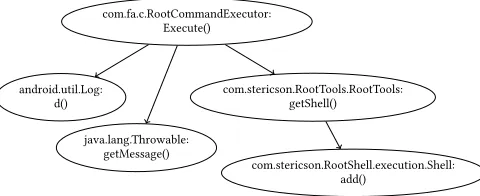
of the code executed in the try/catch block. The resulting call graph of the try/catch block is shown in Fig. 4. For simplicity, we omit calls for object initialization, return types and parameters, as well as implicit calls in a method. Additional calls that are invoked when getShell(true) is called are not shown, except for the add() method that is directly called by the program code, as shown in Fig. 3.
2.3 Sequence Extraction and Abstraction
In its second phase, MaMaDroid extracts the sequences of API calls from the call graph and abstracts the calls to one of three mode.
Call Graph Extraction (1)
Sequence Extraction (2)
Markov Chain Modeling (3)
[image:5.486.64.424.88.158.2]Classification (4)
?
Fig. 2. Overview of MaMaDroid operation. In (1), it extracts the call graph from an Android app, next, it builds the sequences of (abstracted) API calls from the call graph (2). In (3), the sequences of calls are used to build a Markov chain and a feature vector for that app. Finally, classification is performed in (4), classifying the app as benign or malicious.
packagecom.fa.c;
importandroid.content.Context;
importandroid.os.Environment;
importandroid.util.Log;
importcom.stericson.RootShell.execution.Command;
importcom.stericson.RootShell.execution.Shell;
importcom.stericson.RootTools.RootTools;
importjava.io.File;
public classRootCommandExecutor {
public static booleanExecute(Context paramContext) {
paramContext =newCommand(0,newString[] { "cat " + Environment.getExternalStorageDirectory().getAbsolutePath() + File.separator + Utilities.GetWatchDogName(paramContext) + " > /data/" + Utilities.GetWatchDogName(paramContext), "cat " + Environment. getExternalStorageDirectory().getAbsolutePath() + File.separator + Utilities.GetExecName(paramContext) + " > /data/" + Utilities. GetExecName(paramContext), "rm " + Environment.getExternalStorageDirectory().getAbsolutePath() + File.separator + Utilities. GetWatchDogName(paramContext), "rm " + Environment.getExternalStorageDirectory().getAbsolutePath() + File.separator + Utilities. GetExecName(paramContext), "chmod 777 /data/" + Utilities.GetWatchDogName(paramContext), "chmod 777 /data/" + Utilities. GetExecName(paramContext), "/data/" + Utilities.GetWatchDogName(paramContext) + " " + Utilities.GetDeviceInfoCommandLineArgs( paramContext) + " /data/" + Utilities.GetExecName(paramContext) + " " + Environment.getExternalStorageDirectory().getAbsolutePath () + File.separator + Utilities.GetExchangeFileName(paramContext) + " " + Environment.getExternalStorageDirectory().
getAbsolutePath() + File.separator + " " + Utilities.GetPhoneNumber(paramContext) });
try{
RootTools.getShell(true).add(paramContext);
return true; }
catch(Exception paramContext) {
Log.d("CPS", paramContext.getMessage()); }
return false; }
}
Fig. 3. Code from a malicious app (com.g.o.speed.memboost) executing commands as root.
Sequence Extraction.Since MaMaDroid uses static analysis, the graph obtained from Soot repre-sents the sequence of functions that are potentially called by the app. However, each execution of the app could take a specificbranchof the graph and only execute a subset of the calls. For instance, when running the code in Fig. 3 multiple times, the Execute method could be followed by different calls, e.g., getShell() in the try block only or getShell() and then getMessage() in the catch block.
com.fa.c.RootCommandExecutor: Execute()
android.util.Log: d()
com.stericson.RootTools.RootTools: getShell()
java.lang.Throwable: getMessage()
[image:6.486.122.362.88.186.2]com.stericson.RootShell.execution.Shell: add()
Fig. 4. Call graph of the API calls in the try/catch block of Fig. 3. (Return types and parameters are omitted to ease presentation).
API Call Abstraction.Rather than analyzing raw API calls from the sequence of calls, we build MaMaDroid to work at a higher level, and operate in one of three modes by abstracting each call to its family, package, or class. The intuition is to make MaMaDroid resilient to API changes and achieve scalability. In fact, our experiments presented in Section 3, show that, from a dataset of 44K apps, we extract more than 10 million unique API calls, which, depending on the modeling approach used to model each app, may result in the feature vectors being very sparse. While package and class are already existing names for these abstraction levels, we use “family” to indicate an even higher level of abstraction that does not currently exist. Our use of “family” refers to the “root” names of the API packages and not to “malware families,” since we do not attempt to label each malware sample to its family. When operating in family mode, we abstract an API call to one of the nine Android “root” package names, i.e.,android,google,java,javax,xml,apache,junit, json,dom, which correspond to the android.*, com.google.*, java.*, javax.*, org.xml.*, org.apache.*, junit.*, org.json, and org.w3c.dom.* packages. Whereas in package mode, we abstract the call to its package name using the list of Android packages from the documentation3consisting of 243
packages as of API level 24 (the version as of September 2016), as well as 95 from the Google API.4
In class mode, we abstract each call to its class name using a whitelist of all class names in the Android and Google APIs, which consists respectively, 4,855 and 1116 classes.5
In all modes, we abstract developer-defined (e.g., com.stericson.roottools) and obfuscated (e.g. com.fa.a.b.d) API calls respectively, asself-definedandobfuscated. Note that we label an API call as obfuscated if we cannot tell what its class implements, extends, or inherits, due to identifier mangling. Overall, there are 11 (9+2) families, 340 (243+95+2) packages, and 5,973 (4,855+1,116+2) possible classes.
2.4 Markov-chain Based Modeling
Next, MaMaDroid builds feature vectors, used for classification, based on the Markov chains representing the sequences of abstracted API calls for an app. Before discussing this in detail, we first review the basic concepts of Markov chains.
Markov Chains.Markov Chains are memoryless models where the probability of transitioning from a state to another only depends on the current state [48]. They are often represented as a set of nodes, each corresponding to a different state, and a set of edges connecting one node to another labeled with the probability of that transition. The sum of all probabilities associated to all edges from any node (including, if present, an edge going back to the node itself) is exactly 1. The set
com.fa.c.RootCommandExecutor: Execute() [self-defined, self-defined, self-defined]
com.fa.c.RootCommandExecutor: Execute() [self-defined, self-defined, self-defined]
com.fa.c.RootCommandExecutor: Execute() [self-defined, self-defined, self-defined]
com.stericson.RootTools.RootTools: getShell() [self-defined, self-defined, self-defined]
com.stericson.RootShell. execution.Shell: add()
[self-defined, self-defined, self-defined]
android.util.Log: d() [android.util.Log, android.util, android]
java.lang.Throwable: getMessage() [java.lang.Throwable,
[image:7.486.83.404.85.180.2]java.lang, java]
Fig. 5. Sequence of API calls extracted from the call graphs in Fig. 4, with the corresponding class/package/-family abstraction in square brackets.
self-defined
java.lang.Throwable android.util.Log 0.5
0.25 0.25
(a)
self-defined
java.lang android.util 0.5
0.25 0.25
(b)
self-defined
java android
0.5
0.25 0.25
(c)
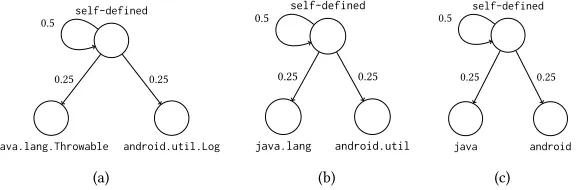
Fig. 6. Markov chains originating from the call sequence in Fig. 5 when using classes (a), packages (b) or families (c).
of possible states of the Markov chain is denoted asS. IfSj andSkare two connected states,Pjk denotes the probability of transition fromSjtoSk.Pjkis given by the number of occurrences (Ojk) of stateSkafter stateSj, divided byOji for all statesiin the chain, i.e.,Pjk =POj k
i∈SOj i.
Building the model.For each app, MaMaDroid takes as input the sequence of abstracted API calls of that app (classes, packages or families, depending on the selected mode of operation), and builds a Markov chain where each class/package/family is a state and the transitions represent the probability of moving from one state to another. For each Markov chain, stateS0is the entry point
from which other calls are made in a sequence. As an example, Fig. 6 illustrates the Markov chains built using classes, packages, and families, respectively, from the sequences reported in Fig. 5.
We argue that considering single transitions is more robust against attempts to evade detection by inserting useless API calls in order to deceive signature-based systems [40]. In fact, MaMaDroid considers all possible calls – i.e., all the branches originating from a node – in the Markov chain, so adding calls would not significantly change the probabilities of transitions between nodes (specifically, families, packages, or classes depending on the operational mode) for each app.
Feature Extraction.Next, we use the probabilities of transitioning from one state (abstracted call) to another in the Markov chain as the feature vector of each app. States that are not present in a chain are represented as 0 in the feature vector. The vector derived from the Markov chain depends on the operational mode of MaMaDroid. With families, there are 11 possible states, thus 121 possible transitions in each chain, while, when abstracting to packages, there are 340 states and 115,600 possible transitions and with classes, there are 5,973 states therefore, 35,676,729 possible transitions.
[image:7.486.103.393.226.321.2]Category Name Date Range #Samples #Samples #Samples (API Calls) (Call Graph)
Benign oldbenign Apr 2013 – Nov 2013 5,879 5,837 5,572
newbenign Mar 2016 – Mar 2016 2,568 2,565 2,465
Total Benign: 8,447 8,402 8,037
Malware
drebin Oct 2010 – Aug 2012 5,560 5,546 5,512
2013 Jan 2013 – Jun 2013 6,228 6,146 6,091
2014 Jun 2013 – Mar 2014 15,417 14,866 13,804
2015 Jan 2015 – Jun 2015 5,314 5,161 4,451
2016 Jan 2016 – May 2016 2,974 2,802 2,555
[image:8.486.82.399.93.202.2]Total Malware: 35,493 34,521 32,413
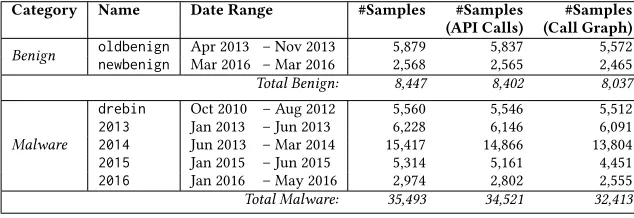
Table 1. Overview of the datasets used in our experiments.
of the original features. The first component contains as much variance (i.e., amount of information) as possible. The variance is given as a percentage of the total amount of information of the original feature space. We apply PCA to the feature set in order to select the principal components, as PCA transforms the feature space into a smaller one where the variance is represented with as few components as possible, thus considerably reducing computation/memory complexity. Also, PCA could reduce overfitting by only building the model from the principal components of the features in our dataset which may in turn, improve the accuracy of the classification.
2.5 Classification
The last step is to perform classification, i.e., labeling apps as either benign or malware. To this end, we test MaMaDroid using different classification algorithms: Random Forests, 1-Nearest Neighbor (1-NN), 3-Nearest Neighbor (3-NN), and Support Vector Machines (SVM). Note that since both accuracy and speed are worse with SVM, we omit results obtained with it. On average, the F-Measure with SVM using Radial Basis Functions (RBF) is 0.09 lower than with Random Forests, and it is 5 times slower to train in family mode (which has a much smaller feature space) than 3-Nearest Neighbors (the slowest among the other classification methods).
Each model is trained using the feature vector obtained from the apps in a training sample. Results are presented and discussed in Section 4, and have been validated by using 10-fold cross validation. Note that due to the different number of features used in different modes, we use two distinct configurations for the Random Forests algorithm. Specifically, when abstracting to families, we use 51 trees with maximum depth 8, while, with classes and packages, we use 101 trees of maximum depth 64. To tune Random Forests we follow the methodology applied in [6].
3 DATASET
In this section, we introduce the datasets used in the evaluation of MaMaDroid (presented later in Section 4), which include 43,940 apk files, specifically, 8,447 benign and 35,493 malware samples. We include a mix of older and newer apps, ranging from October 2010 to May 2016, as we aim to verify that MaMaDroid is robust to changes in Android malware samples as well as APIs. Also, to the best of our knowledge, our evaluation is done on one of the largest Android malware datasets used in a research paper. When evaluating MaMaDroid, we use one set of malicious samples (e.g., drebin) and a benign set (e.g.,oldbenign), thus experimenting with a balanced dataset among the two classes, as shown in Table 1.
0 10000 20000 30000 40000 #API Calls 0.0 0.2 0.4 0.6 0.8 1.0 CDF 2015 newbenign oldbenign drebin 2013 2014 2016
(a) API calls
0.0 0.2 0.4 0.6 0.8 1.0 Fraction of Calls
0.0 0.2 0.4 0.6 0.8 1.0 CDF 2016 2015 2014 2013 drebin newbenign oldbenign (b)android
0.0 0.2 0.4 0.6 0.8 1.0 Fraction of Calls
[image:9.486.45.438.90.205.2]0.0 0.2 0.4 0.6 0.8 1.0 CDF 2016 2015 2014 2013 drebin newbenign oldbenign (c)google
Fig. 7. CDFs of the number of API calls in different apps in each dataset (a), and of the percentage ofandroid (b) andgoogle(c) family calls.
and published on the Internet Archive6on August 7, 2014; and (2) another,newbenign, obtained by
downloading the top 100 apps in each of the 29 categories on the Google Play store as of March 7, 2016, using the googleplay-api tool.7Due to errors encountered while downloading some apps, we have actually obtained 2,843 out of 2,900 apps. Note that 275 of these belong to more than one category, therefore, thenewbenigndataset ultimately includes 2,568 unique apps.
Android Malware Samples. The set of malware samples includes apps that were used to test Drebin [4], dating back to October 2010 – August 2012 (5,560), which we denote asdrebin, as well as more recent ones that have been uploaded on the VirusShare8site over the years.
Specifi-cally, we gather from VirusShare, respectively, 6,228, 15,417, 5,314, and 2,974 samples from2013, 2014,2015, and2016. We consider each of these datasets separately for our analysis.
API Calls.For each app, we extract all API calls, using Androguard9, since, as explained in Section 4.5, these constitute the features used by DroidAPIMiner [1] (against which we compare our system) as well as a variant of MaMaDroid that is based on frequency analysis (see Section 6). Due to Androguard failing to decompress some of the apks, bad CRC-32 redundancy checks, and errors during unpacking, we are not able to extract the API calls for all the samples, but only for 40,923 (8,402 benign, 34,521 malware) out of the 43,940 apps in our datasets.
Call Graphs.To extract the call graph of each apk, we use Soot and FlowDroid. Note that for some of the larger apks, Soot requires a non-negligible amount of memory to extract the call graph, so we allocate 16GB of RAM to the Java VM heap space. We find that for 2,472 (364 benign + 2,108 malware) samples, Soot is not able to complete the extraction due to it failing to apply thejb phase as well as reporting an error in opening some zip files (i.e., the apk). Thejbphase is used by Soot to transform Java bytecode into jimple intermediate representation (the primary IR of Soot) for optimization purposes. Therefore, we exclude these apps in our evaluation and discuss this limitation further in Section 8.4. In Table 1, we provide a summary of our seven datasets, reporting the total number of samples per dataset, as well as those for which we are able to extract the API calls (second-to-last column) and the call graphs (last column).
Dataset Characterization. Aiming to shed light on the evolution of API calls in Android apps, we also performed some measurements over our datasets. In Fig. 7(a), we plot the Cumulative Distribution Function (CDF) of the number of unique API calls in the apps in different datasets,
6https://archive.org/details/playdrone-apk-e8 7https://github.com/egirault/googleplay-api 8https://virusshare.com/
Drebin &
OldBenignOldBenign2013 & OldBenign2014 & Newbenign2014 & Newbenign2015 & Newbenign2016 & 0.0
0.2 0.4 0.6 0.8 1.0
F-measure
RF 1-NN 3-NN
(a) family mode
Drebin &
OldBenignOldBenign2013 & OldBenign2014 & Newbenign2014 & Newbenign2015 & Newbenign2016 & 0.0
0.2 0.4 0.6 0.8 1.0
F-measure
RF 1-NN 3-NN
[image:10.486.68.420.90.226.2](b) package mode
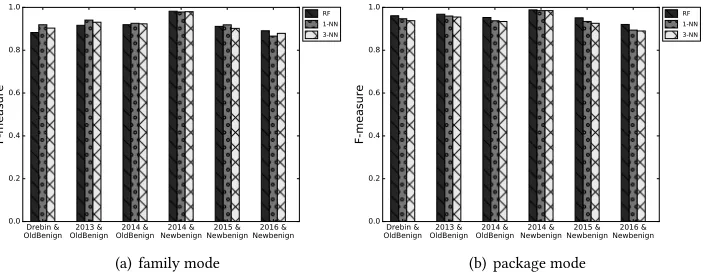
Fig. 8. F-measure of MaMaDroid classification with datasets from the same year using three different classifiers.
highlighting that newer apps, both benign and malicious, use more API calls overall than older apps. This indicates that as time goes by, Android apps become more complex. When looking at the fraction of API calls belonging to specific families, we discover some interesting aspects of Android apps developed in different years. In particular, we notice that API calls belonging to theandroid family become less prominent as time passes (Fig. 7(b)), both in benign and malicious datasets, whilegooglecalls become more common in newer apps (Fig. 7(c)). In general, we conclude that benign and malicious apps show the same evolutionary trends over the years. Malware, however, appears to reach the same characteristics (in terms of level of complexity and fraction of API calls from certain families) as legitimate apps with a few years of delay.
4 MAMADROID EVALUATION
We now present an experimental evaluation of MaMaDroid when it operates in family or package mode. Later in Section 5, we evaluate it in class mode. We use the datasets summarized in Table 1, and evaluate MaMaDroid, as per (1) its accuracy on benign and malicious samples developed around the same time; and (2) its robustness to the evolution of malware as well as of the Android framework by using older datasets for training and newer ones for testing and vice-versa.
4.1 Experimental Settings
To assess the accuracy of the classification, we use the standard F-measure metric, calculated asF =2·(Precision·Recall)/(Precision+Recall), where Precision=TP/(TP+FP)and Recall= TP/(TP+FN). TP denotes the number of samples correctly classified as malicious, while FP an FN indicate, respectively, the number of samples mistakenly identified as malicious and benign.
Note that all our experiments perform 10-fold cross validation using at least one malicious and one benign dataset from Table 1. In other words, after merging the datasets, the resulting set is shuffled and divided into ten equal-size random subsets. Classification is then performed ten times using nine subsets for training and one for testing, and results are averaged out over the ten experiments.
XX
XX
XX
X
Dataset
Mode [Precision, Recall,F-measure]
Family Family (PCA) Package Package (PCA) drebin,oldbenign 0.82 0.95 0.88 0.84 0.92 0.88 0.95 0.97 0.96 0.94 0.95 0.94 2013,oldbenign 0.91 0.93 0.92 0.93 0.90 0.92 0.98 0.95 0.97 0.97 0.95 0.96 2014,oldbenign 0.88 0.96 0.92 0.87 0.94 0.90 0.93 0.97 0.95 0.92 0.96 0.94 2014,newbenign 0.97 0.99 0.98 0.96 0.99 0.97 0.98 1.00 0.99 0.97 1.00 0.99 2015,newbenign 0.89 0.93 0.91 0.87 0.93 0.90 0.93 0.98 0.95 0.91 0.97 0.94 2016,newbenign 0.87 0.91 0.89 0.86 0.88 0.87 0.92 0.92 0.92 0.88 0.89 0.89
Table 2. Precision, Recall, and F-measure obtained by MaMaDroid when trained and tested with dataset from the same year, with and without PCA.
0 1 2 3 4
Years 0.0
0.2 0.4 0.6 0.8 1.0
F-measure
RF 1-NN 3-NN
(a) family mode
0 1 2 3 4
Years 0.0
0.2 0.4 0.6 0.8 1.0
F-measure
RF 1-NN 3-NN
[image:11.486.82.400.221.354.2](b) package mode
Fig. 9. F-measure achieved by MaMaDroid usingoldersamples for training andnewersamples for testing.
Therefore, in family mode, there are 8 possible states, thus 64 features, whereas in package mode, we have 341 states and 116,281 features (cf. Section 2.4).
4.2 MaMaDroid’s Performance (Family and Package Mode)
We start by evaluating the performance of MaMaDroid when it is trained and tested on dataset from the same year.
4.3 Detection Over Time
As Android evolves over the years, so do the characteristics of both benign and malicious apps. Such evolution must be taken into account when evaluating Android malware detection systems, since their accuracy might significantly be affected as newer APIs are released and/or as malicious developers modify their strategies in order to avoid detection. Evaluating this aspect constitutes one of our research questions, and one of the reasons why our datasets span across multiple years (2010–2016).
Recall that MaMaDroid relies on the sequence of API calls extracted from the call graphs and abstracted to either the package or the family level. Therefore, it is less susceptible to changes in the Android API than other classification systems such as DroidAPIMiner [1] and Drebin [4]. Since these rely on the use or the frequency, of certain API calls to classify malware vs benign samples, they need to be retrained following new API releases. On the contrary, retraining is not needed as often with MaMaDroid, since families and packages represent more abstract functionalities that change less over time. Consider, for instance, theandroid.os.healthpackage released in API level 24; it contains a set of classes that helps developers track and monitor system resources.10 Classification systems built before this release – as in the case of DroidAPIMiner [1] (released in 2013, when Android API was up to level 20) – need to be retrained if this package is more frequently used by malicious apps than benign apps, while MaMaDroid only needs to add a new state to its Markov chain when operating in package mode, while no additional state is required when operating in family mode.
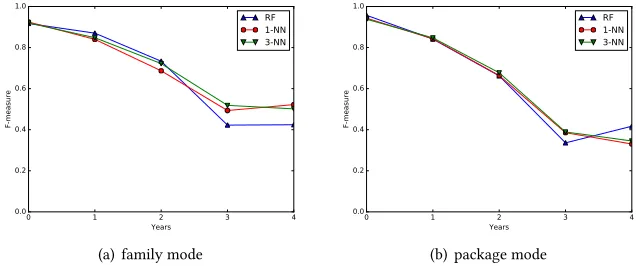
Older training, newer testing.To verify this hypothesis, we test MaMaDroid using older samples as training sets and newer ones as test sets. Fig. 9(a) reports the average F-measure of the classification in this setting, with MaMaDroid operating in family mode. The x-axis reports the difference in years between the training and testing malware dataset. We obtain 0.86 F-measure when we classify apps one year older than the samples on which we train. Classification is still relatively accurate, at 0.75, even after two years. Then, from Fig. 9(b), we observe that the average F-measure does not significantly change when operating in package mode. Both modes of operations are affected by one particular condition, already discussed in Section 3: in our models, benign datasets seem to “precede” malicious ones by 1–2 years in the way they use certain API calls. As a result, we notice a drop in accuracy when classifying future samples and usingdrebin(with samples from 2010 to 2012) or2013as the malicious training set andoldbenign(late 2013/early 2014) as the benign training set. More specifically, we observe that MaMaDroid correctly detects benign apps, while it starts missing true positives and increasing false negatives — i.e., achieving lower Recall.
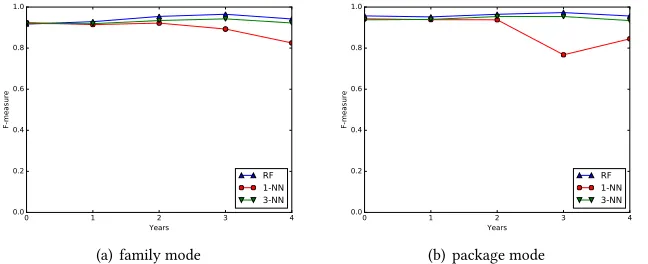
Newer training, older testing.We also set to verify whether older malware samples can still be detected by the system—if not, this would obviously become vulnerable to older (and possibly popular) attacks. Therefore, we also perform the “opposite” experiment, i.e., training MaMaDroid with newer benign (March 2016) and malware (early 2014 to mid 2016) datasets, and checking whether it is able to detect malware developed years before. Specifically, Fig. 10(a) and 10(b) report results when training MaMaDroid with samples from a given year, and testing it with others that are up to 4 years older: MaMaDroid retains similar F-measure scores over the years. Specifically, in family mode, it varies from 0.93 to 0.96, whereas in package mode, from 0.95 to 0.97 with the oldest samples.
Note that as MaMaDroid does general malware classification and not targeted malware family classification, we believe that its detection performance over time is not affected by the family of malware in our datasets. For example, thedrebindataset comprises about 1,048 malware families [4] which may not all be in the, e.g.,2016dataset. As a result, MaMaDroid has no prior
0 1 2 3 4 Years
0.0 0.2 0.4 0.6 0.8 1.0
F-measure
RF 1-NN 3-NN
(a) family mode
0 1 2 3 4
Years 0.0
0.2 0.4 0.6 0.8 1.0
F-measure
RF 1-NN 3-NN
[image:13.486.83.407.90.222.2](b) package mode
Fig. 10. F-measure achieved by MaMaDroid usingnewersamples for training andoldersamples for testing.
knowledge of all the malware samples in the testing samples when it does classification using older samples for training.
4.4 Case Studies of False Positives and Negatives
The experiment analysis presented above show that MaMaDroid detects Android malware with high accuracy. As in any detection system, however, the system makes a small number of incorrect classifications, incurring some false positives and false negatives. Next, we discuss a few case studies aiming to better understand these misclassifications. We focus on the experiments with newer datasets, i.e.,2016andnewbenign.
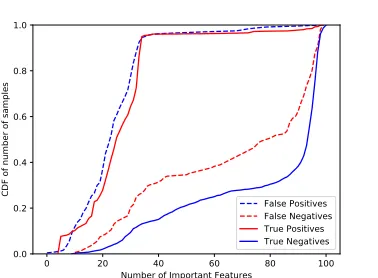
False Positives.First, we analyze the manifest of 164 apps mistakenly detected as malware by MaMaDroid, finding that most of them use “dangerous” permissions [3]. In particular, 67% write to external storage, 32% read the phone state, and 21% access the device’s fine location. We further analyzed apps (5%) that use the READ_SMS and SEND_SMS permissions, i.e., even though they are not SMS-related apps, they can read and send SMSs as part of the services they provide to users. In particular, a“in case of emergency”app is able to send messages to several contacts from its database (possibly added by the user), which is a typical behavior of Android malware in our dataset, ultimately leading MaMaDroid to flag it as malicious. As there are sometimes legitimate reasons for benign apps to use permissions considered to be dangerous, we also analyze the false positives using a second approach. Specifically, we examine the average number of the 100 most important features used by MaMaDroid to distinguish malware from benign apps that are present in the false positive samples when operating in package mode. We select the top 100 features as it represents no more than about 4.5% of the features (there are 2202 features in the2016and newbenigndatasets). As shown in Fig. 11, we find that for 90% of the false positives, there are only, on average, 33 of the most important features present in their feature vectors which are similar to the behavior observed in the true positives (34/100). MaMaDroid misclassifies these samples because they exhibit similar behavior to the true positives and these samples could be further manually analyzed to ascertain maliciousness.
False Negatives.We also check 114 malware samples missed by MaMaDroid when operating in family mode, using VirusTotal.11We find that 18% of the false negatives are actually not classified as malware by any of the antivirus engines used by VirusTotal, suggesting that these are actually legitimate apps mistakenly included in the VirusShare dataset. 45% of MaMaDroid’s false negatives areadware, typically, repackaged apps in which the advertisement library has been substituted with
0 20 40 60 80 100 Number of Important Features
0.0 0.2 0.4 0.6 0.8 1.0
CDF of number of samples
[image:14.486.151.340.90.229.2]False Positives False Negatives True Positives True Negatives
Fig. 11. CDF of the number of important features in each classification type.
a third-party one, which creates a monetary profit for the developers. Since they are not performing any clear malicious activity, MaMaDroid is unable to identify them as malware. Finally, we find that 16% of the false negatives reported by MaMaDroid are samples sending text messages or starting calls to premium services. We also do a similar analysis of false negatives when abstracting to packages (74 samples), with similar results: there a few more adware samples (53%), but similar percentages for potentially benign apps (15%) and samples sending SMSs or placing calls (11%). Similarly, we also investigate the false negatives further, using the 100 most important features of MaMaDroid when operating in package mode. As shown in Fig. 11, we find that for 90% of the false negatives, they have on average, 97 of the 100 features similar to the true negatives (98/100).
4.5 MaMaDroid vs DroidAPIMiner
We also compare the performance of MaMaDroid to previous work using API features for Android malware classification. Specifically, to DroidAPIMiner [1] because: (i) it uses API calls and its parameters to perform classification; (ii) it reports high true positive rate (up to 97.8%) on almost 4K malware samples obtained from McAfee and Genome [80], and 16K benign samples; and (iii) its source code has been made available to us by the authors.
In DroidAPIMiner, permissions that are requested more frequently by malware samples than by benign apps are used to perform a baseline classification. Then, the system also applies frequency analysis on the list of API calls after removing API calls from ad libraries, using the 169 most frequent API calls in the malware samples (occurring at least 6% more in malware than benign samples). Finally, data flow analysis is applied on the API calls that are frequent in both benign and malicious samples, but do not occur by at least 6% more in the malware set. Using the top 60 parameters, the 169 most frequent calls change, and the authors report a Precision of 97.8%.
Testing Sets
drebin,oldbenign 2013,oldbenign 2014,oldbenign 2015,oldbenign 2016,oldbenign
Training Sets Droid MaMa Droid MaMa Droid MaMa Droid MaMa Droid MaMa
drebin & oldbenign 0.32 0.96 0.35 0.95 0.34 0.72 0.30 0.39 0.33 0.42
2013 & oldbenign 0.33 0.94 0.36 0.97 0.35 0.73 0.31 0.37 0.33 0.28
2014 & oldbenign 0.36 0.92 0.39 0.93 0.62 0.95 0.33 0.78 0.37 0.75
drebin,newbenign 2013,newbenign 2014,newbenign 2015,newbenign 2016,newbenign
Training Sets Droid MaMa Droid MaMa Droid MaMa Droid MaMa Droid MaMa
2014 & newbenign 0.76 0.98 0.75 0.98 0.92 0.99 0.67 0.85 0.65 0.81
2015 & newbenign 0.68 0.97 0.68 0.97 0.69 0.99 0.77 0.95 0.65 0.88
[image:15.486.48.442.84.195.2]2016 & newbenign 0.33 0.96 0.35 0.98 0.36 0.98 0.34 0.92 0.36 0.92
Table 3. Classification performance of DroidAPIMiner (Droid) [1] vs MaMaDroid (MaMa) in package mode using Random Forest.
In Table 3, we report the results of DroidAPIMiner compared to MaMaDroid on different combination of datasets. Specifically, we report results for experiments similar to those carried out in Section 4.3 as we evaluate its performance on dataset from the same year and over time. First, we train it using older dataset composed ofoldbenigncombined with one of the three oldest malware datasets each (drebin,2013, and2014), and test on all malware datasets. Testing on all datasets ensures the model is evaluated on dataset from the same year and newer. With this configuration, the best result (with2014andoldbenignas training sets) is 0.62 F-measure when tested on the same dataset. The F-measure drops to 0.33 and 0.39, respectively, when tested on samples one year into the future and past. If we use the same configurations in MaMaDroid, in package mode, we obtain up to 0.97 F-measure (using2013andoldbenignas training sets), dropping to 0.73 and 0.94 respectively, one year into the future and into the past. For the datasets where DroidAPIMiner achieves its best result (i.e.,2014andoldbenign), MaMaDroid achieves an F-measure of 0.95, which drops to respectively, 0.78 and 0.93 one year into the future and the past. The F-measure is stable even two years into the future and the past at 0.75 and 0.92 respectively. As a second set of experiments, we train DroidAPIMiner using a dataset composed ofnewbenign(March 2016) combined with one of the three most recent malware datasets each (2014,2015, and2016). Again, we test DroidAPIMiner on all malware datasets. The best result is obtained when the2014and newbenigndataset are used for both training and testing, yielding an F-measure of 0.92, which drops to 0.67 and 0.75 one year into the future and past respectively. Likewise, we use the same datasets for MaMaDroid, with the best results achieved on the same dataset as DroidAPIMiner. In package mode, MaMaDroid achieves an F-measure of 0.99 which is maintained more than two years into the past, but drops to respectively, 0.85 and 0.81 one and two years into the future
As summarized in Table 3, MaMaDroid achieves significantly higher performance in all but one experiment than DroidAPIMiner. This case occurs when the malicious training set is much older than the malicious test set.
5 FINER-GRAINED ABSTRACTION
In Section 4, we have showed that building models from abstracted API calls allows MaMaDroid to obtain high accuracy, as well as to retain it over the years, which is crucial due to the continuous evolution of the Android ecosystem. Our experiments have focused on operating MaMaDroid in family and package mode (i.e., abstracting calls to family or package).
XX XX
XXX
X
Dataset
Mode [Precision, Recall,F-measure] Class Package
drebin,oldbenign 0.95 0.97 0.96 0.95 0.97 0.96
2013,oldbenign 0.98 0.95 0.97 0.98 0.95 0.97
2014,oldbenign 0.93 0.97 0.95 0.93 0.97 0.95
2014,newbenign 0.98 1.00 0.99 0.98 1.00 0.99
2015,newbenign 0.93 0.98 0.95 0.93 0.98 0.95
[image:16.486.119.367.84.158.2]2016,newbenign 0.91 0.92 0.92 0.92 0.92 0.92
Table 4. MaMaDroid’s Precision, Recall, and F-measure when trained and tested on dataset from thesame year in class and package modes.
0 1 2 3 4
Years
0.0 0.2 0.4 0.6 0.8 1.0
F-measure
Class Package
(a) Newer/Older
0 1 2 3 4
Years
0.0 0.2 0.4 0.6 0.8 1.0
F-measure
Class Package
(b) Older/Newer
Fig. 12. F-measure achieved by MaMaDroid in class mode when usingnewer(older) samples for training and older(newer) samples for testing.
malware and benign samples, so we set to verify whether one can trade-off higher computational and memory complexities for better accuracy. To this end, as discussed in Section 2.3, we abstract each API call to its corresponding class name using a whitelist of all classes in the Android API, which consists of 4,855 classes (as of API level 24), and in the Google API, with 1,116 classes, plus self-defined and obfuscated.
5.1 Reducing the size of the problem
Since there are 5,973 classes, processing the Markov chain transitions that results in this mode increases the memory requirements. Therefore, to reduce the complexity, we cluster classes based on their similarity. To this end, we build a co-occurrence matrix that counts the number of times a class is used with other classes in the same sequence in all datasets. More specifically, we build a co-occurrence matrixC, of size (5,973·5,973)/2, whereCi,j denotes the number of times the i-th and the j-th class appear in the same sequence, for all apps in all datasets. From the co-occurrence matrix, we compute the cosine similarity (i.e.,cos(xxx,yyy) = | |xxxxxx| | · | |·yyyyyy| |), and use k-means to cluster the classes based on their similarity into 400 clusters and use each cluster as the label for all the classes it contains. Since we do not cluster classes abstracted to self-defined and obfuscated, we have a total of 402 labels.
5.2 Class Mode Accuracy
[image:16.486.79.404.187.321.2]5.3 Detection over time
We also report in Fig. 12 (the x-axis shows the difference in years between the training and testing dataset.), the accuracy when MaMaDroid is trained and tested on dataset from different years. We find that, when MaMaDroid operates in class mode, it achieves an F-measure of 0.95 and 0.99, respectively, when trained with datasets one and two years newer than the test sets, as reported in Fig. 12(a)). Likewise, when trained on datasets one and two years older than the test set, F-measure reaches 0.84 and 0.59, respectively (see Fig. 12(b)).
Overall, comparing results from Fig. 9 to Fig. 12(b), we find that finer-grained abstraction actually performs worse with time when older samples are used for training and newer for testing. We note that this is due to a possible number of reasons: 1) newer classes or packages in recent API releases cannot be captured in the behavioral model of older tools, whereas families are; and 2) evolution of malware either as a result of changes in the API or patching of vulnerabilities or presence of newer vulnerabilities that allows for stealthier malicious activities.
On the contrary, Fig. 10 and 12(a) show that finer-grained abstraction performs better when the training samples are more recent than the test samples. This is because from recent samples, we are able to capture the full behavioral model of older samples. However, our results indicate there is a threshold for the level of abstraction which when exceeded, finer-grained abstraction will not yield any significant improvement in detection accuracy. This is because API calls in older releases are subsets of subsequent releases. For instance, when the training samples are two years newer, MaMaDroid achieves an F-measure of 0.99, 0.97, and 0.95 respectively, in class, package, and family modes. Whereas when they are three years newer, the F-measure is respectively, 0.97, 0.97, and 0.96 in class, package, and family modes.
6 FREQUENCY ANALYSIS MODEL (FAM)
MaMaDroid mainly relies on (1) API call abstraction, and (2) behavioral modeling via se-quence of calls. As shown, it outperforms state-of-the-art Android detection techniques, such as DroidAPIMiner [1], that are based on the frequency of non-abstracted API calls. In this section, we aim to assess whether MaMaDroid’s effectiveness mainly stems from the API abstraction, or from the sequence modeling. To this end, we implement and evaluate a variant that uses frequency, rather than sequences, of abstracted API calls. More precisely, we perform frequency analysis on the API calls extracted using Androguard after removing ad libraries, as also done in DroidAPIMiner. In the rest of the section, we denote this variant as FAM (Frequency Analysis Model).
We again use the datasets in Table 1 to evaluate FAM’s accuracy when training and testing on datasets from the same year and from different years. We also evaluate how it compares to standard MaMaDroid. Although we have also implemented FAM in class mode, we do not discuss/report results here due to space limitation.
6.1 FAM Accuracy
We start our evaluation by measuring how well FAM detects malware by training and testing using samples that are developed around the same time. Fig. 13 reports the F-measure achieved in family and package modes using three different classifiers. Also, Table 5 reports Precision, Recall, and F-measure achieved by FAM on each dataset combination, when operating in family and package mode, using Random Forests. We only report the results from the Random Forest classifier because it outperforms both the 1-NN and 3-NN classifiers.
XX XX
XXX
X
Dataset
Mode [Precision, Recall,F-measure] Family Package
drebin,oldbenign - - - 0.51 0.57 0.54
2013,oldbenign - - - 0.53 0.57 0.55
2014,oldbenign 0.71 0.76 0.73 0.73 0.73 0.73
2014,newbenign 0.85 0.90 0.87 0.88 0.89 0.89
2015,newbenign 0.64 0.70 0.67 0.68 0.66 0.67
[image:18.486.121.367.83.159.2]2016,newbenign 0.51 0.49 0.50 0.53 0.52 0.53
Table 5. Precision, Recall, and F-measure (with Random Forests) of FAM when trained and tested on dataset from the same year in family and package modes.
2013malware datasets are used in combination with theoldbenigndataset, there are no families that are more frequently used in these datasets than the benign dataset. As a result, FAM does not yield any result with these datasets as it operates by building a model only from API calls that are more frequently used in malware than benign samples. With the other datasets, there are two (2016), four (2014), and five families (2015) that occur more frequently in the malware dataset than the benign one.
From Fig. 13(a), we observe that F-measure is always at least 0.5 with Random Forests, and when tested on the2014(malware) dataset, it reaches 0.87. In general, lower F-measures are due to increased false positives. This follows a similar trend observed in Section 4.3.
Package mode.When FAM operates in package mode, it builds a model using the minimum of, all API calls that occur more frequently in malware or the top 172 API calls used more frequently in malware than benign apps. We use the top 172 API calls as we attempt to build the model where possible, with packages from at least two families (theandroidfamily has 171 packages). In our dataset, there are at least two (2013) and at most 39 (2016) packages that are used more frequently in malware than in benign samples. Hence, all packages that occur more in malware than benign apps are always used to build the model.
Classification performance improves in package mode, with F-measure ranging from 0.53 with 2016andnewbenignto 0.89 with2014andnewbenign, using Random Forests. Fig. 13(b) shows that Random Forests generally provides better results also in this case. Similar to family mode, the drebinand2013datasets respectively, have only five and two packages that occur more than in theoldbenigndataset. Hence, the results when these datasets are evaluated is poor due to the limited amount of features.
Take Aways.Although we discuss in more detail the performance of the FAM variant vs the standard MaMaDroid in Section 6.3, we can already observe that the former does not yield a robust model, mostly due to the fact that in some cases, no abstracted API calls occur more in malware than benign samples.
6.2 Detection Over Time
Once again, we evaluate the detection accuracy over time, i.e., we train FAM using older samples and test it with newer samples and vice versa. We report the F-measure as the average of the F-measure over multiple dataset combinations; e.g., when training with newer samples and testing on older samples, the F-measure after three years is the average of the F-measure when training with (2015, newbenign) and (2016, newbenign), respectively, and testing ondrebinand2013.
Drebin &
OldBenignOldBenign2013 & OldBenign2014 & Newbenign2014 & Newbenign2015 & Newbenign2016 & 0.0
0.2 0.4 0.6 0.8 1.0
F-measure
RF 1-NN 3-NN
(a) family mode
Drebin &
OldBenignOldBenign2013 & OldBenign2014 & Newbenign2014 & Newbenign2015 & Newbenign2016 & 0.0
0.2 0.4 0.6 0.8 1.0
F-measure
RF 1-NN 3-NN
[image:19.486.70.420.90.229.2](b) package mode
Fig. 13. F-measure for the FAM variant, over same-year datasets, with different classifiers.
0 1 2 3 4
Years
0.0 0.2 0.4 0.6 0.8 1.0
F-measure
RF 1-NN 3-NN
(a) family mode
0 1 2 3 4
Years
0.0 0.2 0.4 0.6 0.8 1.0
F-measure
RF 1-NN 3-NN
[image:19.486.83.401.268.402.2](b) package mode
Fig. 14. F-measure achieved by FAM usingoldersamples for training andnewersamples for testing.
Section 6.1, there is no result when thedrebinand2013datasets are used for training, hence, after 3 years the F-measure is 0. In package mode, the F-measure is 0.81 after one year, and 0.76 after two (Fig. 14(b)).
While FAM appears to perform better in family mode than in package mode, note that the detection accuracy after one and two years in family mode does not include results when the training set is (drebin, oldbenign) or (2013, oldbenign) (cf Section 6.1). We believe this is as a result of FAM performing best when trained on the2014dataset in both modes and performing poorly in package mode when trained with (drebin, oldbenign) and (2013, oldbenign) due to limited features. For example, result after two years is the average of the F-measure when training with (2014, oldbenign/newbenign) datasets and testing on the2016dataset. Whereas in package mode, result is the average F-measure obtained from training with (drebin, oldbenign), (2013, oldbenign), and (2014, oldbenign/newbenign) datasets and testing with respectively, 2014,2015, and2016.
0 1 2 3 4
Years
0.0 0.2 0.4 0.6 0.8 1.0
F-measure
RF 1-NN 3-NN
(a) family mode
0 1 2 3 4
Years
0.0 0.2 0.4 0.6 0.8 1.0
F-measure
RF 1-NN 3-NN
[image:20.486.83.401.90.224.2](b) package mode
Fig. 15. F-measure achieved by FAM usingnewersamples for training andoldersamples for testing.
XX XX
XXX
X
Dataset
Mode
F-measure Family Package
FAM MaMaDroid FAM MaMaDroid DroidAPIMiner
drebin,oldbenign - 0.88 0.54 0.96 0.32
2013,oldbenign - 0.92 0.55 0.97 0.36
2014,oldbenign 0.73 0.92 0.73 0.95 0.62
2014,newbenign 0.87 0.98 0.89 0.99 0.92
2015,newbenign 0.67 0.91 0.67 0.95 0.77
2016,newbenign 0.50 0.89 0.53 0.92 0.36
Table 6. F-measure of FAM and MaMaDroid in family and package modes as well as, DroidAPIMiner [1] when trained and tested on dataset from the same year.
drebinand2013are used for training, thus, effecting the overall result. This effect is minimal in this setting since the training sets are newer than the test sets, thus, thedrebindataset is not used to evaluate any dataset while the2013dataset is used in only one setting, i.e., when the training set is one year newer than the testing set.
6.3 Comparing Frequency Analysis vs. Markov Chain Model (Package and Family
Mode)
We now compare the detection accuracy of FAM– a variant of MaMaDroid that is based on a frequency analysis model – to the standard MaMaDroid, which is based on a Markov chain model using the sequence of abstracted API calls.
[image:20.486.86.405.259.344.2]Testing Sets
drebin,oldbenign 2013,oldbenign 2014,oldbenign 2015,oldbenign 2016,oldbenign
Training Sets Droid FAM MaMa Droid FAM MaMa Droid FAM MaMa Droid FAM MaMa Droid FAM MaMa
drebin,oldbenign 0.32 0.54 0.96 0.35 0.50 0.96 0.34 0.50 0.79 0.30 0.50 0.42 0.33 0.51 0.43
2013,oldbenign 0.33 0.90 0.93 0.36 0.55 0.97 0.35 0.95 0.74 0.31 0.87 0.36 0.33 0.82 0.29
2014,oldbenign 0.36 0.95 0.92 0.39 0.99 0.93 0.62 0.73 0.95 0.33 0.81 0.79 0.37 0.82 0.78
drebin,newbenign 2013,newbenign 2014,newbenign 2015,newbenign 2016,newbenign
Training Sets Droid FAM MaMa Droid FAM MaMa Droid FAM MaMa Droid FAM MaMa Droid FAM MaMa
2014,newbenign 0.76 0.99 0.99 0.75 0.99 0.99 0.92 0.89 0.99 0.67 0.86 0.89 0.65 0.82 0.83
2015,newbenign 0.68 0.92 0.98 0.68 0.84 0.98 0.69 0.95 0.99 0.77 0.67 0.95 0.65 0.91 0.90
[image:21.486.46.442.83.189.2]2016,newbenign 0.33 0.83 0.97 0.35 0.69 0.97 0.36 0.91 0.99 0.34 0.86 0.93 0.36 0.53 0.92
Table 7. F-Measure of MaMaDroid (MaMa) vs our variant using frequency analysis (FAM) vs DroidAPIMiner (Droid) [1].
Detection Accuracy of malware from different years.We also compare FAM with MaMaDroid when they are trained and tested with datasets across several years. In Table 7, we report the F-measures achieved by MaMaDroid and FAM in package mode using Random Forests, and show how they compare with DroidAPIMiner using two different sets of experiments. In the first set of experiments, we train MaMaDroid, FAM, and DroidAPIMiner using samples comprising the oldbenignand one of the three oldest malware datasets (drebin,2013,2014) each, and testing on all malware datasets. MaMaDroid and FAM both outperform DroidAPIMiner in all experiments in this setting, showing that abstracting the API calls improves the detection accuracy of our systems. FAM outperforms MaMaDroid in nine out of the 15 experiments, largely, when the training set comprises thedrebin/2013andoldbenigndatasets. Recall that whendrebinand2013malware datasets are used for training FAM in package mode, only five and two packages, respectively, are used to build the model. It is possible that these packages are the principal components (as in PCA) that distinguishes malware from benign samples. In the second set of experiments, we train MaMaDroid, FAM, and DroidAPIMiner using samples comprising thenewbenignand one of the three recent malware datasets (2014,2015,2016) each, and testing on all malware datasets. In this setting, MaMaDroid outperforms both FAM and DroidAPIMiner in all but one experiment where FAM is only slightly better. Comparing DroidAPIMiner and FAM shows that DroidAPIMiner only performs better than FAM in two out of 15 experiments. In these two experiments, FAM was trained and tested on samples from the same year and resulted in a slightly lower Precision, thus, increasing false positives.
Overall, we find that the Markov chain based model achieves higher detection accuracy in both family and package modes when MaMaDroid is trained and tested on dataset from the same year (Table 6) and across several years (Table 7).
7 RUNTIME PERFORMANCE
We now analyze the runtime performance of MaMaDroid and the FAM variant, when operating in family, package, or class mode, as well as DroidAPIMiner. We run our experiments on a desktop with a 40-core 2.30GHz CPU and 128GB of RAM, but only use 1 core and allocate 16GB of RAM for evaluation.
7.1 MaMaDroid
MaMaDroid’s first step involves extracting the call graph from an apk and the complexity of this task varies significantly across apps. On average, it takes 9.2s±14 (min 0.02s, max 13m) to complete for samples in our malware sets. Benign apps usually yield larger call graphs, and the average time to extract them is 25.4s±63 (min 0.06s, max 18m) per app. Next, we measure the time needed to extract call sequences while abstracting to families, packages or classes depending on MaMaDroid’s mode of operation. In family mode, this phase completes in about 1.3s on average (and at most 11.0s) with both benign and malicious samples. Abstracting to packages takes slightly longer, due to the use of 341 packages in MaMaDroid. On average, this extraction takes 1.67s±3.1 for malicious apps and 1.73s±3.2 for benign samples. Recall that in class mode, after abstracting to classes, we cluster the classes to a smaller set of labels due to its size. Therefore, in this mode it takes on average, 5.84s±2.1 and 7.3s±4.2 respectively, to first abstract the calls from malware and benign apps to classes and 2.74s per app to build the co-occurrence matrix from which we compute the similarity between classes. Finally, clustering and abstracting each call to its corresponding class label takes 2.38s and 3.4s respectively, for malware and benign apps. In total, it takes 10.96s to abstract calls from malware apps to their corresponding class labels and 13.44s for benign apps.
MaMaDroid’s third step includes Markov chain modeling and feature vector extraction. With malicious samples, it takes on average 0.2s±0.3, 2.5s±3.2, and 1.49s±2.39 (and at most 2.4s, 22.1s, and 46.10s), respectively, with families, packages, and classes, whereas with benign samples, it takes 0.6s±0.3, 6.7s±3.8, and 2.23s±2.74 (at most 1.7s, 18.4s, and 43.98s). Finally, the last step is classification, and performance depends on both the machine learning algorithm employed and the mode of operation. More specifically, running times are affected by the number of features for the app to be classified, and not by the initial dimension of the call graph, or by whether the app is benign or malicious. Regardless, in family mode, Random Forests, 1-NN, and 3-NN all take less than 0.01s. With packages, it takes, respectively, 0.65s, 1.05s, and 0.007s per app with 1-NN, 3-NN, Random Forests. Whereas it takes, respectively, 1.02s, 1.65s, and 0.05s per app with 1-NN, 3-NN, and Random Forests in class mode.
Overall, when operating in family mode, malware and benign samples take on average, 10.7s and 27.3s, respectively, to complete the entire process, from call graph extraction to classification. In package mode, the average completion times for malware and benign samples are 13.37s and 33.83s, respectively. Whereas in class mode, the average completion times are, respectively, 21.7s and 41.12s for malware and benign apps. In all modes of operation, time is mostly (>80%) spent on call graph extraction.
7.2 FAM
7.3 DroidAPIMiner
Finally, we evaluate the runtime performance of DroidAPIMiner [1]. Its first step, i.e., extracting API calls, takes 0.7s±1.5 (min 0.01s, max 28.4s) per app in our malware datasets. Whereas it takes on average, 13.2s±22.2 (min 0.01s, max 222s) per benign app. In the second phase, i.e., frequency and data flow analysis, it takes, on average, 4.2s per app. Finally, classification using 3-NN is very fast: 0.002s on average. Therefore, in total, DroidAPIMiner takes respectively, 17.4s and 4.9s for a complete execution on one app from our benign and malware datasets, which while faster than MaMaDroid, achieves significantly lower accuracy. In comparison to MaMaDroid, DroidAPIMiner takes 5.8s and 9.9s less on average to analyze and classify a malicious and benign app when MaMaDroid operates in family mode and 8.47s and 16.43s less on average in package mode.
7.4 Take Aways
In conclusion, our experiments show that our prototype implementation of MaMaDroid is scalable enough to be deployed. Assuming that, everyday, a number of apps in the order of 10,000 are submitted to Google Play, and using the average execution time of benign samples in family (27.3s), package (33.83s), and class (41.12s) modes, we estimate that it would take less than two hours to complete execution of all apps submitted daily in all modes, with just 64 cores. Note that we could not find accurate statistics reporting the number of apps submitted everyday, but only the total number of apps on Google Play.12On average, this number increases by a couple of thousands per day, and although we do not know how many apps are removed, we believe 10,000 apps submitted every day is likely an upper bound.
8 DISCUSSION
We now discuss the implications of our results with respect to the feasibility of modeling app behavior using static analysis and Markov chains, discuss possible evasion techniques, and highlight some limitations of our approach.
8.1 Lessons Learned
Our work yields important insights around the use of API calls in malicious apps, showing that, by abstracting the API calls to higher levels and modeling these abstracted calls, we can obtain high detection accuracy and retain it over several years, which is crucial due to the continuous evolution of the Android ecosystem.
As discussed in Section 3, the use of API calls changes over time, and in different ways across malicious and benign samples. From our newer datasets, which include samples up to Spring 2016 (API level 23), we observe that newer APIs introduce more packages, classes, and methods, while also deprecating some. Fig. 7(a) show that benign apps use more calls than malicious ones developed around the same time. We also notice an interesting trend in the use of Android (Fig. 7(b)) and Google (Fig. 7(c)) APIs: malicious apps follow the same trend as benign apps in the way they adopt certain APIs, but with a delay of some years. This might be a side effect of Android malware authors’ tendency to repackage benign apps, adding their malicious functionalities onto them.
Given the frequent changes in the Android framework and the continuous evolution of malware, systems like DroidAPIMiner [1] – being dependent on the presence or the use of certain API calls – become increasingly less effective with time. As shown in Table 3, malware that uses API calls released after those used by samples in the training set cannot be identified by these systems. On the contrary, as shown in Fig. 9, MaMaDroid detects malware samples that are1 yearnewer
than the training set obtaining an F-measure of 0.86 (as opposed to 0.46 with DroidAPIMiner) when the apps are modeled as Markov chains. After 2 years, the value is still at 0.75 (0.42 with DroidAPIMiner), dropping to 0.51 after 4 years.
We argue that the effectiveness of MaMaDroid’s classification remains relatively high “over the years” owing to the Markov models capturing app’s behavior. These models tend to be more robust to malware evolution because abstracting to, e.g., packages makes the system less susceptible to the introduction of new API calls. To verify this, we developed a variant of MaMaDroid named FAM that abstracts API calls and is based on frequency analysis similar to DroidAPIMiner. Although, the addition of API call abstraction results in an improvement of the detection accuracy of the system (an F-measure of 0.81 and 0.76 after one and two years respectively), it also resulted in scenarios where there are no API calls that are more frequently used in malware than benign apps. In general, abstraction allows MaMaDroid capture newer classes/methods added to the API, since these are abstracted to already-known families or packages. As a result, it does not require any change or modification in its operation with new API releases. In case new packages are added to new API level releases, MaMaDroid only requires adding a new state for each new package to the Markov chains, and the probability of a transition from a state to this new state in old apps (i.e., apps without the new packages) would be 0. That is, if only two packages are added in the new API release, only two states need to be added which requires trivial effort. In reality though, methods and classes are more frequently added than packages with new API releases. Hence, we also evaluate whether MaMaDroid still performs as well as in package mode when we abstract API calls to classes and measure the overall overhead increase. Results from Figure 12, 14, and 15 indicate that finer-grained abstraction is less effective as time passes when older samples are used for training and newer samples for testing, while they are more effective when samples from the same year or newer than the test sets are used for training. However, while all three modes of abstraction performs relatively well, we believe abstraction to packages is the most effective as it generally performs better than family – though less lightweight – and as well as class but more efficient.
8.2 Potential Machine Learning Bias
Recently, Pendelebury et al. [52] present Tesseract, which attempts to eliminate spatial and temporal bias present in malware classifiers. To this end, the authors suggest malware classifiers should enforce three constraints: 1)temporal training consistency, i.e., all objects in the training set must temporally precede all objects in the testing set, 2)temporal goodware/malware windows consistency, i.e., in every testing slot of size∆, all test objects must be from the same time window, and 3)realistic malware-to-goodware percentage in testing, i.e., the testing distribution must reflect the real-world percentage of malware observed in the wild.


![Table 3. Classification performance of DroidAPIMiner (Droid) [1] vs MaMaDroid (MaMa) in package modeusing Random Forest.](https://thumb-us.123doks.com/thumbv2/123dok_us/569990.556483/15.486.48.442.84.195/classification-performance-droidapiminer-mamadroid-package-modeusing-random-forest.webp)
