Exploring areas of consensus and
con
fl
ict around values underpinning
public involvement in health and social
care research: a modi
fi
ed Delphi study
D Snape,1J Kirkham,2J Preston,3J Popay,4N Britten,5M Collins,4K Froggatt,4 A Gibson,5F Lobban,4K Wyatt,5A Jacoby1
To cite:Snape D, Kirkham J, Preston J,et al. Exploring areas of consensus and conflict around values underpinning public involvement in health and social care research: a modified Delphi study.BMJ Open2014;4:e004217. doi:10.1136/bmjopen-2013-004217
▸ Prepublication history for this paper is available online. To view these files please visit the journal online (http://dx.doi.org/10.1136/ bmjopen-2013-004217).
Received 10 October 2013 Revised 9 December 2013 Accepted 11 December 2013
For numbered affiliations see end of article.
Correspondence to Professor Ann Jacoby; [email protected]
ABSTRACT
Objective:There is growing interest in the potential benefits of public involvement (PI) in health and social care research. However, there has been little examination of values underpinning PI or how these values might differ for different groups with an interest in PI in the research process. We aimed to explore areas of consensus and conflict around normative, substantive and process-related values underpinning PI.
Design:Mixed method, three-phase, modified Delphi study, conducted as part of a larger multiphase project.
Setting:The UK health and social care research community.
Participants:Stakeholders in PI in research, defined as: clinical and non-clinical academics, members of the public, research managers, commissioners and funders; identified via research networks, online searches and a literature review.
Results:We identified high levels of consensus for many normative, substantive and process-related issues. However, there were also areas of conflict in relation to issues of bias and representativeness, and around whether the purpose of PI in health and social care research is to bring about service change or generate new knowledge. There were large differences by group in the percentages endorsing the ethical justification for PI and the argument that PI equalises power imbalances. With regard to practical
implementation of PI, research support infrastructures were reported as lacking. Participants reported shortcomings in the uptake and practice of PI. Embedding PI practice and evaluation in research study designs was seen as fundamental to strengthening the evidence base.
Conclusions:Our findings highlight the extent to which PI is already embedded in research. However, they also highlight a need for‘best practice’standards to assist research teams to understand, implement and evaluate PI. These findings have been used in developing a Public Involvement Impact Assessment Framework (PiiAF), which offers guidance to researchers and members of the public involved in the PI process.
INTRODUCTION
There is a growing interest internationally in the potential benefits of public involvement (PI) in health research.1–3 Within the UK, the involvement of members of the public in research is firmly established in health and social care policy,4 and organisations includ-ing, for example, the National Institute for
Strengths and limitations of this study
▪ Despite growing interest in the UK and inter-nationally in the potential benefits of public involvement (PI) in research, there has been little examination of the values underpinning it, or of how these values might be different for different stakeholders. As part of a large study developing guidance on how to assess the impact of PI in research, we undertook a mixed method, modi-fied Delphi study which has provided primary evidence of areas of consensus and conflict around the value systems underpinning PI in research.
▪ Our mixed method, modified Delphi study involved a heterogeneous panel of PI experts, reflective of the range of key stakeholder groups and was geographically diverse.
▪ ‘Consensus’ thresholds were determined in advance of data collection, with two levels of consensus defined.
▪ A limitation of our study was that panellists likely were individuals with a strong commitment to PI; we can therefore say nothing about the values of those who choose not to engage with the PI enterprise. A further limitation is that response rates to the two-round survey were low and that our conclusions are potentially biased. However, a large percentage of the round 1 survey responders also completed the round 2 survey; and the quality of the data was high.
Health Research5increasingly identify PI as a prerequis-ite for funding.
There is a plethora of literature illuminating the experiences of members of the public and professional researchers, and the process of PI and its potential impacts.6–9However, while studies report on use of PI in context of priority setting,10 11 the conduct of clinical trials12 and the identification of treatment outcomes,13 there has been relatively little examination of the values underpinning PI or about capturing and assessing the impact of PI effectively.14–18 Possible reasons cited for the limited number of studies evaluating the impact of PI are that evaluation is too difficult and that PI is of intrinsic value and as such needs no further justifi ca-tion.16 19–21 The authors of the present article acknow-ledge this latter perspective. However, we would argue that the current lack of a research evidence base around the impact of PI presents a challenge, since without such an evidence base it is difficult to ensure integrity of the PI endeavour, avoid potential adverse effects and ensure that it is adequately resourced. The modified Delphi study reported here was part of a larger Medical Research Council funded study (G0902155/93948) which aimed to review evidence on the values and impacts associated with PI, develop guidance on how these impacts can be assessed and contribute to the development of good practice standards for PI. The modified Delphi study utilised mixed methods to explore areas of consensus and conflict underpinning three over-arching value systems identified from a pre-ceding literature review.22These values relate to (1) nor-mative perspectives on PI, which consider involvement as an end in itself, for example, rights and empower-ment; (2) substantive perspectives which consider the consequences of PI, for example, quality and relevance and (3) process-related values associated with good involvement, for example, partnership and equality.
AIM AND OBJECTIVES OF THE DELPHI STUDY
The overall aim of the modified Delphi Study was to explore areas of consensus and conflict around the nor-mative, substantive and process-related values underpin-ning PI in health and social care research. The specific objectives were:
▸ To explore key issues identified from our literature review with PI experts;
▸ To provide new knowledge about the views of differ-ent stakeholders on PI;
▸ To contribute to the development of guidance on how to assess the impact of PI in research.
METHODS
In this study, we defined PI as an active partnership between members of the public and researchers in the research process, rather than the use of people as the
‘subjects’ of research. The term ‘public’ has been used as developed by the UK National Advisory Group
INVOLVE,23 and includes patients and potential patients, carers and people who use health and social care services. Within the study reported here, PI has been achieved through the collaboration of academic researchers with experience of working in the field of PI, user investigators and the wider project’s Public Advisory Group whose members contributed to all five phases of the work. A mixed methods approach to data collection was employed in a three-stage, modified Delphi process:
▸ Three expert workshops ( participant total n=42), including members of the public, academic and user-researchers, researcher/clinicians, research funders and research managers were conducted to generate qualitative data. The range of normative, substantive and process-related values underpinning PI,
identi-fied in a previously conducted literature review,22 were discussed, to identify concepts to be explored at round 1 (R1) and round 2 (R2) of the subsequent modified Delphi survey;
▸ A pilot study to test the R1 survey questionnaire. As a strategy to reduce attrition,24 25careful attention was paid to the content and layout of the invitation email, the survey layout and the clarity of questions. Piloting was conducted with academic (n=6) and user-researchers (n=3) and members of our Patient Advisory Group (n=2). Language, question type and questionnaire formatting were edited in response to participant feedback;
▸ A two-round modified Delphi survey was undertaken between November 2011 and September 2012 to explore areas of consensus and conflict around the normative, substantive and process-related values underpinning PI in health and social care research. In this article, we describe the modified Delphi process and report on thefindings relating to the values underpinning PI in health and social care research. A subsequent article will report the survey findings in relation to perceived PI barriers and facilitators, per-ceived impacts of PI and potential approaches to its evaluation.
A modified Delphi technique
The main premise of the Delphi technique is the assumption that group opinion is more valid than indi-vidual opinion. The technique offers a reliable data
col-lection method in circumstances where there is
to try and tease out areas of conflict as well as areas of consensus.
There are a number of key concepts and assumptions which distinguish the basic Delphi technique from other research methods. These include anonymity, multistage iteration and controlled feedback, exploration of con-sensus via statistical group response and the use of experts.30 39 Each of these key characteristics was given due consideration as a means of enhancing the validity and reliability of the study design and the quality of responses.28 40–43
Sampling and the use of‘experts’
To reduce possible bias, our sampling strategy for panel composition was reflective of the population subgroups under investigation and geographically diverse.31 33 To increase the reliability of the results, a large heteroge-neous panel of ‘experts’, consisting of distinct stake-holder groups was recruited.24 We defined‘experts’ as a group of informed individuals28 44 45—which, in this instance, was knowledge and/or experience of PI in health and social care research. Sampling was purposive. We aimed to capture the various PI perspectives and interests of members of the public, user, academic and clinical researchers and research managers, directors, commissioners and funders. Potential panellists were identified in one of three ways: directly, through
research team members’ contacts and networks;
through online searches of open-access research infor-mation and funding sites and via a review of literature in thefield of PI in health and social care research.
Anonymity
Complete anonymity could not be achieved as survey panellists and their responses were known to some members of the research team. However, anonymity between panellists was guaranteed. Reactions to panel-lists’opinions, key arguments and levels of consensus for each subgroup were fed back to panellists at R2 of the modified Delphi survey; each opinion carried the same weight and was afforded the same degree of importance in the analysis. In this way, participant bias was elimi-nated.33 This approach also enabled panellists to be open and honest about their views on various issues as well as providing them with an equal opportunity to express an opinion without feeling pressured psycho-logically to conform to the views of others.33
Quantitative data analysis
Determining how consensus cut-off points are reached and understanding how they are derived are often prob-lematic, as the reporting of such criteria is limited within many published studies.29 To address this, we sought statistical advice and defined specific criteria for determining consensus thresholds a priori.
We took, as representing clear consensus, endorse-ment or rejection of a stateendorse-ment by at least 60% of respondents. However, attention was also paid to the
distribution of responses of the remaining 40%. Where these responses clustered in one response option only, consensus was not assumed and this item was further explored in R2 of the survey. We took, as representing critical consensus, endorsement or rejection of a state-ment by at least 70% of respondents. An additional cri-terion for critical consensus was that at least 55% of responses either endorsed or rejected the extreme cat-egories in the scales.
At R2, the results from the R1 survey were fed back to panellists in the form of bar charts, textual summaries of statistical data and summarised descriptions of qualita-tive findings. Feedback included comparison of the responses of the different subgroups for each item. Particular attention was drawn to items demonstrating either within-subgroup or between-subgroup dissent. Items at R1 where between-subgroup differences were greater than 10% were further explored at R2. Also explored at R2 were any ‘unexpected’ (in the collective view of the study team) endorsement/rejection of items by the subgroups. We draw attention to these ‘ unex-pected’responses in thefindings section below.
Qualitative data analysis
In R1 and R2, to enable in-depth exploration of the quantitative findings, panellists were provided with the opportunity to make further comments as they saw fit, through open questions. Thematic codes were identified using Framework Analysis,46 a matrix-based method for ordering and synthesising data. The analysis was con-ducted by DS. Quality checking of the coding process and reduction of coding bias were ensured by AJ, who reviewed 10% of the qualitative data. First, data were reviewed inductively to identify recurring themes and concepts raised by panellists. These were coded and formed the initial major and subthemes; additional codes were then incorporated through an iterative process involving DS and AJ. The thematic framework was further refined before being applied systematically to the whole dataset. This process facilitated the identifi -cation of any inconsistencies in coding, which were sub-sequently discussed and reconciled.
RESULTS
The iterative nature of the Delphi technique enabled R2 of the survey to be informed by the results of R1. For this reason, the methods and results for both rounds are discussed together.
Panellists
of the public (MP), (17%); research manager or funding/commissioning body employee (RM), (24%); or occupying multiple roles (MR), (11%).
The characteristics of those who took part in R1 are shown in table 1. Overall, the participants had high levels of expertise, with most of them reporting having at least 5 years of experience in research and three-quarters having some responsibility for PI. However, there were also differences in level of expertise, members of the public being least likely to have lengthy research experience or any specific PPI responsibilities. In contrast, though fewer than half (n=134; 48%) of all the panellists reported having had any formal training relevant to PI, members of the public were far more likely to have had such training (table 1), while aca-demic researchers tended to emphasise ‘learned by doing’.
The panellists reported being involved in a wide range of research roles including, for example, drafting research proposals and protocols (n=239; 86%); develop-ing plain English summaries (n=238; 86%); sittdevelop-ing on project advisory and steering groups (n=228; 82%); pre-senting research findings (n=226; 82%) and being involved in data collection (n=223; 815). The panellists cited a number of practical learning opportunities which underpinned their PI skills acquisition, including, for example:
Good networking. [NCA, R1]
[image:4.595.46.552.74.159.2]“…hard work building rapport and understanding of the patients’ perspective, putting myself in their shoes. [NCA, R1]
Support from others, learning alongside others, and time. [CA, R1]
…so learning from mistakes and trying to listen to what both the patients and the researchers need to make it a meaningful experience. [MP, R1]
Various policy documents for engaging the public in research on which we can rest our local framework and priorities. [RF, R1]
All the panellists (n=318; response rate 43%) who sub-mitted the R1 questionnaire were eligible to participate
in R2. Of the 318 responders, three electronically‘opted out’of receiving further email communications. The R2 questionnaire was therefore emailed to 315 (n=315) panellists. Up to two reminders were actioned as required. A total of 231 (n=231) R2 survey responses were received across the five stakeholder groups: CA, (17%); NCA, (29%); MP, (18%); RM, (24%) and MR), (12%), yielding a R2 response rate of 73% (of the 43% who took part in R1).
Arguments related to the nature of knowledge
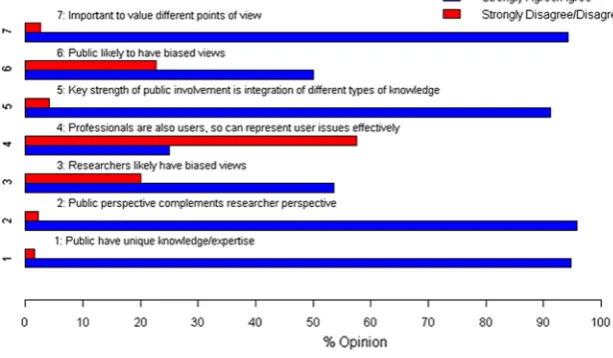
We asked our panellists to comment on what kinds of knowledge they believed should inform health and social care research. Responses at R1 (see figure 1) revealed critical consensus across the different stake-holder groups (over 90% strongly agreed/agreed) for the substantive argument that members of the public have unique knowledge and expertise that is comple-mentary to that of professionals/clinicians and research-ers, and should be valued equally.
A comment from one CA panellist illustrates this:
It is important not to conflate the complementary per-spectives of clinical/health, social care professional researchers versus methodologists. Both have important knowledge and expertise to bring to the table in inform-ing health and social care research, as do patients, their informal carers and advocates and members of the public…it is important that all of these perspectives are regarded as equally important, rather than privileging any one view over the others. [CA; R1]
Though it just failed to reach our definition of clear consensus, there was broad support across the stake-holder groups (58%) for the idea that while profes-sionals/clinicians and researchers may also be service users, they cannot themselves represent user issues effectively. Since there was also some support across stakeholder groups ( just over 50% strongly agreed/ agreed) for the idea that members of the research com-munity and members of the public are likely to have biased views about research, we explored this issue of bias further in R2.
At R2, we asked panellists to comment on whether they felt it mattered if different stakeholder groups held views which others considered biased. Forty-three per Table 1 Research experience by stakeholder group*
Stakeholder group n
Minimum 5 years research experience
Some PI responsibility
Formal training relevant to PI
Clinical academic researcher 63 52 (82.5%) 52 (82.5%) 27 (42.9%) Non-clinical academic researcher 88 70 (79.5%) 63 (71.6%) 27 (30.7%) Member of the public 55 33 (60.0%) 27 (49.1%) 35 (63.6%) Research manager/funder 76 53 (69.7%) 64 (84.2%) 31 (40.8%)
Dual role 34 30 (88.2%) 29 (85.3%) 14 (41.2%)
*Data taken from R1.
cent said ‘yes’ they did feel it mattered, with a percent-age range of 29–59% across stakeholder groups. Individual stakeholder group responses are outlined in
table 2.
A common theme across panellists’ written comments and one articulated by a panellist holding multiple roles was that all research actors are biased to some degree, holding different views based on knowledge and/or experience.
All views will have a bias of some kind, but I think it is more important that the view is ‘informed’. Bringing together the different perspectives in an open, collabora-tive way is one of the strengths of patient involvement, not a weakness. [MR, R2].
Many panellists articulated that differences in perspec-tive should not necessarily be viewed negaperspec-tively; rather they should be acknowledged as a ‘given’. Interestingly, at R2, the issue of power (who holds the power to enforce their viewpoint) was highlighted as more important than the question of bias.
Following from this, in R2 process, values that involve
‘building relationships of trust between the different stakeholder groups’ [NCA, R2] were frequently argued
to be key for managing difference and essential for effective stakeholder partnerships and shared decision-making.
Arguments related to the purposes of PI in health and social care research
There was critical consensus (over 80% strongly agreed/ agreed) at R1, across all stakeholder groups, that members of the public should be involved in publicly funded research, and are entitled to say what and how research is undertaken (see figure 2). There was also critical consensus that members of the public should be involved in research impacting on their own health or on National Health Survey functioning and clear con-sensus that they can influence how such research is used (see figure 2). However, over 60% agreed/strongly agreed that there are tensions between what members of the public and researchers see as the purpose of research and what constitutes good research.
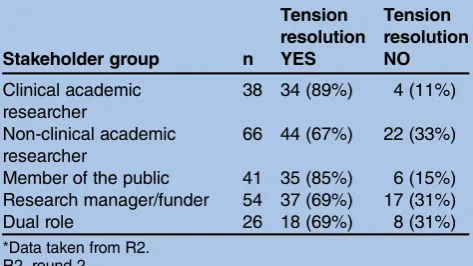
At R2, we asked panellists to comment on whether they believed these/such tensions within the arena of health and social research could be resolved. Given that tensions between the different stakeholder groups in the PI enterprise have been highlighted elsewhere,47 a somewhat unexpectedfinding from our data was critical consensus (75%) that tension resolution was possible. The percentage range across stakeholder groups was 67– 89%. Individual stakeholder group responses are out-lined intable 3.
Also unexpected was that, though tension was seen as an inevitable consequence of potential differences in perspective and/or expectations, it was not necessarily perceived as a negative issue. Rather it was seen by many as a means to stimulate critical debate.
[image:5.595.241.548.61.240.2]There should be tensions because that indicates passion; but the differences need to be managed in an open and transparent manner. [MP, R2]
[image:5.595.48.284.616.749.2]Figure 1 What kinds of knowledge should inform health and social care research? Data taken from Round 1.
Table 2 Does it matter if stakeholder groups hold views considered biased by others?*
Stakeholder group n Bias matters
Bias does not matter
Clinical academic researcher
39 23 (59%) 16 (41%)
Non-clinical academic researcher
66 32 (48%) 34 (52%)
Member of the public 41 17 (41%) 24 (59%) Research manager/funder 56 16 (29%) 40 (71%) Dual role 27 10 (37%) 17 (63%) *Data taken from R2.
Tensions are a natural consequence of different stake-holders having different priorities. To some extent the debate they lead to could be regarded as conducive to better decisions. [NCA, R2]
[image:6.595.244.549.62.210.2] [image:6.595.47.284.606.739.2]This is something to value, rather than to be concerned about! As long as those considering the various perspec-tives understand in advance that there may be differences in opinion, then there aren’t‘tensions’, just differences. [CA, R2]
…if researchers, clinicians and members of the public work together at the start of a trial, it will significantly reduce these tensions. However I also think that you can never entirely remove the tensions, and to some extent this is a good thing as the element of struggle helps to refine the research question. [MP, R2]
Once again, the need to promote values of effective partnership working—including, for example, reci-procity, communication, reflexivity and learning from each other—was seen as a key to tension resolution over time.
There was support in the panellists’ written responses at R1 for the idea that PI training for members of the public needed to not only include an overview of research design and methods but should also involve
education about political and policy context(s) which would lead to greater understanding of fundamental research drivers and processes. It was articulated by some panellists that training could also increase empowerment of members of the public, promoting and facilitating partnership working within the research team. However, panel members also reflected that this should not stop academic researchers from recognising and valuing the experiential knowledge of members of the public themselves.
Arguments relating to the why and the how of PI
There was overall critical consensus (over 70% strongly agreed/agreed) that research is more ethical when members of the public are involved at all stages of the process. However, this statement was most strongly endorsed by members of the public (94% strongly agreed/agreed) and least endorsed by clinical (67%) and non-clinical (59%) academics. There was critical con-sensus across stakeholder groups (81% strongly agreed/ agreed) that involvement is empowering for members of the public. Again, members of the public and those with multiple roles were much more likely to agree (75% strongly agreed/agreed) than were other groups (54%) that PI equalises the power between them and profes-sionals. Clear consensus was also reached (over 65% agreed strongly/agreed) in relation to the statement that PI was often a ‘tick the box’ exercise, with members of the public more likely to express disappointment at the lack of opportunity to influence the research process. Some panellists (across all stakeholder groups) suggested that involvement was still often seen as being tokenistic, with‘lip service’only paid to the issue of PI.
There is the perception that it is an inconvenient tick box exercise giving no added value and actually slowing research process down. [CA, R2]
Until researchers recognise the importance and value of public involvement, and how it can improve the quality of their research, they are likely to give it low priority. [CA, R2]
Figure 2 What are the purposes of public involvement in health and social care research? Data taken from Round 1.
Table 3 Can tensions be resolved in health and social care research?*
Stakeholder group n
Tension resolution YES
Tension resolution NO
Clinical academic researcher
38 34 (89%) 4 (11%)
Non-clinical academic researcher
66 44 (67%) 22 (33%)
Member of the public 41 35 (85%) 6 (15%) Research manager/funder 54 37 (69%) 17 (31%) Dual role 26 18 (69%) 8 (31%) *Data taken from R2.
While PI is no longer optional it can still feel like a hassle for the academic community with gains that can seem remote. That needs to change otherwise people will con-tinue being tokenistic. [NCA, R2]
Panellists voiced a number of concerns about involv-ing members of the public in the research process, including the lack of funding to involve the public in the early stages of research question and proposal devel-opment. Time pressures related to grant applications and project-specific time-lines were also highlighted as problematic, including lack of time to take account for public members’ illness and/or work commitments, the lack of realistic timeframes for reviews and, not least, the lack of time needed to develop and nurture research team relationships.
At R1, a number of panellists expressed the view that a
‘fit-for-purpose model of PI, which reflected study and social contexts, was a more appropriate way of assuring effective PI than the various ‘levels of PI’ frameworks proposed in the PI literature.48 Such frameworks were not popular with panellists, who argued that the hier-archical approach they embody to articulate different PI levels was misleading and not necessarily an indication of PI quality. The framework approach to PI was further criticised for not addressing all the facets of involve-ment, and as such having limited application and becoming potentially a driver for tokenism. Interestingly, INVOLVE49 have recently updated their guidance to refer to ‘approaches’ rather than to ‘levels’ of involve-ment and also recognises that different approaches to PI might be used within the same project.
Following these responses, we asked panellists at R2 whether, in their opinion, they felt there were any cir-cumstances where PI was inappropriate. There was crit-ical consensus among the panellists that members of the public could be involved in all/any type of research— with the caveat that PI may be more challenging within thefield of basic science research. The following obser-vation made by one panellist, a RM/funder, serves to illustrate the potential for variation in the way members of the public can be involved:
…hard to imagine a rationale for no involvement, but it will vary from project to project. One argument is often made that there shouldn’t be public involvement in pure basic biomedical research and certainly the level of involvement will be very different to that, say, of a clinical trial. But there is still potential for involvement for example in wider public debate/involvement about evaluating this type of research and making policy deci-sions about how much money to invest in this type of research than more applied research. Some scientific projects may require human samples and there is a role for the public in the governance issues around this type of research—or motivating others to donate tissue etc. I have come across some aspects of clinical trials where, for example, two different scales for measuring depres-sion were compared—a very technical and limited bit of
work—with no room for influence from public involve-ment—but this was one part of a much larger trial where there was plenty of scope for involvement. So it may not always be appropriate for public involvement to influence the design and delivery of a project if it is very technical —but there is likely to be value of involvement in other aspects of the project around governance and funding decisions and perhaps dissemination in informing people that the research is going on—and explaining the impli-cations of the research to a lay audience. [RM, Round 2]
DISCUSSION
This article reports findings from an online, modified Delphi study involving a range of stakeholder groups to explore normative, substantive and process-related values underpinning PI in health and social care research. This approach to gathering experts’ opinions and suggestions without the need to bring them
together physically proved versatile and
resource-efficient. In this study, Delphi panellists’ responses were fairly evenly balanced across the various stakeholder groups; and the response rate was, in our view, acceptable given the ‘cold call’ approach.50–52 Allowing panellists an opportunity to comment on their interpretation of the items and to express their views via open-question feedback increased the reliability of the study and improved the validity of the results.42
In the following discussion, we first consider key themes emerging from the data in relation to the nor-mative, substantive and process-related values underpin-ning PI in health and social care research; second, we highlight the potential limitations of our research approach; andfinally, we present our conclusions.
Key themes
Our findings suggest high levels of self-reported expert-ise among members of the public involved in health and social care research, regardless of little ‘formal’ educa-tion and training in PI being reported. Panellists reported that timely and appropriate training is required by members of the public to support their involvement. Similarly, panellists also articulated that other actors in the research process require training in how to engage and support members of the public in their research roles. Support strategies suggested by panellists included, for example, advice and mentoring schemes.
in the percentages endorsing the normative position that research is more ethical where there is PI through-out. Although ethical concerns are paramount in the context of health and social care research, it is interest-ing to note that the two stakeholder groups least likely to endorse the importance of PI to ensure that research probity were CA and NCA. There was also disagreement about the extent to which PI was seen as equalising power between the public and professionals, and about the substantive issues around potential stakeholder group bias and representativeness. These concerns about the lack of representativeness of members of the public who participate in PI in research initiatives have preoccupied the PI community for some considerable time53 54 and it has been argued that lack of clarity about these concepts has led to PI being devalued.53 That it remains a focus of concern to our panellists high-lights the need for a more sustained debate around the nature of ‘representativeness’ and about implementing involvement that is meaningful and appropriate.
Most health and social care research areas, including preclinical, were deemed appropriate for PI, with many panellists articulating their views about how and when it might be feasible to introduce and evaluate involvement. This reflects recent changes in commitment by the UK funding bodies in incorporating PI across all research designs and at all stages of the research process.5 Assessments about the appropriateness of PI need to be viewed within the overall opportunities for members of the public to influence project-specific agendas. A recent review of case studies conducted by Booteet al47
highlighted potential tensions between different stake-holder groups involved in PI. However, in our study, the potential for tension was articulated as an inevitable con-sequence of collaborative working; individuals’ agendas can be different when designing research studies. The acknowledgement and management of this standpoint was deemed essential in reconciling potential stake-holder difference. By promoting values of effective part-nership, including, for example, communication, reflexivity and learning from each other, research rela-tionships can develop over time, and tension can lessen as individuals work towards a common goal. The recog-nition that tensions are inevitable and can be used pro-ductively through questioning and discussion has also been highlighted by Abma and Widdershoven.55
It is interesting to note that although panellists recog-nised the normative debates around involving members of the public in health and social care research and acknowledged significant progress in doing so, they also reported shortcomings in process and substantive-related issues around the practice of PI in research, not least of which is the need for quality standards where involve-ment is embedded methodologically in research study designs. Promoting and evaluating PI as ‘normalised’ research practice was seen as a key in strengthening the evidence base around PI, which in turn, it was argued, would reduce the practice of tokenism.
Delphi study limitations
In this study, we chose to adopt a modified Delphi approach for data collection. This involved the use of
fixed choice and open questions in order to try to maxi-mise our understanding of the issues under consider-ation. As with all survey approaches, there are inevitably limitations to the depth of the data obtained; and it could be important to follow-up key issues using more in-depth approaches, which would allow for more detailed exploration of less well understood and articu-lated issues.
Although Delphi techniques vary, face-to-face contact with participants at R1 has been found useful in increas-ing the response rate.28 However, due to the size of our sample, many of the panellists were targeted ‘cold’ without any prior notice. This approach may have had an impact on our response rate at R1. The use of remin-ders is generally endorsed in texts on survey methods,56 and in line with Peterson et al,57 two reminder cover letters were emailed to non-responding participants at R1 and R2 of the survey to stimulate additional responses.
That our response rate to R1 was low was unsurprising given our approach; however, it was encouraging that a large percentage of responders to R1 subsequently com-pleted R2. The Delphi technique requires continued commitment from participants throughout the data col-lection process. Consideration must be given to the fact that individual time constraints and lack of familiarity with the Delphi technique may have prevented some participants from being able to make such a commit-ment. Nonetheless, the quality of the responses provided made clear that those who did take part were firmly committed to offering us detailed and extremely thoughtful answers to our questions.
overly optimistic picture. This needs to be borne in mind when interpreting thefindings.
CONCLUSIONS
This study has identified a number of key issues around PI implementation, in relation to the different weight-ings given by different stakeholder groups to the values around PI, and the resultant potential for conflict. This study serves as one of the few attempts to empirically gauge the views of key stakeholders on these issues. The
findings suggest that there is not only a large degree of consensus across many of these issues, but also a healthy level of debate in some important areas. While acknow-ledging the problem of representativeness of our panel-lists, we feel that this Delphi survey provides us with important insight into the views of this group of PI experts.
Our findings also support the conclusion of Boote
et al58 that there is a need for best practice standards regarding PI, which research teams can follow when seeking to involve members of the public in the research process. The aim of the wider MRC research within which this Delphi study sits was to develop and pilot guidance to support assessment of the impacts of PI and to produce draft of the best practice standards. Findings from our modified Delphi study about commonly held PI values and about assessment of PI impacts (the latter is the subject of a separate article) have contributed to this wider work by identifying areas where conflict is likely to arise and suggesting ways such conflict can be negotiated so the PI agenda can move forward meaningfully.
Author affiliations
1Department of Public Health and Policy, University of Liverpool, Liverpool,
UK
2Medicines for Children Research Network, University of Liverpool, Liverpool,
UK
3University of Liverpool, Liverpool, UK
4Division of Health Research, Lancaster University, Lancaster, UK 5Institute for Health Research, Exeter Medical School, Exeter, UK
AcknowledgementsThe authors of this article are members of Public Involvement Impact Assessment Framework research team, which involves researchers at the Universities of Lancaster, Exeter and Liverpool. Other members of the PiiAF team who contributed to the Delphi Study were: Felix Gradinger, Elaine Hewis, Tim Rawcliffe and Paula Williamson. Gradinger reviewed and commented on the survey questionnaires in light of the literature review, he conducted as part of the wider MRC Study; Hewis and Rawcliffe took part in the expert workshops; Williamson contributed statistical expertise, including on the definition of consensus. The authors would also like to acknowledge the valuable input of the members of the Public Advisory Group connected to this study: Bert Green, Faith Harris-Golesworthy, Dina Lew, Irene McGill, Nigel Pyart; and members of the Advisory Network. They are indebted to all those who took part in the Delphi study and wish to thank participants for their time and insight.
Contributors DS was responsible for day-to-day management of the Delphi study, the qualitative data analysis and the drafting of the manuscript. JK was responsible for management and analysis of the quantitative data. JPr assisted in the expert workshops, in development of the survey
questionnaires and commented on the manuscript. JP and NB contributed to
the conceptual development of the Delphi study and commented on the manuscript. MC, KF, FL and KW all commented on the survey documents and the manuscript. AG assisted with the expert workshops, in development of the questionnaires and commented on the manuscript. AJ had responsibility for the overall conceptual and methodological development of the Delphi study, supervision of DS and drafting/finalising of the manuscript.
Funding The study was supported by the Medical Research Council’s Methodology Research Programme [G0902155/93948]
Competing interests JP was a member of the MRC Methodology Research Programme at the time this grant was awarded.
Ethics approval University of Liverpool Research Ethics Committee.
Provenance and peer review Not commissioned; externally peer reviewed.
Data sharing statement Exploring the scope for making the anonymised data files are available from the corresponding author at the University of Liverpool, which would provide a permanent, citable and open access home for the dataset.
Open Access This is an Open Access article distributed in accordance with the terms of the Creative Commons Attribution (CC BY 3.0) license, which permits others to distribute, remix, adapt and build upon this work, for commercial use, provided the original work is properly cited. See: http:// creativecommons.org/licenses/by/3.0/
REFERENCES
1. Patient-Centred Outcomes Research Institute (PCORI).
Patient-Centred Outcomes Research, University of Pittsburgh. http:// www.pcori.org/research-we-support/pcor (accessed 26 Nov 2013). 2. University of Western Australia. Consumer and Community Participation
Policy. http://www.sph.uwa.edu.au/ (accessed 26 Nov 13). 3. McKenzie A, Hanley B.Consumer and Community Participation in
Health and Medical Research. A practical guide for health and medical research organisations. Australia: University of Western Australia and Telethon Institute for Child Health Research, 2009. 4. Department of Health.Research Governance Framework for Health
and Social Care. 2nd edn. London: Department of Health, 2005. 5. National Institute for Health Research (NIHR). Patients and Public.
http://www.crncc.nihr.ac.uk/PI (accessed 18 Jun 2012).
6. Beresford P. User Involvement in research and evaluation: liberation or regulation?Soc Policy Soc2002;1:95–105.
7. Beresford P. User Involvement in research: exploring the challenges.
Nurs Times Res2003;8:36–46.
8. Popay J, Attree P, Hornby D,et al.Community engagement to address the wider social determinants of health: a review of evidence on impact, experience and process. London: NICE, 2007. http://www.nice.org.uk/guidance/index.jsp?action=folder&o=34709 (accessed on 18 Jun 2012).
9. Wyatt K, Carter M, Mahtani V,et al. The impact of consumer involvement in research: an evaluation of consumer involvement in the London Primary Care Studies Programme.Fam Pract
2008;25:154–61.
10. Caron-Flinterman JF, Broerse JEW, Teerling J,et al. Patients’ priorities concerning health research: the case of asthma and COPD research in the Netherlands.Health Expect2005;8:253–63. 11. Wright DNM, Corner JL, Hopkinson JB,et al. The case for user
involvement in research: the research priorities of cancer patients.
Breast Cancer Res2007;9(Suppl 2):S3.
12. Marsden J, Bradburn J. Patient and clinician collaboration in the design of a national randomised breast cancer trial.Health Expect
2004;7:6–17.
13. Hewlett S, de Wit M, Richards P,et al. Patients and professionals as research partners: challenges, practicalities, and benefits.Arthritis Rheum2006;55;676–80.
14. Minogue V, Boness J, Brown A,et al. The impact of service user involvement in research.Int J Health Care Qual Assur2005; 18:103–12.
15. Boote J, Telford R, Cooper C. Consumer involvement in health research: a review and research agenda.Health Policy
2002;61:213–36.
16. Staley K.Exploring impact: PI in NHS, public health and social care research. Eastleigh: INVOLVE, 2009.
17. Barber R, Boote JD, Parry GD,et al. Can the impact of PI on research be evaluated? A mixed methods study.Health Expect
18. Staniszewska S, Brett J, Mockford C,et al. The GRIPP checklist: strengthening the quality of patient and PI reporting in research.Int J Technol Assess Health Care2011;27:391–9.
19. Entwistle VA, Renfrew MJ, Yearley S,et al. Lay perspectives: advantages for health researchers.BMJ1998;316:463–6. 20. Oliver S, Milne R, Bradburn J,et al. Investigating consumer
perspectives on evaluating health technologies.Evaluation
2001;7:468.
21. Oliver SR, Rees RW, Clarke-Jones L,et al. A multidimensional conceptual framework for analysing public involvement in health services research.Health Expect2008;11:72–84.
22. Gradinger F, Britten N, Wyatt K,et al. Values associated with public involvement in health and social care research.Health Expect2013; in press. doi:10.1111/hex.12158
23. INVOLVE. INVOLVE Strategy, 2012–2015.Putting people first in research. Eastleigh: INVOLVE, 2012. http://www.invo.org.uk (accessed 18 Jun 2012).
24. Duffield C. The Delphi technique: a comparison of results obtained using two expert panels.Int J Nurs Stud1993;30:227–37. 25. Hatton JM, Nunnelee JD. Research priorities of vascular nursing.
J Vasc Nurs1995;13:1–7.
26. Dalkey N, Helmer O. Delphi technique: characteristics and sequence model to the use of experts.Manag Sci1963;9:458–67.
27. Gallagher M, Hares T, Spencer J,et al. The nominal group technique: a research tool for general practice.Fam Pract
1993;10:76–81.
28. McKenna HP. The Delphi technique: a worthwhile approach for nursing?J Adv Nurs1994;19:1221–5.
29. Crisp J, Pelletier D, Duffield C,et al. The Delphi method?Nurs Res
1997;46:116–18.
30. Hassen F, Keeney S, McKenna H. Research guidelines for the Delphi survey technique.J Adv Nurs2000;32:1008–15. 31. Jones J, Hunter D. Consensus methods for medical and health
services research.BMJ1995;311:276–380.
32. Walker A, Selfe J. The Delphi method: a useful tool for the allied health researcher.Br J Ther Rehabil1996;3:677–81.
33. Keeney S, Hassona F, McKennab HP. A critical review of the Delphi technique as a research methodology for nursing.Int J Nurs Stud
2001;38:195–200.
34. Campbell SM, Braspenning J, Hutchinson A,et al. Research methods used in developing and applying quality indicators in primary care.Qual Saf Health2002;11:358–64.
35. Daykin N, Sanidas M, Barley V,et al. Developing consensus and interprofessional working in cancer services: the case of user involvement.J Interprof Care2002;16:405–6.
36. Shield T, Campbell S, Rogers A,et al. Quality indicators for mental health care in primary care.Qual Saf Health2003;12:100–6. 37. Boote J, Barber R, Cooper C. Principles and indicators of successful
consumer involvement in NHS research: results of a Delphi study and subgroup analysis.Health Policy2006;75:280–97.
38. Efstathiou N, Ameen J, Coll AM. A Delphi study to identify healthcare users’priorities for cancer care in Greece.Eur J Oncol Nurs2008;12:262–371.
39. Lynn MR, Layman EL, Englebardt SP. Nursing administration research priorities: a National Delphi Study.J Nurs Adm
1998;28:7–11.
40. Linstone HA, Turoff M, eds.The Delphi method: techniques and applications. Reading, MA: Addison-Wesley, 1975.
41. Sackman H.Delphi Critique. Lexington, MA: Lexington Books, 1975. 42. McDonnell J, Meijler A, Kahan JP,et al. Panellist consistency in the
assessment of medical appropriateness.Health Policy
1996;37:139–52.
43. Hardy DJ, O’Brien AP, Gaskin CJ,et al. Practical application of the Delphi technique in a bicultural mental health nursing study in New ZealandJ Adv Nurs2004;46:95–109.
44. Lemmer B. Successive surveys of an expert panel: research in decision making with health visitors.J Adv Nurs1998;27:538–45. 45. Green B, Jones M, Hughes D,et al. Applying the Delphi technique
in a study of GP’s information requirement.Health Social Care Community1999;7:198–205.
46. Richie J, Spencer L. Qualitative data analysis for applied policy research. In: Bryman A, Burgess RG. edsAnalysis Qualitative Data. London: Routledge, 1994:173–94.
47. Boote J, Baird W, Beecroft C. Public involvement in the design stage of primary health research: a narrative review of case examples.
Health Policy2010;95:10–23.
48. Hanley B, Bradburn J, Barnes M,et al.Involving the public in NHS, public health and social care research: briefing notes for
researchers. 2nd edn. Eastleigh: INVOLVE, 2004.
49. INVOLVE.Briefing notes for researchers: involving the public in NHS, public health and social care research. Eastleigh: INVOLVE, 2012. http://www.invo.org.uk (accessed 8 Jul 2013).
50. Sitzia J, Wood N. Response rate in patient satisfaction research: an analysis of 210 published studies.Int J Qual Health Care
1998;10:311–17.
51. Arber S. Designing samples. In: Gilbert N, ed.Researching social life. London: SAGE Publications, 2001:68–92.
52. Edwards P, Roberts I, Clarke M,et al. Increasing response rates to postal questionnaires: systematic review.BMJ2002;324:1183. 53. Beresford P, Campbell J. Disabled people, service users, user involvement and representation.Disability Soc1994;9:315–25. 54. Morrow E, Boaz A, Brearley S,et al.Handbook of service user
involvement in nursing and health care research, Chap 2. Chichester: Wiley Blackwell, 2012:22–24.
55. Abma TA, Widdershoven GAM. Sharing stories. Narrative and dialogue in responsive nursing evaluation.Eval Health Prof
2005;28:90–109.
56. McColl E, Jacoby A, Thomas L,et al. Design and use of questionnaires: a review of best practice applicable to surveys of health service staff and patients.Health Technol Asses
2001;5:101–32.
57. Peterson RA, Albaum G, Kerin RA. A note on alternative contact strategies in mail surveys.J Market Res Soc1989;31:409–18. 58. Boote J, Baird W, Sutton A. Public involvement in the systematic
research: a modified Delphi study
involvement in health and social care
around values underpinning public
Exploring areas of consensus and conflict
A Gibson, F Lobban, K Wyatt and A Jacoby
D Snape, J Kirkham, J Preston, J Popay, N Britten, M Collins, K Froggatt,
doi: 10.1136/bmjopen-2013-004217
2014 4: BMJ Open
http://bmjopen.bmj.com/content/4/1/e004217
Updated information and services can be found at:
These include:
References
#BIBL
http://bmjopen.bmj.com/content/4/1/e004217
This article cites 42 articles, 3 of which you can access for free at:
Open Access
http://creativecommons.org/licenses/by/3.0/
use, provided the original work is properly cited. See:
others to distribute, remix, adapt and build upon this work, for commercial the Creative Commons Attribution (CC BY 3.0) license, which permits This is an Open Access article distributed in accordance with the terms of
service
Email alerting
box at the top right corner of the online article.
Receive free email alerts when new articles cite this article. Sign up in the
Collections
Topic
Articles on similar topics can be found in the following collections(627) Research methods
(483) Patient-centred medicine
(1551) Health services research
(684) Health policy
(743) Evidence based practice
(84) Ethics
Notes
http://group.bmj.com/group/rights-licensing/permissions
To request permissions go to:
http://journals.bmj.com/cgi/reprintform
To order reprints go to:
http://group.bmj.com/subscribe/