1 Assessing the effectiveness of interventions to support patient decision making about
breast reconstruction: A systematic review.
Author list: Nicole Paraskeva,1 Ella Guest, 1Helena Lewis-Smith, 1Diana Harcourt1.
1 Centre for Appearance Research, University of the West of England, Bristol, United
Kingdom, BS16 1QY
Corresponding author:
Nicole Paraskeva, DHealthPsy, MSc, BSc (hons)
Coldharbour Lane, BS16 1QY
Bristol, United Kingdom
2 Abstract
Background: Decision making about breast reconstruction (BR) following a diagnosis of
breast cancer, Ductal Carcinoma in Situ (DCIS), or to reduce future breast cancer risk, is
difficult and complex. This paper systematically reviews interventions aiming to support
patients facing the option of BR, and assesses their effectiveness in improving a range of
patient outcomes.
Methods: Ten databases were searched for articles published up to October 2017 that
evaluated interventions to support patient decision making about BR within controlled trials.
All included studies were assessed for methodological quality. Descriptive analyses of patient
outcomes within included studies were performed.
Results: The search yielded 3,291 articles. Eight studies met the inclusion criteria resulting in
the evaluation of seven distinct interventions (n = 1,212). Six studies were assessed to be of
weak methodological quality, with one of moderate and one of strong quality. Three out of
five interventions demonstrated a reduction in decisional conflict (ds = 0.26-0.69) and two
out of three interventions resulted in reductions in decisional regret (ds = 0.27-3.69) at
various time points. Treatment choice was altered in two of five studies. There were no
changes in patient-reported anxiety levels, whilst the impact on depression was mixed. In all
studies which reported on it, improvements in patient satisfaction and involvement in
decision making were found.
Conclusions: Few interventions are currently available. Whilst some findings are
encouraging, improvements on patient outcomes are mixed. Further research should focus on
the development and evaluation of effective interventions.
Keywords: breast reconstruction; decision making; systematic review; interventions;
effectiveness; outcome and process assessment; decision support techniques; patient
3 INTRODUCTION
Thousands of women undergo breast reconstruction (BR) following mastectomy each year,
with the aim of restoring psychosocial and health-related quality of life. Indeed, in England,
5,000 women undergo BR annually, with the numbers offered BR increasing[1]. Making a decision about BR can be difficult and complex[2]; whilst patient choice is fundamental to the delivery of healthcare, and women want to be involved in making treatment decisions [3], for many this can be challenging. Indeed, the choices regarding whether to undergo
reconstruction, and the type (e.g., implant-based, autologous) and timing (immediate,
delayed) of surgery are considerable, and the best option for each woman will depend on her
own individual preferences, goals and needs.[4]. Additionally, these decisions must be made in a relatively short timeframe following diagnosis; which is often a stressful and emotional
time [5].
Post-operative regret and dissatisfaction are common among women who have
undergone BR [1, 2, 6, 7]. Reasons include unmet expectations [8, 9], and a lack of
involvement in the decision making process [2]. Additionally, a recent systematic review found
that higher decisional regret is related to a lack of sufficient, understandable information [7].
Interventions designed to support and encourage patient decision making can help involve and
inform them, whilst managing their pre-surgical expectations [4, 10]. Such interventions can improve patient satisfaction and involvement in care [11, 12]. Certainly within the wider field of breast cancer treatment, these interventions have been found to improve decision-related
self-reported outcomes for a wide range of treatments including radiotherapy, endocrine therapy,
and chemotherapy[13].
With regard to support for BR decision making, Preminger and colleagues [14] conducted a systematic review of preoperative patient education aids for BR. They found few
4 included studies of retrospective design and student populations (without a diagnosis of breast
cancer). Further, studies evaluated interventions designed for women deciding between
mastectomy and breast conserving surgery[15, 16], rather than solely BR, thus limiting the conclusions that can be drawn in relation to women who are in the process of making a decision
about BR. Most recently, a systematic review of decision aids for patients making a decision
about treatment for early breast cancer [13] addressed all treatment decisions including surgery, endocrine therapy, chemotherapy, radiotherapy and fertility-preservation, in addition to BR.
The authors identified three papers evaluating decision aids focused on BR decision making,
one of which was a conference abstract. Given the extensive scope of the review, there was
limited information regarding the content and effectiveness of the interventions developed
specifically in relation to decisions concerning BR. It is therefore timely and important to focus
solely on interventions to support BR decision making given the growing numbers of women
who are being offered an increasing array of surgical BR options. In line with this, the aim of
this review was to assess the effectiveness of interventions designed to help women make a
decision about breast reconstruction.
METHOD
This systematic review was conducted in accordance with the Cochrane Handbook for
Systematic Reviews [17]. The search was not restricted by date or publication status, in order to reduce the likelihood of publication bias. The following databases were searched up to
October 2017; EBSCO (which includes AMED, CINAHL, ERIC, MEDLINE, PsychINFO
and PubMed), Cochrane Library, Web of Science and Wiley Online Library. A grey literature
search was conducted via Google Scholar. The following search terms with truncations were
used:(“breast reconstruction” OR “risk reducing mastectomy” OR “mastec* reconstructive
breast surgery” OR “prophylactic mastectomy” OR “oncoplastic breast surgery”) AND
self-5 help OR online) AND (option OR inform* OR collaboration OR partnership OR shar* OR
decision OR shared-decision OR engagement OR proactive OR concordance OR involve*
OR support OR “decision-support”).
After removing duplicates, the database results were screened for inclusion
sequentially by title, abstract and full-text, as illustrated in Figure 1. The reference lists of the
remaining articles were also examined manually.
6 Inclusion Criteria
Articles were included if they met all of the following criteria;
(a) Included women who were making a decision regarding BR following a diagnosis
of breast cancer or Ductal Carcinoma in Situ, or were undergoing risk reducing
mastectomy.
(b) Used an intervention to aid decision-making about BR. Any method of
intervention delivery was included (e.g., online, in person, booklet) and the
intervention could be group- or –individual- based. No restrictions were imposed
in relation to the setting, duration or the facilitator of the intervention.
(c) Were controlled trials, whereby the intervention group was compared with a group
(e.g., treatment as usual). Random allocation was not necessary.
(a) Reported the findings of a primary study or secondary analysis. Data from
reviews, qualitative and retrospective designs were excluded.
(b) Included a patient reported outcome measure. There was no restriction on the
outcome measure employed, and could include the assessment of decision making
(e.g., decisional regret), intervention-specific questions (e.g., knowledge about
BR) and psychosocial outcomes (e.g., anxiety). Only measures that compared the
outcome of the intervention group with the control group were reported.
(c) Published in English.
Data Extraction
Data was extracted by two reviewers (NP and EG) from the final sample of studies included
in the review, in line with the Cochrane Collaboration’s double-data collection and extraction
7 Methodological Quality Assessment
The methodological quality of each study was assessed independently by NP and EG using
the Quality Assessment Tool for Quantitative Studies developed by the Effective Public
Health Practice Project (EPHPP) [18]. This tool provides a standardised method of assessing
study quality, resulting in an overall methodological rating of strong, moderate, or weak, in
the following eight domains; selection bias, study design, confounders, blinding, data
collection methods, withdrawals and dropouts, and intervention. The assessment was based
on the information reported in the manuscript. Methodological quality of studies was
determined as follows:
Strong: A study that received no weak ratings.
Moderate: A study that received one weak rating.
Weak: A study that received two or more weak ratings.
Synthesis of Results
Due to the heterogeneity between studies in the methodologies and measures employed, a
meta-analytic synthesis of the data was not appropriate nor possible. Therefore, a descriptive
synthesis of the results across studies was conducted.
RESULTS
The search resulted in the inclusion of 8 studies evaluating 7 distinct interventions (2 papers
evaluated the same intervention[19, 20]). A total of 1,212 women (intervention group Mage = 47.2-56.8 years; control group Mage = 46.8-54.6 years) participated in the interventions,
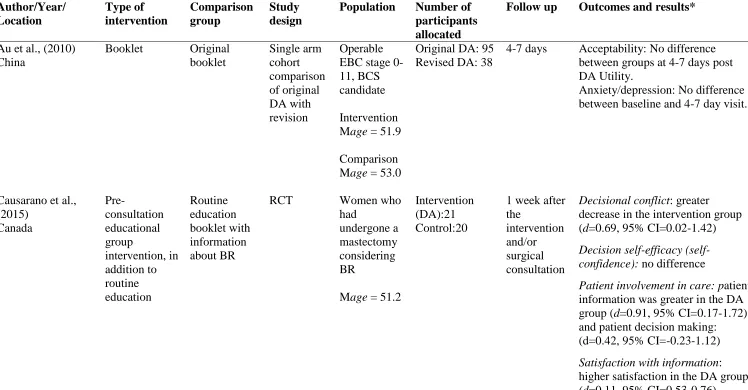
which were delivered across the USA (n=4),[20-23] China (n=2),[19, 24] Australia (n=1),[25] and Canada (n=1)[26]. All participants included women who were eligible for BR, and were either pre- or post- mastectomy at the time of recruitment. Table 1 displays information
8 Table 1: Characteristics of included studies
Author/Year/ Location Type of intervention Comparison group Study design
Population Number of participants allocated
Follow up Outcomes and results*
Au et al., (2010) China
Booklet Original
booklet Single arm cohort comparison of original DA with revision Operable EBC stage 0-11, BCS candidate
Intervention Mage = 51.9
Comparison Mage = 53.0
Original DA: 95 Revised DA: 38
4-7 days Acceptability: No difference between groups at 4-7 days post DA Utility.
Anxiety/depression: No difference between baseline and 4-7 day visit.
Causarano et al., (2015) Canada Pre-consultation educational group intervention, in addition to routine education Routine education booklet with information about BR
RCT Women who
had
undergone a mastectomy considering BR
Mage = 51.2
Intervention (DA):21 Control:20
1 week after the
intervention and/or surgical consultation
Decisional conflict: greater decrease in the intervention group (d=0.69, 95% CI=0.02-1.42)
Decision self-efficacy (self-confidence): no difference
Patient involvement in care: patient information was greater in the DA group (d=0.91, 95% CI=0.17-1.72) and patient decision making: (d=0.42, 95% CI=-0.23-1.12)
9 Treatment decision: higher proportion of patients signed informed consent to undergo BR in the DA group relative to the control (P =0.06)
Heller et al., (2008) USA
Interactive digital system
Standard patient education only (printed)
RCT EBC,
candidate for BR.
Intervention Mage = 47.2
Comparison Mage = 46.8
Intervention (DA): 66 Control: 67
1 month after surgery
Knowledge about breast
reconstruction: intervention group knowledge increased to a greater extent than control (CI 95% 1.07-11.74, p = 0.02).
Satisfaction with means of
acquiring information: intervention group 97% vs control 86% (p = 0.03).
Improved ability to choose reconstruction options: no difference
Received all necessary information: no difference
Pleased with choice of treatment: DA 95% vs control 83%.
Preoperative expectations met: no difference.
10 Lam et al., (2013)
China
As above Standard information booklet
RCT Operable
EBC stage 0-11, BCS candidate
Intervention Mage = 56.8
Comparison Mage = 54.6
Intervention (DA): 138 Control:138
1 week after the
consultation. 1, 4 and 10 months after surgery.
Decisional conflict: compared to the DA group, the control reported significantly greater conflict 1 week after the consultation (d=0.26, P= .016).
Decision regret: No difference between groups 1 month after surgery. Control reported
significantly greater decision regret 4 months (d= 0.32, P=.026) and 10 months (d=0.27, P= .014) after surgery in comparison to the DA group.
Treatment decision-making difficulty: no difference at 1 week.
Anxiety: No difference at 1, 4 and 10 months after surgery.
Depression: No difference at 1 and 4 months after surgery. Control group reported significantly greater depression at 10 months (d=0.40, P=.001).
Levels of patient knowledge: No difference.
11 Lee et al., (2010)
USA Computer-based learning module Usual care (standard surgical consultation) Non-randomised comparative cohort Immediate or delayed BR after mastectomy for EBC Intervention Mage = 48.4
Comparison Mage = 48.9
Intervention (DA): 216 Control:120 Minimum of 1 year follow up after surgery
Patient involvement in decision: greater in the intervention group (p < 0.001).
Surgical choice: intervention group more likely to choose autologous flap surgery.
Satisfaction with information: Mostly/very – intervention 91% vs control 85% (p< 0.001)
General satisfaction: no difference
Luan et al., (2016) USA Printed decision aid (including information and decisional components) Standard pre-consolation material including an informational video
RCT Patients
undergoing BR for mastectomy indicated for breast cancer. Intervention Mage = 49.3
Comparison Mage = 49.0
Intervention (DA):8 Control:8 Immediately preceding the consultation 3-5 months following surgery
Decisional conflict: no significant difference immediately preceding the consultation.
Decision regret: Less regret in the DA condition relative to the control group 3-5 months after surgery (d=3.69, p < 0.05).
Quality of life: no difference 3-5 months after surgery.
Anxiety and depression: no significant difference 3-5 months after surgery.
Manne et al., (2016) USA Online intervention (BRAID) Pamphlet with information about BR
RCT Breast cancer
patients (DCIS or stage 1,2,3 A breast Intervention (DA):31 Control:24 2 weeks following the intervention
Decisional conflict: No difference.
12 cancer) considering mastectomy. No surgery to date.
Mage = 50.2
BR intentions and decision made: No difference.
Knowledge about BR: No difference
Preparation for BR decision: No difference.
Anxiety: No difference.
Sherman et al., (2016) Australia Online interactive DA (BRECONDA) Widely available standard online information about breast reconstruction
RCT Women
diagnosed with breast cancer or DCIS advised to undergo/had already undergone a mastectomy. Intervention Mage = 52.0
Comparison Mage = 51.9
Intervention:116 Control:106
1 and 6 months after the
intervention
Decisional conflict: this was significantly lower (F = 4.01, p = 0.019) in DA group at 1 (d = 0.35) and 6 (d =0.29) month follow up.
Decision regret: No significant differences between groups at 6 months.
13 Quality of studies
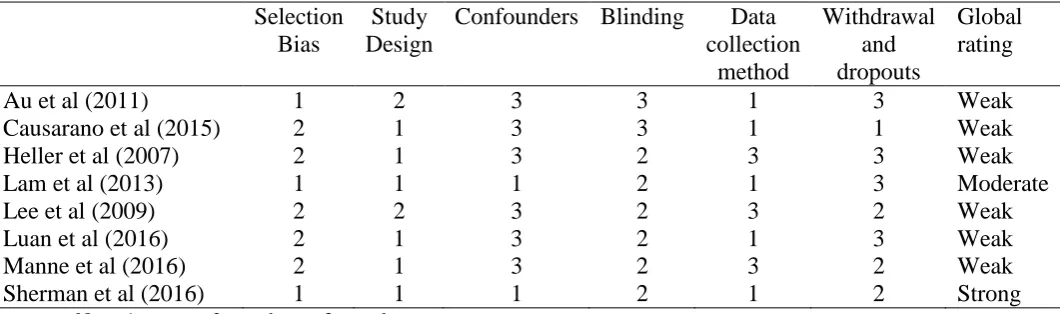
The majority of included studies (six out of eight)[19-23, 26] were assessed to be of weak quality, primarily due to a lack of reporting and controlling for potential confounding
variables (i.e. variables associated with the intervention that causally relate to the outcome,
for example, surgical complications). Furthermore, studies typically failed to blind outcome
assessors or study participants to the intervention or research question, therefore increasing
the chances of detection and reporting bias. Given the nature of the intervention under
investigation, the blinding of assessors/facilitators is particularly challenging. Only one study
was assessed as being strong,[25] and one of moderate quality [24]. The results of the
[image:13.595.34.566.396.553.2]methodological quality assessment are displayed in Table 2.
Table 2: Methodological quality of included studies assessed using the EPHPP.17
Note: 1= strong; 2= moderate; 3= weak
Intervention format and content
Four interventions were interactive, computer-based programmes [21-23, 25], two were
booklets [19, 24], one consisted of an educational group intervention24 and, finally, one was a printed decision aid [20]. The computer-based interventions were similar in format; they were
modular, self-paced, and contained a variety of written information, graphics (e.g. before and
after photos) and video clips (e.g. interviews with patients or health professionals). The Selection
Bias
Study Design
Confounders Blinding Data collection
method
Withdrawal and dropouts
Global rating
Au et al (2011) 1 2 3 3 1 3 Weak
Causarano et al (2015) 2 1 3 3 1 1 Weak
Heller et al (2007) 2 1 3 2 3 3 Weak
Lam et al (2013) 1 1 1 2 1 3 Moderate
Lee et al (2009) 2 2 3 2 3 2 Weak
Luan et al (2016) 2 1 3 2 1 3 Weak
Manne et al (2016) 2 1 3 2 3 2 Weak
14 programmes varied in duration, ranging between 20 minutes,[22] 45 minutes [25] and 74
minutes [23]. Patients who used the interactive computer program aids reported satisfaction
with this method of delivery [21, 25] and satisfaction with the information [22, 23, 25]. The
booklet [19, 24] was self-administered for use at home, and contained worksheets and
graphics to aid literacy. The educational group intervention[26] was facilitated by a range of health professionals and volunteers lasting approximately 2 hours, whilst the printed decision
aid contained worksheets and summaries [20].
The content was similar across the seven interventions. They all provided information
on BR and the various options potentially available to women. The benefits, costs/risks,
possible outcomes, and patients’ values and attitudes, were also frequently included, whilst
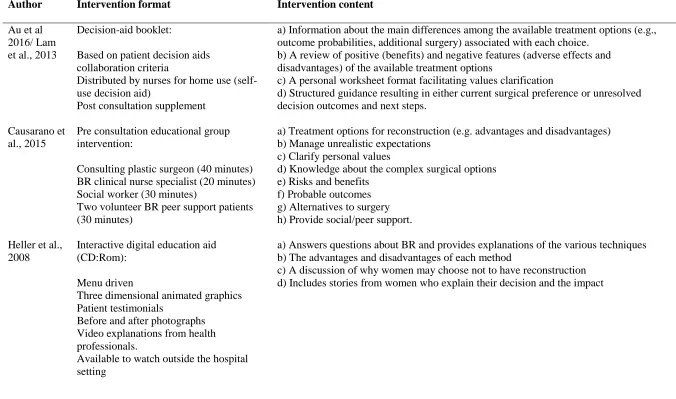
the mode, timing, and duration of delivery varied. The format and content of each
15 Table 3: The format and content of included interventions
Author Intervention format Intervention content
Au et al 2016/ Lam et al., 2013
Decision-aid booklet:
Based on patient decision aids collaboration criteria
Distributed by nurses for home use (self-use decision aid)
Post consultation supplement
a) Information about the main differences among the available treatment options (e.g., outcome probabilities, additional surgery) associated with each choice.
b) A review of positive (benefits) and negative features (adverse effects and disadvantages) of the available treatment options
c) A personal worksheet format facilitating values clarification
d) Structured guidance resulting in either current surgical preference or unresolved decision outcomes and next steps.
Causarano et al., 2015
Pre consultation educational group intervention:
Consulting plastic surgeon (40 minutes) BR clinical nurse specialist (20 minutes) Social worker (30 minutes)
Two volunteer BR peer support patients (30 minutes)
a) Treatment options for reconstruction (e.g. advantages and disadvantages) b) Manage unrealistic expectations
c) Clarify personal values
d) Knowledge about the complex surgical options e) Risks and benefits
f) Probable outcomes g) Alternatives to surgery h) Provide social/peer support. Heller et al.,
2008
Interactive digital education aid (CD:Rom):
Menu driven
Three dimensional animated graphics Patient testimonials
Before and after photographs Video explanations from health professionals.
Available to watch outside the hospital setting
a) Answers questions about BR and provides explanations of the various techniques b) The advantages and disadvantages of each method
16 Lee et al.,
2010
Computer based learning module (CD:Rom):
Written and visual information Self paced presentation format
Approximately 20 minutes to complete the module
Could be viewed in the clinic or at home prior to the consultation
a)Information about the various options b)Pertinent operative details
c)Recovery
d)Associated adverse effects e)Complications
Note; During the consultation, options were reviewed with the patient to assess their understanding. Patient’s values and preferences were gathered – formulating a treatment plan together.
Luan et al., 2016
Printed decision aid: Bright graphics Worksheets Summaries Questions
Distributed 1 week before the initial consultation to review the material before the clinic visit
Informational and decisional components:
a) Information regarding BR surgery and most common options (e.g. anticipated pain or length of hospital stay)
b) Comparison of BR options (e.g. level of activity after surgery, chance of needing revision surgery)
c) Decisional component (e.g., rate importance of various values and/or factors)
Manne et al., 2016
Online intervention (BRAID): Menu driven
10 modules Self-paced Video clips Patient narratives Voice narrated modules Illustrations
Approximately 74 minutes to complete
a) Introductory tour of the site
b) BR overview (e.g., timing of BR, post-mastectomy options)
c) Information specific to implants (including possible complications, pros and cons, outcomes etc.)
d) Information specific to abdominal tissue procedures (including possible complications, pros and cons, outcomes etc.)
e) Information specific to back tissue procedures (including possible complications, pros and cons, outcomes etc.)
f) No reconstruction (reasons, prosthetic options) g) Nipple and areola reconstruction
h) Women’s stories (include reasons for different types of reconstruction) i) Values and attitudes (towards reconstruction)
17 Sherman et
al., 2016
Online interactive module (BRECONDA) Menu driven
Modular Self-paced Videos
Basic information plus optional components with more detail 45 minutes on average
Participants had access to the website for 6 months
a) Introduction: description of BR and who is eligible for it b) Making decisions; overview of BRECONDA content c) Hints for making a decision
d) What reconstructive choices do I have? (e.g., eligibility criteria) e) When can I have reconstruction? (immediate versus delayed) f) What to expect (e.g. recovery time)
g) What else to know before making a decision (e.g., advantages and disadvantages) h) What might go wrong (e.g., potential complications)
i) Feelings (e.g. strategies for managing emotions related to reconstruction decision j) Family issues (e.g. strategies for communication)
k) Others stories (e.g. patient experiences)
18 Intervention effectiveness
An intervention was considered effective if a significant improvement or reduction was found
among the intervention group, in comparison to the control group, on any given
patient-reported outcome. Where possible, Cohen’s d effect sizes were calculated by dividing the
difference between group means by the pooled standard deviation [27]. The outcomes
employed in the studies are examined below.
Decisional conflict
Five studies assessed decisional conflict using the validated 16-item Decisional Conflict
Scale [28], defined as ‘uncertainty about which course of action to take when choice among
competing options involves risk, loss, regret, or challenge to personal life values’[28]. Three out of five interventions using this outcome found a reduction in decisional conflict in the
intervention group relative to the control group [24-26]. Specifically, lower levels of
decisional conflict were found at 1 week (d = 0.2622; d = 0.69) [26], 1 month (d = 0.35)[25] and 6 months (d = 0.29)[25] post-intervention. Conversely, two studies found no difference
in decisional conflict between the intervention and control groups at 2 weeks or 3-5 months
[20, 23].
Decisional regret
Decisional regret is typically described as ‘remorse or distress after a (health care)
decision’[29]. Three studies examined this outcome using the validated 5-item Decision Regret
Scale [29]. Whilst Sherman and colleagues[25] found no group differences in self-reported regret at 6 months, Lam et al (2013) and Luan et al (2016) found significantly reduced
decisional regret in the intervention group compared to the control group at 4 months (d =
19 Treatment choice and decision making
Two of the five studies that used treatment choice as an outcome measure reported changes in
the intervention group including: an increased use of flap-based reconstruction surgery [22]
and fewer women opting to undergo breast reconstruction [26]. Conversely, two studies
found no difference in the numbers of women deciding to have breast reconstruction.[23, 24]. Similarly, no difference in reconstruction rate between groups at 1 or 6 months was found
[25].
No differences were found between groups regarding treatment decision making
difficulty [24] or decision self-efficacy [26]. Furthermore, no differences were found between
the groups when examining women’s ability to choose reconstruction[21] their satisfaction
with the preparation for BR and for the BR decision [23].
The subsequent section describes the range of items used to assess outcomes specific
to the intervention. For example, knowledge about BR, satisfaction with information, and
involvement in decision making. The outcomes examined and measures used varied between
studies, with minimal standardisation:
Patient satisfaction with information provision
Three studies assessed patients’ satisfaction with information provision using a measure
adapted from previous research [25], a measure developed by the authors [22], and
Causarano and colleagues [26] used the BREAST-Q [30]. All 3 studies [22, 25, 26] found greater satisfaction with information provision in the intervention groups. Specifically,
20 [25] and 6 month (d=0.27) [25] follow-up, the educational group at 1 week post-intervention (d
= 0.91)[26], and the computer based learning module[22] at follow up of less than a year.
Patient-perceived involvement in decision making
The two studies [22, 26] that examined patients’ perceived involvement in decision making
reported greater involvement in the intervention groups, assessed using a measure developed
by the authors[22] and Causarano and colleagues[26] used the Modified-Patient perceived Involvement in Care Scale (M-PICS) [30].
BR knowledge
Regarding knowledge concerning BR, one study[21] found that self-reported knowledge increased in the intervention group using a 12-item measure (developed by the authors),
whereas two studies[23, 24] reported no differences in knowledge between the groups.
Finally, no difference in general satisfaction[22], quality of life [20] or meeting pre-operative expectations[21] were found between intervention and control groups.
Anxiety and Depression
Across the five studies which examined anxiety, four [19, 20, 23, 24] employed the Hospital
Anxiety and Depression Scale [31], whilst one [21] used the Spielberger State and Trait Anxiety Inventory for Adults short form [32]. There were no significant differences [19-21,
23, 24]. This holds true across a range of time points, including 4-7 days[20] and 10 months after surgery [24]. Fewer studies examined postoperative levels of depression (as measured
21 groups whereas another[24] found that depression scores were significantly lower among women in the intervention versus the control group 10 months following surgery (d = 0.40).
DISCUSSION
A systematic review of interventions designed to support women making a decision about BR
was conducted, with the purpose of assessing their effectiveness in improving patient
outcomes. Overall, the impact of the evaluated interventions were mixed. Three out of five
interventions demonstrated a reduction in decisional conflict,[24-26] and two of three showed reductions in decisional regret [20, 24]; these attained small to large effects. Treatment choice
had changed in two [22, 26] of the five studies that reported this outcome. Whilst
participation in the decision making appeared to have no effect on anxiety levels [19, 20, 23,
24], the impact on self-reported levels of depression were mixed [20, 24]. In all studies which
reported on it, improvements in patient satisfaction and involvement in decision making were
found [22, 25, 26]. However, there were mixed results for improvements in knowledge,
decision making, and general satisfaction/quality of life [20-24].
The identified improvements in decisional conflict are promising, given that high
levels of decisional conflict are related to poorer outcomes among women in the long term
[33]. The three interventions which found a reduction in decisional conflict varied in terms of
format, implying that no one single format is indicated for recommendation. Interestingly,
the content of those interventions that were found to be effective in reducing decisional
conflict and those that were not, were very similar (e.g., they all included clarifying patients’
values). However, the studies which found no differences in decisional conflict were of weak
methodology and had small sample sizes, potentially limiting the power necessary to detect
22 Previous research has identified considerably high levels of decisional regret among
women who have undergone BR [6]. It is therefore encouraging that two interventions [20,
24] successfully reduced decisional regret with medium to large effects. It is, however, likely
that levels of decisional regret change over time. Indeed, the final results (e.g. the aesthetic
outcome) of BR are unlikely to be evident for some time following surgery and women may
still be recovering or undergoing additional reconstructive or further procedures at the point
of follow-up data collection [25].
Consequently, the relatively short (i.e., <12 months) follow up times across the
studies could help to explain the mixed findings in relation to decisional regret, but also those
relating to quality of life and general satisfaction. It is therefore crucial that future studies
measure both short and longer term follow up given the lengthy recovery process [24].
The findings pertaining to BR knowledge and decision making were generally mixed.
A possible reason for this is the considerable variety in the measures used. The majority of
authors developed their own measure or adapted questions from previous research, limiting
the ability to identify group differences (i.e. a lack of sensitivity) or to compare outcomes
across studies. Indeed, the lack of consistent and validated measures coupled with different
follow up points across the included studies could, in part, explain the mixed findings.
Further, unlike other decisions concerning breast cancer treatment, decisions about BR are
often distinct, because women may have more time to consider their options and seek
information [13]. Women may already possess high levels of knowledge concerning BR and
a desired treatment choice prior to the intervention.
In line with previous studies examining the impact of decision aids on breast cancer
surgery more widely [16, 34], this review found that the interventions did not influence
post-surgical anxiety. This is important, given the concern that shared decision making can
23 to help women make a decision about BR do not remove the anxiety experienced at such a
difficult time. There were however mixed results for depression which warrants further
exploration.
In addition to the points addressed above (i.e., the need for longer follow up times and use of
validated measures), there are several other methodological issues worth noting. First, the
vast majority of interventions outlined in this review were developed for, and tested with,
women from resource-rich countries (i.e., USA), which restricts the ability to generalise the
utility of these interventions to women from resource-poor countries or backgrounds. Further,
women’s preferences for, and decisions about, breast cancer treatment and BR, in addition to
their ability to engage with decision aids, may be impacted by cultural and personal values
[24]. Whilst decision aids have been developed for patients with low literacy or from particular
ethnic groups [36], to date, these interventions do not focus on the decision regarding BR.
Further research must consider women’s literacy levels (for example, those with limited
proficiency in English), culture, socio-economic and ethnic backgrounds.
Second, a woman’s outcome is likely to depend on numerous factors including those
related to the surgery (e.g., complications), the patient (e.g., coping skills), in addition to the
pre-surgical intervention designed to support decision making. Future research could benefit
from measuring potential confounding or moderating factors that may play a powerful role in
the decision making process and beyond, for example, partner and family involvement and
support.
Third, although information concerning the format and content of the included
interventions was provided, information regarding adherence to the intervention was largely
24 providing insight in to how the interventions are being used in ‘real life’ settings. Further, this
information may help to identify what components within the intervention drive any potential
benefits.
Another consideration is that the interventions included within this systematic review are
generally focussed on information specific to the procedure and treatment options available to
patients. However, they largely neglect the psychosocial aspects of breast reconstruction, and
the impact it can have on the lives of individual patients. For this reason, future interventions
should enable health professionals to tailor the information they give to the needs of each
woman [37], incorporating clinical features which are specific to each patient, and giving
attention to their personal motivations and preferences [5]. This may enhance the shared
decision-making process, by enabling health professionals to manage their patients’
expectations and better meet their individual needs [38].
Finally, future research would benefit from including a cost utility analysis to
compare the cost of implementing the intervention in comparison to treatment as usual. In
this review, the booklet developed by Lam and colleagues[24] was distributed as a post
consultation supplement, therefore not prolonging consultations or increasing workloads with
encouraging benefits to women whereas the educational group intervention was
resource-intensive, with multiple stakeholders (e.g., nurses, surgeons) facilitating the intervention with
similar benefits. Given the limited resources (i.e., time and cost) within the health service, it
is important to consider the cost of implementing such interventions and to weigh the benefits
with any additional costs.
On a positive note, ongoing developments in this field mean that preliminary evaluations of
new interventions to support patient decision about breast reconstruction have been published
since our review was conducted. For example PEGASUS [38] (Patients’ Expectations and
25 to support shared decision-making by helping patients to clarify their motivations for surgery
and to share these with their surgical team in discussions that are centred around physical and
psychosocial goals, expectations and possible outcomes of immediate or delayed breast
reconstruction of any sort. This intervention is currently being evaluated in a multi-centre
controlled trial [38]. Furthermore, Metcalfe et al. (2018) [39] have developed a decision aid
for women contemplating delayed breast reconstruction. Studies have found their decision aid
to be both acceptable and feasible, and a small (n = 26) uncontrolled pre-test post-test
evaluation showed reduced decisional conflict and increased knowledge about the procedure
[39].
Conclusion
To date, there are few interventions available to women making a decision about BR. Whilst
the impact of these interventions on patient outcomes are generally mixed, a handful have
shown encouraging effects, whereby reductions in decisional conflict and regret have been
found. However, research developing and evaluating interventions designed to help women
make a choice about BR is in its infancy. Consequently, it is too premature to recommend
certain interventions over others. Further evaluation is required. Going forward, more
research is needed to focus on the rigorous development and evaluation of effective
interventions which aim to support patients facing the option of BR.
Funding
NP and DH are supported by Breast Cancer Now (grant no: 2014NovPR415).
Conflict of interest
26 References
1. Jeevan, R., et al., National mastectomy and breast reconstruction audit 2011. Fourth Annual Report, 2011.
2. Zhong, T., et al., Decision regret following breast reconstruction: the role of self-efficacy and
satisfaction with information in the preoperative period. Plastic and reconstructive surgery,
2013. 132(5): p. 724e-734e.
3. Degner, L.F., et al., Information needs and decisional preferences in women with breast
cancer. Jama, 1997. 277(18): p. 1485-1492.
4. Harcourt, D., et al., The acceptability of PEGASUS: an intervention to facilitate shared
decision-making with women contemplating breast reconstruction. Psychology, health &
medicine, 2016. 21(2): p. 248-253.
5. Hasak, J.M., et al., Stakeholders’ Perspectives on Postmastectomy Breast Reconstruction:
Recognizing Ways to Improve Shared Decision Making. Plastic and Reconstructive Surgery
Global Open, 2017. 5(11).
6. Sheehan, J., et al., Association of information satisfaction, psychological distress and
monitoring coping style with post‐decision regret following breast reconstruction. Psycho‐
Oncology, 2007. 16(4): p. 342-351.
7. Flitcroft, K., M. Brennan, and A. Spillane, Decisional regret and choice of breast
reconstruction following mastectomy for breast cancer: A systematic review. Psycho‐
Oncology, 2017.
8. Fang, S.-Y., L.G. Balneaves, and B.-C. Shu, " A Struggle Between Vanity and Life": The
Experience of Receiving Breast Reconstruction in Women of Taiwan. Cancer nursing, 2010. 33(5): p. E1-E11.
9. Snell, L., et al., Clarifying the expectations of patients undergoing implant breast
reconstruction: a qualitative study. Plastic and reconstructive surgery, 2010. 126(6): p. 1825.
10. O'Brien, M.A., et al., Are cancer-related decision aids effective? A systematic review and
meta-analysis. Journal of Clinical Oncology, 2009. 27(6): p. 974-985.
11. Mandelblatt, J., et al., What is the impact of shared decision making on treatment and
outcomes for older women with breast cancer? Journal of Clinical Oncology, 2006. 24(30): p.
4908-4913.
12. Janz, N.K., et al., Patient-physician concordance: preferences, perceptions, and factors
influencing the breast cancer surgical decision. Journal of clinical oncology, 2004. 22(15): p.
3091-3098.
13. Zdenkowski, N., et al., A systematic review of decision aids for patients making a decision
about treatment for early breast cancer. The Breast, 2016. 26: p. 31-45.
14. Preminger, B.A., et al., Preoperative patient education for breast reconstruction: a systematic
review of the literature. Journal of Cancer Education, 2011. 26(2): p. 270-276.
15. Goel, V., et al., Randomized trial of a patient decision aid for choice of surgical treatment for
breast cancer. Medical Decision Making, 2001. 21(1): p. 1-6.
16. Whelan, T., et al., Effect of a decision aid on knowledge and treatment decision making for
breast cancer surgery: a randomized trial. Jama, 2004. 292(4): p. 435-441.
17. Lefebvre, C., et al., Cochrane handbook for systematic reviews of interventions. Version 5.0.
2. 2009.
18. Thomas, B., et al., A process for systematically reviewing the literature: providing the
research evidence for public health nursing interventions. Worldviews on Evidence‐Based
Nursing, 2004. 1(3): p. 176-184.
19. Au, A.H., et al., Development and pilot‐testing of a Decision Aid for use among Chinese
women facing breast cancer surgery. Health Expectations, 2011. 14(4): p. 405-416.
20. Luan, A., et al., Effects of a novel decision aid for breast reconstruction: a randomized
27 21. Heller, L., et al., Interactive digital education aid in breast reconstruction. Plastic and
reconstructive surgery, 2008. 122(3): p. 717-724.
22. Lee, B.T., et al., Computer-based learning module increases shared decision making in breast
reconstruction. Annals of surgical oncology, 2010. 17(3): p. 738-743.
23. Manne, S.L., et al., Acceptability and pilot efficacy trial of a web‐based breast reconstruction
decision support aid for women considering mastectomy. Psycho‐Oncology, 2016. 25(12): p.
1424-1433.
24. Lam, W.W., et al., Reducing treatment decision conflict difficulties in breast cancer surgery: a
randomized controlled trial. Journal of Clinical Oncology, 2013. 31(23): p. 2879-2885.
25. Sherman, K.A., et al., Reducing decisional conflict and enhancing satisfaction with
information among women considering breast reconstruction following mastectomy: results from the BRECONDA randomized controlled trial. Plastic and reconstructive surgery, 2016. 138(4): p. 592e-602e.
26. Causarano, N., et al., Pre-consultation educational group intervention to improve shared
decision-making for postmastectomy breast reconstruction: a pilot randomized controlled trial. Supportive Care in Cancer, 2015. 23(5): p. 1365-1375.
27. Rosnow, R.L. and R. Rosenthal, Computing contrasts, effect sizes, and counternulls on other
people's published data: General procedures for research consumers. Psychological Methods,
1996. 1(4): p. 331.
28. O'Connor, A.M., Validation of a decisional conflict scale. Medical decision making, 1995.
15(1): p. 25-30.
29. Brehaut, J.C., et al., Validation of a decision regret scale. Medical decision making, 2003.
23(4): p. 281-292.
30. Pusic, A.L., et al., Development of a new patient-reported outcome measure for breast
surgery: the BREAST-Q. Plastic and reconstructive surgery, 2009. 124(2): p. 345-353.
31. Zigmond, A.S. and R.P. Snaith, The hospital anxiety and depression scale. Acta psychiatrica scandinavica, 1983. 67(6): p. 361-370.
32. Spielberger, C.D., R.L. Gorsuch, and R.E. Lushene, Manual for the state-trait anxiety
inventory. 1970.
33. Ben-Ezra, M. and H. Bibi, The association between psychological distress and decision regret
during armed conflict among hospital personnel. Psychiatric Quarterly, 2016. 87(3): p.
515-519.
34. Vodermaier, A., et al., How and for whom are decision aids effective? Long-term
psychological outcome of a randomized controlled trial in women with newly diagnosed breast cancer. Health Psychology, 2011. 30(1): p. 12.
35. Coulter, A., Partnerships with patients: the pros and cons of shared clinical decision-making. Journal of Health Services Research, 1997. 2(2): p. 112-121.
36. Jibaja-Weiss, M.L., et al., Entertainment education for breast cancer surgery decisions: a
randomized trial among patients with low health literacy. Patient education and counseling,
2011. 84(1): p. 41-48.
37. de Ligt, K., et al., The effect of being informed on receiving immediate breast reconstruction
in breast cancer patients. European Journal of Surgical Oncology, 2018. S0748-7983(18): p.
30275-0.
38. Harcourt, D., et al., A study protocol of the effectiveness of PEGASUS: a multi-centred study
comparing an intervention to promote shared decision making about breast reconstruction with treatment as usual. BMC medical informatics and decision making, 2017. 17(1): p. 143.
39. Metcalfe, K., et al., Development and testing of a decision aid for women considering delayed