Analysis Tool or Research Methodology:
Is there an epistemology for patterns?
Dan Dixon
Digital Cultures Research Centre University of the West of England
Introduction
Intuition and pattern recognition are, consciously or unconsciously, used across all realms of rigorous inquiry, from both hard and soft sciences to the humanities, as well as in more applied disciplines. In fact, it could almost be said to be the one common factor in all their approaches to knowledge generation. In many disciplines pattern recognition is often dismissed as merely a means of achieving inspiration or getting that first hunch along the route of inquiry. However in the digital humanities it can sometimes seem that the search for patterns can be an end in itself.
The digital humanities seem to be very concerned with patterns, and across many works the concept conflates the ideas of shape, graph, structure and repetition. Browsing through the literature, the term pattern appears, and tends to be used in a very unproblematic manner. In many cases it is used to mean a wide variety of different relationships in the data, massively dependent on the project and the researcher. They can be used to discuss the shapes that emerge in graphs, the statistical accounts of data sets, or the emergence of relationships that to that point had been unseen.
about the idea of the pattern. Especially if this is to be treated as a special epistemological concept. It is strange that given our human propensity for pattern recognition, and the continual reliance on the concept across all disciplines that we have not developed a deeper philosophical investigation of patterns themselves. This chapter is not intended to be that rigorous philosophical investigation of the idea of the pattern, but instead to present some practical perspectives on the nature of patterns, pattern recognition and the limits of knowledge that we can expect using patterns as a method of analysis. There is a massive body of work across the 20th century that is either explicitly or implicitly based on the idea of structure, relations and patterns. This is a burgeoning topic that needs attention, and this chapter can do no more then scratch the surface. It is intended to be a pragmatic attempt to raise some of the questions that would allow the use of patterns as a justifiable knowledge generation and validation technique. However many of these issues are very substantive and reach further into old questions in epistemology than even the concept of patterns do by themselves.
The main argument in this chapter is that the study and use of a particular approach to patterns has had much success in interventionist or normative types of inquiry, namely design and action research. In these situations, due to the contextual nature of the knowledge, value judgements in relationship to their utility can be made rather than abstract and generalisable truth judgements on the nature of the patterns. Based on this theoretical background, patterns can be justified as part of the process of inquiry in any type of research, but not by themselves as an ends; they are part of the process not the product.
This approach to patterns can apply across many of the clusters of practice that appear in the diverse and quite different areas or typologies of what is coming to be called digital humanities, however this idea is more relevant in some areas than others. Tara McPherson (2009) outlines three quite different areas of development of digital humanities. Firstly there is the relatively established field of humanities computing, which focuses on using computers and information technology to create tools, infrastructure, standards and collections. Then there are the blogging humanities, who use networked media and the possibilities of the internet for collaboration to undertake their projects. Finally there are what McPherson calls the multimodal humanities, which bring together scholarly tools, databases, networked writing and peer-to-peer commentary, often using the technologies and tools that they are themselves studying.
Outline
This chapter is broken down into five further sections and concludes with many open questions about the nature of patterns, their uses and how they can be justified.
The first section will briefly explore the nature of pattern recognition from a psychological perspective, focussing on a viewpoint from cognitive psychology. Our capability to find patterns is a fundamental part of our sensory and thinking processes.
Next there is brief outline of the occurrence of patterns in systems theory influenced research and I present the idea that patterns are emergent, repeated, observable, phenomena that can be used to understand the underlying systems.
Then there is a discussion of how these patterns can be located epistemologically within a continuum of knowledge creation, from scientific enquiry through to action research.
Which leads on to Charles Sander Pierce's concept of abduction and scientific process. The psychological condition of apophenia, the pathological tendency to spot patterns where there are none is presented as a contrasting principle to the useful process of abduction.
Finally an instrumental epistemology is proposed, that puts patterns in as part of the process, not the product of the process. This is supported by discussing the wider nature of scientific process and comparing it to action research, whilst asking where digital humanities projects can, or should, be located in this framework.
Psychology and patterns
Pattern recognition, or stimulus equivalence, is a fundamental capability of all animals, but is still difficult for psychology to fully explain. It is a core function of information processing and part of all our sensory stimulus. However it is not a simple phenomena and psychologists are still divided on how it functions. Although it is recognised that the entire neurophysiological and psychological pathway between sense organ and the higher brain function is involved, researchers are still split on where the most vital aspect of the process occurs (Kalat, 2009).
Currently pattern recognition is a large and active part of cognitive psychology, a theoretical approach which is very concerned with information processing. It was possibly even one of the first questions raised in this field (Juola, 1979). Cognitive psychology is also very closely linked to computer science and research on biologically-based pattern recognition is often then applied to computer-based sensory experiments and insights from computer vision are applied to human psychology experiments.
Within cognitive psychology there are two main competing theories for how pattern recognition works; template matching and feature analysis (Neisser, 2005). In template matching, the stimulus is compared to a mental model, or template, that is based on past experience and represents the shape or structure in memory. The shape is somehow held in memory as a complete, holistic, structure. This template is able to be applied even in situations where the shape has been rotated, enlarged, or transformed. In feature analysis, the visual stimulus is broken down into key features and then the relationships between these key features or pattern are compared to features in memory. Where there is a connection between similar sets of key features, a pattern is recognised.
There are two main points from this. Firstly, from the gestalt theory, that patterns and shapes are constructed from quite different visual stimuli. When we perceive, we can see similar shapes and patterns in quite different data visualisations. This means that care needs to be taken when comparing patterns across different texts, data sets and visualisations. We are very good at spotting possible patterns but not necessarily in being able to use these as objects for comparisons in and of themselves. The second point is that pattern recognition can be seen as matching the incoming visual stimuli to existing mental models. Which means we tend to see patterns and structures that we have already encountered. This means that we cannot spot patterns we haven't encountered before, and have a tendency to seek out patterns or structures that we have seen before. Possibly even see patterns where there are none; the concept of apophenia discussed below.
Much of the research carried out in pattern recognition is in the area of visual patterns because this is our richest sensory input. Much of the recent work in the field of digital humanities is in attempting to create new visualisations of existing texts, using the capabilities that computers give us to create new, transformational, representations. The role of different senses in spotting patterns in data has not been very well explored and this is an area that could be open to more explorative or playful approaches to finding new shapes and patterns in data.
Patterns and systems
influence on design and design research. Through this I propose a more formal definition of patterns based on the work of Alexander. That patterns are repeated shapes and structures which are the observable features of an underlying system. The concept of patterns recurs throughout the interlinked fields of systems theory, cybernetics, complexity, systems and information theory. Systems theory is a late 20th century concept that has had a major impact across a many disciplines, from the humanities to the hard sciences. It developed from the cybernetic thinking that emerged from the interdisciplinary Macy Conferences in the late 1940s, which included, but were not limited to, anthropologists, computer scientists, sociologists and mathematicians. However, many of the participants of these conferences had been working on these system concepts for the some time before meeting after WWII.
The common feature of all of these systems-based approaches to patterns is that repeated, physically-observable features are recognised as emergent and convergent principles that reveal underlying forces and processes.
One of the earliest discussions of patterns, in a systems theory light, appears to be from Gregory Bateson (2000)1, one of the key participants in the Macy Conferences.
During some of his wildly free wheeling classes he would sometimes pull a dead crab out of a bag and ask students to describe the structures before them. He would ask his class to think about the reasons why the crab had various forms of symmetry and similarity. Why were the pincers the same size as each other or why were the legs and pincers similar? What purpose could they deduce from looking at the structure of the crab?
In the 1940s Bateson was primarily working in the field of anthropology and was examining culture. He was working on creating structures of relationships between what he called “bits of culture” and he was looking for patterns in these structures of relationship. His approach differed from the existing symbolic and linguistic doctrine of structuralism; what he was doing might be more akin to what we would now call social network analysis. The patterns he was spotting were commonalities in relationship structures within a culture or across different cultures. Later in his multidisciplinary career he would start to look for common patterns across wildly different systems, i.e. between zoology and psychology (Bateson, 1988). These patterns are common structures that occur in the human and natural world, and are represented in various forms that cut across, or transcend academic disciplines. He called these common structures ‘meta-patterns’ and called for a ‘meta-science’ to study these. Being a truly multi-disciplinary thinker, he called for a multi or transdisciplinary approach to looking at common patterns wherever they occurred, in whatever material and in whatever discipline.
knowledge and inquiry in science and humanities (Volk, 1996, Volk et al., 2007). Although these principles are meant to apply across all disciplines they do tend to be very naturalistic and inspired by the physical world.
Examples of these Bateson/Volk meta-patterns are universal concepts that span disciplinary explanations. For example the meta-pattern spheres, where roundness occurs in a wide variety of scales and places, and where there is a tendency towards a spherical shape in three dimensional space filling networks. Thesphereis a pattern that minimises surface area by volume, has no stress points and is approached, but never perfectly reached in physical objects like stars, animal skulls or fruit. A second meta-pattern is the principle of Binaries, which features in concepts such as electrical charge, bilateral symmetry and structural linguistics. A final example are Sheets, such as leaves, flatworms and wings, which maximise surface area, can be flexible and are able to capture other matter.
Although Volk is carrying on the tradition of Bateson, he is not unique amongst ecologists. Patterns and structures in the overall system, rather than the individual objects, are the important thing for ecologists. This applies to biological ecology and also where ecological principles are applied to other fields, such as media ecology.
Ecologists focus more on dynamic systems in which one part is always multiply connected, acting by virtue of those connections, and always variable, such that it can be regarded as a pattern rather than simply as object. (Fuller, 2005)
Most recently a thread of pattern thinking has been popularised via Software Engineering and Interface Design. This can be traced back to Christopher Alexander's Timeless Way of Building (Alexander, 1979), which uses patterns as a design methodology for democratising architecture and urban planning. Alexander is a self-professed systems thinker and architect, and it is reasonable to assume that he was aware of Bateson's meta-patterns as well as Buckminster Fuller's discussion of patterns in architecture (Fuller, 2005). Contemporary uses of patterns in this tradition cover fields such as pedagogy, ubiquitous computing, mobile social software, moderation, wiki creation, computer supported co-operative work and game design (Dixon, 2009).
This balance of forces is maybe most evident in his larger scale patterns for regions and towns, for example in “city country fingers” the forces being balanced are urbanisation, the need to be near work and infrastructure, whilst wanting to be close to nature, as well as his prescient predictions about very current issues, like lowering food miles (Alexander, 1979). In the “scattered work” pattern, the forces at work are issues such as work-life balance, education, transport, noise and pollution (Alexander et al., 1978, p21). These are also apparent on a much smaller scale when he talks about the physical forces involved in “column connections” (Alexander et al., 1978, p1068) or the infrastructure demands in “duct space” (Alexander et al., 1978, p1076). Generally though, the forces are more human, like needs for sleep, work or food.
At the heart of all these pattern based approaches is a systems view of the world, and in particular one based on a complex systems approach. These complex systems of culture, mathematics or physics are inherently difficult to understand and any attempt to rigourously describe or model them will fail to capture the completeness of the system. This obviously raises many problems for academic inquiry into these areas, and especially problematic when study of these systems is intended for normative purposes or some form of timely intervention is the desired outcome.
The patterns, or recurring structures, that each of these approaches describe and catalogue are the emergent features that are easy to perceive and recognise. They are stable emergent structures of the underlying systems that all of the researchers above are actually trying to access. The pattern is a means to an end - a design tool, not the design.
The study of patterns is therefore a morphology of these structures, but not just for their own sake, but to analyse the underlying forces, the network structure or the system that is actually of primary concern. They are a means of gaining a useful, and timely understanding of a complex system through examining the evolutionary balancing of the forces that created the patterns without having to have a complete, and fundamentally impossible, understanding of the systems that self-balance those forces (Dixon, 2009).
These patterns may be multiple steps removed. Alexander catalogues the patterns of buildings to get at the systems of human habitation. The common structures of 'undesigned' houses show the physical systems of building, which reveal the social systems of human habitation. Bateson and Volk link together the various systems in the natural world, from organisms, to ecologies to astrophysics.
this natural, or partially natural, evolutionary complexity. They are the shapes that repeat themselves because they are, as Alexander would say, optimal solutions to common problems. (Alexander, 1979).
The main benefit of using patterns as a method for system understanding is that one does not have to model the overall system in any way, or create abstract interpretations. The patterns provide an intermediary stage for analysis, as well as signposted routes into the most important parts of the system. They are an empirical result, observed in situ, emerging directly from the systems being examined. Thus they can be used as a way to understand the underlying forces and processes of the system.
These patterns are not an abstraction or a model for the system. The activity of observing, collecting categorising and analysing these types of pattern is not like modelling or trying to replicate the system, it is an empirical process.
Having outlined what patterns are, here are some things they are not. They are not models of the system, they are structural representations of elements within them. They are not metaphors or analogies for emergent properties of a system, they are physically present and not re-interpreted. Neither are they maps, graphs or diagrams of an entire system, they are descriptions of emergent features of those systems. They are not created, they are documented and described.
Given that patterns are common structural elements that identify localised evolutionary sweet spots, how do we go about identifying what these structural elements should look like in new fields of study? This is easy when we think about architecture, or the physical world, but what about history, culture studies or politics? What are the tell-tale structures for those systems and how might we create software that help us surface those structures?
Epistemic orientation
The next step point is the relationship between the concept of a pattern and the way that it can be validated as a epistemic construct. Locating the digital humanities in amongst the variety of approaches to knowledge generation and reflexively understanding the forces which push it around it important.
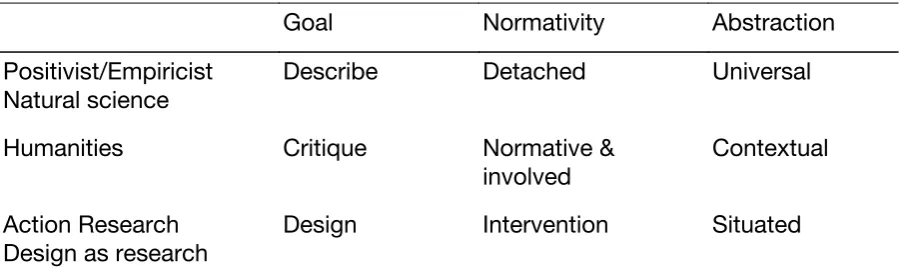
modifying the field of research. Interpretative inquiry sits somewhere in the middle, trying to make generalisable knowledge claims based on context and relativity, but always being in a position of having to make value judgements based on subjective relationship to the area of study (Aakhus and Jackson, 2005).
Table 1: Continuum of knowledge from applied to abstract
Goal Normativity Abstraction
Positivist/Empiricist Natural science
Describe Detached Universal
Humanities Critique Normative &
involved Contextual
Action Research Design as research
Design Intervention Situated
Whilst this is a gross simplification of all these areas, it does provide a platform for understanding the relationships between them and a handy way to fit research along these two scales of normativity and abstraction. This spectrum also doesn't hold up for all ways of viewing or describing these three approaches, and the epistemic basis for all three can be justified in very different ways, but it is a helpful abstraction.
An issue with the humanities computing is that researchers often appear to be dragged towards more scientific interpretations and methods for their research. This could be for the two reasons that there is a researcher bias towards these methods. Many people involved in projects are computer scientists, or those capable of working in this field. Therefore there will be those more familiar with those research methods and attracted to those modes of inquiry and the knowledge claims that one can make from those processes. The other possibility for a drift towards the scientific could be down to the nature of the tools and results themselves (Sculley and Pasanek, 2008). The production of data, the visualisation approaches and the mechanisms for their production have more in common with the hard sciences. So it is only natural that there is some possible confusion and questioning of the borderline between interpretative humanities and the descriptive and explanatory approaches of hard science (Raben, 2007).
The patterns presented by Bateson and Volk come from scientific tradition, and Bateson was surely not naively calling for a meta-science of meta-patterns. He intended meta-patterns to be studied as a science, and Volk's work, especially his position in a scientific discipline further cements the meta-patterns approach as scientific.
making actual change, rather than needing to be generalised and tested for validity on a more universal scale. The correctness of patterns is therefore within the scope of the project or activity, and needs only be valid for the participants.
As such there has been a recent growth in pattern-based inquiry based on the Alexandrian thread. His use of patterns is intentionally grounded in design, he is first and foremost an architect, and although he did publish a collection of his patterns, he claimed that they were not complete and not necessarily right2. His process of
using patterns was intended to identify a new pattern language for each project, including patterns that might be very particular for the type of building project he was working on. So a psychiatric hospital would draw on a different set of patterns than a college campus. There might be some in common, but there would also be many special cases that would apply only to that type of project. Additionally, as the process is participant driven, they were expected to research, document, analyse and use new patterns (Alexander, 1979). Thus each new project would have a contextual pattern language created and explored specifically for itself.
The other aspect of the Alexandrian method is that the patterns are not intended to be considered or used separately, they are, as he describes them, a language. Patterns in this sense are not a static set of knowledge, but instead a process; a design tool, not a design (Dixon, 2009). In this sense it is worth noting that there seem to be parallels to explore in the relationship between structuralist linguistics and Alexander's approach. However one of the key differences is that Alexandrian patterns are cataloguing the emergent physical patterns and structuralism is looking at the repetition of the underlying relationships in language.
Patterns become a tool, rather than a product of a research process. They are useful contextually within the process, and can be validated within the context of the project and against the other methods being used. There is still the problem of identifying useful and valid patterns, because not every shape or structure seen is useful or valid, and it is very easy to see patterns where there are none and end up in the realms of apophenia and numerological digressions.
This leads on to Peirce's Pragmatic framework for science and knowledge creation. This is a framework where scientific research is wrapped in a historical or genealogical framework that at a wider scale looks surprisingly similar to action research. The concept of patterns falls outside the accepted low level frameworks of scientific research, but very much the type of abductive reasoning that Peirce describes as the way ideas and inspiration are found in the natural sciences.
Abduction and apophenia
induction (Burch, 2010). Abduction is the method by which hypotheses were created or discovered, induction and deduction are the methods by which they are proven.
Abductive reasoning is, simply put, the spotting of patterns and relationships in sets of data. Pattern recognition as a process exists within the context of any form of inquiry even without specifically foregrounding the notion of patterns. Seeing patterns, or abductive reasoning, is a necessary part of the scientific or critical process and used across all disciplines. However by itself it is not valid, and patterns spotted by hunches and intuition need to be validated or the process can degenerate into mere apophenia.
Abduction was the third type of reasoning that Peirce formalised, along with deduction and induction. In deduction a premise is reached by purely logical, a priori reasoning, A therefore B, and B therefore C, leading to A therefore C. Induction is the principle of repeated testing. If B follows from A in all observed cases, then that would be a good theory for all cases in the future.
Abductive reasoning is different in that no logical or empirical connection is required, merely spotting patterns in the data. The results of abduction however are not necessarily logically or scientifically coherent, they need to be properly tested, either deductively or inductively, or both. This three step process of abductive hypothesis forming, deductive theory construction and inductive empirical testing was the basis of Peirce's three part iterative scientific process. This process has been actively adopted by many interventionist driven processes of inquiry, which I will discuss more in the next section.
If abduction is seeing patterns where there are patterns and creating the correct interpretation, then apophenia is its natural foil. Apophenia is the experience of seeing connections and patterns where there are none and ascribing excessive meaning to these situations. This is the experience that leads to such things as conspiracy theory and numerology3. The concept, first put forward by Klaus Conrad
as a description of psychosis has become a broader description of the same experience in sane individuals (Dansey, 2008). Although working from the same principles as abduction, in that it is fitting a pattern of connections to a random set of data, the experience is one that is not validated through either deductive or inductive reasoning. In fact, in cases of mental illness the individual will stick, vehemently, to their abductive reasoning and will remain unconvinced by deductive or inductive reasoning. It is pattern recognition gone wrong, seeing only the pattern expected, no matter what data leads to it. In using patterns as a tool, or form of inquiry, it becomes the opposite of abduction. It is false hypotheses based on incorrect patterns.4
identifying the patterns is one where the data is significantly changed and, consciously or unconsciously, agency is effected on that data, then the resulting patterns also show the effects of that agency. The patterns will now be designed, not discovered; artefacts of observation. Whereas apophenia discovers anti-patterns with no validation, design can retro-engineer anti-patterns into an pre-selected normative model.
So the process of spotting, discovering or finding patterns requires both care to not break them by moulding the data to fit pre-conceptions as well as not being over-zealous in finding meaning where there is none. And in all cases being able to perform some form of deductive or inductive reasoning to validate the pattern's existence. Rather than a theory for what patterns are then, a methodology for using patterns, that fits with Peirce's three part method is what is needed.
An interventionist epistemological basis
If a robust methodology for the use of patterns in any discipline is required, and patterns have been used effectively in interventionist methodologies, then it would be sensible to examine the theory behind an established field like action research. Action research is not chosen at random, it is an area where there has been a great deal of work on justifying the techniques, results and knowledge generated. As a practice it is far removed from positivist science and regularly has had to defend its practices constantly against often antagonistic opposition. So action researchers have developed a rigourous process and epistemological stance to deal with these debates and objections.
Action research aims to contribute both to the practical concerns of peo-ple in an immediate problematic situation and to the goals of social sci-ence by joint collaboration within a mutually acceptable framework. (Rapoport, 1970)
Design research is a much more recent discipline and doesn't have the tradition of justifying itself using this kind of theoretical approach, but all forms of interventionist research could be justified using the theoretical background of action research. Through examining a research methodology like action research and contrasting it with traditional science, a starting point for an epistemology of patterns could be extrapolated and applied to both interpretative and scientific endeavours. Based on the Peircean approach we can use patterns as a formalisation of the abductive part of the process.
Action research academics in many ways do position themselves very consciously in opposition to scientific research. They describe action research as favouring:
• Action over contemplation
According to action research, positivist science has many deficiencies in generating knowledge for solving problems. The way the natural science are epistemologically constructed doesn't specifically seek to solve human problems. Action research however is intended to be a problem solving methodology. It can also base its legitimacy as a science on strong philosophical traditions that are different from traditional positivist science. The viewpoints of the following interconnected philosophies are core: Marx's praxis, hermeneutics, existentialism, pragmatism, process philosophy and phenomenology (Susman and Evered, 1978).
Marx wanted philosophy to be a practical activity and the philosopher to take a critical position in the world. His practice of philosophy is intended to change the world, and in doing that, one is also personally changed. The idea of the hermeneutic circle is that there is no knowledge without presuppositions, that interpretation is historically reshaped and different interpretations can freely co-exist. Existentialism brings individual choice, empowerment and the possibility for action to the researcher. It makes the researcher consciouly aware of their connections and involvement in the world. Phenomenology points to the importance of the immediate subjective experience rather than distant objective science. That our experience, viewpoint and understandings as human beings is as important as factical knowledge gained through abstracting away from our unique viewpoint.
Possibly most relevant for this discussion though are the historically interlinked traditions of pragmatism and process philosophy. These both present non-traditional epistemologies where knowledge can only be understood through how it comes about, not in an ahistorical and abstract manner.
Process philosophy puts things in the background and focuses on the doing of learning, understanding or researching; the practice is important not the product. The processes are complex and made up of many stages or phases, that they have a temporal element and that there is a structure or shape to them. So it is an underlying philosophy for dynamic systems, naturally supporting change over time and the concept of evolution (Rescher, 2009). Via the pragmatic philosophy of Pierce, James and Dewey, we get the iterative learning/research cycle (usually known as the Kolb cycle) and the idea that there is no ultimate positivist truth, that the truth of anything can only be judged in how useful it is contextually to the individual (Hookway, 2010).
Most of these underlying assumptions are contrary to traditional science, which assumes its methods are value neutral, people are only ever objects of inquiry, eliminates the role of history in the knowledge generation process and assumes that there can be a denotative language to describe it (Susman and Evered, 1978).
are followed by deductive or inductive thinking, leading to rational and justifiable discoveries. The cycles continue with the abductive reasoning informed by previous cycles of inquiry; knowledge being built upon and inspired by rounds of abductive reasoning, intuition and the practical concerns of doing science.
What this means is that patterns can be used as a valid part of any scientific process, but not necessarily as a scientific product. Pattern recognition or a refined framework of patterns, such as Alexander's, can be used as a method to obtain inspiration and point the researcher in new directions. In this case it is easy to justify the use of patterns as part of this cycle rather than a output of the process, as say, a scientific fact might be an output. They have a validity and a usefulness within the context of the scientific inquiry but cannot be abstractly justified outside that process.
So far the discussion in this section has been concerned with linking scientific research to action research. The two ends of the spectrum of normativity and abstraction presented in table 1. Partly, this is because the literature seeks to show the relationship and linkages between action research's very practical, human and engaged research and the objective, distanced natural sciences. Partly, because through showing that this applies to scientific research, it can also be applied to the humanities, which sit within the continuum between these two seemingly opposed research epistemologies. Which leaves us able to justify the use if patterns, either as the simple recognition of shapes and structures already familiar to us, or through the more systemic approach of emergent, repeated structures.
Conclusion and further questions
This chapter is intended to raise more questions that it answers and to question the use of patterns as an epistemological object. It proposes the idea that patterns are a valid part of the process of inquiry, or a way to seek inspiration. This places the concept within the background epistemology of pragmatism, where the overall validity can be demonstrated via their usefulness. However this is an incredibly general approach and provides a very practical and pragmatic, in the usual sense of the word, approach to discussing patterns.
There is a great deal of space to develop this idea of patterns further and see if there is something more to it than just pattern recognition, abduction and intuition. Maybe there are generalisable approaches, or a methodology that can be developed. Patterns in their current uses appear to be various types of repeated structural forms. Though this does raise questions about the commonality of these forms and the relationships between them across disciplines. What are the patterns for fields such as history, media studies or linguistics? Would patterns identified in individual texts replicate, and why would they do this?
style of thinking is again fashionable or a full cyclic revolution back to the same concerns that sparked off structuralism. Perhaps the transformational tools, techniques and collaborations are now available that could give us new insights based on just such a formal approach.
Though a point worth making is that whereas structuralism was seeking to understand the hidden conceptual structures behind culture, much of the contemporary work in humanities computing is to actually make patterns in data visibly apparent through various forms of information visualisation. There is a much higher level of importance placed on visual perception, and actually seeing shapes in the data. Which begs the question of whether we are seeking patterns where none exist, or creating them ourselves through the software and information artefacts that are made as part of the research process. If the process is one where the data is massaged until either the visualisations or statistics do tell us something, are we just practising the humanities equivalent of numerology? Are we designing patterns in where none existed in the first place and is there is an unavoidable tendency towards apophenia instead of pattern recognition?
At its heart, humanities computing is about turning a text into a system (or depending on one's point of view, exposing an already existent system) and then performing new types of analysis. It is interesting that the concept and term pattern comes up in a variety of systems theory fields. The earliest problems in cybernetics and information theory were concerned with patterns, in fact their definition of information was based in pattern as opposed to randomness. Pattern recognition is important in cognitive psychology as a key problem in mental, information processing and cognitive psychology is predicted on a systems and informational model of the human mind. Now it makes its appearance in the digital humanities as a term used to describe a wide variety of interpretations of data, statistics and structure. All of these disciplines are heavily predicated on the underlying concepts of the system and information, and now the digital humanities as well because of their link to computer science and the use of digital forms of data. Patterns, information and systems are highly interlinked and heavily self referential concepts that have developed over the last 50 years.
At this point it is worth also raising the question as to the nature of these systems. How are these systems conceived, is there is a fundamental difference between patterns of connections versus patterns in emergent physical, psychological, social or political structures? The approach to patterns and systems described by both Alexander and Bateson is one based on the assumption that the underlying systems are evolutionary and not designed. If we are imposing systems on texts or archives, do we have the same kind of evolutionary context that are required to justify the emergence of patterns as systemic sweet spots?
modelling is inherently abstract and theoretical. Suppositions, strategies and connections can be made, but principally these are untestable until modelling, or experimentation can take place. When most of the systems we are talking about are either large scale, or part of very human and nonreplicable forces it means that controlled experimentation is impossible. Of course, located and normative experiments, such as those that action research routinely carry out are very possible, and are the only real option in many of these situations. Which means patterns could be a useful as a way of understanding the balances of forces or local structure, but not a method or a route to model or describe the whole underlying system.
References
Aakhus, M. & Jackson, S. (2005) ‘Technology, interaction, and design.’ Handbook of language and social interaction, Lawrence Erlbaum, 411–436.
Alexander, C. (1979) The timeless way of building. Oxford University Press, USA. Bateson, G. (1988) Mind and nature. Bantam Books, Toronto.
Bateson, G. (2000) Steps to an Ecology of Mind: Collected Essays in Anthropology, Psychiatry, Evolution and Epistemology. Chicago University Press.
Burch, R. (2010) ‘Charles Sanders Peirce’ The Stanford Encyclopedia of Philosophy
(Spring 2010 edition), Zalta, E. (ed), available: http://plato.stanford.edu/archives/ spr2010/entries/peirce/ [10 Nov 2010].
Dansey, N. (2008) ‘Facilitating Apophenia to Augment the Experience of Pervasive Games.’ Breaking the Magic Circle, University of Tampere.
Dixon, D. (2009) ‘Pattern languages for CMC Design.’ Handbook of Research on Socio-Technical Design and Social Networking Systems, 402-415.
Enns, J.T. (2005) ‘Perception, Gestalt Principles of.’ Encyclopedia of Cognitive Science, Wiley
Fuller, M. (2005) Media ecologies: Materialist energies in art and technoculture. MIT Press
Hayles, N.K. (1999) How we became posthuman: Virtual bodies in cybernetics, literature, and informatics. University of Chicago Press,
Hookway, C. (2010) ‘Pragmatism.’ The Stanford Encyclopedia of Philosophy (Spring 2010 edition), Zalta, E. (ed), available: http://plato.stanford.edu/archives/spr2010/ entries/pragmatism/ [10 Nov 2010].
Juola, J.F. (1979) Pattern Recognition. In Cognitive Psychology and Information Processing: An Introduction, (Eds, Lachman, R., Lachman, J.L. & Butterfield, E.C.) Psychology Press.
Kalat, J.W. (2009) Biological Psychology. Wadsworth Publishing Co Inc.
McPherson, T. (2009) ‘Introduction: Media Studies and the Digital Humanities.’
Cinema Journal, 48, 119-123.
Neisser, U. (2005) Pattern Recognition. In Cognitive psychology: key readings, (Ed, D. A. Balota, E.J.M.) Psychology Press.
Raben, J. (2007) ‘Introducing Issues in Humanities Computing.’ Digital Humanities Quarterly, 1.
Rapoport, R.N. (1970) ‘Three dilemmas in action research.’ Human relations, 23, 499.
Rescher, N. (2009) ‘Process Philosophy.’ The Stanford Encyclopedia of Philosophy
win2009/entries/process-philosophy/ [30 Jan 2010]
Resnik, M.D. (1999) Mathematics as a Science of Patterns. Oxford University Press Oxford.
Sculley, D. & Pasanek, B.M. (2008) ‘Meaning and mining: the impact of implicit assumptions in data mining for the humanities.’ Literary and Linguistic Computing, 23, 409.
Stephens, J., Barton, J. & Haslett, T. (2009) ‘Action Research: Its History and
Relationship to Scientific Methodology.’ Systemic Practice and Action Research, 22, 463-474.
Susman, G.I. & Evered, R.D. (1978) ‘An assessment of the scientific merits of action research.’ Administrative science quarterly, 23, 582-603.
Svensson, P. (2009) ‘Humanities Computing as Digital Humanities.’ Digital Humanities Quarterly, 3.
Volk, T., Bloom, J.W. & Richards, J. (2007) ‘Toward a science of metapatterns: building upon Bateson’s foundation.’ Kybernetes, 36, 1070-1080.
1. Steps to an Ecology of Mind was first published in 1972, but includes essays written over Bateson’s lifetime. The chapter, "Experiments in Thinking About Observed Ethnological
Material", originally a paper presented in 1940 is the first place to outline his pattern-influenced thinking.
2. In publishing his list of patterns, and also publishing it before his process, he created a de facto standard for an architectural pattern language. It would probably have been better to
communicate the process by keeping them secret and making other practitioners go through the hard work of documenting and understanding the patterns. This tends to be the problem with pattern languages, that they end up being treated as merely collections of best practice or rules for practitioners in the discipline, rather than a living, dynamic language to be consciously re-interpreted by lay participants on each new project.
3. These cultural practices based on apophenia assume the mantle of science or pseudo-science through circular reasoning and self-justification.