ON THE ENDS OF THE
NETWORK AS A ZONE OF
FRICTION (AND EXTRACTION)
APRJA Volume 9, Issue 1, 2020 ISSN 2245-7755
CC license: ‘Attribution-NonCommercial-ShareAlike’.
Abstract
In a world-order where planetary computational networks have restructured nearly all spheres of existence, what is not already networked lies in wait merely as standing-reserve. Today, it seems as if the network and the world are naturally interoperable. Thinking through Harun Farocki’s work on operational images, I however locate a zone of friction or incommensurability between the network and the world. Revisiting Norbert Wiener’s anti-aircraft predictor – a founding episode in the history of cybernetics – I show how this gap was bridged by a logic of (en)closures that reduced the living human form and the world to narrow operational ends; banishing the openness and indeterminacy of both life and nature into undesirable contingency. However, cybernetics’ relentless expansion into a universal episteme and planetary infrastructure since the Cold war necessarily floods the network with contingency; which it wards off by feeding on a disavowed living labor. I argue that this living labor is an uneasy reconciliation of mechanism and vitalism, which we may call habits. Drawing on the Marxian notion of general intellect, I posit how habits are key to generating network surplus value, and to cybernetic expansionism. Habits shape, prepare the outside for its subsumption into the network. Yet they are not given the status of productive activity, and consequently disavowed and vaporized by networks. I propose that this living labor be given a specific name – interfacing – and, following Georges Bataille’s critique of political economy, speculate on the reasons for its disavowal. Drawing on Bataille’s idea of the
general in ‘general economy’ (that which is opposed to utilitarian or operational
ends) and Hito Steyerl’s How Not to Be Seen, I try to imagine what an interface contiguous with the general intellect might be.
I. The Incommensurability
of the Network and the
World
Harun Farocki’s Eye/Machine series (2001-3) examines the deployment of intelligent weapon systems like course-correcting mis-siles during the first Gulf War, constructing a genealogy of the automated eye. Farocki shows us a series of diptychs composed of operational images – machine-readable images whose sole purpose is instrumental – sourced from the process screens and work tables of war rooms, battlefields, research laboratories, and various industries. This is often counterposed with archival footage from training and factory films, corporate ads, scientific diagrams, etc. to create a dialectical soft montage between two channels. In a way,
Eye/Machine is the culmination of Farocki’s
career-long interest in modern visual forms (diagrams, maps, cinema, video, digital images, etc.), the techniques of war, govern-ance and production, and the changing face of labor (which, in his Marxist worldview, is an expression of the very potential for a full creative life). Since Farocki traces an arc of
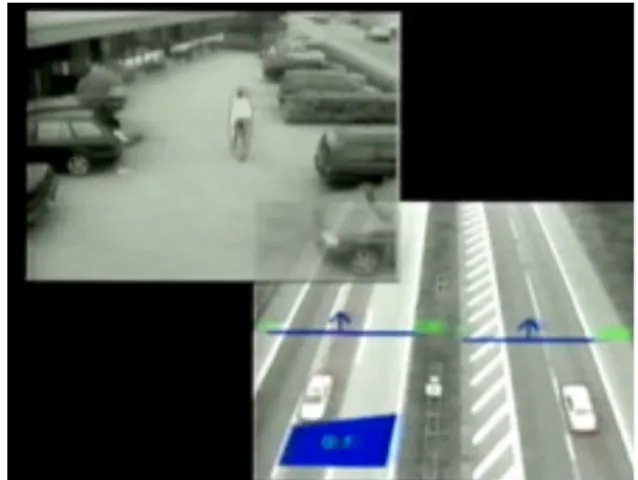
the progressive automation of all spheres of life in his oeuvre, it would seem this arc matures in a total replacement of the man in the machine. Yet, many of the operational im-ages in Eye/Machine show marks and lines in blue, red, green or yellow that laboriously trace vague patterns, often the outlines of things, on a live feed of surveillance images [Fig. 1]. We are amused as we watch these ‘stupid’ machines take inordinately long time to do banal tasks like opening a drawer or navigating a corridor. As in Henri Bergson’s essay on the comic, our amusement derives from a certain “mechanical inelasticity” of the operational image. It is not quite present in the world, like the absent-minded singer who is always reflecting on the last line he has sung while the band has moved on. The op-erational image shows no habitual elegance as it breaks down simple cognitive tasks into the smallest logical parts until a workable ‘fit’ is found. Far from taking over human intelligence confidently and rendering us useless, the AI bots and operational images solicit our amusement, which soon turns to concern and attention. We become like par-ents pouring over the school progress report of a not particularly bright child, correcting their course, helping them learn to navigate the world. Those machines require our eyes.
In 2014, Trevor Paglen wrote of his attempted update of Farocki’s Eye/Machine project:
Figure 1: Colored lines mark out and report the ‘zone of friction’ where the machine-eye recognizes patterns in the noise of the world, in Eye/Machine I-III. Courtesy: Harun Farocki Filmproduktion.
After about six months of research, I came to a rather dramatic conclusion. Increasingly, operational images are not simply alien to humans—they are literally invisible. In retrospect, there’s a kind of irony in Farocki’s Eye/
Machine. Farocki’s film is not actually a
film composed of operational images. It’s a film composed of operational images that have been configured by machines to be interpretable by humans. Machines don’t need funny animated yellow arrows and green boxes in grainy video footage to calcu-late trajectories or recognize moving bodies and objects. Those marks are for the benefit of humans—they’re meant to show humans how a machine is seeing.
My research project didn’t get very far. After scores of phone calls and emails to the laboratories and companies where operational images get made, it became clear that machines rarely even bother making the meat-eye in-terpretable versions of their operational images that we saw in Eye/Machine. There’s really no point. Meat-eyes are far too inefficient to see what’s going on anyway. (Paglen)
In a matter of a decade, the little colored marks in the operational image are gone. But if they were really as unimportant as Paglen implies, why did the eye/machines ever use them? Paglen believes that they were a ruse to maintain a humanistic illusion, a semblance of human superiority over the machine, but what then explains their later disappearance? Is the illusion of the over-seer no more required? Was it then, in the past, merely window dressing or an essential part of image-operations? If the former is true, why would the machine risk breaking
the myth of its omnipotence, allow itself to be humiliated before its human overseer? We have to account, then, for this dynamic of disappearance in/of the operational image.
The operational image differs, of course, from all other preceding types of im-ages, since it does not represent the world so much as directly act and steer it towards an operational telos. A great film, painting or photograph might move its spectator to change the world (for good or bad), but there is always an indeterminacy and unbridgeable gap between the act of creation, its reception and its after effect/influence. Such images may be shaped by the world, they might even shape the world in turn, but this relation is always open, free of total determination. Not so for the operational image. Its relation-ship with the outside is strictly instrumental, which is why – once the job is done – the operational image is completely exhausted. It becomes junk that does not warrant a ‘sec-ond reading,’ ending up often in some secret storage where it never sees the light of the day again. [Resuscitating these images, Farocki intended to show that second read-ings are possible. Operational images aren’t fully closed to interpretation and thought. No matter how small, an indeterminacy exists between action and reaction.] The operation-al image disappears the very moment when the world conforms to it, has become inter-operable for a given purpose – leaving no apparent remainder. To operational images, the world is mere standing-reserve, waiting to be operationalized (Heidegger 19-20).
The cybernetic imaginary is then all-consuming, constantly expanding its fron-tiers, since it wants to subsume the whole earth, and all of its constitutive spheres of existence, inside the machine. This dream of total subsumption is however never fulfilled; there remains always an asymptotic gap, a zone of irritability or friction. While the world is composed of technical as well as natural
and social elements, it is not by-itself gov-erned by the instrumental reason hardcoded into the network [which I understand as a machinic organization of natural, social and technical actors defined by operational logic and goal-orientedness]. The world escapes the network to some degree at every mo-ment of subsumption; even as they become increasingly intertwined. The little colored marks in Eye/Machine register this irritability or friction, even as the operational image labors to overcome this friction by finding a requisite pattern in the ‘raw data’ of the world. Keeping with transmediale 2020’s theme – End to End – I want to analyze the ends of the network as zones of friction where the outside is subsumed. The network’s ends are thresholds beyond which lie the world still unsubordinated to its computational calcu-lus. Network expansion into the world needs a particular dynamic by which this friction at its ends is overcome. As will become clear, living labor is key to this dynamic. Yet I shall argue how this is necessarily an attenuated living labor not given the status of produc-tive activity; and, as a result, condemned, unreciprocated. But first, let us historicize the question a bit.
II. Cybernetics and the
closed world
Immersed within ubiquitous planetary com-puting, it may seem difficult to imagine that the network and the world are not just non-coinciding, their relation may be incommen-surable, if not outright antagonistic. However, a summary look at the origins of cybernetics in the milieu of World War II and the Cold War allows us to see friction haunting the scene of subsumption. What the ‘origin story’ reveals is the incommensurability of the world
and the network. We find that, despite its expansionism, cybernetic imaginaries were shaped by a multi-level logic of enclosure.
Cybernetics started with a humble at-tempt to understand the nature of interaction and feedback in and between living beings and machines. The key experiment was an anti-aircraft predictor designed by Norbert Wiener’s team during World War II: an early prototype of the intelligent weapon systems that fascinated Farocki in Eye/Machine. Wiener’s task was to predict the path of an enemy fighter pilot who kept changing his trajectory anticipating ground artillery, to improve the chance of a successful hit. In a first move, Wiener assumed that all the components of the situation were ‘communi-cating’: the pilot with his plane, the gunner with his gun; even these two enemy cyborg units in their fight with each other. Yet there remained a problem since the pilot could potentially take an infinite number of routes (subject to aerodynamic and flight-hardware constraints). The problem space needed to be delimited, since approximating the flight path was more crucial than exhausting all possibilities. It turned out that the conditions of the battlefield allowed such a delimita-tion, since panic-stricken pilots facing flak, cooped up in claustrophobic metal cham-bers, experienced kinaesthetic dysphoria and behaved neurotically ‘like a machine,’ repeating the same motions over and over again (Galison 236). A pathology forcing the pilot to regress to his most unreflexive habits thereby made him programmable (and dead, if the computation and firing was done right). Closure was the very precondition – reduc-ing the complexity of the outside – by which the enemy other could be subsumed into the cybernetic machine.
This phenomenological closure, partly bracketing the outside, was doubled by one that bracketed off the inside. Blackboxing erased distinctions in kind between man,
animal and machine by treating them all as systems that adapted to a change through feedback with their environments. The old mechanism vs. vitalism debate, for which the irreducibility of life was a persistent problem, was thereby bypassed. Not that cyberneticians misrecognized differences in kind between machines and organisms. Machines were initially proposed only as heuristically simplified analogs of thinking, living organisms – their equivalence estab-lished by demonstrating that both exhibited “purposive behavior” oriented towards a goal (Bowker 110). However, by a later ‘Platonic backhand,’ analogy was transformed into ontology (Hayles 12). Organisms were re-defined as essentially machines, only with an exceptional degree of complexity and flexibility that artificial machines were not yet capable of (but would reach at some point). As Wiener’s predictor showed, however, machine and organism could be equated at first only by robbing the latter of its supple openness to the world.
In Galison’s memorable phrase, this logic of closure seeded an ‘ontology of the enemy’ into the heart of cybernetics. In game theory terms, Wiener understood the enemy pilot as an opponent who purposefully adapts to his changing situation; the challenge for the cybernetic machine was to ‘think like the enemy’ in order to pre-empt his next move. Yet, if the outside to be mapped was defined by antagonism, Wiener made a distinction between two kinds of opponents. There was the Manichean devil purposefully engaged in a battle of wits with the cybernetic machine, willing to use any trick or craft, even change the rules of the game. And there was the Augustinian, non-purposive opponent who might defeat the machine through an un-foreseen contingency, but not out of malice. Nature, Wiener argued, is Augustinian – its entropic tendency for disorder is blind to a scientist’s intention to understand it (190).
While Wiener’s predictor was directed against Manichean opponents, he opposed this assumption of Manichean malice when cybernetics was expanded from wartime research to an investigation of the world at large. Wiener’s fellow scientists, with whom he fell out because they consented to the militarization of scientific research, had put the world in the crosshairs of a target. Like hapless detectives, Wiener rued, they were looking for crime in the forces of nature (189). In transforming into the signature ‘universal science’ of the Cold war, cybernetics had become a Manichean science that (mis)read nature’s contingency as malice, privileging form and order over disorder. Cybernetics, Paul Edwards argued, was therefore not just born in a ‘closed world’ discursive milieu driv-en by Manichean anti-communist politics, its development was entangled in the project to create a “dome of global technological over-sight” in which planetary sensing-computing mechanisms were tasked with pre-empting catastrophe (1).
However, cybernetic expansion could not happen without opening onto contin-gency and error. For this, the relationship between the scientific laboratory – the quintessentially modern site where trial-and-error experiments had been sandboxed since Robert Boyle – and the world at large needed to be reconfigured. If the lab had previously been a isolating space where the noisiness of the world (including political dissensus) was excluded even as scientists worked on its aspects – a space whose secretive ac-tivities needed translation by specialists to be validated in the public sphere – cybernetics folded the lab inside out, made the world into a laboratory (Bowker 122-123). Through a strategy of ‘legitimacy exchange’ at military-industrial academic fora, experts from various sciences (physical, chemical, micro-biological, social, etc.) came to a consensus that cybernetics was best suited to deal with
complex problems of Cold war era society. As the modern successor of Adam Smith’s ‘invisible hand,’ the emergentist, spontane-ous helmsman (kubernetes) became the emblem of anti-(Soviet style) central plan-ning ethos which merged with the neoliberal deregulation of markets, the shrinking role of the state as regulator/overseer, and the progressive immaterialization of capitalism. The proof of concept – whether cybernet-ics was at all appropriate as episteme and ontology of everything – was to be sought in the very world-lab where cybernetic interven-tions were being made (ibid). As Orit Halpern has argued, the demo became the dominant mode of these interventions; which reigns still as the ideologeme of our beta-tested capital-ist times. Enshrined in Nicholas Negroponte’s adage “demo or die!,” the demo is a mode of apprehending the future which never arrives at any final form, but “hangs in an anticipa-tory, or preemptive time of anticipation for the next technical development” (Halpern 59). Demos suspend the question of how apt a cybernetic model is since every iteration looks forward to future improvements, while getting embedded in the world and remaking it. Contra Negroponte’s slogan, even death is no serious impediment to its teleology of deferred success.
For the vitalist philosopher Georges Canguilhem, laboratorization was the very “archetype of a catastrophic situation” in which “the living being [is] commanded from the outside by the milieu” (113). Because it had generalized this catastrophe, cybernetics could not discard with vitalism despite itself privileging mechanistic reduction. Perhaps, says David Bates, the cybernetic dream was always “to infuse machinic beings with the essence of life” (32). If this vitalist impetus split, on one face, into the techno-utopias of California with their dream of planetary emergent architectures – Stewart Brand’s
Whole Earth Catalog being the key node
– the other face of cybernetic investment in vitalism zeroed in on the organism’s adaptiv-ity to pathologies (cf. Turner; Franke and Diedrichsen). As vitalists like Canguilhem had stressed, living organisms faced with turbulent milieu or internal injuries show an inherent plasticity to not just “respond to changing conditions; [but] also... enter wholly new states of being, with new forms of order, and new potentials” (ibid 35). It was this quality of the living to respond to crisis that cyberneticians wanted to inculcate in machines. Wiener, for example, was deeply interested in neural plasticity, in the capac-ity of the brain to establish new norms and paths of communication even in pathological cases like Louis Pasteur’s (whose early-life stroke incapacitated half his brain without impairing his intellectual capacities) (ibid 49-50). Cybernetic systems of the future aspired to a similar resilience and adaptivity. It is no coincidence that Paul Baran drew on such a ‘plastic’ topology to propose the distributed network model, which reacts to attack on some of its nodes and edges by readjusting the lines of communication.
To sum up then, I’m arguing that the incommensurability – or antagonism, if we follow Galison’s ‘ontology of the enemy’ – be-tween the cybernetic network and the world means that the zone of subsumption of the outside into the network is prone to crisis and breakdowns. Such crises only multiply as the network expands and encompasses the whole globe, penetrating into new realms of existence and accumulating huge amounts of ‘raw data’ through constant mining – an expansion that necessarily seeds the system with error and contingency. To overcome these crises, bridge the always existing gap between network and world, cybernetic assemblages draw upon the vital plastic-ity of the living organism. This is the reason why cybernetic networks need living labor more than ever today despite disavowing
and denigrating its relation of dependence. What is however notable, if we reflect upon Wiener’s predictor experiment from the per-spective of ‘bridging the gap,’ is a particular interplay between mechanism and vitalism. If Wiener drew upon the logic of closures to reduce the living organism – the enemy pilot – to the status of an ‘unthinking automaton’ guided solely by his habits, during crisis mediation it is on the other hand the living organism’s relative plasticity that allows the network to subsume the outside. These two tendencies are not opposed to each other; they are complementary. As Wendy Chun suggests in her elegant formula “habit + crisis = update,” habit as an inertial mode of opening to contingency guarantees that the network maintains homeostasis in an updated form instead of disintegrating into something qualitatively new. Habits, I argue now, are key to the cybernetic shaping of the general intellect and therefore central to operation by which the world is subsumed into the network.
III. Habits and the generic
in General Intellect
If Farocki’s oeuvre is celebrated today largely for his essay films on technologies of ration-alization and modern visuality (cinema being one of its privileged subsets) – a genealogy of the operational image across titles like Images
of the World and the Inscription of War, As You See, Workers Leaving the Factory, up to Eye/Machine and Serious Games – there is
another unassuming series of observational videos/films running in parallel. With names like Indoctrination, Interview, and How to
Live in the FRG, these films document, like
the proverbial fly-on-the-wall, small groups of people in test-situations rehearsing for the
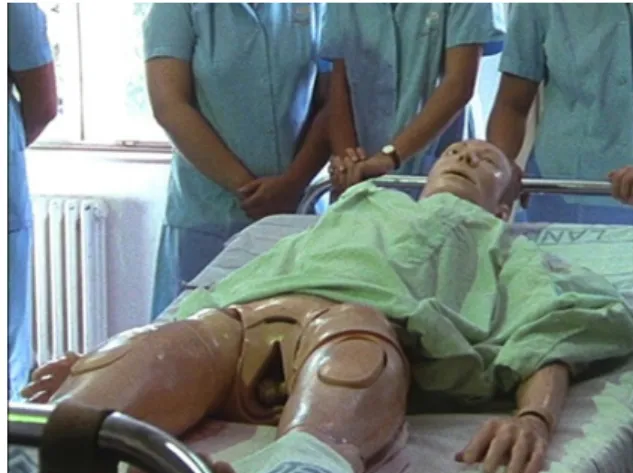
future. They pick up new skills for service jobs (how to do a sales pitch, impress in an interview), practice scenes of social interac-tion (how to plan a group dinner, de-escalate domestic violence) and even learn the most efficient ways to live as such (how to wash a baby, cross the street, etc.) [Fig. 2]. Relatively ignored in critical literature on Farocki, these observational films concern the reciprocal human component and modes of subjectiva-tion that complement the regime of the op-erational image. They show us the condition of “perpetual training” into which the school disperses in societies of control: knowledge and skills have to be regularly updated lest one becomes humanware-incompatible with the latest machines (Deleuze, “Postscript...” 5). These lab-like demos, which Farocki amusingly compares with product-testing in How to Live in the FRG, constitute the other face of the arc traced in Images of the World, Workers Leaving the Factory and Eye/ Machine. If the latter films evince the increas-ing obsolescence of workers within formal spaces of production and war-making – the shrinking numbers of people who have to be paid wages – the observational films trace the increasing centrality of what autonomist Marxists call General Intellect within cyber-netic capitalism.
For Marx – who in the Grundrisse al-ready anticipated automation becoming the main productive force in due time, relegating the worker to the sidelines – general intel-lect is the aggregate of social and scientific knowledge concretized in machines which generate or augment value (Virno). Yet where Marx saw in this relegation of living labor its eventual outmoding as the founda-tion of value in capitalism (the machines of his time could not capture behavior outside the factory/workplace as data), theorists like Paolo Virno and Tiziana Terranova argue that the component of living labor participat-ing in production of value only increases
with cybernetic networks. This labor is not recognized as work, since it masquerades as playful sociality, and goes financially uncom-pensated (Terranova). Contra Marx, general intellect is composed, says Virno, of both social, scientific knowledge concretized in machines (dead labor) and the social compe-tencies embedded in the human form (living labor). It is the sum of all generic capacities of sociality, including languages and embod-ied habits, perhaps even affects, desires and fantasies, that feed into capital’s machines, get concretized, while remaining in excess of every act of subsumption. This quality of the generic in general intellect – with its connota-tions of the repetitive, redundant, formulaic – is central to the dynamic by which living labor subsumes the world, or the outside, into the cybernetic network, in the process generat-ing surplus value.
But what does value in cybernetic sys-tems derive from? Value emerges by extract-ing information from the ‘raw data’ incessantly generated by the expansion of networks into planetary ubiquitous computing. For Matteo Pasquinelli, network surplus value is created by algorithms that “translate information into
information or accumulate information and
extract metadata, that is information about
information” (22). If information is the
con-temporary universal equivalent, the measure of all value, surplus value emerges through a constant redrawing of the lines between information and noise which gives form to, i.e. in-forms, raw data. This demarcation of information and noise raises a problem, since value can be generated only by opening to the unknown, extracting new information (as opposed to what the system already ‘knows’). The network therefore must maintain an umbilical, constitutive relation with the world as standing-reserve. This new information must be assimilable: convertible into useful metadata which can improve algorithmic ef-ficacy, able to “measure the values of social relations” (in links-per-node, for example) and predict mass behaviors (Pasquinelli 23-24). On the one hand then, information must be new; on the other, it must conform to the principle of homophily (must not be really heterogeneous) to guarantee the network’s stability, its homeostasis.
This dialectical relation of value to the unknown, of the network to the world, was already immanent in Claude Shannon’s widely adopted definition of information as the mathematical measure of uncertainty (Malaspina). In arguing that information necessarily means learning something new – computing the probabilities of an as yet-unknown event – Shannon saw its opposite not in noise but in redundancy (if a certain
Figure 2: Groups of stay-at-home mothers and nurses prepare for the future, learning the nitty-gritties of child care and delivery, in How to Live in the FRG. Courtesy: Harun Farocki Filmproduktion.
message implies zero information but 100 percent redundancy, we learn nothing from it). Far from being opposed to noise, infor-mation is merely in-formed noise, resolved or computable uncertainty; while noise is always ‘potential information.’ This raises a paradox though: the moment uncertainty in raw data is in-formed, assimilated into the cognizing system, it risks becoming redundant, slipping out of its status as information. It does not anymore have value to the system unless it is re-formed, mobilized for something else (let’s say, by becoming training data for fu-ture predictions). In Shannon’s theory, then, redundancy appears as the nemesis of any information system, a friction-force impeding its efficiency. Yet this conceals the extent to which redundancy is a necessity in informa-tion systems, acting a minimum buffer or anchorage against noise. A certain amount of redundancy in ‘raw data’ in fact prepares the outside for its subsumption. Without it, the system would be fully open to contingency: unable to subsume the outside, it would be exhausted in infinite recursion. In the terms of second-order systems theory, any system has to therefore strike a balance between ‘environmental openness’ and ‘operational closure’ (Clarke 39).
Deleuze and Guattari go even further: challenging information theory’s insistence on redundancy as merely a ‘limitative condition’ preventing the system from being drowned out by noise, they argue that redundancy is primary in any act of communication (79). Reading both information theory and linguis-tics as permeated by power, Deleuze and Guattari suggest that languages (whether ‘natural,’ mathematical or computational) are not formal but pragmatic questions in their essence, concerned with ordering. The el-ementary units of language are order-words, which “do not concern commands only, but every act that is linked to statements by a ‘social obligation’” (ibid). The order-word acts
upon the world, effects change. The relation-ship between order-word and act is one of redundancy: the act must repeat the word, conform to its order. To correct Shannnon’s information theory, and foreground its prag-matic, social aspects, Deleuze and Guattari suggest revising the hierarchy assigned to information, noise and redundancy:
the redundancy of the order-word is instead primary and [...] information is only the minimal condition for the transmission of order-words (which is why the opposition to be made is not between noise and information but between all the indisciplines at work in language, and the order-word as discipline or “grammaticality”) (Deleuze and Guattari 79).
This is why the quality of the generic permeates general intellect on either side of the divide between machine (concretized scientific knowledge) and human (embodied social intelligence). Habits are redundancies in behavior that bind us to order, patterning mechanisms that allow metadata to emerge from raw data. In this sense, habits are strictly correlates of the tool-relation to the world borne by the operational image (and language). In a way, habits also erase the distinction within general intellect between living labor and dead labor/fixed capital. With the deterritorialization of the factory, fixed capital moves into the human living form: “the body of the labour force [...] become[s] the container of the function of fixed capital, that is machinery, ‘codified knowledge’ and ‘productive grammars’, in other words past labour” (Pasquinelli 15).
Farocki registers this machinic enslave-ment of the living form to cybernetic rational-ity in his observational films: we see a con-stant streamlining of behaviors which must conform to shifting goalposts, fit operational
ideals, learn the passwords to success (or access). In Indoctrination, probably his cru-elest film, Farocki documents a seminar on soft skills taken by aspiring executives. The instructor acts like a despotic superego: con-stantly pitting participants against each other, humiliating them for the smallest gesture of indiscipline, giving each a flexible feedback (which may be anywhere between con-gratulatory or demeaning). Social agonism is dissipated in intense competitiveness and jealousy, in internalizing perpetual inferiority (since we all fail the dictums of this despotic superego). It is the parsing out of the person into dividuals, decimating their autonomy. Yet, as Farocki shows, this is doubled by a subjectivation which relentlessly personal-izes, produces subjects who internalize this violent modulation as an individual respon -sibility (Lazzarato 23-54). What for is this doubling required? Why must the shaping of habits to fit into the operational ideals lapse back into the oldest “habit of saying ‘I’” (Deleuze, “Preface...” x)? The Eye/Machine images provide a clue: individuals have to intervene when the cybernetic ‘abstract ma-chine’ fails to perform, breaks down, or is too slow to yield the desired result. They suture the gap between network and world; put the
machine back on track. By what name do we call this habitual labor?
IV. General Intellect,
Interface, General Economy
One of Farocki’s observational films, which explicitly parallels the labor of fitting opera-tional ideals in Eye/Machine I started this es-say with, allows us to answer this question. In An Image, which takes us ‘behind the scenes’ of a Playboy photo shoot, we witness the despotic superego at work in the person of the fashion photographer. He makes the nude model – the apparent star – painfully strain her body to achieve the exact pose he demands [Fig. 3]. Her muscles quiver with tension as she freezes herself into an ergo -nomic impossibility until the right shot has been taken. Farocki’s Brechtian gesture is to show us how the glossy, weightlessly seduc-tive centerfold emerges through a detailed algorithm of eroticism that feeds upon but ultimately vaporizes bodily labor. In the mo-ment of sexually charged immersion that a Playboy reader experiences though, it would be impossible to think of this labor of media -tion. The parallel with Eye/Machine, I believe, lies in this disappearing mediation. The ardu-ous labor of fitting into an ‘operational ideal’ which both the model and the machine-eye
Figure 3: A Playboy centerfold model struggles to maintain a difficult pose, fit into an operational ideal, in Farocki’s An Image (1986). Courtesy: Harun Farocki Filmproduktion.
engage in is ultimately evaporated. For the Playboy reader immersed in the centerfold as well as for the user surrounded by opera-tional images, it is as if there was never any friction. This, as we know from media theory, is the dynamic of the interface: which modu-lates between opacity and transparency, immersivity and hypermediacy, inter-activity and passivity, being a tool (that one uses consciously) and media environment (which one forgets about). I am therefore calling the zone of friction between the network and the world interface and the labor that sutures the two, minimizes their friction, interfacing.
This calls for some clarification. One agrees that operational images are interfaces in the standard language of computing – cou-pled as they are with the ability to interact with underlying algorithms and participate in the cybernetic feedback loop – but in what sense is the Playboy centerfold an interface. Do we risk eliding the technicalities and concrete textualities of the interface by making it into a metaphor? Perhaps, but I do believe that computational interfaces (GUIs, ambient no-UI objects, etc.) are a particular instance of a general organizational, relational principle in the world today: “it constitutes the gateway through which the reservoir of human agency and experience is situated with respect to all that stands outside of it” (Hookway 1). For Branden Hookway, “the interface is [...] a
form of relation. [...] what is most essential
to a description of the interface lies not in the qualities of an entity or in lineages of devices or technologies, but rather in the qualities of relation between entities” (4). The interface’s dominance is established in the very fact that it appears to us as merely technical as opposed to fundamentally an episteme or
dispositif, a mode of being in and relating
with the world. It relentlessly spatializes and segments the life-world into layers, whose borders are contact zones which frame the relationship of one layer to another, all the
way down; coordinating and setting off distant actions and information loops across scales and temporalities. Benjamin Bratton pro-poses along these lines a six-layered stack of planetary computation composed of earth, cloud, city, address, interface, and user, that has replaced the state as the sovereign since the Second World War (2015). What characterizes the interface, once we think of it as an organizational principle embedded in everyday life, is that it diffuses the chaotic complexity of the globally networked system – one which eludes the cognitive grasp of a generic user – into an apparent simplicity which this user can interact with effortlessly as if it were natural. It is this valence of the interface as a modulator of habits, complexi-ties and contradictions that I am interested in. This makes the Playboy centerfold an interface as much as Farocki’s operational images; both mould habits of perception and action, occlude the material-historical substrate of their production, and generate value by patterning behaviors.
Therefore I am interested in the inter-face less as an object than as a mode of mediation; a method of mitigating friction between contiguous, but not yet fully inter-operable, regimes (Galloway). Interface is necessarily a feedback relation between any system and its complex outside, by which a code of higher complexity is con-verted into a more manageable one. This reduction of complexity and translation of codes may happen in both directions, even simultaneously. So if end-user interfaces flatten out the complicated mechanics of machine languages, codes and protocols of cybernetic networks (entangled with distant global processes and multiple temporalities) into ludic, real-time immersive experiences; they also feed upon habitual living labor to pattern metadata, extract information out of the noise of the world, and thereby gener-ate surplus value. On one hand, interfaces
im-mediate the materiality of networks and its biogeopolitical substrates; on the other, they suspend our consciousness of always secreting data into the network, abetting its expansion deeper into the world and the liv-ing body. The interface is thereby as much a surface of connection as separation, policing boundaries between information and noise, determining what is useful and what is ex-cessive. Galloway sees the interface as an effect of subsuming the outside which tends to drop out of consciousness if the constitu-tive friction between two layers is minimized or stabilized (absorbed into the machine’s architecture, concretized in specific habits or fixed into the protocols of any organiza-tion). Until, that is, a breakdown foregrounds the interface again, calling on living labor to intervene in the state of exception.
The interface is then co-extensive with the shaping of the general intellect across the machine/ human divide; the process by which the network negotiates with the human body (by augmenting, reshaping or compet-ing with it) to fulfill certain operations, and subsume the outside. Nishant Shah reminds us, drawing on Jennifer Light’s work, that in the days of the mainframe, computers re-ferred to the women who manually processed code in addition to the machine itself. Their immaterial labor linked the various material components of the mainframe, smoothened its various kinks. For Shah, the “woman’s body was the first interface of mainframe computing” (184). Yet just as the computer became ‘personal,’ this gendered meaning of computing was forgotten: feminine presence persisting only as a faint echo in the affective intimacy binding computer and user. While the human-computer interface is not the only network interface, this is why I believe the component of living labor can never be discounted in any interface critique. The interface is the site where two contradictory drives of automation are reconciled: on one
hand the tendency to evict human bodies in the machine which slow down automative efficiency (and drive down profit margins); on the other, the need for the relative plasticity of living humans to complete and expand the cybernetic circuit further into the world. The interface is, then, situated in the frictions posed by both the human and the network.
Hookway poses the interface as another kind of reconciliation of two tendencies: it is both a space of passive habitation delimiting the possibilities of actions (an environment constantly tracking the unconscious habitual movements of its dividual subject-users) and a portal opening up “otherwise unavailable phenomena, conditions, situations, and ter-ritories for exploration, use, participation, and exploitation” to an active, synthesizing subject-user (5). In this latter active mode, the interface augments the user’s capaci-ties, allowing them to expand the reach of the network into qualitatively new terrains. The outside is made interoperable, given a surface – a facing-towards the network – by the user’s labor of abstraction. Matteo Pasquinelli rebuffs the common inclination in leftist theory to oppose capital’s computa-tional drive – abstract, alienating – against the incomputable-but-concrete eros of life (“The Labour of Abstraction”). For Pasquinelli, this misrecognizes that life is not given as an im-mediate, concrete condition to the self but in-volves working with/through heterogeneities and abstractions: the organism prevails in a volatile milieu by creating an interior milieu, establishing norms. Far from being opposed to abstraction, the commons of life (general intellect) have a greater power of abstraction than the capitalist abstract machine – which cultivates, shapes and ultimately absorbs this power in a reduced form. The interface can integrate new territory into the network only because the labor of abstraction performed by users, who make sense of the world on its behalf by synthesizing perceptions, deciding
actions, and creating a miniature cognitive map. The interface is akin to a gamespace defined by protocols and codes, dependent on players to work through and exhaust all possible trajectories. In The Metainterface, Christian Ulrik Andersen and Søren Pold identify this as the ergodic drive inherent to the interface. Like gamespaces, the inter-face allows a paradoxical kind of freedom in confinement: precisely by stepping into the arena of play, working with/in given rules of engagement, can one seek new trajectories or relations with other entities (Hookway 32-39). Each move is in turn inscribed by the interface into the algorithm, increasing the network’s overall complexity, establishing a relation of control with the outside. The interface-as-gamespace however produces an effect of immediation: the friction of its textual codes is evaporated and experienced simply as the pleasurable agonism of chas-ing an elusive opponent or target.
What, of course, aids this effect of im-mediation today is a massive redistribution of materiality away from end-users into back-end cloud computing infrastructures – the interface made contiguous with the built world. “The best interface is no interface,” declares a recent design handbook meant to usher in a screen-less world (Krishna). Not content with just this shifting away of heavy materiality, the author (a design innovator at Google) bemoans a culture of too many apps that require constant attention. Build a world of background computing oriented towards better user experience, scratch the tens of user interfaces that constantly vie for our attention, he proffers. Yet as Andersen and Pold insist, no matter how immersive the user experience, the interface will persist at some meta-level as a threshold of friction. The interface is nothing if not the mediation of friction between the network and the world (or what amounts to the same thing, between entities in a heavily networked world). The
interface mediates not just technological, material frictions, it exacerbates and modu-lates social frictions.
As Shah’s example of early women computers clarifies, the undifferentiated notion of the human in speaking of human-computer interfaces elides the politics of capital, which feeds on and exacerbates prior social frictions (the male-female wage gap deriving from the denigration of the ‘me-nial’ labor) since it wants to pay the lowest costs possible for the greatest profits. Since living labor is disavowed by the machine’s rhetoric of smooth efficiency, interfacing bodies are structurally predisposed to be mi-norities: women, persons of color, third world precariat rendered vulnerable by lax labor laws and so on. Anna Tsing’s ethnography of global supply chains foregrounds precisely this constitutive friction in the big picture of Capital – which is genetically made up of multiplicity and difference (2009). Capital is itself a monstrous metainterface between lifeworlds, communities and identities at odds with one another, jostling to get a hold on the same scarce resources and opportunities. Here the interface mediates difference on capital’s behalf: distributing labor, precarities and access across the globe unevenly. It re-makes territories, introduces new partitions, modulates social frictions and optimizes lines of operationality to extract maximum surplus value at minimum cost. Interfacing is then a binary conjunctive-disjunctive opera-tion of Capital on its pre-existing ground: on one hand it connects things up intensely; on the other, it extracts, separates quantities from qualities, form from formless, labor from life, etc. The more capital penetrates into new lifeworlds – things and beings get more networked – interfaces have to proliferate to mediate the multiplication of living labor and borders (Mezzadra and Neilson; Rossiter). However, the interface occludes the ground-ing of capital in this radically heterogeneous
social totality, rendering it as far as possible into a homogeneous, frictionless experience. Difference is not so much obliterated as disavowed, neutralized. Networks privilege homophily over xenophily; centralized platforms restrict internet experience to a few sites/apps which generate high network surplus value for megacorporations (Chun, “Queering Homophily”; Kaeppelin). The interface as a blackboxed mediation of the social totality is therefore the very nemesis of Jameson’s cognitive mapping (Galloway 99).
Perhaps, this analysis may be steered towards a more speculative vein for further research. In seeing the interface as the dominant dynamic by which the network expands into the world, we have so far taken the ‘view from the inside’ and sided with its logic of giving form to the outside. A different perspective emerges if we take a view from the outside, since no subsumption happens without remaindering. Every violent imposi-tion of form on existing social-natural totalities at the interface excretes a certain amount of formlessness, excludes something as noise. Yet, the formless is not just the excreted, it is the very ground on which form is built (Franklin 3). Cyberculture has an apt name for value extraction from an endless flow of accumulating shit, from outdated files, formats and versions, to junk bought online that lies in the garage, and the piling material e-waste of our media lives: crapularity. “In a general sense, the Crapularity is a form of accumulation of capital” (Cramer 1). This al-lows us to read the interface as co-extensive not just with the general intellect but also with what we may call, following Georges Bataille, a general economy of information/noise.
Published in 1949, the year after Wiener’s Cybernetics, Bataille’s The
Accursed Share: An Essay on General Economy was a heterodox critique of
po-litical economy (including the Marxist variant) from the point of view of excess. While most
economists take the scarcity of energy as the founding fact of political economy and pro-pose a rational calculus to manage this finite amount of wealth, Bataille argued that nature is on the contrary characterized by excess en-ergy constantly spent without purpose, vastly overflowing all possible systems of capture. The sun gifts energy in the form of heat and light with no self-interest, enabling all life on Earth. However, dominant economic thought (restricted political economy as opposed to his general economy) is founded on a utilitarianism that disavows nature’s principle of non-productive expenditure. Haunted by visions of scarcity, economists want to put all of this gifted energy to use: arrest this formless excess in form and hoard it up as wealth for the future. Thereby, they ignore the complete otherness of this excess energy, its excessiveness to human purpose. The result is a perverse sovereignty in which pleasure is always deferred or restricted to mere use; a society whose profane realm (dictated by rational utilitarianism) is increasingly repelled from a disavowed sacred realm (activities like sexuality, games, sacrifice, revolt and war that destroy form, gloriously consume energy, producing no surplus value). With roots in the Protestant ethic of capitalism, this thorough profanation of life culminates in the whole world becoming a standing-reserve for future use. For Bataille, this perversion of the cosmic principle of non-productive expenditure institutes the structural violence of capitalism. The separation of form from formless is consigned to social others, who are remaindered as waste (surplus popula-tions), since their labor of retrieving value from accursed matter remains unacknowl-edged, unreciprocated (Bataille, “Definition of Heterology” 36-37). In Marxian terms: first, the formal subsumption of the outside expels the excessive matter or energy which founds the value-form as the formless (waste); it confers non-productive status on a range
of activities. Then in real subsumption, pre-existing social ties of obligation are sundered and racialized, gendered, classed surplus populations are produced (Franklin 3).
Formulated in the same Cold War con-text, general economy and cybernetics had shared roots in thermodynamic notions of en-tropy and order. Both moreover were ostensi-ble attempts to chalk out universal epistemes cutting through academic specialization, if with different universal equivalents: energy contra information. Yet, while cyberneticians were predisposed to find order out of noise – privileging form over formless, homeosta-sis over xenophily – Bataille professed an ethics of non-productive expenditure, urging that all forms and restricted use-values be decimated by contingency. Formulated in a postwar world divided into two enemy blocs, damming up huge reserves of energy for an eventual nuclear catastrophe, cybernetics and general economy were diametrically opposed responses to the same historical problem – how to manage natural excess in a society which, in thermodynamic terms, was the hottest ever (paradoxically locked into a ‘cold war’)? Cybernetics, as we have seen, took a Manichean view: enclosing the world to ward off contingency, hoping to make use of all excess (noise as always potentially information, of value). We do not know if Bataille wrote directly on cybernetics, but he surely would have seen in it a hubris-tic human imposture against the principle of useless expenditure. A general economy of cybernetics would necessarily begin from the excessiveness of noise to notions of value. It would see the petty stupidity of making the world into a standing-reserve to avert crisis. The problem, for Bataille, lies not in having insufficient reserves for the future. It lies in the fact that capitalist utilitarianism banishes non-productivity and sacrifice, considers all that exceeds its narrow ends a danger to be averted. From Bataille’s perspective,
storage and the Protestant work ethic is the crisis; the impoverishment of living experi-ence in latent paranoia. To read the interface as co-extensive with the general intellect and general economy is to recognize what Bataille meant by the general. The general is opposed to the restricted realm of use: it necessarily exceeds utilitarian habits, profits and the common good, reaching for the ecstatic. From Bataille’s perspective, the normative interface only cuts the world down to its own size while subsuming it: “giv[es] a frock coat to what is, a mathematical frock coat” (Bataille, “Formless”). The general interface necessarily exceeds use-value and operationality: breaks with the utilitarian rec-onciliation of the Good, the Useful and the True. It releases the world from subservience to human will and needs, just as it frees the living human form into an open plasticity, and lets the machine play unreservedly with indeterminacy and error.
Hito Steyerl’s video essay How Not To
Be Seen (2013) presents an ironic version
of a general interface. Ostensibly an algo-rithmic primer on evading the panoptic eye of states and corporations, Steyerl undercuts the titular question with deadpan nonsense which is neither useful, nor abides by its own algorithmic schema. For example, ‘lesson II: seven ways to be invisible in plain sight’ goes, “Pretend you are not there. Hide in plain sight.” Then, as if talking of one who’s phubbing and at the same time an avatar inside the smartphone interface, the robotic voiceover continues: “To scroll, to wipe, to zoom, to pinch, to take a picture, to take a picture.” As if the phone is a magical machine that disappears people with the simplest ac-tions. The video image is itself an interface of stock optics and web 1.0-style bright digital blocks layered over greenscreen shots of Steyerl and others performing [Fig. 4]. The screen is filled with digital crap detourned from cheesy simulations and commercial
Figure 4: Hito Steyerl’s playful ‘general inter-face’ composed of stock optics, bright colored blocks and greenscreen graphics into which the body disappears. From
How Not to Be Seen.
Courtesy: Hito Steyerl.
platforms. Steyerl’s central concern, though, is one specific genre of interface: aerial maps that, as their present avatar Google Earth (or higher fidelity military apps), are the visual epitome of the world made into standing-reserve. Identified with the military’s Apollonian gaze, aerial maps put the world at the crosshairs of a target – culminating, as we have seen, in the self-annihilating images of ‘suicide bomb’ cameras in Eye/Machine.
As symptoms of the cybernetic drive to subsume the whole earth, aerial maps, however, come up against the limits of pano-pticism. They are constrained by resolution, which dictates the threshold of visibility up to which the Apollonian eye can zoom in. Beneath this threshold, Steyerl argues, lies the invisible multitude of today, unaccounted
for by the panoptic view from above [Fig. 5]. The digital ‘revolution’ coincided with the disappearance of 170 thousand people, the robo-voiceover says, mostly in war crimes and state-led pogroms. This capitalist transi-tion has also ‘disappeared’ a large merce-nary workforce that “hold[s] the vectors of the mesh and keep the [digital] picture together” (Steyerl, Wretched of the Screen 121-151). It is not just missing people though. Steyerl makes a lot out of a 1951 US Air Force resolution target painted on a patch of as-phalt in California’s desert to calibrate aerial images, decommissioned when the military stopped using analog cameras in favor of high-resolution digital cameras. The ruin of digital culture piles up unacknowledged due to network expansionism and its updates.
Figure 5: A pixel-based resolution target for digital aerial photographs. Proxy people disappear below the threshold of visibility (i.e. of resolution) as “rogue pixels.” From How Not to Be Seen.
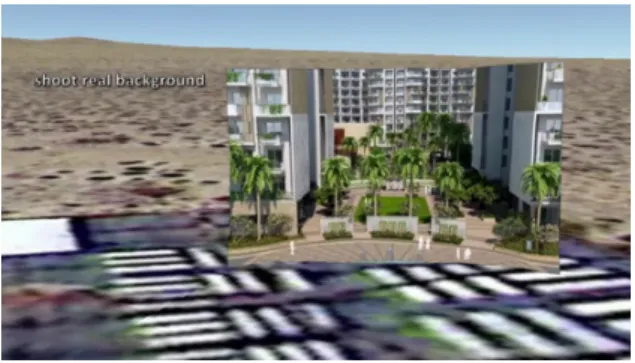
In the cracks of the target, Steyerl says, the digital multitude hides out as rogue pixels. Exhausted, fatigued, this multitude is not the revolutionary masses of yore. They simply want to be let be; they refuse to be counted, represented, conscripted. Bodies wrapped in green bodysuits and burqas (Steyerl’s sly reference to Islamophobic cultural politics), ‘proxy people’ disappear as ghostly generic humans into the gleaming 3D animations made by realtors to sell the swanky malls and condos of the future. In the finale at the site of the 1951 resolution target, Steyerl sets up a green screen against the desert land-scape. Yet the boundaries distinguishing the ‘real’ landscape and the simulated interface on the greenscreen gets blurred: the former is suddenly taken over by its low-res Google Earth copy and, Steyerl jokes, her film crew is held hostage by the rogue pixels [Fig. 6]. The pixels arrest time finally in a low res GIF loop.
Steyerl’s general interface not only re-vives the remains of network culture – miss-ing people, lost formats, stock graphics – it makes fun of the utilitarian realism of cyber-netics and its cult of high resolution. Despite radically deterritorializing the capacities of thought and vision beyond human limits, cy-bernetics naively wants to tether these to its pathetic ends of world domination. Cybernetic capital believes that better Earth images
necessarily mean better control, perhaps even better quality, of life. A life without crises and surprises, where all that lies outside is transparent, up for the taking, while the al-gorithms themselves get murkier, retreat into blackboxes controlled by corporations. With her idea of proxy politics – where truth finds no representation and viral spam proliferates – Steyerl opens the way for us to break free of our habits. If operational images enchain us and instrumentalize our relationship to the world through habits that pattern metadata – making our bodies into a kind of fixed capital – Steyerl insists that the proxy avatar not aid the network in increasing its high-resolution. It is not that, for a better world, we must ask the digital world-picture to correspond more closely with our ‘real’ embodied experience. Instead, our proxyselves must leave behind the belief that the network and the world be made commensurable, widen the chasm that exists between them.
Figure 6: The low-resolution Google Earth simulation takes over the ‘real’ HD landscape, at the site of the decommissioned 1951 USAF resolution target. From
Works cited:
Andersen, Christian Ulrik and Søren Bro Pold. The Metainterface: The Art of
Platforms, Cities, and Clouds. The MIT
Press, 2018.
Baran, Paul. On Distributed
Communications: I. Introduction to
Distributed Communications Networks. The
Rand Corporation, 1964, www.rand.org/ content/dam/rand/pubs/research_memo-randa/ 2006/RM3420.pdf
Bates, David W. “Unity, Plasticity,
Catastrophe: Order and Pathology in the Cybernetic Era.” Catastrophes: A History
and Theory of an Operative Concept, edited
by Nitzan Lebovic and Andreas Killen, De Gruyter Oldenbourg, 2014, pp. 32-54. Bataille, Georges. “Formless.” Visions of
Excess: Selected Writings, 1927-1939,
ed-ited by Allan Stoekl, University of Minnesota Press, 1985, p. 31.
____. The Accursed Share: An Essay on
General Economy. Volume I: Consumption,
translated by Robert Hurley, Zone Books, 1988.
____. The Accursed Share: An Essay on General Economy. Volume II: The History of Eroticism, and Volume III: Sovereignty, translated by Robert Hurley, Zone Books, 1991.
____. “Definition of Heterology.” Theory,
Culture & Society, Vol. 35(4–5), 2018, pp.
29-40.
Bergson, Henri. Laughter: An Essay on
the Meaning of Comic. Project Gutenberg,
2003, www.gutenberg.org/files/4352/4352-h/4352-h.htm
Bowker, Geoffrey C. “How to be Universal. Some Cybernetic Strategies, 1943-70.”
Social Studies of Science, Vol. 23, No. 1,
February 1993, pp. 107-127. JSTOR, www. jstor.org/stable/285691
Bratton, Benjamin. The Stack: On Software
and Sovereignty. The MIT Press, 2015.
Canguilhem, Georges. Knowledge of Life. Fordham University Press, 2008.
Chun, Wendy Hui Kyong. Updating to
Remain the Same: Habitual New Media.
The MIT Press, 2016.
____. “Queerying Homophily.” Pattern
Discrimination. Meson press, 2018, pp.
59-97.
Clarke, Bruce. “Heinz von Foerster’s Demons: The Emergence of Second-Order Systems Theory.” Emergence and
Embodiment: New Essays on Second Order Systems Theory, edited by Bruce Clarke
and Mark B.N. Hansen, Duke University Press, 2009, pp. 34-61.
Cramer, Florian. “Crapularity Aesthetics.”
Making & Breaking 01, 2019, pp. 1-8,
makingandbreaking. org/wp-content/ uploads/2018/11/Cramer_Crapularity_ Aesthetics-Making_and_Breaking-1.pdf Deleuze, Gilles. “Postscript on the Societies of Control.” October, Vol. 59 (Winter, 1992), pp. 3-7.
____. “Preface to the English Language Edition.” Empiricism and Subjectivity: An
Essay on Hume’s Theory of Human Nature,
translated by Constantin V. Boundas, Columbia University Press, 2001, pp. ix-x.
Farocki, Harun. “Phantom Images.” public 29, 2004, public.journals.yorku.ca/index. php/public/ article/view/30354
______. As You See AKA Wie man sieht. Harun Farocki Filmproduktion, 1986. ______. An Image AKA Ein Bild. Harun Farocki Filmproduktion and SFB, 1986. ______. Eye/Machine I-III AKA Auge/
Maschine. Harun Farocki, 2001-03.
______. How to Live in the Federal Republic
of Germany AKA Leben – BRD. Harun
Farocki Filmproduktion, ZDF and La Sept, 1990.
______. Images of the World and the
Inscription of War AKA Bilder der Welt und Inschrift des Krieges. Harun Farocki
Filmproduktion, 1988.
______. Indoctrination AKA Die Schulung. SWF, 1987.
______. The Interview AKA Die Bewerbung. Harun Farocki Filmproduktion, 1986.
______. Serious Games I-IV AKA Ernste Spiele I-IV. Harun Farocki Filmproduktion, 2009-10.
______. Workers Leaving the Factory AKA
Arbeiter verlassen die Fabrik. Harun Farocki
Filmproduktion, 1995.
Franke, Anselm and Diedrich Diedrichsen, editors. The Whole Earth: California and the
Disappearance of the Outside. Sternberg
Press, 2013.
Franklin, Seb. “The Context of Forms.”
World picture 11, Summer 2016, pp. 1-23.
www.world picturejournal.com/WP_11/pdfs/ Franklin_WP_11.pdf
Galison, Peter. “The Ontology of the Enemy: Norbert Wiener and the Cybernetic Vision.”
Critical Inquiry, Vol. 21, No. 1, Autumn
1994, pp. 228-266. JSTOR, www.jstor.org/ stable/1343893
Galloway, Alexander R. The Interface Effect. Polity Press, 2012.
Halpern, Orit. “The Trauma Machine: Demos, Immersive Technologies and the Politics of Simulation.” Alleys of Your Mind:
Augmented Intelligence and Its Traumas,
edited by Matteo Pasquinelli. Meson press, 2015, pp. 53-67.
Hayles, N. Katherine. How We Became
Posthuman: Virtual Bodies in Cybernetics, Literature, and Informatics. University of
Chicago Press, 1999.
Heidegger, Martin. “The Question Concerning Technology.” The Question
Concerning Technology and Other Essays,
translated by William Lovitt, Garland Publishing, 1977, pp. 3-35.
Hookway, Branden. Interface. The MIT Press, 2014.
Kaeppelin, Joséphine. “Joséphine is Surfing.” Strabic, 9 décembre 2011, strabic. fr/JOSEPHINE-IS-SURFING
Krishna, Golden. The Best Interface Is
No Interface: The Simple Path to Brilliant Technology. New Riders, 2015.
Lazzarato, Maurizio. Signs and Machines:
Capitalism and the Production of
Subjectivity. Translated by Joshua David
Jordan, Semiotext(e), 2014.
Malaspina, Cecile. An Epistemology of
Mezzadra, Sandro and Brett Neilson. Border
as Method, or, The Multiplication of Labor.
Duke University Press, 2013.
Pasquinelli, Matteo. “Machinic Capitalism and Network Surplus Value: Notes on the Political Economy of the Turing Machine.” Unpublished paper, delivered at the Joy Forever: Political Economy of
Social Creativity Conference in Warsaw,
October 2011, pp. 1-28. Lust for Life, lust-for-life.org/Lust-For-Life/_Textual/ MatteoPasquinelli_MachinicCapitalismAnd NetworkSurplusValue-NotesOnThePolitical EconomyOfTheTuringMachine_2011_28pp/ MatteoPasquinelli_MachinicCapitalismAnd NetworkSurplusValue-NotesOnThePolitical EconomyOfTheTuringMachine_2011_28pp. pdf
____. “The Labour of Abstraction: Seven Transitional Theses on Marxism and Accelerationism.” Fillip 19, Spring 2014, fillip.ca/content/the-labour-of-abstraction Paglen, Trevor. “Operational Images.”
E-flux Journal, No. 59, November 2014,
www.e-flux.com/ journal/59/61130/ operational-images/
Rossiter, Ned. Software, Infrastructure,
Labor: A Media Theory of Logistical Nightmares. Routledge, 2016.
Shah, Nishant. “From GUI to No-UI: Locating the interface for the Internet of Things.” Digitisation: Theories and Concepts
for Empirical Cultural Research, edited
by Gertraud Koch, Routledge, 2017, pp. 179-196.
Steyerl, Hito. The Wretched of the Screen. Sternberg Press, 2012.
____. “Proxy Politics: Signal and Noise.”
E-flux Journal, No. 60, December 2014,
www.e-flux.com/ journal/60/61045/ proxy-politics-signal-and-noise/ ____. How Not to be Seen: A Fucking
Didactic Educational .MOV File. 2013.
Terranova, Tiziana. “Free Labor: Producing Culture for the Digital Economy.” Social
Text, 63 (Vol. 18, No. 2), Summer 2000,
pp. 33-58. Project MUSE, muse.jhu.edu/ article/31873
Tsing, Anna. “Supply Chains and the Human Condition.” Rethinking Marxism, Vol. 21 No. 2, April 2009, pp. 148-176.
Turner, Fred. From Counterculture to
Cyberculture: Stewart Brand, the Whole Earth Network, and the Rise of Digital Utopianism. University of Chicago Books,
2006.
Virno, Paolo. “General Intellect.” Generation
Online, translated by Arianna Bove, 2001,
www.generation-online.org/p/fpvirno10.htm Wiener, Norbert. The Human Use of Human
Beings: Cybernetics and Society. Free