All marine birds have salt glands that, together with the kidneys, maintain body fluid homeostasis, despite the excess sodium chloride (NaCl) they ingest. They have similar total body water, but twice the daily water flux of birds that lack salt glands (Hughes et al., 1987; Nagy and Peterson, 1988). Among species that produce highly concentrated salt gland secretion (SGS), the salinity of the drinking water has no effect on drinking rate (Harriman, 1967; Walter and Hughes, 1978; Bennett et al., 2003). Such birds become dehydrated only when they drink water more concentrated than their SGS (Bennett et al., 2003).
Three processes central to osmoregulation in marine birds are filtration of sodium (Na+) and water from the plasma by
the kidneys, reabsorption of filtered water and Na+ by cells
along the renal tubules, and secretion of Na+by the salt glands.
These processes must have evolved simultaneously to adapt to the osmoregulatory requirements of birds that use habitats of widely disparate salinities, ranging from freshwater to full-strength seawater. Renal filtration of marine birds is unaffected by either acclimation to saline or acute saline loading and almost all the filtered Na+(and water) is reabsorbed along the
renal tubules, regardless of plasma [Na+] (Hughes, 1995). The
reabsorbed Na+can be secreted by the salt glands in less water
than was imbibed with it. The concentration and rate of salt gland secretion determines the amount of osmotically free
water it can generate for the birds’ other physiological processes (Schmidt-Nielsen, 1960).
Many species of ducks switch seasonally between freshwater and saline habitats. When the drinking water of Pekin ducks is changed from freshwater to saline, their salt glands hypertrophy, enhancing their capacity to excrete salt (Schmidt-Nielson and Kim, 1964), but the glomerular filtration rate (GFR) is little affected (Holmes et al., 1968) and the fractional reabsorption of Na+is reduced (Holmes et al., 1968;
Hughes et al., 1989). Whether these responses occur in wild ducks has not been reported.
Therefore, in this study, we compared simultaneous kidney and salt gland function in three species of ducks: freshwater mallards (tribe Anatini, Anas platyrhynchos), estuarine canvasbacks (tribe Aythyini, Aythya valisineria) and marine Barrow’s goldeneyes (tribe Mergini, Bucephala islandica). Goldeneyes, the most saline-tolerant, have larger kidney mass (Kalisin´ska et al., 1999; D. C. Bennett and M. R. Hughes, unpublished data) and extracellular fluid volume (Bennett, 2002) than mallards, the least saline-tolerant species. Canvasbacks have large kidneys like the goldeneyes (D. C. Bennett and M. R. Hughes, unpublished data), but a smaller extracellular fluid volume, like the mallards (Bennett, 2002). Water flux rates of all three species (Bennett, 2002) are roughly twice the rate predicted allometrically for seabirds (Hughes et doi:10.1242/jeb.00551
Three processes central to osmoregulation of marine birds were compared in three species of ducks that differ in habitat affinity, diet and saline tolerance. These processes are filtration of Na+and water from the plasma by the kidneys, their reabsorption along the renal tubules, and secretion by the salt glands. Barrow’s goldeneyes
Bucephala islandica, the most marine species, have the
highest rates for all three processes and only this species can secrete all the infused salt via the salt glands. Rates of all three processes are lower in mallards Anas
platyrhynchos, the most freshwater species. Following
saline acclimation, mallards could excrete all the infused Na+ by a combined Na+ excretion of the kidneys and salt glands. Canvasbacks Aythya valisineria, despite being
more saline tolerant than mallards, are unable to excrete all the infused Na+. They produce a large volume of urine (like mallards) that has a low [Na+] (like goldeneyes). Salt gland secretion Na+ concentration did not differ among the three species, but only goldeneyes secrete at a rate sufficient to eliminate all infused Na+ via the salt glands. Differences in saline tolerance of these ducks species cannot be fully explained by differences in their filtration, reabsorption and secretion of Na+ and water, suggesting that the intestinal tract plays an important role.
Key words: osmoregulation, kidney, salt gland, mallard, Anas
platyrhynchos, canvasback, Aythya valisineria, Barrow’s goldeneye, Bucephala islandica.
Summary
Introduction
Comparison of renal and salt gland function in three species of wild ducks
Darin C. Bennett and Maryanne R. Hughes
Department of Zoology, 6270 University Boulevard, University of British Columbia, Vancouver, BC, V6T 1Z4, Canada
*Author for correspondence (e-mail: [email protected])
Table·1. Glomerular filtration rate (GFR) and effective renal plasma flow (ERPF) of birds with and without salt glands in
relation to habitat type and diet
Species Mass (g) GFR (ml·min–1) ERPF (ml·min–1) Habitat Diet Source
Without salt glands: Order Struithioniformes
Dromaius novaehollandiae 40700 16.2 TA O 1
Order Galliformes
Alectoris chukar 511.7 0.58 TA O 2
Coturnix chinensis 51.4 0.55 1.50 TM O 3
Coturnix pectoralis 107.3 0.68 4.07 TA H 3
Coturnix japonica 122.3 1.55 TM H 4
Gallus gallus var. dom. 1890 4.13 32.32 TM O 5–33
Meleagris pavo 7400 5.68 TM H 34, 35
Callipepla gambelii 158.4 0.23 TA H 36–42
Order Psittaciformes
Melopsittacus undulatus 37.5 0.14 TA O 43
Cacatua roseicapilla 335.9 0.79 3.76 TA O 44
Order Trochiliformes
Calypta anna 5.1 0.04 TM N 45
Order Columbiformes
Zenaidura macroura 119 0.27 2.05 TM H 46
Columbia livia 569.3 4.04 TM H 47
Order Falconiformes
Falco sparverius 126.0 0.27 TM C 48
Order Passeriformes
Anthochaera carunculata 99 0.35 TM N 49
Sturnus vulgarus 77.1 0.50 4.27 TM O 50–57
Nectarinia osea 5.8 0.03 TM N 58
Passer domesticus 22.8 0.13 TM H 59
Melospiza melodia 18.4 0.13 TM O 60
With salt glands: Order Anseriformes
Branta canadensis 3670 6.24 FW H 61
Anas platyrhynchos 983 2.70 11.00 FW O 61–63
Anas platyrhynchos var. dom. 2513 7.44 52.85 FW O 64–72
Aythya valisineria 1052 2.27 5.23 FW O 62
Bucephala islandica 767 4.06 10.63 MR C 62
Order Charadriiformes
Larus argentatus 1000 4.40 MR C 73
Larsus dominicanus 905 3.09 MR C 74
Larus glaucescens 900 3.84 13.61 MR C 61, 75–77
TA, terrestrial arid; TM, terrestrial mesic; FW, freshwater; MR, marine; H, herbivore; O, omnivore; N, nectivore; C, carnivore.
Source: 1Dawson et al. (1991), 2Goldstein (1990), 3Roberts et al. (1985), 4Roberts and Hughes (1983), 5Berger et al. (1960), 6Dantzler
(1966), 7Glahn et al. (1988a,b), 8Gregg and Wideman (1990), 9Hyden and Knutson (1959), 10Korr (1939), 11Leary et al. (1998), 12Nechay and
Nechay (1959), 13Orloff and Davidson (1959), 14Pitts (1938), 15Pitts and Korr (1938), 16Radin et al. (1993), 17Roberts (1991a), 18Roberts
(1992), 19Sanner (1965), 20Shannon (1938a,b), 21Shideman et al. (1981), 22Singh and Battacharyya (1983), 23Skadhauge (1964), 24Skadhauge
and Schmidt-Nielson (1967), 25Sperber (1960), 26Svendsen and Skadhauge (1976), 27Sykes (1960a,b), 28Vena et al. (1990), 29Wideman and
Gregg (1988), 30Wideman and Laverty (1986), 31Wideman and Nissley (1992), 32Wideman and Satnick (1989), 33Wideman et al. (1987), 34Palmore et al. (1981), 35Vogel et al. (1965), 36Anderson (1980), 37Braun (1976), 38Braun and Dantzler (1972), 39Braun and Dantzler (1974), 40Braun and Dantzler (1975), 41Williams and Braun (1996), 42Williams et al. (1991), 43Krag and Skadhauge (1972), 44Roberts (1991b), 45S.
Medler (unpublished data), 46Shoemaker (1967), 47Chan et al. (1972), 48Lyons and Goldstein (2002), 49Goldstein and Bradshaw (1998b), 50Braun (1978), 51Clark and Wideman (1980), 52Laverty and Dantzler (1982),53Laverty and Dantzler (1983), 54Laverty and Wideman (1989), 55Roberts and Dantzler (1989), 56Roberts and Dantzler (1992), 57Wideman et al. (1980), 58T. J. McWhorter (unpublished data), 59Goldstein and
Braun (1988), 60Goldstein and Rothschild (1993), 61Hughes (1980), 62This study, 63Hughes et al. (1999), 64Bennett et al. (2000), 65Bradley and
Holmes (1971), 66Gerstberger et al. (1985), 67Holmes and Adams (1963), 68Holmes et al. (1968), 69Hughes et al. (1989), 70Schutz et al. (1992), 71Simon and Gray (1991), 72Thomas and Phillips (1975), 73Douglas (1966), 74Gray and Eramus (1988), 75Hughes (1995), 76Hughes et al.
al., 1987; Nagy and Peterson, 1988). We hypothesize that (1) neither saline acclimation nor acute saline loading affect GFR in any of the three species, and (2) saline tolerance is determined by the efficiency of renal tubular reabsorption of water and Na+, and
secretion of Na+by the salt glands.
Materials and methods Animals
24 adult ducks (eight mallards,
Anas platyrhynchos L., eight
Canvasbacks, Aythya valisineria Gray, and eight Barrow’s goldeneyes,
Bucephala islandica Gmelin) were
held in large partially covered outdoor enclosures at the University of British Columbia Animal Care Facility. Groups included equal numbers of males and females. Water was presented in 70·liter plastic wading pools and completely replenished twice daily. Half the ducks of each species drank freshwater, while the other half drank 300·mmol·l–1 NaCl.
They ate duck pellets (17% protein, 2750·kcal·kg–1; Buckerfield’s,
Abbottsfield, BC, Canada) containing 12.7% water and 68, 145 and 190·mmol·l–1·kg–1 Na+, K+ and Cl–,
respectively.
Experiments
These experiments followed the guidelines set forth by the Canadian Council on Animal Care. Each duck was fasted overnight and weighed. Venous catheters were placed in the
left and right tibiotarsal veins (for infusion of saline and markers and for blood sampling, respectively) and were kept patent with heparinized isotonic saline. The duck’s wings were lightly bound to the body with Velcro straps and the bird was placed on a foam-lined restrainer. The duck’s head projected into a large funnel that directed SGS into preweighed glass vials. The SGS of poor secretors was collected by capillary tube. A cannula inserted into the cloaca diverted ureteral urine into a preweighed plastic tube.
An initial 1·ml blood sample was taken and the duck was given a priming injection of 37·kBq of 14C-inulin (marker for
GFR) and 370·kBq of 3H-para-aminohippuric acid (3H-PAH;
marker for effective renal plasma flow, ERPF). An infusion of 75·mmol·l–1NaCl, containing 0.15·kBq·ml–1of 14C-inulin
and 1.1·kBq·ml–1 of 3H-PAH, was begun (0.175·ml·min–1).
After a 1·h equilibration period, four 10–15·min urine samples
were collected. Then infusate NaCl concentration was increased to 500·mmol·l–1 and urine was collected at
10–20·min intervals until the duck began to secrete. Four simultaneous 10–20·min collections of urine and SGS were made. Finally, infusate NaCl concentration was reduced to 75·mmol·l–1and three simultaneous 10–20·min collections of
urine and SGS were made. Urine and SGS volumes were determined by weighing their tubes before and after the collection period. A blood sample (0.4·ml) was taken at the mid-point of each collection period.
Blood, urine and SGS samples were centrifuged for 3·min at 15·600·g and the supernatant fluids were transferred into 1.5·ml centrifuge tubes and stored at –20°C until assayed. Plasma, urine and infusate 3H and 14C concentrations were
determined using a Beckman LS 6500 liquid scintillation counter (Fullerton CA, USA). Determinations of [Na+] and 290
300 310 320
A
B
C
330
0 200 400 600
0
3
3
3
0.5 1.0 1.5 2.0
Mallard Canvasback Goldeneye
75 – +
500
75 75 – +
500
75 75 – +
500 75
Infusate [NaCl] (mmol l–1)
O
sm
o
lal
it
y
(m
O
sm
o
l
k
g
–
1)
Fig.·1. Effect of hypotonic and hypertonic saline infusion (75 and 500·mmol·l–1 NaCl,
respectively) on (A) plasma and (B) urine osmolality and (C) their ratio (Urine:Plasma) in freshwater (open symbols) and saline-acclimated (filled symbols) in mallards Anas
platyrhynchos (circles), canvasbacks Aythya valisineria (triangles) and Barrow’s goldeneyes Bucephala islandica (squares). The period of 500·mmol·l–1NaCl infusion was subdivided into
two parts: the period prior to secretion (–) and the period of secretion (+). Values are means ±
[K+] of plasma, urine and SGS were made by cesium internal
standard flame photometry (Model 943, Instrumentation Laboratory S.p.A, Milano, Italy); and osmolality (Osm) of the plasma and urine by vapor pressure osmometry (Model 5500; Wescor Inc., Logan UT, USA). Subscripts pl, u and sgs designate plasma, urine and salt gland secretion, respectively.
Calculations and statistics
All calculations are as described in Pitts (1968) and Goldstein (1993). GFR and ERPF were calculated as:
GFR = [inulin]uUFR / [inulin]pl
and
ERPF = [PAH]uUFR / [PAH]pl·,
where [marker]uand [marker]plare the marker (inulin or PAH)
concentrations in the urine and plasma, respectively, and UFR
is the urine flow rate. Fractional reabsorption of water (FRH2O)
was calculated as:
FRH2O = (1–[inulin]pl/ [inulin]u) × 100
and fractional reabsorption of Na+ and K+ (FR
Na and FRK,
respectively) was calculated as:
FRion = (GFR[ion]pl– UFR[ion]u) / GFR[ion]pl·,
where [ion]pl and [ion]u represent the Na+ and K+
concentrations of the plasma and urine, respectively.
All analyses and calculations were made on each sample collected and were, within individuals, averaged for each infusate, so that each infusate period for an individual duck is represented by a single value. The 500·mmol·l–1NaCl infusion
was divided into two periods: prior to secretion and active secretion. Data are reported as means ± standard errors (S.E.M.) and statistically analyzed using SYSTAT 9 for Windows (SPSS Science, Chicago, IL, USA). Differences among species and infusion periods and between treatments and sexes were assessed by repeated-measures analysis of variance (ANOVA). Significance is claimed at
P<0.05, although higher P values
suggesting trends are also reported. Relationships among variables were examined using correlation and step-wise linear regression.
To examine the relationships of GFR to habitat and diet of birds, we collected GFR data on 27 species of adult non-dehydrated birds, disregarding the methods used to measure GFR (Table·1). Data were obtained from original sources whenever possible. For each species we calculated a single data point that is the mean of all reported values. GFR was standardized by regressing it on body mass, after log10–log10
transformation, and analysing the residuals by ANOVA.
Results Plasma composition
Overall, Osmpl, [Na]pl and [K]pl
varied significantly among species and infusion periods, but not between the treatments or sexes. Mallards had a lower Osmpl (P<0.06; Fig.·1) and
[Na]pl (P<0.002; Fig.·2) and a higher
[K]pl (P<0.002; Fig.·3) than both
canvasbacks and goldeneyes. Infusion of hypertonic saline significantly
140 150 160 170
0 50 100 150
0 0.2 0.4 0.6 0.8 1.0
Mallard Canvasback Goldeneye
A
B
C
3
3
3
75 – +
500
75 75 – +
500
75 75 – +
500 75
Infusate [NaCl] (mmol l–1)
S
o
d
ium
co
nc
en
tra
tio
n
(mm
o
l
l
–
1)
Fig.·2. Effect of hypotonic and hypertonic saline infusion (75 and 500·mmol·l–1 NaCl,
respectively) on (A) plasma and (B) urine sodium concentration and (C) their ratio (Urine:Plasma) in freshwater (open symbols) and saline-acclimated (filled symbols) mallards
Anas platyrhynchos (circles), canvasbacks Aythya valisineria (triangles) and Barrow’s
goldeneyes Bucephala islandica (squares). The period of 500·mmol·l–1 NaCl infusion was
increased Osmpl, [Na]pl and [K]pl in all three species and
these remained high during active salt secretion. Osmpland
[Na]pl, but not [K]pl, decreased after the infusion of hypotonic
75·mmol·l–1NaCl was reinstated. Kidney function
GFR was significantly greater in goldeneyes than in either mallards or canvasbacks (P<0.005) and differed between freshwater and saline-acclimated ducks only in canvasbacks (Fig.·4), due mainly to lower GFR in freshwater females. GFR did not vary among the infusion periods in any species (P>0.5). ERPF was significantly lower in canvasbacks than in either mallards or goldeneyes (P<0.008). When ducks were infused with hypertonic saline, ERPF increased only in mallards (P<0.03; Fig.·4). Neither saline acclimation nor sex affected ERPF.
Fractional reabsorption of water and Na+ varied significantly among
the three species (P<0.02 and
P<0.0004, respectively; Fig.·5). They were highest in goldeneyes, lowest in canvasbacks and intermediate in mallards (Fig.·5). Fractional reabsorption of water and Na+ of
mallards was not affected by saline acclimation, sex or infusate concentration, but both tended to be higher in saline-acclimated canvasbacks (P<0.08 and P<0.01, respectively), due almost exclusively to the low values of one freshwater female. In goldeneyes, fractional reabsorption of water increased (P<0.005) and reabsorption of Na+
decreased (P<0.002) with infusion period (Fig.·5). Fractional reabsorption of K+ did not differ
among or within species, except that it was significantly lower in freshwater mallards during the final infusion of 75·mmol·l–1 NaCl (Fig.·5).
Goldeneyes had lower UFR than either mallards or canvasbacks (P<0.01). UFR was affected by saline only in canvasbacks, and was lower in saline-acclimated ducks (P=0.04) and reduced by saline infusion in freshwater ducks (P<0.01; Fig.·4).
Overall, Osmu (Fig.·1) and [K]u
(Fig.·3), but not [Na]u(Fig.·2), varied
among species (P=0.0007, P=0.0005
and P=0.14, respectively).
Goldeneyes had the highest Osmuand
[K]uand, together with canvasbacks,
the lowest [Na]u. Canvasbacks also
have the lowest Osmuand [K]u. Osmu,
[Na]uand [K]uvaried significantly among infusion periods (all P<0.00001; Figs·1–3), but only Osmu varied between
treatments (P=0.04), due primarily to lower Osmu of
freshwater canvasbacks (Fig.·1). During hypertonic saline infusion, all three species significantly increased Osmuand it
remained high during active salt secretion. [Na]u and [K]u
increased in mallards and goldeneyes regardless of their drinking water regime. In canvasbacks, only freshwater ducks increased [Na]u and none increased [K]u.
Urine flow rate is correlated to both GFR and fractional reabsorption of water (FRH2O) in all three species (Fig.·6).
UFR and GFR were positively correlated in mallards and goldeneyes, but not in canvasbacks (Fig.·6). Stepwise linear regression indicated that UFR of mallards and goldeneyes was predicted by a combination of both GFR and FRH2O:
2.0 2.5 3.0 3.5 4.0
0 50 100 150
0 10 20 30 40
Mallard Canvasback Goldeneye
A
B
C
3
3
3
75 – +
500
75 75 – +
500
75 75 – +
500 75
Infusate [NaCl] (mmol l–1)
P
o
ta
ss
ium
co
nc
en
tra
ti
o
n
(mm
o
l
l
–
1)
Fig.·3. Effect of hypotonic and hypertonic saline infusion (75 and 500·mmol·l–1 NaCl,
respectively) on (A) plasma and (B) urine potassium concentration and (C) their ratio (Urine:Plasma) in freshwater (open symbols) and saline-acclimated (filled symbols) mallards
Anas platyrhynchos (circles), canvasbacks Aythya valisineria (triangles) and Barrow’s
goldeneyes Bucephala islandica (squares). The period of 500·mmol·l–1 NaCl infusion was
Mallards: UFR = 2.0 + (0.039×GFR) – (0.021×FRΗ2Ο),
r=0.83, P<0.0001,
Goldeneyes: UFR = 3.6 + (0.012×GFR) – (0.036×FRH2O), r=0.95, P<0.0001,
and could be similarly predicted in canvasbacks if one freshwater female were excluded:
Canvasbacks: UFR = 1.6 + (0.021×GFR) – (0.016×FRH2O), r=0.81, P<0.0001,
otherwise UFR of canvasbacks was predicted solely by FRH2O.
Salt gland function
The time required to initiate secretion did not vary among the species (P=0.12) nor was it affected by treatment (P=0.89) or sex (P=0.35). It required 59.3±3.8·min (N=24 ducks) of
infusion (500·mmol·l–1 NaCl at 0.175·ml·min–1) to initiate
secretion. Freshwater mallards and one freshwater female canvasback produced only a trace of SGS. [Na+]
sgsdid not vary
among the species (P=0.56) or between the sexes (P=0.23). Saline acclimation increased [Na+]
sgs of mallards and
goldeneyes (P=0.04 and P=0.01, respectively), but not of canvasbacks (P=0.25; Fig.·7). Salt gland secretion rate varied among species (P=0.0003; goldeneyes>mallards> canvasbacks) and was increased by saline acclimation only in mallards (Fig.·7).
Discussion
Kidneys and salt glands of marine birds act interactively to maintain the volume and composition of body fluids within some homeostatically controlled range. The salt glands secrete excess NaCl as a hypertonic fluid and are the primary site of Na+
excretion, while the kidneys rid the body of excess water, nitrogenous wastes and other osmolytes. To this end, kidneys of marine birds should maintain a high GFR and a high tubular reabsorption of Na+ and water.
Therefore, secretion of excess NaCl directly reflects renal Na+ filtration
and reabsorption. This study simultaneously compared the filtration and reabsorption of Na+and water from
the kidneys, and secretion of Na+by the
salt glands in three species of ducks of utilize habitats of different salinities.
Kidney function
Saline acclimation and acute saline loading have little effect on GFR of ducks (Holmes et al., 1968; Hughes, 1980; Hughes et al., 1989, 1999; Fig.·4) or other species with salt glands (Douglas, 1966; Hughes, 1995). GFR of goldeneyes is roughly twice that of mallards, canvasbacks and Pekin ducks (Table·1, Fig.·4), but is similar to that of other marine birds (gulls; Douglas, 1966; Hughes, 1980, 1995; Hughes et al., 1993). The Canada goose Branta
canadensis, the most terrestrial of the
anseriforms studied to date, has the lowest GFR (Hughes, 1980). This suggests that birds well adapted to highly saline water have higher GFR, and that GFR may vary among habitat types. We examined the generality of this relationship by comparing GFR of 27 species of adult birds for which data are available (Table·1). GFR varied
0 10 20 30
0 2 4 6
0 0.1 0.2 0.3
Mallard Canvasback Goldeneye
A
B
C
3
3
3
75 – +
500
75 75 – +
500
75 75 – +
500 75
Infusate [NaCl] (mmol l–1)
R
at
e (m
l m
in
–
1)
Fig.·4. Effect of hypotonic and hypertonic saline infusion (75 and 500·mmol·l–1 NaCl,
respectively) on (A) effective renal plasma flow (ERPF), (B) glomerular flow rate (GFR) and (C) urine flow rate (UFR) in freshwater (open symbols) and saline-acclimated (filled symbols) mallards Anas platyrhynchos (circles), canvasbacks Aythya valisineria (triangles) and Barrow’s goldeneyes Bucephala islandica (squares). The period of 500·mmol·l–1NaCl
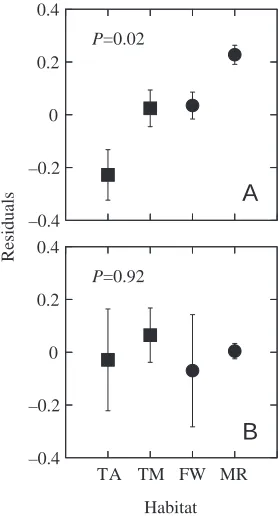
significantly among birds from different habitat types (P=0.02; Figs·8, 9). Marine species had a significantly higher GFR (P=0.02) and terrestrial arid species had a significantly lower GFR (P=0.05) than species from either terrestrial mesic or freshwater habitats, which did not differ significantly from each other (P=0.9).
Yokota et al. (1985) identified the need to eliminate water loads and metabolic wastes as the major factors that tend to increase GFR among vertebrates. The results of the preceding analysis support this hypothesis. The high GFR of marine birds is consistent with their larger kidneys (Hughes, 1970; Kalisin´ska et al., 1999), greater water flux (Hughes et al., 1987; Nagy and Peterson, 1988; Bennett, 2002) and Na+ flux
(Goldstein and Bradshaw, 1998a; Goldstein, 2002) and larger extracellular fluid volumes (Bennett, 2002).
Marine birds are carnivorous and should presumably excrete large amounts of urates. Whether these
patterns reflect adaptations to a marine environment and/or effects of a carnivorous diet have not yet been examined. Only one terrestrial avian carnivore, the American kestrel Falco
sparverius, has been studied and it has
a low GFR (Lyons and Goldstein, 2002; Table·1) and small kidneys, like other birds that lack salt glands (Hughes, 1970). We found no relationship between diet and GFR, standardized to body mass (P=0.58; Table·1). Large renal mass and a high rate of body fluid filtration appear to be adaptations to the saline environment. Studies on terrestrial avian carnivores, including Falconiform birds that have salt glands (Cade and Greenwald, 1966), might clarify these relationships.
Goldeneyes, the most marine of the three duck species, have the highest fractional reabsorption of water and Na+ (Fig.·5), thus a low UFR (Fig.·4)
and [Na+]
u(Fig.·2). They significantly
increased the fractional reabsorption of water and decreased the fractional reabsorption of Na+when infused with
hypertonic saline (Fig.·5), as did gulls (Hughes, 1995). In contrast, mallards had a lower fractional reabsorption of water and Na+(Fig.·5) and produced a
greater volume of urine (Fig.·4) that had a higher [Na+] (Fig.·2). Although
canvasbacks produced a large volume of urine like mallards (Fig.·4), they had a low [Na+]
u like goldeneyes (Fig.·2).
Saline infusion did not affect fractional reabsorption of water and Na+ in
mallards and canvasbacks (Fig.·5).
Birds can adjust UFR by two mechanisms: they may vary the rate of fluid delivery to the renal tubules (GFR) and/or adjust tubular water reabsorption. Neither GFR nor fractional water reabsorption of the three species of wild ducks were much affected by saline acclimation or by acute saline loading (Figs·4, 5). With the exception of female freshwater canvasbacks, both mechanisms regulated urine flow of ducks equally well (Fig.·6). Chickens (Wideman, 1988), red wattlebirds Anthochaera
carunculata (Goldstein and Bradshaw, 1998b) and kestrels
(Lyons and Goldstein, 2002) also use both mechanisms to adjust urine flow. Fractional reabsorption of water is considered the more important regulator of urine flow in wattlebirds (Goldstein and Bradshaw, 1998b) and probably Chukars Alectoris chukar (Goldstein, 1990).
ERPF of mallards and goldeneyes (Fig.·4) is similar to ERPF of gulls (Raveendran, 1987) and galahs (Roberts, 1991b), but
75 80 85 90 95 100
90 92 94 96 98 100
–100 –50 0 50 100
Mallard Canvasback Goldeneye
A
B
C
3
3
3
75 – +
500
75 75 – +
500
75 75 – +
500 75
Infusate [NaCl] (mmol l–1)
F
ract
io
n
al
r
ea
bs
o
rp
ti
o
n
(
%
)
Fig.·5. Effect of hypotonic and hypertonic saline infusion (75 and 500·mmol·l–1 NaCl,
respectively) on the fractional reabsorption of (A) water, (B) sodium and (C) potassium in freshwater (open symbols) and saline-acclimated (filled symbols) mallards Anas platyrhynchos (circles), canvasbacks Aythya valisineria (triangles) and Barrow’s goldeneyes Bucephala
islandica (squares). The period of 500·mmol·l–1NaCl infusion was subdivided into two parts:
lower than that of Pekin ducks, chickens and quail (Table·1). Canvasbacks (Fig.·4) have the lowest ERPF of any avian species studied, while domesticated varieties of birds (chicken and Pekin duck) have the highest ERPF (Table·1). We found no relationship between ERPF (Table·1), standardized to body mass (Fig.·8), and habitat (P=0.92; Fig.·9). Species differences in ERPF do not suggest any significant pattern, as other attributes of avian osmoregulation, such as water flux, extracellular fluid volume and kidney size,
appear to do.
Salt gland function
[Na+]
sgs, of saline infused ducks, did not differ
among the three species, and was higher following saline acclimation only in mallards and goldeneyes (Fig.·7). Salt gland secretion rate did differ among the three species and was highest in goldeneyes (Fig.·7). Only goldeneyes secreted all the infused Na+via their salt glands. Goldeneyes
were able to drink 550·mmol·l–1 NaCl without
changing water intake, yet never secreted when handled during saline acclimation (Bennett, 2002). Saline-acclimated mallards did excrete all infused Na+, but incorporated renal excretion to
do so. Canvasbacks were unable to excrete all the infused Na+. At salinities above 225·mmol·l–1
NaCl, mallards decreased water flux (drinking), but canvasbacks tolerated 450·mmol·l–1 NaCl with no change in
water flux (Bennett, 2002). The SGS of saline infused canvasbacks is more concentrated than their drinking water, yet is produced at a low rate (Fig.·7). Their limited extrarenal Na+ excretion, together with their low renal Na+ excretion
(Fig.·2), suggest they should be unable to eliminate all the Na+
they ingested (Bennett, 2002). Nevertheless, they tolerated
0 2 4 6 8
0 0.1 0.2 0.3 0.
A
B
4
r=0.52, P=0.002
0 2 4 6 8
r=–0.43, P=0.14
0 2 4 6 8
r=0.76, P<0.0001
85 90 95 100
0 0.1 0.2 0.3 0.4
r=–0.46, P=0.008
60 70 80 90 100
r=–0.26, P=0.01
96 97 98 99 100
r=–0.84, P<0.0001
Mallard Canvasback Goldeneye
Glomerular filtration rate (ml min–1)
Fractional reabsorption of water (%)
U
ri
n
e
fl
o
w
ra
te
(m
l
mi
n
–
1)
Fig.·6. Relationship between urine flow rate and (A) glomerular filtration rate and (B) the fractional reabsorption of water in freshwater (open symbols) and saline-acclimated (filled symbols) mallards Anas platyrhynchos (circles), canvasbacks Aythya valisineria (triangles) and Barrow’s goldeneyes Bucephala islandica (squares).
400 500 600 700 800
[Na
+]
SGS
(mmol l
–1)
FW SW –0.05
0 0.05 0.10 0.15 0.20
F
lo
w
r
ate
(ml m
in
–1)
FW SW
Saline treatment
Fig.·7. Salt gland secretion [Na+] and flow rate in freshwater (open symbols) and
saline-acclimated (filled symbols) mallards Anas platyrhynchos (circles), canvasbacks Aythya valisineria (triangles) and Barrow’s goldeneyes Bucephala islandica (squares) infused intravenously with 500·mmol·l–1 NaCl at
450·mmol·l–1NaCl (Bennett, 2002). How they did so, despite
their apparently limited ability to excrete Na+, remains
unresolved, but may involve water and Na+ transport by the
anterior and posterior segments of the intestinal tract.
This paradox could be satisfied if the gut did not absorb all the ingested Na+. There is some evidence that this may be so.
Pekin ducks drink approximately 225·ml·kg–1·day–1(Fletcher
and Holmes 1968; Bennett et al., 2003). If they drink 300·mmol·l–1 NaCl, their estimated Na+ flux would be
67.5·mmol·l–1·kg–1·day–1, but Na+ flux measured by 22Na
turnover was only 21.4·mmol·l–1·kg–1·day–1 (Roberts and
Hughes, 1984). We are currently examining Na+balance in the
three species of ducks used in this study.
Many species of birds modify their urine in the lower intestinal tract to conserve water and/or Na+. For example,
water and Na+excretion rates of chickens (Skadhauge, 1968)
and quail (Anderson and Braun, 1985) are higher in ureteral urine than in voided urine (cloacal fluid). Schmidt-Nielson et al. (1963) suggested that birds with salt glands might reabsorb Na+and water from the urine in the lower intestinal tract. By
secreting the reabsorbed Na+ extrarenally in less water than
was absorbed with it, they could generate osmotically free water. Postrenal modification of urine has the potential to play an important osmoregulatory role in ducks. Pekin ducks (Hughes and Raveendran, 1994) and mallards (Hughes et al., 1999) reflux urine into their hindgut. Mallards reflux about
20% of their urine, regardless of drinking water salinity (Hughes et al., 1999). The capacity for Na+ uptake in the
hindgut of Pekin ducks is only slightly diminished by saline acclimation (Skadhauge et al., 1984), and their cloacal fluid (Hughes et al., 1992) is more concentrated than their urine (Hughes et al., 2003). Postrenal modification of urine may help explain the inconsistencies in osmoregulatory responses of canvasback ducks.
Morphology
It is interesting to speculate on the morphological basis for the differences in kidney and salt gland function observed in this study. The larger kidneys and GFR of goldeneyes, and marine birds in general, presumably reflect an increased number of glomeruli. But whether the higher fractional reabsorption of water and Na+(Fig.·5) and urine-concentrating
capacity (Fig.·1) is due to a higher proportion of mammalian-type nephrons and fewer reptilian-mammalian-type nephrons is not known. The proportion of kidney mass composed of medullary cones is high in marine species (Goldstein and Braun, 1989; Goldstein, 1993), which presumably reflects a high proportion of mammalian-type nephrons. Wideman and Nissley (1992) found that domestic chickens that thrived on saline drinking water had higher ratios of mammalian-type to reptilian-type nephron as compared to those that lost body mass.
Staaland (1967) examined the anatomical basis for
–2 –1 0 1 2
A
B
GFR=0.013 m0.76
r2 =0.89
Log(
GFR
)
0 1 2 3 4 5
0 0.5 1.0 1.5 2.0
ERPF=0.10 m0.71
r2 =0.78
Log(
E
R
P
F
)
Log(mass)
Fig.·8. (A) Glomerular filtration rate (GFR) and (B) effective renal plasma flow (ERPF) as a function of body mass (m) in birds. Data and sources are given in Table·1.
–0.4 –0.2 0 0.2 0.4
A
B
P=0.02
–0.4 –0.2 0 0.2 0.4
P=0.92
TA TM FW MR
Habitat
R
es
idu
als
[image:9.612.93.247.72.363.2] [image:9.612.368.507.76.334.2]variations in salt gland function in Charadriiform birds. He found that the SGS concentration was correlated with the length of the secretory tubule. Although SGS rate was not measure in that study, Staaland (1967) suggested that salt gland size, and presumably the number of lobules, determines SGS flow rate. Given that we found SGS flow rate and not [Na+]
SGS
differed among the three species measured in this study (Fig.·7), it could be argued that goldeneyes have relatively larger salt glands, containing more lobules, than either mallards or canvasbacks, but all three species have similar lobular anatomy (secretory tubule length).
Conclusions
We hypothesized that (1) neither saline acclimation nor acute saline loading affect GFR in any of the three species, and (2) saline tolerance is determined by the efficiency of renal tubular reabsorption of water and Na+, and secretion of Na+by
the salt glands. The results support both hypotheses. Goldeneyes, the most marine species, had the highest rates of filtration (GFR), fractional reabsorption of water and Na+, and
salt gland Na+excretion and were the only species that secreted
all the infused Na+via the salt glands. Rates of these processes
were all lower in mallards, the most freshwater species. However, the high volume and Na+ concentration of urine of
saline-acclimated mallards, coupled with extrarenal Na+
secretion, eliminated all the infused Na+. If mallards infused
with 500·mmol·l–1NaCl can excrete all infused Na+, why can
they not drink greater than 300·mmol·l–1 NaCl? In contrast,
canvasbacks were unable to to excrete all the infused Na+, yet
tolerated higher drinking water salinities than mallards (Bennett, 2002). This suggests that osmoregulation of canvasbacks involves levels of Na+ and water regulation by
organs other than the kidneys and the salt glands. It may be that the intestinal tract plays an important role in conservation of water in canvasbacks.
We thank Anne Cheng and Susan Lee for assisting with this experiment and Arthur Van Der Horst and Sam Gopaul for excellent care of our experimental birds. We thank Drs Lee Gass and John Gosline for their comments on earlier drafts of this manuscript. We thank Todd McWhorter and Dr Scott Medler for their unpublished data. This research was conducted in accordance with the guidelines set forth by the Canadian Council on Animal Care and was supported by the Natural Sciences and Engineering Research Council of Canada (Grant A-3442, to M.R.H.). Manuscript preparation was supported by a grant contributed by Dr G. C. Hughes.
References
Anderson, G. L. (1980). Kidney function and postrenal modification of urine in desert quail. PhD thesis, University of Arizonia, USA. pp. 187. Anderson, G. L. and Braun, E. J. (1985). Postrenal modification of urine in
birds. Am. J. Physiol. 248, R93-R98.
Bennett, D. C. (2002). Effect of saline intake on osmotic homeostasis in ducks. PhD thesis, University of British Columbia, Vancouver, Canada. pp. 114.
Bennett, D. C., Gray, D. A. and Hughes, M. R. (2003). Effect of saline intake
on water flux and osmotic homeostasis in Pekin ducks (Anas platyrhynchos). J. Comp. Physiol. B 173, 27-36.
Bennett, D. C., Hughes, M. R., Elliott, J. E., Scheuhammer, A. M. and Smits, J. E. (2000). Effect of cadmium on Pekin duck total body water, water flux, renal filtration, and salt gland function. J. Toxicol. Environ. Health A 59, 43-56.
Berger, L., Yu, T. F. and Gutman, A. B. (1960). Effects of drugs that alter uric acid excretion in man on uric acid clearance in the chicken. Am. J. Physiol. 198, 575-580.
Bradley, E. L. and Holmes, E. L. (1971). The effects of hypophysectomy on adrenocortical function in the duck (Anas platyrhynchos). J. Endocrinol. 49, 437-457.
Braun, E. J. (1976). Intrarenal blood flow distribution in the desert quail following salt loading. Am. J. Physiol. 231, 1111-1118.
Braun, E. J. (1978). Renal resonse of the starling. Am. J. Physiol. 234, F270-F278.
Braun, E. J. and Dantzler, W. H. (1972). Function of mammalian-type and reptilian-type nephrons in kidney of desert quail. Am. J. Physiol. 222, 617-629.
Braun, E. J. and Dantzler, W. H. (1974). Effects of ADH on single-nephron glomerular filtration rates in the avian kidney. Am. J. Physiol. 226, 1-8. Braun, E. J. and Dantzler, W. H. (1975). Effects of water load on renal
glomerular and tubular function in desert quail. Am. J. Physiol. 229, 222-228.
Cade, T. J. and Greenwald, L. (1966). Nasal salt gland in falconiform birds. Condor 68, 338-350.
Chan, M. Y., Bradley, E. L. and Holmes, W. N. (1972). The effects of hypophysectomy on the metabolism of adrenal steroids in the pigeon (Columba livia). J. Endocrinol. 52, 435-450.
Clark, N. B. and Wideman, R. F., Jr (1980). Calcitonin stimulation of urine flow and sodium excretion in the starling. Am. J. Physiol. 238, R406-R412. Dantzler, W. H. (1966). Renal response of chickens to infusion of hypertonic
sodium chloride solution. Am. J. Physiol. 210, 640-646.
Dawson, T.J., Maloney, S. K. and Skadhauge, E. (1991). The role of the kidney in electrolyte and nitrogen excretion in a large flightless bird, the emu, during different osmotic regimes, including dehydration and nesting. J. Comp. Physiol. B 161, 165-171.
Douglas, D. S. (1966). Low urine salt concentrations in salt loaded gulls. Physiologist 9, 171.
Fletcher, G. L. and Holmes, W. N. (1968). Observations on the intake of water and electrolytes by the duck (Anas platyrhynchos) maintained on freshwater and on hypertonic saline. J. Exp. Biol. 49, 325-329.
Gerstberger, R., Kaul, R., Gray, D. A. and Simon E. (1985). Arginine vasotocin and glomerular filtration rate in salt-acclimated ducks. Am. J. Physiol. 248, F663-F667.
Glahn, R. P., Wideman, R. F., Jr and Cowen, B. S. (1988a). Effect of dietary acidification and alkalinization on urolith formation and renal function in single comb white leghorn laying hen. Poult. Sci. 67, 1694-1701. Glahn, R. P., Wideman, R. F., Jr and Cowen, B. S. (1988b). Effect of gray
strain infectious bronchitis virus and high dietary calcium on renal function of single comb white leghorn pullets at 6, 10, and 18 weeks of age. Poult. Sci. 67, 1250-1263.
Goldstein, D. L. (1990). Effects of different sodium intakes on renal and cloacal sodium excretion in chukars (Aves: Phasianidae). Physiol. Zool. 63, 408-419.
Goldstein, D. L. (1993). Renal response to saline infusion in chicks of Leach’s storm petrels (Oceanodroma leucorhoa). J. Comp. Physiol. B 163, 167-173.
Goldstein, D. L. (2002). Water and salt blance in seabirds. In Biology of Marine Birds (ed. E. A. Schreiber and J. Burger), pp. 467-483. London: CRC Press.
Goldstein, D. L. and Bradshaw, S. D. (1998a). Regulation of water and sodium balance in the field by Australian Honeyeaters (Aves: Meliphagidae). Physiol. Zool. 71, 214-225.
Goldstein, D. L. and Bradshaw, S. D. (1998b). Renal function in red wattlebirds in response to varying fluid intake. J. Comp. Physiol. B 168, 265-272.
Goldstein, D. L. and Braun, E. J. (1988). Contributions of the kidneys and intestines to water conservation, and plasma levels of antidiuretic hormone, during dehydration in house sparrows (Passer domesticus). J. Comp. Physiol. B 158, 353-361.
Goldstein, D. L. and Braun, E. J. (1989). Structure and concentrating ability in the avian kidney. Am. J. Physiol. 256, R501-R509.
glomerular filtration and cloacal excretion in captive and wild song sparrows (Melospiza melodia). Physiol. Zool. 66, 708-719.
Gray, D. A. and Eramus, T. (1988). Glomerular filtration changes during vasotocin-induced antidiuresis in kelp gull. Am. J. Physiol. 255, R936-R939.
Gregg, C. M. and Wideman, F. R., Jr (1990). Morphological and functional comparisons of normal and hypertrophied kidneys of adult domestic fowl (Gallus gallus). Am. J. Physiol. 258, F403-F413.
Harriman, A. E. (1967). Laughing gulls offered saline in preference and survival tests. Physiol. Zool. 49, 273-278.
Holmes, W. N. and Adams, B. M. (1963). Effects of adrenocortical and neurohypophysiol hormones on the renal excretory pattern in the water-loaded duck (Anas platyrhynchos). Endocrinol. 73, 5-10.
Holmes, W. N., Fletcher, G. L. and Stewart, D. J. (1968). The patterns of renal electrolyte excretion in the duck (Anas platyrhynchos) maintained on freshwater and on hypertonic saline. J. Exp. Biol. 45, 487-508.
Hughes, M. R. (1970). Relative kidney size in nonpasserine birds with salt glands. Condor 72, 164-168.
Hughes, M. R. (1980). Glomerular filtration rate in saline acclimated ducks, gulls and geese. Comp. Biochem. Physiol. 65A, 211-213.
Hughes, M. R. (1995). Responses of gull kidneys and salt glands to NaCl-loading. Can. J. Physiol. Pharmacol. 73, 1727-1732.
Hughes, M. R., Bennett, D. C., Gray, D. A., Sharp, P. J., Elliott, J. E. and Scheuhammer, A. M. (2003). Effects of cadmium ingestion on plasma and osmoregulatory hormone concentrations in male and female Pekin ducks. J. Toxicol. Environ. Health A 66, 71-85.
Hughes, M. R., Bennett, D. C., Sullivan, T. M. and Hwang, H. (1999). Retrograde movement of urine into the gut of salt water acclimated Mallards (Anas platyrhynchos). Can. J. Zool. 77, 342-346.
Hughes, M. R., Goldstein, D. L. and Raveendran, L. (1993). Osmoregulatory responses of Glaucous-winged gulls (Larus glaucescens) to dehydration and hemorrhage. J. Comp. Physiol. B 163, 524-531. Hughes, M. R., Kojwang, D. and Zenteno-Savin, T. (1992). Effects of cecal
ligation and saline acclimation on plasma concentration and organ mass in male and female Pekin ducks, Anas platyrhynchos. J. Comp. Physiol. B 162, 625-631.
Hughes, M. R. and Raveendran, L. (1994). Ion and luminal marker concentrations in the gut of saline-acclimated ducks. Condor 96, 295-299. Hughes, M. R., Roberts, J. R. and Thomas, B. R. (1987). Total body water and its turnover in free-living nestling Glaucous-winged gulls with a comparison of body water and water flux in avian species with and without salt glands. Physiol. Zool. 60, 481-491.
Hughes, M. R., Roberts, J. R. and Thomas, B. R. (1989). Renal function in freshwater and chronically saline-stressed male and female Pekin ducks. Poult. Sci. 68, 408-416.
Hyden, S. and Knutson, P.-G. (1959). Renal clearance and distribution volume of polyethylene glycol and inulin in the chicken. Kungl. Lantbrukshögskolans. Annaler. 25, 253-259.
Kalisin´ska, E., Dan´czak, A., Pierko, M. and Wysocki, D. (1999). Relationships between kidney mass and body size in some Anseriformes. Anat. Histol. Embryol. 28, 55-59.
Korr, I. M. (1939). The osmotic function of the chicken kidney. J. Cell. Comp. Physiol. 13, 175-193.
Krag, B. and Skadhauge, E. (1972). Renal salt and water excretion in the budgerygah (Melopsittacus undulates). Comp. Biochem. Physiol. 41A, 667-683.
Laverty, G. and Dantzler, W. H. (1982). Micropuncture of superficial nephrons in avian (Sturnus vulgaris) kidney. Am. J. Physiol. 243, F561-F569.
Laverty, G. and Dantzler, W. H. (1983). Micropuncture study of urate transport by superficial nephrons in avian (Sturnus vulgaris) kidney. Pflüg. Arch. 397, 232-236.
Laverty, G. and Wideman, R. F., Jr (1989). Sodium excretion rates and renal responses to acute salt loading in the European starling. J. Comp. Physiol. B 259, 401-408.
Leary, A. M., Roberts, J. R. and Sharp, P. J. (1998). The effect of infusion of hypertonic saline on glomerular filtration rate and arginine vasotocin, prolactin and aldosterone in the domestic chicken. J. Comp. Physiol. B 168, 313-321.
Lyons, M. E. and Goldstein, D. L. (2002). Osmoregulation by nestling and adult American Kestrels (Falco sparverius) Auk 119, 426-435.
Nagy, K. A. and Peterson, C. C. (1988). Scaling of water flux rate in animals. Univ. Calif. Publ. Zool. 120.
Nechay, B. R. and Nechay, L. (1959). Effects of probenicid, sodium
salicylate, 2,4-dinitrophenol and pyrazinamide on renal secretion of uric acid in chickens. J. Pharmacol. Exp. Ther. 126, 291-295.
Orloff, J. and Davidson, D. G. (1959). The mechanism of potassium secretion in the chicken. J. Clin. Invest. 38, 21-30.
Palmore, W. P., Fregly, M. J. and Simpson, C. F. (1981). Catecholamine-mediated diuresis in turkeys. Proc. Soc. Exp. Biol. Med. 167, 1-5. Pitts, R. F. (1938). The excretion of phenol red by chickens. J. Cell. Comp.
Physiol. 11, 99-115.
Pitts, R. F. (1968). Physiology of the Kidney and Body Fluids. 2ndEdition.
Chicago, IL, USA: Year Book Medical Publishers Inc.
Pitts, R. F. and Korr, I. M. (1938). The excretion of urea by the bird. J. Cell. Comp. Physiol. 11, 117-122.
Radin, M. J., Hoepf, T. M. and Swayne, D. E. (1993). Use of a single injection solute clearance method for the determination of glomerular filtration rate and effective renal plasma flow in chickens. Lab. Animal Sci. 43, 594-596
Raveendran, L. (1987). The effect of intravenous salt loading on osmoregulation of hydrated Glaucous-winged gulls, Larus glaucescens. MSc thesis, University of British Columbia, Vancouver, Canada. Roberts, J. R. (1991a). Effects of water deprivation on renal function and
plasma arginine vasotocin in the feral chicken, Gallus gallus (Phasianidae). Aust. J. Zool. 39, 439-446.
Roberts, J. R. (1991b). Renal function and plasma arginine vasotocin during water deprivation in an Australian parrot, the galah (Cacatua roseicapilla). J. Comp. Physiol. 161B, 620-625.
Roberts, J. R. (1992). Renal function and plasma arginine vasotocin during an acute salt load in feral chickens. J. Comp. Physiol. 162B, 54-58. Roberts, J. R., Baudinette, R. V. and Wheldrake, J. F. (1985). Renal
clearance studies in Stubble Quail coturnix pectoralis and King Quail Coturnix chinensis under conditions of hydration, dehydration, and salt loading. Physiol. Zool. 58, 340-349.
Roberts, J. R. and Dantzler, W. H. (1989). Glomerular filtration rate in conscious unrestrained starlings under dehydration. Am. J. Physiol. 256, R836-R839
Roberts, J. R. and Dantzler, W. H. (1992). Micropuncture study of avian kidney effect of prolactin. Am. J. Physiol. 262, R933-R937.
Roberts, J. R. and Hughes, M. R. (1983). Glomerular filtration rate and drinking rate in Japanese Quail, Coturnix coturnix japonica, in response to acclimation to saline water. Can. J. Zool. 61, 2394-2398.
Roberts, J. R. and Hughes, M. R. (1984). The effects of hypertonic sodium chloride injection on body water distribution in ducks (Anas platyrhynchos), gulls (Larus glaucescens), and roosters (Gallus domesticus). Comp. Biochem. Physiol. 52A, 21-28.
Sanner, E. (1965). Studies on biogenic amines and reserpine induced block of the diuretic action of hydrochlorothiazide and theophylline in the chicken. Acta. Pharmacol. Toxicol. 22(Suppl 1), 386.
Schmidt-Nielsen, K. (1960). The salt-secreting gland of marine birds. Circulation 21, 955-967.
Schmidt-Nielsen, K., Borut, A., Lee, P. and Crawford, E., Jr (1963). Nasal salt excretion and the possible function of the cloaca in water conservation. Science 142, 1300-1301.
Schmidt-Nielsen, K. and Kim, Y.-T. (1964). The effect of salt intake on the size and function of the salt glands in ducks. Auk 81, 160-172.
Schütz, H., Gray, D. A. and Gerstberger, R. (1992). Modulation of kidney function in conscious Pekin ducks by atrial natriuretic factor. Endocrinol. 130, 678-684.
Shannon, J. A. (1938a). The excretion of exogenous creatinine by the chicken. J. Cell. Comp. Physiol. 11, 123-134.
Shannon, J. A. (1938b). The excretion of uric acid by the chicken. J. Cell. Comp. Physiol. 11, 135-148.
Shideman, J. R., Evans, R. L., Bierer, D. W. and Quebbemann, A. J. (1981). Renal venous portal contribution to PAH and uric acid clearance in the chicken. Am. J. Physiol. 240, F46-F53.
Shoemaker, V. H. (1967). Renal function in the morning dove. Am. Zool. 7, 736.
Simon, E. and Gray, D. A. (1991). Control of renal handling of potassium loads in ducks with active salt glands. Am. J. Physiol. 261, R231-R238. Singh, D. S. and Bhattacharyya, N. K. (1983). Renal function in Hy-line
layers fed sal-meal diets. Indian J. Anim. Sci. 53, 349-350.
Skadhauge, E. (1964). The effect of unilateral infusion of arginine vasotocin into the portal circulation of the avian kidney. Acta. Endocrinol. (Copenhagen) 47, 3221-330.
Skadhauge, E. and Schmidt-Nielson, B. (1967). Renal function in domestic fowl. Am. J. Physiol. 212, 793-798.
Skadhauge, E., Munck, B. G. and Rice, G. E. (1984). Regulation of NaCl and water reabsorption in duck intestine. In Lecture Notes on Coastal and Estuarine Studies, Vol. 9. Osmoregulation in estuarine and marine animals (ed. A. Pequeux, R. Gilles and L. Bolis), pp. 131-142. New York: Springer-Verlag.
Sperber, I. (1960). Excretion. In Biology and Physiology of Birds, Vol. 1 (ed. A. J. Marshall), pp. 469-492. London: Academic Press.
Staaland, H. (1967). Anatomical and physiological adaptations of the nasal glands in Charadriiformes birds. Comp. Biochem. Physiol. 23, 933-944.
Svendsen, C. and Skadhauge, E. (1976). Renal function in hens fed graded levels of ochratoxin A. Acta Pharmacol. Toxicol. 38, 186-194.
Sykes, A. H. (1960a). The renal clearance of uric acid and p-amino hippurate in the fowl. Res. Vet. Sci. 1, 308-314.
Sykes, A. H. (1960b). The excretion of inulin, creatine and ferrocyanide by the fowl. Res. Vet. Sci. 1, 315-320.
Thomas, D. H. and Phillips, J. G. (1975). Studies in avian adrenal steroid function III: Adrenalectomy and the renal-cloacal response in water-loaded domestic ducks (Anas platyrhynchos L.). Gen. Comp. Endocrinol. 26, 412-419.
Vena, V. E., Lac, T. H. and Wideman, R. F., Jr (1990). Dietary sodium, glomerular filtration rate autoregulation, and glomerular size distribution profiles in domestic fowl (Gallus gallus). J. Comp. Physiol. B 160, 7-16.
Vogel, G., Stoeckert, I., Kroger, W. and Dobberstein, I. (1965). Harn und Harnbereitung bei terrestrisch lebenden Vögeln: Untersuchungen am Truthuhn (Meleagris pavo L.). Zentralbl. Veterinarmed. Reihe A 12, 132-160.
Walter, A. and Hughes, M. R. (1978). Total body water volume and turnover
rate in fresh water and sea water adapted Glaucous-winged gulls, Larus glaucescens. Comp. Biochem. Physiol. 61A, 233-237.
Wideman, R. F., Jr (1988). Avian kidney anatomy and physiology. CRC Crit. Rev. Poult. Biol. 1, 133-176.
Wideman, R. F., Jr, Clark, N. B. and Braun, E. J. (1980). Effects of phosphate loading and parathyroid hormone on starling renal phosphate excretion. Am. J. Physiol. 239, F233-F243.
Wideman, R. F., Jr and Gregg, C. M. (1988). Model for evaluating avian renal hemodynamics and glomerular filtration rate autoregulation. Am. J. Physiol. 254, R925-R932.
Wideman, R. F., Jr and Laverty, G. (1986). Kidney function in domestic fowl with chronic occlusion of the ureter and caudal renal vein. Poult. Sci. 65, 2148-2155.
Wideman, R. F., Jr and Nissley, A. C. (1992). Kidney structure and responses of two commercial single comb white leghorn strains to saline in the drinking water. Brit. Poult. Sci. 33, 489-504.
Wideman, R. F., Jr and Satnick, J. L. (1989). Physiological evaluation of diuresis in commercial broiler breeders. Brit. Poult. Sci. 30, 313-326. Wideman, R. F., Jr, Satnick, J. L., Mitsos, W. J., Bennett, K. R. and Smith,
S. R. (1987). Effect of saline adaptation and renal portal sodium infusion on glomerular size distributions and kidney function in domestic fowl. Poult. Sci. 66, 348-356.
Williams, J. B. and Braun, E. J. (1996). Renal compensation for cecal loss in Gambel’s quail (Callipepla gambelii). Comp. Biochem. Physiol. 113A, 333-341.
Williams, J. B., Pacelli, M. M. and Braun, E. J. (1991). The effect of water deprivation on renal function in conscious unrestrained gambel’s quail (Callipepla gambelii). Physiol. Zool. 64, 1200-1216.