Printed in Great Britain © The Company of Biologists Limited 1990
THE INFLUENCE OF SALINITY ACCLIMATION ON THE TEMPERATURE SENSITIVITY OF OXYGEN BINDING TO
THE HAEMOCYANTN OF THE PROSOBRANCH
NEPTUNEA ANTIQUA
BY OLE BRIX*, SAVERIO G. COND6t, ALFREDO COLOSIMOt AND BRUNO GIARDINAt
The Department of Zoology, Zoophysiological Laboratory, University of Aarhus, Denmark
Accepted 28 November 1989
Summary
The thermal sensitivity of oxygen binding has been studied at 10, 15, 20 and 25 °C in whole blood from specimens of Neptunea antiqua acclimated to ambient salinities of 24 and 35 %o. The O2 affinity is strongly pH-dependent, demonstrating a large reversed Bohr shift below pH8.0. The magnitude of the Bohr shift is not significantly influenced by temperature or ionic concentration. At 35 %o, the blood O2-affinity is strongly influenced by temperature ( A / f a p p ^ - S S ^ k J m o r1) , while at 24 %o there is almost no temperature sensitivity ( A / fa p p< - 1 8 . 8 k J m o r1) .
Introduction
It has been established that inorganic ions, such as heterotropic allosteric ligands, may control the oxygen-binding properties of haemocyanin-containing blood from marine gastropods and arthropods (Truchot, 1975; Mangum etal. 1976; Mangum and Lykkeboe, 1979; Mangum, 1981; Brix, 1983; Torensma and Brix, 1981; Diefenbach and Mangum, 1983; Burnett et al. 1988). In contrast to this general scheme, and in particular to the study of Mangum and Lykkeboe (1979) on the blood of the prosobranch gastropod Busycon canaliculatum, Brix (1982) demonstrated no effects of salts on the O2-affinity of the blood from the related marine gastropod Buccinum undatum. The two studies, however, were carried out at 20°C and 10°C, respectively.
The temperature sensitivity of a number of arthropod and molluscan haemo-cyanins has been studied (Redfield, 1934; Mauro and Mangum, 1982a,b; Bridges,
* Present address: Zoological Laboratory, University of Bergen, Allegaten 41, N-5007 Bergen, Norway.
t Present address: Department of Experimental Medicine and Biochemical Sciences, II University of Rome, Tor Vergata, Via Orazio Raimondo, 00173 Roma, Italy.
$ Present address: Department of Biochemistry, University of Chieti, 31100 Chieti, Italy.
418 O . BRIX AND OTHERS
1986; Morris and Bridges, 1986; Burnett etal. 1988; Brix etal. 1989a,6). While the variation in temperature sensitivity is very large, most haemocyanins show an exothermic heat of reaction, although an endothermic reaction has been reported for a few species (Morris etal. 1985; Sanders and Childress, 1985; Brix et al. 1989i>). None of these studies, however, has focused on the interrelationship between ambient salinity and temperature sensitivity.
To analyse this interrelationship we studied the effect of temperature on the O2-binding properties of haemolymph from the marine gastropod Neptunea antiqua acclimated to 24 or 35 %o salinity sea water at 10°C.
Materials and methods
The 29 specimens of Neptunea antiqua used in the present investigation were supplied by fishermen from the vicinity of Aarhus, Denmark. Fifteen animals were kept in aerated, recirculating natural sea water of 24 %o salinity at 10°C, while the rest were held in recirculating sea water of 35 %o, prepared by addition of commercial sea salt to natural low-salinity water, also at 10°C. The animals were allowed to acclimate for several months before they were used in the experiments.
Blood samples were obtained by needle puncture of the foot sinus. In each experiment the blood was pooled from about five specimens and centrifuged to sediment cells and debris. The supernatant fluid was stored in iced water before experimentation.
The salinity acclimation was checked by measuring and comparing the Cl~ concentration and the freezing-point depression of blood and ambient water using a Radiometer chloride titrator and a Knauer osmometer, respectively (see Table 1).
O2 dissociation curves for whole blood were constructed from 15-30 point values measured photometrically (366 nm) at 10,15, 20 and 25 °C (Brix et al. 1979). The blood pH was adjusted for each O2-binding curve by changing the percentage of CO2 to a constant value between 0.01 and 1.0 % of the equilibrating gas mixture by means of Wosthoff gas-mixing pumps. pH was measured with a microelectrode mounted in a thermostatted microtonometer system (BMS 2, Radiometer). The total pressure in the chamber was 101 kPa and Pco2 never exceeded 1.0 kPa.
The Monod-Wyman-Changeux model (Monod et al. 1965) was adapted to fit the oxygen-binding data (Torensma and Brix, 1981). The quality of the fitting procedure was estimated from the /--index, which did not exceed 1 % for any of the fitted curves. The temperature sensitivity of oxygen affinity was calculated from the slope of van't Hoff plots. The data used in Fig. 2 were obtained at constant pH from plots of logPso vs pH at 15 and 25 °C. The reported values of the apparent heat of oxygenation:
- 1 9 . 1 4 7 ^ 2 xAlogPso !
AH = —— (kJmol ) , (T2 - Tj) x 1000 V '
Results
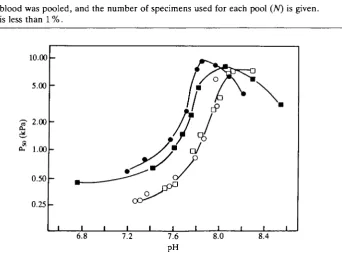
[image:3.451.39.413.221.340.2]Table 1 shows very good agreement between the blood and water osmolality and Cl~ concentration for all the gastropods at both 24 %o and 35 %o salinity. Fig. 1 shows the oxygen affinity expressed as P50 (kPa) as a function of pH at 10 and 20°C. The results indicate the presence of a marked reversed Bohr shift within the pH range 7.2-8.0, as previously reported (Torensma and Brix, 1981). Below pH 7.2 there was no Bohr effect. At 10°C there was no effect of salinity on the pH
Table 1. Osmolarity and Cl~ concentration of Neptunea antiqua blood, in 15
animals acclimated to 24 %o salinity and 14 animals acclimated to 35 %o salinity for several months, and of the ambient water
Water Blood water (So) 24 24 24 35 35 35 The S.D.
y u i
Osmolarity (mosmoll"1)
710 776 749 1090 1086 1070
blood was pooled, and the is less than 1%.
[cr]
(mmoir1)381 385 384 566 559 560 Osmolarity (mosmoll"1)
700 750 735 1070 1056 1070
number of specimens used for each
[cr]
(mmoir1)351 375 368 555 544 555
[image:3.451.67.410.347.602.2]pool (TV) is given. N 5 6 4 5 4 5
420
O. BRIX AND OTHERS
67.0-
50.2-o 2
33.5-
16.7-0.0
6.5 7.0 7.5 8.0
PH
5
4
- 3
- 2
-o
D. <
[image:4.451.66.386.66.293.2]8.5
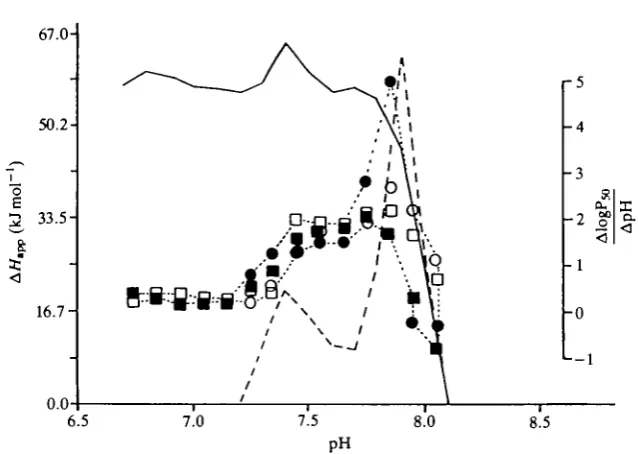
Fig. 2. Apparent heat of oxygenation, A//app at 35 %o salinity (solid line) and 24 %o
salinity (broken line), and the Bohr factor expressed by AlogPso/ApH (symbols) as a function of pH. ( • ) 24%o salinity and 25°C; (O) 24%, salinity and 15°C; ( • ) 35%o salinity and 25°C; ( • ) 35 %o salinity and 15°C. The points represent single measure-ments.
dependence of oxygen affinity, while at the higher temperature increased salinity decreased the O2 affinity. Neither temperature nor salinity seemed to change the magnitude of the Bohr shift except for one point at about pH7.8, where a marked Bohr shift was observed in the low-salinity blood at 25°C (Fig. 2). Fig. 2 also shows a very low temperature sensitivity in the low-salinity blood. When the heat of solution of oxygen was subtracted, the overall heat of oxygenation (AH) approached zero. At pH7.8, where there was a large increase in the magnitude of the Bohr effect, there was a marked increase in AH. In the high-salinity blood, the
AH value was relatively constant up to just below pH8.0. Subtracting the heat of
solution of oxygen, AH is about -46.0kJ mol"1. In the present analysis we focus on the O2-binding behaviour of the whole blood in the pH range of the reversed Bohr shift.
Fig. 3 shows some of the fitted curves for both low- and high-salinity blood at 15 (solid lines) and 25°C (broken lines). For both low- and high-salinity blood we found a marked shift in the low-affinity state (T-state, represented by the lower asymptote) with pH (Fig. 3). Temperature had very little influence on the T-states of blood at 24 %o (at constant pH values) but for 35 %o blood a significant rightward shift was seen in the middle pH range. The minimum and maximum P50 values of the T-state were fairly constant in all the blood analysed (Fig. 4).
100
10
0.1
35 %o
7.74-^
24 %.
[image:5.451.48.412.51.293.2]0.1 10 0.1 10
Fig. 3. Hill plots for low- and high-salinity blood from Neptunea antiqua at 15°C (solid lines) and 25°C (broken lines) at two salinities and constant carbon dioxide tensions. pH values are indicated for each curve. The data points are shown only in one curve for clarity. 1, 2, 3 and 4 indicate the four different R-states, which can be identified from the plot.
stabilized at a lower oxygen affinity (3 in Figs 3 and 4). The lack of effect of pH on the R-state implies that the Bohr shift was present mainly when the first molecules of O2 were bound, as can also be seen in Fig. 4. In the high-salinity blood, however, the R-state was pH-dependent. Four different R-states are demon-strated in the Hill plots of Fig. 3. These are also indicated in Fig. 4, which outlines the very sharp transition induced by raising pH.
Discussion
The present investigation demonstrates a very large difference in thermal sensitivity between low- and high-salinity blood from the arctic marine proso-branch gastropod Neptunea antiqua. The effect of salinity on the O2-binding behaviour decreases with decreasing temperature. Against this background it is possible to speculate on the possible ecophysiological relevance of these findings.
422
O. BRIX AND OTHERST-state
6.5 7.0 7.5 8.0
[image:6.451.119.336.58.394.2]pH
Fig. 4. The oxygen affinities of the T-state (A) and the R-states (B) in the blood of 35 %o- (filled symbols) and 24 %o- (open symbols) acclimated Neptunea antiqua expressed as the P50 values as a function of pH at 15°C (V) and 25°C (A). The four different R-states referred to in the text are indicated in B. The points represent single measurements.
pH would increase the O2 affinity via the reversed Bohr shift, thus keeping it stable.
In the North Atlantic, however, where the gastropod experiences a limited range of temperatures, rarely exceeding 10°C, a combination of high salinity and shallow water often occurs. The low temperature may thus protect the gastropod from the effects of salinity on O2 binding.
At present it must be clearly stressed that our knowledge of in vivo temperature-induced changes of blood pH is very limited and further investigation is called for. Some recent papers on crustacean haemocyanins may be very useful in elucidating the possible mechanisms underlying the findings of the present investigation. Anderson et al. (1982) demonstrated for crustacean haemocyanin that the number of available binding sites for the allosteric modulator Ca2 +, which is known to raise O2 affinity in haemocyanins with a normal Bohr shift, increases with temperature. In this case, a greater interaction between calcium ions and haemocyanin at higher temperature would tend to increase O2 affinity while temperature is acting to decrease it. This feature would thus tend to decrease the effect of higher temperatures (Burnett et al. 1988). However, in blood characterized by a reversed Bohr shift, the greater calcium ion activity would reduce O2 affinity by increasing P50 (Diefenbach and Mangum, 1983). Therefore, one could expect a larger temperature-induced decrease in O2 affinity at higher temperature, caused by an increase in haemocyanin calcium-binding in combination with higher Ca2 + activity. From previous results obtained on N. antiqua haemocyanin (Torensma and Brix, 1981), CY~ would be expected to have the same effect. However, a definitive conclusion must await a direct demonstration of the effect of tempera-ture on the binding of inorganic ions.
OB was supported by the National Research Council of Norway (NAVF) by grant no. D.61.46.053.
References
ANDERSON, T., CHIANCONE, E. AND FORSEN, S. (1982). Characterization of cation-binding sites on Panulirus interruptus hemocyanin by 43Ca and sN a NMR. Eur. J. Biochem. 125,103-108.
BRIDGES, C. R. (1986). A comparative study of the respiratory properties and physiological function of hemocyanin in two burrowing and two non-burrowing crustaceans. Comp. Biochem. Physiol. 83A, 261-270.
BRIX, O. (1982). The adaptive significance of the reversed Bohr and Root shifts in the blood from the marine gastropod, Buccinum undatum. J. exp. Zool. 221, 27-36.
BRIX, O. (1983). Blood respiratory properties in the marine gastropods. In The Mollusca. Environmental Biochemistry and Physiology, vol. 2 (ed. P. W. Hochacka) (ed. in chief K. M. Wilbur), pp. 51-75. New York: Academic Press.
BRIX, O., BARDGARD, A., CAU, A., COLOSIMO, A., COND6, S. G. AND GIARDINA, B. (1989a). Oxygen-binding properties of cephalopod blood with special reference to environmental temperatures and ecological distribution. J. exp. Zool. 252, 34-42.
BRIX, O., BORGUND, S., BARNUNG, T., COLOSIMO, A. AND GIARDINA, B. (1989i). Endothermic oxygenation of hemocyanin in the krill, Meganyctiphanes norvegica: A possible adaptation to diurnal vertical migration through thermocline. FEBS Lett. 247, 177-180.
424 O. BRIX AND OTHERS
hemocyanin of the marine prosobranch, Buccinum undatum: Adaptation to a periodically hypoxic habitat. /. comp. Physiol. B 129, 97-103.
BURNETT, L. E., SCHOLNICK, D. A. AND MANGUM, C. P. (1988). Temperature sensitivity of molluscan and arthropod hemocyanins. Biol. Bull. mar. biol. Lab., Woods Hole 174, 153-162.
DIEFENBACH, C. O. DA C. AND MANGUM, C. P. (1983). The effects of inorganic ions and acclimation salinity on oxygen binding of the hemocyanin of the horseshoe crab Limulus
polyphemus. Molec. Physiol. 4, 197-206.
MANGUM, C. P. (1981). The influence of inorganic ions and pH on HcO2 transport systems.-In
Invertebrate Oxygen-Binding Proteins. Structure, Active Site, and Function (ed. J. Lamy and
J. Lamy), pp. 811-822. New York: Marcel Dekker.
MANGUM, C. P., BOOTH, C. E., DEFUR, P. L., HECKEL, N. A., HENRY, R. P., OGLESBY, L. C. AND POLITES, G. (1976). The ionic environment of hemocyanin in Limulus polyphemus. Biol.
Bull. mar. biol. Lab., Woods Hole 150, 453-467.
MANGUM, C. P. AND LYKKEBOE, G. (1979). The influence of inorganic ions and pH on oxygenation properties of the blood from the gastropod mollusc Busy con canaliculatum.
J. exp. Zool. 207, 417-430.
MAURO, N. A. AND MANGUM, C. P. (1982a). The role of the blood in the temperature dependence of oxidative metabolism in decapod crustaceans. I. Intraspecific responses to seasonal differences in temperature. J. exp. Zool. 219, 179-188.
MAURO, N. A. AND MANGUM, C. P. (19826). The role of the blood in the temperature dependence of oxidative metabolism in decapod crustaceans. II. Interspecific adaptations to latitudinal changes. /. exp. Zool. 219,189-195.
MONOD, J., WYMAN, J. AND CHANGEUX, J. P. (1965). On the nature of allosteric transitions: a plausible model. /. molec. Biol. 12, 88-118.
MORRIS, S. AND BRIDGES, C. R. (1986). Oxygen binding by the hemocyanin of the terrestrial hermit crab Coenobita clypeatus (Herbst) - the effect of physiological parameters in vitro.
Physiol. Zool. 59, 606-615.
MORRIS, S., TAYLOR, A. C , BRIDGES, C. R. AND GRIESHABER, M. K. (1985). Respiratory properties of the haemolymph of the intertidal prawn Palaemon elegans (Rathke). J. exp.
Zool. 233, 175-186.
REDFIELD, A. C. (1934). The haemocyanins. Biol. Rev. 9, 175-212.
SANDERS, N. K. AND CHILDRESS, J. J. (1985). Unusual oxygen binding properties of the deep sea hydrothermal crab Bytheograea thermydron. Am. Zool. 25, 119A.
TORENSMA, R. AND BRIX, O. (1981). Oxygen binding of Neptunea antiqua hemocyanin. Molec.
Physiol. 1, 213-221.