Primed in Great Britain © The Company of Biologists Limited 1991
5-HYDROXYTRYPTAMINE: A SECOND DIURETIC HORMONE IN RHODNIUS PROUXUS
BY S. H. P. MADDRELL1, W. S. HERMAN2, R. L. MOONEY3 AND J. A. OVERTON1
1 Department of Zoology, Downing Street, Cambridge, CB2 3EJ, England,
2Department of Genetics and Cell Biology, University of Minnesota, St Paul,
MN 55414, USA and 3'School of Medicine, Medical College of Virginia, Richmond, VA 23298-1092, USA
Accepted 26 October 1990
Summary
Bioassays of 5-hydroxytryptamine (5-HT) in fifth-instar Rhodnius prolixus haemolymph using Calliphora salivary glands indicate that: (1) biologically active 5-HT is present, (2) in unfed animals there is not enough 5-HT to stimulate Malpighian tubule fluid secretion, and (3) there is enough 5-HT soon after the initiation of feeding to stimulate rapid tubule secretion. The 5-HT receptor antagonists ketanserin and spiperone reversibly and selectively inhibit 5-HT-induced fluid secretion, indicating the presence of specific 5-HT receptors on Rhodnius Malpighian tubules. The data provide evidence that 5-HT is a naturally occurring hormone acting with a previously described peptide hormone to regulate diuresis in this species.
Introduction
Diuresis in the blood-sucking bug Rhodnius prolixus Stal was first shown to be under the control of a diuretic hormone (DH), secreted by neurosecretory cells in the mesothoracic ganglionic mass and acting on the Malpighian tubules to produce very rapid fluid secretion (Maddrell, 1963). Later, it emerged that 5-hydroxytrypt-amine (5-HT, serotonin) would stimulate rapid fluid secretion by in vitro preparations of the Malpighian tubules (Maddrell et al. 1969,1971). The neurosec-retory DH was shown to be a peptide hormone (Aston and White, 1974). At that time it was considered that the stimulatory effect of 5-HT on Malpighian tubule fluid secretion was pharmacological rather than physiological, with 5-HT mim-icking the action of DH, perhaps by interacting with DH receptors on the tubule cells (Maddrell et al. 1971). It had been argued that amines might in some situations be able to interact with receptors for peptide hormones in cases where the side chains of amino acids in the peptide chain occupied spatially similar positions to the component groups of the amine mimic (Maddaiah, 1969).
Recently, chemical analysis has shown that, during feeding in Rhodnius, 5-HT increases rapidly in concentration in the haemolymph from the low values found in the resting insect (Lange et al. 1989). It reaches a peak concentration of about 1CT7 mol I"1 after 5 min and then steadily declines to a lower level by 1 h after the start of feeding (Lange et al. 1989). The peak concentration would be sufficient to cause considerably elevated rates of fluid secretion by the isolated Malpighian tubules (Maddrell et al. 1971). This finding raises the exciting possibility that 5-HT plays a hormonal role in controlling fluid secretion by the Malpighian tubules. Crucially, however, it was not clear from the chemical measurements of 5-HT levels in whole blood (Lange et al. 1989) whether 5-HT was free in the haemolymph and able to interact with the Malpighian tubules; conceivably much of the 5-HT could be contained within the blood cells or be present in a conjugated form and so be unavailable to the tubules. In the rabbit, for example, 5-HT in whole blood is largely confined to the platelets, where its concentration is 25000 times higher than in the plasma (Da Prada and Picotti, 1979).
In the present paper, we present evidence to show (1) by bioassay that free 5-HT does appear at physiologically relevant concentrations in the haemolymph of fed Rhodnius and (2) that Malpighian tubules possess specific 5-HT receptors separate and distinct from those for DH. These results, we believe, provide strong evidence that 5-HT acts as a hormone controlling diuresis in Rhodnius.
Materials and methods
Rhodnius prolixus and Calliphora vicina were obtained from laboratory cultures maintained in the Zoology Department of Cambridge University. The upper (distal) fluid-secreting parts of the Malpighian tubules were dissected from fifth-instar Rhodnius 1-2 weeks after moulting. The tubules were placed in suitably sized drops of Rhodnius saline (Maddrell et al. 1988) containing appropriate concentrations of 5-HT or other agents, and their secretion was monitored under liquid paraffin (mineral oil) for up to l h (Maddrell et al. 1988). Salivary glands were dissected from adult female Calliphora 1-2 weeks after eclosion and their secretory activity was measured by techniques identical to those used for examining Rhodnius tubules. Dissections of salivary glands were performed in Calliphora saline (Berridge and Patel, 1968).
secretion in saline, a higher response in 10 % than in 1 % haemolymph, and a high rate of secretion in 10~6molP: 5-HT were included in this study. This procedure allowed us to determine both the rate of secretion and the percentage of the maximal rate for each gland. The effectiveness of this bioassay relies on the fact that 5-HT is a very effective stimulator of Calliphora salivary glands at concen-trations as low as 10~9mol I"1 (Berridge and Patel, 1968; Berridge, 1970), and it is known to be the in vivo regulator of those glands (Trimmer, 1985). No other substance produced by Rhodnius is known to stimulate salivary glands (S. H. P. Maddrell, unpublished results) but, to establish that the glands in our bioassay were reacting to the presence of 5-HT, we treated stimulated salivary glands with gramine, an effective and specific competitive inhibitor of 5-HT action on the glands (Berridge, 1972).
To produce extracts rich in the peptide DH, we dissected mesothoracic ganglionic masses from fifth-instar Rhodnius (Maddrell, 1963), homogenized them in distilled water, sonicated the extracts for 30 s, and made them up to the required dilution in saline.
5-HT (creatinine sulphate complex), cyclic AMP (adenosine 3',5'-cyclic mono-phosphoric acid) and spiperone were obtained from Sigma, gramine [3-(dimethylaminomethyl)-indole] from Aldrich, and ketanserin tartrate from Cambio, Cambridge. The latter three compounds were initially dissolved in 100 % ethanol and subsequently diluted with Rhodnius saline. Data are presented as mean±s.E.M. Statistical analysis used Student's Mest. In this report the term significant refers to statistical significance in that test at P<0.05. All determi-nations of tubule or salivary gland secretion were conducted at room temperature (21-25 °C).
Results
5-HT activity in Rhodnius haemolymph
We examined the ability of haemolymph from fed and unfed fifth-instar Rhodnius to stimulate secretion by Calliphora salivary glands (Table 1).
Haemo-Table 1. Stimulation of Calliphora salivary gland secretion by Rhodnius haemo-lymph
Percentage Estimated Rate of [5-HT]
Condition TV (nlmin"1) maximum ^
Unfed Fed for 5 min Fed for 60 min
18 19 12
2.6±1 10.1±2 2.1 + 1
.4 .3 .2
8 33 5
.0±2.5 .7±6.6 .1±2.9
1 5 1
.5±0.3 .1±1.7 .2±0.2
lymph from unfed Rhodnius stimulated low levels of salivary gland secretion, whereas that from animals fed for 5 min stimulated secretion at 3.9 times the rate observed for unfed animals. Haemolymph obtained 60 min after the initiation of feeding stimulated low levels of salivary gland activity.
Estimated 5-HT titres in fifth-instar larvae
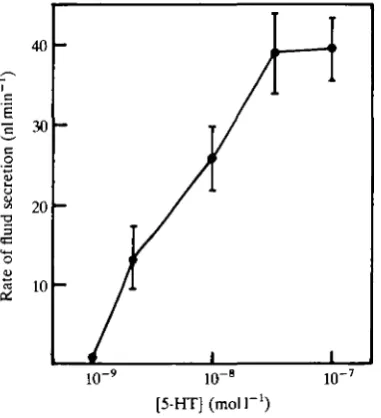
To estimate 5-HT levels in Rhodnius haemolymph, we first determined the dose-response relationship of 5-HT and salivary gland secretion in our experimen-tal conditions (Fig. 1). Maximal secretion occurred at doses above 3xlO~8moll~1 and no response was observed with 5-HT at less than 10~9mol I"1; these values are similar to, but somewhat higher than, those obtained by Berridge (1970). We then used the secretion rate observed in 10 % haemolymph to determine the percentage of the maximum response obtained in each haemolymph sample, and used that data and the dose-response curve to estimate the amount of 5-HT present in each haemolymph sample.
Our bioassays indicated significantly higher 5-HT titres (3.4 times) within a few minutes after the initiation of feeding (Table 1). Considerable variation was observed in these bioassays; haemolymph from 22 % of animals fed for 5 min and 69 % of the others produced no response. All of the unresponsive animals were assumed to have haemolymph titres of 0.9xlO~8molP1 5-HT, since after 10-fold dilution that would be the highest value that would not be detected in our system (see Fig. 1).
40
20
10
-1 -1
1
1
H
i
10" 10"8 [5-HT](moir')
[image:4.451.129.320.375.584.2]10"
Fig. 1. Dose-response relationship for 5-hydroxytryptamine (5-HT) action on
Calli-phora vicina salivary glands. Rates were determined for the first 10 min of stimulation
Stimulation of Calliphora salivary glands affected by gramine
Although we believed in the above experiments that we were measuring 5-HT levels in haemolymph, the possibility existed that some other substance might be responsible for the observed stimulation of salivary glands. To test this possibility we used gramine, an effective competitive inhibitor of 5-HT stimulation of Calliphora salivary glands (Berridge, 1972). 15-20 /A samples of haemolymph were taken from nfth-instar Rhodnius fed for 5 min. They were diluted with an equal volume of saline or with an equal volume of saline containing 2xlO~4moll~1 gramine. Six glands, each in a 10 jA drop of haemolymph diluted with saline, secreted fluid at a rate of 21.0±1.8nlmin~1 during the first 12 min. Six glands, each in a 10/xl drop of haemolymph with gramine at a final concentration of 10~4moll~1, secreted fluid during the first 12min at a rate of 3.3±1.0nlmin~1, which is more than six times more slowly. From Berridge's (1972) data, inhibition by 10~4moll~1 gramine of this extent would be expected in the presence of about 2xlO~8moll~1 5-HT, corresponding to a concentration of 5-HT in the original samples of haemolymph of about 4xlO~8moll~1, which is very similar to our estimates based on secretion in more diluted samples of haemolymph.
Effect of 5-HT antagonists on Malpighian tubules and salivary glands Dose-response curves for ketanserin and spiperone in the presence of 5-HT are shown in Fig. 2. Both substances totally inhibited fluid secretion by Malpighian tubules from fifth-instar larvae when present at 10~5moll~1 or more, but ketanserin was about 10 times more effective than spiperone. The data show the reduction in the amount of fluid secreted within 30 min of applying the drugs. This partially obscures the facts that ketanserin at 10"6moll~1 stops all fluid secretion
0
20
40
60
80
m
-i
ASpiperone \^_
\
i i i i \
T B
^ \
Ketanserin >I
[image:5.451.69.383.410.595.2]10"
ur
10" 10" 10" 10" 10"[Inhibitor] (moll"1)
after about 15min, and that at 3x10 7moll 1 ketanserin inhibition is more than 90% complete within 30min. To test the idea that even lower concentrations of ketanserin might, over still longer times, be effective, we pretreated tubules for 90min in concentrations of ketanserin lower than 10~7moll~1. None of these tubules was significantly inhibited when subsequently exposed to 10~6moll~1 5-HT plus the same low ketanserin concentrations as in the pretreatment.
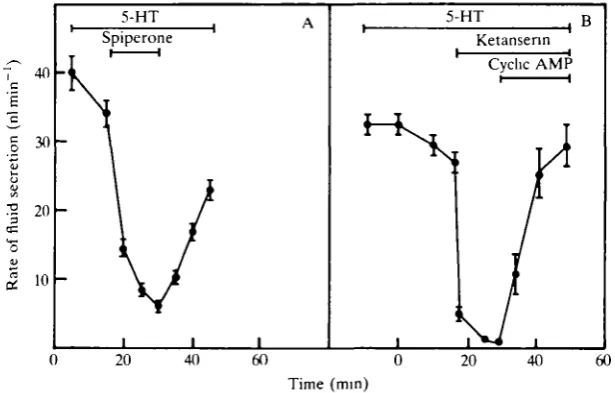
Secretory activity of inhibited tubules could be restored by removal of inhibitors from the bathing medium (Fig. 3A). Cyclic AMP at 2.5xlO"4moll"1 rapidly activated the tubules in the presence of inhibitors (Fig. 3B). Data similar to that shown in Fig. 3 were obtained for both antagonists. Clearly, ketanserin and spiperone have no toxic effects on the tubules, but are effective and reversible inhibitors of 5-HT stimulation.
Two kinds of experiments were done to examine the specificity of ketanserin action. The rate of fluid secretion by 5-HT-stimulated Calliphora salivary glands was unaffected by high concentrations of ketanserin. In the presence of 10 moll ketanserin, secretion by 5-HT-stimulated (10 moll ) salivary glands was n ^ l S . O n l m i n "1 (N=4) compared with 20.7±3.3nlmin"1 (N=4) secreted by control glands in saline containing the same level of 5-HT, but no ketanserin.
Additionally, ketanserin does not affect fluid secretion by Malpighian tubules of Rhodnius stimulated with extracts containing the peptide DH. Three tubules in
40
30
3 20
5-HT Spiperone
5 H T
Ketansenn Cyclic AMP
20 40 60 40 60
[image:6.451.71.379.360.556.2]Time (min)
saline containing 0.2 ganglionic masses per 100 (A and 10~6moll~1 ketanserin secreted fluid at 19.0±3.3 nl min"1, whereas three tubules in saline containing only DH extract secreted at an identical rate (18.9±6.1nlmin~1\ By contrast, fluid secretion decreased from 54.3±4.5nlmin~1 (N=3) in tubules treated with 5-HT (10~6moir1) to 1.8±0.2nlmin"1 (N=3) in tubules treated with 5-HT plus ketanserin (10~6moH"1).
Discussion
Our data show by bioassay that 5-HT in the haemolymph of fed Rhodnius is not confined to the blood cells or present in an inactive form. We find that, 5 min after feeding begins in fifth-instar larvae, 5-HT reaches an effective concentration in the haemolymph of 5.1 xlO~8 moll"1. In unfed insects and in insects l h after feeding has begun, the effective concentration is a little above 10~8moll~1. These values are similar to, but somewhat lower than, those determined by chemical means with HPLC by Lange et al. (1989), who found that total 5-HT levels in the haemolymph rose from around 10~8moll~1 to more than 10"7moll~1. If the differences between our findings and those of Lange et al. (1989) are significant, they may indicate that about half the 5-HT in circulation is not free and is perhaps sequestered in blood cells, as happens in mammals (Da Prada and Picotti, 1979). Alternatively, the difference may arise from natural variation between the two stocks of Rhodnius. What is clear, however, is that the effective concentration of free 5-HT in the haemolymph of fed Rhodnius is sufficient to cause at least partial stimulation of the Malpighian tubules (Maddrell et al. 1971).
We find that Rhodnius Malpighian tubules have receptors for 5-HT that can be blocked by ketanserin and spiperone, known in vertebrate systems to be specific for a particular subclass of 5-HT receptors (Conn et al. 1986; Julias et al. 1990). Ketanserin is an effective blocker of 5-HT stimulation of Rhodnius Malpighian tubules at all concentrations above 2xlO~7 to 3xlO~7moll~1. The inhibition is rapidly relieved if the tubules are treated with 2.5 xlO~4 moll"1 cyclic AMP in addition to ketanserin, so the effects of ketanserin are not caused by non-specific toxicity. Ketanserin is less effective in Rhodnius tubules than in several vertebrate systems, where it often has significant effects at 10~8moll ~l or less (Conn et al. 1986; Julias et al. 1990). This may indicate a difference between 5-HT receptors of vertebrates and insects. We believe, nonetheless, that ketanserin is a specific inhibitor of a class of 5-HT receptors in insects, because we find it to be ineffective in blocking 5-HT stimulation of fluid secretion by Calliphora salivary glands even at 10~5moll"1, a concentration 30 times higher than that causing virtually complete inhibition of 5-HT stimulation of Rhodnius tubules. We have also found that ketanserin-blocked tubules can still be stimulated by extracts of mesothoracic ganglionic masses, which contain the neurosecretory peptide DH. This indicates that the peptide DH acts through a receptor (or receptors) other than the ketanserin-sensitive 5-HT receptor.
in the haemolymph of fed Rhodnius, but also of specific 5-HT receptors on the Malpighian tubules.
There is evidence that 5-HT is capable of stimulating tubules in all postembry-onic stages of Rhodnius (Skaer etal. 1990; W. S. Herman, J. A. Overton and S. H. P. Maddrell, in preparation). 5-HT is produced by, and released from, a neurosecretory system located in the Rhodnius mesothoracic ganglion and associated abdominal nerves (Orchard, 1989), and the 5-HT content of that neurosecretory system is reduced during feeding (Orchard etal. 1988). In addition, Montoreano et al. (1990) report that 5-HT increases cyclic AMP secretion by isolated Rhodnius tubules and 5-HT activates adenylate cyclase in cell membranes isolated from Malpighian tubules of Rhodnius fifth-instars (W. S. Herman, R. W. Farndale and S. H. P. Maddrell, in preparation).
The available evidence therefore demonstrates the following in Rhodnius. (1) The Malpighian tubules of all postembryonic stages can respond to 5-HT. (2) A system capable of producing and releasing 5-HT is present in the nervous system. (3) 5-HT is released from that system into the haemolymph early in the feeding process. (4) Haemolymph titres of free 5-HT shortly after the onset of feeding are sufficient to stimulate tubule secretion. (5) Elevated haemolymph 5-HT concen-tration is correlated with an elevated rate of diuresis. (6) Specific 5-HT receptors are present on the tubules. (7) 5-HT stimulates the cyclic AMP second messenger system of tubules. We therefore believe that 5-HT should be considered to be a diuretic hormone acting with the previously described peptide DH to promote rapid postprandial diuresis, at least in fifth-instar Rhodnius. Furthermore, it appears likely that both hormones promote rapid diuresis in Rhodnius of all post-embryonic stages. The effects of 5-HT on Rhodnius Malpighian tubules do not appear to be pharmacological; rather, they reflect a normal physiological function of that substance.
As noted above, circulating levels of 5-HT never appear to be sufficient in themselves to stimulate maximal secretion by Rhodnius tubules. Elsewhere we present evidence that the peptide DH and 5-HT act synergistically to promote maximal secretion by Malpighian tubules (W. S. Herman, R. W. Farndale and S. H. P. Maddrell, in preparation). Since several other insect species possess tubules responding to both peptides and 5-HT (Nicolson and Millar, 1983; Morgan and Mordue, 1984; Veenstra, 1988; Coast, 1989), it may be that 5-HT is also acting hormonally (and synergistically?) in such systems. Control of Malpighian tubules by more than one hormone appears to be common in a variety of insect species (Spring, 1990; Wheeler and Coast, 1990).
magnitude lower than those required to stimulate the Malpighian tubules of Rhodnius (Berridge, 1972).
We gratefully acknowledge the part played by the late John Treherne in making this collaboration possible, and we thank the AFRC for their support of this work in its initial stages. We also thank John and Charlotte Sparkes for their contributions to this research. Funds to support part of this work were provided by the University of Minnesota.
References
ASTON, R. J. AND WHITE, A. F. (1974). Isolation and purification of the diuretic hormone from
Rhodnius prolixus. J. Insect Physiol. 20, 1673-1682.
BERRIDGE, M. J. (1970). The role of 5-hydroxytryptamine and cyclic AMP in the control of fluid secretion by isolated salivary glands. /. exp. Biol. 53, 171-186.
BERRIDGE, M. J. (1972). The mode of action of 5-hydroxytryptamine. J. exp. Biol. 56, 311-322. BERRIDGE, M. J. AND PATEL, N. G. (1968). Insect salivary glands: stimulation of fluid secretion
by 5-hydroxytryptamine and adenosine 3',5'-monophosphate. Science 162, 462-463. COAST, G. M. (1989). Stimulation of fluid secretion by single isolated Malpighian tubules of the
house cricket, Acheta domesticus. Physiol. Entomol. 14, 21-30.
CONN, P. J., SANDERS-BUSH, E., HOFFMAN, B. J. AND HARTIG, P. R. (1986). A unique serotonin receptor in choroid plexus is linked to phosphatidylinositol turnover. Proc. natn. Acad. Sci.
U.S.A. 83,4086-4088.
DA PRADA, M. AND Picorn, G. B. (1979). Content and subcellular localization of catecholamines and 5-hydroxytryptamine in human and animal blood platelets: monoamine distribution between platelets and plasma. Br. J. Pharmacol. 65, 653-662.
FRIEND, W. G. AND CARTWRIGHT, E. (1963). A practical apparatus for feeding artificial diets to all stages of Rhodnius prolixus Stal. Can. Ent. 95, 362-364.
JULIAS, D. K., HUANG, N., LPVELLI, T. J., AXEL, R. AND JESSELL, T. M. (1990). The 5-HT2
receptor defines a family of structurally distinct but functionally conserved serotonin receptors. Proc. natn. Acad. Sci. U.S.A. 87, 928-932.
LANGE, A. B., ORCHARD, I. AND BARRETT, F. M. (1989). Changes in haemolymph serotonin levels associated with feeding in the blood-sucking bug, Rhodnius prolixus. J. Insect Physiol. 35, 393-399.
MADDAIAH, V. T. (1969). A model for hormone specific activation of adenyl cyclase. Fedn Proc.
Fedn Am. Socs exp. Biol. 24, 1368-1376.
MADDRELL, S. H. P. (1963). Excretion in the blood-sucking bug, Rhodnius prolixus Stal. I. The control of diuresis. /. exp. Biol. 40, 247-256.
MADDRELL, S. H. P., LANE, N. J., HARRISON, J. B., OVERTON, J. A. AND MORETON, R. B. (1988). The initial stages in the action of an insecticidal 6-endotoxin of Bacillus thuringiensis var.
israelensis on the epithelial cells of the Malpighian tubules of Rhodnius prolixus. J. Cell Sci.
90,131-144.
MADDRELL, S. H. P.,PILCHER, D. E. M. AND GARDINER, B. O. C. (1969). Stimulatory effect of 5-hydroxytryptamine (serotonin) on secretion by Malpighian tubules of insects. Nature 222, 784-785.
MADDRELL, S. H. P., PILCHER, D. E. M. AND GARDINER, B. O. C. (1971). Pharmacology of the Malpighian tubules of Rhodnius and Carausius: the structure-activity relationship of tryptamine analogues and the role of cyclic AMP. /. exp. Biol. 54, 779-804.
MONTOREANO, R., TRIANA, F., ABATE, T. AND RANGEL-ALDAO, R. (1990). Cyclic AMP in the Malpighian tubule fluid and in the urine of Rhodnius prolixus. Gen. comp. Endocr. 77, 136-142.
MORGAN, P. J. AND MORDUE, W. (1984). 5-Hydroxytryptamine stimulates fluid secretion in locust Malpighian tubules independently of cAMP. Comp. Biochem. Physiol. 79C, 305-310. NICOLSON, S. W. AND MILLAR, R. P. (1983). Effects of biogenic amines and hormones on
ORCHARD, I. (1989). Serotonergic neurohaemal tissue in Rhodnius prolixus: synthesis, release and uptake of serotonin. J. Insect Physiol. 35, 943-947.
ORCHARD, I., LANGE, A. B. AND BARRETT, F. M. (1988). Serotonergic supply to the epidermis of
Rhodnius prolixus: evidence for serotonin as the plasticising factor. /. Insect Physiol. 34,
873-879.
SKAER, H. LE B., HARRISON, J. B. AND MADDRELL, S. H. P. (1990). Physiological and structural maturation of a polarized epithelium: the Malpighian tubules of a blood-sucking insect,
Rhodnius prolixus. J. Cell Sci. 96, 537-547.
SPRJNG, J. (1990). Endocrine regulation of diuresis in insects. J. Insect Physiol. 36, 13-22.
TRIMMER, B. A. (1985). Serotonin and the control of salivation in the blowfly Calliphora. J. exp.
Biol. 114, 307-328.
VEENSTRA, J. A. (1988). Effects of 5-hydroxytryptamine on the Malpighian tubules of Aedes
aegypti. J. Insect Physiol. 34, 299-304.