Yu He
Assigned by:
THE LIFECYCLE MODEL FOR CLOUD
I
Master Thesis
The Lifecycle Process Model for Cloud Governance
Author
Yu He
Program Msc. Business Information technology
Student Number S1024221
E-mail [email protected]
Graduation Committee
Maria Eugenia Iacob
Department University of Twente, Information System &
Change Management
Email [email protected]
Marten van Sinderen
Department University of Twente, Computer Science
Email [email protected]
René Kleizen
Department Logica , Working Tomorrow
II
Management Summary
The concept of cloud computing has gained much attention in recent years. Cloud computing enables organizations to scale and change their services easily. However, the new business model drives client organizations to reevaluate their current processes and structure for the control. Cloud governance is a new concept established to cope with the control issues regarding the cloud services and to ensure that organizations can realize their business value in a more flexible way through cloud. Since cloud adoption is in the early stage, our model proposes a lifecycle approach to enable organizations to implement their governance incrementally.
This thesis starts from comparison of literatures on SOA governance and Cloud governance, from which five governance areas are derived. The model follows a lifecycle approach and each phrase focuses on a different part of cloud governance. The whole process model is triggered by the process of defining goal for cloud computing. The arrows in our high-level process indicate some causality relationship between the phrases but they do not imply the chronological order. Each process is accompanied with method suggestions and deliverables to make it executable. The highlighted processes indicate that there are some differences between SOA and cloud in those processes. Besides some variations with respect to types of cloud are discussed, however, due to the time limitation the discussions are kept in a higher level.
To increase the practical relevance of this model, a series of interviews covering IaaS, PaaS, and SaaS service have been conducted to show the current state of cloud governance in practice. It turns out that most of the organizations concentrate on contract management. Organizational structure and processes are not yet transformed in most of organizations. From the result of the interviews, we find out that our model basically includes the important parts on cloud governance. In accordance with the interview results, four new processes have been added into our model and one process method has been revised. From our research, some suggestions and findings to ensure successful cloud implementation are made:
Pay more attention to public cloud
Ensure TCO is in place before cloud is introduced and start pilots projects on non-critical application
Cloud coordinator will facilitate cloud adoption
III
Testing security on cloud will be difficult
Delegate incident management and low level configuration management to suppliers , take care of change management
Establish policy management process internally and externally
Monitoring SLA can depend on third party organization to avoid upfront investment
Introduce a self-service portal and registry/repository to support governance
Whether business continuity plan should delegate to suppliers depends on TCO
Evaluate service to compensate lost
Arrange exit plan to avoid vendor lock-in
Unify the control mechanisms in general
Further Researches
We see several improvements which can be made to our lifecycle model in the future:
Further tailor the processes to each type of cloud service, especially for SaaS
Link the roles and processes to clarify the responsibility
Develop a maturity model to guide organizations to implement the governance gradually
IV
Preface
Last year in November I received the internship offer from Riccardo and I was told that my assignment had something to do with cloud governance. At the moment I felt really excited and looked forwards to the new life and research in industry on the most fashionable IT concept – “cloud computing”. Frankly, I had no idea what cloud computing is but the basic IT service that can be acquired like electricity at that time. Since then I started my long journey to explore the essence of cloud computing and its governance mechanisms.
Taking the time to look back at all the results and experience I have received, I believe that my objective has been reached. I have to say that the six-month internship period is the most challenging period of my study in Netherlands. During the time I have to get myself involved into a Dutch working environment, specify the assignment, arrange interviews, and manage my a good quality deliverable within a tight timeframe. Now seeing that my thesis has been finished on time, the experience and skills I have gained, friends I have made and a lot of activities I have joined in, I can proudly announce that I have succeeded my challenging phrase of my life .The research would have never approached its closure without the support and feedback from people around me.
For University of Twente, my supervisors help me out tremendously. First, I would like to thank Maria Iacob, who suggests me to look into the SOA governance approaches and to investigate them for cloud computing. Her advices and own experience as an international student have encouraged me and helped me a lot and kept me continue with my research when I was in a dilemma. Marten van Sinderen, a gentleman I have never met before, walks me through the time when I have questions on my research. I am really grateful for their instructions and assistance during the whole period.
V Of course I own a lot of thanks to all the people who was willing to accept my interviews. You are so kind and supported to spend your own time for an international student. Some of you I just know from the Internet and I am really surprised that you were willing to offer help to such a green student in a kindly manner. Thank you all, Joey Joosten, Robbert Schravendijk, Ruud Ramakers, Roald Kruit, Buve Franc, Wil Janssen, and Maurice van der Woude.
Finally, I would like to thank my family and all my friends, who gave a lot of mental supports to me during the whole six months. Duc, Priscilla, Ravi, Eyla, Mario, and Wei, thank you for checking my work and your comments. Yanting, Haihan and Wei, thanks for the delicious food. You are my family in the Netherlands.
VI
Content
Management Summary ... II Preface ... IV List of Figures ... IX List of Tables ... X
1 Introduction ... 1
1.1 Research Setting ... 1
1.2 Motivation ... 2
1.3 Research objectives and impacts ... 3
1.4 Research Question ... 3
1.5 Research Approach ... 4
1.6 Research Focus ... 5
1.7 Report Structure ... 5
2 Cloud Computing ... 6
2.1 Definition of cloud computing ... 6
2.2 Classification of cloud computing ... 8
2.3 Control of level with regard to cloud types ... 10
2.4 Challenge of Cloud Computing ... 11
3 Cloud Governance ... 12
3.1 Background on Governance ... 12
3.1.1 Corporate Governance ... 12
3.1.2 IT Governance ... 12
3.1.3 SOA governance ... 13
3.1.4 Comparison... 14
3.2 Introduction on Cloud Governance ... 15
3.2.1 Cloud Governance Problem Analysis ... 15
3.2.2 Definition of Cloud Governance ... 16
3.2.3 Position of Cloud Governance ... 17
VII
3.3.1 Schepers’ Lifecycle SOA governance Model ... 20
3.3.2 AUT SOA Governance Framework ... 21
3.3.3 Guo’s Cloud Governance Model ... 22
3.3.4 Microsoft’s Cloud Governance Model ... 23
3.3.5 Comparative Analysis ... 24
4 A Lifecycle Process Model for Cloud Computing ... 27
4.1 Introduction of the Process Model ... 27
4.2 Strategic Plan... 30
4.2.1 Define strategic cloud computing goals ... 31
4.2.2 Create high level adoption approaches ... 33
4.2.3 Involving stakeholders ... 36
4.2.4 Determine service model and delivery model ... 37
4.3 Organizational Alignment ... 39
4.3.1 Create service domains ... 39
4.3.2 Assign responsible teams ... 41
4.3.3 Establish centre of excellent ... 43
4.3.4 Ensure organizational competency ... 44
4.3.5 Create funding model ... 45
4.4 Lifecycle Management ... 48
4.4.1 Define criteria for the services ... 48
4.4.2 Create testing and validation processes ... 51
4.4.3 Create configuration and change processes ... 53
4.4.4 Manage lifecycle of services ... 57
4.5 Policy Management ... 59
4.5.1 Create policy processes ... 60
4.5.2 Define policy enforcement points ... 62
VIII
4.5.4 Create policy reports ... 69
4.6 SLA Management ... 70
4.6.1 Create SLAs ... 70
4.6.2 Monitor compliance ... 74
4.6.3 Evaluate services ... 77
5 Governance-as-a-Service ... 79
6 Model Validation ... 81
6.1 Interview setup ... 81
6.2 Findings ... 83
6.3 Modified process model ... 87
7 Conclusion and further research ... 90
7.1 Research result ... 90
7.2 Limitations and further researches ... 92
References ... 94
Appendices ... 101
Appendix A: Definition of Cloud Governance from Literature ... 101
Appendix B: Collection of Cloud Governance Problems from Literature ... 102
Appendix C: Solution Areas for Cloud Governance ... 105
Appendix D: Centralized and Distributed Governance Model from SOA... 108
Appendix E: Role in cloud computing ... 109
Appendix F: Cost Estimation Example ... 112
Appendix G: Relationship of processes and types of cloud ... 113
Appendix H: Interview Questions ... 115
IX
List of Figures
Figure 1 Organization Structure in Logica ... 1
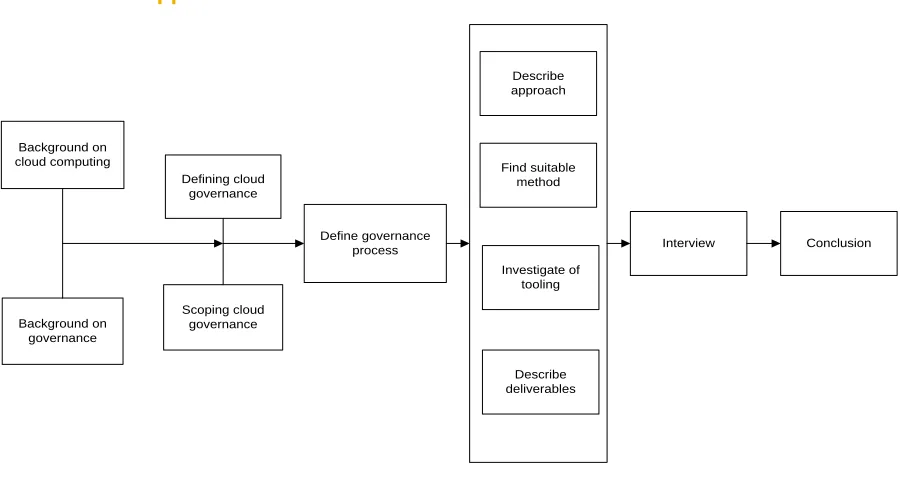
Figure 2 Research Approach ... 4
Figure 3 NIST Cloud Definition Framework(NIST, 2009) ... 10
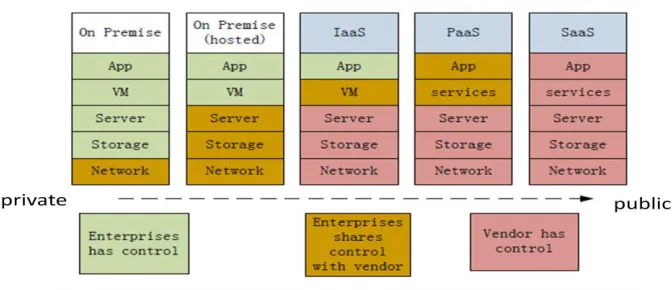
Figure 4 Control Level of Cloud computing (Guo, et al., 2010) ... 11
Figure 5 Challenge of adopting cloud computing(IDC, 2008) ... 11
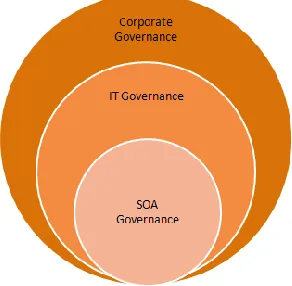
Figure 6 Relationship of different governances ... 14
Figure 7 Position of Cloud Governance ... 19
Figure 8 Lifecycle Method for SOA governance (Schepers, 2007) ... 21
Figure 9 AUT SOA Governance Framework (Hojaji & Shirazi, 2010) ... 22
Figure 10 Cloud Governance Model from Guo et al. (Guo, et al., 2010) ... 23
Figure 11 Microsoft’s Cloud Governance Model(Microsoft, 2010) ... 24
Figure 12 High Level Process for cloud governance ... 29
Figure 13 Low Level process and overview on the delivery of each process ... 29
Figure 14 Strategic Plan ... 30
Figure 15 Example of GQM(Schepers, 2007) ... 31
Figure 16 Cloud computing Maturity Model (Shan, 2010) ... 35
Figure 17 Organizational Alignment ... 39
Figure 18 Lifecycle Management ... 48
Figure 19 Enterprise Service Criteria model(Dow, 2007) ... 49
Figure 20 The Service V-Model(OCG, 2011) ... 52
Figure 21 Registry/Repository for cloud services ... 58
Figure 22 Policy Management ... 60
Figure 23 Policy Enforcement mechanism(Lang, 2010a; Schepers, 2007) ... 67
Figure 24 Service Level Management ... 70
Figure 25 Modified Lifecycle Process Model for Cloud Governance... 89
Figure 26 Centralized Governance Model ... 108
X
List of Tables
Table 1 Definitions of cloud computing ... 8
Table 2 Similarity and differences of cloud governance and SOA governance ... 18
Table 3 Mapping service level of cloud computing and SOA(Ovum, 2010) ... 19
Table 4 Comparative analysis ... 25
Table 5 Description on process discussion template ... 30
Table 6 Example of RACI table ... 37
Table 7 Example of decision making table for different cloud deployment model ... 38
Table 8 Assigning Cloud Responsibility to organizational units ... 43
Table 9 Interview background ... 82
Introduction
The Lifecycle Model for Cloud Governance Page 1
1
Introduction
This chapter presents the research setting, motivation, research objective, research questions and research approach.
1.1
Research Setting
This research takes at Logica, Arnhem. Logica is a major international player in the field of IT and business services with 39,000 employees in 36 countries. It provides solutions and services in the field of consultancy, systems integration, and business process outsourcing. Logica focuses on four market segments, which are Energy and Utilities, Telecom, Finance, Distribution and Transport. Logica strives to deliver custom solutions in order to solve the problems customers face. It is driven to help clients achieve leadership positions and maintain their individual markets. Logica strength lies in the field of industry, domain knowledge, strong managerial and technological knowledge (Logica, 2010).
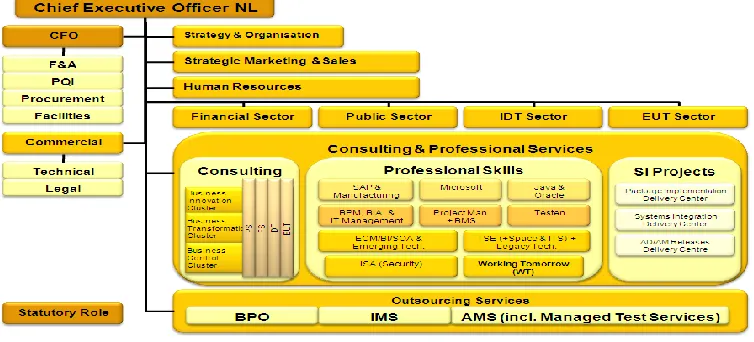
[image:12.612.120.497.457.628.2]The research is executed under the program Working Tomorrow in Logica (see Figure 1). This program has been launched to provide students the opportunity to graduate with good command on an innovative coaching. Student can consult with experienced experts in Logica and any innovative ideas from students are welcome. Working Tomorrow enables students to try on their own ideas in practice. Students in Working Tomorrow will be located among five branches of Logica in the Netherlands.
Introduction
The Lifecycle Model for Cloud Governance Page 2
1.2
Motivation
Cloud computing is an emerging paradigm ,which provides IT services over a network, shared resources, such as software and storage to customers as a service on demand. It is characterized by its on-demand self-service, rapid elasticity and broad network access(Head, Sailer, Shaikh, & Viswanathan, 2009). Cloud computing has three service models (i.e. Software-as-a-service, Platform-as-a-service, Infrastructure-as-a-service) and four deployment models (i.e. private cloud, public cloud, hybrid cloud and community cloud)(NIST, 2009). The advent of the new technology and its potential advantages enable organizations to deploy and maintain applications more easily and flexibly, reducing the time-to-market and saving cost(Armbrust et al., 2010).
According to one cloud computing adoption survey(Mimecast, 2009), which examines the perception and adoption of cloud computing solutions among 565 IT managers across the US and Canada in the Fall of 2009, 62% of all respondents have considered or are considering cloud computing. Nevertheless, there are still myriads of concerns with regards to cloud computing, including security, privacy, location of cloud services and compliance(Armbrust, et al., 2010; Dillon, Chen, & Chang, 2010).
One of the key disciplines to assist in addressing these challenges and realizing the value of cloud in organizations is governance(Guo, Song, & Song, 2010; O'Neill, 2009b).Cloud governance is the discipline of managing outcomes consistent with measurable preconditions and expectations through structured relationships, procedures and policies applied to the organizations and utilization of distributed capabilities which are under the control of different ownership domains.
In the cloud setting, services would be probably running outside consumer organizations. To some extent, the organizations are sort of losing control over the cloud services. Even though some of the Cloud Service Providers (CSP) offer dashboard for tracking the availability of their services and alerting in a timely manner(ManageEngine, 2011), consumer organizations cannot totally rely on the capabilities to ensure the value of cloud to their businesses. For instance, there are some legal restrictions and business requirements from industry, country or the organizations. How can organizations make sure the compliancy of the services if the services are not under their control? What should the organizations do in the case that the services or the monitoring mechanisms from their providers fail?
Introduction
The Lifecycle Model for Cloud Governance Page 3
a long time for the service delivered by the IT departments. However, the autonomy and flexibility will also bring the organizations to a situation where services and applications are becoming silo again, making the integration difficult. In addition, it is dangerous that if anyone can access, alter or configure the services, especially when more and more cloud services are adopted within the organizations and the dependency of the services become complicated. Without understanding the dependency, changing one service might lead to breaking down another service, even a whole supported business system which is built upon those cloud computing services. It will cause a tremendous business loss and diminish the value of introducing cloud computing at the very beginning(Linthicum, 2009).
The need and importance of having a formal cloud governance regimen is emergent for consumer organizations to ease the transition to cloud computing. The governance regimen can establish an approach for the organizations to reduce risks, maintain business alignment, and maximize of value of cloud computing through a combination of people, process, and technology.
Problems on the cloud governance from the perspective of consumer organizations are summarized in Section in 3.2.1.
1.3
Research objectives and impacts
The research aims at defining a process governance model for assisting consumer organizations to govern their cloud services. Within the governance model, activities and approaches will be identified and specified to help the organizations ease the transition to cloud computing. The research impacts are twofold. First, business managers who are responsible for managing IT resources within their organizations will have a guideline to manage the cloud computing services/assets as well as to align their business needs with the organizations. Managers can rely on this model to figure out the needs to change their organizational structure and introduce new tools to ensure the quality and usage the cloud services. Second, this model can serve as an input for providers to search for new opportunities to develop the governance tools for cloud computing. Besides, they can use this model to analyze their existing capabilities provided to their consumers and to enhance their supporting capability to better cater to the needs of their consumers.
1.4
Research Question
This thesis is guided by the main research question, which is formulated as follows:
Introduction
The Lifecycle Model for Cloud Governance Page 4
The main research question is refined into the following sub-questions:
1. What are the activities needed to control cloud computing?
Those activities are the steps which business and IT departments should follow. Those steps will serve as the foundation on which cloud computing governance processes can be built.
2. How can cloud governance be tailored to different types of clouds?
Cloud computing has different service models and deployment models. The processes might be different regarding the types of cloud. The service models and deployment models are described in Sec. 2.2.
3. What tools can support cloud governance processes?
Tools can be methodical and help practitioner to create deliverables. Some of the tools can be software tools which can be used to support the deliverables of cloud governance.
4. Should organizations outsource governance?
This section will discuss whether those tools should be placed in cloud and whether they should be outsourced.
5. How can we test the proposed model?
1.5
Research Approach
Background on cloud computing
Background on governance
Defining cloud governance
Scoping cloud governance
Define governance
process Interview Conclusion
Describe approach
Find suitable method
Investigate of tooling
[image:15.612.81.533.410.651.2]Describe deliverables
Figure 2 Research Approach
Introduction
The Lifecycle Model for Cloud Governance Page 5
background on governance will be introduced to help elicit aspects and interest of cloud governance from the perspective of consumer organizations. The scope of cloud governance can be further specified on the basis of problems analysis, cloud governance models and other relevant governance models. Details will be discussed in chapter 3. Thirdly, processes for cloud governance will be specified in line with the domains. After processes are defined, tools, approaches, and deliverables will be identified for each process. Finally a series of interviews from practice will be conducted in order to validate the model.
1.6
Research Focus
Governance can be interpreted to different things. There are some groups studying the cloud governance topic at the moment and the focuses are various. For example, The Cloud Security Alliance (2009) has studied cloud governance from solely security perspective. Our research concentrates on business and IT alignment for cloud governance, which is linked to the problems we have found in literature (see 3.2.1) and the definition we derive from relevant governance literature (see 3.2.2), particularly SOA governance. Detailed governance domains will be discussed in Chapter 3.
The governance subjects are limited to three types of service models and four types of deployment model of cloud computing, which is addressed in chapter 2.
1.7
Report Structure
The structure of the report will be organized as follows:
Chapter 1 this chapter will give introduction and outline of the research. Chapter 2 this chapter will present the background on cloud computing.
Chapter3 this chapter will cover the background on governance in general, relationship of cloud governance and other governance, and the final scope of cloud governance domains for this research. Chapter 4 this chapter will present the process governance model for cloud computing; each process in the model will be presented and its corresponding approaches, tools, and deliverables will be discussed. Chapter 5 this chapter will present the possibilities of implementing governance-as-a-service based on the tools we have identified for those processes.
Cloud Computing
The Lifecycle Model for Cloud Governance Page 6
2
Cloud Computing
This chapter presents our definition of cloud computing, discusses types of cloud computing which will be used for the governance analysis. Cloud computing is a buzz word confusing most of people in IT filed(Armbrust, et al., 2010). The purpose of this section is not to summarize all the findings regarding cloud computing because that would be an immense work. We only present the information relevant for this research.
This chapter is further structure as follows: section 2.1 presents the definition on cloud computing, Section 2.2 presents the classification of cloud computing, including three types of service model and four types of deployment model. Section 2.3 presents the control levels of cloud computing. Section 2.4 presents the challenges of cloud computing in general from the viewpoint of cloud service consumers.
2.1
Definition of cloud computing
Table 1 provides a holistic view on how researchers define cloud computing. In general, cloud computing is mainly about abstracting IT resources from the underlying hardware and software. These abstract resources are remotely hosted and provided to cloud consumers on demand. Most of the scholars working on cloud computing(Dillon, et al., 2010; Linthicum, 2009) choose the definition from NIST (2009). Nearly other classifications or definitions can be mapped to this definition. Therefore, the definition from NIST has been chosen for our research.
“Cloud computing is a model for enabling ubiquitous, convenient, on-demand network access to a shared pool of configurable computing resources (e.g., networks, servers, storage, applications, and services) that can be rapidly provisioned and released with minimal management effort or service provider interaction” (NIST, 2009).
From the definition, features of cloud computing can be characterized as follows(NIST, 2009):
On-demand self-service: A consumer can unilaterally provision computing capabilities, such as server time and network storage, as needed without requiring human interaction with each service’s provider.
Cloud Computing
The Lifecycle Model for Cloud Governance Page 7
phones, laptops, and PDAs).
Location-independent resource pooling: The provider’s computing resources are pooled to serve all consumers using a multitenant model, with different physical and virtual resources dynamically assigned and reassigned according to the consumer demand. The customer generally has no control over or knowledge of the exact location of the provided resources. Examples of resources include storage, processing, memory, network bandwidth, and virtual machines.
Rapid elasticity: Capabilities can be rapidly and elastically provisioned to quickly scale up, and rapidly released to quickly scale down. To the consumer, the capabilities available for rent often appear to be infinite and can be purchased in any quantity at any time.
Measured Service: Cloud Systems automatically control and optimize resource used by leveraging a metering capability at some level of abstraction appropriate to the type of service (e.g. storage, processing, bandwidth, and active user accounts). Resource usage can be monitored, controlled, and reported providing transparency for both the provider and the consumer of the utilized service.
(Armbrust, et al., 2010)
“Cloud Computing refers to both the applications delivered as services over the Internet and the hardware and systems software in the datacenters that provide those services. The services themselves have long been referred to as Software as a Service (SaaS), so we use that term. The datacenter hardware and software is what we will call a Cloud”
(NIST, 2009) “Cloud computing is a model for enabling ubiquitous, convenient, on-demand network access to a shared pool of configurable computing resources (e.g., networks, servers, storage, applications, and services) that can be rapidly provisioned and released with minimal management effort or service provider interaction”
Cloud Computing
The Lifecycle Model for Cloud Governance Page 8
(Wang et al., 2010)
“A computing Cloud is a set of network enabled services, providing scalable, QoS (Quality of Service) guaranteed, normally personalized, inexpensive computing infrastructures on demand, which could be accessed in a simple and pervasive way.”
(Rimal & Choi, 2010)
“The concept of cloud computing represents the converging evolution of distributed computing in terms of infrastructure and application models. The synergistic goal of this computing model is to make a better use of distributed resources, put them together in order to achieve higher throughput and be able to tackle large scale computation problems”.
Table 1 Definitions of cloud computing
2.2
Classification of cloud computing
There are many ways to classify cloud computing. In this paper ,we simply extend the classification from NIST, explaining three service models and four deploy models of cloud computing. And these concepts are also used by most of the literature with regard to cloud computing.
Three service models from NIST are defined as follows(NIST, 2009):
Cloud Software as a Service (SaaS): The capability provided to the consumer is to use the provider’s applications running on a cloud infrastructure. The applications are accessible from various client devices through a thin client interface. The consumer does not manage or control the underlying cloud infrastructure including network, servers, operating systems, storage, or even individual application capabilities, with the possible exception of limited user-specific application configuration settings.
Cloud Platform as a Service (PaaS): The capability provided to the consumer is to deploy onto the cloud infrastructure consumer-created or acquired applications created using programming languages and tools supported by the provider. The consumer controls the applications that run in the environment (and possibly has some control over the hosting environment), but does not control the operating system, hardware or network infrastructure on which they are running. The platform is typically an application framework.
Cloud Computing
The Lifecycle Model for Cloud Governance Page 9
applications. The consumer can control the operating system, storage, deployed applications and possibly networking components such as firewalls and load balancers, but not the cloud infrastructure beneath them.
Four deployment models(Armbrust, et al., 2010; NIST, 2009)
Public Cloud: In simple terms, public cloud services are characterized as being available to clients from a third party service provider via the Internet. The cloud infrastructure is made available to the general public or a large industry group and is owned by an organization selling cloud services. The term “public” does not always mean free, even though it can be free or fairly inexpensive to use. A public cloud does not mean that a user’s data is publically visible; public cloud vendors typically provide an access control mechanism for their users. Public clouds provide an elastic, cost effective means to deploy solutions.
Private Cloud: The cloud infrastructure is operated solely for an organization. It may be managed by the organization or a third party and may exist on premise or off premise. It is the internal data center of an organization which is not available to the public.
Community Cloud: The cloud infrastructure is shared by several organizations and supports a specific community that has shared concerns (e.g., mission, security requirements, policy, and compliance considerations). It may be managed by the organizations or a third party and may exist on premise or off premises. Community Cloud can be seen as one type of public cloud while the cost for the type of cloud is more expensive and is more controllable due to the less number of users.
Cloud Computing
The Lifecycle Model for Cloud Governance Page 10
Figure 3 NIST Cloud Definition Framework(NIST, 2009)
2.3
Control of level with regard to cloud types
Traditional IT organizations have to take care of security and control over those five stacks (i.e. Network, Storage, Server, Virtual Machine, and Application). The introduction of cloud disperses the responsibilities between Cloud Service Consumers and Cloud Service Providers. As Figure 4 illustrated, the control level from the consumer side diminishes and the control level from the provider side increases as we move from IaaS to SaaS(Guo, et al., 2010; Rizwan & Lech, 2010). For instance, in IaaS, CSPs offer virtual servers and cloud service consumer has capability to control over the virtual servers and install Operating System (OS) and applications on top of them. However, the infrastructure beneath the virtual server is under the control of CSPs. In SaaS, cloud service consumers can only control the configuration parameters of the services. In PaaS, consumers can control the whole applications while CSPs are responsible for runtime environment and supporting the underlying infrastructure.
Cloud Computing
The Lifecycle Model for Cloud Governance Page 11
Figure 4 Control Level of Cloud computing (Guo, et al., 2010)
2.4
Challenge of Cloud Computing
[image:22.612.138.474.75.220.2]The previous graph describes the new paradigm of cloud computing and its potential benefits. However, Consumer organizations also face a lot of challenges brought by the new paradigm According to the survey from IDC (2008), the main challenges regarding the adoption of cloud computing include security, performance, availability, cost efficiency and legal compliance (see Figure 5).
Cloud Governance
The Lifecycle Model for Cloud Governance Page 12
3
Cloud Governance
In previous chapter we have presented the basic idea on what cloud computing is and the types of cloud computing. This chapter will focus to answer what cloud governance is and to define governance domains for our model.
This chapter is further structured as follows: Section 3.1 presents relevant governance background. Section 3.2 defines cloud governance for this research. The definition of the cloud governance is based on the problems analysis of cloud governance from relevant literature, relevant governance background presented in Section 3.1 and the existing definitions of cloud governance. Section 3.3 presents existing models used for designing our own model.
3.1
Background on Governance
3.1.1
Corporate Governance
Corporate Governance is defined as “the set of processes, customs, policies, laws and institutions affecting the way in which a corporation is directed, administered or controlled” (de Leusse, Dimitrakos, & Brossard, 2009). It addresses the need for a mechanism to ensure that there is compliance with the laws, policies, standards and procedures under which an organization operates. Governance is about
Establishing chains of responsibilities, authority and communication to empower people (decision right).
Establishing measurement, policy and control mechanisms to enable people to carry out their roles and responsibilities.
Corporate governance covers every aspect of businesses ranging from human resource department to purchasing and marketing.
3.1.2
IT Governance
Cloud Governance
The Lifecycle Model for Cloud Governance Page 13
The IT Governance Institute adopts a more extensive definition, which suits better to the scope of this thesis: “IT governance (…) is an integral part of enterprise governance and consists of the leadership and organizational structures and processes that ensure that the organization’s IT sustains and extends the organization’s strategies and objectives.”From this definition it appears that IT governance is responsible for aligning business strategy with IT, as well as “extending” this strategy in order to achieve the business value. The IT Governance Institute distinguishes the following four focus areas in IT governance, the first two are related to business value, the second two are related to compliance:
• Performance measurement • IT value delivery
• IT Strategic alignment • Risk management
3.1.3
SOA governance
Service Oriented Architecture (SOA) governance has been selected because currently most of the researches mention that SOA governance technologies and methods can be leveraged for cloud setting (de Leusse, et al., 2009; Linthicum, 2009; O'Neill, 2009b).
SOA governance is an extension of IT governance(Keen et al., 2007; The_Open_Group, 2009), which, in turn, is an extension of corporate governance. SOA governance makes changes from IT governance to ensure that the concepts and principles for service orientation architecture are managed appropriately and that services are able to deliver in line with the business goals.
Core problems of SOA governance from business and IT alignment perspectives include (Linthicum, 2009; Nadhan, 2004; Progress_Software, 2005; Schepers, 2007):
Hard to assure compliance to regulations and legislation: it is emergent to have audit trail IT system to audit behavior of the services.
Hard to create budget for the services within an organization since the services are cross organizational units.
Hard to control consequences of changing services due to various consumers of one service and the unclear dependencies of different services.
Cloud Governance
The Lifecycle Model for Cloud Governance Page 14
Hard to ensure the created services can correctly address the business value and needs.
In accordance with the problems addressed above, most of SOA governances from both practice and literature concentrate on the follows aspects(IBM, 2011a; webMethods, 2006):
Service Governance: it mainly refers to service lifecycle management and establishing decision rights for the development, deployment, operation and management of new services.
Organizational change: it refers to defining responsibilities on who should monitor as well as report decisions and results for communication.
Make sure the services are aligned with business goals and value.
Since SOA governance itself is a big topic while the focus of the thesis is not about SOA governance. We will address some of the relevant SOA governance models as a guideline in order to define our own model. More detailed governance aspects relevant for cloud governance from those SOA governance models will be discussed after we provide our definition for cloud governance.
3.1.4
Comparison
[image:25.612.241.387.531.674.2]Corporate governance focuses on setting processes, roles, and policies in line with business to ensure that business goals have achieved. IT governance concentrates on IT decisions and policies to ensure IT implementation to meet business goals. SOA governance is part of corporate governance that deals with regulating and monitoring the components from service-oriented architecture. It also encompasses the decisions on services which realize and accomplish IT governance goals. Therefore we summarize the relationship of different governances mentioned before in Figure 6.
Cloud Governance
The Lifecycle Model for Cloud Governance Page 15
3.2
Introduction on Cloud Governance
This section will concentrate on cloud governance. We will first collect the problems of governing cloud computing from literatures. Problems we have collected are mainly from business and IT alignment perspective. The relevancy of the business/IT perspective is base on the background we have discussed in previous sections. The definition of cloud governance will be given in line with our research objectives. Finally, positioning of cloud services is discussed, in which the relationship of cloud and SOA is presented. This serves as an important input for outlining the domains of cloud governance.
3.2.1
Cloud Governance Problem Analysis
Problems regarding cloud governance have been summarized in Appendix B. Along with each category, a description for the category is given. Several repeated problems mentioned in the literature (Bentley, 2010; Binning, 2009; Cheliah, 2011; Dinoor, 2010; Guo, et al., 2010; Hollis, 2011; Linthicum, 2009; ManageEngine, 2011; Menken & Blokdijki, 2009; Microsoft, 2010; Vael, 2010)include:
Compliance to laws and standards
Consequences of changing services
Ensuring quality of the services
Aligning organizations with the cloud
Cooperate with suppliers and evaluate suppliers and their services
Compliance to laws and standards can be solved by carefully observing/conducting risk assessment before establishing the project. Some of the compliance issues, consequences of changing services and ensuring quality of the services are related to service behavior as a whole. The service behavior can be guaranteed through defining policies, monitoring the execution of the services, and creating criteria to develop services. Aligning organizations with the cloud can rely on creating new adoption approaches for cloud, establishing new funding models to charge the services, and introducing new units and roles to be in charge of cloud services. Cooperating with suppliers can be ensured through agreeing upon the communication schemes and service level agreement items. Finally, evaluating suppliers can rely on the monitoring reports and business goals achieved through the services from suppliers.
Cloud Governance
The Lifecycle Model for Cloud Governance Page 16
3.2.2
Definition of Cloud Governance
Cloud governance is a new term in IT field. There has not been a definition published by any official organization yet. According to CTO of Vordel(O'Neill, 2009b), Cloud governance involves “applying policies to the use of cloud services”. Cloud Computing Use Discussion Group (2010) shares the same idea that cloud governance is about “the controls and processes that make sure policies are enforced”. Correspondingly, Guo et.al (2010) defines governance in cloud as “the processes used to oversee and control the adoption and implementation of cloud-based services in accordance with recognized policies, audit procedures and management policies”. Similarly, Microsoft (2010) defines cloud governance as “defining policies around managing the above factors *availability, security, privacy, location of cloud services and compliance etc.] and tracking/enforcing the policies at run time when the applications are running”. According to those definitions, defining policies is important, but defining processes to enforce those policies is also essential for accurately enforcing the policies.
Concept of “governance” in cloud can be derived from corporate governance and IT governance. What is missing from most for the definitions of cloud governance is about contribution of cloud governance to achieving business goals. Besides, most of the definitions do not explicate relationship management. For instance, relationship management with cloud service providers. Governance of cloud is more than policy management and defining processes to ensure that policies have been correctly enforced. Comparing to those definitions, the definition set by Agilepath_Corporation (2011) outlines the importance of alignment cloud with business goals. Cloud governance has to support business strategy and ensure service value, service quality and security regardless the control and locations of the services. For our research we define cloud governance as:
Cloud governance is a framework for the leadership, organizational structures and business processes,
standards and compliance to these standards, which ensure that the organization’s cloud capability
supports and enables the achievement of its strategies and objectives.
Therefore, a comprehensive cloud governance model should contain at least three main aspects: “Processes”- outline the processes to introduce cloud computing within organizations.
“Organizational structures”- adjust current organizational structure, roles and responsibilities to ensure better support of implementing cloud computing and governance.
Cloud Governance
The Lifecycle Model for Cloud Governance Page 17
3.2.3
Position of Cloud Governance
In previous sections, we have presented the problems with which cloud governance confronts and the definition of cloud governance used in this research. This section is going to discuss what’s new for cloud governance and from what we can derive our cloud governance model.
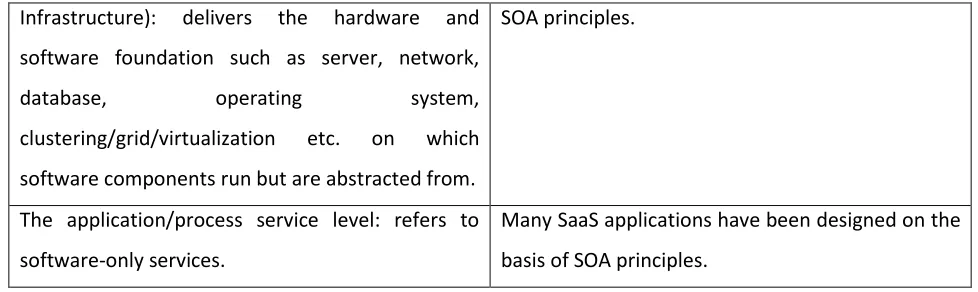
When analyzing and summarizing the problems for cloud governance, we have found that the problems on cloud governance resemble the problems of SOA governance mentioned in 3.1.3. According to the literature(Agilepath_Corporation, 2011; Linthicum, 2009), most of cloud services are designed in line with the SOA principles, cloud computing can be treated as one of the implementation and realization approaches for SOA(See Table 3). At the mean time, SOA as well as virtualization technology, realize the “resource pooling” characteristic from cloud. Both of SOA governance and cloud governance require enterprise-wise cooperation (e.g. communication between IT and Lines of business) to realize the business value. Therefore, governance related to SOA governance, such as service governance and organizational change, is the most applicable approaches to cloud computing. It is easier to leverage SOA governance approaches to cloud servicers governance (Linthicum, 2009).
However, cloud governance do not equal to SOA, there are some differences between them. For instance, cloud computing emphasizes pay-as-you go business model while SOA does not. Detailed similarities and differences between them have been summarized in Table 2.
Similarity:
Organization-wise management: require moving away from local divisions or departments to issues to prioritize usage based on overall the business requirements(Ovum, 2010).
The core of SOA and Cloud governance are service governance, for instance , lifecycle management of service , design time , runtime and change time of management (Linthicum, 2009; O'Neill, 2009b).
Require a new cost allocation/funding model for service within an organization (Australian_Government, 2011; Bentley, 2010).
Process-oriented: both cloud governance and SOA governance should rely on processes to increase the awareness of stakeholders for proper usage rather than merely rely on governance tools(O'Neill, 2009b).
Cloud Governance
The Lifecycle Model for Cloud Governance Page 18
dependencies are needed to manage(Ovum, 2010).
Rely on policies to ensure the right behavior of services, the focus moves from coding software components to defining the purpose via contact details and capability information in the context of policies (Peterson, 2010; van de Dobbelsteen, 2007).
Differences:
Cloud governance technologies demand federation capabilities to synchronize both internal and external cloud registry/repositories. Even though SOA aims for Business to Business services and integration, current governance tools for SOA are still lack of the synchronization capability with external registry/repositories. More investigation on the SOA governance tools is needed to be adaptive to the cloud setting (DevCentral, 2008; Guo, et al., 2010; Linthicum, 2009; Open_Cloud_Standards_Incubator, 2010).
Abstraction is one of the features of cloud computing, this is particular for public cloud where services are deployed outside the boundary of the organization. The problems raised by abstraction could include remote service testing and interface versioning change etc.(Hurley, 2010; King & Ganti, 2010).
SLA (Service Level Agreement) management is much more important in cloud context because services , particularly public services, are running out the organization, requiring an delicate contract to ensure the quality of services for their business (Australian_Government, 2011; Grobauer & Schreck, 2010).
Cloud computing emphasizes on scalability, high performance1 (e.g. resource pooling) and multi-tenant while SOA does not (Yi & Blake, 2010).
Policy management in cloud computing is more complicated in cloud setting because not all the services running in cloud can enforce the policies set by consumer organizations. Sometimes policies are under the control of providers and consumer organizations need to manage both internal policies and public policies (Ovum, 2010).
SOA emphasizes on managing assets first, enforcement and monitoring second. In contrast, cloud demands organizations to address enforcement and monitoring first(Layer7, 2011).
Table 2 Similarity and differences of cloud governance and SOA governance
SOA Cloud computing
The platform service (Service-Oriented IaaS and PaaS have been designed on the basis of
1
Cloud Governance
The Lifecycle Model for Cloud Governance Page 19
Infrastructure): delivers the hardware and software foundation such as server, network,
database, operating system,
clustering/grid/virtualization etc. on which software components run but are abstracted from.
SOA principles.
The application/process service level: refers to software-only services.
[image:30.612.61.550.74.220.2]Many SaaS applications have been designed on the basis of SOA principles.
Table 3 Mapping service level of cloud computing and SOA(Ovum, 2010)
Cloud governance is one of sub-branches in IT governance, through controlling the usage of cloud services, a specific type of IT services, in order to deliver the value to support business needs. A more specific relationship for cloud governance is its link to SOA governance. The overlap and similarities between cloud computing and SOA provide us an indication to sketch a cloud governance model on the basis of exiting SOA governance models as well as cloud governance literatures. Figure 7 summarizes the relationship between cloud governance and other governances we mentioned before.
Figure 7 Position of Cloud Governance
3.3
Existing Governance Model
[image:30.612.231.391.386.542.2]Cloud Governance
The Lifecycle Model for Cloud Governance Page 20
served as very important inputs to define our solution bundles. On the other hand, we can find a suitable reference for our process modeling.
3.3.1
Schepers’ Lifecycle SOA governance Model
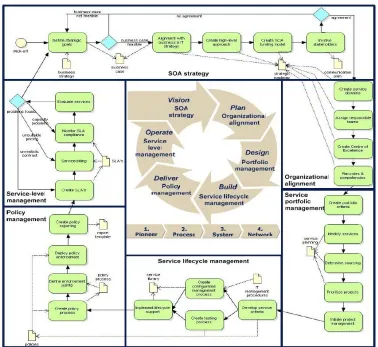
Schepers (2007) has developed a lifecycle approach for SOA governance. The governance areas from his model include portfolio governance, technology governance, project governance and service level governance. This model consists of six phrases to monitor SOA within an organization. Creating a SOA strategy is the task which triggers the whole model and its processes. The lifecycle shows the order in which the phases should be initiated. However, the order does not imply that a chronological order between the phrases. For each process, relevant approaches/tooling and outputs of the process are discussed. The six areas have been summarizes as follows(Schepers, 2007):
SOA strategy (vision): this phrase contains the long-term planning on SOA, funding models and involvement of stakeholders.
Organizational alignment to SOA (plan): this phrase concentrates on the organizational changes and roles/responsibilities adjustment for better business/IT alignment. For example, creating excellent of centre for knowledge sharing.
Portfolio management (design): this phrase is about establishing processes to determine which service to create and when to add one service to the portfolio.
Service lifecycle management (build): this phrase is about ensuring qualitative service development and launching change management.
Policy management (deliver): this phrase concerns about how the service quality can be guaranteed.
Cloud Governance
[image:32.612.117.495.72.419.2]The Lifecycle Model for Cloud Governance Page 21
Figure 8 Lifecycle Method for SOA governance (Schepers, 2007)
3.3.2
AUT SOA Governance Framework
Cloud Governance
[image:33.612.73.541.75.411.2]The Lifecycle Model for Cloud Governance Page 22
Figure 9 AUT SOA Governance Framework (Hojaji & Shirazi, 2010)
3.3.3
Guo’s Cloud Governance Model
Cloud Governance
[image:34.612.120.497.75.288.2]The Lifecycle Model for Cloud Governance Page 23
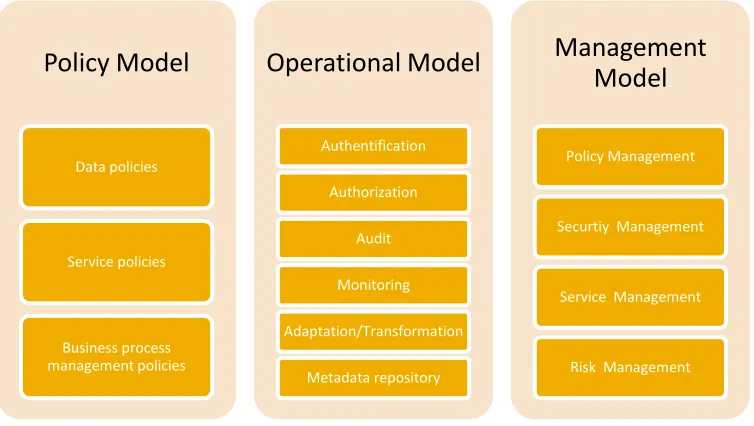
Figure 10 Cloud Governance Model from Guo et al. (Guo, et al., 2010)
3.3.4
Microsoft’s Cloud Governance Model
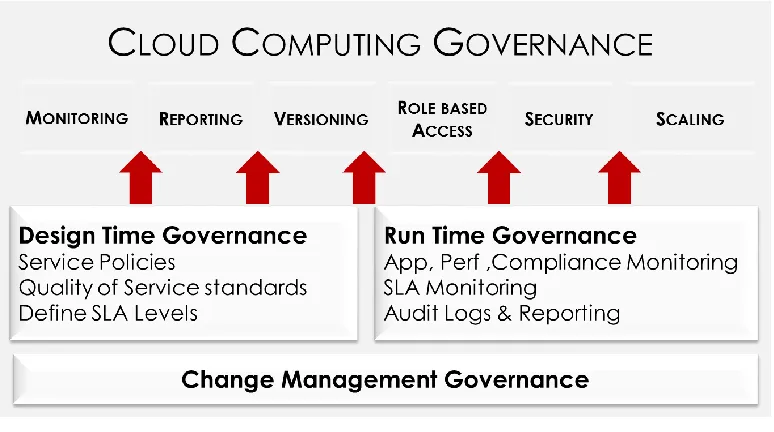
Microsoft (2010) also proposes a cloud governance model for its azure cloud platform. The main focus of the governance model from Microsoft is about policy management. The model is composed of three main parts, including design time, run time governance and change management governance. During design time, it is imperative to define service policies, quality of standards and SLA levels. During runtime, policies are enforced and the application/service performance and compliance are carefully monitored. Change management governance is set to track the change activities and asset. It is required to provide and manage report, alert, and log at the same time. The three components work together to ensure correct versioning, scale and ensure security compliance. This model is similar to Guo’s model, outlining key components of cloud governance but omitting the activities which address the alignment of IT and business.
Policy Model
Data policies
Service policies
Business process management policies
Operational Model
Authentification Authorization
Audit Monitoring Adaptation/Transformation
Metadata repository
Management
Model
Policy Management
Securtiy Management
Service Management
Cloud Governance
[image:35.612.132.519.76.292.2]The Lifecycle Model for Cloud Governance Page 24
Figure 11 Microsoft’s Cloud Governance Model(Microsoft, 2010)
3.3.5
Comparative Analysis
This section will conduct a small comparative analysis among the models mentioned above. In order to have a suitable analysis, we define several criteria for the evaluation, which are summarized as follows:
High coverage of problems addressed in 3.1.3: the proposed model should cover the problems we have identified in 3.1.3 as much as possible.
Parsimonious: the proposed model should not be complicated so that organizations can follow the methodology easily. The model can be refined later as more experience has been gained from the practice. What we define “parsimonious” is that it should not contain too many items within the model. The model should be understandable and the structure of the model should be logical and reasonable.
Process-oriented: This criterion is derived from the definition we have given.
Lifecycle approach: lifecycle approach demands that the model should include a feedback loop. This will help to emphasize that governance of cloud is an on-going, dynamic process instead of one-time work. As organizations get more mature, and more feedback is collected, it will require the organizations to go through those processes and adjust some of the processes if necessary. Applicability of solution: discuss whether the detailed solution can be directly applied to the
Cloud Governance
The Lifecycle Model for Cloud Governance Page 25
Models Schepers’
model
AUT SOA model Guo’s model Microsoft
Coverage of
problems
All All Partially Partially
Parsimonious Yes No Yes Yes
Process Oriented Yes Yes No No
Lifecycle approach Yes Yes No No
Applicability of
Solution
[image:36.612.72.538.73.295.2]Partially Partially Yes Yes
Table 4 Comparative analysis
In the Schepers’ model, compliance to laws is ensured through policy management and SLA monitoring during run-time. Service behavior (e.g. service dependency, changing of service) can be ensured by SLA management and service lifecycle management. Aligning organizations with the cloud is ensured through organizational alignment and SOA strategy. Cooperation with suppliers and evaluating services are ensured through SLA management.
In the AUT SOA model, compliance to laws is guaranteed through “manage policy compliance” in the measurement phrase. Service behavior is guaranteed through “Service lifecycle” phrase. Aligning organizations with the cloud is guaranteed through “Plan” and “Define” phrase, in which a set of plans and processes within the organizations have been created or adjusted. Cooperation with suppliers is guaranteed through “Service Level Management” in the Service Lifecycle phrase and “monitoring and evaluate performance” in Implement phrase.
The solution areas from these two SOA governance models cover all the problems we have identified in 3.1.3. However, the solution areas from Microsoft and Guo’s model, as we have mentioned in 3.3.3 and 3.3.4, mainly focus on policy management and SLA management. Both models are missing relevant assessment and adjustment on organizational structure and roles in order to make sure better business and IT alignment.
Speaking of the complexity of the models, Schepers’ model, Microsoft and Guo’s model are well defined according to their defining requirements. However, the model from AUT is more complicated since it
Cloud Governance
The Lifecycle Model for Cloud Governance Page 26
includes too many processes in the model. Relationships between the inputs/outputs and the processes are not well defined in AUT model.
Two SOA governance models are clearly process-oriented and apply the lifecycle methodology in their models. However, the process-oriented feature in the two cloud governance models is not so obvious. In Guo’s model, there are some processes in its management component. In Microsoft’s model, some part of the model can be treated as process-oriented such as define SLA and monitor SLA. We cannot find any lifecycle approach within Guo’s and Microsoft’s model.
As SOA governance is designed for cloud and we have discussed the similarity and differences in Table 2, the solutions and detailed tools from SOA cannot directly apply to the cloud.
A Lifecycle Process Model for Cloud Computing
The Lifecycle Model for Cloud Governance Page 27
4
A Lifecycle Process Model for Cloud Computing
Previous chapters have analyzed the problems of cloud governance and selected the Schepers’ SOA model as the reference model for our process modeling. This chapter will continue to define and analyze the final domains of our process model for cloud computing on the basis of the reference model and corresponding literature reviews.
This chapter is further structured as follows: Section 4.1 will present the process model as whole, within which the final domains for the model will be discussed and a template used for process analysis will be presented. Section 4.2 to 4.6 will describe each process in detail from those five domains according to the template.
4.1
Introduction of the Process Model
The Schepers´ SOA model focuses on six aspects (i.e. SOA strategy, organizational alignment, portfolio management, service lifecycle management, policy management, and service level management). The six domains fit into the Enterprise-Value-Delivery framework from Deloitte(Delioitte, 2006). Based on these six domains, we collect literature on those aspects and find out that cloud governance aspects could basically be covered by these six aspects. Final domains of our cloud process governance model have compacted into five domains, following the lifecycle of vision, define, deliver, build and operate (see Figure 12). The portfolio management section from Schepers’ model has been removed and the two processes within this domain have moved to strategic plan because service selection and determine delivery model should belong to visioning when one organization decides to move to cloud. In addition, cloud service identification and delivery model determination will rely on workload requirements besides business requirements (e.g. security requirement).Thus it is necessary to discuss the activities and methods regarding those two processes. Other portfolio management activities such as prioritize projects will be the same as traditional service portfolio management and are out of the scope of this thesis. Therefore, a final description with respect to the five domains is summarized as follows and a further summary on those five domains can be found in Appendix C.
A Lifecycle Process Model for Cloud Computing
The Lifecycle Model for Cloud Governance Page 28
Organizational alignment (Define): this domain concerns about organizational change such as introducing new units for cloud computing knowledge management and facilitating cloud adoption within an organization, ensuring existing role competency for cloud service management and establishing funding capability to support cloud service cost allocation within the organization.
Service Lifecycle Management (Build): this domain concerns about creating services using cloud platform and resources. What types of criteria organizations should follow when creating a service on top of cloud and how they make sure the service quality during the design time (e.g. testing cloud service) will be discussed in this domain. Moreover, tools used to manage cloud service lifecycle management will be analyzed, which will support interface versioning and authorization.
Policy Management (Deliver): this domain concerns about policy management and enforcement regarding cloud services. Policy management focuses on internal policy management processes and external policy mapping with the policies from public CSPs. Run-time policy enforcement tools from SOA will be extended for cloud services and corresponding policy reports will be used for monitoring and improvement.
SLA Management (Operate): this domain concerns about quality of services and metrics used to evaluate and monitor the performance of services. Monitoring and ensuring that the SLA can be met is one of the main concentrations for cloud governance, especially for public cloud.
A Lifecycle Process Model for Cloud Computing
[image:40.612.49.540.72.659.2]The Lifecycle Model for Cloud Governance Page 29
Figure 12 High Level Process for cloud governance
Processes
O r g a n iz a ti o n a l A li g n m e n t ( D e fi n e ) S tr a te g ic P la n ( V is io n ) P o li c y M a n a g e m e n t ( D e li v e r ) S e r v ic e L e v e l M a n a g e m e n t ( O p e r a te ) S e r v ic e L if e c y c le M a n a g e m e n t ( B u il d ) 8.Ensure organization competency(*) 19.Monitor compliance(*) 6.Assign responsible teams(*) 5.Create service domains 7,Establish Centre of Excellent (*)18.Create SLAs (*) Problems 20.Evaluate services 14.Create policy processes(*)
16.Deploy policy enforcement(*) 17.Create policy reports 1.Define strategic cloud computing goals 3.Involving stakeholders(*) 10.Define criteria for the services(*)
11.Create testing processes 12.Create configuration and change processes(*) 13.Manage lifecycle of services(*) 1. Define strategic cloud computing goal Yes
2.Create high level adoption approaches(*) go/no go 15.Define policy enforcement points(*) 9.Create funding model (*) No 4.Determine service model and
delivery model(*) Business Case Policies Strategic road map Communication Plan Service Library Policy Processes Report Template Unreasonable contract SLAs 5. 10. 14. 18.
A Lifecycle Process Model for Cloud Computing
The Lifecycle Model for Cloud Governance Page 30
Template for process discussion
In order to make the discussion more structural, we have introduced a template for each process discussion, including process name, description, method and deliverable. Detailed descriptions regarding each component are shown in Table 5.
Process Name Name of the process
Description Describe generic goals of the process.
Articulate problems that can be solved in the process. The problems will be related to the features of cloud computing. (optional)
Present related work from SOA, which can be refined into cloud setting (optional).
Method Describe tools used to support the process. If there are no standard tools available, some of the requirements for the tools will be outlined.
[image:41.612.65.549.173.388.2]Deliverable Describe deliverables of the process and present requirements for the deliverables such as what should be included in a SLA template.
Table 5 Description on process discussion template
4.2
Strategic Plan
This section will concentrate on creating high level cloud computing vision. Introduction of cloud computing is analogous to other IT services, requiring to align business needs so as to ensure the value of the service for the organization. High level vision is the first step for proper governance of cloud service. Strategic plan will tackle the following questions: what goal should be achieved? How is cloud service coordinated? How will an organization choose a service? Processes for this section are identified from the reference model (see Figure 14). Detailed discussion will follow the template described in 4.1.
1.Define strategic cloud computing goal
3.Involving stakeholders(*) Yes
2.Create high level adoption approach(*) go/no go
No
4.Determine service model and
delivery model(*)
Business Case
Strategic road map
Communication Plan
5.
[image:41.612.74.533.564.663.2]A Lifecycle Process Model for Cloud Computing
The Lifecycle Model for Cloud Governance Page 31 4.2.1 Define strategic cloud computing goals
Process Name Define strategic cloud computing goals
Description Cloud governance should connect to high level business strategy and present an argumentation why business needs can be realized by introducing cloud computing(Ovum, 2010). Organizations should not introduce cloud computing only because it is a new technology. Instead, cloud computing should be used as a mean to achieve business goals. Creating a business case can be considered as a normal way to ensure the reasons to adopt cloud computing services(Linthicum, 2009).
The business goals should be measurable so that the organization can manage in a more tangible way. In order to make sure successful alignment, it is necessary to transfer the business goals into high level key performance indicators(Schepers, 2007). More detailed KPIs can be refined during the following strategic execution. KPIs can be an important input for a business case because of the measureable initiatives. Creating business cases will become easier when KPIs can be translated into financial benefits(IBM, 2010b; Linthicum, 2009; Marks & Lozano, 2010). Return of Investment (ROI) and “Goal-Question-Metric” proposed by Schepers(2007) can be still applied to this translation initiative for cloud(Bentley, 2010; Creswich, 2010).
Method Goal-Question-Metric (GQM)
Goal question metric is an approach from software engineering used to break down some vague concepts into measurable metrics. Several questions are derived from the goals which need to meet with business needs. The questions can be continuously broken down into smaller manageable questions. Then metrics are identified in order to answer those sub-questions (see the following example).
Goal Questions
Metrics
Evaluation time-to-market How long does an
improvement take? How much is improved?
Avg Project lifecycle Time
Hours spent on software improvement
[image:42.612.64.549.81.730.2]Number of improved project
A Lifecycle Process Model for Cloud Computing
The Lifecycle Model for Cloud Governance Page 32
Return on Investment
Calculation of ROI for cloud computing has to consider the time for initial payback. Organization can start from the absolute saving that is realized by all facets of IT operation in relate to workload, including hardware cost, software licenses, upgrade ,system administration, support , end-user support and provision. Some other business-related measures such as increasing user productivity, resource utilization, reduction of risks due to the high availability can be included as well(IBM, 2010b). ROI calculation will shift Capex into Opex for cloud assets since the business model from cloud computing emphasizes on pay-as-you go and organizations won’t have to consider upfront investment for public cloud.
Deliverable Business Case
A final deliverable from this process is a business case on cloud computing services. Linthicum (2009) defines what should be described in a business case for cloud computing. Since the business case is specifically for adopting public cloud computing to leverage SOA architecture within an organization. Based on his work, we adjust the content of the business case to suiting for different types of cloud computing, the content is described as follows(Linthicum, 2009):
1. A clear understanding of the current business and IT issues the business is facing.
2. The amount of money costs regarding the business.
3. The proposed improvements using cloud computing to address the identified business issues.
4. The amount of money, if any, that can be saved using these improvements. 5. Soft benefits: refer to the value points which are difficult to quantify such as
customer sati