http://www.scirp.org/journal/opj ISSN Online: 2160-889X
ISSN Print: 2160-8881
DOI: 10.4236/opj.2017.711020 Nov. 14, 2017 221 Optics and Photonics Journal
Photonic Crystal Fiber Based Sensor for
Detecting Binary Liquid Mixture
Md. Faizul Huq Arif
1*, Md. Jaminul Haque Biddut
2, Md. Shaiful Islam Babu
3,
H M Mostafizur Rahman
4, Md. Mahbubur Rahman
1, Busrat Jahan
5,
Moshrefa Sultana Chaity
6, Shah Mostafa Khaled
11Institute of Information Technology (IIT), University of Dhaka, Dhaka, Bangladesh
2Automation and Robotics, Faculty of Electrical Engineering and Information Technology (EEIT), TU DortmundUniversity,
Dortmund, Germany
3Department of Computer Science and Engineering, World University of Bangladesh, Dhaka, Bangladesh 4School of Information Technology, BAC International Study Centre, Dhaka, Bangladesh
5Department of Computer Science and Engineering, Feni University, Feni, Bangladesh 6Institute of Information Technology (IIT), Jahangirnagar University, Dhaka, Bangladesh
Abstract
Detection of liquid mixture of different volume ratio is very important in in-dustrial purposes. The paper reports a sensing mechanism of binary liquid mixture for different volume fraction, based on the measurement of refractive index of the mixture. Here, a highly sensitive liquid filled core Photonic Crys-tal Fiber structure has been proposed to detect liquid mixture solution. Nu-merical investigation of the proposed structure is carried out by employing full vectorial Finite Element Method (FEM).
Keywords
Binary Liquid Mixture, Photonic Crystal Fiber, Refractive Index, Sensitivity, Confinement Loss
1. Introduction
Fiber optic technology was developed primarily for telecommunication and medi-cal science. However, the recent advances of fiber optic technology with its wide-spread of applications lead extensive interests to the researchers. The emergence of Photonic Crystal Fiber (PCF) was a breakthrough in the fiber optic
technolo-gy. Since the invention of PCF using 2D photonic crystal, in 1992 [1], the fiber
optic researchers have been engaged on Research and Development (R & D) with this type of fiber.
How to cite this paper: Arif, M.F.H., Biddut, M.J.H., Babu, M.S.I., Rahman, H.M.M., Rahman, M.M., Jahan, B., Chaity, M.S. and Khaled, S.M. (2017) Photonic Crystal Fiber Based Sensor for Detecting Binary Liquid Mixture. Optics and Photonics Journal, 7, 221-234.
https://doi.org/10.4236/opj.2017.711020
Received: October 5, 2017 Accepted: November 11, 2017 Published: November 14, 2017
Copyright © 2017 by authors and Scientific Research Publishing Inc. This work is licensed under the Creative Commons Attribution International License (CC BY 4.0).
DOI: 10.4236/opj.2017.711020 222 Optics and Photonics Journal PCF is an optic based technology which offers wondering features over con-ventional optical fibers. It has remarkable characteristics such as small size, free from electrical interference, geometric versatility, improved sensitivity and inhe-rent compatibility with respect to fiber optic telecommunications making it
out-standing for opto-devices [2][3]. PCFs can be used for variety of sensing
appli-cations such as, physical sensor, gas sensor, chemical sensor, liquid sensor, elec-trical and magnetic field sensor, humidity, temperature, pressure sensor,
bio-medical properties sensor and so on [3].
Since the last decade, optical techniques have been developing widely in the
field of analytical chemistry for chemical and biochemical analysis [4]. The field
of Optofluidics is emerging because of the development in optics and
microflui-dics in lab-on-a-chip microsystems [5][6][7][8]. PCFs have recently been
inte-grated in lab-on-a-chip systems for sensing applications.
Recently, several studies [9][10][11][12][13] have suggested microstructure
optical fiber for liquid sensing applications since detection of liquid chemical ef-ficiently is one of the most challenging tasks for industrial production manage-ment. Most of the industries use various types of liquid and they need to be sensed smartly for safety issues.
Previously, several researches already have been done in the prospect of sens-ing different liquids in terms of vapor senssens-ing. J. Park et al. [14] proposed a hol-low core Photonic Crystal Fiber for chemical sensing application using the ab-sorption method. In recent years, liquid filled core PCFs has received a great at-tention due to the highly interaction of light and the sample to be sensed. A large number of articles have described infiltrated PCFs with different components as
a promising field. The articles [9] [10][11][12][13] reported that
microstruc-tured core PCF filled with different chemical substances, which show the enhance-ment of the evanescent field interaction in case of liquid sensing. However, the introduction of liquid filled hollow-core led to abundant demonstrations of ther-mally and electrically tunable fibers [15] [16][17]. Recently, the article [3] de-scribes that infiltrated hollow-core shows better sensing property and it is simple
in design. However, all above the articles [9][10][11][12][13] describe the
sen-sitivity characteristics in terms of pure compounds.
A vast amount of literature has been surveyed on various types of industrial chemicals and bio-chemicals. The literature survey indicates that industrial chem-icals are the mixture of two or more fundamental liquids. Binary solution is one of the widely used chemical in industry. Therefore, to identify binary liquid mix-ture of different volume fractions is a challenging task. Generally, different chemi-cal reagents are added to detect it. However, these techniques are time consum-ing and costly too. To detect the binary mixture smartly, various sensconsum-ing
me-chanisms has also been surfed. The article [18] introduced fiber optic sensor for
DOI: 10.4236/opj.2017.711020 223 Optics and Photonics Journal In this article, we have introduced our proposed architecture for smart detec-tion of liquid chemicals in industrial purposes. We considered the potentiality of using our proposed liquid filled hollow core PCF as an optical instrument of a chemical industry to detect necessary liquid mixtures.
2. Methodology
The composition of binary liquid mixtures can be determined by refractive in-dices measurements since the refractive index is the function of the composition
of binary mixtures [19][20]. The articles [21][22] [23] describe the estimation
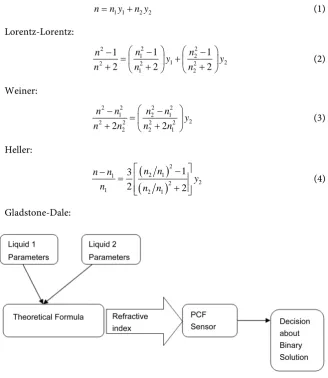
of refractive indices of some binary mixtures and their mixing properties. To de-termine the refractive index of binary liquid mixtures the most extensively used methods are Arago-Biot [24], Lorentz-Lorentz [25], Weiner [26], Heller [27] and
Gladstone-Dale [28]. We can use any above mentioned relationship in the
theo-retical formula of our proposed simple block diagram of smart detection proce-dure of binary mixture through the refractive index values, which has been
pre-sented in Figure 1. The equations have been expressed in following:
Arago-Biot:
1 1 2 2
n=n y +n y (1)
Lorentz-Lorentz:
2 2
2
1 2
1 2
2 2 2
1 2
1 1
1
2 2 2
n n
n
y y
n n n
− −
− = +
+ + + (2)
Weiner:
2 2 2 2
1 2 1
2
2 2 2 2
2 2 1
2 2
n n n n
y
n n n n
− −
=
+ + (3)
Heller:
(
)
(
)
2 2 1 1 2 21 2 1
1 3 2 2 n n n n y
n n n
−
− =
+
(4)
[image:3.595.212.541.331.710.2]Gladstone-Dale:
DOI: 10.4236/opj.2017.711020 224 Optics and Photonics Journal
(
1)
1(
2)
21 1 1
n− = n − y + n − y (5)
where, n = Refractive index of mixture,
n1 and n2=Refractive index of two pure compounds,
y1 and y2 = Volume fractions.
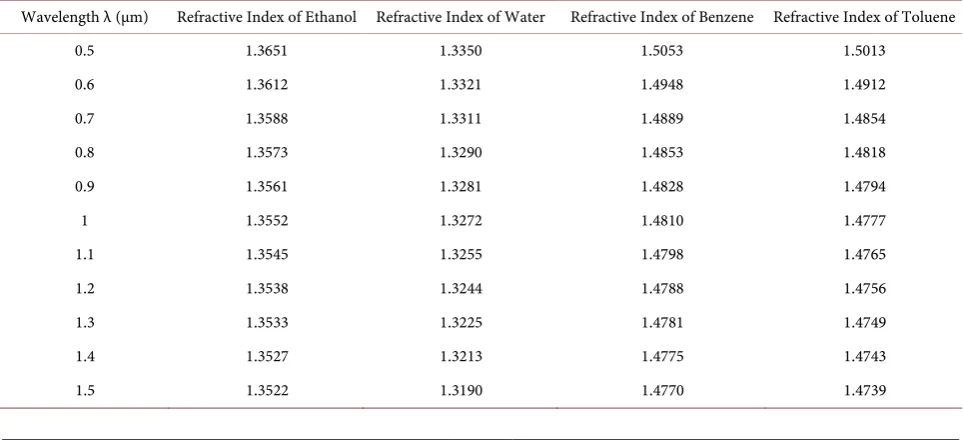
Refractive index of mixture is obtained by taking input values of two pure chemi-cals at a certain temperature. However, in this study, we have selected Arago-Biot equation for investigation since it is very simple. Here, extensive investigations have been done for Ethanol-Water and Benzene-Toluene mixtures. The refrac-tive indices of the input pure components have been taken at different wavelength of light (0.5 µm to 1.5 µm) for extensive investigation; all values have been
calcu-lated using Sellmeier formula. Table 1 shows refractive indices of Ethanol,
Wa-ter, Benzene and Toluene for different wavelengths of light at room temperature 293.15 k.
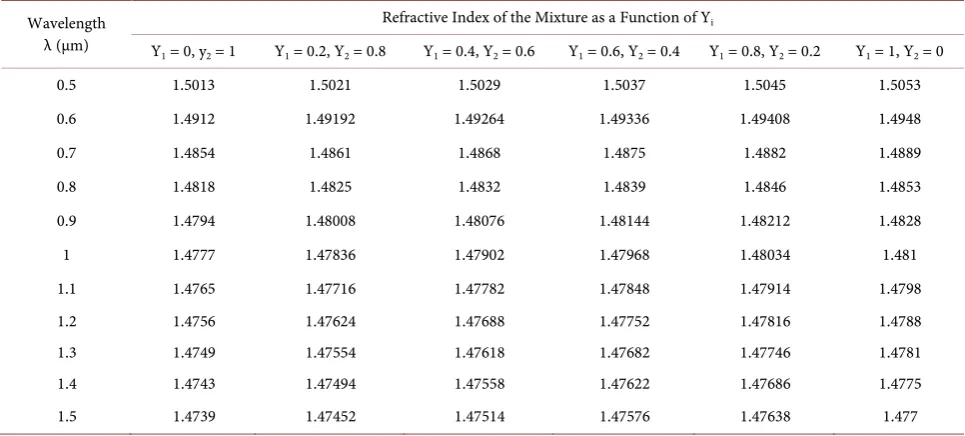
We have calculated the refractive index of the binary mixture varying volumes of 1 to 0 ml, 0.8 to 2 ml, 0.6 to 0.4 ml, 0.4 to 0.6 ml, 0.2 to 0.8 ml and 0 to 1 ml. Moreover, calculated data using Arago-Biot equation for different volume
frac-tions of the two binary mixtures have been given in Table 2 and Table 3.
To focus on efficient sensing we have proposed a highly sensitive Photonic Crystal Fiber (PCF) structure with low confinement loss.
3. Proposed PCF Structure
Several issues are faced like maintaining fiber’s integrity and practical feasibility to design such a photonic waveguide in which the core region is made of liquids.
However, the research articles [29] shows that liquid insertion at the central hole
is permitted and it allows the incident light to propagate directly through the liquid due to the effective index guidance. Moreover, this type of PCF structure
[image:4.595.57.539.518.738.2]can be interfaced with existing technologies without any difficulty [30][31][32].
Table 1. Wavelength dependent refractive index values of ethanol, water, benzene and toluene at a temperature of 293.15 k.
Wavelength λ (µm) Refractive Index of Ethanol Refractive Index of Water Refractive Index of Benzene Refractive Index of Toluene
0.5 1.3651 1.3350 1.5053 1.5013
0.6 1.3612 1.3321 1.4948 1.4912
0.7 1.3588 1.3311 1.4889 1.4854
0.8 1.3573 1.3290 1.4853 1.4818
0.9 1.3561 1.3281 1.4828 1.4794
1 1.3552 1.3272 1.4810 1.4777
1.1 1.3545 1.3255 1.4798 1.4765
1.2 1.3538 1.3244 1.4788 1.4756
1.3 1.3533 1.3225 1.4781 1.4749
1.4 1.3527 1.3213 1.4775 1.4743
DOI: 10.4236/opj.2017.711020 225 Optics and Photonics Journal
Table 2. Calculated value of refractive indices of the ethanol-water mixture for different volume fractions.
Wavelength λ (µm)
Refractive Index of the Mixture as a Function of Yi
Y1 = 0, y2 = 1 Y1 = 0.2, Y2 = 0.8 Y1 = 0.4, Y2 = 0.6 Y1 = 0.6, Y2 = 0.4 Y1 = 0.8, Y2 = 0.2 Y1 = 1, Y2 = 0
0.5 1.3351 1.3411 1.3472 1.3531 1.3590 1.3650
0.6 1.3322 1.3378 1.3436 1.3495 1.3553 1.3612
0.7 1.3314 1.3365 1.3421 1.3476 1.3532 1.3588
0.8 1.3292 1.3346 1.3403 1.3459 1.3516 1.3573
0.9 1.3280 1.3336 1.3392 1.3448 1.3504 1.3561
1 1.3270 1.3326 1.3382 1.3439 1.3495 1.3552
1.1 1.3255 1.3313 1.3371 1.3429 1.3487 1.3545
1.2 1.3243 1.3299 1.3359 1.3418 1.3478 1.3538
1.3 1.3225 1.3286 1.3348 1.3409 1.3471 1.3533
1.4 1.3210 1.3273 1.3336 1.3400 1.3463 1.3527
1.5 1.3191 1.3256 1.3322 1.3389 1.3455 1.3522
Table 3. Calculated value of refractive indices of the benzene-toluene mixture for different volume fractions.
Wavelength λ (µm)
Refractive Index of the Mixture as a Function of Yi
Y1 = 0, y2 = 1 Y1 = 0.2, Y2 = 0.8 Y1 = 0.4, Y2 = 0.6 Y1 = 0.6, Y2 = 0.4 Y1 = 0.8, Y2 = 0.2 Y1 = 1, Y2 = 0
0.5 1.5013 1.5021 1.5029 1.5037 1.5045 1.5053
0.6 1.4912 1.49192 1.49264 1.49336 1.49408 1.4948
0.7 1.4854 1.4861 1.4868 1.4875 1.4882 1.4889
0.8 1.4818 1.4825 1.4832 1.4839 1.4846 1.4853
0.9 1.4794 1.48008 1.48076 1.48144 1.48212 1.4828
1 1.4777 1.47836 1.47902 1.47968 1.48034 1.481
1.1 1.4765 1.47716 1.47782 1.47848 1.47914 1.4798
1.2 1.4756 1.47624 1.47688 1.47752 1.47816 1.4788
1.3 1.4749 1.47554 1.47618 1.47682 1.47746 1.4781
1.4 1.4743 1.47494 1.47558 1.47622 1.47686 1.4775
1.5 1.4739 1.47452 1.47514 1.47576 1.47638 1.477
The cross section of the proposed PCF structure is shown in Figure 2. Air holes
in the cladding are arranged in four regular hexagonal rings which has six air holes in the first ring and six added air holes in every added ring. Air filling ratio of the cladding holes (d/Ʌ) of the optimized structure was kept fixed at 0.79 where,
d is the diameter of cladding air holes and the symbol Ʌ denotes the distance
between two adjacent air holes. However, the diameter of hollow core (red circle)
dc is slightly greater than the cladding air holes diameter d. The pure silica has
[image:5.595.56.539.343.561.2]DOI: 10.4236/opj.2017.711020 226 Optics and Photonics Journal
Figure 2. Cross section of the proposed photonic crystal Fiber.
( )
1 2 2 2 3 22 2 2
1 2 3
1 B B B
n
C C C
λ
λ
λ
λ
λ
λ
λ
= + + +
− − − (6)
where, n is the wavelength dependent refractive index and the symbol λ represents
the operating wavelength. B(i=1,2,3) and C(i=1,2,3) are Sellmeier coefficients of the
material.
The cross section of the proposed PCF is divided into triangular homogeneous sub-spaces using mesh analysis. For each sub-spaces the wave equation is solved. Using Perfectly Matched Layer (PML) as the boundary condition the optical proper-ties and propagation characteristics of leaky mod are measured. Thickness of the PML is set to 10% of the radius of the cross section for efficient calculation of confinement loss [34][35].
In order to fulfill the ever increasing demands for PCF based chemical sensors, a novel PCF structure is need to be developed to overcome the critical trade-off between relative sensitivity and confinement loss in prior PCFs. However, by ca-librating the design parameters of our proposed PCF, we can achieve a higher relative sensitivity and lower confinement loss simultaneously.
4. Simulation and Principle of Operation
To simulate the guiding properties of our proposed PCF structure, a full vectori-al Finite Element Method (FEM) is applied for solving Maxwell’s equation due to
its well-known reliability in case of solving very complex structure [36][37][38]
[39][40]. The FEM formulation for modal analysis based on the Perfectly Matched
Layer (PML) is capable of handling analyze leaky mode.
Using Circular PML as the boundary condition, propagation characteristics and optical properties can be evaluated efficiently. The modal analyses have been
DOI: 10.4236/opj.2017.711020 227 Optics and Photonics Journal
through z direction. Using anisotropic PML the following vectorial equation
with a magnetic field formulation can be derived from Maxwell’s equation [41]
[42][43].
(
1)
20 0
r K r
ε− µ
∇× ∇×H − H= (7)
where, H is the magnetic field, εr is the relative dielectric permittivity and
r
µ is the permeability. The symbol K0 (=2π/λ) represents the wave-number in
the vacuum at the operating wavelength λ.
As the electromagnetic radiation passes through the PCF, a small portion of energy is leaking from the core to the exterior matrix material. This leakage is known as confinement loss. However, this leakage can be eliminated by taking infinite number of air holes in the cladding. But, in practical structure, the number of air holes is finite. Therefore, the modes of PCFs are inherently leaky. It is meas-ured from the imaginary part of the complex effective index using the following equation [44].
( )
60
. 8.686 eff 10
Conf loss= K Im n × [dB/m] (8)
where, Im (neff) is the imaginary part of effective index [45]. The legibility of the
method depends on the accuracy of the value of the imaginary part. The
accura-cy of Im (neff) can be increased by using larger computational window and a
fin-er mesh [46].
The evanescent field interaction between light and the material to be sensed can be measured by the relative sensitivity coefficient. According to the Beer-Lambert law, the relative sensitivity coefficient can be defined as [47]:
r e
n
r f
n
= (9)
where, nr represents the refractive index of the material to be sensed, and ne is
the modal effective index. Here, f is the fractional power located in the air holes
which can be defined as [42]:
(
)
(
)
Re d d
100
Re d d
x y y x sample
x y y x total
E H E H x y f
E H E H x y
−
= ×
−
∫
∫
(10)The transverse electric and magnetic fields of the guided mode are respective-ly introduced by Ex, Ey, and Hx, Hy. Using FEM, the effective index mode neffis
calculated by solving Maxwell’s equation. FEM based simulation tool COMSOL Multiphysics is used to find the guided modes. During simulation, the cross sec-tion is divided into 15,778 triangular elements with 110,803 degrees of freedom for the employed elements.
5. Numerical Results and Discussion
DOI: 10.4236/opj.2017.711020 228 Optics and Photonics Journal wavelength range 0.8 to 1.5 µm. In this study, we have analyzed the sensing per-formance of our proposed PCF for two different binary liquid mixtures (Etha-nol-Water, and Benzene-Toluene). The designed structure of PCF supports the fundamental mode and some higher-order modes. In this study, we have
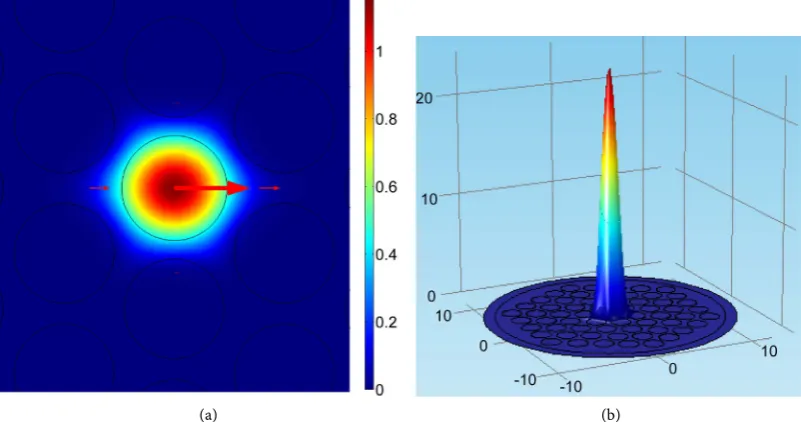
consi-dered the fundamental modes. Figure 3 shows the 2D and 3D views of
funda-mental optical field distribution of our proposed PCF structure when core was filled with Ethanol-Water mixture at an operating wavelength of 1.3 µm.
It is clearly seen from the Figure 3 that the mode field is tightly confined in
the core region. Hence, there is highly interaction between light and the material inserted in the hollow core.
Figure 4 illustrates the wavelength dependence effective refractive index pro-file. It is clear from the Figure 4 that the effective indices decrease linearly with an increase in wavelength. It is also evidently seen that effective index values are higher when the core is filled with higher indexed liquid mixture.
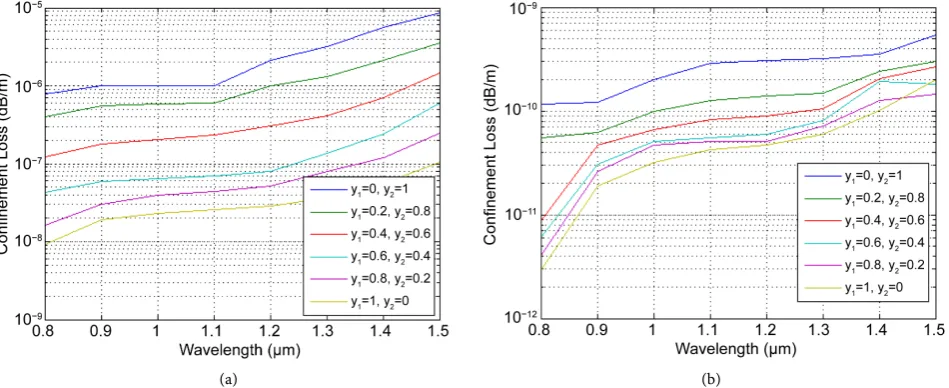
Figure 5 depicts the wavelength dependent confinement loss with the same parameters. It is clear from the curves that confinement loss is declining when the operating wavelength of light is increasing.
Initially to investigate the relative sensitivity we have calculated the perfor-mance of our proposed PCF filling different pure liquids over the refractive in-dex range 1.35 to 1.50. We have observed that sensitivity increases with wave-length when the refractive index of the core material is less than the silica back-ground (~1.45). On the contrary, sensitivity decreases when the refractive index
of the core material is greater than 1.45. Figure 6 shows the relative sensitivity
curves of our proposed PCF as a function of wavelength. It is observed from the
Figure 6 that the relative sensitivity increases with wavelength when the core of the PCF is infiltrated with Ethanol-Water mixture and it shows the vice-versa, when the core was filled with Benzene-Toluene mixture.
[image:8.595.137.538.492.703.2](a) (b)
DOI: 10.4236/opj.2017.711020 229 Optics and Photonics Journal (a) (b)
Figure 4. Wavelength versus effective refractive index curves of our proposed PCF structure; infiltrated the hollow core with
dif-ferent volume fraction of (a) ethanol-water mixture, and (b) benzene-toluene mixture.
(a) (b)
Figure 5. Wavelength versus confinement loss curves of our proposed PCF structure; infiltrated the hollow core with different
vo-lume fraction of (a) ethanol-water mixture, and (b) benzene-toluene mixture.
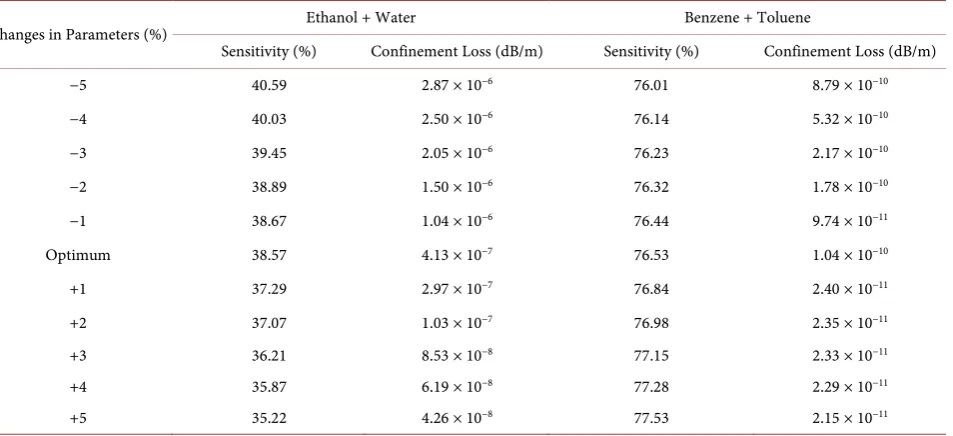
After presenting the relative sensitivity and confinement loss curves, we have checked the accuracy for both of the properties of the proposed PCF. The con-vergence error of the structure due to defective modes is very low about 5.8 ×
10−7. In a standard fiber draw, ±1% changing in fiber global parameter may
oc-cur during the fabrication process [48]. However, in [49] it has been described
that sol-gel technique shows a variation in air hole size less than 3% over 2 km spans for the fabrication of PCF. Therefore, to consider this structural variation,
the global parameter has been varied up to ±5% from their optimum values.
[image:9.595.63.538.317.511.2]DOI: 10.4236/opj.2017.711020 230 Optics and Photonics Journal
[image:10.595.66.535.71.267.2](a) (b)
Figure 6. Wavelength versus sensitivity curves of our proposed PCF structure; infiltrated the hollow core with different volume
fraction of (a) ethanol-water mixture, and (b) benzene-toluene mixture.
Table 4. Variation of relative sensitivity and confinement loss of the proposed PCF for the changes in global parameters at λ =
1.30 µm; volume fraction of the both mixtures: y1 = 0.4, y2 = 0.6.
Changes in Parameters (%) Ethanol + Water Benzene + Toluene
Sensitivity (%) Confinement Loss (dB/m) Sensitivity (%) Confinement Loss (dB/m)
−5 40.59 2.87 × 10⁻⁶ 76.01 8.79 × 10⁻¹⁰
−4 40.03 2.50 × 10⁻⁶ 76.14 5.32 × 10⁻¹⁰
−3 39.45 2.05 × 10⁻⁶ 76.23 2.17 × 10⁻¹⁰
−2 38.89 1.50 × 10⁻⁶ 76.32 1.78 × 10⁻¹⁰
−1 38.67 1.04 × 10⁻⁶ 76.44 9.74 × 10⁻¹¹
Optimum 38.57 4.13 × 10⁻⁷ 76.53 1.04 × 10⁻¹⁰
+1 37.29 2.97 × 10⁻⁷ 76.84 2.40 × 10⁻¹¹
+2 37.07 1.03 × 10⁻⁷ 76.98 2.35 × 10⁻¹¹
+3 36.21 8.53 × 10⁻⁸ 77.15 2.33 × 10⁻¹¹
+4 35.87 6.19 × 10⁻⁸ 77.28 2.29 × 10⁻¹¹
+5 35.22 4.26 × 10⁻⁸ 77.53 2.15 × 10⁻¹¹
In case of the fabrication issue of our proposed structure, it is important to
discuss the robustness of the structure. The studies [50] show that low air-filling
ratio of air holes makes a fiber robust. In our optimized structure, air filling ratio of the cladding holes is set to 0.79 which is tolerable for fabrication.
To show the significance of our proposed structure with more evidence we
need to compare the sensing performance with the prior works. The article [11]
[image:10.595.65.542.344.562.2]DOI: 10.4236/opj.2017.711020 231 Optics and Photonics Journal Formaldehyde-Water mixture (volume ratio: 4:6). It is expected, in case of the presence of all elements of Formalin, our proposed PCF will show near the same result also. It can be estimated that our proposed structure is approximately 40%
higher sensitive than the structure proposed in [11].
6. Conclusions
In conclusion, this paper reports a framework for binary liquid mixture sensing application using the theoretical mixing rules. In addition, for more accuracy, wavelength dependent refractive indices of the mixture have been studied. The behavior of the proposed PCF structure has also been investigated for different volume fraction of the analyte to be detected. However, the drawback of this re-search is that all data is calculated at a fixed temperature 293.15 k.
The mechanism can also easily be extended to other liquid mixtures (e.g. For-malin). Therefore, it is expected that the proposed framework will add a new win-dow of research in the field of chemical engineering. Moreover, our proposed PCF structure exhibits high relative sensitivity and low confinement loss simultaneous-ly. Therefore, the designed structure can effectively overcome the critical trade-off between confinement loss and sensitivity.
Acknowledgements
This research is supported by the fellowship from ICT division, Ministry of posts, Telecommunications and Information Technology, Bangladesh. No-56.00.000.028. 33.073.16-50, Date: 16.04.2017. Moreover, the authors are grateful to those who participated in this research work.
References
[1] Buczynski, R. (2004) Photonic Crystal Fibers. Acta Physica Polonica Series A, 106, 141-168. https://doi.org/10.12693/APhysPolA.106.141
[2] Ademgil, H. and Haxha, S. (2015) PCF Based Sensor with High Sensitivity, High
Birefringence and Low Confinement Losses for Liquid Analyte Sensing Applica-tions. Sensors, 15, 31833-31842. https://doi.org/10.3390/s151229891
[3] Arif, M.F.H., Ahmed, K., Asaduzzaman, S. and Azad, M.A.K. (2016) Design and Optimization of Photonic Crystal Fiber for Liquid Sensing Applications. Photonic Sensors, 6, 279-288. https://doi.org/10.1007/s13320-016-0323-y
[4] Mortensen, N.A., Xiao, S. and Pedersen, J. (2008) Liquid-Infiltrated Photonic Crys-tals: Enhanced Light-Matter Interactions for Lab-on-a-Chip Applications. Micro-fluidics and NanoMicro-fluidics, 4, 117-127. https://doi.org/10.1007/s10404-007-0203-2
[5] Verpoorte, E. (2003) Chip Vision-Optics for Microchips. Lab on a Chip, 3, 42N-52N. [6] Mogensen, K.B., Klank, H. and Kutter, J.P. (2004) Recent Developments in
Detec-tion for Microfluidic Systems. Electrophoresis, 25, 3498-3512.
https://doi.org/10.1002/elps.200406108
DOI: 10.4236/opj.2017.711020 232 Optics and Photonics Journal
[8] Choi, C.J. and Cunningham, B.T. (2006) Single-Step Fabrication and Characteriza-tion of Photonic Crystal Biosensors with Polymer Microfluidic Channels. Lab on a Chip, 6, 1373-1380. https://doi.org/10.1039/b603514k
[9] Asaduzzaman, S., Arif, M.F.H., Ahmed, K. and Dhar, P. (2015) Highly Sensitive Simple Structure Circular Photonic Crystal Fiber Based Chemical Sensor. IEEE In-ternational WIE Conference on Electrical and Computer Engineering (WIECON-ECE), Dhaka,19-20 December 2015, 151-154.
https://doi.org/10.1109/WIECON-ECE.2015.7443884
[10] Arif, M.F.H., Asaduzzaman, S., Ahmed, K. and Morshed, M. (2016) High Sensitive PCF Based Chemical Sensor for Ethanol Detection. 5th International Conference on Informatics Electronics and Vision (ICIEV), Dhaka,13-14 May 2016, 6-9.
https://doi.org/10.1109/ICIEV.2016.7760031
[11] Arif, M.F.H., Biddut, M.J.H., Ahmed, K. and Asaduzzaman, S. (2016) Simulation Based Analysis of Formalin Detection through Photonic Crystal Fiber. 5th Interna-tional Conference on Informatics Electronics and Vision, Dhaka, 776-779.
https://doi.org/10.1109/ICIEV.2016.7760106
[12] Asaduzzaman, S., Ahmed, K., Arif, M.F.H. and Morshed, M. (2015) Proposal of a Simple Structure Photonic Crystal Fiber for Lower Indexed Chemical Sensing. 18th International Conference on Computer and Information Technology, Dhaka, 127-131.
https://doi.org/10.1109/ICCITechn.2015.7488055
[13] Ahmed, K. and Morshed, M. (2016) Design and Numerical Analysis of Microstruc-tured-Core Octagonal Photonic Crystal Fiber for Sensing Applications. Sensing and Bio-Sensing Research, 7, 1-6.
[14] Park, J., Lee, S., Kim, S. and Oh, K. (2011) Enhancement of Chemical Sensing Ca-pability in a Photonic Crystal Fiber with a Hollow High Index Ring Defect at the Center. Optics Express, 19, 1921-1929.https://doi.org/10.1364/OE.19.001921
[15] Larsen, T., Bjarklev, A., Hermann, D. and Broeng, J. (2003) Optical Devices Based on Liquid Crystal Photonic Bandgap Fibres. Optics Express, 11, 2589-2596.
https://doi.org/10.1364/OE.11.002589
[16] Du, F., Lu, Y.Q. and Wu, S.T. (2004) Electrically Tunable Liquid-Crystal Photonic Crystal Fiber. Applied Physics Letters, 85, 2181-2183.
https://doi.org/10.1063/1.1796533
[17] Wolinski, T.R., Szaniawska, K., Ertman, S., Lesiak, P., Domanski, A.W., Dabrowski, R., Nowinowski-Kruszelnicki, E. and Wojcik, J. (2006) Influence of Temperature and Electrical Fields on Propagation Properties of Photonic Liquid-Crystal Fibres.
Measurement Science and Technology, 17, 985.
https://doi.org/10.1088/0957-0233/17/5/S08
[18] Zhou, B., Venart, J.E.S. and Hinata, S. (1992) Fiber Optic Sensor for Liquid Mixture Composition. Fluid Phase Equilibria, 79, 175-185.
[19] Mehra, R. (2003) Application of Refractive Index Mixing Rules in Binary Systems of Hexadecane and Heptadecane with n-Alkanols at Different Temperatures. Pro-ceedingsIndian Academy of Sciences Chemical Sciences, 115, 147-154.
https://doi.org/10.1007/BF02716982
[20] Martincek, I., Pudis, D., Kacik, D. and Schuster, K. (2010) Volume Fraction Deter-mination of Binary Liquid Mixtures by Measurement of the Equalization Wave-length. Sensors, 10, 7082-7088.https://doi.org/10.3390/s100807082
DOI: 10.4236/opj.2017.711020 233 Optics and Photonics Journal
[22] Roy, M.N., Das, R.K. and Chanda, R. (2010) Study on Solution Properties of Binary Mixtures of Some Industrially Important Solvents with Cyclohexylamine and Cyc-lohexanone at 298.15 K. International Journal of Thermophysics, 31, 535-545.
https://doi.org/10.1007/s10765-010-0752-6
[23] Isehunwa, S.O., Olanisebe, E.B., Ajiboye, O.O. and Akintola, S.A. (2015) Estimation of the Refractive Indices of Some Binary Mixtures. African Journal of Pure and Ap-plied Chemistry, 10, 58-64.https://doi.org/10.5897/AJPAC2015.0613
[24] Arago, D.F.J. and Biot, J.B. (1806) Mémoires de l’Académie des sciences de l’Institut de France, Vol. 1806, 7.
[25] Lorentz, H.A. (1906) Theory of Electrons. (In Leipzig) [26] Weiner, O. (1910) Berichte. Vol. 62, 256. (In Leipzig)
[27] Heller, W. (1945) The Determination of Refractive Indices of Colloidal Particles by Means of a New Mixture Rule or from Measurements of Light Scattering. Physical Review, 68, 5. https://doi.org/10.1103/PhysRev.68.5
[28] Dale, D. and Gladstone, F. (1858) On the Influence of Temperature on the Refrac-tion of Light. Philosophical Transactions, 148, 887.
https://doi.org/10.1098/rstl.1858.0036
[29] Yiou, S., Delaye, P., Rouvie, A., Chinaud, J., Frey, R., Roosen, G., Viale, P., Février, S., Roy, P., Auguste, J.L. and Blondy, J.M. (2005) Stimulated Raman Scattering in an Ethanol Core Microstructured Optical Fiber. Optics Express, 13, 4786-4791.
https://doi.org/10.1364/OPEX.13.004786
[30] Huang, Y., Xu, Y. and Yariv, A. (2004) Fabrication of Functional Microstructured Optical Fibers through a Selective-Filling Technique. Applied Physics Letters, 85, 5182-5184.https://doi.org/10.1063/1.1828593
[31] Luo, M., Liu, Y.G., Wang, Z., Han, T., Wu, Z., Guo, J. and Huang, W. (2013) Twin-Resonance-Coupling and High Sensitivity Sensing Characteristics of a Selec-tively Fluid-Filled Microstructured Optical Fiber. Optics Express, 21, 30911-30917.
https://doi.org/10.1364/OE.21.030911
[32] Gerosa, R.M., Spadoti, D.H., de Matos, C.J., Menezes, L.D.S. and Franco, M.A. (2011) Efficient and Short-Range Light Coupling to Index-Matched Liquid-Filled Hole in a Solid-Core Photonic Crystal Fiber. Optics Express, 19, 24687-24698.
https://doi.org/10.1364/OE.19.024687
[33] Ghosh, G. (1997) Sellmeier Coefficients and Dispersion of Thermo-Optic Coeffi-cients for Some Optical Glasses. Applied Optics, 36, 1540-1546.
https://doi.org/10.1364/AO.36.001540
[34] Morshed, M., Hasan, M.I. and Razzak, S.A. (2015) Enhancement of the Sensitivity of Gas Sensor Based on Microstructure Optical Fiber. Photonic Sensors, 5, 312-320.
https://doi.org/10.1007/s13320-015-0247-y
[35] Asaduzzaman, S. and Ahmed, K. (2016) Proposal of a Gas Sensor with High Sensi-tivity, Birefringence and Nonlinearity for Air Pollution Monitoring. Sensing and Bio-Sensing Research, 10, 20-26.
[36] Ademgil, H. (2014) Highly Sensitive Octagonal Photonic Crystal Fiber Based Sen-sor. Optik International Journal for Light and Electron Optics, 125, 6274-6278. [37] Monro, T.M., Belardi, W., Furusawa, K., Baggett, J.C., Broderick, N.G.R. and
Rich-ardson, D.J. (2001) Sensing with Microstructured Optical Fibres. Measurement Science and Technology, 12, 854.https://doi.org/10.1088/0957-0233/12/7/318
[38] Hoo, Y.L., Jin, W., Ho, H.L., Wang, D.N. and Windeler, R.S. (2002) Evanescent-Wave Gas Sensing using Microstructure Fiber. Optical Engineering, 41, 8-9.
DOI: 10.4236/opj.2017.711020 234 Optics and Photonics Journal
[39] Kuhlmey, B.T., Eggleton, B.J. and Wu, D.K. (2009) Fluid-Filled Solid-Core Photonic Bandgap Fibers. Journal of Lightwave Technology, 27, 1617-1630.
https://doi.org/10.1109/JLT.2009.2021142
[40] Vieweg, M., Gissibl, T., Pricking, S., Kuhlmey, B.T., Wu, D.C., Eggleton, B.J. and Giessen, H. (2010) Ultrafast Nonlinear Optofluidics in Selectively Liquid-Filled Photonic Crystal Fibers. Optics Express, 18, 25232-25240.
https://doi.org/10.1364/OE.18.025232
[41] Saitoh, K., Koshiba, M., Hasegawa, T. and Sasaoka, E. (2003) Chromatic Dispersion Control in Photonic Crystal Fibers: Application to Ultra-Flattened Dispersion. Op-tics Express, 11, 843-852.https://doi.org/10.1364/OE.11.000843
[42] Selleri, S., Vincetti, L., Cucinotta, A. and Zoboli, M. (2001) Complex FEM Modal Solver of Optical Waveguides with PML Boundary Conditions. Optical and Quan-tum Electronics, 33, 359-371.https://doi.org/10.1023/A:1010886632146
[43] Akowuah, E.K., Gorman, T., Ademgil, H., Haxha, S., Robinson, G.K. and Oliver, J.V. (2012) Numerical Analysis of a Photonic Crystal Fiber for Biosensing Applica-tions. IEEE Journal of Quantum Electronics, 48, 1403-1410.
https://doi.org/10.1109/JQE.2012.2213803
[44] Ademgil, H. and Haxha, S. (2011) Bending Insensitive Large Mode Area Photonic Crystal Fiber. Optik International Journal for Light and Electron Optics, 122, 1950-1956.
[45] Saitoh, K. and Koshiba, M. (2003) Leakage Loss and Group Velocity Dispersion in Air-Core Photonic Bandgap Fibers. Optics Express, 11, 3100-3109.
https://doi.org/10.1364/OE.11.003100
[46] Uranus, H.P. and Hoekstra, H.J.W.M. (2004) Modelling of Microstructured Wave-guides using a Finite-Element-Based Vectorial Mode Solver with Transparent Boun-dary Conditions. Optics Express, 12, 2795-2809.
https://doi.org/10.1364/OPEX.12.002795
[47] Cordeiro, C.M., Franco, M.A., Chesini, G., Barretto, E.C., Lwin, R., Cruz, C.B. and Large, M.C. (2006) Microstructured-Core Optical Fibre for Evanescent Sensing Ap-plications. Optics Express, 14, 13056-13066.https://doi.org/10.1364/OE.14.013056
[48] Poletti, F., Finazzi, V., Monro, T.M., Broderick, N.G., Tse, V. and Richardson, D.J. (2005) Inverse Design and Fabrication Tolerances of Ultra-Flattened Dispersion Holey Fibers. Optics Express, 13, 3728-3736.
https://doi.org/10.1364/OPEX.13.003728
[49] Bise, R.T. and Trevor, D. (2005) Solgel-Derived Microstructured Fibers: Fabrication and Characterization. In: Optical Fiber Communication Conference, Optical Socie-ty of America, OWL6.
[50] Pottage, J.M., Bird, D.M., Hedley, T.D., Birks, T.A., Knight, J.C., Russell, P.S.J. and Roberts, P.J. (2003) Robust Photonic Band Gaps for Hollow Core Guidance in PCF Made from High Index Glass. Optics Express, 11, 2854-2861.