Munich Personal RePEc Archive
Individually rational rules for the
division problem when the number of
units to be allotted is endogenous
Bergantiños, Gustavo and Massó, Jordi and Neme, Alejandro
Universidade de Vigo, Universitat Autónoma de Barcelona,
Universidad de San Luis
25 January 2019
Online at
https://mpra.ub.uni-muenchen.de/97136/
Individually Rational Rules for the Division Problem
when the Number of Units to be Allotted is Endogenous
Gustavo Bergantiños , Jordi Massóy and Alejandro Nemez
July 15, 2019
Abstract: We study individually rational rules to be used to allot, among a group of agents, a perfectly divisible good that is freely available only in whole units. A rule is individually rational if, at each preference pro…le, each agent …nds that her allotment is at least as good as any whole unit of the good. We study and characterize two individually rational and e¢cient rules, whenever agents’ prefer-ences are symmetric single-peaked on the set of possible allotments. The two rules are in addition envy-free, but they di¤er on wether envy-freeness is considered on losses or on awards. Our main result states that (i) the constrained equal losses rule is the unique individually rational and e¢cient rule that satis…es justi…ed envy-freeness on losses and (ii) the constrained equal awards rule is the unique individually rational and e¢cient rule that satis…es envy-freeness on awards.
Journal of Economic Literature Classi…cation Number: D71.
Keywords: Division problem; Single-peaked preferences; Individual rationality; E¢ciency; Strategy-proofness; Envy-freeness.
Facultade de Económicas, Universidade de Vigo. 36310, Vigo (Pontevedra), Spain. E-mail: [email protected]
yUniversitat Autònoma de Barcelona and Barcelona Graduate School of Economics. Departament
d’Economia i d’Història Econòmica, Campus UAB, Edi…ci B. 08193, Bellaterra (Barcelona), Spain. E-mail: [email protected]
zInstituto de Matemática Aplicada San Luis. Universidad Nacional de San Luis and CONICET.
1
Introduction
Consider the allotment problem faced by a group of agents who may share a homogeneous and perfectly divisible good, available only in whole units. Examples of this kind of good are shares representing ownership of a company, bonds issued by a company to …nance its business operations, treasury bills issued by the government to …nance its short term needs, or any type of …nancial assets with (potentially large) face values or tickets of a lottery. Agents’ risk attitudes and wealth induce single-peaked preferences on their potential allotments of the good, the set of non-negative real numbers. A solution of the problem is a rule that selects, for each pro…le (of agents’ preferences), a non-negative integer number of units of the good to be allotted and a vector of allotments (a list of non-negative real numbers, one for each agent) whose sum is equal to this integer. Observe that although the good is only available in integer amounts agents’ allotments are allowed to take non-integer values; yet, their sum has to be an integer. Namely, in the above examples agents are able to share a …nancial asset or a lottery ticket by getting portions of it. But, for most pro…les, the sum of agents’ best allotments will be either larger or smaller than any integer number and hence, an endogenous rationing problem emerges, positive or negative depending on whether the chosen integer is smaller or larger than the sum of agents’ best allotments. Sprumont (1991) studied the problem when the amount of the good to be allotted is …xed. He characterized the uniform rule as the unique e¢cient, strategy-proof and anonymous rule on the domain of single-peaked preferences. The present paper can be seen as an extension of Sprumont (1991)’s paper to a setting where the amount to be allotted of a perfectly divisible good has to be an integer, which may depend on agents’ preferences.
We are interested in situations where the good is freely available to agents, but only in whole units. Hence, an agent will not accept a proposal of an allotment that is strictly worse than any integer amount of the good. For an agent with a (continuous) single-peaked preference, the set of allotments that are at least as good as any integer amount of the good (the set of individually rational allotments) is a closed interval that contains the best allotment, that we call the peak, and at least one of the two extremes of the interval is an integer. If preferences are symmetric, the peak is at the midpoint of the interval.
fairness requirement. A rule is e¢cient if it selects, at each pro…le, a Pareto optimal vector of allotments: no other choices of (i) integer unit of the good to be allotted or (ii) vector of allotments, or (iii) both, can make all agents better o¤, and at least one of them strictly better o¤. We characterize the class of all e¢cient rules by means of two properties. First, the allotted amount of the good is the closest integer to the sum of agents’ peaks. Second, all agents are rationed in the same direction: all receive more than their peaks, if the integer to be allotted is larger than the sum of the peaks, or all receive less, otherwise. A rule is strategy-proof if it induces, at each pro…le, truth-telling as a weakly dominant strategy in its associated direct revelation game. Our fairness requirements will be related to two alternative and well-known notions of envy-freeness, that we will adapt to our setting (justi…ed envy-freeness on losses and envy-freeness on awards).1
We …rst show that there is no rule that is simultaneously e¢cient and strategy-proof on the domain of symmetric single-peaked preferences.2 We then proceed by
studying separately two subclasses of rules on the symmetric single-peaked domain; those that are individually rational and e¢cient and those that are individually rational and strategy-proof. For the …rst subclass, we identify the constrained equal losses rule and the constrained equal awards rule as the unique rules that, in addition of being individually rational and e¢cient, satisfy also either justi…ed envy-freeness on losses or envy-freeness on awards, respectively. These rules divide the e¢cient integer amount of the good in such a way that all agents experience either equal losses or equal gains, subject to the constraint that all allotments have to be individually rational. Speci…cally, the constrained equal losses rule, evaluated at a pro…le, selects …rst the e¢cient number of integer units. Then, to allot this integer amount it proceeds with the rationing from the vector of peaks, by either reducing or increasing the allotment of each agent (depending on whether the sum of the peaks is larger or smaller than the integer amount to be allotted) until the total amount is allotted. However, it makes sure that the extremes of agents’ individually rational intervals are not overcome by excluding any agent from the rationing process as soon as one of the extremes of the agent’s individually rational interval is reached, and it continues with the rest. The constrained equal awards rule is
1See Section 3 for their de…nitions and justi…cations, and Thomson (2010) for a survey on
envy-freeness.
2This is in contrast with Sprumont (1991)’s setting, which admits an extremely large class of e¢cient
de…ned similarly but instead it uses, as the starting vector of the rationing process, either the vector of lower bounds or the vector of upper bounds of the individually rational intervals, depending on whether the sum of the peaks is larger or smaller than the integer amount to be allotted, but makes sure that no agent’s peak is overcome by excluding her from the rationing process as soon as her peak is reached, and it continues with the rest.
For the subclass of individually rational and strategy-proof rules, we show in contrast that although there are many rules satisfying the two properties simultaneously, they are not very interesting; for instance, none of them is unanimous. A rule is unanimous if, whenever the sum of the peaks is an integer, the rule selects this integer and it allots it according to the agents’ peaks. We show then that individual rationality and strategy-proofness are indeed incompatible with unanimity.
At the end of the paper we extend some of our general and possibility results to the case where agents’ single-peaked preferences are not necessarily symmetric. We argue why relevant strategy-proof rules in the classical division problem (i.e., the uniform rule and all sequential dictator rules) are not satisfactory in our setting. In particular, we show …rst that the (extended) uniform rule is e¢cient on the domain of all single-peaked preference pro…les but it is neither strategy-proof nor individually rational, even on the domain of symmetric single-peaked preference pro…les.3 Finally, we show that
all sequential dictator rules are e¢cient on the domain of all symmetric single-peaked preference pro…les but they are neither individually rational nor strategy-proof, even on this subdomain.4
Before …nishing this Introduction we mention some of the most related papers to ours. As we have already said, Sprumont (1991) proposed the division problem of a …xed amount of a good among a group of agents with single-peaked preferences on
3The extended uniform rule allots, at each pro…le, the e¢cient integer amount as the uniform rule
would do it. It is not strategy-proof because an agent may have incentives to misreport his preferences to induce a di¤erent choice of the integer amount, and it is not individually rational because the vector of allotments selected by the uniform rule is not individually rational in general. However, the adapted version proposed in Bergantiños, Massó and Neme (2015) satis…es individual rationality but it remains manipulable.
4A sequential dictator rule, given a pre-speci…ed order on the set of agents, proceeds by letting
their potential allotments and provided two characterizations of the uniform rule, using strategy-proofness, e¢ciency and either anonymity or envy-freeness. Then, a very large literature followed Sprumont (1991) by taking at least two di¤erent paths. The …rst contains papers providing alternative characterizations of the uniform rule. See for in-stance Ching (1994), Sönmez (1994) and Thomson (1994a, 1994b, 1995 and 1997), whose characterizations we brie‡y discuss in the last section of the paper. The second group of papers proposed alternative rules when the problem is modi…ed by introducing additional features or considering alternative domains of agents’ preferences, or both. For instance, Ching (1992) extended the characterization of Sprumont (using envy-freeness) to the domain of single-plateaud preference pro…les and Bergantiños, Massó and Neme (2012a, 2012b and 2015), Manjunath (2012) and Kim, Bergantiños and Chun (2015) study alter-native ways of introducing individual rationality in the division problem. But in contrast with the present paper they assume that the quantity of the good to be allotted is …xed. Adachi (2010), Amorós (2002), Anno and Sasaki (2013), Cho and Thomson (2013), Er-lanson and Flores-Szwagrzak (2015) and Morimoto, Serizawa and Ching (2013) contain the multi-dimensional analysis of the division problem when several commodities have to be allotted among the same group of agents, but again the quantities of the goods to be allotted are …xed.
The paper is organized as follows. The next section presents the problem, preliminary notation and basic de…nitions. Section 3 contains the de…nitions of the properties of the rules that we will be concerned with. Section 4 describes the rules and states a preliminary result. Section 5 contains the main results of the paper for symmetric single-peaked preferences. Section 6 contains two …nal remarks.
2
The problem
We study situations where each agent of a …nite set N = f1; : : : ; ng wants an amount of a perfectly divisible good that can only be obtained in integer units, but arbitrary portions of each unit can be freely allotted. We assume thatn 2and denote byxi 0
the total amount of the good allotted to agent i 2 N: Since all units of the good are alike, the amount xi may come from di¤erent units. We assume that there is no limit on the (integer) number of units that can be allotted. Hence, and once N is …xed, the set offeasible (vector of) allotments is
F A=fx= (x1; : : : ; xn)2RN+ j P
where R+ = [0;+1) is the set of non-negative real numbers and N0 = f0;1;2; : : :g is the set of non-negative integers.5
Each agent ihas a preference relation i, de…ned on the set of potential allotments,
which is a complete and transitive binary relation on R+. That is, for all xi; yi; zi 2
R+; either xi i yi or yi i xi; and xi i yi and yi i zi imply xi i zi; note that
re‡exivity (xi i xi for all xi 2R+) is implied by completeness. Given i, let i be the
antisymmetric binary relation on R+ induced by i (i.e., for all xi; yi 2 R+, xi i yi if
and only ifyi xi does not hold) and let i be the indi¤erence relation on R+ induced by i (i.e., for all xi; yi 2 R+, xi i yi if and only if xi i yi and yi i xi). We
assume that i is continuous (i.e., for each xi 2 R+ the sets fyi 2 R+ j yi i xig and
fyi 2R+ jxi i yig are closed) and that i issingle-peaked onR+; namely, there exists
a unique pi 2 R+, the peak of i, such that pi i xi for all xi 2 R+nfpig and xi i yi
holds for any pair of allotments xi; yi 2R+ such that either yi < xi pi or pi xi < yi. For each i 2 N; let pi
i be an agent i’s single-peaked preference such that pi 2 R+ is
the peak of pi
i : We say that agent i’s single-peaked preference i is symmetric onR+ if for all zi 2 [0; pi], (pi zi) i (pi+zi) ; that is, for all xi; yi 2 R+; xi i yi if and
only if jpi xij jpi yij: Notice two things. First, the peak of a symmetric single-peaked preference conveys all information about the whole preference. Thus, we will often identify a symmetric single-peaked preference i with its peakpi. Second, for each p= (pi)i2N there exists a unique integer p 2N0 such that
p Pi2Npi < p + 1:
Third, for eachx2R+, there exists a unique integerkx 2N0 such that kx x < kx+ 1: Hence, the following notation is well-de…ned:
bxc = kx
dxe = kx+ 1
[x] =
(
kx when x kx+ 0:5
kx+ 1 when x > kx+ 0:5:
A (division)problemis a pair(N; )whereN is the set of agents and = ( 1; : : : ; n)
is a pro…le of single-peaked preferences on R+, one for each agent in N. Since the set
N will remain …xed we often write instead of(N; ) and refer to as a problem and as a pro…le, interchangeably. To emphasize agent i’s preference i in the pro…le we
often write it as( i; i):
5Since no confusion can arise with negative integers, we will refer to the set of non-negative integers
We denote by P the set of all problems and by PS the set of all problems where
agents’ preferences are symmetric single-peaked.
Since preferences are idiosyncratic, they have to be elicited. Arule onP is a function
f assigning to each problem 2 P a feasible allotment f( ) = (f1( ); : : : ; fn( )) 2
F A: We will also consider rules de…ned only on PS:Any rule on P can be restricted to
operate only on PS:
To study rules onPSselecting individually rational allotments, the following intervals
will play a critical role. Fix a problem 2 PS;with its vector of peaks (p
1; : : : ; pn). For eachi2N; de…ne the associated interval
[li(pi); ui(pi)] =
(
[bpic; pi+ (pi bpic)] if pi bpic+ 0:5 [pi (dpie pi);dpie] if pi bpic+ 0:5:
When no confusion arises we write li instead ofli(pi) and ui instead of ui(pi):
Allotments outside the interval [li; ui] are strictly worse to some integer allotment (either tobpic or todpie), and they will not be acceptable toi;if agent i has free access to any integer amount of the good. Since each interval[li; ui]depends only onpi;we call it theindividually rational interval of pi (Proposition 2 will show the exact relationship between individually rational rules onPS and the individually rational intervals). Given pi 2R+;[li; ui]can be seen as the unique interval with the properties thatpiis equidistant to the two extremes (i.e. pi = li+ui
2 ), at least one of the two extremes is an integer, and its length is at most one. For instance, the individually rational interval of pi = 1:8 is
[1:6;2]and of pi = 2:3is [2;2:6]:
3
Properties of rules
We now describe possible properties that a rulef onP (or on PS) may satisfy. Again,
the properties de…ned onP can be straightforwardly extended toPS by restricting their
de…nitions to the set of problems inPS:
We start with the property of individual rationality, the one that we found more basic for the class of problems we are interested in, which is the main focus of this paper. Since we are assuming that all integer units of the good are freely available, even for a single agent, a rule is individually rational if each agent considers her allotment at least as good as any integer number of units of the good.
Individual rationality. For all 2 P, i2N and k 2N0,fi( ) i k:
allotments, while a rule is strategy-proof if agents can never obtain a strictly better allotment by misrepresenting their preferences.
E¢ciency. For all 2 P, there does not existy2F Asuch thatyi i fi( )for alli2N
and yj fj( ) for at least onej 2N:
Strategy-proofness. For all 2 P; i2N and single-peaked preference 0
i,
fi( ) i fi( 0i; i):
We say that agent imanipulates f at via 0
i if fi( 0i; i) i fi( ).
We will also consider other desirable properties of rules. Participation says that agents will not have interest in obtaining integer units of the good in addition to their received allotments. To de…ne it formally, we need some additional notation. For each 2 P, i 2 N and k 2 N0 such that k pi; let pii k be the single-peaked preference
on R+ obtained from i by shifting it downwards in k units; namely, for each pair xi; yi 2R+; xi pii kyi if and only if k+xi i k+yi.
Participation. For all 2 P, i2N and k2N0 such that k pi;
fi( ) i k+fi( pii k; i):
Unanimity says that the rule selects the pro…le of peaks whenever it is a feasible vector of allotments. Equal treatment of equals says that agents with the same preferences receive equal allotments.
Unanimity. For all 2 P such that Pj2Npj 2N0; fi( ) =pi for all i2N:
Equal treatment of equals. For all 2 P and i; j 2N such that i= j; fi( ) =fj( ):
Envy-freeness says that the rule selects a vector of allotments with the property that no agent would strictly prefer the allotment of another agent.
Envy-freeness. For all 2 P and i; j 2N, fi( ) i fj( ):
or the extremes of their individually rational intervals, respectively. First, envy-freeness on losses says that each agent prefers her loss (with respect to her peak) to the loss of any other agent.
Envy-freeness on losses. For all 2 PSandi; j 2N,fi( )
i maxfpi + (fj( ) pj);0g:6
Second, justi…ed envy-freeness on losses quali…es the previous property by requiring that each agent i prefers his loss (i.e., fi( ) pi) to the loss of any other agentj (i.e.,
fj( ) pj), only if j’s allotment is strictly preferred by j to any integer. Since agents can obtain freely any integer number of units of the good, it may be understood that it is not legitimate for i to express envy against another agent j who is receiving an allotment thatj considers indi¤erent to an integer because it is as if the rule would not allot toj any amount. Hence,i’s envy towards j is only justi…ed if j strictly prefers her allotment to any integer amount.
Justi…ed envy-freeness on losses. For all 2 PS and i; j 2 N such that fj( )
j k for
allk 2N0, fi( ) i maxfpi+ (fj( ) pj);0g:
Envy-freeness on awards roughly says that each agent prefers her award, with respect to her individually rational allotment, to any amount between her award and the award of any other agent. To state it formally, letf be a rule on PS. De…ne, for each 2 PS
and i2N, the award of i (at( ; f)) with respect toi’s individually rational interval as
ai( ; f) =
(
fi( ) li if fi( ) pi ui fi( ) if fi( )> pi:
When no confusion arises we write ai instead ofai( ; f):
Envy-freeness on awards. For all 2 PS and i; j 2N,
x2[minfai( ; f); aj( ; f)g;maxfai( ; f); aj( ; f)g]
impliesfi( ) i li+x.7
To see why envy-freeness on awards is a desirable property consider for example the case whereai( ; f) =fi( ) li; aj( ; f) =fj( ) lj andai < x < aj:Ifli+x i fi( ); i may argue that the non-integer amount received by j was too large and that there is
6Note thatf
i( ) =pi+ (fi( ) pi)always holds; hence, the condition in the de…nition is trivially
satis…ed wheneveri=j:
Sincepi+ (fj( ) pj)<0is possible we consider themaxbecause preferences are only de…ned over
non negative allotments.
7For all suchx; f
i( ) ili+xis equivalent tofi( ) iui xsince iis symmetric single-peaked
a compromise, x2[ai; aj], that may be used to solve the integer problem in a more fair way. Example 1 might also help to better understand this property.
Example 1 Consider the problem(N; )2 PS whereN =f1;2;3g,p= (0:1;0:6;0:6)
and assume the rule f is such that f( ) = (0;0:5;0:5): Agent 1 is not envying agent 2 since 0 0:1
1 0:5: Note thatl1 = 0, l2 = 0:2; a1( ; f) = 0; and a2( ; f) = 0:3. Hence,
[minfa1( ; f); a2( ; f)g;maxfa1( ; f); a2( ; f)g] = [0;0:3]:
By setting x = 0:3 we have that f1( ) = 0 10:1 0:3 = l1 +x: Nevertheless, by setting
x= 0:1we have thatf1( ) = 0 10:1 0:1 = l1+x, and sof would not satisfy envy-freeness on awards. In this case agent 1 can argue that agent 2 is receiving at f( ) (compared with the individually rational pointsl2 = 0:2and l1 = 0) more than her (a2 = 0:3 versus
a1 = 0).
Again, envy-freeness is based on absolute references: it requires comparisons of allot-ments directly. In contrast, our two notions of envy-freeness are relative: they disregard the integer amounts allotted to the agents and compare (using losses or awards as refer-ences) only those fractions received away from the peaks or the relevant extremes of the individually rational intervals.
Finally, group rationality is an extension of individual rationality to groups of agents. It says that each subset of agents receives a total allotment that is (in aggregate terms) “at least as good as” any other total allotment they could receive only by themselves.
Group rationality. For all 2 PS,S N and k 2N
0, P
i2Spi
P
i2Sfi( )
P
i2Spi k :
Remark 1 The following statements hold.8
(R1.1) Iff is e¢cient onP, then f is unanimous.
(R1.2) Iff is envy-free on losses onPS, then f satis…es justi…ed envy-freeness on losses
onPS.
(R1.3) Iff is group rational on PS, then f is individually rational on PS.
4
Rules
In this section we adapt, to our setting with endogenous integer amounts, fair and well-known rules that have already been used to solve the division problem with a …xed
amount. Since our main results will be relative to symmetric single-peaked preferences, we already restrict the rules we consider in the next two sections to operate onPS. This
is important because the rules will allot the integer amount that is closest to the sum of the peaks, which is always the e¢cient amount only if single-peaked preferences are symmetric. Although we will be interested only on their constrained versions (to ensure that they are individually rational) we also present their unconstrained versions for fur-ther reference and because they may help the reader to understand the constrained ones. The …rst one is the equal losses rule fEL. At any pro…le, fEL selects the feasible vector
of allotments by the following egalitarian procedure. Start from the vector of peaks and, if this is an unfeasible vector of allotments, increase (or decrease) all agents’ allotments in the same amount until the integer[Pj2Npj] is allotted, stopping the decrease (if this is the case) of any agent’s allotment, as soon as the zero allotment is reached.
Equal losses fEL . For all 2 PS and i2N; set
fEL i ( ) =
(
pi minf ; pig if Pj2Npj p + 0:5
pi+ if Pj2Npj > p + 0:5;
where is the unique real number for whichPj2N(pj minf ; pjg) = p orPj2N(pj+ ) =
p + 1 holds.9
Figure 1 represents fEL at the pro…les ; 0 and ; where p
1 +p2 = p01 +p02 >
[p1 +p2] = [p01+p02] and p1+p2 <[p1+p2]:
9Corollary 1 below (that follows from Proposition 1) will establish the existence of such unique real
-6
-6
q q q
r r r q q q r r r q ? ?
(p1; p2)
(p0
1; p02)
(p1; p2)
@ @ @ @ @ @ @ @ @ @ @@ @ @ @ @ @ @ @ @ @ @ @ @ @ @ @@ @ @ @ @ @ @ @ @ @ @ @ @ @ @@
[p1 +p2] + 1
[p1+p2] 1
p1+p2 p1+p2
[p1+p2] [p1+p2]
x1
x2
x1
x2
fEL( ) fEL( 0)
fEL( )
Figure 1
The constrained equal losses rule fCEL proceeds by following the same egalitarian
procedure but now the increase or decrease of the allotment of agenti;starting from pi;
stops as soon asi’s allotment is equal to the relevant extreme of i’s individually rational interval. We say that a rulef is aConstrained equal losses if for all 2 PS;
f( ) =
8 > < > :
(pi minfb; pi lig)i2N if Pj2Npj < p + 0:5 (pi+ minfb; ui pig)i2N if Pj2Npj > p + 0:5 (pi minfb; pi lig)i2N or (pi+ minfb; ui pig)i2N if Pj2Npj =p + 0:5:
where b is the unique real number for which Pj2N(pj minfb; pj ljg) = p or P
j2N(pj+ minfb; uj pjg) = p + 1 holds.
Denote by FCEL the set of all constrained equal losses rules.
Observe that for any pairf; f0 2FCEL; f( ) =f0( )except for those pro…les for
whichPj2Npj =p + 0:5: But in this case, for alli2N, fi( ) i fi0( ): To see that,
assume is such thatPj2Npj =p + 0:5: Iff( ) = (pi minfb; pi lig)i2N then
p = Pj2N (pj minfb; pj ljg)
= Pj2N pj Pj2Nminfb; pj ljg
= p + 0:5 Pj2Nminfb; pj ljg:
[image:13.595.77.543.59.312.2]If f( ) = pi+ minnb; ui pio
i2N then
p + 1 = Pj2N pj+ minnb; uj pjo
= Pj2Npj+Pj2Nminnb; uj pjo
= p + 0:5 +Pj2N minnb; uj pjo:
) Pj2Nminnb; uj pjo= 0:5:
Since pj lj =uj pj for all j 2N we deduce that b=b: Hence for alli2N;
pi minfb; pi lig i pi+ minfb; ui pig:
As a consequence, for any pair f; f0 2 FCEL, any pro…le and any i 2 N; fi( ) i f0
[image:14.595.88.525.408.665.2]i ( ):
Figure 2 represents fCEL at the pro…les and ; where p
1 +p2 > [p1 +p2] and
p1+p2 <[p1+p2]:
-6
-6
q q q
r r q q q r r q 6
(p1; p2) (p1; p2)
@ @ @ @ @ @ @ @ @ @ @@ @ @ @ @ @ @ @ @ @ @ @ @ @ @ @ @ @@ @ @ @ @ @ @ @ @ @ @ @ @ @ @ @ @
[p1 +p2] + 1
[p1+p2] 1
p1+p2 p1+p2
[p1+p2] [p1+p2]
x1
x2
x1
x2
l2 q
q l1 l1 q q u2 q u1
fCEL( )
fCEL( )
?
Figure 2
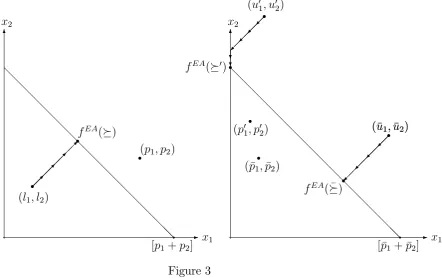
The equal awards rulefEA follows the same egalitarian procedure used to de…nefEL;
extremes of the individually rational intervals and, it increases (or decreases) all agents’ allotments in the same amount until the integer number of units is allotted, making sure that no agent receives a negative allotment.
Equal awards fEA . For all 2 PS and i2N; set
fiEL( ) =
(
li+ if Pj2Npj p + 0:5
ui minf ; uig if Pj2Npj > p + 0:5;
where is the unique real number for whichPj2N(lj + ) =p orPj2N(uj minf ; ug) =
p + 1 holds.
Figure 3 represents fEA at the pro…les ; 0 and ; where p
1 +p2 > [p1 +p2],
p0
1+p02 <[p01+p02], p1+p2 <[p1+p2] and [p01+p02] = [p1+p2]:
-6 -6 q q r r r r r r ? ?
(p1; p2)
@ @ @ @ @ @ @ @ @ @ @ @ @ @ @ @ @@ @ @ @ @ @ @ @ @ @ @ @ @ @ @ @ @ @@
[p1+p2] [p1+p2]
x1
x2
x1
x2
(l1; l2)
r r
r
(u0
1; u02)
(p0
1; p02) (u1; u2)
(p1; p2)
(u1; u2)
fEA( )
fEA( ) fEA( 0)
[image:15.595.92.535.303.581.2]Figure 3
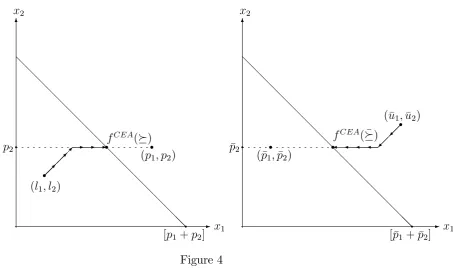
The constrained equal awards rule fCEA proceeds by following the same egalitarian
procedure used to describe fEA; but now the increase or decrease of the allotment of
each agenti;starting from the relevant extreme ofi’s individually rational interval, stops as soon asi’s allotment is equal to pi.
f( ) =
8 > > > < > > > :
li+ minfb; pi lig
i2N if
P
j2N pj < p + 0:5 ui minfb; ui pig
i2N if
P
j2N pj > p + 0:5 li+ minfb; pi lig
i2N or ui minf
b; ui pig
i2N if
P
j2N pj =p + 0:5:
where b is the unique real number for which P
j2N lj + minfb; pj ljg = p or
P
j2N uj minfb; uj pjg = p + 1:
Denote by FCEA the set of all constrained equal awards rules.
Observe that for any pair f; f0 2 FCEA; f( ) = f0( ) except for those pro…les
for which Pj2Npj = p + 0:5: But in this case, we will prove that for all i 2 N,
fi( ) i fi0( ): To see that, assume is such that
P
j2Npj = p + 0:5: If f( ) = li+ minfb; pi lig
i2N then
p = Pj2N lj + minfb; pj ljg
= Pj2Nlj+Pj2Nminfb; pj ljg
= Pj2Npj Pj2N(pj lj) +Pj2Nminfb; pj ljg
= p + 0:5 Pj2N(pj lj) +Pj2Nminfb; pj ljg:
) Pj2Nminfb; pj ljg=Pj2N(pj lj) 0:5
If f( ) = ui minfb; ui pig
i2N then
p + 1 = Pj2N uj minfb; uj pjg
= Pj2Nuj Pj2Nminfb; uj pjg
= Pj2Npj+Pj2N(uj pj) Pj2Nminfb; uj pjg
= p + 0:5 +Pj2N(uj pj) Pj2Nminfb; uj pjg:
) Pj2Nminfb; uj pjg=Pj2N(uj pj) 0:5:
Since pj lj =uj pj for all j 2N we deduce thatb =b: Hence for alli2N;
li+ minfb; pi lig i ui minfb; ui pig:
As a consequence, for any pair f; f0 2 FCEA, any pro…le and any i 2 N; fi( ) i f0
Figure 4 represents fCEA at the pro…les and ; where p
1 +p2 > [p1 +p2] and
p1+p2 <[p1+p2]:
-6 -6 q q q q r
r r r
r
r
-(p1; p2)
@ @ @ @ @ @ @ @ @ @ @ @ @ @ @ @ @@ @ @ @ @ @ @ @ @ @ @ @ @ @ @ @ @ @@
[p1+p2] [p1+p2]
x1
x2
x1
x2
(l1; l2)
p2 p2
(p1; p2)
(u1; u2)
fCEA( ) fCEA( )
[image:17.595.80.534.116.384.2]Figure 4
The existence of the unique numbers , b, and b in each of the above de…nitions is guaranteed by Proposition 1 below.
Proposition 1 For each 2 PS, the relevant statement below holds.
(P1.1) If Pj2Npj p + 0:5 then Pj2Nlj p :
(P1.2) If Pj2Npj p + 0:5 then Pj2Nuj p + 1:
Proof Let 2 PS be arbitrary.
For each i2N there existski 2N0 such that ki li pi < ki+ 1: We de…ne
t= X
j:pj kj+0:5
kj + X
j:pj>kj+0:5
(kj+ 1): (1)
Notice that ifpj kj+ 0:5, then lj =kj anduj =pj+ (pj kj) = 2pj kj:Similarly, if pj > kj + 0:5, thenlj =pj (kj + 1 pj) = 2pj (k+ 1) and uj =kj+ 1: Thus,
t = X
j:pj kj+0:5
lj + X
j:pj>kj+0:5
We have the following expressions. X
j2N
lj t X j2N
uj: (3)
X
j2N
lj 2X
j2N
pj t X j2N
uj: (4)
Equation (3) is a trivial consequence of Equation (2). We now prove Equation (4).
2X
j2N
pj t = X
j:pj kj+0:5
(2pj kj) + X
j:pj>kj+0:5
(2pj kj 1)
= X
j:pj kj+0:5
uj + X
j:pj>kj+0:5
lj:
Since lj uj for all j 2N; Equation (4) holds.
(P1.1) Assume Pj2Npj p + 0:5holds. We consider two cases depending on t:
1. t p By Equation(3); Pj2N lj t:
2. t > p : Since p and t are integer numbers (see Equation (1)), we have that t p + 1: Now,
p + 1 Pj2Npj t Pj2Npj:
Sincep Pj2Npj p + 0:5 we have that P
j2Npj p 0:5 p + 1
P
j2Npj:
Thus,
P
j2Npj p t
P
j2Npj
) 2Pj2Npj t p
By Equation(4); Pj2Nlj t holds.
(P1.2) Assume Pj2Npj p + 0:5holds. We consider two cases depending on t:
2. p + 1 > t:Sincep + 1 andt are integer numbers (see Equation (1)), we have that
p t: Now,
P
j2Npj p
P
j2Npj t:
Sincep + 0:5 Pj2Npj 1 we have that
p + 1 Pj2Npj 0:5 Pj2Npj p :
Thus,
p + 1 Pj2Npj Pj2Npj t )
p + 1 2Pj2Npj t:
By Equation(4); p + 1 Pj2Nuj holds.
Proposition 1 implies that the real numbers ;b; andbused to de…ne the four rules do exist and they are unique, and hence the rules are well-de…ned. To see that, observe that fEL and fCEL start allotting the good from p in a continuous and egalitarian (or
constrained egalitarian) way until the full amount is allotted. On the other hand, fEA
andfCEA start allotting the good from the vector of relevant extremes of the individually
rational intervals in a continuous and egalitarian (or constrained egalitarian) way until the full amount is allotted. Proposition 1 guarantees that the direction of the allotment process goes in the right direction to reach the full amount, from either one of the two starting vectors. So, Corollary 1 holds.
Corollary 1 The real numbers ; b; and b, used to de…ne respectively fEL; fCEL; fEA and fCEA do exist and they are unique.
5
Results for symmetric single-peaked preferences
5.1
Individual rationality and basic impossibilities
basic incompatibilities among properties of rules hold, even when agents’ preferences are restricted to be symmetric single-peaked.
Proposition 2 The following statements hold.
(P2.1) A rule f on PS is individually rational if and only if, for all 2 PS and i2N; fi( )2[li; ui]:
(P2.2)A rule f on PS is e¢cient and individually rational if and only if, for all 2 PS;
three conditions hold:
(E2.1) Pj2Nfj( ) =
8 > < > :
p when Pj2Npj < p + 0:5
p + 1 when Pj2Npj > p + 0:5
p or p + 1 when Pj2Npj =p + 0:5
.
(E2.2) fi( ) pi for all i2N orfi( ) pi for all i2N:
(E2.3) fi( )2[li; ui] for all i2N:
(P2.3) There is no rule on PS satisfying group rationality and e¢ciency.
(P2.4) There is no rule on PS satisfying individual rationality, e¢ciency and
strategy-proofness.
(P2.5) There is no rule on PS satisfying individual rationality and envy-freeness on
losses.
(P2.6) There is no rule on PS satisfying individual rationality, e¢ciency, and
envy-freeness.10
Proof
(P2.1) It is obvious.
(P2.2) Letf be an e¢cient and individually rational rule onPS. By (P2.1)f satis…es
(E2.3).
We now prove that f satis…es (E2.2). Suppose not. Then, there exist i; j 2 N
such thatfi( )> pi: and fj( )< pj: Let " be such that0< " <minffi( ) pi; pj fj( )g:Then, by single-peakedness, the feasible vector of allotments(fi( ) "; fj( )+
";(fk( ))k2Nnfi;jg) Pareto dominates f( ): Hence, f is not e¢cient. This proves that (E2.2) holds.
We now prove that f satis…es (E2.1).
10There are however rules onPS satisfying simultaneously individual rationality and envy-freeness.
For instance, the rulef that, at each pro…le, assigns to each agent the closest integer to her peak. To see thatf is not e¢cient, consider the problem(N; )2 PS whereN=f1;2gandp= (0:6;0:8):Then,
We prove thatPj2Nfj( )2 fp ; p + 1g:Suppose thatPj2Nfj( )< p :By (E2.2) for all i 2N; fi( ) pi and there exists j 2 N such that fj( )< pj: Let y 2F A be such that for all i 2 N; fi( ) yi pi; fj( )< yj pj and Pj2Nyj =p : Since by single-peakednessyi i fi( ) for alli2 N and yj j fj( ); and so y Pareto dominates f( );a contradiciton with the e¤ciency off: IfPj2Nfj( )> p + 1 the proof proceeds similarly.
We consider three cases.
1. Pj2Npj < p +xwithx <0:5:To obtain a contradiction, suppose thatPj2Nfj( ) =
p + 1: By (E2.2), for all i 2 N; fi( ) pi. By individual rationality, for all
i 2N; fi( ) ui: Hence, pi (fi( ) pi) li for all i 2 N; which means that
(2pj fj( ))j2N 2F A:Notice that fi( ) i (2pi fi( )) for all i2N: Now,
P
j2N(2pj fj( )) = 2
P
j2Npj
P
j2Nfj( )
= 2(p +x) p 1
= p + 2x 1
< p :
Lety 2 F A be such that, for all i2 N, 2pi fi( ) yi pi and Pj2Nyj = p :
By single-peakedness, yi i 2pi fi( ) i fi( ) and since Pj2Nyj = p >
P
j2N(2pj fj( )) there exists j 2 N such that 2pj fj( ) < yj and so yj j
2pj fj( ) j fj( ), a contradiction with the e¢ciency of f.
2. Pi2Npi =p +xwithx >0:5:To obtain a contradiction, suppose thatPj2Nfj( ) =
p : By (E2.2), for all i 2 N; fi( ) pi. By individual rationality, for all i 2 N; fi( ) li: Hence, pi + (pi fi( )) ui for all i 2 N; which means that
(2pj fj( ))j2N 2F A:Notice that fi( ) i (2pi fi( )) for all i2N: Now,
P
j2N(2pj fj( )) = 2
P
j2Npj
P
j2Nfj( )
= 2(p +x) p
= p + 2x
> p + 1:
Lety2F Abe such that, for alli2N,2pi fi( ) yi pi andPj2Nyj =p + 1:
By single-peakedness, yi i 2pi fi( ) i fi( ) and since Pj2N yj = p + 1 <
P
j2N(2pj fj( )) there exists j 2 N such that 2pj fj( ) > yj and so yj j
3. Pi2Npi =p +xwithx= 0:5:It follows inmediately from the fact thatPj2Nfj( )2 fp ; p + 1g;that it has been proved above.
We now prove the reciprocal. Let f be a rule satisfying (E2.1), (E2.2) and (E2.3). By (P2.1) and (E2.3) we conclude thatf is individually rational.
We now prove thatf is e¢cient. By (E2.1) it is enough to consider the following two cases.
1. Pj2Nfj( ) = p : By (E2.2), fi( ) pi for all i 2 N: Suppose f is not e¢cient. Then, there exists y 2 F A that Pareto dominates f( ): Since preferences are symmetric single-peaked,
yi 2[fi( ); pi+ (pi fi( ))] for all i2N; and
yj0 2(fj0( ); pj0 + (pj0 fj0( ))) for some j0 2N:
By (E2.1) and our assumption, P
j2Nfj( ) =p
P
j2Npj p + 0:5:
Thus,
p = Pj2Nfj( )
< Pj2Nyj
< Pj2N(pj + (pj fj( )))
= Pj2Npj +Pj2Npj p
P
j2Npj + 0:5 p + 1;
Thus,p <Pj2Nyj < p + 1: SincePj2Nyj 2N0 we have a contradiction.
2. Pj2Nfj( ) =p +1:By (E2.2),fi( ) pi for alli2N:Supposef is not e¢cient. Then, there exists y 2 F A that Pareto dominates f( ): Since preferences are symmetric single-peaked,
yi 2[pi (fi( ) pi); fi( )] for all i2N; and
yj0 2(pj0 (fj0( ) pj0); fj0( )) for some j0 2N:
By (E2.1) and our assumption, P
j2Nfj( ) =p + 1
P
Thus,
p + 1 = Pj2Nfj( )
> Pj2Nyj
> Pj2N(pj (fj( ) pj))
= Pj2Npj k 1 +Pj2Npj
0:5 1 +Pj2Npj
= Pj2Npj 0:5
p ;
Thus,p <Pj2Nyj < p + 1: SincePj2Nyj 2N0 we have a contradiction.
(P2.3) Assumef satis…es group rationality and e¢ciency onPS. Consider the
prob-lem(N; )2 PS whereN =f1;2;3gandp= (0:8;0:4;0:4):By (R1.3),f is individually
rational on PS. By e¢ciency, individual rationality and (P2.2), P
i2Nfi( ) = 2 and fi( ) pi for all i2N:
To apply the property of group rationality, consider the following table indicating, for each subset of agents with cardinality two, the aggregate loss, assuming the best integer amount is allotted (i.e., for each S N with jSj= 2; min
k2N0
P
j2Spj k ).
S min
k2N0
P
j2Spj k
f1;2g 0.2 f1;3g 0.2 f2;3g 0.2
Observe that 0:4 = Pj2Npj Pj2Nfj( ) = Pj2N (fj( ) pj): Suppose …rst that
fi( ) pi = 0:4
3 for alli2N:Then, for anyS (N with two agents, P
j2Spj
P
j2Sfj( ) =
0:8
3 > 0:2 = minx2N0
P
j2Spj x : Hence, f does not satisfy group rationality. Suppose
now that there exists i2 N such that (fi( ) pi) < 0:4
3 : Then, by settingS =Nnfig; P
j2Spj
P
j2Sfj( ) > 0 :8
3 > 0:2 = mink2N0
P
j2Spj k ; again a contradiction with
group rationality off:
(P2.4) Assume f is individually rational, e¢cient and strategy-proof on PS. We
evaluate f at …ve problems (N; (t))2 PS where N =f1;2g and t= 1;2;3;4;and 5.
Consider the pro…le (1) where p(1) = (0:26;0:26): By (P2.2) in Proposition 2,
p(2) = (0:26;0): By (P2.2) in Proposition 2, f
1 (2) +f2 (2) = 0: Thus, f (2) =
(0;0): Let (3) be such that p(3) = (0;0:26): Similarly, f (3) = (0;0). By strategy-proofness,f1 (1) (1)1 f1 (3) = 0:Since preferences are symmetric,f1 (1) 0:52: Similarly, f2 (1) 0:52: Thus,0:48 fi (1) 0:52for all i2N:
Consider the pro…le (4) wherep(4) = (0:26;0:3):Similarly to (1);we can prove that
0:4 f1 (4) 0:52 and 0:48 f2 (4) 0:6: We now obtain a contradiction in each of the three possible cases below.
1. f2 (1) > f2 (4) :Sincef2 (4) 0:48>0:26 = p(1)2 and preferences are sym-metric single-peaked,f2 (4) (1)2 f2 (1) ;which contradicts strategy-proofness because agent 2 manipulatesf at pro…le (1) via (4)
2 with p (4)
2 = 0:3:
2. f2 (1) < f2 (4) : Since f2 (1) 0:48>0:3 = p(4)2 and preferences are sym-metric single-peaked,f2 (1) (4)2 f2 (4) ;which contradicts strategy-proofness because agent 2 manipulatesf at pro…le (4) via (1)
2 with p (1)
2 = 0:26:
3. f2 (1) = f2 (4) : Thus, f1 (1) = f1 (4) and 0:48 fi (4) 0:52 for all i 2 N: Consider the pro…le (5) where p(5) = (0:21;0:3): Similarly to the pro…le (1) we can show that 0:4 f
1 (5) 0:42 and 0:58 f2 (5)
0:6: Since f1 (4) 0:48 > 0:42 f1 (5) > 0:26 = p(4)1 and preferences are symmetric single-peaked, f1 (5) (4)1 f1 (4) ; which contradicts strategy-proofness because agent 1 manipulatesf at pro…le (4) via (5)
1 with p (5)
1 = 0:21:
(P2.5) Assume f satis…es individual rationality and envy-freeness on losses on PS.
Consider the problem (N; ) 2 PS where N = f1;2g and p = (1;0:7): By individual
rationality, f1( ) = 1: Thus,f2( )2 f0;1;2; : : :g which means that agent 2 envies the zero loss(f1( ) p1 = 0) of agent 1.
(P2.6) Assume f satis…es individual rationality, e¢ciency, and envy-freeness on PS.
Consider the problem(N; )2 PS whereN =f1;2g and p= (0:2;0:35):By individual
rationality, 0 f1( ) 0:4 and 0 f2( ) 0:7: By e¢ciency and (P2.2) in Propo-sition 2, f1( ) +f2( ) = 1: Thus, 0:3 f1( ) 0:4 and 0:6 f2( ) 0:7: Then,
f1( ) 2 f2( ); which contradicts envy-freeness.
(P2.3) in Proposition 2 says that no rule satis…es individual rationality, e¢ciency and strategy-proofness simultaneously. In the next two subsections we study rules that are individually rational and e¢cient (Subsection 5.2) and rules that are individually rational and strategy-proof (Subsection 5.3). For the …rst case, we identify the constrained equal losses rule and the constrained equal awards rule as the unique ones that in addition of being individually rational and e¢cient satisfy also either justi…ed envy-freeness on losses or envy-freeness on awards, respectively (Theorem 1). In contrast, in Subsection 5.3 we …rst show that although there are individually rational and strategy-proof rules, they are not very interesting. For instance, we show in Proposition 4 that individually rationality and strategy-proofness are indeed incompatible with unanimity.
5.2
Individual rationality and e¢ciency
Let 2 PS be a problem. Denote by IRE( ) the set of feasible vectors of allotments
satisfying individual rationality and e¢ciency. It is easy to see that, by using similar arguments to the ones used to check that (P2.1) and (P2.2) in Proposition 2 hold, this set can be written as
IRE( ) =fx2RN+ j Pj2N xj 2 fp ; p + 1g and, for all i2N,
li xi pi when Pj2Nxj =p and
pi xi ui when Pj2Nxj =p + 1g:
By Proposition 1, the set IRE( ) is non-empty. Hence, a rule f satis…es individual rationality and e¢ciency if and only if, for each 2 PS; f ( )2IRE( ):
However, individual rationality and e¢ciency are properties of rules that apply only to each problem separately. They do not impose conditions on how the rule should be-have across problems. Thus, and given two di¤erent criteria compatible with individual rationality and e¢ciency, a rule can choose, in an arbitrary way, at problem an allo-cation inIRE( ), following one criterion, while choosing at problem 0 an allocation in
IRE( 0), following the other criterion. For instance the rulef that selectsf 2FCEL( )
when p is odd and f 2 FCEA( ) when p is even satis…es individual rationality and
e¢ciency.11 Thus, it seems appropriate to require that the rule satis…es an additional
property in order to eliminate this kind of arbitrariness. We will focus on two alternative properties related to envy-freeness: justi…ed envy-freeness on losses and envy-freeness on awards. But then, the consequence of requiring that rules (in addition of being individ-ually rational and e¢cient) satisfy either one of these two forms of non-envyness is that only one rule is left, either the constrained equal losses or the constrained equal awards,
respectively. Theorem 1, the main result of the paper, characterizes axiomatically the constrained equal losses rule fCEL and the constrained equal awards rule fCEA on the
domain of symmetric single-peaked preferences.
Theorem 1 The following two characterizations hold.
(T1.1)A rule f satis…es individual rationality, e¢ciency, and justi…ed envy-freeness on losses if and only if f is a constrained equal losses rule.
(T1.2) The constrained equal awards rule fCEA is the unique rule on PS satisfying
individual rationality, e¢ciency, and envy-freeness on awards.
Before proving Theorem 1, we provide in Proposition 3 preliminary results on the two rules that will be useful along the proof of Theorem 1 and in the sequel.
Proposition 3
(P3.1) Let f be a constrained equal losses rule on PS; then f satis…es individual
ra-tionality, e¢ciency, justi…ed envy-freeness on losses, participation, unanimity and equal treatment of equals.
(P3.2) Let f be a constrained equal losses rule on PS; then f does not satisfy
strategy-proofness, group rationality, envy-freeness, envy-freeness on losses, and envy-freeness on awards.
(P3.3)Let f be a constrained equal awards rule on PS; then f satis…es individual
ratio-nality, e¢ciency, envy-freeness on awards, participation, unanimity and equal treatment of equals.
(P3.4)Let f be a constrained equal awards rule on PS;then f does not satisfy
strategy-proofness, group rationality, freeness, freeness on losses, and justi…ed envy-freeness on losses.
Proof of Proposition 3
(P3.1) Thatf satis…esunanimity and equal treatment of equals follows directly from its de…nition. Now, we show thatf satis…es the other properties.
Individual rationality. By its de…nition, for all 2 PS and i 2 N, f
i( ) 2 [li; ui]:
By (P2.1) in Proposition 2, f is individually rational.
E¢ciency. By its de…nition,f satis…es conditions (E2.1), (E2.2) and (E2.3) in Propo-sition 2. Hence, by (P2.2),f is e¢cient.
Justi…ed envy-freeness on losses. Let j 2N be such that
fj( ) j k for all k 2N0: (5)
We want to show that for alli2N; fi( ) i maxfpi+ (fj( ) pj);0g:
1. Pj2Npj < p + 0:5: By de…nition, fj( ) = pj minfb; pj ljg: If pj lj b,
then fj( ) = lj; which contradicts (5) because fj( ) j lj uj and either lj or uj is an integer. Hence,
fj( ) = pj b: (6)
Leti2N be arbitrary. We distinguish between two cases. First,b pi li. Then, by (6), fi( ) =pi b =pi+ (fj( ) pj); which means that fi( ) = maxfpi+
(fj( ) pj);0g: Hence, fi( ) i maxfpi+ (fj( ) pj);0g: Second, b > pi li.
Then, by de…nition,fi( ) = li:Since, by (6), pi+ (fj( ) pj) =pi b < li pi, single-peakedness implies that fi( ) i maxfpi+ (fj( ) pj);0g:
2. Pj2Npj > p + 0:5: By de…nition, fj( ) = pj + minfb; uj pjg: If uj pj b,
then fj( ) = uj; which contradicts (5) because fj( ) j lj uj and either lj or uj is an integer. Hence, fj( ) =pj +b:
Let i 2 N be arbitrary. We distinguish between two cases. First, b ui pi. Then,
fi( ) = pi+ minfb; ui pig=pi b
= pi+ (fj( ) pj);
which means thatfi( ) = maxfpi+ (fj( ) pj);0g: Hence, fi( ) i maxfpi+
(fj( ) pj);0g: Second, b> ui pi. Then, by de…nition, fi( ) = ui:Since,
pi+ (fj( ) pj) =pi+b> ui;
single-peakedness implies that fi( ) i maxfpi+ (fj( ) pj);0g:
3. Pj2Npj = p + 0:5: Two cases are possible: Pj2N fj( ) = p or Pj2N fj( ) =
p + 1: Case Pj2Nfj( ) =p is similar to Case 1 and Case Pj2Nfj( ) =p + 1
is similar to Case 2.
Participation. Let 2 PS be such that k pi for some i 2 N and k 2 N0. We
want to show that fi( ) = k+fi pi k
i ; i : Set 0= ( ipi k; i) and p0 = (pi k;(pj)j2Nnfig):
We consider two cases.
1. Pj2Nfi( ) = p : This means that Pj2Npj p + 0:5: Then, fi( ) = pi
minfb; pi lig where b satis…es Pj2Nfj( ) = p : Since p0i = pi k and k is an
We consider two cases. Case 1. Pj2Np0
j < p0 + 0:5: Now,fi( 0) =p0i minfb
0
; p0
i li0g where b
0
satis…es P
j2Nfj( 0) = p0 : Sinceli0 =li k and lj0 =lj for all j 2Nn fig;we deduce that
b0 =b: Then,
fi( 0) = pi k minfb; pi k (li k)g
= pi minfb; pi lig k
= fi( ) k;
which is what we wanted to show. Case 2. Pj2Np0
j =p0 +0:5:Again two cases are possible. Case 2.1.
P
j2Nfj(
0) =
p0 : Similarly to Case 1 we can conclude that fi( 0) = fi( ) k: Case 2.2.
P
j2Nfj(
0) = p0 + 1: We have argued above that the allocation proposed by
any CEL rule in Case 2.1 and Case 2.2 are indi¤erent for any agent. Thus,
fi( 0)
i fi( ) k:
2. Pj2Nfi( ) = p + 1: This means that Pj2Npj p + 0:5: Then, fCEL
i ( ) =
pi+ minfb; ui pigwhere b satis…esPj2Nfj( ) =p + 1: Sincep0
i =pi k and k is an integer, p0 =p k.
We consider two cases. Case 1. Pj2Np0
j > p0 +0:5:Now,fi( 0) =p0i+minfb
0; u0
i p0
igwhere b
0 satis…esP
j2N fj(
0) =p0 + 1: Since u0
i =ui k and u0j =uj for all j 2Nn fig;we deduce that b0 = b: Then,
fi( 0) = pi k+ minfb; ui k (pi k)g
= pi minfb; ui pig k
= fi( ) k;
which is what we wanted to show. Case 2. Pj2Np0
j =p0 +0:5:Again two cases are possible. Case 2.1.
P
j2Nfj( 0) = p0 + 1: Similarly to Case 1 we can conclude that fi( 0) = fi( ) k: Case 2.2.
P
j2Nfj( 0) = p0 : We have argued above that the allocation proposed by any CEL rule in Case 2.1 and Case 2.2 are indi¤erent for any agent. Thus, fi( 0)
i fi( ) k:
(P3.2) We show that f does not satisfy the following properties on PS.
Strategy-proofness. Consider the problems (N; ) and (N; 0) where N = f1;2g,
0:8 2 0:7,f does not satisfy strategy-proofness because agent 2 manipulatesf at pro…le via 0
2 :
Group rationality. It follows from (P3.1) and (P2.4).
Envy-freeness. Consider the problem (N; ) where N =f1;2g and p= (0:40;0:46):
Then, f( ) = (0:47;0:53); which contradicts envy-freeness because agent 2 strictly prefers 0:47to0:53:
Envy-freeness on losses. If follows from (P3.1) and (P2.5).
Envy-freeness on awards. Consider the problem (N; ) where N = f1;2g and p = (0:4;0:46): Then, f( ) = (0:47;0:53): Therefore, a1( ; f) = 0:8 0:47 = 0:33 and
a2( ; f) = 0:92 0:53 = 0:39:For0:382[0:33;0:39];we have thatf1( ) = 0:47 1 0:38. Thus,f does not satisfy envy-freeness on awards.
(P3.3) Thatf satis…esunanimity and equal treatment of equals follows directly from its de…nition. Now, we show thatfCEA satis…es the other properties.
Individual rationality. By its de…nition, for all 2 PS and i2N,fCEA
i ( )2[li; ui]:
By (P2.1) in Proposition 2, f is individually rational.
E¢ciency. By its de…nition,f satis…es conditions (E2.1), (E2.2) and (E2.2) in Propo-sition 2. Hence, by (P2.2),f is e¢cient.
Envy-freeness on awards. We consider three cases.
1. Pj2Npj < p + 0:5: By de…nition, fi( ) pi for all i 2 N: Suppose that f
does not satisfy envy-freeness on awards. Then, there exist i; j 2 N and x 2 [minfai; ajg;maxfai; ajg] such that
li+x i fi( ): (7)
Hence,fi( )is not the peak of i and sofi( )< pi:Sincefi( ) =li+minfb; pi lig; b < pi li and hence
fi( ) =li+b: (8)
Thus,ai =b: We distinguish between two cases.
(a) minfb; pj ljg = b: Since aj = fj( ) lj = b; it must be the case that
x=b. Hence, by (7),
li+b=li+x i fi( ) = li+b;
(b) minfb; pj ljg=pj lj <b:By de…nition; fj( ) =pj andaj =fj( ) lj = pj lj: Thus,x2[pj lj;b] and
li+x li+b=fi( ) pi;
where the equality follows from (8). By single-peakedness, fi( ) i li+x; a
contradiction with (7).
2. Pj2Npj > p + 0:5: By de…nition, fi( ) pi for all i 2 N: Suppose that f
does not satisfy envy-freeness on awards. Then, there exist i; j 2 N and x 2 [minfai; ajg;maxfai; ajg] such that
ui x i fi( ): (9)
Hence,fi( )is not the peak of iand sofi( )> pi:Sincefi( ) =ui minfb; ui pig; b< ui pi and hence
fi( ) =ui b: (10)
Thus,ai =b: We distinguish between two cases.
(a) minfb; uj pjg = b: Since aj = uj fj( ) = b; it must be the case that x=b. Hence, by (9),
ui b =ui x i fi( ) =ui b;
which is a contradiction.
(b) minfb; uj pjg=uj pj <b:By de…nition; fj( ) =pjandaj =uj fj( ) = uj pj: Thus,x2[uj pj;b]and
ui x ui b=fi( ) pi;
where the equality follows from (10). By single-peakedness, fi( ) i ui x;
a contradiction with (9).
3. Pj2Npj = p + 0:5: Two cases are possible: Pj2N fj( ) = p or
P
j2N fj( ) = p + 1: Case Pj2Nfj( ) =p is similar to Case 1 and Case
P
j2Nfj( ) =p + 1
is similar to Case 2.
Participation. Let 2 PS be such that k pi for some i 2 N and k 2 N0. We
want to show that fi( ) i k+fi pii k; i : Set 0= ( pii k; i) and p0 = (pi k;(pj)j2Nnfig): We consider
1. Pj2Nfi( ) = p : This means that Pj2Npj p + 0:5: Then, fi( ) = li + minfb; pi lig: Since p0
i = pi k and k is an integer, p0 = p k. We consider
two cases. Case 1. Pj2Np0
j < p0 + 0:5:Then, fi( 0) = l0i+ minfb
0
; p0
i l0ig where b
0
satis…es P
j2Nfj(
0) = p0 : Sincel0
i =li k and lj0 =lj for all j 2Nn fig;we deduce that
b0 =b: Then,
fi( 0) = li k+ minfb; pi k (li k)g
= li+ minfb; pi lig k
= fi( ) k;
which is what we wanted to prove. Case 2. Pj2Np0
j =p0 +0:5:Again two cases are possible. Case 2.1.
P
j2Nfj(
0) =
p0 : Similarly to Case 1 we can conclude that fi( 0) = fi( ) k: Case 2.2.
P
j2Nfj(
0) = p0 + 1: We have argued above that the allocation proposed by
any CEA rule in Case 2.1 and Case 2.2 are indi¤erent for any agent. Thus,
fi( 0)
i fi( ) k:
2. Pj2Nfi( ) = p + 1: This means that Pj2N pj p + 0:5: Then, fi( ) =
ui minfb; ui pig:Sincep0
i =pi k andk is an integer,p0 =p k. We consider
two cases. Case 1. Pj2Np0
j > p0 + 0:5:Then, fi( 0) = l0i minfb
0
; u0
i p0igwhere b
0
satis…es P
j2Nfj(
0) = p0 : Since u0
i = ui k and u0j = uj for all j 2 Nn fig; we deduce
that b0 =b: Then,
fi( 0) = ui k minfb; ui k (pi k)g
= ui minfb; ui pig k
= fi( ) k;
which is what we wanted to prove. Case 2. Pj2Np0
j =p0 +0:5:Again two cases are possible. Case 2.1.
P
j2Nfj( 0) = p0 + 1:
Similarly to Case 1 we can conclude thatfi( 0) =fi( ) k:Case 2.2. P
j2Nfj( 0) = p0 : We have argued above that the allocation proposed by any CEA rule in Case
2.1 and Case 2.2 are indi¤erent for any agent. Thus,fi( 0)
(P3.4) We show that fCEA does not satisfy the following properties on PS.
Strategy-proofness. Consider the problems (N; ) and (N; 0) where N = f1;2g,
p= (0:4;0:8) and p0 = (0:6;0:8): Then, f( ) = (0:2;0:8) and f( 0) = (0:3;0:7): Since
0:3 1 0:2; f does not satisfy strategy-proofness because agent 1 manipulatesf at pro…le via 0
1 :
Group rationality. It follows from (P3.3) and (P2.4).
Envy-freeness. Consider the problem (N; ) where N = f1;2g and p = (0:6;0:8):
Then, f( ) = (0:3;0:7); which means that f is not envy-free because agent 1 strictly prefers 0:7to 0:3:
Envy-freeness on losses. It follows from (P3.3) and (P2.5).
Justi…ed envy-freeness on losses. Consider the problem(N; )whereN =f1;2gand
p = (0:6;0:8): Then, f( ) = (0:3;0:7); which means that f does not satisfy justi…ed envy-freeness on losses because agent 1 strictly prefers 0:6 + (0:7 0:8) = 0:5to 0:3:
Proof of Theorem 1
(T1:1) Let f be a constrained equal losses rule. By Proposition 3, f satis…es indi-vidual rationality, e¢ciency and justi…ed envy-freeness on losses.
Letf be a rule satisfying individual rationality, e¢ciency, and justi…ed envy-freeness on losses. Let 2 PS be a problem. By (E2.1) in (P2.2) of Proposition 2 we deduce
that Pj2Nfj( )2 fp ; p + 1g: We consider several cases.
1. Pj2Nfj( ) =p : By (E2.2) in (P2.2) of Proposition 2, for all i2N
fi( ) pi (11)
By (P2.1) in Proposition 2, fi( ) li for all i2N:
By(11)for each i2N; fi( ) =pi xi:By individual rationality,0 xi pi li. Assume …rst thatxi =xfor alli2N:Then, setting b =x, we havefi( ) =pi b
and b pi li for all i 2 N: Thus, for all i 2 N; fi( ) = pi minfb; pi lig:
Thus,f coincides with a constrained equal losses rule for pro…le :
Assume now that xj < xi for some pair i; j 2N: By single peakedness, pi xj i pi xi:Since
fi( ) = pi xi i pi xj =pi+ (fj( ) pj)
holds, by justi…ed envy-freeness on losses, there must exist yj 2 N0 such that
fj( ) j yj: By individual rationality,
LetS be the set of agents with the largest loss from the peak: Namely, S =fi0 2
N j xi0 xj0 for all j0 2 Ng: Since N is …nite, S 6= ;: Moreover, our assumption
that xj < xi for some pair i; j 2N implies S ( N: For anybj 2 S;set b =x^| and
observe that fbj( ) = pbj b lbj: Hence, fbj( ) = pbj minfb; pbj lbjg: Take any j0 2= S; then there exists i0 2 S such that xj
0 < xi0: By (12), fj0( ) = lj0: Since
fj0( ) = lj0 = pj0 xj0 and b > xj0 = pj0 lj0, fj0( ) = pj0 minfb; pj0 lj0g:
Thus,f coincides with a constrained equal losses rule for pro…le :
2. Pj2Nfj( ) =p + 1:By (E2.2) in (P2.2) of Proposition 2, for all i2N
fi( ) pi (13)
By (P2.1) in Proposition 2, fi( ) ui for all i2N:
By(13)for eachi2N; fi( ) =pi+xi:By individual rationality,0 xi ui ii. Assume …rst thatxi =xfor alli2N:Then, settingb =x, we havefi( ) =pi+b
and b ui pi for all i 2 N: Thus, for all i 2 N; fi( ) = pi+ minfb; pi lig:
Thus,f coincides with a constrained equal losses rule for pro…le :
Assume now that xj < xi for some pair i; j 2N: By single peakedness, pi+xj i pi +xi: Since
fi( ) =pi+xi i pi+xj =pi+ (fj( ) pj)
holds, by justi…ed envy-freeness on losses, there must exist yj 2 N0 such that
fj( ) j yj: By individual rationality,
fj( ) = uj: (14)
Let S and b be de…ned as in Case 1. Then, for any bj 2 S; fbj( ) = pbj +b ubj:
Hence, fbj( ) = pbj + minfb; ubj pbjg: Take any j0 2= S; then there exists i0 2 S
such that xj0 < xi0: By (14), fj0( ) = uj0: Since fj0( ) = uj0 = pj0 +xj0 and
b > xj0 = uj0 pj0, fj0( ) = pj0 + minfb; uj0 pj0g: Thus, f coincides with a
constrained equal losses rule for pro…le :
(T1:2) Let f be a constrained equal awardss rule. By Proposition 3, f satis…es individual rationality, e¢ciency and envy-freeness on awards.
Let f be a rule satisfying individual rationality, e¢ciency, and envy-freeness on awards. Let 2 PS be a problem. By (E2.1) in (P2.2) of Proposition 2 we deduce

![Figure 2 represents f + � CEL at the pro…les � and ��; where p1 + p2 > [p1 + p2] andp < [�p + �p]:](https://thumb-us.123doks.com/thumbv2/123dok_us/59051.506355/14.595.88.525.408.665/figure-represents-f-cel-pro-les-p-andp.webp)