1098
Heuristic Authorship Obfuscation
Janek Bevendorff∗ Martin Potthast† Matthias Hagen‡ Benno Stein∗
∗
Bauhaus-Universität Weimar †
Leipzig University
‡Martin-Luther-Universität Halle-Wittenberg
<first>.<last>@uni-{weimar, leipzig}.de <first>.<last>@informatik.uni-halle.de
Abstract
Authorship verification is the task of deter-mining whether or not two texts were written by the same author. This paper deals with the adversary task, calledauthorship obfusca-tion: Preventing verification by altering a to-be-obfuscated text. We introduce an approach that (1) models writing style difference as the Jensen-Shannon distance between the charac-ter n-gram distributions of texts, and (2) ma-nipulates an author’s subconsciously encoded writing style in a sophisticated manner using heuristic search. To obfuscate, we explore the huge space of textual variants in order to find a paraphrased version of the to-be-obfuscated text that has a sufficient Jensen-Shannon dis-tance at minimal costs in terms of text quality loss. We analyze, quantify, and illustrate the rationale of this approach, define paraphrasing operators, derive obfuscation thresholds, and develop an effective obfuscation framework. Our authorship obfuscation approach defeats state-of-the-art verification approaches, includ-ing unmaskinclud-ing and compression models, while keeping text changes at a minimum.
1 Introduction
Can the authorial style of a text be consistently ma-nipulated? More than a century worth of research on stylometry and authorship analysis could not produce a reliable approach to do so manually. In the context of computational authorship obfusca-tion, a handful of approaches have achieved some limited success but are still rather insufficient. Rule-based approaches are neither flexible, nor is stylom-etry understood well enough to compile rule sets that specifically target author style. Monolingual machine translation-based approaches suffer from a lack of training data, whereas applying multilin-gual translation in a cyclic manner as a workaround has proved to be ineffective. In addition, none of the existing approaches offers a means to control
the result quality. Given recent advances in con-trolled text generation, it stands to reason that a lot more can be achieved.
In this paper, we depart from the mentioned ob-fuscation paradigms and, for the first time, cast author obfuscation as a heuristic search problem. Given a to-be-obfuscated text, we search for a cost-minimum sequence of tailored paraphrasing op-erations that achieve a significant increase of the text’s style distance to other texts from the same author under a generic writing style representation; costs accrue through operations in terms of their estimated text quality reduction. By designing a hy-brid search strategy that neglects admissibility only in the pooling phase, we obtain a significant reduc-tion of the exponentially growing search space that is induced by the paraphrasing operators, enabling the use of informed search algorithms. Moreover, we developed a sophisticated framework to deal with the conflicting objectives that naturally arise with such kind of complex text synthesis tasks: a compact representation of the search space of para-phrased text variants, and an effective and efficient, non-monotonic exploration of this search space.1
Our key contributions are a greedy obfuscation approach that maximizes obfuscation gain per op-eration (Section 3); based on that, an obfuscation heuristic that reconciles obfuscation gain with text quality loss (Section 4); as well as an extensive comparative evaluation (Section 5). Relevant code and research data is released publicly on GitHub.2
2 Related Work
Authorship analysis dates back over 120 years (Bourne,1897) and has mostly dealt with author-ship attribution (given a text of unknown authorauthor-ship and texts from known candidate authors, attribute
1
Up to 10,000 text variants per second on a standard PC.
the unknown text to its true author among the can-didates). More recently, the task of authorship verification attracted a lot of interest (given a text of unknown authorship and a set of texts from one known author, verify whether the unknown text is written by that author) since it lies at the heart of many authorship-related problems.
Systematic reviews on authorship analysis have been contributed byJuola(2006) andStamatatos
(2009) and the effectiveness of character 3-grams today is “folklore knowledge,” albeit not systemat-ically proven. Still, a complete list of stylometric features has not been compiled to date.Abbasi and Chen (2008) proposed writeprints, a set of over twenty lexical, syntactic, and structural text feature types, which has gained some notoriety within at-tribution, verification, but also for “anonymizing” texts (Zheng et al.,2006;Narayanan et al.,2012;
Iqbal et al.,2008;McDonald et al.,2012).
Instead of relying on a rich feature set, Zhao et al.(2006) only extract POS tag distributions and interpret style differences as measurable by the Kullback-Leibler divergence. Teahan and Harper
(2003) andKhmelev and Teahan(2003) use com-pression as an indirect means to measure stylistic difference; later adapted and improved byHalvani et al.(2017).Koppel and Schler(2004) developed the unmasking approach based on the 250 most frequent function words, which are iteratively re-moved, effectively reducing the differentiability between the texts. The idea behind this approach is that texts written by the same author only differ in few superficial features. By removing those su-perficial features, differentiability between texts by the same author is expected to degrade faster than for texts written by different authors.
Among the first to tackle authorship obfuscation wereRao and Rohatgi(2000), who used cyclic ma-chine translation. LaterBrennan et al.(2012) found that machine translation is ineffective and due to its blackbox character also rather uncontrollable. Instead,Xu et al.(2012) proposed within-language machine translation to translate directly between styles. The practicality of this approach, however, is diminished by the general lack of large-scale par-allel training data. Another obfuscation approach byKacmarcik and Gamon(2006) directly targets
Koppel and Schler’s unmasking. By iteratively re-moving the most discriminatory text features, the classification performance of an unmasking verifier is degraded—at the cost of rather unreadable texts.
From 2016 to 2018, a shared task on authorship obfuscation was organized at PAN (Potthast et al.,
2018). Some of the seven participating teams sug-gested rather conservative rule-based approaches that do not change a text sufficiently to obfuscate authorship against most state-of-the-art verifiers but other obfuscators “fooled” several verifiers, yet again, generating rather unreadable texts. To score high in terms of text quality and obfusca-tion performance, the shared task organizers asked for approaches that more carefullyparaphrase a text (i.e., the meaning should stay the same and the text should still be readable). Our new author-ship obfuscation approach is inspired byStein et al.
(2014)’s heuristic paraphrasing idea for “encoding” an acrostic in a given text and byKacmarcik and Gamon’s observation that changing rather few text passages may successfully obfuscate authorship.
3 Greedy Obfuscation
We approach obfuscation from a verification per-spective: Given texts from the same author, one of which is not publicly known to be written by that author, the goal is to paraphrase that text so that ver-ification attempts against the other texts fail. In this setting, the key element of our heuristic obfusca-tion approach is a basic, yet powerful distribuobfusca-tional representation of writing style: the Jensen-Shannon distance of the character trigram frequency distri-bution of the to-be-obfuscated text compared to the others. This model serves three purposes at once: (1) as a stopping criterion, (2) as a primary selection criterion for parts of the text that will yield the high-est obfuscation gains if changed, and, (3) as part of our heuristic enabling informed search, which rec-onciles obfuscation gain with potential text quality loss. In what follows, we formally motivate these dimensions.
3.1 Measuring Stylistic Distance
In order to know when to stop obfuscating a text we require a style distance measure. Once a text has been changed sufficiently and its style distance to other texts from the same author exceeds a given threshold, the obfuscator terminates.3
By utilizing character trigram frequencies to rep-resent texts, we employ one of the most versatile
3Another possibility is to stop once the decision of existing
yet simple features available for authorship anal-ysis, encoding many aspects of authorial style at the same time including vocabulary, morphology, and punctuation. Based on this representation, we consider the well-known Kullback-Leibler diver-gence (KLD) as a style distance measure:
KLD(PkQ) =X i
P[i] logP[i]
Q[i] , (1)
where P andQ are discrete probability distribu-tions corresponding to the relative frequencies of character trigrams in the to-be-obfuscated text and the known texts respectively. For true probability distributions, the KLD is always non-negative.
The KLD has shortcomings. First, it is asymmet-ric, so it is not entirely clear which character distri-bution should beP and which should beQwhen comparing texts. Second, the KLD is defined only for distributionsP andQwhereQ[i] = 0implies P[i] = 0. Conversely,P[i] = 0yields a zero sum-mand. Since we want to avoid reducing or skewing the measure further by “subsetting” or smoothing the trigrams, we resort to the Jensen-Shannon dis-tanceJS∆(Endres and Schindelin,2003) in lieu of the KLD. TheJS∆is a metric based on the sym-metric Jensen-Shannon divergence (JSD) that is defined as
JSD(PkQ) = KLD(PkM) + KLD(QkM)
2 ,
(2) with
M = P +Q
2 . (3)
Introducing the artificial distributionM circum-vents the KLD’s problem of samples of one dis-tribution being unknown in the other. SinceM[i] can never be0for anyiwithP[i] +Q[i]>0, all summands of eitherKLD(PkM)orKLD(QkM) must also be non-zero. Using the base-2 loga-rithm in the KLD, the JSD is[0,1]-bounded. The JS∆metric is derived as
JS∆(P, Q) =
q
2·JSD(PkQ). (4)
3.2 Adaptive Obfuscation Thresholds
During pilot experiments on our training data, we observed that a fixedJS∆threshold as the obfusca-tion target is a bad idea: it leads to over- or under-obfuscation for text pairs that have an a-priori high or low style distance. It also turned out thatJS∆ is inversely correlated with text length: pairs of
1.0
Text length (characters)
JS∆
(JS distance)
1.4
1.2
0.8
0.6
27 28 29 210 211 212 213 214 different authors (93) same author (89)
ε0
[image:3.595.307.526.62.209.2]ε0.5
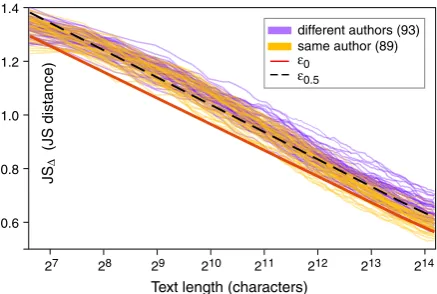
Figure 1: JS∆ in our training data over text length.
Each line corresponds to a text pair The straight lines indicate the 0th and the 50th percentiles of distances within the truedifferent-authorscases.
long texts are less distant to each other than pairs of short texts, since, the shorter a text the sparser and noisier is its trigram distribution. This even holds if the texts are written by the same author.
Figure 1plots theJS∆over the text length in our training data, revealing an approximately logarith-mic relationship. The most interesting observation is the almost length-invariant spread of the result-ing curves. Moreover, dependresult-ing on their class, the curves tend to converge towards the upper / lower bounds of this spread with growing length, thus being visibly separated.
Assuming that the observedJS∆-to-length rela-tionship generalizes to other text pairs of similar length—a hypothesis which merits further investi-gation in future work—, we measure style distance inJS∆@L(Jensen-Shannon distance at length) and fit threshold lines to define obfuscation levels. Ta-ble 1details the obfuscation levelsεk correspond-ing to a linear least-squares fit on the logarithmic scale through a given level’sk-th percentile of the distribution ofJS∆in thedifferent-authorsclass; the 0th percentileε0and the 50th percentileε0.5are
displayed inFigure 1. Theε0threshold serves as
an obfuscation baseline, indicating asame-author
case as unobfuscated, if theJS∆between its doc-uments is below this threshold. Otherwise, we call the obfuscation moderate, strong, stronger, and over-obfuscated, depending on the threshold theJS∆exceeds.
Regarding the line fit coefficients given in Ta-ble 1, the gradients of higher ε thresholds are slightly steeper, providing further evidence of the convergence rate ofdifferent-authorscases. Theε0
Threshold Obfuscation level Slope Intercept
< ε0 No Obfuscation n / a n / a
≥ε0 Moderate Obfuscation – 0.099 1.936
≥ε0.5 Strong Obfuscation – 0.103 2.056
≥ε0.7 Stronger Obfuscation – 0.104 2.083
> ε0.99 Over-obfuscation – 0.107 2.168
Table 1: Obfuscation levels and their log-scale polyno-mial fit coefficients on our training corpus.
ofx ≈219.5 characters. Since negative distances are not sensible, such book-sized texts may be split into smaller chunks, which then can be obfuscated individually. Note that we were able to reproduce these threshold observations on the PAN 2014 nov-els corpus (Stamatatos et al.,2014), albeit obtain-ing slightly different coefficients. In practice, we recommend training the coefficients on an appro-priate corpus matching genre and register of the to-be-obfuscated texts.
3.3 Ranking Trigrams for Obfuscation
Our key idea to yield a strong obfuscation (com-pared to other texts from the same author) is to iteratively change the frequency of those trigrams of the to-be-obfuscated text for which the positive impact onJS∆is maximum. In each iteration we rank the trigrams by their influence on JS∆ via their partial KLD derivative, assuming that proba-bility distributionQis to be obfuscated:
∂ ∂ Q[i]
P[i] log2P[i] Q[i]
=− P[i]
Q[i] ln 2 . (5)
Omitting constants, we get the rank-equivalent
RKL(i) =
P[i]
Q[i] . (6)
RKLgets larger with smallerQ[i]. I.e., a single obfuscation step boils down toremoving one oc-currence of the most influential trigram from the to-be-obfuscated text. This can be done naively by simply “cutting it out” (which we tried as a proof-of-concept), or, more sensibly, via a targeted para-phrasing operation replacing a text passage with the trigram by another semantically equivalent text passage without the trigram. Then, the trigrams are re-ranked and the procedure is repeated untilJS∆ exceeds the desired obfuscation threshold. We call this strategyobfuscation by reduction. Reversing the roles ofP andQyields anadditionstrategy, which we leave for future work.
The above described greedy obfuscation effec-tively hindered verification in our pilot experiments.
However, the naive cut-it-out variant results in rather unreadable texts, and, it may be easily “re-verse engineered” by an informed verifier. Even with more sophisticated paraphrasing operations, a reverse-engineering attack against the greedy strat-egy seems plausible. Thus, we suggest to aug-ment the greedy approach with an informed search, which is introduced in the next section.
4 Heuristic Search for Obfuscation
An author of a to-be-obfuscated text does obviously not wish her text to be “foozled” due to obfuscation (e.g., by naively cutting out trigrams). Actually, the text has to convey the same message as before and, ideally, it should look “inconspicuous” to an ex-tent that readers do not suspect tampering (Potthast et al.,2016). However, automatic paraphrasing is still in its infancy: Beyond synonym substitution, paraphrasing operators targeting single words have hardly been devised so far. Still, the paraphras-ing operators we are lookparaphras-ing for do not have to alter a text substantially, which enables us to better estimate an operator’s negative impact on text qual-ity. Furthermore, similar to the presented greedy obfuscation, we can stop modifying a text when the desired obfuscation threshold is reached, which renders our approach “minimally invasive.” The optimization goals can be summarized as follows:
1. Maximize the obfuscation as per theJS∆
be-yond a givenεkwithout “over-obfuscating.”
2. Minimize the accumulated text quality loss from consecutive paraphrasing operations.
3. Minimize the number of text operations.
Heuristic search is our choice to tackle this op-timization problem. We will pay attention to ad-missibility for two reasons: (1) to understand (in terms of modeling) the nature of the problem, and (2) to be able to compute an optimum solution if time and space constraints permit. However, due to the exponential size of the induced state space (text versions as nodes, paraphrasing operators as edges), we may give up admissibility while staying within acceptable error bounds. In the following, we derive an admissible obfuscation heuristic and suggest a small, viable set of basic paraphrasing operators as an initial proof of concept.
4.1 An Admissible Obfuscation Heuristic
from node n, and letg(n) denote the path costs tonstarting at the original text nodes.
Applying a paraphrasing operator has a highly non-linear effect on text quality (some changes are inconspicuous, others are not) and may also restrict the set of applicable operators (in the same text). For instance, applying the same operator a third time in a row may entail higher (quality) costs compared to applying it for the first time. This means that different paths from stoncan come with different estimations for the rest costh(n)—in a nutshell, the parent discarding property may not hold (Pearl,1984). A similar effect, but rooted in a different cause, results from the observation that some authors’ texts are easier to be obfuscated than others. We can address both issues and re-install the conditions for parent discarding and admissible search by updating the operator costs for future application beyond node n, such that g(n) turns into “normalized path costs.”
Based on both the desired obfuscation thresh-oldεand the JS distanceJS∆nof the text at noden to the other text(s) from the same author, we define the prior heuristic as
hprior(n) =ε−JS∆n. (7)
The normalized path costs gnorm are defined
as the cost-to-gain ratio of the accumulated path costsg(n)to totalJS∆change from start nodes:
gnorm(n) =
g(n)
JS∆n−JS∆s. (8)
Finally, the heuristich(n)is defined as the prod-uct ofhprior(n)andgnorm(n):
h(n) = (ε−JS∆n)· g(n)
JS∆n−JS∆s. (9)
The prior heuristic guarantees convergence to-wards zero as we approach a goal node that exceeds the obfuscation thresholdε, while the normalized path costs determine the slope of the heuristic.
Consistency and Admissibility
A heuristic h(n) is admissible if it does not ex-ceedh∗(n), the true cost of reaching an optimum goal via staten, for allnin the search space. Mono-tonicityh(n)≤c(n, n0) +h(n0)is a sufficient con-dition for admissibility, yet easier to show. Rewrit-ing it as
−h(n0) +h(n)≤g(n0)−g(n), and inserting in the heuristicEquation 9yields
−(ε−JS∆n0)·g(n
0
) JS∆n0−JS∆s +
(ε−JS∆n)·g(n)
JS∆n−JS∆s
≤g(n0)−g(n).
Defining¯g(n) = JS∆n−JS∆sas change func-tion and inserting previous definifunc-tions we get
−hprior(n0)·g(n0)
¯
g(n0) −
−hprior(n)·g(n)
¯
g(n) ≤g(n
0
)−g(n).
We knowhprior(n)to be monotonically
decreas-ing, inverse to¯g(n), and converging towards zero as we approach a goal. If the cost and change func-tionsg(n)and¯g(n)are equivalent up to scale, they cancel out each other (up to scale), the slope of their quotient becomes zero, and the inequality turns into equality. Otherwise, ifg(n)dominates¯g(n), the inequality still holds. Though, ifg¯(n)dominates g(n), the sign of the quotient’s gradient flips (as can be proved by the quotient rule), breaking the in-equality and violating consistency. But sinceJS∆ is bounded by √2 globally, the change function ¯
g(n)cannot be superlinear.
Limitations of our argument: (1) occasionally ¯
g(n)can locally dominateg(n), and (2) both func-tions are presumed differentiable atn. In practice, the latter may hardly ever be true as texts are noisy, text operation side effects are unpredictable, and, the cumulative change function is not guaranteed to be monotonic. Still, step costsc(n, n0)will never be negative, which makesg(n)monotonic but not necessarily differentiable. Thus, the heuristic func-tion will not be fully consistent and may even over-estimate.
4.2 Search Space Challenges
Given a longer text (one page or more), the num-ber of potential operator applications is high. The most direct way to expand a node is to generate a successor with each applicable operator for each occurrence of each selectedn-gram, but this will inevitably result in an immense number of very similar states with identical costs and almost iden-tical JS∆ change. I.e., the main challenge is to find a sensible middle ground between accepting a non-optimal solution too quickly or not finding a solution at all. Recall that one can easily turn the A* search into a depth-first or breadth-first search by making successor generation too cheap or too costly: depth-first search will always find a (non-optimal) solution after a sufficient number of op-erations, while breadth-first will never terminate before running out of memory.
We can accept a near-optimal solution, so select-ing one or two occurrences of ann-gram (instead of all) will be sufficient. A potential problem is that the applicability of a high-quality operator is often restricted. However, one can increase the application probability by selecting not only the top-rankedn-gram but a small number of different near-topn-grams. This way, we have multiple high-impact n-grams with different contexts to work with, and we increase the chances of applying the operator opening alternative paths for the search. In practice,JS∆change is not a monotonic function and steepest-ascent hill climbing does not guaran-tee an overall lowest-cost path. Thus, we applied each operator to two occurrences of the top ten n-grams and selected from these (up to 140 succes-sors) six randomly for expansion. However, even with only six successors we still generate millions of nodes very quickly and will eventually run out of memory without finding a solution. Fortunately, we can assume that exploring more neighbors will not produce much better results after a while, so we can restart the search from a few promising nodes and still discard other open nodes.
4.3 Paraphrasing Operators
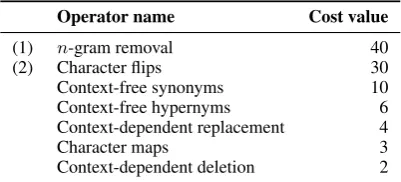
Our prototype employs the seven basic text opera-tors shown inTable 2. These are to be understood as a pilot study, more state-of-the-art text genera-tion operators can be added easily. The most ver-satile yet most disruptive basic modification are (1) the removal of ann-gram, and (2) flipping two of its (or adjacent) characters. Such operations
Operator name Cost value
(1) n-gram removal 40
(2) Character flips 30
Context-free synonyms 10
Context-free hypernyms 6
Context-dependent replacement 4
Character maps 3
[image:6.595.316.517.68.159.2]Context-dependent deletion 2
Table 2: Implemented text operators and their assigned step costs in our heuristic obfuscation prototype.
only are a last resort, and we hence set their costs much higher than those of other operators. As steps towards real paraphrasing, we also perform context-free synonym and hypernym replacement based on WordNet (Miller,1995) as well as context-dependent replacements and deletions using the word 5-gram model of Netspeak (Stein et al.,2010). Also, a map of similar punctuation characters indi-cates inconspicuous character swaps.
5 Evaluation
To evaluate our approach, we report on: (1) an efficiency comparison of greedy versus heuristic obfuscation, (2) an effectiveness analysis against well-known authorship verification approaches (un-masking, compression-based models, and PAN par-ticipants), as well as (3) a review and discussion of an example obfuscated text.
Our experiments are based on PAN authorship corpora and our new Webis Authorship Verifica-tion Corpus 2019 of 262 authorship verificaVerifica-tion cases (Bevendorff et al.,2019), half of them same-authorcases, the other halfdifferent-authorscases (each a pair of texts of about 23,000 characters / 4,000 words). Instead of the more particular genres studied at PAN, our new corpus contains longer texts and more modern literature from Project Gutenberg. We also took extra care to cleanse the plain text, unified special characters, and removed artifacts; in particular, we ensured that no author appears in more than one case. The training-test split is 70-30 so as to have a decent training portion. The corpus is released alongside the code of our search framework and other research data.
5.1 Search Over Greedy Obfuscation
Efficiency Cases Median
Subset # Greedy A* Gain
Total operations
all 41 148 145 −2 %
1+ ops 28 241 202 −16 %
100+ ops 21 291 236 −19 %
Path costs
all 41 5,960 1,968 −67 %
1+ ops 28 9,680 2,712 −72 %
100+ ops 21 11,680 2,935 −75 %
Table 3: Efficiency of greedy obfuscation vs heuristic obfuscation for an obfuscation threshold ofε0.5.
Confidence Unobfuscated Obfuscated
Hyperplane Classified Effectiveness Classified Effectiveness threshold cases [%] Prec. Rec. cases [%] Prec. Rec.
0.8 11.3 1.00 0.17 2.5 1.00 0.02 0.7 15.0 1.00 0.24 6.2 1.00 0.05 0.6 18.8 1.00 0.24 11.3 0.75 0.07 0.5 26.3 1.00 0.29 24.0 0.86 0.15 0.0 100.0 0.74 0.63 100.0 0.71 0.42
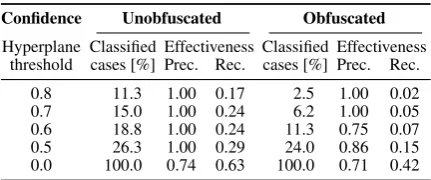
Table 4: Unmasking performance on our test data at various confidence thresholds before and after obfusca-tion. Recall treats unclassified cases as false negatives.
need at least 100 operations and an accumulated path cost decrease of up to 75%. Since the greedy obfuscation approach cannot choose among differ-ent operators, it must rely on the most effective one to achieve the obfuscation goal, incurring signifi-cant path costs. Given that both obfuscators employ adaptive thresholds, there are cases which do not require any (or only little) obfuscation, whereas oth-ers need more than 100. The latter are of particular interest, since it is here where heuristic obfuscation outperforms greedy obfuscation the most.
5.2 Obfuscation against Unmasking
One of today’s most effective and robust verifica-tion approaches is unmasking byKoppel and Schler
(2004). It decomposes to-be-compared texts into two chunk sets, and iteratively trains a linear classi-fier to discriminate between them while removing the most significant features in each iteration to measure the increased reconstruction error. This error increases faster forsame-authorcases since those share more function words than do different-authorscases. Fooling unmasking verification pro-vides us with evidence that our obfuscation tech-nique works at a deeper level than just the few most superficial text features. Unmasking further produces curve plots of the declining classification accuracy, which render the effects of obfuscation accessible to human inspection and interpretation.
FollowingKoppel and Schler, we use the chunk frequencies of the 250 most common words as fea-tures, determine classification accuracy by 10-fold cross validation using an SVM classifier, and re-move ten features per iteration. The final curves and their gradients are used to train another SVM to separate curves originating fromsame-author
cases fromdifferent-authorscurves. Following the example of the PAN competitions where the in-centive was to classify only high-confidence cases, we consider decisions for cases which can be clas-sified with pre-determined confidence thresholds (i.e., the distance to the hyperplane), which allows to maximize precision at the cost of recall.
Table 4contrasts the performance of unmasking before and after obfuscation on the test data. With increasing confidence thresholds, between 19 % down to 11 % of the cases are decidable before obfuscation, decreased by a factor of 2 to 4 after obfuscation. On average, 205 trigrams were obfus-cated; as little as about 3 % of a text.
5.3 Obfuscation against Compression Models
Another verification approach that differs from tra-ditional feature-engineering are compression-based models. We use the approach by Halvani et al.
(2017), who recommend the compression-based cosine (CBC) bySculley and Brodley(2006) cal-culated on the text pairs after compression with the PPMD algorithm (Howard,1993).
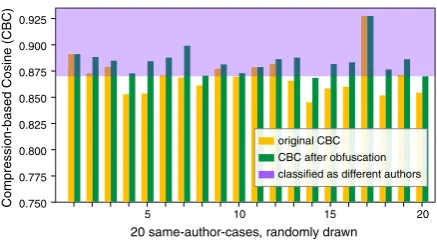
Figure 2shows CBC values on a random selec-tion of 20 exemplarysame-authorcases from our test dataset before and after obfuscation with the decision threshold highlighted. Quite impressively, almost none of the cases are classified correctly anymore after obfuscation. Overall, the accuracy drops from originally 71 % to 55 %, which is equiv-alent to random guessing. This strong effect can be explained as follows:Sculley and Brodleydescribe their metrics in terms of the Kolmogorov complex-ity, but the reason why natural language allows for very good compression ratios is its predictability (printed English has an entropy of at most 1.75 bits per character (Brown et al.,1992)). PPMD uses finite-order Markov language models for compres-sion, which are effective at predicting characters in a sentence, but sensitive to increased entropy, which is the result of our obfuscation.
5.4 PAN Obfuscation Evaluation
[image:7.595.73.289.215.305.2]20 same-author-cases, randomly drawn
Compression-based Cosine (CBC)
10 20
0.925
0.900
0.875
0.850
0.825
0.800
0.775
0.750
15 5
[image:8.595.72.291.59.181.2]original CBC CBC after obfuscation classified as different authors
Figure 2: CBC values of 20 PPMD-compressed same-authorpairs before and after obfuscation up to the ob-fuscation thresholdε0.7. The classification threshold by
which same-authorand different-authors cases could be distinguished is highlighted in the top portion.
the verification task at PAN 2013–2015 (Juola and Stamatatos,2013;Stamatatos et al.,2014,2015). The results are shown inTable 5. On all verifiers tested, we achieve an average AUC and C@1 re-duction of around 10 and 6 percentage points on three of the corpora. With only minimal text modi-fications, this puts us in second place on the PAN13 and PAN15 corpora, and fourth on PAN14 Essays compared to other obfuscators submitted to PAN (Hagen et al.,2017). The PAN14 Novels corpus turns out to be the most challenging for our ap-proach and there are multiple reasons for that. First, the texts are significantly longer. This makes it dif-ficult to assess the overall obfuscation with a global measure like JS∆. As a result, only few sentences
were actually obfuscated with most of the text left untouched. Insofar, we were surprised to see any significant effect at all (best individual result: 13 percentage points). To make matters worse, the flat search landscape spanned by our obfuscation op-erators leads to an increasing number of reopened states on these longer texts, greatly reducing the efficiency of the heuristic search. This reveals an important detail to explore in future work: obfus-cation operations need to be distributed across the whole text and progress needs to be measured on smaller parts of it to ensure uniform obfuscation of everything and avoid obfuscation “hot spots”. Secondly, the number of “known” texts varies sub-stantially, which demands more research into how we can calculate a minimal yet sufficientJS∆@L
stopping criterion if a larger amount of known ma-terial is available. Thirdly, the corpus consists pri-marily of works by H. P. Lovecraft paired with fan fiction, which incurs unforeseeable global corpus features that verifiers can exploit, but which we do
not consider for obfuscation. Lastly, we identify
kocher15as the most difficult verifier for us to ob-fuscate. Employing an impostor approach on the most frequent words, it was not the best-performing verifier in the first place, but proves most resilient against our “reductive” obfuscation, which tends to obfuscate only n-grams that are already rare for maximum effect. We expect that augmenting a re-duction obfuscation with the previously-mentioned extension strategy will yield better results and an overall safer obfuscation.
5.5 Example of an Obfuscated Text
Assessing the text quality in tasks that involve gen-eration, such as translation, paraphrasing, and sum-marization, is still mostly manual work. Frequently used measures like ROUGE cannot be applied in the context of obfuscation, since our obfuscated texts are up to 97 % identical to their unobfuscated versions. This is why we resort to manually in-specting obfuscated texts and the changes made. Below is an excerpt of an original text along with the obfuscations applied to it. Selected trigrams are underlined, removed words are struck out, and inserted words are highlighted:
’It was the only chance we hadw ehad to win.’ Duke swallowed the idea slowly. He couldn’t picture a planetsatellite giving up its last
protection for aphi desperate effort to end the war on purely offensive drive. Three billion people watching the home fleet take off,
knowingdeciding the skies were
openresort for all the hellmischief that a savage enemy could send! On Earth, the World Senate hadn’t permitted the building of one battleshipfrigate, for fear of reprisal. [...]
Excerpt ofVictoryby Lester del Rey
We selected an example where, by chance, dif-ferent operators were applied in close vicinity. This “density” of operations is not representative. We can see both high- and low-quality replacements at work. Most can be attributed to the WordNet synonym operator. The replacement of “a” with “phi” is clearly such a case. The more suitable
re-placements originate from more context-dependent replacements, whereas “we had”→“w ehad” is a result of the flip operator.
obfusca-Verifier Unobfuscated Obfuscated Difference
AUC C@1 FS AUC C@1 FS AUC C@1 FS
a) PAN13
bagnall15 0.86 0.79 0.68 0.74 0.64 0.48 0.11 0.15 0.20 castillojuarez14 0.49 0.43 0.21 0.50 0.53 0.27-0.02 -0.10 -0.06
castro15 0.93 0.77 0.71 0.87 0.73 0.64 0.06 0.03 0.08
frery14 0.62 0.57 0.35 0.37 0.40 0.15 0.25 0.17 0.20
khonji14 0.86 0.76 0.65 0.70 0.60 0.42 0.16 0.16 0.23
kocher15 0.75 0.64 0.48 0.77 0.65 0.50-0.02 -0.01 -0.02
layton14 0.62 0.67 0.41 0.47 0.53 0.25 0.15 0.13 0.16
mezaruiz14 0.75 0.65 0.49 0.57 0.53 0.30 0.18 0.12 0.19 mezaruiz15 0.73 0.71 0.52 0.50 0.53 0.26 0.24 0.18 0.26
modaresi14 0.50 0.50 0.25 0.47 0.50 0.24 0.03 0.00 0.02
moreau14 0.77 0.62 0.48 0.61 0.51 0.32 0.16 0.11 0.17
moreau15 0.71 0.47 0.33 0.60 0.47 0.28 0.12 0.00 0.05
singh14 0.39 0.33 0.13 0.44 0.43 0.19-0.06 -0.10 -0.06
zamani14 0.75 0.70 0.53 0.71 0.70 0.50 0.05 0.00 0.03
Average 0.10 0.06 0.10
b) PAN14 Essays
bagnall15 0.57 0.55 0.31 0.43 0.45 0.19 0.14 0.10 0.12 castillojuarez14 0.55 0.58 0.32 0.55 0.58 0.32 0.00 0.00 0.00
castro15 0.62 0.59 0.36 0.51 0.53 0.27 0.11 0.05 0.09
frery14 0.72 0.71 0.51 0.68 0.68 0.46 0.04 0.03 0.05
khonji14 0.60 0.58 0.35 0.41 0.50 0.20 0.19 0.09 0.15
kocher15 0.63 0.59 0.37 0.61 0.57 0.35 0.02 0.02 0.02
layton14 0.59 0.61 0.36 0.51 0.53 0.27 0.08 0.08 0.09
mezaruiz14 0.57 0.56 0.32 0.49 0.51 0.25 0.08 0.04 0.07 mezaruiz15 0.52 0.52 0.27 0.32 0.37 0.12 0.21 0.16 0.16
modaresi14 0.60 0.58 0.35 0.57 0.57 0.32 0.04 0.01 0.03
moreau14 0.62 0.60 0.37 0.51 0.53 0.27 0.11 0.07 0.10
moreau15 0.57 0.52 0.30 0.50 0.51 0.26 0.07 0.01 0.04
singh14 0.70 0.66 0.46 0.61 0.61 0.37 0.09 0.04 0.08
zamani14 0.58 0.55 0.32 0.48 0.49 0.23 0.11 0.06 0.09
Average 0.09 0.05 0.08
Verifier Unobfuscated Obfuscated Difference
AUC C@1 FS AUC C@1 FS AUC C@1 FS
c) PAN14 Novels
bagnall15 0.68 0.68 0.47 0.61 0.59 0.36 0.07 0.09 0.10 castillojuarez14 0.63 0.62 0.39 0.59 0.56 0.33 0.04 0.05 0.06
castro15 0.64 0.51 0.33 0.50 0.39 0.19 0.14 0.12 0.13
frery14 0.61 0.59 0.36 0.59 0.57 0.34 0.02 0.02 0.02
khonji14 0.75 0.61 0.46 0.71 0.58 0.41 0.04 0.03 0.05
kocher15 0.63 0.57 0.36 0.66 0.59 0.39 -0.03 -0.02 -0.03
layton14 0.51 0.51 0.26 0.50 0.50 0.25 0.01 0.01 0.01
mezaruiz14 0.66 0.61 0.41 0.64 0.62 0.40 0.02 0.00 0.01 mezaruiz15 0.56 0.51 0.28 0.57 0.51 0.29 -0.01 0.00 0.00 modaresi14 0.71 0.72 0.51 0.69 0.69 0.47 0.02 0.03 0.03
moreau14 0.60 0.52 0.31 0.56 0.51 0.29 0.04 0.01 0.03
moreau15 0.64 0.50 0.32 0.61 0.53 0.32 0.03 -0.03 0.00
singh14 0.66 0.58 0.38 0.63 0.56 0.35 0.03 0.02 0.03
zamani14 0.73 0.65 0.48 0.71 0.63 0.44 0.03 0.02 0.03
Average 0.03 0.02 0.03
d) PAN15
bagnall15 0.81 0.76 0.61 0.72 0.71 0.51 0.09 0.05 0.10 castillojuarez14 0.64 0.64 0.41 0.55 0.55 0.30 0.09 0.09 0.11
castro15 0.75 0.69 0.52 0.72 0.68 0.49 0.03 0.01 0.03
frery14 0.54 0.46 0.25 0.47 0.43 0.20 0.07 0.04 0.05
khonji14 0.82 0.65 0.53 0.59 0.49 0.49 0.23 0.16 0.24
kocher15 0.74 0.69 0.51 0.72 0.66 0.48 0.02 0.02 0.03
layton14 0.67 0.50 0.34 0.49 0.50 0.25 0.18 0.00 0.09
mezaruiz14 0.65 0.61 0.40 0.55 0.54 0.30 0.10 0.07 0.10 mezaruiz15 0.74 0.69 0.51 0.55 0.53 0.29 0.19 0.16 0.22 modaresi14 0.40 0.41 0.16 0.39 0.40 0.16 0.01 0.00 0.00
moreau14 0.66 0.58 0.38 0.52 0.49 0.25 0.14 0.09 0.13
moreau15 0.71 0.64 0.45 0.52 0.49 0.26 0.19 0.15 0.20
singh14 0.78 0.50 0.39 0.66 0.50 0.33 0.12 0.00 0.06
zamani14 0.74 0.67 0.50 0.71 0.66 0.47 0.04 0.00 0.03
[image:9.595.73.525.70.423.2]Average 0.11 0.06 0.10
Table 5: Results of the top verifiers of PAN 2013–2015 before and after obfuscating the four task corpora. FS (Fi-nal Score) is the product of AUC and C@1. On average, we degrade AUC by at least 10 and C@1 by about 6 percentage points on three of the corpora, though much less on the PAN14 Novels corpus. Most noticeably, we can reduce the FS ofbagnall15(winning submission of PAN 2015) by 10–20 percentage points on all four corpora. The best obfuscation results on each corpus are marked bold. Verifiers that were improved are highlighted in red.
tion samples as per the PAN obfuscation task. We achieved an overall grade of about 2.6 (1 = excel-lent, 5 = fail), which places us somewhere within the top three submissions.
While the obfuscated text probably is not fit for publication, it does look promising even with our basic set of paraphrasing operators. The text was generated within a few minutes and passes the ver-ifiers without being recognized as a same-author case. Texts from other cases look similar: a mix-ture of poor and good operations, where according to our own review about half of the changes made are still rather nonsensical. Since our set of opera-tors is just a proof of concept, we will devise more sophisticated ones and better weighting schemes in future work, which is vital for achieving acceptable text quality. Promising approaches already exist, such as neural editing and paraphrasing (Grangier and Auli,2017;Guu et al.,2017).
6 Conclusion
We introduced a promising new paradigm for au-thorship obfuscation and implemented a first fully functional prototype. We identified and addressed the following challenges: measuring style similar-ity in a manner that is agnostic to state-of-the-art verifiers, identifying those parts of a text that have the highest impact on style, and devising and an-alyzing a search heuristic amenable for informed search. Our study opens up interesting avenues for future research: obfuscation by addition instead of by reduction, development of more powerful, targeted paraphrasing operators, and, theoretical analysis of the search space properties.
References
Ahmed Abbasi and Hsinchun Chen. 2008.Writeprints: A stylometric approach to identity-level identifica-tion and similarity detecidentifica-tion in cyberspace. ACM Trans. Inf. Syst., 26(2):7:1–7:29.
Janek Bevendorff, Benno Stein, Matthias Hagen, and Martin Potthast. 2019. Bias Analysis and Mitiga-tion in the EvaluaMitiga-tion of Authorship VerificaMitiga-tion. In
Proceedings of ACL 2019, (to appear).
Edward Gaylord Bourne. 1897. The authorship of the federalist. The American Historical Review, 2(3):443–460.
Michael Brennan, Sadia Afroz, and Rachel Green-stadt. 2012. Adversarial Stylometry: Circumvent-ing Authorship Recognition to Preserve Privacy and Anonymity.ACM Trans. Inf. Syst. Secur., 15(3):12.
Peter F. Brown, Stephen Della Pietra, Vincent J. Della Pietra, Jennifer C. Lai, and Robert L. Mercer. 1992. An estimate of an upper bound for the entropy of English. Computational Linguistics, 18(1):31–40.
Dominik Maria Endres and Johannes E. Schindelin. 2003. A new metric for probability distributions.
IEEE Trans. Information Theory, 49(7):1858–1860.
David Grangier and Michael Auli. 2017. Quickedit: Editing text & translations via simple delete actions.
arXiv, 1711.04805.
Kelvin Guu, Tatsunori B. Hashimoto, Yonatan Oren, and Percy Liang. 2017. Generating sentences by editing prototypes.arXiv, 1709.08878.
Matthias Hagen, Martin Potthast, and Benno Stein. 2017. Overview of the Author Obfuscation Task at PAN 2017: Safety Evaluation Revisited. InWorking Notes Papers of the CLEF 2017 Evaluation Labs.
Oren Halvani, Christian Winter, and Lukas Graner. 2017. Authorship verification based on compre-ssion-models.arXiv, 1706.00516.
Paul G. Howard. 1993. The Design and Analysis of Efficient Lossless Data Compression Systems. Tech-nical Report, CS-93-28, Brown University, 1993.
Farkhund Iqbal, Rachid Hadjidj, Benjamin C.M. Fung, and Mourad Debbabi. 2008. A novel approach of mining writprints for authorship attribution in e-mail forensics.Digital Investigation, 5:S42–S51.
Patrick Juola. 2006. Authorship Attribution. Foun-dations and Trends Information Retrieval, 1(3):233– 334.
Patrick Juola and Efstathios Stamatatos. 2013. Over-view of the Author Identification Task at PAN 2013. InCLEF 2013 Working Notes Papers.
Gary Kacmarcik and Michael Gamon. 2006. Ob-fuscating Document Stylometry to Preserve Author Anonymity. InProceedings of ACL 2006.
Dmitry V. Khmelev and William John Teahan. 2003.A repetition based measure for verification of text col-lections and for text categorization. InProceedings of SIGIR 2003, pages 104–110.
Moshe Koppel and Jonathan Schler. 2004. Authorship Verification as a One-Class Classification Problem. InProceedings of ICML 2004, pages 1–7.
Andrew W. E. McDonald, Sadia Afroz, Aylin Caliskan, Ariel Stolerman, and Rachel Greenstadt. 2012. Use Fewer Instances of the Letter "i": Toward Writing Style Anonymization. InProceedings of PETS 2012, pages 299–318.
George A. Miller. 1995. Wordnet: A lexical database for english.Commun. ACM, 38(11):39–41.
Arvind Narayanan, Hristo S. Paskov, Neil Zhenqi-ang Gong, John Bethencourt, Emil Stefanov, Eui Chul Richard Shin, and Dawn Song. 2012. On the feasibility of Internet-scale author identification. In
Proceedings of SP 2012, pages 300–314.
Judea Pearl. 1984.Heuristics - intelligent search strate-gies for computer problem solving. Addison-Wesley series in artificial intelligence.
Martin Potthast, Matthias Hagen, and Benno Stein. 2016. Author Obfuscation: Attacking the State of the Art in Authorship Verification. InWorking Notes Papers of the CLEF 2016 Evaluation Labs.
Martin Potthast, Felix Schremmer, Matthias Hagen, and Benno Stein. 2018. Overview of the Author Ob-fuscation Task at PAN 2018: A New Approach to Measuring Safety. InWorking Notes Papers of the CLEF 2018 Evaluation Labs.
Josyula R. Rao and Pankaj Rohatgi. 2000.Can Pseudo-nymity Really Guarantee Privacy? InProceedings of USENIX 2000.
D. Sculley and Carla E. Brodley. 2006. Compression and machine learning: A new perspective on feature space vectors. InProceedings of DCC 2006, pages 332–332.
Efstathios Stamatatos. 2009. A Survey of Modern Au-thorship Attribution Methods. Journal of the Ameri-can Society for Information Science and Technology, 60(3):538–556.
Efstathios Stamatatos, Walter Daelemans, Ben Verho-even, Patrick Juola, Aurelio López López, Martin Potthast, and Benno Stein. 2015. Overview of the Author Identification Task at PAN 2015. InCLEF 2015 Working Notes Papers.
Benno Stein, Matthias Hagen, and Christof Bräutigam. 2014. Generating Acrostics via Paraphrasing and Heuristic Search. InProceedings of COLING 2014, pages 2018–2029.
Benno Stein, Martin Potthast, and Martin Trenkmann. 2010. Retrieving Customary Web Language to As-sist Writers. InProceedings of ECIR 2010, pages 631–635.
William J Teahan and David J Harper. 2003. Using compression-based language models for text catego-rization. InLanguage modeling for information re-trieval, pages 141–165.
Wei Xu, Alan Ritter, Bill Dolan, Ralph Grishman, and Colin Cherry. 2012. Paraphrasing for style. In Pro-ceedings of COLING 2012, pages 2899–2914.
Ying Zhao, Justin Zobel, and Phil Vines. 2006. Using Relative Entropy for Authorship Attribution. In Pro-ceedings of AIRS 2006, pages 92–105.