Sharing annotations better: RESTful Open Annotation
Sampo Pyysalo1 Jorge Campos2 Juan Miguel Cejuela2 Filip Ginter1
Kai Hakala1 Chen Li3 Pontus Stenetorp4 Lars Juhl Jensen5 1 University of Turku, Finland,2tagtog, Germany,
3Massachusetts Institute of Technology, United States, 4 University of Tokyo, Japan,5 University of Copenhagen, Denmark [email protected] [email protected] [email protected] [email protected] [email protected] [email protected]
[email protected] [email protected]
Abstract
Annotations are increasingly created and shared online and connected with web re-sources such as databases of real-world entities. Recent collaborative efforts to provide interoperability between online annotation tools and resources have intro-duced the Open Annotation (OA) model, a general framework for representing an-notations based on web standards. Build-ing on the OA model, we propose to share annotations over a minimal web inter-face that conforms to the Representational State Transfer architectural style and uses the JSON for Linking Data representation (JSON-LD). We introduce tools support-ing this approach and apply it to several existing annotation clients and servers, demonstrating direct interoperability be-tween tools and resources that were pre-viously unable to exchange information. The specification and tools are available fromhttp://restoa.github.io/.
1 Introduction
Annotation is an important task in many fields ranging from historical and literary study to exper-imental sciences including biology. The value of annotations is closely associated with the ability to share them. The web has become instrumental to information sharing, and there has thus been much interest in web-based tools and repositories for the creation, collaborative editing and sharing of an-notations. Unfortunately, design and implemen-tation differences have resulted in poor interoper-ability, raising barriers to communication and in-troducing costs from the need to convert between
data models, formats, and protocols to bridge dif-ferent systems.
To fully interoperate, annotation tools and re-sources must agree at least on a way to name and refer to things, an abstract data model, a format capturing that model, and a communication proto-col. Here, we suggest a web application program-ming interface (API) that resolves these questions by building upon web standards and best practices, namely Linked Data principles (Bizer et al., 2009), the Open Annotation data model (Bradshaw et al., 2013) and its serialization as JSON-LD (Sporny et al., 2014), and a minimal HTTP-based proto-col adhering to the Representational State Trans-fer (REST) architectural style (Fielding and Tay-lor, 2002). By implementing support for the API in a variety of independently developed annotation tools and resources, we demonstrate that this ap-proach enables interoperability and novel ways of combining previously isolated methods.
2 Design
We aim to define a minimal web API for shar-ing annotations that conforms closely to relevant standards and best practices. This should reduce implementation effort and ensure generality and compatibility with related efforts (Section5). We next briefly discuss the components of our design.
Linked Data. We use representations based on the Resource Description Framework (RDF) stan-dards for modeling data on the web, following the best practice of using HTTP uniform resource identifiers (URIs), which provide useful informa-tion when dereferenced (Bizer et al., 2009).
Open Annotation. We describe text annotations according to the OA draft W3C standard1, which
1http://www.openannotation.org/
body target
“related”
example.org/annotations/1 example.org/annotations/1
www.w3.org www.w3.org en.wikipedia.org/wiki/W3C
[image:2.595.311.524.62.145.2]en.wikipedia.org/wiki/W3C
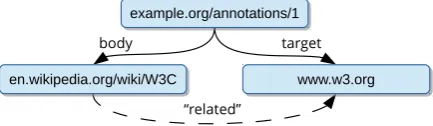
Figure 1: OA model example. The annotation ex-presses that the W3C Wikipedia article is related to the W3C homepage. The three resources are all in different domains, and the”related”relation is not represented explicitly.
is an RDF-based graph representation compati-ble with linguistic annotation formalisms such as LAF/GrAF (Ide and Suderman, 2007; Verspoor and Livingston, 2012). At its most basic level, the OA model differentiates between three key com-ponents: annotation, body, and target, where the annotation expresses that the body is related to the target of the annotation (Figure1). The body can carry arbitrarily complex embedded data.
JSON-LD was recently accepted as a standard RDF serialization format (Sporny et al., 2014) and is the recommended serialization of OA. Every JSON-LD document is both a JSON document and a representation of RDF data. Figure 2 shows an example of a simple annotation using the OA JSON-LD representation.2
{
"@id": "/annotations/1", "@type": "oa:Annotation",
"target": "/documents/1#char=0,10", "body": "Person"
}
Figure 2: Example annotation in JSON-LD for-mat.
RESTful architecture We define a resource-oriented API that uses HTTP verbs to manipulate resources (Table1). The API provides hypermedia controls in data using JSON-LD and established link relations, in conformance with best practices for RESTful APIs (Fielding and Taylor, 2002).
The API defines just two types of resources: an annotation and a collection of annotations. The former is defined according to the core OA spec-ification. While there are no formal standards for the representation of collections in RESTful APIs,
2The OA JSON-LD@contextis understood to be
ac-tive. Relative URLs are interpreted with respect to the HTTP request base.
Verb Resource Action
GET Annotation Read annotation
GET Collection Read all annotations
PUT Annotation Update annotation
DELETE Annotation Delete annotation
POST Collection Create annotation
Table 1: HTTP verbs, resources, and actions. Read-only services support only the two GET re-quests.
the basic collection pattern is well established. We specify a simple implementation, drawing on rel-evant draft standards such as Collection+JSON3
and Hydra4.
3 Reference Implementation
To support the development, testing and integra-tion of RESTful OA API implementaintegra-tions, we have created a reference server and client as well as tools for format conversion and validation.
3.1 OA Store
The OA Store is a reference implementation of persistent, server-side annotation storage that al-lows clients to create, read, update and delete an-notations using the API. The store uses MongoDB, which is well suited to the task as it is a document-oriented, schema-free database that natively sup-ports JSON for communication. The API is imple-mented using the Python Eve framework, which is specifically oriented towards RESTful web APIs using JSON and is thus easily adapted to support OA JSON-LD.
3.2 OA Explorer
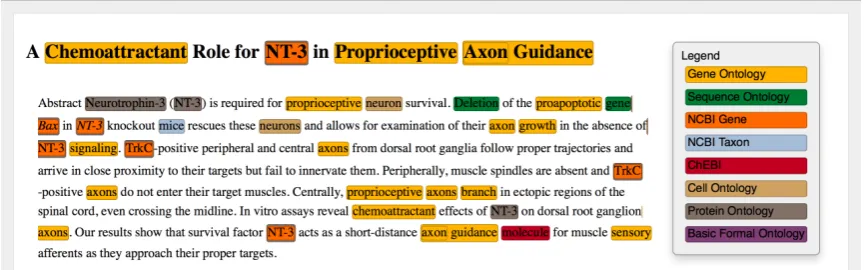
The OA Explorer is a reference client that provides an HTML interface for navigating and visualizing the contents of any compatible store (Figure 3). The service first prompts the user for a store URL and then provides the user with a dynamically gen-erated view of the contents of the store, which it discovers using the API. OA Explorer is imple-mented in Python using the Flask microframework for web development.
3http://amundsen.com/media-types/
collection/
4http://www.hydra-cg.com/spec/latest/
[image:2.595.73.290.64.127.2]Figure 3: OA Explorer shown visualizing annotations from the CRAFT corpus (Bada et al., 2012) con-verted to OA and served from the OA Store.
3.3 Format conversion
The OA Adapter is middleware that we created for sharing Open Annotation data. The software implements both the client and server sides of the API and a variety of conversions to and from dif-ferent serializations of the OA model and related formats using the OA JSON-LD serialization as the pivot format. This allows the OA Adapter to operate transparently between a client and a server, providing on-the-fly conversions of client requests from representations favored by the client into ones favored by the server, and vice versa for server responses. Standard HTTP content negotia-tion is used to select the best supported representa-tions. The adapter implements full support for all standard RDF serializations: JSON-LD, N-Triples and N-Quads, Notation3, RDF/XML, TriG, TriX, and Turtle. With the exception of named graphs for serializations that do not support them, conver-sion between these representations is guaranteed to preserve all information.
In addition to the general, reversible format translation services provided by the OA Adapter, we provide scripts for offline conversion of vari-ous annotation file formats into the OA JSON-LD format to allow existing datasets to be imported into OA stores. The following are currently sup-ported: Penn Treebank format (including PTB II PAS) (Marcus et al., 1994), a number of variants of CoNLL formats, including CoNLL-U,5
Know-tator XML (Ogren, 2006), and the standoff format used by theBRATannotation tool (Stenetorp et al.,
2012). We also provide supporting tools for im-porting files with OA JSON-LD data to a store and exporting to files over the RESTful OA API.
5http://universaldependencies.github.
io/docs/
3.4 Validation
OA JSON-LD data can be validated on three lev-els: 1) whether the data is syntactically well-formed JSON, 2) whether it conforms to the JSON-LD specification, and 3) whether the ab-stract information content fulfills the OA data model. The first two can be accomplished using any one of the available libraries that implement the full JSON-LD syntax and API specifications.6
To facilitate also validation of conformity to the OA data model, we define the core model of the OA standard using JSON Schema (Galiegue and Zyp, 2013). The JSON Schema community has provided tools in various programming languages for validating JSON against a JSON Schema. The schema we defined is capable of validating data for compliance against JSON-LD and OA Core at the same time. Complementing this support for data validation, we are also developing a standalone tool for testing web services for conformance to the RESTful OA API specification.
4 Adaptation of Existing Tools
In addition to creating reference implementations, we have adapted two previously introduced web-based annotation tools to support the API. We further demonstrate the scope and scalability of the framework on several publicly available mass-scale datasets from the biomedical domain, show-ing how annotations on millions of documents can be transparently linked across well-established database services and to non-textual resources such as gene and protein databases.
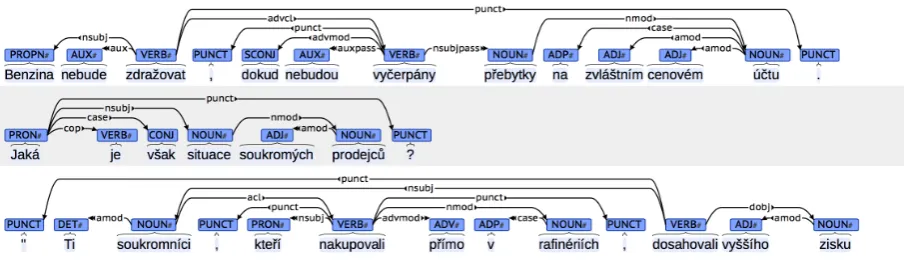
Figure 4: BRAT showing Czech dependency annotations from the Universal Dependencies corpus (http://universaldependencies.github.io/docs/).
Figure 5: tagtog showing entity annotations for a full-text document from PubMed Central.
4.1 BRAT
The brat rapid annotation tool (BRAT) is an open-source web-based annotation tool that supports a wide range of text annotation tasks (Stenetorp et al., 2012). It provides intuitive visualization of text-bound and relational annotations and allows for annotations to be created and edited using a drag-and-drop interface (Figure 4). The server is a web service implemented in Python, whereas the client is a browser-based application written in JavaScript. For annotation storage, the server uses a file-based back-end with a stand-off file format7.
The original client and server implement a cus-tom communication protocol, leading to tight cou-pling between the two. We rewrote the client and server communication components to use OA JSON-LD and the RESTful API as an alternative to the native format and protocol, thus enabling both components to communicate also with other clients and servers.
7http://brat.nlplab.org/standoff.html
4.2 tagtog
The tagtog web-based annotation system is de-signed to combine manual and automatic annota-tions to accurately and efficiently mark up full-text articles (Cejuela et al., 2014). The system was originally developed with a focus on annotating biological entities and concepts such as genes and Gene Ontology terms. The web interface is im-plemented in JavaScript using the Play framework with Scala. The system is centered on the concept of user projects, each of which holds a corpus of annotated documents.
4.3 Biomedical entity recognition resources
We implemented the API for four large-scale databases of biomedical entity mentions. The COMPARTMENTS database integrates evidence on protein subcellular localization (Binder et al., 2014), and TISSUES and DISEASES similarly in-tegrate evidence on tissue expression and disease-associations of human genes, respectively (Santos et al., 2015;Pletscher-Frankild et al., 2015). All three resources include a text mining component based on the highly efficient NER engine used also for detection of species names and names of other taxa in the ORGANISMS database (Pafilis et al., 2014). Together, these databases contain over 123M mentions of genes/proteins, cellular compo-nents, tissues and cell lines, disease terms and tax-onomic identifiers. This dataset is regularly pre-computed for the entire Medline corpus, which currently consists of more than 24M abstracts and 3B tokens.
To make this large collection of automatic an-notations available as OA JSON-LD, we defined the annotations of each abstract to be a separate (sub)collection of a document resource, accessible using URL patterns of the formhttp://.../ document/{docid}/annotations/. The web services were implemented as part of the Python framework common to all four databases. They query a PostgreSQL back-end for text and annotations, which are formatted as OA JSON-LD using the standard Pythonjsonmodule.
4.4 EVEX
The EVEX database is a collection of events from the molecular biology domain obtained by pro-cessing the entire collection of PubMed articles and PubMed Central Open Access full-text arti-cles (Van Landeghem et al., 2013), together con-stituting a corpus of nearly 6B tokens. In to-tal, EVEX contains 40M individual events among 77M entity mentions. The events are of 24 dif-ferent types (e.g.POSITIVE REGULATION,PHOS -PHORYLATION) and the participants are primar-ily genes and proteins. Where possible, the entity mentions are grounded to their corresponding En-trez Gene database identifiers.
The event structures consist of entity mentions,
trigger phrases expressing events, and typed relations identifying the roles that the entities play in the events. All of this data is accessible through a newly implemented EVEX API compliant with
the OA JSON-LD format. Every document is de-fined as a separate annotation collection following the approach described in Section4.3. The EVEX web service is written in Python using the Django web framework. Data are stored in a MySQL database and the OA JSON-LD interface uses the standard Pythonjsonmodule for formatting.
5 Related work
Our approach builds directly on the OA data model (Bradshaw et al., 2013), which harmonizes the earlier Open Annotation Collaboration ( Hasl-hofer et al., 2011) and Annotation Ontology Ini-tiative (Ciccarese et al., 2011) efforts and is cur-rently developed further under the auspices of the W3C Web Annotation WG.8 Approaches
build-ing on RESTful architectures and JSON-LD are also being pursued by the Linguistic Data Con-sortium (Wright, 2014) and the Language Appli-cation Grid (Ide et al., 2014), among others. A number of annotation stores following similar pro-tocols have also been released recently, includ-ing Lorestore (Hunter and Gerber, 2012), PubAn-notation (Kim and Wang, 2012), the Annotator.js store9, and NYU annotations10.
6 Conclusions and future work
We have proposed to share annotations using a minimal RESTful interface for Open Annotation data in JSON-LD. We introduced reference im-plementations of a server, client, validation and conversion tools, and demonstrated the integra-tion of several independently developed annota-tion tools and resources using the API. In future work, we will continue to develop the API speci-fication further in collaboration with the relevant standardization efforts and interested parties us-ing a fully open process. We will focus in par-ticular on modular extensions to the specification for supporting search, tagging, and bulk modifica-tions. We will also continue to develop and ex-tend the tools, with emphasis on reversible con-versions between OA JSON-LD and major re-lated formats. Except for tagtog, a commercial tool, all of the tools and resources introduced in this study are available under open licenses from
http://restoa.github.io/.
8http://www.w3.org/annotation/ 9http://annotateit.org/
Acknowledgments
This work was in part funded by the Novo Nordisk Foundation Center for Protein Research [NNF14CC0001], by the National Institutes of Health [U54 CA189205-01], by JSPS KAKENHI [13F03041], and by Quanta Computer Inc.
References
Michael Bada, Miriam Eckert, Donald Evans, Kristin Garcia, Krista Shipley, Dmitry Sitnikov, William A Baumgartner, K Bretonnel Cohen, Karin Verspoor, Judith A Blake, et al. 2012. Concept annotation in the craft corpus.BMC bioinformatics, 13(1):161.
Janos X Binder, Sune Pletscher-Frankild, Kalliopi Tsafou, Christian Stolte, Sean I O’Donoghue, Rein-hard Schneider, and Lars Juhl Jensen. 2014. COM-PARTMENTS: unification and visualization of pro-tein subcellular localization evidence. Database, 2014:bau012.
Christian Bizer, Tom Heath, and Tim BernersLee. 2009. Linked Data the story so far. International Journal on Semantic Web & Information Systems.
Shannon Bradshaw, Dan Brickley, Leyla Jael Garca Castro, Timothy Clark, Timothy Cole, Phil Desenne, Anna Gerber, Antoine Isaac, Jacob Jett, Thomas Habing, et al. 2013. Open annotation data model (community draft).
Juan Miguel Cejuela, Peter McQuilton, Laura Ponting, Steven J Marygold, Raymund Stefancsik, Gillian H Millburn, Burkhard Rost, et al. 2014. tagtog: interactive and text-mining-assisted annotation of gene mentions in PLOS full-text articles.Database, 2014:bau033.
Paolo Ciccarese, Marco Ocana, Leyla Jael Garcia-Castro, Sudeshna Das, and Tim Clark. 2011. An open annotation ontology for science on web 3.0. J. Biomedical Semantics, 2(S-2):S4.
Roy T Fielding and Richard N Taylor. 2002. Prin-cipled design of the modern web architecture. ACM Transactions on Internet Technology (TOIT), 2(2):115–150.
Francis Galiegue and Kris Zyp. 2013. JSON Schema: Core definitions and terminology. Internet Engi-neering Task Force (IETF).
Bernhard Haslhofer, Rainer Simon, Robert Sander-son, and Herbert Van de Sompel. 2011. The open annotation collaboration (oac) model. InProc. MMWeb’11, pages 5–9.
Jane Hunter and Anna Gerber. 2012. Towards anno-topiaenabling the semantic interoperability of web-based annotations. Future Internet, 4(3):788–806.
Nancy Ide and Keith Suderman. 2007. Graf: A graph-based format for linguistic annotations. In Proc. LAW’07, pages 1–8.
Nancy Ide, James Pustejovsky, Christopher Cieri, Eric Nyberg, Denise DiPersio, Chunqi Shi, Keith Su-derman, Marc Verhagen, Di Wang, and Jonathan Wright. 2014. The language application grid. Proc. LREC’14.
Jin-Dong Kim and Yue Wang. 2012. Pubannotation: a persistent and sharable corpus and annotation repos-itory. InProc. BioNLP’12, pages 202–205.
Mitchell Marcus, Grace Kim, Mary Ann Marcinkiewicz, Robert MacIntyre, Ann Bies, Mark Ferguson, Karen Katz, and Britta Schas-berger. 1994. The penn treebank: annotating predicate argument structure. InProc. HLT, pages 114–119.
Philip V Ogren. 2006. Knowtator: a prot´eg´e plug-in for annotated corpus construction. InProc. HLT-NAACL’06 demos, pages 273–275.
Evangelos Pafilis, Sune Pletscher-Frankild, Lucia Fanini, Sarah Faulwetter, Christina Pavloudi, Aikaterini Vasileiadou, Christos Arvanitidis, and Lars Juhl Jensen. 2014. The SPECIES and OR-GANISMS resources for fast and accurate identi-fication of taxonomic names in text. PLoS ONE, 8:e65390.
Sune Pletscher-Frankild, Albert Palleja, Kalliopi Tsafou, Janos X Binder, and Lars Juhl Jensen. 2015. DISEASES: Text mining and data integration of disease-gene associations. Methods, 74:83–89. Alberto Santos, Kalliopi Tsafou, Christian Stolte,
Sune Pletscher-Frankild, Sean I O’Donoghue, and Lars Juhl Jensen. 2015. Comprehensive compari-son of large-scale tissue expression datasets. PeerJ. Manu Sporny, Dave Longley, Gregg Kellogg, Markus
Lanthaler, and Niklas Lindstr¨om. 2014. JSON-LD 1.0: A JSON-based serialization for linked data. Pontus Stenetorp, Sampo Pyysalo, Goran Topi´c,
Tomoko Ohta, Sophia Ananiadou, and Jun’ichi Tsu-jii. 2012. Brat: a web-based tool for nlp-assisted text annotation. InProc. ACL’12 demos, pages 102– 107.
Sofie Van Landeghem, Jari Bj¨orne, Chih-Hsuan Wei, Kai Hakala, Sampo Pyysalo, Sophia Ananiadou, Hung-Yu Kao, Zhiyong Lu, Tapio Salakoski, Yves Van de Peer, et al. 2013. Large-scale event extrac-tion from literature with multi-level gene normaliza-tion. PLoS ONE, 8(4):e55814.
Karin Verspoor and Kevin Livingston. 2012. Towards adaptation of linguistic annotations to scholarly an-notation formalisms on the semantic web. InProc. LAW’12, pages 75–84.