Weakly Supervised User Profile Extraction from Twitter
Jiwei Li1, Alan Ritter2, Eduard Hovy1
1Language Technology Institute,2Machine Learning Department Carnegie Mellon University, Pittsburgh, PA 15213, USA
[email protected], [email protected], [email protected]
Abstract
While user attribute extraction on social media has received considerable attention, existing approaches, mostly supervised, encounter great difficulty in obtaining gold standard data and are therefore limited to predicting unary predicates (e.g., gen-der). In this paper, we present a weakly-supervised approach to user profile extrac-tion from Twitter. Users’ profiles from so-cial media websites such as Facebook or Google Plus are used as a distant source of supervision for extraction of their at-tributes from user-generated text. In addi-tion to tradiaddi-tional linguistic features used in distant supervision for information ex-traction, our approach also takes into ac-count network information, a unique op-portunity offered by social media. We test our algorithm on three attribute domains:
spouse, education and job; experimental results demonstrate our approach is able to make accurate predictions for users’ at-tributes based on their tweets.1
1 Introduction
The overwhelming popularity of online social me-dia creates an opportunity to display given as-pects of oneself. Users’ profile information in social networking websites such as Facebook2 or Google Plus3 provides a rich repository personal information in a structured data format, making it amenable to automatic processing. This includes, for example, users’ jobs and education, and pro-vides a useful source of information for applica-tions such as search4, friend recommendation,
on-1Both code and data are available athttp://aclweb.
org/aclwiki/index.php?title=Profile_data
2https://www.facebook.com/ 3https://plus.google.com/
4https://www.facebook.com/about/
graphsearch
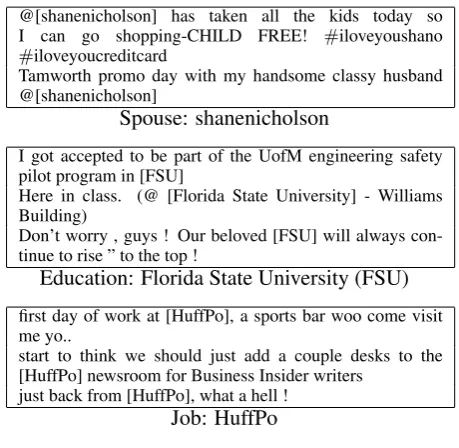
@[shanenicholson] has taken all the kids today so I can go shopping-CHILD FREE! #iloveyoushano #iloveyoucreditcard
Tamworth promo day with my handsome classy husband @[shanenicholson]
Spouse: shanenicholson
I got accepted to be part of the UofM engineering safety pilot program in [FSU]
Here in class. (@ [Florida State University] - Williams Building)
Don’t worry , guys ! Our beloved [FSU] will always con-tinue to rise ” to the top !
Education: Florida State University (FSU)
first day of work at [HuffPo], a sports bar woo come visit me yo..
start to think we should just add a couple desks to the [HuffPo] newsroom for Business Insider writers
just back from [HuffPo], what a hell !
[image:1.595.304.534.187.411.2]Job: HuffPo
Table 1: Examples of Twitter message clues for user profile inference.
line advertising, computational social science and more.
Although profiles exist in an easy-to-use, struc-tured data format, they are often sparsely popu-lated; users rarely fully complete their online pro-files. Additionally, some social networking ser-vices such as Twitter don’t support this type of structured profile data. It is therefore difficult to obtain a reasonably comprehensive profile of a user, or a reasonably complete facet of information (say, education level) for a class of users. While many users do not explicitly list all their personal information in their online profile, their user gen-erated content often contains strong evidence to suggest many types of user attributes, for example education, spouse, and employment (See Table 1). Can one use such information to infer more de-tails? In particular, can one exploit indirect clues from an unstructured data source like Twitter to obtain rich, structured user profiles?
In this paper we demonstrate that it is feasi-ble to automatically extract Facebook-style
files directly from users’ tweets, thus making user profile data available in a structured format for upstream applications. We view user profile inference as a structured prediction task where both text and network information are incorpo-rated. Concretely, we cast user profile predic-tion as binary relapredic-tion extracpredic-tion (Brin, 1999), e.g., SPOUSE(Useri, Userj), EDUCATION(Useri,
Entityj) and EMPLOYER(Useri, Entityj). Inspired
by the concept of distant supervision, we collect training tweets by matching attribute ground truth from an outside “knowledge base” such as Face-book or Google Plus.
One contribution of the work presented here is the creation of the first large-scale dataset on three general Twitter user profile domains (i.e., EDUCA -TION, JOB, SPOUSE). Experiments demonstrate
that by simultaneously harnessing both text fea-tures and network information, our approach is able to make accurate user profile predictions. We are optimistic that our approach can easily be ap-plied to further user attributes such as HOBBIES
and INTERESTS (MOVIES, BOOKS, SPORTS or STARS),RELIGION, HOMETOWN,LIVING LOCA -TION, FAMILY MEMBERSand so on, where
train-ing data can be obtained by matchtrain-ing ground truth retrieved from multiple types of online social me-dia such as Facebook, Google Plus, or LinkedIn. Our contributions are as follows:
• We cast user profile prediction as an informa-tion extracinforma-tion task.
• We present a large-scale dataset for this task gathered from various structured and unstruc-tured social media sources.
• We demonstrate the benefit of jointly rea-soning about users’ social network structure when extracting their profiles from text.
• We experimentally demonstrate the effective-ness of our approach on 3 relations:SPOUSE,
JOBandEDUCATION.
The remainder of this paper is organized as fol-lows: We summarize related work in Section 2. The creation of our dataset is described in Section 3. The details of our model are presented in Sec-tion 4. We present experimental results in SecSec-tion 5 and conclude in Section 6.
2 Related Work
While user profile inference from social media has received considerable attention (Al Zamal et al., 2012; Rao and Yarowsky, 2010; Rao et al., 2010; Rao et al., 2011), most previous work has treated this as a classification task where the goal is to pre-dict unary predicates describing attributes of the user. Examples include gender (Ciot et al., 2013; Liu and Ruths, 2013; Liu et al., 2012), age (Rao et al., 2010), or political polarity (Pennacchiotti and Popescu, 2011; Conover et al., 2011).
A significant challenge that has limited previous efforts in this area is the lack of available training data. For example, researchers obtain training data by employing workers from Amazon Mechanical Turk to manually identify users’ gender from pro-file pictures (Ciot et al., 2013). This approach is appropriate for attributes such as gender with a small numbers of possible values (e.g.,maleor fe-male), for which the values can be directly iden-tified. However for attributes such as spouse or
educationthere are many possible values, making it impossible to manually search for gold standard answers within a large number of tweets which may or may not contain sufficient evidence.
Also related is the Twitter user timeline extrac-tion algorithm of Li and Cardie (2013). This work is not focused on user attribute extraction, how-ever.
Distant Supervision Distant supervision, also known as weak supervision, is a method for learn-ing to extract relations from text uslearn-ing ground truth from an existing database as a source of supervision. Rather than relying on mention-level annotations, which are expensive and time consuming to generate, distant supervision lever-ages readily available structured data sources as a weak source of supervision for relation ex-traction from related text corpora (Craven et al., 1999). For example, suppose r(e1, e2) =
IsIn(P aris, F rance) is a ground tuple in the database ands =“Paris is the capital of France” contains synonyms for both “Paris” and “France”, then we assume that s may express the fact
Figure 1: Illustration of Goolge Plus “knowledge base”.
fields such as protein relation extraction (Craven et al., 1999; Ravikumar et al., 2012), event extrac-tion from Twitter (Benson et al., 2011), sentiment analysis (Go et al., 2009) and Wikipedia infobox generation (Wu and Weld, 2007).
Homophily Online social media offers a rich source of network information. McPherson et al. (2001) discovered that people sharing more attributes such as background or hobby have a higher chance of becoming friends in social media. This property, known as HOMOPHILY
(summarized by the proverb “birds of a feather flock together”) (Al Zamal et al., 2012) has been widely applied to community detection (Yang and Leskovec, 2013) and friend recommendation (Guy et al., 2010) on social media. In the user attribute extraction literature, researchers have considered neighborhood context to boost inference accuracy (Pennacchiotti and Popescu, 2011; Al Zamal et al., 2012), where information about the degree of their connectivity to their pre-labeled users is included in the feature vectors. A related algorithm by Mis-love et al. (2010) crawled Facebook profiles of 4,000 Rice University students and alumni and in-ferred attributes such as major and year of ma-triculation purely based on network information. Mislove’s work does not consider the users’ text stream, however. As we demonstrate below, rely-ing solely on network information is not enough to enable inference about attributes.
3 Dataset Creation
We now describe the generation of our distantly supervised training dataset in detail. We make use of Google Plus and Freebase to obtain ground facts and extract positive/negative bags of post-ings from users’ twitter streams according to the ground facts.
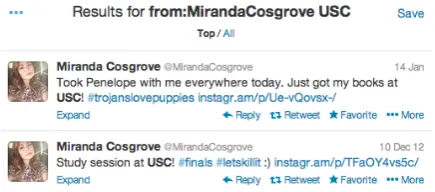
Figure 2: Example of fetching tweets containing entityUSCmention fromMiranda Cosgrove(an American actress and singer-songwriter)’s twitter stream.
Education/Job We first used the Google Plus API5 (shown in Figure 1) to obtain a seed set of users whose profiles contain both their educa-tion/job status and a link to their twitter account.6 Then, we fetched tweets containing the mention of the education/job entity from each correspondent user’s twitter stream using Twitter’s search API7 (shown in Figure 2) and used them to construct positive bags of tweets expressing the associated attribute, namely EDUCATION(Useri, Entityj), or
EMPLOYER(Useri, Entityj). The Freebase API8
is employed for alias recognition, to match terms such as “Harvard University”, “Harvard”, “Har-vard U” to a single The remainder of each corre-sponding user’s entire Twitter feed is used as neg-ative training data.9
We expanded our dataset from the seed users according to network information provided by Google Plus and Twitter. Concretely, we crawled circle information of users in the seed set from both their Twitter and Google Plus accounts and performed a matching to pick out shared users between one’s Twitter follower list and Google Plus Circle. This process assures friend identity and avoids the problem of name ambiguity when matching accounts across websites. Among candi-date users, those who explicitly display Job or Ed-ucation information on Google Plus are preserved. We then gathered positive and negative data as de-scribed above.
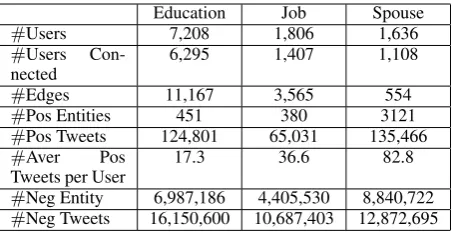
Dataset statistics are presented in Table 2. Our
5https://developers.google.com/+/api/ 6An unambiguous twitter account link is needed here
be-cause of the common phenomenon of name duplication.
7https://twitter.com/search 8http://wiki.freebase.com/wiki/
Freebase_API
9Due to Twitter user timeline limit, we crawled at most
[image:3.595.308.526.66.162.2]education dataset contains 7,208 users, 6,295 of which are connected to others in the network. The positive training set for the EDUCATIONis
com-prised of 134,060 tweets.
Spouse Facebook is the only type of social me-dia where spouse information is commonly dis-played. However, only a tiny amount of individ-ual information is publicly accessible from Face-book Graph API10. To obtain ground truth for the spouse relation at large scale, we turned to Free-base11, a large, open-domain database, and gath-ered instances of the /PEOPLE/PERSON/SPOUSE
relation. Positive/negative training tweets are ob-tained in the same way as was previously de-scribed for EDUCATION and JOB. It is worth
noting that our Spouse dataset is not perfect, as individuals retrieved from Freebase are mostly celebrities, and thus it’s not clear whether this group of people are representative of the general population.
SPOUSE is an exception to the
“ho-mophily” effect. But it exhibits another unique property, known as, REFLEXIVITY: fact IsSpouseOf(e1, e2) and IsSpouseOf(e2, e1) will hold or not hold at the same time. Given train-ing data expresstrain-ing the tupleIsSpouseOf(e1, e2) from usere1’s twitter stream, we also gather user
e2’s tweet collection, and fetch tweets with the mention of e1. We augment negative training data frome2 as in the case of Education and Job. Our Spouse dataset contains 1,636 users, where there are 554 couples (1108 users). Note that the number of positive entities (3,121) is greater than the number of users as (1) one user can have multiple spouses at different periods of time (2) multiple entities may point to the same individual, e.g., BarackObama, Barack Obama and Barack.
4 Model
We now describe our approach to predicting user profile attributes.
4.1 Notation
Message X: Each user i ∈ [1, I] is associ-ated with his Twitter ID and his tweet corpus
Xi. Xi is comprised of a collection of tweets
Xi = {xi,j}jj==1Ni, where Ni denotes the number
of tweets useripublished.
10https://developers.facebook.com/docs/
graph-api/
11http://www.freebase.com/
Education Job Spouse
#Users 7,208 1,806 1,636
#Users
Con-nected 6,295 1,407 1,108
#Edges 11,167 3,565 554
#Pos Entities 451 380 3121
#Pos Tweets 124,801 65,031 135,466 #Aver Pos
Tweets per User 17.3 36.6 82.8
[image:4.595.308.535.61.177.2]#Neg Entity 6,987,186 4,405,530 8,840,722 #Neg Tweets 16,150,600 10,687,403 12,872,695
Table 2: Statistics for our Dataset
Tweet CollectionLe
i: Lei denotes the collection
of postings containing the mention of entityefrom useri.Le
i ⊂Xi.
Entity attribute indicator zk
i,e and zi,xk : For
each entitye∈Xi, there is a boolean variablezk i,e,
indicating whether entityeexpresses attributekof useri. Each postingx∈Le
i is associated with
at-tribute indicatorzk
i,x indicating whether postingx
expresses attribute k of user i. zk
i,e and zi,xk are
observed during training and latent during testing.
Neighbor set Fk
i : Fik denotes the neighbor set
of useri. For Education(k= 0)and Job(k= 1),
Fk
i denotes the group of users within the network
that are in friend relation with useri. For Spouse attribute,Fk
i denote current user’s spouse.
4.2 Model
The distant supervision assumes that if entity e
corresponds to an attribute for useri, at least one posting from useri’s Twitter stream containing a mention ofemight express that attribute. For user-level attribute prediction, we adopt the following two strategies:
(1) GLOBAL directly makes aggregate (entity)
level prediction for zk
i,e, where features for all
tweets from Le
i are aggregated to one vector for
training and testing, following Mintz et al. (2009). (2) LOCAL makes local tweet-level predictions
for each tweetze
i,x,x∈Lki in the first place,
mak-ing the stronger assumption that all mentions of an entity in the users’ profile are expressing the asso-ciated attribute. An aggregate-level decisionzk
i,eis
then made from the deterministic OR operators.
zi,xe = (
1 ∃x∈Lei,s.t.zi,xk = 1
0 Otherwise (1)
The rest of this paper describes GLOBALin
de-tail. The model and parameters with LOCAL are
encode a tweet-level feature vector rather than an aggregate one. They are therefore excluded for brevity. For each attributek, we use a model that factorizes the joint distribution as product of two distributions that separately characterize text fea-tures and network information as follows:
Ψ(zki,e, Xi, Fik: Θ)∝
Ψtext(zi,ek , Xi)ΨNeigh(zki,e, Fik)
(2)
Text Factor We useΨtext(zk
e, Xi)to capture the
text related features which offer attribute clues:
Ψtext(zek, , Xi) = exp[(Θktext)T ·ψtext(zi,ek , Xi)]
(3) The feature vectorψtext(zki,e, Xi)encodes the
fol-lowing standard general features:
• Entity-level: whether begins with capital let-ter, length of entity.
• Token-level: for each tokent∈e, word iden-tity, word shape, part of speech tags, name entity tags.
• Conjunctive features for a window of k (k=1,2) words and part of speech tags.
• Tweet-level: All tokens in the correspondent tweet.
In addition to general features, we employ attribute-specific features, such as whether the en-tity matches a bag of words observed in the list of universities, colleges and high schools for Edu-cationattribute, whether it matches terms in a list of companies forJobattribute12. Lists of universi-ties and companies are taken from knowledge base NELL13.
Neighbor Factor For Job and Education, we bias friends to have a larger possibility to share the same attribute.ΨNeigh(zi,ek , Fik)captures such
influence from friends within the network:
ΨNeigh(zi,ek , Fik) =
Y
j∈Fk i
ΦNeigh(zek, Xj)
ΦNeigh(zi,ek , Xj)
= exp[(Θk
Neigh)T ·ψNeigh(zi,ek , Xj)]
(4) Features we explore include the whether entity e
is also the correspondent attribute with neighbor userj, i.e.,I(ze
j,k = 0)andI(zej,k= 1).
12Freebase is employed for alias recognition.
13http://rtw.ml.cmu.edu/rtw/kbbrowser/
Input: Tweet Collection {Xi}, Neighbor set {Fk
i }
Initialization:
•for each useri:
for each candidate entitye∈Xi zk
i,e = argmaxz0Ψ(z0, Xi) from text
features
End Initialization while not convergence:
•for each useri:
update attribute values forj ∈Fk i
for each candidate entitye∈Xi zk
i,e= argmaxz0Ψ(z0, Xi, Fik)
end while:
Figure 3: Inference forNEIGH-LATENTsetting.
For Spouse, we set Fispouse = {e} and the neighbor factor can be rewritten as:
ΨNeigh(zi,ek , Xj) = ΨNeigh(Ci, Xe) (5)
It characterizes whether current userCi to be the spouse of user e (if e corresponds to a Twitter user). We expect clues about whetherCibeing
en-titye’s spouse frome’s Twitter corpus will in turn facilitate the spouse inference procedure of useri.
ψNeigh(Ci, Xe)encodesI(Ci ∈Se),I(Ci 6∈Se).
Features we explore also include whether Ci’s twitter ID appears ine’s corpus.
4.3 Training
We separately trained three classifiers regarding the three attributes. All variables are observed during training; we therefore take a feature-based approach to learning structure prediction models inspired by structure compilation (Liang et al., 2008). In our setting, a subset of the features (those based on network information) are com-puted based on predictions that will need to be made at test time, but are observed during train-ing. This simplified approach to learning avoids expensive inference; at test time, however, we still need to jointly predict the best attribute values for friends as is described in section 4.4.
4.4 Inference
observed (NEIGH-OBSERVED) or latent (NEIGH -LATENT). Real world applications, where network
information can be partly retrieved from all types of social networks, can always falls in between.
Inference in the NEIGH-OBSERVED setting is
trivial; for each entitye ∈ Gi, we simply predict it’s candidate attribute values using Equ.6.
zki,e= argmax
z0 Ψ(z
0, Xi, Fk
i ) (6)
For NEIGH-LATENT setting, attributes for each
node along the network are treated latent and user attribute prediction depends on attributes of his neighbors. The objective function for joint infer-ence would be difficult to optimize exactly, and algorithms for doing so would be unlikely to scale to network of the size we consider. Instead, we use a sieve-based greedy search approach to inference (shown in Figure 3) inspired by recent work on coreference resolution (Raghunathan et al., 2010). Attributes are initialized using only text features, maximizing Ψtext(e, Xi), and ignoring network
information. Then for each user we iteratively re-estimate their profile given both their text features and network features (computed based on the cur-rent predictions made for their friends) which pro-vide additional epro-vidence.
In this way, highly confident predictions will be made strictly from text in the first round, then the network can either support or contradict low con-fidence predictions as more decisions are made. This process continues until no changes are made at which point the algorithm terminates. We em-pirically found it to work well in practice. We ex-pect thatNEIGH-OBSERVED performs better than NEIGH-LATENT since the former benefits from
gold network information.
Spouse For Spouse inference, if candidate entity
ehas no correspondent twitter account, we directly determine zk
i,e = argmaxz0Ψ(z0, Xi) from text
features. Otherwise, the inference ofzk
i,edepends
on thezk
e,Ci. Similarly, we initializezki,eandze,Ck i
by maximizing text factor, as we did for Educa-tion and Job. Then we iteratively updatezk given
by the rest variables until convergence.
5 Experiments
In this Section, we present our experimental re-sults in detail.
Education Job
AFFINITY 74.3 14.5
Table 3: Affinity values for Education and Job.
5.1 Preprocessing and Experiment Setup
Each tweet posting is tokenized using Twitter NLP tool introduced by Noah’s Ark14 with # and @ separated following tokens. We assume that at-tribute values should be either name entities or terms following@and#. Name entities are ex-tracted using Ritter et al.’s NER system (2011). Consecutive tokens with the same named entity tag are chunked (Mintz et al., 2009). Part-of-speech tags are assigned based on Owoputi et al’s tweet POS system (Owoputi et al., 2013).
Data is divided in halves. The first is used as training data and the other as testing data.
5.2 Friends with Same Attribute
Our network intuition is that users are much more likely to be friends with other users who share tributes, when compared to users who have no at-tributes in common. In order to statistically show this, we report the value of AFFINITYdefined by
Mislove et al (2010), which is used to quantita-tively evaluate the degree of HOMOPHILY in the
network. AFFINITYis the ratio of the fraction of
links between attribute (k)-sharing users (Sk), rel-ative to what is expected if attributes are randomly assigned in the network (Ek).
Sk=
P
iPj∈Fk i I(P
k i =Pjk)
P
iPj∈Fk i I
Ek=
P
mTmk(Tmk −1) Uk(Uk−1)
(7)
where Tk
m denotes the number of users with m
value for attributek andUk = P
mTmk. Table 3
shows the affinity value of the Education and Job. As we can see, the property of HOMOPHILY
in-deed exists among users in the social network with respect to Education and Job attribute, as signifi-cant affinity is observed. In particular, the affinity value for Education is 74.3, implying that users connected by a link in the network are 74.3 times more likely affiliated in the same school than as expected if education attributes are randomly as-signed. It is interesting to note that Education ex-hibits a much strongerHOMOPHILYproperty than
14https://code.google.com/p/
Job. Such affinity demonstrates that our approach that tries to take advantage of network information for attribute prediction of holds promise.
5.3 Evaluation and Discussion
We evaluate settings described in Section 4.2 i.e.,
GLOBALsetting, where user-level attribute is
pre-dicted directly from jointly feature space andLO -CAL setting where user-level prediction is made
based on tweet-level prediction along with differ-ent inference approaches described in Section 4.4, i.e. NEIGH-OBSERVED and NEIGH-LATENT,
re-garding whether neighbor information is observed or latent.
Baselines We implement the following base-lines for comparison and use identical processing techniques for each approach for fairness.
• Only-Text: A simplified version of our algo-rithm where network/neighbor influence is ig-nored. Classifier is trained and tested only based on text features.
• NELL:For Job and Education, candidate is se-lected as attribute value once it matches bag of words in the list of universities or companies borrowed from NELL. For Education, the list is extended by alias identification based on Free-base. For Job, we also fetch the name abbrevia-tions15. NELL is only implemented for Educa-tion and Job attribute.
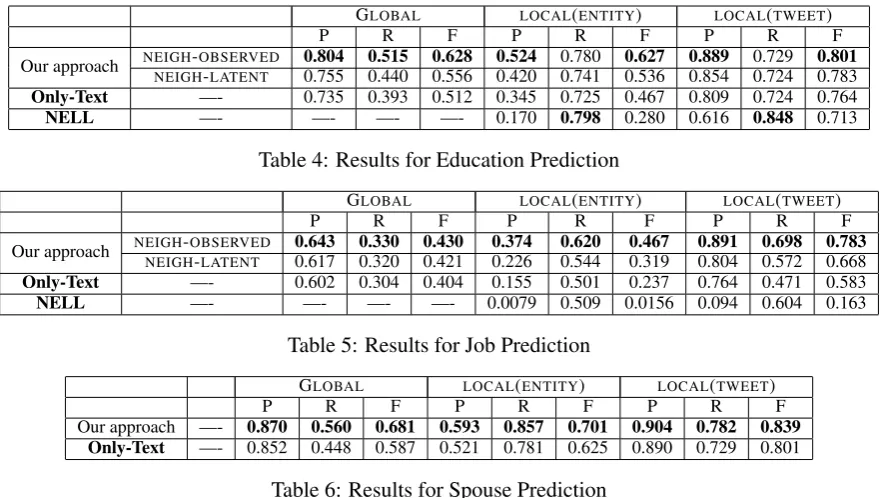
For each setting from each approach, we report the (P)recision, (R)ecall and (F)1-score. ForLO -CAL setting, we report the performance for both
entity-level prediction (Entity) and posting-level
prediction (Tweet). Results for Education, Job and
Spouse from different approaches appear in Table 4, 5 and 6 respectively.
Local or Global For horizontal comparison, we observe that GLOBAL obtains a higher Precision
score but a lower Recall than LOCAL(ENTITY).
This can be explained by the fact thatLOCAL(U)
setszk
i,e= 1once one postingx∈Lei is identified
as attribute related, whileGLOBALtend to be more
meticulous by considering the conjunctive feature space from all postings.
Homophile effect In agreement with our ex-pectation,NEIGH-OBSERVEDperforms better than NEIGH-LATENT since erroneous predictions in
15http://www.abbreviations.com/
NEIGH-LATENT setting will have negative
in-fluence on further prediction during the greedy search process. Both NEIGH-OBSERVED and NEIGH-LATENT where network information is
harnessed, perform better than Only-Text, which the prediction is made independently on user’s text features. The improvement ofNEIGH-OBSERVED
overOnly-Text is 22.7%and6.4% regarding F-1 score for Education and Job respectively, which further illustrate the usefulness of making use of Homophile effect for attribute inference on online social media. It is also interesting to note the im-provement much more significant in Education in-ference than Job inin-ference. This is in accord with what we find in Section 5.2, where education net-work exhibits strongerHOMOPHILEproperty than
Job network, enabling a significant benefit for ed-ucation inference, but limited for job inference.
Spouse prediction also benefits from neighbor-ing effect and the improvement is about12%for
LOCAL(ENTITY) setting. Unlike Education and
Job prediction, for which in NEIGH-OBSERVED
setting all neighboring variables are observed, net-work variables are hidden during spouse predic-tion. By considering network information, the model benefits from evident clues offered by tweet corpus of usere’s spouse when making prediction fore, but also suffers when erroneous decision are made and then used for downstream predictions.
NELL Baseline Notably, NELL achieves high-est Recall score for Education inference. It is also worth noting that most of education men-tions that NELL fails to retrieve are those in-volve irregular spellings, such as HarvardUniv and Cornell U, which means Recall score for NELL baseline would be even higher if these irregular spellings are recognized in a more sophisticated system. The reason for such high recall is that as our ground truths are obtained from Google plus, the users from which are mostly affiliated with de-cent schools found in NELL dictionary. However, the high recall from NELL is sacrificed at preci-sion, as users can mention school entities in many of situations, such as paying a visit or reporting some relevant news. NELL will erroneously clas-sify these cases as attribute mentions.
NELL does not work out for Job, with a fairly poor 0.0156 F1 score for LOCAL(ENTITY) and
0.163 for LOCAL(TWEET). Poor precision is
GLOBAL LOCAL(ENTITY) LOCAL(TWEET)
P R F P R F P R F
Our approach NEIGHNEIGH-OBSERVED-LATENT 0.8040.755 0.5150.440 0.5560.628 0.4200.524 0.7410.780 0.5360.627 0.8540.889 0.7240.729 0.8010.783 Only-Text —- 0.735 0.393 0.512 0.345 0.725 0.467 0.809 0.724 0.764
NELL —- —- —- —- 0.170 0.798 0.280 0.616 0.848 0.713
Table 4: Results for Education Prediction
GLOBAL LOCAL(ENTITY) LOCAL(TWEET)
P R F P R F P R F
Our approach NEIGHNEIGH-OBSERVED-LATENT 0.6430.617 0.3300.320 0.4210.430 0.2260.374 0.5440.620 0.3190.467 0.8040.891 0.5720.698 0.7830.668 Only-Text —- 0.602 0.304 0.404 0.155 0.501 0.237 0.764 0.471 0.583
NELL —- —- —- —- 0.0079 0.509 0.0156 0.094 0.604 0.163
Table 5: Results for Job Prediction
GLOBAL LOCAL(ENTITY) LOCAL(TWEET)
P R F P R F P R F
[image:8.595.79.522.60.309.2]Our approach —- 0.870 0.560 0.681 0.593 0.857 0.701 0.904 0.782 0.839 Only-Text —- 0.852 0.448 0.587 0.521 0.781 0.625 0.890 0.729 0.801
Table 6: Results for Spouse Prediction
NELL in job inference is also quite low as job related entities exhibit a greater diversity of men-tions, many of which are not covered by the NELL dictionary.
Vertical Comparison: Education, Job and Spouse Job prediction turned out to be much more difficult than Education, as shown in Ta-bles 4 and 5. Explanations are as follows: (1) Job contains a much greater diversity of mentions than Education. Education inference can benefit a lot from the dictionary relevant feature which Job may not. (2) Education mentions are usually asso-ciated with clear evidence such as homework, ex-ams, studies, cafeteria or books, while situations are much more complicated for job as vocabular-ies are usually specific for different types of jobs. (3) The boundary between a user working in and a fun for a specific operation is usually ambigu-ous. For example, a Google engineer may con-stantly update information about outcome prod-ucts of Google, so does a big fun. If the aforemen-tioned engineer barely tweets about working con-ditions or colleagues (which might still be ambigu-ous), his tweet collection, which contains many of mentions about outcomes of Google product, will be significantly similar to tweets published by a Google fun. Such nuisance can be partly solved by the consideration of network information, but not totally.
The relatively high F1 score for spouse predic-tion is largely caused by the great many of
non-individual related entities in the dataset, the iden-tification of which would be relatively simpler. A deeper look at the result shows that the classifier frequently makes wrong decisions for entities such as userID and name entities. Significant as some spouse relevant features are, such as love, hus-band, child, in most circumstances, spouse men-tions are extremely hard to recognize. For exam-ple, in tweets “Check this out, @alancross, it’s awesomebit.ly/1bnjYHh.” or “Happy Birth-day @alancross !”. alancross can reasonably be any option among current user’s friend, colleague, parents, child or spouse. Repeated mentions add no confidence. Although we can identify alan-cross as spouse attribute once it jointly appear with other strong spouse indicators, they are still many cases where they never co-appear. How to integrate more useful side information for spouse recognition constitutes our future work.
6 Conclusion and Future Work
In this paper, we propose a framework for user at-tribute inference on Twitter. We construct the pub-licly available dataset based on distant supervision and experiment our model on three useful user profile attributes, i.e., Education, Job and Spouse. Our model takes advantage of network informa-tion on social network. We will keep updating the dataset as more data is collected.
at-tributes, such as interested books, movies, home-town, religion and so on. Facebook would an ideal ground truth knowledge base. Another direc-tion involves incorporating richer feature space for better inference performance, such as multi-media sources (i.e. pictures and video).
7 Acknowledgments
A special thanks is owned to Dr. Julian McAuley and Prof. Jure Leskovec from Stanford University for the Google+ circle/network crawler, without which the network analysis would not have been conducted. This work was supported in part by DARPA under award FA8750-13-2-0005.
References
Faiyaz Zamal, Wendy Liu, and Derek Ruths. 2012. Homophily and latent attribute inference: Inferring latent attributes of twitter users from neighbors. In
ICWSM.
Edward Benson, Aria Haghighi, and Regina Barzilay. 2011. Event discovery in social media feeds. In
Proceedings of the 49th Annual Meeting of the Asso-ciation for Computational Linguistics: Human Lan-guage Technologies-Volume 1, pages 389–398. As-sociation for Computational Linguistics.
Sergey Brin. 1999. Extracting patterns and relations
from the world wide web. InThe World Wide Web
and Databases.
Morgane Ciot, Morgan Sonderegger, and Derek Ruths. 2013. Gender inference of twitter users in
non-english contexts. InProceedings of the 2013
Con-ference on Empirical Methods in Natural Language Processing, Seattle, Wash, pages 18–21.
Michael Conover, Jacob Ratkiewicz, Matthew Fran-cisco, Bruno Gonc¸alves, Filippo Menczer, and Alessandro Flammini. 2011. Political polarization
on twitter. InICWSM.
Mark Craven and Johan Kumlien 1999. Construct-ing biological knowledge bases by extractConstruct-ing
infor-mation from text sources. In ISMB, volume 1999,
pages 77–86.
Alec Go, Richa Bhayani, and Lei Huang. 2009. Twit-ter sentiment classification using distant supervision.
CS224N Project Report, Stanford, pages 1–12.
Ido Guy, Naama Zwerdling, Inbal Ronen, David Carmel, and Erel Uziel. 2010. Social media
recom-mendation based on people and tags. InProceedings
of the 33rd international ACM SIGIR conference on Research and development in information retrieval, pages 194–201. ACM.
Raphael Hoffmann, Congle Zhang, Xiao Ling, Luke S Zettlemoyer, and Daniel S Weld. 2011. Knowledge-based weak supervision for information extraction
of overlapping relations. InACL, pages 541–550.
Jiwei Li and Claire Cardie. 2013. Timeline generation:
Tracking individuals on twitter. Proceedings of the
23rd international conference on World wide web. Percy Liang, Hal Daum´e III, and Dan Klein. 2008.
Structure compilation: trading structure for features. InProceedings of the 25th international conference on Machine learning.
Wendy Liu and Derek Ruths. 2013. Whats in a name? using first names as features for gender inference in
twitter. In2013 AAAI Spring Symposium Series.
Wendy Liu, Faiyaz Zamal, and Derek Ruths. 2012. Using social media to infer gender composition of
commuter populations. InProceedings of the When
the City Meets the Citizen Workshop, the Interna-tional Conference on Weblogs and Social Media.
Miller McPherson, Lynn Smith-Lovin, and James M Cook. 2001. Birds of a feather: Homophily in social
networks. Annual review of sociology, pages 415–
444.
Mike Mintz, Steven Bills, Rion Snow, and Dan Ju-rafsky. 2009. Distant supervision for relation
ex-traction without labeled data. InProceedings of the
Joint Conference of the 47th Annual Meeting of the ACL and the 4th International Joint Conference on Natural Language Processing of the AFNLP: Vol-ume 2-VolVol-ume 2, pages 1003–1011. Association for Computational Linguistics.
Alan Mislove, Bimal Viswanath, Krishna Gummadi, and Peter Druschel. 2010. You are who you know: inferring user profiles in online social networks. In
Proceedings of the third ACM international confer-ence on Web search and data mining, pages 251– 260. ACM.
Olutobi Owoputi, Brendan OConnor, Chris Dyer, Kevin Gimpel, Nathan Schneider, and Noah A Smith. 2013. Improved part-of-speech tagging for online conversational text with word clusters. In
Proceedings of NAACL-HLT, pages 380–390. Marco Pennacchiotti and Ana Popescu. 2011. A
ma-chine learning approach to twitter user classification. InICWSM.
Karthik Raghunathan, Heeyoung Lee, Sudarshan Ran-garajan, Nathanael Chambers, Mihai Surdeanu, Dan Jurafsky, and Christopher Manning. 2010. A
multi-pass sieve for coreference resolution. In
Proceed-ings of the 2010 Conference on Empirical Methods in Natural Language Processing.
Delip Rao and David Yarowsky. 2010. Detecting latent
user properties in social media. InProc. of the NIPS
Delip Rao, David Yarowsky, Abhishek Shreevats, and Manaswi Gupta. 2010. Classifying latent user
at-tributes in twitter. In Proceedings of the 2nd
in-ternational workshop on Search and mining user-generated contents, pages 37–44. ACM.
Delip Rao, Michael Paul, Clayton Fink, David Yarowsky, Timothy Oates, and Glen Coppersmith. 2011. Hierarchical bayesian models for latent
at-tribute detection in social media. InICWSM.
Haibin Liu, Michael Wall, Karin Verspoor, et al. 2012. Literature mining of protein-residue associations with graph rules learned through distant supervision.
Journal of biomedical semantics, 3(Suppl 3):S2. Alan Ritter, Sam Clark, Mausam, Oren Etzioni, et al.
2011. Named entity recognition in tweets: an
ex-perimental study. InProceedings of the Conference
on Empirical Methods in Natural Language Pro-cessing, pages 1524–1534. Association for Compu-tational Linguistics.
Alan Ritter, Luke Zettlemoyer, Mausam, and Oren Et-zioni. 2013. Modeling missing data in distant su-pervision for information extraction.
Mihai Surdeanu, Julie Tibshirani, Ramesh Nallapati, and Christopher Manning. 2012. Multi-instance
multi-label learning for relation extraction. In
Pro-ceedings of the 2012 Joint Conference on Empirical Methods in Natural Language Processing and Com-putational Natural Language Learning, pages 455– 465. Association for Computational Linguistics. Shingo Takamatsu, Issei Sato, and Hiroshi Nakagawa.
2012. Reducing wrong labels in distant
supervi-sion for relation extraction. In Proceedings of the
50th Annual Meeting of the Association for Compu-tational Linguistics: Long Papers-Volume 1, pages 721–729. Association for Computational Linguis-tics.
Fei Wu and Daniel S Weld. 2007. Autonomously
se-mantifying wikipedia. In Proceedings of the
six-teenth ACM conference on Conference on infor-mation and knowledge management, pages 41–50. ACM.
Jaewon Yang and Jure Leskovec. 2013. Overlapping community detection at scale: A nonnegative matrix
factorization approach. InProceedings of the sixth