461
From Receptive to Productive: Learning to Use Confusing Words
through Automatically Selected Example Sentences
Chieh-Yang Huang1, Yi-Ting Huang2, Mei-Hua Chen3and Lun-Wei Ku2 1IST, Pennsylvania State University, USA,2 IIS, Academia Sinica, Taiwan
3FLLD, Tunghai University, Taiwan
1 [email protected],2{ythuang, lwku}@iis.sinica.edu.tw 3 [email protected]
Abstract
Knowing how to use words appropriately has been a key to improving language proficiency. Previous studies typically discuss how stu-dents learn receptively to select the correct candidate from a set of confusing words in the fill-in-the-blank task where specific con-text is given. In this paper, we go one step fur-ther, assisting students to learn to use confus-ing words appropriately in a productive task: sentence translation. We leverage the GiveMe-Example system, which suggests example sen-tences for each confusing word, to achieve this goal. In this study, students learn to differenti-ate the confusing words by reading the exam-ple sentences, and then choose the appropriate word(s) to complete the sentence translation task. Results show students made substantial progress in terms of sentence structure. In ad-dition, highly proficient students better man-aged to learn confusing words. In view of the influence of the first language on learners, we further propose an effective approach to im-prove the quality of the suggested sentences.
1 Introduction
In second or foreign language learning, learn-ing synonyms is not uncommon in vocabulary learning (Hashemi and Gowdasiaei,2005;Webb,
2007). However, clear differentiation and proper use of near-synonyms poses a challenge to many language learners (Laufer, 1990;Tinkham,1993;
Waring,1997). Researchers have investigated lan-guage learners’ lexical use problems, e.g., (Chen and Lin, 2011; Hemchua et al., 2006; Yan-juan, 2014; Laufer, 1990; Tinkham, 1993; War-ing, 1997; Yeh et al., 2007; Zughoul, 1991) and suggested that discriminating among seman-tically similar items presents difficulties for learn-ers (Laufer,1990). For example, Zughoul (1991) analyzed the writings of Arab EFL college stu-dents and found that misapplication of
near-synonyms was the most common type of word choice error made by his students. Likewise, Hemchua and Schmitt (2006) investigated lexical error types in the writings of Thai college students and found that the use of near-synonyms was the most common error made by their students.
Learners are prone to assuming that synonyms behave identically in all contexts (Martin, 1984). Actually, even though two words may share sim-ilar meanings, they may not be fully substitutable in certain scenarios (Edmonds and Hirst, 2002;
Karlsson, 2014; Liu and Zhong, 2014; Martin,
1984;Webb,2007). Synonyms are highly likely to confuse learners (Martin,1984). For example, bothemphasis andstressdescribe “special atten-tion or importance”. The verbslay,place, andput can collocate with “emphasis on” and “stress on”; however, “place stress on” is a rare expression (it occurs only once in the British National Corpus). For ESL/EFL learners, correct word usage neces-sitates not only knowledge of the meaning of a word but also knowledge of its paradigmatic and syntagmatic association. Without usage informa-tion, synonyms “usually leave the student mysti-fied” (Martin, 1984). Verbsconstruct and estab-lishillustrate the fact that synonyms do not always have the same collocates (Webb,2007). Although both words share the same meaning of “build”, in practice, they are not interchangeable in the col-locations “establish contact” and “construct sys-tem”. Learners must grasp the collocational and syntactic differences to use synonyms effectively in a productive mode (Martin,1984).
information these reference tools provide is appro-priate and instructive, the contents – especially ex-ample sentences – are neither rich nor constantly updated.
In view of this, artificial intelligence techniques recently have been widely applied to assist lan-guage learning. Applications such as grammar correction (Ng et al.,2014;Napoles and Callison-Burch,2017) and essay scoring (Alikaniotis et al.,
2016; Dong and Zhang, 2016; Zhang and Lit-man,2018) are relatively mature. Research on the lexical substitution (McCarthy and Navigli,2007,
2009;Mihalcea et al.,2010;Melamud et al.,2015) and the detection and correction of collocation er-rors (Futagi, 2010; Alonso Ramos et al., 2014) have also shown the potential of helping ESL learn similar words, near-synonyms or synonyms. Lex-ical substitution task try to determine a substitute for a word in a context and preserving its mean-ing and is possible to help language learners un-derstand the correct meaning of a target word by selecting a lexical substitute. The detection and correction, on the other hand, is an inevitable as-sistance for ESL learners since, as we know, col-location error is one of the most common lexical misuse problem. However, as interpretation is still challenging for AI models, especially deep learn-ing models (Ribeiro et al.,2016;Doshi-Velez and Kim,2017), there are fewer applications for tasks involving comparisons and explanations, which is the key to learning confusing words.
GiveMeExample (Huang et al.,2017) is one of the few systems. It offers students suggestions of example sentences for confusing words and helps them to choose proper words for fill-in-the-blank multiple-choice questions. GiveMeExample aims to provide opportunities for learners to self-learn the nuances between confusing words by compar-ing and contrastcompar-ing the suggested example sen-tences. However, the fill-in-the-blank multiple-choice format has its limitations. First, it decreases learning efficiency: students look for hints (such as prepositions or collocations) from the exam-ple sentences to match the words adjacent to the blank instead of reading and comparing these ex-ample sentences thoroughly. Also, as answering multiple-choice questions is a discriminative task, students attempt to select the most possible candi-date among all choices instead of learning to prop-erly use the confusing words in question.
To improve the learning effect, we adopt
Give-MeExample but deploy it using a carefully de-signed sentence translation task. Studies (Uzawa,
1996;Prince,1996;Laufer and Girsai,2008) have investigated the effect of using translation tasks in language learning. With the integration of the translation task, learners were asked to produce a second language (L2) text conditioned on a given first language (L1) sentence. It is one of effec-tive ways to learn word usage by producing a good translation. In other words, we intentionally move from a receptive to a productive learning task. Generating sentences using confusing words re-quires a better understanding of the words: with this task we hope to discover how to better assist language learners to learn to differentiate confus-ing words.
2 Automatic Example Sentence Selection
In this study, we seek to use the GiveMeExam-ple system (Huang et al.,2017) as a basis to im-prove the automatic example sentence selection task which aims to select sentences that clarify the differences between confusing words. GiveMeEx-ample proposes a clarification score to represent the ability of a sentence to clear up confusion be-tween the given words. In this section, we describe the three main steps to build the automatic exam-ple sentence selection model: the definition of the clarification score, the word usage model, and the dictionary-like sentence classifier.
2.1 Problem Definition
Here we define the task more clearly. Given a confusing word set W = {w1, w2, ..., wn} and their corresponding sentence sets{S1, S2, ..., Sn}, each sentence set contains a set of sentencesSt = {st1, st2, ..., stm}. The target is to choosek sen-tences from each sentence set that clarify the dif-ferences among the words in the confusing word set. The desired results are thus sentence sets which clarify W, {S10, S20, ..., Sn0}, where St0 =
{s01, s02, ..., s0k}.
2.2 Workflow
Number Word Example sentence 1 refuse I was expecting you to refuse to leave the house.
2 refuse She declined to serve as an informant and refused his request that she keep their meeting secret. 3 reject In July, a judge in Australia rejected his request for a suppression order.
Table 1: Example sentences that illustrate clarification
five sentences for each word are selected to show learners.
2.3 Clarification Score
To understand the definition of clarification, we start from the confusing word set{refuse,reject} in Table1. The first sentence clarifies the differ-ences better than the second sentence, as the us-age of refuse in “refused his request” from the second sentence is the same as that for reject in “rejected his request” in the third sentence. This illustrates two properties of clarification: the fit-ness score and the relative closefit-ness score. The fitness score measures how well a sentence s il-lustrates the usage of word w1: in this sentence
the word should be used in a common way in-stead of a rare way. The relative closeness score, in turn, measures how well a sentencesfor wordw1
highlights the difference betweenw1and the other
words{w2, ..., wn}: it must be appropriate forw1
but inappropriate for{w2, ..., wn}. Namely, when we replacew1with{w2, ..., w3}ins, this sentence
should become a wrong sentence. As a result, given a functionP(s|w)that estimates the fitness between a sentencesand a wordw, we define the clarification score as
score(s|wi) =P(s|wi)∗( X
wj∈W−wi
P(s|wi)−P(s|wj))
(1)
which is the multiplication of the fitness score and the relative closeness score.
2.4 Word Usage Model
The word usage model represents the distribution of the usage and the context for a given word, that is, the fitness scoreP(s|w). GiveMeExample in-cludes two word usage models: a Gaussian mix-ture model (GMM) and a bidirectional long-short-term-memory model (BiLSTM), described as fol-lows. Notice that the word usage model is trained as a classifier per word.
2.4.1 GMM with Local Contextual Features
The idea of the GMM is to turn words around the target word, namely, its context, into em-beddings and then model the distribution with a
Gaussian mixture model (Xu and Jordan, 1996). Empirically, taking words within a window of size two provides the best results. Therefore, given a sentence s = {w1· · ·wt· · ·wn} where wt is the target word, the features are f = {ewt−2, ewt−1, ewt−2+ewt−1, ewt+1, ewt+2, ewt+1+ ewt+2}. Note that the features contain not only the corresponding word embeddings, but also the summation of two adjacent words to leverage the meaning. Since the word embedding contains both word identity information and semantic informa-tion, the GMM model1therefore learns the distri-bution of both usage and semantic meaning.
2.4.2 BiLSTM
As the confusing words can diverge widely from the target word itself, or could involve long-term dependencies, GMM with local contextual fea-tures do not always capture enough information. The BiLSTM model thus utilizes the whole sen-tence as a feature. The BiLSTM model consists of a forward LSTM and a backward LSTM, which take the words preceding and following the target word as features respectively. The output vectors of these two LSTMs are concatenated to form a sentence embedding. After passing through two dense layers, the BiLSTM model is then built as a binary classifier that decides whether the given sentence is the sentence of the target word or not. In contrast to the generative GMM model, nega-tive samples are needed to train the BiLSTM. As a result, sentences from the corpus are randomly sampled as negative samples2.
2.5 Dictionary-like Sentence Classification
The given sentences are not always suitable for language learning. For example, a 40-word-long sentence could be too complicated and distracting to learn, and a short sentence such as “It is so-phisticated” is not suitable for language learning due to its lack of information. GiveMeExample is equipped with a dictionary-like sentence classi-fier to select sentences that are simple but
informa-1
Each GMM model is trained on 5,000 instances.
2Each BiLSTM model is trained on 5,000 positive
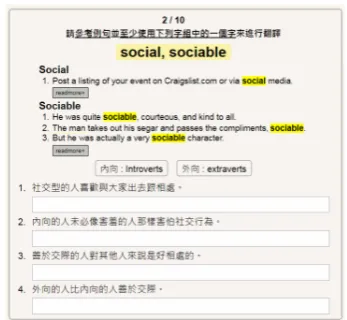
Figure 1: Example questions for translation experi-ment. Participants click the readmore button to retrieve more example sentences (the maximum number of sen-tences for each word is five). Also,introvertsand ex-travertsare two tips that we provide, as they are more difficult but not directly related tosocialandsociable.
tive. GiveMeExample collects sentences from the COBUILD English Usage Dictionary (Sinclair,
1992) to train the dictionary-like sentence classi-fier with syntactic features (Pil´an et al.,2014) and a logistic regression model (Walker and Duncan,
1967). Hence, it tends to select sentences similar to those in the COBUILD dictionary.
3 Deployment: Sentence Translation
The sentence translation experiment was separated into a pre-test and a post-test. In both of the tests, participants were asked to translate ten sets of questions from Mandarin to English. In each set, there were four translation questions correspond-ing to a specific set of confuscorrespond-ing words. In addi-tion to answering the quesaddi-tion, participants could refer to the example sentences suggested by Give-MeExample in the post-test. In the following para-graph, we describe the experiment in detail.
3.1 Building Translation Questions
In the sentence translation task were 15 confus-ing word sets selected from Collins COBUILD English Usage (Sinclair, 1992) and the Long-man Dictionary of Common Errors (Turton and Heaton,1996). These two books identify errors in word usage commonly made by language learn-ers and then clear up the confusion. Thus the word sets provided in the books were used as the desired confusing words. A word set contained two or three words. After selecting the confusing word set, we extracted sentences that contain these words from the parallel corpora Chinese English
News Magazine Parallel Text (LDC2005T10) and Hong Kong Parallel Text (LDC2004T08). These sentences were used as candidate questions. Since many sentences in the parallel corpora were long and complicated, we removed sentences whose Chinese translation contains more than 40 words. In the last step, we manually chose appropriate sentences for testing the confusing words. In the end, 15 confusing word sets were determined, each of which contains four questions to be trans-lated resulting a total of 60 questions. Note that some difficult words in the question, such as “in-troverts” and “extraverts” in Figure 1, were pro-vided as they were unrelated to testing learner use of confusing words.
3.2 Recommending Example Sentences
To recommend sentences, we first collected sen-tences from Vocabulary3, an online dictionary. The example sentences in Vocabulary mainly come from formally-written news articles. We col-lected 5,000 sentences for each word and used all of them to train the GMM and BiLSTM word us-age models. When recommending example sen-tences, we used only the qualified sentences which were filtered by the dictionary-like sentence clas-sifier. The pretrained 300-dimension GloVe ( Pen-nington et al., 2014) embeddings were used in both GMM and BiLSTM. We selected the last five sentences from Vocabulary as a baseline setting.
3.3 Experimental Setup
Sixteen college students were recruited for this translation experiment. As the translation of total 60 questions may not be done in one class, each participants was asked to complete ten randomly-assigned question sets, each of which contained four questions. Thus a total of 40 translation ques-tions were given. This process guarantees that every questions is translated by the same num-ber of participants. The testing period was about 45 minutes, leaving participants about five min-utes for each question set. In addition to trans-lating, five example sentences were provided for each word in the post-test. To ensure the students read the suggested sentences, only one example sentence was displayed in the beginning, a “read-more” button was designed for retrieving more ex-ample sentences (the maximum number of exam-ple sentences is five for each word). The
Category Example Grade
Appropriateness There is a small opportunitypossibilitythat she had actually met such a person. 0
Local grammar What are you going to do if we refuse to followingfollowyou? 3
Global grammar This building iswasdestroyed by the earthquake. 3
Structure The accident was caused by error. 1
(The error is made by human, so it should be “by human error.”)
Meaning
To a skillful pilot, it’s lucky to say that landing in torrential rain.
[image:5.595.82.520.64.194.2]1 (The meaning is wired and the correct sentence should be “Landing safely in torrential rain can only be a matter of luck for the most skilled pilot.”)
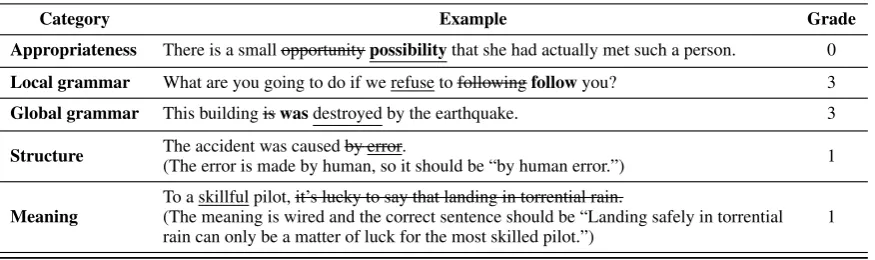
Table 2: Examples of grade criteria. The underlined word is the target confusing word.
more” activities were logged for further investiga-tion. The pre- and post-tests were administered in two different weeks to reduce short-term memory effects. Figure1shows a screen-shot of a post-test with the confusing word setsocialandsociable.
The example sentences provided were sug-gested by the GMM and BiLSTM models or se-lected from the Vocabulary website. Note that to discourage participants from guessing specific pat-terns, the example sentences from one of the three sources were presented randomly. For instance, as GMM takes contexts within a window as features, the most significant difference exists only within this window. However, we do not expect partici-pants to look only at this small piece of text. Also, sentences from Vocabulary are generally more dif-ficult than those from GMM or BiLSTM, but par-ticipants who are consistently presented with diffi-cult sentences may stop considering these example sentences to be useful resources. As the source is assigned randomly for each proposed example sentence, the total number of sentences for each source is set to the number that can best distribute sentences from different sources evenly.
3.4 Grading
Grading was done by an English native speaker who is professional in language learning and teaching. The grading criteria takes into account appropriateness, grammar, and completeness. Ap-propriateness measures whether the correct word is used or not, so the score here is either zero or one point. Grammar involves local grammar as well as global grammar. All the grammar errors relating directly to the target confusing word be-long to local grammar; the remaining grammar errors throughout the sentence belong to global grammar. The initial points for both grammar parts are four points; each grammar error results in a one-point deduction. Completeness, which
eval-uates whether the student’s translation represents all of the meanings, takes into account structure and meaning. If a student missed content such as adverbial phrases, points were deducted in terms of structure. Similarly, if a student’s translation was different from the original meaning, points were deducted in terms of meaning. Both structure and meaning started with two points. Examples are listed in Table2. Given our focus on examin-ing whether students can learn how to differentiate and use confusing words, we computed a weighted sum for reference as follows:
W eightedSum= 5∗Appropriateness+LocalGrammar
(2)
which is the sum of the appropriateness scores, weighted by 5, and the local grammar scores.
4 Results and Discussions
The pre and post scores for the grading categories are summarized in Table3. Student are separated into Highly proficient group and Less proficient group evenly by an external collocation test score (Chen and Lin,2011). In general, the suggested example sentences helped students make substan-tial progress in terms of sentence structure. It is worth noting that students were able to com-prehend the meaning of confusing words in the given sentences selected from both of the BiLSTM and GMM models. Students performed signifi-cantly better in appropriateness, local grammar, andstructurewhen the sentences were suggested by BiLSTM; while the GMM model was good at presenting the structures of sentences and demon-strating the meaning of confusing words.
Group Model Appropriateness Local grammar Weighted sum Global grammar Structure Meaning pre post t-test pre post t-test pre post t-test pre post t-test pre post t-test pre post t-test H Vocabulary 0.714 0.571 0.302 3.429 3.143 0.178 7.000 6.000 0.237 2.429 2.143 0.229 0.714 1.000 0.229 1.000 1.000 0.500 H GMM 0.444 0.444 0.500 2.444 3.000 0.123 4.667 5.222 0.347 1.667 1.556 0.364 0.667 1.222 0.025* 0.333 1.111 0.004* H BiLSTM 0.273 0.545 0.041* 2.364 3.273 0.008* 3.727 6.000 0.011* 1.545 1.364 0.276 0.818 1.182 0.052 0.545 0.909 0.052 L Vocabulary 0.182 0.364 0.170 2.182 2.909 0.098 3.091 4.727 0.056 0.818 1.091 0.247 0.364 1.000 0.013* 0.455 0.636 0.220 L GMM 0.417 0.583 0.169 2.333 2.917 0.066 4.417 5.833 0.072 0.750 1.500 0.028* 0.500 1.167 0.012* 0.333 1.083 0.010* L BiLSTM 0.429 0.524 0.165 2.667 2.714 0.443 4.810 5.333 0.169 1.238 1.571 0.116 0.762 1.143 0.004* 0.524 0.857 0.025*
Table 3: Result of translation experiment. The number of translated questions for each model ranges from 7 to 21, with the average number 11.8, depending on the number of early leave and absence we encountered in the experiment day. The pre- and post- numbers correspond to the average score for pre-test and post-test respectively and the t-test stars represent significance. The participants were separated into highly proficient (H) and less proficient (L) groups.
helped with structure and meaning. Although it was difficult for less-proficient students to recog-nize the difference (small improvement in appro-priatenessandlocal grammar), the GMM model significantly facilitated their comprehension in terms ofstructure,global grammarandmeaning.
The “readmore” logs show that most of the stu-dents clicked the button and expand all the exam-ple sentences immediately. This might imply that students did read all the example sentences and could refer to them when producing translations.
We analyzed the translation tasks to identify possible problems. Below we discuss three pos-sible explanations in terms of test items, learner behavior, and the suggested example sentences.
First, in the proposed translation task, partici-pants sometimes focused on the wrong segment of the test item to translate with the confusing words. This may be because in this productive testing pro-cess, we do not specifically tell participants which source word should be aligned to the target con-fusing word. For instance, in “For a person to be-come so poor, if it’s not because they didn’t work hard in their youth then its because they have truly had hard luck”, participants should have translated the source words “hard luck” to English using the appropriate word in the confusing word set. How-ever, the students showed confusion in their focus-ing on translatfocus-ing the source wordpoorinto one of hard,difficult, andtoughas opposed to the source wordhard inhard luck. One example translation made by a participant is “The reason why a per-son’s life is tough might because he/she was lazy when he/she was young or he/she had a bad luck”. In such cases, the learning effect cannot be cor-rectly evaluated.
We seek to find the best example sentences for word sets where the words are confusing for learn-ers. Hence regarding the suggested example sen-tences, the example sentences were extracted as
long as the confusing words shared the least fa-miliar senses. However, this led to words being chosen in example sentences with different senses and/or even different parts of speech, which is how we wanted to compare them. The wordshardand difficult exemplify these issues. First, according to WordNet,hard in this case indicates “resisting weight or pressure” in the example sentence “Such uncertainty can be hard on families, too”, whereas difficultmeans “needing skill or effort” in the sen-tence “But other stories are more difficult to ex-plain”. On the other hand, hard is an adverb in “Banks will have to work harder to make profits”, whiledifficultis an adjective in “But other stories are more difficult to explain”.
These three limitations partially explain learner performance in the translation task. Thus we at-tempted to refine the method for example sentence extraction. Improving the test items and control-ling student learning behavior is beyond the scope of this study.
5 Leveraging First Language for Better Example Sentence Selection
From the results of the translation experiment, we observed that some words were confusing to stu-dents due to language transfer from L1 (native lan-guage) to L2 (foreign lanlan-guage). Some students learn English such that they only remember how to spell words and their L1 definitional glosses, rather than understanding their context or usage. For example, the confusing wordshard and diffi-cultare very similar and almost interchangeable. If these words are memorized only by memoriz-ing the L1 definitional glosses,not easy, students may fail to recognize the slight difference between them. In other words, example sentences contain-ing words that translate into similar glosses in L1 are the sentences that indeed contain confusing senses, and thus are the target candidates for the GiveMeExample system to consider for sugges-tion. We follow this line of thinking to improve the example sentences.
In the new setting, the GiveMeExample system groups example sentences by the L1 definitional glosses of confusing words before proceeding to automatic sentence selection with the BiLSTM or GMM word usage model. When a word has multi-ple senses, this step helps to identify the confusing sense, under the assumption that words with simi-lar L1 definitions are confusing. Take for example hardanddifficult:hard as an adjective has multi-ple meanings – “not easy, requiring great physical or mental effort to accomplish, resisting weight or pressure, hard to bear”, etc; whereasdifficult has the meanings “not easy, requiring great physical or mental effort to accomplish, and hard to con-trol”. The common sense in L1 isnot easy, requir-ing great physical or mental effort to accomplish. Sentences containing confusing words whose L1 translations share these two senses are selected for later processing and suggestion.
To identify these sentences, we need each word in the sentence and its corresponding L1 trans-lation. For this purpose, parallel texts from two corpora – Chinese English News Magazine
Paral-lel Text (LDC2005T10) and Hong Kong ParalParal-lel Text (LDC2004T08), that is, a total of 2,682,129 English-Chinese sentence pairs – are utilized to learn the word alignment between L1 and L2 par-allel sentences. To align example sentences from Vocabulary, first they were all translated into Tra-ditional Chinese using Googletrans4. Then we used NLTK5 to tokenize English sentences and CKIP (Chen and Liu, 1992) to segment Chinese sentences respectively. After that, the word align-ment model GIZA++ (Och and Ney, 2003), a toolkit that implements several statistical word alignment models, was adopted to align English words to their corresponding Chinese words. Af-ter alignment, the L1 translations of confusing words were recognized, after which the sentences in the example sentence pool of the confusing words in the same set were clustered with respect to their L1 translation. There were 12 confus-ing word sets with more than one common L1 translation. Only words in three confusing word sets (possibilityvs. opportunity,socialvs. socia-ble, andunusualvs. strange) had all different L1 translations. When a common L1 translation was found for a set of confusing words, GiveMeExam-ple passed through only those sentences contain-ing confuscontain-ing words with the same L1 translation to the sentence selection component.
5.1 Human Evaluation
We employed Amazon Mechanical Turk crowd-workers to give their perspectives on the suggested sentences considering the L1 of learners. Twelve sets of confusing words with common L1 trans-lations were evaluated. GiveMeExample in both the original and the new settings suggested respec-tively five sentences using the BiLSTM and GMM models for each word in the twelve sets. In this new setting, six words – (briefly, duty, ordinary, sight, shortly, and unusual) – had less than five sentences.
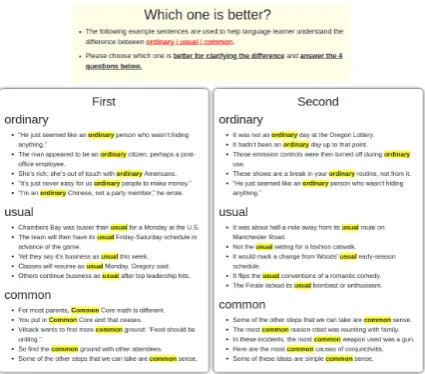
Figure2shows a screenshot of two versions of the suggested example sentences presented side-by-side. Crowd-workers were given no informa-tion about the settings or the sentence selecinforma-tion models (BiLSTM or GMM). For each task, par-ticipants were to read several sentences suggested by the two versions of the GiveMeExample system and then answer the following four questions.
4
https://pypi.org/project/googletrans/
Figure 2: An example survey for crowd-workers to compare GiveMeExample with different settings. In this specific example, first represents sentences sug-gested by the new setting;secondrepresents those from the original.
Q1: Is Mandarin your first language (y/n)?
Q2: Are these words confusing to you (y/n)?
Q3: Which set of example sentences you think is more useful for learning these words (1/2)?
Q4: In what aspect you think they are more use-ful (choose one)? (a) clarifying their mean-ing (e.g.,socialencountervs. sociable char-acter) (b) demonstrate their usage (e.g., as usual but notascommon) (c) showing cor-rect grammar (e.g., The proposal was nar-rowlydefeatedin a January election, but Ob-viously we want to continue towingames.)
The purpose of Q1 and Q2 is to understand the background of turkers, Q3 is to compare the new setting with old setting among two models, and Q4 is to investigate the effect of considering L1 translation. We also consulted a native speaker who works as an expert editor. This expert com-pleted the surveys under the same conditions as the crowd-workers.
5.2 Results and Analysis
Sixty-one crowd-workers participated in the eval-uation. Mandarin was the first language of 12 (19.67%) of them. On average, each worker com-pleted six tasks (SD=8.17). For each set out of 12 sets, 15 workers were asked to answer the ques-tions. We tested the example sentences suggested by both GMM and BiLSTM models, collecting in total 360 ratings from workers. It was an inter-esting finding that only 5% of the confusing word
sets were labeled by workers as confusing no mat-ter they were native speakers or not6. Details are shown in Table4.
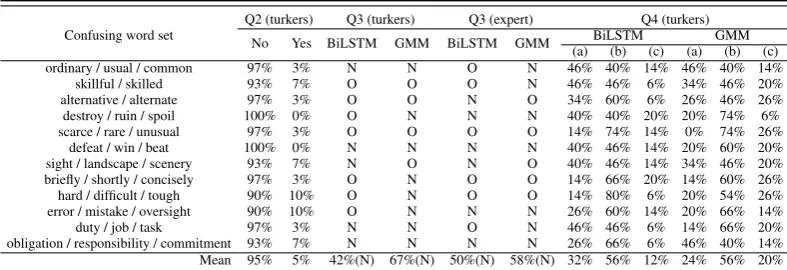
Table4shows the feedback on Q3 and Q4 from workers and the expert on each confusing word set. Results from the expert confirm that when considering L1, our approach could provide bet-ter example sentences. However, results from the crowd-workers were mixed.
Several interesting observations were gleaned from this experiment. First, when considering the L1 translation and grouping sentences by their L1 sense, the example sentences containing confusing words with different senses were excluded. There-fore, learners could focus more on the confusing sense to be learned. For example, work hardis a commonly seen phrase in the example sentences suggested by the original setting. When students learned the confusion set containinghard,difficult, and tough, the sentences containing work hard were of little help, as the meanings were irrelevant to the confusing sense in this set. However, in the new setting, the example sentences forhard were more semantically related to difficult and tough. We can say that in this task, consideration of L1 amounted to implicitly performing word sense dis-ambiguation (WSD).
The exclusion of sentences that did not contain words with the confusing sense has additional ben-efit. That is, the suggested sentences are more likely to focus on the demonstration of the ing sense. This has the advantage that the confus-ing words in the suggested sentences are diverse in their part of speech and pragmatic domain. For in-stance, in the confusion setdefeat,win, andbeat, the common L1 sense among them is “to con-quest” and “victory”. Under these certain mean-ings, only win can be used as a verb or a noun whereas the other two words can only function as a verb. This illustrates the power of grouping sen-tences by L1 translation Another example is de-stroyin the confusion setdestroy,ruin, andspoil. In the original setting,destroy is used in only the military domain and thus is misleading. When us-ing the GMM model which considers only the lo-cal context, the issue is even more serious. This is mitigated in the new setting, especially for the GMM model.
Following the above, in some cases workers in-deed tended to prefer example sentences of some
[image:8.595.76.289.61.248.2]Confusing word set
Q2 (turkers) Q3 (turkers) Q3 (expert) Q4 (turkers)
No Yes BiLSTM GMM BiLSTM GMM BiLSTM GMM
(a) (b) (c) (a) (b) (c)
ordinary / usual / common 97% 3% N N O N 46% 40% 14% 46% 40% 14%
skillful / skilled 93% 7% O O O N 46% 46% 6% 34% 46% 20%
alternative / alternate 97% 3% O O N O 34% 60% 6% 26% 46% 26%
destroy / ruin / spoil 100% 0% O N N N 40% 40% 20% 20% 74% 6%
scarce / rare / unusual 97% 3% O O O O 14% 74% 14% 0% 74% 26%
defeat / win / beat 100% 0% N N N N 40% 46% 14% 20% 60% 20%
sight / landscape / scenery 93% 7% N O N O 40% 46% 14% 34% 46% 20%
briefly / shortly / concisely 97% 3% O N O O 14% 66% 20% 14% 60% 26%
hard / difficult / tough 90% 10% O N O O 14% 80% 6% 20% 54% 26%
error / mistake / oversight 90% 10% O N N N 26% 60% 14% 20% 66% 14%
duty / job / task 97% 3% N N O N 46% 46% 6% 14% 66% 20%
obligation / responsibility / commitment 93% 7% N N N N 26% 66% 6% 46% 40% 14%
[image:9.595.101.495.63.198.2]Mean 95% 5% 42%(N) 67%(N) 50%(N) 58%(N) 32% 56% 12% 24% 56% 20%
Table 4: Results from the human evaluation. N represents the example sentences from the new setting, and O are from the original one. In addition, the expert annotated that ALL of the suggested sentences were useful for demonstrating their usage (b).
pattern. For example, in the set scarce, rare, andunusual, confusing words in the example sen-tences that shared the L1 translation very hardly resulted in example sentences containing confus-ing words functionconfus-ing as adverb, adjective, and adjective, respectively; however, in the original setting where context is considered before sense, they all function as adjectives. This interesting re-sult reveals that there is overhead when learning from materials without patterns, which could also be why only highly proficient students can learn the appropriateness.
6 Conclusion
In this paper, we leverage GiveMeExample, an AI system which automatically suggests exam-ple sentences to help ESL learners better learn to differentiate confusing words. To evaluate the system effectiveness, we designed a sophisticated sentence translation task around the problem of students not really learning via the previously de-signed receptive task, i.e., multiple-choice selec-tion. This approach was evaluated using college students; results show that students made substan-tial progress with assistance of the system. Specif-ically, after learning the example sentences, stu-dents produced more structural sentences. How-ever, learning to use appropriate words is a de-manding task which requires higher language pro-ficiency.
The learner’s first language may lead to confu-sion in different areas: this is also taken into ac-count with a novel approach. Overall, the example sentences in the refined list were considered more useful for learning by Amazon mechanical turkers and the expert English editor. However, for ESL learners such as students and some of the turkers,
they tended to prefer example sentences with sim-ilar patterns to mitigate cognitive overhead. Thus, future work will focus on providing example sen-tences with similar patterns but diverse contexts.
Acknowledgments
This research is partially supported by Ministry of Science and Technology, Taiwan under Grant No. 2634-F-002-008- and MOST108-2634-F-001-004-.
References
Dimitrios Alikaniotis, Helen Yannakoudakis, and Marek Rei. 2016. Automatic text scoring using neu-ral networks. arXiv preprint arXiv:1606.04289.
Margarita Alonso Ramos, Marcos Garc´ıa Salido, and Orsolya Vincze. 2014. Towards a collocation writ-ing assistant for learners of spanish.
Keh-Jiann Chen and Shing-Huan Liu. 1992. Word identification for Mandarin Chinese sentences. In
Proceedings of the 14th Conference on Computa-tional linguistics (COLING ’92) - Volume 1, pages 101–107.
Mei-Hua Chen and Maosung Lin. 2011. Factors and analysis of common miscollocations of college stu-dents in Taiwan. Studies in English Language and Literature, (28):57–72.
Fei Dong and Yue Zhang. 2016. Automatic features for essay scoring–an empirical study. In Proceed-ings of the 2016 Conference on Empirical Methods in Natural Language Processing, pages 1072–1077.
Finale Doshi-Velez and Been Kim. 2017. Towards a rigorous science of interpretable machine learning.
arXiv preprint arXiv:1702.08608.
Yoko Futagi. 2010. The effects of learner errors on the development of a collocation detection tool. In
Proceedings of the fourth workshop on Analytics for noisy unstructured text data, pages 27–34. ACM.
Mohammad Reza Hashemi and Farah Gowdasiaei. 2005. An attribute-treatment interaction study: Lexical-set versus semantically-unrelated vocabu-lary instruction.RELC journal, 36(3):341–361.
Saengchan Hemchua, Norbert Schmitt, et al. 2006. An analysis of lexical errors in the English compositions of Thai learners.
Chieh-Yang Huang, Mei-Hua Chen, and Lun-Wei Ku. 2017. Towards a better learning of near-synonyms: Automatically suggesting example sentences via fill in the blank. In Proceedings of the 26th Interna-tional Conference on World Wide Web Companion, pages 293–302. International World Wide Web Con-ferences Steering Committee.
Monica Karlsson. 2014. Advanced Students’ L1 and L2 Mastery of Lexical Fields of Near Synonyms.
World Journal of English Language, 4(3):1.
Batia Laufer. 1990. Ease and difficulty in vocabulary learning: Some teaching implications.Foreign Lan-guage Annals, 23(2):147–155.
Batia Laufer and Nany Girsai. 2008. Form-focused in-struction in second language vocabulary learning: A case for contrastive analysis and translation. Applied linguistics, 29(4):694–716.
Dilin Liu and Shouman Zhong. 2014. L2 vs. L1 use of synonymy: An empirical study of synonym use/acquisition. Applied linguistics, 37(2):239–261.
Marilyn Martin. 1984. Advanced vocabulary teaching: The problem of synonyms. The Modern Language Journal, 68(2):130–137.
Diana McCarthy and Roberto Navigli. 2007. SemEval-2007 task 10: English lexical substitution task. In
Proceedings of the Fourth International Workshop on Semantic Evaluations (SemEval-2007), pages 48–53, Prague, Czech Republic. Association for Computational Linguistics.
Diana McCarthy and Roberto Navigli. 2009. The en-glish lexical substitution task. Language resources and evaluation, 43(2):139–159.
Oren Melamud, Omer Levy, and Ido Dagan. 2015. A simple word embedding model for lexical substitu-tion. InProceedings of the 1st Workshop on Vector Space Modeling for Natural Language Processing, pages 1–7.
Rada Mihalcea, Ravi Sinha, and Diana McCarthy. 2010. Semeval-2010 task 2: Cross-lingual lexical substitution. InProceedings of the 5th international workshop on semantic evaluation, pages 9–14. As-sociation for Computational Linguistics.
Courtney Napoles and Chris Callison-Burch. 2017. Systematically adapting machine translation for grammatical error correction. InProceedings of the 12th Workshop on Innovative Use of NLP for Build-ing Educational Applications, pages 345–356.
Hwee Tou Ng, Siew Mei Wu, Ted Briscoe, Christian Hadiwinoto, Raymond Hendy Susanto, and Christo-pher Bryant. 2014. The CoNLL-2014 shared task on grammatical error correction. InProceedings of the Eighteenth Conference on Computational Natu-ral Language Learning: Shared Task, pages 1–14.
Franz Josef Och and Hermann Ney. 2003. A systematic comparison of various statistical alignment models.
Computational Linguistics, 29(1):19–51.
Jeffrey Pennington, Richard Socher, and Christopher Manning. 2014. GloVe: Global vectors for word representation. In Proceedings of the 2014 Con-ference on Empirical Methods in Natural Language Processing (EMNLP), pages 1532–1543.
Ildik´o Pil´an, Elena Volodina, and Richard Johansson. 2014. Rule-based and machine learning approaches for second language sentence-level readability. In
Proceedings of the Ninth Workshop on Innovative Use of NLP for Building Educational Applications, pages 174–184.
Peter Prince. 1996. Second language vocabulary learn-ing: The role of context versus translations as a func-tion of proficiency. The modern language journal, 80(4):478–493.
Nancy Ragno. 2016. Use the Right Word: Your Quick & Easy Guide to 158 Words Most Often Confused or Misused. Nancy Ragno.
Marco Tulio Ribeiro, Sameer Singh, and Carlos Guestrin. 2016. Why should I trust you?: Explain-ing the predictions of any classifier. InProceedings of the 22nd ACM SIGKDD International Conference on Knowledge Discovery and Data Mining, pages 1135–1144. ACM.
Adrian Room. 1988. Dictionary of confusing words and meanings. Dorset Press.
John Sinclair. 1992. Collins COBUILD English Usage. Collins.
Thomas Tinkham. 1993. The effect of semantic clus-tering on the learning of second language vocabu-lary. System, 21(3):371–380.
Nigel D Turton and John Brian Heaton. 1996. Long-man Dictionary of Common Errors. Longman.
Strother H Walker and David B Duncan. 1967. Esti-mation of the probability of an event as a function of several independent variables. Biometrika, 54(1-2):167–179.
Robert Waring. 1997. The negative effects of learn-ing words in semantic sets: A replication. System, 25(2):261–274.
Stuart Webb. 2007. The effects of synonymy on second-language vocabulary learning. Reading in a Foreign Language, 19(2):120–136.
Lei Xu and Michael I Jordan. 1996. On convergence properties of the EM algorithm for Gaussian mix-tures. Neural computation, 8(1):129–151.
HUO Yanjuan. 2014. BNC-Based Design of lege English Vocabulary Teaching for Chinese Col-lege Students. Studies in Literature and Language, 8(3):122–125.
Yuli Yeh, Hsien-Chin Liou, and Yi-Hsin Li. 2007. Online synonym materials and concordancing for EFL college writing. Computer Assisted Language Learning, 20(2):131–152.
Haoran Zhang and Diane Litman. 2018. Co-attention based neural network for source-dependent essay scoring. InProceedings of the Thirteenth Workshop on Innovative Use of NLP for Building Educational Applications, pages 399–409.