229
MICHAEL: Mining Character-level Patterns for Arabic Dialect
Identification (MADAR Challenge)
Dhaou Ghoul
STIH Lab, Sorbonne University
Ga¨el Lejeune
STIH Lab, Sorbonne University
Abstract
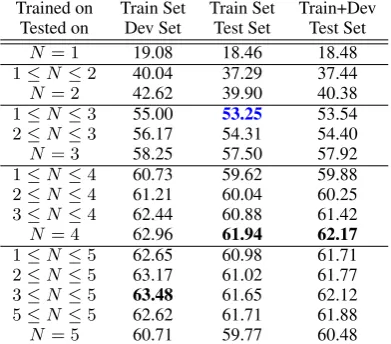
We present MICHAEL, a lightweight method developed for the MADAR shared task on travel domain Dialect Identification (DID). It uses character-level features and perform clas-sification without any pre-processing. Charac-ter N-grams extracted from the original sen-tences are used to train a Multinomial Naive Bayes classifier. MICHAELachieved an offi-cial score (accuracy) of 53.25% with1≤N ≤
3but showed a much better result with charac-ter 4-grams (62.17%).
1 Introduction
The Arabic language is one of the most widely spoken language in the world, currently consid-ered as the fifth language (Chung,2008) with more than 330 million Arabic speakers. It is the official language of more than 22 countries. In its written form, commonly referred as Literary Arabic, it is divided into two categories: Classical Arabic and Modern Standard Arabic (MSA). However, Ara-bic speakers mostly use dialects which are a lin-guistic variant of classical Arabic with their own features, varying with respect to the country or the region. If MSA is used only for written and official communication, dialects are used for oral com-munication as well as for many device mediated communication forms: email, sms, chat or blogs. Therefore, Arabic dialects identification (DID) has become a very important pre-processing step that attracts many attention from NLP research. In-deed, the knowledge about the dialect of an input text is useful in several NLP tasks such as senti-ment analysis (Al-Twairesh et al.,2016).
We propose a simple, light-weight, character-based method to classify Arabic sentences into 26 classes (25 dialects + MSA) based on the MADAR
corpus provided for this competition (Bouamor
et al.,2019). This paper is organized as follows:
in Section 2, we present some related word for
DID. In section 3, we describe some aspects of
the Arabic dialects and in section4we present the
MADAR dataset and we introduce MICHAEL, the
system we designed to tackle the DID task.
Fi-nally, we show our results in Section5 and give
some future directions in section6
2 Previous Work
Arabic Dialect Identification is a very difficult task because of several factors like the lack of NLP tools that deal with Arabic variants. So far, the researchers have tried to address this task using different methods.
Salameh et al. (Salameh et al., 2018),
pre-sented a MNB (Multinomial Naive Bayes) clas-sifier trained to identify a tweet among 26 classes (MSA+25 dialects) using a large-scale of parallel sentences (Bouamor et al., 2018). Their models reach 67.9% accuracy for sentences with an aver-age length of 7 word and reached more than 90% with 16 words.
Elfardy and Diab (Elfardy and Diab, 2013)
proposed a supervised method for identifying whether a given sentence in prevalently MSA or Egyptian using the Arabic online commentary dataset(AOC) (Zaidan and Callison-Burch,2011). Their system achieves an accuracy of 85.5% on an Arabic online-commentary dataset.
Najafian et al. (Najafian et al., 2018), pre-sented different approaches for Dialect Identifica-tion (DID) in Arabic broadcast speech using use Support Vector Machines (SVM), and Convolu-tional Neural Networks (CNN) as backend clas-sifiers. The final system merges these results and obtains 24.7% and 19.0% relative error rate reduc-tion compared to convenreduc-tional phonotactic DID,
and i-vectors with bottleneck features. Rabee et
sys-tems. The first system uses word transcriptions and tries to recognize the speaker’s dialect by modeling the word sequence of each dialect. The second one aims to recognize the dialect by mod-eling the telephonesequences produced by non-Arabic telephone recognition devices. The other two systems use GMM trained in acoustic func-tions to recognize the dialect. This system reached
68.77% in micro F1. Elarabyet al. (Elaraby and
Abdul-Mageed, 2018), presented a deep learning models for DID taking advantage of the perfor-mance of several conventional machine learning models under different conditions. Their model showed a 87.65% score in accuracy for the binary task (MSA vs. dialects), 87.4% for the 3 class task (Egyptian, Gulf and Levantine).
3 The Dialectal Varieties of Arabic
Arabic language is a rather generic term that refers in fact to many variants and dialects. Nowadays, one can consider that Arabic language is divided into three major categories: classical Arabic,
stan-dard Arabic (MSA) and dialectal Arabic. The
2019 MADAR competition focused on the latter. Dialectal Arabic is a proper form of the Ara-bic language used in everyday communication, usually called ”darija”. It varies from one coun-try to another and even from one region to an-other within the same country. All Arab coun-tries have their own dialects that are more or less close to each other. The differences the dialects exhibit depend mainly on the history of each coun-try and its geographical location. For example, the Tunisian dialect (TUN) integrates several borrow-ings from French language as it has been colo-nized by France. Words like ”stylo” (pen/pencil) or ”cartable” (schoolbag) are examples of bor-rowings completely integrated into TUN. Accord-ing to Zaidan and Callison-Burch (2014), arabic dialects can be classified into five major classes (these classes can have several subclasses):
• Egyptian: The most widely understood di-alect, due to a thriving Egyptian television and movie industry (Haeri,2003).
• Levantine:A set of dialects that differ some-what in pronunciation and intonation, but are largely equivalent in written form. They are closely related to Aramaic (Amara,2010).
• Gulf: Probably the closest to MSA, perhaps because the current form of MSA evolved
from an Arabic variety originating in the Gulf region. There are differences between Gulf and MSA but Gulf kept more of MSA’s verb conjugation than other dialects (Versteegh,
2001).
• Iraqi: Despite its similarity to Gulf dialects it exhibits some very distinctive features in terms of prepositioning, verb conjugation and pronunciation (Mitchell,1993).
• Maghrebi: These dialects were influenced by both French and Berber languages. The Western-most varieties could be unintelli-gible for speakers from other regions in the Middle East, especially in spoken form. Maghreb is a large region with more varia-tion than regions like the Levant or the Gulf. It makes it probably easier to distinguish its local variants : Tunisia, Algeria, Morocco, Libya. . . (Tilmatine,1999).
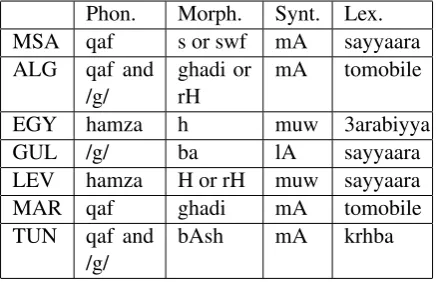
Arabic dialect differ from one another and from MSA on several levels of linguistic representation such as phonology, morphology, lexicon and syn-tax. Table1 exhibits examples of differences be-tween some dialects. For instances, the phonem ”qaf” (first column) will not have the same pro-nounciation in all the dialects. In the second col-umn one can see that the future tense is not marked by the same morpheme in each variant. The syn-tax of negation (third column) is not the same in Maghrebian dialects and in othe dialects. Regard-ing lexicon (fourth column) the concept ”car” in ALG and MAR dialects reflects a borowing from the French term ”automobile”.
Phon. Morph. Synt. Lex.
MSA qaf s or swf mA sayyaara
ALG qaf and
/g/
ghadi or rH
mA tomobile
EGY hamza h muw 3arabiyya
GUL /g/ ba lA sayyaara
LEV hamza H or rH muw sayyaara
MAR qaf ghadi mA tomobile
TUN qaf and
/g/
bAsh mA krhba
[image:2.595.307.526.553.694.2]4 Arabic Dialect Identification: Methods for classification
4.1 Some Difficulties of Arabic DID
Despite the differences between the different di-alects, their automatic identification remains a very difficult task, even impossible in some cases. This difficulty is due to several factors:
• Shared lexicon: dialects have a common
vo-cabulary and a dialectal sentence can contain several dialects as well as MSA.
• Grammatical Ambiguity: some identical
words are used with different functions. For example, the word ”Tyb” can be an adjective in some dialects and an interjection in others.
• Homonyms: mostly due to the omission
of short vowels, a dialectal word can have the same spelling as an MSA word but an
entirely different meaning. This includes
strongly dialectal words such as dwl: it is either the Egyptian (EGY) word for ”these” (pronounced dowl) or the MSA word for
”countries” (pronounced duwal) (Zaidan and
Callison-Burch,2014).
4.2 Data: The MADAR corpus
The purpose of the shared task is to give each short sentence a label among 26 avialable labels. We took advantage of the MADAR corpus sup-plied for the competition in order to train various classifiers. We did not use anay external resource. The MADAR corpus has been created by trans-lating sentences from the Basic Traveling Expres-sion Corpus (BTEC) from English and French to the different dialects. This corpus has been split-ted into Train, Validation and Test sets, they are priefly presented in Table2.
Datasets Train Dev Test
# sentences 41,600 5,200 5,200
# words 336,342 42,586 36,811
# characters 1,301,599 166,898 162,185
Table 2: Size of the Train, Dev and Test sets
4.3 Method: Character N-grams
MICHAEL has been built on the assumption that the features most prone to discriminate languages are found at character-level. With this idea in mind
Trained on Train Set Train Set Train+Dev Tested on Dev Set Test Set Test Set
N = 1 19.08 18.46 18.48
1≤N≤2 40.04 37.29 37.44
N = 2 42.62 39.90 40.38
1≤N≤3 55.00 53.25 53.54
2≤N≤3 56.17 54.31 54.40
N = 3 58.25 57.50 57.92
1≤N≤4 60.73 59.62 59.88
2≤N≤4 61.21 60.04 60.25
3≤N≤4 62.44 60.88 61.42
N = 4 62.96 61.94 62.17 1≤N≤5 62.65 60.98 61.71
2≤N≤5 63.17 61.02 61.77
3≤N≤5 63.48 61.65 62.12
5≤N≤5 62.62 61.71 61.88
[image:3.595.319.515.63.235.2]N = 5 60.71 59.77 60.48
Table 3: Results for the Multinomial Naive Bayes Clas-sifier, character N-grams with various range ofNfrom
Nmin = 1toNmax = 5 with different training and
testing configurations (blue score is our official score)
we tried different classifiers but quickly found that, under the technical constraints we were fac-ing, Naive Bayes algorithms were the most appro-priate for such a multi-class problem. The One VS Rest implementation of SVM we tested were unable to reach a result and we did not want to train 26 different classifiers separately. We used
the SCI-KITLEARNimplementation of MNB and
it proves quickly that among the NB implementa-tions of this library, the Multinomial Naive Bayes (MNB) was the most efficient. We will show in the next section different learning configurations and various size of n-grams for feature engineering.
5 Results and Error Analysis
5.1 Results
The results obtained by MICHAEL are shown on
Table 3. One can see that character 1−grams
(Nmin=Nmax = 1) alone can achieve more than
18% in accuracy which is an interesting result for a 26-class task. Increasing the maximum size of the N-grams increases the accuracy quickly: +19
percentage points (pp) with Nmax = 2 and
an-other 16 points with Nmax = 3. The gain with
Nmax= 4is lower but it is still a 6 pp gain.
Working on the minimal size of the n-grams is also a good way to improve the score. In our par-ticular learning setting, removing short n-grams helps to improve the results. For instance with
Nmax= 3, settingNmin = 3instead ofNmin = 1
Maghreb Egyptian S. Levant N. Levant Iraqi Gulf
[image:4.595.70.525.61.264.2]ALG BEN FES RAB SFX TRI TUN ALX ASW CAI KHA AMM JER SAL ALE BEI DAM BAG BAS MOS DOH JED MUS RIY SAN MSA ALG 153 3 5 6 4 3 5 1 0 3 2 0 0 2 0 1 0 0 0 0 0 0 5 1 0 1 BEN 7 127 2 3 2 8 0 2 0 0 0 4 6 3 1 3 3 3 3 2 3 5 5 9 4 0 FES 8 1 135 36 1 0 1 1 2 1 2 2 3 1 2 5 2 1 2 0 2 2 2 1 2 0 RAB 7 2 34 138 3 2 6 1 2 2 1 1 1 3 1 1 0 0 1 0 1 0 0 0 1 0 SFX 3 5 5 4 149 3 47 0 0 1 1 1 1 2 0 1 1 2 1 0 2 4 1 1 2 2 TRI 2 11 0 4 3 145 3 0 3 1 3 1 1 1 1 1 1 1 2 6 5 3 0 2 4 0 TUN 1 1 1 1 22 3 119 0 1 2 0 0 1 0 1 3 1 0 0 0 1 0 1 0 0 0 ALX 2 0 1 1 0 0 1 143 27 20 3 4 3 2 0 2 2 0 1 2 2 3 2 1 0 2 ASW 0 7 1 0 0 3 0 14 116 36 11 4 2 4 1 3 3 3 1 0 1 6 3 0 2 0 CAI 1 1 2 0 0 2 1 12 22 88 2 4 2 3 0 4 2 1 1 0 0 2 2 4 3 1 KHA 3 3 1 0 0 5 0 8 3 14 139 3 2 2 2 4 2 1 2 1 4 7 10 2 5 9 AMM 0 4 0 0 1 2 1 5 3 6 1 108 21 10 8 5 13 2 1 0 2 4 1 3 2 0 JER 2 3 0 3 2 3 1 2 4 3 2 18 112 15 8 7 9 0 0 0 4 1 0 3 1 0 SAL 0 0 1 0 1 3 3 0 1 2 1 6 12 106 4 6 10 1 2 2 4 5 3 3 3 2 ALE 0 1 0 1 1 2 0 0 0 7 0 6 7 3 122 9 16 2 0 2 3 0 2 1 0 2 BEI 1 1 0 0 0 2 0 1 0 2 1 5 7 4 6 113 15 2 1 0 1 2 1 1 0 0 DAM 1 1 0 0 1 0 1 0 2 0 3 9 5 6 25 18 100 1 1 1 3 5 3 0 2 2 BAG 0 1 1 0 2 1 1 1 0 1 0 1 0 2 3 1 7 123 26 1 3 1 5 3 5 4 BAS 2 1 0 0 0 0 3 0 1 0 2 0 3 3 2 2 2 31 128 8 3 0 3 3 2 1 MOS 1 0 1 0 2 0 1 1 0 1 2 1 0 3 3 1 0 7 12 165 4 2 1 6 3 0 DOH 0 3 2 1 1 4 2 0 3 1 4 6 3 4 0 2 2 2 3 0 119 9 12 5 5 1 JED 2 7 0 1 0 2 3 4 5 4 3 5 3 4 5 1 4 1 2 1 13 115 4 21 6 3 MUS 1 3 3 0 1 1 1 0 1 0 6 4 2 5 2 3 0 0 2 3 9 0 94 13 2 23 RIY 2 10 2 0 2 2 0 1 3 1 1 5 2 6 0 3 1 7 3 3 7 13 12 102 7 5 SAN 0 4 3 1 0 4 0 1 1 3 1 2 1 4 1 1 2 5 4 3 3 8 5 10 130 2 MSA 4 1 3 0 0 2 0 4 1 0 8 2 1 2 2 0 0 2 1 1 0 2 12 3 0 137
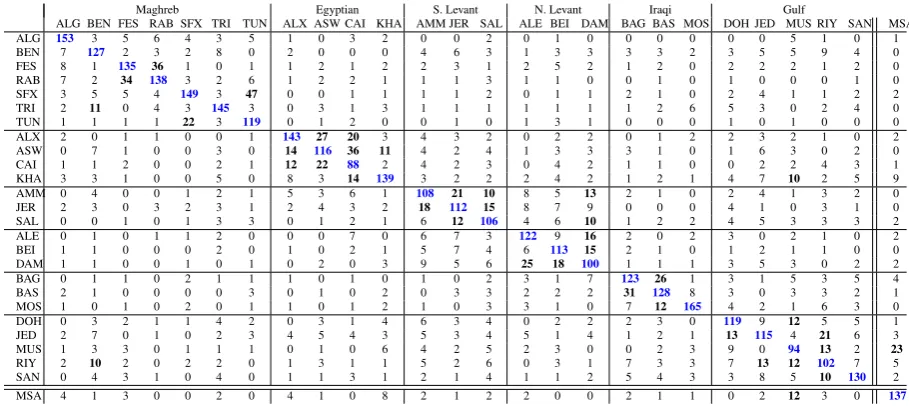
Table 4: Confusion matrix for our best system (MNB with character 4-grams) with dialects grouped with respect to regions, with true positives in blue, and in blod dialect pairs with more than ten false positives.
It appears that the results obtained on the Test Set were worse than those obtained on the Dev Set (third column of Table3), with an average loss of 1.6 percentage points. Merging the Train and the Dev Set resulted in a gain that in most cases was marginal (+0.26 pp). WithNmax > 4we did not
find much improvement in results, except on the dev set but this can be a bias. This threshold may be related to the fact that character N-grams with
N > 4 tend to represent the lexicon more than general properties of the dialect itself.
5.2 Error Analysis
Table 4 shows the confusion matrix of our best
configuration. The 25 dialects are grouped by re-gions and MSA appears as the last class. We can see that MUS and SAN are the closest dialects to MSA with respectively 35 and 17 errors in-volving the MUS-MSA and the SAN-MSA pairs. CAI, MUS and DAM dialects were the most dif-ficult to detect with respectively 112, 106 and 100 False Negatives (FN). Regarding False Positives (FP), the most problematic cases were ASW (106) , RIY (105) and JED (103). Interestingly, the most difficult dialect pairs to discriminate were from Maghreb: FES–RAB (36 and 34 FP) and SFX– TUN (47 and 22). Most of FPs occured between dialects of the same regions with two exceptions : (I) a minor one because North Levant dialects are hard to distinguish from South Levant dialects and (II) a more strange situation with BEN-RIY and KHA-MUS being rather difficult pairs to dis-tinguish despite their apparent distance.
6 Conclusion and Future Work
In this paper, we explored the problem of Arabic dialect classification into 26 classes (covering 25 cities from the Arab World in addition to Modern
Standard Arabic(MSA)). We presented MICHAEL
a simple, pre-processing free, system design for
this DID task. MICHAELuses character N-Grams
features to train a Multinomial Naive Bayes classi-fier. Beside its simplicity, MICHAELdoes not need a huge amount of training data to achieve good re-sults. This system achieved an official score
(ac-curacy) of 53.25% with1 ≤ N ≤ 3 but showed
a much better result with only character 4-grams
(62.17% accuracy). Using N-grams withN > 4
did not seem to improve the results. However, an accurate feature selection technique, like mutual information, may help to get advantage of these longer n-grams that capture more lexical informa-tion than shorter N-grams.
References
Nora Al-Twairesh, Hend Al-Khalifa, and Abdulmalik AlSalman. 2016. AraSenTi: Large-scale twitter-specific Arabic sentiment lexicons. In Proceed-ings of the 54th Annual Meeting of the Association for Computational Linguistics (Volume 1: Long Pa-pers), pages 697–705, Berlin, Germany. Association for Computational Linguistics.
Muhammad Amara. 2010. Reem bassiouney: Arabic sociolinguistics.Language Policy, 9:379–381.
Houda Bouamor, Nizar Habash, Mohammad Salameh, Wajdi Zaghouani, Owen Rambow, Dana Abdul-rahim, Ossama Obeid, Salam Khalifa, Fadhl Eryani, Alexander Erdmann, and Kemal Oflazer. 2018. The madar arabic dialect corpus and lexicon. In Pro-ceedings of LREC 2018.
Houda Bouamor, Sabit Hassan, and Nizar Habash. 2019. The MADAR Shared Task on Arabic Fine-Grained Dialect Identification. InProceedings of the Fourth Arabic Natural Language Processing Work-shop (WANLP19), Florence, Italy.
Davide Buscaldi, Joseph Le Roux, and Ga¨el Lejeune. 2018. Character-level models for polarity detection in tweets. InAtelier DEFT 2018, Rennes, France.
Wingyan Chung. 2008. Web searching in a multilin-gual world.Commun. ACM, 51(5):32–40.
Mohamed Elaraby and Muhammad Abdul-Mageed. 2018. Deep models for arabic dialect identification on benchmarked data. InVarDial@COLING 2018.
Heba Elfardy and Mona Diab. 2013.Sentence level di-alect identification in Arabic. InProceedings of the 51st Annual Meeting of the Association for Compu-tational Linguistics (Volume 2: Short Papers), pages 456–461, Sofia, Bulgaria. Association for Computa-tional Linguistics.
Niloofar Haeri. 2003.Sacred Language, Ordinary Peo-ple: Dilemmas of Culture and Politics in Egypt. Sa-cred Language, Ordinary People: Dilemmas of Cul-ture and Politics in Egypt. Palgrave Macmillan.
Terence Frederic Mitchell. 1993. Pronouncing Arabic. vol. 2. Clarendon Press.
Maryam Najafian, Sameer Khurana, Suwon Shon, Ahmed Ali, and James Glass. 2018. Exploiting con-volutional neural networks for phonotactic based di-alect identification. InICASSP, pages 5174–5178. IEEE.
Rabee Naser and Abualsoud Hanani. 2018. Birzeit ara-bic dialect identification system for the 2018 vardial challenge. InVarDial@COLING 2018.
Mohammad Salameh, Houda Bouamor, and Nizar Habash. 2018. Fine-grained arabic dialect identi-fication. InProceedings of the International Con-ference on Computational Linguistics (COLING), pages 1332–1344, Santa Fe, New Mexico, USA.
Mohand Tilmatine. 1999. Substrat et convergences: le berbre et l’arabe nord-africain. Estudios de dialec-tolog’ia norteafricana y andalus’i, EDNA, pages 99–120.
Cornelis Henricus Maria Versteegh. 2001. The Arabic Language. Edinburgh University Press Series. Ed-inburgh University Press.
Omar Zaidan and Chris Callison-Burch. 2011. Crowd-sourcing translation: Professional quality from non-professionals. In Proceedings of the 49th Annual Meeting of the Association for Computational Lin-guistics: Human Language Technologies, pages 1220–1229, Portland, Oregon, USA. Association for Computational Linguistics.