104
On Evaluating Embedding Models for Knowledge Base Completion
Yanjie Wang, Daniel Ruffinelli, Rainer Gemulla, Samuel Broscheit, Christian Meilicke Data and Web Science Group
University of Mannheim, Germany {ywang,rgemulla}@uni-mannheim.de,
{daniel,broscheit,christian}@informatik.uni-mannheim.de,
Abstract
Knowledge graph embedding models have re-cently received significant attention in the lit-erature. These models learn latent semantic representations for the entities and relations in a given knowledge base; the representations can be used to infer missing knowledge. In this paper, we study the question of how well recent embedding models perform for the task of knowledge base completion, i.e., the task of inferring new facts from an incomplete knowl-edge base. We argue that the entity ranking protocol, which is currently used to evaluate knowledge graph embedding models, is not suitable to answer this question since only a subset of the model predictions are evaluated. We propose an alternative entity-pair ranking protocol that considers all model predictions as a whole and is thus more suitable to the task. We conducted an experimental study on standard datasets and found that the perfor-mance of popular embeddings models was un-satisfactory under the new protocol, even on datasets that are generally considered to be too easy. Moreover, we found that a simple rule-based model often provided superior perfor-mance. Our findings suggest that there is a need for more research into embedding mod-els as well as their training strategies for the task of knowledge base completion.
1 Introduction
A knowledge base (KB) is a collection of rela-tional facts, often represented as (subject, rela-tion, object)-triples. KBs provide rich information for NLP tasks such as question answering ( Abu-jabal et al., 2017) or entity linking (Shen et al.,
2015). Since knowledge bases are inherently in-complete (West et al.,2014), there has been con-siderable interest into methods that infer missing knowledge.
In particular, a large number of knowledge graph embedding (KGE) models have been
pro-posed in the recent literature (Nickel et al.,2016a). These models embed the entities and relations of a given knowledge base into a low-dimensional latent space such that the structure of the knowl-edge base is captured. The embeddings are subse-quently used to assess whether unobserved triples constitute missing facts or are likely to be false.
To evaluate the performance of a KGE model, the most commonly adopted protocol is the en-tity ranking(ER) protocol.1 The protocol takes as input a set of previously unobserved test triples, such as(Einstein, bornIn, Ulm), and uses the em-bedding model to rank all possible answers to the questions(?, bornIn, Ulm)and(Einstein, bornIn, ?). Model performance is then assessed based on the rank of the answer present in the test triple (EinsteinandUlm, resp.). Since each question is constructed from a test triple, the protocol ensures that questions are meaningful and always have a correct answer. Throughout this paper, we refer to the task of answering such questions as question answering(QA). The ER protocol is, in principle, well-suited to evaluate performance of KGE mod-els for QA, although concerns about the bench-mark datasets (Toutanova and Chen, 2015), the considered models (Kadlec et al., 2017) and the evaluation (Joulin et al.,2017) have been raised.
In this paper, we aim to study the performance of popular embedding models for the task of knowledge base completion (KBC): given a rela-tion of a knowledge base (bornIn), infer true miss-ing facts ((Einstein, bornIn, Ulm)). This task is different from QA (as defined above) since no in-formation about potential missing triples is pro-vided upfront. We argue that the ER protocol is not well-suited to assess model performance for KBC. To see this, observe that models that assign high confidence scores to incorrect triples such as
(Ulm, bornIn, Einstein) are not penalized by the ER protocol because the corresponding questions (e.g., (Ulm, bornIn, ?)) are never asked. Thus a model that performs well on ER may still not perform well for KBC. In fact, we argue here that some commonly used KGE models are inherently not well-suited to KBC.
We propose a simple entity-pair ranking(PR) protocol (PR), which is more suitable to assess model performance for KBC. Given a relation such as bornIn, PR uses the KGE model to rank all possible answers—i.e., all entity pairs—to the question(?,bornIn,?), and subsequently assesses model performance based on the rank of the test triples for relationbornInin the answer. The pro-tocol ensures that a model’s performance is nega-tively affected if the model assigns high scores to false triples such as(Ulm, bornIn, Einstein).
We conducted an experimental study on com-monly used benchmark datasets under the ER and the PR protocols. We found that the performance of popular embeddings models was often good un-der the ER but unsatisfactory unun-der the PR proto-col, even on “simple” datasets that are generally considered to be too easy. Moreover, we found that a simple rule-based model often provided su-perior performance for PR. Our findings suggests that there is a need for more research into embed-ding models as well as their training strategies for the task of knowledge base completion.
2 Preliminaries
Given a set of entitiesEand a set of relationsR, a knowledge baseK ⊆ E × R × Eis a set of triples
(i, k, j), wherei, j ∈ E andk ∈ R. We refer to
i, kandjas thesubject,relation, andobjectto the triple, respectively.
Embedding models. A KGE model associates anembeddingei ∈ Rde andrk ∈ Rdr with each entity iand relation k, resp. We refer to de and
dr ∈ N+ as the size of the embeddings. Each KGE model uses ascoring functions:E × R × E →Rto associate a scores(i, k, j)to each triple
(i, k, j)∈ E ×R×E. The scores induce a ranking: triples with high scores are considered more likely to be true than triples with low scores. Roughly speaking, the models try to find embeddings that capture the structure of the entire knowledge graph well. In this work, we consider a popular family of embedding models called bilinear models.
Bilinear KGE models. Bilinear models use the relation embeddingrk ∈ Rdr to construct a mix-ing matrix Rk ∈ Rde×de, and they use scoring functions(i, k, j) = eTi Rkej. The models differ mainly in how Rk is constructed. Unless stated otherwise, the models use the same embedding sizes for entities and relations (i.e.,dr=de).
RESCAL (Nickel et al.,2011) is the most gen-eral bilinear model: it setsdr = d2e and stores in rk the values of each entry ofRk. Analogy (Liu
et al., 2017) constrains Rk ∈ Rde×de to a block diagonal matrix in which each block is either (i) a
real scalar or (ii) a2×2matrix of form
x −y
y x
with x, y ∈ R. DistMult (Carroll and Chang,
1970; Yang et al., 2014) is a symmetric factor-ization model with Rk = diag (rk) or, equiva-lently, considers only case (i) of Analogy. Com-plEx (Trouillon et al., 2016) and HolE (Nickel et al., 2016b) are equivalent to a model that re-strictsRkto case (ii). TransE (Bordes et al.,2013) is a translation-based model with scoring func-tion s(i, k, j) = − kei+rk−ejk2 (or k·k1); it
can also be written in bilinear form (Wang et al.,
2018).
Rule learning. Rule learning methods derive logical rules that encode dependencies found in the KBs (Gal´arraga et al., 2013). We consider a simple rule-based model called RuleN ( Meil-icke et al., 2018) as baseline. The model learns (weighted) implication rules of form
r(i, j) ← r1(i, z1)∧ · · · ∧rn(zn, j)
r(i, c) ← ∃z.r(i, z)
whereri are relations, c is a constant entity, and
i, j, and zi are variables quantified over entities. To perform KBC, rule-based models query the KB for instances of the bodies of each rule and in-terpret the corresponding head as (weighted) pre-dicted fact.
3 Evaluation Protocols
3.1 Current Evaluation Protocols
The triple classification (TC) or the entity rank-ing (ER) protocols are commonly used to assess KGE model performance, where ER is arguably the most widely adopted protocol. We assume throughout that only true but no false triples are available (as is commonly the case), and that the available true triples are divided into training, val-idation, and test triples.
Triple classification (TC) The goal of triple classification is to test the model’s ability to dis-criminate between true and false triples (Socher et al.,2013). Since only true triples are available in practice, pseudo-negative triples are generated by randomly replacing either the subject or the ob-ject of each test triple by a random entity (that ap-pears as a subject or object in the considered re-lation). All triples are then classified as positive or negative according to the KGE scores. In par-ticular, triple(i, k, j)is classified as positive if its scores(i, k, j)exceeds a relation-specific decision thresholdτk(learned on validation data using the same procedure). Model performance is assessed by classification accuracy.
Entity ranking (ER) ER assesses model per-formance by testing its ability to perform QA (as defined before). In particular, for each test triplet = (i, k, j), two questionsqs = (?, k, j) and qo = (i, k,?) are generated. For question
qs, all entities i0 ∈ E are ranked based on the scores(i0, k, j). To avoid misleading results, en-tities i0 6= i that correspond to observed triples in the dataset—i.e., (i0, k, j) occurs in the train-ing/validation/test triples—are discarded to obtain a filtered ranking. The same process is applied for questionqo. Model performance is evaluated based on the recorded positions of the test triples in the filtered ranking. Models that tend to rank test triples (known to be true) higher than un-known triples (assumed to be false) are thus con-sidered superior. Usually, the micro-average of fil-tered Hits@K—i.e., the proportion of test triples ranking in the top-K—andfiltered MRR—i.e., the mean reciprocal rank of the test triples—are used to assess model performance.
3.2 Discussion
Wang et al.(2018) found that most models achieve a TC accuracy of at least 93% on a benchmark dataset. This is because each test triple is
com-pared against a single negative triple, and due to the high number of possible negative triples, it is unlikely that the chosen triple has a high predicted score, rendering most classification tasks “easy”. Consequently, the accuracy of triple classification overestimates model performance. This protocol is less adopted in recent work.
We argue that ER is appropriate to evaluate QA performance, but may overestimate model perfor-mance for KBC. Since ER generates questions from true test triples, it only asks questions that are known to have a correct answer. The ques-tion itself thus provides useful informaques-tion. This perfectly matches QA, but it does not match KBC where such information is not available.
To better illustrate why ER can lead to mislead-ing assessment of a model’s KBC performance, consider the DistMult model and the asymmetric relation nominatedFor. As described in Sec. 2, DistMult models all relations as symmetric in that s(i, k, j) = s(j, k, i). Now consider triple
t = (H. Simon, nominatedFor, Nobel Prize), and let us suppose that the model correctly assigns
t a high score s(t). Then the inverse triple
t0 = (Nobel Prize, nominatedFor, H. Simon) will also obtain a high score sinces(t0) = s(t). Thus the score produced by DistMult does not discrim-inate between the true tripletand the false triple
t0. In ER, however, questions about t0 are never asked; there is no test triple for this relation con-taining eitherNobel Prizeas subject orH. Simon as object. The symmetry of DistMult’s prediction thus barely affects its performance under the ER protocol.
For another example, consider TransE and the relationk = marriedTo, which is symmetric but not reflexive. One can show that for all (i, k, j), the TransE scores satisfy
s(i, k, j) +s(j, k, i)
=−kei+rk−ejk − kej +rk−eik
≤ −kei+0−ejk − kej+0−eik.
the correct answerifor question(?, k, j)ranks at most one position lower.
More expressive models such as RESCAL or ComplEx do not have such inherent limitations. Nevertheless, our experimental study shows that these models (at least in the way are currently trained) also tend to assign high scores to false triples.
3.3 Entity-Pair Ranking Protocol
We propose a simple alternative protocol called entity-pair ranking (PR). The protocol is more suitable to assess a model’s KBC performance (al-though it is not without flaws either; see below). PR proceeds as follows: for each relation k, we use the KGE model to rank all triples for a speci-fied relationk, i.e., to rank all answers to question
(?, k,?). As in ER, we filter out all triples that oc-cur in the training and validation data to obtain a filtered ranking, i.e., to only rank triples that were not used during model training. If a model tends to assign a high score to negative triples, its perfor-mance is likely to be negatively affected because it becomes harder for true triples to rank high.
Note that the number of candidate answers con-sidered by PR is much larger than those consid-ered by ER. Consider a relation k and let Tk be the set of test triples for relationk. Then ER con-siders 2|Tk| |E| candidates in total during evalua-tion, while PR considers |E|2 candidates.
More-over, PR considers all test triples in Tk simulta-neously instead of sequentially. For this reason, we cannot use the MRR metric commonly used in ER. Instead, we assess model performance using weighted MAP@K—i.e., the weighted mean av-erage precision in the top-K filtered results—and weightedHits@K—i.e., the weighted percentage of test triples in the top-K filtered results. We weight the influence of relation k proportionally to its number of test triples (capped atK), thereby closely following ER:
MAP@K =X
k∈R
APk@K×
min(K,|Tk|)
P
k0∈R
min(K,|Tk0|)
Hits@K =X
k∈R
Hitsk@K×
min(K,|Tk|)
P
k0∈R
min(K,|Tk0|).
Here APk@K is the average precision of the
top-Klist (w.r.t. test triplesTk) and Hitsk@Krefers to the fraction of test triples in the top-K list. Note thatK should be chosen much larger for PR than
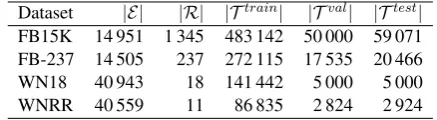
Dataset |E| |R| |Ttrain| |Tval| |Ttest| FB15K 14 951 1 345 483 142 50 000 59 071 FB-237 14 505 237 272 115 17 535 20 466
WN18 40 943 18 141 442 5 000 5 000
[image:4.595.306.525.62.122.2]WNRR 40 559 11 86 835 2 824 2 924
Table 1: Dataset statistics
for ER since it roughly corresponds to the number of triples we aim to predict for relationk.
The PR protocol is more suited to evaluate KBC performance because it considers all model pre-dictions. The protocol also has some disadvan-tages, however. First, as ER, the PR protocol may underestimate model performance due to un-observed true triples ranked high by the model. Since a larger number of candidates is consid-ered, PR may be more sensitive to this problem than ER. We explore the effect of underestima-tion in our empirical study in Sec. 4.4. Another concern with PR is its potentially high computa-tional cost. For current benchmark datasets, we found that the PR evaluation is feasible. Gener-ally, one may argue that an embedding model is suitable for KBC only if it is feasible to determine high-scoring triples in a sufficiently efficient way. Since PR only requires the computation of the
top-Kpredictions, performance can potentially be im-proved using techniques such as maximum inner-product searchShrivastava and Li(2014).
4 Experimental Study
We conducted an experimental study to assess the performance of various bilinear embedding mod-els for KBC.2 All datasets, experimental results, and source code are publicly available.3 For all models, we performed evaluation under both the ER and PR protocols in order to assess their per-formance for the QA and KBC tasks, respectively. We found that many KGE models provided good ER but low PR performance. We also considered a simple rule-based system calledRuleN (Meilicke et al., 2018), which provided good performance under the ER protocol, and found that RuleN per-formed better in both ER and PR. Our results im-ply that more research into KGE models for KBC is needed.
We also investigated the extent to which PR
2
Some other KGE models do not support KBC directly due to their architecture; e.g., ConvE (Dettmers et al.,2018).
3http://www.uni-mannheim.de/dws/
underestimates model performance due to unob-served true triples. We found that underestimation is not the main reason for the low PR performance of many KGE models; in fact, many KGE models ranked high clearly wrong tuples (e.g., with incor-rect types).
4.1 Experimental Setup
Datasets. We used the four common KBC benchmark datasets: FB15K, WN18, FB-237, and WNRR. The latter two datasets were created since the former two datasets were considered too easy for embedding models (based on ER). Key dataset statistics are summarized in Table1.
Negative sampling. We trained the embedding models using negative sampling to obtain pseudo-negative triples. We consider three sampling strategies in our experiments:
Perturb 1: For each training triple t = (i, k, j), sample pseudo-negative triples by randomly re-placing either i or j with a random entity (but such that the resulting triple is unobserved). This strategy matches ER, which is based on questions
(?, k, j)and(i, k,?).
Perturb 1-R: For each training triplet= (i, k, j), sample pseudo-negative triples by randomly re-placing either i, k or j. The generated nega-tive samples are not compared with the training set (Liu et al.,2017).
Perturb 2: For each training triplet= (i, k, j), ob-tain pseudo-negative triples by randomly sampling unobserved tuples for relationk. This method ap-pears more suited to PR.
Training and implementation. We trained DistMult, ComplEx, Analogy and RESCAL with AdaGrad (Duchi et al., 2011) using binary cross-entropy loss. We used pair-wise ranking loss for TransE (as it always produces negative scores). All embeddding models are implemented on top of the code of Liu et al. (2017)4 in C++ using OpenMP. For RuleN, we use the original imple-mentation provided by the authors. The evalua-tion protocols were written in Python, with Bot-tleneck5 used for efficiently obtaining the top-K
entries for PR. We found PR (which took≈30–90 minutes) was about 3–4 times slower than ER .
Hyperparameters. The best hyperparameters were selected based on MRR (for ER) and
4
https://github.com/quark0/ANALOGY
5https://pypi.org/project/Bottleneck/
MAP@100 (for PR) on the validation data. For both protocols, we performed an exhaustive grid search over the following hyperparameter set-tings: de ∈ {100,150,200}, weight of l2
-regularization λ ∈ {0.1,0.01,0.001}, learning rateη ∈ {0.01,0.1}, negative sampling strategies Perturb 1,Perturb 2andPerturb 1-R,6and margin
hyperparameter γ ∈ {0.5,1,2,3,4} for TransE. For each training triple, we sampled 6 pseudo-negative triples. To keep effort tractable, we only used the most frequent relations from each dataset for hyperparameter tuning (top-5, top-5, top-15, and top-30 most frequent relations for WN18, WNRR, FB-237 and FB-15k, respectively). We trained each model for up to 500 epochs during grid search. In all cases, we evaluated model per-formance every 50 epochs and used the overall best-performing model. For RuleN, we used the best settings reported by the authors for ER ( Meil-icke et al.,2018). For PR, we learned path rules of length 2 using a sampling size of 500 for FB15K and FB-237. For WN18 and WNRR, we learned path rules of length 3 and sampling size of 500.
4.2 Performance Results with ER
Table 2 summarizes the ER results. Embed-ding models perform competitively with respect to RuleN on all datasets, except for their MRR performance on FB15K. Notice that this generally holds even for the more restricted models (TransE and DistMult) on the more challenging datasets, which were created after criticizing FB15K and WN18 as too easy (Toutanova and Chen, 2015;
Dettmers et al., 2018). In particular, although DistMult can only model symmetric relations, and although most relations in these datasets are asymmetric, DistMult has good ER performance. Likewise, TransE achieved great performance in Hits@10 on all datasets, including WN18 which contains a large number of symmetric relations, which are not easily modeled by TransE.
4.3 Performance Results with PR
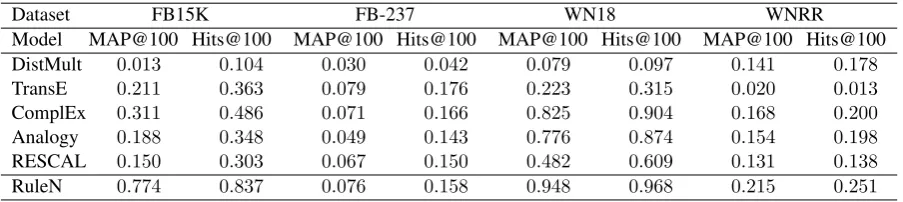
The evaluation results of PR withK = 100 are summarized in Table3. Note that Tables2and3
are not directly comparable: they measure differ-ent tasks. Also note that we use a differdiffer-ent value ofK, which in PR corresponds to the number of predicted facts per relation. We discuss the effect of the choice ofKlater.
Dataset FB15K FB-237 WN18 WNRR Model MRR Hits@10 MRR Hits@10 MRR Hits@10 MRR Hits@10 DistMult 0.660 0.845 0.270 0.432 0.790 0.937 0.432 0.474
TransE 0.500 0.777 0.290 0.466 0.720 0.908 0.220 0.491
ComplEx 0.700 0.835 0.280 0.435 0.940 0.948 0.440 0.481
Analogy 0.700 0.836 0.270 0.433 0.941 0.942 0.440 0.486
RESCAL 0.464 0.699 0.270 0.427 0.920 0.939 0.420 0.447
[image:6.595.74.526.194.295.2]RuleN 0.805 0.870 0.260 0.420 0.950 0.958 — 0.536
Table 2: Results with the entity ranking protocol (ER), which assesses QA performance
Dataset FB15K FB-237 WN18 WNRR
Model MAP@100 Hits@100 MAP@100 Hits@100 MAP@100 Hits@100 MAP@100 Hits@100 DistMult 0.013 0.104 0.030 0.042 0.079 0.097 0.141 0.178
TransE 0.211 0.363 0.079 0.176 0.223 0.315 0.020 0.013
ComplEx 0.311 0.486 0.071 0.166 0.825 0.904 0.168 0.200
Analogy 0.188 0.348 0.049 0.143 0.776 0.874 0.154 0.198
RESCAL 0.150 0.303 0.067 0.150 0.482 0.609 0.131 0.138
RuleN 0.774 0.837 0.076 0.158 0.948 0.968 0.215 0.251
Table 3: Results with the entity-pair ranking protocol (PR), which assesses KBC performance
For the embeddings, observe that with the ex-ception of Analogy and ComplEx on WN18, the performance of all models is unsatisfactory on all datasets, especially when compared with RuleN on FB15K and WN18, which were previously considered to be too easy for embedding models. Specifically, DistMult’s Hits@100 is slightly less than 10% on WN18, meaning that if we add the top 100 ranked triples to the KB, over 90% of what is added is likely false. Even when using Com-plEx, the best model on FB15K, we would poten-tially add more than 50% false triples. This im-plies that embedding models cannot capture sim-ple rules successfully. The notable exceptions are ComplEx and Analogy on WN18, although both are still behind RuleN. TransE and DistMult did not achieve competitive results on WN18. In addi-tion, DistMult did not achieve competitive results on FB15K and FB-237 and TransE did not achieve competitive results in WNRR. In general, Com-plEx and Analogy performed consistently better than other models across different datasets. When compared with the RuleN baseline, however, the performance of these models was often not sat-isfactory. This suggests that better KGE models and/or training strategies are needed for KBC.
RuleN did not perform well on FB-237 and WNRR, likely because the way these datasets were constructed makes them intrinsically diffi-cult for rule-based methods (Meilicke et al.,2018). This is reflected in both ER and PR results.
To better understand the change in performance of TransE and DistMult, we investigated their pre-dictions for the top-5 most frequent relations on WN18. Table4 shows the number of test triples appearing in the top-100 for each relation (after fil-tering triples from the training and validation sets). The numbers in parentheses are discussed in Sec-tion4.4.
We found that DistMult worked well on the symmetric relation derivationally related form, where its symmetry assumption clearly helps. Here 93% of the training data consists of symmet-ric pairs (i.e., (i, k, j) and (j, k, i)), and 88% of the test triples have its symmetric counterpart in the training set. In contrast, TransE contained no test triples for derivationally related form in the top-100 list. We found that the norm of the em-bedding vector of this relation was0.1, which was considerably smaller than for the other relations (avg.1.4). This supports our argument that TransE tends to push symmetric relation embeddings to0.
Model
Relation DistMult TransE ComplEx Analogy RESCAL RuleN
hyponymy 1 ( 1) 18 ( 32) 99 ( 99) 99 ( 99) 92 ( 93) 100 (100)
hypernymy 0 ( 0) 5 ( 33) 99 ( 99) 99 ( 99) 96 ( 98) 100 (100)
derivationally related form 100 (100) 0 ( 0) 100 (100) 100 (100) 6 ( 68) 100 (100)
member meronym 0 ( 0) 18 ( 41) 74 ( 84) 83 ( 85) 44 ( 63) 100 (100)
[image:7.595.73.525.62.143.2]member holonym 0 ( 0) 16 ( 47) 74 ( 83) 83 ( 85) 37 ( 54) 100 (100)
Table 4: Number of test triples in the top-100 filtered predictions on WN18. An estimate of the number of true triples in the top-100 list is given in parentheses.
these relations (they are asymmetric). ComplEx and Analogy showed superior performance across all relations. RESCAL is in between, most likely due to difficulties in finding a good parameteriza-tion. However, it is unclear to us why TransE per-formed well on FB15K and FB-237.
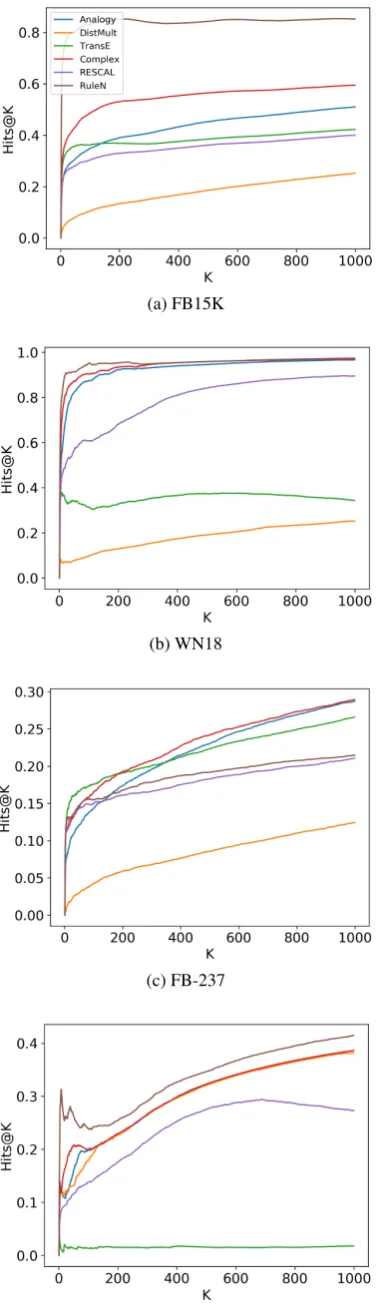
To investigate model performance in PR for dif-ferent values ofK, we give the curves of Hits@K
as a function ofKfor all datasets in Fig.1. Com-plEx and Analogy, which are universal models, performed best for largeKw.r.t. other embedding models. Similarly, TransE works the best for small values of K on FB15K and FB-237. Notice that RuleN performs considerably better on FB15K, WN18 and WNRR, while it still performs com-petitively on FB-237.
4.4 Influence of Unobserved True Triples
Since all datasets are based on incomplete knowl-edge bases, all evaluation protocols may system-atically underestimate model performance. In par-ticular, any true tripletthat is neither in the train-ing, nor validation, nor test data is treated as neg-ative during ranking-based evaluations. A model which correctly ranksthigh is thus penalized. PR might be particularly sensitive to this due to the large number of candidates considered.
It is generally unclear how to design an auto-matic evaluation strategy that avoids this problem. Manual labeling can be used to address this, but it may sometimes be infeasible given the large num-ber of relations, entities, and models for KBC.
To explore such underestimation effect in PR, we decoded the unobserved triples in the top-100 predictions of the 5 most frequent relations of WN18. We then checked whether those triples are implied by the symmetry and transitivity proper-ties of each relation. In Table4, we give the result-ing number of triples in parentheses (i.e., number of test triples + implied triples). We observed that underestimation indeed happened. TransE was mostly affected, but still did not lead to
competi-tive results when compared to ComplEx and Anal-ogy. RuleN achieves the best possible results in all 5 relations. These results suggest that (1) underes-timation is indeed a concern, and (2) the results in PR can nevertheless give an indication of relative model performance.
4.5 Type Filtering
When background knowledge (BK) is available, embedding models only need to score triples con-sistent with the BK. We explored whether their performance can be improved by filtering out type-inconsistent triples from each model’s pre-dictions. Notice that this is inherently what rule-based approaches do, since all predicted candi-dates will be type-consistent. In particular, we investigated how model performance is affected when we filter out predictions that violate type constraints (domain and range of each relation). If a model’s performance improves with such type filtering, it must have ranked tuples with incorrect types high in the first place. We can thus assess to what extent models capture entity types as well as the domain and range of the relations.
(a) FB15K
(b) WN18
(c) FB-237
[image:8.595.308.525.61.216.2](d) WN18RR
Figure 1: Hits@K with PR as a function ofK
Data Model MAP@K (%) Hits@K (%)
FB15K DistMult 18.8 (+17.5) 36.4 (+26.0) TransE 25.7 (+4.5) 41.7 (+5.4) ComplEx 53.1 (+22.0) 69.6 (+21.0) Analogy 41.3 (+22.5) 61.5 (+26.7) RESCAL 16.7 (+1.7) 32.8 (+2.5)
RuleN 77.4 (0.0) 83.7 (0.0)
FB-237 DistMult 9.5 (+9.2) 18.1 (+13.9) TransE 11.3 (+3.4) 21.2 (+3.6) ComplEx 11.3 (+4.2) 21.8 (+5.2) Analogy 10.5 (+5.6) 20.9 (+6.6) RESCAL 10.2 (+3.5) 19.0 (+4.0)
[image:8.595.88.280.67.725.2]RuleN 7.6 (0.0) 15.8 (0.0)
Table 5: Results with PR using type filtering (K = 100).
relations in FB15K (about 85% for FB-237) have a different type for their domain and range. As DistMult treats all relations as symmetric, it intro-duces a wrong triple for each true triple into the top-K list on these relations; type filtering allows us to ignore these wrong tuples. This is also con-sistent with DistMult’s improved performance un-der ER, where type constraints are implicitly used since only questions with correct types are con-sidered. Interestingly, ComplEx and Analogy im-proved considerably on FB15K, suggesting that the best performing embedding models on this dataset are still making a considerable number of type-inconsistent predictions. On FB15K, the rel-ative ranking of the models with type filtering is roughly equal to the one without type filtering. On the harder FB-237 dataset, all models now perform similarly. Notice that when compared with RuleN, embedding models are still behind on FB15K, but are no longer behind on FB-237.
5 Conclusion
References
Abdalghani Abujabal, Mohamed Yahya, Mirek Riede-wald, and Gerhard Weikum. 2017. Automated tem-plate generation for question answering over knowl-edge graphs. In Proceedings of the 26th Interna-tional Conference on World Wide Web (WWW).
Antoine Bordes, Nicolas Usunier, Alberto Garc´ıa-Dur´an, Jason Weston, and Oksana Yakhnenko. 2013. Translating embeddings for modeling multi-relational data. InAdvances in Neural Information Processing Systems (NIPS).
J. Douglas Carroll and Jih-Jie Chang. 1970. Analysis of individual differences in multidimensional scal-ing via an n-way generalization of “Eckart-Young” decomposition.Psychometrika, 35(3).
Tim Dettmers, Pasquale Minervini, Pontus Stenetorp, and Sebastian Riedel. 2018. Convolutional 2D knowledge graph embeddings. In Association for the Advancement of Artificial Intelligence (AAAI).
John C. Duchi, Elad Hazan, and Yoram Singer. 2011. Adaptive subgradient methods for online learning and stochastic optimization. Journal of Machine Learning Research, 12.
Luis Antonio Gal´arraga, Christina Teflioudi, Katja Hose, and Fabian Suchanek. 2013. AMIE: associ-ation rule mining under incomplete evidence in on-tological knowledge bases. In Proceedings of the 22nd international conference on World Wide Web (WWW).
Armand Joulin, Edouard Grave, Piotr Bojanowski, Maximilian Nickel, and Tomas Mikolov. 2017. Fast linear model for knowledge graph embeddings.
CoRR, abs/1710.10881.
Rudolf Kadlec, Ondrej Bajgar, and Jan Kleindienst. 2017. Knowledge base completion: Baselines strike back. InWorkshop on Representation Learning for NLP (RepL4NLP@ACL).
Hanxiao Liu, Yuexin Wu, and Yiming Yang. 2017. Analogical inference for multi-relational embed-dings. In International Conference on Machine Learning (ICML).
Christian Meilicke, Manuel Fink, Yanjie Wang, Daniel Ruffinelli, Rainer Gemulla, and Heiner Stucken-schmidt. 2018. Fine-grained evaluation of rule-and embedding-based systems for knowledge graph completion. InInternational Semantic Web Confer-ence (ISWC).
Maximilian Nickel, Kevin Murphy, Volker Tresp, and Evgeniy Gabrilovich. 2016a. A review of relational machine learning for knowledge graphs. Proceed-ings of the IEEE, 104(1).
Maximilian Nickel, Lorenzo Rosasco, and Tomaso A. Poggio. 2016b. Holographic embeddings of knowl-edge graphs. InAssociation for the Advancement of Artificial Intelligence (AAAI).
Maximilian Nickel, Volker Tresp, and Hans-Peter Kriegel. 2011. A three-way model for collective learning on multi-relational data. InInternational Conference on Machine Learning (ICML).
Wei Shen, Jianyong Wang, and Jiawei Han. 2015. En-tity linking with a knowledge base: Issues, tech-niques, and solutions. IEEE Transactions on Knowl-edge and Data Engineering (TKDE), 27(2).
Anshumali Shrivastava and Ping Li. 2014. Asymmet-ric LSH (ALSH) for sublinear time maximum inner product search (MIPS). InAdvances in Neural In-formation Processing Systems (NIPS).
Richard Socher, Danqi Chen, Christopher D. Manning, and Andrew Y. Ng. 2013. Reasoning with neural tensor networks for knowledge base completion. In
Advances in Neural Information Processing Systems (NIPS).
Kristina Toutanova and Danqi Chen. 2015. Observed versus latent features for knowledge base and text inference. InProceedings of the 3rd Workshop on Continuous Vector Space Models and their Compo-sitionality.
Th´eo Trouillon, Johannes Welbl, Sebastian Riedel, ´Eric Gaussier, and Guillaume Bouchard. 2016. Complex embeddings for simple link prediction. In Interna-tional Conference on Machine Learning (ICML).
Yanjie Wang, Rainer Gemulla, and Hui Li. 2018. On multi-relational link prediction with bilinear models. InAssociation for the Advancement of Artificial In-telligence (AAAI).
Robert West, Evgeniy Gabrilovich, Kevin Murphy, Shaohua Sun, Rahul Gupta, and Dekang Lin. 2014. Knowledge base completion via search-based ques-tion answering. In International World Wide Web Conference (WWW).