Proceedings of the 57th Annual Meeting of the Association for Computational Linguistics, pages 5650–5669 5650
Improving Neural Conversational Models
with Entropy-Based Data Filtering
Richard Csaky
Department of Automation and Applied Informatics Budapest University of Technology and Economics
Patrik Purgai
Department of Automation and Applied Informatics Budapest University of Technology and Economics
Gabor Recski
Apollo.AI
Abstract
Current neural network-based conversational models lack diversity and generate boring re-sponses to open-ended utterances.Priorssuch as persona, emotion, or topic provide addi-tional information to dialog models to aid re-sponse generation, but annotating a dataset with priors is expensive and such annotations are rarely available. While previous methods for improving the quality of open-domain re-sponse generation focused on either the un-derlying model or the training objective, we present a method of filtering dialog datasets by removing generic utterances from training data using a simple entropy-based approach that does not require human supervision. We conduct extensive experiments with different variations of our method, and compare dialog models across 17 evaluation metrics to show that training on datasets filtered this way re-sults in better conversational quality as chat-bots learn to output more diverse responses.
1 Introduction
Current open-domain neural conversational mod-els (NCM) are trained on pairs of source and tar-get utterances in an effort to maximize the likeli-hood of each target given the source (Vinyals and Le,2015). However, real-world conversations are much more complex, and a plethora of suitable tar-gets (responses) can be adequate for a given in-put. We propose a data filtering approach where the “most open-ended” inputs - determined by cal-culating the entropy of the distribution over tar-get utterances - are excluded from the training set. We show that dialog models can be improved us-ing this simple unsupervised method which can
be applied to any conversational dataset. We con-duct several experiments to uncover how some of the current open-domain dialog evaluation meth-ods behave with respect to overfitting and random data. Our software for filtering dialog data and au-tomatic evaluation using 17 metrics is released on GitHub under an MIT license12.
2 Background
Most open-domain NCMs are based on neural net-work architectures developed for machine trans-lation (MT, Sutskever et al. (2014); Cho et al.
(2014); Vaswani et al. (2017)). Conversational data differs from MT data in that targets to the same source may vary not only grammatically but also semantically (Wei et al.,2017;Tandon et al.,
2017): consider plausible replies to the question What did you do today?. Dialog datasets also con-tain generic responses, e.g. yes, no and i don’t know, that appear in a large and diverse set of con-texts (Mou et al.,2016;Wu et al.,2018). Follow-ing the approach of modelFollow-ing conversation as a se-quence to sese-quence (seq2seq, Sutskever et al.
(2014)) transduction of single dialog turns, these issues can be referred to as theone-to-many, and
many-to-one problem. seq2seq architectures
are not suited to deal with the ambiguous nature of dialogs since they are inherently deterministic, meaning that once trained they cannot output dif-ferent sequences to the same input. Consequently they tend to produce boring and generic responses
1
https://github.com/ricsinaruto/ Seq2seqChatbots
2https://github.com/ricsinaruto/
(Li et al.,2016a;Wei et al.,2017;Shao et al.,2017;
Zhang et al.,2018a;Wu et al.,2018).
Previous approaches to theone-to-many, many-to-one problem can be grouped into three cat-egories. One approach involves feeding extra information to the dialog model such as dialog history (Serban et al., 2016; Xing et al., 2018), categorical information like persona (Li et al.,
2016b; Joshi et al., 2017; Zhang et al., 2018b), mood/emotion (Zhou et al.,2018;Li et al.,2017c), and topic (Xing et al.,2017;Liu et al.,2017; Ba-heti et al.,2018), or through knowledge-bases ( Di-nan et al., 2019;Ghazvininejad et al.,2018;Zhu et al., 2017; Moghe et al., 2018). A downside to these approaches is that they require annotated datasets which are not always available, or might be smaller in size. Augmenting the model itself, with e.g. latent variable sampling (Serban et al.,
2017b;Zhao et al., 2017, 2018; Gu et al., 2019;
Park et al., 2018; Shen et al., 2018b;Gao et al.,
2019), or improving the decoding process (Shao et al.,2017;Kulikov et al.,2018;Mo et al.,2017;
Wang et al., 2018) is also a popular approach. Sampling provides a way to generate more diverse responses, however such models are more likely to output ungrammatical or irrelevant responses. Finally, directly modifying the loss function (Li et al., 2016a), or training by reinforcement (Li et al.,2016d;Serban et al.,2017a;Li et al.,2016c;
Lipton et al.,2018;Lewis et al.,2017) or adver-sarial learning (Li et al., 2017b; Ludwig, 2017;
Olabiyi et al.,2018;Zhang et al.,2018c) has also been proposed, but this is still an open research problem, as it is far from trivial to construct ob-jective functions that capture conversational goals better than cross-entropy loss.
Improving dataset quality through filtering is frequently used in the machine learning literature (Sedoc et al., 2018; Ghazvininejad et al., 2018;
Wojciechowski and Zakrzewicz, 2002) and data distillation methods in general are used both in machine translation and dialog systems (Axelrod et al.,2011; Li et al.,2017a). Xu et al. (2018b) introduced coherence for measuring the similar-ity between contexts and responses, and then fil-tered out pairs with low coherence. This improves datasets from a different aspect and could be com-bined with our present approach. However, natural conversations allow many adequate responses that are not similar to the context, thus it is not intu-itively clear why filtering these should improve
di-alog models. Our experiments also further support that cross-entropy is not an adequate loss function (shown qualitatively byCsaky(2019) andTandon et al. (2017)), by showing that many automatic metrics continue to improve after the validation loss reaches its minimum and starts increasing. However, we found that the metrics steadily im-prove even after we can be certain that the model overfitted (not just according to the loss function). Further research is required, to determine whether this indicates that overfitted model responses are truly better or if it’s a shortcoming of the metrics that they prefer such models.
Currently, there is no well-defined automatic evaluation method (Liu et al., 2016), and while some metrics that correlate more with human judgment have been proposed recently (Li et al.,
2017b; Lowe et al., 2017; Tao et al., 2018), they are harder to measure than simpler auto-matic metrics like perplexity or BLEU (Papineni et al., 2002). Furthermore, even human evalua-tion has its downsides, like high variance, high cost, and difficulty of replicating experimental setups (Zhang et al., 2018b; Tao et al., 2018). Some works resort to human evaluations (Krause et al., 2017; Fang et al., 2018), others use auto-matic metrics only (Olabiyi et al.,2018;Xing and Fern´andez, 2018; Kandasamy et al., 2017; Sha-lyminov et al.,2018;Xu et al.,2018b), and some use both (Shen et al.,2018a;Xu et al.,2018a; Ba-heti et al.,2018;Ram et al.,2018). While exten-sive human evaluation of the methods presented here is left for future work, we do conduct an es-pecially thorough automatic evaluation both at the validation loss minimum and of overfitted models. We believe our experiments also shed light on the limitations of frequently used automatic metrics.
3 Methods
3.1 Intuition
source and target utterance. However, in the case of sources that appear with multiple targets ( one-to-many), models are forced to learn some “aver-age” of observed responses (Wu et al.,2018).
The entropy of response distribution of an utter-ancesis a natural measure of the amount of “con-fusion” introduced bys. For example, the context What did you do today? has high entropy, since it is paired with many different responses in the data, butWhat color is the sky? has low entropy since it’s observed with few responses. The many-to-onescenario can be similarly formulated, where a diverse set of source utterances are observed with the same target (e.g. I don’t know has high en-tropy). While this may be a less prominent issue in training NCMs, we shall still experiment with excluding such generic targets, as dialog models tend to generate them frequently (see Section2).
3.2 Clustering Methods and Filtering
We refer withIDENTITYto the following entropy computation method. For each source utterances in the dataset we calculate the entropy of the con-ditional distributionT|S =s, i.e. given a dataset Dof source-target pairs, we define thetarget en-tropyofsas
Htgt(s, D) =−
X
(s,ti)∈D
p(ti|s) log2p(ti|s) (1)
Similarly,source entropyof a target utterance is
Hsrc(t, D) =−
X
(si,t)∈D
p(si|t) log2p(si|t) (2)
The probabilities are based on the observed rela-tive frequency of utterance pairs in the data.
For the purposes of this entropy-based filter-ing, we considered the possibility of also includ-ing some form of similarity measure between ut-terances that would allow us to detect whether a set of responses is truly diverse, as in the case of a question likeWhat did you do today?, or diverse only on the surface, such as in the case of a ques-tion likeHow old are you? (since answers to the latter are semantically close). Measuring the en-tropy of semantic clusters as opposed to individual utterances may improve our method by reducing data sparsity. For exampleHow are you? can ap-pear in many forms, likeHow are you<name>? (see Section4.2). While the individual forms have low entropy (because they have low frequency),
we may decide to filter them all if together they form a high-entropy cluster.
To this end we performed the filtering based not only on the set of all utterances, as in the case of IDENTITY, but also on clusters of utterances established by clustering their vector representa-tions using the Mean Shift algorithm (Fukunaga and Hostetler,1975). Source and target utterances are clustered separately. In theAVG-EMBEDDING
setup the representation R(U) of utterance U is computed by taking the average word embed-ding weighted by the smooth inverse frequency R(U) = |U1|P
w∈U
E(w)·0.001
0.001+p(w) of words (Arora
et al.,2017), whereE(w)andp(w)are the embed-ding and the probability3of word wrespectively. We also experiment withSENT2VEC4, a more
so-phisticated sentence embedding approach, which can be thought of as an extension of word2vec to sentences (Pagliardini et al.,2018).
Thetarget entropyof a source clustercsis
Htgt(cs, C) =−
X
ci∈C
p(ci|cs) log2p(ci|cs) (3)
where C is the set of all clusters and p(ci|cs) is the conditional probability of observing an utter-ance from clusteriafter an utterance from cluster s. In the context of these methods, the entropy of an utterance will mean the entropy of its clus-ter. Note that IDENTITYis a special case of this cluster-based entropy computation method, since inIDENTITYa “cluster” is comprised of multiple examples of one unique utterance. Thus a target cluster’s entropy is computed similarly to Equa-tion2, but using clusters as in Equation3.
Entropy values obtained with each of these methods were used to filter dialog data in three ways. The SOURCE approach filters utterance pairs in which the source utterance has high en-tropy, TARGET filters those with a high entropy target, and finally the BOTHstrategy filters all ut-terance pairs that are filtered by eitherSOURCEor
TARGET. Some additional techniques did not yield meaningful improvement and were excluded from further evaluation. Clustering based on the Jaccard similarity of the bag of words of utterances only added noise to IDENTITY and resulted in much
worse clusters thanSENT2VEC. Clustering single occurrences of each unique utterance (as opposed to datasets with multiplicity) lead to less useful
3
Based on the observed relative frequency in the data.
clusters than when clustering the whole dataset, probably because it resulted in less weight being given to the frequent utterances that we want to fil-ter out. K-means proved inferior to the Mean Shift algorithm, which is a density-based clustering al-gorithm and seems to work better for clustering vectors of sentences. Filtering stop words before clustering did not improve the quality of clusters, probably because many utterances that we want to filter out contain a large number of stop words.
4 Data Analysis
4.1 Dataset
[image:4.595.311.521.62.231.2]With 90 000 utterances in 13 000 dialogs, Dai-lyDialog (Li et al., 2017c), our primary dataset, is comparable in size with the Cornell Movie-Dialogs Corpus (Danescu-Niculescu-Mizil and Lee,2011), but contains real-world conversations. Using theIDENTITY approach, about 87% of ut-terances have 0 entropy (i.e. they do not appear with more than one target), 5% have an entropy of 1 (e.g. they appear twice, with different targets), remaining values rise sharply to 7. This distribu-tion is similar for source and target utterances.
Figure 1: Entropy of source utterances (computed with
IDENTITY) with respect to utterance frequency.
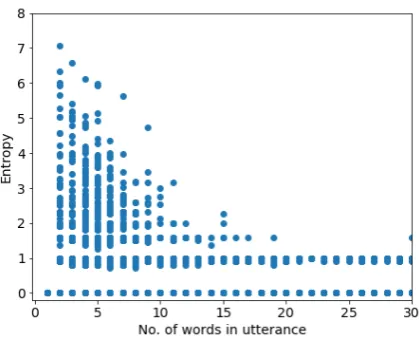
[image:4.595.77.288.412.580.2]Entropy is clearly proportional to utterance fre-quency (Figure1), but has a wide range of values among utterances of equal frequency. For exam-ple, utterances with a frequency of 3 can have en-tropies ranging from 0 tolog23 ≈1.58, the latter of which would be over our filtering threshold of 1 (see Section5.1 for details on selecting thresh-olds). Since high-entropy utterances are relatively short, we also examined the relationship between entropy and utterance length (Figure 2). Given
Figure 2: Entropy of source utterances (computed with
IDENTITY) with respect to utterance length.
the relationship between frequency and entropy, it comes as no surprise that longer utterances have lower entropy.
4.2 Clustering Results
Compared to IDENTITY, both SENT2VEC and
AVG-EMBEDDINGproduce a much lower number of clusters with 0 entropy, but also a huge clus-ter with more than 5000 elements (the size of the second largest cluster is below 500), which we didn’t filter since it clearly doesn’t group ut-terances with similar meaning. Generally, clus-ters were formed of similar utterances with the occasional exception of longer outlier utterances clustered together (instead of creating a separate cluster for each outlier), which can be attributed to the nature of the clustering algorithm. Over-all,SENT2VECappeared to produce better clusters thanAVG-EMBEDDING, as reflected in the
evalua-tion in Secevalua-tion5.
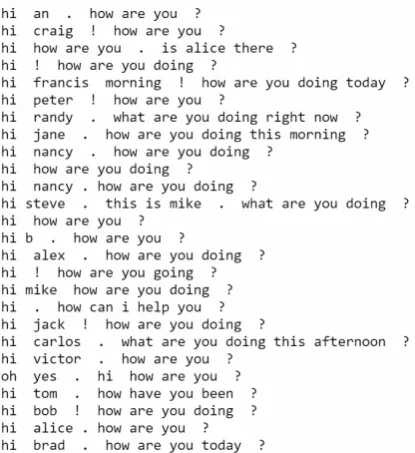
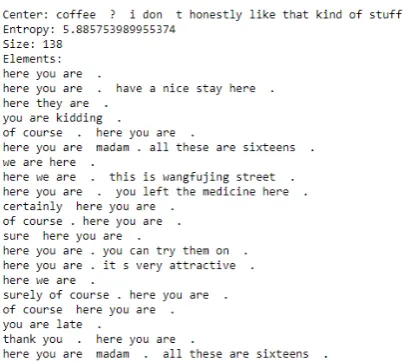
We experimented with different bandwidth val-ues5for the Mean Shift algorithm to produce clus-ters with as many elements as possible while also keeping the elements semantically similar. In an example cluster (Figure 3) we can see that the clustering was able to group together several vari-ants ofHow are you?, in particular, those with dif-ferent names. In general, we noticed that both in the case ofIDENTITYand the clustering methods, utterances labeled with the highest entropy are in-deed those generic sources and replies which we hoped to eliminate. See AppendixA.1for a selec-tion of high entropy utterances and clusters.
5Bandwidth is like a radius in the latent space of utterance
Figure 3: A cluster produced bySENT2VEC.
5 Experiments
In this section the model and parameter setups are presented along with 17 evaluation metrics. Lim-itations of these metrics are discussed and a com-parison between our filtering methods is presented on DailyDialog (Section 5.3), and other datasets (Section5.4).
5.1 Model and Parameters
Dataset Type Th. SOURCE TARGET BOTH
DailyDialog
ID 1 5.64% 6.98% 12.2% AE 3.5 5.39% 7.06% 12.0% SC 3.5 6.53% 8.45% 14.3%
Cornell ID 4 - 7.39% 14.1%
Twitter ID 0.5 - 1.82% 9.96%
Table 1: Entropy threshold (Th.) and amount of data filtered for all datasets in the 3 filtering scenarios. ID
stands forIDENTITY,AEstands forAVG-EMBEDDING, andSCforSENT2VEC.
We usetransformer(Vaswani et al.,2017) as our dialog model, an encoder-decoder architec-ture relying solely on attention mechanisms ( Bah-danau et al.,2015). transformerhas already been applied to a plethora of natural language pro-cessing tasks, including dialog modeling (Dinan et al., 2019; Mazare et al., 2018; Devlin et al.,
2018). We used the official implementation6 (see Appendix A.2 for a report of hyperparameters).
6https://github.com/tensorflow/
tensor2tensor
The vocabulary for DailyDialog was limited to the most frequent 16 384 words, and train / validation / test splits contained 71 517 / 9 027 / 9 318 exam-ples, respectively.
Clustering and Filtering. For AVG
-EMBEDDING fastText7 embeddings were used. The bandwidth of Mean Shift was set to 0.7 and 3.5 for AVG-EMBEDDING and SENT2VEC, which produced 40 135 and 23 616 clusters, respectively. Entropy thresholds and amount of data filtered can be found in Table 1. Generally we set the threshold so that filtered data amount is similar to the DailyDialogIDENTITY scenario. We also set a threshold for the maximum average utterance length (15 and 20 forAVG-EMBEDDING
and SENT2VEC) in clusters that we considered
for filtering, excluding outliers from the filtering process (see Section4.2).
Training and Decoding. Word embeddings of size 512 were randomly initialized, batch size was set to 2048 tokens, and we used the Adam optimizer (Kingma and Ba, 2014). We experi-mented with various beam sizes (Graves, 2012), but greedy decoding performed better according to all metrics, also observed previously (Asghar et al.,2017;Shao et al.,2017;Tandon et al.,2017).
5.2 Evaluation Metrics
As mentioned in Section 2, automatic evaluation of chatbots is an open research problem. In order to get as complete a picture as possible, we use 17 metrics that have been applied to dialog models over the past years, briefly described below. These metrics assess different aspects of response qual-ity, thus models should be compared on the whole set of metrics.
Response length. Widely used as a simple en-gagement indicator (Serban et al.,2017b;Tandon et al.,2017;Baheti et al.,2018).
Word and utterance entropy. The per-word en-tropy Hw = −|U1|Pw∈Ulog2p(w) of responses
is measured to determine their non-genericness (Serban et al.,2017b). Probabilities are calculated based on frequencies observed in the training data. We introduce the bigram version of this metric, to measure diversity at the bigram level as well. Ut-terance entropy is the product ofHwand|U|, also reported at the bigram level.
[image:5.595.77.288.474.534.2]KL divergence. We use the KL divergence be-tween model and ground truth (GT) response sets to measure how well a model can approximate the GT distribution of words. Specifically, we define distributions pgt and pm based on each set of responses and calculate the KL divergence Dkl = |U1gt|
P
w∈Ugtlog2
pgt(w)
pm(w) for each GT
re-sponse. The bigram version of this metric is also reported.
Embedding metrics. Embedding average, ex-trema, and greedy are widely used metrics (Liu et al., 2016; Serban et al., 2017b; Zhang et al.,
2018c). average measures the cosine similarity between the averages of word vectors of response and target utterances. extrema constructs a rep-resentation by taking the greatest absolute value for each dimension among the word vectors in the response and target utterances and measures the cosine similarity between them. Finally, greedy matches each response token to a target token (and vice versa) based on the cosine similarity between their embeddings and averages the total score across all words. For word embeddings and average word embedding representations, we used the same setup as inAVG-EMBEDDING.
Coherence. We measure the cosine similarity between pairs of input and response (Xu et al.,
2018b). Although a coherence value of 1 would indicate that input and response are the same, gen-erally a higher value seems better as model re-sponses tend to have lower coherence than targets.
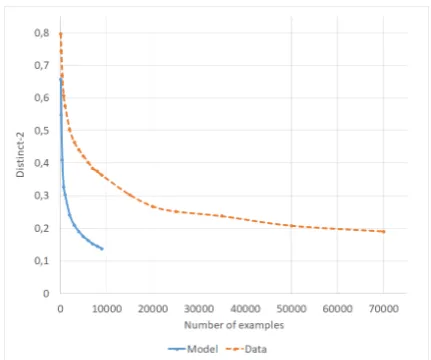
Distinct metrics. Distinct-1 and distinct-2 are widely used in the literature (Li et al.,2016a;Shen et al.,2018a;Xu et al.,2018b), measuring the ratio of unique unigrams/bigrams to the total number of unigrams/bigrams in a set of responses. However, they are very sensitive to the test data size, since increasing the number of examples in itself low-ers their value. While the number of total words increases linearly, the number of unique words is limited by the vocabulary, and we found that the ratio decreases even in human data (see Ap-pendixA.3 for details). It is therefore important to only comparedistinctmetrics computed on the same test data.
Bleu. Measuring n-gram overlap between re-sponse and target is widely used in the machine learning and dialog literature (Shen et al.,2018a;
Xu et al., 2018b). We report BLEU-1,
[image:6.595.309.525.111.301.2]BLUE-2, BLEU-3, and BLEU-4 computed with the 4th smoothing algorithm described in Chen and Cherry(2014).
Figure 4: Embedding metrics and coherence (on vali-dation data) as a function of the training evolution of transformeron unfiltered data (DailyDialog).
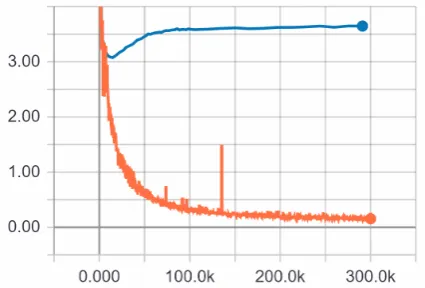
Figure 5: Training (bottom) and validation (top) loss with respect to training steps oftransformer trained on unfiltered data (DailyDialog).
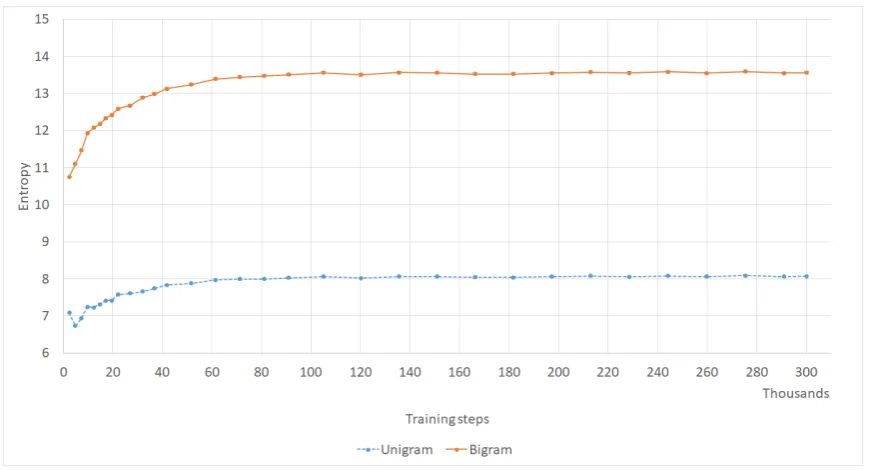
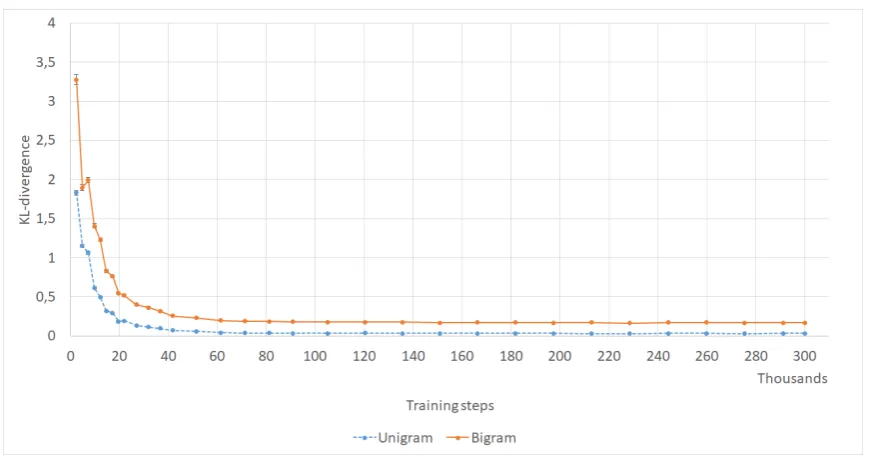
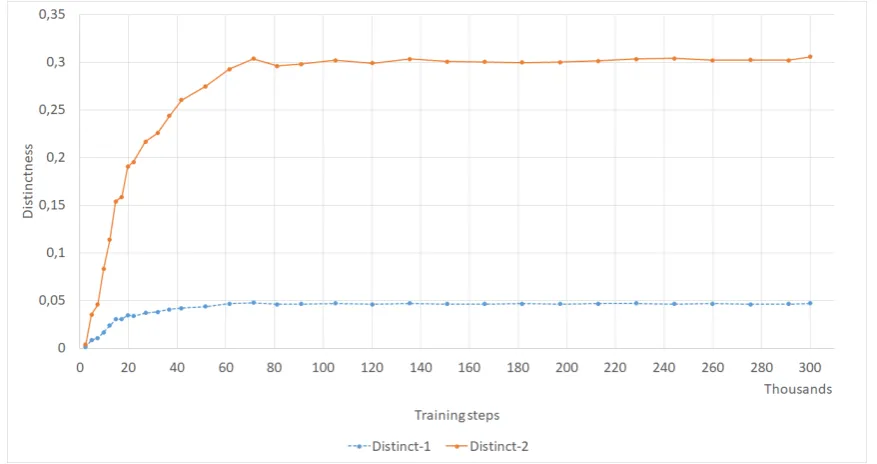
Normally metrics are computed at the validation loss minimum of a model, however in the case of chatbot models loss may not be a good indicator of response quality (Section2), thus we also looked at how our metrics progress during training. Fig-ure4shows how coherence and the 3 embedding metrics saturate after about 80-100k steps, and never decrease (we ran the training for 300k steps, roughly 640 epochs). Most metrics show a simi-lar trend of increasing until 100k steps, and then stagnating (see AppendixA.3for more figures).
[image:6.595.310.523.375.519.2]|U| Hu
w Hwb Huu Hub Dklu Dbkl AVG EXT GRE COH d1 d2 b1 b2 b3 b4
TRF 8.6 7.30 12.2 63.6 93 .330 .85 .540 .497 .552 .538 .0290 .149 .142 .135 .130 .119
ID
B 9.8 7.44 12.3 71.9 105 .315 .77 .559 .506 .555 .572 .0247 .138 .157 .151 .147 .136
T 10.9 7.67 12.7 83.2 121 .286 .72 .570 .507 .554 .584 .0266 .150 .161 .159 .156 .146
S 9.4 7.19 11.9 66.4 98 .462 1.08 .540 .495 .553 .538 .0262 .130 .139 .133 .128 .117
AE
B 7.9 7.25 12.0 57.7 83 .447 1.05 .524 .486 .548 .524 .0283 .132 .128 .121 .115 .105
T 8.6 7.26 12.1 61.4 90 .425 1.12 .526 .492 .548 .529 .0236 .115 .133 .127 .121 .111
S 9.0 7.21 11.9 65.1 95 .496 1.16 .536 .490 .548 .538 .0232 .109 .134 .130 .126 .116
SC
B 10.0 7.40 12.3 72.6 108 .383 .97 .544 .497 .549 .550 .0257 .131 .145 .142 .138 .128
T 11.2 7.49 12.4 82.2 122 .391 .97 .565 .500 .552 .572 .0250 .132 .153 .153 .152 .142
S 11.1 7.15 11.9 74.4 114 .534 1.27 .546 .501 .560 .544 .0213 .102 .144 .139 .135 .125
Table 2: Metrics computed at the minimum of the validation loss on the unfiltered test set (DailyDialog). TRF
refers to transformer, ID to IDENTITY, AEto AVG-EMBEDDING, and SC to SENT2VEC. SOURCE-side,
TARGET-side, and filtering BOTHsides are denoted by initials. Best results are highlighted with bold and best results separately for each entropy computing method are in italic (and those within a 95% confidence interval).
|U| Hu
w Hwb Huu Hub Dklu Dklb AVG EXT GRE COH d1 d2 b1 b2 b3 b4
TRF 11.5 7.98 13.4 95 142 .0360 .182 .655 .607 .640 .567 .0465 .297 .333 .333 .328 .315
ID
B 13.1 8.08 13.6 107 162 .0473 .210 .668 .608 .638 .598 .0410 .275 .334 .340 .339 .328
T 12.2 8.04 13.6 100 150 .0335 .181 .665 .610 .640 .589 .0438 .289 .338 .341 .339 .328
S 12.3 7.99 13.5 101 153 .0406 .187 .662 .610 .641 .578 .0444 .286 .339 .342 .338 .326
AE
B 11.9 7.98 13.5 98 147 .0395 .197 .649 .600 .628 .574 .0434 .286 .318 .321 .318 .306
T 12.5 7.99 13.5 102 155 .0436 .204 .656 .602 .634 .580 .0423 .279 .324 .327 .325 .313
S 12.1 7.93 13.4 99 148 .0368 .186 .658 .605 .636 .578 .0425 .278 .325 .328 .324 .311
SC
B 12.8 8.07 13.6 105 159 .0461 .209 .655 .600 .629 .583 .0435 .282 .322 .328 .327 .316
T 13.0 8.06 13.6 107 162 .0477 .215 .657 .602 .632 .585 .0425 .279 .324 .330 .329 .318
S 12.1 7.96 13.4 100 150 .0353 .183 .657 .606 .638 .576 .0443 .286 .331 .333 .329 .317
RT 13.5 8.40 14.2 116 177 .0300 .151 .531 .452 .481 .530 .0577 .379 .090 .121 .130 .125
GT 14.1 8.39 13.9 122 165 0 0 1 1 1 .602 .0488 .362 1 1 1 1
Table 3: Metrics computed on the unfiltered test set (DailyDialog) after 150 epochs of training. TRF refers to transformer,IDtoIDENTITY,AEtoAVG-EMBEDDING, andSCtoSENT2VEC.SOURCE-side,TARGET-side, and filteringBOTHsides are denoted by initials. Best results are highlighted with bold and best results separately for each entropy computing method are in italic (and those within a 95% confidence interval).GTrefers to ground truth responses andRTrefers to randomly selected responses from the training set.
the loss function, but it also questions the valid-ity of these metrics, as they seem to favor a model that overfitted the training data, which we can as-sume after 640 epochs. This could be due to the many identical inputs in train and test splits, be-cause of the nature of dialog data. Most interest-ing are embeddinterest-ing metrics and BLEU scores (Sec-tion 5.3), since they show that even after overfit-ting responses do not get farther from targets. This is in line with other findings reporting that qualita-tively responses are better after overfitting (Csaky,
2019;Tandon et al.,2017), however occasionally they also tend to be too specific and irrelevant. We leave it for future work to conduct human evalua-tion between non-overfitted and overfitted models to solidify these claims. In light of these issues, we compare trainings on the DailyDialog dataset both
at the validation loss minimum and at an overfitted point (150 epochs).
5.3 DailyDialog Results
We compute metrics on the unfiltered test set to show that filtered trainings perform better even on utterances that would have been filtered from the training data. TRF, the baseline transformer model trained on unfiltered data is compared to the 9 trainings on filtered data. In all tables the 17 metrics from left to right are: response length, unigram and bigram entropy, unigram and bigram utterance entropy, unigram and bigram KL diver-gence, embedding average, extrema and greedy, coherence, distinct-1 and distinct-2, and finally, BLEU-1, BLEU-2, BLEU-3 and BLEU-4 (see Section5.2).
(Ta-Input Response
your starting salary is 2500 yuan a month and after you become a permanent employee it will be higher .
BASE:i can tell you what is the best way to find a job . BASE-O:do you know what it is ?
TARGET:i ’m very interested in the position .
TARGET-O:that ’s very nice of you . i ’ll have to think about it .
you can greatly improve your grades by always reflecting on what you can improve on .
BASE:i want to be a great singer . BASE-O:i really appreciate it . thanks .
TARGET:i think i am experienced in that position . i think i would like to make a good impression .
TARGET-O:i always liked it . thank you .
umm i think i would be hard to find something in that range in this area . you know the environment in the south district is the nicest .
[image:8.595.75.527.63.202.2]BASE:what about the kitchen ? BASE-O:what about the kitchen ? TARGET:what about the kitchen ? TARGET-O:what about the kitchen ?
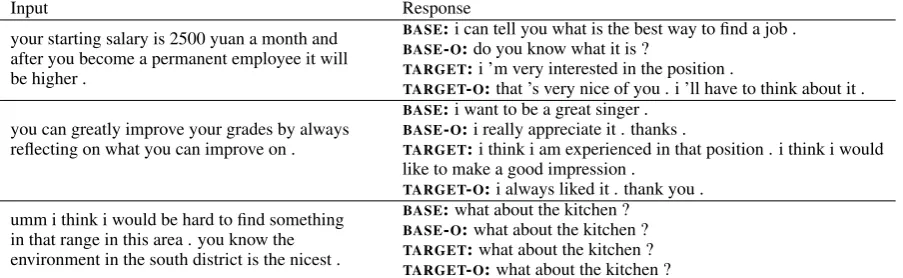
Table 4: Example inputs and responses from DailyDialog. BASEis trained on unfiltered data, andTARGETis the model trained onIDENTITY,TARGETfiltered data. Models marked withOare evaluated at an overfitted point.
ble 2) clearly shows that models trained on data filtered by IDENTITY and SENT2VEC are better than the baseline. IDENTITYperforms best among the three methods, surpassing the baseline on all but the distinct-1 metric. SENT2VEC is a close second, getting higher values on fewer metrics thanIDENTITY, but mostly improving on the base-line. Finally, AVG-EMBEDDING is inferior to the baseline, as it didn’t produce clusters as mean-ingful as SENT2VEC, and thus produced a lower quality training set. It seems like filtering high entropy targets (both in the case of IDENTITY
and SENT2VEC) is more beneficial than filtering sources, and BOTHfalls mostly in the middle as expected, since it combines the two filtering types. By removing example responses that are boring and generic from the dataset the model learns to improve response quality. Finding such utterances is useful for a number of purposes, but earlier it has been done mainly manually (Li et al.,2016d;
Shen et al., 2017), whereas we provide an au-tomatic, unsupervised method of detecting them based on entropy.
Every value is higher after 150 epochs of train-ing than at the validation loss minimum (Table3). The most striking change is in the unigram KL divergence, which is now an order of magnitude lower. IDENTITY still performs best, falling
be-hind the baseline on only the twodistinctmetrics. Interestingly this time BOTH filtering was better than theTARGETfiltering.SENT2VECstill mostly
improves the baseline andAVG-EMBEDDINGnow also performs better or at least as good as the base-line on most metrics. In some cases the best per-forming model gets quite close to the ground truth performance. On metrics that evaluate utterances without context (i.e. entropy, divergence,
dis-tinct), randomly selected responses achieve sim-ilar values as the ground truth, which is expected. However, on embedding metrics, coherence, and BLEU, random responses are significantly worse than those of any model evaluated.
Computing the unigram and bigram KL diver-gence with a uniform distribution instead of the model yields a value of 4.35 and 1.87, respec-tively. Thus, all models learned a much better distribution, suggesting that this is indeed a use-ful metric. We believe the main reason that clus-tering methods perform worse than IDENTITY is that clustering adds some noise to the filtering pro-cess. Conducting a good clustering of sentence vectors is a hard task. This could be remedied by filtering only utterances instead of whole clus-ters, thus combiningIDENTITYand the clustering
methods. In this scenario, the entropy of individ-ual utterances is computed based on the clustered data. The intuition behind this approach would be that the noise in the clusters based on which we compute entropy is less harmful than the noise in clusters which we consider for filtering. Finally, Table4shows responses from the baseline and the best performing model to 3 randomly selected in-puts from the test set (which we made sure are not present in the training set) to show that training on filtered data does not degrade response quality. We show more example responses in AppendixA.3.
5.4 Cornell and Twitter Results
To further solidify our claims we tested the two best performing variants ofIDENTITY(BOTHand
Twit-|U| Hwu Hwb Huu Hub Dukl D b
kl AVG EXT GRE COH d1 d2 b1 b2 b3 b4
TRF 8.1 6.55 10.4 54 75 2.29 3.40 .667 .451 .635 .671 4.7e-4 1.0e-3 .108 .120 .120 .112
ID B 7.4 6.67 10.8 50 69 1.96 2.91 .627 .455 .633 .637 2.1e-3 7.7e-3 .106 .113 .111 .103 T 12.0 6.44 10.4 74 106 2.53 3.79 .646 .456 .637 .651 9.8e-4 3.2e-3 .108 .123 .125 .118 RT 13.4 8.26 14.2 113 170 .03 .12 .623 .386 .601 .622 4.6e-2 3.2e-1 .079 .102 .109 .105
[image:9.595.74.527.62.131.2]GT 13.1 8.18 13.8 110 149 0 0 1 1 1 .655 4.0e-2 3.1e-1 1 1 1 1
Table 5: Metrics on the unfiltered test set (Cornell) at the validation loss minimum.TRFrefers totransformer,
IDtoIDENTITY.TARGET-side, and filteringBOTHsides are denoted by initials. Best results are highlighted with bold.GTrefers to ground truth responses andRTrefers to randomly selected responses from the training set.
|U| Hwu Hwb Huu Hub Dukl D b
kl AVG EXT GRE COH d1 d2 b1 b2 b3 b4
TRF 20.6 6.89 11.4 121 177 2.28 3.40 .643 .395 .591 .659 2.1e-3 6.2e-3 .0519 .0666 .0715 .0693
ID B 20.3 6.95 11.4 119 171 2.36 3.41 .657 .394 .595 .673 1.2e-3 3.4e-3 .0563 .0736 .0795 .0774 T 29.0 6.48 10.7 157 226 2.68 3.69 .644 .403 .602 .660 1.4e-3 4.6e-3 .0550 .0740 .0819 .0810 RT 14.0 9.81 15.9 136 171 .05 .19 .681 .334 .543 .695 8.5e-2 5.4e-1 .0444 .0751 .0852 .0840
GT 14.0 9.78 15.8 135 167 0 0 1 1 1 .734 8.1e-2 5.3e-1 1 1 1 1
Table 6: Metrics on the unfiltered test set (Twitter) at the validation loss minimum.TRFrefers totransformer,
IDtoIDENTITY.TARGET-side, and filteringBOTHsides are denoted by initials. Best results are highlighted with bold.GTrefers to ground truth responses andRTrefers to randomly selected responses from the training set.
ter corpus8. Entropy thresholds were selected to be similar to the DailyDialog experiments (Ta-ble 1). Evaluation results at the validation loss minimum on the Cornell corpus and the Twitter dataset are presented in Table 5 and Table 6, re-spectively. On these noisier datasets our simple
IDENTITY method still managed to improve over
the baseline, but the impact is not as pronounced and in contrast to DailyDialog, BOTH and TAR
-GET perform best on nearly the same number of
metrics. On these noisier datasets the clustering methods might work better, this is left for fu-ture work. Compared to DailyDialog there are some important distinctions that also underline that these datasets are of lesser quality. The CO
-HERENCE metric is worse on the ground truth
re-sponses than on model rere-sponses (Table 5, and some embedding metrics and BLEU scores are better on randomly selected responses than on model responses (Table6).
6 Conclusion
We proposed a simple unsupervised entropy-based approach that can be applied to any conversa-tional dataset for filtering generic sources/targets that cause “confusion” during the training of open-domain dialog models. We compared various se-tups in an extensive quantitative evaluation, and showed that the best approach is measuring the
8https://github.com/Marsan-Ma/chat_
corpus/
entropy of individual utterances and filtering pairs based on the entropy of target, but not source utter-ances. Some limitations of current automatic met-rics and the loss function have also been shown, by examining their behavior on random data and with overfitting.
In the future, we plan to explore several addi-tional ideas. As mentioned in Section 5.3, we want to extend our clustering experiments combin-ing the ideas behindIDENTITYand the clustering methods to make them more robust to noise. We wish to conduct clustering experiments on nois-ier datasets and try other sentence representations (Devlin et al.,2018). We also plan to combine our method with coherence-based filtering (Xu et al.,
2018b). Furthermore, we intend to perform a di-rect quantitative evaluation of our method based on human evaluation. Finally, we believe our method is general enough that it could also be ap-plied to datasets in other similar NLP tasks, such as machine translation, which could open another interesting line of future research.
Acknowledgments
[image:9.595.76.527.191.261.2]References
Sanjeev Arora, Yingyu Liang, and Tengyu Ma. 2017.
A simple but tough-to-beat baseline for sentence em-beddings. InInternational Conference on Learning Representations.
Nabiha Asghar, Pascal Poupart, Xin Jiang, and Hang Li. 2017. Deep active learning for dialogue genera-tion. InProceedings of the 6th Joint Conference on Lexical and Computational Semantics (*SEM 2017), pages 78–83. Association for Computational Lin-guistics.
Amittai Axelrod, Xiaodong He, and Jianfeng Gao. 2011. Domain adaptation via pseudo in-domain data selection. InProceedings of the 2011 Conference on Empirical Methods in Natural Language Process-ing, pages 355–362, Edinburgh, Scotland, UK. As-sociation for Computational Linguistics.
Dzmitry Bahdanau, Kyunghyun Cho, and Yoshua Ben-gio. 2015. Neural machine translation by jointly learning to align and translate. InInternational Con-ference on Learning Representations (ICLR 2015).
Ashutosh Baheti, Alan Ritter, Jiwei Li, and Bill Dolan. 2018. Generating more interesting responses in neural conversation models with distributional con-straints. InProceedings of the 2018 Conference on Empirical Methods in Natural Language Process-ing, pages 3970–3980. Association for Computa-tional Linguistics.
Boxing Chen and Colin Cherry. 2014. A systematic comparison of smoothing techniques for sentence-level BLEU. InProceedings of the Ninth Workshop on Statistical Machine Translation, pages 362–367, Baltimore, Maryland, USA. Association for Compu-tational Linguistics.
Kyunghyun Cho, Bart van Merri¨eenboer, Caglar Gul-cehre, Fethi Bougares, Holger Schwenk, and Yoshua Bengio. 2014. Learning phrase representations using rnn encoder-decoder for statistical machine translation. InProceedings of the 2014 Conference on Empirical Methods in Natural Language Pro-cessing (EMNLP), pages 1724–1734, Doha, Qatar.
Richard Csaky. 2019. Deep learning based chatbot models. National Scien-tific Students’ Associations Conference. Https://tdk.bme.hu/VIK/DownloadPaper/asdad.
Cristian Danescu-Niculescu-Mizil and Lillian Lee. 2011. Chameleons in imagined conversations: A new approach to understanding coordination of lin-guistic style in dialogs. In Proceedings of the 2nd Workshop on Cognitive Modeling and Compu-tational Linguistics, pages 76–87. Association for Computational Linguistics.
Jacob Devlin, Ming-Wei Chang, Kenton Lee, and Kristina Toutanova. 2018. Bert: Pre-training of deep bidirectional transformers for language understand-ing.
Emily Dinan, Stephen Roller, Kurt Shuster, Angela Fan, Michael Auli, and Jason Weston. 2019. Wizard of wikipedia: Knowledge-powered conversational agents. In International Conference on Learning Representations.
Hao Fang, Hao Cheng, Maarten Sap, Elizabeth Clark, Ari Holtzman, Yejin Choi, Noah A. Smith, and Mari Ostendorf. 2018. Sounding board: A user-centric and content-driven social chatbot. InProceedings of the 2018 Conference of the North American Chap-ter of the Association for Computational Linguis-tics: Demonstrations, pages 96–100. Association for Computational Linguistics.
Keinosuke Fukunaga and Larry Hostetler. 1975. The estimation of the gradient of a density function, with applications in pattern recognition. IEEE Transac-tions on information theory, 21(1):32–40.
Xiang Gao, Sungjin Lee, Yizhe Zhang, Chris Brock-ett, Michel Galley, Jianfeng Gao, and Bill Dolan. 2019. Jointly optimizing diversity and relevance in neural response generation. arXiv preprint arXiv:1902.11205.
Marjan Ghazvininejad, Chris Brockett, Ming-Wei Chang, Bill Dolan, Jianfeng Gao, Wen-tau Yih, and Michel Galley. 2018.A knowledge-grounded neural conversation model. InThirty-Second AAAI Confer-ence on Artificial IntelligConfer-ence. Association for the Advancement of Artificial Intelligence.
Alex Graves. 2012. Sequence transduction with recur-rent neural networks. In Representation Learning Workshop, ICML 2012, Edinburgh, Scotland.
Xiaodong Gu, Kyunghyun Cho, Jung-Woo Ha, and Sunghun Kim. 2019. DialogWAE: Multimodal response generation with conditional wasserstein auto-encoder. In International Conference on Learning Representations.
Chaitanya K Joshi, Fei Mi, and Boi Faltings. 2017.
Personalization in goal-oriented dialog. arXiv preprint arXiv:1706.07503.
Kirthevasan Kandasamy, Yoram Bachrach, Ryota Tomioka, Daniel Tarlow, and David Carter. 2017.
Batch policy gradient methods for improving neural conversation models. arXiv preprint arXiv:1702.03334.
Diederik P Kingma and Jimmy Ba. 2014. Adam: A method for stochastic optimization. arXiv preprint arXiv:1412.6980.
Ilya Kulikov, Alexander H Miller, Kyunghyun Cho, and Jason Weston. 2018. Importance of a search strategy in neural dialogue modelling. arXiv preprint arXiv:1811.00907.
Mike Lewis, Denis Yarats, Yann N Dauphin, Devi Parikh, and Dhruv Batra. 2017. Deal or no deal? end-to-end learning for negotiation dialogues. In Proceedings of the 2017 Conference on Empirical Methods in Natural Language Processing, pages 2443–2453. Association for Computational Linguis-tics.
Jiwei Li, Michel Galley, Chris Brockett, Jianfeng Gao, and Bill Dolan. 2016a. A diversity-promoting ob-jective function for neural conversation models. In Proceedings of NAACL-HLT 2016, pages 110–119. Association for Computational Linguistics.
Jiwei Li, Michel Galley, Chris Brockett, Georgios P Spithourakis, Jianfeng Gao, and Bill Dolan. 2016b.
A persona-based neural conversation model. In Pro-ceedings of the 54th Annual Meeting of the Asso-ciation for Computational Linguistics, pages 994– 1003. Association for Computational Linguistics.
Jiwei Li, Alexander H Miller, Sumit Chopra, Marc’Aurelio Ranzato, and Jason Weston. 2016c.
Dialogue learning with human-in-the-loop. arXiv preprint arXiv:1611.09823.
Jiwei Li, Will Monroe, and Dan Jurafsky. 2017a. Data distillation for controlling specificity in dialogue generation. arXiv preprint arXiv:1702.06703.
Jiwei Li, Will Monroe, Alan Ritter, Michel Galley, Jianfeng Gao, and Dan Jurafsky. 2016d. Deep rein-forcement learning for dialogue generation. In Pro-ceedings of the 2016 Conference on Empirical Meth-ods in Natural Language Processing, pages 1192– 1202. Association for Computational Linguistics.
Jiwei Li, Will Monroe, Tianlin Shi, Alan Ritter, and Dan Jurafsky. 2017b. Adversarial learning for neu-ral dialogue generation. InProceedings of the 2017 Conference on Empirical Methods in Natural Lan-guage Processing, pages 2157–2169. Association for Computational Linguistics.
Yanran Li, Hui Su, Xiaoyu Shen, Wenjie Li, Ziqiang Cao, and Shuzi Niu. 2017c. Dailydialog: A man-ually labelled multi-turn dialogue dataset. In Pro-ceedings of the The 8th International Joint Confer-ence on Natural Language Processing, pages 986– 995. AFNLP.
Zachary Lipton, Xiujun Li, Jianfeng Gao, Lihong Li, Faisal Ahmed, and Li Deng. 2018. Bbq-networks: Efficient exploration in deep reinforcement learning for task-oriented dialogue systems. In The Thirty-Second AAAI Conference on Artificial Intelligence (AAAI-18). Association for the Advancement of Ar-tificial Intelligence.
Chia-Wei Liu, Ryan Lowe, Iulian Serban, Mike Nose-worthy, Laurent Charlin, and Joelle Pineau. 2016.
How not to evaluate your dialogue system: An em-pirical study of unsupervised evaluation metrics for dialogue response generation. InProceedings of the 2016 Conference on Empirical Methods in Natural Language Processing, pages 2122–2132. Associa-tion for ComputaAssocia-tional Linguistics.
Huiting Liu, Tao Lin, Hanfei Sun, Weijian Lin, Chih-Wei Chang, Teng Zhong, and Alexander Rudnicky. 2017.Rubystar: A non-task-oriented mixture model dialog system. In 1st Proceedings of Alexa Prize (Alexa Prize 2017).
Ryan Lowe, Michael Noseworthy, Iulian Vlad Ser-ban, Nicolas Angelard-Gontier, Yoshua Bengio, and Joelle Pineau. 2017. Towards an automatic tur-ing test: Learntur-ing to evaluate dialogue responses. In Proceedings of the 55th Annual Meeting of the Association for Computational Linguistics (Volume 1: Long Papers), pages 1116–1126. Association for Computational Linguistics.
Oswaldo Ludwig. 2017. End-to-end adversarial learn-ing for generative conversational agents. arXiv preprint arXiv:1711.10122.
Pierre-Emmanuel Mazare, Samuel Humeau, Martin Raison, and Antoine Bordes. 2018. Training mil-lions of personalized dialogue agents. In Proceed-ings of the 2018 Conference on Empirical Methods in Natural Language Processing, pages 2775–2779. Association for Computational Linguistics.
Kaixiang Mo, Yu Zhang, Qiang Yang, and Pascale Fung. 2017. Fine grained knowledge transfer for personalized task-oriented dialogue systems. arXiv preprint arXiv:1711.04079.
Nikita Moghe, Siddhartha Arora, Suman Banerjee, and Mitesh M. Khapra. 2018. Towards exploiting back-ground knowledge for building conversation sys-tems. In Proceedings of the 2018 Conference on Empirical Methods in Natural Language Process-ing, pages 2322–2332, Brussels, Belgium. Associ-ation for ComputAssoci-ational Linguistics.
Lili Mou, Yiping Song, Rui Yan, Ge Li, Lu Zhang, and Zhi Jin. 2016. Sequence to backward and for-ward sequences: A content-introducing approach to generative short-text conversation. InProceedings of COLING 2016, the 26th International Confer-ence on Computational Linguistics: Technical Pa-pers, pages 3349–3358. The COLING 2016 Orga-nizing Committee.
Oluwatobi Olabiyi, Alan Salimov, Anish Khazane, and Erik Mueller. 2018. Multi-turn dialogue response generation in an adversarial learning framework. arXiv preprint arXiv:1805.11752.
Linguistics: Human Language Technologies, Vol-ume 1 (Long Papers), pages 528–540. Association for Computational Linguistics.
Kishore Papineni, Salim Roukos, Todd Ward, and Wei-Jing Zhu. 2002. Bleu: a method for automatic eval-uation of machine translation. InProceedings of the 40th Annual Meeting of the Association for Compu-tational Linguistics, Philadelphia.
Yookoon Park, Jaemin Cho, and Gunhee Kim. 2018.
A hierarchical latent structure for variational con-versation modeling. InProceedings of NAACL-HLT 2018, pages 1792–1801. Association for Computa-tional Linguistics.
Ashwin Ram, Rohit Prasad, Chandra Khatri, Anu Venkatesh, Raefer Gabriel, Qing Liu, Jeff Nunn, Behnam Hedayatnia, Ming Cheng, Ashish Nagar, et al. 2018. Conversational ai: The science behind the alexa prize.arXiv preprint arXiv:1801.03604.
Joao Sedoc, Daphne Ippolito, Arun Kirubarajan, Jai Thirani, Lyle Ungar, and Chris Callison-Burch. 2018. Chateval: A tool for the systematic evalua-tion of chatbots. InProceedings of the Workshop on Intelligent Interactive Systems and Language Gen-eration (2IS&NLG), pages 42–44. Association for Computational Linguistics.
Iulian V Serban, Chinnadhurai Sankar, Mathieu Ger-main, Saizheng Zhang, Zhouhan Lin, Sandeep Sub-ramanian, Taesup Kim, Michael Pieper, Sarath Chandar, Nan Rosemary Ke, et al. 2017a. A deep reinforcement learning chatbot.arXiv preprint arXiv:1709.02349.
Iulian Vlad Serban, Alessandro Sordoni, Yoshua Ben-gio, Aaron C Courville, and Joelle Pineau. 2016.
Building end-to-end dialogue systems using gener-ative hierarchical neural network models. InAAAI, pages 3776–3784.
Iulian Vlad Serban, Alessandro Sordoni, Ryan Lowe, Laurent Charlin, Joelle Pineau, Aaron C Courville, and Yoshua Bengio. 2017b. A hierarchical latent variable encoder-decoder model for generating di-alogues. InThirty-First AAAI Conference on Artifi-cial Intelligence. Association for the Advancement of Artificial Intelligence.
Igor Shalyminov, Ondˇrej Duˇsek, and Oliver Lemon. 2018. Neural response ranking for social conver-sation: A data-efficient approach. InProceedings of the 2018 EMNLP Workshop SCAI: The 2nd Interna-tional Workshop on Search-Oriented ConversaInterna-tional AI, pages 1–8. Association for Computational Lin-guistics.
Yuanlong Shao, Stephan Gouws, Denny Britz, Anna Goldie, Brian Strope, and Ray Kurzweil. 2017.
Generating high-quality and informative conversa-tion responses with sequence-to-sequence models. In Proceedings of the 2017 Conference on Empiri-cal Methods in Natural Language Processing, pages
2210–2219. Association for Computational Linguis-tics.
Xiaoyu Shen, Hui Su, Wenjie Li, and Dietrich Klakow. 2018a. Nexus network: Connecting the preceding and the following in dialogue generation. In Pro-ceedings of the 2018 Conference on Empirical Meth-ods in Natural Language Processing, pages 4316– 4327. Association for Computational Linguistics.
Xiaoyu Shen, Hui Su, Yanran Li, Wenjie Li, Shuzi Niu, Yang Zhao, Akiko Aizawa, and Guoping Long. 2017. A conditional variational framework for dia-log generation. In Proceedings of the 55th Annual Meeting of the Association for Computational Lin-guistics (Volume 2: Short Papers), pages 504–509. Association for Computational Linguistics.
Xiaoyu Shen, Hui Su, Shuzi Niu, and Vera Demberg. 2018b. Improving variational encoder-decoders in dialogue generation. In The Thirty-Second AAAI Conference on Artificial Intelligence (AAAI-18). As-sociation for the Advancement of Artificial Intelli-gence.
Ilya Sutskever, Oriol Vinyals, and Quoc V. Le. 2014.
Sequence to sequence learning with neural net-works. InProc. NIPS, pages 3104–3112, Montreal, CA.
Shubhangi Tandon, Ryan Bauer, et al. 2017. A dual encoder sequence to sequence model for open-domain dialogue modeling. arXiv preprint arXiv:1710.10520.
Chongyang Tao, Lili Mou, Dongyan Zhao, and Rui Yan. 2018. Ruber: An unsupervised method for au-tomatic evaluation of open-domain dialog systems. In The Thirty-Second AAAI Conference on Artifi-cial Intelligence (AAAI-18). Association for the Ad-vancement of Artificial Intelligence.
Ashish Vaswani, Noam Shazeer, Niki Parmar, Jakob Uszkoreit, Llion Jones, Aidan N Gomez, Ł ukasz Kaiser, and Illia Polosukhin. 2017. Attention is all you need. In I. Guyon, U. V. Luxburg, S. Bengio, H. Wallach, R. Fergus, S. Vishwanathan, and R. Gar-nett, editors, Advances in Neural Information Pro-cessing Systems 30, pages 5998–6008. Curran As-sociates, Inc.
Oriol Vinyals and Quoc V. Le. 2015. A neural conver-sational model. InProceedings of the 31st Interna-tional Conference on Machine Learning.
Yansen Wang, Chenyi Liu, Minlie Huang, and Liqiang Nie. 2018. Learning to ask questions in open-domain conversational systems with typed decoders. InProceedings of the 56th Annual Meeting of the As-sociation for Computational Linguistics (Long Pa-pers), pages 2193–2203. Association for Computa-tional Linguistics.
replies? a comparison between dialog and transla-tion.arXiv preprint arXiv:1712.02250.
Marek Wojciechowski and Maciej Zakrzewicz. 2002.
Dataset filtering techniques in constraint-based fre-quent pattern mining. InPattern detection and dis-covery, pages 77–91. Springer.
Bowen Wu, Nan Jiang, Zhifeng Gao, Suke Li, Wenge Rong, and Baoxun Wang. 2018. Why do neural re-sponse generation models prefer universal replies?
arXiv preprint arXiv:1808.09187.
Chen Xing, Wei Wu, Yu Wu, Jie Liu, Yalou Huang, Ming Zhou, and Wei-Ying Ma. 2017. Topic aware neural response generation. In Proceedings of the Thirty-First AAAI Conference on Artificial Intelli-gence (AAAI-17). Association for the Advancement of Artificial Intelligence.
Chen Xing, Yu Wu, Wei Wu, Yalou Huang, and Ming Zhou. 2018. Hierarchical recurrent attention net-work for response generation. InThe Thirty-Second AAAI Conference on Artificial Intelligence (AAAI-18). Association for the Advancement of Artificial Intelligence.
Yujie Xing and Raquel Fern´andez. 2018. Automatic evaluation of neural personality-based chatbots. In Proceedings of The 11th International Natural Lan-guage Generation Conference, pages 189–194. As-sociation for Computational Linguistics.
Can Xu, Wei Wu, and Yu Wu. 2018a. Towards ex-plainable and controllable open domain dialogue generation with dialogue acts. arXiv preprint arXiv:1807.07255.
Xinnuo Xu, Ondˇrej Duˇsek, Ioannis Konstas, and Ver-ena Rieser. 2018b. Better conversations by model-ing, filtermodel-ing, and optimizing for coherence and di-versity. InProceedings of the 2018 Conference on Empirical Methods in Natural Language Process-ing, pages 3981–3991. Association for Computa-tional Linguistics.
Hainan Zhang, Yanyan Lan, Jiafeng Guo, Jun Xu, and Xueqi Cheng. 2018a. Reinforcing coherence for se-quence to sese-quence model in dialogue generation. InProceedings of the Twenty-Seventh International Joint Conference on Artificial Intelligence (IJCAI-18), pages 4567–4573.
Saizheng Zhang, Emily Dinan, Jack Urbanek, Arthur Szlam, Douwe Kiela, and Jason Weston. 2018b.
Personalizing dialogue agents: I have a dog, do you have pets too? In Proceedings of the 56th Annual Meeting of the Association for Computational Lin-guistics (Long Papers), pages 2204–2213. Associa-tion for ComputaAssocia-tional Linguistics.
Yizhe Zhang, Michel Galley, Jianfeng Gao, Zhe Gan, Xiujun Li, Chris Brockett, and Bill Dolan. 2018c.
Generating informative and diverse conversational responses via adversarial information maximization. In32nd Conference on Neural Information Process-ing Systems (NeurIPS 2018).
Tiancheng Zhao, Kyusong Lee, and Maxine Eskenazi. 2018. Unsupervised discrete sentence representa-tion learning for interpretable neural dialog gener-ation. InProceedings of the 56th Annual Meeting of the Association for Computational Linguistics (Long Papers), pages 1098–1107. Association for Compu-tational Linguistics.
Tiancheng Zhao, Ran Zhao, and Maxine Eskenazi. 2017. Learning discourse-level diversity for neural dialog models using conditional variational autoen-coders. In Proceedings of the 55th Annual Meet-ing of the Association for Computational LMeet-inguistics (Volume 1: Long Papers), pages 654–664. Associa-tion for ComputaAssocia-tional Linguistics.
Hao Zhou, Minlie Huang, Tianyang Zhang, Xiaoyan Zhu, and Bing Liu. 2018. Emotional chatting ma-chine: Emotional conversation generation with in-ternal and exin-ternal memory. InThe Thirty-Second AAAI Conference on Artificial Intelligence (AAAI-18). Association for the Advancement of Artificial Intelligence.
A Appendix
A.1 High Entropy Utterances
A.1.1 Top 20 high entropy utterances
Utterance Frequency Entropy
yes . 173 7.06
thank you . 141 6.57
why ? 104 6.33
here you are . 99 6.10
ok . 75 6.00
what do you mean ? 77 5.97 may i help you ? 72 5.96 can i help you ? 80 5.93
really ? 74 5.91
sure . 66 5.66
what can i do for you ? 51 5.63
why not ? 61 5.42
what ? 48 5.27
what happened ? 44 5.18 anything else ? 43 5.17 thank you very much . 72 5.14
what is it ? 41 5.06
i see . 42 5.05
no . 42 5.04
thanks . 50 5.03
Table 7: Top 20 source utterances (from DailyDialog) sorted by entropy. The entropy was calculated with
IDENTITY.
A.1.2 High Entropy Clusters
[image:14.595.73.289.127.414.2]Figure 6: A high entropy cluster from DailyDialog.
[image:14.595.75.280.508.689.2]Figure 7: A high entropy cluster from DailyDialog.
A.2 Model Parameters
Name Value
Hidden size 512
Number of hidden layers 6 Label smoothing 0.1
Filter size 2048
Number of attention heads 8
Layer dropout 0.2
Relu dropout 0.1
Attention dropout 0.1
Learning rate 0.2
[image:15.595.97.267.84.240.2]Learning rate warmup steps 8000
Table 8: Transformer hyperparameters.
[image:15.595.308.524.292.472.2]A.3 Evaluation Metrics and Examples
Figure 9: Distinct-1 metric with respect to number of test examples (on DailyDialog). Model responses were evaluated on 9000 examples only, since the rest were training examples.
[image:15.595.72.290.296.492.2]Figure 11: Average length of responses (computed on the validation set) with respect to the number of training steps of thetransformertrained on unfiltered data (DailyDialog).
[image:16.595.82.518.457.692.2]Figure 13: Utterance entropy of responses (computed on the validation set) with respect to the number of training steps of thetransformertrained on unfiltered data (DailyDialog).
[image:17.595.82.517.462.691.2]Input Unfiltered Unfiltered-Overfitted IDENTITY TARGET fil-tered
IDENTITY TARGET
filtered-overfitted
some high speed chase scene i think .
i ’m not sure . but many things are went wrong !
i ’m so sorry . enough !
how long is this bus ride ?
about twelve hours . it ’s about fortyfive min-utes to an hour .
it ’s about 20 minutes . it ’s only about fortyfive minutes to an hour . is that yellow bus it ? no it ’s not far . it ’s a bit
cold .
yeah . there s a new one in america .
no it ’s a yellow one . no it ’s not very expen-sive these days . hi mary ! what do you
like to do in your spare time ?
i like playing basketball .
well i like to play the pi-ano .
i like playing basketball .
i like playing chess .
let me see . we can visit the country . we have n’t done that for such a long time .
i hope so . yes there are many fa-mous paintings on show . i hope it ’s the nicest city in the united states .
i ’m glad to hear that . where are your parents ?
thirty u . s . dollars . . . and it ’s only been used for six months .
that ’s fine . i see . is it a long time to come to the station ?
how many months did you get there ?
what ’re two weeks ?
five hundred dollars al-together .
here you are . here you are . here is your bill . here you are . thank you byebye .
look at this bridge . we will soon be crossing the thames .
yes i agree . oh yeah . how far is it ? well there ’s a spanish teacher . so i ’ll often go back to the spanish mu-seum .
is the furniture crafted well ?
yes it is . yes it ’s fully furnished . yes the furniture is right over there .
yes it ’s a furnished eatin kitchen . the furni-ture and the icebox are all pretty outdated . where do they go ? they ’re on the bottom
floor .
i have no idea . they re in the cabinet next to the library .
go to them department please .
let me pay for it . ok . here you are . cash credit card or debit card ?
ok . here is the money . cash credit card or debit card ?
he never does and in fact he seldom commu-nicates with him .
he is a hard job . he can also learn a lot from the government .
that ’s right . he has no children and his wife experience too .
he is a very kind of man .
yeah . he ’s a very easy teacher .
so you must have had a busy and enjoyable day yesterday .
yes i am . i really en-joyed it .
yes . i am very sorry i can t make it .
i will . thanks for com-ing .
yes . let ’s go .
yes . the reservation un-der mr . watson .
ok . could you spell that please ?
i ’m afraid there ’s no seat in the middle of the table .
[image:19.595.77.522.65.702.2]ok . would you please fill out the table ?
there are so many to choose from . i did n’t know you could do all of this using a card .
i see . what ’s the best part ? i ’m not sure . i ’ll go to the doctor and get my card right away .
you mean you do n’t have to tell me the truth ?
it was great ! how was your year ?
it was great . i had a great time .
my mother had a birth-day party for me .
it was great . i ’m glad i did n’t like it .
it was ok . there was a lot of turbulence though . the worst thing was n’t too good !
tomorrow ? no i am afraid i won t be able to . i m going on business to birmingham .
i think you are looking for a .<unk><unk>in the future . the best rea-son why are you want to see the results .
well there is a problem with the exchange rate . it s the same size that you have in the u . s .
you should go to the dentist .
you might want to change your plans . with the cold and wet weather that we re sup-posed to have tomorrow the roads are going to be rather slippery .
Table 9: Responses to randomly selected test inputs which we made sure were not in the training data (DailyDia-log).Unfilteredis the model trained on unfiltered data, andIDENTITY TARGETis the model trained onIDENTITY,
Input Unfiltered Unfiltered-Overfitted IDENTITY TARGET fil-tered
IDENTITY TARGET
filtered-overfitted
you ’re flattering me . no . no really . no but you can t . no really . i can only hear a little accent . three bags and a
suit-case . this is my luggage to check .
ok . i will take one . what ’s this ? essential oil ? wow ! this is a small bag .
i ’ll put you in the bag . ok . is this your luggage properly labelled sir ?
i like orange better . what ’s your favorite fla-vor ?
how about drinks ? i ’ll tell you what you ’re doing .
could i have some water ?
i like to watch barbie sticking her tongue out .
what ’s her figure ? oh she ’s a pretty woman .
you are not supposed to be serious .
oh shut up ! she ’s not what you are thinking about .
if you give us your in-quiry i shall go very carefully into the price and try my best to put you on the best of the terms .
ok . i will take it . thank you very much . we will try our best to do our best to help you .
i understand . i under-stand that you are right .
ok i will . i look forward to it .
ok . any time on friday will be ok with me .
ok . see you then . i think so . i ’ll be expecting you then .
great !
no wonder you can con-trol your voice so well . you are a professional singer .
i am not a singer . i would n’t mind a posi-tion that would be great .
i am a singer . i think i can be a singer in the lead .
i would n’t like to be a singer but i love to sing that dream .
when can i get high speed internet installed ?
you can make a list of the company and make sure that you do n’t have to use the machine .
you ’ll need to make an appointment before the company starts .
you can get up at the air-port and you ’ll have to make an appointment .
you ’ll have to make an appointment before we can come in and install it .
i like those kinds of pro-grammes too . they re very informative . i think that many people underrate the education value of tv .
i agree . people often criticize tv for showing too much sex and vio-lence .
i agree . people often criticize tv for showing too much sex and vio-lence .
i think that teenagers should be often become addicted and violence .
i agree . people often criticize tv for showing too much sex and vio-lence .
can you tell that i m ex-cited ?
i m afraid i m not a child .
i m a fashion designer . next month i have a fashion show .
i m not sure . what do you want to know ?
i m sure that i ll cook the same for you .
would you like to have a shampoo sir ?
yes i ’d like a glass of iced tea .
no thank you . no i ’d rather have it with me .
yes with the lux dan-druff shampoo . it helps a lot to get rid of my dandruff .
what else would i pre-pare sir ?
you can bring your beef with your chicken and a bottle of wine .
oh good ! can you make some recommen-dation for me ?
well the interviewers are not interested in the position .
let me see . everything looks fine .
he always says i am a hard worker with con-sciousness of responsi-bility sufficient educa-tion and enough experi-ence .
i think that maybe you are right .
what s the matter with you ?
how many years of ex-perience will you earn ?
would you like to work in the finance depart-ment ?
what made you think that ?
i like it a lot . i love that shirt on you . i think it ’s great . i think i ve learned a lot from different countries .
i will care for it .
i can tell you what bus to catch but you have to walk a little bit .
i do n’t know . tell me how to get a ticket and a student bus station .
i ’m sorry but i do n’t have to wait .
[image:20.595.78.522.60.710.2]you ’re going to have a car .
Table 10: Responses to randomly selected test inputs which we made sure were not in the training data (DailyDia-log).Unfilteredis the model trained on unfiltered data, andIDENTITY TARGETis the model trained onIDENTITY,