1705
Multi-Granularity Hierarchical Attention Fusion Networks
for Reading Comprehension and Question Answering
Wei Wang∗, Ming Yan∗, Chen Wu∗
Alibaba Group, 969 West Wenyi Road, Hangzhou 311121, China
{hebian.ww,ym119608,wuchen.wc}@alibaba-inc.com
Abstract
This paper describes a novel hierarchical attention network for reading comprehen-sion style question answering, which aims to answer questions for a given narrative paragraph. In the proposed method, atten-tion and fusion are conducted horizontally and vertically across layers at different levels of granularity between question and paragraph. Specifically, it first encode the question and paragraph with fine-grained language embeddings, to better capture the respective representations at semantic level. Then it proposes a multi-granularity fusion approach to fully fuse information from both global and attended representa-tions. Finally, it introduces a hierarchical attention network to focuses on the answer span progressively with multi-level soft-alignment. Extensive experiments on the large-scale SQuAD and TriviaQA datasets validate the effectiveness of the proposed method. At the time of writing the pa-per (Jan. 12th 2018), our model achieves the first position on the SQuAD leader-board for both single and ensemble mod-els. We also achieves state-of-the-art re-sults on TriviaQA, AddSent and AddOne-Sent datasets.
1 Introduction
As a brand new field in question answering com-munity, reading comprehension is one of the key problems in artificial intelligence, which aims to read and comprehend a given text, and then an-swer questions based on it. This task is chal-lenging which requires a comprehensive under-standing of natural languages and the ability to do further inference and reasoning. Restricted
by the limited volume of the annotated dataset, early studies mainly rely on a pipeline of NLP models to complete this task, such as seman-tic parsing and linguisseman-tic annotation (Das et al.,
2014). Not until the release of large-scale cloze-style dataset, such as Children’s Book Test (Hill et al.,2015) and CNN/Daily Mail (Hermann et al.,
2015), some preliminary end-to-end deep learning methods have begun to bloom and achieve supe-rior results in reading comprehension task ( Her-mann et al., 2015; Chen et al., 2016; Cui et al.,
2016).
However, these cloze-style datasets still have their limitations, where the goal is to predict the single missing word (often a named entity) in a passage. It requires less reasoning than previously thought and no need to comprehend the whole pas-sage (Chen et al.,2016). Therefore, Stanford pub-lish a new large-scale dataset SQuAD (Rajpurkar et al., 2016), in which all the question and an-swers are manually created through crowdsourc-ing. Different from cloze-style reading compre-hension dataset, SQuAD constrains answers to all possible text spans within the reference passage, which requires more logical reasoning and content understanding.
a gated attention-based recurrent network where self-match attention mechanism is first incorpo-rated (Wang et al., 2017). In (Liu et al., 2017b) and (Shen et al.,2017), the multi-turn memory net-works are designed to simulate multi-step reason-ing in machine readreason-ing comprehension.
The idea of our approach derives from the nor-mal human reading pattern. First, people scan through the whole passage to catch a glimpse of the main body of the passage. Then with the ques-tion in mind, people make connecques-tion between passage and question, and understand the main in-tent of the question related with the passage theme. A rough answer span is then located from the pas-sage and the attention can be focused on to the lo-cated context. Finally, to prevent from forgetting the question, people come back to the question and select a best answer according to the previously lo-cated answer span.
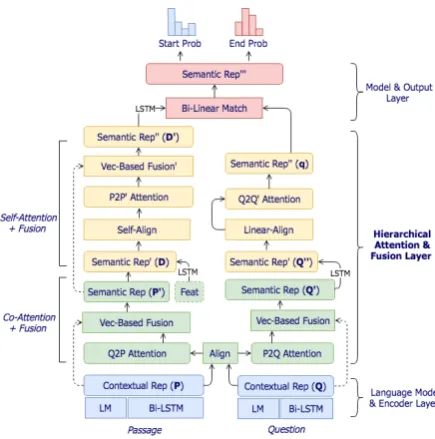
Inspired by this, we propose a hierarchical tention network which can gradually focus the at-tention on the right part of the answer boundary, while capturing the relation between the question and passage at different levels of granularity, as il-lustrated in Figure1. Our model mainly consists of three joint layers: 1) encoder layer where pre-trained language models and recurrent neural net-works are used to build representation for ques-tions and passages separately; 2) attention layer in which hierarchical attention networks are de-signed to capture the relation between question and passage at different levels of granularity; 3) match layer where refined question and passage are matched under a pointer-network (Vinyals et al.,2015) answer boundary predictor.
In encoder layer, to better represent the ques-tions and passages in multiple aspects, we com-bine two different embeddings to give the funda-mental word representations. In addition to the typical glove word embeddings, we also utilize the ELMo embeddings (Peters et al., 2018) de-rived from a pre-trained language model, which shows superior performance in a wide range of NLP problems. Different from the original fusion way for intermediate layer representations, we de-sign a representation-aware fusion method to com-pute the output ELMo embeddings and the context information is also incorporated by further passing through a bi-directional LSTM network.
The key in machine reading comprehension so-lution lies in how to incorporate the question
con-text into the paragraph, in which attention mech-anism is most widely used. Recently, many dif-ferent attention functions and types have been de-signed (Xiong et al.,2016;Seo et al.,2016;Wang et al., 2017), which aims at properly aligning the question and passage. In our attention layer, we propose a hierarchical attention network by leveraging both the co-attention and self-attention mechanism, to gradually focus our attention on the best answer span. Different from the previous attention-based methods, we constantly comple-ment the aligned representations with global infor-mation from the previous layer, and an additional fusion layer is used to further refine the represen-tations. In this way, our model can make some minor adjustment so that the attention will always be on the right place.
Based on the refined question and passage rep-resentation, a bilinear match layer is finally used to identify the best answer span with respect to the question. Following the work of (Wang and Jiang, 2016), we predict the start and end bound-ary within a pointer-network output layer.
The proposed method achieves state-of-the-art results against strong baselines. Our single model achieves 79.2% EM and 86.6% F1 score on the hidden test set, while the ensemble model further boosts the performance to 82.4% EM and 88.6% F1 score. At the time of writing the paper (Jan. 12th 2018), our model SLQA+ (Semantic Learn-ing for Question AnswerLearn-ing) achieves the first po-sition on the SQuAD leaderboard1for both single and ensemble models. Besides, we are also among the first to surpass human EM performance on this golden benchmark dataset.
2 Related Work
2.1 Machine Reading Comprehension
Traditional reading comprehension style question answering systems rely on a pipeline of NLP mod-els, which make heavy use of linguistic annota-tion, structured world knowledge, semantic pars-ing and similar NLP pipeline outputs (Hermann et al.,2015). Recently, the rapid progress of ma-chine reading comprehension has largely bene-fited from the availability of large-scale bench-mark datasets and it is possible to train large end-to-end neural network models. Among them, CNN/Daily Mail (Hermann et al.,2015) and Chil-dren’s Book Test (Hill et al., 2015) are the first
large-scale datasets for reading comprehension task. However, these datasets are in cloze-style, in which the goal is to predict the missing word (often a named entity) in a passage. Moreover, Chen at al. have also shown that these cloze-style datasets requires less reasoning than previ-ously thought (Chen et al.,2016). Different from the previous datasets, the SQuAD provides a more challenging benchmark dataset, where the goal is to extract an arbitrary answer span from the origi-nal passage.
2.2 Attention-based Neural Networks
The key in MRC task lies in how to incorpo-rate the question context into the paragraph, in which attention mechanism is most widely used. In spite of a variety of model structures and atten-tion types (Cui et al.,2016;Xiong et al.,2016;Seo et al.,2016;Wang et al.,2017;Clark and Gardner,
2017), a typical attention-based neural network model for MRC first encodes the symbolic repre-sentation of the question and passage in an embed-ding space, then identify answers with particular attention functions in that space. In terms of the question and passage attention or matching strat-egy, we roughly categorize these attention-based models into two large groups: one-way attention and two-way attention.
In one-way attention model, question is first summarized into a single vector and then directly matched with the passage. Most of the end-to-end neural network methods on the cloze-style datasets are based on this model (Hermann et al.,
2015;Kadlec et al.,2016;Chen et al.,2016; Dhin-gra et al., 2016). Hermann et al. are the first to apply the attention-based neural network meth-ods to MRC task and introduce an attentive reader and an impatient reader (Hermann et al., 2015), by leveraging a two layer LSTM network. Chen et al. (Chen et al., 2016) further design a bilin-ear attention function based on the attentive reader, which shows superior performance on CNN/Daily Mail dataset. However, part of information may be lost when summarizing the question and a fine-grained attention on both the question and passage words should be more reasonable.
Therefore, the two-way attention model un-folds both the question and passage into respective word embeddings, and compute the attention in a two-dimensional matrix. Most of the top-ranking methods on SQuAD leaderboard are based on this
attention mechanism (Wang et al., 2017; Huang et al.,2017;Xiong et al.,2017;Liu et al.,2017b,a). (Cui et al., 2016) and (Xiong et al., 2016) intro-duce the co-attention mechanism to better couple the representations of the question and document. Seo et al. propose a bi-directional attention flow network to capture the relevance at different lev-els of granularity (Seo et al.,2016). (Wang et al.,
2017) further introduce the self-attention mecha-nism to refine the representation by matching the passage against itself, to better capture the global passage information. Huang et al. introduce a fully-aware attention mechanism with a novel
history-of-wordconcept (Huang et al.,2017).
We propose a hierarchical attention network by leveraging both co-attention and self-attention mechanisms in different layers, which can capture the relevance between the question and passage at different levels of granularity. Different from the above methods, we further devise a fusion func-tion to combine both the aligned representafunc-tion and the original representation from the previous layer within each attention. In this way, the model can always focus on the right part of the passage, while keeping the global passage topic in mind.
3 Machine Comprehension Model
3.1 Task Description
Typical machine comprehension systems take an evidence text and a question as input, and pre-dict a span within the evidence that answers the question. Based on this definition, given a pas-sage and a question, the machine needs to first read and understand the passage, and then finds the an-swer to the question. The passage is described as a sequence of word tokens P = nwPton
t=1
and the question is described asQ = nwtQom
t=1,
where n is the number of words in the passage, andmis the number of words in the question. In general, n m. The answer can have differ-ent types depending on the task. In the SQuAD dataset (Rajpurkar et al., 2016), the answer A is guaranteed to be a continuous span in the
pas-sage P. The object function for machine
read-ing comprehension is to learn a functionf(q,p) =
arg maxa∈A(p)P(a|q,p). The training data is a
Figure 1: Hierarchical Attention Fusion Network.
3.2 Encode-Interaction-Pointer Framework
We will now describe our framework from the bot-tom up. As show in Figure1, the proposed frame-work consists of four typical layers to learn differ-ent concepts of semantic represdiffer-entations:
• Encoder Layer as a language model, utilizes contextual cues from surrounding words to re-fine the embedding of the words. It converts the passage and question from tokens to semantic representation;
• Attention Layerattempts to capture relations between question and passage. Besides the aligned context, the contextual embeddings are also merged by a fusion function. Moreover, the multi-level of this operation forms a ”work-ing memory”;
• Match Layeremploys a bi-linear match func-tion to compute the relevance between the question and passage representation on a span level;
• Output Layeruses a pointer network to search the answer span of question.
The main contribution of this work is the atten-tion layer, in order to capture the relaatten-tionship be-tween question and passage, a hierarchical strat-egy is used to progressively make the answer boundary clear with the refined attention mecha-nism. A fine-grained fusion function is also in-troduced to better align the contextual representa-tions from different levels. The detailed
descrip-tion of the model is provided as follows.
3.3 Hierarchical Attention Fusion Network
Our design is based on a simple but natural in-tuition: performing fine-grained mechanism re-quires first to roughly see the potential answer do-main and then progressively locate the most dis-criminative parts of the domain.
The overall framework of our Hierarchical At-tention Fusion Network is shown in Figure1. It consists of several parts: a basic co-attention layer with shallow semantic fusion, a self-attention layer with deep semantic fusion and a memory-wise bilinear alignment function. The proposed network has two distinctive characteristics: (i) A fine-grained fusion approach to blend atten-tion vectors for a better understanding of the re-lationship between question and passage; (ii) A multi-granularity attention mechanism applied at the word and sentence-level, enabling it to prop-erly attend to the most important content when constructing the question and passage representa-tion. Experiments conducted on SQuAD and ad-versarial example datasets (Jia and Liang, 2017) demonstrate that the proposed framework outper-form previous methods by a large margin. Details of different components will be described in the following sections.
3.4 Language Model & Encoder Layer
Encoder layer of the model transform the dis-crete word tokens of question and passage to a se-quence of continuous vector representations. We use a pre-trained word embedding model and a char embedding model to lay the foundation for our model. For the word embedding model, we adopt the popular glove embeddings ( Penning-ton et al., 2014) which are widely used in deep learning-based NLP domain. For the char em-bedding model, the ELMo language model ( Pe-ters et al.,2018) is used due to its superior perfor-mance in a wide range of NLP tasks. As a result, we obtain two types of encoding vectors, i.e., word embeddingsneQt om
t=1, n
ePton
t=1and char
embed-dingsncQtom
t=1, n
cPton
t=1.
contextual network, we concat the word embed-dings and char embedembed-dings for a full understand-ing of each word. The final output of our encoder layer is shown as below,
uQt =hBiLSTMQ([eQt ,c
Q t ]),c
Q t
i
(1)
uPt =hBiLSTMP([etP,cPt]),cPt i
(2)
where we further concat the output of the con-textual Bi-LSTM network with the pre-trained char embeddings for its good performance (Peters et al.,2018). This can be regarded as a residual connection between word representations in dif-ferent levels.
3.5 Hierarchical Attention & Fusion Layer
The attention layer is responsible for linking and fusing information from the question and passage representation, which is the most critical in most MRC tasks. It aims to align the question and pas-sage so that we can better locate on the most rele-vant passage span with respect to the question. We propose a hierarchical attention structure by com-bining the co-attention and self-attention mecha-nism in a multi-hop style. Besides, we think that the original representation and the aligned repre-sentation via attention can reflect the content se-mantics in different granularities. Therefore, we also apply a particular fusion function after each attention function, so that different levels of se-mantics can be better incorporated towards a better understanding.
3.5.1 Co-attention & Fusion
Given the question and passage representationuQt anduPt, a soft-alignment matrixShas been built to calculate the shallow semantic similarity between question and passage as follows:
Sij= Att(uQt,u P
t) = ReLU(W
>
linu Q t)
>
·ReLU(W>linu P t) (3)
whereWlinis a trainable weight matrix.
This decomposition avoids the quadratic com-plexity that is trivially parallelizable (Parikh et al.,
2016). Now we use the unnormalized attention weights Sij to compute the attentions between
question and passage, which is further used to ob-tain the attended vectors in passage to question and question to passage direction, respectively.
P2Q Attentionsignifies which question words are most relevant to each passage word, given as below:
αj= softmax(S:j) (4)
where αj represents the attention weights on the
question words.
The aligned passage representation from ques-tionQ =nuQt om
t=1can thus be derived as,
˜
Q:t=
X
j
αtj·Q:j,∀j∈[1, ...,m] (5)
Q2P Attention signifies which passage words have the closest similarity to one of the question words and are hence critical for answering the question.
We utilize the same way to calculate this atten-tion as in the passage to quesatten-tion attenatten-tion (P2Q), except for that in the opposite direction:
βi= softmax(Si:) (6)
˜
Pk: =
X
i
βik·Pi:,∀i∈[1, ...,n] (7)
where P˜ indicates the weighted sum of the most important words in the passage with respect to the question.
With the aligned passage and question represen-tationsQ˜ and P˜ derived, a particular fusion unit has been designed to combine the original contex-tual representations and the corresponding atten-tion vectors for quesatten-tion and passage separately:
P0 = Fuse(P,Q)˜ (8)
Q0 = Fuse(Q,P)˜ (9)
whereFuse(·,·)is a typical fusion kernel.
The simplest way of fusion is a concatenation or addition of the two representations, followed by some linear or non-linear transformation. Re-cently, a heuristic matching trick with difference and element-wise product is found effective in combining different representations (Mou et al.,
2016;Chen et al.,2017b):
m(P,Q) = tanh(W˜ f[P; ˜Q; P◦Q; P˜ −Q] + b˜ f)
(10) where ◦ denotes the element-wise product, and Wf, bf are trainable parameters. The output
di-mension is projected back to the same size as the original representation P or Q via the projected matrixWf.
projected representationsm(·,·) with the original contextual representations. As a result, the final fused representations of passage and question can be formulated as:
P0 = g(P,Q)˜ ·m(P,Q) + (1˜ −g(P,Q))˜ ·P (11)
Q0 = g(Q,P)˜ ·m(Q,P) + (1˜ −g(Q,P))˜ ·Q (12)
where g(·,·) is a gating function. To capture the relation between the representations in differ-ent granularities, we also design a scalar-based, a vector-based and a matrix-based sigmoid gating function, which are compared in Section4.5.
3.5.2 Self-attention & Fusion
Borrowing the idea from wide and deep net-work (Cheng et al., 2016), manual features have also been added to combine with the outputs of previous layer for a more comprehensive repre-sentation. In our model, these features are con-catenated with the refined question-aware passage representation as below:
D = BiLSTM([P0; featman]) (13)
wherefeatmandenotes the word-level manual
pas-sage features.
In this layer, we separately consider the se-mantic representations of question and passage, and further refine the obtained information from the co-attention layer. Since fusing informa-tion among context words allows contextual in-formation to flow close to the correct answer, the self-attention layer is used to further align the question and passage representation against it-self, so as to keep the global sequence informa-tion in memory. Benefiting from the advantage of self-alignment attention in addressing the long-distance dependence (Wang et al.,2017), we adopt a self-alignment fusion process in this level. To al-low for more freedom of the aligning process, we introduce a bilinear self-alignment attention func-tion on the passage representafunc-tion:
L = softmax(D·Wl·D>) (14)
˜
D = L·D (15)
Another fusion function Fuse(·,·) is again adopted to combine the question-aware passage representationDand self-aware representationD,˜ as below:
D0 = Fuse(D,D)˜ (16)
Finally, a bidirectional LSTM is used to get the final contextual passage representation:
D00= BiLSTM(D0) (17)
As for question side, since it is generally shorter in length and could be adequately represented with less information, we follow the question encoding method used in (Chen et al., 2017a) and adopt a linear transformation to encode the question rep-resentation to a single vector.
First, another contextual bidirectional LSTM network is applied on top of the fused question representation:Q00= BiLSTM(Q0). Then we ag-gregate the resulting hidden units into one single question vector, with a linear self-alignment:
γ = softmax(w>q ·Q00) (18)
q=X
j
γj·Q00:j,∀j∈[1, ...,m] (19)
wherewqis a weight vector to learn, we self-align
the refined question representation to a single vec-tor according to the question self-attention weight, which can be further used to compute the match-ing with the passage words.
3.6 Model & Output Layer
Instead of predicting the start and end positions based only onD00, a top-level bilinear match func-tion is used to capture the semantic relafunc-tion be-tween questionqand paragraphD00in a matching style, which actually works as a multi-hop match-ing mechanism.
Different from the co-attention layer that gen-erates coarse candidate answers and the self-attention layer that focus the relevant context of passage to a certain intent of question, the top model layer uses a bilinear matching function to capture the interaction between outputs from pre-vious layers and finally locate on the right answer span.
The start and end distribution of the passage words are calculated in a bilinear matching way as below,
Pstart= softmax(q·Ws>·D00) (20)
Pend= softmax(q·We>·D00) (21)
where Ws and We are trainable matrices of the
bilinear match function.
start and end position of the answer, since it re-quires the model to find the sub-phrase of the pas-sage to answer the question.
In training process, with cross entropy as met-ric, the loss for start and end position is the sum of the negative log probabilities of the true start and end indices by the predicted distributions, av-eraged over all examples:
L(θ) =−1
N
N X
i
log ps(yis) + log pe(yei) (22)
where θ is the set of all trainable weights in the model, andpsis the probability of start index,pe
is the probability of end index, respectively.ysiand yei are the true start and end indices.
During prediction, we choose the answer span with the maximum value ofps ·pe under a
con-straint thats≤e≤s + 15, which is selected via a dynamic programming algorithm in linear time.
4 Experiments
In this section, we first present the datasets used for evaluation. Then we compare our end-to-end Hierarchical Attention Fusion Networks with ex-isting machine reading models. Finally, we con-duct experiments to validate the effectiveness of our proposed components. We evaluate our model on the task of question answering using recently released SQuAD and TriviaQA Wikipedia (Joshi et al., 2017), which have gained a huge attention over the past year. An adversarial evaluation for the Stanford Question Answering SQuAD is also used to demonstrate the robust of our model under adversarial attacks (Jia and Liang,2017).
4.1 Dataset
We focus on the SQuAD dataset to train and evalu-ate our model. SQuAD is a popular machine com-prehension dataset consisting of 100,000+ ques-tions created by crowd workers on 536 Wikipedia articles. Each context is a paragraph from an ar-ticle and the answer to each question is guaran-teed to be a span in the context. The answer to each question is always a span in the context. The model is given a credit if its answer matches one of the human chosen answers. Two metrics are used to evaluate the model performance: Exact Match (EM) and a softer metric F1 score, which measures the weighted average of the precision and recall rate at a character level.
Table 1: The performance of our SLQA model and competing approaches on SQuAD.
Dev Set Test Set Single model EM / F1 EM / F1
LR Baseline (Rajpurkar et al.,2016) 40.0 / 51.0 40.4 / 51.0 Match-LSTM (Wang and Jiang,2016) 64.1 / 73.9 64.7 / 73.7 DrQA (Chen et al.,2017a) - / - 70.7 / 79.4 DCN+ (Xiong et al.,2017) 74.5 / 83.1 75.1 / 83.1 Interactive AoA Reader+ (Cui et al.,2016) - / - 75.8 / 83.8 FusionNet (Huang et al.,2017) - / - 76.0 / 83.9 SAN (Liu et al.,2017b) 76.2 / 84.0 76.8 / 84.4 AttentionReader+ (unpublished) - / - 77.3 / 84.9 BiDAF + Self Attention + ELMo (Peters et al.,2018) - / - 78.6 / 85.8 r-net+ (Wang et al.,2017) - / - 79.9 / 86.5
SLQA+ 80.0 / 87.0 80.4 / 87.0 Ensemble model
FusionNet (Huang et al.,2017) - / - 78.8 / 85.9 DCN+ (Xiong et al.,2017) - / - 78.9 / 86.0 Interactive AoA Reader+ (Cui et al.,2016) - / - 79.0 / 86.4 SAN (Liu et al.,2017b) 78.6 / 85.9 79.6 / 86.5 BiDAF + Self Attention + ELMo (Peters et al.,2018) - / - 81.0 / 87.4 AttentionReader+ (unpublished) - / - 81.8 / 88.2 r-net+ (Wang et al.,2017) - / - 82.6 / 88.5
SLQA+ 82.0 / 88.4 82.4 / 88.6
Human Performance 80.3 / 90.5 82.3 / 91.2
TriviaQA is a newly available machine compre-hension dataset consisting of over 650K context-query-answer triples. The contexts are automat-ically generated from either Wikipedia or Web search results. The length of contexts in TriviaQA (average 2895 words) is much more longer than the one in SQuAD (average 122 words).
4.2 Training Details
We use the AdaMax optimizer, with a mini-batch size of 32 and initial learning rate of 0.002. A dropout rate of 0.4 is used for all LSTM layers. To directly optimize our target against the evaluation metrics, we further fine-tune the model with some well-defined strategy. During fine-tuning, Focal Loss (Lin et al.,2017) and Reinforce Loss which take F1 score as reward are incorporated with Cross Entropy Loss. The training process takes roughly 20 hours on a single Nvidia Tesla M40 GPU. We also train an ensemble model consisting of 15 training runs with the identical framework and hyper-parameters. At test time, we choose the answer with the highest sum of confidence scores amongst the 15 runs for each question.
4.3 Main Results
The results of our model and competing ap-proaches on the hidden test set are summarized in Table 1. The proposed SLQA+ ensemble model achieves an EM score of 82.4 and F1 score of 88.6, outperforming all previous approaches, which val-idates the effectiveness of our hierarchical atten-tion and fusion network structure.
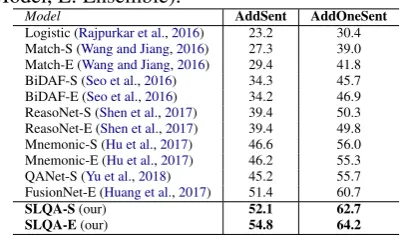
Table 2: The F1 scores of different models on AddSent and AddOneSent datasets (S: Single Model, E: Ensemble).
Model AddSent AddOneSent
Logistic (Rajpurkar et al.,2016) 23.2 30.4 Match-S (Wang and Jiang,2016) 27.3 39.0 Match-E (Wang and Jiang,2016) 29.4 41.8 BiDAF-S (Seo et al.,2016) 34.3 45.7 BiDAF-E (Seo et al.,2016) 34.2 46.9 ReasoNet-S (Shen et al.,2017) 39.4 50.3 ReasoNet-E (Shen et al.,2017) 39.4 49.8 Mnemonic-S (Hu et al.,2017) 46.6 56.0 Mnemonic-E (Hu et al.,2017) 46.2 55.3 QANet-S (Yu et al.,2018) 45.2 55.7 FusionNet-E (Huang et al.,2017) 51.4 60.7
SLQA-S(our) 52.1 62.7 SLQA-E(our) 54.8 64.2
SQuAD dataset (Jia and Liang,2017) to study the robustness of the proposed model. In the dataset, one or more sentences are appended to the origi-nal SQuAD context, aiming to mislead the trained models. We use exactly the same model as in our SQuAD dataset, the performance comparison re-sult is shown in Table2. It can be seen that the proposed model can still get superior results than all the other competing approaches.
4.4 Ablations
In order to evaluate the individual contribution of each model component, we run an ablation study. Table 3shows the performance of our model and its ablations on SQuAD dev set. The bi-linear alignment plus fusion between passage and ques-tion is most critical to the performance on both metrics which results in a drop of nearly 15%. The reason may be that in top-level attention layer, the similar semantics between question and pas-sage are strong evidence to locate the correct an-swer span. The ELMo accounts for about 5% of the performance degradation, which clearly shows the effectiveness of language model. We conjec-ture that language model layer efficiently encodes different types of syntactic and semantic informa-tion about words-in-context, and improves the task performance. To evaluate the performance of hier-archical architecture, we reduce the multi-hop fu-sion with the standard LSTM network. The result shows that multi-hop fusion outperforms the stan-dard LSTM by nearly 5% on both metrics.
4.5 Fusion Functions
In this section, we experimentally demonstrate how different choices of the fusion kernel impact the performance of our model. The compared fu-sion kernels are described as follows:
Simple Concat: a simple concatenation of two
Table 3: Ablation tests of SLQA single model on the SQuAD dev set.
SLQA single model EM/F1
SLQA+ 80.0 / 87.0
-Manual Features 79.2 / 86.2
-Language Embedding (ELMo) 77.6 / 84.9
-Self Matching 79.5 / 86.4
-Multi-hop 79.1 / 86.1
-Bi-linear Match 65.4 / 72.0
-Fusion (simple concat) 78.8 / 85.8 -Fusion, -Multi-hop 77.5 / 84.8 -Fusion, -Bi-linear Match 63.1 / 69.6
Table 4: Comparison of different fusion kernels on the SQuAD dev set.
Fusion Kernel EM/F1
Simple Concat 78.8 / 85.8
Add Full Projection (FPU) 79.1 / 86.1 Scalar-based Fusion (SFU) 79.5 / 86.5
Vector-based Fusion (VFU) 80.0/87.0
Matrix-based Fusion (MFU) 79.8 / 86.8
channel inputs.
Full Projection: the heuristic matching and projecting function as in Equ.10.
Scalar-based Fusion: the gating function is a trainable scalar parameter (a coarse fusion level):
g(P,Q) = g˜ p (23)
wheregpis a trainable scalar parameter.
Vector-based Fusion: the gating function con-tains a weight vector to learn, which acts as a one-dimensional sigmoid gating,
g(P,Q) =˜ σ(w>g ·[P; ˜Q; P◦Q; P˜ −Q]+b˜ g) (24)
wherewgis trainable weight vector,bgis trainable
bias, andσis sigmoid function.
Matrix-based Fusion: the gating function con-tains a weight matrix to learn, which acts as a two-dimensional sigmoid gating,
g(P,Q) =˜ σ(W>g·[P; ˜Q; P◦Q; P˜ −Q]+b˜ g) (25)
whereWgis a trainable weight matrix.
The comparison results of different fusion ker-nels can be found in Table 4. We can see that different fusion methods contribute differently to the final performances, and the vector-based fu-sion method performs best, with a moderate pa-rameter size.
4.6 Attention Hierarchy and Function
Table 5: Comparison of different attention styles on the SQuAD dev set.
Attention Hierarchy EM/F1
1-layer attention (only qp co-attention) 61.9 / 68.4 2-layer attention (add self-attention) 65.4 / 71.7
3-layer attention (add bilinear match) 80.0/87.0
Attention Function EM/F1
dot product 62.9 / 69.3
linear attention 78.0 / 84.9
bilinear attention (linear + relu) 80.0/87.0
[image:9.595.316.508.65.217.2]trilinear attention 78.9 / 85.8
Table 6: Published and unpublished results on the TriviaQA wikipedia leaderboard.
Full Verified Model EM/F1 EM/F1
BiDAF (Seo et al.,2016) 40.26 / 45.74 47.47 / 53.70 MEMEN (Pan et al.,2017) 43.16 / 46.90 49.28 / 55.83 M-Reader (Hu et al.,2017) 46.94 / 52.85 54.45 / 59.46 QANet (Yu et al.,2018) 51.10 / 56.60 53.30 / 59.20 document-qa (Clark and Gardner,2017) 63.99 / 68.93 67.98 / 72.88 dirkweissenborn (unpublished) 64.60 / 69.90 72.77 / 77.44
SLQA-Single 66.56/71.39 74.83/78.74
for four common attention functions. Empirically, we find bilinear attention which add ReLU after linearly transforming does significantly better than the others.
At the top of Table5we show the effect of vary-ing the number of attention layers on the final per-formance. We see a steep and steady rise in accu-racy as the number of layers is increased from N = 1 to 3.
4.7 Experiments on TriviaQA
To further examine the robustness of the proposed model, we also test the model performance on TriviaQA dataset. The test performance of dif-ferent methods on the leaderboard (on Jan. 12th 2018) is shown in Table 6. From the results, we can see that the proposed model can also obtain state-of-the-art performance in the more complex TriviaQA dataset.
5 Conclusions
[image:9.595.74.285.93.189.2]We introduce a novel hierarchical attention net-work, a state-of-the-art reading comprehension model which conducts attention and fusion hor-izontally and vertically across layers at different levels of granularity between question and para-graph. We show that our proposed method is very powerful and robust, which outperforms the previous state-of-the-art methods in various large-scale golden MRC datasets: SQuAD, TriviaQA, AddSent and AddOneSent.
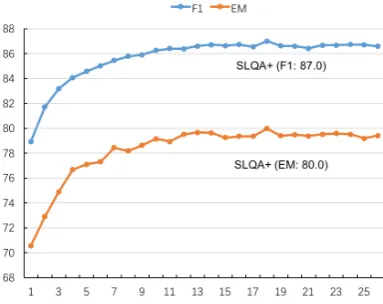
Figure 2: Learning curve of F1 / EM score on the SQuAD dev set
Acknowledgments
We thank the Stanford NLP Group and the Univer-sity of Washington NLP Group for evaluating our results on the SQuAD and the TriviaQA test set.
References
Danqi Chen, Jason Bolton, and Christopher D
Man-ning. 2016. A thorough examination of the
cnn/daily mail reading comprehension task. arXiv
preprint arXiv:1606.02858.
Danqi Chen, Adam Fisch, Jason Weston, and
An-toine Bordes. 2017a. Reading wikipedia to
an-swer open-domain questions. arXiv preprint
arXiv:1704.00051.
Qian Chen, Xiaodan Zhu, Zhen-Hua Ling, and
Di-ana Inkpen. 2017b. Natural language
infer-ence with external knowledge. arXiv preprint
arXiv:1711.04289.
Heng-Tze Cheng, Levent Koc, Jeremiah Harmsen, Tal Shaked, Tushar Chandra, Hrishi Aradhye, Glen An-derson, Greg Corrado, Wei Chai, Mustafa Ispir, et al. 2016. Wide & deep learning for recommender
sys-tems. InProceedings of the 1st Workshop on Deep
Learning for Recommender Systems, pages 7–10. ACM.
Christopher Clark and Matt Gardner. 2017. Simple
and effective multi-paragraph reading
comprehen-sion.arXiv preprint arXiv:1710.10723.
Yiming Cui, Zhipeng Chen, Si Wei, Shijin Wang, Ting Liu, and Guoping Hu. 2016. Attention-over-attention neural networks for reading
comprehen-sion.arXiv preprint arXiv:1607.04423.
Dipanjan Das, Desai Chen, Andr´e FT Martins, Nathan
Schneider, and Noah A Smith. 2014.
Frame-semantic parsing. Computational linguistics,
Bhuwan Dhingra, Hanxiao Liu, Zhilin Yang, William W Cohen, and Ruslan Salakhutdinov. 2016. Gated-attention readers for text
comprehen-sion.arXiv preprint arXiv:1606.01549.
Karl Moritz Hermann, Tomas Kocisky, Edward
Grefenstette, Lasse Espeholt, Will Kay, Mustafa
Su-leyman, and Phil Blunsom. 2015. Teaching
ma-chines to read and comprehend. InAdvances in
Neu-ral Information Processing Systems, pages 1693– 1701.
Felix Hill, Antoine Bordes, Sumit Chopra, and Jason Weston. 2015. The goldilocks principle: Reading children’s books with explicit memory representa-tions. arXiv preprint arXiv:1511.02301.
Minghao Hu, Yuxing Peng, and Xipeng Qiu. 2017. Re-inforced mnemonic reader for machine
comprehen-sion.CoRR, abs/1705.02798.
Hsin-Yuan Huang, Chenguang Zhu, Yelong Shen, and Weizhu Chen. 2017. Fusionnet: Fusing via fully-aware attention with application to machine
compre-hension. arXiv preprint arXiv:1711.07341.
Robin Jia and Percy Liang. 2017. Adversarial exam-ples for evaluating reading comprehension systems. In Proceedings of the 2017 Conference on Empiri-cal Methods in Natural Language Processing, pages 2021–2031.
Mandar Joshi, Eunsol Choi, Daniel S Weld, and Luke Zettlemoyer. 2017. Triviaqa: A large scale distantly supervised challenge dataset for reading
comprehen-sion.arXiv preprint arXiv:1705.03551.
Rudolf Kadlec, Martin Schmid, Ondrej Bajgar, and
Jan Kleindienst. 2016. Text understanding with
the attention sum reader network. arXiv preprint
arXiv:1603.01547.
Tsung-Yi Lin, Priya Goyal, Ross Girshick, Kaiming He, and Piotr Doll´ar. 2017. Focal loss for dense ob-ject detection. arXiv preprint arXiv:1708.02002.
Rui Liu, Wei Wei, Weiguang Mao, and Maria Chik-ina. 2017a. Phase conductor on multi-layered
at-tentions for machine comprehension.arXiv preprint
arXiv:1710.10504.
Xiaodong Liu, Yelong Shen, Kevin Duh, and Jian-feng Gao. 2017b. Stochastic answer networks for
machine reading comprehension. arXiv preprint
arXiv:1712.03556.
Lili Mou, Rui Men, Ge Li, Yan Xu, Lu Zhang, Rui Yan, and Zhi Jin. 2016. Natural language inference by tree-based convolution and heuristic matching. In The 54th Annual Meeting of the Association for Computational Linguistics, page 130.
Boyuan Pan, Hao Li, Zhou Zhao, Bin Cao, Deng Cai, and Xiaofei He. 2017. Memen: Multi-layer embed-ding with memory networks for machine
compre-hension. arXiv preprint arXiv:1707.09098.
Ankur Parikh, Oscar T¨ackstr¨om, Dipanjan Das, and Jakob Uszkoreit. 2016. A decomposable attention
model for natural language inference. In
Proceed-ings of the 2016 Conference on Empirical Methods in Natural Language Processing, pages 2249–2255.
Jeffrey Pennington, Richard Socher, and Christopher Manning. 2014. Glove: Global vectors for word
representation. InProceedings of the 2014
confer-ence on empirical methods in natural language pro-cessing (EMNLP), pages 1532–1543.
Matthew E Peters, Mark Neumann, Mohit Iyyer, Matt Gardner, Christopher Clark, Kenton Lee, and Luke Zettlemoyer. 2018. Deep contextualized word rep-resentations. arXiv preprint arXiv:1802.05365.
Pranav Rajpurkar, Jian Zhang, Konstantin Lopyrev, and
Percy Liang. 2016. Squad: 100,000+ questions
for machine comprehension of text. arXiv preprint
arXiv:1606.05250.
Minjoon Seo, Aniruddha Kembhavi, Ali Farhadi, and Hannaneh Hajishirzi. 2016. Bidirectional attention
flow for machine comprehension. arXiv preprint
arXiv:1611.01603.
Yelong Shen, Po-Sen Huang, Jianfeng Gao, and Weizhu Chen. 2017. Reasonet: Learning to stop
reading in machine comprehension. InProceedings
of the 23rd ACM SIGKDD International Conference on Knowledge Discovery and Data Mining, pages 1047–1055. ACM.
Oriol Vinyals, Meire Fortunato, and Navdeep Jaitly.
2015. Pointer networks. InAdvances in Neural
In-formation Processing Systems, pages 2692–2700.
Shuohang Wang and Jing Jiang. 2016. Machine com-prehension using match-lstm and answer pointer. arXiv preprint arXiv:1608.07905.
Wenhui Wang, Nan Yang, Furu Wei, Baobao Chang,
and Ming Zhou. 2017. Gated self-matching
net-works for reading comprehension and question
an-swering. InProceedings of the 55th Annual
Meet-ing of the Association for Computational LMeet-inguistics (Volume 1: Long Papers), volume 1, pages 189–198.
Caiming Xiong, Victor Zhong, and Richard Socher. 2016. Dynamic coattention networks for question
answering. arXiv preprint arXiv:1611.01604.
Caiming Xiong, Victor Zhong, and Richard Socher.
2017. Dcn+: Mixed objective and deep residual
coattention for question answering. arXiv preprint
arXiv:1711.00106.
Adams Wei Yu, David Dohan, Minh-Thang Luong, Rui Zhao, Kai Chen, Mohammad Norouzi, and Quoc V
Le. 2018. Qanet: Combining local convolution
with global self-attention for reading