1108
Learning to Control the Specificity in Neural Response Generation
Ruqing Zhang, Jiafeng Guo, Yixing Fan, Yanyan Lan, Jun Xu and Xueqi Cheng University of Chinese Academy of Sciences, Beijing, China
CAS Key Lab of Network Data Science and Technology, Institute of Computing Technology, Chinese Academy of Sciences, Beijing, China
{zhangruqing,fanyixing}@software.ict.ac.cn
{guojiafeng,lanyanyan,junxu,cxq}@ict.ac.cn
Abstract
In conversation, a general response (e.g., “I don’t know”) could correspond to a large variety of input utterances. Previ-ous generative conversational models usu-ally employ a single model to learn the relationship between different utterance-response pairs, thus tend to favor gen-eral and trivial responses which appear frequently. To address this problem, we propose a novel controlled response generation mechanism to handle different utterance-response relationships in terms of specificity. Specifically, we introduce an explicit specificity control variable into a sequence-to-sequence model, which in-teracts with the usage representation of words through a Gaussian Kernel layer, to guide the model to generate responses at different specificity levels. We describe two ways to acquire distant labels for the specificity control variable in learning. Empirical studies show that our model can significantly outperform the state-of-the-art response generation models under both automatic and human evaluations.
1 Introduction
Human-computer conversation is a critical and challenging task in AI and NLP. There have been two major streams of research in this direction, namely task oriented dialog and general purpose dialog (i.e., chit-chat). Task oriented dialog aims to help people complete specific tasks such as buy-ing tickets or shoppbuy-ing, while general purpose dia-log attempts to produce natural and meaningful conversations with people regarding a wide range of topics in open domains (Perez-Marin, 2011;
Sordoni et al.). In recent years, the latter has
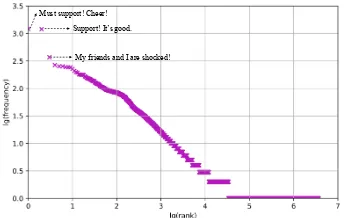
at-Must support! Cheer! Support! It’s good.
[image:1.595.329.501.223.332.2]My friends and I are shocked!
Figure 1: Rank-frequency distribution of the responses in the chit-chat corpus, withxandyaxes beinglg(rank order) and
lg(frequency) respectively.
tracted much attention in both academia and in-dustry as a way to explore the possibility in de-veloping a general purpose AI system in language (e.g., chatbots).
model to learn the relationship between them, will inevitably favor such general responses with high frequency. Although these responses are safe for replying different utterances, they are boring and trivial since they carry little information, and may quickly lead to an end of the conversation.
There have been a few efforts attempting to ad-dress this issue in literature. Li et al. (2016a) proposed to use the Maximum Mutual Informa-tion (MMI) as the objective to penalize general re-sponses. It could be viewed as a post-processing approach which did not solve the generation of trivial responses fundamentally.Xing et al.(2017) pre-defined a set of topics from an external cor-pus to guide the generation of the Seq2Seq model. However, it is difficult to ensure that the top-ics learned from the external corpus are consist-ent with that in the conversation corpus, leading to the introduction of additional noises. Zhou
et al. (2017) introduced latent responding factors
to model multiple responding mechanisms. How-ever, these latent factors are usually difficult in in-terpretation and it is hard to decide the number of the latent factors.
In our work, we propose a novel controlled re-sponse generation mechanism to handle different utterance-response relationships in terms of spe-cificity. The key idea is inspired by our observa-tion on everyday conversaobserva-tion between humans. In human-human conversation, people often actively control the specificity of responses depending on their own response purpose (which might be af-fected by a variety of underlying factors like their current mood, knowledge state and so on). For example, they may provide some interesting and specific responses if they like the conversation, or some general responses if they want to end it. They may provide very detailed responses if they are familiar with the topic, or just “I don’t know” otherwise. Therefore, we propose to simulate the way people actively control the specificity of the response.
We employ a Seq2Seq framework and further introduce an explicit specificity control variable to represent the response purpose of the agent. Meanwhile, we assume that each word, beyond the semantic representation which relates to its meaning, also has another representation which relates to the usage preference under different re-sponse purpose. We name this representation as the usage representation of words. The specificity
control variable then interacts with the usage rep-resentation of words through a Gaussian Kernel layer, and guides the Seq2Seq model to generate responses at different specificity levels. We refer to our model as Specificity Controlled Seq2Seq model (SC-Seq2Seq). Note that unlike the work
by (Xing et al.,2017), we do not rely on any
ex-ternal corpus to learn our model. All the model parameters are learned on the same conversation corpus in an end-to-end way.
We employ distant supervision to train our SC-Seq2Seq model since the specificity control vari-able is unknown in the raw data. We describe two ways to acquire distant labels for the specificity control variable, namely Normalized Inverse Re-sponse Frequency (NIRF) and Normalized Inverse Word Frequency (NIWF). By using normalized values, we restrict the specificity control variable to be within a pre-defined continuous value range with each end has very clear meaning on the spe-cificity. This is significantly different from the dis-crete latent factors in (Zhou et al.,2017) which are difficult in interpretation.
We conduct an empirical study on a large pub-lic dataset, and compare our model with several state-of-the-art response generation methods. Em-pirical results show that our model can generate either general or specific responses, and signi-ficantly outperform existing methods under both automatic and human evaluations.
2 Related Work
In this section, we briefly review the related work on conversational models and response specificity.
2.1 Conversational Models
Automatic conversation has attracted increasing attention over the past few years. At the very be-ginning, people started the research using hand-crafted rules and templates (Walker et al., 2001;
Williams et al., 2013; Henderson et al., 2014).
These approaches required little data for train-ing but huge manual effort to build the model, which is very time-consuming. For now, con-versational models fall into two major categories: retrieval-based and generation-based. Retrieval-based conversational models search the most suit-able response from candidate responses using dif-ferent schemas (Kearns,2000;Wang et al.,2013;
Yan et al., 2016). These methods rely on
exten-ded to open domains (Zhou et al.,2017). With the large amount of conversation data available on the Internet, generation-based conversational models developed within a SMT framework (Ritter et al.,
2011; Cho et al., 2014; Bahdanau et al., 2015)
show promising results. Shang et al. (2015) generated replies for short-text conversation by encoder-decoder-based neural network with local and global attentions.Serban et al.(2016) built an end-to-end dialogue system using generative hier-archical neural network. Gu et al. (2016) intro-duced copynet to simulate the repeating behavior of humans in conversation. Similarly, our model is also based on the encoder-decoder framework.
2.2 Response Specificity
Some recent studies began to focus on generat-ing more specific or informative responses in con-versation. It is also called a diversity problem since if each response is more specific, it would be more diverse between responses of different ut-terances. As an early work,Li et al.(2016a) used Maximum Mutual Information (MMI) as the ob-jective to penalize general responses. Later, Li
et al. (2017) proposed a data distillation method,
which trains a series of generative models at differ-ent levels of specificity and uses a reinforcemdiffer-ent learning model to choose the model best suited for decoding depending on the conversation context. These methods circumvented the general response issue by using either a post-processing approach or a data selection approach.
Besides, Li et al.(2016b) tried to build a sonalized conversation engine by adding extra per-sonal information. Xing et al. (2017) incorpor-ated the topic information from an external corpus into the Seq2Seq framework to guide the genera-tion. However, external dataset may not be always available or consistent with the conversation data-set in topics. Zhou et al.(2017) introduced latent responding factors to the Seq2Seq model to avoid generating safe responses. However, these latent factors are usually difficult in interpretation and hard to decide the number.
Moreover, Mou et al. (2016) proposed a content-introducing approach to generate a re-sponse based on a predicted keyword. Yao et al.
(2016) attempted to improve the specificity with the reinforcement learning framework by using the averaged IDF score of the words in the response as a reward. Shen et al.(2017) presented a
con-ditional variational framework for generating spe-cific responses based on spespe-cific attributes. Un-like these existing methods, we introduce an ex-plicit specificity control variable into a Seq2Seq model to handle different utterance-response rela-tionships in terms of specificity.
3 Specificity Controlled Seq2Seq Model
In this section, we present the Specificity Con-trolled Seq2Seq model (SC-Seq2Seq), a novel Seq2Seq model designed for actively controlling the generated responses in terms of specificity.
3.1 Model Overview
The basic idea of a generative conversational model is to learn the mapping from an input ut-terance to its response, typically using an encoder-decoder framework. Formally, given an input ut-terance sequence X = (x1, x2, . . . , xT) and a
target response sequence Y = (y1, y2, . . . , yT0),
a neural Seq2Seq model is employed to learn p(Y|X) based on the training corpus D =
{(X,Y)|Yis the response ofX}. By maximizing the likelihood of all the utterance-response pairs with a single mapping mechanism, the learned Seq2Seq model will inevitably favor those general responses that can correspond to a large variety of input utterances.
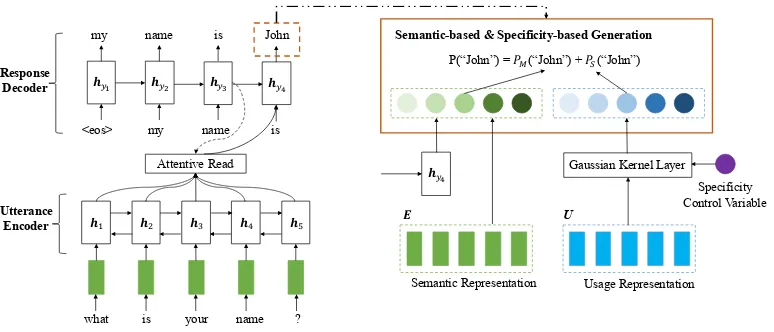
To address this issue, we assume that there are different mapping mechanisms between utterance-response pairs with respect to their specificity re-lation. Rather than involving some latent factors, we propose to introduce an explicit variablesinto a Seq2Seq model to handle different utterance-response mappings in terms of specificity. By do-ing so, we hope that (1) s would have explicit meaning on specificity, and (2) scould not only interpret but also actively control the generation of the responseYgiven the input utteranceX. The goal of our model becomes to learnp(Y|X, s)over the corpusD, where we acquire distant labels for sfrom the same corpus for learning. The overall architecture of SC-Seq2Seq is depicted in Figure
2, and we will detail our model as follows.
3.1.1 Encoder
The encoder is to map the input utteranceXinto a compact vector that can capture its essential top-ics. Specifically, we use a bi-directional GRU
(Cho et al., 2014) as the utterance encoder, and
each wordxi is firstly represented by its semantic
Attentive Read 𝒉#$ 𝒉#% 𝒉#& 𝒉#'
<eos> my
my name
name is
is John
P(“John”) = 𝑃)(“John”) + 𝑃*(“John”)
Semantic Representation Usage Representation 𝒉#'
𝒉+
𝒉, 𝒉- 𝒉. 𝒉/
what is your name ?
Utterance Encoder Response Decoder
𝑬 U
Gaussian Kernel Layer
Specificity Control Variable
[image:4.595.107.494.60.226.2]Semantic-based & Specificity-based Generation
Figure 2: The overall architecture of SC-Seq2Seq model.
matrixEas the input of the encoder. Then, the en-coder represents the utteranceXas a series of hid-den vectors{ht}Tt=1 modeling the sequence from
both forward and backward directions. Finally, we use the final backward hidden state as the initial hidden state of the decoder.
3.1.2 Decoder
The decoder is to generate a responseYgiven the hidden representations of the input utteranceX un-der some specificity level denoted by the control variable s. Specifically, at step t, we define the probability of generating any target wordyt by a
“mixture” of probabilities:
p(yt) =βpM(yt) +γpS(yt), (1)
wherepM(yt) denotes the semantic-based
gener-ation probability, pS(yt) denotes the
specificity-based generation probability,βandγare the coef-ficients.
Specifically,pM(yt)is defined the same as that
in traditional Seq2Seq model (Sutskever et al.,
2014):
pM(yt=w) =wT(WhM·hyt+W
e
M·et−1+bM),
(2) wherewis a one-hot indicator vector of the word w and et−1 is the semantic representation of the
t−1-th generated word in decoder. WhM, WeM
andbM are parameters. hytis thet-th hidden state
in the decoder which is computed by:
hyt =f(yt−1,hyt−1,ct), (3)
wheref is a GRU unit andctis the context
vec-tor to allow the decoder to pay different attention to different parts of input at different steps ( Bah-danau et al.,2015).
pS(yt)denotes the generation probability of the
target word given the specificity control variable s. Here we introduce a Gaussian Kernel layer to define this probability. Specifically, we assume that each word, beyond its semantic representation
e, also has a usage representationumapped by us-age embedding matrix U. The usage representa-tion of a word denotes its usage preference under different specificity. The specificity control vari-ablesthen interacts with the usage representations through the Gaussian Kernel layer to produce the specificity-based generation probabilitypS(yt):
pS(yt=w) =
1
√
2πσ exp(−
(ΨS(U,w)−s)2
2σ2 ),
ΨS(U,w) =σ(wT(U·WU+bU)),
(4) whereσ2is the variance, andΨS(·)maps the word
usage representation into a real value with the spe-cificity control variablesas the mean of the Gaus-sian distribution.WUandbUare parameters to be
learned. Note here in general we can use any real-value function to defineΨS(U,w). In this work,
we use the sigmoid function σ(·) for ΨS(U,w)
since we want to defineswithin the range [0,1] so that each end has very clear meaning on the spe-cificity, i.e., 0 denotes the most general response while1denotes the most specific response. In the next section, we will also keep this property when we define the distant label for the control variable.
3.2 Distant Supervision
We train our SC-Seq2Seq model by maximizing the log likelihood of generating responses over the training setD:
L= X
(X,Y)∈D
where θ denotes all the model parameters. Note here since sis an explicit control variable in our model, we need the triples (X,Y, s) for training. However,sis not directly available in the raw con-versation corpus, thus we acquire distant labels for sto learn our model. We introduce two ways of distant supervision on the specificity control vari-ables, namely Normalized Inverse Response quency (NIRF) and Normalized Inverse Word Fre-quency (NIWF).
3.2.1 Normalized Inverse Response Frequency
Normalized Inverse Response Frequency (NIRF) is based on the assumption that a response is more general if it corresponds to more input utterances in the corpus. Therefore, we use the inverse fre-quency of a response in a conversation corpus to indicate its specificity level. Specifically, we first build the response collection R by extracting all the responses fromD. For a responseY ∈ R, let fYdenote its corpus frequency inR, we compute
its Inverse Response Frequency (IRF) as:
IRFY= log(1 +|R|)/fY, (6)
where |R| denotes the size of the response col-lectionR. Next, we use the min-max normaliz-ation method (Jain et al.,2005) to obtain the NIRF value. Namely,
NIRFY=
IRFY−minY0∈R(IRFY0) maxY0∈R(IRFY0)−minY0∈R(IRFY0).
(7) where max(IRFR) and min(IRFR) denotes the
maximal and minimum IRF value in R respect-ively. The NIRF value is then used as the distant label of s in training. Note here by using nor-malized values, we aim to constrain the specificity control variablesto be within the pre-defined con-tinuous value range [0,1].
3.2.2 Normalized Inverse Word Frequency
Normalized Inverse Word Frequency (NIWF) is based on the assumption that the specificity level of a response depends on the collection of words it contains, and the sentence is more specific if it contains more specific words. Hence, we can use the inverse corpus frequency of the words to indic-ate the specificity level of a response. Specifically, for a wordyin the response Y, we first obtain its Inverse Word Frequency (IWF) by:
IWFy = log(1 +|R|)/fy, (8)
where fy denotes the number of responses in R
containing the word y. Since a response usu-ally contains a collection of words, there would be multiple ways to define the response-level IWF value, e.g., sum, average, minimum or maximum of the IWF values of all the words. In our work, we find that the best performance can be achieved by using the maximum of the IWF of all the words inYto represent the response-level IWF by
IWFY= maxy∈Y(IWFy). (9)
This is reasonable since a response is specific as long as it contains some specific words. We do not require all the words in a response to be specific, thus sum, average, and minimum would not be appropriate operators for computing the response-level IWF. Again, we use min-max normalization to obtain the NIWF value for the responseY.
3.3 Specificity Controlled Response Generation
Given a new input utterance, we can employ the learned SC-Seq2Seq model to generate responses at different specificity levels by varying the con-trol variables. In this way, we can simulate hu-man conversations where one can actively con-trol the response specificity depending on his/her own mind. When we apply our model to a chat-bot, there might be different ways to use the con-trol variable for conversation in practice. If we want the agent to always generate informative re-sponses, we can set s to 1 or some values close to 1. If we want the agent to be more dynamic, we can sample s within the range [0,1] to en-rich the styles in the response. We may further employ some reinforcement learning technique to learn to adjust the control variable depending on users’ feedbacks. This would make the agent even more vivid, and we leave this as our future work.
4 Experiment
In this section, we conduct experiments to verify the effectiveness of our proposed model.
4.1 Dataset Description
We conduct our experiments on the public Short Text Conversation (STC) dataset1 released in NTCIR-13. STC maintains a large reposit-ory of post-comment pairs from the Sina Weibo which is one of the popular Chinese social sites.
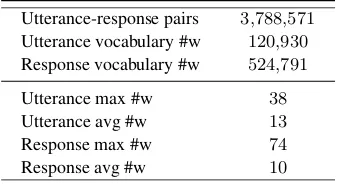
Utterance-response pairs 3,788,571
Utterance vocabulary #w 120,930
Response vocabulary #w 524,791
Utterance max #w 38
Utterance avg #w 13
Response max #w 74
[image:6.595.97.267.63.155.2]Response avg #w 10
Table 1: Short Text Conversation (STC) data statistics: #w denotes the number of Chinese words.
STC dataset contains roughly 3.8 million post-comment pairs, which could be used to simu-late the utterance-response pairs in conversation. We employ the Jieba Chinese word segmenter2
to tokenize the utterances and responses into se-quences of Chinese words, and the detailed data-set statistics are shown in Table1. We randomly selected two subsets as the development and test dataset, each containing 10k pairs. The left pairs are used for training.
4.2 Baselines Methods
We compare our proposed SC-Seq2Seq model against several state-of-the-art baselines: (1)
Seq2Seq-att: the standard Seq2Seq model with the attention mechanism (Bahdanau et al.,2015); (2) MMI-bidi: the Seq2Seq model using Max-imum Mutual Information (MMI) as the object-ive function to reorder the generated responses (Li
et al., 2016a); (3) MARM: the Seq2Seq model
with a probabilistic framework to model the lat-ent responding mechanisms (Zhou et al., 2017); (4) Seq2Seq+IDF: an extension of Seq2Seq-att by optimizing specificity under the reinforcement learning framework, where the reward is calcu-lated as the sentence level IDF score of the gen-erated response (Yao et al., 2016). We refer to our model trained using NIRF and NIWF as SC-Seq2SeqNIRFandSC-Seq2SeqNIWFrespectively.
4.3 Implementation Details
As suggested in (Shang et al., 2015), we con-struct two separate vocabularies for utterances and responses by using 40,000 most frequent words on each side in the training data, covering 97.7% words in utterances and 96.1% words in responses respectively. All the remaining words are replaced by a special token<UNK>symbol.
We implemented our model in Tensorflow3. We
2
https://pypi.python.org/pypi/jieba
3https://www.tensorflow.org/
tuned the hyper-parameters via the development set. Specifically, we use one layer of bi-directional GRU for encoder and another uni-directional GRU for decoder, with the GRU hidden unit size set as 300 in both the encoder and decoder. The dimen-sion of semantic word embeddings in both utter-ances and responses is 300, while the dimension of usage word embeddings in responses is 50. We apply the Adam algorithm (Kingma and Ba,2015) for optimization, where the parameters of Adam are set as in (Kingma and Ba,2015). The variance σ2of the Gaussian Kernel layer is set as 1, and all other trainable parameters are randomly initialized by uniform distribution within [-0.08,0.08]. The mini-batch size for the update is set as 128. We clip the gradient when its norm exceeds 5.
Our model is trained on a Tesla K80 GPU card, and we run the training for up to 12 epochs, which takes approximately five days. We select the model that achieves the lowest perplexity on the development dataset, and we report results on the test dataset.
4.4 Evaluation Methodologies
For evaluation, we follow the existing work and employ both automatic and human evaluations: (1) distinct-1 & distinct-2 (Li et al., 2016a): we count numbers of distinct unigrams and bi-grams in the generated responses, and divide the numbers by total number of generated uni-grams and biuni-grams. Distinct metrics (both the numbers and the ratios) can be used to evalu-ate the specificity/diversity of the responses. (2)
BLEU (Papineni et al., 2002): BLEU has been
proved strongly correlated with human evalu-ations. BLEU-n measures the average n-gram pre-cision on a set of reference sentences. (3)Average & Extrema (Serban et al., 2017): Average and Extrema projects the generated response and the ground truth response into two separate vectors by taking the mean over the word embeddings or tak-ing the extremum of each dimension respectively, and then computes the cosine similarity between them. (4)Human evaluation: Three labelers with rich Weibo experience were recruited to conduct evaluation. Responses from different models are randomly mixed for labeling. Labelers refer to
informat-Models distinct-1 distinct-2 BLEU-1 BLEU-2 Average Extrema
SC-Seq2SeqNIRF
s= 1 5258/0.064 16195/0.269 15.109 7.023 0.578 0.380
s= 0.8 5337/0.065 16105/0.271 15.112 7.003 0.578 0.381
s= 0.5 5318/0.065 16183/0.269 15.054 7.001 0.578 0.380
s= 0.2 5323/0.065 16087/0.270 15.168 7.032 0.580 0.380
s= 0 5397/0.066 16319/0.271 15.093 7.011 0.577 0.380
SC-Seq2SeqNIWF
s= 1 11588/0.116 27144/0.347 12.392 5.869 0.554 0.353
s= 0.8 6006/0.051 17843/0.257 11.492 5.703 0.553 0.350
s= 0.5 2835/0.050 9537/0.235 16.122 7.674 0.609 0.399
s= 0.2 1534/0.048 5117/0.218 8.313 4.058 0.542 0.335
[image:7.595.101.499.64.211.2]s= 0 1038/0.046 3154/0.211 4.417 3.283 0.549 0.334
Table 2: Model analysis of our SC-Seq2Seq under the automatic evaluation.
Models distinct-1 distinct-2 BLEU-1 BLEU-2 Average Extrema Seq2Seq-att 5048/0.060 15976/0.168 15.062 6.964 0.575 0.376 MMI-bidi 5074/0.082 12162/0.287 15.772 7.215 0.586 0.381
MARM 2566/0.096 3294/0.312 7.321 3.774 0.512 0.336
Seq2Seq+IDF 4722/0.052 15384/0.229 14.423 6.743 0.572 0.369 SC-Seq2SeqNIWF,s=1 11588/0.116 27144/0.347 12.392 5.869 0.554 0.353 SC-Seq2SeqNIWF,s=0.5 2835/0.050 9537/0.235 16.122 7.674 0.609 0.399
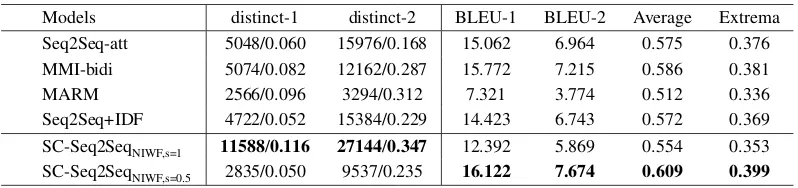
Table 3: Comparisons between our SC-Seq2Seq and the baselines under the automatic evaluation.
ive and interesting; 2)+1: the response is gram-matical and can be used as a response to the utter-ance, but is too trivial (e.g., “I don’t know”); 3)+0: the response is semantically irrelevant or ungram-matical (e.g., gramungram-matical errors or UNK). Agree-ments to measure inter-rater consistency among three labelers are calculated with the Fleiss’ kappa (Fleiss and Cohen,1973).
4.5 Evaluation Results
Model Analysis: We first analyze our models trained with different distant supervision inform-ation. For each model, given a test utterance, we vary the control variablesby setting it to five dif-ferent values (i.e., 0, 0.2, 0.5, 0.8, 1) to check whether the learned model can actually achieve different specificity levels. As shown in Table2, we find that: (1) The SC-Seq2Seq model trained with NIRF cannot work well. The test perform-ances are almost the same with differentsvalue. This is surprising since the NIRF definition seems to be directly corresponding to the specificity of a response. By conducting further analysis, we find that even though the conversation dataset is large, it is still limited and a general response could appear very few times in this corpus. In other words, the inverse frequency of a response is very weakly correlated with its response
spe-cificity. (2) The SC-Seq2Seq model trained with NIWF can achieve our purpose. By varying the control variable sfrom 0 to 1, the generated re-sponses turn from general to specific as measured by the distinct metrics. The results indicate that the max inverse word frequency in a response is a good distant label for the response specificity. (3) When we compare the generated responses against ground truth data, we find the SC-Seq2SeqNIWF
model with the control variable s set to 0.5 can achieve the best performances. The results indic-ate that there are diverse responses in real data in terms of specificity, and it is necessary to take a balanced setting if we want to fit the ground truth.
[image:7.595.100.499.245.339.2]+2 +1 +0 kappa
Seq2Seq-att 29.32% 25.27% 45.41% 0.448 MMI-bidi 30.40% 24.85% 44.75% 0.471
MARM 20.11% 27.96% 51.93% 0.404
Seq2Seq+IDF 28.81% 23.87% 47.33% 0.418
SC-Seq2SeqNIWF,s=1 42.47% 14.29% 43.24% 0.507 SC-Seq2SeqNIWF,s=0.5 20.62% 40.16% 39.22% 0.451 SC-Seq2SeqNIWF,s=0 14.34% 46.38% 39.28% 0.526
Table 4: Results on the human evaluation.
the Seq2Seq model, the Seq2Seq+IDF does not show much advantages, but only achieves compar-able results as MMI-bidi. (4) By setting the con-trol variable s to 1, our SC-Seq2SeqNIWF model
can achieve the best specificity performance as evaluated by the distinct metrics. By setting the control variable s to 0.5, our SC-Seq2SeqNIWF
model can best fit the ground truth data as eval-uated by the BLEU scores, Average and Extrema. All the improvements over the baseline models are statistically significant (p-value < 0.01). These results demonstrate the effectiveness as well as the flexibility of our controlled generation model.
Table4shows the human evaluation results. We can observe that: (1) SC-Seq2SeqNIWF,s=1 gen-erates the most informative responses and inter-esting (labeled as “+2”) and the least general re-sponses than all the baseline models. Meanwhile, SC-Seq2SeqNIWF,s=0 generates the most general responses (labeled as “+1”); (2) MARM gener-ates the most bad responses (labeled as “+0”), which indicates the drawbacks of the unknown lat-ent responding mechanisms; (3) The kappa values of our models are all larger than 0.4, considered as “moderate agreement” regarding quality of re-sponses. The largest kappa value is achieved by SC-Seq2SeqNIWF,s=0, which seems reasonable since it is easy to reach an agreement on general responses. Sign tests demonstrate the improve-ments of SC-Seq2SeqNIWF,s=1to the baseline mod-els are statistically significant (p-value < 0.01). All the human judgement results again demon-strate the effectiveness of our controlled genera-tion mechanism.
4.6 Case Study
To better understand how different models per-form, we conduct some case studies. We randomly sample three utterances from the test dataset, and show the responses generated by different models.
Utterance:三室一厅的帐篷,你值得拥有!A tent with three rooms and one hall, you’re worth it!
Seq2Seq-att:这个不错,很好!It looks good, very good!
MMI-bidi:这个不错,我喜欢。It looks good, I like it. MARM:不错。Good.
Seq2Seq+IDF:帐篷不错。The tent is good.
s=1:我想知道这帐篷是什么牌子的?I want to know what the brand of this tent is?
s=0.8:我想知道这是在哪买的?I want to know where to buy it?
s=0.5:我也想买一个,可惜买不起!I want one too, but it’s a pity that I can’t afford it.
s=0.2:不错不错!Good, good.
s=0:真的吗?Really?
Utterance:哎哟!被发现了!汤唯有必要那么美吗? Oh! Got caught! Why is Tang Wei so beautiful?
Seq2Seq-att:我超喜欢她!I really like her!
MMI-bidi:好美。我超喜欢她!So beautiful. I really like her! MARM:我不喜欢汤唯。I don’t like Tang Wei.
Seq2Seq+IDF:我超喜欢她的,我喜欢。I really like her, I like.
s=1:我超喜欢她的眼妆,她的气质很美!I really like her eye make-up, and her temperament is so beautiful!
s=0.8:我超喜欢她的,她的眼睛很雪亮!I really like her, and her eyes are so bright!
s=0.5:我觉得她很美,很喜欢她!I think she is very beautiful, and I really like her!
s=0.2:我觉得她很美!I think she is very beautiful. s=0:是的。Yes.
Utterance:将来也要养一只这么乖的的萨摩,让它陪着孩子一起长大。I will keep such a sweet samoyed, and let it accompany my children to grow up. Seq2Seq-att:这不是萨摩吗?Is it a samoyed?
MMI-bidi:好可爱的萨摩。What a lovely samoyed. MARM:好可爱啊。So lovely.
Seq2Seq+IDF:好可爱的狗狗。What a lovely dog.
s=1:萨摩耶好可爱,真想养一只! The samoyed is so lovely, and I really want to keep one!
s=0.8:萨摩好可爱,好想掐掐。The samoyed is so lovely, and I really want to pinch it.
s=0.5:好可爱的狗狗,好可爱的狗狗。What a lovely dog, what a lovely dog.
s=0.2:好可爱!好可爱!So lovely, so lovely!
s=0:好可爱!So lovely!
Table 5: Examples of response generation from the STC test data. s = 1, 0.8, 0.5, 0.2, 0 are the outputs of our SC-Seq2SeqNIWFwith differentsvalues.
爸爸(dad) 水果(fruits) 脂肪肝(fatty liver) 单反相机(DSLR)
Usage Semantic Usage Semantic Usage Semantic Usage Semantic
更好(better) 妈妈(mother) 尝试(attempt) 蔬菜(vegetables) 坐久(outsit) 胖(fat) 亚洲杯(Asian Cup) 照相机(camera) 睡觉(sleep) 哥哥(brother) 诱惑(tempt) 牛奶(milk) 素食主义(vegetarian) 减肥(diet) 读取(read) 摄影(photography)
快乐(happy) 老公(husband) 表现(express) 西瓜(watermelon) 散步(walk) 高血压(hypertension) 半球(hemispherical) 镜头(shot)
[image:9.595.76.286.200.291.2]无聊(boring) 爷爷(grandfather) 拥有(own) 米饭(rice) 因果关系(causality) 亚健康(sub-health) 防辐射(anti-radiation) 影楼(studio) 电影(movie) 姑娘(girl) 梦想(dream) 巧克力(chocolate) 哑铃(dumbbell) 呕吐(emesis) 无人机(UAV) 写真(image)
Table 6: Target words and their top-5 similar words under usage and semantic representations respectively.
fatty liver outsit
fat
fatty liver fat
outsit
(a) usage (b) semantic
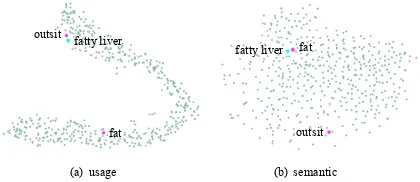
Figure 3: t-SNE embeddings of usage and semantic vectors.
4.7 Analysis on Usage Representations
We also conduct some analysis to understand the usage representations of words introduced in our model. We randomly sample 500 words from our SC-Seq2SeqNIWF and apply t-SNE (Maaten
and Hinton,2008) to visualize both usage and
se-mantic embeddings. As shown in Figure 3, we can see that the two distributions are significantly different. In the usage space, words like “脂
肪肝(fatty liver)” and “久坐(outsit)” lie closely which are both specific words, and both are far from the general words like “胖(fat)”. On the contrary, in the semantic space, “脂肪 肝(fatty liver)” is close to “胖(fat)” since they are se-mantically related, and both are far from the word “久坐(outsit)”. Furthermore, given some sampled target words, we also show the top-5 similar words based on cosine similarity under both represent-ations in Table 6. Again, we can see that the nearest neighbors of a same word are quite differ-ent under two represdiffer-entations. Neighbors based on semantic representations are semantically re-lated, while neighbors based on usage representa-tions are not so related but with similar specificity levels.
5 Conclusion
We propose a novel controlled response gener-ation mechanism to handle different utterance-response relationships in terms of specificity. We introduce an explicit specificity control variable
into the Seq2Seq model, which interacts with the usage representation of words to generate re-sponses at different specificity levels. Empirical results showed that our model can generate either general or specific responses, and significantly outperform state-of-the-art generation methods.
6 Acknowledgments
This work was funded by the 973 Program of China under Grant No. 2014CB340401, the National Natural Science Foundation of China (NSFC) under Grants No. 61425016, 61472401, 61722211, and 20180290, the Youth Innova-tion PromoInnova-tion AssociaInnova-tion CAS under Grants No. 20144310, and 2016102, and the National Key R&D Program of China under Grants No. 2016QY02D0405.
References
Dzmitry Bahdanau, Kyunghyun Cho, and Yoshua Ben-gio. 2015. Neural machine translation by jointly learning to align and translate. InICLR.
Kyunghyun Cho, Bart Van Merri¨enboer, Caglar Gul-cehre, Dzmitry Bahdanau, Fethi Bougares, Holger Schwenk, and Yoshua Bengio. 2014. Learning phrase representations using rnn encoder-decoder for statistical machine translation. In Proceedings of the conference on empirical methods in natural language processing.
Joseph L Fleiss and Jacob Cohen. 1973. The equival-ence of weighted kappa and the intraclass correla-tion coefficient as measures of reliability. Educa-tional and psychological measurement, 33(3):613– 619.
Jiatao Gu, Zhengdong Lu, Hang Li, and Victor OK Li. 2016. Incorporating copying mechanism in sequence-to-sequence learning. In Proceedings of the 54th annual meeting of the Association for Com-putational Linguistics. Association for Computa-tional Linguistics.
challenge. InProceedings of the 15th Annual Meet-ing of the Special Interest Group on Discourse and Dialogue (SIGDIAL), pages 263–272.
Anil Jain, Karthik Nandakumar, and Arun Ross. 2005. Score normalization in multimodal biometric sys-tems. Pattern recognition, 38(12):2270–2285.
Michael Kearns. 2000. Cobot in lambdamoo: A social statistics agent.
Diederik Kingma and Jimmy Ba. 2015. Adam: A method for stochastic optimization. InInternational Conference on Learning Representations.
Jiwei Li, Michel Galley, Chris Brockett, Jianfeng Gao, and Bill Dolan. 2016a. A diversity-promoting ob-jective function for neural conversation models. In
NAACL.
Jiwei Li, Michel Galley, Chris Brockett, Georgios P Spithourakis, Jianfeng Gao, and Bill Dolan. 2016b. A persona-based neural conversation model. In Pro-ceedings of the 54th annual meeting of the Associ-ation for ComputAssoci-ational Linguistics.
Jiwei Li, Will Monroe, and Dan Jurafsky. 2017. Data distillation for controlling specificity in dialogue generation. arXiv preprint arXiv:1702.06703.
Laurens van der Maaten and Geoffrey Hinton. 2008. Visualizing data using t-sne. Journal of Machine Learning Research, 9(Nov):2579–2605.
Lili Mou, Yiping Song, Rui Yan, Ge Li, Lu Zhang, and Zhi Jin. 2016. Sequence to backward and forward sequences: A content-introducing approach to gen-erative short-text conversation. InCOLING.
Kishore Papineni, Salim Roukos, Todd Ward, and Wei-Jing Zhu. 2002. Bleu: a method for automatic eval-uation of machine translation. In Proceedings of the 40th annual meeting on association for compu-tational linguistics, pages 311–318. Association for Computational Linguistics.
Diana Perez-Marin. 2011. Conversational Agents and Natural Language Interaction: Techniques and Ef-fective Practices: Techniques and EfEf-fective Prac-tices. IGI Global.
Alan Ritter, Colin Cherry, and William B Dolan. 2011. Data-driven response generation in social media. In
Proceedings of the conference on empirical methods in natural language processing, pages 583–593. As-sociation for Computational Linguistics.
Iulian Vlad Serban, Alessandro Sordoni, Yoshua Ben-gio, Aaron C Courville, and Joelle Pineau. 2016. Building end-to-end dialogue systems using gener-ative hierarchical neural network models. InAAAI, pages 3776–3784.
Iulian Vlad Serban, Alessandro Sordoni, Ryan Lowe, Laurent Charlin, Joelle Pineau, Aaron C Courville, and Yoshua Bengio. 2017. A hierarchical latent variable encoder-decoder model for generating dia-logues. InAAAI.
Lifeng Shang, Zhengdong Lu, and Hang Li. 2015. Neural responding machine for short-text conversa-tion. InProceedings of the 53th annual meeting of the Association for Computational Linguistics. As-sociation for Computational Linguistics.
Xiaoyu Shen, Hui Su, Yanran Li, Wenjie Li, Shuzi Niu, Yang Zhao, Akiko Aizawa, and Guoping Long. 2017. A conditional variational framework for dia-log generation. In Proceedings of the 55th annual meeting of the Association for Computational Lin-guistics.
Alessandro Sordoni, Michel Galley, Michael Auli, Chris Brockett, Yangfeng Ji, Margaret Mitchell, Jian-Yun Nie, Jianfeng Gao, and Bill Dolan. A neural network approach to context-sensitive gener-ation of conversgener-ational responses. InNAACL-HLT, pages 196–205.
Ilya Sutskever, Oriol Vinyals, and Quoc V Le. 2014. Sequence to sequence learning with neural net-works. InNIPS, pages 3104–3112.
Marilyn A Walker, Rebecca Passonneau, and Julie E Boland. 2001. Quantitative and qualitative evalu-ation of darpa communicator spoken dialogue sys-tems. In Proceedings of the 39th Annual Meeting on Association for Computational Linguistics, pages 515–522. Association for Computational Linguist-ics.
Hao Wang, Zhengdong Lu, Hang Li, and Enhong Chen. 2013. A dataset for research on short-text conversations. InProceedings of the conference on empirical methods in natural language processing.
Jason Williams, Antoine Raux, Deepak Ramachandran, and Alan Black. 2013. The dialog state tracking challenge. In Proceedings of the SIGDIAL 2013 Conference, pages 404–413.
Chen Xing, Wei Wu, Yu Wu, Jie Liu, Yalou Huang, Ming Zhou, and Wei-Ying Ma. 2017. Topic aware neural response generation. In AAAI, pages 3351– 3357.
Rui Yan, Yiping Song, and Hua Wu. 2016. Learning to respond with deep neural networks for retrieval-based human-computer conversation system. In
Proceedings of the 39st annual international ACM SIGIR conference on Research and development in information retrieval, pages 55–64. ACM.
Kaisheng Yao, Baolin Peng, Geoffrey Zweig, and Kam-Fai Wong. 2016. An attentional neural conver-sation model with improved specificity. arXiv pre-print arXiv:1606.01292.
Ganbin Zhou, Ping Luo, Rongyu Cao, Fen Lin, Bo Chen, and Qing He. 2017. Mechanism-aware neural machine for dialogue response generation. In