989
Discourse Marker Augmented Network with Reinforcement Learning for
Natural Language Inference
Boyuan Pan†, Yazheng Yang‡, Zhou Zhao‡, Yueting Zhuang‡, Deng Cai†]∗, Xiaofei He?† †State Key Lab of CAD&CG, Zhejiang University, Hangzhou, China
‡College of Computer Science, Zhejiang University, Hangzhou, China ]Alibaba-Zhejiang University Joint Institute of Frontier Technologies
?Fabu Inc., Hangzhou, China
{panby, yazheng yang, zhaozhou, yzhuang}@zju.edu.cn
{dengcai, xiaofeihe}@cad.zju.edu.com
Abstract
Natural Language Inference (NLI), also known as Recognizing Textual Entailment (RTE), is one of the most important prob-lems in natural language processing. It re-quires to infer the logical relationship be-tween two given sentences. While current approaches mostly focus on the interac-tion architectures of the sentences, in this paper, we propose to transfer knowledge from some important discourse markers to augment the quality of the NLI model. We observe that people usually use some dis-course markers such as “so” or “but” to represent the logical relationship between two sentences. These words potentially have deep connections with the meanings of the sentences, thus can be utilized to help improve the representations of them. Moreover, we use reinforcement learning to optimize a new objective function with a reward defined by the property of the NLI datasets to make full use of the labels information. Experiments show that our method achieves the state-of-the-art per-formance on several large-scale datasets.
1 Introduction
In this paper, we focus on the task of Natural Lan-guage Inference (NLI), which is known as a sig-nificant yet challenging task for natural language understanding. In this task, we are given two sen-tences which are respectively calledpremiseand hypothesis. The goal is to determine whether the logical relationship between them is entailment, neutral, orcontradiction.
Recently, performance on NLI(Chen et al., 2017b; Gong et al., 2018; Chen et al., 2017c)
∗
corresponding author
Premise: A soccer game with multiple males playing.
Hypothesis: Some men are playing a sport. Label:Entailment
Premise: An older and younger man smiling. Hypothesis: Two men are smiling and laughing at the cats playing on the floor.
Label:Neutral
Premise: A black race car starts up in front of a crowd of people
Hypothesis: A man is driving down a lonely road.
Label:Contradiction
Table 1: Three examples in SNLI dataset.
has been significantly boosted since the re-lease of some high quality large-scale benchmark datasets such as SNLI(Bowman et al.,2015) and MultiNLI(Williams et al., 2017). Table 1 shows some examples in SNLI. Most state-of-the-art works focus on the interaction architectures be-tween the premise and the hypothesis, while they rarely concerned the discourse relations of the sen-tences, which is a core issue in natural language understanding.
People usually use some certain set of words to express the discourse relation between two sen-tences1. These words, such as “but” or “and”, are
denoted as discourse markers. These discourse markers have deep connections with the intrinsic relations of two sentences and intuitively corre-spond to the intent of NLI, such as “but” to “con-tradiction”, “so” to “entailment”,etc.
Very few NLI works utilize this information re-vealed by discourse markers. Nie et al. (2017) proposed to use discourse markers to help
rep-1Here sentences mean either the whole sentences or the
resent the meanings of the sentences. However, they represent each sentence by a single vector and directly concatenate them to predict the answer, which is too simple and not ideal for the large-scale datasets.
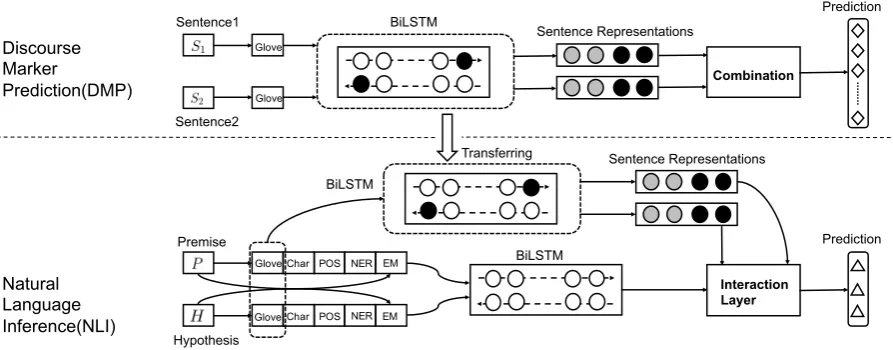
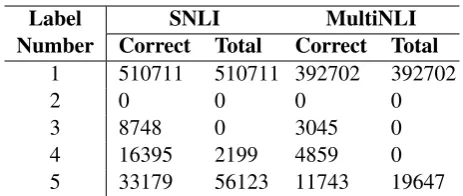
In this paper, we propose a Discourse Marker Augmented Network for natural language infer-ence, where we transfer the knowledge from the existing supervised task: Discourse Marker Pre-diction (DMP)(Nie et al., 2017), to an integrated NLI model. We first propose a sentence encoder model that learns the representations of the stences from the DMP task and then inject the en-coder to the NLI network. Moreover, because our NLI datasets are manually annotated, each exam-ple from the datasets might get several different la-bels from the annotators although they will finally come to a consensus and also provide a certain la-bel. In consideration of that different confidence level of the final labels should be discriminated, we employ reinforcement learning with a reward defined by the uniformity extent of the original la-bels to train the model. The contributions of this paper can be summarized as follows.
• Unlike previous studies, we solve the task of the natural language inference via trans-ferring knowledge from another supervised task. We propose the Discourse Marker Aug-mented Network to combine the learned en-coder of the sentences with the integrated NLI model.
• According to the property of the datasets, we incorporate reinforcement learning to opti-mize a new objective function to make full use of the labels’ information.
• We conduct extensive experiments on two large-scale datasets to show that our method achieves better performance than other state-of-the-art solutions to the problem.
2 Task Description
2.1 Natural Language Inference (NLI)
In the natural language inference tasks, we are given a pair of sentences (P, H), which respec-tively means the premise and hypothesis. Our goal is to judge whether their logical relationship between their meanings by picking a label from a small set: entailment (The hypothesis is defi-nitely a true description of the premise), neutral
(The hypothesis might be a true description of the premise), andcontradiction(The hypothesis is definitely a false description of the premise).
2.2 Discourse Marker Prediction (DMP)
For DMP, we are given a pair of sentences (S1, S2), which is originally the first half and sec-ond half of a complete sentence. The model must predict which discourse marker was used by the author to link the two ideas from a set of candi-dates.
3 Sentence Encoder Model
Following (Nie et al.,2017;Kiros et al.,2015), we use BookCorpus(Zhu et al.,2015) as our training data for discourse marker prediction, which is a dataset of text from unpublished novels, and it is large enough to avoid bias towards any particular domain or application. After preprocessing, we obtain a dataset with the form(S1, S2, m), which means the first half sentence, the last half sentence, and the discourse marker that connected them in the original text. Our goal is to predict themgiven
S1andS2.
We first use Glove(Pennington et al., 2014) to transform{St}2t=1 into vectors word by word and subsequently input them to a bi-directional LSTM:
− →
hti =−−−−→LSTM(Glove(Sti)), i= 1, ...,|St|
←−
hit =←−−−−LSTM(Glove(Sti)), i=|St|, ...,1
(1)
whereGlove(w)is the embedding vector of the word w from theGlove lookup table, |St|is the
length of the sentence St. We apply max
pool-ing on the concatenation of the hidden states from both directions, which provides regularization and shorter back-propagation paths(Collobert and We-ston, 2008), to extract the features of the whole sequences of vectors:
− →r
t = Maxdim([
−→
h1t;−h→2t;...; −−→
h|St|
t ])
←−
rt = Maxdim([
←−
h1t; ←−
h2t;...; ←−−
h|St|
t ])
(2)
whereMaxdimmeans that the max pooling is
per-formed across each dimension of the concatenated vectors,[; ] denotes concatenation. Moreover, we combine the last hidden state from both directions and the results of max pooling to represent our sentences:
rt= [−→rt;←r−t;
−−→
h|St|
t ;
←−
Discourse Marker
Prediction(DMP)
Natural Language Inference(NLI)
Combination
Interaction Layer
Glove
Glove
Glove
Glove Char
Char POS POS
NER NER EM
EM
BiLSTM
BiLSTM
BiLSTM
Prediction Prediction Sentence Representations
Sentence Representations Sentence1
Sentence2
Premise
Hypothesis
Transferring
Figure 1: Overview of our Discource Marker Augmented Network, comprising the part of Discourse Marker Prediction (upper) for pre-training and Natural Language Inferance (bottom) to which the learned knowledge will be transferred.
where rt is the representation vector of the
sen-tence St. To predict the discource marker
be-tweenS1andS2, we combine the representations of them with some linear operation:
r= [r1;r2;r1+r2;r1r2] (4)
where is elementwise product. Finally we project rto a vector of label size (the total num-ber of discourse markers in the dataset) and use softmax function to normalize the probability dis-tribution.
4 Discourse Marker Augmented Network
As presented in Figure1, we show how our Dis-course Marker Augmented Network incorporates the learned encoder into the NLI model.
4.1 Encoding Layer
We denote the premise asP and the hypothesis as
H. To encode the words, we use the concatenation of following parts:
Word Embedding: Similar to the previous sec-tion, we map each word to a vector space by using pre-trained word vectorsGloVe.
Character Embedding:We apply Convolutional Neural Networks (CNN) over the characters of each word. This approach is proved to be help-ful in handling out-of-vocab (OOV) words(Yang et al.,2017).
POS and NER tags: We use the part-of-speech (POS) tags and named-entity recognition (NER)
tags to get syntactic information and entity label of the words. Following (Pan et al.,2017b), we ap-ply the skip-gram model(Mikolov et al.,2013) to train two new lookup tables of POS tags and NER tags respectively. Each word can get its own POS embedding and NER embedding by these lookup tables. This approach represents much better geo-metrical features than common used one-hot vec-tors.
Exact Match: Inspired by the machine compre-hension tasks(Chen et al., 2017a), we want to know whether every word in P is in H (and H
in P). We use three binary features to indicate whether the word can be exactly matched to any question word, which respectively means original form, lowercase and lemma form.
For encoding, we pass all sequences of vectors into a bi-directional LSTM and obtain:
pi = BiLSTM(frep(Pi),pi−1), i= 1, ..., n uj = BiLSTM(frep(Hj),uj−1), j = 1, ..., m
(5) where frep(x) = [Glove(x); Char(x); POS(x);
NER(x); EM(x)]is the concatenation of the em-bedding vectors and the feature vectors of the wordx,n=|P|,m=|H|.
4.2 Interaction Layer
[image:3.595.78.525.66.241.2]We first obtain a similarity matrixA ∈ Rn×m
between the premise and hypothesis by
Aij =v1>[pi;uj;pi◦uj;rp;rh] (6)
wherev1 is the trainable parameter,rpandrhare
sentences representations from the equation (3) learned in the Section3, which denote the premise and hypothesis respectively. In addition to previ-ous popular similarity matrix, we incorporate the relevance of each word ofP(H)to the whole sen-tence ofH(P). Now we useAto obtain the atten-tions and the attended vectors in both direcatten-tions.
To signify the attention of thei-th word ofP to every word ofH, we use the weighted sum ofuj
byAi::
˜
ui=
X
j
Aij ·uj (7)
where u˜i is the attention vector of the i-th word
ofP for the entireH. In the same way, thep˜j is
obtained via:
˜
pj =
X
i
Aij·pi (8)
To model the local inference between aligned word pairs, we integrate the attention vectors with the representation vectors via:
ˆ
pi=f([pi; ˜ui;pi−u˜i;piu˜i])
ˆ
uj =f([uj; ˜pj;uj −p˜j;ujp˜j])
(9)
wheref is a 1-layer feed-forward neural network with the ReLU activation function,pˆi anduˆj are
local inference vectors. Inspired by (Seo et al., 2016) and (Chen et al., 2017b), we use a mod-eling layer to capture the interaction between the premise and the hypothesis. Specifically, we use bi-directional LSTMs as building blocks:
pMi = BiLSTM(ˆpi,pMi−1)
uMj = BiLSTM(ˆuj,uMj−1)
(10)
Here,pMi anduMj are the modeling vectors which contain the crucial information and relationship among the sentences.
We compute the representation of the whole sentence by the weighted average of each word:
pM =X
i
exp(v>2pMi )
P
i0exp(v>2pMi0 )
pMi
uM =X
j
exp(v>3uM j )
P
j0exp(v>3uMj0 )
uMj
(11)
Label SNLI MultiNLI
Number Correct Total Correct Total
1 510711 510711 392702 392702
2 0 0 0 0
3 8748 0 3045 0
4 16395 2199 4859 0
5 33179 56123 11743 19647
Table 2: Statistics of the labels of SNLI and MuliNLI. Total means the number of examples whose number of annotators is in the left column. Correct means the number of examples whose number of correct labels from the annotators is in the left column.
wherev2,v3are trainable vectors. We don’t share these parameter vectors in this seemingly parallel strucuture because there is some subtle difference between the premise and hypothesis, which will be discussed later in Section5.
4.3 Output Layer
The NLI task requires the model to predict the logical relation from the given set: entailment, neutralorcontradiction. We obtain the probabil-ity distribution by a linear function with softmax function:
d= softmax(W[pM;uM;pM uM;rprh])
(12) where W is a trainable parameter. We com-bine the representations of the sentences computed above with the representations learned from DMP to obtain the final prediction.
4.4 Training
[image:4.595.305.537.60.158.2]We propose a new objective function that com-bines both the log probabilities of the ground-truth label and a reward defined by the property of the datasets for the reinforcement learning. The most widely used objective function for the natural lan-guage inference is to minimize the negative log cross-entropy loss:
JCE(Θ) =−
1
N
N
X
k
log(dkl) (13)
whereΘare all the parameters to optimize,N is the number of examples in the dataset, dl is the
probability of the ground-truth labell.
However, directly using the final label to train the model might be difficult in some situations, where the example is confusing and the labels from the annotators are different. For instance, consider an example from the SNLI dataset:
• P: “A smiling costumed woman is holding an umbrella.”
• H: “A happy woman in a fairy costume holds an umbrella.”
The final label is neutral, but the original labels from the five annotators are neural, neural, en-tailment,contradiction,neural, in which case the relation between “smiling” and “happy” might be under different comprehension. The final label’s confidence of this example is obviously lower than an example that all of its labels are the same. To simulate the thought of human being more closely, in this paper, we tackle this problem by using the REINFORCE algorithm(Williams, 1992) to min-imize the negative expected reward, which is de-fined as:
JRL(Θ) =−El∼π(l|P,H)[R(l,{l∗})] (14)
whereπ(l|P, H)is the previous action policy that predicts the label givenP andH,{l∗}is the set of annotated labels, and
R(l,{l∗}) = number of lin{l
∗}
|{l∗}| (15)
is the reward function defined to measure the dis-tance to all the ideas of the annotators.
To avoid of overwriting its earlier results and further stabilize training, we use a linear function to integrate the above two objective functions:
J(Θ) =λJCE(Θ) + (1−λ)JRL(Θ) (16)
whereλis a tunable hyperparameter.
Discourse Marker Percentage(%)
but 57.12
because 9.41
if 29.78
when 25.32
so 31.01
although 1.76
before 15.52
[image:5.595.322.507.64.195.2]still 11.29
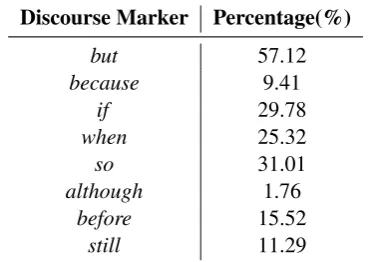
Table 3: Statistics of discouse markers in our dataset from BookCorpus.
5 Experiments
5.1 Datasets
BookCorpus: We use the dataset from BookCor-pus(Zhu et al., 2015) to pre-train our sentence encoder model. We preprocessed and collected discourse markers from BookCorpus as (Nie et al., 2017). We finally curated a dataset of 6527128 pairs of sentences for 8 discourse markers, whose statistics are shown in Table3.
SNLI: Stanford Natural Language Infer-ence(Bowman et al., 2015) is a collection of more than 570k human annotated sentence pairs labeled for entailment, contradiction, and semantic independence. SNLI is two orders of magnitude larger than all other resources of its type. The premise data is extracted from the cap-tions of the Flickr30k corpus(Young et al.,2014), the hypothesis data and the labels are manually annotated. The original SNLI corpus contains also the other category, which includes the sentence pairs lacking consensus among multiple human annotators. We remove this category and use the same split as in (Bowman et al.,2015) and other previous work.
Method SNLI MultiNLI
Matched Mismatched
300D LSTM encoders(Bowman et al.,2016) 80.6 – –
300D Tree-based CNN encoders(Mou et al.,2016) 82.1 – –
4096D BiLSTM with max-pooling(Conneau et al.,2017) 84.5 – –
600D Gumbel TreeLSTM encoders(Choi et al.,2017) 86.0 – –
600D Residual stacked encoders(Nie and Bansal,2017) 86.0 74.6 73.6
Gated-Att BiLSTM(Chen et al.,2017d) – 73.2 73.6
100D LSTMs with attention(Rockt¨aschel et al.,2016) 83.5 – –
300D re-read LSTM(Sha et al.,2016) 87.5 – –
DIIN(Gong et al.,2018) 88.0 78.8 77.8
Biattentive Classification Network(McCann et al.,2017) 88.1 – –
300D CAFE(Tay et al.,2017) 88.5 78.7 77.9
KIM(Chen et al.,2017b) 88.6 – –
600D ESIM + 300D Syntactic TreeLSTM(Chen et al.,2017c) 88.6 – –
DMAN 88.8 78.9 78.2
BiMPM(Ensemble)(Wang et al.,2017) 88.8 – –
DIIN(Ensemble)(Gong et al.,2018) 88.9 80.0 78.7
KIM(Ensemble)(Chen et al.,2017b) 89.1 – –
300D CAFE(Ensemble)(Tay et al.,2017) 89.3 80.2 79.0
[image:6.595.76.522.66.360.2]DMAN(Ensemble) 89.6 80.3 79.4
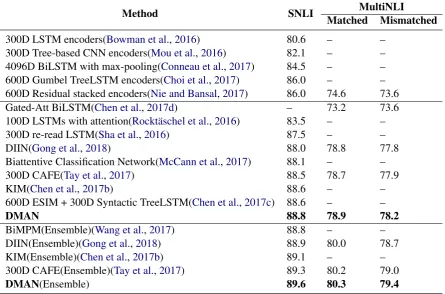
Table 4: Performance on the SNLI dataset and the MultiNLI dataset. In the top part, we show sentence encoding-based models; In the medium part, we present the performance of integrated neural network models; In the bottom part, we show the results of ensemble models.
5.2 Implementation Details
We use the Stanford CoreNLP toolkit(Manning et al., 2014) to tokenize the words and generate POS and NER tags. The word embeddings are ini-tialized by 300d Glove(Pennington et al., 2014), the dimensions of POS and NER embeddings are 30 and 10. The dataset we use to train the embed-dings of POS tags and NER tags are the training set given by SNLI. We apply Tensorflow r1.3 as our neural network framework. We set the hid-den size as 300 for all the LSTM layers and ap-ply dropout(Srivastava et al., 2014) between lay-ers with an initial ratio of 0.9, the decay rate as 0.97 for every 5000 step. We use the AdaDelta for optimization as described in (Zeiler,2012) withρ
as 0.95 andas 1e-8. We set our batch size as 36 and the initial learning rate as 0.6. The parame-terλin the objective function is set to be 0.2. For DMP task, we use stochastic gradient descent with initial learning rate as 0.1, and we anneal by half each time the validation accuracy is lower than the previous epoch. The number of epochs is set to be 10, and the feedforward dropout rate is 0.2. The
learned encoder in subsequent NLI task is train-able.
5.3 Results
In table4, we compare our model to other compet-itive published models on SNLI and MultiNLI. As we can see, our method Discourse Marker Aug-mented Network (DMAN) clearly outperforms all the baselines and achieves the state-of-the-art re-sults on both datasets.
The methods in the top part of the table are sentence encoding based models. Bowman et al. (2016) proposed a simple baseline that uses LSTM to encode the whole sentences and feed them into a MLP classifier to predict the final inference re-lationship, they achieve an accuracy of 80.6% on SNLI. Nie and Bansal(2017) test their model on both SNLI and MiltiNLI, and achieves competi-tive results.
Ablation Model Accuracy
Only Sentence Encoder Model 83.37
No Sentence Encoder Model 87.24
No Char Embedding 87.95
No POS Embedding 88.76
No NER Embedding 88.71
No Exact Match 88.26
No REINFORCE 88.41
DMAN 88.83
Table 5: Ablations on the SNLI development dataset.
CAFE(Tay et al., 2017) exceed other methods by more than 4% on MultiNLI dataset. How-ever, our DMAN achieves 88.8% on SNLI, 78.9% on matched MultiNLI and 78.2% on mismatched MultiNLI, which are all best results among the baselines.
We present the ensemble results on both datasets in the bottom part of the table 4. We build an ensemble model which consists of 10 sin-gle models with the same architecture but initial-ized with different parameters. The performance of our model achieves 89.6% on SNLI, 80.3% on matched MultiNLI and 79.4% on mismatched MultiNLI, which are all state-of-the-art results.
5.4 Ablation Analysis
As shown in Table5, we conduct an ablation ex-periment on SNLI development dataset to evaluate the individual contribution of each component of our model. Firstly we only use the results of the sentence encoder model to predict the answer, in other words, we represent each sentence by a sin-gle vector and use dot product with a linear func-tion to do the classificafunc-tion. The result is obvi-ously not satisfactory, which indicates that only using sentence embedding from discourse mark-ers to predict the answer is not ideal in large-scale datasets. We then remove the sentence encoder model, which means we don’t use the knowledge transferred from the DMP task and thus the rep-resentations rp andrh are set to be zero vectors
[image:7.595.75.292.65.199.2]in the equation (6) and the equation (12). We observe that the performance drops significantly to 87.24%, which is nearly 1.5% to our DMAN model, which indicates that the discourse mark-ers have deep connections with the logical rela-tions between two sentences they links. When
Figure 2: Performance when the sentence encoder is pretrained on different discourse markers sets. “NONE” means the model doesn’t use any dis-course markers; “ALL” means the model use all the discourse markers.
we remove the character-level embedding and the POS and NER features, the performance drops a lot. We conjecture that those feature tags help the model represent the words as a whole while the char-level embedding can better handle the out-of-vocab (OOV) or rare words. The exact match feature also demonstrates its effectiveness in the ablation result. Finally, we ablate the reinforce-ment learning part, in other words, we only use the original loss function to optimize the model (setλ= 1). The result drops about 0.5%, which proves that it is helpful to utilize all the informa-tion from the annotators.
5.5 Semantic Analysis
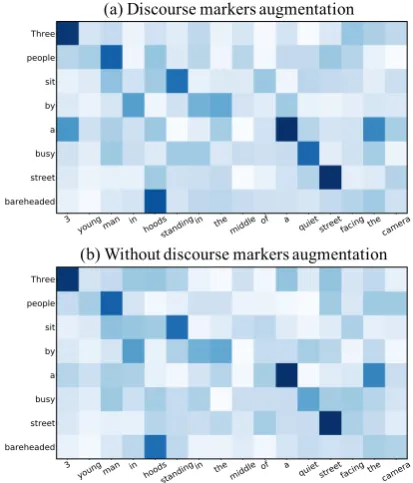
[image:7.595.318.522.73.236.2](a) Discourse markers augmentation
[image:8.595.72.279.67.309.2](b) Without discourse markers augmentation
Figure 3: Comparison of the visualized similarity relations.
actually improve the performance of the model. Compared to the other two categories, the “contra-diction” label examples seem to benefit the most from the pre-trained sentence encoder.
5.6 Visualization
In Figure3, we also provide a visualized analysis of the hidden representation from similarity ma-trixA(computed in the equation (6)) in the situ-ations that whether we use the discourse markers or not. We pick a sentence pair whose premise is “3 young man in hoods standing in the mid-dle of a quiet street facing the camera.” and hy-pothesis is “Three people sit by a busy street bare-headed.” We observe that the values are highly correlated among the synonyms like “people” with “man”, “three” with “3” in both situations. How-ever, words that might have contradictory mean-ings like “hoods” with “bareheaded”, “quiet” with “busy” perform worse without the discourse mark-ers augmentation, which conforms to the conclu-sion that the “contradiction” label examples bene-fit a lot which is observed in the Section5.5.
6 Related Work
6.1 Discourse Marker Applications
This work is inspired most directly by the DisSent model and Discourse Prediction Task ofNie et al. (2017), which introduce the use of the discourse
markers information for the pretraining of sen-tence encoders. They follow (Kiros et al.,2015) to collect a large sentence pairs corpus from Book-Corpus(Zhu et al., 2015) and propose a sentence representation based on that. They also apply their pre-trained sentence encoder to a series of natural language understanding tasks such as sentiment analysis, question-type, entailment, and related-ness. However, all those datasets are provided by Conneau et al.(2017) for evaluating sentence em-beddings and are almost all small-scale and are not able to support more complex neural network. Moreover, they represent each sentence by a sin-gle vector and directly combine them to predict the answer, which is not able to interact among the words level.
In closely related work, Jernite et al. (2017) propose a model that also leverage discourse re-lations. However, they manually group the dis-course markers into several categories based on human knowledge and predict the category instead of the explicit discourse marker phrase. How-ever, the size of their dataset is much smaller than that in (Nie et al.,2017), and sometimes there has been disagreement among annotators about what exactly is the correct categorization of discourse relations(Hobbs,1990).
Unlike previous works, we insert the sentence encoder into an integrated network to augment the semantic representation for NLI tasks rather than directly combining the sentence embeddings to predict the relations.
6.2 Natural Language Inference
Earlier research on the natural language inference was based on small-scale datasets(Marelli et al., 2014), which relied on traditional methods such as shallow methods(Glickman et al., 2005), natural logic methods(MacCartney and Manning, 2007), etc. These datasets are either not large enough to support complex deep neural network models or too easy to challenge natural language.
et al., 2017; Gong et al., 2018; McCann et al., 2017;Chen et al., 2017b; Choi et al., 2017;Tay et al.,2017). Most of them focus on the improve-ment of the interaction architectures and obtain competitive results, while transfer learning from external knowledge is popular as well. Vendrov et al. (2016) incorpated Skipthought(Kiros et al., 2015), which is an unsupervised sequence model that has been proven to generate useful sentence embedding. McCann et al. (2017) proposed to transfer the pre-trained encoder from the neural machine translation (NMT) to the NLI tasks.
Our method combines a pre-trained sentence encoder from the DMP task with an integrated NLI model to compose a novel framework. Further-more, unlike previous studies, we make full use of the labels provided by the annotators and em-ploy policy gradient to optimize a new objective function in order to simulate the thought of human being.
7 Conclusion
In this paper, we proposeDiscourse Marker Aug-mented Network for the task of the natural lan-guage inference. We transfer the knowledge learned from the discourse marker prediction task to the NLI task to augment the semantic represen-tation of the model. Moreover, we take the various views of the annotators into consideration and em-ploy reinforcement learning to help optimize the model. The experimental evaluation shows that our model achieves the state-of-the-art results on SNLI and MultiNLI datasets. Future works in-volve the choice of discourse markers and some other transfer learning sources.
8 Acknowledgements
This work was supported in part by the National Nature Science Foundation of China (Grant Nos: 61751307), in part by the grant ZJU Research 083650 of the ZJUI Research Program from Zhe-jiang University and in part by the National Youth Top-notch Talent Support Program. The experi-ments are supported by Chengwei Yao in the Ex-periment Center of the College of Computer Sci-ence and Technology, Zhejiang university.
References
Samuel R Bowman, Gabor Angeli, Christopher Potts, and Christopher D Manning. 2015. A large
an-notated corpus for learning natural language infer-ence. In Proceedings of the 2015 Conference on Empirical Methods in Natural Language Processing (EMNLP), pages 632–642.
Samuel R Bowman, Jon Gauthier, Abhinav Ras-togi, Raghav Gupta, Christopher D Manning, and Christopher Potts. 2016. A fast unified model for parsing and sentence understanding. InProceedings of the 54th Annual Meeting of the Association for Computational Linguistics (ACL), volume 1, pages 1466–1477.
Danqi Chen, Adam Fisch, Jason Weston, and Antoine Bordes. 2017a. Reading wikipedia to answer open-domain questions. In Meeting of the Association for Computational Linguistics (ACL), pages 1870– 1879.
Qian Chen, Xiaodan Zhu, Zhen-Hua Ling, and Di-ana Inkpen. 2017b. Natural language infer-ence with external knowledge. arXiv preprint arXiv:1711.04289.
Qian Chen, Xiaodan Zhu, Zhen-Hua Ling, Si Wei, Hui Jiang, and Diana Inkpen. 2017c. Enhanced lstm for natural language inference. In Proceedings of the 55th Annual Meeting of the Association for Compu-tational Linguistics (ACL), volume 1, pages 1657– 1668.
Qian Chen, Xiaodan Zhu, Zhen-Hua Ling, Si Wei, Hui Jiang, and Diana Inkpen. 2017d. Recurrent neural network-based sentence encoder with gated atten-tion for natural language inference. InProceedings of the 2nd Workshop on Evaluating Vector Space Representations for NLP, pages 36–40.
Zheqian Chen, Ben Gao, Huimin Zhang, Zhou Zhao, Haifeng Liu, and Deng Cai. 2017e. User person-alized satisfaction prediction via multiple instance deep learning. In International Conference on World Wide Web (WWW), pages 907–915.
Jihun Choi, Kang Min Yoo, and Sang goo Lee. 2017. Learning to compose task-specific tree structures. The Association for the Advancement of Artificial In-telligence (AAAI).
Ronan Collobert and Jason Weston. 2008. A unified architecture for natural language processing: Deep neural networks with multitask learning. In Pro-ceedings of the 25th international conference on Machine learning (ICML), pages 160–167. ACM.
Alexis Conneau, Douwe Kiela, Holger Schwenk, Lo¨ıc Barrault, and Antoine Bordes. 2017. Supervised learning of universal sentence representations from natural language inference data. InProceedings of the 2017 Conference on Empirical Methods in Natu-ral Language Processing (EMNLP), pages 670–680.
Yichen Gong, Heng Luo, and Jian Zhang. 2018. Nat-ural language inference over interaction space. In International Conference on Learning Representa-tions (ICLR).
Jerry R Hobbs. 1990. Literature and cognition. 21. Center for the Study of Language (CSLI).
Yacine Jernite, Samuel R Bowman, and David Son-tag. 2017. Discourse-based objectives for fast un-supervised sentence representation learning. arXiv preprint arXiv:1705.00557.
Ryan Kiros, Yukun Zhu, Ruslan R Salakhutdinov, Richard Zemel, Raquel Urtasun, Antonio Torralba, and Sanja Fidler. 2015. Skip-thought vectors. In Advances in neural information processing systems (NIPS), pages 3294–3302.
Bill MacCartney and Christopher D Manning. 2007. Natural logic for textual inference. InProceedings of the ACL-PASCAL Workshop on Textual Entail-ment and Paraphrasing, pages 193–200. Associa-tion for ComputaAssocia-tional Linguistics.
Christopher Manning, Mihai Surdeanu, John Bauer, Jenny Finkel, Steven Bethard, and David McClosky. 2014. The stanford corenlp natural language pro-cessing toolkit. In Proceedings of 52nd annual meeting of the association for computational lin-guistics: system demonstrations, pages 55–60.
Marco Marelli, Stefano Menini, Marco Baroni, Luisa Bentivogli, Raffaella Bernardi, Roberto Zamparelli, et al. 2014. A sick cure for the evaluation of com-positional distributional semantic models. InLREC, pages 216–223.
Bryan McCann, James Bradbury, Caiming Xiong, and Richard Socher. 2017. Learned in translation: Con-textualized word vectors. InAdvances in Neural In-formation Processing Systems (NIPS), pages 6297– 6308.
Tomas Mikolov, Ilya Sutskever, Kai Chen, Greg S Cor-rado, and Jeff Dean. 2013. Distributed representa-tions of words and phrases and their compositional-ity. InAdvances in neural information processing systems (NIPS), pages 3111–3119.
Lili Mou, Rui Men, Ge Li, Yan Xu, Lu Zhang, Rui Yan, and Zhi Jin. 2016. Natural language inference by tree-based convolution and heuristic matching. In Proceedings of the 54th Annual Meeting of the As-sociation for Computational Linguistics (Volume 2: Short Papers), volume 2, pages 130–136.
Allen Nie, Erin D Bennett, and Noah D Goodman. 2017. Dissent: Sentence representation learning from explicit discourse relations. arXiv preprint arXiv:1710.04334.
Yixin Nie and Mohit Bansal. 2017. Shortcut-stacked sentence encoders for multi-domain infer-ence. arXiv preprint arXiv:1708.02312.
Boyuan Pan, Hao Li, Zhou Zhao, Deng Cai, and Xi-aofei He. 2017a. Keyword-based query compre-hending via multiple optimized-demand augmenta-tion. arXiv preprint arXiv:1711.00179.
Boyuan Pan, Hao Li, Zhou Zhao, Bin Cao, Deng Cai, and Xiaofei He. 2017b. Memen: Multi-layer em-bedding with memory networks for machine com-prehension. arXiv preprint arXiv:1707.09098.
Jeffrey Pennington, Richard Socher, and Christo-pher D. Manning. 2014. Glove: Global vectors for word representation. InEmpirical Methods in Nat-ural Language Processing (EMNLP), pages 1532– 1543.
Tim Rockt¨aschel, Edward Grefenstette, Karl Moritz Hermann, Tom´aˇs Koˇcisk`y, and Phil Blunsom. 2016. Reasoning about entailment with neural attention. International Conference on Learning Representa-tions (ICLR).
Minjoon Seo, Aniruddha Kembhavi, Ali Farhadi, and Hannaneh Hajishirzi. 2016. Bidirectional attention flow for machine comprehension. arXiv preprint arXiv:1611.01603.
Lei Sha, Baobao Chang, Zhifang Sui, and Sujian Li. 2016. Reading and thinking: Re-read lstm unit for textual entailment recognition. InProceedings of COLING 2016, the 26th International Confer-ence on Computational Linguistics: Technical Pa-pers, pages 2870–2879.
Nitish Srivastava, Geoffrey Hinton, Alex Krizhevsky, Ilya Sutskever, and Ruslan Salakhutdinov. 2014. Dropout: A simple way to prevent neural networks from overfitting. The Journal of Machine Learning Research, 15(1):1929–1958.
Yi Tay, Luu Anh Tuan, and Siu Cheung Hui. 2017. A compare-propagate architecture with alignment factorization for natural language inference. arXiv preprint arXiv:1801.00102.
Ivan Vendrov, Ryan Kiros, Sanja Fidler, and Raquel Urtasun. 2016. Order-embeddings of images and language. International Conference on Learning Representations (ICLR).
Zhiguo Wang, Wael Hamza, and Radu Florian. 2017. Bilateral multi-perspective matching for natural lan-guage sentences. International Joint Conference on Artificial Intelligence (IJCAI).
Adina Williams, Nikita Nangia, and Samuel R Bow-man. 2017. A broad-coverage challenge corpus for sentence understanding through inference. arXiv preprint arXiv:1704.05426.
Zhilin Yang, Bhuwan Dhingra, Ye Yuan, Junjie Hu, William W. Cohen, and Ruslan Salakhutdinov. 2017. Words or characters? fine-grained gating for read-ing comprehension. International Conference on Learning Representations (ICLR).
Peter Young, Alice Lai, Micah Hodosh, and Julia Hockenmaier. 2014. From image descriptions to visual denotations: New similarity metrics for se-mantic inference over event descriptions. Transac-tions of the Association for Computational Linguis-tics, 2:67–78.
Matthew D Zeiler. 2012. Adadelta: an adaptive learn-ing rate method.arXiv preprint arXiv:1212.5701.
Yu Zhu, Hao Li, Yikang Liao, Beidou Wang, Ziyu Guan, Haifeng Liu, and Deng Cai. 2017. What to do next: modeling user behaviors by time-lstm. In Proceedings of the Twenty-Sixth International Joint Conference on Artificial Intelligence (IJCAI), pages 3602–3608.