474
Neural Adversarial Training for Semi-supervised
Japanese Predicate-argument Structure Analysis
Shuhei Kurita†‡ Daisuke Kawahara†‡
†Graduate School of Informatics, Kyoto University ‡CREST, JST
{kurita, dk, kuro}@nlp.ist.i.kyoto-u.ac.jp
Sadao Kurohashi†‡
Abstract
Japanese predicate-argument structure (PAS) analysis involves zero anaphora resolution, which is notoriously difficult. To improve the performance of Japanese PAS analysis, it is straightforward to in-crease the size of corpora annotated with PAS. However, since it is prohibitively ex-pensive, it is promising to take advantage of a large amount of raw corpora. In this paper, we propose a novel Japanese PAS analysis model based on semi-supervised adversarial training with a raw corpus. In our experiments, our model outper-forms existing state-of-the-art models for Japanese PAS analysis.
1 Introduction
In pro-drop languages, such as Japanese and Chi-nese, pronouns are frequently omitted when they are inferable from their contexts and background knowledge. The natural language processing (NLP) task for detecting such omitted pronouns and searching for their antecedents is called zero anaphora resolution. This task is essential for downstream NLP tasks, such as information ex-traction and summarization.
For Japanese, zero anaphora resolution is usu-ally conducted within predicate-argument struc-ture (PAS) analysis as a task of finding an omitted argument for a predicate. PAS analysis is a task to find an argument for each case of a predicate. For Japanese PAS analysis, the ga (nominative, NOM),wo(accusative, ACC) andni(dative, DAT) cases are generally handled. To develop mod-els for Japanese PAS analysis, supervised learn-ing methods uslearn-ing annotated corpora have been applied on the basis of morpho-syntactic clues.
However, omitted pronouns have few clues and thus these models try to learn relations between a predicate and its (omitted) argument from the an-notated corpora. The anan-notated corpora consist of several tens of thousands sentences, and it is diffi-cult to learn predicate-argument relations or selec-tional preferences from such small-scale corpora. The state-of-the-art models for Japanese PAS anal-ysis achieve an accuracy of around 50% for zero pronouns (Ouchi et al.,2015;Shibata et al.,2016;
Iida et al.,2016;Ouchi et al.,2017;Matsubayashi and Inui,2017).
A promising way to solve this data scarcity problem is enhancing models with a large amount of raw corpora. There are two major approaches to using raw corpora: extracting knowledge from raw corpora beforehand (Sasano and Kurohashi,
2011;Shibata et al.,2016) and using raw corpora for data augmentation (Liu et al.,2017b).
In traditional studies on Japanese PAS analy-sis, selectional preferences are extracted from raw corpora beforehand and are used in PAS analy-sis models. For example, Sasano and Kurohashi
(2011) propose a supervised model for Japanese PAS analysis based on case frames, which are au-tomatically acquired from a raw corpus by cluster-ing predicate-argument structures. However, case frames are not based on distributed representations of words and have a data sparseness problem even if a large raw corpus is employed. Some recent approaches to Japanese PAS analysis combines neural network models with knowledge extraction from raw corpora.Shibata et al.(2016) extract se-lectional preferences by an unsupervised method that is similar to negative sampling (Mikolov et al.,
Us-Predicate NOM ACC DAT
(1)タクシーがNOM 客をACC 駅にDAT 送った 。 送った タクシー 客 駅
i k e u k a y k i h s u k a t a t t u k o . a t t u k o i n -i k e o w -u k a y k a g -i h s u k a t n o i t a t s r e g n e s s a p i x a t d e i r r a c / t n e s . n o i t a t s e h t o t s r e g n e s s a p d e i r r a c i x a t A
(2)その列車は荷物をACC運んだ 。 運んだ 列車 荷物
u s t o m i n a h s s e r a d n o k a h a. d n o k a h o w -u s t o m i n a w -a h s s e r o n o s NULL e g a g g a b n i a r t d e i r r a c . s e g a g g a b d e i r r a c o s l a n i a r t e h T
(3)タクシーがNOM客をACC乗せた とき事故にDAT巻き込まれた 。 乗せた タクシー 客
takushi-ga kyaku-wo noseta toki jiko-ni makikomareta. noseta takushi kyaku NULL When the taxi picked up passengers, it was involved in the accident. picked up taxi passenger
巻き込まれた タクシー 事故
makikomareta takushi NULL jiko
was involved taxi accident
(4)この列車に は乗れません 。 乗れません あなた 列車
a t a n a n e s a m e r o n n. e s a m e r o n a w -i n -a h s s e r o n o
k NULL ressha
[image:2.595.81.532.70.248.2]n i a r t u o y e k a t t o n n a c . n i a r t s i h t e k a t t o n n a c u o Y
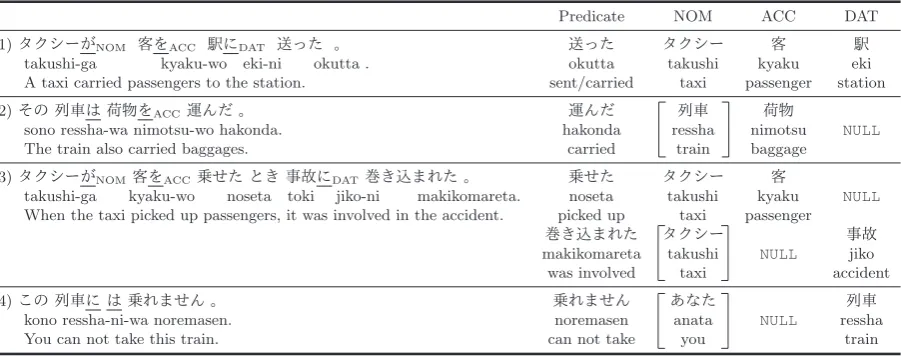
Table 1: Examples of Japanese sentences and their PAS analysis. In sentence (1), case markers (が(ga), を(wo), andに(ni)) correspond to NOM, ACC, and DAT. In example (2), the correct case marker is hidden by the topic markerは(wa). In sentence (3), the NOM argument of the second predicate巻き込まれた(was involved), is dropped. NULLindicates that the predicate does not have the corresponding case argument or that the case argument is not written in the sentence.
ing pre-trained external knowledge in the form of word embeddings has also been ubiquitous. How-ever, such external knowledge is overwritten in the task-specific training.
The other approach to using raw corpora for PAS analysis is data augmentation. Liu et al.
(2017b) generate pseudo training data from a raw corpus and use them for their zero pronoun resolu-tion model. They generate the pseudo training data by dropping certain words or pronouns in a raw corpus and assuming them as correct antecedents. After generating the pseudo training data, they rely on ordinary supervised training based on neu-ral networks.
In this paper, we propose a neural semi-supervised model for Japanese PAS analysis. We adopt neural adversarial training to directly ex-ploit the advantage of using a raw corpus. Our model consists of two neural network models: a generator model of Japanese PAS analysis and a so-called “validator” model of the generator pre-diction. The generator neural network is a model that predicts probabilities of candidate arguments of each predicate using RNN-based features and a head-selection model (Zhang et al.,2017). The validator neural network gets inputs from the gen-erator and scores them. This validator can score the generator prediction even when PAS gold la-bels are not available. We apply supervised learn-ing to the generator and unsupervised learnlearn-ing to the entire network using a raw corpus.
Our contributions are summarized as follows: (1) a novel adversarial training model for PAS analysis; (2) learning from a raw corpus as a source of external knowledge; and (3) as a re-sult, we achieve state-of-the-art performance on Japanese PAS analysis.
2 Task Description
Japanese PAS analysis determines essential case roles of words for each predicate: who didwhat to whom. In many languages, such as English, case roles are mainly determined by word order. However, in Japanese, word order is highly flexi-ble. In Japanese, major case roles are the nomina-tive case (NOM), the accusanomina-tive case (ACC) and the dative case (DAT), which roughly correspond to Japanese surface case markers: が(ga), を(wo), andに(ni). These case markers are often hidden by topic markers, and case arguments are also often omitted.
We explain two detailed tasks of PAS analysis: case analysis and zero anaphora resolution. In Ta-ble1, we show four example Japanese sentences and their PAS labels. PAS labels are attached to nominative, accusative and dative cases of each predicate. Sentence (1) has surface case markers that correspond to argument cases.
depen-( j-th predicate )
NOM:
Raw Labeled
ACC:
DAT: v(arg
1) v(arg2)v(arg3). . . v(arg1) v(arg2)v(arg3). . . v(arg1) v(arg2)v(arg3). . .
Attention mechanism to
hDAT predj
hACC predj
hpredNOMj
hpredj
FNN of
1 (xl, yl)
xul
GeneratorPAS
Generator
Training using
xl
xul
validator embeddings v( )*
spredDATj spredACCj spredNOMj
Error
Raw Corpus
q(G(xl), yl)
G(x)
V(x)
Corpus
Corpus
[image:3.595.87.517.69.188.2]Validator
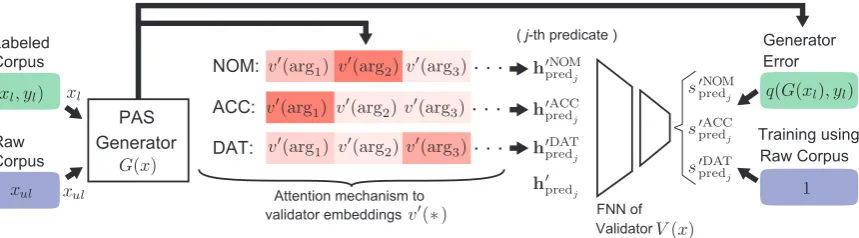
Figure 1: The overall model of adversarial training with a raw corpus. The PAS generatorG(x) and validator V(x). The validator takes inputs from the generator as a form of the attention mechanism. The validator itself is a simple feed-forward network with inputs of j-th predicate and its argument representations:{h0pred
j, h
0casek
predj}. The validator returns scores for three cases and they are used for both
the supervised training of the validator and the unsupervised training of the generator. The supervised training of the generator is not included in this figure.
dencies to their predicates. Sentence (2) does not have the nominative case markerが(ga). It is hid-den by the topic case markerは(wa). Therefore, a case analysis model has to find the correct NOM case argument列車(train).
Sentence (3) is an example sentence for zero anaphora resolution. Zero anaphora resolution is a task to find arguments that do not have direct de-pendencies to their predicates. At the second pred-icate“巻き込まれた”(was involved), the correct nomi-native argument is“タクシー”(taxi), while this does not have direct dependencies to the second predi-cate. A zero anaphora resolution model has to find
“タクシー”(taxi)from the sentence, and assign it to the NOM case of the second predicate.
In the zero anaphora resolution task, some cor-rect arguments are not specified in the article. This is called as exophora. We consider “author” and “reader” arguments as exophora (Hangyo et al.,
2013). They are frequently dropped from Japanese natural sentences. Sentence (4) is an example of dropped nominative arguments. In this sentence, the nominative argument is“あなた”(you), but“あ
なた”(you) does not appear in the sentence. This is also included in zero anaphora resolution. Ex-cept these special arguments of exophora, we fo-cus on intra-sentential anaphora resolution in the same way as (Shibata et al.,2016;Iida et al.,2016;
Ouchi et al.,2017;Matsubayashi and Inui,2017). We also attachNULLlabels to cases that predicates do not have.
3 Model
3.1 Generative Adversarial Networks
Generative adversarial networks are originally proposed in image generation tasks (Goodfellow et al.,2014;Salimans et al., 2016;Springenberg,
2015). In the original model inGoodfellow et al.
(2014), they propose a generatorGand a discrim-inatorD. The discriminator Dis trained to dev-ide the real data distributionpdata(x)and images
generated from the noise samplesz(i) ∈ D
zfrom
noise priorp(z). The discriminator loss is
LD =− Ex∼pdata(x)[logD(x)]
+Ez∼pz(z)[log(1−D(G(z)))]
, (1)
and they train the discriminator by minimizing this loss while fixing the generatorG. Similarly, the generatorGis trained through minimizing
LG= 1
|Dz| X
i h
log1−D(G(z(i))) i , (2)
3.2 Proposed Adversarial Training Using Raw Corpus
Japanese PAS analysis and many other syntactic analyses in NLP are not purely generative, and we can make use of a raw corpus instead of the numer-ical noise distributionp(z). In this work, we use an adversarial training method using a raw corpus, combined with ordinary supervised learning using an annotated corpus. Letxl ∈ Dlindicate labeled
data andp(xl)indicate their label distribution. We
also use unlabeled dataxul ∈ Dul later. Our
gen-eratorG can be trained by the cross entropy loss with labeled data:
LG/SL=−Exl,y∼p(xl)
logG(xl)
. (3)
Supervised training of the generator works by minimizing this loss. Note that we follow the no-tations ofSubramanian et al.(2017) in this subsec-tion.
In addition, we train a so-called validator against the generator errors. We use the term “val-idator” instead of “discriminator” for our adversar-ial training. Unlike the discriminator that is used for dividing generated images and real images, our validator is used to score the generator results. As-sume thatylis the true labels andG(xl)is the
pre-dicted label distribution of dataxlfrom the
gener-ator. We define the labels of the generator errors as:
q(G(xl),yl) =δarg max[G(xl)],yl , (4)
whereδi,j = 1only ifi =j, otherwiseδi,j = 0.
This means that q is equal to 1 if the argument that the generator predicts is correct, otherwise 0. We use this generator error for training labels of the following validator. The inputs of the validator are both the generator outputsG(x)and datax∈ D. The validator can be written asV(G(x)). The validatorV is trained with labeled dataxlby
LV /SL=−Exl,y∼q(G(xl),yl)
logV(G(xl))
,
(5)
while fixing the generatorG. This equation means that the validator is trained with labels of the gen-erator errorq(G(xl),yl).
Once the validator is trained, we train the gen-erator with an unsupervised method. The genera-torGis trained with unlabeled dataxul ∈ Dulby
minimizing the loss
LG/U L=− 1 |Dul|
X
i
logV(G(x(uli))) , (6)
while fixing the validatorV. This generator train-ing loss ustrain-ing the validator can be explained as fol-lows. The generator tries to increase the validator scores to 1, while the validator is fixed. If the val-idator is well-trained, it returns scores close to 1 for correct PAS labels that the generator outputs, and 0 for wrong labels. Therefore, in Equation (6), the generator tries to predict correct labels in order to increase the scores of fixed validator. Note that the validator has a sigmoid function for the output of scores. Therefore output scores of the validator are in[0,1].
We first conduct the supervised training of gen-erator network with Equation (3). After this, fol-lowing Goodfellow et al. (2014), we use k-steps of the validator training and one-step of the gener-ator training. We also alternately conductl-steps of supervised training of the generator. The entire loss function of this adversarial training is
L=LG/SL+LV /SL+LG/U L . (7)
Our contribution is that we propose the validator and train it against the generator errors, instead of discriminating generated data from real data. Sal-imans et al. (2016) explore the semi-supervised learning using adversarial training for K-classes image classification tasks. They add a new class of images that are generated by the generator and classify them.
Miyato et al. (2016) propose virtual adversar-ial training for semi-supervised learning. They ex-ploit unlabeled data for continuous smoothing of data distributions based on the adversarial pertur-bation of Goodfellow et al. (2015). These stud-ies, however, do not use the counterpart neural net-works for learning structures of unlabeled data.
In our Japanese PAS analysis model, the gener-ator corresponds to the head-selection-based neu-ral network for Japanese anaphora resolution. Fig-ure 1 shows the entire model. The labeled data correspond to the annotated corpora and the labels correspond to the PAS argument labels. The unla-beled data correspond to raw corpora. We explain the details of the generator and the validator neural networks in Sec.3.3and Sec.3.4in turn.
3.3 Generator of PAS Analysis
Bi-LSTM
Bi-LSTM Bi-LSTM Bi-LSTM
Bi-LSTM Bi-LSTM
Bi-LSTM Bi-LSTM
embedding embedding embedding embedding
この 列車 に 乗れません
harg1 1
harg1 hpred1
Wcasek 1
Wcasek 2
scasek
arg1,predj s casek arg2,predj
hpredjhpath j
scasek arg3,predj softmax
harg2hpredjhpath2 j harg3hpredjhpath3 j Argument Selection Model
Sentence Encoder Model pcasek
arg1,predj p casek arg2,predj p
casek arg3,predj
( j-th predicate, k-th case )
kono ressha ni noremasen Bi-LSTM
Bi-LSTM
embedding は wa
this train can not take Wcasek
1 Wcasek
2
Wcasek 1
[image:5.595.69.292.70.329.2]Wcasek 2
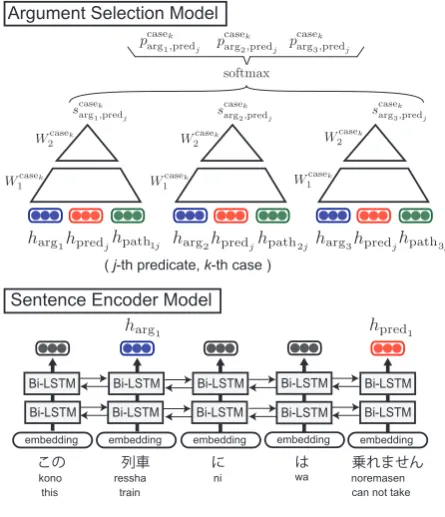
Figure 2: The generator of PAS. The sentence en-coder is a three-layer bi-LSTM to compute the dis-tributed representations of a predicate and its argu-ments: hpredi andhargi. The argument selection
model is two-layer feedforward neural networks to compute the scores,scasek
argi,predj, of candidate
ar-guments for each case of a predicate.
use a three-layer bidirectional-LSTM (bi-LSTM) to read the whole sentence and extract both global and local features as distributed representations. The argument selection model consists of a two-layer feedforward neural network (FNN) and a softmax function.
For the sentence encoder, inputs are given as a sequence of embeddingsv(x), each of which con-sist of word x, its inflection from, POS and de-tailed POS. They are concatenated and fed into the bi-LSTM layers. The bi-LSTM layers read these embeddings in forward and backward order and outputs the distributed representations of a predi-cate and a candidate argument: hpredj andhargi.
Note that we also use the exophora entities, i.e., an author and a reader, as argument candidates. Therefore, we use specific embeddings for them. These embeddings are not generated by the bi-LSTM layers but are directly used in the argument selection model.
We also use path embeddings to capture a de-pendency relation between a predicate and its candidate argument as used in Roth and Lapata
(2016). Although Roth and Lapata (2016) use a one-way LSTM layer to represent the depen-dency path from a predicate to its potential argu-ment, we use a bi-LSTM layer for this purpose. We feed the embeddings of words and POS tags to the bi-LSTM layer. In this way, the result-ing path embeddresult-ing represents both predicate-to-argument and predicate-to-argument-to-predicate paths. We concatenate the bidirectional path embeddings to generatehpathij, which represents the dependency
relation between the predicatejand its candidate argumenti.
For the argument selection model, we apply the argument selection model (Zhang et al.,2017) to evaluate the relation between a predicate and its potential argument for each argument case. In the argument selection model, a single FNN is repeat-edly used to calculate scores for a child word and its head candidate word, and then a softmax func-tion calculates normalized probabilities of candi-date heads. We use three different FNNs that cor-respond to the NOM, ACC and DAT cases. These three FNNs have the same inputs of the distributed representations ofj-th predicate hpredj, i-th
can-didate argumenthargi and path embeddinghpathij
between the predicate j and candidate argument
i. The FNNs for NOM, ACC and DAT compute the argument scores scasek
argi,predj, where casek ∈ {NOM,ACC,DAT}. Finally, the softmax func-tion computes the probabilityp(argi|predj,casek)of
candidate argument ifor case kofj-th predicate as:
p(argi|predj,casek) =
expscasek
argi,predj
X
argi
expscasek
argi,predj
. (8)
Our argument selection model is similar to the neural network structure ofMatsubayashi and Inui
model of Ouchi et al.(2017) has the same prob-lem.
3.4 Validator
We exploit a validator to train the generator us-ing a raw corpus. It consists of a two-layer FNN to which embeddings of a predicate and its argu-ments are fed. For predicate j, the input of the FNN is the representations of the predicateh0pred
j
and three arguments
n h0NOM
predj , h
0ACC predj , h
0DAT predj
o
that are inferred by the generator. The two-layer FNN outputs three values, and then three sigmoid functions compute the scores of scalar values in a range of[0,1]for the NOM, ACC and DAT cases:
n s0NOM
predj , s
0ACC predj , s
0DAT predj
o
. These scores are the outputs of the validatorD(x). We use dropout of 0.5 at the FNN input and hidden layer.
The generator and validator networks are cou-pled by the attention mechanism, or the weighted sum of the validator embeddings. As shown in Equation (8), we compute a probability distribu-tion of candidate arguments. We use the weighted sum of embeddingsv0(x)of candidate arguments to compute the input representations of the valida-tor:
h0casek
predj =Ex∼p(argi)[v
0 (x)]
=X argi
p(argi|predj,casek)v0(argi).
This summation is taken over candidate arguments in the sentence and the exophora entities. Note that we use embeddings v0(x) for the validator that are different from the embeddings v(x) for the generator, in order to separate the computa-tion graphs of the generator and the validator neu-ral networks except the joint part. We use this weighted sum by the softmax outputs instead of the argmax function. This allows the backpropa-gation through this joint. We also feed the embed-ding of a predicate to the validator:
h0pred j =v
0
(predj). (9)
Note that the validator is a simple neural net-work compared with the generator. The validator has limited inputs of predicates and arguments and no inputs of other words in sentences. This allows the generator to overwhelm the validator during the adversarial training.
Type Value
Size of hidden layers of FNNs 1,000
Size of Bi-LSTMs 256
[image:6.595.319.514.202.270.2]Dim. of word embedding 100 Dim. of POS, detailed POS, inflection form tags 10, 10, 9 Minibatch size for the generator and validator 16, 1
Table 2: Parameters for neural network structure and training.
KWDLC # snt # of dep # of zero
Train 11,558 9,227 8,216 Dev. 1,585 1,253 821
Test 2,195 1,780 1,669
Table 3: KWDLC data statistics.
3.5 Implementation Details
The neural networks are trained using backprop-agation. The backpropagation has been done to the word and POS tags. We use Adam (Kingma and Ba,2015) at the initial training of the genera-tor network for the gradient learning rule. In ad-versarial learning, Adagrad (Duchi et al.,2010) is suitable because of the stability of learning. We use pre-trained word embeddings from 100M sen-tences from Japanese web corpus by word2vec (Mikolov et al.,2013). Other embeddings and hid-den weights of neural networks are randomly ini-tialized.
For adversarial training, we first train the gen-erator for two epochs by the supervised method, and train the validator while fixing the generator for another epoch. This is because the validator training preceding the generator training makes the validator result worse. After this, we alter-nately do the unsupervised training of the genera-tor (LG/U L),k-times of supervised training of the validator (LV /SL) andl-times of supervised
train-ing of the generator (LG/SL).
KWDLC NOM ACC DAT
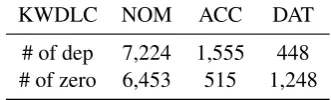
[image:7.595.97.263.66.116.2]# of dep 7,224 1,555 448 # of zero 6,453 515 1,248
Table 4: KWDLC training data statistics for each case.
Case Zero
Ouchi+ 2015 76.5 42.1 Shibata+ 2016 89.3 53.4
Gen 91.5 56.2
[image:7.595.106.255.160.246.2]Gen+Adv 92.0‡ 58.4‡
Table 5: The results of case analysis (Case) and zero anaphora resolution (Zero). We use F-measure as an evaluation F-measure. ‡denotes that the improvement is statistically significant atp <
0.05, compared with Gen using paired t-test.
4 Experiments
4.1 Experimental Settings
Following Shibata et al. (2016), we use the KWDLC (Kyoto University Web Document Leads Corpus) corpus (Hangyo et al., 2012) for our ex-periments.1 This corpus contains various Web documents, such as news articles, personal blogs, and commerce sites. In KWDLC, lead three sen-tences of each document are annotated with PAS structures including zero pronouns. For a raw cor-pus, we use a Japanese web corpus created by
Hangyo et al.(2012), which has no duplicated sen-tences with KWDLC. This raw corpus is automat-ically parsed by the Japanese dependency parser KNP.
We focus on intra-sentential anaphora resolu-tion, and so we apply a preprocess to KWDLC. We regard the anaphors whose antecedents are in the preceding sentences asNULLin the same way asOuchi et al.(2015);Shibata et al.(2016). Tables
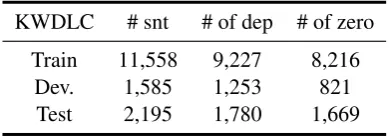
3and4list the statistics of KWDLC.
We use the exophora entities, i.e., an author and a reader, following the annotations in KWDLC. We also assign author/reader labels to the follow-ing expressions in the same way asHangyo et al.
(2013);Shibata et al.(2016):
author “私” (I), “僕” (I), “我々” (we), “弊社” (our company)
1 The KWDLC corpus is available at http://nlp.
ist.i.kyoto-u.ac.jp/EN/index.php?KWDLC
reader “あなた”(you),“君”(you),“客”(customer),
“皆様”(you all)
FollowingOuchi et al.(2015) andShibata et al.
(2016), we conduct two kinds of analysis: (1) case analysis and (2) zero anaphora resolution. Case analysis is the task to determine the correct case labels when predicates and their arguments have direct dependencies but their case markers are hid-den by surface markers, such as topic markers. Zero anaphora resolution is a task to find certain case arguments that do not have direct dependen-cies to their predicates in the sentence.
Following Shibata et al. (2016), we exclude predicates that the same arguments are filled in multiple cases of a predicate. This is relatively uncommon and 1.5 % of the whole corpus are ex-cluded. Predicates are marked in the gold depen-dency parses. Candidate arguments are just other tokens than predicates. This setting is also the same asShibata et al.(2016).
All performances are evaluated with micro-averaged F-measure (Shibata et al.,2016).
4.2 Experimental Results
We compare two models: the supervised genera-tor model (Gen) and the proposed semi-supervised model with adversarial training (Gen+Adv). We also compare our models with two previous mod-els: Ouchi et al.(2015) andShibata et al. (2016), whose performance on the KWDLC corpus is re-ported.
Table5lists the experimental results. Our mod-els (Gen and Gen+Adv) outperformed the previ-ous models. Furthermore, the proposed model with adversarial training (Gen+Adv) was signifi-cantly better than the supervised model (Gen).
4.3 Comparison with Data Augmentation
Model
Case analysis Zero anaphora resolution
Model NOM ACC DAT NOM ACC DAT
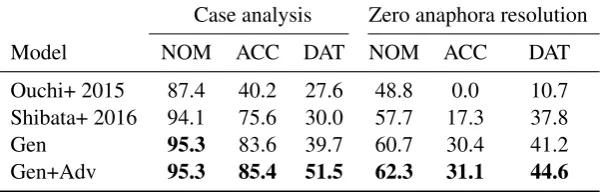
[image:8.595.149.450.66.162.2]Ouchi+ 2015 87.4 40.2 27.6 48.8 0.0 10.7 Shibata+ 2016 94.1 75.6 30.0 57.7 17.3 37.8 Gen 95.3 83.6 39.7 60.7 30.4 41.2 Gen+Adv 95.3 85.4 51.5 62.3 31.1 44.6
Table 6: The detailed results of case analysis and zero anaphora resolution for the NOM, ACC and DAT cases. Our models outperform the existing models in all cases. All values are evaluated with F-measure.
Case Zero
Gen 91.5 56.2 Gen+Aug 91.2 57.0
[image:8.595.118.245.215.287.2]Gen+Adv 92.0‡ 58.4‡
Table 7: The comparisons of Gen+Adv with Gen and the data augmentation model (Gen+Aug). ‡
denotes that the improvement is statistically sig-nificant atp <0.05, compared with Gen+Aug.
Therefore we use existing training corpora and word embeddings for the data augmentation. First we randomly choose an argument wordw in the training corpus and then swap it with another word
w0 with the probability of p(w, w0). We choose top-20 nearest words to the original word w in the pre-trained word embedding as candidates of swapped words. The probability is defined as
p(w, w0) ∝ [v(w)>v(w0)]r, wherer = 10. This
probability is normalized by top-20 nearest words. We then merge this pseudo data and the original training corpus and train the model in the same way with the Gen model. We conducted several experiments and found that the model trained with the same amount of the pseudo data as the training corpus achieved the best result.
Table 7 shows the results of the data augmen-tation model and the GAN-based model. Our Gen+Adv model performs better than the data augmented model. Note that our data augmenta-tion model does not use raw corpora directly.
4.4 Discussion
4.4.1 Result Analysis
We report the detailed performance for each case in Table6. Among the three cases, zero anaphora resolution of the ACC and DAT cases is notori-ously difficult. This is attributed to the fact that these ACC and DAT cases are fewer than the NOM
case in the corpus as shown in Table4. However, we can see that our proposed model, Gen+Adv, performs much better than the previous models es-pecially for the ACC and DAT cases. Although the number of training instances of ACC and DAT is much smaller than that of NOM, our semi-supervised model can learn PAS for all three cases using a raw corpus. This indicates that our model can work well in resource-poor cases.
We analyzed the results of Gen+Adv by com-paring with Gen and the model ofShibata et al.
(2016). Here, we focus on the ACC and DAT cases because their improvements are notable.
• “パックは 洗って、 分別して リサイクルに 出
さなきゃいけないので 手間がかかる。“
It is bothersome to wash, classify and recycle spent packs.
In this sentence, the predicates“洗って”(wash),“分 別して” (classify), “(リサイクルに)出す”(recycle) takes the same ACC argument, “パック” (pack). This is not so easy for Japanese PAS analysis be-cause the actual ACC case marker “を” (wo) of
“パック”(pack) is hidden by the topic marker“は”
(wa). The Gen+Adv model can detect the cor-rect argument while the model of Shibata et al.
(2016) fails. In the Gen+Adv model, each pred-icate gives a high probability to “パック” (pack) as an ACC argument and finally chooses this. We found many examples similar to this and speculate that our model captures a kind of selectional pref-erences.
The next example is an error of the DAT case by the Gen+Adv model.
• “各専門分野も お任せ下さい。”
please leave every professional field (toφ)
0 2 4 6 8 10 12 14 16 18 Epoch
60 70 80 90
F-value
NOM ACC DAT
0 2 4 6 8 10 12 14 16 18 Epoch
20 30 40 50 60
F-value of Zero NOM
[image:9.595.83.499.65.209.2]ACC DAT
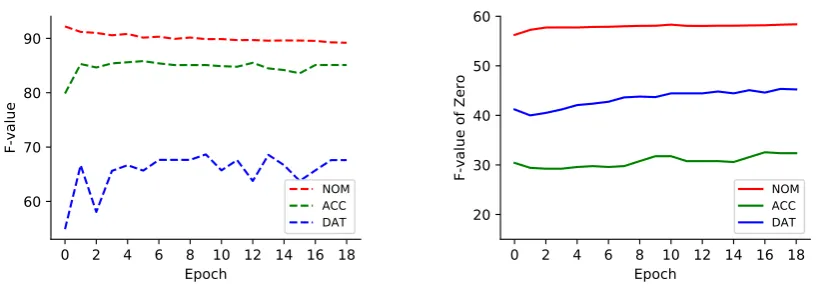
Figure 3: Left: validator scores with the development set during adversarial training epochs. Right: generator scores for Zero with the development set during adversarial training epochs.
However, the Gen+Adv model judged the DAT ar-gument as “author”. Although we cannot specify
φas “author” only from this sentence, “author” is a possible argument depending on the context.
4.4.2 Validator Analysis
We also evaluate the performance of the valida-tor during the adversarial training with raw cor-pora. Figure 3 shows the validator performance and the generator performance of Zero on the de-velopment set. The validator score is evaluated with the outputs of generator.
We notice that the NOM case and the other two cases have different curves in both graphs. This can be explained by the speciality of the NOM case. The NOM case has much more author/reader expressions than the other cases. The prediction of author/reader expressions depends not only on se-lectional preferences of predicates and arguments but on the whole of sentences. Therefore the val-idator that relies only on predicate and argument representations cannot predict author/reader ex-pressions well.
In the ACC and DAT cases, the scores of the generator and validator increase in the first epochs. This suggests that the validator learns the weak-ness of the generator and vice versa. However, in later epochs, the scores of the generator increase with fluctuation, while the scores of the validator saturates. This suggests that the generator gradu-ally becomes stronger than the validator.
5 Related Work
Shibata et al. (2016) proposed a neural network-based PAS analysis model using local and global features. This model is based on the non-neural
model of Ouchi et al. (2015). They achieved state-of-the-art results on case analysis and zero anaphora resolution using the KWDLC corpus. They use an external resource to extract selectional preferences. Since our model uses an external re-source, we compare our model with the models of
Shibata et al.(2016) andOuchi et al.(2015).
Ouchi et al. (2017) proposed a semantic role labeling-based PAS analysis model using Grid-RNNs. Matsubayashi and Inui(2017) proposed a case label selection model with feature-based neu-ral networks. They conducted their experiments on NAIST Text Corpus (NTC) (Iida et al.,2007,
2016). NTC consists of newspaper articles, and does not include the annotations of author/reader expressions that are common in Japanese natural sentences.
6 Conclusion
We proposed a novel Japanese PAS analysis model that exploits a semi-supervised adversarial train-ing. The generator neural network learns Japanese PAS and selectional preferences, while the valida-tor is trained against the generavalida-tor errors. This val-idator enables the generator to be trained from raw corpora and enhance it with external knowledge. In the future, we will apply this semi-supervised training method to other NLP tasks.
Acknowledgment
References
Denny Britz, Quoc Le, and Reid Pryzant. 2017. Effec-tive domain mixing for neural machine translation. In Proceedings of the Second Conference on Ma-chine Translation. Association for Computational Linguistics, Copenhagen, Denmark, pages 118–126.
http://www.aclweb.org/anthology/W17-4712.
John Duchi, Elad Hazan, and Yoram Singer. 2010. Adaptive subgradient methods for online learning and stochastic optimization. UCB/EECS-2010-24.
Ian J. Goodfellow, Jean Pouget-Abadie, Mehdi Mirza, Bing Xu, David Warde-Farley, Sherjil Ozair, Aaron C. Courville, and Yoshua Bengio. 2014. Gen-erative adversarial nets. In Advances in Neural Information Processing Systems 27: Annual Con-ference on Neural Information Processing Systems 2014, December 8-13 2014, Montreal, Quebec, Canada. pages 2672–2680.
Ian J. Goodfellow, Jonathon Shlens, and Christian Szegedy. 2015. Explaining and harnessing adver-sarial examples. InProceedings of the International Conference on Learning Representations (ICLR).
Masatsugu Hangyo, Daisuke Kawahara, and Sadao Kurohashi. 2012. Building a diverse document leads corpus annotated with semantic relations. In Proceedings of the 26th Pacific Asia Conference on Language, Information, and Computation. Fac-ulty of Computer Science, Universitas Indonesia, Bali,Indonesia, pages 535–544.
Masatsugu Hangyo, Daisuke Kawahara, and Sadao Kurohashi. 2013. Japanese zero reference resolution considering exophora and author/reader mentions. InProceedings of the 2013 Conference on Empirical Methods in Natural Language Processing. Associa-tion for ComputaAssocia-tional Linguistics, Seattle, Wash-ington, USA, pages 924–934.
Ryu Iida, Mamoru Komachi, Kentaro Inui, and Yuji Matsumoto. 2007. Annotating a japanese text cor-pus with predicate-argument and coreference rela-tions. In Proceedings of the Linguistic Annotation Workshop, LAW@ACL 2007, Prague, Czech Repub-lic, June 28-29, 2007. pages 132–139.
Ryu Iida, Kentaro Torisawa, Jong-Hoon Oh, Cana-sai Kruengkrai, and Julien Kloetzer. 2016. Intra-sentential subject zero anaphora resolution using multi-column convolutional neural network. In Pro-ceedings of the 2016 Conference on Empirical Meth-ods in Natural Language Processing. Association for Computational Linguistics, Austin, Texas, pages 1244–1254. https://aclweb.org/anthology/D16-1132.
D. P. Kingma and J. Ba. 2015. Adam: A method for stochastic optimization. In Proceedings of the 53rd Annual Meeting of the Association for Compu-tational Linguistics and the 7th International Joint Conference on Natural Language Processing (Vol-ume 1: Long Papers).
Jiwei Li, Will Monroe, Tianlin Shi, S´ebastien Jean, Alan Ritter, and Dan Jurafsky. 2017. Adversarial learning for neural dialogue generation. In Proceed-ings of the 2017 Conference on Empirical Methods in Natural Language Processing. Association for Computational Linguistics, Copenhagen, Denmark, pages 2157–2169.
Pengfei Liu, Xipeng Qiu, and Xuanjing Huang. 2017a. Adversarial multi-task learning for text classifica-tion. InProceedings of the 55th Annual Meeting of the Association for Computational Linguistics (Vol-ume 1: Long Papers). Association for Computa-tional Linguistics, Vancouver, Canada, pages 1–10.
Ting Liu, Yiming Cui, Qingyu Yin, Wei-Nan Zhang, Shijin Wang, and Guoping Hu. 2017b. Generat-ing and exploitGenerat-ing large-scale pseudo trainGenerat-ing data for zero pronoun resolution. InProceedings of the 55th Annual Meeting of the Association for Compu-tational Linguistics (Volume 1: Long Papers). As-sociation for Computational Linguistics, Vancouver, Canada, pages 102–111.
Yuichiroh Matsubayashi and Kentaro Inui. 2017. Re-visiting the design issues of local models for japanese predicate-argument structure analysis. In Proceedings of the Eighth International Joint Con-ference on Natural Language Processing (Volume 2: Short Papers). Asian Federation of Natural Lan-guage Processing, Taipei, Taiwan, pages 128–133.
Tomas Mikolov, Kai Chen, Greg Corrado, and Jeffrey Dean. 2013. Efficient estimation of word repre-sentations in vector space. volume abs/1301.3781.
http://arxiv.org/abs/1301.3781.
Takeru Miyato, Shin-ichi Maeda, Masanori Koyama, Ken Nakae, and Shin Ishii. 2016. Distributional smoothing by virtual adversarial examples. In Pro-ceedings of the International Conference on Learn-ing Representations (ICLR).
Hiroki Ouchi, Hiroyuki Shindo, Kevin Duh, and Yuji Matsumoto. 2015. Joint case argument identifica-tion for japanese predicate argument structure anal-ysis. In Proceedings of the 53rd Annual Meet-ing of the Association for Computational LMeet-inguistics and the 7th International Joint Conference on Natu-ral Language Processing (Volume 1: Long Papers). Association for Computational Linguistics, Beijing, China, pages 961–970.
Hiroki Ouchi, Hiroyuki Shindo, and Yuji Matsumoto. 2017. Neural modeling of multi-predicate interac-tions for japanese predicate argument structure anal-ysis. InProceedings of the 55th Annual Meeting of the Association for Computational Linguistics (Vol-ume 1: Long Papers). Association for Computa-tional Linguistics, Vancouver, Canada, pages 1591– 1600.
(Volume 1: Long Papers). Association for Compu-tational Linguistics, Berlin, Germany, pages 1192– 1202.
Tim Salimans, Ian Goodfellow, Wojciech Zaremba, Vicki Cheung, Alec Radford, Xi Chen, and Xi Chen. 2016. Improved techniques for training gans. In D. D. Lee, M. Sugiyama, U. V. Luxburg, I. Guyon, and R. Garnett, editors, Advances in Neural Infor-mation Processing Systems 29. Curran Associates, Inc., pages 2234–2242.
Ryohei Sasano and Sadao Kurohashi. 2011. A dis-criminative approach to japanese zero anaphora res-olution with large-scale lexicalized case frames. In Proceedings of 5th International Joint Conference on Natural Language Processing. Asian Federation of Natural Language Processing, Chiang Mai, Thai-land, pages 758–766.
Tomohide Shibata, Daisuke Kawahara, and Sadao Kurohashi. 2016. Neural network-based model for japanese predicate argument structure analysis. In Proceedings of the 54th Annual Meeting of the As-sociation for Computational Linguistics (Volume 1: Long Papers). Association for Computational Lin-guistics, pages 1235–1244.
Jost Tobias Springenberg. 2015. Unsupervised and semi-supervised learning with categorical generative adversarial networks.
Sandeep Subramanian, Sai Rajeswar, Francis Dutil, Chris Pal, and Aaron Courville. 2017. Adversar-ial generation of natural language. InProceedings of the 2nd Workshop on Representation Learning for NLP. Association for Computational Linguistics, Vancouver, Canada, pages 241–251.