Describing Images using Inferred Visual Dependency Representations
Desmond Elliott and Arjen P. de Vries
Information Access Group Centrum Wiskunde & Informatica
Amsterdam, The Netherlands [email protected], [email protected]
Abstract
The Visual Dependency Representation (VDR) is an explicit model of the spa-tial relationships between objects in an im-age. In this paper we present an approach to training a VDR Parsing Model without the extensive human supervision used in previous work. Our approach is to find the objects mentioned in a given descrip-tion using a state-of-the-art object detec-tor, and to use successful detections to pro-duce training data. The description of an unseen image is produced by first predict-ing its VDR over automatically detected objects, and then generating the text with a template-based generation model using the predicted VDR. The performance of our approach is comparable to a state-of-the-art multimodal deep neural network in images depicting actions.
1 Introduction
Humans typically write the text accompanying an image, which is a time-consuming and expen-sive activity. There are many circumstances in which people are well-suited to this task, such as captioning news articles (Feng and Lapata, 2008) where there are complex relationships between the modalities (Marsh and White, 2003). In this pa-per we focus on generating literal descriptions, which are rarely found alongside images because they describe what can easily be seen by others (Panofsky, 1939; Shatford, 1986; Hodosh et al., 2013). A computer that can automatically gen-erate these literal descriptions, filling the gap left by humans, may improve access to existing image collections or increase information access for vi-sually impaired users.
There has been an upsurge of research in this area, including models that rely on spatial
tionships (Farhadi et al., 2010), corpus-based rela-tionships (Yang et al., 2011), spatial and visual at-tributes (Kulkarni et al., 2011), n-gram phrase fu-sion from Web-scale corpora (Li et al., 2011), tree-substitution grammars (Mitchell et al., 2012), se-lecting and combining phrases from large image-description collections (Kuznetsova et al., 2012), using Visual Dependency Representations to cap-ture spatial and corpus-based relationships (El-liott and Keller, 2013), and in a generative frame-work over densely-labelled data (Yatskar et al., 2014). The most recent developments have fo-cused on deep learning the relationships between visual feature vectors and word-embeddings with language generation models based on recurrent neural networks or long-short term memory net-works (Karpathy and Fei-Fei, 2015; Vinyals et al., 2015; Mao et al., 2015; Fang et al., 2015; Don-ahue et al., 2015; Lebret et al., 2015). An alter-native thread of research has focused on directly pairing images with text, based on kCCA (Hodosh et al., 2013) or multimodal deep neural networks (Socher et al., 2014; Karpathy et al., 2014).
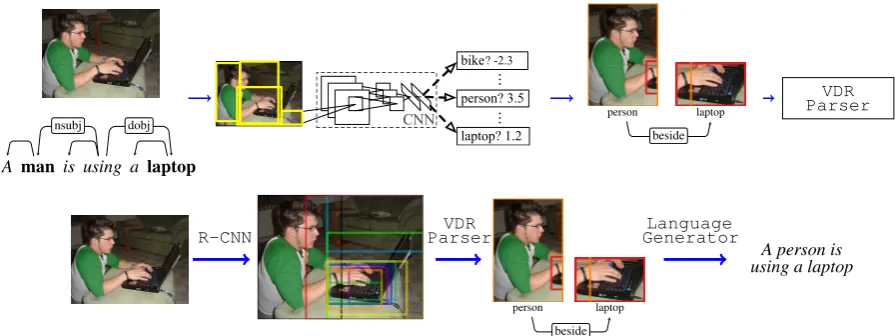
We revisit the Visual Dependency Representa-tion (Elliott and Keller, 2013, VDR), an intermedi-ate structure that captures the spatial relationships between objects in an image. Spatial context has been shown to be useful in object recognition and naming tasks because humans benefit from the vi-sual world conforming to their expectations (Bie-derman et al., 1982; Bar and Ullman, 1996). The spatial relationships defined in VDR are closely, but independently, related to cognitively plausible spatial templates (Logan and Sadler, 1996) and re-gion connection calculus (Randell et al., 1992). In the image description task, explicitly modelling the spatial relationships between observed objects constrains how an image should be described. An example can be seen in Figure 1, where the train-ing VDR identifies the defintrain-ing relationship be-tween the man and the laptop, which may be
A man is using a laptop - nsubj- dobj
-bike? -2.3
...
person? 3.5
laptop? 1.2
...
CNN person laptop
beside
VDR Parser
R-CNN
person laptop
beside
VDR Parser
A person is using a laptop Language
[image:2.595.78.526.60.228.2]Generator
Figure 1: We present an approach to inferring VDR training data from images paired with descriptions (top), and for generating descriptions from VDR (bottom). Candidates for the subject and object in the image are extracted from the description. An object detector1searches for the objects and
determinis-tically produces a training instance, which is used to train a VDR Parser to predict the relationships between objects in unseen images. When an unseen image is presented to the model, we first extract N-candidate objects for the image. The detected objects are then parsed into a VDR structure, which is passed into a template-based language generator to produce a description of the image.
alised as a “using”, “typing”, or “working” rela-tionship between the objects.
The main limitation of previous research on VDR has been the reliance on gold-standard train-ing annotations, which requires trained annota-tors. We present the first approach to automati-cally inferring VDR training examples from nat-ural scenes using only an object detector and an image description. Ortiz et al. (2015) have re-cently presented an alternative treatment of VDR within the context of abstract scenes and phrase-based machine translation. Figure 1 shows a de-tailed overview of our approach. At training time, we learn a VDR Parsing model from representa-tions that are constructed by searching for the sub-ject and obsub-ject in the image. The description of an unseen image is generated using a template-based generation model that leverages the VDR predicted over the top-N objects extracted from an object detector.
We evaluate our method for inferring VDRs in an image description experiment on the Pascal1K (Rashtchian et al., 2010) and VL2K data sets (El-liott and Keller, 2013) against two models: the bi-directional recurrent neural network (Karpathy and Fei-Fei, 2015, BRNN) and MIDGE(Mitchell et al., 2012). The main finding is that the qual-ity of the descriptions generated by our method
1The image of the R-CNN object detector was modified
with permission from Girshick et al. (2014).
depends on whether the images depict an action. In the VLT2K data set of people performing ac-tions, the performance of our approach is compa-rable to the BRNN; in the more diverse Pascal1K dataset, the BRNNis substantially better than our method. In a second experiment, we transfer the VDR-based model from the VLT2K data set to the Pascal1K data set without re-training, which im-proves the descriptions generated in the Pascal1K data set. This suggests that refining how we ex-tract training data may yield further improvements to VDR-based image description.
The code and generated descriptions are avail-able athttp://github.com/elliottd/vdr/.
2 Automatically Inferring VDRs
Relation Definition
Beside The angle between the subject and the object is either between 315◦ and45◦or135◦and225◦. Above The angle between the subject and
object is between225◦ and315◦. Below The angle between the subject and
object is between45◦and135◦. On More than 50% of the subject
overlaps with the object.
Surrounds More than 90% of the subject overlaps with the object.
Table 1: The cascade of spatial relationships be-tween objects in VDR. We always use the last relationship that matches. These definitions are mostly taken from (Elliott and Keller, 2013), ex-cept that we remove the 3D relationships. Angles are defined with respect to the unit circle, which has 0◦on the right. All relations are specific with respect to the centroid of the bounding boxes.
of the human process used to create gold-standard data (Elliott and Keller, 2013).
An inferred VDR is constructed by searching for the subject and object referred to in the descrip-tion of an image using an object detector. If both the subject and object can be found in the image, a VDR is created by attaching the detected subject to the detected object, given the spatial relation-ship between the object bounding boxes. The spa-tial relationships that can be applied between sub-jects and obsub-jects are defined in the cascade defined in Table 1. The set of relationships was reduced from eight to six due to the difficulty in predict-ing the 3D relationships in 2D images (Eigen et al., 2014). The spatial relation selected for a pair of objects is determined by applying each tem-plate defined in Table 1 to the object pair. We use only the final matching relationship, although fu-ture work may consider applying multiple match-ing relationships between objects.
Given a set of inferred VDR training examples, we train a VDR Parsing Model with theVDR+IMG feature set using only the inferred examples (El-liott et al., 2014). We tried training a model by combining the inferred and gold-standard VDRs but this lead to an erratic parsing model that would regularly predict flat structures instead of object–
[image:3.595.313.524.67.173.2]person 3.13 c. keyboard 1.22 laptop 0.77 sofa 0.61 waffle iron 0.47 tape player 0.21 banjo 0.14 accordion -0.16 iPod -0.26 vacuum -0.40
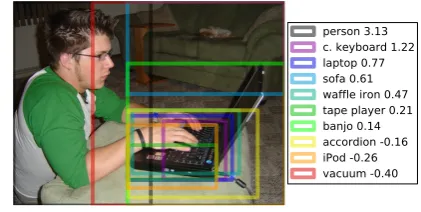
Figure 2: An example of the most confident object detections from the R-CNN object detector.
object relationships. One possibility for this be-haviour is the mismatch caused by removing the infront and behind relationships in the inferred training data. Another possible explanation is the gold-standard data contains deeper and more complex structures than the simple object–object structures we infer.
2.1 Linguistic Processing
The description of an image is processed to extract candidates for the mentioned objects. We extract candidates from the nsubjand dobjtokens in the dependency parsed description2. If the parsed
description does not contain both a subject and an object, as defined here, the example is discarded. 2.2 Visual Processing
If the dependency parsed description contains candidates for the subject and object of an age, we attempt to find these objects in the im-age. We use the Regions with Convolutional Neural Network features object detector (Gir-shick et al., 2014, R-CNN) with the pre-trained
bvlc reference ilsrvc13detection model implemented in Caffe (Jia et al., 2014). This ob-ject detection model is able to detect 200 different types of objects, with a mean average precision of 31.4% in the ImageNet Large-Scale Visual Recog-nition Challenge3(Russakovsky et al., 2014). The
output of the object detector is a bounding box with real-valued confidence scores, as shown in
2The descriptions are Part-of-Speech tagged using the
Stanford POS Tagger v3.1.0 (Toutanova et al., 2003) with the english-bidirectional-distsim pre-trained model. The tagged descriptions are then Dependency Parsed using Malt Parser v 1.7.2 (Nivre et al., 2007) with the engmalt.poly-1.7pre-trained model.
3The state-of-the-art result for this task is 37.2% using a
Aboyis using alaptop
(a) on
Amanis riding abike
(b) above
Awomanis riding abike
(c) surrounds
Awomanis riding ahorse
(d) surrounds
Amanis playing asax
(e) surrounds
Amanis playing aguitar
(f) beside
Thewomanis wearing ahelmet
[image:4.595.86.510.64.343.2](g) surrounds
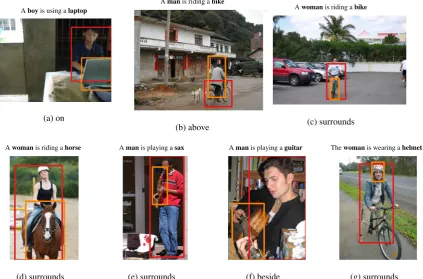
Figure 3: Examples of the object detections and automatically inferred VDR. In each example, the object detector candidates were extracted from the description and the VDR relationships were determined by the cascade in Table 1. Automatically inferring VDR allows us to learn differences in spatial relationships from different camera viewpoints, such as people riding bicycles.
Figure 2. The confidence scores are not probabili-ties and can vary widely across images.
The words in a description that refer to objects in an image are not always within the constrained vocabulary of the object labels in the object de-tection model. We increase the chance of finding objects with two simple back-offs: by lemmatis-ing the token, and transformlemmatis-ing the token into its WordNet hypernym parent. If the subject and the object can be found in the image, we create an in-ferred VDR from the detections, otherwise we dis-card this training example.
Figure 3 shows a collection of automatically in-ferred VDRs. One of the immediate benefits of VDR, as a representation, is that we can easily in-terpret the structures extracted from images. An example of helpful object orientation invariance can be seen in 3 (b) and (c), where VDR captures the two different types of spatial relationships be-tween people and bicycles that are grounded in the verb “riding”. This type of invariance is useful and it suggests VDR can model interacting objects from various viewpoints. We note here the
sim-ilarities between automatically inferred VDR and Visual Phrases (Sadeghi and Farhadi, 2011). The main difference between these models is that VDR is primarily concerned with object–object interac-tions for generation and retrieval tasks, whereas Visual Phrases were intended to model person– object interactions foractivity recognition. 2.3 Building a Language Model
person laptop sofa banjo vacuum c=3.12 c=0.77 c=0.61 c=0.14 c=-0.40
beside root
besidebeside VDR
Parser A person is using a laptop (0.84)A person is playing a banjo (0.71) A person is beside a vacuum (0.38)†
A person is in the image (0.96)⋆ Language
[image:5.595.78.513.68.136.2]Generator
Figure 4: An overview of VDR-constrained language generation. We extract the top-N objects from an image using an object detector and predict the spatial relationships between the objects using a VDR Parser trained over the inferred training data. Descriptions are generated for all parent–child subtrees in the VDR, and the final text has the highest combined corpus and visual confidence. †: only generated is there are no verbs between the objects in the language model;⋆: only generated if there are no verbs between any pairs of objects in the image.
3 Generating Descriptions
The description of an image is generated using a template-based language generation model de-signed to exploit the structure encoded in VDR. The language generation model extends Elliott and Keller (2013) with the visual confidence scores from the object detector. Figure 4 shows an overview of the generation process.
The top-N objects are extracted from an image using the pre-trained R-CNN object detector (see Section 2.2 for more details). We remove non-maximal detections with the same class label that overlap by more than 30%. The objects are then parsed into a VDR structure using the VDR Parser trained on the automatically inferred training data. Given the VDR over the set of detected objects, we generate all possible descriptions of the image that can be produced in a depth-first traversal of the VDR. A description is assigned a score that com-bines the corpus-based evidence and visual con-fidence of the objects selected for the description. The descriptions are generated using the following template:
DTheadisV DTchild.
In this template, headandchildare the labels of the objects that appear in the head and child po-sitions of a specific VDR subtree. Vis a verb de-termined from a subject-verb-object-spatial rela-tion model derived from the training data descrip-tions. This model captures statistics about nouns that appear as subjects and objects, the verbs be-tween them, and spatial relationships observed in the inferred training VDRs. The verbvthat satis-fies theVfield is determined as follows:
v= arg max
v p(v|head, child, spatial) (1)
p(v|head,child, spatial) =
p(v|head)·p(child|v, head)· p(spatial|child, v, head)
(2)
If no verbs were observed between a particular object–object pair in the training corpus,Vis filled using a back-off that uses the spatial relationship label between the objects in the VDR.
The object detection confidence values, which are not probabilities and can vary substantially be-tween images, are transformed into the range [0,1] usingsgm(conf) = 1
1+e−conf. The final score
as-signed to a description is then used to rank all of the candidate descriptions, and the highest-scoring description is assigned to an image:
score(head, v,child, spatial) =
p(v|head, child, spatial)· sgm(head)·sgm(child)
(3)
If the VDR Parser does not predict any rela-tionships between objects in an image, which may happen if all of the objects have never been ob-served in the training data, we use a back-off tem-plate to generate the description. In this case, the most confidently detected object in the image is used with the following template:
A/Anobjectis in the image.
The number of objectsNobjects extracted from an unseen image is optimised by maximising the sentence-level Meteor score of the generated de-scriptions in the development data.
4 Experiments
generate a natural language description of an im-age, which is evaluated directly against multiple reference descriptions.
4.1 Models
We compare our approach against two state-of-the-art image description models. MIDGE gener-ates text based on tree-substitution grammar and relies on discrete object detections (Mitchell et al., 2012) for visual input. We make a small modi-fication to MIDGE so it uses all of the top-N de-tected objects, regardless of the confidence of the detections4. BRNN is a multimodal deep neural
network that generates descriptions directly from vector representations of the image and the de-scription (Karpathy and Fei-Fei, 2015). The im-ages are represented by the visual feature vector extracted from theFC7 layer of the VGG 16-layer
convolutional neural network (Simonyan and Zis-serman, 2015) and the descriptions are represented as a word-embedding vector.
4.2 Evaluation Measures
We evaluate the generated descriptions using sentence-level Meteor (Denkowski and Lavie, 2011) and BLEU4 (Papineni et al., 2002), which have been shown to have moderate correlation with humans (Elliott and Keller, 2014). We adopt a jack-knifing evaluation methodology, which en-ables us to report human–human results (Lin and Och, 2004), using MultEval (Clark et al., 2011). 4.3 Data Sets
We perform our experiments on two data sets: Pas-cal1K and VLT2K. The PasPas-cal1K data set contains 1,000 images sampled from the PASCAL Object Detection Challenge data set (Everingham et al., 2010); each image is paired with five reference de-scriptions collected from Mechanical Turk. It con-tains a wide variety of subject matter drawn from the original 20 PASCAL Detection classes. The VLT2K data set contains 2,424 images taken from the trainval 2011 portion of the PASCAL Action Recognition Challenge; each image is paired with three reference descriptions, also collected from Mechanical Turk. We randomly split the images into 80% training, 10% validation, and 10% test.
4In personal communication with Margaret Mitchell, she
explained that the object confidence thresholds for MIDGE
were determined by visual inspection on held-out data, which we decided was not feasible for 200 new detectors.
VLT2K Pascal1K
Meteor BLEU Meteor BLEU
VDR 16.0 14.8 7.4 9.0
BRNN 18.6 23.7 12.6 16.0
-genders 16.6 17.4 12.1 15.1
MIDGE 5.5 8.2 3.6 9.1
[image:6.595.308.524.62.191.2]Human 26.4 23.3 21.7 20.6
Table 2: Sentence-level evaluation of the gen-erated descriptions. VDR is comparable to BRNNwhen the images exclusively depict actions (VLT2K). In a more diverse data set,BRNN gener-ates better descriptions (Pascal1K).
4.4 Results
Table 2 shows the results of the image description experiment. The main finding of our experiments is that the performance of our proposed approach VDR depends on the type of images. We found thatVDRis comparable to the deep neural network BRNN on the VLT2K data set of people perform-ing actions. This is consistent with the hypothesis underlying VDR: it is useful to encode the spa-tial relationships between objects in images. The difference between the models is increased by the inability of the object detector used byVDRto pre-dict bounding boxes for three objects (cameras, books, and phones) crucial to describing 30% of the images in this data set. In the more diverse Pascal1K data set, which does not necessarily de-pict people performing actions, the deep neural network generates substantially better descriptions thanVDRandMIDGE. The tree-substitution gram-mar approach to generating descriptions used by MIDGEdoes not perform well on either data set.
Me-VDRis better
VDR: A person is playing a saxophone. BRNN: A man is playing a guitar
VDR: A person is playing a guitar. BRNN: A man is jumping off a cliff
VDR: A person is playing a drum. BRNN: A man is standing on a
BRNNis better
VDR: A person is using a computer. BRNN: A man is jumping on a trampoline
VDR: A person is riding a horse. BRNN: A group of people riding horses
VDR: A person is below sunglasses. BRNN: A man is reading a book
Equally good
VDR: A person is sitting a table. BRNN: A man is sitting on a chair
VDR: A person is using a laptop. BRNN: A man is using a computer
VDR: A person is riding a horse. BRNN: A man is riding a horse
Equally bad
VDR: A person is holding a microphone. BRNN: A man is taking a picture
VDR: A person is driving a car. BRNN: A man is sitting on a phone
[image:7.595.71.541.47.733.2]VDR: A person is driving a car. BRNN: A man is riding a bike
2 4 6 8 10 12 14 16 18 20 Number of detected objects
12 13 14 15 16 17 18
Score
[image:8.595.334.501.65.137.2]Meteor BLEU4
Figure 6: Optimising the number of detected ob-jects against generated description Meteor scores for our model. Improvements are seen until eight objects, which suggests good descriptions do not always need the most confident detections.
teor is able to back-off from “man” or “woman” to “person” and still give partial credit to the de-scription. If we replace the gendered referents in the descriptions generated by theBRNN, its perfor-mance on the VLT2K data set drops by 2.0 Meteor points and 6.3BLEUpoints.
Figure 6 shows the effect of optimising the number of objects extracted from an image against the eventual Meteor score of a generated descrip-tion in the validadescrip-tion data. It can be seen that the most confidently predicted objects are not al-ways the most useful objects for generating scriptions. Interestingly, the quality of the de-scriptions does not significantly decrease with an increased number of detected objects, suggesting our model formulation is appropriately discarding unsuitable detections.
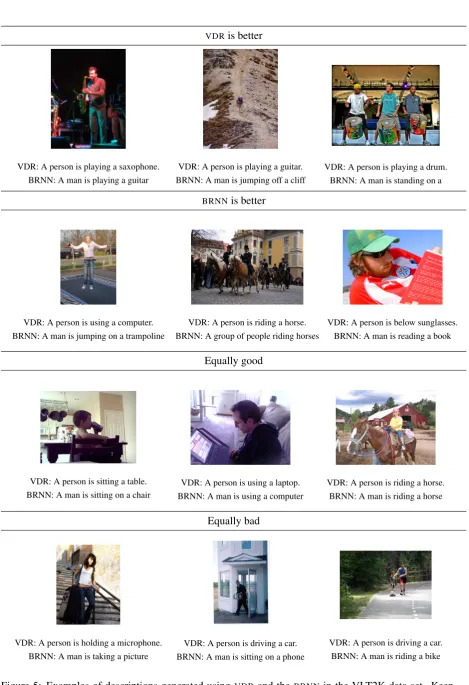
Figure 5 shows examples of the descriptions generated by VDR andBRNN on the VLT2K val-idation set. The examples where VDR generates better descriptions than BRNN are because the VDR Parser makes good decisions about which objects are interacting in an image. In the ex-amples where the BRNN is better than VDR, we see that the multimodal RNN language model succeeds at describing intransitive verbs, group events, and objects not present in the R-CNN ob-ject detector. Both models generate bad descrip-tions when the visual input pushes them in the wrong direction, seen at the bottom of the figure.
VLT→Pascal
Meteor BLEU
[image:8.595.87.288.68.221.2]VDR 7.4→8.2 9.1→9.2 BRNN 12.6→8.1 16.0→10.2
Table 3: Sentence-level scores when transferring models directly between data sets with no retrain-ing. TheVDR-based approach generates better de-scriptions in the Pascal1K data set if we transfer the model from the VLT2K data set.
4.5 Transferring Models
The main reason for the low performance of VDR on the Pascal1K data set is that the linguistic and visual processing steps (Section 2) discard too many training examples. We found that only 190 of the 4,000 description in the training data were used to infer VDRs. This was because most of the descriptions did not contain both a subject and an object, as required by our method. This ob-servation led us to perform a second experiment where we transferred the VDR Parsing and Lan-guage Generation models between data sets. The aim of this experiment was to determine whether VDR simply cannot work on more widely diverse data sets, or whether the process we defined to replicate human VDR annotation was too strict.
Table 3 shows the results of the model trans-fer experiment. In general, neither model is par-ticularly good at transferring between data sets. This could be attributed to the shift in the types of scenes depicted in each data set. However, trans-ferringVDRfrom the VLT2K to the Pascal1K data
set improves the generated descriptions from 7.4
→8.2 Meteor points. The performance of BRNN substantially decreases when transferring between data sets, suggesting that the model may be over-fitting its training domain.
4.6 Discussion
Notwithstanding the conceptual differences be-tween multi-modal deep learning and learning an explicit spatial model of object–object relation-ships, two key differences between theBRNNand our approach are the nature visual input and the language generation models.
Zoo, whereas VDR is currently restricted to dis-crete object detector outputs from those models. The implication of this is that the VDR-based ap-proach is unable to describe 30% of the data in the VLT2K data set. This is due to the object de-tection model not recognising crucial objects for three of the action classes: cameras, books, and telephones. We considered using the VGG-16 pre-trained model from the ImageNet Recognition and Localization task in the RCNN object detector, thus mirroring the detection model used by the neural network. Frustratingly, this does not seem possible because none of the 1,000 types of objects in the recognition task correspond to a person-type of entity. One approach to alleviating this problem could be to use weakly-supervised object localisa-tion (Oquab et al., 2014).
The template-based language generation model used by VDR lacks the flexibility to describe in-teresting prepositional phrases or variety within its current template. An n-gram language gener-ator, such as the phrase-based approaches of (Or-tiz et al., 2015; Lebret et al., 2015), that works within the constraints imposed by VDR structure may generate better descriptions of images than the current template.
5 Conclusions
In this paper we showed how to infer useful and re-liable Visual Dependency Representations of im-ages without expensive human supervision. Our approach was based on searching for objects in images, given a collection of co-occurring descrip-tions. We evaluated the utility of the representa-tions on a downstream automatic image descrip-tion task on two data sets, where the quality of the generated text largely depended on the data set. In a large data set of people performing actions, the descriptions generated by our model were com-parable to a state-of-the-art multimodal deep neu-ral network. In a smaller and more diverse data set, our approach produced poor descriptions be-cause it was unable to extract enough useful train-ing examples for the model. In a follow-up exper-iment that transferred the VDR Parsing and Lan-guage Generation model between data, we found improvements in the diverse data set. Our exper-iments demonstrated that explicitly encoding the spatial relationships between objects is a useful way of learning how to describe actions.
There are several fruitful opportunities for
fu-ture work. The most immediate improvement may be found with broader coverage object detectors. It would be useful to search for objects using multiple pre-trained visual detection models, such as a 200-class ImageNet Detection model and a 1,000-class ImageNet Recognition and Localisa-tion model. A second strand of further work would be to relax the strict mirroring of human annota-tor behaviour when searching for subjects and ob-jects in an image. It may be possible to learn good representations using only the nouns in the POS tagged description. Our current approach strictly limits the inferred VDRs to transitive verbs; im-ages with descriptions such as “A large cow in a field” or “A man is walking” are also a focus for future relaxations of the process for creating train-ing data. Another direction for future work would be to use a n-gram based language model con-strained by the structured predicted in VDR. The current template based method is limiting the gen-eration of objects that are being correctly realised in images.
Tackling the aforementioned future work opens up opportunities to working with larger and more diverse data sets such as the Flickr8K (Hodosh et al., 2013), Flickr30K (Young et al., 2014), and MS COCO (Lin et al., 2014b) or larger action recogni-tion data sets such as TUHOI (Le et al., 2014) or MPII Human Poses (Andriluka et al., 2014).
Acknowledgements
We thank the anonymous reviewers for their com-ments, and members of LaCo at ILLC and WIL-LOW at INRIA for comments on an earlier version of the work. We thank the Database Architectures Group and the Life Sciences Group at CWI for ac-cess to their NVIDIA Tesla K20 GPUs. D. El-liott is funded by an Alain Bensoussain Career De-velopment Fellowship, A. P. de Vries is partially funded by COMMIT/.
References
Mykhaylo Andriluka, Leonid Pishchulin, Peter Gehler, and Bernt Schiele. 2014. 2D Human Pose Estima-tion: New Benchmark and State of the Art Anal-ysis. In CVPR ’14, pages 3686–3693, Columbus, OH, US.
Moshe Bar and Shimon Ullman. 1996. Spatial Context in Recognition. Perception, 25(3):343–52.
and judging objects undergoing relational violations.
Cognitive Psychology, 14(2):143–177.
JH Clark, Chris Dyer, Alon Lavie, and NA Smith. 2011. Better hypothesis testing for statistical ma-chine translation: Controlling for optimizer instabil-ity. InACL-HTL ’11, pages 176–181, Portland, OR, U.S.A.
Michael Denkowski and Alon Lavie. 2011. Meteor 1.3: Automatic metric for reliable optimization and evaluation of machine translation systems. InSMT at EMNLP ’11, Edinburgh, Scotland, U.K.
Jeff Donahue, Lisa Anne Hendricks, Sergio Guadar-rama, Marcus Rohrbach, Subhashini Venugopalan, Kate Saenko, and Trevor Darrell. 2015. Long-term Recurrent Convolutional Networks for Visual Recognition and Description. InCVPR ’15, Boston, MA, U.S.A.
David Eigen, Christian Puhrsch, and Rob Fergus. 2014. Depth Map Prediction from a Single Image using a Multi-Scale Deep Network. In NIPS 27, Lake Tahoe, CA, U.S.A, June.
Desmond Elliott and Frank Keller. 2013. Image Description using Visual Dependency Representa-tions. In EMNLP ’13, pages 1292–1302, Seattle, WA, U.S.A.
Desmond Elliott and Frank Keller. 2014. Comparing Automatic Evaluation Measures for Image Descrip-tion. InACL ’14, pages 452–457, Baltimore, MD, U.S.A.
Desmond Elliott, Victor Lavrenko, and Frank Keller. 2014. Query-by-Example Image Retrieval using Vi-sual Dependency Representations. InCOLING ’14, pages 109–120, Dublin, Ireland.
Mark Everingham, Luc Van Gool, Christopher Williams, John Winn, and Andrew Zisserman. 2010. The PASCAL Visual Object Classes Chal-lenge. IJCV, 88(2):303–338.
Hao Fang, Saurabh Gupta, Forrest Iandola, Rupesh Srivastava, Li Deng, Piotr Doll´ar, Jianfeng Gao, Xiaodong He, Margaret Mitchell, John C. Platt, C. Lawrence Zitnick, and Geoffrey Zweig. 2015. From Captions to Visual Concepts and Back. In
CVPR ’15, Boston, MA, U.S.A.
Ali Farhadi, Mohsen Hejrati, Mohammad Amin Sadeghi, Peter Young, Cyrus Rashtchian, Julia Hockenmaier, and David Forsyth. 2010. Every picture tells a story: generating sentences from im-ages. InECCV ’10, pages 15–29, Heraklion, Crete, Greece.
Yansong Feng and Mirella Lapata. 2008. Automatic Image Annotation Using Auxiliary Text Informa-tion. InACL ’08, pages 272–280, Colombus, Ohio.
Ross Girshick, Jeff Donahue, Trevor Darrell, and Ji-tendra Malik. 2014. Rich feature hierarchies for ac-curate object detection and semantic segmentation.
CoRR, abs/1311.2.
Micah Hodosh, Peter Young, and Julia Hockenmaier. 2013. Framing Image Description as a Ranking Task: Data, Models and Evaluation Metrics. JAIR, 47:853–899.
Yangqing Jia, Evan Shelhamer, Jeff Donahue, Sergey Karayev, Jonathan Long, Ross B. Girshick, Sergio Guadarrama, and Trevor Darrell. 2014. Caffe: Con-volutional Architecture for Fast Feature Embedding. InMM ’14, pages 675–678, Orlando, FL, U.S.A. Andrej Karpathy and Li Fei-Fei. 2015. Deep
Visual-Semantic Alignments for Generating Image De-scriptions. InCVPR ’15, Boston, MA, U.S.A. Andrej Karpathy, Armand Joulin, and Li Fei-Fei. 2014.
Deep Fragment Embeddings for Bidirectional Image Sentence Mapping. InNIPS 28, Montreal, Quebec, Canada.
Girish Kulkarni, Visruth Premraj, Sagnik Dhar, Siming Li, Yejin Choi, Alexander C. Berg, and Tamara L. Berg. 2011. Baby talk: Understanding and generat-ing simple image descriptions. InCVPR ’11, pages 1601–1608, Colorado Springs, CO, U.S.A.
Polina Kuznetsova, Vicente Ordonez, Alexander C. Berg, Tamara L. Berg, and Yejin Choi. 2012. Col-lective Generation of Natural Image Descriptions. InACL ’12, pages 359–368, Jeju Island, South Ko-rea.
Dieu-thu Le, Jasper Uijlings, and Raffaella Bernardi. 2014. TUHOI : Trento Universal Human Object In-teraction Dataset. InWVL at COLING ’14, pages 17–24, Dublin, Ireland.
Remi Lebret, Pedro O. Pinheiro, and Ronan Collobert. 2015. Phrase-based Image Captioning. In ICML ’15, Lille, France, February.
Siming Li, Girish Kulkarni, Tamara L. Berg, Alexan-der C. Berg, and Yejin Choi. 2011. Composing sim-ple image descriptions using web-scale n-grams. In
CoNLL ’11, pages 220–228, Portland, OR, U.S.A. Chin-Yew Lin and Franz Josef Och. 2004.
Auto-matic evaluation of machine translation quality us-ing longest common subsequence and skip-bigram statistics. In ACL ’04, pages 605–612, Barcelona, Spain.
Min Lin, Qiang Chen, and Shuicheng Yan. 2014a. Network In Network. In ICLR ’14, volume abs/1312.4, Banff, Canada.
GD Logan and DD Sadler. 1996. A computational analysis of the apprehension of spatial relations. In Paul Bloom, Mary A. Peterson, Lynn Nadel, and Merrill F. Garrett, editors, Language and Space, pages 492–592. MIT Press.
Junhua Mao, Wei Xu, Yi Yang, Yiang Wang, and Alan L. Yuille. 2015. Deep captioning with mul-timodal recurrent neural networks (m-rnn). InICLR ’15, volume abs/1412.6632, San Diego, CA, U.S.A. Emily E. Marsh and Marilyn Domas White. 2003. A taxonomy of relationships between images and text.
Journal of Documentation, 59(6):647–672.
Guido Minnen, John Carroll, and Darren Pearce. 2001. Applied morphological processing of English. Nat-ural Language Engineering, 7(3):207–223.
Margaret Mitchell, Jesse Dodge, Amit Goyal, Kota Ya-maguchi, Karl Stratos, Alyssa Mensch, Alex Berg, Tamara Berg, and Hal Daum. 2012. Midge : Gen-erating Image Descriptions From Computer Vision Detections. InEACL ’12, pages 747–756, Avignon, France.
Joakim Nivre, Johan Hall, Jens Nilsson, Atanas Chanev, G¨ulsen Eryigit, Sandra K¨ubler, Svetoslav Marinov, and Erwin Marsi. 2007. MaltParser: A language-independent system for data-driven de-pendency parsing. Natural Language Engineering, 13(2):1.
Maxime Oquab, Leon Bottou, Ivan Laptev, and Josef Sivic. 2014. Learning and Transferring Mid-level Image Representations Using Convolutional Neural Networks. InCVPR ’14, pages 1717–1724, Colum-bus, OH, US.
Luis M. G. Ortiz, Clemens Wolff, and Mirella Lapata. 2015. Learning to Interpret and Describe Abstract Scenes. InNAACL ’15, Denver, CO, U.S.A. Erwin Panofsky. 1939. Studies in Iconology. Oxford
University Press.
Kishore Papineni, Salim Roukos, Todd Ward, and WJ Zhu. 2002. BLEU: a method for automatic eval-uation of machine translation. In ACL ’02, pages 311–318, Philadelphia, PA, U.S.A.
DA Randell, Z Cui, and AG Cohn. 1992. A spatial logic based on regions and connection. InPrinciples of Knowledge Representation and Reasoning, pages 165–176.
Cyrus Rashtchian, Peter Young, Micah Hodosh, and Julia Hockenmaier. 2010. Collecting image anno-tations using Amazon’s Mechanical Turk. In AMT at NAACL ’10, pages 139–147, Los Angeles, CA, U.S.A.
Olga Russakovsky, Jia Deng, Hao Su, Jonathan Krause, Sanjeev Satheesh, Sean Ma, Zhiheng Huang, An-drej Karpathy, Aditya Khosla, Michael Bernstein, Alexander C Berg, and Li Fei-Fei. 2014. ImageNet Large Scale Visual Recognition Challenge.
Mohammad A Sadeghi and Ali Farhadi. 2011. Recog-nition Using Visual Phrases. In CVPR ’11, pages 1745–1752, Colorado Springs, CO, U.S.A.
Sara Shatford. 1986. Analysing the Subject of a Pic-ture: A Theoretical Approach. Cataloging & Clas-sification Quarterly, 6(3):39–62.
Karen Simonyan and Andrew Zisserman. 2015. Very Deep Convolutional Networks for Large-Scale Im-age Recognition. InICLR ’15, volume abs/1409.1, San Diego, CA, U.S.A.
Richard Socher, Andrej Karpathy, Q Le, C Manning, and A Ng. 2014. Grounded Compositional Seman-tics for Finding and Describing Images with Sen-tences. TACL, 2:207–218.
Kristina Toutanova, Dan Klein, and Christopher D Manning. 2003. Feature-Rich Part-of-Speech Tag-ging with a Cyclic Dependency Network. In HLT-NAACL ’03, pages 173–180, Edmonton, Canada. Oriol Vinyals, Alexander Toshev, Samy Bengio, and
Dumitru Erhan. 2015. Show and tell: A neural im-age caption generator. InCVPR ’15, Boston, MA, U.S.A.
Yezhou Yang, Ching Lik Teo, Hal Daum´e III, and Yiannis Aloimonos. 2011. Corpus-Guided Sen-tence Generation of Natural Images. InEMNLP ’11, pages 444–454, Edinburgh, Scotland, UK.
Mark Yatskar, Michel Galley, L Vanderwende, and L Zettlemoyer. 2014. See No Evil, Say No Evil: Description Generation from Densely Labeled Im-ages. In*SEM, pages 110–120, Dublin, Ireland. Peter Young, Alice Lai, Micah Hodosh, and Julia