ORIGINAL RESEARCH
Morphometric Changes in the Episodic Memory
Network and Tau Pathologic Features Correlate
with Memory Performance in Patients with Mild
Cognitive Impairment
A.M. Fjell K.B. Walhovd I. Amlien A. Bjørnerud I. Reinvang L. Gjerstad T. Cappelen F. Willoch P. Due-Tønnessen R. Grambaite A. Skinningsrud V. Stenset T. Fladby
BACKGROUND AND PURPOSE: Mild cognitive impairment (MCI) may affect several cognitive domains, including attention and reasoning, but is often first characterized by memory deficits. The purpose of this study was to ask these 2 questions: 1) Can levels of CSF tau proteins and amyloid beta 42 peptide explain thinning of the cerebral cortex in patients with MCI? 2) How are brain morphometry, CSF biomarkers, and apolipoprotein E (APOE) allelic variation related to episodic memory function in MCI?
MATERIALS AND METHODS: Hippocampal volume and cortical thickness were estimated by MR imaging and compared for patients with MCI (n⫽18) and healthy controls (n⫽18). In addition, regions of interest (ROIs) were selected in areas where the MCI group had atrophy and which overlapped with the episodic memory network (temporal, entorhinal, inferior parietal, precuneus/posterior cingulate, and frontal). Relationships among morphometry, CSF biomarkers, APOE, and memory were tested. The analyses were repeated with an independent sample of patients with MCI (n⫽19).
RESULTS: Patients with MCI and pathologic CSF values had hippocampal atrophy. However, both patients with pathologic and patients with nonpathologic CSF had a thinner cortex outside the hippocampal area. CSF pathology was related to hippocampal volume, whereas relationships with cortical thickness were found mainly in one of the samples. Morphometry correlated robustly with memory performance across MCI samples, whereas less stable results were found for tau protein.
CONCLUSION:The differences in hippocampal volume between the MCI and the healthy control groups were only found in patients with pathologic CSF biomarkers, whereas differences in cortical thickness were also found for patients without such pathologic features. Morphometry in areas in the episodic memory network was robustly correlated with memory performance. It is speculated that atrophy in these areas may be associated with the memory problems seen in MCI.
M
ild cognitive impairment (MCI) is a condition that greatly increases the likelihood of the development of Alzheimer disease (AD), with an annual conversion rate from MCI to AD of 6% to 25%.1We undertook this study to inves-tigate the cognitive significance of biomarkers associated with MCI by asking 2 questions:1) Can levels of CSF tau proteins and amyloid beta 42 pep-tide (A42) explain thinning of the cerebral cortex in MCI? It has been argued that volumetric temporal and hippocampal damage in MCI2-5is secondary to the pathologic depositions of A426-8and intracellular neurofibrillary tangles9(tau pro-teins). Correlations between CSF biomarkers and brain mor-phometry in the temporal areas have been found in MCI and AD.10-12Recent results indicate differences in thickness be-tween patients with MCI and healthy controls outside the tem-poral brain areas (eg, in the frontal and parietal cortex.)5It has not been tested whether these changes can be explained by
levels of CSF biomarkers in AD, only in frontotemporal de-mentia.13Furthermore, the number of4 alleles of the apoli-poprotein E (APOE) gene is an established risk factor for AD14 and is suggested to interact with Ato inhibit clearance or stimulate deposition of A,15enhance Aproduction,16and initiate cortical thinning.17
2) How are brain morphometry, CSF biomarkers, and APOE allelic variation related to episodic memory function in MCI? Deficit in episodic memory is the major cognitive symptom of MCI and is related to hippocampal volume in MCI and AD.18-21However, memory has never been related to detailed measures of cortex in MCI. This is so, despite the fact that cortico-subcortical and cortico-cortical networks for episodic memory have been identified, including the medial temporal lobe structures (ie, hippocampus, entorhi-nal cortex), medial and lateral parietal areas (ie, precuneus/ posterior cingulate, inferior parietal cortex) as well as the prefrontal cortical areas,22-23and that thickness in the cor-responding areas has been found to correlate with verbal memory in healthy controls.24In our study, episodic mem-ory will be related to hippocampal volume and cortical thickness in areas overlapping with this episodic memory network and where patients with MCI have probable atrophy.
The relevance of tau and Ato memory performance in MCI is poorly understood.25Two studies have found that T-tau, but not A42, was related to episodic memory func-tion,26,27whereas one found that this depended on the
pres-Received December 6, 2007; accepted after revision January 23, 2008.
From the Departments of Psychology (A.M.F., K.B.W., I.A., I.R.) and Physics (A.B.), University of Oslo, Oslo, Norway; Departments of Radiology (A.B., P.D.-T.), Neurology (L.G.), and Nuclear Medicine (T.C.), Rikshospitalet University Hospital, Oslo, Norway; Department of Radiology (F.W.), Aker University Hospital, Oslo, Norway; and the Departments of Neurol-ogy Faculty Division, (R.G., V.S., T.F.) and Clinical Chemistry and Nuclear Medicine (A.S.), Akershus University Hospital, University of Oslo, Lørenskog, Norway.
The study was supported by grants to Tormod Fladby within the MedCoast initiative and from the University of Oslo to Kristine B Walhovd.
Please address correspondence to Anders M. Fjell, University of Oslo, Department of Psychology, POB 1094 Blindern, 0317 Oslo, Norway; e-mail: [email protected] DOI 10.3174/ajnr.A1059
BRAIN
ORIGINAL
ence of APOE4 alleles.28In none of these studies were the relationships with brain morphometry tested.
Methods
Sample
Sample characteristics are presented in Table 1. The project was ap-proved by a committee for medical research ethics. Patients aged 40 to 79 years with MCI29established for at least 6 months attending a
university-based clinic were assessed for inclusion, all giving in-formed consent. Patients with no problems with activities of daily living, symptoms lasting 6 months or longer, Global Deterioration Scale score30,311 to 3, and Mini-Mental State Examination32score of
23 or greater were included. Criteria for exclusion were established psychiatric disorder, cancer, drug abuse, solvent exposure, or anoxic brain damage. The first 18 patients (sample 1) were scanned on 1 MR scanner and the next 19 (sample 2), on another. Practical reasons imposed the change of scanner. Neuropsychology data for 2 partici-pants from sample 1 are missing because 1 patient did not wish to participate further after the imaging and lumbar puncture were done, and 1 did not receive this examination because of insufficient coordi-nation in the initial phases of the project. Healthy volunteers without deficits related to memory, emotionality, and tempo (primarily spouses of the patients) were included as controls. All controls were scanned at the same scanner as sample 1, and thus all comparisons between controls and patients with MCI are based on sample 1. In addition, 6 controls were scanned on both scanners. This was done for comparison of data from the 2 scanners. As seen from Tables 1 and 2, the 2 MCI samples were very similar.
Lumbar Puncture and Laboratory Analyses
Patients, but not controls, underwent lumbar puncture, examined for CSF biomarkers for degenerative brain disease (T-tau, P-tau, and
A42) with commercially available kits (Innogenetics, Belgium) adapted to a Robotic Microplate 150 Processor (Tecan, Switzerland). Lumbar puncture was not performed in 1 patient in sample 1 because of recent back surgery and low back pain. The criteria for pathologic values were as follows: T-tau, 300 ng/L or more for⬍50 years, 450 ng/L or more for 50 to 69 years, and 500 ng/L or more for⬎70 years,33
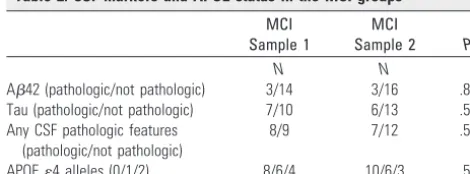
P-tau,⬎80 ng/L, and A42⬍550 ng/L. The participants were tested for APOE4 alleles, and scored as presence of 0, 1, or 24 alleles. The number of patients with pathologic CSF biomarkers and distribution of APOE4 alleles is presented in Table 2. There was large overlap between pathologic features for P-tau and T-tau, and the 2 variables were combined to 1 tau score (pathologic versus nonpathologic).
MR Imaging Scanning and Analyses
Sample 1.A Symphony 1.5T MR scanner (syngo MR 2004A 4VA25A software) with a conventional quadrature head coil was used (Siemens, New York, NY). The pulse sequences used for morphomet-ric analysis were two 3D magnetization-prepared rapid acquisition of gradient echo (MPRAGE), T1-weighted sequences in succession (TR, 2730 ms; TE, 3.19 ms; TI, 1100 ms; FA, 15 °; matrix, 256⫻192). Each volume consisted of 128 sagittal sections with a thickness of 1.33 mm and in-plane resolution of 1.0 mm⫻1.33 mm.
Sample 2.An Espree 1.5T MR scanner (syngo MR B13 4VB13A software) (Siemens) was used, with the following sequences: Two 3D MPRAGE, T1-weighted sequences in succession (TR, 2400 ms; TE, 3.65 ms; TI, 1000 ms; FA, 8 °; matrix, 240⫻192), 160 sagittal sections with thickness of 1.2 mm, and in-plane resolution of 1⫻1.2 mm. The 2 MPRAGES were averaged to increase the signal-to-noise ratio. MR segmentations were performed with FreeSurfer software (http:// surfer.nmr.mgh.harvard.edu/). The procedures for automated thick-ness measurement are described elsewhere34-40and are validated by
histology and MR.41-42Scans were also segmented to yield volumetric
data for the hippocampal formation,43including the dentate gyrus,
cornu ammonis (CA) fields, subiculum/parasubiculum, and the fim-bria.44Hippocampal volume was calculated as the sum of the left and
right hippocampal volume, regressed on intracranial volume (ICV). SPSS 15.0 (SPSS, Chicago, Ill) was used for the rest of the analyses.
Memory Testing
The Rey Auditory-Verbal Test (RAVLT)45-47was used to measure
episodic memory in the patients. A total of 15 words are read aloud to the patient, who subsequently recalls as many words as possible. This is repeated 5 times with the same list (learning trials). Next, an inter-ference list is presented and to be recalled before the patient is re-quested to recall the first list without its being read again. After 30 minutes, the patient is asked to recall the first list of words again with no re-reading. This trial is termed30 minutes recall.The number of correct responses on the 5 learning trials is summed to 1 learning score. To limit the number of statistical tests performed, we analyzed only the learning score and the 30 minutes recall score.
Statistical Analyses
First, ICV-corrected hippocampal volume was compared between the control and MCI groups from sample 1 by an independent samplest
[image:2.594.52.283.58.164.2]test. Next, cortical thickness across the brain surface was compared between the groups by use of a general linear model approach. This was done to identify areas where those with MCI have probable atro-phy, and additional analyses were restricted to areas of difference, which also overlapped reasonably well with the above-described epi-sodic memory network. To control for false-positives as a result of Table 1: Sample characteristics*
Controls
MCI Sample 1
MCI
Sample 2 P
(SD) (SD) (SD)
N 18 18 19
Women/Men 7/11 7/11 10/9 .63
Age (43–77 y) 63.7 (6.3) 61.6 (9.0) 61.8 (7.1) .66
Education 10.8 (2.7) 13.1 (3.3) 11.6 (2.7) .06
GDS NA 2.94 (0.24) 2.95 (0.23) .97
MMSE (23–30) NA 27.4 (1.9) 27.9 (1.7) .47
Symptom duration NA 2.11 (1.40) 2.98 (1.57) .95
Note:—MCI indicates mild cognitive impairment; GDS, Global Deterioration Scale; MMSE, Mini-Mental State Examination.
* ThePvalues are from an ANOVA with a group factor of 3 levels. Post hoc analyses confirmed that none of the contrast between the groups was significant. The MMSE was not administered to the controls. SD is presented in parentheses where relevant.
Table 2: CSF markers and APOE status in the MCI groups
MCI Sample 1
MCI
Sample 2 P
N N
A42 (pathologic/not pathologic) 3/14 3/16 .89
Tau (pathologic/not pathologic) 7/10 6/13 .56
Any CSF pathologic features (pathologic/not pathologic)
8/9 7/12 .55
APOE4 alleles (0/1/2) 8/6/4 10/6/3 .58
Note:—MCI indicates mild cognitive impairment; A42, amyloid beta 42 peptide; APOE
4, apolipoprotein E.
[image:2.594.51.286.225.312.2]multiple comparisons, the distribution ofPvalues were computed, and the degree of shift relatively to the midline was inspected. The regions of interest (ROIs) were first entered as dependent variables into 1-way analyses of variance (ANOVAs) with a group factor con-sisting of 3 levels: controls, MCIs from sample 1 without pathologic CSF biomarker, and MCI group from sample 1 with at least 1 patho-logic CSF biomarker. This was done to test whether probable atrophy also existed in patients without pathologic CSF biomarkers. Next, the morphometry ROIs were entered into separate ANOVAs to directly test the relationship with pathologic CSF biomarker and APOE status. These analyses were performed for sample 1 and 2 separately. Because there were only 2 participants in sample 1 and 3 in sample 2 with pathologic A42 values, Pearson correlations and actual A42 values were used for these analyses. Finally, the morphometry variables,
pathologic CSF biomarker, and APOE were correlated with RAVLT learning and 30 minutes recall in the 2 MCI samples independently. The significant relationships were then retested by partial correlations controlling for the effects of age. All analyses were run separately in sample 1 and sample 2, and the results compared. This was done to test the stability of the results and the validity of the method.
Results
Correlations Across Scanners
Volumes of hippocampus, cortex, and the lateral ventricles were estimated for the 6 healthy controls who were scanned on both scanners and correlated across scanners. The Pearson coefficients were of 0.99, 0.90, and 0.999 (allP⬍.05), respec-tively. Mean differences in cortical thickness were generally within⫾0.1 mm across the brain surface. This indicates that change of scanner did not introduce much bias in the data.
Morphometry Comparisons Between MCI and Healthy Control Groups
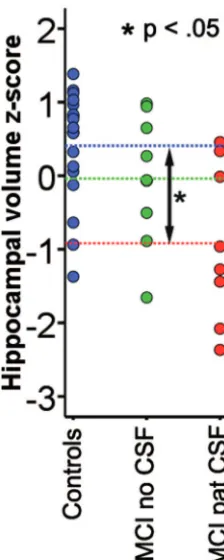
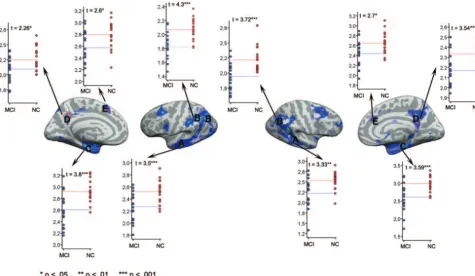
Both ICV-corrected (t [34]⫽2.70;P⫽.011; MCI, ⫺0.41; controls, 0.41) and raw (t [34]⫽2.24;P⫽.032; MCI, 7689 mm3; SD, 1550; controls, 8615 mm3; SD, 828) hippocampal volumes were significantly smaller in MCI sample 1 than in the healthy controls. Additional analyses were done with ICV-corrected volume. Figure 1 shows a scatterplot with hip-pocampal volume for patients and controls. Figure 2 shows the results of the cortical comparisons, and scatterplots are presented in Fig 3. There was bilateral thinning of the cerebral cortex in MCI in large areas, especially in the temporal cortex, inferior parietal, and medial parietal areas, and partly in the superior and inferior frontal areas. A strong effect was ob-served in the right and a weaker in the left hemisphere extend-ing from the posterior cextend-ingulate to precuneus. As can be seen from Fig 4, the distribution ofPvalues is shifted to the left (thicker cortex in controls), with almost no voxels to the right of the midline (thicker cortex in MCI). This indicates that it is very unlikely that the effect of MCI on cortical thickness is a result of false-positives from multiple statistical comparisons. To test whether probable atrophy could be found also in participants without pathologic CSF biomarker values, hip-pocampal volume and the ROIs from Fig 3 were entered into one-way ANOVAs with 3 groups (controls, MCI without pathologic CSF biomarkers, MCI with pathologic CSF bi-omarkers). There was a main effect of group for all variables except for the left hemisphere precuneus (P⫽.12) and right hemisphere superior frontal gyrus (P⫽.06). Post hoc testing with Bonferroni corrections for multiple comparisons showed that patients with MCI and pathologic CSF biomarkers had significantly smaller hippocampal volume than the controls, whereas this was not found for patients with MCI without pathologic values (P⫽.66). For the cortical ROIs, differences between the control and MCI groups without pathologic CSF were found in the left hemisphere inferior parietal cortex (P⬍
.05), with a trend toward significance for the entorhinal cortex (P⫽.071) and in the right hemisphere inferior parietal gyrus, entorhinal cortex, and precuneus (P⬍.05) and a trend for the middle temporal gyrus (P⫽.073).
Fig 1.Hippocampal volume in patients with MCI versus controls. Hippocampal volume is calculated as the total volume of the right and left hippocampus and regressed on ICV. The standardized residuals are shown on the y-axis (z-scores). The patients are grouped according to whether they have pathologic (MCI pat CSF) or nonpathologic (MCI no CSF) values of tau or A42. The blue-dotted lines indicate the mean value for each group. Independent samplesttests (Bonferroni corrected for multiple comparisons) showed that the patients with pathologic CSF biomarkers had significantly smaller hippocampal volume than the controls, whereas the other contrasts did not reach significance.
[image:3.594.114.226.42.322.2] [image:3.594.54.286.418.501.2]Correlations Between CSF Biomarkers, APOE Status, and Brain Morphometry
Table 3 presents the results of ANOVAs testing the relation-ships between CSF biomarkers, APOE status, and the dif-ferent morphometry variables. Figure 5 illustrates scatter-plots of selected relationships. In general, stronger associations were observed in sample 2 compared with sample 1. The hippocampus was related to tau in both sam-ples, as was the left and right inferior parietal and entorhi-nal gyri in sample 2 and the left middle temporal gyrus in sample 1. A42 and APOE were only related to morphom-etry in sample 2: the hippocampus and precuneus in both hemispheres, and the left entorhinal gyrus for A42; and the left and right entorhinal gyri, in addition to the right precuneus, for APOE.
The significant relationships were retested with age as a covariate. In sample 1, the relationships between the tau and the hippocampus survived. In sample 2, the association be-tween tau pathology and the left and right inferior parietal gyri and the right entorhinal gyrus survived, as did the
relation-ships among A42 and the hippocampus, the left and right precuneus, and the left entorhinal gyrus.
Correlations Between Psychometric Memory Performance and Brain Morphometry
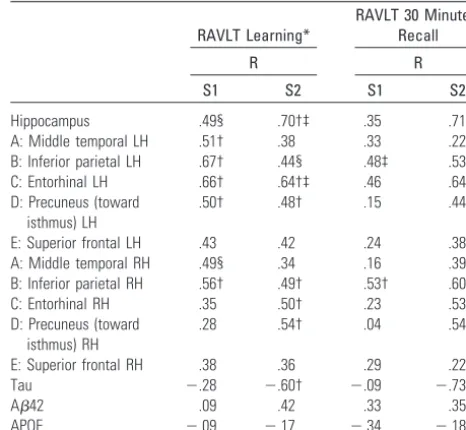
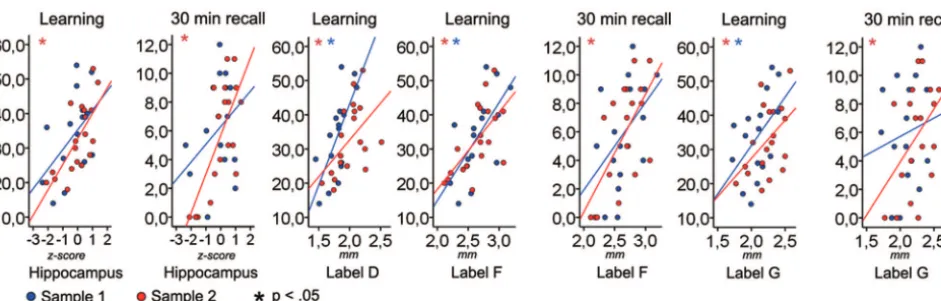
Mean scores for RAVLT learning and 30 minutes recall was 33.6 (SD, 11.99) and 5.9 (SD, 3.7) in sample 1, and 32.7 (SD, 10.2) and 5.7 (SD, 3.7) in sample 2. Correlations between memory scores and the biomarkers are presented in Table 4 and scatterplots in Fig 6. Of the 10 morphometry variables, 5 and 6 correlated significantly with RAVLT learning in samples 1 and 2, respectively, whereas 3 showed a trend toward signif-icance (P⬍.06). The correlations with RAVLT 30 minutes recall were much smaller in sample 1, where 1 reached signif-icance and 1 showed a trend. In sample 2, the same 6 variables correlated with 30 minutes recall and learning, in addition to the inferior parietal gyrus and middle temporal gyrus. Tau correlated significantly with both learning and 30 minutes call in sample 2. The significant relationships were then re-tested by partial correlations controlling for the effects of age. Fig 4.Distribution ofPvalues. This figure shows the number of voxels for any givenPvalue from the cortical comparisons illustrated in Fig 2. The left side of each chart (blue-green colors) represents a thicker cortex in healthy controls; the right side (red-yellow colors) represents a thicker cortex in the patients. As can be seen, the distri-bution ofPvalues is shifted to the left, with almost no voxels to the right of the midline (indicating thicker cortex for patients). This shows clearly that the patients have a thinner cortex than the healthy controls and that it is very unlikely that this is a result of false-positives from multiple statistical comparisons.
[image:4.594.58.534.45.321.2] [image:4.594.53.371.383.469.2]In sample 2, the hippocampus and entorhinal gyrus still cor-related with both learning and 30 minutes recall, whereas tau correlated with 30 minutes recall.
Discussion
There are 2 main findings in our study: 1) Although the tients with pathologic CSF biomarker levels (but not the pa-tients with nonpathologic levels) had smaller hippocampal volume than controls, differences in cortical thickness were found also in patients with MCI without pathologic CSF bi-omarkers. 2) Episodic memory correlated with morphometry in areas overlapping with the episodic memory network.
Can levels of CSF tau proteins and A42 explain thinning of the cerebral cortex in MCI?Our results indicate that espe-cially tau-pathology is related to reductions in hippocampal volume in MCI. The findings of a reduced hippocampus in MCI are in accordance with previous reports,43,48but the new finding was that this difference depended on the participants with pathologic CSF biomarkers. This fits with knowledge that tau-related pathologic features (neurofibrillary tangles) are initially limited to the hippocampus, the entorhinal cortex, and adjacent limbic structures,49whereas amyloid deposition is more distributed.25,50,51
Our data are in accordance with recent results showing widespread cortical thinning in MCI.5The current sample is small, but the similarity of findings indicates that the results probably are valid. The thinning was quite symmetric across hemispheres and was located mainly in the temporal (lateral and medial) and inferior parietal cortices, in addition to parts of the superior frontal cortex and some more scattered medial parietal and frontal effects. In several ROIs, differences be-tween patients and controls did not depend on the patients with pathologic CSF biomarkers. Thus, these data indicate that patients with pathologic CSF levels alone do not account for the group effect of a thinner cortex in MCI. It seems that tau-related pathologic features strike the hippocampus ag-gressively, as indicated by de Leon et al,11but cannot account for all cortical atrophy in MCI.
When the brain areas that distinguished the patients from the controls were related directly to the CSF biomarkers and APOE status, it was found that tau was related to 2 of the 10 ROIs in sample 1 and 5 in sample 2. A42 was related to none of the ROIs in sample 1 but 4 in sample 2, and APOE status was related to 3 ROIs in sample 2. In general, the effects were
[image:5.594.301.534.58.273.2]stron-Fig 5.Relationships between tau pathologic features and brain morphometry. Hippocampal volume and mean thickness in left hemisphere entorhinal ROI compared across groups of pathologic (pato) versus nonpathologic (norm) T-tau or P-tau values.
Table 3: Effects of CSF biomarkers and APOE on brain morphometry*
Tau A42 APOE
F R F
S1 S2 S1 S2 S1 S2
Hippocampus 5.90†‡ 7.86† .30 .51†‡ 0.04 3.19
A: Middle temporal LH 5.57† 0.00 .20 .11 1.24 0.16 B: Inferior parietal LH 1.50 16.67†‡ ⫺.04 .11 0.87 2.60 C: Entorhinal LH 2.32 7.35† .05 .57†‡ 0.42 4.39† D: Precuneus (toward
isthmus) LH
1.42 1.06 ⫺.16 .51†‡ 0.98 2.99 E: Superior frontal LH 3.41 1.72 ⫺.08 .24 0.06 1.93 A: Middle temporal RH 1.06 0.77 ⫺.19 .27 0.08 1.47 B: Inferior parietal RH 2.24 10.30†‡ ⫺.11 .29 0.76 0.90 C: Entorhinal RH 1.35 11.32†‡ ⫺.19 .23 0.27 3.62† D: Precuneus (toward
isthmus) RH
0.50 3.80 ⫺.25 .59†‡ 1.15 3.85† E: Superior frontal RH 0.00 0.31 ⫺.06 .11 0.51 1.24
Note:—S1 indicates Sample 1; S2, Sample 2; LH, left hemisphere; RH, right hemisphere; A42, amyloid beta 42 peptide; APOE, apolipoprotein E; F, F-ratio; R, Pearson r. * The effects of the APOE genotype and pathologic values of CSF biomarkers tau and A42 on the morphometry (thickness or volume) of the brain in regions that are significantly different between healthy controls and patients with MCI. Because only 3 participants had pathologic A42 values in each sample, the absolute A42 values were used instead of cutoff values, and the relationships were tested with Pearson correlations. In the rest of the analyses, ANOVA was used. Hippocampus is the sum of the left and right hippocampus, regressed on intracranial volume, and the residuals are used in the analyses. The capital letters refer to the cortical ROI from Fig 3.
†P⬍.05.
‡P⬍.05 when the effect of age is controlled for.
Table 4: Correlations between biomarkers and episodic memory
RAVLT Learning*
RAVLT 30 Minutes’ Recall
R R
S1 S2 S1 S2
Hippocampus .49§ .70†‡ .35 .71†‡
A: Middle temporal LH .51† .38 .33 .22
B: Inferior parietal LH .67† .44§ .48‡ .53†
C: Entorhinal LH .66† .64†‡ .46 .64†‡
D: Precuneus (toward isthmus) LH
.50† .48† .15 .44†
E: Superior frontal LH .43 .42 .24 .38
A: Middle temporal RH .49§ .34 .16 .39†
B: Inferior parietal RH .56† .49† .53† .60†
C: Entorhinal RH .35 .50† .23 .53†
D: Precuneus (toward isthmus) RH
.28 .54† .04 .54†
E: Superior frontal RH .38 .36 .29 .22
Tau ⫺.28 ⫺.60† ⫺.09 ⫺.73†‡
A42 .09 .42 .33 .35
APOE ⫺.09 ⫺.17 ⫺.34 ⫺.18
Note:—S1 indicates Sample 1; S2, Sample 2; RAVLT, Rey Auditory-Verbal Test; APOE, apolipoprotein E; A42; amyloid beta 42 peptide; LH, left hemisphere; RH, right hemi-sphere; R, Pearson r.
* RAVLT learning is the sum of correct responses across learning trials 1 to 5. APOE is quantified as the number of⑀4 alleles (0, 1, or 2). For tau, cutoff criteria are used in the analyses (0 for nonpathologic, 1 for pathologic), whereas for A42 the actual values are used because only 2 participants in Sample 1 had pathologic values.
†P⬍.05.
[image:5.594.52.288.69.240.2] [image:5.594.59.433.611.724.2]ger in sample 2, but the relationship between the hippocampus and tau pathologic features was replicated across samples. The relationship between tau and hippocampal volume is well known,11-12but relationships between tau pathologic features and thickness in widespread cortical areas, to our knowledge, have not been reported previously. The discrepant findings across the 2 samples indicate that these effects are not very robust, however. Still, although relationships between tau pathologic features and cortical thickness in selected ROIs were found in the patients from sample 2, group differences in thickness existed also independently of this pathologic pro-cess. Longitudinal data are needed to better assess the effects of tau pathologic features on the cortical morphometry in MCI.
How are brain morphometry, CSF biomarkers, and APOE related to episodic memory function in patients with MCI?There were 7 of the 10 morphometry variables that cor-related with the learning score in at least 1 of the samples, whereas 5 of these were significant or near significant in both samples. For instance, the entorhinal gyrus and precuneus in the left hemisphere correlated with learning in both samples, whereas the hippocampus correlated strongly in sample 2 and was marginally significant in sample 1. These are core struc-tures in the episodic memory network. In sample 2, there was an almost perfect correspondence between the results for learning and 30 minutes recall, indicating that atrophy in the episodic memory network in MCI affects both learning and 30 minutes’ recall performance.
Of the CSF biomarkers, tau pathologic features correlated with learning and recall in sample 2. Correlations between tau and memory have been found previously.26,27 Our results partly confirm this, but the discrepant findings in sample 1 indicate that this relationship is not very robust. A42 and APOE did not correlate with memory performance in either of the samples. Thus, it seems that morphometry and episodic memory correlated robustly across samples, whereas the re-sults for tau are less stable.
Our results indicate that the differences in morphometry within the MCI group have cognitive correlates. Several of the brain areas with probable atrophy in MCI correlated with memory function. Buckner22suggested that dysfunction of a neural network including the medial temporal lobe and the precuneus, extending into the posterior cingulate and retro-splenial cortex, may be central in explaining the memory
def-icits associated with AD. In our study, morphometric differ-ences and correlations with episodic memory were identified in these areas, indicating that atrophy here contributes to the memory problems seen in MCI. However, the effect of age is substantial on both brain morphometry40and episodic mem-ory function,52and the results should be replicated with larger patient groups of same-age patients.
Limitations
Previous knowledge about the episodic memory network guided the selection of the ROIs, but the exact placement and size of each were based on where controls and patients with MCI differed in thickness. This was done to ensure that the ROIs reflected brain areas where the patients are likely to have atrophy and thus are areas relevant for the disease. However, exact definition of the ROIs a priori would be a more solid approach. The samples were scanned on different scanners, which may potentially lead to biased results. However, the replication of the results across the 2 samples makes this less likely and increases the generalizability of the conclusions. Furthermore, it has been shown that the segmentation ap-proach used in our study yields thickness estimates53 and brain-behavior relationships54that are highly reliable across different scanner platforms. The original voxel resolution was not identical between the 2 scanner platforms (1.0⫻1.33 mm vs 1.0⫻1.2 mm). Still, the high correlations between the es-timated volumes of the different structures indicate that this difference did not introduce much bias in the data and that the results across samples can be compared. Another point relates to the relatively small difference in cortical thickness between participants. However, histologic validation studies have shown that the measurement error associated with the ap-proach used is approximately 0.25 mm,41which is clearly less than the differences reported in our study.
Conclusion
[image:6.594.60.531.40.190.2]caution. The findings should be replicated with larger patient populations and longitudinal data. Still, the replication of the results across samples suggests reliability of the results.
References
1. Petersen RC, Stevens JC, Ganguli M, et al.Practice parameter: early detection of dementia: mild cognitive impairment (an evidence-based review). Report of the Quality Standards Subcommittee of the American Academy of Neurol-ogy.Neurology2001;56:1133– 42
2. Bell-McGinty S, Lopez OL, Meltzer CC, et al.Differential cortical atrophy in subgroups of mild cognitive impairment.Arch Neurol2005;62:1393–97 3. Karas GB, Scheltens P, Rombouts SA, et al.Global and local gray matter loss in
mild cognitive impairment and Alzheimer’s disease.NeuroImage2004;23: 708 –16
4. Du AT, Schuff N, Amend D, et al.Magnetic resonance imaging of the entorhi-nal cortex and hippocampus in mild cognitive impairment and Alzheimer’s disease.J Neurol Neurosurg Psychiatry2001;71:441– 47
5. Singh V, Chertkow H, Lerch JP, et al.Spatial patterns of cortical thinning in mild cognitive impairment and Alzheimer’s disease.Brain2006;129:2885–93 6. Arriagada PV, Marzloff K, Hyman BT.Distribution of Alzheimertype patho-logic changes in nondemented elderly individuals matches the pattern in Alz-heimer’s disease.Neurology1992;42:1681– 88
7. Naslund J, Haroutunian V, Mohs R, et al.Correlation between elevated levels of amyloid beta-peptide in the brain and cognitive decline.JAMA2000;283: 1571–77
8. Thal DR, Rub U, Orantes M, Braak H.Phases of A beta-deposition in the human brain and its relevance for the development of AD.Neurology2002;58: 1791– 800
9. Price JL, Morris JC.Tangles and plaques in nondemented aging and preclini-cal Alzheimer’s disease.Ann Neurol1999;45:358 – 68
10. Wahlund, L-O, Blennow K.Cerebrospinal fluid biomarkers for disease stage and intensity in cognitively impaired patients.Neurosci Lett2003;339:99 –102 11. de Leon MJ, DeSanti S, Zinkowski R, et al.Longitudinal CSF and MRI biomar-kers improve the diagnosis of mild cognitive impairment.Neurobiol Aging
2006;27:394 – 401
12. Hampel H, Burger K, Pruessner JC, et al.Correlation of cerebrospinal fluid levels of tau protein phosphorylated at threonine 231 with rates of hippocam-pal atrophy in Alzheimer disease.Arch Neurol2005;62:770 –73
13. Grossman MM, Farmer JJ, Leight SS, et al.Cerebrospinal fluid profile in fron-totemporal dementia and Alzheimer’s disease.Ann Neurol2005;57:721–29 14. Corder EH, Saunders AM, Strittmatter WJ, et al.Gene dose of apolipoprotein E
type 4 allele and the risk of Alzheimer’s disease in late onset families.Science
1993;261:921–23
15. Huang Y, Weisgraber KH, Mucke L, et al.Apolipoprotein E: diversity of cellu-lar origins, structural and biophysical properties, and effects in Alzheimer’s disease.J Mol Neurosci2004;23:189 –204
16. Ye S, Huang Y, Mullendorff K, et al.Apolipoprotein (apo) E4 enhances amyloid beta peptide production in cultured neuronal cells: apoE structure as a poten-tial therapeutic target.Proc Natl Acad Sci U S A2005;102:18700 – 05 17. Espeseth T, Westlye LT, Fjell AM, et al.Accelerated age-related cortical
thin-ning in healthy carriers of apolipoprotein E epsilon 4.Neurobiol Aging
2008;29:329 – 40
18. Deweer B, Lehericy S, Pillon B, et al.Memory performance in probable Alzhei-mer’s disease: the role of hippocampal atrophy as shown with MRI.J Neurol Neurosurg Psychiatry1995;58:590 –97
19. Heun R, Mazanek M, Atzor KR, et al.Amygdala hippocampal atrophy and memory performance in dementia of Alzheimer type.Dement Geriatr Cogn Disord1997;8:329 –36
20. Mori E, Yoneda Y, Yamashita H, et al.Medial temporal structures related to memory impairment in Alzheimer’s disease: an MRI volumetric study.J Neu-rol Neurosurg Psychiatry1997;63:214 –21
21. Small SA, Perera GM, DeLaPaz R, et al.Differential regional dysfunction of the hippocampal formation among elderly with memory decline and Alzheimer’s disease.Ann Neurol1999;45:466 –72
22. Buckner RL.Memory and executive function in aging and AD: multiple fac-tors that cause decline and reserve facfac-tors that compensate.Neuron2004;44: 195–208
23. Buckner RL, Wheeler ME.The cognitive neuroscience of remembering.Nat Rev Neurosci2001;2:624 –34
24. Walhovd KB, Fjell AM, Dale AM, et al.Regional cortical thickness matters in recall after months more than minutes.Neuroimage2006;31:1343–51 25. Guillozet AL, Weintraub S, Mash DC, et al.Neurofibrillary tangles, amyloid,
and memory in aging and mild cognitive impairment.Arch Neurol2003;60: 729 –36
26. Ivanoiu A, Sindic C.Cerebrospinal fluid TAU protein and amyloid beta42 in mild cognitive impairment: prediction of progression to Alzheimer’s disease and correlation with the neuropsychological examination. Neurocase
2005;11:32–39
27. Schoonenboom SN, Visser PJ, Mulder C, et al.Biomarker profiles and their relation to clinical variables in mild cognitive impairment.Neurocase2005;11: 8 –13
28. Andersson C, Blennow K, Johansson SE, et al.Differential CSF biomarker lev-els in APOE-epsilon 4-positive and -negative patients with memory impair-ment.Dement Geriatr Cogn Disord2007;23:87–95
29. Gauthier S, Reisberg B, Zaudig M, et al.Mild cognitive impairment.Lancet
2006;367:1262–70
30. Reisberg B, Ferris SH, de Leon MJ, et al.Global Deterioration Scale (GDS).
Psychopharmacol Bull1988;24:661– 63
31. Auer S, Reisberg B.The GDS/FAST staging system.Int Psychogeriatr1997;9: 167–71
32. Folstein MF, Folstein SE, McHugh PR.Mini-mental state.J Psychiatr Res
1975;12:189 –98
33. Sjo¨gren M, Vanderstichele H, Agren H, et al.Tau and Abeta42 in cerebrospinal fluid from healthy adults 21–91 years of age; establishment of reference val-ues.Clin Chem2001;47:1776 – 81
34. Dale AM, Sereno MI.Improved localization of cortical activity by combining EEG and MEG with MRI cortical surface reconstruction: a linear approach.J Cogn Neurosci1993;5:162–76
35. Dale AM, Fischl B, Sereno MI.Cortical surface-based analysis. I. Segmentation and surface reconstruction.NeuroImage1999;9:179 –94
36. Fischl B, Sereno MI, Dale AM.Cortical surface-based analysis. II: Inflation, flattening, and a surface-based coordinate system.NeuroImage1999;9:195– 207
37. Fischl B, Sereno MI, Tootell RB, et al.High-resolution intersubject averaging and a coordinate system for the cortical surface.Hum Brain Mapp1999;8: 272– 84
38. Fischl B, Liu A, Dale AM.Automated manifold surgery: constructing geomet-rically accurate and topologically correct models of the human cerebral cor-tex.IEEE Trans Med Imaging2001;20:70 – 80
39. Fischl B, Dale AM.Measuring the thickness of the human cerebral cortex from magnetic resonance images.Proc Natl Acad Sci U S A2000;97:11050 –55 40. Salat DH, Buckner RL, Snyder AZ, et al.Thinning of the cerebral cortex in
aging.Cereb Cortex2004;14:721–30
41. Rosas HD, Liu AK, Hersch S, et al.Regional and progressive thinning of the cortical ribbon in Huntington’s disease.Neurology2002;58:695–701 42. Kuperberg GR, Broome MR, McGuire PK, et al.Regionally localized thinning
of the cerebral cortex in schizophrenia.Arch Gen Psychiatry2003;60:878 – 88 43. Fischl B, Salat DH, Busa E, et al.Whole brain segmentation. Automated
label-ing of neuroanatomical structures in the human brain. Neuron 2002; 33:341–55
44. Makris N, Meyer J, Bates J, et al.MRI-based parcellation of human cerebral white matter and nuclei. Part II. Rationale and applications with systematics of cerebral connectivity.NeuroImage1999;9:18 – 45
45. Corwin J, Bylsma FW.Translations of excerpts from the Andre Rey’s psycho-logical examination of traumatic encephalopathy and P.A. Osterreith’s the complex figure copy test.Clin Neuropsychol1993;7:3–15
46. Rey A.L’examen clinique en psychologie.Paris: Presses Universitaires de France; 1964
47. Lezak MD.Neuropsychological assessment, 3rd ed.Oxford: Oxford University Press; 1995
48. de Leon MJ, George AE, Stylopoulos LA, et al.Early marker for Alzheimer’s disease: the atrophic hippocampus.Lancet1989;2:672–73
49. Mesulam MM.Neuroplasticity failure in Alzheimer’s disease: bridging the gap between plaques and tangles.Neuron1999;24:521–29
50. Rowe CC, Ng S, Ackermann U, et al.Imaging-amyloid burden in aging and dementia.Neurology2007;68:1718 –25
51. Edison P, Archer HA, Hinz R, et al.Amyloid, hypometabolism, and cognition in Alzheimer disease: an [11C]PIB and [18F]FDG PET study.Neurology
2007;68:501– 08
52. Weniger G, Boucsein K, Irle E.Impaired associative memory in temporal lobe epilepsy subjects after lesions of hippocampus, parahippocampal gyrus, and amygdala.Hippocampus2004;14:785–96
53. Han X, Jovicich J, Salat D, et al.Reliability of MRI-derived measurements of human cerebral cortical thickness: The effects of field strength, scanner up-grade and manufacturer.Neuroimage2006;32:180 –94