Efficient Extraction of Starch from Microalgae Using
Ultrasonic Homogenizer and Its Conversion into Ethanol
by Simultaneous Saccharification and Fermentation
Chikako Asada, Keita Doi, Chizuru Sasaki, Yoshitoshi Nakamura*
Department of Life System, Institute of Technology and Science, University of Tokushima, Tokushima, Japan. Email: *[email protected]
Received October 16th, 2012; revised November 18th, 2012; accepted November 29th, 2012
ABSTRACT
To utilize starch and protein contained in microalgae as carbon and nitrogen sources for ethanol production, an extrac- tion method, i.e. ultrasonic treatment using a homogenizer, and simultaneous saccharification and fermentation (SSF) of extracted microalgae solution were studied using Chlamydomonas fasciata Ettl 437. 30 min of ultrasonic treatment gave the maximum extraction ratio of starch contained in microalgae, i.e. 93.8%, that corresponded to 0.408 g-starch/g-dry microalgae. SSF of the extracted solution obtained from ultrasonic treated microalgae at 30 min by glutase-ANand Saccahromyces cerevisiae AM12 provided 0.194 and 0.168 g-ethanol/g-dry microalgae with and without yeast extract, respectively, corresponding to 79.5 and 68.8% of theoretical ethanol yield.
Keywords: Bioethanol; Microalgae; Ultrasonic Treatment; Homoginizer; Starch
1. Introduction
In late years bioethanol has been considered as a candi- date of alternative energy of fossil resources [1,2]. Pro- duction of bioethanol from corn and sugar cane as raw materials is performed in industrial level, but the re- markable rise of cereals occurs globally because they are also used as food. Recently, many researchers have stud- ies on ethanol production from lignocellulosic material, i.e. wood, bagasse, straw, and etc., which does not com- pete with food. However, since lignocellulosic materials undergoes lignifications and the pretreatment method, i.e. delignification method, is necessary for the effective sac- charification and fermentation of lignocellulosic ma- terials [3-5], it is desired for cost-effective bioethanol pro- duction to use other biomass as a source of bioethanol production. On the other hand, microalgae have been at- tracted as the most promisingly renewable resource for bioethanol production because of their faster growth rate, higher photosynthetic efficiency and polysaccharide pro- duction compared with other energy biomass [6-9]. A major obstacle of bioethanol production from microalgae is its hard cell wall that covered starch, a substrate of bioethanol production, contained in microalgae strongly. Therefore, it is necessary to degrade and/or remove the cell wall and enhance accessibility of starch to enzyme
and microorganism.
Recently, ultrasonic technologies have been used as pre- treatment methods in various industrial fields for decades. For examples, ultrasonic treatments were used to hydro- lyze starch contained in corn for increasing enzymatic susceptibility but also to improve melt processing of starch contained in corn [10-12]. Furthermore, Lomboy et al. [13] reported that the total cost of ultrasonic treatment was lower than that of conventional jet cookers for corn dry-grind ethanol plants.
In this work, the efficient extraction of starch from mi- croalgae using ultrasonic homogenizer and its conver- sion into ethanol by simultaneous saccharification and fermentation (SSF) were attempted. The effect of ultra- sonic treatment on extraction of starch was clarified and the optimal condition of SSF was determined for the ef- fective conversion of ultrasonic treated microalgae into ethanol.
2. Materials and Methods
2.1. Microalgae Culture
Chlamydomonas fasciata Ettl NIES-437 provided by MICROBIAL CULTURE COLLECTION at National Institute for Environmental Studies, Japan was used as a microalga in this study. The culture experiment was car- ried out at 25˚C and pH 7.5 in a 10 L stirred photobiore-
actor containing 6 L of medium. The carbon source, i.e. CO2, was supplied by bubbling air at an aeration rate of 4
vvm. A light level of 3000 lux was provided by fluores- cent lamps continuously. The medium used in this work had the following composition: 150 mg/L Ca(NO3)·4H2O,
100 mg/L KNO3, 50 mg/L β-glycero-phosphoric acid, 40
mg/L MgSO4·7H2O, 0.0001 mg/L vitamine B12, 0.0001
mg/L biotin, 0.01 mg/L thiamin hydrochloride, 0.558 mg/L FeCl3·6H2O, 0.108 mg/L MnCl2·4H2O, 0.066
mg/L ZnSO4·7H2O, 0.012 mg/L CoCl2·6H2O, 0.0075
mg/L Na2MoO4·2H2O, 3 mg/L Na2EDTA·2H2O, and 500
mg/L tris (hydoxymethyl) aminomethane in distilled wa- ter. Microalgae and culture were withdrawn from the photobioreactor for measuring the growth amount of mi- croalgae. Microalgae were collected by a centrifugation at 12,000 g during 20 min and then washed with distilled water and methanol for measuring dry cell weight and chlorophyll content in the microalgae, respectively. The chlorophyll content was measured according to the method reported by Grimme and Boardman [14].
2.2. Extraction and Measurement Method of Starch from Microalgae
For efficient extraction of starch from microalgae, dry 2 g of microalgae was added into 20 mL distilled water and then mixed using a vortex followed by ultrasonic treated using a homogenizer (Branson Sonifier 250, Emerson Japan Ltd.) with 30 W and 20 kHz for 0 - 40 min. The sample was taken from the extracted solution obtained from ultrasonic treated microalgae and used for composi- tion analysis. Starch, protein, and ash content were de- termined using AOAC method [15]. Glucose content was measured by the mutarotase GOD method (Glucose C-Test; Wako Pure Chemical, Osaka, Japan). All ana- lytical determinations were performed in triplicate and average results are shown.
2.3. Alcohol Fermenting Yeast and Inoculum Cultivation
A heat-tolerant alcohol fermenting yeast, Saccharomyces cerevisiae AM12, provided by Bioacademia Co. Ltd., Japan, was used for the SSF experiments. The microor- ganism was precultured in 100 mL of medium in a 300-mL flask at 40˚C for 24 h using an orbital shaker at 60 rpm. The media for preculture were as follows: 0.1 g/L (NH4)2SO4, 10 g/L glucose, 0.1 g/L KH2PO4, 0.1 g/L
MgSO4·7H2O, and 1.0 g/L yeast extract. Thereafter, the
cells were collected by centrifugation at 2000 g during 15 min, rinsed thoroughly with sterile distilled water, cen- trifuged again, and then resuspended in sterile distilled water.
2.4. Simultaneous Saccharification and Fermentation (SSF) Conditions
The medium for SSF contained the extracted solution obtained from ultrasonic treated microalgae (with a sub- strate concentration of 10% w/v), nutrient medium, 0.05 M acetate buffer (pH 5.0), glutase-AN (0.1% w/v), and 10% v/v preculture solution. Glutase-AN (produced by Aspergillus niger, 13,000 u/g, where u is the amount of enzyme that hydrolyses soluble starch to produce 10 mg of glucose every 30 min at 40˚C and pH 5.0) was pro- vided by HBI Enzymes Inc. The extracted solution, nu- trient medium, and buffer were autoclaved at 121˚C for 20 min, but the enzyme solution was added after sterili- zation using a 0.22-μm-pore size filter. The nutrient me- dium comprised 1.0 g/L (NH4)2HPO4, 0.05 g/L
MgSO4·7H2O, and 2.0 g/L yeast extract [16]. Further-
more, the sterile distilled water containing cells described above was added to the medium and the initial concen- tration of cells was adjusted to 0.1% w/v. SSF was per- formed in a 300-mL flask with 100 mL of the medium using the orbital shaker at 100 rpm for 30 h at 40˚C. Aliquots of the samples were then collected and assayed for ethanol and residual glucose concentrations.
2.5. Analytical Methods
Glucose and ethanol concentrations were determined by HPLC using a refractive index (RI) detector and a Bio- Rad HPX-87H column at 65˚C; 5 mM H2SO4 was used
as an eluent at a flow rate of 0.6 mL/min, and the in- jected sample volume was 10 μL. All fermentation ex- periments were performed in triplicate and average re- sults are shown.
3. Results and Discussion
[image:2.595.310.539.568.718.2]3.1. Incubation of Microalgae
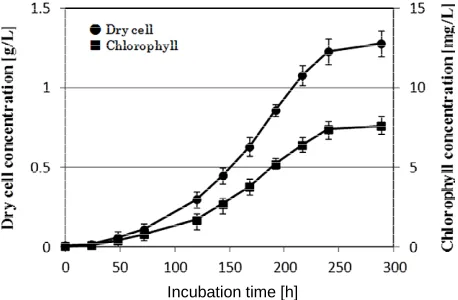
Figure 1 shows the time courses of dry cell and chloro-
phyll concentration in the incubation of microalgae using
Incubation time [h]
the photo-bioreactor. In this experiment the initial con- centration of dry cell and chlorophyll was about 0.17 g/L and 0.1 mg/L. The dry cell and chlorophyll concentration increased with the increase of incubation time reaching their maximum values, i.e. about 1.28 g/L and 7.65 mg/L, respectively, at an incubation time of 250 h. As a result, it was found that C. fasciata Ettl 437 contains about 6 mg of chlorophyll per unit of one gram of microalgae. Furthermore, from the result of composition analysis using dry microalgae, it was found that these microalgae con- tained 43.5% starch, 30.4% protein, 6.8% ash, and 19.3% others in the dry state.
3.2. Extraction of Starch from Microalgae
To increase the extraction ratio of starch from microalgae for effective conversion of starch into ethanol, the ultra- sonic treatment was attempted using a homogenizer.
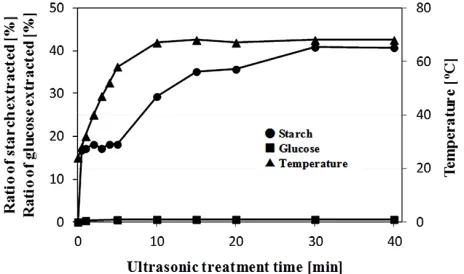
Figure 2 shows the percentage ratios of amounts of
starch and glucose extracted from 2 g of dry microalgae in 20 mL of water by the ultrasonic treatment at various treatment times. At zero treatment time no extraction of starch was observed, but 0.5 min of ultrasonic treatment could extract starch from microalgae. Though 0.5 - 5 min of ultrasonic treatment did not affect starch extraction ratio, i.e. about 18%, beyond 5 min of ultrasonic treat- ment the starch extraction ratio increased significantly with the increase of treatment time and then reached a maximum value, i.e. 40.8%, at 30 min. Since as described above the dry microalgae contains 43.5% starch, 30 min of ultrasonic treatment seems to be enough for starch extraction from microalgae and the extraction ratio of starch contained in microalgae is calculated as 93.8%. Solution temperature was increased rapidly from 24˚C to 68˚C by this treatment and it could also definitely affect the starch extraction efficiency. This point is a future subject. Furthermore, regardless of treatment time the glucose extraction ratio was maintained at a low constant
Figure 2. Ratios of amounts of starch and glucose extracted to dry weight of microalgae and change of solution tem- perature by ultrasonic homogenizer treatment.
value, i.e. below 1%. This means that the ultrasonic treatment does not degrade starch to glucose directly be- cause it cannot break down α-1,4- and/or β-1,6-glucoside linkages. On the other hand, in the case that the microal- gae was crushed finely for 30 min with a mortar (data not shown), a lower starch extraction ratio, i.e. 14%, was obtained and no further increase of extraction ratio was observed even at a longer crushing time. As a result, it was found that the ultrasonic treatment using a homoge- nizer is effective for not the degradation but the extraction of starch from microalgae. Since in this experiment the mixing ratio of microalgae (dry base) to water was 1/10, a future study will be focused on evaluating the optimal mixing ratio of microalgae to water.
3.3. Simultaneous Saccharification of
Fermentation (SSF) of Extracted Solution Obtained from Ultrasonic Treated Microalgae
Figure 3 shows SSF of microalgae crushed by a mortar
and extracted solution obtained from ultrasonic treated microalgae. The initial dry microalgae concentration was 100 g/L. Before SSF of these extracted solutions, SSF of microalgae without neither crushing nor ultrasonic treat- ments was carried, but little amount of ethanol was pro- duced (data not shown). This means that the direct con-version of microalgae into ethanol using only enzyme and yeast is difficult due to its resistant cell wall structure. In SSF of microalgae crushed by a mortar as shown in
Figure 3(a), the glucose was produced from starch by
the enzyme and then converted into ethanol by S. cere- visiae AM12, and only 6.94 g/L of ethanol was obtained after 24 h of incubation time. Furthermore, in case of extracted solution obtained from ultrasonic treated mi- croalgae for 5 min as shown in Figure 3(b), little effect
for increasing ethanol production was observed. This means that a short ultrasonic treatment is not effective for the extraction of starch as shown in Figure 2. On the
other hand, in case of extracted solution obtained from ultrasonic treated microalgae for 30 min as shown in
Figure 3(c), a large amount of glucose was produced and
then converted into ethanol, and 19.4 g/L of ethanol was obtained after 24 h of incubation time. This ethanol yield, 0.194 g/g-dry microalgae, corresponds to 79.5% of the theoretical yield based on the total glucose from starch in microalgae.
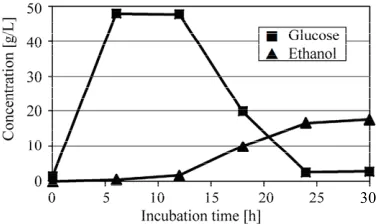
Next, to study an economical ethanol production from microalgae and possibility of use of microalgae as not only carbon but also nitrogen sources, SSF was per- formed without supplying any additional nitrogen source, i.e. yeast extract. Figure 4 shows SSF of extracted solu-
[image:3.595.57.289.561.698.2](a)
(b)
[image:4.595.77.268.93.479.2](c)
Figure 3. Time courses of glucose and ethanol in SSF of microalgae at pH 5 and 40˚C. (a) Microalgae crushed by a mortar; (b) Ultrasonic treated microalgae for 5 min; and (c) Ultrasonic treated microalgae for 30 min.
30
Figure 4. Time courses of glucose and ethanol in SSF of ultra-sonic treated microalgae for 30 min with no addition of nitrogen source at pH 5 and 40˚C.
g/L of ethanol was obtained at an incubation time of 30 h, the ethanol production rate and the ethanol yield were a little lower than those of the result as shown in Figure
3(c). Furthermore, the glucose was not consumed com-
pletely and some glucose remained even after an incuba- tion time of 30 min. This reason seems to be attributed to lack of nitrogen source. However, since the ethanol yield was a comparatively high value, i.e. 0.168 g/g-dry mi- croalgae, which corresponds to 68.8% of the theoretical yield, it was found that the ultrasonic treated microalgae was used as not only carbon but also nitrogen sources.
4. Conclusion
The present work aims at clarifying the effect of ultra- sonic treatment using a homogenizer on the extraction of starch from microalgae and converting the extracted starch into ethanol efficiently by the simultaneous sac- charification and fermentation. The ultrasonic treatment could extract the starch contained in the microalgae al- most completely. The ethanol production from the ex- tracted starch solution obtained from the ultrasonic treated microalgae was attempted using SSF and the comparatively high ethanol yields, i.e. about 70% - 80% of the theoretical value, with and without the addition of nitrogen source, i.e. yeast extract. Since the ultrasonic treatment uses no chemical reagents such as acids and organic solvents, it seems to be an environmentally friendly method. Therefore, it was confirmed that the ultrasonic treatment is an effective pretreatment method of microalgae not only for ethanol production but also for environmental protection. Furthermore, since this method was effective for the cell wall degradation of microalgae, this might be applied on an industrial scale to the effect- tive extraction of not only starch but also lipid contained in microalgae. Future study will be focused on the com- parisons with other technologies in terms of efficiency, costs, and etc.
REFERENCES
[1] A. E. Farrell, R. J. Plevin, B. T. Turner, A. D. Jones, M. O’Hare and D. M. Kammen, “Ethanol Can Contribute to Energy and Environmental Goal,” Science, Vol. 311, No. 5760, 2006, pp. 506-508. doi:10.1126/science.1121416 [2] H. Blottniz and M. A. Curran, “A Review of Assessments
Conducted on Bio-Ethanol as a Transportation Fuel from a Net Energy, Greenhouse Gas, and Environmental Life Cycle Perspective,”Journal of Cleaner Production, Vol. 15, No. 7, 2007, pp. 607-619.
doi:10.1016/j.jclepro.2006.03.002
[3] P. Adapa, L. Tabil and G. Schoenau, “Grinding Perform- ance and Physical Properties of Non-Treated and Steam Exploded Barley, Canola, Oat and Wheat Straw,” Bio-
mass Bioeregy, Vol. 35, No. 1, 2011, pp. 549-561.
[image:4.595.78.270.539.651.2]plied Biochemistry and Biotechnology, Vol. 137-140, No. 1-12, 2007, pp. 367-377. doi:10.1007/s12010-007-9065-z
[5] C. Asada, C. Sasaki, Y. Uto, J. Sakafuji, Y. Nakamura “Effect of Steam Explosion Pretreatment with Ultra-High Temperature and Pressure on Effective Utilization of Soft- wood Biomass,” Biochemical Engineering Journal, Vol. 60, No. 2012, pp. 25-29. doi:10.1016/j.bej.2011.09.013
[6] M. Matsumoto, H. Yokouchi, N. Suzuki, H. Ohata and T. Matsunaga, “Saccharification of Marine Microalgae Us-ing Marine Bacteria for Ethanol Production,” Applied
Biochemistry and Biotechnology, Vol. 105, No. 1-3, 2003,
pp. 247-254. doi:10.1385/ABAB:105:1-3:247
[7] S. P. Choi, M. T. Nguyen and S. J. Sim, “Enzymatic Pre-treatment of Chlamydomonas reinhardtii Biomass for Ethanol Production,” Bioresource Technology, Vol. 101, No. 14, 2010, pp. 5330-5336.
doi:10.1016/j.biortech.2010.02.026
[8] R. P. John, G. S. Anisha, K. M. Nampoothiri and A. Pandey, “Micro and Microalgal Biomass: A Renewable Source for Bioethanol,” Bioresource Technology, Vol. 102, No. 1, 2011, pp. 186-193. doi:10.1016/j.biortech.2010.06.139
[9] E. Suali and R. Sarbatly, “Conversion of Microalgae to Biofuel,” Renewable and Sustainable Energy Reviews, Vol. 16, No. 6, 2012, pp. 4316-4342.
doi:10.1016/j.rser.2012.03.047
[10] J. Qian, X. Chen, X. Ying and B. Lv, “Optimisation of Porous Starch Preparation by Ultrasonic Pretreatment Fol- lowed by Enzymatic Hydrolysis,” International Journal
of Food Science & Technology, Vol. 46, No. 1, 2011, pp.
179-185. doi:10.1111/j.1365-2621.2010.02469.x
[11] Q. Huang, L. Li, X. Fu, “Ultrasound Effects on the Struc- ture and Chemical Reactivity of Cornstarch Granules,”
Starch, Vol. 59, No. 8, 2007, pp. 371-378.
doi:10.1002/star.200700614
[12] F. F. Lima, C. T. Andrade, “Effect of Melt-Processing and Ultrasonic Treatment on Physical Properties of High Amylase Maize Starch,” Ultrasonics Sonochemistry, Vol. 17, No. 4, 2010, pp. 637-641.
doi:10.1016/j.ultsonch.2010.01.001
[13] M. M. Lomboy, S. K. Khanal, J. Leeuwen, D. R. Raman and D. Grewell, “Simultaneous Saccharification and Fer- mentation and Economic Evaluation of Ultrasonic and Jet Cooking Pretreatment of Corn Slurry,” Biotechnology Pro-
gress, Vol. 27, No. 6, 2011, pp. 1561-1569.
doi:10.1002/btpr.677
[14] L. H. Grimme, N. K. Boardman, “Photochemical Activi- ties of a Particle Fraction P1 Obtained from the Green
Alga Chlorella fusca,” Biochemical and Biophysical Re-
search Communications, Vol. 49, No. 6, 1972, pp. 1617-
1623. doi:10.1016/0006-291X(72)90527-X
[15] AOAC, “Official Method of Analysis,” 13th Edition, In: W. Horwitz, Ed., Association of Official Analytical Chem- ist, Washington DC, 1980, pp. 56-132.
[16] H. Itoh, M. Wada, Y. Honda, M. Kuwahara and T. Wata- nabe, “Bioorganosolve Pretreatments for Simultaneous Sac- charification and Fermentation of Beech Wood by Etha- nolysis and White Rot Fungi,” Journal of Biotechnology, Vol. 103, No. 3, 2003, pp. 273-280.