276
What does BERT look at?
An Analysis of BERT’s Attention
Kevin Clark† Urvashi Khandelwal† Omer Levy‡ Christopher D. Manning†
†Computer Science Department, Stanford University ‡Facebook AI Research
{kevclark,urvashik,manning}@cs.stanford.edu
Abstract
Large pre-trained neural networks such as BERT have had great recent success in NLP, motivating a growing body of research investi-gating what aspects of language they are able to learn from unlabeled data. Most recent anal-ysis has focused on model outputs (e.g., lan-guage model surprisal) or internal vector rep-resentations (e.g., probing classifiers). Com-plementary to these works, we propose meth-ods for analyzing the attention mechanisms of pre-trained models and apply them to BERT. BERT’s attention heads exhibit patterns such as attending to delimiter tokens, specific po-sitional offsets, or broadly attending over the whole sentence, with heads in the same layer often exhibiting similar behaviors. We further show that certain attention heads correspond well to linguistic notions of syntax and coref-erence. For example, we find heads that at-tend to the direct objects of verbs, determiners of nouns, objects of prepositions, and corefer-ent mcorefer-entions with remarkably high accuracy. Lastly, we propose an attention-based probing classifier and use it to further demonstrate that substantial syntactic information is captured in BERT’s attention.
1 Introduction
Large pre-trained language models achieve very high accuracy when fine-tuned on supervised tasks (Dai and Le, 2015; Peters et al., 2018; Radford et al., 2018), but it is not fully understood why. The strong results suggest pre-training teaches the models about the structure of language, but what specific linguistic features do they learn?
Recent work has investigated this question by examining the outputs of language models on carefully chosen input sentences (Linzen et al., 2016) or examining the internalvector representa-tionsof the model through methods such as prob-ing classifiers (Adi et al., 2017; Belinkov et al., 2017). Complementary to these approaches, we
study1 theattention mapsof a pre-trained model. Attention (Bahdanau et al., 2015) has been a highly successful neural network component. It is naturally interpretable because an attention weight has a clear meaning: how much a particular word will be weighted when computing the next repre-sentation for the current word. Our analysis fo-cuses on the 144 attention heads in BERT ( De-vlin et al.,2019), a large pre-trained Transformer (Vaswani et al., 2017) network that has demon-strated excellent performance on many tasks.
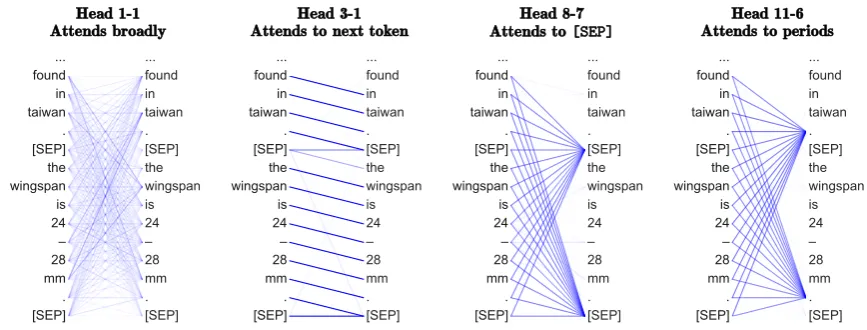
We first explore generally how the attention heads behave. We find that there are common pat-terns in their behavior, such as attending to fixed positional offsets or attending broadly over the whole sentence. A surprisingly large amount of BERT’s attention focuses on the deliminator to-ken [SEP], which we argue is used by the model as a sort of no-op. Generally we find that attention heads in the same layer tend to behave similarly.
We next probe each attention head for linguis-tic phenomena. In parlinguis-ticular, we treat each atten-tion head as a simple no-training-required classi-fier that, given a word as input, outputs the most-attended-to other word. We then evaluate the abil-ity of the heads to classify various syntactic rela-tions. While no single head performs well at many relations, we find that particular heads correspond remarkably well to particular relations. For exam-ple, we find heads that find direct objects of verbs, determiners of nouns, objects of prepositions, and objects of possesive pronouns with >75% accu-racy. We perform a similar analysis for corefer-ence resolution, also finding a BERT head that per-forms quite well. These results are intriguing be-cause the behavior of the attention heads emerges purely from self-supervised training on unlabeled data, without explicit supervision for syntax or coreference.
Head 1-1 Attends broadly
Head 3-1 Attends to next token
Head 8-7 Attends to [SEP]
[image:2.595.80.514.62.227.2]Head 11-6 Attends to periods
Figure 1: Examples of heads exhibiting the patterns discussed in Section3. The darkness of a line indicates the strength of the attention weight (some attention weights are so low they are invisible).
Our findings show that particular heads special-ize to specific aspects of syntax. To get a more overall measure of the attention heads’ syntac-tic ability, we propose an attention-based probing classifier that takes attention maps as input. The classifier achieves 77 UAS at dependency pars-ing, showing BERT’s attention captures a substan-tial amount about syntax. Several recent works have proposed incorporating syntactic information to improve attention (Eriguchi et al.,2016;Chen et al.,2018;Strubell et al.,2018). Our work sug-gests that to an extent this kind of syntax-aware attention already exists in BERT, which may be one of the reason for its success.
2 Background: Transformers and BERT
Although our analysis methods are applicable to any model that uses an attention mechanism, in this paper we analyze BERT (Devlin et al., 2019), a large Transformer (Vaswani et al.,2017) network. Transformers consist of multiple lay-ers where each layer contains multiple attention heads. An attention head takes as input a sequence of vectors h = [h1, ..., hn] corresponding to the
n tokens of the input sentence. Each vector hi is transformed into query, key, and value vectors
qi, ki, vi through separate linear transformations. The head computes attention weightsα between all pairs of words as softmax-normalized dot prod-ucts between the query and key vectors. The out-putoof the attention head is a weighted sum of the value vectors.
αij =
exp (qT
i kj) Pn
l=1exp (qiTkl)
oi= n X
j=1 αijvj
Attention weights can be viewed as governing how “important” every other token is when producing the next representation for the current token.
BERT is pre-trained on 3.3 billion tokens of un-labeled text to perform two tasks. In the “masked language modeling” task, the model predicts the identities of words that have been masked-out of the input text. In the “next sentence prediction” task, the model predicts whether the second half of the input follows the first half of the input in the corpus, or is a completely separate random text segment. Further training the model on supervised data results in impressive performance across a va-riety of tasks ranging from sentiment analysis to question answering. An important detail of BERT is the preprocessing used for the input text. A spe-cial token [CLS] is added to the beginning of the text and another token [SEP] is added to the end. If the input consists of multiple separate texts (e.g., a reading comprehension example consists of a sep-arate question and context), [SEP] tokens are also used to separate them. As we show in the next sec-tion, these special tokens play an important role in BERT’s attention. We use the “base” sized BERT model, which has 12 layers containing 12 attention heads each. We use<layer>-<head number>to denote a particular attention head.
3 Surface-Level Patterns in Attention
2 4 6 8 10 12
Layer
0.0 0.2 0.4 0.6 0.8
Avg. Attention
[CLS] [SEP] . or ,
2 4 6 8 10 12
Layer
0.0 0.2 0.4 0.6 0.8 1.0
Avg. Attention
[image:3.595.71.288.63.321.2][SEP] -> [SEP] other -> [SEP]
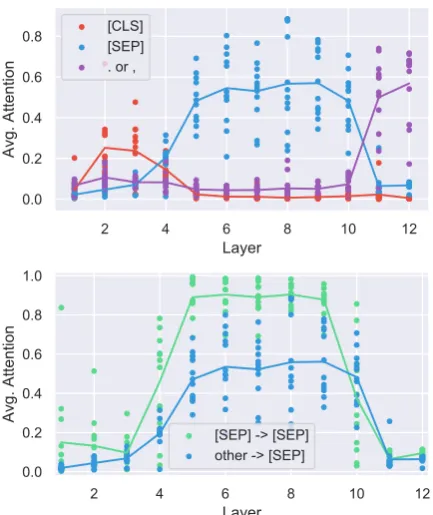
Figure 2: Each point corresponds to the average atten-tion a particular BERT attenatten-tion head puts toward a ken type. Above: heads often attend to “special” to-kens. Early heads attend to [CLS], middle heads attend to [SEP], and deep heads attend to periods and com-mas. Often more than half of a head’s total attention is to these tokens. Below: heads attend to [SEP] tokens even more when the current token is [SEP] itself.
Setup. We extract the attention maps from BERT-base over 1000 Wikipedia segments. We follow the setup used for pre-training BERT where each segment consists of at most 128 tokens corresponding to two consecutive para-graphs of Wikipedia. The input presented to the model is [CLS]<paragraph-1>[SEP]< paragraph-2>[SEP].
3.1 Relative Position
First, we compute how often BERT attention heads attend to the current token, the previous to-ken, or the next token. We find that most heads put little attention on the current token. However, there are heads that specialize to attending heavily on the next or previous token, especially in ear-lier layers of the network. In particular four atten-tion heads (in layers 2, 4, 7, and 8) on average put
>50% of their attention on the previous token and five attention heads (in layers 1, 2, 2, 3, and 6) put
>50% of their attention on the next token.
2 4 6 8 10 12
Layer 0.0
0.5 1.0 1.5 2.0 2.5 3.0
Average
∂
L ∂α
All unmasked tokens [SEP]
[image:3.595.311.519.64.209.2]. or ,
Figure 3: Gradient-based feature importance estimates for attention to [SEP], periods/commas, and other to-kens.
2 4 6 8 10 12
Layer 0
2 4
Avg. Attention Entropy (nats)
uniform attention
[image:3.595.309.522.282.402.2]BERT Heads
Figure 4: Entropies of attention distributions. In the first layer there are particularly high-entropy heads that produce bag-of-vector-like representations.
3.2 Attending to Separator Tokens
Interestingly, we found that a substantial amount of BERT’s attention focuses on a few tokens (see Figure2). For example, over half of BERT’s at-tention in layers 6-10 focuses on [SEP]. To put this in context, since most of our segments are 128 tokens long, the average attention for a token oc-curring twice in a segments like [SEP] would nor-mally be 1/64. [SEP] and [CLS] are guaranteed to be present and are never masked out, while pe-riods and commas are the most common tokens in the data excluding “the,” which might be why the model treats these tokens differently. A sim-ilar pattern occurs for the uncased BERT model, suggesting there is a systematic reason for the at-tention to special tokens rather than it being an ar-tifact of stochastic training.
hypothesis were true, we would expect attention heads processing [SEP] to attend broadly over the whole segment to build up these representations. However, they instead almost entirely (more than 90%; see bottom of Figure2) attend to themselves and the other [SEP] token. Furthermore, qualita-tive analysis (see Figure5) shows that heads with specific functions attend to [SEP] when the func-tion is not called for. For example, in head 8-10 direct objects attend to their verbs. For this head, non-nouns mostly attend to [SEP]. Therefore, we speculate that attention over these special tokens might be used as a sort of “no-op” when the atten-tion head’s funcatten-tion is not applicable.
To further investigate this hypothesis, we ap-ply gradient-based measures of feature importance (Sundararajan et al.,2017). In particular, we com-pute the magnitude of the gradient of the loss from BERT’s masked language modeling task with re-spect to each attention weight. Intuitively, this value measures how much changing the attention to a token will change BERT’s outputs. Results are shown in Figure3. We find that starting in layer 5 – the same layer where attention to [SEP] becomes high – the gradients for attention to [SEP] become small. This indicates that attending more or less to [SEP] does not substantially change BERT’s out-puts, supporting the theory that attention to [SEP] is used as a no-op for attention heads.
3.3 Focused vs Broad Attention
Lastly, we measure whether attention heads fo-cus on a few words or attend broadly over many words. To do this, we compute the average en-tropy of each head’s attention distribution (see Figure4). We find that some attention heads, es-pecially in lower layers, have very broad atten-tion. These high-entropy attention heads typically spend at most 10% of their attention mass on any single word. The output of these heads is roughly a bag-of-vectors representation of the sentence.
We also measured entropies for all attention heads from only the [CLS] token. While the av-erage entropies from [CLS] for most layers are very close to the ones shown in Figure 4, the last layer has a high entropy from [CLS] of 3.89 nats, indicating very broad attention. This find-ing makes sense given that the representation for the [CLS] token is used as input for the “next sen-tence prediction” task during pre-training, so it at-tends broadly to aggregate a representation for the
whole input in the last layer.
4 Probing Individual Attention Heads
Next, we investigate individual attention heads to probe what aspects of language they have learned. In particular, we evaluate attention heads on la-beled datasets for tasks like dependency parsing. An overview of our results is shown in Figure5.
4.1 Method
We wish to evaluate attention heads at word-level tasks, but BERT uses byte-pair tokenization ( Sen-nrich et al., 2016), which means some words (∼8% in our data) are split up into multiple to-kens. We therefore convert token-token attention maps to word-word attention maps. For attention toa split-up word, we sum up the attention weights over its tokens. For attentionfroma split-up word, we take the mean of the attention weights over its tokens. These transformations preserve the prop-erty that the attention from each word sums to 1. For a given attention head and word, we take whichever other word receives the most attention weight as that model’s prediction2
4.2 Dependency Syntax
Setup. We extract attention maps from BERT on the Wall Street Journal portion of the Penn Tree-bank (Marcus et al.,1993) annotated with Stanford Dependencies. We evaluate both “directions” of prediction for each attention head: the head word attending to the dependent and the dependent at-tending to the head word. Some dependency rela-tions are simpler to predict than others: for exam-ple a noun’s determiner is often the immediately preceding word. Therefore as a point of compar-ison, we show predictions from a simple fixed-offset baseline. For example, a fixed fixed-offset of -2 means the word two positions to the left of the de-pendent is always considered to be the head.
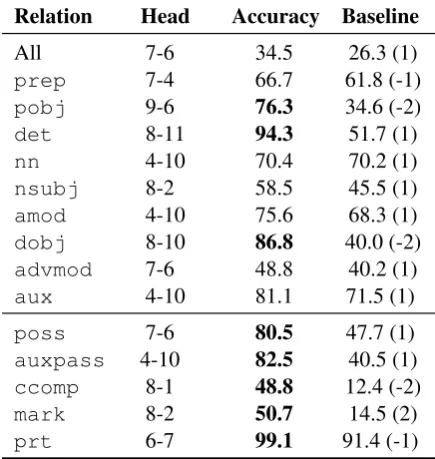
Results. Table1shows that there is no single at-tention head that does well at syntax “overall”; the best head gets 34.5 UAS, which is not much better than the right-branching baseline, which gets 26.3 UAS. This finding is similar to the one reported by Raganato and Tiedemann(2018), who also evalu-ate individual attention heads for syntax.
However, we do find that certain attention heads specialize to specific dependency relations,
some-2We ignore [SEP] and [CLS], although in practice this
Head 9-6
- Prepositions attend to their objects
- 76.3% accuracy at thepobjrelation
Head 8-11
- Noun modifiers (e.g., determiners) attend
to their noun
- 94.3% accuracy at thedetrelation
Head 8-10
- Direct objects attend to their verbs
- 86.8% accuracy at thedobjrelation
Head 7-6
- Possessive pronouns and apostrophes
attend to the head of the corresponding NP - 80.5% accuracy at thepossrelation
Head 4-10
- Passive auxiliary verbs attend to the
verb they modify
- 82.5% accuracy at theauxpassrelation
Head 5-4
- Coreferent mentions attend to their antecedents
[image:5.595.77.520.54.690.2]- 65.1% accuracy at linking the head of a coreferent mention to the head of an antecedent
Relation Head Accuracy Baseline
All 7-6 34.5 26.3 (1)
prep 7-4 66.7 61.8 (-1)
pobj 9-6 76.3 34.6 (-2)
det 8-11 94.3 51.7 (1)
nn 4-10 70.4 70.2 (1)
nsubj 8-2 58.5 45.5 (1)
amod 4-10 75.6 68.3 (1)
dobj 8-10 86.8 40.0 (-2)
advmod 7-6 48.8 40.2 (1)
aux 4-10 81.1 71.5 (1)
poss 7-6 80.5 47.7 (1)
auxpass 4-10 82.5 40.5 (1)
ccomp 8-1 48.8 12.4 (-2)
mark 8-2 50.7 14.5 (2)
[image:6.595.71.289.65.295.2]prt 6-7 99.1 91.4 (-1)
Table 1: The best performing attentions heads of BERT on WSJ dependency parsing by dependency type. Numbers after baseline accuracies show the best offset found (e.g., (1) means the word to the right is predicted as the head). We show the 10 most common relations as well as 5 other ones attention heads did well on. Bold highlights particularly effective heads.
times achieving high accuracy and substantially outperforming the fixed-offset baseline. We find that for all relations in Table1 exceptpobj, the dependent attends to the head word rather than the other way around, likely because each dependent has exactly one head but heads have multiple de-pendents. We also note heads can disagree with standard annotation conventions while still per-forming syntactic behavior. For example, head 7-6 marks’sas the dependent for thepossrelation, while gold-standard labels mark the complement of an’sas the dependent (the accuracy in Table1 counts ’s as correct). Such disagreements high-light how these syntactic behaviors in BERT are learned as a by-product of self-supervised train-ing, not by copying a human design.
Figure5shows some examples of the attention behavior. While the similarity between learned at-tention weights and human-defined syntactic re-lations are striking, we note these are rere-lations for which attention heads do particularly well on. There are many relations for which BERT only slightly improves over the simple baseline, so we would not say individual attention heads capture dependency structure as a whole.
4.3 Coreference Resolution
Having shown BERT attention heads reflect cer-tain aspects of syntax, we now explore using at-tention heads for the more challenging semantic task of coreference resolution. Coreference links are usually longer than syntactic dependencies and state-of-the-art systems generally perform much worse at coreference compared to parsing.
Setup. We evaluate the attention heads on coref-erence resolution using the CoNLL-2012 dataset3 (Pradhan et al.,2012). In particular, we compute antecedent selection accuracy: what percent of the time does the head word of a coreferent mention most attend to the head of one of that mention’s antecedents. We compare against three baselines for selecting an antecedent:
• Picking the nearest other mention.
• Picking the nearest other mention with the same head word as the current mention.
• A simple rule-based system inspired byLee et al.(2011). It proceeds through 4 sieves: (1) full string match, (2) head word match, (3) number/gender/person match, (4) all other mentions. The nearest mention satisfying the earliest sieve is returned.
We also show the performance of a recent neural coreference system from (Wiseman et al.,2015).
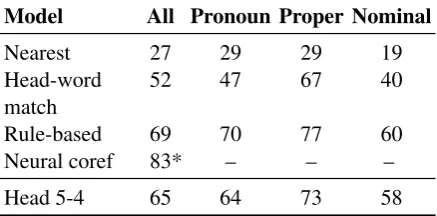
Results. Results are shown in Table 2. We find that one of BERT’s attention heads achieves de-cent coreference resolution performance, improv-ing by over 10 accuracy points on the strimprov-ing- string-matching baseline and performing close to the rule-based system. It is particularly good with nominal mentions, perhaps because it is capable of fuzzy matching between synonyms as seen in the bottom right of Figure5.
5 Probing Attention Head Combinations
Since individual attention heads specialize to par-ticular aspects of syntax, the model’s overall “knowledge” about syntax is distributed across multiple attention heads. We now measure this overall ability by proposing a novel family of attention-based probing classifiers and applying them to dependency parsing. For these classifiers we treat the BERT attention outputs as fixed, i.e.,
3We truncate documents to 128 tokens long to keep
Model All Pronoun Proper Nominal
Nearest 27 29 29 19
Head-word match
52 47 67 40
Rule-based 69 70 77 60
Neural coref 83* – – –
Head 5-4 65 64 73 58
[image:7.595.72.291.65.173.2]*Only roughly comparable because on non-truncated docu-ments and with different mention detection.
Table 2: Accuracies (%) for different mention types of systems selecting a correct antecedent given a corefer-ent mcorefer-ention in the CoNLL-2012 data. One of BERT’s attention heads performs fairly well at coreference.
we do not back-propagate into BERT and only train a small number of parameters.
The probing classifiers are basically graph-based dependency parsers. Given an input word, the classifier produces a probability distribution over other words in the sentence indicating how likely each other word is to be the syntactic head of the current one.
Attention-Only Probe. Our first probe learns a simple linear combination of attention weights.
p(i|j)∝exp
Xn
k=1
wkαkij+ukαkji
where p(i|j) is the probability of word i being wordj’s syntactic head,αk
ijis the attention weight from wordito wordjproduced by headk, andn
is the number of attention heads. We include both directions of attention: candidate head to depen-dent as well as dependepen-dent to candidate head. The weight vectorswanduare trained using standard supervised learning on the train set.
Attention-and-Words Probe. Given our finding that heads specialize to particular syntactic rela-tions, we believe probing classifiers should benefit from having information about the input words. In particular, we build a model that sets the weights of the attention heads based on the GloVe ( Pen-nington et al., 2014) embeddings for the input words. Intuitively, if the dependent and candi-date head are “the” and “cat,” the probing classi-fier should learn to assign most of the weight to the head 8-11, which achieves excellent perfor-mance at the determiner relation. The attention-and-words probing classifier assigns the
probabil-ity of wordibeing wordj’s head as
p(i|j)∝exp
Xn
k=1
Wk,:(vi⊕vj)αkij+
Uk,:(vi⊕vj)αkji
Where v denotes GloVe embeddings and ⊕ de-notes concatenation. The GloVe embeddings are held fixed in training, so only the two weight ma-trices W and U are learned. The dot product
Wk,:(vi⊕vj)produces a word-sensitive weight for the particular attention head.
Results. We evaluate our methods on the Penn Treebank dev set annotated with Stanford depen-dencies. We compare against three baselines:
• A right-branching baseline that always pre-dicts the head is to the dependent’s right.
• A simple one-hidden-layer network that takes as input the GloVe embeddings for the depen-dent and candidate head as well as a set of features indicating the distances between the two words.4
• Our attention-and-words probe, but with at-tention maps from a BERT network with pre-trained word/positional embeddings but ran-domly initialized other weights. This kind of baseline is surprisingly strong at other prob-ing tasks (Conneau et al.,2018).
Results are shown in Table3. We find the Attn + GloVe probing classifier substantially outper-forms our baselines and achieves a decent UAS of 77, suggesting BERT’s attention maps have a fairly thorough representation of English syntax. As a rough comparison, we also report results from the structural probe from Hewitt and Man-ning(2019), which builds a probing classifier on top of BERT’s vector representations rather than attention. The scores are not directly compara-ble because the structural probe only uses a sin-gle layer of BERT, produces undirected rather than directed parse trees, and is trained to produce the syntactic distance between words rather than di-rectly predicting the tree structure. Nevertheless, the similarity in score to our Attn + Glove probing classifier suggests there is not much more syntac-tic information in BERT’s vector representations compared to its attention maps.
4indicator features for short distances as well as
Model UAS
Right-branching 26
Distances + GloVe 58
Random Init Attn + GloVe 30
Attn 61
Attn + GloVe 77
Structural probe (Hewitt and Manning,2019)
[image:8.595.72.291.64.185.2]80 UUAS*
Table 3: Results of attention-based probing tasks on dependency parsing. A simple model taking BERT at-tention maps and GloVe word embeddings as input per-forms quite well at dependency parsing. *Not directly comparable to our numbers; see text.
Overall, our results from probing both individ-ual and combinations of attention heads suggest that BERT learns some aspects syntax purely as a by-product of self-supervised training. Other work has drawn a similar conclusions from examin-ing BERT’s predictions on agreement tasks ( Gold-berg,2019) or internal vector representations ( He-witt and Manning, 2019; Liu et al., 2019). Tra-ditionally, syntax-aware models have been devel-oped through architecture design (e.g., recursive neural networks) or from direct supervision from human-curated treebanks. Our findings are part of a growing body of work indicating that indirect supervision from rich pre-training tasks like lan-guage modeling can also produce models sensitive to language’s hierarchical structure.
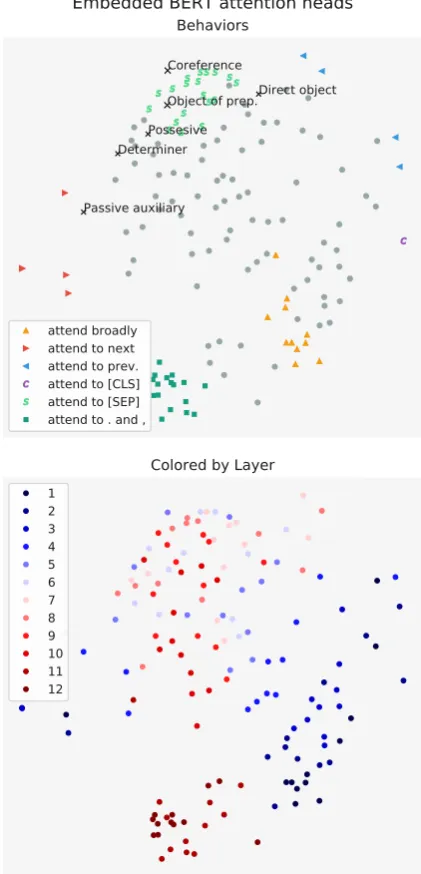
6 Clustering Attention Heads
Are attention heads in the same layer similar to each other or different? In general, can attention heads be clearly grouped by behavior? We inves-tigate these questions by computing the distances between all pairs of attention heads. Formally, we measure the distance between two heads Hi and Hjas:
X
token∈data
JS(Hi(token),Hj(token))
WhereJSis the Jensen-Shannon Divergence be-tween attention distributions. Using these dis-tances, we visualize the attention heads by apply-ing multidimensional scalapply-ing (Kruskal, 1964) to embed each head in two dimensions such that the euclidean distance between embeddings reflects the Jensen-Shannon distance between the corre-sponding heads as closely as possible.
Figure 6: BERT attention heads embedded in two-dimensional space. Distance between points approx-imately matches the average Jensen-Shannon diver-gences between the outputs of the corresponding heads. Heads in the same layer tend to be close together. At-tention head “behavior” was found through the analysis methods discussed throughout this paper.
[image:8.595.310.521.65.503.2]ma-chine translation. One possibility for the apparent redundancy in BERT’s attention heads is the use of attention dropout, which causes some attention weights to be zeroed-out during training.
7 Related Work
There has been substantial recent work perform-ing analysis to better understand what neural net-works learn, especially from language model pre-training. One line of research examines the out-puts of language models on carefully chosen in-put sentences (Linzen et al., 2016; Khandelwal et al., 2018;Gulordava et al., 2018;Marvin and Linzen, 2018). For example, the model’s perfor-mance at subject-verb agreement (generating the correct number of a verb far away from its sub-ject) provides a measure of the model’s syntactic ability, although it does not revealhowthat ability is captured by the network.
Another line of work investigates the internal vector representations of the model (Adi et al., 2017; Giulianelli et al., 2018; Zhang and Bow-man,2018), often using probing classifiers. Prob-ing classifiers are simple neural networks that take the internal vector representations of a pre-trained model as input. They are trained to do a supervised task (e.g., part-of-speech tagging). If a probing classifier achieves high accuracy, it suggests that the vector representations reflect the correspond-ing aspect of language (e.g., low-level syntax). Like our work, some of these studies have also demonstrated neural networks capturing aspects of syntactic structures (Shi et al.,2016;Blevins et al., 2018) or coreference (Tenney et al., 2018,2019) without explicitly being trained for the tasks.
With regards to analyzing attention,Vig(2019) builds a visualization tool for the BERT’s attention and reports observations about some of the heads’ behaviors, but does not perform any quantitative analysis. Burns et al.(2018) analyze the attention of memory networks to understand model perfor-mance on a question answering dataset; we instead aim to understand linguistic information captured in pre-trained models. There has also been some initial work in correlating attention with syntax. Raganato and Tiedemann (2018) evaluate the at-tention heads of a machine translation model on dependency parsing, but only report overall UAS scores instead of investigating heads for specific syntactic relations or using probing classifiers. Marecek and Rosa(2018) propose heuristic ways
of converting attention scores to syntactic trees, but do not quantitatively evaluate their approach.
Concurrently with our workVoita et al.(2019) identify syntactic, positional, and rare-word-sensitive attention heads in machine translation models. They also demonstrate that many atten-tion heads can be pruned away without substan-tially hurting model performance. Interestingly, the important attention heads that remain after pruning tend to be ones with identified behaviors. Michel et al.(2019) similarly show that many of BERT’s attention heads can be pruned. Although our analysis in this paper only found interpretable behaviors in a subset of BERT’s attention heads, these recent works suggest that there might not be much to explain for some attention heads because they have little effect on model perfomance.
Jain and Wallace(2019) argue that attention of-ten does not “explain” model predictions. They show that attention weights frequently do not cor-relate with other measures of feature importance. Furthermore, attention weights can often be sub-stantially changed without altering model predic-tions. However, our motivation for looking at at-tention is different: rather than explaining model predictions, we are seeking to understand infor-mation learned by the models. For example, if a particular attention head learns a syntactic rela-tion, we consider that an important finding from an analysis perspective even if that head is not always used when making predictions for some downstream task.
8 Conclusion
We have proposed a series of analysis methods for understanding the attention mechanisms of mod-els and applied them to BERT. While most recent work on model analysis for NLP has focused on probing vector representations or model outputs, we have shown that a substantial amount of lin-guistic knowledge can be found not only in the hidden states, but also in the attention maps. We think probing attention maps complements these other model analysis techniques, and should be part of the toolkit used by researchers to under-stand what neural networks learn about language.
Acknowledgements
References
Yossi Adi, Einat Kermany, Yonatan Belinkov, Ofer Lavi, and Yoav Goldberg. 2017. Fine-grained anal-ysis of sentence embeddings using auxiliary predic-tion tasks. InICLR.
Dzmitry Bahdanau, Kyunghyun Cho, and Yoshua Ben-gio. 2015. Neural machine translation by jointly learning to align and translate. InICLR.
Yonatan Belinkov, Nadir Durrani, Fahim Dalvi, Has-san Sajjad, and James R. Glass. 2017. What do neu-ral machine translation models learn about morphol-ogy? InACL.
Terra Blevins, Omer Levy, and Luke S. Zettlemoyer. 2018. Deep rnns encode soft hierarchical syntax. In ACL.
Kaylee Burns, Aida Nematzadeh, Alison Gopnik, and Thomas L. Griffiths. 2018. Exploiting attention to reveal shortcomings in memory models. In
Black-boxNLP@EMNLP.
Kehai Chen, Rui Wang, Masao Utiyama, Eiichiro Sumita, and Tiejun Zhao. 2018. Syntax-directed at-tention for neural machine translation. InAAAI.
Alexis Conneau, Germ´an Kruszewski, Guillaume Lample, Lo¨ıc Barrault, and Marco Baroni. 2018. What you can cram into a single $&!#* vector: Probing sentence embeddings for linguistic proper-ties. InACL.
Andrew M Dai and Quoc V Le. 2015. Semi-supervised sequence learning. InNIPS.
Jacob Devlin, Ming-Wei Chang, Kenton Lee, and Kristina Toutanova. 2019. BERT: Pre-training of deep bidirectional transformers for language under-standing. InNAACL-HLT.
Akiko Eriguchi, Kazuma Hashimoto, and Yoshimasa Tsuruoka. 2016. Tree-to-sequence attentional neu-ral machine translation. InACL.
Mario Giulianelli, Jack Harding, Florian Mohnert, Dieuwke Hupkes, and Willem H. Zuidema. 2018. Under the hood: Using diagnostic classifiers to in-vestigate and improve how language models track agreement information. InBlackboxNLP@EMNLP.
Yoav Goldberg. 2019. Assessing BERT’s syntactic abilities. arXiv preprint arXiv:1901.05287.
Kristina Gulordava, Piotr Bojanowski, Edouard Grave, Tal Linzen, and Marco Baroni. 2018. Colorless green recurrent networks dream hierarchically. In NAACL-HLT.
John Hewitt and Christopher D. Manning. 2019. Find-ing syntax with structural probes. InNAACL-HLT.
Sarthak Jain and Byron C. Wallace. 2019. Attention is not explanation. arXiv preprint arXiv:1902.10186.
Urvashi Khandelwal, He He, Peng Qi, and Daniel Ju-rafsky. 2018. Sharp nearby, fuzzy far away: How neural language models use context. InACL.
Joseph B Kruskal. 1964. Multidimensional scaling by optimizing goodness of fit to a nonmetric hypothe-sis.Psychometrika, 29(1):1–27.
Heeyoung Lee, Yves Peirsman, Angel Chang, Nathanael Chambers, Mihai Surdeanu, and Dan Ju-rafsky. 2011. Stanford’s multi-pass sieve corefer-ence resolution system at the conll-2011 shared task. InCoNLL.
Tal Linzen, Emmanuel Dupoux, and Yoav Goldberg. 2016. Assessing the ability of lstms to learn syntax-sensitive dependencies.TACL.
Nelson F. Liu, Matt Gardner, Yonatan Belinkov, M. Pe-ters, and Noah A. Smith. 2019. Linguistic knowl-edge and transferability of contextual representa-tions. InNAACL-HLT.
Mitchell P Marcus, Mary Ann Marcinkiewicz, and Beatrice Santorini. 1993. Building a large annotated corpus of english: The Penn treebank. Computa-tional linguistics, 19(2):313–330.
David Marecek and Rudolf Rosa. 2018. Extract-ing syntactic trees from transformer encoder self-attentions. InBlackboxNLP@EMNLP.
Rebecca Marvin and Tal Linzen. 2018. Targeted syn-tactic evaluation of language models. InEMNLP.
Paul Michel, Omer Levy, and Graham Neubig. 2019. Are sixteen heads really better than one? arXiv preprint arXiv:1905.10650.
Jeffrey Pennington, Richard Socher, and Christopher Manning. 2014. Glove: Global vectors for word representation. InEMNLP.
Matthew E Peters, Mark Neumann, Mohit Iyyer, Matt Gardner, Christopher Clark, Kenton Lee, and Luke Zettlemoyer. 2018. Deep contextualized word rep-resentations. InNAACL-HLT.
Sameer Pradhan, Alessandro Moschitti, Nianwen Xue, Olga Uryupina, and Yuchen Zhang. 2012. Conll-2012 shared task: Modeling multilingual unre-stricted coreference in ontonotes. InJoint Confer-ence on EMNLP and CoNLL-Shared Task.
Alec Radford, Karthik Narasimhan, Tim Salimans, and Ilya Sutskever. 2018. Improving lan-guage understanding by generative pre-training. https://blog.openai.com/language-unsupervised.
Alessandro Raganato and J¨org Tiedemann. 2018. An analysis of encoder representations in transformer-based machine translation. In
Black-boxNLP@EMNLP.
Xing Shi, Inkit Padhi, and Kevin Knight. 2016. Does string-based neural mt learn source syntax? In EMNLP.
Emma Strubell, Patrick Verga, Daniel Andor, David I Weiss, and Andrew McCallum. 2018. Linguistically-informed self-attention for semantic role labeling. InEMNLP.
Mukund Sundararajan, Ankur Taly, and Qiqi Yan. 2017. Axiomatic attribution for deep networks. In ICML.
Ian Tenney, Dipanjan Das, and Ellie Pavlick. 2019. Bert rediscovers the classical nlp pipeline. arXiv preprint arXiv:1905.05950.
Ian Tenney, Patrick Xia, Berlin Chen, Alex Wang, Adam Poliak, R Thomas McCoy, Najoung Kim, Benjamin Van Durme, Samuel R Bowman, Dipan-jan Das, et al. 2018. What do you learn from con-text? probing for sentence structure in contextual-ized word representations. InICLR.
Zhaopeng Tu, Baosong Yang, Michael R. Lyu, and Tong Zhang. 2018. Multi-head attention with dis-agreement regularization. InEMNLP.
Ashish Vaswani, Noam Shazeer, Niki Parmar, Jakob Uszkoreit, Llion Jones, Aidan N. Gomez, Lukasz Kaiser, and Illia Polosukhin. 2017. Attention is all you need. InNIPS.
Jesse Vig. 2019. Visualizing attention in transformer-based language models. arXiv preprint arXiv:1904.02679.
Elena Voita, David Talbot, Fedor Moiseev, Rico Sen-nrich, and Ivan Titov. 2019. Analyzing multi-head self-attention: Specialized multi-heads do the heavy lifting, the rest can be pruned. arXiv preprint arXiv:1905.09418.
Sam Joshua Wiseman, Alexander Matthew Rush, Stu-art Merrill Shieber, and Jason Weston. 2015. Learn-ing anaphoricity and antecedent rankLearn-ing features for coreference resolution. InACL.