000
001
002
003
004
005
006
007
008
009
010
011
012
013
014
015
016
017
018
019
020
021
022
023
024
025
026
027
028
029
030
031
032
033
034
035
036
037
038
039
040
041
042
043
044
045
046
047
048
049
050
051
052
053
054
055
056
057
058
059
060
061
062
063
064
065
066
067
068
069
070
071
072
073
074
075
076
077
078
079
080
081
082
083
084
085
086
087
088
089
090
091
092
093
094
095
096
097
098
099
Filtering of Noisy Parallel Corpora Based on Hypothesis Generation
Zuzanna Parcheta1 Germ´an Sanchis-Trilles1
1Sciling S.L.,Carrer del Riu 321, Pinedo, 46012, Spain
{zparcheta, gsanchis}@sciling.com
2PRHLT Research Center, Camino de Vera s/n, 46022 Valencia, Spain
Francisco Casacuberta2
Abstract
The filtering task of noisy parallel corpora in WMT2019 aims to challenge participants to create filtering methods to be useful for train-ing machine translation systems. In this work, we introduce a noisy parallel corpora filter-ing system based on generatfilter-ing hypotheses by means of a translation model. We train trans-lation models in both language pairs: Nepali– English and Sinhala–English using provided parallel corpora. To create the best possible translation model, we first join all provided parallel corpora (Nepali, Sinhala and Hindi to English) and after that, we applied bilingual cross-entropy selection for both language pairs (Nepali–English and Sinhala–English). Once the translation models are trained, we trans-late the noisy corpora and generate a hypoth-esis for each sentence pair. We compute the smoothed BLEU score between the target sen-tence and generated hypothesis. In addition, we apply several rules to discard very noisy or inadequate sentences which can lower the translation score. These heuristics are based on sentence length, source and target similar-ity and source language detection. We com-pare our results with the baseline published on the shared task website, which uses the Zip-porah model, over which we achieve signifi-cant improvements in one of the conditions in the shared task. The designed filtering system is domain independent and all experiments are conducted using neural machine translation.
1 Introduction
A large amount of parallel corpora can be ex-tracted using web-crawling. This technique of data acquisition is very useful to increase the train-ing set for low-resourced languages. Unfortu-nately, the extracted data can include noisy sen-tence pairs, such as unaligned sensen-tences, partially translated pairs, or sentences containing different languages than those intended. For these reasons
the creation of systems for filtering of noisy paral-lel corpora are needed.
In this paper, we introduce a filtering method for noisy parallel corpora based mainly on generating hypotheses for each sentence pair from noisy data and scoring based on hypothesis and target sen-tence similarity. This technique consists of build-ing the best possible translation engine for each language pair and generating a translation hypoth-esis for each sentence of the noisy data. Once the hypotheses are generated, we compute the BLEU (Papineni et al., 2002), smoothed by adding one to both numerator and denominator from (Lin and Och, 2004), between each target and hypothesis. To create a translation engine, which will be used for generating hypothesis for each sentence from noisy corpus, we select sentence pairs using bilin-gual cross-entropy selection (Axelrod et al.,2011) from all parallel corpora provided (Nepali, Sin-hala, Hindi to English) jointly. To apply bilingual cross-entropy, we first train language models using the provided monolingual corpora in Nepali, Sin-hala and English. In addition, we use some rules to discard useless sentences by filtering according to sentence length, Nepali and Sinhala characters detection, and BLEU scoring between source and target sentences. The last rule is used to discard highly similar sentence pairs.
100
101
102
103
104
105
106
107
108
109
110
111
112
113
114
115
116
117
118
119
120
121
122
123
124
125
126
127
128
129
130
131
132
133
134
135
136
137
138
139
140
141
142
143
144
145
146
147
148
149
150
151
152
153
154
155
156
157
158
159
160
161
162
163
164
165
166
167
168
169
170
171
172
173
174
175
176
177
178
179
180
181
182
183
184
185
186
187
188
189
190
191
192
193
194
195
196
197
198
199 2 WMT 2019 shared task on parallel
corpus filtering for low-resource conditions
The task “Parallel Corpus Filtering for Low-Resource Conditions”1 tackles the problem of cleaning noisy parallel corpora for low-resourced language pairs. Given a noisy parallel corpus, par-ticipants are required to develop methods to fil-ter it down to a smaller size with a high qual-ity subset. This year there are two language pairs: Nepali–English and Sinhala–English. Par-ticipants are asked to provide score files for each sentence in each of the noisy parallel sets. The scores will be used to subsample sentence pairs into two different training set sizes: 1 million and 5 million English words. For this task, very noisy corpora of 40.6 million English words in Nepali–English and 59.6 million English words in Sinhala–English are provided. The data were crawled from the web as part of the Paracrawl project2. The quality of the resulting subsets is determined by the quality of a statistical machine translation (SMT) and neural machine translation (NMT) systems trained on this data. The qual-ity of the machine translation system is measured with the sacreBLEU score (Post,2018) on a held-out test set of Wikipedia translations for Nepali-English (ne–en) and Sinhala-Nepali-English (si–en). The organisers provide development and test sets for each pair of languages but due to the fact that the task addresses the challenge of data quality and not domain-relatedness of the data for a particular use case, the test sets may be very different from the final official test set in terms of topics.
2.1 Data provided
Organisers provide noisy corpora for the Nepali– English and Sinhala–English language pairs. The main figures of both corpora are shown in Table1. In addition, organisers provide links to the permissible third-party sources of bilingual data to be used in the competition. Parallel cor-pora for the Nepali–English language pair comes from the Bible, Global Voices, Penn Tree Bank, GNOME/KDE/Ubuntu and Nepali Dictionary cor-pora. For the Sinhala–English language pair, the Open Subtitles and GNOME/KDE/Ubuntu paral-lel corpora are provided. The main figures of the
1
http://www.statmt.org/wmt19/parallel-corpus-filtering.html
[image:2.595.311.522.156.242.2]2https://paracrawl.eu/
Table 1: Main figures of the noisy corpora for the Nepali–English and Sinhala–English language pairs. k denotes thousands of elements and M denotes millions of elements. |S|stands for number of sentences,|W| for number of running words, and|V|for vocabulary size. Figures computed on tokenised and lowercased corpora.
corpus language |S| |W| |V|
ne–en Nepali 2.2M 52.3M 925.3k
English 56.0M 782.9k
si–en Sinhala 3.6M 61.2M 822.6k
English 62.6M 803.0k
[image:2.595.313.519.371.456.2]parallel corpora are shown in Table2.
Table 2: Allowed parallel corpora for Nepali–English and Sinhala–English main figures. k denotes thousands of elements and M denotes millions of elements. |S| stands for number of sentences,|W|for number of run-ning words, and|V|for vocabulary size. Figures com-puted on tokenised and lowercased corpora.
corpus language |S| |W| |V|
ne–en Nepali 573k 4.2M 141.3k
English 4.5M 64.5k
si–en Sinhala 692k 4.5M 178.5k
English 5.0M 69.9k
In addition to the parallel data above, mono-lingual corpora are also provided. The main fig-ures of the monolingual corpora for Nepali, Sin-hala and English are shown in Table3.
Table 3: Main figures of the monolingual data for Nepali, Sinhala and English languages. k denotes thou-sands of elements and M denotes millions of elements. |S|stands for number of sentences,|W|for number of running words, and|V| for vocabulary size. Figures computed on tokenised and lowercased corpora.
language |S| |W| |V|
Nepali 3.7M 116.1M 1.4M
Sinhala 5.3M 43.2M 766.7k English 448.2M 760.2M 9.6M
Additional resources provided in the shared task were a Hindi–English (hi–en) parallel corpus and Hindi monolingual data. The main figures of these two corpora are shown in Table4.
[image:2.595.320.510.618.683.2]200
201
202
203
204
205
206
207
208
209
210
211
212
213
214
215
216
217
218
219
220
221
222
223
224
225
226
227
228
229
230
231
232
233
234
235
236
237
238
239
240
241
242
243
244
245
246
247
248
249
250
251
252
253
254
255
256
257
258
259
260
261
262
263
264
265
266
267
268
269
270
271
272
273
274
275
276
277
278
279
280
281
282
283
284
285
286
287
288
289
290
291
292
293
294
295
296
297
298
[image:3.595.84.281.421.615.2]299 Table 4: Main figures of the monolingual (mono.) data
for Hindi and bilingual data for Hindi–English (hi–en). k denotes thousands of elements and M denotes mil-lions of elements. |S|stands for number of sentences, |W|for number of running words, and|V|for vocab-ulary size. Figures computed on tokenised and lower-cased corpora.
corpus lang. |S| |W| |V|
mono. Hindi 45.1M 838.8k 4.0M
hi–en Hindi 1.6M 22.4M 333.3k
English 20.7M 192.5k
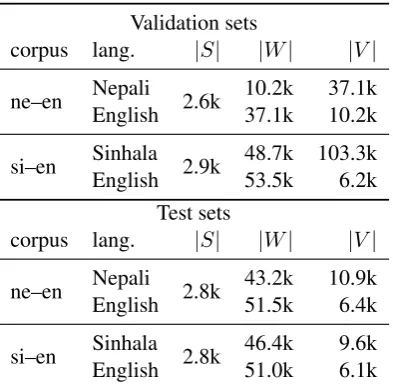
are provided in the shared task. Both sets are drawn from Wikipedia articles. These may be very different from the final official test set in terms of topics due to the fact that the task addresses the challenge of data quality and not domain-relatedness of the data. Main figures of develop-ment sets are shown in Table5.
Table 5: Development sets main figures. k denotes thousands of elements. |S|stands for number of sen-tences,|W|for number of running words, and|V|for vocabulary size. Figures computed on tokenised and lowercased corpora.
Validation sets
corpus lang. |S| |W| |V|
ne–en Nepali 2.6k 10.2k 37.1k
English 37.1k 10.2k
si–en Sinhala 2.9k 48.7k 103.3k
English 53.5k 6.2k
Test sets
corpus lang. |S| |W| |V|
ne–en Nepali 2.8k 43.2k 10.9k
English 51.5k 6.4k
si–en Sinhala 2.8k 46.4k 9.6k
English 51.0k 6.1k
2.2 Sub-sampling of noisy data
Participants submit files with numerical scores, giving one score per line for the original unfiltered parallel corpus. A tool provided by the organisers takes as input the scores and the noisy parallel cor-pus. The tool then selects sentences with higher scores to complete the desired 1M and 5M words in target. Systems trained on these data sets are used for evaluation by the organisers.
2.3 Translation evaluation
As specified in the shared task, the evaluation of a selected subset of sentences is done using SMT and NMT. The SMT system is implemented using Moses (Koehn et al.,2007) and the NMT system is built using the FAIRseq (Ott et al.,2019) toolkit. Organisers provided scripts which allow for im-plementing the same translation system which will be used in the final evaluation. However, we only conducted experiments using NMT. The FAIRseq system tokenises source and target sentences and applies BPE (Sennrich et al., 2016). The tokeni-sation of Nepali, Sinhala and Hindi sentences is done using the Indic NLP Library3. The system (Guzm´an et al., 2019) uses a Transformer archi-tecture with 5 encoder and 5 decoder layers, where the number of attention heads, embedding dimen-sion and inner-layer dimendimen-sion are 2, 512 and 2048, respectively. The model is regularised with dropout, label smoothing and weight decay. The model is optimised with Adam (Kingma and Ba,
2014) usingβ1= 0.9,β2 = 0.98, and= 1e−8.
The learning rate is fixed tolr= 1e3, as described in (Ott et al.,2019). The NMT system from the shared task is trained for 100 epochs and mod-els are saved every 10 epochs. The best model is chosen according to validation set loss function value. The script which allowed us to reproduce the network used in the shared task can be found at https://github.com/facebookresearch/flores. All experiments were performed using NVidia Titan Xp GPUs.
3 System description
In this section, the entire process of sentence scor-ing is detailed.
Our process for scoring noisy corpora is as fol-lows:
1. We apply bilingual cross-entropy selection (described in3.1.1) to select the best set of sentences from Nepali, Sinhala and Hindi to English jointly for each language pair: Nepali–English and Sinhala–English.
2. We train an NMT engine using the above se-lected data for each language pair.
3. Once the NMT engine is trained, we generate a hypothesis for each sentence in the noisy corpus.
300
301
302
303
304
305
306
307
308
309
310
311
312
313
314
315
316
317
318
319
320
321
322
323
324
325
326
327
328
329
330
331
332
333
334
335
336
337
338
339
340
341
342
343
344
345
346
347
348
349
350
351
352
353
354
355
356
357
358
359
360
361
362
363
364
365
366
367
368
369
370
371
372
373
374
375
376
377
378
379
380
381
382
383
384
385
386
387
388
389
390
391
392
393
394
395
396
397
398
399 4. We then compute smoothed BLEU for each
target sentence in the noisy corpus, along with its corresponding hypothesis. These computed BLEU scores will be used for the selection of the required subsets of 1M and 5M words of English tokens for the final eval-uation.
5. Additionally, we apply a few rules (described in 3.3) to discard some sentences which are considered useless, by replacing their smoothed BLEU score to zero, effectively avoiding that the selection algorithm includes such sentences into the selected subsets.
3.1 Translation engine
The main core of the scoring process is hypothesis generation using a well-trained translation model. To create the translation model we used the NMT system from the shared task and we selected sen-tences from all provided bilingual corpora in all three language pairs jointly: Nepali, Sinhala and Hindi to English. To select the subset of sentences to train the translation model we used the bilin-gual cross-entropy selection method (Moore and Lewis,2010) described in the next subsection.
3.1.1 Bilingual Cross-Entropy selection
We ranked sentences from all bilingual corpora by their perplexity score according to a language model trained on the monolingual corpora in Nepali, Sinhala and English. The perplexity ppl
of a strings with empirical ngram distributionp
given a language modelqis:
ppl(s) = 2−Px∈sp(x)log q(x)= 2H(p,q) (1)
whereH(p, q)is the cross-entropy betweenpand
q. Selecting the sentences with the lowest per-plexity is therefore equivalent to choosing the sen-tences with the lowest cross-entropy according to the language model trained on monolingual data. To compute bilingual cross-entropy scoreX(s)of a sentences, we sum the cross-entropy difference over each side of the corpus, both source and tar-get:
X(s) = [HM−src(s)−HN−src(s)]+
[HM−tgt(s)−HN−tgt(s)]
(2)
where HM−src(s) andHM−trg(s) are the
cross-entropy of a source/target sentence, respectively, according to a language model trained on the
monolingual data provided, and HN−src(s) and
HN−trg(s)are the cross-entropy of a source/target
sentence, respectively, according to a language model trained on the noisy corpora. Lower scores are presumed to be better.
3.2 Filtering by hypothesis
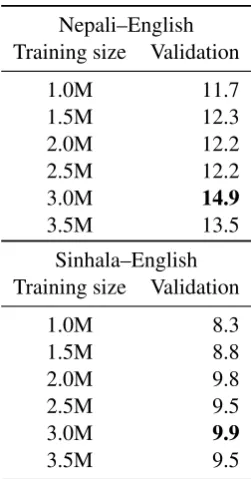
[image:4.595.353.479.468.708.2]Here, the purpose is to filter the noisy data accord-ing to the potential smoothed BLEU score of the sentence pair and the generated hypothesis. With the purpose of building a translation system for ob-taining this probability, we trained an NMT sys-tem with different training set sizes selected us-ing the bilus-ingual cross-entropy technique above. The system was trained for 200 epochs, which was enough to achieve convergence. As development set, and for selecting the best model for comput-ing the BLEU score of the hypothesis associated to a sentence pair, we used the same development set as provided in the shared task. We selected the best epoch according to validation set loss func-tion value. In Table6we show sacreBLEU scores for models trained with different number of sen-tences.
Table 6: Validation sacreBLEU scores for bilin-gual cross-entropy selection results depending on the number of training sentences for Nepali–English and Sinhala–English. M denotes millions of elements. Best system marked in bold.
Nepali–English Training size Validation
1.0M 11.7
1.5M 12.3
2.0M 12.2
2.5M 12.2
3.0M 14.9
3.5M 13.5
Sinhala–English Training size Validation
1.0M 8.3
1.5M 8.8
2.0M 9.8
2.5M 9.5
3.0M 9.9
3.5M 9.5
se-400
401
402
403
404
405
406
407
408
409
410
411
412
413
414
415
416
417
418
419
420
421
422
423
424
425
426
427
428
429
430
431
432
433
434
435
436
437
438
439
440
441
442
443
444
445
446
447
448
449
450
451
452
453
454
455
456
457
458
459
460
461
462
463
464
465
466
467
468
469
470
471
472
473
474
475
476
477
478
479
480
481
482
483
484
485
486
487
488
489
490
491
492
493
494
495
496
497
498
499 lected, we translated the noisy corpora and we
ob-tained the hypothesis for each sentence, which al-lowed us to compute the corresponding smoothed BLEU score. This is the final score provided as competition result. However, and before providing the score, we also applied other filtering strategies, as described in the following subsections.
3.3 Rule based Filtering
After obtaining the hypothesis for each sentence from the noisy corpora, we applied a few rules to filter the sentence pairs. These rules are the fol-lowing:
1. Remove sentence pairs where the source or target sentence contains more than 250 BPE segments.
2. Remove sentences where the lower-cased source sentence is equal to the lower-cased target sentence.
3. Remove sentence pairs which do not contain any Nepali/Sinhala characters in the source sentence.
4. Remove sentences where the smoothed BLEU score between the source and the tar-get sentence is higher than a fixed thresh-oldµ. We explored different values for this threshold µ = {0.20,0.25,0.30,0.35,1.0}. Note that the space between0.35and1.0was not explored because values ofµonly slightly above0.35already implied that no sentences were filtered.
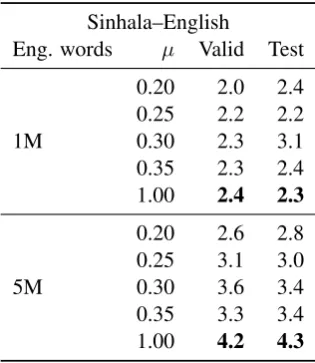
The order in which the rules are applied is impor-tant, since sentences that are filtered out with zero score assigned by one rule will not be a candidate for selection in subsequent rules. After applying different threshold values we used the provided script to subsample sentence pairs to amount to 1 million and 5 million English words. The results of training the final NMT system by applying dif-ferent thresholdsµare shown in Tables7and8.
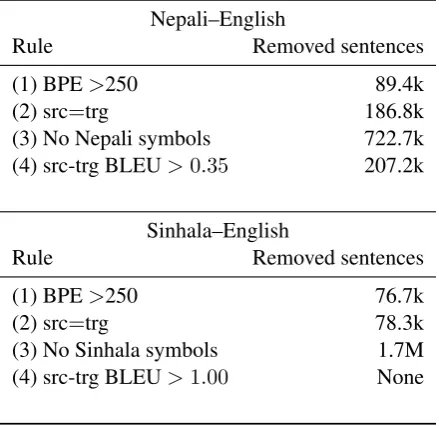
Finally, we selected thresholdsµ= 0.35for the Nepali–English corpus, andµ= 1.00(no thresh-old, all BLEU values between source and target sentences accepted) for the Sinhala–English lan-guage pair. In Table 9, the number of removed sentences by each rule are shown.
[image:5.595.336.495.106.290.2]In total, we discarded 1.2M from Nepali noisy corpus and 1.9M sentences from Sinhala noisy
Table 7: SacreBLEU scores for final NMT system trained using sentences selected with different values of thresholdµfor Nepali–English.
Nepali–English
Eng. words µ Valid Test
1M
0.20 0.1 0.2 0.25 3.3 4.1 0.30 3.4 4.2 0.35 3.4 4.3
1.00 2.4 3.0
5M
0.20 0.2 0.2 0.25 2.6 3.0 0.30 2.8 3.2 0.35 3.0 3.4
1.00 3.0 3.3
Table 8: SacreBLEU scores for final NMT system trained using sentences selected with different values of thresholdµfor Sinhala–English.
Sinhala–English
Eng. words µ Valid Test
1M
0.20 2.0 2.4 0.25 2.2 2.2 0.30 2.3 3.1 0.35 2.3 2.4 1.00 2.4 2.3
5M
0.20 2.6 2.8 0.25 3.1 3.0 0.30 3.6 3.4 0.35 3.3 3.4 1.00 4.2 4.3
corpus. The rest of sentences from noisy cor-pus were scored using target-hypothesis smoothed BLEU described previously.
3.4 Baseline comparision
[image:5.595.337.495.349.531.2]500
501
502
503
504
505
506
507
508
509
510
511
512
513
514
515
516
517
518
519
520
521
522
523
524
525
526
527
528
529
530
531
532
533
534
535
536
537
538
539
540
541
542
543
544
545
546
547
548
549
550
551
552
553
554
555
556
557
558
559
560
561
562
563
564
565
566
567
568
569
570
571
572
573
574
575
576
577
578
579
580
581
582
583
584
585
586
587
588
589
590
591
592
593
594
595
596
597
598
[image:6.595.72.292.145.358.2]599 Table 9: Statistics of how many sentences of noisy
cor-pus were set their final score as zero after applying dif-ferent rules. The number in parenthesis indicates the rule described in the enumerated list above. k denotes thousands of elements and M denotes millions of ele-ments.
Nepali–English
Rule Removed sentences
(1) BPE>250 89.4k
(2) src=trg 186.8k
(3) No Nepali symbols 722.7k (4) src-trg BLEU>0.35 207.2k
Sinhala–English
Rule Removed sentences
(1) BPE>250 76.7k
(2) src=trg 78.3k
(3) No Sinhala symbols 1.7M
(4) src-trg BLEU>1.00 None
Table 10: SacreBLEU scores for NMT system compar-ison with the Zipporah model.
Nepali–English Eng. words Model Test
1M Sciling 4.3
Zipporah 5.2
5M Sciling 3.4
Zipporah 1.9
Sinhala–English Eng. words Model Test
1M Sciling 2.3
Zipporah 4.7
5M Sciling 4.3
Zipporah 3.7
4 Conclusions and future work
We introduced filtering of noisy parallel corpora based on hypothesis generation and combined this filtering with several filtering rules. We submitted only the best set of scores for each language pair to the shared task. In both language pairs, Nepali– English and Sinhala–English, we achieved results that performed better than the Zipporah baseline with corpora containing 5M English words. Our conclusion is that the designed filtering method is able to reach better performance when confronted
with larger amounts of data.
Future work should concentrate on further im-proving of our filtering method. We would train a logistic model to combine the BLEU score be-tween the generated hypothesis and target with the BLEU score between source and target in-stead of threshold values. Also, we would ap-ply data selection techniques such as infrequent n-gram selection (Parcheta et al., 2018) or con-tinuous vector-space representation of sentences (Chinea-Rios et al.,2019).
Acknowledgments
Work partially supported by MINECO under grant DI-15-08169 and by Sciling under its R+D pro-gramme. The authors would like to thank NVIDIA for their donation of Titan Xp GPU that allowed to conduct this research.
References
Amittai Axelrod, Xiaodong He, and Jianfeng Gao. 2011. Domain adaptation via pseudo in-domain data selection. InProc. of EMNLP, pages 355–362.
Mara Chinea-Rios, Germ´an Sanchis-Trilles, and Fran-cisco Casacuberta. 2019. Vector sentences represen-tation for data selection in statistical machine trans-lation.Computer Speech & Language, 56:1–16.
Francisco Guzm´an, Peng-Jen Chen, Myle Ott, Juan Pino, Guillaume Lample, Philipp Koehn, Vishrav Chaudhary, and Marc’Aurelio Ranzato. 2019. Two new evaluation datasets for low-resource machine translation: Nepali-english and sinhala-english.
arXiv preprint arXiv:1902.01382.
Diederik P. Kingma and Jimmy Ba. 2014. Adam: A method for stochastic optimization. CoRR, abs/1412.6980.
Philipp Koehn, Hieu Hoang, Alexandra Birch, Chris Callison-Burch, Marcello Federico, Nicola Bertoldi, Brooke Cowan, Wade Shen, Christine Moran, Richard Zens, et al. 2007. Moses: Open source toolkit for statistical machine translation. InProc. of ACL, pages 177–180.
Chin-Yew Lin and Franz Josef Och. 2004. Auto-matic evaluation of machine translation quality us-ing longest common subsequence and skip-bigram statistics. InProc. of ACL, pages 605–615.
Robert C. Moore and William Lewis. 2010. Intelligent selection of language model training data. InProc. of ACL, pages 220–224.
[image:6.595.109.255.402.589.2]600
601
602
603
604
605
606
607
608
609
610
611
612
613
614
615
616
617
618
619
620
621
622
623
624
625
626
627
628
629
630
631
632
633
634
635
636
637
638
639
640
641
642
643
644
645
646
647
648
649
650
651
652
653
654
655
656
657
658
659
660
661
662
663
664
665
666
667
668
669
670
671
672
673
674
675
676
677
678
679
680
681
682
683
684
685
686
687
688
689
690
691
692
693
694
695
696
697
698
699 Michael Auli. 2019. fairseq: A fast,
extensi-ble toolkit for sequence modeling. arXiv preprint arXiv:1904.01038.
Kishore Papineni, Salim Roukos, Todd Ward, and Wei-Jing Zhu. 2002. BLEU: a method for automatic evaluation of machine translation. InProc. of ACL, pages 311–318.
Zuzanna Parcheta, Germ´an Sanchis-Trilles, and Fran-cisco Casacuberta. 2018. Data selection for nmt us-ing infrequent n-gram recovery. pages 219–228.
Matt Post. 2018. A call for clarity in reporting BLEU scores. InProc. of WMT, pages 186–191.