6065
Improving the Robustness of Question Answering Systems
to Question Paraphrasing
Wee Chung Gan
Department of Computer Science National University of Singapore gan [email protected]
Hwee Tou Ng
Department of Computer Science National University of Singapore
Abstract
Despite the advancement of question answer-ing (QA) systems and rapid improvements on held-out test sets, their generalizability is a topic of concern. We explore the robust-ness of QA models to question paraphrasing by creating two test sets consisting of para-phrased SQuAD questions. Parapara-phrased ques-tions from the first test set are very similar to the original questions designed to test QA models’ over-sensitivity, while questions from the second test set are paraphrased using con-text words near an incorrect answer candidate in an attempt to confuse QA models. We show that both paraphrased test sets lead to significant decrease in performance on multi-ple state-of-the-art QA models. Using a neural paraphrasing model trained to generate multi-ple paraphrased questions for a given source question and a set of paraphrase suggestions, we propose a data augmentation approach that requires no human intervention to re-train the models for improved robustness to question paraphrasing.
1 Introduction
With the release of large-scale, high-quality, and increasingly challenging question answering (QA) datasets (Rajpurkar et al., 2016; Nguyen et al., 2016;Joshi et al., 2017;Reddy et al.,2018), the research community has made rapid progress on QA systems. On the popular SQuAD dataset (Rajpurkar et al., 2016), top QA models have achieved higher evaluation scores compared to hu-man. However, since the test set is typically a randomly selected subset of the whole set of data collected, and thus follows the same distribution as the training and development sets, the perfor-mance of models on the test set tends to overes-timate the models’ ability to generalize to other unseen test data. It is thus important for QA mod-els to be evaluated on other unseen test data for a
Context: ... commentators had debated
whether the figure could be reached as the growth in subscriber numbers elsewhere in Europe flattened.
Original Question: What was happening to subscriber numbers in other areas of Europe?
Prediction:flattened
Paraphrased Question: What was going on with subscriber numbers in other areas of Eu-rope?
Prediction:growth
Context: ... According to the Second law of thermodynamics, nonconservative forces necessarily result in energy transformations within closed systems from ordered to more random conditions as entropy increases.
Original Question: What is the law of ther-modynamics associated with closed system heat exchange?
Prediction:Second law of thermodynamics
Paraphrased Question: What is the law of thermodynamics related to closed system heat exchange?
Prediction:nonconservative forces
Figure 1: Examples of brittleness to paraphrasing. Both examples show an initially correct prediction turning into a wrong prediction after small changes in the question.
be improved for better reliability of QA models on unseen test questions.
We focus on the SQuAD QA task in this paper. SQuAD was created by getting crowd workers to create questions and answers from Wikipedia paragraphs. SQuAD serves as a benchmark for QA systems, taking as input a question and a con-text to predict the correct answer. Two evalua-tion metrics are used: exact match (EM) and F1. Since an answer must be a span from the context, most models output a probability distribution for the start and end token separately, and constrain the end token to be after the start token.
Despite the availability of SQuAD 2.0 (Ra-jpurkar et al.,2018) which requires models to ad-ditionally decide whether a question is unanswer-able, we focus on the original version of SQuAD (Rajpurkar et al., 2016). This is due to the sim-pler task of the original SQuAD which allows us to concentrate on robustness of models to question paraphrasing.
We created two paraphrased test sets by para-phrasing SQuAD questions so as to evaluate the robustness of models to question paraphrasing. Using a neural paraphrasing model trained to gen-erate a paraphrased question given a source ques-tion and a paraphrase suggesques-tion, we created a non-adversarial paraphrased test set from SQuAD development questions which is subsequently ver-ified by human annotators. We also created an adversarial paraphrased test set by re-writing the original question using words in the context near a confusing answer candidate of the same type as the correct answer. Both test sets lead to signifi-cant decrease in the performance of QA models.
We hypothesize that exposing a model to vari-ous ways of asking the same question during train-ing will improve its robustness to question phrasing. To this end, we use the trained para-phrasing model to introduce additional training examples containing paraphrased training ques-tions to augment the original training data for re-training.
The contributions of this paper are as follows:
• We introduce anovelmethod to generate di-verse paraphrased questions by guiding the model with paraphrase suggestions.
• We release two paraphrased test sets1 us-ing SQuAD development questions for
eval-1The two test sets are available at https://github.com/nusnlp/paraphrasing-squad.
uation of QA models’ robustness to ques-tion paraphrasing. The non-adversarial para-phrased test set consists of 1,062 questions paraphrased with slight perturbations from the original questions. The adversarial phrased test set consists of 56 questions para-phrased using context words near a confusing answer candidate.
• We show that all three state-of-the-art QA models that we experimented with, in-cluding one that outperforms human on SQuAD, have worse performance on the non-adversarial paraphrased test set even though they are semantically and syntactically sim-ilar to the original questions. All three QA models have drastically lower performance on the adversarial paraphrased test set.
• We show that it is possible to improve the ro-bustness of QA models to paraphrased ques-tions for both paraphrased test sets, using a fully automatic approach to augment the training set and retraining the model on the augmented training set.
2 Paraphrase-Guided Paraphrasing Network
2.1 Model Architecture
We use the transformer model from Vaswani et al. (2017) which is an encoder-decoder architec-ture that relies mainly on a self-attention mech-anism. We extend the decoder using the copy mechanism of See et al. (2017) which allows to-kens to be copied from the source question. This is achieved by augmenting the probability distri-bution of the output vocabulary to include tokens from the source question.
The input to the encoder is the concatenation of a paraphrase suggestion and the source ques-tion separated by a special token: “<suggestion> <sep> <source question>”, tokenized using the subword tokenizer SentencePiece by Kudo and Richardson (2018).
2.2 Dataset Preparation
We use a combination of the WikiAnswers para-phrase corpus (Fader et al.,2013) and the Quora Question Pairs dataset2for training. The two ques-tions in a question pair in the Quora dataset are typically very similar in meaning. In contrast, the WikiAnswers paraphrase corpus tends to be nois-ier but one source question is paired with multi-ple target questions. This allows the model to be trained to output different target questions depend-ing on the paraphrase suggestion given. A combi-nation of these two datasets thus provides a bal-ance between good paraphrasing and using a para-phrase suggestion to generate a parapara-phrase.
2.2.1 Obtaining Source and Target Questions WikiAnswers dataset: This paraphrase corpus contains over 22 million question pairs. We use only a small portion of this dataset so as not to overwhelm the Quora dataset. We only keep a question pair if each question is at least 7 to-kens long, since training on longer sentences is more helpful. We also attempt to filter out er-roneous question pairs by removing all question pairs with paraphrase similarity scores below 0.7 using a pre-trained model by Wieting and Gimpel (2018). Then, we randomly sample source ques-tions to obtain about 350,000 question pairs.
Quora dataset: For the Quora dataset, we use a pair of questions as two training examples by in-cluding both source question to target question and vice versa in the training set, i.e., we include Ques-tionA→QuestionB and QuestionB→QuestionA
2 https://data.quora.com/First-Quora-Dataset-Release-Question-Pairs
in the training set. A total of about 280,000 train-ing examples come from the Quora dataset.
2.2.2 Obtaining Paraphrase Suggestions
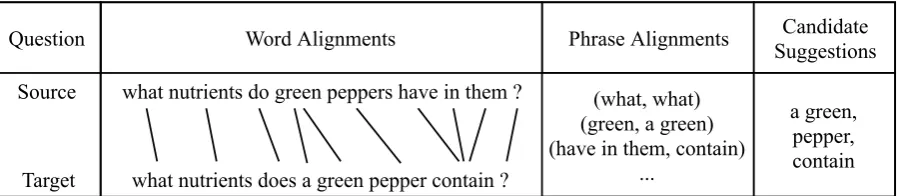
WikiAnswers dataset: For each source and tar-get question pair, we use word alignments that come with the dataset to match words and phrases from the source to target question to obtain phrase alignment pairs. The alignment pairs are filtered to keep phrases that occur in the target question but are not in the source question. Given a source and target question pair, we thus have a set of possible paraphrase suggestions to choose from. We show an example in Figure2.
Since most source questions have multiple tar-get questions in this dataset, given one source questionqand all of its corresponding target ques-tionst1, t2, ..., tk, we thus haveksets of possible paraphrase suggestionsS1, S2, ..., Sk. From each set of possible paraphrase suggestionsSi, we se-lect one suggestion si ∈ Si to construct a train-ing example (q, si, ti). We constrain the selec-tion such that all paraphrase suggesselec-tions chosen are unique, i.e., ∀i, j(i 6= j ⇒ si 6= sj). This is to ensure that there are no duplicate(q, si)input pairs in the training dataset which will result in the model being trained on different targets given the same input.
Furthermore, to enable the model to paraphrase even without a suggestion given, some paraphrase suggestions are randomly selected to be replaced with a special empty token.
Quora dataset: Since the Quora dataset does not come with word alignments, we first use Tex-tRank (Mihalcea and Tarau,2004) to obtain tion keywords from both source and target ques-tions. Then, the paraphrase suggestion is the high-est ranked key phrase in the target quhigh-estion that is not in the source question. We do not allow stop-words to be selected as a paraphrase suggestion. Similarly, a random subset of the paraphrase sug-gestions is replaced with the special empty token. We show an example of obtaining paraphrase sug-gestions for this dataset in Figure3.
2.3 Implementation
Phrase Alignments
what nutrients do green peppers have in them ?
what nutrients does a green pepper contain ?
(what, what) (green, a green) (have in them, contain)
...
Candidate Suggestions
a green, pepper, contain Source
Target
Word Alignments Question
Figure 2: An example of finding possible paraphrase suggestions for a source and target question pair from the WikiAnswers dataset. Since there can be multiple target questions for a given source question, we ensure that there are no duplicates in the suggestions chosen for the same source question.
Question Keywords Candidate
Suggestions
Selected Suggestion Source how can i find out how many
de-vices are connected to my wifi?
wifi, connected, many de-vices, dede-vices, find
wifi network, network, know
wifi network Target how can i know how many
de-vices are connected to my wifi network?
[image:4.595.76.525.63.161.2]wifi network, network, wifi, connected, many devices, devices, know
Figure 3: An example of obtaining a paraphrase suggestion for a source and target question pair from the Quora dataset. Keywords from the questions are obtained from TextRank.
Since our model is not directly comparable to other neural paraphrasing models in the literature, we do not perform automatic evaluation and in-stead leave the evaluation of our model’s perfor-mance to Section3.1.2, where we employ human annotators to evaluate the paraphrasing quality of our model on SQuAD questions.
3 Paraphrasing SQuAD Questions
In this section, we discuss the creation of two para-phrased test sets using SQuAD development ques-tions for the evaluation of the robustness of QA models to question paraphrasing.
3.1 Non-Adversarial Paraphrased Test Set
We use the trained paraphrasing model from Sec-tion2to create a non-adversarial paraphrased test set. We employ human annotators to ensure the quality of the questions for this test set, which also serves as evaluation for our paraphrasing model.
In contrast to methods that query the model to create adversarial examples, this dataset is created in a completely model-independent way designed to provide a better indication on performance dur-ing actual use.
3.1.1 Paraphrasing Process
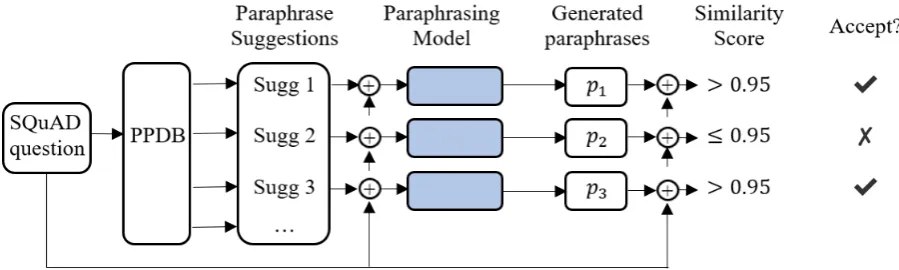
To obtain paraphrase suggestions for input to our paraphrasing model to paraphrase SQuAD
ques-tions, we rely on the paraphrase database PPDB (Pavlick et al., 2015), which is an automatically extracted database consisting of millions of para-phrase pairs. The parapara-phrase pairs can contain a single word or multiple words. PPDB comes in 6 different sizes, with larger sizes having greater coverage but are less accurate.
First, we obtain all n-grams (up to 6-grams) from the source question and remove unigrams that are stopwords. Next, we search the PPDB (XL size) for paraphrases of the remaining n-grams with equivalence score above 0.25. This gives us a set of paraphrase suggestions for the model to gen-erate paraphrased questions. We use a threshold of 0.25 for a balance between having a larger set of paraphrase suggestions and having a less noisy set of suggestions.
After paraphrase generation, we perform post-processing to remove semantically dissimilar paraphrases. Similar to filtering question pairs from the WikiAnswers corpus, we use the pre-trained model by Wieting and Gimpel (2018) to obtain paraphrase similarity score for the gener-ated questions and keep only those scoring above 0.95. This is required due to noisiness of the para-phrase suggestions obtained from PPDB and to en-sure that a larger number of paraphrased questions are semantically similar to the original question.
Fig-Figure 4: Process to paraphrase SQuAD questions. We first use PPDB to obtain paraphrase suggestions before passing both the original question and the suggestions to our paraphrasing model to generate paraphrases. A generated paraphrase is accepted if its similarity score with the original question is above 0.95.L
refers to the use of the original SQuAD question and the previous output as inputs to the next step.
Original Question
the european court of justice cannot uphold measures that are incompatible with what?
Paraphrased Questions
1. the european court of justice cannot uphold a number of measures that are incompatible with what?
2. the european court of justice cannot uphold measures that are inconsistent with what? 3. the european court of justice cannot uphold measures which are not compatible with what? 4. the european court of justice has not been able to uphold measures that are incompatible with what?
Figure 5: Examples of generated paraphrases.
ure 4and show four example paraphrases gener-ated by our model from the same question in Fig-ure5.
3.1.2 Human Evaluation
To evaluate the quality of the automatically gen-erated paraphrases, we employ human annotators from Amazon Mechanical Turk (AMT) to rate the semantic equivalence and fluency of the para-phrased questions.
We paraphrase questions from the SQuAD de-velopment set and randomly select 3,000 gen-erated paraphrases, containing between 2 and 3 paraphrased questions for each original question. For each pair of questions, we ask 2 annotators from AMT to state how well they agree with the following two statements, on a scale of one to five (strongly disagree, disagree, neutral, agree, or
strongly agree):
1. The paraphrased question has the same meaning as the original question (i.e., both the paraphrased and the original question are expected to yield the same answer).
2. The paraphrased question is written in fluent English.
For better annotation quality, we employ two annotators to annotate each paraphrased question and require the annotators to have at least 99% ap-proval rate with at least 1,000 approved HITs.
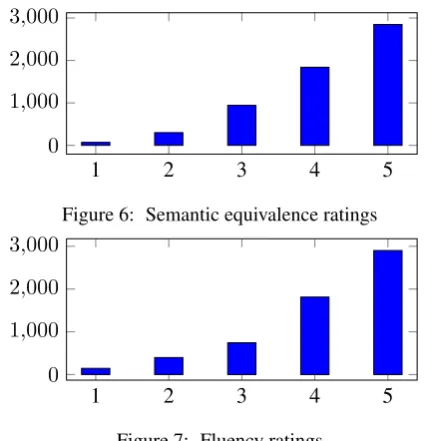
The evaluation results are shown in Figures 6 and 7, where we plot the number of tions against the scores assigned by the annota-tors, which are between 1 (Strongly Disagree) to 5 (Strongly Agree). 78.1% of the generated para-phrases are judged to be semantically equivalent and 78.6% are judged to be fluent, where annota-tors agree or strongly agree to questions 1 and 2 respectively.
3.1.3 Test Set Creation
[image:5.595.73.523.62.197.2]1 2 3 4 5
[image:6.595.71.285.62.283.2]0 1,000 2,000 3,000
Figure 6: Semantic equivalence ratings
1 2 3 4 5
0 1,000 2,000 3,000
Figure 7: Fluency ratings
3.2 Adversarial Paraphrased Test Set
Motivated by the observation that QA models trained on SQuAD tend to perform string match-ing to return an answer of an appropriate type near a region of significant word overlap between the context and the question (Jia and Liang, 2017; Rondeau and Hazen, 2018), we create a test set to exploit this weakness of the models. In the con-text of question paraphrasing, we can simply para-phrase the question by using words in the context near a wrong answer candidate of the same type to generate a natural adversarial example.
We show in Figure 8an example of producing such a paraphrased question. Since the correct answer “2009” is a year, we locate another year “1963” in the context and use the nearby context words “been televised” to paraphrase the original question.
We perform such paraphrasing manually by go-ing through question and context pairs from the SQuAD development set and re-writing the ques-tion using context words near a confusing answer candidate if such a candidate exists and there are suitable nearby context words for use in para-phrasing. We create a total of 56 paraphrased questions for the adversarial test set.
Context: 826 Doctor Who instalments have been televised since 1963 ... Starting with the 2009 special “Planet of the Dead”, the series was filmed in 1080i for HDTV ...
Original Question:In what year did Doctor Who begin being shown in HDTV?
Prediction:2009
Paraphrased Question:Since
what year has Doctor Who been televised in HDTV?
Prediction:1963
Figure 8: An example of paraphrasing question us-ing context words (underlined) near a confusus-ing answer candidate to generate a natural adversarial example.
4 Experiments on QA Models
We conduct experiments on three state-of-the-art QA models: BERT (Devlin et al.,2018)3, DrQA4 (Chen et al.,2017), and BiDAF5(Seo et al.,2016). BERT, in particular, outperforms human on the SQuAD task.
4.1 Evaluating Performance on the Two
Paraphrased Test Sets
For each paraphrased test set, we compare the per-formance of the three QA models on the original questions from the SQuAD development set and the corresponding paraphrased questions.
4.1.1 Non-Adversarial Paraphrased Test Set
The performance of the QA models on the original and paraphrased questions for the non-adversarial paraphrased test set is given in Table1.
Despite the paraphrased set being semantically similar, and no model querying is performed to in-tentionally locate weaknesses of the QA models, all three models suffer a significant drop in per-formance. This highlights the brittleness of the trained models to question paraphrasing.
4.1.2 Adversarial Paraphrased Test Set
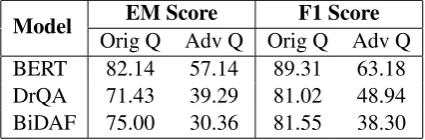
We compare the performance of QA models on the original and paraphrased questions for the adver-sarial paraphrased test set in Table2.
3
We used the PyTorch re-implementation available at https://github.com/huggingface/pytorch-pretrained-BERT
4
We used the re-implementation focusing on the reader module available at https://github.com/hitvoice/DrQA
[image:6.595.315.520.65.215.2]Model EM Score F1 Score
Orig Q Para Q Orig Q Para Q
BERT 83.62 79.85 90.78 87.63
DrQA 67.33 65.25 76.25 74.25
BiDAF 67.80 63.84 76.85 73.51
Table 1: Performance of QA models on the original questions (Orig Q) compared to non-adversarial para-phrased questions (Para Q).
Model EM Score F1 Score
Orig Q Adv Q Orig Q Adv Q
BERT 82.14 57.14 89.31 63.18
DrQA 71.43 39.29 81.02 48.94
[image:7.595.78.290.62.132.2]BiDAF 75.00 30.36 81.55 38.30
Table 2: Performance of QA models on the origi-nal questions (Orig Q) compared to adversarial para-phrased questions (Adv Q).
The adversarial paraphrased test set is able to exploit the reliance of QA models on string match-ing to cause drastic decrease in the models’ per-formance. BiDAF demonstrated the weakest re-silience to such a deliberate attack with a decrease of 43.25 F1, while BERT and DrQA suffered a decrease of 26.13 F1 and 32.08 F1 respectively. This sharp drop in performance highlights a se-rious flaw in QA models trained on the SQuAD dataset: if we ask a question that matches the con-text words near a confusing answer candidate, we are likely to get a wrong answer.
4.2 Re-Training Using Training Data
Augmentation
Our evaluation suggests that the original training dataset does not contain sufficiently diverse ques-tion phrasing. This leads to the models not learn-ing to respond correctly to various ways of asklearn-ing the same question.
A natural way to improve the robustness of QA models to question paraphrasing would thus be to expose them to more diverse question phrasing. We attempt to achieve this by using our paraphras-ing model to paraphrase the trainparaphras-ing set of ques-tions.
4.2.1 Non-Adversarial Paraphrased Test Set
For improvements on the non-adversarial para-phrased test set, we use the same approach de-scribed in Section 3.1.1 to automatically gener-ate paraphrased questions from the training set of questions and keep paraphrased questions with
Model EM Score F1 Score
Before After Before After
BERT 79.85 80.89 87.63 88.62
DrQA 65.25 67.33 74.25 75.00
[image:7.595.313.519.62.133.2]BiDAF 63.84 66.20 73.51 75.94
Table 3: Performance on the non-adversarial para-phrased test set before and after re-training.
Model EM Score F1 Score
Before After Before After
BERT 84.02 83.76 91.00 90.88
DrQA 69.04 68.74 78.38 77.86
BiDAF 67.67 67.49 77.46 77.10
Table 4: Performance on the original development set before and after re-training.
similarity score above 0.9. This acceptance thresh-old is lower than that used in Section3.1.1in or-der to create more diverse paraphrased questions as training data (as a result, these questions are ex-pected to be noisier). No human annotator is em-ployed to check the semantic equivalence of the paraphrased questions and the original questions.
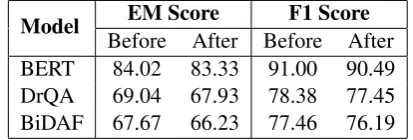
We randomly sample 25,000 paraphrased ques-tions to be used as additional training data. We re-train all three QA models using the original re- train-ing data and the additional 25,000 paraphrased questions. The performance of the three QA mod-els on the paraphrased test set before and after re-training is shown in Table3.
Even though the augmented training dataset is noisy (since not all generated questions are true paraphrases), all QA models still show improve-ment on the paraphrased test set after retraining. Furthermore, re-training causes only a negligible drop to the performance of QA models on the orig-inal development set, as shown in Table4.
4.2.2 Adversarial Paraphrased Test Set
In contrast to using PPDB to obtain paraphrase suggestions for the neural paraphrasing model, we now require the paraphrase suggestions to be from the context of the associated question.
We use Flair6 (Akbik et al., 2018) trained on the Ontonotes dataset7 which contains 12 named entity classes to label which named entity class, if any, that the answer belongs to. Then, we extract
6Pre-trained models available at https://github.com/zalandoresearch/flair
[image:7.595.75.288.179.249.2]Model EM Score F1 Score
Before After Before After
BERT 57.14 69.64 63.18 73.85
DrQA 39.29 41.07 48.94 49.86
[image:8.595.80.286.62.132.2]BiDAF 30.36 39.29 38.30 47.49
Table 5: Performance of QA models on the adversarial test set before and after re-training.
Model EM Score F1 Score
Before After Before After
BERT 84.02 83.33 91.00 90.49
DrQA 69.04 67.93 78.38 77.45
BiDAF 67.67 66.23 77.46 76.19
Table 6: Performance on the original development set before and after re-training.
sentences from the context containing named enti-ties of the same type if the named entity contains no overlapping words with the answer.
We perform syntactic chunking on the extracted sentences using Flair trained on the CoNLL-2000 dataset (Sang and Buchholz, 2000). We use the noun and verb phrases from the result of chunking to form the set of paraphrase suggestions for the given question. We ensure that each suggestion obtained contains at least two words and does not overlap with the answer.
After using the paraphrasing model to para-phrase questions from the SQuAD training set us-ing context words as suggestions, we keep only paraphrased questions with paraphrase similarity score above 0.83. This similarity threshold is set lower than the previous selection criterion since we want to allow context words that could be very different from the question words to appear in the generated paraphrase.
We similarly re-train all three QA models with an additional 25,000 paraphrased training exam-ples. The results are shown in Table 5. We see that re-training leads to a significant improvement in the performance of BERT and BiDAF on the adversarial paraphrased test set, although it still falls short of the performance on the correspond-ing original questions. However, re-training is only able to improve DrQA’s performance slightly. In all cases, re-training also only causes a slight decrease in performance on the original SQuAD development set (Table6).
5 Related Work
We present related work in this section, divided into three sub-topics.
5.1 Adversarial Examples for Question
Answering
Jia and Liang (2017) showed that QA models can be confused by appending a distracting sentence to the end of a passage. While this highlighted an important weakness of trained models, the ad-versarial examples created are unnatural and not expected to be present in naturally occurring pas-sages. In contrast, semantic preserving changes to an input question that lead to returning the wrong answers present more relevant failure cases that occur in practice.
Some previous work used question paraphras-ing to create more natural adversarial examples. Ribeiro et al. (2018) made use of back transla-tion to obtain paraphrasing rules that were sub-sequently filtered by human annotators. Exam-ples of rules obtained include “What VERB →
So what VERB” and “What NOUN → Which
NOUN”. Rychalska et al. (2018) replaced the most important question word identified using the LIME framework with a synonym from WordNet and ELMo embeddings, which was verified by hu-man annotators. These replacements are expected to maintain the meaning of the questions but can sometimes change initially correct answers.
In contrast, we do not restrict ourselves to spe-cific types of paraphrasing when creating the non-adversarial paraphrased test set. Our paraphrasing model can produce paraphrases including but not limited to those in the above two methods. Fur-thermore, we do not perform any model query-ing when creatquery-ing the test set. The ability of our generic approach to decrease the performance of
all evaluated state-of-the-art QA models demon-strates the need to improve the robustness of cur-rent QA models.
The creation of the adversarial paraphrased test set which aims to trick QA models intentionally also contrasts with the approach by Jia and Liang (2017), as the examples created in this work are natural and coherent.
5.2 Neural Paraphrasing Networks
[image:8.595.77.284.167.237.2]Huang et al.,2018;Wang et al.,2018). One con-ceptually simple approach that does not require a paraphrase corpus is to carry out back translation (Lapata et al.,2017), by first translating the source sentence to a pivot foreign language and back.
Besides single paraphrase generation, the value of generating multiple paraphrases for a given in-put sentence has also been explored. Gupta et al. (2018) achieved this by using a variational au-toencoder (VAE) with a long short-term memory (LSTM) network. Xu et al. (2018) assumed that different paraphrasing styles used different rewrit-ing patterns, which were represented as latent em-beddings. These embeddings were used to aug-ment the decoder’s hidden state to generate differ-ent paraphrases.
In contrast to previous work, we introduce a more guided approach to generate diverse para-phrases, by using a paraphrase suggestion together with a source question to generate a paraphrased question. Givenksuggestions, our model is thus able to generate up tokparaphrased questions.
5.3 Paraphrasing as an Intermediate Task to Question Answering
Some previous work considers question reformu-lation as a subtask of question answering. The in-tuition for doing this is to reduce the space of ques-tion paraphrases that the QA model is required to understand. Models trained by this approach are expected to be more robust to various ques-tion paraphrases since the model can paraphrase a question to one which it understands.
Dong et al. (2017) first generated multiple para-phrases for a given question and used a neural net-work to score the quality of each paraphrase. The probability distribution of the answer was then generated for each paraphrased question, which was subsequently weighted by the score of each paraphrased question to compute the overall con-ditional probability of the answer given the ques-tion. Buck et al. (2017) formulated QA as a reinforcement learning problem and introduced a paraphrasing agent trained to paraphrase a ques-tion to one that was able to get the best answer from the QA model. Similarly, multiple question paraphrases were generated to obtain multiple an-swers from the QA model before answer selection was performed.
In contrast to previous work, we consider ques-tion paraphrasing as a separate task instead of
a subtask. Our approach is conceptually sim-pler since it only augments the training data to expose models to various question paraphrases and requires no change to the system during test time. Furthermore, the previous approaches re-quire multiple queries to the QA model for a single question, resulting in longer inference time.
6 Conclusion
In this paper, we propose a novel approach to train a neural paraphrasing network to paraphrase ques-tions utilizing paraphrase suggesques-tions. We use the approach to construct a test set of paraphrased SQuAD questions containing questions similar to the original to test models’ robustness to question paraphrasing. We also create an adversarial para-phrased test set to test models’ reliance on string matching. We show that all three state-of-the-art QA models give poorer performance on the first test set and drastically reduced performance on the second test set. We also show that a completely au-tomatic approach to augment the training data can improve the robustness of the QA models to the paraphrased questions, while still retaining perfor-mance on the original questions. Our experiments highlight the need for separate adversarial testing and the importance of improving the robustness of QA models to question paraphrasing for better re-liability when tested on future unseen test ques-tions.
There are several possible future directions stemming from this work. As post-processing is required to remove semantically dissimilar para-phrased questions, there is scope for developing better techniques for semantic similarity scoring. There is also scope for better techniques to gen-erate more coherent question paraphrasing when significant question re-writing is required, such as for the situation when we want to paraphrase the question using context words. In addition, we have only considered paraphrasing the question in this paper. Paraphrasing the context is another area to explore but poses significant technical challenge, since it requires altering words over multiple sen-tences while still retaining the original meaning of the context.
Acknowledgments
References
Alan Akbik, Duncan Blythe, and Roland Vollgraf. 2018. Contextual string embeddings for sequence labeling. In Proceedings of the 27th International Conference on Computational Linguistics, pages 1638–1649.
Christian Buck, Jannis Bulian, Massimiliano Cia-ramita, Andrea Gesmundo, Neil Houlsby, Wojciech Gajewski, and Wei Wang. 2017. Ask the right ques-tions: Active question reformulation with reinforce-ment learning. CoRR, abs/1705.07830.
Danqi Chen, Adam Fisch, Jason Weston, and Antoine Bordes. 2017. Reading Wikipedia to answer open-domain questions. InProceedings of the 55th An-nual Meeting of the Association for Computational Linguistics, pages 1870–1879.
Jacob Devlin, Ming-Wei Chang, Kenton Lee, and Kristina Toutanova. 2018. BERT: pre-training of deep bidirectional transformers for language under-standing. CoRR, abs/1810.04805.
Li Dong, Jonathan Mallinson, Siva Reddy, and Mirella Lapata. 2017. Learning to paraphrase for question answering. InProceedings of the 2017 Conference on Empirical Methods in Natural Language Pro-cessing, pages 875–886.
Anthony Fader, Luke S. Zettlemoyer, and Oren Etzioni. 2013. Paraphrase-driven learning for open question answering. InProceedings of the 51st Annual Meet-ing of the Association for Computational LMeet-inguis- Linguis-tics, pages 1608–1618.
Ankush Gupta, Arvind Agarwal, Prawaan Singh, and Piyush Rai. 2018. A deep generative framework for paraphrase generation. InProceedings of the Thirty-Second AAAI Conference on Artificial Intelligence, pages 5149–5156.
Shaohan Huang, Yu Wu, Furu Wei, and Ming Zhou. 2018. Dictionary-guided editing networks for para-phrase generation.CoRR, abs/1806.08077.
Robin Jia and Percy Liang. 2017. Adversarial exam-ples for evaluating reading comprehension systems. In Proceedings of the 2017 Conference on Empiri-cal Methods in Natural Language Processing, pages 2021–2031.
Mandar Joshi, Eunsol Choi, Daniel S. Weld, and Luke Zettlemoyer. 2017. TriviaQA: A large scale dis-tantly supervised challenge dataset for reading com-prehension. In Proceedings of the 55th Annual Meeting of the Association for Computational Lin-guistics, pages 1601–1611.
Guillaume Klein, Yoon Kim, Yuntian Deng, Vin-cent Nguyen, Jean Senellart, and Alexander M. Rush. 2018. OpenNMT: neural machine translation toolkit. InProceedings of the 13th Conference of the Association for Machine Translation in the Ameri-cas, pages 177–184.
Taku Kudo and John Richardson. 2018. Sentence-Piece: A simple and language independent subword tokenizer and detokenizer for neural text processing. In Proceedings of the 2018 Conference on Empiri-cal Methods in Natural Language Processing (Sys-tem Demonstrations), pages 66–71.
Mirella Lapata, Rico Sennrich, and Jonathan Mallinson. 2017. Paraphrasing revisited with neural machine translation. In Proceedings of the 15th Conference of the European Chapter of the Association for Computational Linguistics, pages 881–893.
Rada Mihalcea and Paul Tarau. 2004. TextRank: bringing order into text. InProceedings of the 2004 Conference on Empirical Methods in Natural Lan-guage Processing, pages 404–411.
Tri Nguyen, Mir Rosenberg, Xia Song, Jianfeng Gao, Saurabh Tiwary, Rangan Majumder, and Li Deng. 2016. MS MARCO: A human generated machine reading comprehension dataset. InProceedings of the Workshop on Cognitive Computation: Integrat-ing Neural and Symbolic Approaches.
Ellie Pavlick, Pushpendre Rastogi, Juri Ganitkevitch, Benjamin Van Durme, and Chris Callison-Burch. 2015. PPDB 2.0: Better paraphrase ranking, fine-grained entailment relations, word embeddings, and style classification. InProceedings of the 53rd An-nual Meeting of the Association for Computational Linguistics, pages 425–430.
Aaditya Prakash, Sadid A. Hasan, Kathy Lee, Vivek V. Datla, Ashequl Qadir, Joey Liu, and Oladimeji Farri. 2016. Neural paraphrase generation with stacked residual LSTM networks. In Proceedings of the 26th International Conference on Computational Linguistics, pages 2923–2934.
Pranav Rajpurkar, Robin Jia, and Percy Liang. 2018. Know what you don’t know: Unanswerable ques-tions for SQuAD. In Proceedings of the 56th An-nual Meeting of the Association for Computational Linguistics, pages 784–789.
Pranav Rajpurkar, Jian Zhang, Konstantin Lopyrev, and Percy Liang. 2016. SQuAD: 100,000+ questions for machine comprehension of text. InProceedings of the 2016 Conference on Empirical Methods in Nat-ural Language Processing, pages 2383–2392.
Siva Reddy, Danqi Chen, and Christopher D. Manning. 2018. Coqa: A conversational question answering challenge. CoRR, abs/1808.07042.
Marco T´ulio Ribeiro, Sameer Singh, and Carlos Guestrin. 2018. Semantically equivalent adversar-ial rules for debugging NLP models. InProceedings of the 56th Annual Meeting of the Association for Computational Linguistics, pages 856–865.
answering dataset. InProceedings of the ACL Work-shop on Machine Reading for Question Answering, pages 12–20.
Barbara Rychalska, Dominika Basaj, and Przemyslaw Biecek. 2018. Are you tough enough? Framework for robustness validation of machine comprehension systems. CoRR, abs/1812.02205.
Erik F. Tjong Kim Sang and Sabine Buchholz. 2000. Introduction to the conll-2000 shared task chunking. InProceedings of the Fourth Conference on Compu-tational Natural Language Learning and the Second Learning Language in Logic Workshop, pages 127– 132.
Abigail See, Peter J. Liu, and Christopher D. Manning. 2017. Get to the point: Summarization with pointer-generator networks. InProceedings of the 55th An-nual Meeting of the Association for Computational Linguistics, pages 1073–1083.
Min Joon Seo, Aniruddha Kembhavi, Ali Farhadi, and Hannaneh Hajishirzi. 2016. Bidirectional at-tention flow for machine comprehension. CoRR, abs/1611.01603.
Ashish Vaswani, Noam Shazeer, Niki Parmar, Jakob Uszkoreit, Llion Jones, Aidan N. Gomez, Lukasz Kaiser, and Illia Polosukhin. 2017. Attention is all you need. InProceedings of the Thirty-First Con-ference on Neural Information Processing Systems.
Su Wang, Rahul Gupta, Nancy Chang, and Jason Baldridge. 2018. A task in a suit and a tie: paraphrase generation with semantic augmentation.
CoRR, abs/1811.00119.
John Wieting and Kevin Gimpel. 2018. ParaNMT-50M: Pushing the limits of paraphrastic sentence embeddings with millions of machine translations. InProceedings of the 56th Annual Meeting of the As-sociation for Computational Linguistics, pages 451– 462.