Munich Personal RePEc Archive
Ethics and the public function:
Evaluation of legislative effectiveness in
Mexico
Medel-Ramírez, Carlos
Center of Studies on Public Finance and Combat Poverty
25 March 2018
Online at
https://mpra.ub.uni-muenchen.de/86306/
Electronic copy available at: https://ssrn.com/abstract=3063126
ETHICS AND THE PUBLIC FUNCTION: EVALUATION OF
LEGISLATIVE EFFECTIVENESS IN MEXICO
Carlos Medel Ramírez 1
Abstract
This paper addresses the study of the ethics of responsibility in the legislative function of the Chamber of Deputies of the H. Congress of the Union, from the perspective of evaluating the work of federal deputies, and seeks to answer the following question: Is the work of the Federal Deputies in the Chamber of Deputies efficient? The purpose is how to measure and evaluate the performance in the legislative function of the Federal Deputies? and with that, to approach to identify if is the work performed by these public representatives efficient and ethical? The work is integrated in three parts. The first is the concept of the ethics of responsibility and the legislative function. In the second section, the proposal of an indicator to measure legislative efficiency is presented and the case of the federal deputies of the LXI Legislature representing the State of Veracruz of Ignacio de la Llave is analyzed. Finally, the third part presents a proposal for citizen action based on information on legislative efficiency and the need to demand compliance with ethical responsibility in the legislative function. As important conclusions of the evaluation of the legislative efficiency of the federal deputies of the LXI Legislature, it shows at least two important results: i) The legislative effectiveness index (IEL) shows very low levels, both at the plenary level of the Chamber of Deputies, as at the level of the study group of federal deputies representing the State of Veracruz. ii) In both cases, they show a very high legislative lag index. An alternative is the citizen's demand for ethical compliance with responsibility in the legislative function when knowing the evaluation of results, which serves as a reference to identify scenarios of political choice based on results.
Key words: Ethics of responsibility and legislative function, ethics in the legislative function, Legislative efficiency index
JEL K4: Legal Procedure, the Legal System, and Illegal Behavior
1 * Doctor in Public Finance from the Universidad Veracruzana. Center for Studies on Public Finance and Combat Poverty. Xalapa s/n
Electronic copy available at: https://ssrn.com/abstract=3063126
INTRODUCTION
In the present work the evaluation of the work of the Federal Deputies of the H. Congress of the Union is approached, from the legislative perspective, and it is about answering the following question: Is the work in the Chamber of Deputies efficient? ? The purpose of this paper is to present the elements of analysis that allow us to define the technical question of: how to measure and evaluate the ethics of responsibility in the legislative function of the Federal Deputies? and to establish if it is ethical and responsible for the work performance of public representatives?
The present work is divided into three sections. The first section presents the definition of the object of study, the ethics of legislative responsibility conferred on the Chamber of Deputies of the H. Congress of the Union of the LXI Legislature of Mexico. In the second section, the key question of our work is addressed: is the work of Federal Deputies in the Chamber of Deputies efficient? This valuation is done through the legislative efficiency index. Finally, in the third section some proposals are presented to evaluate and demand an efficient improvement in the work of the Federal Deputies of the Chamber of Deputies, by means of a simple proposal: measure to evaluate, evaluate to demand, as a citizen alternative of action and demand of results.
1 ETHICS AND THE PUBLIC FUNCTION
1.1 Current debate on the ethics of conviction and the ethics of responsibility: The threshold of public service
According to (Weber, 1959) there is currently a debate on the concept of ethics, points out that there is a debate in what he calls ethical conviction and on the other hand, in the ethics of responsibility. Weber recognizes that there is an abysmal difference between these, however he considers that the ethics of conviction and the ethics of responsibility are not contradictory, and on the contrary they complement each other and together constitute the authentic man, that is, a man who can aspire to the political vocation.
Weber asks what is morally correct and what is morally wrong? Given this conflict, it seeks to solve it with the least internal and external harm for all concerned, by focusing on the consequences of the various decisions and not on the insistence on introspective awareness. In this sense, the concept of ethics of responsibility recognizes the search rather for a political positioning, while the ethics of conviction refers only to what each of us act, according to our feelings and without explicit or implicit reference to the consequences.
As noted, the ethics of responsibility requires locating a situation, that is, considers the consequences of possible decisions and tries to introduce into the plot of events, an act that will culminate in certain results or determine certain consequences we desire. Consequently, the ethics of responsibility interprets the action in terms of means and ends.
under a utilitarian approach that prioritizes decisions based on good rather than right. In this same sense, (Sánchez, 2012) identifies that the politician, who has the responsibility of the legislative function, his action entails an ethic of responsibility since he must consider the circumstances and the consequences of his acts.
What is the implication when we use the concept of responsibility ethics to the public function? and is there a particularity of ethics in the public function in the legislative field? This invites us to reflect, how to assess or measure whether the actions of the public function referred to the legislative process, is ethical or not?
In the next section we deal with the identification, from a perspective of the ethics of the responsibility of the legislative function, the form of how to evaluate it and measure the legislative efficiency, and consequently, assess whether the actions carried out by those responsible for the legislative function, by law, they fulfill the ethical responsibility conferred upon them by effective suffrage in their appointment. It is necessary to make a first dimension. Is the public function compatible with the ethics of responsibility?
First, we must define the term public function. According to the (OAS, 1996) shall be understood as any temporary or permanent activity, paid or honorary, performed by a natural person on behalf of the State or the service of the State or its entities, in any of its hierarchical levels. It is observed that its political connotation is inherent in the public space that the action of the State performs. In a clearer sense, the aspect of the public function refers to the internal disposition or self-regulation of those who perform public functions to fully comply with the postulates and mandates of the Political Constitution and the laws that indicate how this function should be exercised, in terms of efficiency, integrity, transparency and with an orientation towards the common good.
In this context, we consider that public ethics refers to the ethical guidelines that govern the performance of those who perform a public function, that is, of public officials -which includes in our case of study- those who are appointed through a popular election: federal deputies members of the H. Chamber of Deputies of the Congress of the Union.
1.2 The ethics of legislative responsibility. Approach to the federal legislative process in Mexico
In this section we address the study of the ethics of legislative responsibility, going into the legislative process of the Chamber of Deputies, from the perspective of the legal framework, in order to identify its meaning and its raison d'etre, such as the social representation of interests that citizens give to the Legislative Power
Article 49 of the Political Constitution of the United Mexican States establishes that the Supreme Power of the Federation is divided for its exercise in Legislative, Executive and Judicial. For its part, Article 50 defines that the legislative power is deposited in a General Congress, which is divided into two chambers: one for Deputies and one for Senators.
the Legislature, our case study corresponds to the LXI Legislature, which took effect on September 1, 2009, and ended on August 31, 2012.
The selection of this period of analysis is in virtue that it minimizes the bias of the political direction, on the part of the Federal Executive, as it happens at present with the structural reforms of: energy, communication, labor, fiscal, among others, undertaken since 2013 and that are reflected in 2014. Therefore, we consider that the selection of the LXI Legislature showed a level in its legislative process that allows us to evaluate the legislative effectiveness without counting on the political bias of the pressure of the Executive Power and the recomposition of forces within the H. Congress of the Union, as a product of the agreements embodied in the Pact for Mexico.
The Chamber of Deputies is composed of a total of 500 deputies, of which 300 deputies are elected by principle of relative majority voting, in single-member electoral districts, and 200 are elected by the principle of proportional representation, through a system of Regional Lists. . In the LXI Legislature of the Congress of the Union, the distribution of the federal deputies, according to political party, presents the following distribution: 48.0% of the deputies are from the Institutional Revolutionary Party (PRI), 28.4% from the National Action Party (PAN), 14.6% of the Party of the Democratic Revolution (PRD), 4.2% of the Partido del Verde Ecologista (PVE), 2.6% of the Labor Party (PT), 1.6% of Convergence (CONV), 1.4% of Nueva Alianza (NA) and only 0.2% Independent. (See table 1, at the end of this document) The conformation of the federal deputies, according to their political party of origin, it is observed that 52.2% correspond to the PRI - PVEM, parties that have presented in coalition as electoral strategy, and that can consider to share the majority decision in the voting of proposals presented in the plenary session of the Chamber of Deputies, reason for which, the other minority parties must present a major lobbying activity in order to achieve the approval of their law initiatives.
In the election of deputies elected by the principle of relative majority voting, the territorial demarcation of the 300 uninominal electoral districts, which is the result of dividing the total population of the country between the districts indicated. (See table 2 at the end of this document). On the other hand, in the election of the 200 deputies according to the principle of proportional representation and the System of Regional Lists, these are constituted in five multi-member electoral districts in the country.
The Federal Deputies have the power conferred by the people to be their representative and they have the legal duty to represent the people in the legislative tasks and in those faculties conferred by the Political Constitution. From the technical-legal perspective, this is the meaning and reason of the Chamber of Deputies, but it is necessary to ask the following question: how to evaluate its performance? Do the federal deputies really obey the interests of the people who elected them? Or to what interests do the federal deputies, those of your party or those of the parliamentary branch obey? In the next section, we will seek to answer the first question, starting from the analysis of the work in the legislative process of the Federal Deputies representing the districts and districts of the State of Veracruz de Ignacio de la Llave.
1.3 What is the legislative process? And where is the ethics of legislative responsibility located?
and establish a way to evaluate the efficiency of Federal Deputies in the fulfillment of legislative tasks.
The legislative process is a systematic process for the preparation of federal laws, and defines a series of stages that must be observed by the Legislative Power and the Executive Power, to incorporate into the legal system those legal norms of application and general obligation. The federal legislative process is governed by the Political Constitution of the United Mexican States, the Organic Law of the General Congress of the United Mexican States and the Regulation for the Interior Government of the General Congress of the United Mexican States. At least three cases can be considered: i) constitutional reforms, ii) new laws and iii) reform of existing laws. The federal legislative process in Mexico has 6 phases: I) Right of initiative and preeminence of the place of presentation, II) Discussion, III) Approval, IV Sanction, V) Promulgation and / or publication and VI) Right of veto.
A first approach to measure and evaluate the efficiency of the Federal Deputies, is to analyze work and participation in the legislative process, and particularly, in the elaboration of initiatives whose expected final product is the formulation of laws. That is, if we consider the evaluation of the legislative process, it is through the analysis of indicators of effectiveness and / or lag, which allows us to evaluate the tasks they perform in legislative matters.
2 EVALUATION OF LEGISLATIVE RESPONSIBILITY: APPROACH
TO THE MEASUREMENT OF THE ETHICS OF LEGISLATIVE
RESPONSIBILITY
2.1 How to measure the ethics of legislative responsibility of federal deputies? Proposal for empirical evaluation: Indicators of effectiveness and legislative backwardness
To measure the performance of the Federal Deputies, three indicators are presented: legislative effectiveness index (IEL), legislative ineffectiveness index (INEL) and the legislative lag index (IRL).
The Legislative Effectiveness Index (IEL) is an indicator that measures the ability of each Federal Deputy to convert the initiatives presented into law. To obtain the Legislative Effectiveness Index (IEL), the different stages of the legislative process that are required for an initiative to become a law are analyzed. In this way, the information that is considered for the calculation of the index are the initiatives presented (IP) and the initiatives approved (IA). Where:
Legislative effectiveness index (IEL) = (Initiatives approved (IA) / Initiatives presented (IP)) x 100
According to the information contained in the Legislative Information System of the LXI Legislature, up to the third year of its exercise, 2,486 initiatives have been presented, only 66 initiatives have been approved. (See table 5 at the end of this document). The legislative effectiveness index is 2.65%, that is, out of every 100 proposals submitted, at least 3 are approved. This value reflects a low level of efficiency of the Federal Deputies, as a whole, in the legislative process.
(INEL), the different stages of the legislative process that are required for an initiative to become a law are analyzed. In this way, the information that is considered for the calculation of the index are the initiatives presented (IP) and the initiatives rejected (ID). Where:
Legislative ineffectiveness index (INEL) = (initiatives rejected (ID) / Initiatives presented (IP)) x 100
Of the 2,486 initiatives presented, 145 initiatives have been discarded. The legislative ineffectiveness index is 5.83%, that is, out of every 100 proposals presented, at least 6 are rejected.
The legislative lag index (IRL) is an indicator that measures the level of lag in the approval of the initiatives presented by each deputy, for its conversion into law. To obtain the Legislative Effectiveness Index (LRI), the submitted initiatives (PI) and pending initiatives (IPe) are considered for the calculation of the index.
Legislative lag index (IRL) = (Initiatives pending (IPe) / Initiatives submitted (IP)) x 100
Finally, of the 2,486 initiatives presented, 2,275 initiatives are pending, in this way, the rate of legislative lag is 91.51%, that is, out of every 100 proposals presented at least 92 are pending resolution. This value reflects an important lag of a large number of initiatives that are still in the process of revision, discussion and final approval.
The results presented in the previous section correspond to the total evaluation of the initiatives presented in the plenary session of the Chamber of Deputies. Here we can ask a question. What is the evaluation of the legislative effectiveness of the federal deputies representing the State of Veracruz? Hence, in the following section this dimension is presented in our subject of study.
2.2 Case study: Evaluation of the legislative effectiveness of the federal deputies of the State of Veracruz of Ignacio de la Llave in the LXI Legislature of the H. Congress of the Union
The annotation presented below in this work, will allow us to identify the level of legislative effectiveness of the work done by the Federal Deputies, representatives of the State of Veracruz of Ignacio de la Llave, as well as assess what has been done and where appropriate , demand the fulfillment of the duties and functions conferred by the Political Constitution, in the matter of the legislative process.
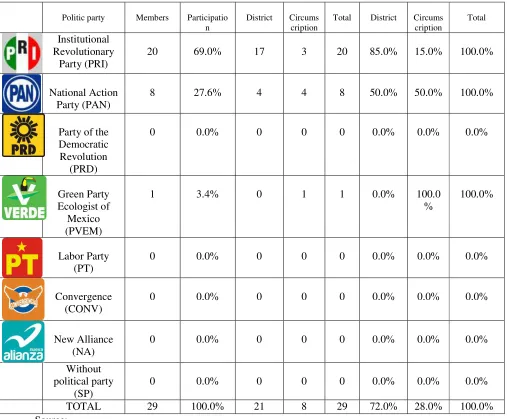
It is important to note that the Chamber of Deputies of the LXI Legislature has 29 Federal Representatives representing the districts and districts of the State of Veracruz of Ignacio de la Llave. Its distribution is as follows: 69.0% are from the PRI, 27.6% from the PAN and 3.4% from the PVEM. (See table 4 at the end of this document). Table 5 shows the allocation and distribution of the commissions in which the Federal Representatives representing the State of Veracruz of Ignacio de la Llave participate, from which it is observed that these are integrated into more than one commission, since in average participate in 3 commissions. Here is the question: What is the level of legislative effectiveness of the Federal Representatives representing the districts and circumscriptions of the State of Veracruz of Ignacio de la Llave? The results are shown below.
Effectiveness Index (IEL) is 5.9%, this indicator measures the capacity of the deputies to convert the presented initiatives into law. On the other hand, the legislative ineffectiveness index (INEL) is only 1.2%, a non-conclusive value, because of the number of initiatives rejected, it is low, compared to an index of legislative lag (IRL) of 92.9%.
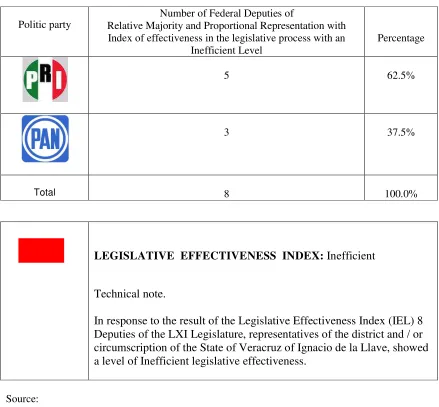
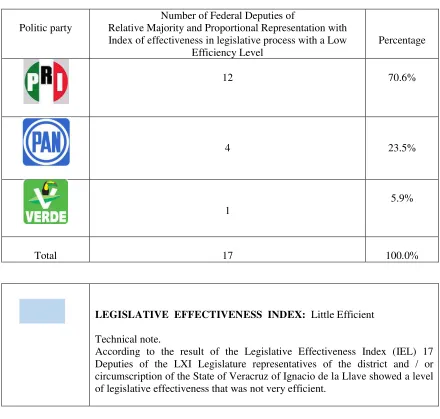
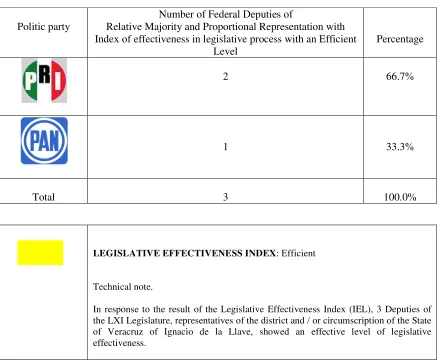
That is, the participation of federal deputies representing Veracruz, show a high lag value of their initiatives as these are pending processing and / or review process. In order to eliminate the bias in the interpretation of the results, when evaluating the activity as a whole of the Federal Representatives representing Veracruz, a categorization of the legislative effectiveness index (IEL) is presented below, which results from evaluating each one of the Federal Deputies, with which a more objective measurement of its legislative work is obtained. In this way, table 7 shows a qualification of the legislative work performance (See the end of this document). Finally, the evaluation of the 29 Federal Representatives representing Veracruz in the LXI Legislature shows the following results: 8 Federal Deputies show an inefficient level in their legislative work, 17 present an inefficient level, 3 show an efficient level and only 1 present an very efficient level.
The result obtained is indicative of the degree of effectiveness of the federal deputies of the Chamber of Deputies of the LXI Legislature. (See tables 8, 9, 10 and 11, at the end of the document).
These results are not flattering, however, from a broader perspective of research, the result invites us to seek to correlate the result obtained with other studies, for example, to measure the cost / benefit of the operation of the Chamber of Deputies to the light of the indicators obtained, and present new questions: How much do federal deputies cost us? Is this expense profitable with the effectiveness of your legislative work? As it is observed, this new question raises a new research work, with a greater depth of analysis, which for the moment is put on the academic discussion table.
3 MEASURE TO EVALUATE, EVALUATE TO DEMAND. A
PROPOSAL FOR ACTION AND DEMAND FOR LEGISLATIVE
EFFECTIVENESS
Under the axiom "What can not be measured, can not be evaluated", we added "What can be evaluated, its effectiveness could be demanded". The result of the evaluation of the work of the Federal Deputies of the LXI Legislature, show at least two important results:
I. The Legislative Effectiveness Index (IEL) shows very low levels, both at the plenary level of the Chamber of Deputies, and at the level of the study group of the Federal Representatives representing the State of Veracruz.
II. In both cases, they show a very high legislative lag index. In this way, the combination of these two results allows us to indicate that under the current conditions of operation, commitment and political work, it is possible to point out that the work of the Federal Deputies in the Chamber of Deputies of the LXI Legislature is not efficient. So, how to improve the level of effectiveness of federal deputies in the legislative process in the Chamber of Deputies?
The proactive action framework contemplates a simple strategy: measure to evaluate and evaluate to demand. The characteristics of the proposed strategy are presented below.
have elements to measure and evaluate the legislative work of the Federal Deputies, and how it was addressed, can be applied to the set of Federal Deputies, as to each of them, in order to measure their legislative effectiveness.
2. The second part of the strategy corresponds to citizen oversight. Thus, the requirement of compliance with a legal duty embodied in the Constitution, by the electorate, will identify and define the interests of party or parliamentarians, and directing the task of the Federal Deputies to the maximum objective that is the good of the nation
CONCLUSIONS
Our research question: is the work of the Federal Deputies in the Chamber of Deputies efficient ?, leads us to conclude with the evidence presented that in terms of legislative effectiveness, the work of the Federal Deputies of the LXI Legislature does not present good results The result of the evaluation of the work of the Federal Deputies of the LXI Legislature, show at least two important results: i) The Legislative Effectiveness Index (IEL) shows very low levels, both at the plenary level of the Chamber of Deputies, and at the level of the study group of the Federal Deputies representing the State of Veracruz. ii) In both cases, they show a very high legislative lag index. As an alternative solution, the measurement and citizen demand is raised to raise the level of legislative effectiveness. It follows the following conditions to seek greater effectiveness in legislative work.
I. Evaluate and demand a higher level of efficiency in the work of the Federal Deputies, in the fulfillment of the legislative tasks and
II. Achieve greater involvement of society to know if the Federal Deputies are complying or not with their obligation of legal duty, and if required, by legal means and / or through their civic will expressed in the vote, in the elections after having information and evaluation that allows them to issue a reasoned vote based on the legislative effectiveness of the political party. III. Evaluate at the individual level, the legislative effectiveness index of the deputies and
particularly of those who are elected under the principle of proportional representation, since as it is observed their level of legislative efficiency is not very efficient, thereby granting pertinent information to propose the elimination of these representatives since they do not have an operational justification.
At the level of the legislative process, the proposal for the creation of a regulation regarding the expiration of Initiatives of Law is put to the academic discussion table. Under this scheme, and the systematization of the relative information with public access, for every bill of law subject to the consideration of the Congress, that does not obtain sanction in one of its Chambers during the parliamentary year in which it had entrance, it will be considered expired and that the citizenry will have access to the state of the initiatives and bills that are of great interest to him . This action aims to streamline the legislative work and provides incentives for the professionalization of the projects presented. Therefore, for the Nation to move forward, it is an indispensable requirement, a citizen participation increasingly committed and requires
REFERENCES
Betancour Ma. Cristina y Cubillos Marcela. (1998). Efectividad legislativa: Cómo evaluar al gobierno y a los parlamentarios. Presentado en el panel número 6: Política y políticas públicas, en el 2° Encuentro Sociedad Chilena, 19 de enero de 2011. Pontificia Universidad Católica de Chile. Santiago de Chile. Recuperado en: http://www.sociedadpoliticaspublicas.cl/archivos/BLOQUE1/Politica_y_Politicas_Publicas/E fectividad_Legislativa_Como_evaluar_al_Gobierno_y-a-los_Parlamentarios.pdf consultado el 2 de agosto de 2014.
Casar Pérez. María Amparo (2011). ¿Cómo y cuánto gasta la Cámara de Diputados? Serie: El Uso y Abuso de los Recursos Públicos. Cuaderno de debate Núm. 8 CIDE. México, septiembre
2011. Recuperado de:
http://www.researchgate.net/publication/267565388_Cmo_y_cunto_gasta_la_Cmara_de_Dip utados consultado el 2 de agosto de 2014.
Gamboa Montejano Claudia y Valdés Robledo Sandra. (2006) Proceso legislativo. Estudio de Derecho Comparado de diversos países. LX Legislatura. Centro de Documentación, Información y Análisis Dirección de Servicios de Investigación y Análisis. Subdirección de Política Interior. México, septiembre, 2006. Recuperado de: http://www.diputados.gob.mx/sedia/sia/spi/SPI-ISS-16-06.pdf consultado el 15 de diciembre de 2014.
Mestre, A. (2006). La ética de la responsabilidad según Robert Spaemann. Revista Ecclesia, XX .
Número 2, págs, 227-250. Recuperado de:
http://universitas.ups.edu.ec/documents/1781427/1792270/01Religion10.pdf consultado el 4 de septiembre de 2014.
Montesquieu. (1906) El espíritu de las Leyes. Trad. Siro García del Mazo. Tomo I. Biblioteca de Derecho y Ciencias Sociales. Librería General de Victoriano Suárez. . Madrid. 1906.
Recuperado de:
http://www.google.com.mx/url?sa=t&rct=j&q=&esrc=s&frm=1&source=web&cd=1&ved=0 CBwQFjAA&url=http%3A%2F%2Ffama2.us.es%2Ffde%2Focr%2F2006%2FespirituDeLas
LeyesT1.pdf&ei=756OVKKEIY-UyAS01oDADA&usg=AFQjCNFsHuf6xAHtTqxTjBHnlxWXnAfW8A consultado el 12 de octubre de 2011
Musacchio Humberto. (1989) Gran Diccionario Enciclopédico de México Visual. Tomo III, p. 1428. México.
Organización de los Estados Americanos. (1996). Convención Interamericana contra la Corrupción, OEA, Caracas, Venezuela. Recuperado de: http://www.oas.org/juridico/spanish/firmas/b-58.html consultado el 12 de octubre de 2011
Rhonheimer Martin. (1994) La prospettiva della morale. Fondamenti dell'etica filosofica.
Armando, Roma, Italia. Recuperado de:
https://books.google.com.mx/books?id=2i0J9HSg4EwC&pg=PA4&lpg=PA4&dq=Rhonheim er+Martin.++La+prospettiva+della+morale.+Fondamenti+dell%27etica+filosofica.+Armand o,+Roma,+Italia&source=bl&ots=RILO2Ke5zU&sig=LFbi7pAkFl6qwVtrLDgtfOjcAKo&hl
honheimer%20Martin.%20%20La%20prospettiva%20della%20morale.%20Fondamenti%20 dell'etica%20filosofica.%20Armando%2C%20Roma%2C%20Italia&f=false consultado el 15 de diciembre de 2014.
Sánchez, B., Jose Antonio. (2012). La ética en la función legislativa. Revista De La Facultad De Derecho De México, LXII (258), julio-diciembre, 487-508.
Spaemann Robert (1987) Ética: Cuestiones fundamentales, Eunsa, Pamplona.
Weber Max & Mills, C. W. (1958). From Max Weber : Essays in Sociology (H. H. Gerth, Trans.). New York: Oxford University Press, Incorporated.
Table 1
Integration of the Federal Deputies, according to political party, in the Chamber of Deputies of the H. Congress of the Union. LXI Legislature.
Percentage distribution
Politic party Integrantes Participación
Institutional Revolutionary Party
(PRI) 240 48.0%
National Action Party (PAN) 142 28.4%
Party of the Democratic Revolution (PRD)
68 13.6%
Green Party Ecologist of Mexico
(PVEM) 21 4.2%
Labor Party (PT) 13 2.6%
Convergence (CONV) 8 1.6%
New Alliance (NA) 7 1.4%
Without political party (SP) 1 0.2%
TOTAL 500 100.0%
Source:
Table 2
Integration of Federal Deputies by Relative Majority and Proportional Representation, according to political party, representatives of the State of Veracruz of Ignacio de la Llave in the Chamber of
Deputies. H. Congress of the Union. LXI Legislature,
Source:
Chamber of Deputies. H. Congress of the Union. List of Deputies by Parliamentary Group. Recovered from: http://sitl.diputados.gob.mx/LXI_leg/listado_diputados_gpnp.php?tipo=TOTAL
Politic party
Integran-tes cipación Parti- Distrito Circuns- cripción Total Distrito Circuns- cripción Total
Institutional Revolutionary
Party (PRI)
240 48.0% 187 53 240 77.9% 22.1% 100.0%
National Action Party (PAN)
142 28.4% 68 74 142 47.9% 52.1% 100.0%
Party of the Democratic Revolution
(PRD)
68 13.6% 37 31 68 54.4% 45.6% 100.0%
Green Party Ecologist of Mexico (PVEM)
21 4.2% 4 17 21 19.1% 80.9% 100.0%
Labor Party
(PT) 13 2.6% 3 10 13 23.1% 76.9% 100.0%
Convergence (CONV)
8 1.6% 1 7 8 12.5% 87.5% 100.0%
New Alliance
(NA) 7 1.4% 0 7 7 0.0% 100.0% 100.0%
Without political party
(SP)
1 0.2% 0 1 1 0.0% 100.0% 100.0%
Table 3
Initiatives presented by the Federal Deputies by relative majority and proportional representation, according to political party, in the Chamber of Deputies of the H. Congress
of the Union. LXI Legislature Percentage distribution
Source:
Chamber of Deputies. H. Congress of the Union. List of Deputies by Parliamentary Group.
Recovered from: http://sitl.diputados.gob.mx/LXI_leg/listado_diputados_gpnp.php?tipo=TOTAL
Politic party
Presen ted
Slopes Appro ved
Discar ded
Legislati ve Effecti veness Index
Index of Legislati
ve Non-Effectiv eness
Index of Legislati
ve Lag
Total Index
Institutional Revolutionary
Party (PRI) 918 850 22 46 2.4% 5.0% 92.6% 100.0%
National Action Party (PAN)
526 487 14 25 2.7% 4.7% 92.6% 100.0%
Party of the Democratic Revolution
(PRD)
380 349 14 17 3.7% 4.5% 91.8% 100.0%
Green Party Ecologist of
Mexico (PVEM)
211 196 9 6 4.3% 2.8% 92.9% 100.0%
Labor Party
(PT) 181 165 2 14 1.1% 7.7% 91.2% 100.0%
Convergence (CONV)
53 50 1 2 1.9% 3.8% 94.3% 100.0%
New Alliance (NA)
203 167 4 32 1.9% 15.8% 82.3% 100.0%
Without political party
(SP)
14 11 0 3 0.0% 21.4% 78.6% 100.0%
Table 4
Integration of Federal Deputies by Relative Majority and Proportional Representation, according to political party, representatives of the State of Veracruz of Ignacio de la Llave in the Chamber of
Deputies. H. Congress of the Union. LXI Legislature,
September 2011
Source:
Chamber of Deputies. H. Congress of the Union. List of Deputies by Parliamentary Group. Recovered from: http://sitl.diputados.gob.mx/LXI_leg/listado_diputados_gpnp.php?tipo=TOTAL
Politic party Members Participatio
n District Circumscription Total District Circumscription Total
Institutional Revolutionary
Party (PRI)
20 69.0% 17 3 20 85.0% 15.0% 100.0%
National Action
Party (PAN) 8 27.6% 4 4 8 50.0% 50.0% 100.0%
Party of the Democratic Revolution
(PRD)
0 0.0% 0 0 0 0.0% 0.0% 0.0%
Green Party Ecologist of
Mexico (PVEM)
1 3.4% 0 1 1 0.0% 100.0
% 100.0%
Labor Party
(PT) 0 0.0% 0 0 0 0.0% 0.0% 0.0%
Convergence
(CONV) 0 0.0% 0 0 0 0.0% 0.0% 0.0%
New Alliance
(NA) 0 0.0% 0 0 0 0.0% 0.0% 0.0%
Without political party
(SP)
0 0.0% 0 0 0 0.0% 0.0% 0.0%
Distribution and integratio and Proportional Repre
Chamber of De
Commissions
Agrarian reform
Agriculture and Livestock Attention to vulnerable group Budget and public account Citizen participation Communications Constitutional points Cooperative development an economy
Culture Energy
Environment and natural reso Equity and gender
External relationships Fishing Health Hydraulic resources Indigenous affairs Living place Marine National defense
Population, borders and imm issues
Public education and educati services
Public function Public security
Radio, television and cinema Rural development
Science in technology Social development Social Security
Strengthening federalism Surveillance of the Superior Federation
Tourism Transportation
Treasury and public credit Work and social security Youth and sport
Source:
Chamber of Deputies. H. Con Recovered from: http://sitl.dip
Table 5
tion of Commissions of the Federal Deputies for resentation of the State of Veracruz of Ignacio d Deputies. H. Congresses of the Union. LXI Legis
2 0
1 0
ups 3 0
1 0
1 0
2 0
1 0
and social 1 1
2 0
3 2
esources 1 1
2 0
1 0
2 1
1 1
1 2
2 2
1 0
2 1
0 1
migration 1 0
ational 1 0
1 0
0 0
atography 2 0
1 2
1 0
1 2
0 1
0 0
or Audit of the 1 0
1 1
1 0
2 1
3 0
2 0
ongress of the Union. List of Deputies by Parliamen iputados.gob.mx/LXI_leg/listado_diputados_gpnp
or Relative Majority de la Llave in the gislature.
Total
0 2
0 1
0 3
0 1
0 1
1 3
0 1
0 2
0 2
0 5
0 2
0 2
0 1
0 3
0 2
0 3
0 4
0 1
2 5
0 1
0 1
0 1
1 1
1 1
0 2
1 4
0 1
0 3
0 1
1 1
0 1
0 2
0 1
1 4
0 3
0 2
Index of Legislative Effectiv Representation of the Sta
According to politi
Initiatives presented Approved initiatives Discarded initiatives Pending initiatives
Legislative effectiveness ind Legislative non-effectiveness Index of legislative backward Totals
Source:
Chamber of Deputies. H. C Recovered from: http://sitl.dip
Technical note.
The Legislative Effectiveness party to convert the initiatives
Legislative Effectiveness Ind
The Legislative Non-Effective deputy / party to convert the in
Index of legislative effectiven
The Index of Legislative Non the initiatives of each deputy following:
[image:17.595.84.515.137.317.2]Index of legislative lag (I
Table 6
tiveness of the Federal Deputies for Relative Major tate of Veracruz by Ignacio de la Llave in the Cham litical party in the H. Congress of the Union. LXI L
46 21
4 1
8 1
34 19
ndex 8.7% 4.8%
ess index 17.4% 4.7%
ardness 73.9% 90.5% 9
100.0% 100.0% 10
Congress of the Union. List of Deputies by P iputados.gob.mx/LXI_leg/listado_diputados_gpnp
ss Index (IEL) is an indicator that measures the ab es presented into law. Its formula is the following:
ndex (IEL) = [Appropriate Initiatives (IA) / Initiativ 100
iveness Index (INEL) is an indicator that measures initiatives presented into law. Its formula is the fo
ness (INEL) = [Initiatives discarded (ID) / Initiati 100
on-Effectiveness (IRL) is an indicator that measur ty / party to convert the initiatives presented into l
(IRL) = [Initiatives pending (IPe) / Initiatives subm
jority and Proportional amber of Deputies. Legislature.
Total
19 86
0 5
1 10
18 71
0.0% 5.8%
5.3% 11.6% 94.7% 82.6% 100.0% 100.0%
Parliamentary Group. np.php?tipo=TOTAL
ability of each deputy /
tives Submitted (IP)] x
res the inability of each following:
atives presented (IP)] x
ures the level of lag of law. Its formula is the
Index of effectiveness in the Proportional Representation o
Percentage distribution Ignacio de la Llave acc
Source:
Chamber of Deputies. H. Congre http://sitl.diputados.gob.mx/LXI_ Own estimates according to the process (IEL).
Index of effectiveness in the legislative proce
Very efficient
Efficient
Little Efficient
Inefficient
[image:18.595.98.504.208.426.2]Total
Table 7
he legislative process of the Federal Deputies of Re n of the State of Veracruz of Ignacio de la Llave in
September 2011
Number of federal deputies according to classi
n of category identified in Federal Deputies of the ccording to Effectiveness Index in the Legislative
Legislature.
gress of the Union. List of Deputies by Parliamentary G I_leg/listado_diputados_gpnp.php?tipo=TOTAL e proposed methodology for calculating the efficiency
Institutional Revolutiona-ry Party
(PRI)
National Action Party
(PAN)
Green Party Ecologist o
Mexico (PVEM)
1 0 0
2 1 0
12 4 1
5 3 0
20 8 1
Relative Majority and in the LXI Legislature.
ssification
e State of Veracruz of e Process, in the LXI
Group. Recovered from:
cy index in the legislative
rty
of Total
1
3
17
8
Table 8
Federal Deputies of Relative Majority and Proportional Representation of the State of Veracruz of Ignacio de la Llave in the LXI Legislature according to the effectiveness index in the legislative
process with an Inefficient Level
September 2011
Politic party Relative Majority and Proportional Representation with Number of Federal Deputies of Index of effectiveness in the legislative process with an
Inefficient Level Percentage
5 62.5%
3 37.5%
Total 8 100.0%
LEGISLATIVE EFFECTIVENESS INDEX: Inefficient
Technical note.
In response to the result of the Legislative Effectiveness Index (IEL) 8 Deputies of the LXI Legislature, representatives of the district and / or circumscription of the State of Veracruz of Ignacio de la Llave, showed a level of Inefficient legislative effectiveness.
Source:
Table 9
Federal Deputies of Relative Majority and Proportional Representation of the State of Veracruz of Ignacio de la Llave in the LXI Legislature according to the effectiveness index in the legislative
process with a Low Efficiency Level.
September 2011
Politic party Relative Majority and Proportional Representation with Number of Federal Deputies of Index of effectiveness in legislative process with a Low
Efficiency Level
Percentage
12 70.6%
4 23.5%
1
5.9%
Total 17 100.0%
LEGISLATIVE EFFECTIVENESS INDEX: Little Efficient
Technical note.
According to the result of the Legislative Effectiveness Index (IEL) 17 Deputies of the LXI Legislature representatives of the district and / or circumscription of the State of Veracruz of Ignacio de la Llave showed a level of legislative effectiveness that was not very efficient.
Source:
Table 10
Federal Deputies of Relative Majority and Proportional Representation of the State of Veracruz of Ignacio de la Llave in the LXI Legislature according to effectiveness index in the legislative process
with an Efficient Level
September 2011
Politic party Relative Majority and Proportional Representation with Number of Federal Deputies of Index of effectiveness in legislative process with an Efficient
Level Percentage
2 66.7%
1 33.3%
Total 3 100.0%
LEGISLATIVE EFFECTIVENESS INDEX: Efficient
Technical note.
In response to the result of the Legislative Effectiveness Index (IEL), 3 Deputies of the LXI Legislature, representatives of the district and / or circumscription of the State of Veracruz of Ignacio de la Llave, showed an effective level of legislative effectiveness.
Source:
Table 11
Federal Deputies of Relative Majority and Proportional Representation of the State of Veracruz of Ignacio de la Llave in the LXI Legislature according to effectiveness index in legislative process
with a Very Efficient Level
September 2011
Partido Relative Majority and Proportional Representation with Number of Federal Deputies of Index of effectiveness in legislative process with an Efficient
Level
Percentage
1 100.0%
Total 1 100.0%
LEGISLATIVE EFFECTIVENESS INDEX: Very Efficient
Technical note.
Considering the result of the Legislative Effectiveness Index (IEL) 1 Deputy of the LXI Legislature representatives of the district and / or circumscription of the State of Veracruz of Ignacio de la Llave showed a very efficient Legislative effectiveness level.
Source: