Proceedings of the 55th Annual Meeting of the Association for Computational Linguistics, pages 1568–1578 Vancouver, Canada, July 30 - August 4, 2017. c2017 Association for Computational Linguistics Proceedings of the 55th Annual Meeting of the Association for Computational Linguistics, pages 1568–1578
Vancouver, Canada, July 30 - August 4, 2017. c2017 Association for Computational Linguistics
A Corpus of Annotated Revisions for Studying Argumentative Writing
Fan Zhang Homa B. Hashemi Rebecca Hwa Diane Litman University of Pittsburgh
Pittsburgh, PA, 15260
{zhangfan,hashemi,hwa,litman}@cs.pitt.edu
Abstract
This paper presents ArgRewrite, a corpus of between-draft revisions of argumenta-tive essays. Drafts are manually aligned at the sentence level, and the writer’s pur-pose for each revision is annotated with categories analogous to those used in argu-ment mining and discourse analysis. The corpus should enable advanced research in writing comparison and revision analysis, as demonstrated via our own studies of student revision behavior and of automatic revision purpose prediction.
1 Introduction
Most writing-related natural language process-ing (NLP) research focuses on the analysis of single drafts. Examples include document-level quality assessment (Attali and Burstein, 2006; Burstein and Chodorow, 1999), discourse-level analysis and mining (Burstein et al.,2003; Falak-masir et al., 2014; Persing and Ng, 2016), and fine-grained error detection (Leacock et al.,2010; Grammarly, 2016). Less studied is the analysis of changes between drafts – a comparison of re-visions and the properties of the differences. Re-search on this topic can support applications invol-ing revision analysis (Zhang and Litman, 2015), paraphrase (Malakasiotis and Androutsopoulos, 2011) and correction detection (Swanson and Ya-mangil,2012;Xue and Hwa,2014).
Although there are some corpora resources for NLP research on writing comparisons, most tend to be between individual sentences/phrases for tasks such as paraphrase comparison (Dolan and Brockett, 2005; Tan and Lee, 2014) or gram-mar error correction (Dahlmeier et al., 2013; Yannakoudakis et al., 2011). In terms of revi-sion analysis, the most relevant work analyzes
Wikipedia revisions (Daxenberger and Gurevych, 2013;Bronner and Monz,2012); however, the do-main of Wikipedia is so specialized that the prop-erties of Wikipedia revisions do not correspond well with other kinds of texts.
This work presents the ArgRewrite corpus1 to
facilitate revision analysis research for argumen-tative essays. The corpus consists of a collec-tion of three drafts of essays written by univer-sity students and employees; the drafts are man-ually aligned at the sentence level, then the pur-pose of each revision is manually coded using a revision schema closely related to argument min-ing/discourse analysis. Within the domain of argu-mentative essays, the corpus will be useful for sup-porting research in argumentative revision analy-sis and the application of argument mining tech-niques. The corpus may also be useful for re-search on paraphrase comparisons, grammar error correction, and computational stylistics (Popescu and Dinu,2008;Flekova et al.,2016). In this pa-per, we present two example uses of our corpus: 1) rewriting behavior data analysis, and 2) automatic revision purpose classification.
2 Corpus Design Decisions
Consider this scenario: Alice begins her social sci-ence argumentative essay with the sentsci-ence “Elec-tronic communication allows people to make con-nections beyond physical limits.”
An analytical system might (rightly) identify the sentence as the thesis of her essay, and an eval-uative system might give the essay a low score due to this sentence’s vagueness and a later lack of ev-idence (though Alice may not know why she re-ceived that score).
Now suppose in a revised draft, Alice expanded
1The corpus is based on the ArgRewrite system developed in our prior work (Zhang et al.,2016).
the sentence: “Electronic communication allows people to make connections beyond physical lim-its location and enriches connections that would have been impossible to make otherwise.”
An analytical system would still identify the sentence as the thesis, and an evaluative system might raise the overall score a little higher. Alice may become satisfied with the increase and move on. However, there is an opportunity lost – neither the analytical nor the evaluative system addressed the quality of her revision.
A revision analysis system might be helpful for Alice because it would link “limits” to “location and ...” and identify the reason why she made the change – perhaps adding precision. If Alice had intended her change as a way to add evidential support for her thesis, she would see that her at-tempt was not as successful as she hoped.
The above scenario highlights the application of a revision analysis system. This paper is about cre-ating a corpus to enable the development of such systems. Because this is a relatively new problem, there are many possible ways for us to design the corpus. Here we discuss some of our decisions.
First, we need to define the unit of revision. The example above illustrates a phrase-aligned revi-sion. While this offers a fairly precise definition of the scope of a revision, it may be difficult to achieve consistent annotations. For example, the changes may not adhere to any syntactic linguistic unit. For this first corpus, we define our unit of re-vision to be at the sentence level. In other words, even if a pair of sentences contains multiple edits, the entire sentence pair will be annotated as one sentence revision.
Second, we need to define the quality we want to observe about the revision sentence pair. For this first corpus, we focus on recognizing the pur-pose of the revision, as in the example above. It is a useful property, and it has previously been stud-ied by others in the literature. People have consid-ered both binary purpose categories such as Con-tent vs. Surface (Faigley and Witte,1981) or Fac-tual vs. Fluency (Bronner and Monz,2012) as well as more fine-grained categories (Pfeil et al.,2006; Jones, 2008; Liu and Ram, 2009; Daxenberger and Gurevych, 2012; Zhang and Litman, 2015). Our corpus follows the two-tiered schema used by (Zhang and Litman,2015) (see Section3.2).
Third, we not only have to decide on the annota-tion format, we also need to decide how to obtain
Write Draft1 @home
Draft1
Revise Draft1 @home
Draft2
Revise Draft2 @lab
Draft3
Annotated Revisions I (Rev12)
Annotated Revisions II
[image:2.595.312.522.61.147.2](Rev23)
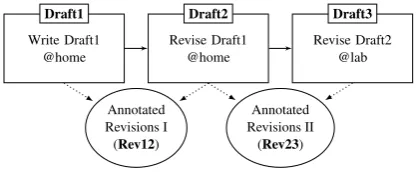
Figure 1: Our collected corpus contains five com-ponents: three drafts of an essay and two anno-tated revisions between drafts.
the raw text: argumentative essays with multiple drafts. We decided to sample from a population of predominantly college students, inclusive of both native and proficient non-native (aka L2) speakers. Comparing to high school students, college stu-dents are expected to produce essays having a bet-ter organization of the argument elements. Includ-ing native and L2 speakers allows for the explo-ration of possible rewriting differences between writers of varying backgrounds. We decided to give all subjects the same writing prompt and col-lect three drafts. The identical prompt minimizes the impact of topic difference for argumentation-related study. The collection of three drafts allows for a comparison of revision differences at differ-ent stages of rewriting.
Finally, we need a method for eliciting two re-vised drafts from each writer. Ideally, an instructor would give formative feedback after each draft for each student, but we do not have the resources to carry out such an expensive project. We simulate instructor feedback by asking students to add more examples after the first draft. To elicit a second re-vised draft, we use two different systems. First, we utilize an idealized2version of the ArgRewrite
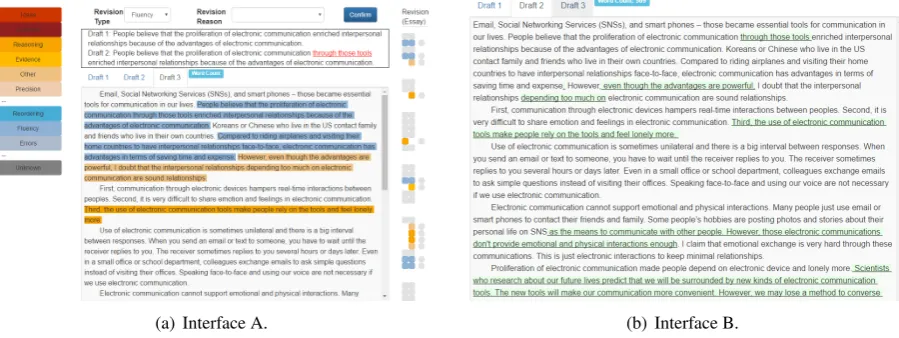
revision analysis system (Zhang et al.,2016). Ar-gRewrite highlights the locations of revisions at the sentence level and colors the revisions dif-ferently according to the revision purpose types. Our second system shows a character-based com-parison between subsequent essay drafts3. This
system is designed to have a similar look as Ar-gRewrite by highlighting the location of revisions. However, the type of revisions are not provided.
2All automatic revision feedback was manually exam-ined/corrected to guarantee correctness.
(a) Interface A. (b) Interface B.
Figure 2: Screenshot of the interfaces. (a)Interface Awith the annotated revision purposes, (b)Interface Bwith a streamlined character-based diff.
3 The ArgRewrite Corpus
Based on the above design decisions, we have developed a corpus of argumentative essays with three drafts and detailed annotations for sentence-aligned revisions between each consecutive pair of drafts. The main corpus has five elements, with the relationships between them shown in Figure1; Section3.1 describes the procedure for obtaining them. Section 3.2 briefly describes the revision schema we used and reports the inter-annotator agreement. Additionally, we have collected meta-data from the participants who contributed to the corpus (discussed in Section3.3); these data may be useful for user behavior analysis.
3.1 Corpus Development Procedure
We have recruited 60 participants aged 18 years and older, among whom 40 were English native speakers and 20 were non-native speakers with sufficient English proficiency.4 The study to
col-lect the corpus is carried out in three 40-60 minute sessions over the duration of two weeks.
Draft1 Each participant begins by completing a pre-study questionnaire (Section3.3) and writing a short essay online. Participants are instructed to keep the essay around 400 words, making a single main point with two supporting examples. They are given the following prompt:
“Suppose you’ve been asked to contribute a short op-ed piece for The New York Times. Argue whether the proliferation of electronic
4i.e., with a TOEFL score higher than 100.
communications (e.g., email, text or other so-cial media) enriches or hinders the develop-ment of interpersonal relationships.”
Draft2 A few days later, participants are asked to revise their first draft online based on the fol-lowing feedback: Strengthen the essay by adding one more example or reasoning for the claim; then add a rebuttal to an opposing idea; keep the essay at 400 words. With this feedback we try to push participants to make revisions for later processing by the two interfaces used to create Draft3.
Annotated Revisions I (Rev12) The two drafts are semi-manually aligned at the sentence level.5
Then, the purpose of each pair of sentence revision is manually coded by a trained annotator, follow-ing the annotation guideline (see Section3.2).
Draft3 Participants write their third draft in a lab environment. This time, they are not given addi-tional instrucaddi-tional feedback. Instead, participants are shown a computer interface that highlights the differences between their first and second drafts. They are asked to revise and create a third draft to improve the general quality of their essay. We experimented with two variations of revision elic-itation. Chosen at random, half of the participants (10 L2 participants and 20 Native participants) are shown Interface A, the interface based on the Ar-gRewrite system (Zhang et al.,2016), which high-lights the annotated differences between the drafts (Figure2(a)); half of the participants are shown
Draft1 Revision
Purpose Draft2 RevisionPurpose Draft3
This world has no restriction on
who one can talk to. Conventions/Grammar/ Spelling
This world has no restrictions on
whom one can talk to. This world has no restrictions onwhom one can talk to.
Rebuttal/ Reserva-tion
Unfortunately, the younger users of digital communication cannot be entirely protected from the rhetoric of any out-sider.
Warrant/ Reasoning/ Backing
Modern society is now faced with the issue of cyber bullying as a result.
The only aspects of communica-tion that this new development improves are internet navigation and faux internet relatability.
Word-Usage/ Clarity
The only aspects of digital com-munication that this new de-velopment improves are internet navigation and faux internet re-latability.
Word-Usage/ Clarity
The only aspects of digital com-munication that this new de-velopment improves are internet navigation and faux internet re-lationships.
Claims/ Ideas
Being immersed in the sphere of new technologies can allow for complete isolation from the ac-tive, non-digital world.
[image:4.595.77.520.61.292.2]Being immersed in the sphere of new technologies can allow for complete isolation from the ac-tive, non-digital world.
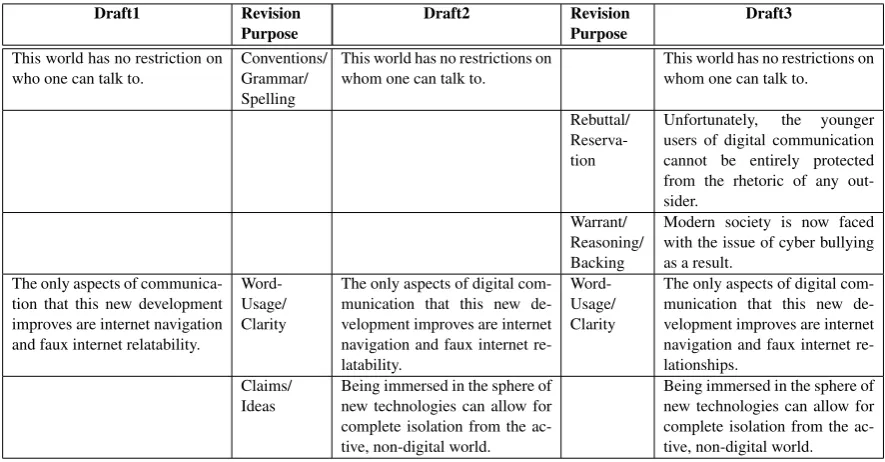
Table 1: Examples from the annotated corpus. The sentences were aligned across the drafts and the revision purposes were labeled on the aligned sentence pairs. From Draft1 to Draft2, there are two
Modifyrevisions (SpellingandClarity) and oneAddrevision. From Draft2 to Draft3, there are twoAdd
revisions (RebuttalandReasoning) and oneModifyrevision (Clarity).
terface B, a streamlined character-based diff (Fig-ure2(b)). In Interface A, some purposes were re-named from the original annotation categories to help the participants better understand the system (as detailed in Table2)6. Both interface groups are
asked to read a tutorial about their respective in-terfaces before beginning to revise. Participants in group A are also asked to verify the manually an-notated revision purposes between their first and second drafts. This information is collected to in-vestigate the impact of the difference between the system’s recognized and the participant’s intended purpose. After completing the final revision, all participants are given a post-study survey about their experiences (Section3.3). Additionally, par-ticipants in group A are asked to verify the au-tomatically predicted revision purposes between their second and third drafts (Section4.2).
Annotated Revisions II (Rev23) Regardless of which interface the participants used, the second and third draft are compared and annotated by the trained annotator in the same process as before.
6Figure2(a)has two additional categories. Precision was intended to represent revisions that make a sentence more precise. Unknown was intended to represent revisions that cannot be categorized to existing categories. These two cate-gories were not used during annotation as they were reported to be confusing in our pilot studies.
3.2 Revision Annotation Guidelines
Following our prior corpus annotations (Zhang and Litman, 2015), sentence revisions are first coarsely categorized as Surface or Con-tent changes (Faigley and Witte, 1981), de-pending on whether any informational con-tent was modified; within each coarse cate-gory, we distinguish between several finer cat-egories based on the argumentative and dis-course writing literature (Kneupper,1978;Faigley and Witte, 1981; Burstein et al., 2003). Our adapted schema has threeSurfacecategories (Or-ganization, Word Usage/Clarity, and Conven-tions/Grammar/Spelling) and five Content cate-gories (Claim/Ideas, Warrant/Reasoning/Backing, Rebuttal/Reservation, Evidence, and General Content Development). Table 1 shows example aligned sentences in three collected drafts and their annotated revision categories. The edit types of revisions (Add, Delete and Modify) are decided according to the alignment of sentences.
Name in Schema Name in System Definition
Content Content revisions that changed the information of essay Claims/Ideas Ideas revisions that aimed to change the thesis of essay Warrant/Reasoning/Backing Reasoning revisions that aimed to change the reasoning of thesis
Rebuttal/Reservation Rebuttal revisions that aimed to change the rebuttal of thesis
Evidence Evidence revisions that aimed to change the evidence support for thesis General Content Other other types of content revisions
Surface Surface revisions that did not change the information of essay Organization Reordering revisions that switched the order of sentences Word Usage/Clarity Fluency revisions that aimed to make the essay more fluent Conventions/Grammar/Spelling Errors revisions that aimed to fix the spelling/grammar mistakes
Table 2: Definition of category names in Interface A.
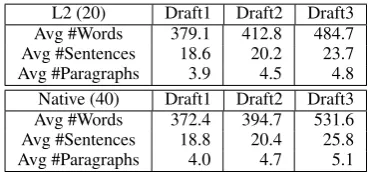
[image:5.595.78.519.60.178.2]L2 (20) Draft1 Draft2 Draft3 Avg #Words 379.1 412.8 484.7 Avg #Sentences 18.6 20.2 23.7 Avg #Paragraphs 3.9 4.5 4.8 Native (40) Draft1 Draft2 Draft3 Avg #Words 372.4 394.7 531.6 Avg #Sentences 18.8 20.4 25.8 Avg #Paragraphs 4.0 4.7 5.1 Table 3: Descriptive statistics of the ArgRewrite Corpus, including average number of words, sen-tences and paragraphs per essay draft.
on the annotation of these 10 new files. The Kappa on this held-out data is 0.84 on the two coarse cate-gories ofSurfacevs.Contentand 0.71 on the eight fine-grained categories that appear in Table2. The disagreements between annotators were removed after discussion and the final labels were used as the gold standard annotation.
3.3 Meta-Data
In addition to the raw text and annotations, the corpus release includes participant meta-data from both a pre-study and a post-study survey.
Pre-Study Survey The pre-study survey asks for participants’ demographic information as well as their self-reported writing background, such as participants’ confidence in their writing ability, the number of drafts they typically make, etc. The questions are listed in AppendixA.
Post-Study SurveyThe post-study survey con-tains questions about the participants’ in-lab revi-sion experience, such as whether they found the computer interface helpful. All questions are an-swered on a scale of 1 to 5, ranging from “strongly disagree” to “strongly agree”. Details of questions are shown in AppendixB.
3.4 Descriptive Statistics
Table 3 indicates the average number of words/sentences/paragraphs per essay draft.
The corpus includes 180 essays: 120 (Draft1 and Draft2) with an average of about 400 words and 60 (Draft3) with an average of around 500 words. Among the 40 native speakers, there were 29 (72.5%) undergraduates, 6 (15%) graduate stu-dents, and 5 (12.5%) non-students (post-docs and lecturers). Among the 20 L2 speakers, there were 4 (20%) undergraduates, and 16 (80%) gradu-ate students; there were 9 Chinese, 2 Bengali, 2 Marathi, 2 Persian, 1 Arabic, 1 Korean, 1 Por-tuguese, 1 Spanish, and 1 Tamil. In terms of disci-pline, 33 participants (55%) were from the natural sciences, 24 (40%) from the social sciences, and 2 (3.3%) from the humanities. 1 participant (1.7%) did not reveal his/her discipline.
3.5 Public Release
The corpus is freely available for research usage7.
The first release includes the raw text plus the re-vision annotations and the meta-data. The revi-sion annotations are stored as .xlsx files. There are 60 spreadsheet files for revisions from Draft1 to Draft2 and 60 more spreadsheet files for revi-sions from Draft2 to Draft3. Each spreadsheet file contains two sheets: Old Draft and New Draft. Each row in the sheet represents one sentence in the corresponding draft. The index of the aligned sentence row in the other draft and the type of the revision on the sentence are recorded. The meta-data are in .log text files. Information in the text files are stored using the JSON data format.
4 Example Uses of the Corpus
While the development of a full fledged revision analysis system is outside the scope of this work, we demonstrate potential uses of our corpus with two examples. We first perform statistical anal-yses on the collected revision data and meta-data
[image:5.595.88.273.216.302.2]Content Surface Rev12 Rev23 Rev12 Rev23
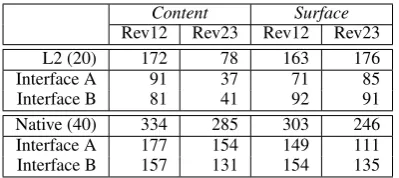
L2 (20) 172 78 163 176
Interface A 91 37 71 85
Interface B 81 41 92 91
Native (40) 334 285 303 246
Interface A 177 154 149 111
Interface B 157 131 154 135
Table 4: Number of revisions, by participant groups (language, interface), coarse-grain pur-poses, and revision drafts (Rev12 is between Draft1-Draft2; Rev23 is between Draft2-Draft3).
to understand aspects of participant behavior. We also use the corpus to train a supervised classifier to automatically predict revision purposes.
4.1 Student Revision Behavior Analysis
While it is well-established that thoughtful re-visions improve one’s writing, and while many college-level courses require students to submit multiple drafts of writing assignments (Addison and McGee,2010), instructors rarely monitor and provide feedback to students while they revise. This is partly due to instructors’ time constraints and partly due to their uncertainty about how to support students’ revisions (Cole, 2014; Melzer, 2014). There is much we do not know about how to stimulate students to self-reflect and revise.
4.1.1 Hypotheses
Using the ArgRewrite Corpus, we can begin to ask and address some questions about revision habits and behaviors. Our first question is: How do dif-ferent types of revision feedback impact student revision? And relatedly: Does student background (e.g., native vs. L2) make a difference? We thus mine the corpus to test the following hypotheses:
H1. There is a difference in participants’ re-vising behaviors depending on which interface is used to elicit the third draft.
H2. For participants who used Interface A, if the recognized revision purpose differs from the participants’ intended revision purpose, partici-pants will further modify their revision.
H3. L2 and native speakers have different be-haviors in making revisions.
H1 and H2 address the first question; H3 ad-dresses the second.
4.1.2 Methodology
To test the hypotheses, we will use both subjective and objective measures. Subjective measures are
based on participant post-study survey answers. Ideally, objective measures should be based on an assessment of improvements in the revised drafts; since we do not have evaluative data at this time, we approximate the degree of improvement using the number of revisions, since these two quanti-ties were demonstrated to be positively correlated (Zhang and Litman, 2015). The objective mea-sures are computed from Tables4and5.
To compare differences between specific sub-groups on the subjective and objective measures, we conduct ANOVA tests with two factors. There are multiple factors that can influence the users’ rewriting behaviors such as the user’s native lan-guage, education level and previous revision be-haviors, etc. In our study, we try to explore the dif-ference between interface groups considering one of the most salient confounding factors: language. We use one factor as the participant’s native lan-guage (whether the participant is native or L2) and the other factor as the interface used. To deter-mine correlation between quantitative measures, we conduct Spearman (ρ) and Pearson (r)
corre-lation tests.
4.1.3 Results and Discussion
Testing for H1 Comparing Group A and Group B participants, we observe some differences. First, we detect that Group A agrees with the statement “The system helps me to recognize the weakness of my essay” more so than Group B (Group A has a mean rating of 3.97 (“Agree”) while Group B’s is 3.17 (“Neutral”),p < .003). Second, in Group
A, there is a trending positive correlation between the number of revisions8 from Draft2 to Draft3
and the ratings for the statement “The system en-courages me to make more revisions than I usu-ally make” (ρ=.33 and p < .07); whereas there
is no such correlation for Group B. Additional information about revision purposes may elicit a stronger self-reflection response in Group A par-ticipants. In contrast, in Group B, there is a signif-icant negative correlation between the number of Rev12 and ratings for the statement “it is conve-nient to view my previous revisions with the sys-tem” (ρ=-.36 andp < .05). This suggests that the
character-based interface is ineffective when par-ticipants have to reflect on many changes.
8The results reported are the normalized numbers #revisions
#sentences, where #sentences represents the number of
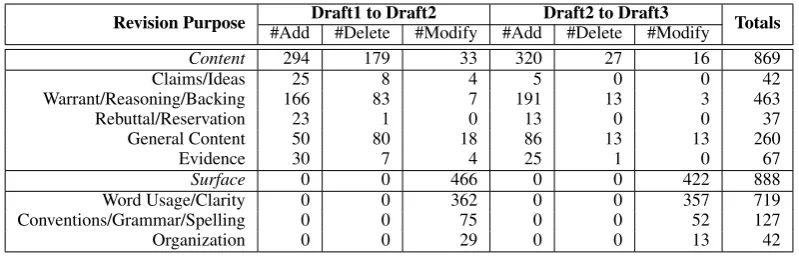
[image:6.595.82.282.61.150.2]Revision Purpose #AddDraft1 to Draft2#Delete #Modify #AddDraft2 to Draft3#Delete #Modify Totals
Content 294 179 33 320 27 16 869
Claims/Ideas 25 8 4 5 0 0 42
Warrant/Reasoning/Backing 166 83 7 191 13 3 463
Rebuttal/Reservation 23 1 0 13 0 0 37
General Content 50 80 18 86 13 13 260
Evidence 30 7 4 25 1 0 67
Surface 0 0 466 0 0 422 888
Word Usage/Clarity 0 0 362 0 0 357 719
Conventions/Grammar/Spelling 0 0 75 0 0 52 127
[image:7.595.99.499.61.189.2]Organization 0 0 29 0 0 13 42
Table 5: Number of revisions, by fine-grain revision purposes and edit types (add, delete, modify).
On the other hand, when comparing the number of revisions made by Group A and Group B on Rev23 (controlling for their Rev12 numbers), we did not find a significant difference.
As we did not observe a significant difference in the number of revisions made by the two interface groups, we cannot verify thatH1is true; possibly a larger pool of participants is needed, or possi-bly the writing assignment is not extensive enough (in length and in the number of drafts). Another possible explanation is that the system might only motivate the users to make more revisions when the feedback is different from the user’s intention. To further verify the correctness of H1, we plan to have the essays graded by experts. The graded scores could allow us to analyze whether essays improved more when Interface A was used.
Testing for H2 Focusing on the 30 participants from Group A, we check the impact of the feed-back regarding Rev12 on how they subsequently revise (Rev23). We counted the Add and Mod-ify revisions where the participant disagrees with the revision purpose assigned by the annotator in Rev12. Of those, we then count the number of times the corresponding sentences were further re-vised9. Of the 53 sentences where the participants
disagreed with the annotator, 45 were further re-vised in the third draft. The ratio is 0.849, much higher than the overall ratio of general Rev12 re-visions being further revised in Rev23 (161/394 = 0.409) and the ratio of the agreed Rev12 revi-sions being revised in Rev23 (67/341 = 0.196). In further analysis, a Pearson correlation test is con-ducted to check the correlation between the num-ber of Rev23 and the numnum-ber of disagreements for different types of agreement/disagreements, con-trolling for the number of Rev12. We find a nega-9Deleterevisions were ignored as the deleted sentences are not traceable in Draft3
tive correlation between Rev23 and the number of cases (r=-0.41,p < .03) in which the revisions
an-notated asContentare verified by the participants; we also find a positive correlation between Rev23 and the number of cases (r=0.36, p <= .05) in
which the revisions annotated as Surface are in-tended to beContentrevisions by the participants. Both findings are consistent withH2, suggesting that participants will revise further if they perceive that their intended revisions were not recognized.
Testing for H3 We observe that native and L2 speakers exhibit different behaviors. First, we tested the difference in Content23 and Surface2310
between these speaker groups with ANOVA. We observe significant difference in the number of content (p < .02) and surface (p < .03)
re-visions made by L2 and native speakers. More specifically, our native speakers make more Con-tent changes while the L2 speakers make more
Surfacechanges. Second, with ANOVA we found
a significant interaction effect of the two factors (Group and users’ L2 or native status) (p < .021)
on their ratings for the statement “the system helps me to recognize the weakness of my essay” with L2 speakers having a stronger Interface A pref-erence. Third, we observe a significant positive correlation in the native group between the num-ber of content revisions in Rev23 and the ratings of the statement “the system encourages me to make more revisions than I usually make” (ρ=.4
andp < .009). This suggests that giving feedback
(from either interface) encourages native speakers to make more content revisions. Finally, in the L2 group, there is a significant negative correla-tion between the number of surface revisions in Rev12 and the ratings for the statement “the sys-tem helps me to recognize the weakness of my
say” (ρ=-.57 andp < .008). This shows that giv-ing feedback to L2 speakers is less helpful when they make more surface revisions. These results are consistent withH3.
Summary Our findings suggest that feedback on revisions do impact how students review and rewrite their drafts. However, there are many fac-tors at play, including the interface design and the students’ linguistic backgrounds.
4.2 Automatic Revision Identification
Another use of the corpus is to serve as a gold standard for training and testing a revision purpose prediction component for use in an automatic revi-sion analysis system. In the verrevi-sion of ArgRewrite evaluated earlier (Interface A), the manual anno-tation of revision purposes enabled the system to provide revision feedback to users, which moti-vated them to improve their writing (H2). Auto-matic argumentative revision purpose prediction has been previously investigated by Zhang and Litman(2015). They developed and reported the performance of a binary classifier for each individ-ual revision category (1 for revisions of the cate-gory and 0 for the rest of all revisions) using fea-tures from prior research. The availability of our corpus makes it possible for researchers to repli-cate such methods and conduct further studies.
4.2.1 Hypotheses
In this paper, we repeat the experiment of Zhang and Litman (2015) under different settings to in-vestigate three new hypotheses that can now be investigated given the features of our corpus:
H4. The method used in Zhang and Litman (2015) for high school writings is also useful for the writings of college students.
H5. The same revision classification method works differently for first revision attempts and second revision attempts.
H6. The revision classification model trained on L2 essays has a different preference from the model trained on native essays.
4.2.2 Methodology
We followed the work of (Zhang and Litman, 2015), where unigram features (words) were used as the baseline and the SVM classifier was used. Besides unigrams, three groups of features used in revision analysis, argument mining and discourse analysis research were extracted (Location, Tex-tual and Language) as in Table 6 (Bronner and
Monz, 2012; Daxenberger and Gurevych, 2013; Burstein et al.,2001;Falakmasir et al.,2014).
ForH4, 10-fold (participant) cross-validation is conducted on all the essays in the corpus. Un-weighted average F-score for each revision cat-egory is reported, using unigram features versus using all features. Zhang and Litman(2015) ob-served a significant improvement over the unigram baseline using all the features. If H4is true, we should expect a similar improvement over the un-igram baseline using our corpus.
ForH5, 10-fold cross-validation was conducted for the revisions from Draft1 to Draft2 and revi-sions from Draft2 to Draft3 separately. We com-pared the improvement ratio brought by the ad-vanced features over the unigram baseline.
For H6, we trained two classifiers separately with L2 and native essays with all the features. 20 native participants were first randomly selected as the test data. Afterwards classifiers were trained separately using the 20 L2 participants’ essays and the remaining 20 native participants’ essays. We would expect that the performance of the two trained classifiers is different on the same test data.
4.2.3 Results and Discussion
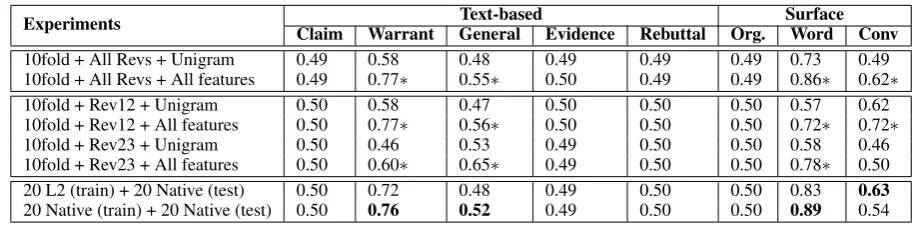
The first two rows of Table7supportH4. We ob-serve that the method (SVM + all features) used in Zhang and Litman(2015) significantly improves performance (compared to a unigram baseline) for half of the classification tasks, which is similar to Zhang and Litman’s results on high school (pri-marily L1) writing. In our corpus, performance on
Claim, Evidence, Rebuttal andOrganizationwas not significantly better than the baseline, possibly due to the limited number of positive training sam-ples for these categories (Table5). For example, one reason that the performance in Table7for Ev-idencemight be low is that there are less than 100 Evidence instances in Table5.
ob-Group Illustration
Location The location of revised sentences in the paragraph/essay (e.g., whether the sentence is the first or last sen-tence of the paragraph/essay, the index of the sensen-tence in the paragraph)
Textual The textual features of revised sentences (e.g., whether the sentence contains a named entity, certain dis-course markers (“because”, “due to”, etc), sentence difference (edit distance, difference in punctuations, etc.) and edit types (Add, Delete or Modify))
[image:9.595.68.527.164.277.2]Language The language features of revised sentences (e.g., difference in POS tags, spelling/grammar mistakes) Table 6: Illustration of features used in the revision classification study.
Experiments Claim Warrant Text-basedGeneral Evidence Rebuttal Org. SurfaceWord Conv 10fold + All Revs + Unigram 0.49 0.58 0.48 0.49 0.49 0.49 0.73 0.49 10fold + All Revs + All features 0.49 0.77∗ 0.55∗ 0.50 0.49 0.49 0.86∗ 0.62∗
10fold + Rev12 + Unigram 0.50 0.58 0.47 0.50 0.50 0.50 0.57 0.62
10fold + Rev12 + All features 0.50 0.77∗ 0.56∗ 0.50 0.50 0.50 0.72∗ 0.72∗
10fold + Rev23 + Unigram 0.50 0.46 0.53 0.49 0.50 0.50 0.58 0.46
10fold + Rev23 + All features 0.50 0.60∗ 0.65∗ 0.49 0.50 0.50 0.78∗ 0.50 20 L2 (train) + 20 Native (test) 0.50 0.72 0.48 0.49 0.50 0.50 0.83 0.63 20 Native (train) + 20 Native (test) 0.50 0.76 0.52 0.49 0.50 0.50 0.89 0.54 Table 7: Average unweighted F-score for each binary classification task. The first 6 rows show the average value of 10-fold cross-validation. ∗ indicates significantly better than unigram baseline (p < .05). The last 2 rows show the F-value for training on L2/Native data and testing on Native data. Bold
indicates larger than the number in the other row.
serve a significant improvement for revisions from Draft2 and Draft3. A possible explanation is that there is a bigger difference in the writers’ rewriting behavior from Draft2 to Draft3, which increases the difficulty of prediction.
The last two rows of Table7supportH6. Inter-estingly, we observe a better performance on War-rant,GeneralandWord Usage/Claritywith a clas-sifier trained and tested using native essays. Per-haps essays of native speakers are more similar to each other when revised along these dimensions. For Conventions/Grammar/Spelling, in contrast, the classifier trained on L2 data yields a better per-formance on the same native test set. This may be because the L2 revisions usually include more spelling/grammar corrections.
5 Conclusion and Future Work
We have presented a new corpus for writing com-parison research. Currently the corpus focuses on essay revisions made by both native and L2 col-lege students. In addition to three drafts of essays, we have analyzed the drafts to align semantically similar sentences and to assign revision purposes for each revised aligned sentence pair. We have also conducted two studies to demonstrate the use of the corpus for revision behavior analysis and for automatic revision purpose classification.
While in this paper we explored language as
one factor influencing rewriting behavior, our cor-pus also contains information about other potential factors such as gender and education level which we plan to investigate in the future. We also plan to augment the corpus to support additional types of research on revision analysis. Some potential augmentations include more fine-grained revision categories, revision properties such as statement strength (Tan and Lee,2014) and quality evalua-tions, and sub-sentential revision scopes.
Acknowledgments
References
Joanne Addison and Sharon James McGee. 2010. Writing in high school/writing in college: Research trends and future directions. College Composition and Communicationpages 147–179.
Yigal Attali and Jill Burstein. 2006. Automated essay scoring with e-raterR v. 2. The Journal of
Technol-ogy, Learning and Assessment4(3).
Amit Bronner and Christof Monz. 2012. User edits classification using document revision histories. In
Proceedings of the 13th Conference of the European Chapter of the Association for Computational Lin-guistics. pages 356–366.
Jill Burstein and Martin Chodorow. 1999. Automated essay scoring for nonnative English speakers. In
Proceedings of a Symposium on Computer Medi-ated Language Assessment and Evaluation in Nat-ural Language Processing. pages 68–75.
Jill Burstein, Daniel Marcu, Slava Andreyev, and Mar-tin Chodorow. 2001. Towards automatic classifica-tion of discourse elements in essays. InProceedings of the 39th annual Meeting on Association for Com-putational Linguistics. pages 98–105.
Jill Burstein, Daniel Marcu, and Kevin Knight. 2003. Finding the WRITE stuff: Automatic identification of discourse structure in student essays. IEEE Intel-ligent Systems18(1):32–39.
Daniel Cole. 2014. What if the earth is flat? working with, not against, faculty concerns about grammar in student writing. The WAC Journal25:7–35.
Daniel Dahlmeier, Hwee Tou Ng, and Siew Mei Wu. 2013. Building a large annotated corpus of learner English: The NUS corpus of learner English. In
Proceedings of the Eighth Workshop on Innovative Use of NLP for Building Educational Applications. pages 22–31.
Johannes Daxenberger and Iryna Gurevych. 2012. A corpus-based study of edit categories in featured and non-featured Wikipedia articles. InCOLING. pages 711–726.
Johannes Daxenberger and Iryna Gurevych. 2013. Au-tomatically classifying edit categories in Wikipedia revisions. InProceedings of the 2013 Conference on Empirical Methods in Natural Language Process-ing. pages 578–589.
William B Dolan and Chris Brockett. 2005. Automati-cally constructing a corpus of sentential paraphrases. InProc. of IWP.
Lester Faigley and Stephen Witte. 1981. Analyzing revision. College composition and communication
pages 400–414.
Mohammad Hassan Falakmasir, Kevin D Ashley, Christian D Schunn, and Diane J Litman. 2014. Identifying thesis and conclusion statements in stu-dent essays to scaffold peer review. InInternational Conference on Intelligent Tutoring Systems. pages 254–259.
Lucie Flekova, Daniel Preot¸iuc-Pietro, and Lyle Ungar. 2016. Exploring stylistic variation with age and in-come on Twitter. InProceedings of the 54th Annual Meeting of the Association for Computational Lin-guistics (Short Papers). pages 313–319.
Grammarly. 2016. Grammarly. http://www.grammarly.com. [Online; accessed 04-10-2017].
John Jones. 2008. Patterns of revision in online writ-ing a study of Wikipedia’s featured articles.Written Communication25(2):262–289.
Charles W Kneupper. 1978. Teaching argument: An introduction to the Toulmin model. College Compo-sition and Communication29(3):237–241.
Claudia Leacock, Martin Chodorow, Michael Gamon, and Joel Tetreault. 2010. Automated grammatical error detection for language learners. Synthesis lec-tures on human language technologies3(1):1–134. Jun Liu and Sudha Ram. 2009. Who does what:
Col-laboration patterns in the Wikipedia and their impact on data quality. In19th Workshop on Information Technologies and Systems. pages 175–180.
Prodromos Malakasiotis and Ion Androutsopoulos. 2011. A generate and rank approach to sentence paraphrasing. InProceedings of the Conference on Empirical Methods in Natural Language Process-ing. pages 96–106.
Dan Melzer. 2014. The connected curriculum: Design-ing a vertical transfer writDesign-ing curriculum. The WAC Journal25:78–91.
Eugene W Myers. 1986. An O(ND) difference algo-rithm and its variations. Algorithmica1(1-4):251– 266.
Isaac Persing and Vincent Ng. 2016. End-to-end argu-mentation mining in student essays. InProceedings of NAACL-HLT. pages 1384–1394.
Ulrike Pfeil, Panayiotis Zaphiris, and Chee Siang Ang. 2006. Cultural differences in collaborative author-ing of Wikipedia. Journal of Computer-Mediated Communication12(1):88–113.
Marius Popescu and Liviu P. Dinu. 2008. Rank dis-tance as a stylistic similarity. InColing 2008. pages 91–94.
Chenhao Tan and Lillian Lee. 2014. A corpus of sentence-level revisions in academic writing: A step towards understanding statement strength in com-munication. InProceedings of ACL (short paper).
Huichao Xue and Rebecca Hwa. 2014. Improved cor-rection detection in revised ESL sentences. InACL (2). pages 599–604.
Helen Yannakoudakis, Ted Briscoe, and Ben Medlock. 2011. A new dataset and method for automatically grading ESOL texts. InProceedings of the 49th An-nual Meeting of the Association for Computational Linguistics: Human Language Technologies-Volume 1. pages 180–189.
Fan Zhang, Rebecca Hwa, Diane Litman, and Homa B Hashemi. 2016. Argrewrite: A web-based revision assistant for argumentative writings. NAACL HLT 2016page 37.
Fan Zhang and Diane Litman. 2014. Sentence-level rewriting detection. In Proceedings of the Ninth Workshop on Innovative Use of NLP for Building Educational Applications. pages 149–154.
Fan Zhang and Diane Litman. 2015. Annotation and classification of argumentative writing revisions. In
Proceedings of the Tenth Workshop on Innovative Use of NLP for Building Educational Applications. pages 133–143.
A Questions of the pre-study survey
1. Is English your native language?
2. (only L2 participants) What is your native language?
3. What is your major? Please select the closest discipline to your major.
• Natural sciences
• Social sciences
• Humanities
4. Are you an undergraduate or graduate stu-dent?
5. What is your current year of study?
6. When writing a paper for a class, how many drafts of major revisions do you typically make?
7. Overall, how confident are you with your writings? (Not at all confident, Not very con-fident, Somewhat concon-fident, concon-fident, Ex-tremely confident)
8. (only L2 participants) Please tell us how comfortable you feel about writing in the En-glish language versus writing in your primary language. (Not at all comfortable, Not very
comfortable, Somewhat comfortable, com-fortable, Extremely comfortable)
9. What are some of your recent classes that have an intensive writing component to them? How did you do in these classes? 10. What aspects of writing do you think you are
good at? e.g. vocabulary choice, clear sen-tences, writing organization.
11. What aspects of writing do you think you can improve?
B Questions of the post-study survey
1. The system allows me to have a better under-standing of my previous revision efforts. 2. It is convenient to view my previous revisions
with the system.
3. The system helps me to recognize the weak-ness of my essay.
4. The system encourages me to make more re-visions than I usually make.