Proceedings of the 55th Annual Meeting of the Association for Computational Linguistics (Short Papers), pages 256–262 Vancouver, Canada, July 30 - August 4, 2017. c2017 Association for Computational Linguistics
Proceedings of the 55th Annual Meeting of the Association for Computational Linguistics (Short Papers), pages 256–262 Vancouver, Canada, July 30 - August 4, 2017. c2017 Association for Computational Linguistics
A Recurrent Neural Model with Attention for
the Recognition of Chinese Implicit Discourse Relations
Samuel R¨onnqvist1,2,∗,Niko Schenk2,∗ andChristian Chiarcos2
1Turku Centre for Computer Science – TUCS, ˚Abo Akademi University, Turku, Finland
2Applied Computational Linguistics Lab, Goethe University, Frankfurt am Main, Germany
{schenk,chiarcos}@informatik.uni-frankfurt.de
Abstract
We introduce an attention-based Bi-LSTM for Chinese implicit discourse relations and demonstrate that modeling argument pairs as a joint sequence can outperform word order-agnostic approaches. Our model benefits from a partial sampling scheme and is conceptually simple, yet achieves state-of-the-art performance on the Chinese Discourse Treebank. We also visualize its attention activity to illustrate the model’s ability to selectively focus on the relevant parts of an input sequence.
1 Introduction
True text understanding is one of the key goals in Natural Language Processing and requires capa-bilities beyond the lexical semantics of individual words or phrases. Natural language descriptions are typically driven by an inter-sentential coher-ent structure, exhibiting specificdiscourse proper-ties, which in turn contribute significantly to the global meaning of a text. Automatically detecting how meaning units are organized benefits practi-cal downstream applications, such as question an-swering (Sun and Chai, 2007), recognizing tex-tual entailment (Hickl, 2008), sentiment analysis (Trivedi and Eisenstein,2013), or text summariza-tion (Hirao et al.,2013).
Various formalisms in terms of semantic co-herence frameworks have been proposed to ac-count for these contextual assumptions (Mann and Thompson, 1988; Lascarides and Asher, 1993; Webber, 2004). The annotation schemata of the Penn Discourse Treebank (Prasad et al., 2008, PDTB) and the Chinese Discourse Treebank (Zhou and Xue,2012, CDTB), for instance, define
∗Both first authors contributed equally to this work.
discourse units as syntactically motivated charac-ter spans in the text, augmented with relations pointing from the second argument (Arg2, proto-typically, a discourse unit associated with an ex-plicit discourse marker) to its antecedent, i.e., the discourse unit Arg1. Relations are labeled with a relation type (its sense) and the associated dis-course marker. Both, PDTB and CDTB, distin-guishexplicitfromimplicitrelations depending on the presence of such a marker (e.g.,because/因).1
Sense classification for implicit relations is by far more challenging because the argument pairs lack the marker as an important feature. Consider, for instance, the following example from the CDTB as implicit CONJUNCTION:
Arg1: 会谈就一些原则和具体问题进行了
深入讨论,达成了一些谅解 In the talks, they
discussed some principles and specific questions in depth, and reached some understandings
Arg2: 双方一致认为会谈具有积极成果
Both sides agree that the talks have positive re-sults
Motivation: Previous work on implicit sense la-beling is heavily feature-rich and requires domain-specific, semantic lexicons (Pitler et al., 2009; Feng and Hirst, 2012; Huang and Chen, 2011). Only recently, resource-lean architectures have been proposed. These promising neural meth-ods attempt to infer latent representations appro-priate for implicit relation classification (Zhang et al.,2015;Ji et al.,2016;Chen et al.,2016). So far, unfortunately, these models have been eval-uated only on four top-level senses—sometimes even with inconsistent evaluation setups.2
Further-more, most systems have initially been designed for the English PDTB and involve complex,
task-1The set of relation types and senses is completed by
alter-native lexicalizations (ALTLEX/discourse marker rephrased), and entity relations (ENTREL/anaphoric coherence).
2E.g., four binary classifiers vs. four-way classification.
specific architectures (Liu and Li, 2016), while discourse modeling techniques for Chinese have received very little attention in the literature and are still seriously underrepresented in terms of publicly available systems. What is more, over 80% of all words in Chinese discourse relations are implicit—compared to only 52% in English (Zhou and Xue,2012).
Recently, in the context of the CoNLL 2016 shared task (Xue et al.,2016), a first independent evaluation platform beyond class level has been established. Surprisingly, the best performing neu-ral architectures to date are standardfeedforward
networks, cf. Wang and Lan(2016);Schenk et al. (2016);Qin et al.(2016). Even though these spe-cific models completely ignore word order within arguments, such feedforward architectures have been claimed byRutherford et al. (2016) to gen-erally outperform any thoroughly-tuned recurrent architecture.
Our Contribution: In this work, we release the first attention-based recurrent neural sense clas-sifier, specifically developed for Chinese implicit discourse relations. Inspired byZhou et al.(2016), our system is a practical adaptation of the recent advances in relation modeling extended by a novel sampling scheme.
Contrary to previous assertions by Rutherford et al. (2016), our model demonstrates superior performance over traditional bag-of-words ap-proaches with feedfoward networks by treating discourse arguments as a joint sequence. We eval-uate our method within an independent frame-work and show that it performs very well beyond standard class-level predictions, achieving state-of-the-art accuracy on the CDTB test set.
We illustrate how our model’s attention mech-anism provides means to highlight those parts of an input sequence that are relevant for the classi-fication decision, and thus, it may enable a bet-ter understanding of the implicit discourse pars-ing problem. Our proposed network architecture is flexible and largely language-independent as it operates only on word embeddings. It stands out due to its structural simplicity and builds a solid ground for further development towards other tex-tual domains.
2 Approach
We propose the use of an attention-based bidi-rectional Long Short-Term Memory (Hochreiter
. . . . . .
A'1 A'2 . . . A''1 A''2
h2
e2
A'k A''k
hk
ek
h1
e1
hk r
. . .
t2 tk
t1
Input layer
y Sense labels
(<ARG1>, 会 谈, ..., </ARG1>, <ARG2>, 双 方, ..., </ARG2>) Token input sequence
Embeddinglayer Recurrentlayers Attentionlayer Output layer
[image:2.595.312.521.66.310.2]h'1 ⊕h''1 h'2 ⊕h''2h''2 h'k ⊕h''k · α
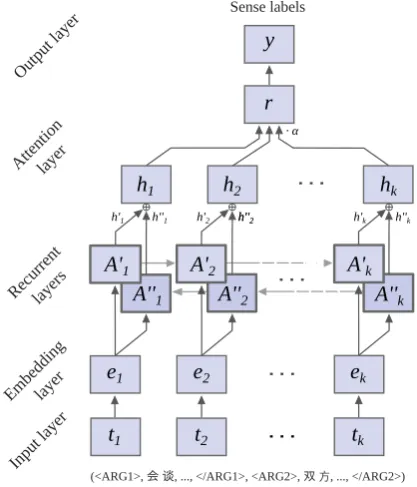
Figure 1: The attention-based bidirectional LSTM network for the task of modeling argument pairs for Chinese implicit discourse relations.
and Schmidhuber, 1997, LSTM) network to pre-dict senses of discourse relations. The model draws upon previous work on LSTM, in particu-lar its bidirectional mode of operation (Graves and Schmidhuber,2005), attention mechanisms for re-current models (Bahdanau et al., 2014;Hermann et al.,2015), and the combined use of these tech-niques for entity relation recognition in annotated sequences (Zhou et al., 2016). More specifically, our model is a flexible recurrent neural network with capabilities tosequentiallyinspect tokens and to highlight which parts of the input sequence are most informative for the discourse relation recog-nition task, using the weighting provided by the at-tention mechanism. Furthermore, the model bene-fits from a novel sampling scheme for arguments, as elaborated below. The system is learned in an end-to-end manner and consists of multiple layers, which are illustrated in Figure1.
only the tokens in the respective spans are con-sidered. Note that, unlike previous works, our ap-proach modelsArg1-Arg2pairs as ajointsequence and does not first compute intermediate represen-tations of arguments separately.
Second, an input layer encodes tokens using one-hot vector representations (tifor tokens at
po-sitions i ∈ [1, k]), and a subsequent embedding layer provides a dense representation (ei) to serve
as input for the recurrent layers. The embedding layer is initialized using pre-trained word vectors, in our case 300-dimensional Chinese Gigaword vectors (Graff and Chen, 2005).3 These
embed-dings are further tuned as the network is trained towards the prediction task. Embeddings for un-known tokens, e.g., markers, are trained by back-propagation only. Note that, tokens, markers and the pre-trained vectors represent the only source of information for the prediction task.
For the recurrent setup, we use a layer of LSTM networks in a bidirectional manner, in order to bet-ter capture dependencies between parts of the in-put sequence by inspection of both left and right-hand-side contexts at each time step. The LSTM holds a state representation as a continuous vector passed to the subsequent time step, and it is capa-ble of modeling long-range dependencies due to its gated memory. The forward (A0) and backward (A00) LSTMs traverse the sequence ei, producing
sequences of vectorsh0iandh00i respectively, which are then summed together (indicated by⊕in Fig-ure1).
The resulting sequence of vectorshiis reduced
into a single vector and fed to the final softmax output layer in order to classify the sense labely of the discourse relation. This vector may be ob-tained either as the final vectorh produced by an LSTM, or through pooling of all hi, or by using
attention, i.e., as a weighted sum overhi. While
the model may be somewhat more difficult to opti-mize using attention, it provides the added benefit of interpretability, as the weights highlight to what extent the classifier considers the LSTM state vec-tors at each token during modeling. This is par-ticularly interesting for discourse parsing, as most previous approaches have provided little support for pinpointing the driving features in each argu-ment span.
Finally, the attention layer contains the trainable
3http://www.cs.brandeis.edu/˜clp/
conll16st/dataset.html
vector w (of the same dimensionality as vectors hi) which is used to dynamically produce a weight
vectorαover time stepsiby:
α =sof tmax(wTtanh(H))
whereH is a matrix consisting of vectorshi. The
output layerris the weighted sum of vectors inH:
r=HαT
Partial Argument Sampling: For the purpose of enlarging the instance space of training items in the CDTB, and thus, in order to improve the predictive performance of the model, we propose a novel partial sampling scheme of arguments, whereby the model is trained and validated on se-quences containing both arguments, as well as sin-glearguments. A data point(a1, a2, y), withai
be-ing the token sequence of argumenti, is expanded into {(a1, a2, y),(a1, a2, y),(a1, y),(a2, y)}. We
duplicate bi-argument samples (a1, a2, y) (in
training and development data only) to balance their frequencies against single-argument samples. Two lines of motivation support the inclusion of single argument training examples, grounded in linguistics and machine learning, respectively. First, it has been shown that single arguments in isolation can evoke a strong expectation towards a certain implicit discourse relation, cf. Asr and Demberg (2015) and, in particular, Rohde and Horton (2010) in their psycholinguistic study on
implicit causality verbs. Second, the procedure may encourage the model to learn better represen-tations of individual argument spans in support of modeling of arguments in composition, cf.LeCun et al.(2015). Due to these aspects, we believe this data augmentation technique to be effective in re-inforcing the overall robustness of our model. Implementational Details: We train the model using fixed-length sequences of 256 tokens with zero padding at the beginning of shorter sequences and truncate longer ones. Each LSTM has a vector dimensionality of 300, matching the embedding size. The model is regularized by0.5dropout rate
between the layers and weight decay (2.5e−6) on the LSTM inputs. We employ Adam optimization (Kingma and Ba, 2014) using the cross-entropy loss function with mini batch size of 80.4
4The model is implemented in Keras https://
CDTB Development Set CDTB Test Set
Rank System % accuracy Rank System % accuracy
1 Wang and Lan(2016) 73.53 1 Wang and Lan(2016) 72.42
2 Qin et al.(2016) 71.57 2 Schenk et al.(2016) 71.87
3 Schenk et al.(2016) 70.59 3 Rutherford and Xue(2016) 70.47 4 Rutherford and Xue(2016) 68.30 4 Qin et al.(2016) 67.41
5 Weiss and Bajec(2016) 66.67 5 Weiss and Bajec(2016) 64.07
[image:4.595.85.513.68.201.2]6 Weiss and Bajec(2016) 61.44 6 Weiss and Bajec(2016) 63.51 7 Jian et al.(2016) 21.90 7 Jian et al.(2016) 21.73 This Paper: 93.52∗ This Paper: 73.01
Table 1: Non-explicit parser scores on the official CoNLL 2016 CDTB development and test sets. (∗Scores on development set are obtained through partial sampling and are not directly comparable.)
Sense Label Training Dev’t Test
CONJUNCTION 5,174 189 228
majority class (66.3%) (62.8%) (64.8%)
EXPANSION 1,188 48 40
ENTREL 1,099 50 71
CAUSATION 187 10 8
CONTRAST 66 3 1
PURPOSE 56 1 3
CONDITIONAL 26 0 1
TEMPORAL 26 0 0
PROGRESSION 7 0 0
# impl. rels 7,804 301 352
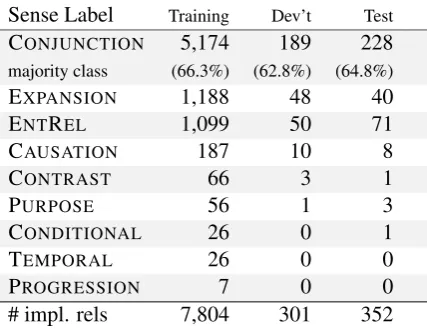
Table 2: Implicit sense labels in the CDTB.
3 Evaluation
We evaluate our recurrent model on the CoNLL 2016 shared task data5 which include the official
training, development and test sets of the CDTB; cf. Table2 for an overview of the implicit sense distribution.6
In accordance with previous setups (Rutherford et al., 2016), we treat entity relations (ENTREL)
as implicit and exclude ALTLEX relations. In the
evaluation, we focus on thesense-only track, the subtask for which gold arguments are provided and a system is supposed to label a given argu-ment pair with the correct sense. The results are shown in Table1.
With our proposed architecture it is possible to correctly label 257/352 (73.01%) of implicit
rela-5http://www.cs.brandeis.edu/˜clp/
conll16st/
6Note that, in the CDTB, implicit relations appear almost
three times more oftenthan explicit relations. Out of these, 65% appear within the same sentence. Finally, 25 relations in the training set have two labels.
tions on the test set, outperforming the best feed-forward system of Wang and Lan (2016) and all other word order-agnostic approaches. Develop-ment and test set performances suggest the robust-ness of our approach and its ability to generalize to unseen data.
Ablation Study:We perform an ablation study to quantitatively assess the contribution of two of the characteristic aspects of our model. First, we com-pare the use of the attention mechanism against the simpler alternative of feeding the final LSTM hidden vectors (h0k andh001) directly to the output layer. When attention is turned off, this yields an absolute decrease in performance of 2.70% on the test set, which is substantial and significant ac-cording to a Welch two-sample t-test (p <.001). Second, we independently compare the use of the partial sampling scheme against training on the standard argument pairs in the CDTB. Here, the absence of the partial sampling scheme yields an absolute decrease in accuracy of 5.74% (p <.001), which demonstrates its importance for achieving competitive performance on the task.
[image:4.595.74.288.260.425.2]CONJUNCTION:
<Arg1> 会会会谈谈谈 就就就 ⼀⼀⼀些些些 原原原则则则 和和和 具具具体体体 问问问题题题 进进进⾏⾏⾏ 了了了 深深深⼊⼊⼊ 讨讨讨论论论 ,,, 达达达成成成 了了了 ⼀⼀⼀些些些 谅谅谅解解解 </Arg1>
<Arg2> 双双双⽅⽅⽅ ⼀⼀⼀致致致 认认认为为为 会会会谈谈谈 具具具有有有 积积积极极极 成成成果果果 </Arg2>
ENTREL:
<Arg1> 他他他 说说说 ::: 我我我们们们 希希望希望望 澳澳澳门门门 政政政府府府 对对对于于于 这这这 三三三 个个个 问问问题题题 继继续继续续 给给给予予予 关关关注注注 ,,,
以 以
以 求求求得得得 最最最后后后 的的的 妥妥妥善善善 解解解决决决 </Arg1>
<Arg2> 李李李鹏鹏鹏 说说说 ,,, ⻙⻙⻙奇奇奇⽴⽴ 总⽴ 总总督督督 为为为 澳澳澳门门门 问问问题题题 的的的 顺顺顺利利利 解解解决决决 做做做 了了了 许许多许多多 有有有益益益 的的的 ⼯⼯⼯作作作 ,,,
对对对 此此此 我我我们们们 表表⽰表⽰⽰ 赞赞赞赏赏赏 </Arg2>
In the talks, they discussed some principles and specific questions in depth, and reached some understandings
Both sides agree that the talks have positive results
He said: We hope that the Macao government will continue to pay attention to these three issues,
in order to find a final proper solution
Peng Li said, Governor Liqi Wei has done a lot of useful work for the smooth settlement of the Macao question,
[image:5.595.68.495.64.330.2]we appreciate that
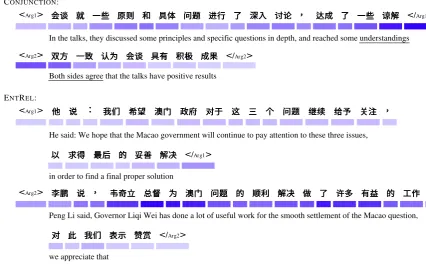
Figure 2: Visualization of attention weights for Chinese characters with high (dark blue) and low (light blue) intensities. The underlined English phrases are semantically structure-shared by the two arguments.
Visualizing Attention Weights: Finally, in Fig-ure 2, we illustrate the learned attention weights which pinpoint important subcomponents within a given implicit discourse relation. For the im-plicit CONJUNCTIONrelation the weights indicate
a peak on the transition between the argument boundary, establishing a connection between the semantically related termsunderstandings–agree. Most ENTRELs show an opposite trend: here
sec-ond arguments exhibit larger intensities thanArg1, as most entity relations follow the characteristic writing style of newspapers by adding additional information by reference to the same entity.
4 Summary & Outlook
In this work, we have presented the first attention-based recurrent neural sense labeler specifically developed for Chinese implicit discourse relations. Its ability to model discourse units sequentially and jointly has been shown to be highly benefi-cial, both in terms of state-of-the-art performance on the CDTB (outperforming word order-agnostic feedforward approaches), and also in terms of insightful observations into the inner workings of the model through its attention mechanism. The architecture is structurally simple, benefits from partial argument sampling, and can be
eas-ily adapted to similar relation recognition tasks. In future work, we intend to extend our approach to different languages and domains, e.g., to the recent data sets on narrative story understanding or ques-tion answering (Mostafazadeh et al., 2016; Feng et al.,2015). We believe that recurrent modeling of implicit discourse information can be a driving force in successfully handling such complex se-mantic processing tasks.7
Acknowledgments
The authors would like to thank Ayah Zirikly, Philip Schulz and Wei Ding for their very help-ful suggestions on an early draft version of the pa-per, and also thank the anonymous reviewers for their valuable feedback and insightful comments. We are grateful to Farrokh Mehryary for techni-cal support with the attention layer implementa-tion. Computational resources were provided by CSC – IT Centre for Science, Finland, and Arcada University of Applied Sciences, Helsinki, Finland. Our research at Goethe University Frankfurt was supported by the project ‘Linked Open Dictionar-ies (LiODi, 2015-2020)’, funded by the German Ministry for Education and Research (BMBF).
7The code involved in this study is publicly
References
Fatemeh Torabi Asr and Vera Demberg. 2015. Uni-form InUni-formation Density at the Level of Dis-course Relations: Negation Markers and Dis-course Connective Omission. In11th International Conference on Computational Semantics (IWCS). page 118. http://www.coli.uni-saarland.de/ fate-meh/iwcs2015.pdf.
Dzmitry Bahdanau, Kyunghyun Cho, and Yoshua Bengio. 2014. Neural Machine Translation by Jointly Learning to Align and Translate. CoRR
abs/1409.0473. http://arxiv.org/abs/1409.0473.
Jifan Chen, Qi Zhang, Pengfei Liu, Xipeng Qiu, and Xuanjing Huang. 2016. Implicit Discourse Relation Detection via a Deep Architecture with Gated Relevance Network. In Proceedings of the 54th Annual Meeting of the Association for Com-putational Linguistics, ACL 2016, August 7-12, 2016, Berlin, Germany, Volume 1: Long Papers. http://aclweb.org/anthology/P/P16/P16-1163.pdf.
Minwei Feng, Bing Xiang, Michael R. Glass, Lidan Wang, and Bowen Zhou. 2015. Ap-plying deep learning to answer selection: A study and an open task. In 2015 IEEE Work-shop on Automatic Speech Recognition and Understanding, ASRU 2015, Scottsdale, AZ, USA, December 13-17, 2015. pages 813–820. https://doi.org/10.1109/ASRU.2015.7404872.
Vanessa Wei Feng and Graeme Hirst. 2012. Text-level Discourse Parsing with Rich Linguistic Features. In
Proceedings of the 50th Annual Meeting of the Asso-ciation for Computational Linguistics: Long Papers - Volume 1. Association for Computational Linguis-tics, Stroudsburg, PA, USA, ACL ’12, pages 60–68. http://www.aclweb.org/anthology/P12-1007.
David Graff and Ke Chen. 2005. Chinese Gigaword. LDC Catalog No.: LDC2003T09, ISBN, 1:58563– 58230.
Alex Graves and J¨urgen Schmidhuber. 2005. Framewise phoneme classification with bidi-rectional LSTM and other neural network ar-chitectures. Neural Networks 18(5-6):602–610. https://doi.org/10.1016/j.neunet.2005.06.042.
Karl Moritz Hermann, Tomas Kocisky, Edward Grefenstette, Lasse Espeholt, Will Kay, Mustafa Su-leyman, and Phil Blunsom. 2015. Teaching ma-chines to read and comprehend. InAdvances in Neu-ral Information Processing Systems. pages 1693– 1701.
Andrew Hickl. 2008. Using Discourse Commit-ments to Recognize Textual Entailment. In
Proceedings of the 22nd International Confer-ence on Computational Linguistics - Volume 1. Association for Computational Linguistics, Strouds-burg, PA, USA, COLING ’08, pages 337–344. http://dl.acm.org/citation.cfm?id=1599081.1599124.
Tsutomu Hirao, Yasuhisa Yoshida, Masaaki Nishino, Norihito Yasuda, and Masaaki Nagata. 2013. Single-Document Summarization as a Tree Knap-sack Problem. In Proceedings of the 2013 Con-ference on Empirical Methods in Natural Lan-guage Processing, EMNLP 2013, 18-21 Octo-ber 2013, Grand Hyatt Seattle, Seattle, Wash-ington, USA, A meeting of SIGDAT, a Special Interest Group of the ACL. pages 1515–1520. http://aclweb.org/anthology/D/D13/D13-1158.pdf.
Sepp Hochreiter and J¨urgen Schmidhuber. 1997. Long Short-Term Memory. Neural Comput. 9(8):1735– 1780.https://doi.org/10.1162/neco.1997.9.8.1735.
Hen-Hsen Huang and Hsin-Hsi Chen. 2011. Chinese Discourse Relation Recognition. In Proceedings of 5th International Joint Conference on Natural Language Processing. Asian Federation of Natural Language Processing, Chiang Mai, Thailand, pages 1442–1446. http://www.aclweb.org/anthology/I11-1170.
Yangfeng Ji, Gholamreza Haffari, and Jacob Eisen-stein. 2016. A Latent Variable Recurrent Neu-ral Network for Discourse-Driven Language Mod-els. In Proceedings of the 2016 Conference of the North American Chapter of the Association for Computational Linguistics: Human Language Technologies. Association for Computational Lin-guistics, San Diego, California, pages 332–342. http://www.aclweb.org/anthology/N16-1037.
Ping Jian, Xiaohan She, Chenwei Zhang, Pengcheng Zhang, and Jian Feng. 2016. Discourse Relation Sense Classification Systems for CoNLL-2016 Shared Task. In Proceedings of the CoNLL-16 shared task. Association for Computational Linguistics, pages 158–163. https://doi.org/10.18653/v1/K16-2022.
Diederik P. Kingma and Jimmy Ba. 2014. Adam: A method for stochastic optimization. CoRR
abs/1412.6980. http://arxiv.org/abs/1412.6980.
Alex Lascarides and Nicholas Asher. 1993. Tempo-ral Interpretation, Discourse Relations and Com-monsense entailment. Linguistics and Philosophy
16(5):437–493.
Yann LeCun, Yoshua Bengio, and Geoffrey Hinton. 2015. Deep learning. Nature521(7553):436–444.
Yang Liu and Sujian Li. 2016. Recognizing Im-plicit Discourse Relations via Repeated Read-ing: Neural Networks with Multi-Level Atten-tion. In Proceedings of the 2016 Confer-ence on Empirical Methods in Natural Lan-guage Processing, EMNLP 2016, Austin, Texas, USA, November 1-4, 2016. pages 1224–1233. http://aclweb.org/anthology/D/D16/D16-1130.pdf.
Nasrin Mostafazadeh, Nathanael Chambers, Xiaodong He, Devi Parikh, Dhruv Batra, Lucy Vanderwende, Pushmeet Kohli, and James Allen. 2016. A Cor-pus and Cloze Evaluation for Deeper Understand-ing of Commonsense Stories. InProceedings of the 2016 Conference of the North American Chapter of the Association for Computational Linguistics: Hu-man Language Technologies. Association for Com-putational Linguistics, San Diego, California, pages 839–849. http://www.aclweb.org/anthology/N16-1098.
Emily Pitler, Annie Louis, and Ani Nenkova. 2009. Automatic Sense Prediction for Implicit Discourse Relations in Text. InProceedings of the Joint Con-ference of the 47th Annual Meeting of the ACL and the 4th International Joint Conference on Natural Language Processing of the AFNLP: Volume 2 -Volume 2. Association for Computational Linguis-tics, Stroudsburg, PA, USA, ACL 2009, pages 683– 691. http://www.aclweb.org/anthology/P/P09/P09-1077.pdf.
Rashmi Prasad, Nikhil Dinesh, Alan Lee, Eleni Milt-sakaki, Livio Robaldo, Aravind Joshi, and Bon-nie Webber. 2008. The Penn Discourse TreeBank 2.0. In Proceedings, 6th International Conference on Language Resources and Evaluation. Marrakech, Morocco, pages 2961–2968.
Lianhui Qin, Zhisong Zhang, and Hai Zhao. 2016. Shallow Discourse Parsing Using Convolutional Neural Network. InProceedings of the CoNLL-16 shared task. Association for Computational Linguis-tics, pages 70–77. https://doi.org/10.18653/v1/K16-2010.
Hannah Rohde and William Horton. 2010. Why or what next? Eye movements reveal expectations about discourse direction. Talk at the 23rd Annual CUNY Conference on Human Sentence Processing. New York, NY.
Attapol Rutherford and Nianwen Xue. 2016. Ro-bust Non-Explicit Neural Discourse Parser in En-glish and Chinese. InProceedings of the CoNLL-16 shared task. Association for Computational Linguis-tics, pages 55–59. https://doi.org/10.18653/v1/K16-2007.
Attapol T. Rutherford, Vera Demberg, and Nian-wen Xue. 2016. Neural Network Models for Im-plicit Discourse Relation Classification in English and Chinese without Surface Features. CoRR
abs/1606.01990. http://arxiv.org/abs/1606.01990.
Niko Schenk, Christian Chiarcos, Kathrin Donandt, Samuel R¨onnqvist, Evgeny Stepanov, and Giuseppe Riccardi. 2016. Do We Really Need All Those Rich Linguistic Features? A Neural Network-Based Approach to Implicit Sense Labeling. In Pro-ceedings of the CoNLL-16 shared task. Associa-tion for ComputaAssocia-tional Linguistics, pages 41–49. https://doi.org/10.18653/v1/K16-2005.
Mingyu Sun and Joyce Y Chai. 2007. Discourse pro-cessing for context question answering based on linguistic knowledge. Knowledge-Based Systems
20(6):511–526.
Rakshit S. Trivedi and Jacob Eisenstein. 2013. Dis-course connectors for latent subjectivity in senti-ment analysis. In Human Language Technolo-gies: Conference of the North American Chap-ter of the Association of Computational Linguis-tics, Proceedings, June 9-14, 2013, Westin Peachtree Plaza Hotel, Atlanta, Georgia, USA. pages 808–813. http://aclweb.org/anthology/N/N13/N13-1100.pdf. Jianxiang Wang and Man Lan. 2016. Two
End-to-end Shallow Discourse Parsers for English and Chinese in CoNLL-2016 Shared Task. In Pro-ceedings of the CoNLL-16 shared task. Associa-tion for ComputaAssocia-tional Linguistics, pages 33–40. https://doi.org/10.18653/v1/K16-2004.
Bonnie L. Webber. 2004. D-LTAG: extend-ing lexicalized TAG to discourse. Cogni-tive Science 28(5):751–779. http://dblp.uni-trier.de/db/journals/cogsci/cogsci28.html.
Gregor Weiss and Marko Bajec. 2016. Discourse Sense Classification from Scratch using Focused RNNs. In
Proceedings of the CoNLL-16 shared task. Associ-ation for ComputAssoci-ational Linguistics, pages 50–54. https://doi.org/10.18653/v1/K16-2006.
Nianwen Xue, Hwee Tou Ng, Sameer Pradhan, Bon-nie Webber, Attapol Rutherford, Chuan Wang, and Hongmin Wang. 2016. The CoNLL-2016 Shared Task on Shallow Discourse Parsing. InProceedings of the Twentieth Conference on Computational Nat-ural Language Learning - Shared Task. Association for Computational Linguistics, Berlin, Germany. Biao Zhang, Jinsong Su, Deyi Xiong, Yaojie Lu, Hong
Duan, and Junfeng Yao. 2015. Shallow Convolu-tional Neural Network for Implicit Discourse Re-lation Recognition. In Proceedings of the 2015 Conference on Empirical Methods in Natural Lan-guage Processing, EMNLP 2015, Lisbon, Portu-gal, September 17-21, 2015. pages 2230–2235. http://aclweb.org/anthology/D/D15/D15-1266.pdf. Peng Zhou, Wei Shi, Jun Tian, Zhenyu Qi, Bingchen
Li, Hongwei Hao, and Bo Xu. 2016. Attention-Based Bidirectional Long Short-Term Memory Net-works for Relation Classification. In Proceedings of the 54th Annual Meeting of the Association for Computational Linguistics, ACL 2016, August 7-12, 2016, Berlin, Germany, Volume 2: Short Papers. http://aclweb.org/anthology/P/P16/P16-2034.pdf. Yuping Zhou and Nianwen Xue. 2012.