Proceedings of the 55th Annual Meeting of the Association for Computational Linguistics (Short Papers), pages 118–124 Vancouver, Canada, July 30 - August 4, 2017. c2017 Association for Computational Linguistics
Proceedings of the 55th Annual Meeting of the Association for Computational Linguistics (Short Papers), pages 118–124 Vancouver, Canada, July 30 - August 4, 2017. c2017 Association for Computational Linguistics
A Generative Parser with a Discriminative Recognition Algorithm
Jianpeng Cheng Adam Lopez and Mirella Lapata School of Informatics, University of Edinburgh
[email protected], {alopez,mlap}@inf.ed.ac.uk
Abstract
Generative models defining joint distribu-tions over parse trees and sentences are useful for parsing and language modeling, but impose restrictions on the scope of fea-tures and are often outperformed by dis-criminative models. We propose a frame-work for parsing and language modeling which marries a generative model with a discriminative recognition model in an encoder-decoder setting. We provide in-terpretations of the framework based on expectation maximization and variational inference, and show that it enables parsing and language modeling within a single im-plementation. On the English Penn Treen-bank, our framework obtains competi-tive performance on constituency parsing while matching the state-of-the-art single-model language single-modeling score.1
1 Introduction
Generative models defining joint distributions over parse trees and sentences are good theoretical models for interpreting natural language data, and appealing tools for tasks such as parsing, grammar induction and language modeling (Collins,1999;
Henderson, 2003; Titov and Henderson, 2007;
Petrov and Klein,2007;Dyer et al.,2016). How-ever, they often impose strong independence as-sumptions which restrict the use of arbitrary fea-tures for effective disambiguation. Moreover, gen-erative parsers are typically trained by maximiz-ing the joint probability of the parse tree and the sentence—an objective that only indirectly relates to the goal of parsing. At test time, these mod-els require a relatively expensive recognition
algo-1Our code is available at https://github.com/
cheng6076/virnng.git.
rithm (Collins,1999;Titov and Henderson,2007) to recover the parse tree, but the parsing per-formance consistently lags behind their discrim-inative competitors (Nivre et al., 2007; Huang,
2008;Goldberg and Elhadad,2010), which are di-rectly trained to maximize the conditional proba-bility of the parse tree given the sentence, where linear-time decoding algorithms exist (e.g., for transition-based parsers).
In this work, we propose a parsing and lan-guage modeling framework that marries a gener-ative model with a discrimingener-ative recognition al-gorithm in order to have the best of both worlds. The idea of combining these two types of mod-els is not new. For example, Collins and Koo
(2005) propose to use a generative model to gen-erate candidate constituency trees and a discrimi-native model to rank them. Sangati et al. (2009) follow the opposite direction and employ a gener-ative model to re-rank the dependency trees pro-duced by a discriminative parser. However, pre-vious work combines the two types of models in a goal-oriented, pipeline fashion, which lacks model interpretations and focuses solely on parsing.
In comparison, our framework unifies genera-tive and discriminagenera-tive parsers with a single objec-tive, which connects to expectation maximization and variational inference in grammar induction settings. In a nutshell, we treat parse trees as latent factors generating natural language sentences and parsing as a posterior inference task. We showcase the framework using Recurrent Neural Network Grammars (RNNGs;Dyer et al. 2016), a recently proposed probabilistic model of phrase-structure trees based on neural transition systems. Differ-ent from this work which introduces separately trained discriminative and generative models, we integrate the two in an auto-encoder which fits our training objective. We show how the framework enables grammar induction, parsing and language
modeling within a single implementation. On the English Penn Treebank, we achieve competitive performance on constituency parsing and state-of-the-art single-model language modeling score.
2 Preliminaries
In this section we briefly describe Recurrent Neu-ral Network Grammars (RNNGs; Dyer et al. 2016), a top-down transition-based algorithm for parsing and generation. There are two versions of RNNG, one discriminative, the other generative. We follow the original paper in presenting the dis-criminative variant first.
The discriminative RNNG follows a shift-reduce parser that converts a sequence of words into a parse tree. As in standard shift-reduce parsers, the RNNG uses a buffer to store unpro-cessed terminal symbols and a stack to store par-tially completed syntactic constituents. At each timestep, one of the following three operations2is
performed:
• NT(X) introduces an open non-terminal X onto the top of the stack, represented as an open parenthesis followed by X, e.g., (NP.
• SHIFTfetches the terminal in the front of the buffer and pushes it onto the top of the stack.
• REDUCE completes a subtree by repeatedly popping the stack until an open non-terminal is encountered. The non-terminal is popped as well, after which a composite term repre-senting the entire subtree is pushed back onto the top of the stack, e.g., (NPthe cat).
The above transition system can be adapted with minor modifications to an algorithm that gen-erates trees and sentences. In generator tran-sitions, there is no input buffer of unprocessed words but there is an output buffer for storing words that have been generated. To reflect the change, the previous SHIFToperation is modified into aGENoperation defined as follows:
• GENgenerates a terminal symbol and add it to the stack and the output buffer.
2To be precise, the total number of operations under our
description is|X|+2 since theNT operation varies with the
non-terminal choice X.
3 Methodology
Our framework unifies generative and discrimi-native parsers within a single training objective. For illustration, we adopt the two RNNG variants introduced above with our customized features. Our starting point is the generative model (§3.1), which allows us to make explicit claims about the generative process of natural language sentences. Since this model alone lacks a bottom-up recog-nition mechanism, we introduce a discriminative recognition model (§3.2) and connect it with the generative model in an encoder-decoder setting. To offer a clear interpretation of the training objec-tive (§ 3.3), we first consider the parse tree as la-tent and the sentence as observed. We then discuss extensions that account for labeled parse trees. Fi-nally, we present various inference techniques for parsing and language modeling within the frame-work (§3.4).
3.1 Decoder (Generative Model)
The decoder is a generative RNNG that models the joint probabilityp(x, y)of a latent parse treey
and an observed sentencex. Since the parse tree
is defined by a sequence of transition actions a,
we write p(x, y) as p(x, a).3 The joint
distribu-tionp(x, a)is factorized into a sequence of
transi-tion probabilities and terminal probabilities (when actions are GEN), which are parametrized by a transitional state embeddingu:
p(x, a) = p(a)p(x|a)
=
|a|
Y
t=1
p(at|ut)p(xt|ut)I(at=GEN)(1)
whereIis an indicator function andutrepresents the state embedding at time step t. Specifically,
the conditional probability of the next action is:
p(at|ut) = |a|
Y
t=1
exp(atuTt +ba)
P
a0∈Aexp(a0uTt +ba0) (2)
whereatrepresents the action embedding at time step t, A the action space andba the bias. Simi-larly, the next word probability (when GENis in-voked) is computed as:
p(wt|ut) = |a|
Y
t=1
exp(wtuTt +bw)
P
w0∈Wexp(w0uTt +bw0) (3)
3We assume that the action probability does not take the
whereW denotes all words in the vocabulary. To satisfy the independence assumptions im-posed by the generative model, ut uses only a restricted set of features defined over the output buffer and the stack — we considerp(a)as a
con-text insensitive prior distribution. Specifically, we use the following features: 1) the stack embed-ding dt which encodes the stack of the decoder and is obtained with a stack-LSTM (Dyer et al.,
2015, 2016); 2) the output buffer embedding ot;
we use a standard LSTM to compose the output buffer andotis represented as the most recent state of the LSTM; and 3) the parent non-terminal em-bedding nt which is accessible in the generative model because the RNNG employs a depth-first generation order. Finally,utis computed as:
ut=W2tanh(W1[dt,ot,nt] +bd) (4)
whereWs are weight parameters andbdthe bias.
3.2 Encoder (Recognition Model)
The encoder is a discriminative RNNG that com-putes the conditional probability q(a|x) of the
transition action sequence a given an observed sentencex. This conditional probability is
factor-ized over time steps as:
q(a|x) =
|a|
Y
t=1
q(at|vt) (5)
wherevtis the transitional state embedding of the encoder at time stept.
The next action is predicted similarly to Equa-tion (2), but conditioned onvt. Thanks to the dis-criminative property,vthas access to any contex-tual features defined over the entire sentence and the stack —q(a|x)acts as a context sensitive pos-terior approximation. Our features4 are: 1) the
stack embeddingetobtained with a stack-LSTM that encodes the stack of the encoder; 2) the in-put buffer embedding it; we use a bidirectional
LSTM to compose the input buffer and repre-sent each word as a concatenation of forward and backward LSTM states; it is the representation of the word on top of the buffer; 3) to incorpo-rate more global features and a more sophisticated look-ahead mechanism for the buffer, we also use an adaptive buffer embedding¯it; the latter is com-puted by having the stack embeddingetattend to
4Compared toDyer et al.(2016), the new features we
in-troduce are 3) and 4), which we found empirically useful.
all remaining embeddings on the buffer with the attention function in Vinyals et al. (2015); and 4) the parent non-terminal embeddingnt. Finally, vtis computed as follows:
vt=W4tanh(W3[et,it,¯it,nt] +be) (6)
whereWs are weight parameters andbethe bias.
3.3 Training
Consider an auto-encoder whose encoder infers the latent parse tree and the decoder generates the observed sentence from the parse tree.5 The
max-imum likelihood estimate of the decoder parame-ters is determined by the log marginal likelihood of the sentence:
logp(x) = logX
a
p(x, a) (7)
We follow expectation-maximization and varia-tional inference techniques to construct an ev-idence lower bound of the above quantity (by Jensen’s Inequality), denoted as follows:
logp(x)≥Eq(a|x)log
p(x, a)
q(a|x) =Lx (8)
wherep(x, a) = p(x|a)p(a) comes from the
de-coder or the generative model, andq(a|x) comes
from the encoder or the recognition model. The objective function6 in Equation (8), denoted by
Lx, is unsupervised and suited to a grammar in-duction task. This objective can be optimized with the methods shown inMiao and Blunsom(2016). Next, consider the case when the parse tree is observed. We can directly maximize the log likelihood of the parse tree for the encoder out-putlogq(a|x)and the decoder outputlogp(a):
La= logq(a|x) + logp(a) (9)
This supervised objective leverages extra informa-tion of labeled parse trees to regularize the distri-butionq(a|x)andp(a), and the final objective is:
L=Lx+La (10) where Lx and La can be balanced with the task focus (e.g, language modeling or parsing).
5Here,GENandSHIFTrefer to the same action with
dif-ferent definitions for encoding and decoding.
6See §4and AppendixAfor comparison between this
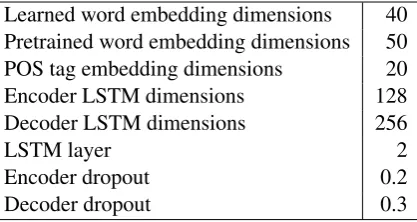
Learned word embedding dimensions 40 Pretrained word embedding dimensions 50 POS tag embedding dimensions 20 Encoder LSTM dimensions 128 Decoder LSTM dimensions 256
LSTM layer 2
Encoder dropout 0.2
[image:4.595.78.287.62.173.2]Decoder dropout 0.3
Table 1: Hyperparameters.
3.4 Inference
We consider two inference tasks, namely parsing and language modeling.
Parsing In parsing, we are interested in the parse tree that maximizes the posteriorp(a|x)(or
the joint p(a, x)). However, the decoder alone does not have a bottom-up recognition mecha-nism for computing the posterior. Thanks to the encoder, we can compute an approximated pos-terior q(a|x) in linear time and select the parse
tree that maximizes this approximation. An al-ternative is to generate candidate trees by sam-pling from q(a|x), re-rank them with respect to
the jointp(x, a)(which is proportional to the true
posterior), and select the sample that maximizes the true posterior.
Language Modeling In language modeling, our goal is to compute the marginal probability
p(x) =Pap(x, a), which is typically intractable.
To approximate this quantity, we can use Equa-tion (8) to compute a lower bound of the log like-lihood logp(x) and then exponentiate it to get a
pessimistic approximation ofp(x).7
Another way of computingp(x)(without lower
bounding) would be to use the variational approxi-mationq(a|x)as the proposal distribution as in the
importance sampler of Dyer et al.(2016). How-ever, this is beyond the scope of this work and we leave detailed discussions to Appendix A.
4 Related Work
Our framework is related to a class of variational autoencoders (Kingma and Welling,2014), which use neural networks for posterior approximation in variational inference. This technique has been previously used for topic modeling (Miao et al.,
7As a reminder, the language modeling objective is
exp(N LL/T), whereN LLdenotes the total negative log likelihood of the test data andTthe token counts.
Discrimina-tive parsers
Socher et al.(2013) 90.4
Zhu et al.(2013) 90.4
Dyer et al.(2016) 91.7
Cross and Huang(2016) 89.9
Vinyals et al.(2015) 92.8 Generative
parsers
Petrov and Klein(2007) 90.1
Shindo et al.(2012) 92.4
Dyer et al.(2016) 93.3 This work argmaxaq(a|x) 89.3
argmaxap(a, x) 90.1
Table 2: Parsing results (F1) on the PTB test set.
2016) and sentence compression (Miao and Blun-som, 2016). Another interpretation of the pro-posed framework is from the perspective of guided policy search in reinforcement learning (Bachman and Precup, 2015), where a generative parser is trained to imitate the trace of a discriminative parser. Further connections can be drawn with the importance-sampling based inference ofDyer et al. (2016). There, a generative RNNG and a discriminative RNNG are trained separately; dur-ing language modeldur-ing, the output of the discrim-inative model serves as the proposal distribution of an importance sampler p(x) = Eq(a|x)qp((x,aa|x)).
Compared to their work, we unify the generative and discriminative RNNGs in a single framework, and adopt a joint training objective.
5 Experiments
We performed experiments on the English Penn Treebank dataset; we used sections 2–21 for train-ing, 24 for validation, and 23 for testing. Follow-ing Dyer et al. (2015), we represent each word in three ways: as a learned vector, a pretrained vector, and a POS tag vector. The encoder word embedding is the concatenation of all three vec-tors while the decoder uses only the first two since we do not consider POS tags in generation. Ta-ble1presents details on the hyper-parameters we used. To find the MAP parse treeargmaxap(a, x)
(where p(a, x) is used rank the output of q(a|x))
and to compute the language modeling perplex-ity with the evidence lower bound (where a ∼ q(a|x)), we collect 100 samples from q(a|x),
same asDyer et al.(2016).
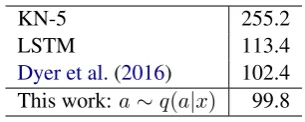
Experimental results for constituency parsing and language modeling are shown in Tables 2
[image:4.595.309.527.63.202.2]pars-KN-5 255.2
LSTM 113.4
[image:5.595.104.257.60.121.2]Dyer et al.(2016) 102.4 This work:a∼q(a|x) 99.8
Table 3: Language modeling results (perplexity).
ing performance. Comparing the two inference methods for parsing, ranking approximated MAP trees fromq(a|x)with respect to p(a, x) yields a small improvement, as inDyer et al.(2016). It is worth noting that our parsing performance lags be-hindDyer et al.(2016). We believe this is due to implementation disparities, such as the modeling of the reduce operation. WhileDyer et al.(2016) use an LSTM as the syntactic composition func-tion of each subtree, we adopt a rather simple com-position function based on embedding averaging for memory concern.
On language modeling, our framework achieves lower perplexity compared to Dyer et al. (2016) and baseline models. This gain possibly comes from the joint optimization of both the genera-tive and discriminagenera-tive components towards a lan-guage modeling objective. However, we acknowl-edge a subtle difference betweenDyer et al.(2016) and our approach compared to baseline language models: while the latter incrementally estimate the next word probability, our approach (andDyer et al. 2016) directly assigns probability to the en-tire sentence. Overall, the advantage of our frame-work compared to Dyer et al. (2016) is that it opens an avenue to unsupervised training.
6 Conclusions
We proposed a framework that integrates a gen-erative parser with a discriminative recognition model and showed how it can be instantiated with RNNGs. We demonstrated that a unified frame-work, which relates to expectation maximization and variational inference, enables effective pars-ing and language modelpars-ing algorithms. Evalua-tion on the English Penn Treebank, revealed that our framework obtains competitive performance on constituency parsing and state-of-the-art results on single-model language modeling. In the fu-ture, we would like to perform grammar induc-tion based on Equainduc-tion (8), with gradient descent and posterior regularization techniques (Ganchev et al.,2010).
Acknowledgments We thank three anonymous reviewers and members of the ILCC for valu-able feedback, and Muhua Zhu and James Cross for help with data preparation. The support of the European Research Council under award num-ber 681760 “Translating Multiple Modalities into Text” is gratefully acknowledged.
References
Philip Bachman and Doina Precup. 2015. Data gener-ation as sequential decision making. InAdvances in Neural Information Processing Systems, MIT Press, pages 3249–3257.
Michael Collins. 1999. Head-Driven Statistical Mod-els for Natural Language Parsing. Ph.D. thesis, University of Pennsylvania, Pennsylvania, Philadel-phia.
Michael Collins and Terry Koo. 2005. Discriminative reranking for natural language parsing. Computa-tional Linguistics31(1):25–70.
James Cross and Liang Huang. 2016. Incremental parsing with minimal features using bi-directional lstm. InProceedings of the 54th Annual Meeting of the Association for Computational Linguistics (Vol-ume 2: Short Papers). Berlin, Germany, pages 32– 37.
Chris Dyer, Miguel Ballesteros, Wang Ling, Austin Matthews, and Noah A. Smith. 2015. Transition-based dependency parsing with stack long short-term memory. In Proceedings of the 53rd Annual Meeting of the Association for Computational Lin-guistics and the 7th International Joint Conference on Natural Language Processing (Volume 1: Long Papers). Beijing, China, pages 334–343.
Chris Dyer, Adhiguna Kuncoro, Miguel Ballesteros, and Noah A. Smith. 2016. Recurrent neural net-work grammars. InProceedings of the 2016 Con-ference of the North American Chapter of the Asso-ciation for Computational Linguistics: Human Lan-guage Technologies. San Diego, California, pages 199–209.
Kuzman Ganchev, Jennifer Gillenwater, Ben Taskar, et al. 2010. Posterior regularization for structured latent variable models. Journal of Machine Learn-ing Research11(Jul):2001–2049.
Zoubin Ghahramani and Matthew J. Beal. 2000. Vari-ational inference for Bayesian mixtures of factor analysers. InAdvances in Neural Information Pro-cessing Systems, MIT Press, pages 449–455. Yoav Goldberg and Michael Elhadad. 2010. An
James Henderson. 2003. Inducing history representa-tions for broad coverage statistical parsing. In Pro-ceedings of the 2003 Human Language Technology Conference of the North American Chapter of the Association for Computational Linguistics. Edmon-ton, Canada, pages 24–31.
Liang Huang. 2008. Forest reranking: Discriminative parsing with non-local features. In Proceedings of ACL-08: HLT. Columbus, Ohio, pages 586–594.
Diederik P Kingma, Shakir Mohamed, Danilo Jimenez Rezende, and Max Welling. 2014. Semi-supervised learning with deep generative models. InAdvances in Neural Information Processing Systems, MIT Press, pages 3581–3589.
Diederik P Kingma and Max Welling. 2014. Auto-encoding variational Bayes. InProceedings of the International Conference on Learning Representa-tions. Banff, Canada.
Yishu Miao and Phil Blunsom. 2016. Language as a latent variable: Discrete generative models for sen-tence compression. InProceedings of the 2016 Con-ference on Empirical Methods in Natural Language Processing. Austin, Texas, pages 319–328.
Yishu Miao, Lei Yu, and Phil Blunsom. 2016. Neu-ral variational inference for text processing. In Pro-ceedings of The 33rd International Conference on Machine Learning. New York, New York, USA, pages 1727–1736.
Andriy Mnih and Karol Gregor. 2014. Neural vari-ational inference and learning in belief networks. InProceedings of the 31st International Conference on Machine Learning. Beijing, China, pages 1791– 1799.
Joakim Nivre, Johan Hall, Jens Nilsson, Atanas Chanev, G¨ulsen Eryigit, Sandra K¨ubler, Svetoslav Marinov, and Erwin Marsi. 2007. Maltparser: A language-independent system for data-driven de-pendency parsing. Natural Language Engineering
13(2):95–135.
Jeffrey Pennington, Richard Socher, and Christopher Manning. 2014. Glove: Global vectors for word representation. In Proceedings of the 2014 Con-ference on Empirical Methods in Natural Language Processing (EMNLP). Doha, Qatar, pages 1532– 1543.
Slav Petrov and Dan Klein. 2007. Improved infer-ence for unlexicalized parsing. InHuman Language Technologies 2007: The Conference of the North American Chapter of the Association for Computa-tional Linguistics; Proceedings of the Main Confer-ence. Rochester, New York, pages 404–411.
Reuven Y Rubinstein and Dirk P Kroese. 2008. Simu-lation and the Monte Carlo method. John Wiley & Sons.
Federico Sangati, Willem Zuidema, and Rens Bod. 2009. A generative re-ranking model for depen-dency parsing. In Proceedings of the 11th In-ternational Conference on Parsing Technologies (IWPT’09). Paris, France, pages 238–241.
Hiroyuki Shindo, Yusuke Miyao, Akinori Fujino, and Masaaki Nagata. 2012. Bayesian symbol-refined tree substitution grammars for syntactic parsing. In Proceedings of the 50th Annual Meeting of the Association for Computational Linguistics: Long Papers-Volume 1. Jeju Island, Korea, pages 440– 448.
Richard Socher, John Bauer, Christopher D. Manning, and Ng Andrew Y. 2013. Parsing with composi-tional vector grammars. InProceedings of the 51st Annual Meeting of the Association for Computa-tional Linguistics (Volume 1: Long Papers). Sofia, Bulgaria, pages 455–465.
Ivan Titov and James Henderson. 2007. Constituent parsing with incremental sigmoid belief networks. In Proceedings of the 45th Annual Meeting of the Association of Computational Linguistics. Prague, Czech Republic, pages 632–639.
Oriol Vinyals, Łukasz Kaiser, Terry Koo, Slav Petrov, Ilya Sutskever, and Geoffrey Hinton. 2015. Gram-mar as a foreign language. InAdvances in Neural Information Processing Systems, MIT Press, pages 2773–2781.
Muhua Zhu, Yue Zhang, Wenliang Chen, Min Zhang, and Jingbo Zhu. 2013. Fast and accurate shift-reduce constituent parsing. In Proceedings of the 51st Annual Meeting of the Association for Compu-tational Linguistics (Volume 1: Long Papers). Sofia, Bulgaria, pages 434–443.
A Comparison to Importance Sampling
(Dyer et al.,2016)
In this appendix we highlight the connections be-tween importance sampling and variational infer-ence, thereby comparing our method with Dyer et al.(2016).
Consider a simple directed graphical model with discrete latent variablesa(e.g.,ais the tran-sition action sequence) and observed variables x
(e.g., xis the sentence). The model evidence, or
the marginal likelihoodp(x) = Pap(x, a)is of-ten intractable to compute. Importance sampling transforms the above quantity into an expectation over a distributionq(a), which is known and easy to sample from:
p(x) =X
a
p(x, a)q(a)
q(a) =Eq(a)w(x, a) (11)
where q(a) is the proposal distribution
The proposal distribution can potentially depend on the observationsx, i.e.,q(a),q(a|x).
A challenge with importance sampling lies in choosing a proposal distribution which leads to low variance. As shown inRubinstein and Kroese
(2008), the optimal choice of the proposal distri-bution is in fact the true posteriorp(a|x), in which
case the importance weight p(a,x)
p(a|x) =p(x) is
con-stant with respect toa. InDyer et al.(2016), the
proposal distribution depends on x, i.e., q(a) , q(a|x), and is computed with a separately-trained,
discriminative model. This proposal choice is close to optimal, since in a fully supervised setting
a is also observed and the discriminative model
can be trained to approximate the true posterior well. We hypothesize that the performance of their importance sampler is dependent on this specific proposal distribution. Besides, their training strat-egy does not generalize to an unsupervised setting. In comparison, variational inference approach approximates the log marginal likelihoodlogp(x)
with the evidence lower bound. It is a natural choice when one aims to optimize Equation (11) directly:
logp(x) = logX
a
p(x, a)q(a) q(a)
≥Eq(a)log
p(x, a) q(a)
(12)
where q(a) is the variational approximation of the true posterior. Again, the variational approx-imation can potentially depend on the observa-tion x (i.e., q(a) , q(a|x)) and can be
com-puted with a discriminative model. Equation (12) is a well-defined, unsupervised training objec-tive which allows us to jointly optimize genera-tive (i.e.,p(x, a)) and discriminative (i.e.,q(a|x))
models. To further support the observed vari-ablea, we augment this objective with supervised
terms shown in Equation (10), followingKingma et al.(2014) andMiao and Blunsom(2016).
Equation (12) can be also used to approximate the marginal likelihood p(x) (e.g., in language
modeling) with its lower bound. An alternative choice without lower bounding is to use the vari-ational approximationq(a|x)as the proposal
dis-tribution in importance sampling (Equation (11)).
Ghahramani and Beal (2000) show that this pro-posal distribution leads to improved results of im-portance samplers. However, a potential drawback of importance sampling-based approach is that it