Proceedings of the 55th Annual Meeting of the Association for Computational Linguistics, pages 613–622 Proceedings of the 55th Annual Meeting of the Association for Computational Linguistics, pages 613–622
Representations of language in a model of visually grounded speech signal
Grzegorz Chrupała
Tilburg University
Lieke Gelderloos
Tilburg University
Afra Alishahi
Tilburg University
Abstract
We present a visually grounded model of speech perception which projects spoken utterances and images to a joint seman-tic space. We use a multi-layer recurrent highway network to model the temporal nature of spoken speech, and show that it learns to extract both form and meaning-based linguistic knowledge from the input signal. We carry out an in-depth analy-sis of the representations used by different components of the trained model and show that encoding of semantic aspects tends to become richer as we go up the hierar-chy of layers, whereas encoding of form-related aspects of the language input tends to initially increase and then plateau or de-crease.
1 Introduction
Speech recognition is one of the success stories of language technology. It works remarkably well in a range of practical settings. However, this success relies on the use of very heavy supervi-sion where the machine is fed thousands of hours of painstakingly transcribed audio speech signal. Humans are able to learn to recognize and under-stand speech from notably weaker and noisier su-pervision: they manage to learn to extract struc-ture and meaning from speech by simply being ex-posed to utterances situated and grounded in their daily sensory experience. Modeling and emulat-ing this remarkable skill has been the goal of nu-merous studies; however in the overwhelming ma-jority of cases researchers used severely simplified settings where either the language input or the ex-tralinguistic sensory input, or both, are small scale and symbolically represented. Section2provides a brief overview of this research.
More recently several lines of work have moved towards more realistic inputs while modeling or emulating language acquisition in a grounded set-ting. Gelderloos and Chrupała (2016) use the image captioning dataset MS COCO (Lin et al.,
2014) to mimic the setting of grounded language learning: the sensory input consists of images of natural scenes, while the language input are pho-netically transcribed descriptions of these scenes. The use of such moderately large and low-level data allows the authors to train a multi-layer re-current neural network model, and to explore the nature and localization of the emerging hierarchy of linguistic representations learned in the process. Furthermore, in a series of recent studiesHarwath and Glass(2015);Harwath et al.(2016);Harwath and Glass (2017) use image captioning datasets to model learning to understand spoken language from visual context with convolutional neural net-work models. Finally, there is a small but grow-ing body of work dedicated to elucidatgrow-ing the na-ture of representations learned by neural networks from language data (see Section 2.2 for a brief overview). In the current work we build on these three strands of research and contribute the follow-ing advances:
• We use a multi-layer gated recurrent neural network to properly model the temporal na-ture of speech signal and substantially im-prove performance compared to the convolu-tional architecture from Harwath and Glass
(2015);
• We carry out an in-depth analysis of the rep-resentations used by different components of the trained model and correlate them to repre-sentations learned by a text-based model and to human patterns of judgment on linguistic stimuli. This analysis is especially novel for a model with speech signal as input.
The general pattern of findings in our analysis is
as follows: The model learns to extract from the acoustic input both form-related and semantics-related information, and encodes it in the activa-tions of the hidden layers. Encoding of semantic aspects tends to become richer as we go up the hi-erarchy of layers. Meanwhile, encoding of form-related aspects of the language input, such as ut-terance length or the presence of specific words, tends to initially increase and then decay.
We release the code for our models and analyses as open source, available at
https://github.com/gchrupala/visually-grounded-speech. We also release a dataset of synthetically spoken image captions based on MS COCO, avail-able athttps://doi.org/10.5281/zenodo.400926.
2 Related work
Children learn to recognize and assign meaning to words from continuous perceptual data in ex-tremely noisy context. While there have been many computational studies of human word mean-ing acquisition, they typically make strong sim-plifying assumptions about the nature of the in-put. Often language input is given in the form of word symbols, and the context consists of a set of symbols representing possible referents (e.g.
Siskind, 1996; Frank et al., 2007; Fazly et al.,
2010). In contrast, several studies presented mod-els that learn from sensory rather than symbolic in-put, which is rich with regards to the signal itself, but very limited in scale and variation (e.g. Roy and Pentland,2002;Yu and Ballard,2004; Lazari-dou et al.,2016).
2.1 Multimodal language acquisition
Chrupała et al. (2015) introduce a model that learns to predict the visual context from image captions. The model is trained on image-caption pairs from MSCOCO (Lin et al., 2014), captur-ing both rich visual input as well as larger scale input, but the language input still consists of word symbols.Gelderloos and Chrupała(2016) propose a similar architecture that instead takes phoneme-level transcriptions as language input, thereby in-corporating the word segmentation problem into the learning task. In this work, we introduce an ar-chitecture that learns from continuous speech and images directly.
This work is related to research on visual grounding of language. The field is large and growing, with most work dedicated to the
ground-ing of written text, particularly in image cap-tioning tasks (see Bernardi et al. (2016) for an overview). However, learning to ground language to visual information is also interesting from an automatic speech recognition point of view. Po-tentially, ASR systems could be trained from nat-urally co-occurring visual context information, without the need for extensive manual annota-tion – a particularly promising prospect for speech recognition in low-resource languages. There have been several attempts along these lines. Syn-naeve et al. (2014) present a method of learning to recognize spoken words in isolation from co-occurrence with image fragments. Harwath and Glass (2015) present a model that learns to map pre-segmented spoken words in sequence to as-pects of the visual context, while inHarwath and Glass (2017) the model also learns to recognize words in the unsegmented signal.
Most closely related to our work is that of Har-wath et al. (2016), as it presents an architecture that learns to project images and unsegmented spoken captions to the same embedding space. The sentence representation is obtained by feed-ing the spectrogram to a convolutional network. The architecture is trained on crowd-sourced spo-ken captions for images from the Places dataset (Zhou et al.,2014), and evaluated on image search and caption retrieval. Unfortunately this dataset is not currently available and we were thus unable to directly compare the performance of our model to
Harwath et al.(2016). We do compare toHarwath and Glass (2015) which was tested on a public dataset. We make different architectural choices, as our models are based on recurrent highway net-works (Zilly et al.,2016). As in human cognition, speech is processed incrementally. This also al-lows our architecture to integrate information se-quentially from speech of arbitrary duration.
2.2 Analysis of neural representations
fi-nal representation by removing them from the in-put and comparing the resulting representations to the ones generated by the original input. In a sim-ilar approach,Li et al. (2016) study the contribu-tion of individual input tokens as well as hidden units and word embedding dimensions by erasing them from the representation and analyzing how this affects the model.
Miao et al.(2016) andTang et al.(2016) use vi-sualization techniques for fine-grained analysis of GRU and LSTM models for ASR. Visualization of input and forget gate states allowsMiao et al.
(2016) to make informed adaptations to gated re-current architectures, resulting in more efficiently trainable models. Tang et al. (2016) visualize qualitative differences between LSTM- and GRU-based architectures, regarding the encoding of in-formation, as well as how it is processed through time.
We specifically study linguistic properties of the information encoded in the trained model. Adi et al. (2016) introduce prediction tasks to ana-lyze information encoded in sentence embeddings about word order, sentence length, and the pres-ence of individual words. We use related tech-niques to explore encoding of aspects of form and meaning within components of our stacked archi-tecture.
3 Models
We use a multi-layer, gated recurrent neural net-work (RHN) to model the temporal nature of speech signal. Recurrent neural networks are de-signed for modeling sequential data, and gated variants (GRUs, LSTMs) are widely used with speech and text in both cognitive modeling and engineering contexts. RHNs are a simple gener-alization of GRU networks such that the transform between time points can consist of several steps.
Our multimodal model projects spoken utter-ances and images to a joint semantic space. The idea of projecting different modalities to a shared semantic space via a pair of encoders has been used in work on language and vision (among them
Vendrov et al. (2015)). The core idea is to en-courage inputs representing the same meaning in different modalities to end up nearby, while main-taining a distance from unrelated inputs.
The model consists of two parts: an utterance encoder, and an image encoder. The utterance en-coder starts from MFCC speech features, while
the image encoder starts from features extracted with a VGG-16 pre-trained on ImageNet. Our loss function attempts to make the cosine distance be-tween encodings of matching utterances and im-ages greater than the distance between encodings of mismatching utterance/image pairs, by a mar-gin:
(1)
X
u,i
X
u0
max[0, α+d(u, i)−d(u0, i)]
+X
i0
max[0, α+d(u, i)−d(u, i0)]
!
where d(u, i) is the cosine distance between the
encoded utterance u and encoded imagei. Here
(u, i) is the matching utterance-image pair, u0 ranges over utterances not describing i and i0 ranges over images not described byu.
The image encoderenci is a simple linear
pro-jection, followed by normalization to unit L2 norm:
enci(i) = unit(Ai+b) (2)
where unit(x) = (xTxx)0.5 and with (A, b) as
learned parameters. The utterance encoder encu
consists of a 1-dimensional convolutional layer of lengths, size dand stride z, whose output feeds into a Recurrent Highway Network with k lay-ers and L microsteps, whose output in turn goes through an attention-like lookback operator, and finally L2 normalization:
encu(u) = unit(Attn(RHNk,L(Convs,d,z(u)))) (3) The main function of the convolutional layer
Convs,d,z is to subsample the input along the
tem-poral dimension. We use a 1-dimensional convo-lution with full border mode padding. The atten-tion operator simply computes a weighted sum of the RHN activation at all timesteps:
Attn(x) =X t
αtxt (4)
where the weights αt are determined by learned
parameters U and W, and passed through the timewise softmax function:
αt=
exp(Utanh(Wxt))
P
t0exp(Utanh(Wxt0)) (5)
RHN is to increase the depth of the transform be-tween timesteps, or the recurrence depth. Other-wise they are a type of gated recurrent networks. The transition from timestept−1totis then de-fined as:
rhn(xt,s(tL−)1) =s (L)
t (6)
where xt stands for input at time t, and s(tl)
de-notes the state at timetat recurrence layerl, with Lbeing the top layer of recurrence. Furthermore,
st(l)=ht(l)t(tl)+s(tl−1)1−t(tl) (7)
whereis elementwise multiplication, and
h(tl)= tanhI[l= 1]WHxt+UHls
(l−1)
t
(8)
t(tl)=σI[l= 1]WTxt+UTls
(l−1) (9)
HereI is the indicator function: input is only in-cluded in the computation for the first layer of re-currencel = 1. By applying therhnfunction
re-peatedly, an RHN layer maps a sequence of inputs to a sequence of states:
(10)
RHN(X,s0)
= rhn(xn, . . . ,rhn(x2,rhn(x1,s(0L))))
Two or more RHN layers can be composed into a stack:
RHN2(RHN1(X,s10(L)),s2(0L)), (11)
wheresn(tl)stands for the state vector of layernof
the stack, at layerlof recurrence, at timet. In our version of the Stacked RHN architecture we use residualizedlayers:
RHNres(X,s0) = RHN(X,s0) +X (12)
This formulation tends to ease optimization in multi-layer models (cf.He et al.,2015;Oord et al.,
2016).
In addition to the speech model described above, we also define a comparable text model. As it takes a sequence of words as input, we re-place the convolutional layer with a word embed-ding lookup table. We found the text model did not benefit from the use of the attention mecha-nism, and thus the sentence embedding is simply the L2-normalized activation vector of the topmost layer, at the last timestep.
4 Experiments
Our main goal is to analyze the emerging repre-sentations from different components of the model and to examine the linguistic knowledge they en-code. For this purpose, we employ a number of tasks that cover the spectrum from fully form-based to fully semantic.
In Section4.2we assess the effectiveness of our architecture by evaluating it on the task of rank-ing images given an utterance. Sections4.3to4.6
present our analyses. In Sections 4.3and4.4 we define auxiliary tasks to investigate to what extent the network encodes information about the surface form of an utterance from the speech input. In Sec-tion4.5and4.6we focus on where semantic infor-mation is encoded in the model. In the analyses, we use the following features:
Utterance embeddings: the weighted sum of the unit activations on the last layer, as calculated by Equation (3).
Average unit activations: hidden layer activa-tions averaged over time and L2-normalized for each hidden layer.
Average input vectors: the MFCC vectors aver-aged over time. We use this feature to exam-ine how much information can be extracted from the input signal only.
4.1 Data
For the experiments reported in the remainder of the paper we use two datasets of images with spo-ken captions.
4.1.1 Flickr8K
The Flickr8k Audio Caption Corpus was con-structed by having crowdsource workers read aloud the captions in the original Flickr8K cor-pus (Hodosh et al., 2013). For details of the data collection procedure refer to Harwath and Glass (2015). The datasets consist of 8,000 im-ages, each image with five descriptions. One thousand images are held out for validation, and another one thousand for the final test set. We use the splits provided by (Karpathy and Fei-Fei,
2015). The image features come from the final fully connect layer of VGG-16 (Simonyan and Zisserman, 2014) pre-trained on Imagenet ( Rus-sakovsky et al.,2014).
then compute and add first order and second order differences (deltas) for a total of 37 dimensions. We use 25 milisecond windows, sampled every 10 miliseconds.1
4.1.2 Synthetically spoken COCO
We generated synthetic speech for the captions in the MS COCO dataset (Lin et al., 2014) via the Google Text-to-Speech API.2 The audio and the corresponding MFCC features are released as
Chrupała et al.(2017)3. This TTS system we used produces high-quality realistic-sounding speech. It is nevertheless much simpler than real human speech as it uses a single voice, and lacks tempo variation or ambient noise. The data consists of over 300,000 images, each with five spoken cap-tions. Five thousand images each are held out for validation and test. We use the splits and image features provided byVendrov et al.(2015).4 The image features also come from the VGG-16 net-work, but are averages of feature vectors for ten crops of each image. For the MS COCO captions we extracted only plain MFCC and total energy features, and did not add deltas in order to keep the amount of computation manageable given the size of the dataset.
4.2 Image retrieval
We evaluate our model on the task of ranking im-ages given a spoken utterance, such that highly ranked images contain scenes described by the ut-terance. The performance on this task on valida-tion data is also used to choose the best variant of the model architecture and to tune the hyperpa-rameters. We compare the speech models to mod-els trained on written sentences split into words. The best settings found for the four models were the following:
Flickr8K Text RHN 300-dimensional word em-beddings, 1 hidden layer with 1024 dimen-sions, 1 microstep, initial learning rate 0.001.
Flick8K Speech RHN convolutional layer with length 6, size 64, stride 2, 4 hidden layers with 1024 dimensions, 2 microsteps,
atten-1We noticed that for a number of utterances the audio
sig-nal was very long: on inspection it turned out that most of these involved failure to switch off the microphone on the part of the workers, and the audio contained ambient noise or unrelated speech. We thus trucated all audio for this dataset at 10,000 miliseconds.
2Available athttps://github.com/pndurette/gTTS. 3Available athttps://doi.org/10.5281/zenodo.400926. 4Seehttps://github.com/ivendrov/order-embedding.
tion MLP with 128 hidden units, initial learn-ing rate 0.0002
COCO Text RHN 300-dimensional word em-beddings, 1 hidden layer with 1024 dimen-sions, 1 microstep, initial learning rate 0.001
COCO Speech RHN convolutional layer with length 6, size 64, stride 3, 5 hidden layers with 512 dimensions, 2 microsteps, attention MLP with 512 hidden units, initial learning rate 0.0002
All models were optimized with Adam (Kingma and Ba,2014) with early stopping: we kept the parameters for the epoch which showed the best recall@10 on validation data.
Model R@1 R@5 R@10 r˜
Speech RHN4,2 0.055 0.163 0.253 48
Spectr. CNN - - 0.179
-Text RHN1,1 0.127 0.364 0.494 11
Table 1: Image retrieval performance on Flickr8K. R@N stands for recall at N;r˜stands for median
rank of the correct image.
Model R@1 R@5 R@10 r˜
Speech RHN5,2 0.111 0.310 0.444 13 Text RHN1,1 0.169 0.421 0.565 8
Table 2: Image retrieval performance on MS COCO. R@N stands for recall at N;r˜stands
for median rank of the correct image.
Table1shows the results for the human speech from the Flickr8K dataset. The Speech RHN model scores substantially higher than model of
Harwath and Glass(2015) on the same data. How-ever the large gap between its perfomance and the scores of the text model suggests that Flickr8K is rather small for the speech task. In Table 2
we present the results on the dataset of synthetic speech from MS COCO. Here the text model is still better, but the gap is much smaller than for Flickr8K. We attribute this to the much larger size of dataset, and to the less noisy and less variable synthetic speech.
up any obvious patterns for the cases of text be-ing better than speech. For the cases where speech outperformed text, two patterns stood out: (i) sen-tences with spelling mistakes, (ii) unusually long sentences. For example for the sentencea yellow
Figure 1: Images returned for utterancea yellow and white birtd is in flight by the text (left) and speech (right) models.
and white birtd is in flightthe text model misses the misspelled wordbirtdand returns an irrelevant image, while the speech model seems robust to some degree of variation in pronunciation and re-turns the target image at rank 1 (see Figure1). In an attempt to quantify this effect we counted the number of unique words with training set frequen-cies below 5 in the top 100 utterances with lowest and highest rank ratio: for the utterances where text was better there were 16 such words; for ut-terances where speech was better there were 28, among them misspellings such as streeet, scears (forskiers),contryside, scull, birtd, devise.
The distribution of utterance lengths in Fig-ure 2 confirms pattern (ii): the set of 100 sen-tences where speech beats text by a large margin are longer on average and there are extremely long outliers among them. One of them is the
36-word-●
● ●
●
speech text
10 20 30 40
Length
better
Figure 2: Length distribution for sentences where one model performs much better than the other.
long utterance depicted in Figure3, with ranks 470 and 2 for text and speech respectively. We suspect that the speech model’s attention mechanism en-ables it to cherry pick key fragments of such mon-ster utterances, while the text model lacking this mechanism may struggle. Figure3shows the plot of the attention weights for this utterance from the
speech model.
4.3 Predicting utterance length
Our first auxiliary task is to predict the length of the utterance, using the features explained at the beginning of Section4. Since the length of an ut-terance directly corresponds to how long it takes to articulate, we also use the number of time steps5as a feature and expect it to provide the upper bound for our task, especially for synthetic speech. We use a Ridge Regression model for predicting utter-ance length using each set of features. The model is trained on 80% of the sentences in the validation set, and tested on the remaining 20%. For all fea-tures regularization penaltyα= 1.0gave the best
results.
Figure 4shows the results for this task on hu-man speech from Flickr8K and synthetic speech from COCO. With the exception of the average in-put vectors for Flickr8K, all features can explain a high proportion of variance in the predicted ut-terance length. The pattern observed for the two datasets is slightly different: due to the systematic conversion of words to synthetic speech in COCO, using the number of time steps for this dataset yields the highestR2. However, this feature is not as informative for predicting the utterance length in Flickr8K due to noise and variation in human speech, and is in fact outperformed by some of the features extracted from the model. Also, the input vectors from COCO are much more informative than Flickr8K due to larger quantity and simpler structure of the speech signal. However, in both datasets the best (non-ceiling) performance is ob-tained by using average unit activations from the hidden layers (layer 2 for COCO, and layers 3 and 4 for Flickr8K). These features outperform utter-ance embeddings, which are optimized according to the visual grounding objective of the model and most probably learn to ignore the superficial char-acteristics of the utterance that do not contribute to matching the corresponding image.
Note that the performance on COCO plateaus after the second layer, which might suggest that form-based knowledge is learned by lower layers. Since Flickr8K is much smaller in size, the stabil-ising happens later in layer 3.
[image:6.595.112.249.531.610.2]Figure 3: Attention weight distribution for a long utterance.
Figure 4:R2values for predicting utterance length for Flickr8K and COCO. Layers 1–5 represent (normalized) average unit activation, whereas the first (#0) and last point represent average input vectors and utterance embeddings, respectively.
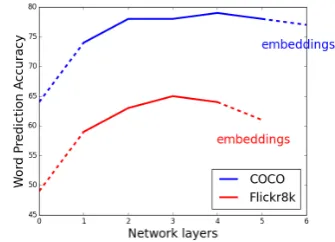
4.4 Predicting word presence
Results from the previous experiment suggest that our model acquires information about higher level building blocks (words) in the continuous speech signal. Here we explore whether it can detect the presence or absence of individual words in an terance. We formulate detecting a word in an ut-terance as a binary classification task, for which we use a multi-layer perceptron with a single hid-den layer of size 1024, optimized by Adam. The input to the model is a concatenation of the fea-ture vector representing an utterance and the one representing a target word. We again use utter-ance embeddings, average unit activations on each layer, and average input vectors as features, and represent each target word as a vector of MFCC features extracted from the audio signal syntheti-cally produced for that word.
For each utterance in the validation set, we ran-domly pick one positive and one negative target (i.e., one word that does and one that does not ap-pear in the utterance) that is not a stop word. To balance the probability of a word being positive or negative, we use each positive target as a neg-ative target for another utterance in the validation
set. The MLP model is trained on the positive and negative examples corresponding to 80% of the ut-terances in the validation set of each dataset, and evaluated on the remaining 20%.
Figure5shows the mean accuracy of the MLP on Flickr8K and COCO. All results using features extracted from the model are above chance (0.5), with the average unit activations of the hidden lay-ers yielding the best results (0.65 for Flickr8K on layer 3, and 0.79 for COCO on layer 4). These numbers show that the speech model infers re-liable information about word-level blocks from the low-level audio features it receives as input. The observed trend is similar to the previous task: average unit activations on the higher-level hid-den layers are more informative for this task than the utterance embeddings, but the performance plateaus before the topmost layer.
Figure 5: Mean accuracy values for predicting the presence of a word in an utterance for Flickr8K and COCO. Layers 1–5 represent the (normalized) average unit activations, whereas the first (#0) and last point represent average input vectors and ut-terance embeddings, respectively.
4.5 Sentence similarity
[image:7.595.332.500.442.563.2]Figure 6: Pearson’srof cosine similarities of aver-aged input MFCCs and COCO Speech RHN hid-den layer activation vectors and embeddings of sentence pairs with relatedness scores from SICK, cosine similarity of COCO Text RHN embed-dings, and edit similarity.
Flickr8K and video captions from the SemEval 2012 STS MSRVideo Description data set (STS) (Agirre et al.,2012). Captions were paired at ran-dom, as well as modified to obtain semantically similar and contrasting counterparts, and the re-sulting pairs were rated for semantic similarity.
For all sentence pairs in SICK, we generate synthetic spoken sentences and feed them to the COCO Speech RHN, and calculate the cosine sim-ilarity between the averaged MFCC input vectors, the averaged hidden layer activation vectors, and the sentence embeddings. Z-score transformation was applied before calculating the cosine similar-ities. We then correlate these cosine similarities with
• semantic relatedness according to human rat-ings
• cosine similarities according to z-score trans-formed embeddings from COCO Text RHN • edit similarities, a measure of how
sim-ilar the sentences are in form, specifi-cally, 1−normalized Levenshtein distance over character sequences
Figure 6 shows a boxplot over 10,000 bootstrap samples for all correlations. We observe that (i) correlation with edit similarity initially increases, then decreases; (ii) correlation with human re-latedness scores and text model embeddings in-creases until layer 4, but dein-creases for hidden layer 5. The initially increasing and then decreasing cor-relation with edit similarity is consistent with the findings that information about form is encoded by lower layers. The overall growing correlation with both human semantic similarity ratings and
0.00 0.25 0.50 0.75 1.00
0 2 4 6
layer
RER
words
peaking/peeking great/grate mantle/mantel peer/pier tale/tail wit/whit weight/wait
isle/aisle sight/site pic/pick sun/son wears/wares pause/paws tied/tide
ware/wear sales/sails boarder/border plane/plain lapse/laps rose/rows stares/stairs
seen/scene plains/planes see/sea main/mane rains/reins tea/tee stair/stare
waist/waste hole/whole suite/sweet pairs/pears cole/coal sale/sail
log(mincount) 4 5 6 7
Figure 7: Disambiguation performance per layer. Points #0 and #6 (connected via dotted lines) rep-resent the input vectors and utterance embeddings, respectively. The black line shows the overall mean RER.
the COCO Text RHN indicate that higher layers learn to represent semantic knowledge. We were somewhat surprised by the pattern for the correla-tion with human ratings and the Text model simi-larities which drops for layer 5. We suspect it may be caused by the model at this point in the layer hierarchy being strongly tuned to the specifics of the COCO dataset. To test this, we checked the correlations with COCO Text embeddings on val-idation sentences from the COCO dataset instead of SICK. These increased monotonically, in sup-port of our conjecture.
4.6 Homonym disambiguation
[image:8.595.72.292.60.181.2]gives us 34 word pairs. For each pair we gener-ate a binary classification task by taking all the ut-terances where either form appears, using average input vectors, utterance embeddings, and average unit activations as features. Instances for all fea-ture sets are normalized to unit L2 norm.
For each task and feature set we run strati-fied 10-fold cross validation using Logistic Re-gression to predict which of the two words the utterance contains. Figure 7 shows, for each pair, the relative error reduction of each feature set with respect to the majority baseline. There is substantial variation across word pairs, but overall the task becomes easier as the features come from higher layers in the network. Some forms can be disambiguated with very high accu-racy (e.g. sale/sail, cole/coal, pairs/pears), while some others cannot be distinguished at all (peak-ing/peeking, great/grate, mantle/mantel). We ex-amined the sentences containing the failing forms, and found out that almost all occurrences of peak-ingandmantlewere misspellings ofpeekingand mantel, which explains the impossibility of disam-biguating these cases.
5 Conclusion
We present a multi-layer recurrent highway net-work model of language acquisition from visually grounded speech signal. Through detailed analy-sis we uncover how information in the input sig-nal is transformed as it flows through the network: formal aspects of language such as word identities that not directly present in the input are discovered and encoded low in the layer hierarchy, while se-mantic information is most strongly expressed in the topmost layers.
Going forward we would like to compare the representations learned by our model to the brain activity of people listening to speech in order to determine to what extent the patterns we found correspond to localized processing in the human cortex. This will hopefully lead to a better under-standing of language learning and processing by both artificial and neural networks.
Acknowledgements
We would like to thank David Harwath for mak-ing the Flickr8k Audio Caption Corpus publicly available.
References
Yossi Adi, Einat Kermany, Yonatan Belinkov, Ofer Lavi, and Yoav Goldberg. 2016. Fine-grained anal-ysis of sentence embeddings using auxiliary predic-tion tasks.arXiv preprint arXiv:1608.04207.
Eneko Agirre, Mona Diab, Daniel Cer, and Aitor Gonzalez-Agirre. 2012. Semeval-2012 task 6: A pi-lot on semantic textual similarity. InProceedings of the First Joint Conference on Lexical and
Compu-tational Semantics. Association for Computational
Linguistics, volume 2, pages 385–393.
Raffaella Bernardi, Ruket Cakici, Desmond Elliott, Aykut Erdem, Erkut Erdem, Nazli Ikizler-Cinbis, Frank Keller, Adrian Muscat, and Barbara Plank. 2016. Automatic description generation from im-ages: A survey of models, datasets, and evaluation measures. arXiv preprint arXiv:1601.03896.
Grzegorz Chrupała, Akos K´ad´ar, and Afra Alishahi. 2015. Learning language through pictures. In Pro-ceedings of the 53rd Annual Meeting of the
Associa-tion for ComputaAssocia-tional Linguistics.
Grzegorz Chrupała, Lieke Gelderloos, and Afra Alishahi. 2017. Synthetically spoken COCO.
https://doi.org/10.5281/zenodo.400926.
Afsaneh Fazly, Afra Alishahi, and Suzanne Steven-son. 2010. A probabilistic computational model of cross-situational word learning. Cognitive Science:
A Multidisciplinary Journal34(6):1017–1063.
Michael C. Frank, Noah D. Goodman, and Joshua B. Tenenbaum. 2007. A Bayesian framework for cross-situational word-learning. InAdvances in Neural
In-formation Processing Systems. volume 20.
Lieke Gelderloos and Grzegorz Chrupała. 2016. From phonemes to images: levels of representation in a recurrent neural model of visually-grounded lan-guage learning. In Proceedings of COLING 2016, the 26th International Conference on Computational
Linguistics: Technical Papers.
David Harwath and James Glass. 2015. Deep multi-modal semantic embeddings for speech and images.
InIEEE Automatic Speech Recognition and
Under-standing Workshop.
David Harwath and James R Glass. 2017. Learn-ing word-like units from joint audio-visual analysis.
arXiv preprint arXiv:1701.07481.
David Harwath, Antonio Torralba, and James Glass. 2016. Unsupervised learning of spoken language with visual context. In Advances in Neural
Infor-mation Processing Systems. pages 1858–1866.
Micah Hodosh, Peter Young, and Julia Hockenmaier. 2013. Framing image description as a ranking task: Data, models and evaluation metrics. Journal of
Ar-tificial Intelligence Research47:853–899.
´Akos K´ad´ar, Grzegorz Chrupała, and Afra Alishahi. 2016. Representation of linguistic form and function in recurrent neural networks. CoRR
abs/1602.08952.
Andrej Karpathy and Li Fei-Fei. 2015. Deep visual-semantic alignments for generating image descrip-tions. In Proceedings of the IEEE Conference on
Computer Vision and Pattern Recognition. pages
3128–3137.
Diederik P. Kingma and Jimmy Ba. 2014. Adam: A method for stochastic optimization. CoRR
abs/1412.6980.
Angeliki Lazaridou, Grzegorz Chrupała, Raquel Fern´andez, and Marco Baroni. 2016. Multimodal semantic learning from child-directed input. In
The 15th Annual Conference of the North American Chapter of the Association for Computational
Lin-guistics: Human Language Technologies.
Jiwei Li, Will Monroe, and Dan Jurafsky. 2016. Un-derstanding neural networks through representation erasure. arXiv preprint arXiv:1612.08220.
Tsung-Yi Lin, Michael Maire, Serge Belongie, James Hays, Pietro Perona, Deva Ramanan, Piotr Doll´ar, and C Lawrence Zitnick. 2014. Microsoft coco: Common objects in context. In Computer Vision–
ECCV 2014, Springer, pages 740–755.
Marco Marelli, Stefano Menini, Marco Baroni, Luisa Bentivogli, Raffaella Bernardi, and Roberto Zam-parelli. 2014. A sick cure for the evaluation of com-positional distributional semantic models. InLREC. pages 216–223.
Yajie Miao, Jinyu Li, Yongqiang Wang, Shi-Xiong Zhang, and Yifan Gong. 2016. Simplifying long short-term memory acoustic models for fast training and decoding. InIEEE International Conference on
Acoustics, Speech and Signal Processing (ICASSP).
IEEE, pages 2284–2288.
Aaron van den Oord, Nal Kalchbrenner, and Koray Kavukcuoglu. 2016. Pixel recurrent neural net-works. arXiv preprint arXiv:1601.06759.
Deb K Roy and Alex P Pentland. 2002. Learning words from sights and sounds: a computational model.
Cognitive Science26(1):113 – 146.
Olga Russakovsky, Jia Deng, Hao Su, Jonathan Krause, Sanjeev Satheesh, Sean Ma, Zhiheng Huang, An-drej Karpathy, Aditya Khosla, Michael Bernstein, Alexander C. Berg, and Li Fei-Fei. 2014. ImageNet Large Scale Visual Recognition Challenge.
Karen Simonyan and Andrew Zisserman. 2014. Very deep convolutional networks for large-scale image recognition. CoRRabs/1409.1556.
Jeffrey M. Siskind. 1996. A computational study of cross-situational techniques for learning word-to-meaning mappings. Cognition61(1-2):39–91.
Gabriel Synnaeve, Maarten Versteegh, and Emmanuel Dupoux. 2014. Learning words from images and speech. InNIPS Workshop on Learning Semantics,
Montreal, Canada.
Zhiyuan Tang, Ying Shi, Dong Wang, Yang Feng, and Shiyue Zhang. 2016. Memory visualization for gated recurrent neural networks in speech recogni-tion. arXiv preprint arXiv:1609.08789.
Ivan Vendrov, Ryan Kiros, Sanja Fidler, and Raquel Urtasun. 2015. Order-embeddings of images and language.arXiv preprint arXiv:1511.06361.
Chen Yu and Dana H Ballard. 2004. A multimodal learning interface for grounding spoken language in sensory perceptions. ACM Transactions on Applied
Perception (TAP)1(1):57–80.
Bolei Zhou, Agata Lapedriza, Jianxiong Xiao, Anto-nio Torralba, and Aude Oliva. 2014. Learning deep features for scene recognition using places database. In Z. Ghahramani, M. Welling, C. Cortes, N. D. Lawrence, and K. Q. Weinberger, editors,Advances
in Neural Information Processing Systems 27,
Cur-ran Associates, Inc., pages 487–495.
Julian Georg Zilly, Rupesh Kumar Srivastava, Jan Koutn´ık, and J¨urgen Schmidhuber. 2016. Recurrent highway networks. arXiv preprint