A Thesis Submitted for the Degree of PhD at the University of Warwick
Permanent WRAP URL:
http://wrap.warwick.ac.uk/78778
Copyright and reuse:
This thesis is made available online and is protected by original copyright.
Please scroll down to view the document itself.
Please refer to the repository record for this item for information to help you to cite it.
Our policy information is available from the repository home page.
AUTHOR:Robert J. B. Goudie DEGREE:Ph.D.
TITLE:Bayesian structural inference with applications in social science
DATE OF DEPOSIT: . . . .
I agree that this thesis shall be available in accordance with the regulations governing the University of Warwick theses.
I agree that the summary of this thesis may be submitted for publication.
Iagreethat the thesis may be photocopied (single copies for study purposes only).
Theses with no restriction on photocopying will also be made available to the British Library for microfilming. The British Library may supply copies to individuals or libraries. subject to a statement from them that the copy is supplied for non-publishing purposes. All copies supplied by the British Library will carry the following statement:
“Attention is drawn to the fact that the copyright of this thesis rests with its author. This copy of the thesis has been supplied on the condition that anyone who consults it is understood to recognise that its copyright rests with its author and that no quotation from the thesis and no information derived from it may be published without the author’s written consent.”
AUTHOR’S SIGNATURE: . . . .
USER’S DECLARATION
1. I undertake not to quote or make use of any information from this thesis without making acknowledgement to the author.
2. I further undertake to allow no-one else to use this thesis while it is in my care.
DATE SIGNATURE ADDRESS
. . . .
. . . .
. . . .
. . . .
M A E
G NS
I T A T MOLEM
U N
IV
ER
SITAS WARWICEN
SIS
Bayesian structural inference with applications in
social science
by
Robert J. B. Goudie
Thesis
Submitted to the University of Warwick
for the degree of
Doctor of Philosophy
Department of Statistics
School of Health and Social Studies
Contents
List of Tables vii
List of Figures viii
List of Notation xi
Acknowledgements xvii
Declarations xviii
Abstract xix
Chapter 1 Introduction 1
1.1 Scope of the analysis . . . 2
1.2 Statistical model selection . . . 3
1.2.1 Inadequacy of the complete model . . . 3
1.2.2 Objectives and viewpoints . . . 5
1.2.3 What is a statistical model? . . . 7
1.2.4 Implementation of model selection . . . 7
1.3 Bayesian model selection . . . 9
1.3.1 Basic Bayesian framing . . . 9
1.3.4 Summarising the posterior distribution . . . 11
1.3.5 Bayesian model uncertainty in social science . . . 11
1.4 Contributions of the thesis . . . 12
Chapter 2 Background 13 2.1 Model selection . . . 13
2.1.1 Bayesian model selection . . . 15
2.2 Graphical models . . . 17
2.2.1 Conditional independence . . . 18
2.2.2 Graphs . . . 18
2.2.3 Bayesian networks . . . 20
2.3 Univariate Bayesian models . . . 22
2.3.1 Conjugate priors . . . 22
2.3.2 Multinomial-Dirichlet . . . 24
2.3.3 Normal inverse-gamma . . . 25
2.4 Model selection for Bayesian regression models . . . 26
2.4.1 Multinomial-Dirichlet . . . 27
2.4.2 Linear regression . . . 29
2.4.3 Model priors . . . 33
2.4.4 Posterior distribution over models . . . 34
2.5 Model selection for Bayesian networks . . . 34
2.5.1 Independence assumptions . . . 35
2.5.2 Multinomial-Dirichlet . . . 36
2.5.3 Normal linear regression . . . 38
2.5.4 Model priors . . . 39
2.5.5 Posterior distribution over models . . . 40
2.6 Posterior distribution computation . . . 40
2.6.2 MAP-finding methods . . . 41
2.6.3 Markov chain Monte Carlo . . . 42
2.6.4 Approximations for the posterior distribution . . . 48
2.7 Constraint-based methods . . . 50
2.7.1 Survey of available methods . . . 50
2.7.2 PC-algorithm . . . 51
Chapter 3 Subjective well-being and risk-avoiding behaviour 54 3.1 Background . . . 55
3.1.1 Risky behaviour . . . 55
3.1.2 Subjective well-being . . . 56
3.2 Data and methods . . . 58
3.2.1 Behavioural Risk Factor Surveillance System Survey . . . 58
3.2.2 Bayesian methods . . . 60
3.3 Results . . . 64
3.3.1 Raw data . . . 64
3.3.2 Regression for seatbelt use . . . 65
3.3.3 Bayesian variable selection . . . 65
3.3.4 Joint confounding . . . 66
3.4 Discussion . . . 69
Chapter 4 An efficient Gibbs sampler for structural inference 75 4.1 Introduction . . . 76
4.1.1 Problems with small local moves . . . 76
4.1.2 Methods for improving mixing . . . 76
4.1.3 A Gibbs sampler . . . 77
4.1.4 Constraints on in-degree . . . 78
4.2.2 Joint distribution and priors . . . 79
4.3 Preliminaries . . . 80
4.3.1 MC3 sampler . . . 81
4.3.2 A na¨ıve Gibbs sampler . . . 81
4.3.3 Convergence conditions for Gibbs samplers . . . 82
4.4 Optimising Gibbs samplers . . . 84
4.5 A Gibbs sampler for Bayesian networks . . . 86
4.6 Computational aspects . . . 88
4.6.1 Online cyclicity checking . . . 89
4.6.2 Efficient implementation of a Gibbs sampler . . . 92
Chapter 5 Evaluation of the Gibbs sampler 104 5.1 Setup . . . 105
5.1.1 Alternative methods . . . 105
5.1.2 Simulation setup . . . 106
5.2 Evaluation metrics . . . 107
5.2.1 Synthetic data . . . 108
5.2.2 Real data . . . 110
5.3 Synthetic data . . . 111
5.3.1 Simulation setup . . . 111
5.3.2 Accuracy . . . 112
5.3.3 Monte Carlo stability . . . 116
5.3.4 Marginal likelihood trace plot . . . 118
5.4 Behavioral Risk Factor Surveillance System Survey data . . . 119
5.4.1 Data and setup . . . 119
5.4.2 Monte Carlo stability . . . 120
5.4.3 Marginal likelihood trace plot . . . 120
5.5 Flow cytometry data . . . 123
5.5.1 Data and setup . . . 124
5.5.2 Monte Carlo stability . . . 125
5.5.3 Marginal likelihood trace plot . . . 126
5.5.4 Bootstrap stability . . . 127
5.6 Discussion . . . 127
Chapter 6 Exploratory network analysis of large social science questionnaires 131 6.1 Introduction . . . 132
6.1.1 Aims and background . . . 132
6.1.2 Adolescent depression . . . 133
6.1.3 Graphical models . . . 133
6.2 Data and methods . . . 134
6.2.1 Add Health . . . 134
6.2.2 Methods . . . 137
6.3 Results . . . 138
6.4 Discussion . . . 143
Chapter 7 Discussion 146 7.1 Well-being and risky behaviour . . . 147
7.2 Depression in adolescents . . . 147
7.3 Model enhancements . . . 148
7.3.1 Errors-in-variables models . . . 148
7.3.2 Parameter priors . . . 149
7.3.3 Model priors . . . 149
7.4 Posterior approximation . . . 150
7.4.3 Improvements to the Gibbs sampler . . . 152
7.4.4 Generalising the approach . . . 154
Appendix A Data used in Chapter 5 155
Appendix B Additional figures for Chapter 5 156
List of Tables
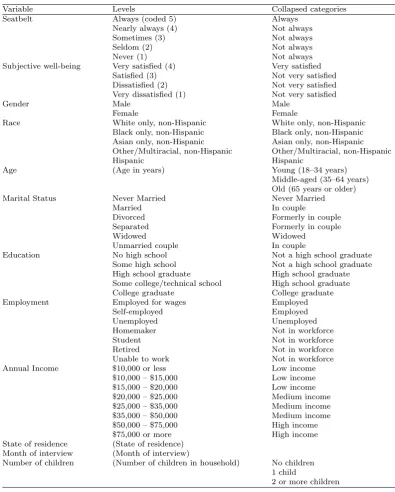
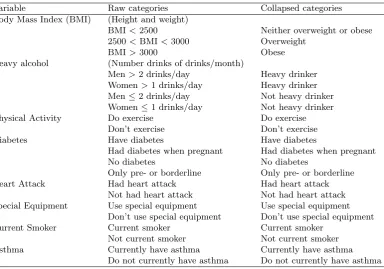
3.1 The main covariates used from BRFSS in Chapter 3. . . 59
3.2 Additional covariates from BRFSS used in model selection analyses in Chapter 3. . . 71
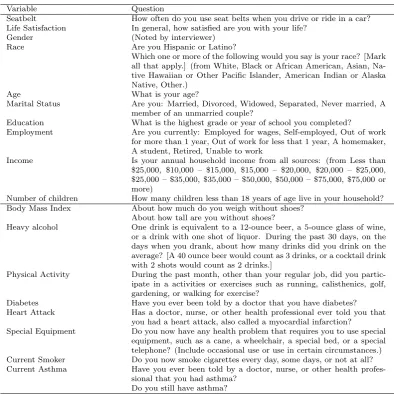
3.3 Questions used in the study from BRFSS in Chapter 3. . . 72
3.4 Logistic regression equations for seatbelt use. . . 73
3.5 Ordinary Least Squares (OLS) equations for seatbelt use. . . 74
5.1 Structural Hamming distances (SHDs) between the graph given by the five different methods and the true graph. . . 115
6.1 The variables used in Chapter 6, the number of categories, and the exact wording of the questions. . . 135
List of Figures
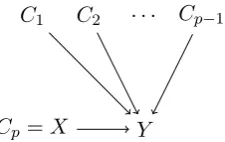
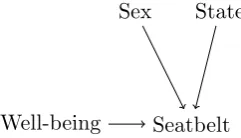
3.1 A graphical representation of the form of the models used in variable
selection in Chapter 3 for joint effects of multiple covariates. . . 60
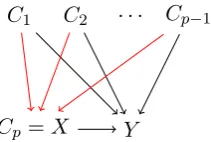
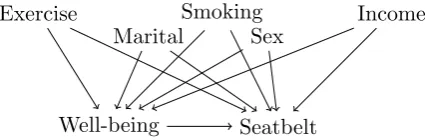
3.2 A graphical representation of the form of the models used in model
selection in Chapter 3 for joint confounding by multiple factors. . . . 62
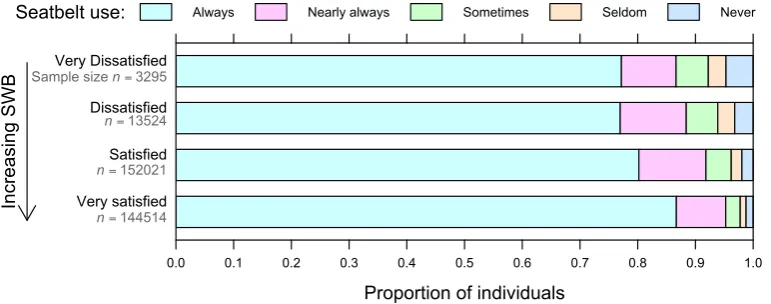
3.3 Frequency of seatbelt use cross-tabulated by subjective well-being
(SWB). . . 64
3.4 The model selected by variable selection for seatbelt use for joint
effects of multiple covariates. . . 66
3.5 Fitted (posterior) probabilities of always wearing a seatbelt given
subjective well-being. . . 67
3.6 The model selected for joint confounding by multiple factors of the
relationship between well-being and seatbelt use. . . 68
4.1 Illustrative graphs of when small local moves may fail to enable
tran-sitions between two regions of high probability. . . 85
4.2 An illustrative example of the notation used in defining the two-stage
sampling for the Gibbs sampler. . . 94
5.1 ROC curves given by estimated posterior distributions from 10
repli-cations of our Gibbs sampler, MC3, and the REV sampler for the
5.2 The distribution of the areas under the ROC curves for the synthetic
data from the ALARM network, forn= 100, . . . ,5000. . . 114
5.3 Convergence diagnostics for all three MCMC samplers for the ALARM
data withn= 1000. . . 116
5.4 Convergence diagnostics for all 10 runs of each MCMC sampler for
the ALARM data withn= 1000. . . 117
5.5 Major discrepancies between pairs of the 10 independent runs for each
MCMC sampler. . . 118
5.6 Convergence diagnostics for all three MCMC samplers for the BRFSS
data. . . 121
5.7 Convergence diagnostics for all 10 runs of each MCMC sampler for
the BRFSS data. . . 122
5.8 Stability of estimators of the BRFSS data across bootstrapping, as
measured by SHDs, with the graph density made to match the graph
given by the PC-algorithm. . . 124
5.9 Convergence diagnostics for all three MCMC samplers, for the flow
cytometry data. . . 126
5.10 Stability of estimators for the flow cytometry data across
bootstrap-ping, as measured by SHDs, with the graph density made to match
the graph given by the PC-algorithm. . . 128
6.1 Convergence diagnostics for MC3 and the Gibbs sampler for the Add
Health data. . . 138
6.2 Summary network for the Add Health variables considered. . . 141
6.3 Conditional probability of depression, given various covariate states. 142
B.1 Log scores of the graphs visited by the three MCMC samplers in 10
B.2 Major discrepancies between pairs of the 10 independent runs, for
each MCMC sampler on the BRFSS data. . . 158
B.3 Log scores of the graphs visited by the three MCMC samplers in 10
independent runs on the BRFSS data. . . 159
B.4 Log scores of the graphs visited by the three MCMC samplers in 10
independent runs on the flow cytometry data. . . 160
B.5 Stability of estimators for the BRFSS data across bootstrapping, as
measured by SHDs, with the graph density made to match the graph
given by the Xie-Geng method, or so that the threshold is 0.5. . . . 161
B.6 The edges with posterior edge probability greater than 0.5, as given
by the Gibbs sampler for the BRFSS data. . . 162
B.7 Major discrepancies between pairs of the 10 independent runs, for
each MCMC sampler on the flow cytometry data. . . 162
B.8 Convergence diagnostics for all 10 runs of each MCMC sampler for
the flow cytometry data. . . 163
B.9 The edges with posterior edge probability greater than 0.5, as given
by the Gibbs sampler for the flow cytometry data. . . 164
B.10 Stability of estimators for the flow cytometry data across
bootstrap-ping, as measured by SHDs, with the graph density made to match
the graph given by the Xie-Geng method, or so that the threshold is
List of Notation
Basics
n The number of observations . . . 14
p The number of variables . . . 14
y A n-dimensional vector random vector . . . 13
Θ The parameter space of the entire model . . . 13
θ A vector parameterθ∈Θ . . . 13
X A n× p matrix of data, or the collection of random vectors {X1, . . . , Xp} . . . 20
XA The columns ofX specified by A . . . 34
X−i The columns ofX except column i . . . 20
⊥⊥ Independence of random variables. . . 18
⊥⊥ Dependence of random variables. . . 18
O Complexity upper bound. . . 90
N Normal distribution . . . 25
MVN Multivariate normal distribution . . . 30
IG Inverse-gamma distribution . . . 25
Models M A finite set of models . . . 15
M A model from the set of modelM . . . 15
|M| The number of models . . . 15
pM The dimension of model M . . . 14
ΘM Parameter space under model M . . . 15
θM The parameters of model M . . . 15
p(y|θM) The likelihood of model M . . . 15
π(θM |M) Parameter priors under model M . . . 15
π(M) Prior weight for model M . . . 15
p(y|M) The marginal likelihood of model M . . . 16
p(M |y) The posterior model distribution . . . 15
MMAP The maximuma posteriori model . . . . 16
Graphs G The set of all directed, acyclic graphs (DAGs) with p nodes 20 G= (V, E) A mathematical graph . . . 18
V Vertices . . . 18
Gij The (i, j) element of the adjacency matrix . . . 19
p The number of nodes in the graph G . . . 18
The number of edges in the graph G . . . 90
(i, j) Directed edge from node ito node j . . . 18
i→j Directed edge from node ito node j . . . 18
j←i Directed edge from node ito node j . . . 18
Gj The parents of node j inG . . . 18
hG1, . . . , Gpi The graphG with these parent sets. . . 19
GA The parent sets inG of nodes in A . . . 19
G−A The parent sets inG of nodes not in A . . . 19
TG Transitive closure matrix for G . . . 90
CG A path count matrix for G . . . 91
ν(G) The set of neighbouring graphs of G . . . 48
G−ij The graphG, with no edge i→j . . . 82
G+ij The graphG, with an edge i→j . . . 82
d The number of nodes in a path . . . 19
Bayesian networks G A Bayesian network. . . 20
XGj The random variables corresponding to the parentsGj of nodej inG . . . 20
π(G) Prior for graph G . . . 39
πi(Gi) Prior for the parents of node iin graphG . . . 79
p(X|G) The marginal likelihood for G . . . 39
p(Xi|XGi) The local marginal likelihood . . . 80
κ The maximum in-degree . . . 41
Regression models γ Indicator variable for the included predictors. . . 27
Mγ Regression model, with predictors indicated byγ . . . 27
pγ The number of predictors in modelMγ . . . 27
Xγ Matrix formed from the columns of X corresponding to predic-tors inMγ. For normal linear regression, the matrix also includes a column of 1s. . . 27
Discrete data r The number of categories (or levels) of y . . . 24
nk The number of observations in the kth category . . . 25
Cjγ jth configuration under modelMγ . . . 27
qγ Cardinality of the sample space of Xγ . . . 27
Normal data m,mγ The prior mean (under model Mγ) . . . 25
v,Vγ The prior variance (under model Mγ) . . . 25
wj The jth node inW . . . 93
ρ The number of nodes in W . . . 86
FW The collection of parent sets of W that yield an acyclic graph. . . 87
FW The collection of parent sets of nodes inW . . . 86
Fwj The parents in FW of the node wj inW . . . 86
F The set of acyclic graphs that differ from G in the parents of nodes inW . . . 93
P(FW |G−W,X) The conditional distribution for the parents of nodes in W . 87 H The set of all DAGs on the nodes in W . . . 93
H A DAG on the nodes in W . . . 93
η The number of nodes in H . . . 93
FHh A component of a partition of F. . . 93
G− The graph formed from Gby removing edges directed towards a node in W . . . 93
Dj The descendants of node wj ∈W inG− . . . 93
Kj The non-descendants of node wj ∈W inG− . . . 93
K Nodes that are not descendants in G− of any node inW . . 93
DjH Descendants inG− of nodes in Hwj . . . 93
FHW The collection of allowed parent sets for each nodewj ∈W, using H . . . 98
FHj The set of allowed parent sets for wj, using H . . . 98
Gj The set of possible parent sets of node j . . . 99
Gij The Gj that contain node i . . . 99
⊗ Outer matrix product . . . 91
Acknowledgements
I am very grateful to my supervisors, Sach Mukherjee and Frances Griffiths, for
their constant enthusiasm, encouragement and inspiration throughout my time at
Warwick. It has also been a pleasure to collaborate with three economists (Andrew
Oswald, Jan-Emmanuel De Neve and Stephen Wu) and I am particularly grateful
for their efforts in helping a statistician to understand some of their field.
I have been fortunate to work amongst many other generous and friendly members of
staff and students at the Department of Statistics. Thank you particularly to those
in Sach’s group, those who suffered me in D0.06, and to Chris Jewell who ran the
departmental high performance computing facilities in his own time so pleasantly.
I am indebted to my parents and sisters for their encouragement and support. Most
importantly, I thank Sarah, my fianc´e and closest friend, who experienced the
devel-opment and writing of this thesis the most closely, but was nevertheless supportive
and encouraging throughout.
I also thank Marco Grzegorczyk, Dirk Husmeier, Karen Sachs, Amanda Goodall,
Graham Loomes, and Mark Steel for an assortment of thoughts, code and data
used in various parts of this thesis. Financially, I have been been supported by a
joint Economic and Social Research Council (ESRC) and Engineering and Physical
Declarations
I hereby declare that this thesis is based on my own research, except when stated
otherwise. This thesis has not been submitted for a degree at another university.
Some of this work has been published, is available as a working paper, or has been
submitted for publication as follows.
The material of Chapter 3 forms part of a paper ‘Happiness as a driver of
risk-avoiding behavior’ that is under review, co-authored with Sach Mukherjee,
Jan-Emmanuel De Neve, Andrew J. Oswald and Stephen Wu. The analyses from this
paper presented here are my own work, although an initial ordinary least squares
analysis was conducted by Stephen Wu. An earlier version of this paper is available
as CESifo Working Paper Series No. 3451.
Chapters 4 and 5 are an extension of work available as CRISM Working Paper
No. 11-21, under the title ‘An efficient Gibbs sampler for structural inference in
Bayesian networks’. The working paper is co-authored with Sach Mukherjee.
The material presented in Chapter 6 was published as ‘Exploratory network analysis
of large social science questionnaires’ in the Proceedings of Bayesian Modelling
Applications Workshop (BMAW-11). This was co-authored with Sach Mukherjee
Abstract
Structural inference for Bayesian networks is useful in situations where the under-lying relationship between the variables under study is not well understood. This is often the case in social science settings in which, whilst there are numerous theories about interdependence between factors, there is rarely a consensus view that would form a solid base upon which inference could be performed. However, there are now many social science datasets available with sample sizes large enough to allow a more exploratory structural approach, and this is the approach we investigate in this thesis.
In the first part of the thesis, we apply Bayesian model selection to address a key question in empirical economics: why do some people take unnecessary risks with their lives? We investigate this question in the setting of road safety, and demon-strate that less satisfied individuals wear seatbelts less frequently.
Bayesian model selection over restricted structures is a useful tool for exploratory analysis, but fuller structural inference is more appealing, especially when there is a considerable quantity of data available, but scant prior information. However, robust structural inference remains an open problem. Surprisingly, it is especially challenging for largenproblems, which are sometimes encountered in social science. In the second part of this thesis we develop a new approach that addresses this problem—a Gibbs sampler for structural inference, which we show gives robust results in many settings in which existing methods do not.
Chapter 1
Introduction
The aim of statistical modelling is to improve the degree of understanding of a
phenomenon of interest. Statistical models can help to describe and explain many
things including which factors are important; the direction and magnitude of the
associated effects; and, more generally, the relationship (if any) between variables of
interest. However, the level of precision that is attainable with statistical analysis
is usually determined by the nature of the data that are available and the (a priori)
assumptions one is prepared to make.
In general, more precise inferences will be possible when more data are available.
The sample size is usually the most important dimension of the data. In addition,
for the analysis to be useful, it will typically be important that the data are a
representative sample from the larger population under study, to facilitate inference
about the wider population. The second dimension of the data (the number of
variables measured) is also important because of the need to minimise the possibility
that a factor that was not measured performs an important role in the system under
study.
is the existing level of understanding. Statistical inference is always built upon
assumptions. In likelihood-based inference, many of the important assumptions are
made when determining the likelihood. In some settings, these assumptions may be
based upon accepted theories of the underlying system and are thus well founded.
In such a case, inference is about understanding the details of a system for which
the structure is already understood. In multivariate statistics, a core part of these
assumptions relate to the dependencies between different variables (or components)
of the system. Any assumption made about the structure of the dependency is
important in statistical inference because it is built into the likelihood.
1.1
Scope of the analysis
In this thesis, we consider the situation in which high-quality data are available,
but the existing accepted level of understanding of the phenomenon under study is
poor. In particular, we mostly do not assume a particular structure of dependence
between the components of the system. Instead, the purpose of the analysis is to
make inference about dependence. Making relatively weak assumptions, such as we
do here, means that we keep an open mind to unexpected relationships. Thus the
analysis that we make is mostly exploratory in nature.
We also assume that only observational data are available. In such cases, without
any information about the effect of interventions, it usually is very difficult to infer
anything conclusive about causality. There is a large literature covering methods
for analysing data collected through observational studies (Rosenbaum, 2002), but
much of this avoids making causal claims. Some of the strongest claims about
causality have come from researchers working with graphical models, for example,
Cox and Wermuth (2004), and, most prominently, Pearl (2009). However, it remains
there are many advocates of other approaches (notably Rubin, 2005).
Here, we take the view that graphical approaches are useful tools in situations in
which strong causal claims are sought, but we do not seek to construe our results in
this manner. Instead, we view our work as primarily about discovering relationships
that suggest interesting conjectures; these are framed in a manner that allows further
work (ideally interventional) to be carried out to examine the conjectures in more
detail. This point of view has been proposed previously by many authors including
Williamson (2005), who views the approach as a hybrid between a
hypothetico-deductive and an inductive approach to discovering causal relationships.
The cost of data collection is generally falling, and so ‘large’ datasets are now
in-creasingly the norm. A considerable amount of data are now available that describe
phenomena about which no consensus model is available. Datasets describing
var-ious aspects of economics, genetics, molecular and cell biology, and diverse areas
of the social sciences are widely available. In many of these areas, the growth in
the availability of data has exceeded the growth in theoretical understanding. This
opportunity is an opening for statistical methods that improve understanding in
these settings.
1.2
Statistical model selection
1.2.1 Inadequacy of the complete model
In poorly understood settings there may be many factors that could plausibly play an
important role in the system under study. In this situation a model that incorporates
all of these factors may seem attractive, because it incorporates all of the available
information and the analysis is not prejudiced by the disregarding of potentially
The estimator associated with thiscomplete orfull modelwill have many
de-grees of freedom, and so it is able to closely replicate features in the data. However,
the ‘volume’ of space in which a high-dimensional probability distribution may have
support (regions of positive probability) increases exponentially as its dimension
in-creases, a phenomenon described as the ‘curse of dimensionality’ by Bellman (1961)
in the context of dynamic programming. This effect results in the available data
being sparsely dispersed across the space relative to its size.
Another example of this problem is given by Silverman (1986), who calculates
the required sample size for an estimator ˆp(x) of the density p(x) at the origin
of a unit multivariate normal distribution to have relative mean squared error
E (ˆp(0)−p(0))2
/p(0)2 less than 0.1. For a univariate distribution p(x), only 4
samples are required to satisfy this criterion; for a 5-dimensional distribution, 768
samples are required; and for a 10-dimensional distribution, around 842,000 samples
are required. Thus even for a smooth unimodal distribution, with a simple
mea-sure of fit based around the mode of the distribution, the amount of data required
rapidly becomes enormous as the dimension of the distribution grows. As a result,
even with a large sample size, a single dataset in a high-dimensional setting will not
exhibit all of the characteristics of the underlying probability distribution.
Thus, while on average closely matching the data will give accurate estimates, rigidly
replicating the exact properties of a single dataset may be far from optimal. An
estimator that does this will be particularly susceptible to small variations in the
data, and so the estimator will have high variance. On the other hand, the estimator
has low bias because averaging across replications of the data will give accurate
estimates. Particularly in exploratory settings, the complexity of a model including
all of the factors is a disadvantage. For these reasons, the complete model is often
complete model whilst mitigating its disadvantages. The advantage that we want to
keep is the small bias; the disadvantage we seek to ameliorate is its large variance.
In these settings reducing variance will increase the bias, and so a trade-off exists
between these properties (see, e.g. Hastie et al., 2009). At the opposite end of the
spectrum of model complexity to the full model, we could consider a univariate
model that includes no covariates. This model will typically have the opposite
problem: large bias, but low variance.
A particular example of these trade-offs is a regression model with 100 potential
predictors. The ordinary least squares estimators for the regression coefficients are
consistent, so as the sample size grows, the coefficients will converge to their true
values. In practice, we have only a finite sample, and so the estimators will not give
the true values of the coefficients. In particular, the estimates for the coefficients
in the full model will have a large variance. The large variance in the estimates is
intuitive because in the parameter space for the full model, the data will be sparsely
dispersed, and so a small change to an individual data point may lead to a large
change in the estimators. Averaging across replications of the data, however, will
lead to the estimators having the correct values. Thus, the bias of the estimators is
low. In contrast, a model including only one predictor will have low variance, which
is intuitive because a relatively large amount of data will be used to estimate its
value. However, such a simple model may not be expressive enough to capture the
true form of the data, and so the bias of the estimator will be high.
1.2.2 Objectives and viewpoints
We have described why in many settings a full model may not be appropriate even if
it does subsume the ‘true model’ (the concept of a ‘true model’ is discussed further
below, in Sections 1.3.2 and 1.2.3). Conversely a simple, univariate model may not
an intermediate model that balances the competing requirements of minimising
bias and variance. The models that are considered may be of differing dimension or
contain different functional forms. Handling the varying dimensions of the models
considered is particularly difficult. The problem of finding an appropriate model is
known in general asmodel selection.
The ideal model will strike a balance of being consistent with the data without being
overly complicated in such a way that over-fitting will occur. This idea has a long
history and is often attributed to William of Ockham, under the name Occam’s
razor, or called theprinciple of parsimony. Each model may be associated with
a particular scientific hypothesis, and so model selection may be useful in comparing
the competing hypotheses.
One aim of model selection is to understand the dependence structure of the
vari-ables. The structure of the dependence within a system can be encapsulated by the
likelihood function of a statistical model. Inference about the dependence
struc-ture can thus be considered as statistical model selection. The origins of this form
of analysis can be traced back to the work of Sewall Wright, who developed the
method of path analysis (Wright, 1921), which aims to measure the direct effect
of each ‘path’ in a system. Another early methodology that can be viewed in this
light is that of Dempster (1972), in which the covariance structure of a multivariate
normal distribution is modelled with a particular focus on finding a simple
descrip-tion of its structure. A simple descripdescrip-tion of the structure is achieved by setting
appropriate entries of the inverse covariance matrix to zero. In doing so, conditional
independence, given all other variables, is implied between the corresponding
vari-ables, and the number of parameters in the model is reduced. These models can
be viewed as undirected Gaussian graphical models (Lauritzen, 1996). The models
considered in this thesis can be viewed as originating in similar work. However,
Bayesian networks.
1.2.3 What is a statistical model?
Before turning to practical issues related to choosing the model, we discuss the
meaning and role of statistical models and their relationship to ‘truth’. Bernardo
and Smith (1994, ch. 4, pp. 237) argue that most statisticians agree that the role of
models is to provide a focused framework within which simplified representations of
phenomena can be discussed. The most optimistic view is that a single statistical
model can encapsulate ‘truth’. Thus, if we can construct a list M of candidate models, we can try to determine which of these is true. This view usually seems
overly-optimistic. Instead, a more appropriate view in most contexts is the
prag-matic view taken by Box and Draper (1987) in a discussion of the bias-variance
trade-off: “all models are false, but some are useful”. Buckland et al. (1997) take
a similar view asserting that the ‘truth’ is high dimensional, and effectively infinite
dimensional, and so in handling model uncertainty we should seek the best
approx-imating fit rather than the ‘truth’. Another pragmatic viewpoint is taken by Fisher
and Neymann (as discussed by Lehmann, 1990), who suggest that the key
char-acteristic of models should be familiarity and simplicity. See Cox (1990) for more
discussion on the role of models.
1.2.4 Implementation of model selection
In practice, choosing a model that balances bias and variance is not straightforward.
For complex multivariate models, assessing the bias and variance associated with
an estimator from a single, finite dataset is challenging. In particular, measuring
the discrepancy between the observed data and a model is not sufficient because by
this metric the full model is always selected. In addition, the traditional methods of
maximum likelihood estimators (MLEs) do not give sensible results in this context
for several reasons.
One problem is multiple testing. Freedman (1983) examined this issue empirically.
Data from 50 independent random variables were regressed against data from an
entirely independent variable. Alarmingly, after dropping 35 variables which were
insignificant at 0.25 level, 6 of the remaining 15 variables were judged significant
at the 0.05 level. The Bonferroni correction (Bonferroni, 1936; Bland and Altman,
1995) offers a simple adjustment for this problem under an assumption of
indepen-dent tests. There has been much work on multiple testing in recent years (see e.g.
Benjamini and Hochberg, 1995; Dudoit and van der Laan, 2008).
Additionally, the metric by which we judge a model must account for the number
of parameters that the model includes. One approach in the frequentist framework
is to add a term to the likelihood function that penalises high-dimensional models.
Examples include Akaike’s information criteria (Akaike, 1974; Burnham and
Ander-son, 2002), which is known as AIC, and the Bayesian information criteria (Schwarz,
1978), which is known as BIC. Information criteria describe a general method for
likelihood penalisation. Penalised likelihood approaches for model selection have a
rich literature, see e.g. Claeskens and Hjort (2008). We describe AIC and BIC in
more detail in Section 2.1.
In the specific context of regression, penalisation based on `1 and `2 norms of the
coefficient vector are widely used (B¨uhlmann and van de Geer, 2011). Ridge
re-gression (Hoerl and Kennard, 1970) uses a `2 penalty. Using this penalty allows
straightforward maximisation of the (penalised) likelihood to yield a closed-form
estimator. The estimates for the regression coefficients are shrunk towards zero,
thereby controlling over-fitting. However, ridge regression does not set regression
se-estimates for the regression coefficients to exactly zero. Here, maximisation of the
penalised likelihood requires optimisation, but an efficient algorithm called LARS
(Efronet al., 2004) exists.
Bayesian model selection offers an alternative approach (detailed in the next
sec-tion). Rather than directly using penalised likelihoods, a posterior distribution
across a set of models is constructed, and comparison between pairs of models can
be made using Bayes factors. Bayesian model selection and penalised likelihood
methods are closely related: the log posterior distribution is given, up to a
con-stant, by the sum of the log likelihood and the log prior. The (negative) log prior
can therefore be viewed as a penalty term. This view makes clear the relationship
between various penalised likelihood estimators and related Bayesian formulations.
Approaches that draw ideas from the Bayesian approach in a frequentist context are
also available. For example, Buckland et al. (1997) propose a method for
assign-ing weights to models, but the weights arise from functions of information criteria,
rather than from a posterior distribution. The BIC also straddles both frameworks:
although it takes the form of a penalised likelihood, it is also an asymptotic
approx-imation to the Bayes factor.
1.3
Bayesian model selection
1.3.1 Basic Bayesian framing
Model selection in the Bayesian framework considers an indicator variable over
mod-els as an additional parameter, equipped with a prior and posterior distribution in
the same way that all parameters do in the Bayesian framework. The usual
models can then be found by an application of the discrete version of Bayes’
the-orem. The theory of handling model uncertainty in a Bayesian framework is now
well-developed; Clyde and George (2004) give a full overview.
1.3.2 Interpretations of Bayesian model selection
The interpretation of Bayesian model selection is clearest when one of the models
is viewed as the ‘truth’. Usually this seems unrealistic, but in practice, especially
when|M|is large, this may be a sufficiently good approximation. Assuming one of the models inMis true is calledM-closed by Bernardo and Smith (1994), who also delineate two further perspectives that could be taken on the list Mof models. In theM-completed viewpoint none of the models inMis viewed as true because our true beliefs can only be represented by a separate modelMt, which is precluded from
direct consideration by intractability. In this setting we need to proceed differently
because it does not make sense to assign a prior toMwhen this would not represent our true prior beliefs. The final possibility, M-open, occurs when even specifying
Mt is not possible. For the settings considered here, an M-open viewpoint is the most plausible, but for pragmatic reasons we will generally work in a relatively
M-closed framework.
1.3.3 Practical implementation
In the previous section, we noted the difficulty in comparing models of different
dimension, because unadjusted measures of fit will invariably prefer the most
com-plex model. In the Bayesian formulation, the relative posterior weights assigned to
two models is determined by the Bayes factor, which is the relative marginal
likeli-hood. Comparison of models of differing dimension is possible because the marginal
The computation of the posterior model distribution is often challenging, and
ad-dressing this in a particular context forms a key part of this thesis. Simpler
alter-natives have been proposed. For example, Draper (1995) considers starting from a
single model, and expanding it as suggested by context or the data. However, in the
context we consider here, it is attractive to consider a fully-Bayesian approach
be-cause the high-dimensionality makes it difficult to propose a sensible starting model.
Another simplification that can be often useful is BIC, which is an asymptotic
ap-proximation to the posterior distribution.
1.3.4 Summarising the posterior distribution
Once the posterior distribution over models has been evaluated, two distinct
ap-proaches can be taken to summarising its contents.
A simple approach is to find the posterior mode. The modal model (or models) is
the model that is most consistent with the data. While simple and convenient, a
drawback to this approach is that a level of uncertainty is ignored because it implies
that the final results are made conditional on the modal model (e.g. Chatfield, 1995).
When a quantity of interest that is interpretable across all the models under
con-sideration can be extracted from each model an alternative approach is available.
In this case, it follows from Bayes’ theorem that the posterior distribution for this
quantity is given by taking its average across the models, weighted by the posterior
mass for each model.
1.3.5 Bayesian model uncertainty in social science
Bayesian approaches to model uncertainty have not been widely adopted in social
science, despite the significant model uncertainty that exists. The foremost
research is Raftery (1995). In econometrics, Fern´andez et al. (2001b) advocated
Bayesian model averaging as a principled way to account for model uncertainty in
cross-country growth regression.
1.4
Contributions of the thesis
The thesis consists of three main contributions.
The first contribution is a study of the effects of well-being on risk-taking. This
question has not been considered before, although Kirkcaldy and Furnham (2000)
found correlations consistent with the findings of our work. We take a Bayesian
model selection approach to the question, which is unusual in empirical economics.
We find evidence in support of the theory that those with higher levels of well-being
are more averse to risk-taking.
We then introduce a novel Gibbs sampler for structural inference of Bayesian
net-works. While Gibbs samplers have been used with Bayesian networks before, they
have not been used for structural inference. The Gibbs sampler introduced here
explores the posterior distribution of Bayesian networks. While the general method
of Gibbs sampling is well-established, the requirement of acyclicity in Bayesian
net-works makes designing a Gibbs sampler difficult in this context. We show
empiri-cally that the Gibbs sampler exhibits far superior performance compared to several
state-of-the-art methods. Indeed, in many cases, results obtained from widely used
methods are so unstable as to be unusable in practice.
The final contribution of the thesis is an explorative study of depression in
adoles-cents. Large social science questionnaires, including the survey we use in the thesis,
have not been previously studied using structural inference of Bayesian networks.
Chapter 2
Background
2.1
Model selection
A parametric statistical model does not fully describe a probability distribution.
Instead, it describes a family of distributions, up to some parameters θ. For a
vector valued random variabley, a modelM specifies the joint distribution ofy, up
to unknown parameters θ. The joint probability of y can be specified conditional
on both parametersθand model M.
p(y|θ, M) withθ∈Θ
Often, dependence on the modelM is left implicit and emphasis placed on the joint
distribution as a function of parameters θ, i.e. the likelihood function.
Statisti-cal inference seeks to understand the relationship between these parameters, and
data. In Bayesian inference, we aim to describe the posterior distribution of these
parameters, given the data.
As outlined in Chapter 1, we will be considering a situation in which observations
of many variables are available, but the appropriate model for the variables is not
known. Therefore, we will consider the model itself as the object of interest for
inference.
Supposensamples frompvariables are available. LetpM be the dimension of model
M.
In the frequentist framework, a widely used approach to model selection involves
pe-nalised likelihood methods. The most well-known of these, the AIC, was introduced
by Akaike (1974) and has the following form.
−2 log(p(y|θ, M)) + 2pM
The model that minimises AIC is preferred. An alternative is the Bayesian
Infor-mation Criterion (BIC), introduced by Schwarz (1978).
−2 log(p(y|θ, M)) +pMlog(n)
In the specific context of regression, numerous penalised estimators for the regression
coefficients β have been proposed. Consider a regression model for an outcome
variabley, using a set ofqpredictors. Suppose we have observationsy= (y1, . . . , yn)
of the outcome, and observations of the predictors arranged into the columns of
a matrix X. The LASSO (Tibshirani, 1996) penalises the regression coefficients
by an `1 penalty. This penalty permits setting of some regression coefficients to
exactly zero, thereby leading to variable selection. An older alternative is ridge
regression (Hoerl and Kennard, 1970), which uses an `2 penalty, and yields the
following estimators for the regression coefficients, with Iq being the q×q identity
matrix.
ˆ
While ridge regression will shrink coefficients towards zero, it will not shrink them
to exactly zero in the way the LASSO does, and so does not lead to variable
selec-tion directly. Numerous other penalties have been proposed, notably the smoothly
clipped absolute deviation (Fan and Li, 2001), the elastic net (Zou and Hastie, 2005)
and the adaptive LASSO (Zou, 2006).
The Bayesian approach does not use a penalised likelihood explicitly, but the log
prior can be viewed as such. A particular instance in which the two approaches yield
the same solution is a regression in which the prior for the regression coefficients
is β ∼N(0, σ2λ−1Iq). The resultingmaximum a posteriori (MAP) estimator forβ
matches the ridge estimators exactly (Hoerl and Kennard, 1970; Hsiang, 1975).
2.1.1 Bayesian model selection
The Bayesian approach to model selection treats the model simply as another
pa-rameter. Suppose a finite set of modelsMis under consideration, and that a vector of observationsy is available. Each modelM ∈ Mconsists of a likelihood function p(y|M, θM) with parameters θM ∈ΘM. These parameters have priorsπ(θM |M)
in each model.
Since the set of modelsM under consideration is a finite set, the model prior is a discrete distribution over this set.
π(M) =πM, M ∈ M where πM ≥0 and X
M∈M
πM = 1
An expression for the posterior distribution for a model M can be written down
immediately, by a simple application of Bayes Theorem. The expression depends
on the marginal likelihoodp(y|M) of M.
P(M |y) = P p(y|M)π(M) M∈Mp(y|M)π(M)
The quantityp(y|M) is given by
p(y|M) = Z
ΘM
p(y|M, θM)π(θM |M)dθM, (2.2)
and is referred to as themarginal likelihood.
Evaluation of this posterior distribution is typically difficult for two reasons. First,
the integration in Equation 2.2 may be difficult to evaluate. This difficulty motivates
the use of conjugate models, as described in Section 2.3.1, which enable evaluation
of the integral analytically. The second difficulty is the summation over M in the normalising constant of Equation 2.1. When the cardinality of M is large, it is not possible to evaluate the summation exactly. However, Markov chain Monte
Carlo methods enable the posterior distribution to be approximated without directly
evaluating the normalising constant.
There are two distinct approaches for summarising the posterior distribution. A
simple approach is to select a single model, and base any further inference as
condi-tional upon this model. When choosing a single model, the maximuma posteriori
(MAP) model is usually chosen.
MMAP= arg max
M P(M |y)
The MAP modelMMAP may not be unique, and even when it is, it may not be
rep-resentative of the posterior distribution. If the posterior distribution is multi-modal,
with disparate models having high posterior probability, it may be unsatisfactory
to choose the one model.
Alternatively, if some quantity ∆ is interpretable in all models, we can average it
across all of the models, weighting by the posterior model probability.
This approach is called Bayesian Model Averaging (Hoetinget al., 1999; Wasserman,
2000). Choosing an appropriate model prior can be challenging, and is discussed
further in Sections 2.4.3 and 2.5.4.
2.2
Graphical models
Throughout this thesis, the relationship between variables is studied using graphical
models. These models enable the decomposition of complex multivariate
distribu-tions into simpler local distribudistribu-tions. Such a decomposition can reveal a great
deal about the relationships between the variables. In addition, a graphical model
provides a statistical and computationally tractable description of a large joint
dis-tribution.
The decomposition is formed by the conditional independence structure, which can
be represented by a graph. Thus, graphical models describe families of probability
distributions using a mathematical graph. The graphical representation can ease
the interpretation and clarify the structure of complex models. In addition, in some
situations, the computation of particular marginal distributions can be simplified
when a graphical representation is considered (see e.g. Lauritzen and Spiegelhalter,
1988).
In most graphical models, the nodes of the graph represent random variables and
the edges represent the (conditional) dependence structure amongst the random
variables. The conditional independence structure gives a deeper understanding of
the relationships between the random variables, as we describe below.
A variety of graphical models have been developed (see e.g. Lauritzen, 1996; Smith,
2010). The two most widely used graphical models are Markov random field models,
which are represented by an undirected graph, and Bayesian networks, which are
model.
2.2.1 Conditional independence
While a crude understanding of the relationship between random variables is
pro-vided by a simple correlation analysis, a far deeper understanding is propro-vided by
the conditional independence structure. In particular, correlation analysis gives no
understanding of whether relationships between two variables are mediated by a
third, whereas this is captured in the conditional independence structure. Such
knowledge is generally informative, and indeed much of statistics can be considered
in terms of conditional independence (Dawid, 1979). Knowledge of the conditional
independence structure is particularly valuable when a loose form of causality is
sought.
Two random variablesAandB are conditionally independent given a third random
variableC if the following property holds.
p(A, B|C) =p(A|C)p(B|C) for all C such thatp(C)>0
When this property holds, we use the shorthandA ⊥⊥B |C. We write A ⊥⊥B |C
when the property does not hold.
2.2.2 Graphs
A mathematicalgraphG= (V, E) consists of a set ofnodesV = (1, . . . , p), and a
set ofedgesE that link pairs of nodes. We also usev1, . . . , vp to denote the nodes
in the graph.
and will use three different notations to specify their edges: the collection of edges;
adjacency matrices; and parent sets.
First, we can specify edges of a graph as a subsetE ⊆V ×V, as per the definition of a graph. Individual directed edges from node i to node j can thus be denoted
by either the pair (i, j), or the symbol i→j. We will refer toi as thehead of the edge, andj as the tail.
We can also specify the graphG= (V, E) with anadjacency matrix G, ap×p matrix with elementsGij given by
Gij =
1 if (i, j)∈E 0 otherwise.
The final specification of the edge set E of the graph Gthat we use is in terms of
the parents Gj of each node j, forj ∈ {1, . . . , p}. The parents Gj of node j are
the subset of nodesV such that i∈Gj ⇔(i, j) ∈E. We refer to Gj as a parent set.
It will sometimes be convenient to use the collection of parent setshG1, . . . , Gpi to
specify a graphG. Subsets thereof are denoted by GA=hGk : k∈Ai. ThusGA is
a collection of parent sets, specifying only the parent sets of nodes inA; the parent
sets of nodes not inAare not specified byGA. The subset given by the complement
AC = {1, . . . , p} \A of a set A is denoted by G−A = hGk : k ∈ ACi. Thus G−A
specifies the parent sets of nodes not in A, leaving the parent sets of nodes in A
unspecified. The parent sets of all nodes can be specified byhGA, G−Ai. Thus, in
particular, any graph G can be specified as hGj, G−ji = hG1, . . . Gpi = G for any j∈ {1, . . . , p}.
for each i = 1, . . . , d. In a directed graph, we usually require that (vi−1, vi) ∈ E
meaning that the path obeys the directions of the edges. However, it will occasionally
be useful to consider a path that does not obey the direction of the edges on a path.
Cycles are a particular type of path that will be of key interest. A cycle is path
v0, v1, . . . , vd, d ∈ N, such that v0 = vd, and the path obeys the direction of the
edges. A graphG in which a cycle exists is called cyclic; a graph without cycles
is called acyclic. We denote the set of all directed, acyclic graphs (DAGs) withp
nodes byG.
For undirected graphs, we denote byi−j an edge between node iand nodej. We define adj(i) as the set of nodesjsuch thati−j. Acomplete undirected graph is an undirected graph in which an edge links every pair of nodes in the graph.
2.2.3 Bayesian networks
Bayesian networks are a particular type of graphical model. A Bayesian networkG
is a DAG with nodes V = (1, . . . , p), and directed edges E ⊂ V ×V. The nodes correspond to the components of the random variables X1, . . . , Xp. We denote by
XGj the set of random variables that correspond to the parentsGj of nodej in the
graphG. It is convenient to refer to XGj as theparents of Xj.
A defining feature of Bayesian networks is that the joint distribution of X is
spec-ified in terms of p(Xi | XGi, θi), the conditional distribution of each Xi, given
its parentsXGi in the Bayesian network, with parameters θi. Denoting by X−i =
{X1, . . . , Xi−1, Xi+1, . . . , Xp}the random vector excludingXi, we havelocal mod-els(orlocal distributions) p(Xi|XGi, θi) that satisfy the following.
product of these local distributions.
p(X1, . . . , Xp |G) = p Y
i=1
p(Xi|XGi, θi)
The conditional dependence structure of the probability distribution can be
deter-mined using the d-separation criterion (Verma and Pearl, 1990). We describe this
criterion using the concept of blocked paths, which uses the concept of a path being
head-to-head at a node. We say that a path v0, . . . , vd (not necessarily obeying
edge directions) on a DAG G = (V, E) is head-to-head at a node vi, for some
i∈ {1, . . . , d−1}if (vi−1, vi)∈E and (vi+1, vi)∈E.
A blocked path can then be defined as follows. LetS be a subset of V so thatS is
a set of nodes in the graph. A path (not necessarily obeying edge directions) from
node v0 ∈ V to nodevd ∈V in a DAGG is said to be blockedby S if the path includes a nodevi, i∈ {1, . . . , d−1}, such that one of the following two criteria is
satisfied.
• vi ∈S and the path from nodev0 to nodevd is not head-to-head at nodevi. • The path is head-to-head at nodevi, and neither is node vi in S, nor does S
contain any of the descendants in the graphG of nodevi.
Two subsetsA, B⊆V ared-separated if all the paths (not necessarily obeying edge directions) fromA toB are blocked.
A particular conditional independence structure can be implied by multiple different
Bayesian networks. However, we can define an equivalence class on the space of
Bayesian networks such that Bayesian networks within the same class imply the
same conditional independence structure. The definition arises from the definition
ofd-separation and uses the concept of the skeleton of a Bayesian network, and ofv
-structures. Theskeletonof a Bayesian network is the undirected graph formed by
is defined as an ordered triple (i, j, k) of nodes, such thati→j and k→j, but no edge exists linking nodesiand kdirectly. Two Bayesian networks areequivalent
if they share the same skeleton andv-structures (Verma and Pearl, 1990).
We can specify the equivalence class of a Bayesian network using a completed
partially-directed acyclic graph (CPDAG). This name originates in Chickering (2002),
but the idea has been used by other authors under a variety of names. A CPDAG is
a partially-directed graph, whose directed edges do not form a cycle. For a Bayesian
networkG, CPDAG(G) is formed by considering all of the edgesE0 for which in all
graphs G0, such thatG and G0 are equivalent, that edge is oriented as in G. Then
CPDAG(G) is formed by removing the direction attached to each edge not in E0.
Chickering (2002) show that CPDAGs uniquely represent an equivalence class of
Bayesian networks.
2.3
Univariate Bayesian models
The basic building-blocks of the models that we consider in Section 2.4 and 2.5 are
simple univariate models. In this section, we first describe conjugacy, a property that
characterises a class of analytically-tractable models. We then review the simplest
form of the two conjugate models that are considered throughout this thesis.
We assume that Y is an n-dimensional random vector consisting of independent,
identically distributed components. We suppose observationsy ofY are available.
2.3.1 Conjugate priors
The integration required to evaluate Equation 2.2 is analytically intractable for
many choices of priors for a given model. If our understanding is such that our prior
a prior for which the integration is straightforward, this difficulty can be avoided.
For the models that we consider in this thesis, priors of the required form are well
known, and are calledconjugate priors.
Conjugate priors (Raiffa and Schlaifer, 1961) are familiesP of distributions that are closed under sampling from a distribution in a familyF of distributions. A familyP
of prior distributions is said to be closed under sampling from a distributionp(y|θ) in a parametric family F if for every prior distribution π(θ) ∈ P, the posterior distribution p(θ | y) ∝ π(θ)p(y | θ) is also in P. A catalogue of many conjugate priors is given in Gelmanet al. (2004).
Raiffa and Schlaifer (1961) list three properties that they view as desirable in a
family of priors: tractability, interpretability and richness. Conjugate families are
tractable, and this is the main reason for their adoption. Conjugate priors sometimes
also have a simple interpretation. In exponential families we can consider the prior
as constituting “virtual samples” (see, e.g. Robert, 2007), and so the relative weight
implied on the prior and data can be ascertained. It is in richness, however, that
conjugate families can be lacking. Ideally, a prior should exactly match a Bayesian
modeller’s prior beliefs, but conjugate priors are often not flexible enough to allow
this to be fully achieved. Sometimes, a close approximation to prior beliefs can be
constructed within the conjugate family, but often a poor approximation is accepted
because of the computational advantages of conjugate priors.
In many standard Bayesian models, using non-conjugate priors is now feasible since
the emergence of easily available computationally-intensive approximations.
How-ever, in the setting considered here, non-conjugate priors are not viable for the
following reasons.
First, there are formidable computational challenges even when conjugate priors are
used. These challenges are considerably compounded by the use of non-conjugate
size of the data is large. The large sample size means that the prior will exert only
a minimal effect on the posterior distribution, thus making its exact specification
less important.
For these reasons, we use conjugate priors throughout.
2.3.2 Multinomial-Dirichlet
The standard Bayesian model for univariate multinomial data (e.g. O’Hagan and
Forster, 2004) will form the basis of the models we consider in this thesis. Consider a
random vectorY, each component of which takes one ofr discrete categories.
Sup-pose thatY is distributed according to a multinomial distribution, with parameter
vectorθ= (θ1, . . . , θr), withθ >0 and θ1+· · ·+θr = 1.
Y∼Mult(θ1, . . . , θr)
The conjugate prior for the vectorθis Dirichlet, with hyperparametersα= (α1, . . . , αr)
whereαk >0,k= 1, . . . r.
θ1, . . . , θr ∼Dir(α1, . . . , αr) withθ1, . . . , θr ≥0 and r X
k=1
θk= 1
The normalising factor in the Dirichlet likelihood is a ratio of gamma functions
Γ(α) =R∞
0 xα−1e−xdx, for which, in particular, Γ(α) = (α−1)! forα∈N.
p(θ1, . . . , θr) =
Γ(α1+· · ·+αr)
Γ(α1). . .Γ(αr) r Y
k=1
θαk−1 k
The mean isαk(Prk=1αk)−1 for each θk.
The posterior distribution of θ is parameterised in terms of a contingency table
thekth category,k= 1, . . . , r.
θ1, . . . , θr |y∼Dir(α1+n1, . . . , αr+nr)
The formulation simplifies in the natural manner for binomial data with beta priors.
In using this formulation, we are assuming that the data are independent,
identically-distributed draws from a multinomial distribution. It will often be the case that some
heterogeneity exists and so it is more appropriate to use a model that is conditional
on some collection of covariates; we consider this possibility in Section 2.4.1.
2.3.3 Normal inverse-gamma
The models for normally-distributed data that we consider will similarly build upon
standard univariate models (e.g. Gelman et al., 2004). Suppose we have a
ran-dom vectorY, components of which are independent random variables distributed
according to a normal distribution, with meanµand varianceσ2.
Y ∼N(µ, σ2)
When both µ and σ2 are unknown, the conjugate priors for µ and σ2 are normal
and inverse-gamma respectively.
µ|σ2 ∼N(m, v−1σ2) σ2 ∼IG(a, b)
The hyperparameters a and b are respectively the shape and scale parameters of
the inverse-gamma distribution. The hyperparametersm can be interpreted as the
distribution has density
π(σ2) = b
a
Γ(a)(σ
2)−(a+1)exp(−b/σ2).
The joint prior for (µ, σ2) is thus normal inverse-gamma NIG(m, v, a, b).
π(µ, σ2) =
√
v
σ√2π ba Γ(a)(σ
2)−(a+1)exp
−2b+v(µ−m) 2
2σ2
By conjugacy, the joint posterior distribution for (µ, σ2) is also normal
inverse-gamma.
µ, σ2|y∼NIG(m?, v?, a?, b?) where, with ¯y= n1Pn
i=1yi and s2=
Pn
i=1(yi−y¯)2, the parameters are
m?= mv+ny¯
n+v
v?= 1
n+v
a?=a+n
2
b?=b+1 2
s2+nv(¯x−m)
2
n+v
.
2.4
Model selection for Bayesian regression models
Regression models aim to characterise the relationship between a response variable
and a collection of predictor variables. The model for the response is specified
condi-tionally on the predictor variables. We consider situations in which the parametric
form of the conditional distribution is known, up to the choice of predictor
vari-ables. Model uncertainty in this context is therefore uncertainty about which set of
predictor variables should be used. The problem is known asvariable selection.
‘out-come’ values, and an×p random matrixx of observations ofp predictor variables. These observations come from a random vector Y, and a n×p random matrix X, the columns of which are random vectorsX1, . . . , Xp, respectively.
We aim to determine which subset of the predictors {X1, . . . , Xp}is best suited to
predictingY, the outcome variable. There are 2p subsets of the p predictors, each
of which corresponds to a possible model forY. A regression modelMγ is specified
using ap-dimensional indicator vectorγ = (γ1, . . . , γp), the ith component of which
takes the value 1 when theith variable is included in the model, fori= 1, . . . p. Let
Xγ = {Xi: γi = 1} be the set of predictor variables included in model Mγ, and pγ = Ppi=1γi be the number of predictors included in the model. We use Mγ to
refer to the set of all models. Note that the predictor variables are assumed to be
observed without error.
2.4.1 Multinomial-Dirichlet
Suppose each component of the response vectorYhasrlevels, or categories. We will
be considering models for the responseYspecified to be conditional on a subsetXγ
of the set of discrete variables{X1, . . . , Xp}. Each component ofXi, fori= 1, . . . , p,
has ri levels. We define the configurations of Xγ to be the components of its
sample space, for whichqγ=Qpi=1r
γi
i is the cardinality. We label the configurations
Cjγ forj= 1, . . . , qγ. We assume that observationsyand xfor the outcome random
vectorYand the predictor random variablesXrespectively are available; we denote
byxγ the observations for the predictors included in modelMγ.
For a particular modelMγ, we assume that the distribution of Y is independently
parameterised for different configurations ofXγ, the predictors in the model. Thus
smaller parameter spaces Θγ,j corresponding to the configurations of the predictors.
Θγ =
×
j=1,...,qγ
Θγ,j
Thus the likelihood factorises across configurations.
p(Y|Xγ, θγ,j, Mγ) = qγ Y
j=1
p(Y|Xγ =Cjγ, θγ,j, Mγ) with θγ,j ∈Θγ,j
This independence assumption means that no information is ‘shared’ about the
dis-tribution ofY between cases in which the configuration of the predictors differ, and
the model may be entirely different for different configurations. In particular,
lin-earity in the predictors is not a requirement for the fitted model. This unstructured
form of model means that availability of a large sample size is important for useful
inference to be possible.
The distribution ofY conditional on the configurationCjγ of the predictors is
spec-ified to be multinomial for each configuration, with j = 1, . . . , qγ, and with an
r-dimensional parameter vectorθγ,j ∈Θγ, each component of which corresponds to
a category ofY.
Y|Xγ, θγ,j, Mγ ∼Mult(θγ,j,1, . . . , θγ,j,r) forj= 1, . . . , qγ
The likelihood for y under a modelMγ is a function of the random variableNγ,j,k
given by the number of times that the predictors take thejth configurationCjγ and
the outcome variable has thekth category, forj = 1, . . . , qγ and k= 1, . . . , r.
p(y|Xγ, θγ, Mγ) = qγ Y
j=1
r Y
k=1
θγ,j,kNγ,j,k
1, . . . , qγ.
θγ,j,1, . . . , θγ,j,r ∼Dir(αγ,j,1, . . . , αγ,j,r) withθγ,j,1, . . . , θγ,j,r ≥0, r X
k=1
θγ,j,k= 1
We assume thatθγ,j are a priori independent. This assumption, when taken with
the assumption that the distribution ofy is independently parameterised, is called
local independence (Spiegelhalter and Lauritzen, 1990). The joint prior for
(θγ,1, . . . , θγ,qγ) is thus the product of Dir(αγ,j,1, . . . , αγ,j,r) distributions.
π(θγ,1, . . . , θγ,qγ |Mγ) = qγ Y
j=1
Γ(αγ,j,1+· · ·+αγ,j,r)
Γ(αγ,j,1). . .Γ(αγ,j,r) r Y
k=1
θαγ,j,kγ,j,k−1
For eachj= 1, . . . , qγ, unless otherwise stated, we take the hyperparametersαγ,j,k =
(riqγ)−1 for all k= 1, . . . , r, following Buntine (1991) and Heckerman et al. (1995).
Given observationsnγ,j,k of the contingency table random variables Nγ,j,k, formed
from observations y and x, the posterior distribution for each θγ,j is Dir(αj,1 +
nγ,j,1, . . . , αj,r+nγ,j,r), for eachj= 1, . . . , qγ. Defining the collection of countsnγ =
{nγ,j,k: j = 1, . . . , qγ and k= 1, . . . , r} under a model Mγ, and the corresponding
collection of hyperparameters αγ = {αj,k : j = 1, . . . , qγ and k = 1, . . . , r}, the
marginal likelihood can be written in closed-form.
p(y|Mγ, nγ, αγ) = qγ Y
j=1
Γ(αγ,j,1+· · ·+αγ,j,r)
Γ(Pr
k=1nγ,j,k+Prk=1αγ,j,k) r Y
k=1
Γ(nγ,j,k+αγ,j,k)
Γ(αγ,j,k)
2.4.2 Linear regression
The second model we consider is for a normally-distributed random variable Y
taking values in R. We again assume that Y is dependent on a subset Xγ of
ran-dom variables {X1, . . . , Xp} that defines the model Mγ, but we now assume that