
Exploring the relationship between CSR and technical innovations from the perspective of capital stakeholders
49
0
0
Full text
(2) Master thesis. Environmental and Energy Management. Table of Contents Acknowledgement ..................................................................................................................... 1 Abstract ..................................................................................................................................... 2 List of Acronyms ....................................................................................................................... 3 1.. 2.. 3. Introduction ....................................................................................................................... 4 1.1. Problem statement .................................................................................................. 4. 1.2. Research question ................................................................................................... 5. 1.3. Research structure .................................................................................................. 5. Literature review ............................................................................................................... 6 2.1. Corporate Social Responsibility (CSR) ................................................................... 6. 2.2. Technical innovation ................................................................................................ 8. 2.3. Stakeholder theory ................................................................................................. 12. 2.4. Capital stakeholder ................................................................................................ 13. 2.5. Technical innovation drivers based on capital stakeholder .................................. 14. 2.6. CSR and innovation.............................................................................................. 15. Research methodology .................................................................................................... 17 3.1. Research framework ............................................................................................. 17. 3.2. Research question ................................................................................................. 19. 3.3. Research strategy .................................................................................................. 19. 3.4. Research unit ........................................................................................................ 19. 3.5. Research material and accessing method ............................................................. 21. 3.6. Data analysis......................................................................................................... 21. 4. Findings ............................................................................................................................... 23 4.1. Corporation benefits promoted by CSR................................................................. 25 4.1.1 Human resources capital stakeholder benefits promoted by CSR .................. 25 4.1.2 Market capital stakeholder benefits promoted by CSR .................................. 29 4.1.3 Ecological capital stakeholder benefits promoted by CSR............................. 30. 4.2. Technical innovation driven from capital stakeholders ......................................... 33 4.2.1 Technical innovation driven from human resources capital stakeholder ........ 33 4.2.2 Technical innovation driven from market capital stakeholder........................ 34 4.2.3 Technical innovation driven from ecological capital stakeholder .................. 34. 5.Conclusions and Recommendations ..................................................................................... 35 5.1. Conclusions ........................................................................................................... 35 5.1.1 Research highlights ........................................................................................ 35 5.1.2 Final conclusions ............................................................................................ 36.
(3) Master thesis. 5.2. Environmental and Energy Management. Limitations and Recommendations ....................................................................... 36. Reference list ........................................................................................................................... 38 Appendix 1 Questionnaires ..................................................................................................... 42. List of Tables Table 1 Classifying the responsibilities of stakeholders .................................................. 12 Table 2 Sources of the Research Perspective .................................................................. 17 Table 3 Target Dutch food companies list ....................................................................... 20 Table 4 Data and information required for research accessing method ........................... 21 Table 5 Data and Method of Data Analysis ..................................................................... 22 Table 6 Technical innovation points from research cases................................................ 23 Table 7 CSR influences in human resources stakeholder ................................................ 26 Table 8 CSR influences in ecological capital stakeholder ............................................... 30. List of Figures Figure 1 The pyramid of CSR (Carrol, 1991).................................................................... 7 Figure 2 The W-model as high -level sequencing concept (Brandenburg, 2002).............. 9 Figure 3 Corporation growth and innovation .................................................................. 10 Figure 4 Innovation portfolio (Brandenburg and Spielberg, 1998) ..................................11 Figure 5 A Schematic Presentation of Research Framework .......................................... 18.
(4) Master thesis. Environment and Energy Management. Acknowledgement. During the process of carrying out this research project, I learned enormously and gained valuable experience. The learning process turned out to be a great learning and professional improvement opportunity. I could not succeed finishing this research project without the help and suggestions from my master’s fellows, teachers and informants for my study cases. First and most, I would like to thank my parents for supporting me to study abroad for the MEEM program. Only with their support and encouragements I could finish this journey and finalize this thesis. I would like to thank my first supervisor, Dr. Laura Franco-García. She was always ready to help and provide useful suggestions for my thesis. She gave advice not only to frame of my project in a scientific manner but she also gave all kind of suggestions to improve the writing details. With her feedback, I could advance and develop my thesis. Thanks to her timely communication with me, I could finalize my thesis in time. I would also like to thank my second supervisor Dr. Gül Özerol for her feedback and comments on this work. As mentioned here above, my gratitude goes also for my master fellows for providing useful suggestions for my thesis. Last but not least, I want to thank all the people who helped me filling the interview questionnaires.. Yuexin Zhang. 1.
(5) Master thesis. Environmental and Energy Management. Abstract. Corporate Social Responsibility(CSR) contributes at corporations to enhance the organizational and operational strategies. Meanwhile technical innovation helps to increase competitiveness and reduces costs for companies. Both these two themes are beneficial to companies. Based on the Dutch experience, the objective of this research is to identify the relationship(s) between CSR and technical innovation from the perspective of capital stakeholder. Some works analyzing the relationships between CSR and technical innovation can be already found but they are mainly focused on the financial performance to prove the positive links between CSR and technical innovation. A gap in the literature was identified in terms of cause-effect relationship and how this can in practice be organized and by whom. At this regard, in this research the key intermediate connection (capital stakeholder) between CSR and technical innovation was explored. Consequently the main research questions is how does CSR lead technical innovations from the capital stakeholder perspective? The research is based on qualitative analysis by using a mix-methods approach. The primary data was gathered from companies in the food industry, one of the top Dutch industry sectors, and interviews with (sustainability affairs) managers of those companies were carried out. As secondary data, internal reports, corporate official websites, among other sources of information were considered. The results show that CSR program is one of the drivers but not the main driver for technical innovation, CSR promotes the technical innovation especially on human resources, market and ecological capital stakeholders.. 2.
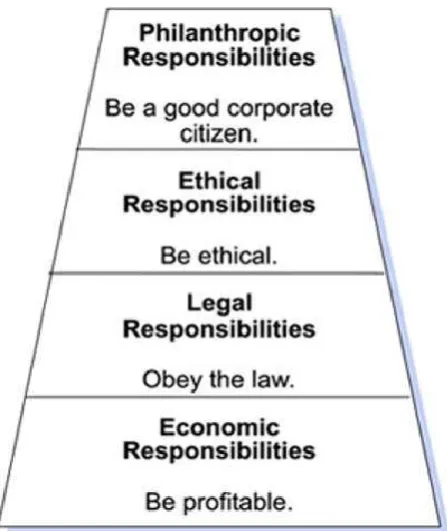
(6) Master thesis. Environmental and Energy Management. List of Acronyms CSR- Corporate Social Responsibility CO2- Carbon Dioxide NGO- Non- Government Organization IRM- Innovation RoadMap AIM- Aachen Innovation Model SGMK- St. Gallen Management Concept MOH- Manufacturing overhead. 3.
(7) Master thesis. Environmental and Energy Management. 1. Introduction Corporate Social Responsibility (CSR) has become an important theme during last decades. It helps the companies to build a better organization and strategic operations. Due to an increasing interest in the responsible behavior of companies, many companies are nowadays concerned about ethical values (integrity) and developing ethical codes to foster responsible behavior among their employees and other stakeholders (Kaptein et al., 1999; Van Luijck, 2000). For many companies, although following the CSR policy increases the operation costs, it pays off when companies can improve their social reputation. Hence they see CSR policy as competitive advantage. Several scholars have written how companies benefit from applying CSR (Christina, 2008; Crowther and Aras, 2008; Zu, 2009; Freisleben, 2011). Hence, there is a tendency of companies that want to obtain the CSR credentials in order to increase their business performance. Within academia, this topic has trigged the research efforts of a growing number of researches with the purpose to understand how to apply and develop CSR within companies (Hohnen, 2007; Rangan, Chase, Karim, 2012; Rexhepi, Kurtishi, Bexheti, 2013). Technical innovation increases competitiveness and reduces costs for companies. Technical innovation makes contributions to both: to economic and societal aspects. Technical innovation is a key factor for corporations which want to develop and keep a competitive advantage in the market and entry into new markets (Becheikh et al., 2006). Both these two themes are beneficial to companies. In the innovation management system1, these benefits affected the process of setting up innovation and became the internal and external innovation factors. Due to the same capital stakeholder categories, the corporation benefits promoted by CSR were defined as the drivers for technical innovation.. 1.1 Problem statement For the relationships between CSR and technical innovation, some works can be found but they are mainly focused on the financial performance to prove the positive links between CSR and technical innovation. A gap in the literature was identified in terms of cause-effect relationship between the two and how this can in practice be organized and by whom. At this regard, in this research the key intermediate connection (capital stakeholder) between CSR and technical innovation was explored. The purpose of this research project is to explore the relationship(s) between CSR and technical innovation from the capital stakeholder perspective. To explore the relationship(s) between CSR and technical innovation, the key point is to find out an intermediate connection- the capital stakeholder. Stakeholders are the groups who are vital to the survival and success of the corporation (Freeman, 2004). Capital stakeholders are the ones 1. Innovation Management is a combination approach of innovation and management (Eversheim, 2009). 4.
(8) Master thesis. Environmental and Energy Management. who have a direct stake in the organization and its success (Stakeholder Research Associates Canada Inc., 2005). Based on the capital stakeholder theory, the capital stakeholders are additionally divided into five main categories: financial capital stakeholder, human resources capital stakeholder, market capital stakeholder, social capital stakeholder and ecological capital stakeholder (Wheeler and Sillanpaa, 1997). In this research project, all the analysis of exploring the relationship(s) between CSR and technical innovation was classified into five categories based on the perspective of the five capital stakeholders. From literature review, the capital stakeholder seemed to offer the rational grounds to connect the two concepts and used for this research as intermediate framework. The link between CSR and capital stakeholder was put forward firstly for this analysis.. 1.2 Research question The main research question is: how does CSR lead technical innovations from the capital stakeholder perspective? The sub research questions are: i). How does CSR promote the corporations from the perspective of capital stakeholder?. ii). How does the improvement of capital stakeholder lead to technical innovation?. 1.3 Research structure The first chapter of the thesis presents the general background, research problem and analysis framework. The second chapter includes the literature review on the main concepts used in this research project, namely CSR, technical innovation, stakeholder theory, capital stakeholder, and introduces the existing literature about the relationship(s) between CSR and technical innovation. The third chapter covers the research methodology applied to this project. The fourth chapter presents the analysis on CSR benefits and technical innovation drivers from the perspective of capital stakeholder. The last chapter elaborates on the conclusions, limitations and recommendations of the research project.. 5.
(9) Master thesis. 2.. Environmental and Energy Management. Literature review. In this chapter, an overview of the concepts and theories such as CSR, technical innovations, stakeholder theory and capital stakeholder are here provided. The technical innovation drivers from capital stakeholders are analyzed after the introduction of technical innovations. Previous studies trying to identify and explain the relationships between CSR and technical innovation are also presented.. 2.1 Corporate Social Responsibility (CSR) Nowadays the society has to face serious problems such as population growth, pollution, natural resources access and energy security. All members of the society need to participate and cooperate in order to solve these problems. Corporations are one important constituent part of society. The society obtains high quality commodities and satisfactory services affordably from these corporations, however it desires more from the commodities and services (Stigson, 2002). Being a socially responsible corporation is much more important than ever. Here is where the “corporate social responsibility” certification can play a strategic role for the corporations. Corporate social responsibility (CSR) has a wide range of definitions that stress on some particular characteristics. In general, the prior purpose for corporations is to be profitable but the current challenge is to generate profit by socially contributing in a responsible manner. Dahl (1972) underlined the meaning of corporation social purpose, he declared that large corporations should play the roles as the social corporations. This latter is conceptualized as an entity whose existence and decisions can be justified as they serve for the public or social purposes. Carroll (1979) focused on the societal role of corporations. He linked the social responsibility with social performance and divided the responsibilities that “business encompasses the economic, legal, ethical and discretionary expectations that society has within the organization at a given point in time”. Later he adapted the theory and brought up with the pyramid of CSR (figure 1). In 1984, Freeman expanded the definitions of stakeholders. He came up with the opinions that managers should not only just focus on the stockholders’ needs, but also on the stakeholders, such as workers, customers, suppliers, and local community organizations. In 1998, Balabanis, Phillps and Lyall stated the society welfare and came up with the viewpoint that in modern society, corporations and administrators increased the importance of welfare role due to the public stress. In 2000, Holme and Watts defined CSR from the commitment business view for corporations to behave ethically and contribute to economic development, meanwhile the corporations needed to improve the quality of employees’ lives and their families, the local community and society.. 6.
(10) Master thesis. Environmental and Energy Management. Figure 1 The pyramid of CSR (Carrol, 1991). Even though there might be some variations among the definitions here above provided, most of them merge to the one indicated by the European Commission’s: “CSR is a concept whereby companies integrate social and environmental concerns in their business operations and in their interaction with their stakeholders on a voluntary basis”. Based on an extensive study of CSR definitions, Dahlrud (2008) identified the CSR definition into five dimensions: economic, environmental and social value creation, stakeholder relations and voluntariness. The economic dimension is about the financial aspect which contributes to corporations’ economic development and business operations. The environmental dimension includes the nature environment, environmental management and focus in business operations. The social element includes the relationships between corporations and societal groups. This element devotes to describe the ways and channels for corporations to integrate social concerns in business operations and consider their impact on communities and society. The stakeholder relations refer to how corporations interplay with their shareholders, employees, suppliers, customers and communities. The voluntariness dimension includes the actions beyond legal obligations and is mostly based on ethical values. Garriga and Mele (2004) developed the theoretical approaches for CSR analysis. They identified four theoretical approaches which are: marketing theories, political theories, integrative theories and ethical theories. In this research project, the effects of CSR influence are financially analyzed, hence, the main approach for analyzing CSR is based on the marketing 7.
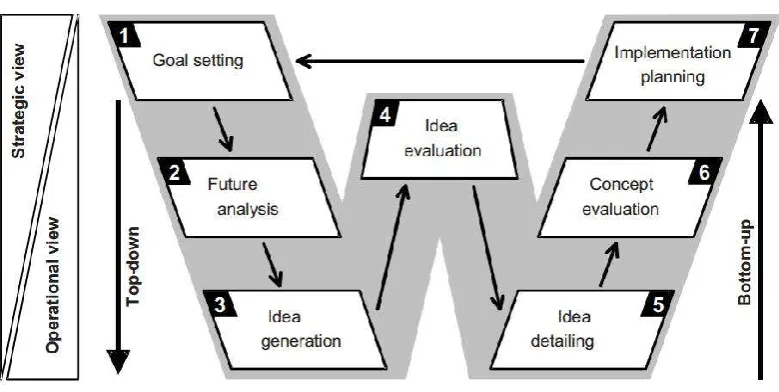
(11) Master thesis. Environmental and Energy Management. theories.. 2.2 Technical innovation Technical innovation is mainly driven by the development of society. Science and technology development are mainly driven by national objectives and public demands (Hannay, 1980). Technical innovation makes contributions to both: economic and societal aspects. On the economic side, technical innovation helps to increase the productivity (Atkinson, 2013). Higher productivity improves the sales income and economic growth. On the social side, new technology improves the quality of lives (European Commission, 2000). Technical innovation is a key factor in a firm’s competitiveness. For those corporations that plan to keep competitive and enter new market, technical innovation is the key element (Becheikh et al., 2006). If the corporations want to be succeed in their fields, technical innovations play an important role (Hoffman et al., 1998). From an external point of view, innovative projects are classified into improvements and innovations, both of them are the necessary issues for achieving success goals (Eversheim, 2009). If corporations want to stay ahead and competitive in their market fields, they need to develop innovative products (Lee, 1998). As pointed out by Wagner (2010) now the corporation administrators realized the importance of innovation in their sustainability and social performance strategy operations. For the innovation programs, the innovation management was the tool to support and apply the innovation programs. In the innovation management system, it described the whole process from goal setting to implementation. The Aachen Innovation Model (AIM) was set up based on the concept of the St. Gallen Management Concept (SGMK) 2 , it expressed the reference framework for innovation management. The SGMK system-theoretical approach enables the general management approach into subsystems (Schuh and Schwenk, 2001). Innovation Management copes with a complicated and multiple field of activities, these activities need an integral approach in the process for succeed. The W-model methodology is the foundation of Innovation RoadMap (IRM) methodology (Brandenburg 2002). The framework of W-model IRM methodology is presented in figure 2. In the figure, there are 7 phases in the W-model IRM methodology: Goal setting (1), Future analysis (2), Idea generation (3), Idea evaluation (4), Idea detailing (5), Concept evaluation (6) and Implementation planning (7).. 2. The St. Gallen Management Concept is a way to classify management decision problems into multielement. Based. on its concept, it provides a holistic framework and methodology for problem solving (Flaschka, 1996). 8.
(12) Master thesis. Environmental and Energy Management. Figure 2 The W-model as high -level sequencing concept (Brandenburg, 2002) Goal setting: In the goal setting phase, the strategic direction and goals are set from the overall corporation strategy. Innovation strategy, goals, application areas and potentials are identified in this phase. Future analysis: During the future analysis phase, the innovation potentials derivation is deduced in three steps including finding or defining future requirements, analyzing chances for success and defining the task. Future projections, innovation potentials and innovation tasks are selected in this phase. Idea generation: In the idea generation phase, the problem solutions are set up and developed to be detailed and concretized. Idea evaluation: This phase is used to identify the products ideas based on company, market and technology potential. In the evaluation phase, the rating and evaluation system is set up first and then ideas are evaluated according to solution principles. Idea detailing: the idea detailing phase aims for developing the idea concepts after collecting the relevant details and information. Concept evaluation: this phase takes in further refining and expanding based on verified information. It includes three steps: evaluation of the fulfillment of requirements, description of the technical feasibility and evaluation of profitability. In the end, the concepts are available both from technically feasible and economically reasonable. Implementation planning: for the last phase, all the previous phases are combined and aggregated in Innovation RoadMap (IRM). Projects and tasks are classified, after that, the corporation activities are deduced and implemented. The W-model IRM methodology is a complicated process, among these seven phases, the first three phases are related to the idea generation. To explore how to generate and influence the 9.
(13) Master thesis. Environmental and Energy Management. innovation idea generation, the internal and external factors are the analyzing targets.. With. the help of innovation management, corporations develop new products and process based on the react of external and internal chances (Kelly and Kranzburg, 1978). Figure 3 presents the whole process of the corporation growth and innovation. In this research project, the related external and internal drivers were selected out due to the CSR benefits.. Figure 3 Corporation growth and innovation. To analyze the drivers of technical innovation, the drivers are classified into two parts-external and internal factors. The innovation portfolio is based on a company-external and internal view. From the internal view, the distinction is between competence development and the use of synergies. From an external point of view, improvements and innovations are the two themes of innovation projects (Eversheim, 2009). Four forms of innovation projects (Basics, Stars, Teachers, High-Risk) are put forward in the event that internal and external evaluation criterion correlate with each other. These four innovation projects are presented in Figure 4. Moreover Eversheim divided the internal innovation factors as technology push and external innovation factors as market pull. The market pull means a corporation carried out market-oriented strategies, this kind of strategies generates short-term innovation potentials. The technology 10.
(14) Master thesis. Environmental and Energy Management. push means a corporation gets technological potentials and capabilities to imply new products or manufacturing process. Most of the technology push creates medium to long term innovation potentials.. Figure 4 Innovation portfolio (Brandenburg and Spielberg, 1998). Basics innovation: it results internally from the use of synergies and represents the improvement of an existing product from an external point of view. The basics innovation is low risk project because of the existing feasible technical and estimated market potential. Stars innovation: it is achieved internally through the use of synergies and detected as an innovation from the external view (market point of view). Teachers innovation: it is a learning project. Internal capabilities are developed based on the learning project, these capabilities are evaluated as the improvements from an external point of view. Corporations entry new market and gain potential high future with the implement of the teachers innovation projects. High Risk innovation: it is based on teachers and stars with a higher risk potential. Internally, it raises development and means to be an innovation from external. The high-risk project can help the corporations to entry a new market with new technology. 11.
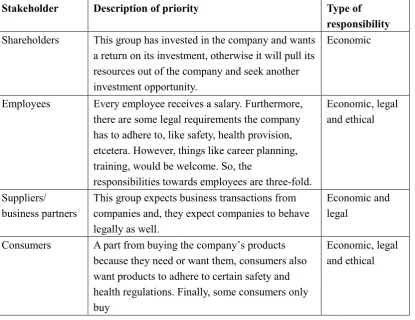
(15) Master thesis. Environmental and Energy Management. 2.3 Stakeholder theory The stakeholder theory is a theory about the organization management and corporate ethics in managing corporations. Freeman (1984) stated the stakeholder approach that corporations should manage ethical and social items by integrating their stakeholders in strategy operation. All the parties that influence or influenced by corporations are included in the stakeholder theory, in this theory, they are linked with CSR (Klonoski, 1991). In corporate social responsibility methods, people take the stakeholder theory as the framework for analysis. For instance, ISO 26000 and GRI (Global Reporting Initiative) take the stakeholder theory for analysis (Duckworth, Moore, 2010). Based on the overview from Carroll (1991) and Freeman (1984), there are nine stake holder categories for a corporation to take into account. They range from shareholders to NGOs and from customers to suppliers. Carroll (1991) stated that the corporations should be responsible to all the stakeholders. All the stakeholders are equally important to the corporations. The lack of communication between the corporation and its stakeholders will cause losses, even though some of the stakeholders have less impact compared with other stakeholders (Clarkson, 1995). Table 1 presents the classification of stakeholders’ responsibilities given by Carrol (1991) and Freeman (1984).. Table 1 Classifying the responsibilities of stakeholders Stakeholder. Description of priority. Shareholders. This group has invested in the company and wants a return on its investment, otherwise it will pull its resources out of the company and seek another investment opportunity.. Employees. Every employee receives a salary. Furthermore, there are some legal requirements the company has to adhere to, like safety, health provision, etcetera. However, things like career planning, training, would be welcome. So, the responsibilities towards employees are three-fold. This group expects business transactions from companies and, they expect companies to behave legally as well. A part from buying the company’s products because they need or want them, consumers also want products to adhere to certain safety and health regulations. Finally, some consumers only buy. Suppliers/ business partners Consumers. 12. Type of responsibility Economic. Economic, legal and ethical. Economic and legal Economic, legal and ethical.
(16) Master thesis. Government. Environment. Community. NonGovernmental/ Organizations. Media. Environmental and Energy Management. products from companies that are produced ethically. The governments set regulations and makes the legislation within which companies operate, but they also depend on the taxes companies pay. Furthermore, they try to stimulate social responsible conduct by the businesses. To adhere to legal standards that protect the environment, but also to improve their business practices to prevent further environmental decay. The community wants to be recognized and involved in the activities of the company to minimize the effects on the community. These effects can also have economic consequences. These organizations demand that companies adhere to certain legislation and try to persuade or pressure them to take additional actions that will benefit society. For financial resource some depend on business as well. The media expects companies to behave economically, legally and ethically sound.. Economic, legal and ethical. Legal and ethical. Economic and ethical. Economic, legal and ethical. Economic, legal and ethical. 2.4 Capital stakeholder Stakeholders are divided into capital stakeholders and secondary stakeholders (Stakeholder Research Associates Canada Inc., 2005). For capital stakeholders, these are the stakeholders which have a direct stake in the organization and its success. For the secondary stakeholders, these are the stakeholders which have indirect stake in the organization, but are dominant in reputation and other fields. Clarkson (1995) defined the “capital stakeholder group” as the one that the corporation is dependent on for its survival. Thus the capital stakeholders are divided into five groups: investors and shareholders; employees and customers; suppliers; governments and communities. Those groups cover from corporation structure to markets, from policy tools to social concerns. Wheeler and Sillanpaa (1997) took the categorization of capital stakeholders a step further splitting it into social and non-social groups. Primary Social stakeholders includes shareholders and investors (financial capital stakeholder); employees and managers (human resources capital stakeholder); customers, suppliers and other business partners (market capital stakeholder); local communities (social capital stakeholder). Non-social stakeholders include natural 13.
(17) Master thesis. Environmental and Energy Management. environment, future generations and nonhuman species (ecological capital stakeholder). In this research project, Wheeler and Sillanpaa’s capital stakeholders approach was selected to be included in the analytical framework. All the CSR’s benefits and technical innovations were divided into these five capital stakeholder categories.. 2.5 Technical innovation drivers based on capital stakeholder For the perspective of capital stakeholder, it is divided into five categories introduced in section 2.4. Among these five categories, human resources, market and ecological capital stakeholder are selected out for analyzing because those three capital stakeholders are related with technical innovation. The reason for selecting those three capital stakeholders related with technical innovation points is presented in chapter 4. Human resources capital stakeholder is the internal factor for technical innovation. Four elements are included in internal factor, self-motivation, technical education and entrepreneurship, work experience and innovative ideas. The technical education and work experience are related to human resources. In the structure of innovation leadership, staff encouragement, decision making, performance evaluation and communication behavior are the main dimensions for considering (Eversheim, 2009). Encouragement is related to the working staffs. Decision making are related with the decision makers and the feedback from the decision contents. Performance evaluation is based on the outcomes of employee development. Innovation leadership is related with high requirements for administrators. As a result, the staff quality level is a key element in innovation organization. Market capital stakeholder is the external factor for innovation. The external factor for innovation is mainly on market pressure including customer demand, market opportunities, suppliers of equipment or materials, institutional support, economic incentives and competition. Among these elements, customer demand, market opportunities and suppliers of equipment or materials are related with customers and suppliers. Customers and suppliers are the main part for the market capital stakeholder. For the corporations, all the means to improve the products and manufacturing process are used to satisfy the purpose of getting more benefits. To meet consumers’ demand, the corporations engage in producing new products and improving the current products. More competitive and meeting customer demand means more sales and benefits. In the phase of innovation planning, the direction of impact for future innovations are set from the perspective of external orientation. The external orientation of innovation planning manages the dealings of development related with customers and suppliers (Eversheim, 2009). The customer orientation is focused on the collaboration with customers and the supplier orientation is focused on the collaboration with suppliers. 14.
(18) Master thesis. Environmental and Energy Management. Ecological capital stakeholder is the external factor for innovation. It’s related with economic incentives and competition. The ecological capital stakeholder is related with nature environment, future generations and nonhuman species. To protect the environment and contribute for generations, corporations need to reduce the energy consumption and waste pollutions. Reduction of energy consumption and improvement of energy efficiency save the MOH cost and then lead the reduction of business cost. The reduction of business cost meets the corporations’ economic incentives. For the reduction of waste pollutions, there are two benefits for the corporations. The first benefit is to reduce the MOH cost. For reducing the waste pollutions, corporations develop the manufacturing process and improve the reuse of waste. The second benefit is to improve the reputation of corporations by claiming that they take part in protecting the environment. High reputation brings financial benefit for corporations (Fombrun, 1996; Podolny, 1993; Roberts and Dowling, 2002). High reputation also helps to improve the competition and social performance (Brammer and Pavelin, 2006). These two benefits related with economic incentives and competition are the drivers for technical innovation.. 2.6 CSR and innovation For exploring the relationship between CSR and innovation, prior research has identified some relationships between CSR and innovation (McWilliams and Siegel, 2000). Furthermore, some authors have highlighted the bi-directional nature between CSR and innovation (Moore and Spence, 2006; Husted and Allen, 2007a). Under the hypothesis that CSR as an external regulation increases cost for corporations while technical innovation helps to reduce their cost. Scholars try to find the links between CSR and technical innovation to highlight CSR benefits. Most of the researches carried out their research based on the analysis of financial performance to prove the positive links between CSR and technical innovation. As priorly indicated, in this research the key intermediate connection between CSR and technical innovation is the capital stakeholder. From the theoretical analysis3, there are two main paths for exploring the relationship between CSR and innovation: (i) case study as analytical research model; (ii) the statistical analysis approach by using corporations’ financial performance. From the perspective of analytical research model, CSR is considered as a driver for innovation through the use of “social, environmental or sustainability drivers to create new ways of working, new products, services, processes and new market space” (Little 2006). For the. 3. Abend, Gabriel. "The Meaning of Theory." Sociological Theory 26 (June 2008): 173–199; Swanson, Richard A. Theory Building in Applied Disciplines. San Francisco, CA: Berrett-Koehler Publishers 2013. 15.
(19) Master thesis. Environmental and Energy Management. corporation decision-making process, corporations value CSR as an important strategy operation. Some corporation administrators now take CSR as part of their strategic management program, while others value it as the source of innovation (Allen and Husted, 2006). There are two kinds of viewpoints related with the relationship between CSR and technical innovation (Ghemawat, 2001). For the innovative corporations, CSR is beneficial in the field of technical innovation and opportunity recognition, these two issues help to improve their competitive advantage. For the other companies, they value CSR as a social strategic engagement tool and they focus on the social competences. Technical innovation is seen as the internal driving force to enhance the competitiveness under the condition that corporations value CSR as a strategic process (Nidumolu, 2009). From the perspective of society, technical innovations are driven by social and environment resources (Sharma and Vredenburg, 1998). From the perspective of employee, in the procedure of innovation, employees play an important role in environmental strategy (Sharma and Vredenburg, 1998). In sum, these studies conceptually indicate that CSR can lead to technological innovation. From the perspective of statistical analysis of the financial performance, works from Bansal (2005) and Husted & Allen (2007) have brought some arguments regarding the linear regression (relationship) between CSR and innovation strategies. Research and development investment is the indicator for CSR and innovation. For instance, if companies applied CSR principles to their products, productive processes and organizational practices would require changes in the existing technology. This latter would lead to research and development expenditure. In order to understand the value creation generated from the CSR programs better, Husted and Allen (2007) took the five key dimensions model proposed by Burke and Logsdon (1996) in their research. The research results showed that CSR generated positive influence on innovation based on firm’s financial performance. Through the financial performance analysis, CSR provides the opportunities for innovation through the use of social, environmental and sustainability drivers to create new ways of working, new products, services, manufacturing processes and new market. Therefore, the aim of this research is to provide tangible evidence through the financial performance of those companies that report for several years on their CSR practices.. 16.
(20) Master thesis. 3. Environmental and Energy Management. Research methodology. In this section, the research methodology is described with the help of some terms commonly used in social science to present its different components. This will start by defining what a research design is. Pollit (2001) stated the research design as an approach to solve the research questions or to examine the research hypothesis. In the research design, the elements of the methodology to be presented in this section are: the research framework, research question, research strategy, research unit, research material & accessing methods and research analysis.. 3.1 Research framework In the process of setting up research framework, Vershuren and Doorewaard (2010) characterized seven phases to set up the research framework in the research:. Phase 1: Characterizing the research objects The goal of the research is to explore the relationship(s) between CSR and technical innovation though the capital stakeholder theory.. Phase 2: Determining the research objects The research objects are CSR and technical innovation. The research samples are ten Dutch food corporations.. Phase 3: Establishing the research analyzing perspective The research is analyzed from the perspective of capital stakeholder to explore the relationship(s) between CSR and technical innovation. The capital stakeholder perspective is set as an intermediate link both to CSR and technical innovation. In the research analysis, one connection is between CSR and capital stakeholder, the other connection is between capital stakeholder to technical innovation.. Phase 4: Determining the sources of research The research uses scientific literatures to develop a cause-effect model. Theories to be used in this research are shown in table 2: Table 2 Sources of the Research Perspective Key concepts. Theories and documentation. CSR, technical innovation,. Theory of stakeholder. Capital stakeholder. Technical innovation with research and. 17.
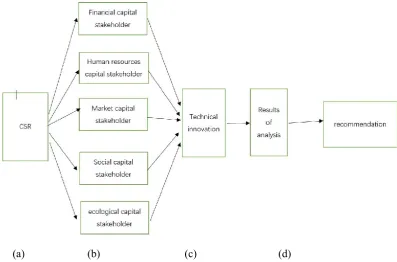
(21) Master thesis. Environmental and Energy Management. development investment. Phase 5: Setting a sketch map of the research framework The research framework is described through the following flowcharts:. (a). (b). (c). (d). Figure 5 A Schematic Presentation of Research Framework. The first step was to find out the corporation benefits promoted by CSR, these benefits were analyzed and picked out based on the capital stakeholder categories. These CSR’s benefits were divided into financial, human resources, market, social and ecological categories. The second step was to analyze the selected benefits and checked if they were the technical innovation drivers.. Phase 6: Drawing up the research framework a.. This section is about the introduction of CSR, stakeholder theory, capital stakeholder. theory and technical innovation. b.. This section introduces the corporations’ benefits promoted by CSR.. c.. It elaborated the technical innovation drivers from the perspective of related capital. stakeholders. d.. The section states the results of analysis based on the research cases.. 18.
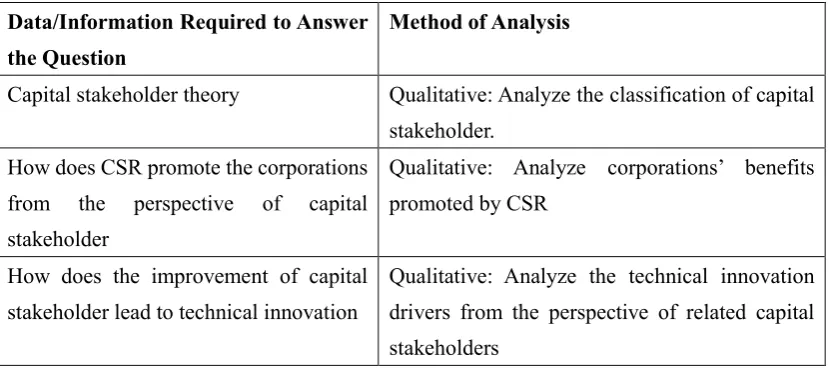
(22) Master thesis. Environmental and Energy Management. Phase 7: Checking whether the model requires any change no indication that the change is required.. 3.2 Research question The main research question is: how does CSR lead technical innovations from the capital stakeholder perspective? The sub research questions are: i). How does CSR promote the corporations from the perspective of capital stakeholder?. ii). How does the improvement of capital stakeholder lead to technical innovation?. 3.3 Research strategy The research strategy compiles both desk research and empirical data gathering, allowing to have different information sources to validate the information collected along the execution of this research. The applied research methods include: Desk research were about the review of existing peer reviewed and professional literature using Google scholar, company official website, CSR reports, annual reports, and official reports from “MVO Nederland4”. In-depth interviews were planned with 10 managers or key informants from each of the selected Dutch food companies. Questionnaires for the interviews were developed based on the research questions and literature. The interview questionnaires were open questions focused on how these corporations value CSR as a driver of technical innovation; how they value the technical innovation in business operation strategy; how CSR influences in human resources, market and ecological capital stakeholder; more details introduction about the outcomes of CSR programs. The answers of the questionnaires were held via email. Due to the corporations’ policy, at the end only three responds were received. The questionnaires are presented in appendix 1.. 3.4 Research unit The Netherlands is one of the world’s leading countries in food processing machinery. It is the world’s second exporter of agricultural products and processed food. In 2016, the Netherlands had more than 5695 food processing corporations in the food industry. More than 13500 employees worked in those corporations. The total turnover of 2015 was over $ 69.8 billion (U.S. Department of Agriculture’s Foreign Agriculture Service). The Dutch food corporations 4. MVO Nederland (CSR in Dutch) is a Dutch organization committed to disseminate CSR for Dutch corporations. 19.
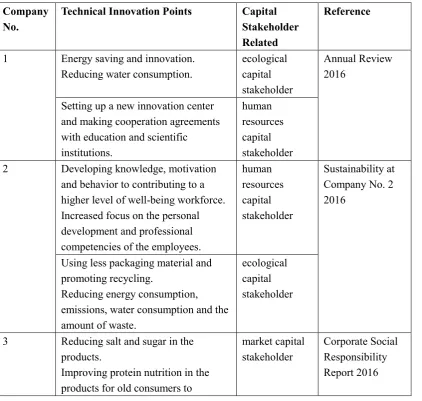
(23) Master thesis. Environmental and Energy Management. value the research and development as an important strategy especially on product development and improvement, development of new technologies, develop of sustainable products (GMV5). The research units are 10 Dutch companies from the food industry. These ten companies vary in terms of size and food industry sectors. Though all of them correspond to the category of large unit6 accordance to their number of employees. They were selected under the basis of their good reputation companies and technological level. Even further, they have an outstanding position within their sector. The companies are listed anonymously in table 3.. Table 3 Target Dutch food companies list Company No.. Sector. Number of employees by enterprise size class. 1. Starch Food products. Between 1000 to 1500. 2. Seasoning products. Between 250 to 500. 3. Dairy products. More than 20000. 4. Finished food product. Between 250 to 500. 5. Food and beverage. More than 20000. 6. Meat products. More than 2000. 7. Meat products. Between 500 to 1000. 8. Meat products. Between 10000 to 15000. 8. Dairy foods. Between 250 to 500. 10. Organic food. Between 500 to 1000. 5. GMV is the sector association of manufacturers of machines for food processing and packaging in The Netherlands. 6 Based on Eurostat size class: SMEs (1-249 persons employed); micro enterprises (1-9 persons employed); small enterprises (10-49 persons employed); medium-sized enterprises (50-249 persons employed); large enterprises (250 or more persons employed). 20.
(24) Master thesis. Environmental and Energy Management. 3.5 Research material and accessing method Research material includes data that can give an answer to the research questions. The information required to answer the RQs are collected via several methods including document analysis, observation and interviews in depth. The interviews via email are planned to be held with 10 (sustainability affaires) managers working at the selected Dutch food companies. However, due to each company’s policy, only three interview feedbacks were gathered. Qualitative data collection is designed under a mixedmethod approach as the informational sources are different and vary during validation. For all the research questions, desk research and interviews were deployed to gather information to answer them. Table 4 Data and information required for research accessing method Research questions. Data/Information. Sources of data. Accessing data. Literature sources.. Content analysis. Required to Answer the Question Capital stakeholder. The classification of. theory. capital stakeholder. How does CSR. CSR influences in. Literature sources.. Content analysis. promote the. capital stakeholder. Primary data through. In-depth interviews. corporations from. questionnaires with. the perspective of. CSR mangers.. capital stakeholder?. Secondary data from CSR/ Annul reports.. How does the. Technical innovation. Literature sources.. Content analysis. improvement of. driven from capital. Primary data through. In-depth interviews. capital stakeholder. stakeholder. questionnaires with. lead to technical. CSR mangers.. innovation?. Secondary data from CSR/Annul reports.. 3.6 Data analysis Data analysis is based on annual reports, CSR reports and interviews. This refers to the source of data to be used during the evaluation process. This latter took place through the logical steps shown in the analytical framework (table 5).. 21.
(25) Master thesis. Environmental and Energy Management. Table 5 Data and Method of Data Analysis Data/Information Required to Answer Method of Analysis the Question Capital stakeholder theory. Qualitative: Analyze the classification of capital stakeholder.. How does CSR promote the corporations Qualitative: Analyze corporations’ benefits from. the. perspective. of. capital promoted by CSR. stakeholder How does the improvement of capital Qualitative: Analyze the technical innovation stakeholder lead to technical innovation. drivers from the perspective of related capital stakeholders. 22.
(26) Master thesis. Environmental and Energy Management. 4. Findings This chapter presents the findings of the research which are based on desk research and indepth interviews. The data was analyzed qualitatively and the findings are here presented. With the purpose to identify the nexus among technical innovation, CSR and capital stakeholders. An inventory of the technical innovations is enlisted in table 6. As an independent section, the corporations’ benefits from CSR based on the perspective of capital stakeholders are discussed in section 4.1. Whilst on section 4.2, the technical innovation drivers from the perspective of capital stakeholders are presented. Based on latest CSR and annual reports, the technical innovation points are picked out. These technical innovation points are related to improving of manufacturing process, developing new products and improving employee management system. All the innovation points are classified into related capital stakeholder areas. The results are presented in table 6.. Table 6 Technical innovation points from research cases Company No.. Technical Innovation Points. 1. Energy saving and innovation. Reducing water consumption.. 2. 3. Setting up a new innovation center and making cooperation agreements with education and scientific institutions. Developing knowledge, motivation and behavior to contributing to a higher level of well-being workforce. Increased focus on the personal development and professional competencies of the employees. Using less packaging material and promoting recycling. Reducing energy consumption, emissions, water consumption and the amount of waste. Reducing salt and sugar in the products. Improving protein nutrition in the products for old consumers to 23. Capital Stakeholder Related ecological capital stakeholder human resources capital stakeholder human resources capital stakeholder. Reference. Annual Review 2016. Sustainability at Company No. 2 2016. ecological capital stakeholder. market capital stakeholder. Corporate Social Responsibility Report 2016.
(27) Master thesis. 4. 5. 6. 7. 8. Environmental and Energy Management. maintaining and improving physical condition. Reducing greenhouse gases from dairy farmers, transport, processing of dairy. Reducing energy consumption, water consumption, packaging. Reduction of energy consumption, waste stream, water pollution. Inventory of packaging. Developing healthier products. Reducing CO2 emissions, waste and package. Improving water use. Reducing emissions and waste. Improving the use of materials, Developing sustainable package. Eco-design: improving the sustainability of products. Reducing antibiotics. Refitted vehicles for animal transportation. The company possesses its own Research and Development (R&D) department. This department conducts research into nutrition, animal husbandry systems and use of natural products such as phototherapeutics. Reducing power and water consumption: Developing the study for more efficient use of the cooling system and the lighting system. Waste water: improving performance of the existing equipment and further prevention of pollution of the process wastewater based on Good Housekeeping. Further reduction in the use of antibiotics among all pig farmers. Efficient farming network through the exchange of data for improving the herd health management. Reducing antibiotics. 24. ecological capital stakeholder ecological capital stakeholder market capital stakeholder ecological capital stakeholder ecological capital stakeholder. CSR Report 2015. Annual report 2016 Annual CSR Report 2015. human resources capital stakeholder. ecological capital stakeholder. CSR Annual Report 2015. market capital stakeholder. CSR Report 2016.
(28) Master thesis. 9. 10. Environmental and Energy Management. Reducing energy and water consumption. Investing in improving and standardizing slaughter infrastructure. Food safety research. Setting up sustainability programs for suppliers. Reducing water consumption and studying on reuse the water evaporated from milk for cleaning, washing hands or flushing toilets. Reducing CO2 emissions by improving transportation efficiency. Investment on renewable energy. Improving transport efficiencies. Avoiding waste/obsolete products. Developing packaging. Improving in water efficiency. Investing on renewable electric. Improving nutritional policies on products, such as reducing salt and sugar in products.. ecological capital stakeholder. market capital stakeholder ecological capital stakeholder. Sustainability Report 2016. ecological capital stakeholder. Annual Report 2016. market capital stakeholder. As Table 6 describes, the technical innovation points are mainly related with three capital stakeholders, namely human resources capital stakeholder, market capital stakeholder and ecological capital stakeholder. With the purpose to gain insights into those relevant capital stakeholders, the following sections are centered on these three capital stakeholders.. 4.1 Corporation benefits promoted by CSR The human resources, market and ecological capital stakeholders were the most represented capital categories of capital stakeholders through the inventorying phase of those technical innovations associated to CSR. In this section, a further analysis takes place to explain the benefits of technical innovations nexus CSR per each category.. 4.1.1 Human resources capital stakeholder benefits promoted by CSR One important part of CSR is related to the employees’ rights and working conditions. Every corporation value their employees as precious wealth. On the perspective of human resources capital stakeholder, CSR promotes to care about the company’s employees and upgrade the capabilities of the working staffs. Skilled and high-qualified staffs create more value and help to improve the level of the corporations. The two main benefits of CSR are reducing operational 25.
(29) Master thesis. Environmental and Energy Management. cost and attracting and retaining good staffs. All ten companies examined point out that they care about their employees and came up with the employee caring programs. The details and outcomes of these programs are presented in table 7.. Table 7 CSR influences in human resources stakeholder Company. Human resources capital stakeholder. Outcomes. No.. program. 1. Providing safety working environment. Accident frequency decreased from. and paying attention to personal. 1.6 (2015) to 0.8 (2016).. protection equipment. Organizing. Sickness absence decreased from. safety training sessions.. 4.9% (2012) to 4.0% (2016).. Providing training courses to promote healthcare among 2. Providing Personal Effectiveness. The rate of permanent contracts. program.. (93%) is higher than national. Providing proper working conditions.. (Source from CBS7, 2016) The working hours percentage lost as a result of strikes is 0.. 3. Setting up the platform “Nourishing by. Number of lost time accidents per. nature” for employee training and. 200000 hours worked decreased. motivation.. from 0.33(2014) to 0.24(2015). Accidents requiring sick leave decreased for 27.3%.. 4. Providing safety training campaign.. The number of accidents in 2015 declined compared to 2014.. 5. Providing employee training program. Total Recordable Frequency Rate. for development purpose. Continue to. (TRFR) from 2015 to 2016 went. focus on working safety environment.. from 1.12 accidents per 1 million hours worked to 1.01.. 6. Providing training courses on safety,. Sickness-related absences decreased. health, language, quality-related. from 6% (2014) to 5.6% (2015).. training courses. Providing information on a healthy lifestyle. 7. CBS: Dutch Central Statistics (Centraal Bureau voor de Statistiek). 26.
(30) Master thesis. 7. Environmental and Energy Management. Promoting healthy lifestyle to. Lost workday case accidents per. employees.. 200000 hours decreased from. Setting up the campus for employee. 1.9(2014) to 1.8(2015).. training and development.. Sick leave decreased.. Improvement of working conditions.. More employees completed the campus training program.. 8. Employee training program.. Absentee rate decreased from. Providing safe and healthy working. 4.5%(2015) to 4.3%(2016).. place.. Lost day rate decreased from 4.8%(2015) to 3.5%(2016).. 9. Providing pleasant and professional. Sickness absence decreased from. work.. 5.4% in 2015 to 3.5% in 2016.. Employee training and development program for employee engagement. 10. Providing employee training program. Employee training hours raised. for personal development. Promotions. from 11.4(2014) to 19.9(2016).. for employee healthy lifestyle.. Lost time injury per 100FTEs decreased from 3.1(2015) to 2.6(2016).. The human resources programs mainly focus on three aspects, providing safety working environment, personal development training, promoting for better lifestyle among the most important. Safety working environment is always oriented to decline the accident frequency and loss of working hours. It also connects with the sickness absence rate. Low accident frequency guarantees the normal working hours and working process as planned. The corporations have to face the visible loss and invisible loss because of the accidents. For the visible loss is the property loss. To handle the accidents, the corporations need to spend money on management, product damages, property damage costs, salary compensation, medical care cost and extra cost. For the invisible loss is mainly observed as damage of reputation, or harming the relationships with employees and customers. All these visible and invisible loss causes economic loss. Personal development training helps to improve the labor productivity and the quality of staff. All companies in table 7 shows that they provide the employee training program in order to improve the labor productivity and the quality of staffs. These training programs include working skills training and personal improvement quality training programs. Skilled workers 27.
(31) Master thesis. Environmental and Energy Management. help to reduce cost and downtime. A prior research shows that the costs of employee turnover vary differently, ranging from 50% of base salary for entry-level positions to 400% of base salary for senior technician employees (Blake, 2006). Moreover the training programs also meet the staffs’ personal need of development. With the employees’ high satisfaction, the loss of employee turnover drops. If the corporations meet employees’ needs, the problem of staff wastage could be solved by several minimizing ways. Recent research showed that in the implementation of CSR, employees got inspired and made contributions to their corporations (Balakrishnan, Sprinkle and Williamson, 2010). Promoting for a better lifestyle has been observed as an assertive way to reduce the staffs’ sickleave. It helps to improve the labor productivity and reduce the costs for health care. Both the personal development and promotions for better lifestyle make the corporation more attractive to potential future employees. High quality and good capabilities staff members make the company more competitive as well. In the CSR program activities, staffs learn new skills and apply these skills in the workplace which results as a way to contribute to their work. In the 2016 Cone Communications Employee Engagement Study8, 1020 adults took the survey. The results showed that: “64% of employees felt their work and personal lives are combining increasingly; 93% of employees wanted to work for a company that cares about them as individuals; 51% of employees won’t work for a company that doesn’t have strong social and environmental commitments; 74% of employees said their job is more fulfilling when they are provided opportunities to make a positive impact at work”. Regarding the influence of CSR on human resources, the main benefits are the drop of sickness absence and accident frequency. This drop of sickness absence and accident frequency leads to reduce the cost for corporations. Based on the estimate of TNO9, in the overview of Dutch working conditions 2016, the paying salaries to employees who were absent due to work-related causes is 4.7 billion euros, disability benefits is 1.9 billion euros, the costs of medical and other care for people with a work-related condition is 1.4 billion euros. The cost for sickness absence is a huge number and even a small improvement of reducing the sickness absence would be a great financial benefit for a corporation. In hence, less accidents and sickness absence means low cost for the corporations.. 8. Cone Communications (www.conecomm.com) is a public relations and marketing agency known for igniting brands with high-impact strategies and programs based in deep insights, unique subject matter expertise and innovation. Focusing on key areas such as corporate social responsibility, cause marketing, brand communications, social media, nonprofit marketing, corporate communications and crisis prevention/management, the agency helps clients achieve both business and societal outcomes. 9 TNO: A Dutch organization for applied scientific research. 28.
(32) Master thesis. Environmental and Energy Management. 4.1.2 Market capital stakeholder benefits promoted by CSR Market stakeholder includes consumers and suppliers. The CSR program stresses the caring and building up good relationships with consumers and suppliers. A strong CSR framework is beneficial to build up good connection between the corporations and consumers. This good connection helps to increase sales and customer loyalty. The corporations build up good connection through meeting different consumers’ demand, improving products quality, developing new products, keeping the sale prices in reasonable scope. For instance, Company No. 3 developed new products for reducing salt and sugar in dairy products. Additionally the company improved protein nutrition in the products for the old consumers to maintaining and improving physical conditions. Company No. 10 and Company No. 4 developed new products for reducing salt and sugar for healthier products. All these activities show that they do care about the consumers and try to improve themselves to meet consumers’ demands. Many researches based on different fields have shown that CSR associations are linked to consumer loyalty (Garcia de los Salmones et al., 2005; Marin et al., 2009; Perez et al., 2012). Customer loyalty contributes the corporations in three ways. The first benefit is conducive to the consolidation of existing markets. The second benefit is helping to reduce the market costs including the transaction costs and communication costs. The third benefit is that it enables corporations to get better protection in the competition. A well-developed CSR framework is also beneficial to build up good connection between the corporations and their suppliers. The CSR program makes the cooperation strong and tight. Good cooperation between corporations and their suppliers generates positive effects in the market. The positive effects include shorting supply cycle, reducing corporations’ raw materials management costs, improving the quality of raw materials, improving the accuracy of material requirements, sharing the technology and innovation achievement, sharing management experience. In the interview with Company No. 8, the manager introduced more detail about the corporation with their suppliers by the efficient farming network. The network through the exchange of data aims for improving the herd health management. The benefits are that the farmers together with their advisors (the nutritionist and the veterinarian) are using these data to steer herd health and herd production at the farm. With these instruments of data exchange from the slaughter process, the animals become healthier and the use of antibiotics in the animals is reduced. The farmers that supply company No. 8 with pigs belong to the group of farmers that use very restrictive antibiotics. They belong to the group of farmers with lowest use of antibiotics in Europe. Based on the case here under analysis, Company No. 9 set up a sustainability program for suppliers. The sustainability program was aimed for applying the Dutch Dairy Association targets within the Sustainable Dairy Chain for 2020. If the suppliers 29.
(33) Master thesis. Environmental and Energy Management. passed the requirements of the sustainability program, they got financial reward. As a result, the production grew obviously, this growing milk production met the growing market demand. Another example is that Company No. 3 set up the “Dairy Development Program” aiming to improve the quality of milk, increasing the productivity per cow and marketing. Company No. 3 strived to share knowledge and expertise by means of training, knowledge partnerships and initiating and supporting projects to improve the dairy farming infrastructure. The results show that their activities help to improve the farmers’ milk production capacity and quality. Company No. 7 improved the management of supply chain. The supply chain management system was implemented for risk analysis of all raw materials and suppliers. Company No. 2 provided training and technology information to their suppliers, the suppliers learnt to irrigate their fields effectively and sustainably. The packing was utilized and recycled with maximum effect and the waste was reduced to a minimum. As a result, the suppliers got sales guarantee. Company No. 5 set up six research and development centers worldwide to respond to markets. More than 6000 Company No. 5 research and development professionals worked on innovation. each year around €1 billion was invested in research and development. All these results show that the corporations value the good relationship with consumers and suppliers important and engaged to improve the relationship by all means.. 4.1.3 Ecological capital stakeholder benefits promoted by CSR Corporations as the main consumption of resources and the environment, they have the obligation to minimize the pollution caused by the production process and impact to the environment along their value chain. Although profitability is the primary purpose for enterprises, they still need to pay attention to sustainability and environment protection. The ecological capital stakeholder is related with nature environment, future generations and nonhuman species. In order to follow the CSR rules from the ecological capital stakeholder perspective, corporations need to reduce the energy consumption and reduce waste pollution to the environment. These CSR benefits lead to improve efficiencies and reduce cost in manufacturing and operating process. Table 8 shows ecological programs and outcomes.. Table 8 CSR influences in ecological capital stakeholder Company No. 1. Ecological stakeholder programs. Outcomes. Energy saving and innovation: Greening (solar energy) and saving energy. Reducing water consumption.. CO2 emission was 16% less in 2016 than 2015. The energy costs were 1.8 million (€) lower than previous year.. 30.
(34) Master thesis. Environmental and Energy Management. 2. Using less packaging material and promoting recycling. Analyzing packaging methods, including the strength, thickness and format of the package. Reducing energy consumption, emissions, water consumption and the amount of waste that is generated, are important starting points in that respect. Reducing the loss of heat.. 3. Reducing greenhouse gases from dairy farmers, transport, processing of dairy. Reducing energy consumption, water consumption, packaging.. 4. Reduction of energy consumption, waste stream, water pollution, inventory of packaging.. 5. Reducing CO2 emissions, waste and package. Improving water use.. 6. Reducing emissions and waste. Improving the use of materials and developing sustainable package.. 31. Water consumption reduced 1 million cubic meters by 2018. Compared to the year of 2010, the overall improvement in terms of volume of energy consumed per unit of produced is 35.7%. The amount of waste per unit of product produced has fallen by 27.8%. Compared to the 2010 base year, the overall improvement in terms of volume of energy consumed per unit of product produced is 35.7%. Water consumption reduced 32.2% compared to the 2010 reference year. CO2 emission dropped 6.7% in 2015 compared with 2014. Energy efficiency reduced from 2.68(2014) to 2.67(2015). Water efficiency dropped from 4.62(2014) to 4.59(2015). The percentage of waste reuse improved from 67%(2014) to 72%(2015). Hazardous and industrial waste reduced. Fuels and electricity consumption reduced. CO2 emission per ton of manufacturing production reduced from 88.49kg (2015) to 83.52kg (2016). Water consumption per ton of manufacturing production reduced from 1.88m3 (2015) to 1.85m3(2016). Energy consumption reduced by 2% per annum in long term energy agreements. CO2 emission dropped 20%.
(35) Master thesis. Environmental and Energy Management. in 5 years. 7. 8. 9. 10. Reducing power and water consumption: Developing a study for more efficient use of the cooling system and the lighting system. Reviewing the feasibility of an automatic cleaning/thawing system on the coil freezers, crust freezers and rinsing section of the crate washing system. Improvement of the heat recovery system and optimism in the cooking lines. Improving performance of the existing equipment and further prevention of pollution of the process wastewater based on ‘Good Housekeeping’. Reducing energy and water consumption. Investing in improving and standardizing slaughter infrastructure.. Reducing water consumption and studying on reuse the water evaporated from milk for cleaning, washing hands or flushing toilets. Reducing CO2 emissions by improving transportation efficiency. Investment on renewable energy. Improving transport efficiencies. Avoiding waste/obsolete products. Improving Water efficiency. Developing renewable energy.. Energy consumption in MJ / ton sold reduced from 604 (2015) to 568 (2016). In 2016, electricity consumption was 13% less gas per ton sold than in 2015. Total Water consumption cubic meter per ton sold reduced from 1.76 (2015) to 1.71 (2016). CO2 emission (2015) reduced by 50% compared with 2010. Gas consumption in 2015 decreased 11% compared with 2014. Total fuel consumption per kilometer calculated over all transportation modes fell by 1.6% in 2015. In 2015, the pollution rate of the process wastewater fell by over 10% compared with 2014. The total energy consumption was reduced by 6%, to 568 MJ / metric ton sold. In 2016, the CO2 emissions were more than 8% lower per kilogram of milk in comparison with 2013 (in 2015 this was 10%). The use rate of renewable electricity increased from 94% (2015) to 97% (2016). CO2 emission dropped from 31590 tons (2015) to 31394 tons (2016).. According to table 8, the benefits in ecological stakeholder are mainly on reducing energy 32.
(36) Master thesis. Environmental and Energy Management. consumption and waste emissions, improving energy efficiency and energy reuse. The energy consumption includes water consumption, gas consumption, electricity consumption and fuel consumption. Reducing these energy consumption helps the corporations saving the operation costs. For the purpose of meeting growing market’s demand, corporations improved their productions. Even though growing productions generated more profits, the energy consumption increased. In hence, now the energy efficiency is a key metric in energy consumption. These ten Dutch companies all decreased their energy consumption by all means. Another important way of reducing energy consumption is improving the reuse energy usage. For example, Company No. 10 invested in wind power generated the electricity for self-supply. Company No. 3 and Company No. 10 improved the waste reuse. Waste reuse reduced the consumption of raw materials and saved costs. The results in table 8 shows that all the ten companies reduced their total energy consumption or improve the energy efficiency. The energy consumption cost is an important part of manufacturing overhead (MOH) costs. These ten food companies generate productions in a huge number, at the meantime the energy consumption cost is huge. In that case, the reduction of energy consumption and improving of energy efficiency help to reduce the MOH costs. The reduction of cost is one of the most important benefits for the corporations.. 4.2 Technical innovation driven from capital stakeholders Based on section 2.2 the concept of technical innovation, the drivers are mainly divided into two categories: internal and external factors. The CSR benefits for the selected three capital stakeholders are analyzed in these two approaches.. 4.2.1 Technical innovation driven from human resources capital stakeholder As mentioned in section 2.5, human resources capital stakeholder is the internal driver for technical innovation. In section 4.1.1 CSR benefits in human capital stakeholder, the 10 research targets all committed to improve the staff quality such as working skills training and personal development training programs. Company No. 5, Company No. 1 and Company No. 6 set up the innovation center and the Research and Development department for innovation. In the W-model process of innovation, all these phases are related with the quality of human resources. From the perspective of human resources, CSR promotes to improve staffs' quality and capability. In summary, high quality of staffs is not the crucial condition but a necessary condition for innovation.. 33.
(37) Master thesis. Environmental and Energy Management. 4.2.2 Technical innovation driven from market capital stakeholder Based on section 2.5, market capital stakeholder is the external driver for technical innovation. From the cases analysis, Company No. 3, Company No. 10 and Company No. 4 illustrated how they produced new products for different consumers because to some extent, consumers requested for them. Company No. 8, Company No. 9 and Company No. 2 set up the programs aiming to improving the quality of the raw materials from the suppliers. All these good relationships with the customers and suppliers help to improve the corporations to meet the customer demand and improve the suppliers’ raw materials quality to engage their products. The market pressure is the main driver for innovation. In short, the market capital stakeholdercustomers and suppliers are the main external factors for technical innovation. In the interview with Company No. 8, the manager agreed with the opinion that in the process of achieving CSR goals it promoted for technical innovation. CSR helped to improve the raw material quality and technical innovation was an important tool in the CSR implementation process.. 4.2.3 Technical innovation driven from ecological capital stakeholder In section 2.5, ecological capital stakeholder is the external factor for innovation. It’s related with economic incentives and competition. Based on section 4.1.3, all the ten target corporations reduced the CO2 emission by improving the manufacturing and transportation efficiency. High efficiency leads to the reduction of MOH cost. In the interview with Company No. 3, the manager stressed that CSR was a driver but not the main driver for technical innovation. The main driver for technical innovation in ecological was the cost efficiency. The cost efficiency was related with cost and profits. In the interview with Company No. 6, the manager held the opinion that CSR in ecological capital stakeholder help to improve the competition. In the process of implementation of CSR program, the corporation needs to develop on technical innovation. that is to say, CSR is the driver of technical innovation.. 34.
Figure


+7


Related documents
Thus, in one sentence, the behavioral public policy framework proposed here is for policy makers to secure a behaviorally informed environment that is conducive to helping people
Figure Car Air Freshener Picture, Specifications and Applications of The Yankee Candle Company Table Car Air Freshener Sales Volume, Price, Operating Cost, Operating Profits,
Aim: To identify and discuss the personal attributes required by learning disability nurses to work effectively with people with an offending background in secure
Now, the government says a later survey than that used by the group shows that those below the official poverty line came down to 19 per cent of the population in 1993-94.. To get
innovations in the Law Library, Computing Technology Services and Support, Academic Technologies, Enterprise Applications, Information Security, and Enterprise Technology Planning
We have performed the dynamic simulation of the substrate handling robot with the flexible end-effector using the commercial software.[8]-[9] In the paper, we carried
If we look at a fluid flowing under normal circumstances - a river for example - the conditions at one point will vary from those at another point (e.g. different velocity) we
