1
An Augmented Reality
Game to Support the
Ski-Learning Process
BACHELOR THESIS
Luciënne de With s1596349 Creative Technology University of Twente
Supervisors Dr. J. Zwiers Dr. D. Reidsma
2
Abstract
Within this research an augmented reality game that supports the ski-learning process has been designed. The game that was designed throughout this research can serve as a support tool during skiing lessons on a revolving ski slope and improves the user experience of the skiers. By making the
choice for augmented reality instead of virtual reality, the user’s safety while playing the game is
3
Summary
4
Acknowledgements
This project would not have been what it is today without the help of others. That is why there are some people who I would like to thank for the help and dedication that they have put into this project.
First of all, I would like to thank my supervisor from the University of Twente, Job Zwiers, for his guidance, supervision, feedback, and his relevant suggestions for possible improvements that could be made to this project. I would also like to thank my critical observer from the University of Twente, Dennis Reidsma, for providing me with new insights regarding the possible directions of this project. Furthermore, I want to thank the client of this project, Michiel Groot-Koerkamp, for initiating this project, for offering me the opportunity to work on it, and for providing a portable revolving ski slope that could be used during the user tests. Along with Michiel Groot-Koerkamp, I would like to offer particular thanks to André de Brouwer, Richard Bults, and Job Zwiers for the dedication and effort they put into facilitating the option to place the revolving ski slope at the terrain of the University of Twente, and for offering me the opportunity to use the revolving ski slope during the user tests of this project.
Moreover, I want to thank all the people who participated in the user tests and who shared their opinions about the realised prototype with me. My special thanks go to Alfred de Vries, Henk Waaijer, and Sander Baks for supervising my experiments and for assisting me alongside the revolving ski slope when needed.
5
Table of Contents
Abstract ... 2
Summary ... 3
Acknowledgements ... 4
Table of Contents ... 5
List of Figures and Tables ... 7
Chapter 1 – Introduction ... 9
1.1 Problem statement ... 9
1.2 Research questions ... 9
1.3 Outline ... 9
Chapter 2 – Methods and Techniques ... 10
2.1 Creative Technology Design Process ... 10
2.2 Methods ... 12
Chapter 3 – State of the Art on Augmented Reality Games that Teach People in Sports ... 17
3.1 Related work ... 17
3.2 Motivational aspects... 18
3.3 Feedback ... 20
3.4 Learning effect ... 20
3.5 Cyber sickness ... 21
3.6 Conclusion... 23
Chapter 4 – Ideation and Exploration ... 24
4.1 First Ideation ... 24
4.2 Stakeholder Analysis ... 27
4.3 Early Design Choices ... 27
4.4 Use Cases ... 28
4.5 First Brainstorm ... 30
4.6 Brainstorm and Evaluation with Client ... 36
4.7 Product Idea ... 37
Chapter 5 – Product Specification ... 39
6
5.2 Requirements analysis ... 44
5.3 Game Design ... 46
Chapter 6 – Product Realisation ... 49
6.1 System Architecture ... 49
6.2 Implementation ... 50
Chapter 7 – Evaluation ... 63
7.1 Functional evaluation ... 63
7.2 User evaluation ... 65
7.2.1 First Round of User Tests ... 65
7.2.2 Second Round of User Tests ... 72
7.3 Conclusion and Discussion of Test Results ... 76
Chapter 8 – Discussion and Conclusion ... 79
8.1 Conclusions ... 79
8.2 Discussion ... 80
Chapter 9 – Future Work ... 83
Appendix ... 85
Appendix A. Code Markerless Augmented Reality Prototype ... 85
Appendix B. Realisation Timeline ... 87
Appendix C. Spawner Script ... 89
Appendix D. Camera Collider Script ... 93
Appendix E. Player Manager Script ... 95
Appendix F. Canvas Position Script ... 97
Appendix G. Floating Script ... 98
Appendix H. Game Manager Script ... 99
Appendix I. Network Manager Script... 101
Appendix J. Obstacle Script ... 102
Appendix K. Ski Rotation Script... 103
Appendix L. Questionnaire First Round of User Tests ... 104
Appendix M. Questionnaire Second Round of User Tests ... 108
7
List of Figures and Tables
Figures
Figure Description Page
2.1 Creative Technology Design Process. 10
4.1 A revolving ski slope. 24
4.2 The first ideation phase. 26
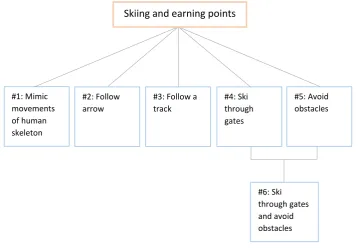
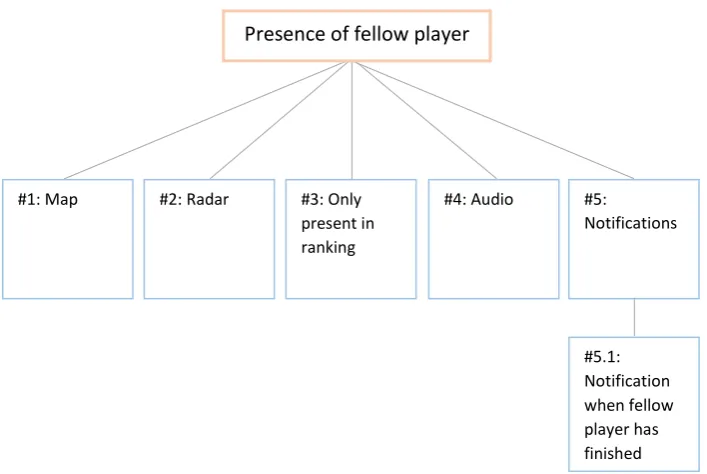
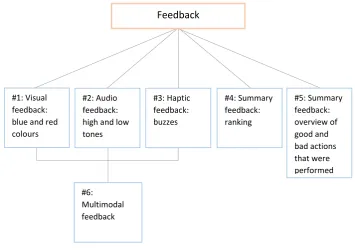
4.3 The ideas that were found for skiing and earning points in the game. 31 4.4 The ideas that were found for the presence of a fellow player in the game. 33 4.5 The ideas that were found for providing feedback in the game. 34 4.6 The ideas that were found for implementing levels in the game. 35 5.1 An example of a Vuforia application that is very similar to the Vuforia prototype
that was made.
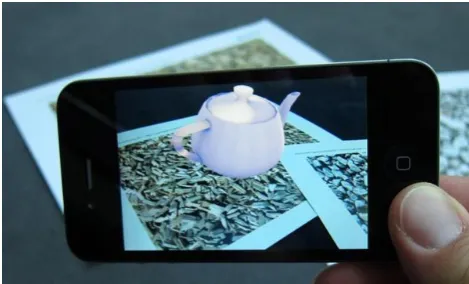
43 5.2 An application that is very similar to the markerless augmented reality prototype
that was made.
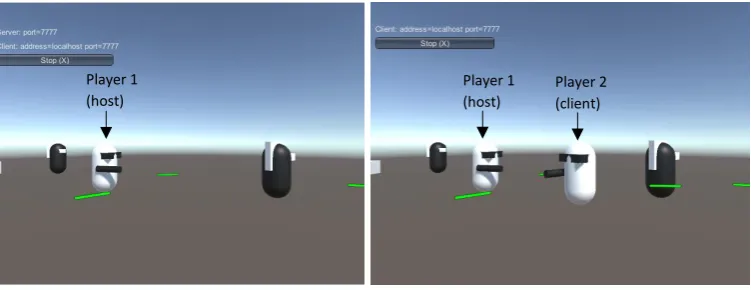
43 5.3 The multiplayer prototype, showing the game being played with only the host and
with the host and client.
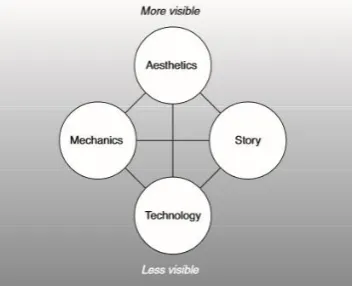
44 5.4 The elemental tetrad, containing the four basic elements that form a game. 47
6.1 Simple system architecture of the skiing game. 49
6.2 An augmented reality application on a smartphone. 51
6.3 The three-dimensional objects created in the Maya software and used in the game as gates and obstacles.
52 6.4 The situation on the revolving ski slope with the corresponding axes. 52
6.5 Placement of the game objects along the ski slope. 54
6.6 Placement of the game objects along the slope and the associated calculations. 55
6.7 The client-server model. 55
6.8 The parent-child relationship for the parent of the Unity camera and the Unity camera.
58 6.9 A schematic overview of the communication between the scripts of the project. 60
6.10 The game from the perspective of the player. 61
6.11A Placement of the player and the game objects while the game is being played in the Unity editor.
61 6.11B Placement of the player and the game objects while the game is being played in
the Unity editor.
62 7.1 Pie charts containing the characteristics of the test participants of the first round
of user tests.
65 7.2 Means and standard deviation of participants’ perceived cyber sickness
symptoms.
67 7.3 Overall scores for the questions about intrinsic motivation, divided in the
categories effort/importance, perceived competence, and interest/enjoyment.
68 7.4 Average IMI scores per category (interest/enjoyment, perceived competence,
effort/importance) over the whole population.
69 7.5 Average IMI scores per category (interest/enjoyment, perceived competence,
effort/importance) per level of experience.
70 7.6 Mean scores of the multiplayer statements in the test. 71 7.7 Mean scores of the multiplayer statements in the test for people who noticed the
fellow player.
8
7.9 The updated appearance of the obstacle game object. 73
7.10 Pie charts containing the characteristics of the test participants of the first round of user tests.
74 7.11 Means and standard deviation of participants’ perceived cyber sickness
symptoms.
75 7.12 Mean scores for statements related to feedback, given during the second round
of user tests.
76
Tables
Table Description Page
4.1 The possible sub-directions for direction number one and direction number three. 25 4.2 Overview of the stakeholders per category for the skiing game. 27 4.3 The ideas for skiing and earning points in the game and their explanations. 31 4.4 The ideas for the presence of a fellow player in the game and their explanations. 33 4.5 The ideas for providing feedback in the game and their explanations. 34 4.6 The ideas for implementing levels in the game and their explanations. 35 4.7 The results of the brainstorm session with the client. 36 4.8 Evaluation of the ideas that were generated through the brainstorm sessions. 37 5.1 A use scenario for the skiing game with the paper prototype that was made. 39 5.2 Product requirements and prioritization for the skiing game. 45
6.1 Overview of the scripts and their functionality. 59
9
Chapter 1
–
Introduction
1.1 Problem statement
Taking skiing classes on a ski-slope in The Netherlands does not necessarily provide the user with a feeling that is related to the experience of being in the snowy mountains. Yet people go skiing to get the “real” skiing experience, which is lacking at the moment. Therefore the idea arose of combining skiing on an artificial ski-slope with augmented reality. To enable the user the learn something from the experience and to add meaning to it, it was decided to make the envisioned product a serious game that can be used to support the ski-learning process. Overall, games are seen as entertaining and therefore motivational. However, serious games do not have a primary focus on entertainment but on education instead [1], [2], [3], which makes them a perfect means for training people in the field of sports. Since games are seen as entertaining, people experience learning through serious games as entertaining as well, which makes them more excited to learn in serious games [4], [5]. Augmented reality, which presents the user to an environment where normally present surroundings are overlaid with virtual three-dimensional objects [6], [7], is seen as a suitable technology for serious games, as it allows for natural interactions between the player and the game.
1.2 Research questions
In this thesis it is investigated how a game that uses augmented reality technology to support the ski-learning process can be designed. An important aspect when designing such a game is the question what the added value of a game in augmented reality for skiing classes on a revolving ski slope is. Another important aspect that was investigated is how people perceive a game in augmented reality that is meant to support the ski-learning process. Additionally, it is researched if the augmented reality skiing game that was designed causes cyber sickness symptoms for its players. These three aspects were investigated in order to answer the main research question of this thesis.
1.3 Outline
10
Chapter 2
–
Methods and Techniques
In this chapter the methods and techniques that were used in this research to eventually answer the research questions that were mentioned in Chapter 1 will be explained. The chapter starts with an explanation of the design process that was followed throughout the project, which is the Creative Technology Design Process. In order to properly execute the phases of the Creative Technology Design Process, a number of methods were used. The used methods are listed and explained in this chapter.
2.1 Creative Technology Design Process
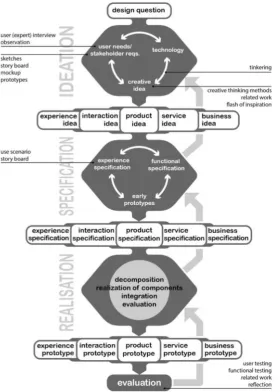
The overall process of this graduation project was carried out following the Creative Technology Design Process by Mader and Eggink [8]. The Design Process of Creative Technology consists of four phases: Ideation, Specification, Realisation, and Evaluation. Figure 2.1 gives a schematic
[image:10.595.161.442.335.728.2]representation of this design process.
11 Every phase in the Creative Technology Design Process has two separate phases of its own, a
divergence phase and a convergence phase. Every phase (Ideation, Specification, Realisation, Evaluation) starts with a divergence phase, where the design space is opened and different possible solutions can be explored. The divergence phase is followed by the convergence phase, where the design space is reduced again to one or few solutions.
2.1.1 Ideation
The ideation phase usually starts with a design question, an assignment from a client, or a creative idea. In this case, the ideation phase started with the assignment that was given by the client of this project, which was to make a combination between a revolving ski slope and augmented reality or virtual reality. In the Creative Technology Design Process, technology can be the starting point for the ideation phase. That is why tinkering, finding new functions or utilizations for existing technologies, is an important part of the ideation phase.
Related work is often used as an inspiration during the ideation phase. Therefore Chapter 3, section 3.1, gives an overview of related work. This overview contains games that use augmented reality to teach or train people in sports, since the search for games that use augmented reality to teach or train people in skiing did not deliver results. The games found under related work were reviewed, and useful techniques that were used in these games were taken into consideration in the ideation phase.
It is important to know whom the final design of the skiing game is targeted at. That is why in the ideation phase a stakeholder analysis was executed, to find out who the possible end users of the skiing game are. Once it was clear who the end users were, several brainstorm sessions were held and multiple use cases were made that entailed a variety of design possibilities. Out of the different generated solutions, one product idea was chosen that was taken to the specification phase.
2.1.2 Specification
The product idea that resulted from the ideation phase served as a starting point for the specification phase. The goal of the specification phase was to decide on the functional specifications of the skiing game. Specification was done by making several prototypes and evaluating their functionalities. For this purpose, a paper prototype was made of what the researcher envisioned the final game to be like. Besides the paper prototype, several prototypes were made to test the possibilities and
functionalities of the software that was chosen to use for making the skiing game. After creating and evaluating the prototypes, a list with functional requirements of the final prototype of the skiing game was made. The MoSCoW method, which is explained in section 2.2.5, was used to prioritize between the requirements.
2.1.3 Realisation
12
2.1.4 Evaluation
The final prototype that resulted from the realisation phase was evaluated in the evaluation phase. The evaluation consisted of two parts, functional evaluation and user evaluation. Functional evaluation was used to determine if the resulting prototype fulfils the functional requirements that were set in the specification phase. This part of the evaluation was carried out by the researcher. User evaluation consisted of test sessions with end users, where users got the chance to share their opinions about the final prototype. User evaluation was done to determine if the final prototype satisfies the needs and desires of the end user.
2.2 Methods
A number of methods were used throughout the process of this project. The used methods are listed and explained in this section.
2.2.1 Research
Literature research was done in the field of serious games that use augmented reality to teach or train people in sports. The results of this research can be found in chapter 3 and serve as background knowledge to this project. First of all, a state of the art research was done about existing games that use augmented reality to teach or train people in sports. The research was elaborated by the techniques that were used in these games to teach people, give them feedback and motivate them. Also, research was done about cyber sickness, especially about its causes and ways to decrease or prevent its symptoms, since cyber sickness is a well-known problem in applications that present the user to virtual environments. The result of the literature research served as a starting point and as background knowledge for the ideation phase of this project.
2.2.2 Stakeholder analysis
An analysis of stakeholders was executed to identify the users that the skiing game was designed for. Stakeholders are the people who will or can be affected by the product. The stakeholders of the skiing game were identified using the methodology of Sharp et al. [9]. Sharp et al. identified four groups of baseline stakeholders, the stakeholders who are most directly influenced by the product and have the most influence on the product. The categories of baseline stakeholders are users, developers, legislators, and decision-makers.
• Users
According to Sharp et al. [9], users are the people who interact with a product and control it directly. Eason [10] argues that users can be divided into three different groups, which are primary users, secondary users, and tertiary users. Primary users use the product the most directly and often. Secondary users are the users who use the product occasionally. Tertiary
users are influenced by the product’s launch on the market and can have an influence on its
sales.
• Developers
The developers are the stakeholders who are responsible for the development of the
product. Stated differently, the developers are the people who design and build the product. They have a great influence on the requirements engineering process of the product.
• Legislators
13 regulations. Legislators can be both people and institutions, on a local, national, or
international level.
• Decision-makers
As the name says, the decision-makers are the people who make decisions about the product. According to Sharp et al. [9], decision-makers are present in both the developer organisation and the user organisation.
2.2.3 Brainstorm
In the ideation phase, several brainstorm sessions were held in order to generate ideas on how to design a game that supports people in the ski-learning process. There is a great number of brainstorming techniques in existence that could be used to do this. Wilson [11] distinguishes
between individual brainstorming and group brainstorming. Wilson also mentions three fundamental principles that should be taken into account when having brainstorm sessions. The first fundamental principle is to aim for quantity, not quality. The goal of brainstorming is to get as many ideas as possible, which means that the successfulness of a brainstorm session can be measured by the number of ideas that was generated. The second fundamental principle of brainstorming is that the ideas of others cannot be criticized, positively or negatively, implicitly or explicitly, during the brainstorm session. The third principle is that new and wild ideas should be stimulated. New ideas can arise from already existing ideas, by combining them, stretching them, improving them, or by finding a metaphor for them. Wild ideas, which are ideas that are not directly feasible or applicable, can serve as a trigger to find suitable ideas. These three fundamental principles for brainstorming essentially mean that every idea is welcome in a brainstorm session.
Wilson [11] also mentions several brainstorming techniques for group brainstorming, which are the following:
• Buzz Sessions
Buzz Sessions are an effective technique for brainstorm sessions in large groups. The group is divided into smaller groups, which all get a topic to brainstorm about for a set period of time. After the set period of time, all the small groups come back to the big group and present their ideas.
• Free Listing
When Free Listing, all individual participants of a brainstorm session are asked to make a list of their ideas or solutions to the topic of the brainstorm in a short and predefined period of time.
• Reverse Brainstorming
In Reverse Brainstorming, also called Negative Brainstorming, the goal is to first find negative ideas or faults and then focus on positive ideas and solutions. The idea behind this approach is that it is often easier to find faults than it is to find solutions. The faults are used as an input to find solutions.
• Delphi Method
14 are summarized and sent to all the experts. This process continues until there is a final idea that will serve as the solution.
• Remote Brainstorming
Remote Brainstorming is rather a communication technique than a brainstorm technique. Using this method, brainstorm sessions can be held over distance, using communication technologies. The options for brainstorming are dependent on the options that are offered by the chosen communication technology.
Within this project, two brainstorm sessions were held. The first was an individual brainstorm session by the researcher, using the Free Listing technique. The first brainstorm session served as an input to the second session, which was held by the researcher and the client of this project. Also for that brainstorm session the Free Listing technique was used, since no other techniques seemed applicable for a small group like that.
2.2.4 Use Cases
In the ideation phase, use cases were used to identify requirements that were needed for the skiing
game from a user’s point of view. Use cases describe expected interactions between the user and the
product. A use case can be defined as a “set of scenarios tied together by a common user goal” [12]. In software engineering, the use case template of Cockburn is often used to construct valid use cases. Cockburn [13] describes two structures for use cases, “fully dressed” and “casual”. For this project
the casual structure defined by Cockburn was used, which entails the following details:
• Title of the use case, stating the goal.
• Primary actor.
• Scope, answering what problem is being solved, how the problem will be solved, and why this is an appropriate solution.
• Level, which can be “system”, “internal”, or “context”. The system level is applicable to goals
that can be reached in a single session with the system. The internal level applies to goals that are not complete. The context level is used for goals that involve other systems next to the system that the use case is about.
• Story, consisting of success scenario and extension conditions. Extension conditions are steps that could go wrong in the scenario.
2.2.4 Game Design
Because the final prototype that resulted from this project is a game, game design principles were studied. This was done by using the method of lenses by Schell [14]. Schell defines one hundred lenses, which all provide different ways of seeing and thinking about a game. Every lens requires to see the game from another perspective and possibly change thoughts about it. A selection of the lenses of Schell were used to consider the possible solutions and design choices that arose from the ideation and specification phase and to add or refine some of these ideas.
2.2.5 Requirements Analysis and Prioritization
15 this project, the feasibility of the requirements had to be taken into account. Also, the different requirements were prioritized, defining which requirements should be met first. The prioritization of the requirements was done following the MoSCoW method [15]. MoSCoW stands for Must have, Should have, Could have, and Won’t have. All four of them have their own level of prioritization, where Must have is the most important and Won’t have the least important. The requirements on the Must have-level are the minimal requirements that the product should fulfil. The Should have -requirements are not as critical to the launch of the product as the Must have-requirements, however they are of a high value to the user and are therefore seen as important. The Could have -requirements are features that are nice to include in the design of the product, but only if time and costs allow. These requirements are the first to be removed in case there is not enough time to fulfil all requirements. Finally, the Won’t have-requirements are the requirements that were taken into consideration for the final product, but were taken out of the design plan because of limited duration of the project. The Won’t have-requirements typically include features that could be added to a future version of the product.
2.2.6 Evaluation
After a functioning prototype of the skiing game was realised the prototype was be evaluated, which was the last phase of this research. In the evaluation phase, a functional evaluation as well as a user evaluation were executed. The functional evaluation assessed if the prototype functions as intended and if all the requirements are met. The user evaluation allowed end users to interact with the prototype and share their opinions about it. The functional evaluation had to be executed before the user evaluation could be executed, to prevent the prototype from malfunctioning during user tests.
2.2.6.1 Functional Evaluation
The functional evaluation of the final prototype of the skiing game was done by comparing the functionality of the skiing game to the requirements that were set in the specification phase, using the MoSCoW analysis. A table containing the requirements and their MoSCoW value was made. For every requirement it was assessed if the requirement was met in the prototype or not.
2.2.6.2 User Evaluation
The user evaluation was executed by organised test sessions with potential end users of the skiing game. A number of test participants had to ski on the revolving ski slope while wearing a head-mounted display that presented them to the skiing game. They could play the game for
approximately three to four minutes. After testing the game, they were presented to a questionnaire that they had to fill out. The questionnaire was composed based on two validated tests. In addition to the questions from the validated tests, some extra questions were added.
The first part of the questionnaire consists of the questions from the Simulator Sickness
16 headache, eyestrain, difficulty focussing, difficulty concentrating, and blurred vision. The
Disorientation cluster contains difficulty focussing, nausea, fullness of head, blurred vision, dizzy (eyes open), dizzy (eyes closed), and vertigo as symptoms. The symptoms that belong to the Nausea cluster are general discomfort, increased salivation, sweating, nausea, difficulty concentrating, stomach awareness, and burping. It can be noted that some of the symptoms belong to two of the symptom clusters. Based on how the test participants indicated being affected by the different symptoms it was decided if they were suffering from cyber sickness after the experiment, or not. Based on the symptoms that were rated highest it was decided what cluster of symptoms were affecting the test participants the most.
The second part of the questionnaire consists of part of the questions from the Intrinsic Motivation Inventory, also referred to as IMI, mentioned by Van Delden [17]. IMI is a validated test to measure a
participants’ subjective experience with an experiment. Stated differently, the results of IMI indicate what the test participants’ opinions are about the prototype that is presented to them during the experiment. However, only part of the questions of IMI were chosen to be included in the
questionnaire that was used in the user evaluation of the skiing game. Because of this, it can be doubted how validated the test questions are, since they are taken out of their context. The questions of IMI are divided into seven categories, which are interest/enjoyment, perceived competence, effort/importance, pressure/tension, perceived choice, value/usefulness, and relatedness. Participants could answer the questions by choosing points on a scale from one to
seven, where one means “not true at all” and seven means “very true”. A scale from one to seven was chosen because the standard IMI questions also use a scale that ranges from one to seven and the standard IMI test provides a way to calculate test scores based on these scales. Also, a scale from one to seven allows test participants to give their answers very detailed, as they can choose from not true at all, not true, slightly not true, neutral, slightly true, true, and very true. This way, participants are allowed to show their doubts or their certainty when they are saying a statements is true or not true, because they can also say it is slightly true/not true or very true/not true. Therefore, it is expected that a scale from one to seven delivers more reliable results than when a smaller scale would be used.
The categories which were part of the questionnaire that was presented to test participants after the experiments are interest/enjoyment, perceived competence, and effort/importance. The other categories are not related to the experience of the game and are therefore excluded, except for the questions under value/usefulness. These were taken as a starting point to formulate new questions about the use and usefulness of the skiing game in particular. A total of ten questions were added to the questionnaire, consisting of two open questions and eight questions that should be answered on a scale from one to seven. It was chosen to use a scale from one to seven again to keep the
questionnaire consistent, as all other questions also used a scale from one to seven.
The scores obtained from the IMI part of the questionnaire were processed by calculating the mean score for every IMI category (interest/enjoyment, perceived competence, effort/importance) by averaging the scores obtained for the statements in the category. Every IMI category consists of one
or more questions which are said to be “reversed statements”, as they state something negative.
17
Chapter 3
–
State of the Art on
Augmented Reality Games that Teach
People in Sports
This chapter contains the result of a state of the art research on serious games that use augmented reality to train people in sports. Section 3.1 presents related work, concerning related exergames, movement games and rehabilitation games. In section 3.2, motivational aspects of serious games that teach people in sports or movements are described. Section 3.3 gives an overview of effective ways of providing feedback in serious games that are aimed at teaching people in sports or
movements. In section 3.4, the effects that cause a learning effect in serious games that train people in sports or movements are described. This is followed by an explanation of cyber sickness and its causes in section 3.5. Finally, section 3.6 provides a conclusion, describing aspects that will be taken from this background research to the design process.
3.1 Related work
It is difficult to find a system that uses a serious game in augmented reality to train people for the particular case of skiing. However, serious games that use augmented reality to train people in sports or movements were found. The results include exergames, movement games, and rehabilitation games. Exergames are games that encourage people to exercise [2], [19]. The category of movement games entails the games in which people do not learn sports, but focus on learning certain
movements instead. Rehabilitation games use game technology to help and motivate people in their physical rehabilitation. Per category a number of relevant games will be mentioned and explained.
3.1.1 Exergames
Various exergames were found, although only the games Calory Battle AR and GeoBoids actually make use of augmented reality. Calory Battle AR is a mobile augmented reality exergame platform that uses sensors to connect between the real world and the game [7]. In Calory Battle AR the player has to help the Dews to fight the Caloroids by finding and deactivating calory bombs that were placed around a geographical area. In order to do so, the player has to go outside and perform physical activities. GeoBoids is a game that is rather similar to Calory Battle AR. It uses augmented reality to display virtual creatures, the GeoBoids, on a map on the player’s smartphone. The player
has to find and catch them within a set time limit [7], [20]. While playing the game, the player can see the GeoBoids moving around in the real world. Both exergames use augmented reality to make a connection between the game and the real world, making the user feel more context aware and motivated in the games.
3.1.2 Movement Games
YouMove is an augmented reality game that teaches the trainee how to perform bodily movements. The trainee is presented to an augmented reality mirror that is overlaid with a simplified
18 that should be mimicked by the user. A Kinect is used to track the position and pose of the user, which is directly compared to the pose presented on the mirror to determine if the user is correctly imitating the human skeleton. The game consists of five stages which should be executed in the
following order: “demonstration”, “posture guide”, “movement guide”,“mirror”, “on your own”. In
every stage the trainee becomes less dependent on the system, which requires more skills from the trainee [21]. To conclude, YouMove is a game that teaches the user movements by making the user less reliant on the game system.
Reidsma et al. [22] designed a very different system that motivates its user to perform movements, which entails a virtual trainer that looks and behaves like a human. This system is not a game because it does not contain any game elements, such as competition, the chance of winning or the risk of losing. However, it is seen as relevant to this research since it stimulates users to perform physical activity. The movements to be made and the pace are determined and shown by the virtual
trainer based on the user’s heart-rate [22]. The system uses anthropomorphic behaviours and representations to motivate and activate its user.
3.1.3 Rehabilitation Games
Tannous et al. [4] and Hossain et al. [23] both designed two comparable games that adopt game technology and augmented reality for rehabilitation purposes. The serious game concept by Tannous et al. shows similarities to the work of Anderson et al. [21] with the game YouMove. Just as in YouMove, this game uses a Kinect to make a three-dimensional visualisation of the player’s body
which is directly compared to a model of the right position or movement to be made by the player. The model of the position or movement is brought into the system by the expert, the person who helps the patient in the rehabilitation process [4]. The second game, SIERRA from Hossain et al. [23], uses augmented reality to display virtual objects on a real table, which should be reached for or picked up by the player, the rehabilitation patient. For both games it is the case that the more movements the patient is able to carry out correctly, the more complicated the next movements in the game will be.
3.2 Motivational aspects
In a serious game motivational aspects are needed to allow the game to have an educational effect on its players. That is because people need motivation to continue playing the game. Only when people play the serious game long enough they get the chance to learn something from it.
Therefore, motivating the players of a serious game to play the game contributes significantly to the effectiveness of the serious game.
Games in itself are seen as entertaining and therefore motivate people to play them. Serious games make use of the concepts that make games entertaining, such as rules and a clear goal that should be reached [3]. Hossain et al. [23] argue that by using the entertaining aspects of regular games, serious games become more entertaining and motivate their players. However, Iten and Petko [24] disagree and state that entertainment in games has also proven to distract the player. Distraction prevents the player from having a focus on the learning goal of the serious game, which undermines the purpose of the serious game. Therefore it remains doubtful to what extend a serious game should be entertaining.
19 all, Göbel et al. [2] state that multiplayer games offer competition. When there is competition, people want to prove that they are the best which makes them likely to continue playing the game until they get near that goal. Secondly, playing against a human opponent is less predictable than playing against the computer, which enhances the replayability of the game [2]. Thirdly, Whitehead et al. [19] add that there is a social aspect in multiplayer games. They argue that peer pressure plays an important role in motivating the fellow player. Because of these three factors, people will enjoy the game for a longer time and therefore feel motivated to play the game.
Also, classic game elements are known for contributing to a player’s motivation to play the game.
Göbel et al. [2] explain that when players are presented to a ranking of the best players, they tend to compare their personal results to those of others, which makes them want to do better in the game and continue playing. Cheng and Liu [25] add to this that a clear goal in the game makes the player aware of the gap between what should be reached and the current situation that the player is in. When the goal is clear and the game offers means that can be used to reach it, the player feels motivated to keep on playing until the goal of the game has been reached. Also, Whitehead et al. [19] state that games that do not allow for cheating are more motivational than games where cheating is possible. Therefore, when cheating is impossible, people will feel motivated to play the game because that is the only way they can reach their desired result. All in all, rankings, a clear goal and fair play are classic game elements that motivate the players of a game.
Furthermore, personalization of a game increases the motivation of its players as well. This works especially well for sports games. Hardy et al. indicate that serious sports games can be personalized by giving trainers and trainees the option to add personal content to the game, such as training schedules and exercises. Using this input, the training will be at an appropriate level of challenge for the trainee [5]. It is clear that a challenging but manageable game adds to the motivation of the player.
Another motivational factor in games, but also in general, is the use of a virtual human-like character as a trainer. People have the tendency to follow the behaviour of the virtual trainer as long as it looks and behaves like a human. Reidsma et al. [22] claim that a human-like virtual coach can be able to make people do certain fitness exercises without verbally giving them the command to do so. People tend to copy the behaviour of the human-like trainer. Therefore, a human-like representation in a game that verbally or non-verbally transmits what should be done adds to a player’s motivation to
continue playing the game.
A final motivational factor in games are rewards, which are usually given for specific performances or actions in the game. According to Swartz and Lyons [26] rewards offer the player a favour or
advantage in return for his/her performance in the game, which has a positive effect on the player’s
motivation to continue playing the game. Goh et al. [27] suggest that rewards reinforce a player’s
enjoyment and make a player feel self-determined and competent, which adds to the motivation of the player. However, Cruz et al. [28] contradict these statements by claiming that rewards are not stimulating every form of motivation. According to the Self-Determination Theory from Deci and Ryan [29] there are two types of motivation: intrinsic motivation, and extrinsic motivation. Intrinsic
motivation is defined as an internal and inherent desire to do an activity for one’s own pleasure and
satisfaction, while extrinsic motivation is a feeling of motivation that comes from external sources instead of from an internal drive. Cruz et al. [28] claim that rewards increase extrinsic motivation and decrease intrinsic motivation. Rewards stimulate a player to play for the goal of getting more
20 commonly used types of rewards are points and badges [26], [27]. Points and scores are the result of change in behaviour [26] and supply the player with insights in personal performances [27], while
badges are seen as an indication of a player’s status in the game [27].
3.3 Feedback
Another important aspect in serious games is the feedback provided, since people need feedback to know what they did right and what they did wrong. Based on feedback, improvements can be made which will enable the player of the serious game to make progress. In the examined literature three effective ways were found to provide feedback.
First of all, summary feedback and intermediate feedback play significant roles. Summary feedback can be defined as feedback at the end of a series of trials in the game, whereas intermediate feedback is provided at every single trial. Anderson et al. [21] state that providing a player with intermediate feedback can possibly cause an overload of information presented to the player, which will hardly benefit their performance. They add to this that supporting a player by summary feedback instead will allow the player to think about the feedback for a longer time and will enable the player to improve his/her skills throughout a series of trials, without being interrupted. However,
contradictory findings from Hossain et al. [23] show that real-time feedback is most effective, since it allows the user to know what to do in every stage of the game. Real-time feedback is rather related to intermediate feedback than to summary feedback, as it is provided continuously. Therefore, it remains unclear if summary feedback is actually preferred over intermediate feedback. However, it is expected that a restricted amount of intermediate feedback is desired from the trainee’s side, since
it allows the trainee to adapt behaviours according to the feedback at the right moments. The use of a limited amount of intermediate feedback can be accompanied by summary feedback at the end of every game to make the feedback more effective.
Second, multimodal feedback has positive effects on the player. Multimodal feedback is feedback that is provided to multiple senses [23]. Usually, multimodal feedback entails audio feedback, visual feedback, and possibly even haptic feedback. According to Hossein et al. [23], accessing multiple senses by the feedback makes the player more aware of the feedback and more likely to change his behaviour accordingly. Anderson et al. [21] add that audio, for example, has positive effects on the learning timing of the player. All in all, multimodal feedback makes the player more attentive and thoughtful towards his/her own behaviour in the game.
Third, the use of assessment games, intermediate games that assess whether the player actually learnt something from the normal game, are seen as a powerful way to address the player and provide feedback. Hossain et al. [23] state that by playing an assessment game, the player will discover what skills were learnt throughout the gameplay and what skills are still inadequately developed. This will help the player to clearly see what his/her competences are and what should still be developed through gameplay. Assessment games also provide feedback to the game itself as to what level the player is currently at. Using assessment games, the game can determine what exercises or challenges the player needs in the regular game.
3.4 Learning effect
21 something new from the game. A number of causes that make a serious game more effective in teaching were found.
First, clarity of the game enables the player to learn something from it. Ke [3] and Iten and Petko [24] agree that clear tasks, explanation and cues in a serious game cause a learning effect for the player. According to Iten and Petko [24] that is because a player’s expectations of an easy and instructive
game makes his/her approach towards the game more positive. Ke [3] adds that this becomes even
more effective when the game builds upon the player’s prior knowledge, as this makes it easier for
the player to connect the gameplay experience to the educational content of the game. Ke [3] also states that in this case, rules play a significant role as well, to restrict the player in what can or cannot
be done during gameplay. Rules empower the player’s learning efforts even more as they force the
player to find alternative ways to reach the goal of the game. All in all, clear tasks and explanations, the use of prior knowledge, and the use of rules add to the clarity of the serious game.
Second, a decrease in guidance during gameplay has positive effects on the player’s learning as well.
Anderson et al. [21] concluded that gradually reducing the guidance in the game forces the player to fill up the gap of missing guidance with increased skill. Therefore, lowering the amount of guidance in the game over time makes the player work harder on his/her skills and causes a learning effect. Cheng and Liu [25] add that the decrease in guidance also helps the player to get in “flow”. Flow is
the situation where a challenging goal is set in the game and the supplies and techniques that are offered enable the player to reach the goal. Learning in flow is most likely to happen when players experience a balance between their own skills and the challenges offered by the game, which is an important aspect to take into account when decreasing the guidance in the game.
3.5 Cyber sickness
An important aspect to consider when designing for virtual reality or augmented reality is cyber sickness. Bruck and Watters [30] define cyber sickness, also referred to as simulator sickness or virtual environment sickness [31], as a feeling of illness that is similar to motion sickness, while there is no physical motion present. Rebenitsch and Owen [32] confirm this definition and describe cyber sickness as an illness that is very similar to motion sickness, without the presence of actual physical motion. The symptoms of cyber sickness are comparable to the symptoms of motion sickness and include nausea, disorientation, headaches, and dizziness [31], [32].
3.5.1 Possible causes of cyber sickness
In the examined literature, six theories were found about the cause of cyber sickness. The first theory is the sensory conflict theory, which confirms the definitions mentioned above. According to Duh et al. [31] and Renebitsch and Owen [32] the sensory conflict theory claims that cyber sickness results
from contrasting information from a person’s visual perception and inertial perception. An example
of this is a system where the person is stationary in the physical world and gets visual signals of movement in the virtual world.
22 A third theory that explains a possible cause for cyber sickness is the postural instability theory. Riccio and Stoffregen [34] posed the postural instability theory as an alternative to the sensory conflict theory. The theory suggests that cyber sickness is caused by the fact that virtual
environments are different from people’s natural environment. They imply that virtual environments
force people to find new ways of controlling their postural stabilities, since it is different from their natural environment. Similar to animals that get sick in environments where they cannot get control over their balance, humans get sick from losing their postural stability. Rebenitsch and Owen [32] also mention the postural instability theory as a possible cause for cyber sickness.
Fourth, the duration of exposure in augmented reality or virtual reality plays an important role. Rebenitsch and Owen [32] claim that the intensity of cyber sickness increases as the duration of exposure increases. Bruck and Waters [30] add to this that cyber sickness symptoms can already be increased after only six to ten minutes of exposure.
The fifth theory that possibly explains the cause of cyber sickness is the rest frame theory. Rebenitsch and Owen [32] describe the rest frame theory as a theory that is rather similar to the postural stability theory. The rest frame theory claims that cyber sickness is caused by disagreements between the direction a user thinks is upwards based on what he or she sees in the virtual
environment, and the actual upwards direction in the physical world. In other words, this theory posits that if the virtual environment is tilted compared to the physical world, a user may experience cyber sickness.
A sixth theory that was found on the cause of cyber sickness is the Eye Movement Theory of motion sickness. Bruck and Watters [30] reported that fatigue is one of the components of cyber sickness. They claim that rapid movement of the eyes results into tiredness of the eye muscles. In their research they linked this to the Eye Movement Theory posed by Ebenholtz [35], which suggests that overstimulating the muscles in the eye as a result from exposure to a virtual environment can cause tiredness of the eye muscles and headache, which are symptoms of cyber sickness [31], [32].
3.5.2 Decreasing symptoms
Contrary to the possible causes of cyber sickness, there is not much information on ways to decrease or prevent its symptoms. In the examined literature, only few methods were found to decrease cyber sickness symptoms. Repeated exposures to the virtual environment can decrease symptoms of cyber sickness. Duh et al. [31] mentioned a research from Kennedy and Fowlkes [36] in their work, that showed that symptoms of cyber sickness decreased with repeated exposures to the virtual environment. Besides the number of exposures, Rebenitsch and Owen [32] claim that limiting the horizontal field of view and including the physical world in the virtual environment reduces cyber sickness symptoms. The latter suggests that cyber sickness symptoms will be less severe in augmented reality environments than in virtual reality environments, since augmented reality environments include the physical world [6], [7].
23
3.6 Conclusion
Overall it can be concluded that several reliable methods exist that teach people in sports through a serious game in augmented reality. In the examined literature, methods were found that are related to motivational factors, feedback and learning effects in serious games. Also, it must be taken into consideration that cyber sickness symptoms can appear when people play such games.
A number of exergames, movement games and rehabilitation games were found in a state of the art research. Studies conducted on these games showed that, although players get motivated by the entertaining aspect of serious games, this can also be a distraction for them. Furthermore, multiplayer games, classic game elements such as rankings and a clear goal in the game, personalization of the game, a human-like representation of the trainer or coach, and including rewards in the game are successful motivational factors in serious games. With regard to the feedback provided in serious games it remains unclear if summary feedback or intermediate feedback is most adequate. However, based on the findings it can be concluded that multimodal feedback and the use of assessment games are reliable and effective. Finally, clarity in games such as clear tasks, explanation and cues enforce the learning effect that the game has on the player. Besides that, a decrease in the guidance that the game offers also shows positive learning effects.
Cyber sickness symptoms, causes, and ways to prevent it were examined as well. Cyber sickness symptoms are very similar to the symptoms of motion sickness, while there is no physical motion present when one suffers from cyber sickness. Possible causes of cyber sickness are the sensory conflict theory, lag of the graphics, the postural instability theory, long exposures to the virtual environment, the rest frame theory, and the Eye Movement Theory of motion sickness. Cyber sickness symptoms can be prevented or decreased by having repeated exposures to the virtual environment, limiting the horizontal field of view, and inclusion of the physical world in the virtual environment. Based on these findings it is expected that augmented reality, which presents the user to an environment where the physical world is overlaid with three-dimensional virtual objects, will not cause severe cyber sickness symptoms.
3.6.1 Design Recommendations
Based on the findings of this chapter several recommendations can be made about the design of the serious skiing game. First of all, the envisioned game should be a multiplayer game, since that adds to the motivational impact that the game has. Second, players should be able to earn points in the game. Rankings should show how many points every single player has earned so that individual players can compare their achievements to those of their opponents or other players. The rankings will provide the players with more insight into their own performance in the game. Third,
intermediate feedback should be used. However, this should be done to a limited extent, to prevent the player from being overloaded with information. The intermediate feedback should be in the form of multimodal feedback, providing the player with visuals and audio that show areas where
improvement is possible and indicate how the improvements should be made. The actual look of the multimodal intermediate feedback will be further explored in Chapter 4 Ideation and Exploration. Fourth, the option to accompany the intermediate feedback with summary feedback will be
24
Chapter 4
–
Ideation and Exploration
This chapter describes the results of the ideation phase, which was executed to gather possible product ideas for the prototype that will be the result of this project. The ideation phase consisted of diverging phases and converging phases. In the diverging phase, possible ideas were explored, which were brought back to one final idea in the converging phase. The result of this chapter is a final product idea, which will be further specified in the specification phase of this project.
4.1 First Ideation
The starting point for the ideation phase was the assignment that was given by the client of the project. The client gave the assignment to make a combination between a revolving ski slope and augmented reality or virtual reality. A revolving ski slope, also called infinite slope, is a ski slope with a revolving surface [37]. This causes the same effect as running on a running treadmill, but then for skiing. Figure 4.1 gives a visual representation of a revolving ski slope.
Figure 4.1: A revolving ski slope.
Based on the assignment, the first ideation phase was started. The goal of the first ideation phase was to determine what the exact assignment for this project was going to be, since a combination between a revolving ski slope and augmented reality or virtual reality can be made in many ways. Possible directions for this project that were thought of were the following:
1. The combination between a revolving ski slope and augmented reality or virtual reality to enhance the skiing experience. This could for example be done by stimulating the user’s
senses in such a way that an experience is being evoked that the user will strongly relate to the experience of real skiing. The user could be shown to a visual representation of a real ski area in the snowy mountains, accompanied with the sounds and smells that are present there. Cold air or the feeling of snow could even be included to add to the skiing experience. 2. The combination between a revolving ski slope and augmented reality to offer people help
and instructions when they are skiing. This could for example be done by visualizing a track that indicates to the user where he/she should ski.
25 4. The creation of a virtual coach that gives a skier instructions and exercises that can be done
before the actual skiing activity, as preparation.
5. The combination between sensors that measure physical data, such as heart rate and blood pressure, and sensors that measure ski-related data, such as the pressure put on the skis. This can be combined with augmented reality or virtual reality to inform a skier about his/her data. Additionally, this could be taken even further by using the obtained data to control the
user’s behaviour based on it. For example, if the skier’s heart rate is too high, a
representation in augmented reality or virtual reality could be used to try to slow him/her down, which is likely to eventually also slow the skier’s heart rate down.
6. The creation of a tracking system that can track a user’s positions and movements in the
physical world, on the actual ski slope that is, and uses that information to enable the user to move himself/herself through a virtual environment based on his/her movements in the real world.
7. The combination between skiing on a revolving ski slope and augmented reality or virtual reality to make a social platform for skiers, which allows them to stay in contact while skiing. The social platform would be presented to the users in augmented reality or virtual reality.
[image:25.595.61.525.661.748.2]Out of the seven possible directions that are described above, two were considered most interesting and feasible within the limited time that is available for this project. The two directions that were further explored were direction number one, the combination between a revolving ski slope and augmented reality or virtual reality to enhance the skiing experience, and direction number three, the creation of a skiing teacher or teaching system in augmented reality or virtual reality. Directions number two and four were considered feasible, but less interesting than directions number one and three. Directions number five, six, and seven were not considered to be feasible within the limited time scope of this project. With respect to direction number five, a system that combines sensor input from multiple sensors, transfers the input to a form that can be used to make a representation of it in virtual reality or augmented reality, and combines the data in such a way that meaningful conclusions can be drawn upon it did not seem realistic and achievable within ten weeks. Regarding direction number six, tracking is a subject that has undergone extensive research and yet there are no easily implementable or reliable solutions found. Therefore, it is expected that this direction poses problems that are unrealistic to solve within this project. Concerning direction number seven, social platforms contain extensive internal architectures which are not seen as realistic to be developed within the limited timeline of this project. Apart from the feasibility of direction number seven, also its desirability was questioned. Distracting people from their skiing activities with a social platform seems to be an objectionable thing to do. For both of the chosen directions, two possible sub-directions were found. Table 4.1 lists the possible sub-directions per chosen direction.
Table 4.1: The possible sub-directions for direction number one and direction number three.
Direction
Sub-directions
1 The combination between a revolving ski slope and augmented reality or virtual reality to enhance the skiing experience
26 Research about which senses should be
stimulated and with how much intensity to give users the feeling of skiing in the Alpes, instead of on the revolving ski slope.
3 The creation of a skiing teacher or teaching system in augmented reality or virtual reality
The creation of a system that uses simple icons to give skiers instruction and to teach them new skiing techniques, which will be displayed to them in augmented reality or virtual reality. The creation of a (serious) game that teaches people how to ski, using augmented reality or virtual reality techniques.
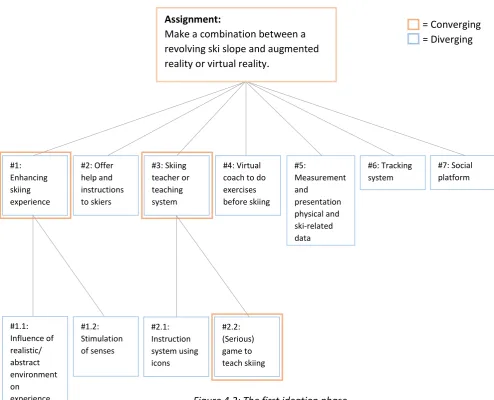
The last sub-direction, the creation of a (serious) game that teaches people how to ski, was finally chosen to be the direction for this project. This direction was chosen because it combines game design with augmented reality or virtual reality, which is seen as an interesting direction. Therefore, the rest of this chapter will focus on the direction of the (serious) teaching game for skiing. Figure 4.2 gives an overview of the converging and diverging phases of the first ideation phase that was
[image:26.595.58.553.344.744.2]described in this section.
Figure 4.2: The first ideation phase.
#1: Enhancing skiing experience #2: Offer help and instructions to skiers #3: Skiing teacher or teaching system #4: Virtual coach to do exercises before skiing #5: Measurement and presentation physical and ski-related data #7: Social platform #6: Tracking system #1.1: Influence of realistic/ abstract environment on experience #1.2: Stimulation of senses #2.1: Instruction system using icons #2.2: (Serious) game to teach skiing = Converging = Diverging Assignment:
27
4.2 Stakeholder Analysis
A stakeholder analysis was executed to identify who the product will be designed for. As was described in Chapter 2 Methods and Techniques, stakeholders are identified according to the methodology of Sharp et al. [9]. Sharp et al. identify four groups of baseline stakeholders, which are users, developers, legislators, and decision-makers. The last three groups are not important for the project in this early stage, as the focus is now on creating a working prototype that is aimed at the primary users. There is no product in existence yet, which means that developers, legislators, and decision-makers will not get confronted with the product and will not have an influence on it. This might happen at a later stage, when there is a product being readied for the market.
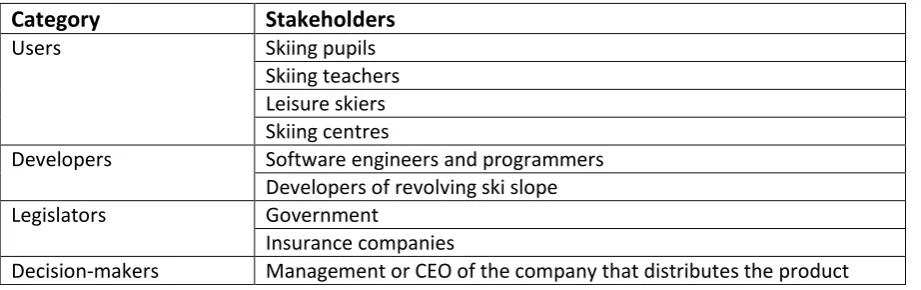
[image:27.595.71.532.406.551.2]The identified stakeholders per category are listed in Table 4.2. Four groups of user-stakeholders were found, which include skiing pupils, skiing teachers, leisure skiers, and skiing centres. Skiing pupils are people who take ski classes to learn how to ski, they can be seen as the primary target group of the product. Skiing teachers are the people who teach the skiing pupils how to ski, they could be interested in using the product that is being developed throughout this project as a support tool during their teaching activities. Leisure skiers are people who practice skiing as a leisure activity, for entertainment. The product could potentially be interesting for them as well to add more fun to their skiing activities. Skiing centres are the places that employ the skiing teachers and where skiing pupils can take lessons before they actually go to the real skiing areas. Skiing centres could be interested in the product to offer it to their customers and their employees during skiing classes.
Table 4.2: Overview of the stakeholders per category for the skiing game.
Category
Stakeholders
Users Skiing pupils
Skiing teachers Leisure skiers Skiing centres
Developers Software engineers and programmers Developers of revolving ski slope
Legislators Government
Insurance companies
Decision-makers Management or CEO of the company that distributes the product
4.3 Early Design Choices
After the first ideation phase and the stakeholder identification, some early design choices could be made. The first and very essential choice was the choice between augmented reality and virtual reality. Augmented reality can be defined as the technology that presents the user to an
28 not correct their movements when they are likely to fall down the slope. Therefore, augmented reality was chosen as the most suitable technology for this project.
A second early design choice that was made was the choice to make a system that supports the ski-learning process, rather than a system that would replace the normal skiing teacher and become a teacher on its own. Since skiing pupils need intensive and detailed instruction when they ski on the slope for the first time, it is expected that this cannot be reached yet with a learning game in
augmented reality. However, it is expected that the teacher can use the game as an extra tool during the teaching activities. Therefore, the skiing game will be designed as a tool that supports the ski-learning process, instead of actually teaching a pupil how to ski.
4.4 Use Cases
Based on the stakeholders that were identified in the stakeholder analysis of section 4.2, two use cases were made. The use cases were made based on the “casual” use case template by Cockburn [13], which was explained in Chapter 2 Methods and Techniques. The goal of the use cases is to
identify requirements that are needed for the skiing game from a user’s point of view. Therefore, the
use cases are made for the users that are listed in Table 4.2. Use case number one has skiing pupils and skiing teachers as the primary actors, use case number two has leisure skiers as primary actors and the employees of skiing centres as secondary actors. Besides the actors, every use case contains a scope, level, success scenario, and extension conditions. The latter consists of the steps that could go wrong in the success scenario. The use cases described in this section served as a starting point for the brainstorm sessions that were executed afterwards, as is described in the sections that follow.
Use case #1
Title Using the skiing game during ski classes Primary actors Skiing pupil
Skiing teacher
Scope For the pupil:
The problem of boring ski classes on a revolving ski slope is being solved by introducing an augmented reality skiing game to the ski classes. This is an appropriate solution because games are a good means for entertaining people [3], [23] .
For the teacher:
The problem of only being capable of teaching one pupil at a time is being solved by using the augmented reality skiing game. This is an appropriate solution because the skiing game allows the teacher to let one pupil practice on his/her own with the skiing game while giving personal attention to another pupil, which can be reversed when the first pupil has finished the game.
Level Internal
29 2. The skiing pupil gathers the right materials (ski boots, skis) and
enters the slope.
3. The teacher gives the skiing pupil a head-mounted display with the skiing game on it.
4. The pupil puts on the head-mounted display. 5. The teacher turns the revolving ski slope on.
6. When the pupil is stable enough, he/she can turn the game on and the game will start.
7. The skiing game challenges the pupil to make certain movements in order to perform well in the game. The pupil plays the game and the teacher can give his/her attention to another pupil in the meantime.
8. After some time, the game is finished. At that moment, the slope stops. The pupil is presented to summary feedback, which indicates how well he/she did in the game.
9. The pupil takes the head-mounted display off.
10. The teacher returns from the other pupil (who can now start playing the game) and decides what should be worked on during the lessons, based on how well the pupil performed in the game. Extension conditions 5. If the pupil has never used the head-mounted display before while
skiing on the revolving slope, he/she might fall because distraction or disorientation.
6. Due to technological problems, the game might not start.
7. The challenges of the skiing game might be too easy or too difficult for the pupil, causing boredom or a feeling of incompetence. Challenges that are too difficult can also cause dangerous
behaviour, because the pupil is demanded to perform actions that he/she is not capable of.
Use case #2
Title Using the skiing game for skiing for fun Primary actors Leisure skiers
Secondary actors Employee of skiing centre
Scope The problem of the lack of fun while skiing on revolving ski slopes is solved by using the augmented reality skiing game while skiing on the revolving ski slope. This is an appropriate solution because games are a good means for entertaining people [3], [23]. Besides that, the inclusion of the
multiplayer aspect in the game allows multiple leisure skiers to ski together, even over distance.
Level System
Success scenario 1. The leisure skier goes to a skiing centre with revolving ski slopes. 2. The leisure skier gathers the right materials (ski boots, skis) and
30 3. An employee of the skiing centre gives the leisure skier a
head-mounted display with the skiing game on it.
4. The leisure skier puts on the head-mounted display. 5. The leisure skier can start the game application.
6. The leisure skier has the option to connect his/her game to other skiers, by virtually inviting skiers that are using the application at the same time (which will be shown in the application). These other skiers might be acquaintances of the leisure skier. However, the leisure skier can also connect to skiers that he/she does not know.
7. When the connection is made and all players are satisfied with the amount of fellow players, the game starts.
8. The employee of the skiing centre turns the revolving ski slope on. 9. The leisure skier starts playing the game. The goal is to perform
well enough to earn the most points and reach the finish earlier than the opponents.
10. When all players have reached the finish, the game ends. 11. The employee stops the revolving ski slope.
12. Summary feedback provides all players that were present in the game with an overview that compares their personal
achievements to those of the other players.
13. The leisure skier can decide to play the game again (repeat from step 5 onward), or to stop.
14. The leisure skier takes the head-mounted display off. 15. The leisure skier leaves.
Extension conditions 5. Due to technological problems, the game might not start.
6. Due to connection problems, it might not be possible to connect to other players at all times.
7. Due to technological problems, the game might not start.
9. The challenges of the skiing game might be too easy or too difficult for the leisure skier, causing boredom or a feeling of
incompetence. Challenges that are too difficult can also cause dangerous behaviour, because the leisure skier is demanded to perform actions that he/she is not capable of.
12. Due to technological problems, summary feedback might not appear.