i
Master Thesis
Resilience in relation to the FIRST
self-defense training
L. M. De Witte
S1779168
May 2018
Supervisors:
Dr. ir. P.W. De Vries
Dr. J.M. Gutteling
Faculty of Behavioural Management and
2
Abstract
In the Dutch society feelings of insecurity exist among citizens due to events such as recent terrorist attacks in Europe. As a result, people adjust their behaviour, for example by avoiding certain destinations. Therefore, it might be important to increase the resilience of individuals. A training methodology aimed at increasing the resilience is the FIRST (Functional Intuitive Replication Scenario Training) reflex-based self-defense training methodology. The current study has examined whether the psychological resilience of civilians of the Netherlands can be increased by following this training. In total, 70 participants between 14 and 62 years of age have participated in the training. The effects of the training on their resilience is measured by the use of questionnaires. The results show people being less optimistic, having an increased risk perception and an increased level of self-efficacy after following the FIRST training. Although the training causes people to have a less optimistic view afterwards, which may be associated with their increased risk perception, it can be stated that this is a positive finding because awareness of risks is a prerequisite to respond effectively to a threatening situation. After the training people feel more capable of responding effectively to- and protect themselves from a potential threatening situation. Therefore, this study suggests that the FIRST training can improve the resilience of individuals. A remark must be made, because in this study only a basic part of the training has been examined. For future research, it might be interesting to
3
Samenvatting
4
Table of contents
1. Introduction ... 5
2. Theoretical framework ... 6
2.1 Protective- and risk factors ... 6
2.1.1 Protective factors ... 7
2.2.2 Risk factors ... 8
2.3 Three parts of resilience ... 8
2.3.1 Cognition ... 9
2.3.2 Emotion ... 9
2.3.3 Behaviour ... 10
2.4 FIRST training ... 10
3. Method ... 12
3.1 Participants and design ... 12
3.2 Measures ... 13
3.2.1 Scales ... 13
3.4 Data analysis ... 16
4. Results ... 17
4.1 Correlations ... 17
4.2 Effect of the FIRST training on the dependent variables ... 19
4.3 Additional analysis ... 20
5. Conclusion and discussion ... 22
5.1 Findings and possible explanations ... 22
5.2 Strenghts and limitations ... 24
5.4 Potential side effects ... 25
5.3 Recommendations for future research ... 25
References ... 27
5
1.
Introduction
One in three people has feelings of insecurity in the Dutch society now and then (Centraal Bureau voor de Statistiek, 2017). Even though there has been a slight decline in recent years, 31.2 percent of the people were actually involved in a form of crime as a victim in 2016, ranging from violent crimes, capital offenses and cybercrime (CBS, 2017). In addition, various terrorist attacks have occurred in Europa in recent years. With countries involved such as France, Germany and Belgium, it is coming closer to the Netherlands. This has led terrorism becoming a current theme in politics and society (CBS, 2017). Four out of ten Dutch residents think the chance of a terrorist attack in the Netherlands is high. Although people are not very afraid to become a victim of this, they are adjusting their behaviour by being alert or avoiding certain destinations (CBS, 2017).
Experiencing a traumatic event leaves its marks behind. According to Meichenbaum (2007), any person who experiences a natural catastrophe or a traumatic event will be damaged in one way or another, with 30 percent of the people who were exposed to such an event really notice harmful effects, such as chronic distress or even a Post-traumatic Stress Disorder. The extent to which someone experiences the after effects depends on the particular situation, the type of stressor and the period in a person’s life. In addition, some people are more vulnerable than others but everyone can increase their resilience. Resilience can be seen as a process of adapting well when confronted with adversity (Meichembaum, 2007). This term will be further elaborated hereafter. According to Bakker (2012), resilience applies to both individuals and society. The more resilient, the more people and society can prepare themselves for misfortunes and then recover from it. Therefore, increasing resilience is important (Bakker, 2012).
A training methodology aimed at increasing the resilience is the FIRST (Functional Intuitive Replication Scenario Training) reflex-based self-defense training methodology. This training is based on recognizing cues that may indicate danger and anticipating these, and when confronted with an acute danger, recognizing the natural fright reaction and turning it into action immediately. Renden, Savelsbergh and Oudejans (2016) have investigated the effects of the FIRST training on police performance in simulated high-pressure arrest situations. The results show that police officers are better prepared for performing in high-pressure arrest situations after following this training, compared to the current form of police training. If an attack occurs, participants were better prepared to act. The explanation for this lies in human reflexes. When people experience increased stress, instinctive reactions take place quickly and reflexively (Renden, Nieuwenhuys, Willemsen & Oudejans, 2015). For example, shoulder shrug, retraction of the head from the direction of impact and arm movements which depend on the location of the threat (Metoyer & Wu, 2002). It is easier and more effective to respond to these reflexive expressions instead of switching to skills that are trained at the police academy for only a few hours a year. Reflexive skills are relatively quick to learn and easy to perform in violent situations (Renden, Nieuwenhuys, Willemsen & Oudejans, 2015). Hence, it seems that with relatively little training, the resilience of people can be increased.
6
the following research question: what are the effects of the FIRST training on the resilience of civilians of the Netherlands?
2.
Theoretical framework
Since the second half of the last century the term resilience has become more popular in various research areas, such as in the fields of architecture, ecology and psychology (Bakker, 2012). Not only much is written about resilience, also many different definitions are formed.
To begin with, a global definition is given by Bakker (2012), who states that resilience is ‘the ability of a material, person, or biotope to resist sudden changes or adverse events, as well as ability to recover or repackage’ (p. 7). Second, another broad definition is that of Masten (2015), who states that resilience is ‘the potential of manifested capacity of a dynamic system to adapt successfully to
disturbances that threaten the function, survival, or development of the system’ (p. 187). Third, according to Van Berlo (2014), resilience is ‘not only catching a blow, but also moving it along and adapting to changing circumstances so that the blow does not arrive or less hard, or that one is better prepared for future crises’ (p. 42). These definitions therefore assume that resilience applies to multiple areas.
Resilience can also be applied to the individual level. First, according to Rutter (1987) resilience is described as ‘the positive pole of individual differences in people’s response to stress and adversity’ (p. 316). Moreover, Bonanno (2004) states that resilience ‘pertains to the ability of adults in otherwise normal circumstances who are exposed to an isolated and potentially highly disruptive event, such as the death of a close relation or a violent or life-threatening situation, to maintain relatively stable, healthy levels of psychological and physical functioning’ (p. 20).
In addition, there are studies which emphasize the importance of protective factors and risk factors regarding resilience and have added these concepts to their definition. As follows, Eshel, Kimhi, Lahad and Leykin (2017) define resilience as ‘the balance of individual strength (protective factors) and vulnerability (risk factors) following an adversity or a traumatic event’ (p. 160). By the same token, it can be defined as ‘the process of people in which they bounce back from adversity and go on with their lives’. The balance between protective- and risk factors is important in order to manage it (Dyer & McGuinnes, 1996, p. 277). Or it can be defined as ‘a dynamic process of
adaptation to a risk setting that involves interaction between a range of risk and protective factors from the individual to the social’ (Olsson, Bond, Burns, Vella-Brodrick & Sawyer, 2002, p. 2).
On the whole, the term resilience can be explained in many different ways. However, themes that appear in many definitions are the degree of adaptation to, restoration from or responding to a risky situation.Furthermore, protective- and risk factors are important concepts with respect to resilience.Therefore, in this paper resilience will be conceptualized as the extent to which a person can cope with or recover from adversity, where the protective factors are sufficiently present in relation to the risk factors.
2.1 Protective- and risk factors
7
Research has found that there are key protective factors in which a distinction can be made between three levels. It can be seen as a framework of resilience and consists of individual-level factors, social-level factors and societal-social-level factors. The degree to which a person is resilient may depend on an assessment on these three levels (Olsson et al., 2002). First, the protective factors will be described, divided into the three different areas. After that, the risk factors regarding to resilience will be described.
2.1.1 Protective factors
Individual-level
Within the individual-level there are various processes that help the individual regarding resilience. Of course, humans are complex beings and there are many differences between people. However,
research indicates that there is a general distinction between individual-level processes. These processes can be subdivided into different areas, including constitutional factors, intelligence, sociability, communication skills and personality traits (Olsson et al., 2002).
To begin with, a positive temperament can provide an advantage for constitutional resilience (Werner and Smith, 1992). When people have a positive temperament as characteristic, then this increases the chance that it will trigger a positive response from other people, which is already visible during the early development. A positive temperament may be a resilience-promoting factor. By the same token, research indicate that optimism is a core competence which contributes to resilience. Optimism is described as ‘noticing the goodness in self and others, identifying what is controllable, remaining wedded to reality, and challenging counterproductive beliefs’ (Reivich, Seligman & McBride, 2011, p. 27).
In the second place, intelligence and scholastic competence can also serve as a resilient factor. Intelligent people often have the ability to better assess the adversity at the right time and to develop better strategies to deal with or resolve the adversity, by using their own efforts or using resources (Werner, 1995). In the third place, within the individual sociability can be a factor that contributes to being resilient. Research has proved that having social skills is a protective factor in vulnerability processes. Resilient people are naturally more sociable and have better communication skills. This leads to more social support in times of stress (Luther, 1991; Reich, Zautra & Stuart Hall, 2010).
Finally, there are also personal attributes that make people more resilient under risky
conditions. Among other things, self-efficacy, self-esteem, foundational sense of self, internal locus of control, a sense of humour, balanced perspective on experience and strategies to deal with stress. In terms of stress, when people experience more stress, this may have an effect on their resilience, either psychological or physical (Loue & Sajatovic, 2009). All these characteristics contribute to the extent to which a person is resilient (Olsson et al., 2002).
Social-level
Protective factors within the social-level are processes that occur between the family and peer network. Within the social-level important themes are a positive parent-child attachment, a belief in the child and a non-blaming parental style. Also both other family processes (Olsson et al, 2002) and a supportive environment (Stewart & Yuen, 2011) are involved in resilience.
First, the way parents interact with their child(ren) plays an important role in the upbringing of an individual to a resilient adult. Research indicates parental warmth is a key aspect of positive
parenting which is associated with social and emotional well-being (Bowes, Maughan, Caspi, Moffitt & Arseneault, 2010). Also a positive parent-child attachment and a non-blaming parenting style are important protective factors (Cicchetti & Cohen, 2006; Olsson et al., 2003).
8
resources when experiencing stressful life events. The likelihood of developing emotional problems is lower compared to children who do not have a good relationship with their siblings.
Moreover, also a warm and supportive relationship with others contributes to resilience. The study of Stewart and Yuen (2011) shows that a close relationship with other people leads to
experiencing positive emotions in the individual, which makes them better able to handle stress. This study also indicates that social support enhances resilience.
Societal-level
Protective factors within the societal-level are about the environment and the community, in which the socio-economic status, school experiences and supportive communities play an important role
regarding protective factors (Olsson et al., 2002).
First, socio-economic status is related to different aspects of daily life, such as social class, education and income and can lead to both vulnerability and resilience. Additionally, positive school experiences in people’s youth is an important protective factor for resilience. Supportive peers, positive teachers and getting opportunities to develop oneself, are positively associated to adolescent resilience (Olssen et al., 2002). According to Alvord and Grados (2005) and Benzies and Mychasiuk (2009), protective factors in the community are about prevention and interventions, safety in the living environment, relevant support services, opportunities to recreate, being able to use health institutions, economic opportunities and the possibility of religious and spiritual services.
All these aspects contribute to a resilient society, which in turn recovers more easily from extreme events such as a terroristic attack (Bakker, 2012). Eventually, protective factors related to resilience as described could lead to a successful intervention in increasing resilience (Olsson et al., 2003).
2.2.2 Risk factors
A lot of literature focuses on resilience and enhances aspects. In fact, some research indicates that vulnerability factors are the opposite of protective factors. It states that, as an example, ‘as high IQ is protective, low IQ connotes vulnerability’ (Luthar, Sawyer & Brown, 2006, p. 2). A remark must be made, because it is not always the case for all variables. To illustrate, when a person is very flexible, one can probably easily anticipate the events of everyday life. However, it may also be that one becomes chaotic and causing problems. Therefore, caution is required (Luthar, Sawyer & Brown, 2006).
By the same token, it seems that if the mentioned protective factors are not present within the individual-level, social-level or societal-level, or to a lesser degree, the chance of being a resilient person is lower and therefore, it seems that a person is more vulnerable when confronted with adversity. However, some studies do describe some factors which can affect people’s resilience. According to Lopez and Snyder (2011), risk factors can be defined as ‘a measurable characteristic of a group of individuals or their situation that predicts negative outcome on a specific outcome criterion. Stressful life events (stressors) are one type of risk factor’. Other examples of risk factors are a single-parent household, single-parents who did not finish high school, a large family size or low income(Mayes & Lewis, 2012). Risk factors can be seen as individual biological/psychological or environmental factors which increase the change of developing various problems, both developing and maintaining it (Fraser, 1997). Therefore, risk factors can cause a reduced resilience.
2.3 Three parts of resilience
9
emotion (feeling) and behaviour (doing). These concepts are all related to each other. Below these important indicators of resilience will be elaborated.
2.3.1 Cognition
Cognition in the view of resilience implies the ability of a person to bounce back after an adversity and relates to a complex and self-reflective (thinking) style. Also one’s coping style and the ability to reinterpret a situation is part of cognition regarding to resilience (Mann et al., 2015).
In the first place, research shows that coping style can be a mitigating mechanism for life stress and physical and psychological functioning (Lazarus, 1999). It affects the way a person perceives an adversity and how one this will manage (Lazarus & Folkman, 1984). Hooberman, Rosenfeld, Rasmussen and Keller (2010) have examined the role of coping style in the resilience variables social support, cognitive appraisals and social comparisons of participants with PTSD symptoms. The results indicate that coping style can play a moderating role in resilience, both in an enhanced or inhibited manner. Thus, it can be stated that coping style is a cognitive factor regarding resilience, and can have either a positive or negative effect for the person.
In addition, also the need for cognitive closure (Webster & Kruglanski, 1994) is an important concept within the indicator cognition (Mann et al., 2015). Cognitive closure states the preference of a person for clarity rather than ambiguity. The need for cognitive closure indicates the extent to which a person has a complex thinking style. Research shows that the more need for cognitive closure, the more people have prejudices (Orehek et al., 2010) and may contribute conformity in group consensus (Kruglanski et al., 2014). According to Jackson (2015), it can be speculated that people with a high need for cognitive closure, are more motivated to believe that they can control their lives and to see less threat around them. However, this has to be evident from future research.
Besides, people who are able to think in a self-reflective manner, realize that they have a choice about how to act in a certain situation, instead of responding though impulse or without thinking about the impact of their actions (Goleman, 1995) and therefore, they are better able to manage their behaviour during adversity (Grafton, Gillespie & Henderson, 2010).
Finally, people can benefit from experiencing negative events by being more effective in subsequent functioning. This means the conscious use of newly acquired skills and knowledge, which can give them confidence and mastery in their abilities to cope with future events (Fredrickson, Tugade, Waugh and Larkin, 2003).
2.3.2 Emotion
Emotion in relation to resilience implies that people are more resilient when feeling more positive emotions instead of negative emotions. And when feeling negative emotions, this will not take long and can be regulated properly. Emotions include a sense of ()confidence, personal strength, self-determination, self-efficacy, self-enhancement, giving meaning and bonding with others (Mann et al., 2015).
First, (self-)confidence is an important aspect when it comes to resilience. People with confidence in themselves are able to respond to their own ideas and feelings and are less hampered by the manipulative interests of adults or peers. This emotional strength can have a long effect throughout their lives (Kline & Short, 1991). Also personality can have an effect on resilience. Research indicates that people who experience strong personal strength or competence, are likely to have a coherent and stable family or good social resources (Friborg, Barlaug, Martinussen, Rosenvinge & Hjemdal, 2005). For this reason, and as mentioned before, personality is a protective factor which can make people more resilient.
10
higher. Self-determination is about feeling one is worth it and about having the belief that one can handle everything in life, where feelings of, for example, hopelessness, do not predominate
(Earvolino-Ramirez, 2007). Consequently, they experience that they can give guidance to their lives. Furthermore, self-efficacy is also related to resilience. Self-efficacy affects resilience to adversity and vulnerability to stress and depression. Self-efficacy can be seen as the belief someone has about his own capabilities to produce effects. It affects the way people feel, think, motivate themselves and how they behave. The higher the sense of efficacy, the higher people have a feeling of human accomplishment and personal well-being in their life (Bandura, 1994).
Next, self-enhancement is another character associated with resilience wherein research has found that self-enhancers are better adjusted. Particularly, for persons who suffer more severe losses, self-enhancement proved to be adaptive. It also turned out that self-enhancement leads to more active social networks and were perceived more positive by others (Bonanno, 2004).
2.3.3 Behaviour
Behaviour in the view of resilience implies the maintenance of positive relationships with others and social capital (Norris, Stevens, Pfefferbaum, Wyche & Pfefferbaum, 2008). Resilient people are active in social groups, in their environment and in society. They also actively use resources when necessary (Bonanno, 2004; Rutter, 2006). According to Iyer, Jetten, Tsivrikos, Postmes and Haslam (2009) a reason for resilience with regard to behaviour might be that participating in multiple groups enables the process of successfully taking membership on new groups and therefore, there is a higher
likelihood that some of these memberships will be maintained over time. In like manner, for resilience it is important that families and communities must cooperate effectively to respond to confronted adversity. When experiencing traumatic loss, individuals have the need to feel that they can appeal to others for support (Walsh, 2007).
2.4 FIRST training
The FIRST training is based on two components. To begin with, when confronted with a threatening situation, recognizing it and then anticipate it. In the second place, using the flinch reaction. The flinch reaction is an automatic fright reaction that every human being exhibits when faced with sudden events. The flinch reaction stems from an important emotional processing area in the brain, the amygdala. When a person is faced with a sudden attack, increased activity in this area makes it difficult to exercise conscious control in a situation. Therefore, this reaction occurs without a person being aware of it. The resulting benefit is an extremely reliable and effective response (Renden, Nieuwenhuys, Willemsen & Oudejans, 2015). To put it differently, a more detailed explanation lies in the Survival Stress Reaction (SSR). This reaction occurs when the sympathetic nervous system is activated. This is an autonomic response process which one has little control of. A definition of SSR is “a state where a “perceived” high threat stimulus automatically engages the sympathetic nervous system” (Laur, 2002, p. 3). This SSR plays an important role in self-protection, because when it is activated, it has both a psychological and physiological effect to the body (for example: an increased heart rate which, at a certain rate, can make lose complex motor skills). That in turn can affect one’s perception of threat (Laur, 2002).
11
learned capacity or talent to carry out pre-determined results, often with the minimum outlay of time, energy, or both. All of this will be affected by suddenness, aggression and proximity of the threat. In turn these are affecting the primal, protective flinch reaction and makes the person able to carry out a tactical response. Therefore, this flinch reaction is the second stage, in which the person should always push the danger away. If the person sensed that the situation could get dangerous, he should move towards the suspect (to minimize his movement space) and keep his hands between him and the suspect, in order to make the flinch response as effectively as possible in case of an attack. After that, the third stage is the tactical response. This means the use of a manoeuvre against the enemy, to ward off the attack and control the suspect (E. van Beek, personal communication, March 13, 2017).
On the whole, the FIRST training is aimed to use the flinch reaction, by converting this primary reflexes into tactical responses. The trained skills include, among other things, the following: ‘reading’ a certain situation, communicating clearly and assertively, recognising and anticipating on signals of potential aggression and possible an imminent attack. Research has shown that these skills are taught faster and are better used in stressful situations, because these skills respond to the flinch reaction and use the same rough motoric movements (Renden, Savelsbergh and Oudejans, 2016).
When comparing the constituents found in the concept of resilience as described above with the underlying theories of the FIRST training, than a connection can be expected. As discussed, the degree to which a person is resilient may depend on an assessment of the different levels of resilience (individual-, social- and societal level) and the way in which a person deals with adversity, viewed from a cognitive, emotional and behavioural point of view. The training relates to different factors explaining resilience. To begin with, people who use newly acquired skills and knowledge in a consciously manner, can give them confidence and mastery in their ability to cope with future events. This can be seen in line with the FIRST training, because this training is aimed at learning new skills, trying to make people more resilient. The FIRST training could have a cognitive impact on people, because part of the training consists of mental training with explaining theoretical background. This could help people to become aware of signs of possible danger in the environment, the several automatic human reactions to risk and how these can be converted into actions to protect oneself or others. Additionally, different concepts associated with the emotional factor of resilience are reflected in the FIRST training. The training is focused on making people better able to deal with a threatening situation, allowing people to gain more confidence in themselves and therefore becoming more resilient. Here also self-determination plays a role, because they learn practical skills that they can consciously use in a threatening situation. Besides, if they know how they can intervene in such a situation, their self-efficacy may increase. Moreover, for resilience it is important that people must cooperate effectively to respond to confronted adversity. This is also in line with the FIRST training, because the training is focused on preventive action and early scanning of environments, also when others are involved in emergency situations. This may ensure that people rely more on each other which consequently may lead to a more resilient society. Next, concerning the behavioural factor of resilience, than the practical skills learned during training could help people to be physically more resilient.
12
1. To what extent does participation in the FIRST training influence the level of Optimism, Self-efficacy, Response-Self-efficacy, Severity, Susceptibility, Risk Perception, Feelings in a
Threatening Situation and Ambiguous Photo?
2. To what extent are the effects of the FIRST training affected by the trait variables Resilience and Stress Resistance?
3.
Method
This study is part of a more extensive study in order to examine the effects of the FIRST training on the resilience of civilians of the Netherlands. First, the participants’ experiences of the FIRST training regarding their resilience are explored through in-dept interviews (Oude Groeniger, 2018). In addition, the effect of the FIRST training on people’s behaviour during an unexpected, threatening staged situation is measured, by the use of observations (Willemsen, 2018). Finally, this study was aimed to measure the level of resilience after participating in the FIRST training, based on a questionnaire.
3.1 Participants and design
For this study, the research population consists of civilians of The Netherlands. A sample was drawn by means of a random sampling method. In order to participate in this study, participants had to meet a number of requirements.
First, the minimum age to participate in the FIRST training was at least eighteen years old, or with permission from legal representatives, 14 years old. Second, because the FIRST training consists of, among other things, a physical part, it was important that respondents were physically competent to participate in this study. The responsibility of this competence assessment was of the participants, because they can only judge this themselves. In the last place, participants were only allowed to participate if they agreed to the anonymous processing of research results and to voluntary
participation in this study. In total, a number of 70participants took part in the study. Of this number, 42 are women (60%) and 26 are men (37.1%). Two people have not indicated their gender. On average, the participants were 35.09 years old (M = 35.09, SD = 10.34, min = 14, max = 62). The highest completed education varied from primary education (N = 6, 8.6 %) to higher vocational education/university (N = 21, 30 %).
The study has a post-only control group design and looks as follows:
T ____________ Experimental group: R O1 X O2 Control group: R O X
R = Random assignment O = Measurement questionnaire
O1 = Measurement questionnaire part 1 O2 = Measurement questionnaire part 2 X = Training
T = Measuring moment
13
condition have received the complete questionnaire prior to the training. The participants of the experimental condition have received a part of the questionnaire prior to the training and another part of the questionnaire afterwards. In this way, the data of both groups will be compared in order to measure the effect of the training.
3.2 Measures
For this study, a questionnaire is used as a method to measure the effects of the FIRST training regarding resilience. The questionnaire that was administered to the participants was developed by the researcher and consists of different parts.
First of all, it starts with a short introduction about the questionnaire, the estimated time it takes to complete and permission that respondents should provide for the anonymous processing of their data. After that, the questionnaire starts with collecting demographic data, such as gender, age and education. This information reflects the spread of respondents and is important for the
representativeness of the questionnaire.
Next, different scales are addressed about both the three mentioned levels of protective factors regarding resilience; individual level, social level and societal level and the three parts of resilience as mentioned before: cognition, emotion and behaviour. To put the answers in the right perspective, it is important to know to what extent people have already experienced violent situations in their life. Therefore, it started with a question about what experience the respondents have with violence in the past.
3.2.1 Scales
Below all the scales used in the questionnaire to measure the resilience of the participants, will be explained.
Resilience (trait). The resilience of the participants is included as a fixed property and measured by the use of the Connor-Davidson Resilience Scale (Campbell-Sills & Stein, 2007) (α = .99). The 10-item Connor-Davidson Resiliency Scale (10-item CD-RISC) is a shorter version of the original Connor-Davidson Resiliency Scale (1997) and is used in the field of psychology to determine an individual’s ability to cope or adapt to stressful or adversarial events. This 10-item scale is based on a likert scale ranging from 1-5, 1 = strongly disagree, 5 = strongly agree. For example: ‘I am able to adapt when changes occur’.
Stress Resistance (trait). The degree to which a person is resistant to stress is measured by the use of the Perceived Stress Scale (Cohen, 1994) (α = .87). Eight items have been used and adjusted to trait items. This scale measures the stress level of the participants by asking them about their feelings and thoughts during the last month. It is based on a likert scale ranging from 1-5, 1 = strongly disagree, 5 = strongly agree. For example: ‘I am able to stay calm if something unexpected happens’.
Optimism. In order to examine the level of optimism or pessimism in life, the Life Orientation Test-Revised (Creed, Patton & Bartrum, 2002) (α = .78) is used. It consists of six items, based on a likert scale ranging from 1-5, 1 = strongly disagree, 5 = strongly agree. For example: ‘I am confident good things will happen to me’.
Self-efficacy. The extent to which a person has the belief about his own capabilities to produce effects, is measured on the basis of the Risk Behaviour Diagnosis Scale (Witte, McKeon, Cameron & Berkowitz, 1995) (α = .80). It consists of three items, based on a likert scale ranging from 1-5, 1 = strongly disagree, 5 = strongly agree. For example: ‘If I would be exposed to a threatening situation now, than I think I am able to deal with it’.
14
of three items, based on a likert scale ranging from 1-5, 1 = strongly disagree, 5 = strongly agree. For example: ‘The learned skills from the resilience training are effective in preventing escalation’.
Severity. The degree to which participants perceive the severity of a threatening situation is also measured by the Risk Behaviour Diagnosis Scale (Witte, McKeon, Cameron & Berkowitz, 1995) (α = .80). It consists of three items, based on a likert scale ranging from 1-5, 1 = strongly disagree, 5 = strongly agree. For example: ‘I believe that a threatening situation is severe’.
Susceptibility. The extent to which participants consider themselves susceptible to being involved in a threatening situation, is also measured by the Risk Behaviour Diagnosis Scale (Witte, McKeon, Cameron & Berkowitz, 1995) (α = .80). It consists of three items, based on a likert scale ranging from 1-5, 1 = strongly disagree, 5 = strongly agree. For example: ‘It is likely that I will ever experience a threatening situation’.
Risk Perception. The extent to which participants perceive the risk of a threatening situation is measured based on a study of Kievik (2008) (α = .91). It consists of seven items, partially adapted to fit this research. The items are based on a likert scale ranging from 1-5, of which the first four items 1= strongly disagree, 5 = strongly agree and the other three items are about a probability estimation, 1 = very small, 5 = very high. For example: ‘The chance of a threatening situation in my environment is…’.
Feelings in a Threatening Situation. To assess how people feel when they think of a threatening situation and whether the training affects this, a scale of a study of Rohaan (2015) (α = .79) is used. This scale has been expanded with a number of self-invented items and leads to a number of twelve items. They are based on a likert scale ranging from 1-5, 1= strongly disagree, 5 = strongly agree. For example: ‘Wat do you feel if you think of the possibility of being exposed to a threatening situation? Then I feel being watched’.
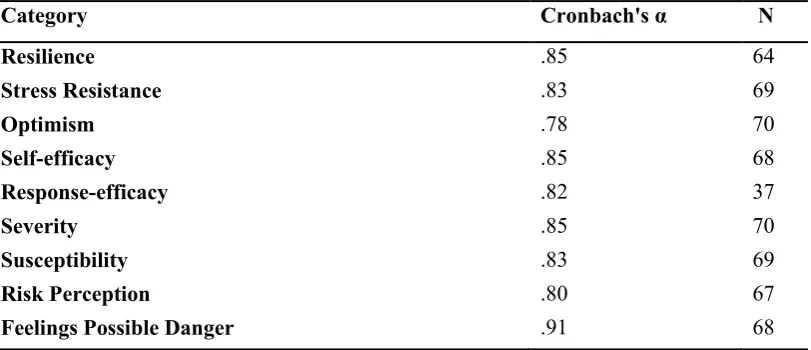
Category Cronbach's α N
Resilience .85 64
Stress Resistance .83 69
Optimism .78 70
Self-efficacy .85 68
Response-efficacy .82 37
Severity .85 70
Susceptibility .83 69
Risk Perception .80 67
[image:14.595.76.482.420.595.2]Feelings Possible Danger .91 68
Table 1. Cronbach’s Alpha of each Category.
In order to examine the reliability of the questionnaire, the Cronbach’s Alpha is measured. The scores of the Cronbach’s Alpha of the scales in this study are similar to the scores of the original scales. Although some alpha’s slightly deviate from the original scale, all scores indicate that the Cronbach’s alpha of each category is above the .70 and therefore, it meets the criteria that are generally used. The only category that did not meet this at first was the ‘Optimism’ category. However, after deleting one item, the reliability was good and could be included in the analysis.
15
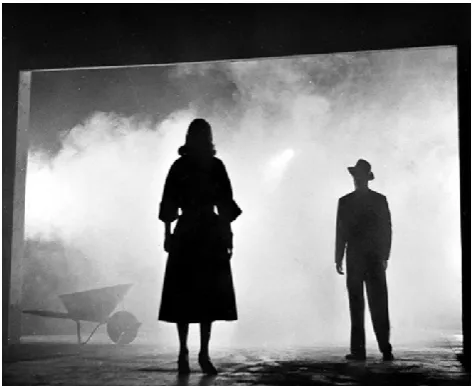
[image:15.595.70.308.186.379.2]item: ‘To what extent do you rate the situation in the picture positively or negatively?’, based on a likert scale ranging from 1-5, 1 = very negative, 5 = very positive. After that, the answers were assessed by three researchers in order to increase the quality of this variable. The scores of all three assessors were included and allocated to each other to one score, called ‘Rating Ambiguous Photo’. Because the control group received this question before the training and the experimental condition after the training, it can be assessed whether the training affects the view of the participants of an ambiguous situation.
Figure 1. Ambiguous photo.
In order to measure the effects of the FIRST training regarding the level of resilience, the participants in the control condition received the complete questionnaire before the training and the participants in the experimental condition received prior to the training a questionnaire with only the questions about the trait variables and afterwards all other questions. Besides, the questionnaire has been developed in both Dutch and English, because in advance it was not clear whether people from a foreign
background would participate. The complete questionnaires can be found in Appendix E (control group) and Appendix F (experimental group).
3.3 Procedure
For a period of 45 days before the start of the study, respondents have been recruited by sending a flyer to participate in the FIRST training (Appendix A). People are informed of what the training entails, what requirements they had to meet to participate, the dates of the training to which they could give their preference, and the email address to which they could send their registration and remaining questions. After signing up, respondents received a confirmation email containing more information about the purpose of the study and confidentiality terms (Appendix B). Two weeks before the first training day, respondents who had already signed up received an email with final information (Appendix C). Because three studies are conducted during one training session, a schedule is made when which part was performed (Appendix D).
16
increase the number of participants, the training was held on two different days. For this study the procedure of completing the questionnaires and following the experiment has been carried out in exact the same way on both days.
At 8.45 pm the respondents arrived at the fitness center Reebok Crossfit in Amsterdam. The walk in took place until 9.00 am. After that, the participants were welcomed and they were offered coffee or tea. Then they got an explanation about the training day and they were asked to fill in the informed consent paper (Appendix I). After this the participants were divided into the control group and the experimental group, by giving them an even or odd number. Both groups were asked to fill in a questionnaire that lasted about ten minutes. After completing these, around 10.00 am, the training day was explained to the participants by one of the trainers. During this introduction, eleven participants were randomly chosen for the ambush situation, part of the observational study (Willemsen, 2018). After that, the theoretical part of the FIRST training began, that lasted about an hour. During this section, the basics of the FIRST training were explained, such as theory about the primary responses of human beings (for example: the flinch response) and tactical coping strategies. After that, the discussed theory has been put into practice in which they learned to convert the primary responses into effective action to protect themselves in threatening situations. For example, when they are attacked, protect the face with the arms in front of their face (elbows bend) and to push the danger away. When the practical part was ended, the participants of the experimental group have been asked to fill in a questionnaire again, that lasted about ten minutes. By the end of the day, a debriefing took place and the participants were thanked for their participation in the training. In addition, they were given the opportunity to ask questions. Lastly, people who have volunteered by mail for a short interview, are asked by the trainers to complete this with the researchers in a closed room to take into account their privacy. These interviews took about half an hour per participant. Afterwards they received a small gift as compensation.
3.4 Data analysis
For this study, the data of the paper questionnaires have been manually entered in the statistical computer program IBM SPSS Statistics, version 24. After this, the following statistical analyses were performed. First, correlations have been calculated to see to what extent the different variables are interrelated and to check for assumptions. Next, a reliability analysis has been performed. The averages of all scales are used to check for the internal consistency by calculating the Cronbach’s Alpha. After all categories showed sufficient scores to be included in the subsequent analyses, a multivariate analysis of variance is performed to compare multivariate sample means. This was followed by significance tests involving individual dependent variables separately. Finally, a
17
4.
Results
In this chapter, the results of the effects of the FIRST training are presented. In total 70 people have participated in the FIRST training and have completed a questionnaire focusing on their degree of resilience. Which questionnaire they received depended on the condition they were in.
4.1 Correlations
The correlation between different variables has been examined. It revealed a number of significant correlations, both positive and negative.
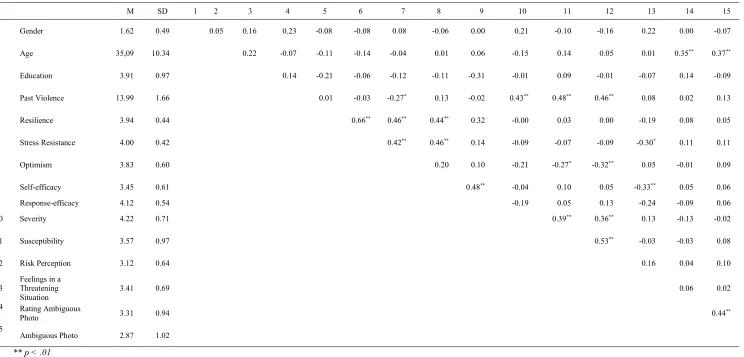
To begin with, two strong positive correlations have been found. The strongest positive correlation exists between ‘Resilience’ and ‘Stress Resistance’ (r = 0.66). For this reason, people who score higher on resilience seem to be more stress-resistant. As was to be expected, this strong positive correlation also applies to ‘Risk-perception’ and ‘Susceptibility’ (r = 0.53). Participants who see themselves as more susceptible to a threatening situation, estimate the risk of such a situation higher. Other positive correlations were found between ‘Optimism’ on the one hand and ‘Resilience’ (r = 0.46), ‘Stress Resistance’ (r = 0.42) and ‘Past Violence’ (r = 0.27) on the other. As follows, the more optimistic people are, the more resilient and stress-resistant they are and the less different situations of violence they have experienced in their life. Besides, between ‘Self-efficacy’ on the one hand and ‘Resilience’ (r = 0.44), ‘Stress Resistance’ (r = 0.47) and ‘Response-efficacy’ (r = 0.48) on the other also a positive correlation is found. This suggests that participants who have a higher belief in one’s ability to succeed in a threatening situation, are more resilient, stress-resistant and see the
recommended behaviour of the FIRST training as more effective in preventing possible harm. Also between ‘Severity’ on the one hand and ‘Susceptibility’ (r = 0.39) and ‘Risk Perception’ (r = 0.36) on the other a positive correlation exists. Participants who score higher on severity, see themselves as more susceptible and have a higher risk perception. A striking correlation has been found between ‘Age’ in relation to ‘Rating Ambiguous Photo (r = 0.35) and ‘Ambiguous Photo’ (r = 0.37). The higher the age, the more positive participants described the ambiguous photo situation. Furthermore, correlations were found between ‘Past Violence’ on the one hand and ‘Severity’ (r = 0.43),
‘Susceptibility’ (r = 0.48) and ‘Risk Perception’ (r = 0.46) on the other. This suggests that the more people have experienced different forms of violence in the past, the higher they estimate a threatening situation as severe, the higher they think they are susceptible to a threatening situation and the higher their risk perception is.
18 Table 2. Pearson Correlation.
M SD 1 2 3 4 5 6 7 8 9 10 11 12 13 14 15
1 Gender 1.62 0.49 0.05 0.16 0.23 -0.08 -0.08 0.08 -0.06 0.00 0.21 -0.10 -0.16 0.22 0.00 -0.07
2 Age 35,09 10.34 0.22 -0.07 -0.11 -0.14 -0.04 0.01 0.06 -0.15 0.14 0.05 0.01 0.35** 0.37**
3 Education 3.91 0.97 0.14 -0.21 -0.06 -0.12 -0.11 -0.31 -0.01 0.09 -0.01 -0.07 0.14 -0.09
4 Past Violence 13.99 1.66 0.01 -0.03 -0.27* 0.13 -0.02 0.43** 0.48** 0.46** 0.08 0.02 0.13
5 Resilience 3.94 0.44 0.66** 0.46** 0.44** 0.32 -0.00 0.03 0.00 -0.19 0.08 0.05
6 Stress Resistance 4.00 0.42 0.42** 0.46** 0.14 -0.09 -0.07 -0.09 -0.30* 0.11 0.11
7 Optimism 3.83 0.60 0.20 0.10 -0.21 -0.27* -0.32** 0.05 -0.01 0.09
8 Self-efficacy 3.45 0.61 0.48** -0.04 0.10 0.05 -0.33** 0.05 0.06
9 Response-efficacy 4.12 0.54 -0.19 0.05 0.13 -0.24 -0.09 0.06
10 Severity 4.22 0.71 0.39** 0.36** 0.13 -0.13 -0.02
11 Susceptibility 3.57 0.97 0.53** -0.03 -0.03 0.08
12 Risk Perception 3.12 0.64 0.16 0.04 0.10
13
Feelings in a Threatening
Situation 3.41 0.69 0.06 0.02
14 Rating Ambiguous
Photo 3.31 0.94 0.44**
15
Ambiguous Photo 2.87 1.02
19
4.2 Effect of the FIRST training on the dependent variables
A multivariate ANOVA is performed with Training Participation as independent variable, Resilience and Stress Resistance as covariates and Optimism, Self-efficacy, Response-efficacy, Severity, Susceptibility, Risk Perception, Feelings in a Threatening Situation, Rating Ambiguous Photo and Ambiguous Photo as dependent variables. This analysis led to the following results.
There appeared to be a marginally significant multivariate main effect for Training Participation (
Wilk's
Λ
: 0.77; F (8, 55) = 2.03, p = .06), but not for Resilience (Wilk's
Λ
: 0.84; F (8, 55) = 1.31, p = 0.26) and Stress Resistance (Wilk's
Λ
: 0.86; F (8, 55) = 1.14, p = 0.35).Subsequent univariate analyses of variance revealed a significant effect of Training
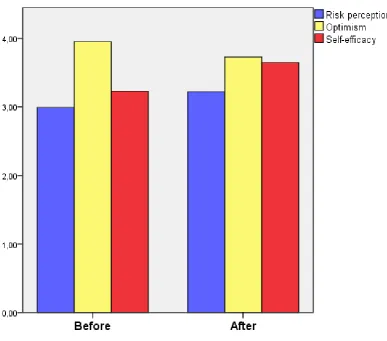
[image:19.595.97.485.351.692.2]Participation on Optimism (F (1, 62) = 7.56, p = .01). The participants were less optimistic after the training (M = 3.69, SD = 0.63) than before the training (M = 3.97, SD = 0.50). Second, a significant effect has been found for Self-efficacy (F (1, 62) = 7.50, p = .01). The participants experience themselves better able to perform the recommended actions after the training (M = 3.63, SD = 0.53) than before (M = 3.22, SD = 0.61). Finally, it has been shown that there is a marginally significant effect for Risk Perception (F (1, 62) = 3.50, p = .07). People experience more risk after the training (M = 3.23, SD = 0.57) compared with before the training (M = 2.93, SD = 0.69).
20
4.3 Additional analysis
To investigate whether the effects of Training Participation depend on the extent to which people are stress sensitive and/or resilient of themselves as a person, a regression analysis has been conducted. The effect of Training Participation may depend on how high one scores on these variables. The expectation was that people who score low on Stress Resistance and Resilience, benefit the most from the FIRST training.
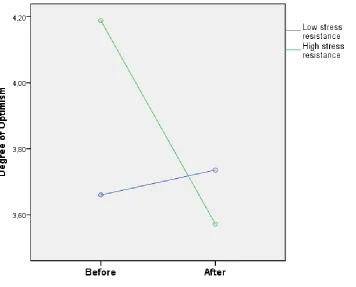
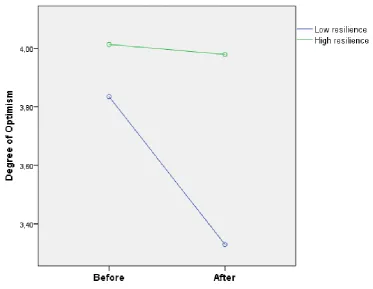
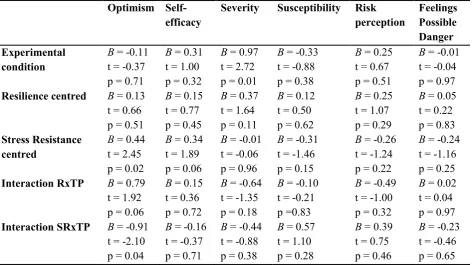
A regression analysis is conducted with Training Participation, Stress Resistance, Resilience and the interaction terms on each of the dependent variables. The results can be found in Appendix G. It appears that only for Optimism the interaction of Resilience and Training Participation (B = 0.79; t (69) = 1.9; p = .06) and the interaction of Stress Resistance and Training Participation (B = -0.91; t (69) = -2.10; p = .04) was marginally significant. To see what this interaction consists of, the dataset is split in two and for the control condition and experimental condition is investigated separately what the effect is of Resilience and Stress Resistance on the dependent variables. This analysis showed a significant relation between Resilience on Optimism after the training (B = 0.67; t = 3.03; p = .005) but not for Stress Resistance (B = -0.13; t = -0.62; p = .54). The reverse applies to the other condition, it showed a significant relation between Stress Resistance on Optimism before the training (B = 0.50; t
[image:20.595.83.440.421.708.2]= 2.82; p = .008) but not for Resilience (B = 0.14; t = 0.76; p = .45). As these findings show, the level of Resilience has a significant influence on the level of Optimism after the training. The extent to which participants are stress resistant themselves in advance has hardly any effect on the degree to which they have an optimistic way of thinking after the training. On the other hand, the extent to which participants are resilient of themselves in advance, that appears to have a stronger influence on the optimistic way of thinking of the participants after the training.
21
22
5.
Conclusion and discussion
This study was part of a more extensive research into the effects of the FIRST training on the resilience of civilians of the Netherlands. For this study questionnaires were conducted among 70 participants with the general aim to investigate whether the psychological resilience of ordinary citizens can be increased by following the FIRST training. The corresponding research question was: what are the effects of the FIRST training on the resilience of civilians of the Netherlands? To answer this main question, it was subdivided into the following two sub-questions:
1. To what extent does participation in the FIRST training influence the level of Optimism, Self-efficacy, Response-Self-efficacy, Severity, Susceptibility, Risk Perception, Feelings in a
Threatening Situation and Ambiguous Photo?
2. To what extent are the effects of the FIRST training affected by the trait variables Resilience and Stress Resistance?
Based on the results above, different conclusions can be drawn to answer these questions. As described resilience exists of several sub-components in which it is tested what their effect is on citizens after following this training. First, the findings and possible explanations will be discussed, followed by the strengths and limitations of this study. Furthermore, potential side effects of the FIRST training will be described and finally, it ends with recommendations for future research.
5.1 Findings and possible explanations
It appeared that the effect of the FIRST training on the resilience of the participants was confirmed with a marginally significant main effect. After analysing this further, the FIRST training appeared to have a significant effect on three variables.
To begin with, the levels of optimism in life of the participants are affected by following the FIRST training. Participating in the FIRST training makes people less optimistic. It turned out that participants have a less optimistic view after they had followed the training, compared to before the training. As a matter of fact, this result is interesting given the positive correlation found between the resilience of people and their level of optimism. This correlation suggests that a higher resilience leads to a higher level of optimism in life. Since the additional analysis showed that the extent to which participants are resilient of themselves in advance has a strong influence on the level of optimism of the participants after the training, then the reverse can be expected. As follows, it seems that the lower people are resilient from themselves when they start the FIRST training, the less optimistic view they have after the training. An explanation for this could be that people who are not very resilient of themselves are most likely to notice the effects from the FIRST training. Perhaps this training has more impact on them and they have become more aware of risks in their environment, making their view less optimistic. As described before, to the concept optimism belongs: ‘identifying what is controllable, remaining wedded to reality, and challenging counterproductive beliefs’ (Reivich, Seligman and McBride, 2011, p. 27). The FIRST training teaches the participants to be aware to prevent danger or respond faster and more effective to a threatening situation, therefore an explanation for this result may be that people have become aware both of the risks around them, the things they can control, their environment as a reality and the corresponding challenges. This awareness could make them less optimistic. This is in line with the correlation found between the level of optimism and the way participants feel susceptible for a threatening situation. The less optimistic, the more they think they are susceptible for a threatening situation.
23
communication, March 13, 2017). If people are not aware of this, they can be surprised by an attack and therefore are not able to respond effectively according the skills learned during the FIRST training. As a result, this can be seen as an intended effect in promoting resilience by following the training.
The reduced level of optimism is in line with the next significant effect found in this study. It has been found that the risk perception of participants is higher after they have followed the FIRST training. To be more precise, it can be stated that they are more aware of potentially threatening situations after the training than before. This corresponds to the A-SAP model of the training (E. van Beek, personal communication, March 13, 2017), in which ‘Awareness’ is a key element and comprises the perception of a human to a sudden attack. Therefore, this can also be seen as a desired effect of the training.
Moreover, this study has shown that the self-efficacy of the participants is significantly improved. The participants consider themselves better able to deal with a threatening situation after following the FIRST training than before. This corresponds to the ‘skill’ part of the A-SAP model, which means the learned capacity or talent to carry out pre-determined results. Support for this idea comes from a study of Meichembaum (2007) who, as previously described, showed that under adverse circumstances, people are more resilient than they initially think. More awareness of people’s own ability may help people to prevent from and recover during and after a threatening situation. Therefore, an explanation for this could be that people have become more aware of their own capabilities to perform the right skills to deal with a threatening situation.
In addition, an interesting finding is the correlation between the age of the respondents and the way they rate the ambiguous photo situation. It suggests that the older people are, the more positive they judge an ambiguous situation. An explanation for this could be the photo itself. The picture looks like an old-fashioned photo, with two persons wearing clothes similar to former times. It could be that this evokes more recognition among older people and perhaps nostalgia, which makes them more likely to rate the picture more positively than the younger participants.
Furthermore, this study did not detect any evidence that the FIRST training had an effect on the extent to which the participants believe in the message of the training, the extent to which they perceive threatening situation as severe, the degree of susceptibility to being involved in a threatening situation, the way people feel when they think of a threatening situation and the way participants rate an ambiguous situation on a photo. Therefore, it can be stated that these variables did not play an important role in this research. The fact that these scales did not show any significant effects, could have multiple reasons. The scales did show a good reliability, some even excellent. Therefore, the internal consistency of the items could not be the reason for the non-significant results. On the other hand, it may have to do with the validity of the scales. Perhaps the scales do not measure the resilience of the participants as intended. However, the correlation table shows many plausible relationships between the variables, such as the extent to which participants are resilient of themselves and the extent to which a person has the belief about his own capabilities to produce effects (r = 0.44) or the amount of different forms of violence participants have experienced and their risk perception (r = 0.46). For this reason, a deteriorated validity is probably not the reason for the non-significant results. The validity of the scales could be verified by repeating this study with a larger sample size.
24
situation. Therefore, it can be concluded that the resilience of people can be improved by following the FIRST training.
5.2 Strenghts and limitations
The findings of the current study should be interpreted while accounting for the study strengths and limitations.
To begin with, the intention was to get a randomly drawn sample. However, afterwards it seems to be a sample obtained through a snowball effect because most of the participants have been recruited via the network of the initiator. Therefore, the sample appears to be only partially a reflection of the study population. It does show diversity with reference to age and education level. Both young and old people participated in the study. In terms of education level, most people have completed secondary vocational education as highest level and there are a number of outliers to a lower and higher level of education. This corresponds to the population, in which secondary vocational education is the average in the Netherlands. However, certain aspects of the sample give a distorted reflection of reality. First, more women than men participated in the study. Second, and as mentioned before, many of the participants are members of CrossFit. According to Machida, Irwin and Feltz (2013), sports provide special opportunities and experiences that facilitate the resilience process, such as learning new skills. As a result, they may have been already more resilient due to sports. Moreover, the participants who are CrossFit members already knew the trainers. This may have led them to give socially desirable answers in favour of the effectiveness of the training. Additionally, perhaps they had already heard about the content of the training and therefore, they could have been biased. As a consequence, these aspects of the sample may not give a clear representation of the Dutch civilians. In addition, the number of participants, which was 70, could also be of influence on the results of the study. Because of the sample size, it is doubtful whether the results are representative for the current population. However, within the practical limits, the number of participants in this study was the most feasible.
Second, a few remarks must be made regarding the measurement instruments of the study. First, in many items of the questionnaire participants had to take a threatening situation into their mind. It might be hard to imagine how one would respond in a certain situation, so the items may not measure what they should measure. Second, regarding the use of the scale Optimism. The extent to which the items of this scale are trait or state variables are is doubtful. The items used in this scale seem to be trait variables, but it does show an effect of training participation. For this reason, it is not that stable. Therefore, the decision to include this scale as a state variable is acceptable.
Next, some variables showed a positive effect and some showed a negative effect. It could be that the positive effect is a result of social desirability. The social desirability of the answers could be verified by repeating this study with a larger sample size.
Moreover, an important note should be made concerning the moment at which the last questionnaire was taken. The experimental group received this second part of the questionnaire after the training. At that moment the training had just ended and as a result, it could be that the participants were still be in a certain, probably positive, vibe. If this measurement moment had taken place, for example, a day or a week thereafter, then the results could have been different.
Another limitation of the study relates to the training itself. The entire FIRST training consists of several weeks in which people are taught in violence control. During the current study, the
25
5.4 Potential side effects
Concerning the results of this study, the suggestion is that the FIRST training can make an individual more resilient. However, an interesting question is whether it also affects resilience at the social- or societal level. Research has shown that when people experience more stress, this may have an effect on their resilience, either psychological or physical (Loue & Sajatovic, 2009). When the FIRST training would be spread around the country, more people become resilient, which means that the stress level among the population presumably decreases. This can be beneficial, because many people in the Netherlands perceive living in this society as fast and experience a lot of pressure to perform, for example concerning work (Sonneveld & Wiezer, 2016). Therefore, spreading the FIRST training could have a positive effect on public health in the Netherlands. If people become more resilient, it can result in the costs falling, which means the government can invest more in other important areas. An improved public health ensures people to pay less premium that probably again ensures experiencing less stress.
In addition, the FIRST training could also have effects on the immediate environment of people. When the FIRST training becomes more widely known among the population, it may even be that people start to make each other aware of possible threatening situations and teach each other skills from the training. Research has shown that a factor that contributes to an increased level of resilience is supportive peers (Olsson et al., 2003). In this way, the FIRST training could increase resilience on the social level. Besides, this effect could be even stronger if this training is integrated into people’s life from an early age. As previously described the upbringing of people influences their resilience. A study of Masten (2001) indicated that resilient people had better parenting resources and the cognitive test scores were higher when they became older. They had also a more positive self-esteem and a higher consciousness compared to people who were not resilient. A good upbringing has a major influence on becoming a resilient person. Perhaps the FIRST training can contribute to this process when the training is included as part of the primary- and secondary school. In this way, the skills of the FIRST training are learned early and regularly repeated, thus benefiting the rest of their life.
Furthermore, if more people have knowledge and skills from the FIRST training, it could also make the society more resilient. When there is heightened awareness among the population, this may lead to fewer conflict situations/aggression. When more people are able to deal with violence, including noticing suspicious situations on the street and anticipating on it or even preventing a terrorist attack, this could lead to society being more resistant to violence. This is in line with a study of Bakker (2012), who showed that a resilient society is not only able to recover easier from extreme events such as a terrorist attack, but also if a terrorist attack occurs in a resilient society, it will have a less serious effect. In this way, the training may have a direct or indirect effect on the resilience of family, peer network or community. However, follow-up research should be done to gain more insight into factors contributing to higher feelings of resilience.
5.3 Recommendations for future research
Taking into account both the results and the limitations of this study, some suggestions for future research can be formulated.
To begin with, it might be interesting to repeat this study with a larger sample size which is randomly drawn, in order to check whether the results hold. As a consequence, there will be more diversity among the participants so that the effects of the FIRST training regarding resilience can be generalized to the research population.
26
effects are of the training on resilience. According to Zimbardo (2013), through rehearsal information is stored more strongly in the brain and consequently, the memory will be trained. If the memory is improved, it is easier to retrieve memories. Rehearsal of information can even lead to recall a memory in a fraction of a second. Therefore, it is interesting what the effects of the training are when people are trained more often because through repetition they might better master the skills and apply them in the right way when necessary.
Additionally, in this study resilience is measured by the use of different scales. These are based on scales of other studies. It could be that different researchers use different names for the concept ‘resilience’ and as a consequence, perhaps the scales measure the same. However, concerning the correlations found, these are not such high to conclude that the scales measure the same concept of resilience. Therefore, this justifies the fact that in this study several scales are included to measure resilience. Nonetheless, it raises the question why these concepts of resilience are different. As mentioned before, the concept ‘resilience’ can be explained in different ways. It can be seen as being prepared for-, experiencing little damage- or bouncing back to balance when confronted with
adversity. Accordingly, an explanation could be that ‘resilience’ consists of several sub-dimensions. It may be interesting to do follow-up research on this and could lead to a further elaboration of the conceptual model of resilience.
Furthermore, for future research into the FIRST training, it could be of added value when the staged threatening situations during the training would be realistically imitated. In this way, it might be easier for the participant to imagine a threatening situation and to experience what it does to him or her. A way to do this is, for example, by using virtual reality glasses, showing video recordings or creating – ethically responsible – simulated threatening situations with actors.
Next, it may be interesting to investigate what the effects of the FIRST training are on
different cultures. Research has shown that both the perception of- and responses to risk differs within different cultures (Renn & Rohrmann, 2000). Therefore, the effects of the training may be different depending on the type of culture. It could be that the content of the training should be adapted to the specific culture in order to achieve the highest possible effect in increasing resilience.
27
References
Alvord, M. K., & Grados, J. J. (2005). Enhancing resilience in children: A proactive approach.
Professional Psychology: Research and Practice, 36(3), 238–245. Doi: 10. 1037/0735 7028.36.3.238.
Bakker, E. (2012). Naar meer weerbaarheid en veerkracht in contraterrorismebeleid. Retrieved from https://drive.google.com/drive/folders/0B_3yB9UVCaluWGY3LXhmeWFucnM
Bandura, A. (1994). Self-efficacy. Encyclopedia of human behaviour, 4, 71-81.
Benzies, K., & Mychasiuk, R. (2009). Fostering family resiliency: A review of the key protective factors. Child & Family Social Work, 14, 103–114. Doi: 10.1111/j.1365-2206.2008.00586.x Berlo, van, M. (2014). Critical Infrastructure Resilience: de community centraal. Magazine nationale
veiligheid en crisisbeheersing, 5, 42-43.
Bonanno, G. A. (2004). Loss, Trauna, and Human Resilience. American Psychologist, 59(1), 20-28. Doi: 10.1037/0003-066X.59.1.20
Bowes, L., Maughan, B., Caspi, A., Moffitt, T. E. & Arseneault, L. (2010). Families promote
emotional and behavioural resilience to bullying: evidence of an environmental effect. Journal of Child Psychology and Psychiatry, 51(7), 809-817. Doi: 10.1111/j.1469-7610.2010.02216.x Campbell-Sills, L., & Stein, M. B. (2007). Psychometric Analysis and Refinement of the Connor
Davidson Resilience Scale (CD-RISC): Validation of a 10-Item Measure of Resilience.
Journal of Traumatic Stress, 20(6), 1019-1028.
CBS. (2017). Ervaren terroristische dreiging in Nederland. Den Haag: Centraal Bureau voor de Statistiek.
CBS. (2017). Ondervonden delicten; persoonskenmerken. Den Haag: Centraal Bureau voor de Statistiek.
CBS. (2017). (On)veiligheidsbeleving; regio. Den Haag: Centraal Bureau voor de Statistiek
CBS. (2017). 4 op de 10 Nederlanders achten kans op aanslag groot. Den Haag: Centraal Bureau voor de Statistiek.
Cicchetti, D. & Cohen, D. J. (2006). Developmental psychopathology: Risk, disorder, and adaptation.
Hoboken, NJ, US: John Wiley & Sons Inc.
Cohen, S. (1994). Perceived Stress Scale. Journal of Health and Social Behavior, 24, 386-396. Creed, P. A., Patton, W. & Bartrum, D. (2002). Multidimensional Properties of the LOT-R: Effects of
Optimism and Pessimism on Career and Well-Being Related Variables in Adolescents.
Journal of career assessment, 10(1), 42-61.
Dyer, J.G., & McGuinness, T.M. (1996). Resilience: Analysis of the concept. Archives of Psychiatric Nursing, 10, 276–282
Earvolino-Ramirez, M. (2007). Resilience: A concept analysis. Nursing forum, 3(2), 73-82. Doi:10.1111/j.1744-6198.2007.00070.x
Eshel, Y., Kimhi, S., Lahad, M. & Leykin, D. (2017). Individual attributes as predictors of protective and risk components of resilience under continuing terror attacks: a longitudinal study.
Elsevier, 114(3), 160-166. Doi: 10.1016/j.paid.2017.03.033
Fraser, M. W. (1997). Risk and resilience in childhood: An ecological perspective. Washington, DC: National Association of Social Workers Press.
Fredrickson, B.L, Tugade, M.M., Waugh, E.C., & Larkin, G.R. (2003). What Good Are Positive Emotions in Crises? A Prospective Study of Resilience and Emotions Following the Terrorist Attacks on the United States on September 11th, 2001. Journal of personality and social psychology, 84(2), 365-376.